What 2nd Grade Word Problems Require
Second-grade word-problem work connects reading, quantity relationships, addition, subtraction, and explanation. A learner should gradually become able to:
- Read or listen to a short mathematical story.
- Retell what is happening.
- identify the known and unknown quantities.
- Represent their relationship with objects, a drawing, a bar model, or a number line.
- Choose and complete a calculation.
- answer in context and check whether the result is reasonable.
The concise answer is this: teach the learner to understand the situation before choosing an operation. Begin with one-step addition and subtraction stories within the learner’s secure number range. Vary the location of the unknown, introduce comparison problems, and then move toward two-step problems within 100. Let the learner’s observed work—not a fixed calendar—determine the pace.
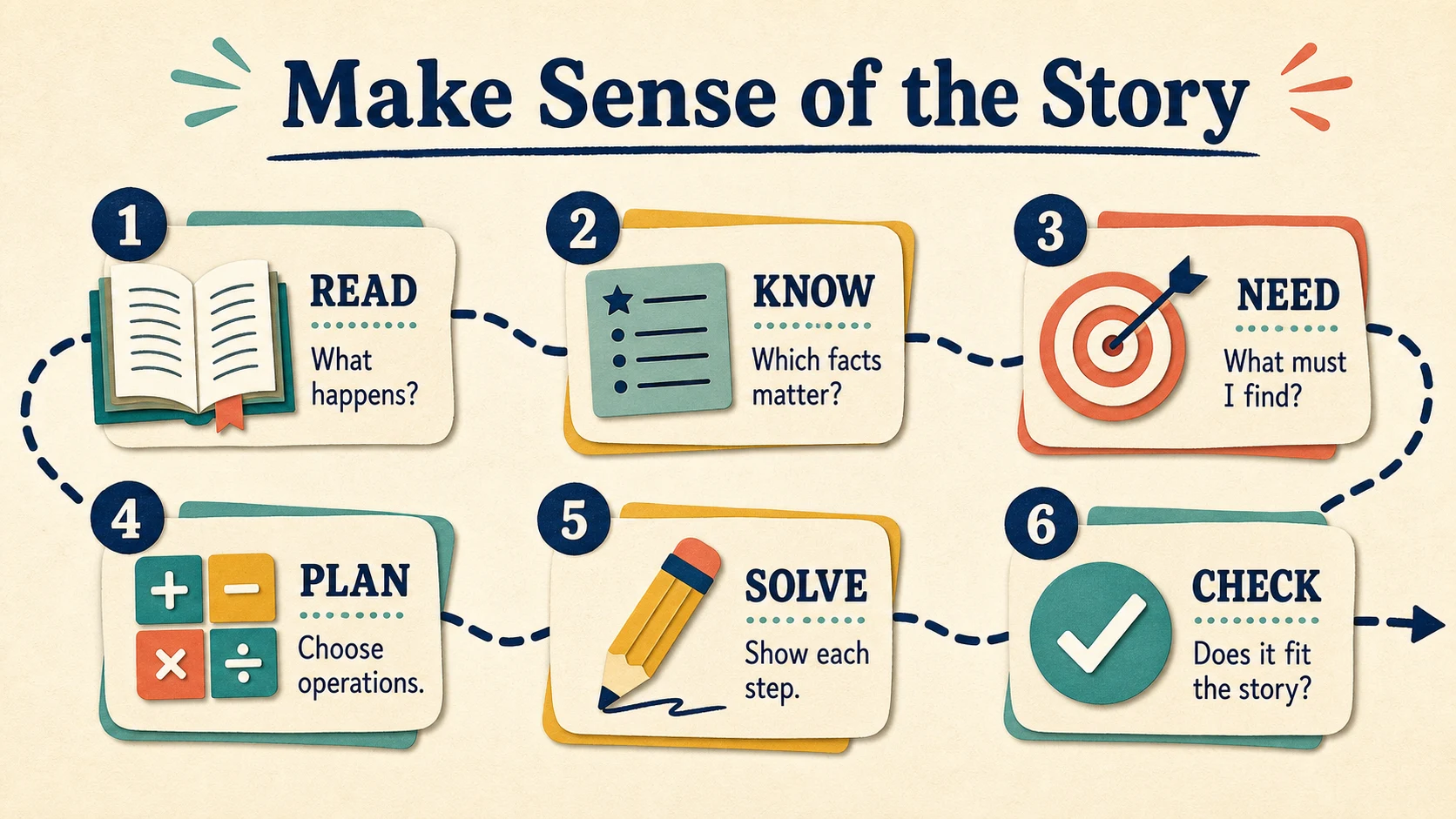
Word-problem success depends on connected reading, modeling, calculation, and checking skills.
Grade labels describe an intended practice level, not a guarantee that every learner has followed the same sequence. Local curricula and instructional sequences differ. The Common Core materials place one- and two-step addition and subtraction problems within 100 in Grade 2, but families and educators should compare that scope with their own curriculum. The broader Common Core mathematics framework also emphasizes both mathematical understanding and procedural skill rather than correct answers alone.
WorksheetWise organizes related resources through the 2nd Grade hub, the 2nd Grade Math collection, and the dedicated Word Problems topic guide.
Prerequisites to Check Before Increasing Difficulty
A learner does not need perfect computation before beginning story problems. However, several foundations make the work manageable.
Understanding quantities and relationships
Check whether the learner can distinguish a quantity from its label. In “27 red beads,” the number is 27 and the unit is beads. Ask:
- “What are we counting?”
- “Which number tells how many?”
- “Are both numbers describing the same kind of thing?”
A learner also needs practical meanings for addition and subtraction. Addition may join parts or describe an increase. Subtraction may describe taking away, finding a missing part, or comparing two quantities. Those meanings are more reliable than isolated keywords.
Reading and retelling
A learner should be able to retell a short problem without calculating immediately. Reading difficulty can conceal mathematical understanding, so it is reasonable to read a problem aloud when the instructional goal is mathematical reasoning.
After reading, ask the learner to explain:
- what happened first;
- what changed, if anything;
- what must be found;
- which information matters.
Do not require the learner to repeat the original wording. A clear retelling in simpler language is often more informative.
Addition, subtraction, and place value
Second-grade work commonly includes addition and subtraction within 100 using number lines, base-ten blocks, drawings, and mental strategies. Check whether the learner can:
- compose and decompose two-digit numbers into tens and ones;
- add or subtract within a comfortable range;
- explain at least one calculation strategy;
- recognize when an answer is implausibly large or small.
If a learner represents the story correctly but makes a calculation error, preserve the successful reasoning. Correct the computation separately instead of treating the entire response as a failure.
A Grade-Appropriate Teaching Progression
Progress from visible actions toward less supported reasoning. Do not advance simply because a set number of days has passed.
| Stage |
Problem relationship |
Helpful model |
Evidence that the learner is ready to continue |
| 1 |
Join or separate, result unknown |
Objects or quick pictures |
Retells the action and chooses the operation accurately |
| 2 |
Part-part-whole, one part unknown |
Two-part bar model |
Explains why the missing part is found by subtraction |
| 3 |
Change unknown |
Objects, bar model, or number line |
Finds how much was added or removed |
| 4 |
Start unknown |
Bar model with the first quantity blank |
Reasons backward without relying on a keyword |
| 5 |
Comparison: more, fewer, difference |
Aligned comparison bars |
Identifies the larger and smaller quantities correctly |
| 6 |
Mixed one-step problems |
Learner-selected representation |
Chooses a model from the relationships, not surface wording |
| 7 |
Two-step problems within 100 |
Two diagrams or a labeled plan |
Identifies and completes both necessary steps |
| 8 |
Boundary cases |
Model plus written explanation |
Detects extra or missing information and justifies the response |
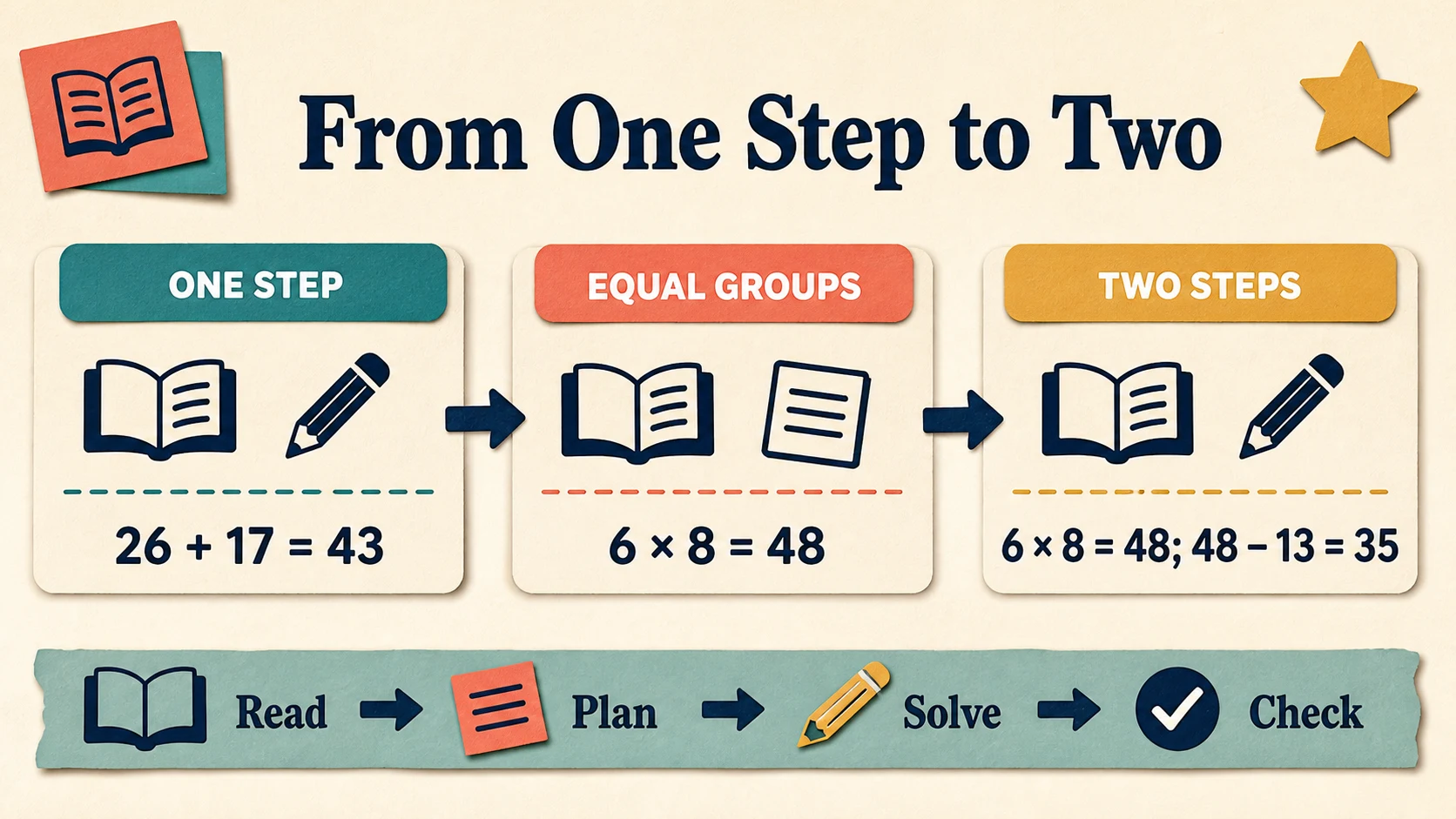
Support should fade only when the learner can explain the relationships independently.
Vary the location of the unknown
Repeated result-unknown problems can create a shallow rule: “Use the numbers in the order shown.” Build flexibility by changing what is missing.
- Result unknown: Maya has 24 cards and gets 13 more. How many does she have now?
- Change unknown: Maya has 24 cards. She gets some more and now has 37. How many did she get?
- Start unknown: Maya had some cards. She got 13 more and now has 37. How many did she have first?
All three stories share the relationship 24+13=37, but they ask for different quantities.
Introduce two-step work carefully
A two-step problem is not merely a longer one-step problem. The learner must determine an intermediate result and then use it.
Before independent practice, ask the learner to state a plan:
- “First I will find…”
- “Then I will find…”
If the learner consistently solves only the first step, return to oral planning and draw two connected diagrams.
Concrete and Visual Models
The IES guide for assisting elementary students who struggle with mathematics recommends deliberate word-problem instruction, clear mathematical language, systematic instruction, and well-chosen concrete or semi-concrete representations. It also identifies number lines as an instructional support. This is high-level guidance; the source did not evaluate WorksheetWise or any worksheet described here.
Objects and acted-out stories
Counters, cubes, coins, or small classroom items can make an action visible.
For “There were 18 cubes. Seven were removed,” the learner can:
- build a set of 18;
- move seven away;
- count or calculate the remainder;
- connect the action to 18−7=11.
Use objects to reveal the relationship, not as decoration. After the learner understands the action, replace individual objects with a drawing or diagram.
Bar models
A bar model represents quantities as lengths. It is especially useful when the story has no visible action.
For a part-part-whole problem:
Total: 63
┌───────────────────────────┐
│      28      │      ?     │
└───────────────────────────┘
The full bar is 63. One part is 28. The unknown is the other part, so 63−28 finds it.
For a comparison:
Lena:  ─────────────────── 52
Omar:  ───────────────     39
                       └─?─┘
The unmatched portion represents how many more Lena has than Omar.
Number lines and base-ten models
A number line highlights movement and distance. To calculate 46+27, a learner might jump from 46 to 66 by adding 20, then to 73 by adding 7.
Base-ten blocks or tens-and-ones drawings make place value visible:
46 = 4 tens + 6 ones
27 = 2 tens + 7 ones
The learner combines tens and ones, regrouping ten ones as one ten when needed. Choose the representation that clarifies the difficulty. Requiring every possible model for every problem can obscure the reasoning.
Fully Checked Worked Examples
Example 1: Join, result unknown
Problem: A class made 26 paper stars on Monday and 18 on Tuesday. How many stars did the class make altogether?
Retell: Two groups of stars are being joined.
Model: One bar has parts 26 and 18.
Equation: 26+18=?
Calculation:
26+18=(20+10)+(6+8)=30+14=44
Answer: The class made 44 paper stars.
Check: Subtract the second part: 44−18=26. The answer is also reasonable because joining 26 and 18 must produce more than 26.
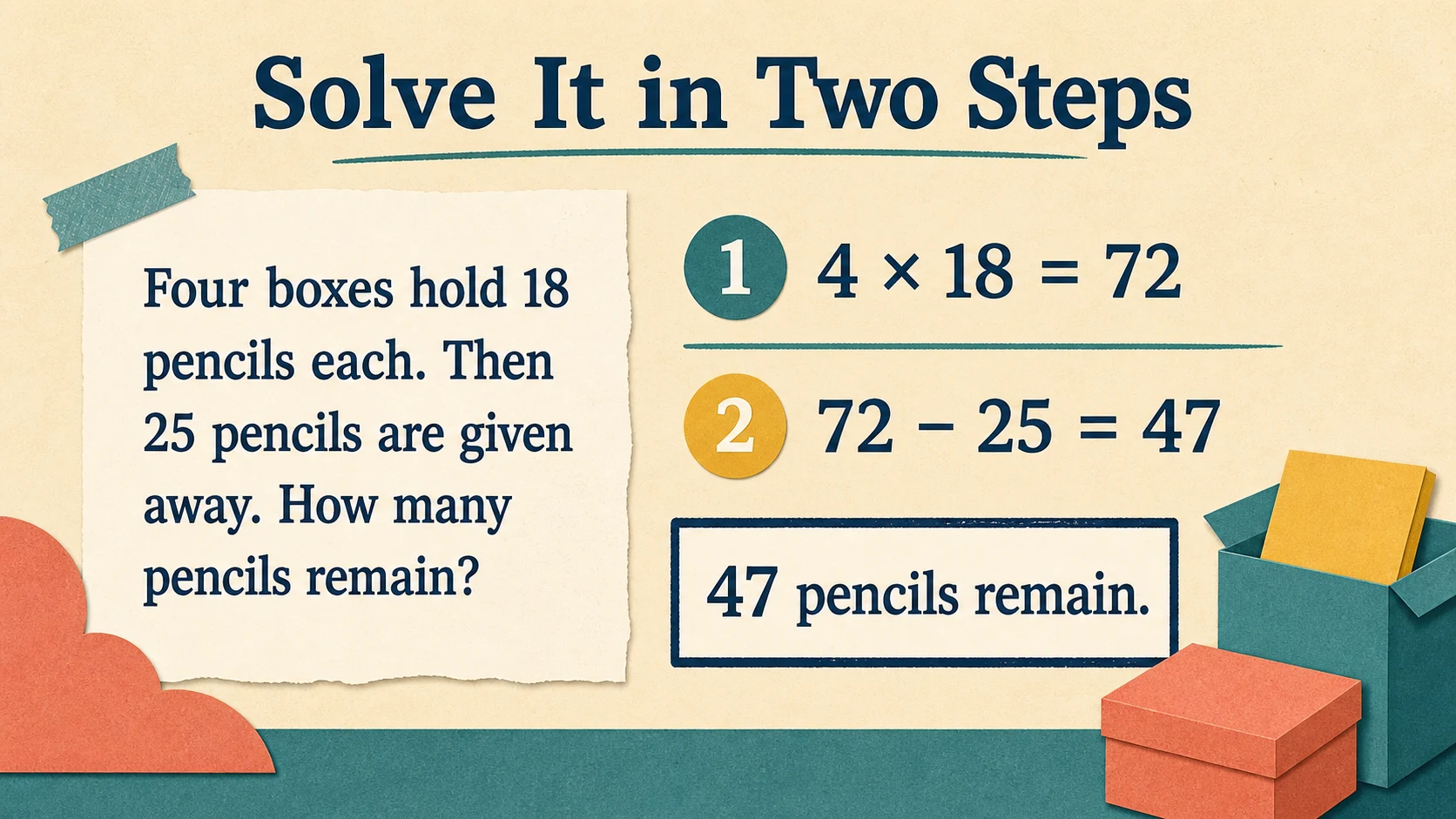
The representation should show why the chosen calculation matches the story.
Example 2: Separate, change unknown
Problem: A shelf held 61 books. After some books were borrowed, 45 remained. How many books were borrowed?
Retell: The shelf started with 61, an unknown number left, and 45 remained.
Relationship: 61−?=45
The missing change can be found with subtraction:
61−45=16
One place-value method is:
61−40=21
21−5=16
Answer: 16 books were borrowed.
Check: Put the borrowed books back: 45+16=61. The original total is restored.
This example shows why “left means subtract” is inadequate. The word “left” can refer to the amount remaining, while the question may ask for the amount removed.
Example 3: Comparison
Problem: Jordan collected 54 buttons. Priya collected 38 buttons. How many more buttons did Jordan collect than Priya?
Retell: The problem asks for the difference between two quantities.
Equation: 54−38=?
Calculate by finding the distance from 38 to 54:
38+2=40
40+14=54
2+14=16
Answer: Jordan collected 16 more buttons than Priya.
Check: 38+16=54. The difference is smaller than 38 and 54, which is sensible for these quantities.
Ask the learner to name who has more before calculating. A correct subtraction performed in the wrong comparison direction may produce confused wording even if the numerical difference is positive.
Example 4: Start unknown
Problem: Some pencils were in a box. The teacher added 27 pencils, and then there were 72. How many pencils were in the box at first?
Relationship: ?+27=72
A bar model shows 72 as the whole, with 27 as one part and the starting quantity as the other.
72−27=45
Using tens and ones:
72−20=52
52−7=45
Answer: There were 45 pencils in the box at first.
Check: 45+27=72.
The word “added” appears, but subtraction finds the unknown. This is a useful test of whether the learner follows the relationship rather than a keyword.
Example 5: Two-step problem
Problem: A reading corner had 34 picture books and 29 information books. Students borrowed 17 books. How many books remained?
Plan: First find the total number of books. Then subtract the borrowed books.
First step:
34+29=63
Second step:
63−17=46
Answer: 46 books remained.
Checks:
46+17=63
and
34+29=63
Both stages agree with the story.
Example 6: Money in context
Problem: Kai has a $20 bill and three $5 bills. How many dollars does Kai have?
The three $5 bills form equal groups:
5+5+5=15
Then combine that amount with $20:
20+15=35
Answer: Kai has $35.
Check: Count by fives—5, 10, 15—then add two tens. The answer is stated in dollars because the quantities were dollars.
This example introduces equal-group reasoning through repeated addition. It does not require formal multiplication notation.
A Short, Repeatable Lesson Routine
A focused session may be brief, but no duration is universal. Continue while the learner is attentive and producing useful evidence.
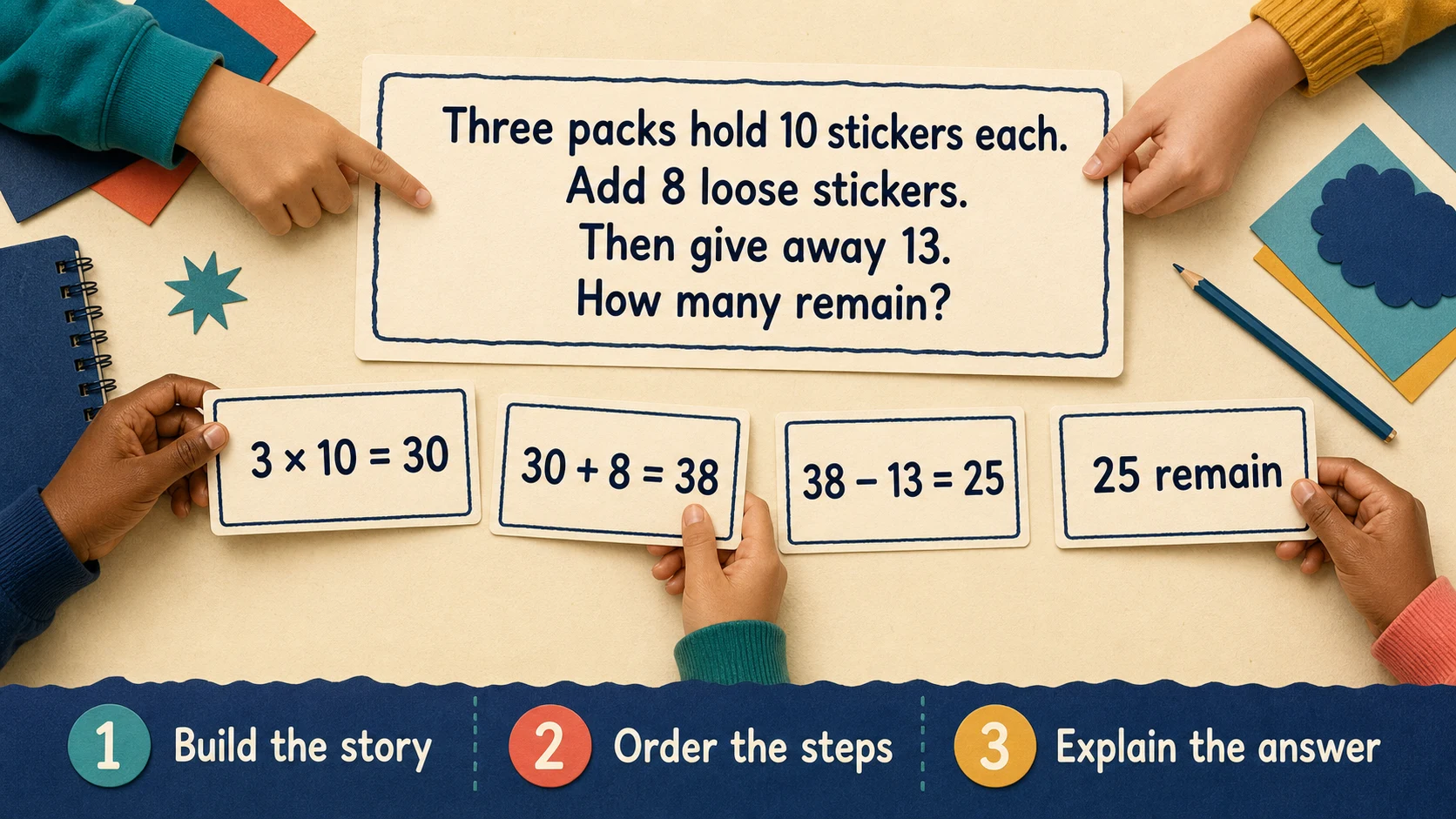
A stable routine reduces procedural uncertainty while leaving the mathematical thinking to the learner.
1. Read and retell
Read the whole problem before touching the numbers. Ask, “What is happening?” If necessary, read it aloud and let the learner retell it.
2. Identify knowns and the unknown
Label quantities with units: 24 cards, 13 cards, unknown cards. Ask what the question requires. Avoid circling every number automatically because some problems contain irrelevant information.
3. Model the relationship
Let the learner use objects, a sketch, a bar model, or a number line. Prompt with “Show how the quantities are connected,” not “Draw a subtraction picture.”
4. Solve and explain
Write an equation after the relationship is understood. The learner may use any accurate grade-appropriate calculation strategy. Ask for a short explanation: “I subtracted because I knew the whole and one part.”
5. Check in context
Have the learner reread the question, attach the correct unit, and check through an inverse operation, estimation, or the model.
The IES early-mathematics guide addresses younger children, so it should not be treated as a Grade 2 prescription. Its high-level emphasis on developmental progression, mathematical descriptions of everyday situations, and progress monitoring remains useful framing for deciding what support to offer next.
Choosing Useful Practice
Choose practice according to the learner’s current error pattern, not the largest available problem set.
Match the set to the instructional goal
Use a narrow set when teaching a new relationship. Four carefully selected comparison problems may provide better evidence than twelve mixed problems.
Use mixed practice after the learner can recognize several relationships separately. Mixed sets test whether the learner can choose an operation without being told which one to use.
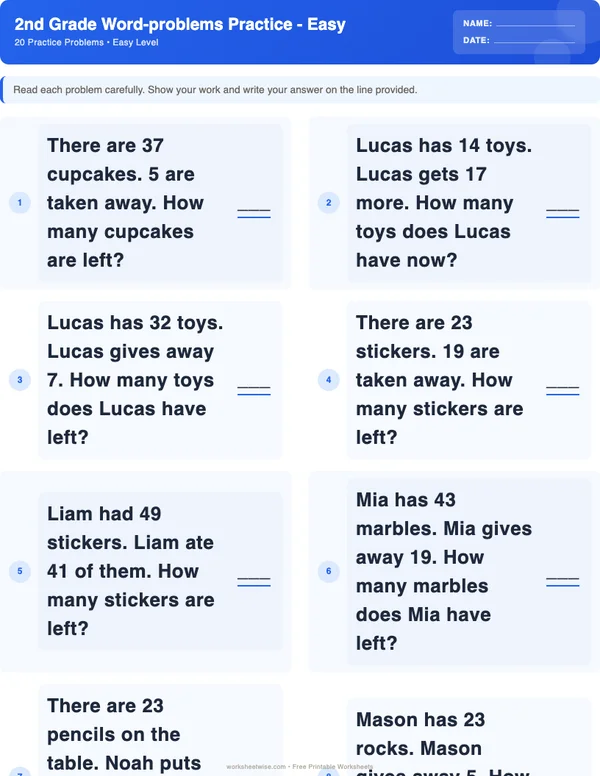
The free easy 2nd Grade Word Problems worksheet contains 12 exercises, an answer key, and space to show work. Its catalogue scope includes problem solving, reading comprehension, mixed operations, and multi-step reasoning. Inspect individual items before assigning them, and select only the amount that fits the learner’s present goal.
The focused word-problems pack contains 18 worksheets and is listed at $4.79. A larger pack is useful only when its range matches the learner’s needs; quantity alone does not make practice appropriate. For fresh variations, the free worksheet generators can support additional practice, but generated material should still be reviewed for language, number range, and intended problem type.
Adjust one demand at a time
To make a problem easier, keep the relationship but:
- reduce the number size;
- read the text aloud;
- replace unfamiliar vocabulary;
- provide objects or a partly drawn model;
- separate a two-step problem into two linked questions.
To increase challenge, keep the arithmetic manageable but:
- move the unknown to a different position;
- mix problem types;
- include one irrelevant detail;
- ask the learner to create or compare two representations;
- require a written explanation;
- introduce a second step.
Changing the reading load, number size, problem structure, and representation simultaneously makes it difficult to diagnose the source of an error.
Common Errors and Diagnostic Responses
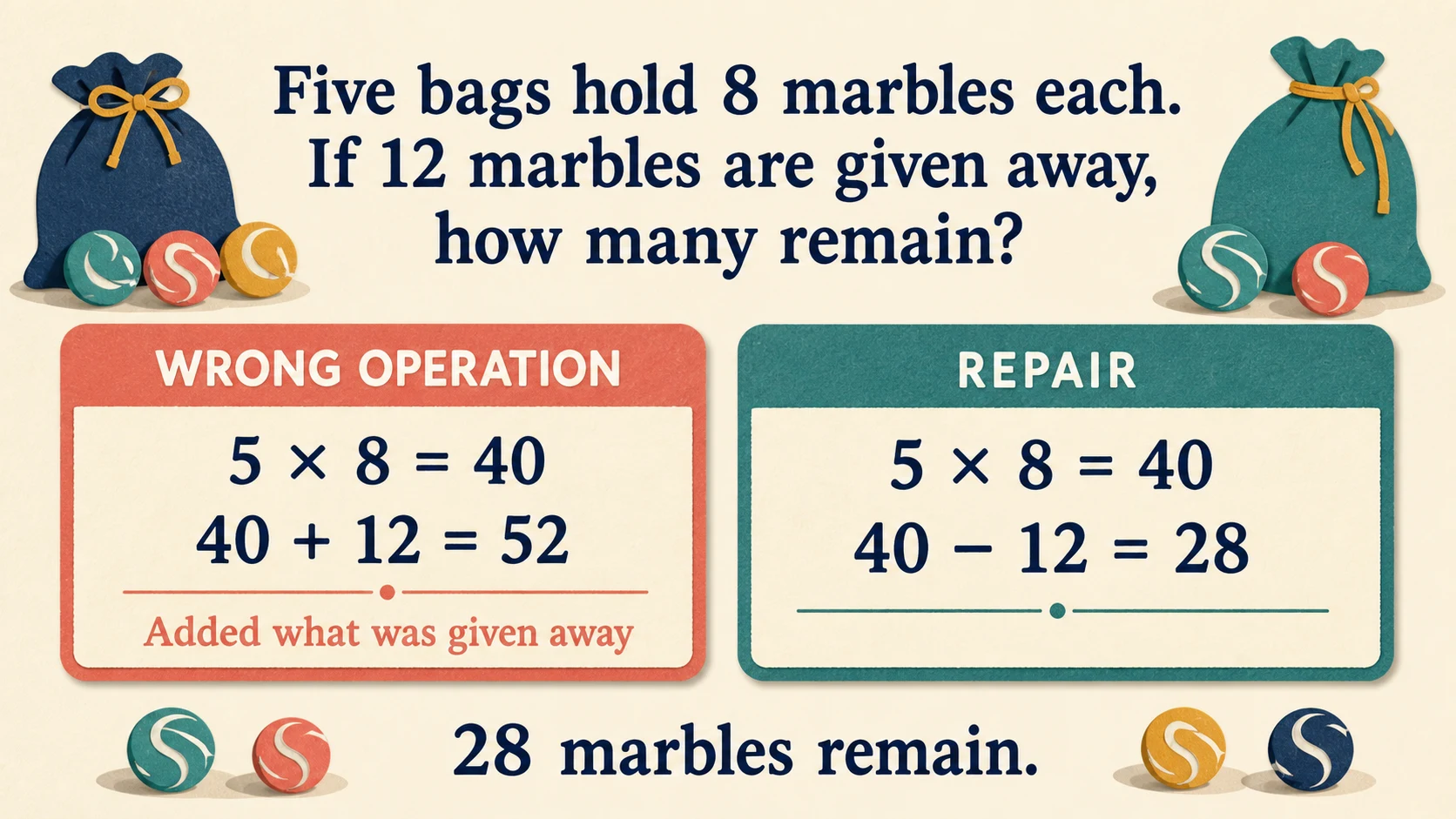
The response should address the cause of the error, not merely replace the answer.
| Observed work |
Likely instructional issue |
Useful response |
| Adds whenever the problem says “more” |
Keyword dependence |
Act out contrasting stories and compare their diagrams |
| Uses both numbers but cannot explain the equation |
Weak connection between story and symbols |
Return to retelling and a bar model |
| Chooses the right operation but calculates incorrectly |
Computation or place-value difficulty |
Preserve the model; practice the calculation separately |
| Solves only the first step |
Incomplete planning |
Require “first…then…” statements before calculation |
| Reverses a comparison |
Unclear larger-versus-smaller relationship |
Align two bars and identify the unmatched amount |
| Gives a bare number |
Weak attention to the question or unit |
Have the learner complete “There are ___ ___” |
| Includes every number |
Assumes all information must be used |
Ask what each number describes and whether it affects the unknown |
| Cannot start without an adult naming the operation |
Support has not faded |
Offer a choice of models instead of a choice of operations |
Do not infer a fixed learner trait from one response. Check the pattern across several similar problems and note whether reading aloud, changing the numbers, or offering a model changes performance.
Boundary Cases Worth Teaching
A strong set includes occasional problems that cannot be solved by grabbing two numbers.
Extra information
Problem: Nora has 18 red beads and 25 blue beads. Her box is green. How many beads does she have?
The color is irrelevant. The answer is:
18+25=43
Nora has 43 beads.
Missing information
Problem: Theo had some stickers and gave away 12. How many stickers remain?
There is not enough information because the starting amount is unknown. The appropriate response is not a guessed operation; it is an explanation that the problem needs the starting number.
Zero change
Problem: There were 36 markers. No markers were removed. How many remain?
36−0=36
The answer remains 36 markers. This checks whether the learner understands the action rather than expecting subtraction always to make a number smaller.
A mathematically possible but contextually wrong answer
If 47 students need one chair each and a learner answers “74 chairs,” the digits may have been reversed. The adult should ask for a model and a context check rather than saying only that the answer is wrong. A plausible answer must satisfy both the arithmetic and the story.
Monitoring Progress Without Overinterpreting Scores
Keep a brief record of independent performance. For each selected problem, note:
- accurate retelling;
- correct identification of the unknown;
- suitable model;
- operation choice;
- calculation accuracy;
- contextual answer;
- level of prompting.
A score such as 8 out of 10 hides important distinctions. One learner may model every problem accurately but make two regrouping errors. Another may calculate accurately after an adult chooses each operation. Those learners need different instruction.
Review patterns after several sessions:
- If modeling is accurate but calculation is not, support computation.
- If computation is secure but operation choice is inconsistent, compare problem structures.
- If oral reasoning is stronger than written work, reduce the writing burden temporarily while continuing mathematical explanations.
- If performance drops only on two-step problems, restore explicit planning.
- If support remains necessary across several carefully taught examples, use smaller numbers, clearer language, and more concrete modeling before adding difficulty.
Progress means more than correct answers. Look for less prompting, clearer explanations, more efficient models, and successful transfer to a differently worded problem.
A Flexible Two-Week Practice Plan
This plan offers a sequence, not a universal timetable. Shorten, repeat, or pause a stage according to the learner’s work.
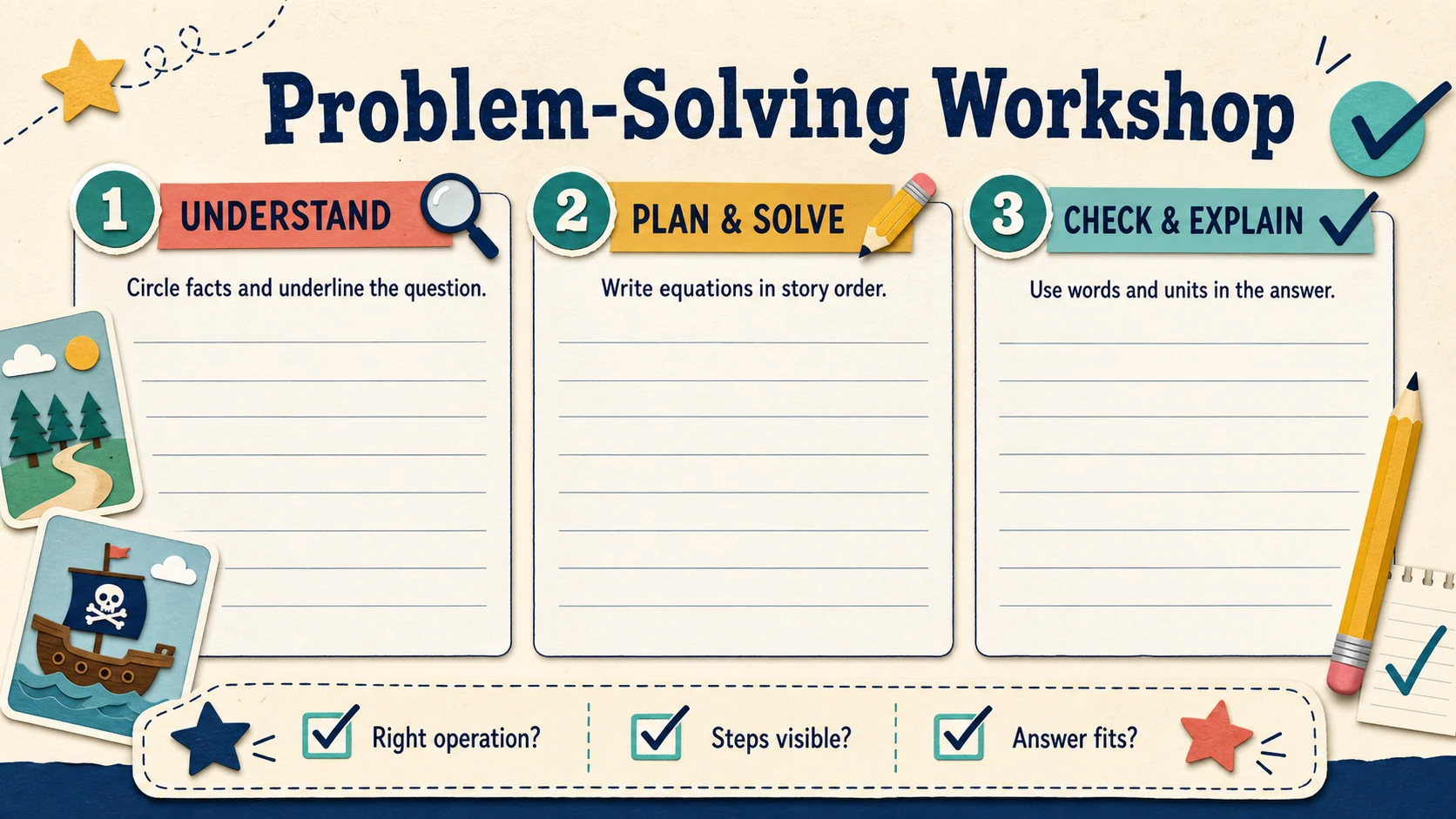
Each day should provide evidence for the next instructional choice.
| Day |
Focus |
Suggested evidence to collect |
| 1 |
One-step join and separate stories with objects |
Can the learner retell the action? |
| 2 |
Result-unknown problems with drawings |
Does the model match the story? |
| 3 |
Missing-part problems with bar models |
Can the learner distinguish a part from the whole? |
| 4 |
Change-unknown problems |
Can the learner explain the unknown change? |
| 5 |
Mixed review and one independent exit problem |
Which relationships still require prompts? |
| 6 |
Start-unknown problems |
Does the learner resist keyword guessing? |
| 7 |
Comparison stories with aligned bars |
Can the learner identify who has more or fewer? |
| 8 |
Mixed one-step problems within a secure number range |
Can the learner choose a model independently? |
| 9 |
Two-step stories with an oral plan |
Does the learner identify both steps? |
| 10 |
Review, one boundary case, and learner explanation |
Can the learner solve, check, and explain independently? |
On each day, begin with one familiar review item, teach or model one target, complete a few guided problems, and end with one problem completed with minimal help. If the exit problem reveals confusion, repeat the relationship with different numbers rather than moving ahead automatically.
Limitations and the Next Instructional Step
No worksheet or two-week sequence can diagnose every source of difficulty. Printed problems cannot show whether a learner misunderstood vocabulary, lost track of an action, selected an inefficient calculation strategy, or simply rushed. An answer key verifies results but does not replace observation of the learner’s explanation and model.
This guide also does not establish comprehensive standards alignment, prescribe a universal schedule, or guarantee an outcome. It provides a practical instructional sequence within the supplied Grade 2 scope. Adapt language, quantities, presentation, and pacing to observed work and the learner’s local curriculum.
For the next session, select four items from the free 2nd Grade Word Problems worksheet. Ask the learner to retell, model, solve, and check each one. Record which step first needs a prompt; that observation should determine whether the following practice targets reading, relationships, calculation, or independent checking.