What 2nd Grade Division Means
2nd Grade Division is an early study of equal sharing and equal grouping. A learner should use objects, drawings, counting, repeated subtraction, and known multiplication relationships to answer questions such as:
- “If 12 counters are shared equally among 3 children, how many does each child receive?”
- “If 12 counters are placed in groups of 4, how many groups can be made?”
Both situations have the same calculation, 12÷3=4 or 12÷4=3, but they ask different questions. The first asks for the amount in each group. The second asks for the number of groups.
At this level, understanding the action matters more than memorizing a procedure. A learner who can build equal groups, explain what each number represents, and check the result has a stronger foundation than one who can recite isolated division facts without understanding them.
Grade labels describe the intended practice level, not a universal timetable. Local curricula and teaching sequences differ. In the Common Core State Standards for Mathematics, formal interpretation of whole-number quotients and division problem solving appears in Grade 3. Second-grade work more commonly establishes the necessary foundation through equal groups, arrays, repeated addition, and early multiplication ideas. Introduce division when the learner’s observed work shows readiness, even if a worksheet carries a 2nd Grade label.
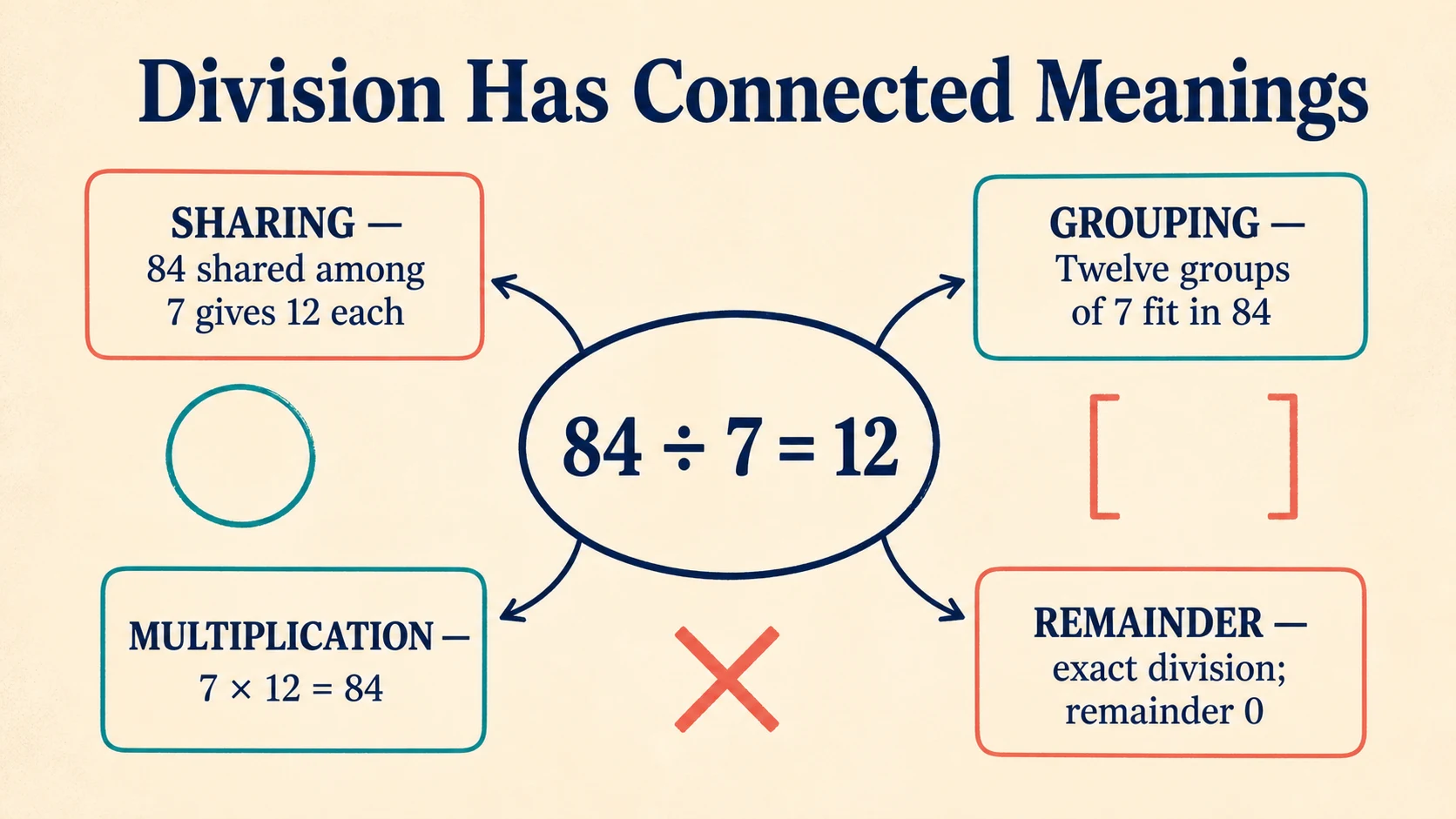
Equal groups, visual models, equations, and explanations should develop as connected skills.
Prerequisites to Check First
Division becomes manageable when several earlier ideas are secure. Before beginning symbolic exercises, see whether the learner can:
- Count a collection accurately, moving or marking each object once.
- Recognize when groups are equal or unequal.
- Make a requested number of equal groups with a small collection.
- Skip-count by 2s, 5s, and 10s, with emerging work by other small group sizes.
- Add equal quantities, such as 4+4+4.
- Subtract the same quantity repeatedly.
- Read and write addition and subtraction equations.
- Explain an array in rows and columns.
- Understand that multiplication can describe equal groups, even if multiplication facts are not yet fluent.
These are instructional checks, not a formal test. Use a small set of objects and ask the learner to show rather than merely tell.
For example, place 10 counters on the table and say, “Make 2 equal groups.” If the learner makes groups of 5 and can confirm that the groups are equal, try, “Make groups of 2. How many groups did you make?” A learner who solves one task but not the other may understand sharing better than grouping. That difference tells you which model to teach next.
Also check the meaning of vocabulary. “Share equally” means every recipient gets the same amount. “Groups of 3” means 3 objects belong in each completed group. Confusing those phrases can lead to reversed answers even when the counting is accurate.
The IES practice guide on teaching mathematics to young children supports broad instructional practices such as using progressions, monitoring children’s mathematical understanding, and helping learners connect informal ideas with mathematical language and representations. It does not evaluate this guide or any WorksheetWise resource.
A Grade-Appropriate Teaching Progression
Move forward when the learner can solve and explain several examples with the current representation. Return to an earlier stage if answers become guesses or if the learner cannot identify what the groups mean.
| Stage |
Main learner action |
Useful task |
Evidence of readiness to continue |
| 1. Notice equality |
Compare groups |
Decide whether two plates hold equal amounts |
Identifies equal and unequal sets accurately |
| 2. Share objects |
Distribute one at a time |
Share 8 counters among 2 people |
Makes equal shares and states the amount per person |
| 3. Form groups |
Build fixed-size sets |
Make groups of 3 from 12 counters |
States how many complete groups were made |
| 4. Draw models |
Sketch circles, dots, or arrays |
Show 15 objects in 5 equal groups |
Drawing matches the situation |
| 5. Record equations |
Connect model and notation |
Write 15÷5=3 |
Explains what 15, 5, and 3 represent |
| 6. Connect multiplication |
Use an unknown factor |
Solve 15÷5 using 5×3=15 |
Uses a related fact and verifies it |
| 7. Solve mixed stories |
Choose the needed model |
Compare sharing and grouping problems |
Identifies whether the unknown is group size or group count |
| 8. Work independently |
Solve, model, and check |
Complete a short mixed set |
Maintains accuracy without losing the meaning |
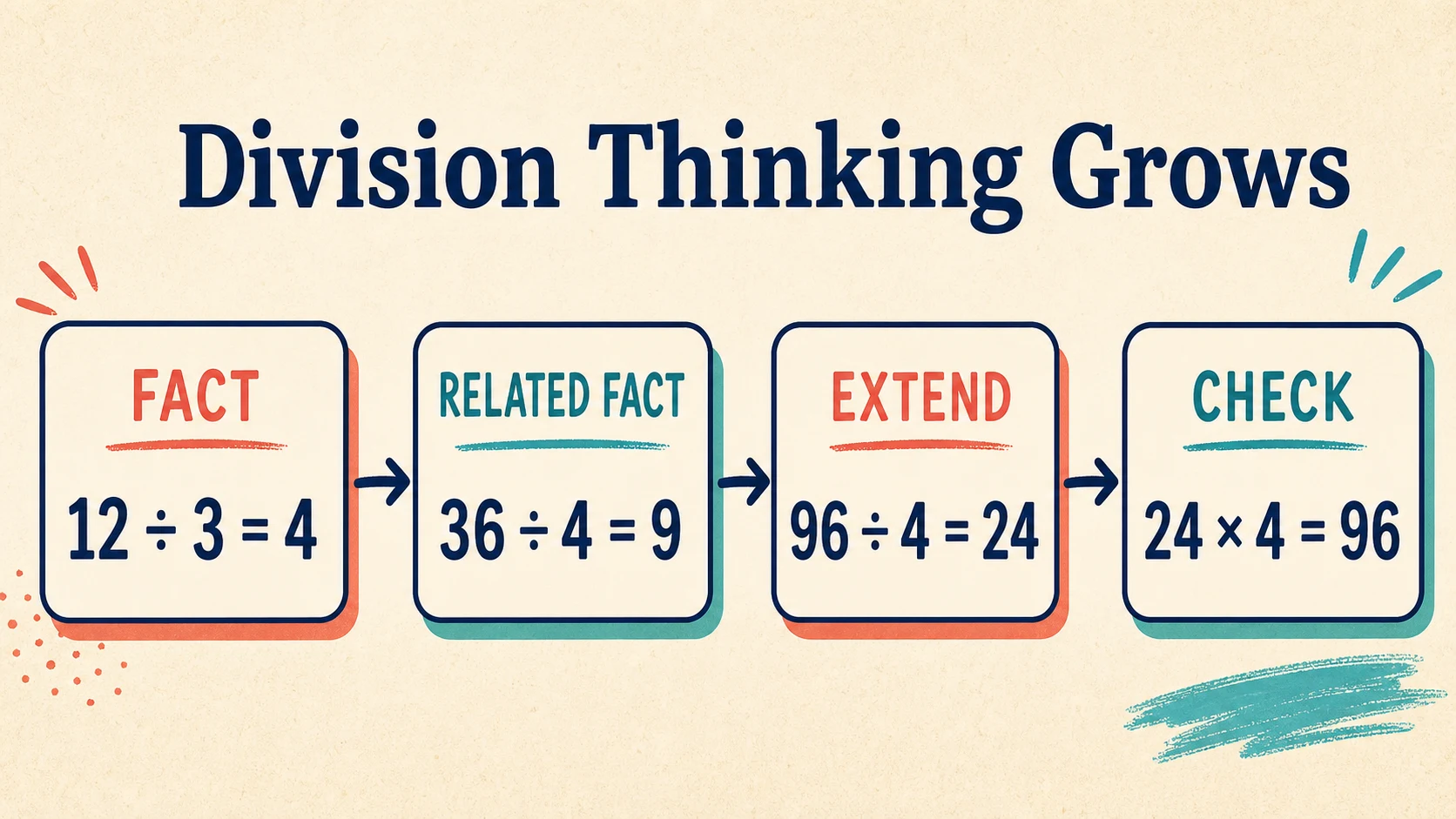
Independence follows successful modeling and explanation; it does not replace them.
Keep quantities small enough to model
Begin with totals that can be handled without excessive counting, such as 6, 8, 10, 12, 15, or 20. Use divisors and answers that produce equal whole-number groups. Large totals can hide a conceptual problem behind a counting burden.
Increase one demand at a time. If the learner has just begun interpreting grouping stories, do not simultaneously introduce unfamiliar vocabulary, large numbers, remainders, and timed work.
Delay formal algorithms
Long division is part of the broader division progression, but it is not the starting point for a typical second-grade learner. The catalogue’s division topic extends into later grades, including remainders and multi-digit division. Those later skills should not be treated as required second-grade outcomes merely because they appear in the same topic family.
A mnemonic for long division cannot substitute for understanding equal groups or place value. At this stage, concrete models, drawings, fact relationships, and explanations are usually the more informative teaching tools.
Concrete and Visual Models
A representation should make the situation easier to understand. It should not become an extra decoration added after the learner has already guessed an answer.
Equal sharing
Use this model when a known total is distributed among a known number of recipients or groups.
For 12 crackers shared among 3 plates:
- Place 3 plates or draw 3 circles.
- Distribute one cracker or counter to each plate in turn.
- Continue until all 12 have been placed.
- Count each plate: 4 crackers.
- Record 12÷3=4.
Here, 12 is the total, 3 is the number of groups, and 4 is the amount in each group.
Equal grouping
Use this model when the size of each group is known and the number of groups must be found.
For 12 blocks packed 4 in each box:
- Count 12 blocks.
- Move 4 blocks into the first group.
- Continue making complete groups of 4.
- Count the groups: 3.
- Record 12÷4=3.
Here, 12 is the total, 4 is the size of each group, and 3 is the number of groups.
Arrays and repeated subtraction
An array organizes equal groups into rows and columns. Twelve counters can be shown as 3 rows of 4 or 4 rows of 3. The orientation changes, but the total remains 12. Ask the learner to point to the rows, count the objects in each row, and state both related multiplication facts:
3×4=12
4×3=12
Repeated subtraction can model grouping:
12−4=8,8−4=4,4−4=0
Three subtractions were made, so 12 contains 3 groups of 4. Use this after the learner understands what each subtraction represents. Otherwise, it can become another unexplained routine.
Fully Checked Worked Examples
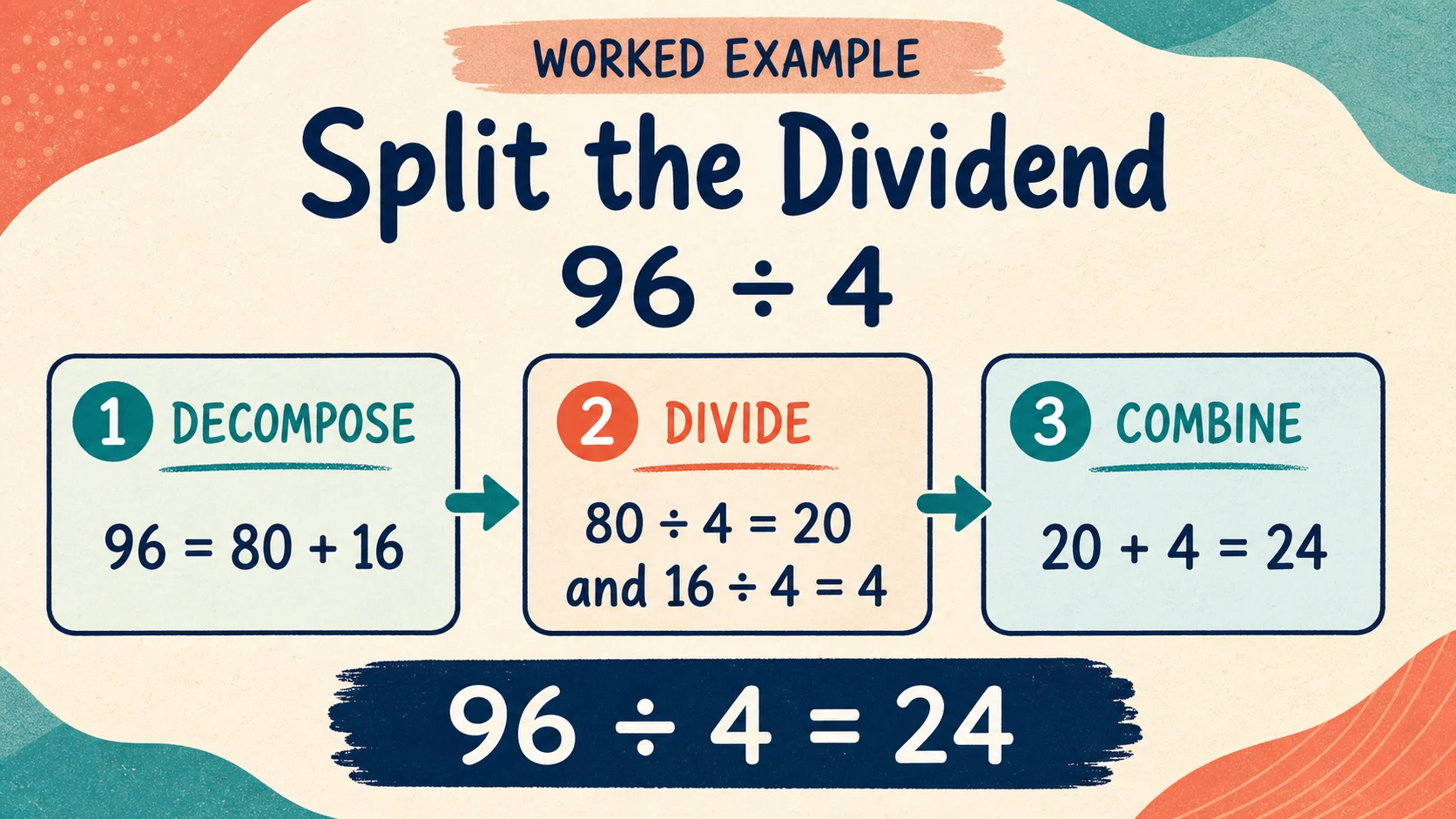
The equation should record a relationship the learner has already built or drawn.
Example 1: Sharing equally
Problem: Twelve strawberries are shared equally among 3 bowls. How many strawberries go in each bowl?
Build or draw 3 bowls. Distribute the 12 strawberries one at a time:
- After the first round, each bowl has 1 and 9 remain.
- After the second round, each has 2 and 6 remain.
- After the third round, each has 3 and 3 remain.
- After the fourth round, each has 4 and none remain.
Therefore:
12÷3=4
Answer: Each bowl receives 4 strawberries.
Check:
3×4=12
The product returns the original total, and every bowl has the same amount.
Example 2: Finding the number of groups
Problem: Fifteen pencils are bundled in groups of 5. How many bundles can be made?
Separate 15 pencils into fixed-size groups:
5,5,5
There are 3 groups, so:
15÷5=3
Answer: Three bundles can be made.
Check:
3×5=15
Notice that 5 is the size of each bundle, while 3 is the number of bundles. Reversing these labels would misinterpret the story even though 3×5 and 5×3 have the same product.
Example 3: Using a related multiplication fact
Problem: Solve 18÷3.
Think, “Three times what number equals 18?”
Count by 3s:
3, 6, 9, 12, 15, 18
Six groups of 3 reach 18, so:
18÷3=6
Check:
3×6=18
A learner may also draw 3 equal rows and place 6 dots in each row. Both methods give the same quotient.
Example 4: Comparing two meanings
Problem A: Twenty counters are shared among 4 children. How many counters does each child receive?
The number of groups is 4. The size of each group is unknown:
20÷4=5
Each child receives 5 counters.
Problem B: Twenty counters are placed in bags of 4. How many bags are filled?
The group size is 4. The number of groups is unknown:
20÷4=5
Five bags are filled.
Both equations and answers are numerically identical, but the 4 and 5 describe different things. In Problem A, 4 is the number of children and 5 is each share. In Problem B, 4 is the amount per bag and 5 is the number of bags.
Check for both:
4×5=20
Example 5: A zero-total boundary case
Problem: Zero buttons are shared equally among 4 boxes. How many buttons go in each box?
There are 4 boxes but no buttons to distribute. Every box receives 0:
0÷4=0
Check:
4×0=0
This is different from dividing by zero. An expression such as 8÷0 does not describe a possible equal-sharing arrangement, because there are no groups among which to share. Do not ask a second grader to calculate division by zero as though it had an ordinary whole-number answer.
Example 6: A remainder as an extension
Problem: Ten counters are placed in groups of 3. How many complete groups can be made, and how many counters remain?
Make three groups of 3:
3+3+3=9
One counter remains because:
10−9=1
The result may be described as 3 complete groups with 1 left over.
Check:
3×3+1=10
Remainders are a boundary topic here, not an automatic next lesson. Start with exact sharing. Introduce leftovers only after the learner consistently understands whole-number groups, and keep the context visible.
A Short, Repeatable Lesson Routine
A useful lesson can take 10 to 15 minutes, but this is an instructional suggestion rather than a sourced or universal timetable. Shorten, extend, or pause according to the learner’s concentration and work.
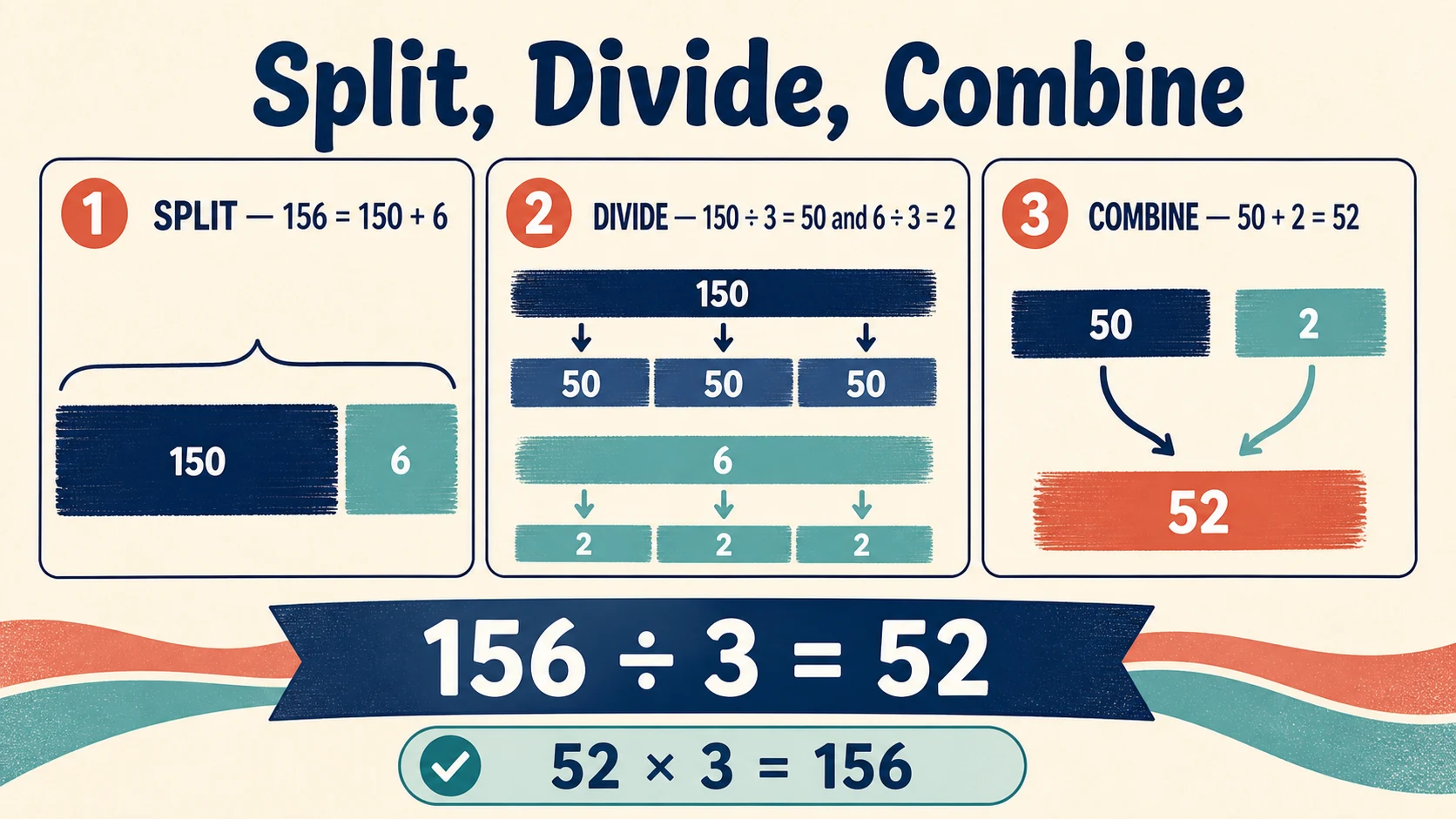
Each lesson moves from meaning to representation, notation, explanation, and a brief check.
1. Retrieve a prerequisite
Spend about two minutes on a connected idea: skip-count by 2s, build three groups of 4, or identify whether two sets are equal.
2. Model one situation
Present one sharing or grouping story. Let the learner use counters, cubes, buttons, or drawn dots. Ask:
- What is the total?
- What is already known about the groups?
- What must we find?
3. Connect the model to an equation
Write the division equation only after the model is clear. Have the learner point to each number and explain its role. Add the related multiplication fact.
4. Practice a small set
Use three to six carefully selected problems. Keep most examples similar to the model, then include one that requires the learner to decide between sharing and grouping.
5. Close with explanation
Ask the learner to solve one final problem and finish a sentence such as, “I know the groups are equal because…” or “I checked my answer by…”
The IES guide for assisting students struggling with mathematics provides high-level guidance on systematic instruction, mathematical language, representations, number lines, and regular assessment. Those principles can inform a lesson routine, but they do not prescribe one fixed schedule for every learner.
Choosing Practice That Matches the Learner
Select practice from observed evidence, not from the worksheet title alone. A productive set contains enough repetition to reveal a pattern without adding several new demands at once.
| If the learner can… |
Choose practice that… |
Avoid for now… |
| Make equal shares but not record them |
Pairs objects or pictures with equations |
Bare equations only |
| Group by 2, 5, or 10 |
Uses small exact totals with those group sizes |
Mixed divisors and remainders |
| Draw accurate models |
Fades some pictures and asks for learner-created drawings |
Removing all representations at once |
| Use multiplication to check |
Mixes division facts with related multiplication facts |
Timed fact tests as the only evidence |
| Solve both division meanings |
Mixes sharing and grouping stories |
Repetitive stories with identical wording |
| Explain independent work accurately |
Adds a modest number of unfamiliar examples |
Immediate movement to long division |
The 2nd Grade Math hub can help place division beside addition, subtraction, number sense, and early multiplication work. The broader 2nd Grade worksheet collection is useful when a prerequisite needs reinforcement.
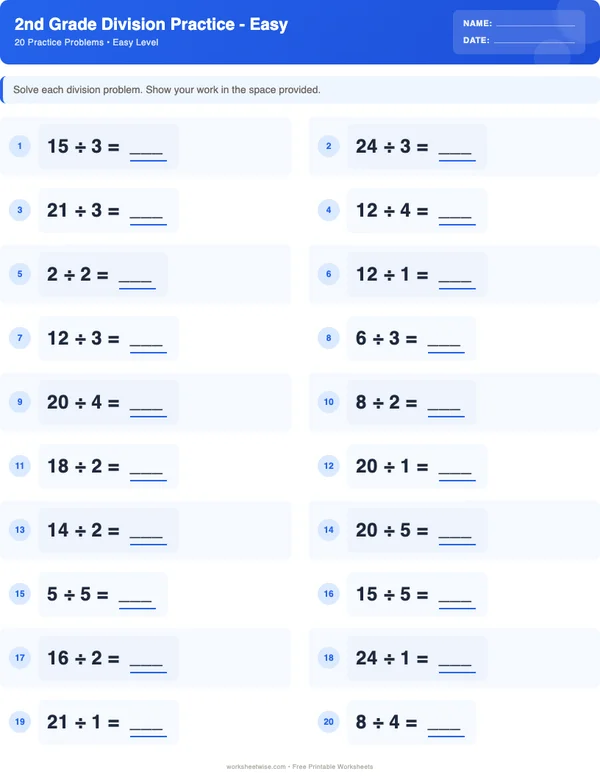
The free easy division worksheet contains 20 exercises and a separate answer key. Preview the actual problems before assigning them. The catalogue associates this worksheet with division facts, mental math, number sense, long division, and remainders, but those elements are not equally suitable for every second-grade learner. Select only the portion that matches the learner’s present understanding.
Differentiate by changing support
For a learner who needs more support:
- Reduce totals while preserving the same concept.
- Provide counters and pre-drawn group circles.
- Read word problems aloud without changing the mathematical meaning.
- Keep sharing and grouping in separate short sets before mixing them.
- Let the learner say the equation before writing it.
- Use multiplication facts the learner already understands.
- Stop when inaccurate work suggests that counting or equality has broken down.
For a learner ready for more challenge:
- Ask for two different models of the same equation.
- Remove the picture and ask the learner to create one.
- Include the unknown in different positions, such as 4×□=20.
- Ask the learner to write both a sharing story and a grouping story for 16÷4.
- Compare two correct strategies.
- Introduce a small leftover and discuss what it means in that specific context.
Challenge should deepen reasoning before it enlarges numbers.
Diagnosing Common Errors
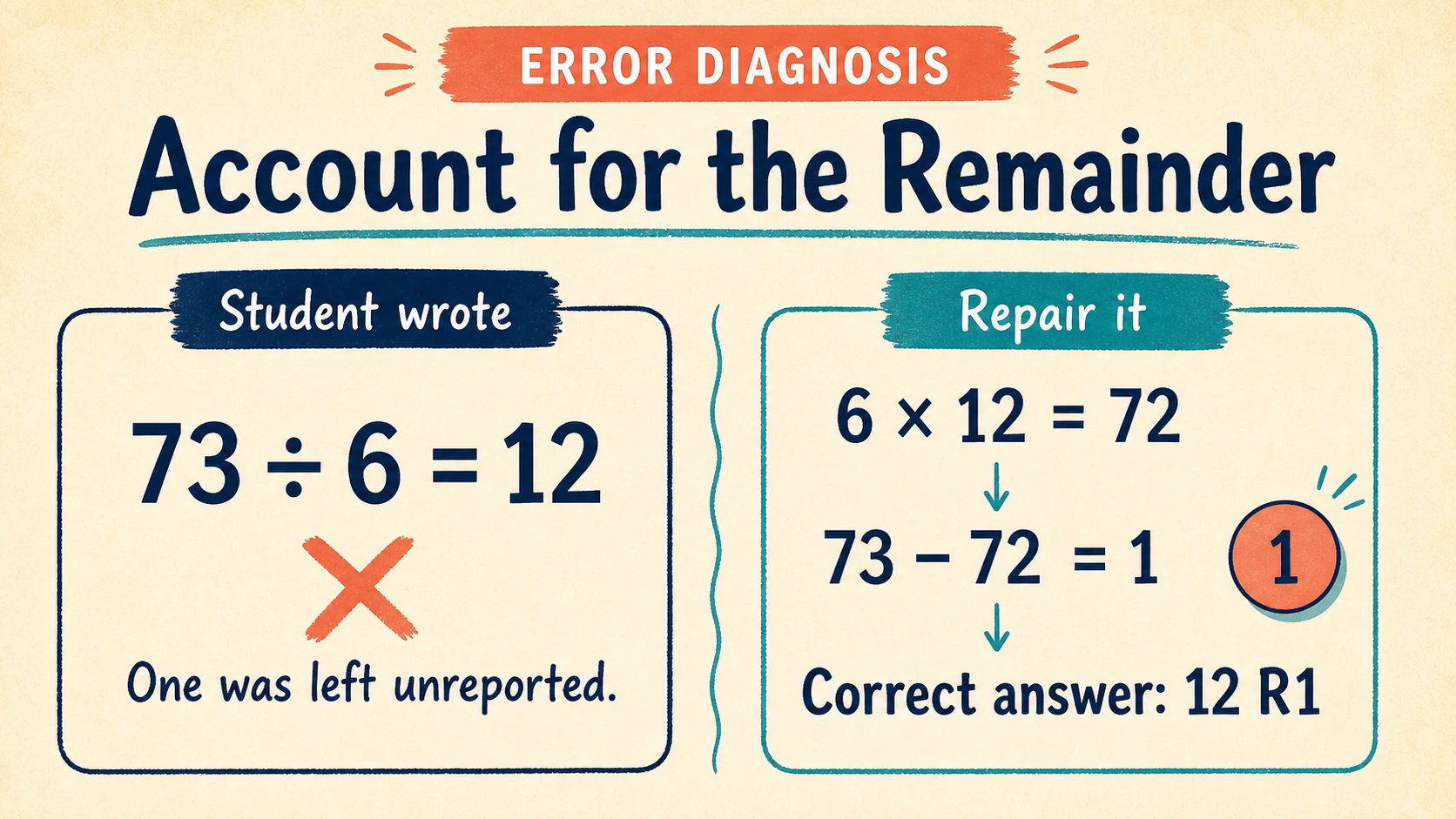
An incorrect answer is most useful when it leads to a specific check and response.
Unequal groups
A learner shares 10 counters among 2 plates but ends with 6 on one and 4 on the other.
Likely issue: The learner tracked the total but not the equal-sharing condition.
Response: Have the learner distribute one counter to each plate in alternating turns. Ask whether either plate can receive another counter without the other receiving one too.
Reporting the wrong quantity
For “12 objects in groups of 3,” the learner answers 3 instead of 4.
Likely issue: The learner named the group size rather than the number of groups.
Response: Label both quantities: “3 in each group” and “4 groups.” Ask which one the question requests.
Reversing multiplication and division relationships
The learner writes 12÷4=4 because the number 4 appears in the problem.
Likely issue: The equation is being assembled from visible numbers rather than from the modeled relationship.
Response: Build four equal groups from 12 counters. Count each group, then verify 4×3=12.
Counting errors inside a correct model
The learner creates 5 equal groups of 3 but reports a total of 14.
Likely issue: Division meaning may be sound while counting or addition is unstable.
Response: Count each group, skip-count 3,6,9,12,15, and compare the final count with 5×3. Assigning harder division will not address the underlying counting error.
Treating a remainder as an equal share
The learner distributes 10 counters among 3 groups as 4, 3, and 3, then calls the result equal.
Likely issue: The learner is trying to use every object without preserving equality.
Response: Compare the group sizes. Rebuild three groups of 3 and place the leftover counter outside the groups. Discuss that it remains because it cannot be added to only one group while keeping the groups equal.
Applying a memorized rule without meaning
The learner produces correct fact answers but cannot draw or explain them.
Likely issue: Recall may be present without a stable interpretation.
Response: Ask for a story, array, or grouping model for one equation. Do not discard correct recall, but reconnect it to quantities and language.
Monitoring Progress Without Over-Testing
Keep a simple record after two or three sessions. Note the representation used, the type of problem, accuracy, and whether the learner explained the result independently.
A compact monitoring check might include:
- Share 12 objects among 3 groups.
- Make groups of 3 from 12 objects.
- Draw a model for 10÷2.
- Solve one short story problem.
- Check one division result with multiplication.
Record more than a score. “Four out of five” does not reveal whether the learner confused group size, lost count, or misread the story. A note such as “accurate with objects; reverses the requested quantity in grouping stories” gives a clear next teaching target.
Move toward less support when the learner:
- Creates equal groups reliably.
- Distinguishes the number of groups from the size of each group.
- Connects a model to a correct equation.
- Uses multiplication or reconstruction to check.
- Explains an answer without copying adult language.
- Maintains these skills across more than one session.
If performance falls apart when pictures disappear, restore the representation and fade it more slowly. If errors occur only in word problems, work on interpreting the situation rather than assigning additional bare facts.
A Two-Week Practice Plan
This plan offers ten short sessions across two weeks. It is not a universal timetable. Repeat, combine, or postpone sessions according to observed work.
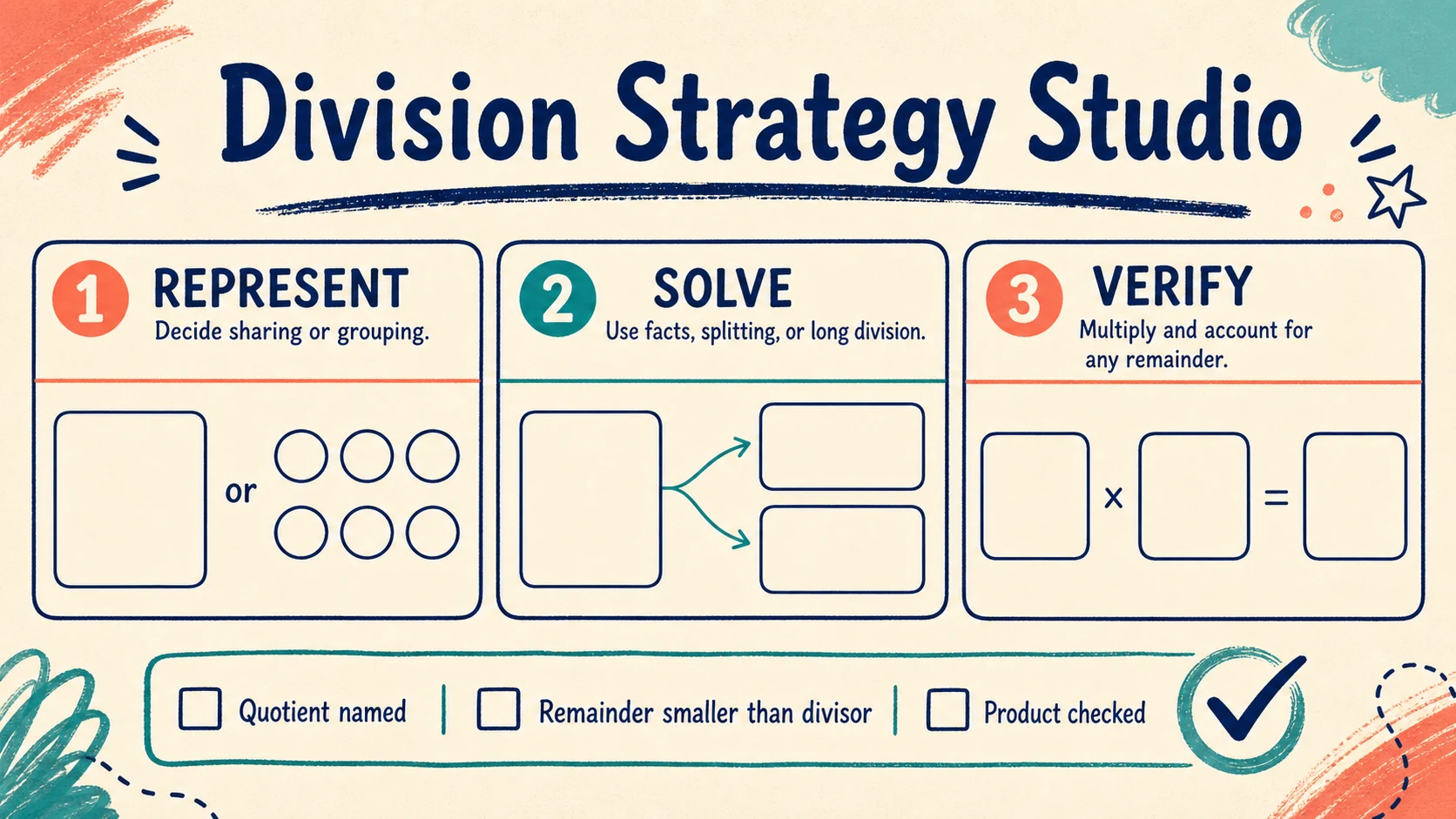
The plan alternates instruction, retrieval, application, and review so that pacing can respond to evidence.
| Session |
Focus |
Suggested activity |
Quick evidence |
| 1 |
Equal and unequal groups |
Sort or rebuild small collections |
Explains why groups are or are not equal |
| 2 |
Equal sharing |
Share 6, 8, and 12 counters among 2–4 recipients |
States the amount in each group |
| 3 |
Equal grouping |
Make groups of 2, 3, or 5 from small totals |
Counts completed groups |
| 4 |
Compare meanings |
Solve one sharing and one grouping story |
Identifies what the answer represents |
| 5 |
Review and check |
Revisit two examples and use multiplication checks |
Corrects or confirms work |
| 6 |
Drawings and arrays |
Replace some objects with dots, rows, or circles |
Drawing matches the quantities |
| 7 |
Division equations |
Connect models to a÷b=c |
Explains all three numbers |
| 8 |
Fact families |
Match division equations to multiplication facts |
Uses b×c=a to check |
| 9 |
Mixed application |
Solve a brief set of facts and word problems |
Chooses a suitable model independently |
| 10 |
Monitor and plan |
Repeat the five-item progress check |
Shows the next support or extension needed |
If Session 4 reveals confusion between sharing and grouping, repeat those models before moving to equations. If Session 8 is difficult because multiplication is unfamiliar, return to equal groups and repeated addition. If the learner completes Session 10 accurately but explanations remain vague, ask for clearer mathematical language rather than simply increasing the numbers.
Limits of This Guide and an Honest Next Step
This guide explains a sensible foundation for early division, but it cannot determine an individual learner’s curriculum placement, learning needs, or required intervention. It does not claim comprehensive standards alignment, certification, guaranteed outcomes, or medical guidance. A worksheet result is one piece of evidence, not a diagnosis.
The WorksheetWise catalogue spans division from equal sharing through later work with facts, remainders, and long division. That full range should not be compressed into a second-grade timetable. For most beginning learners, the honest next step is smaller: confirm equal groups, teach both meanings of division, connect a model to an equation, and check with multiplication.
Begin with one concrete sharing problem and one concrete grouping problem. If both are understood, open the 2nd Grade Division topic guide and choose a small, appropriate set from the free easy worksheet. For longer practice, review the focused division pack; for customized quantities or formats, explore the free worksheet generators.