What 2nd Grade Digraphs Teach
A digraph is a pair of letters that represents one sound. In ship, the letters sh work together for /sh/. In chip, ch represents /ch/. This differs from a blend such as sl in slip, where both /s/ and /l/ remain audible.
For a second-grade learner, the practical goal is to recognize common digraphs quickly enough to read and spell familiar one-syllable words. Useful instruction includes:
- sh in ship and wish
- ch in chin and much
- th in thin, bath, this, and that
- wh in when
- ck in duck, neck, and stick
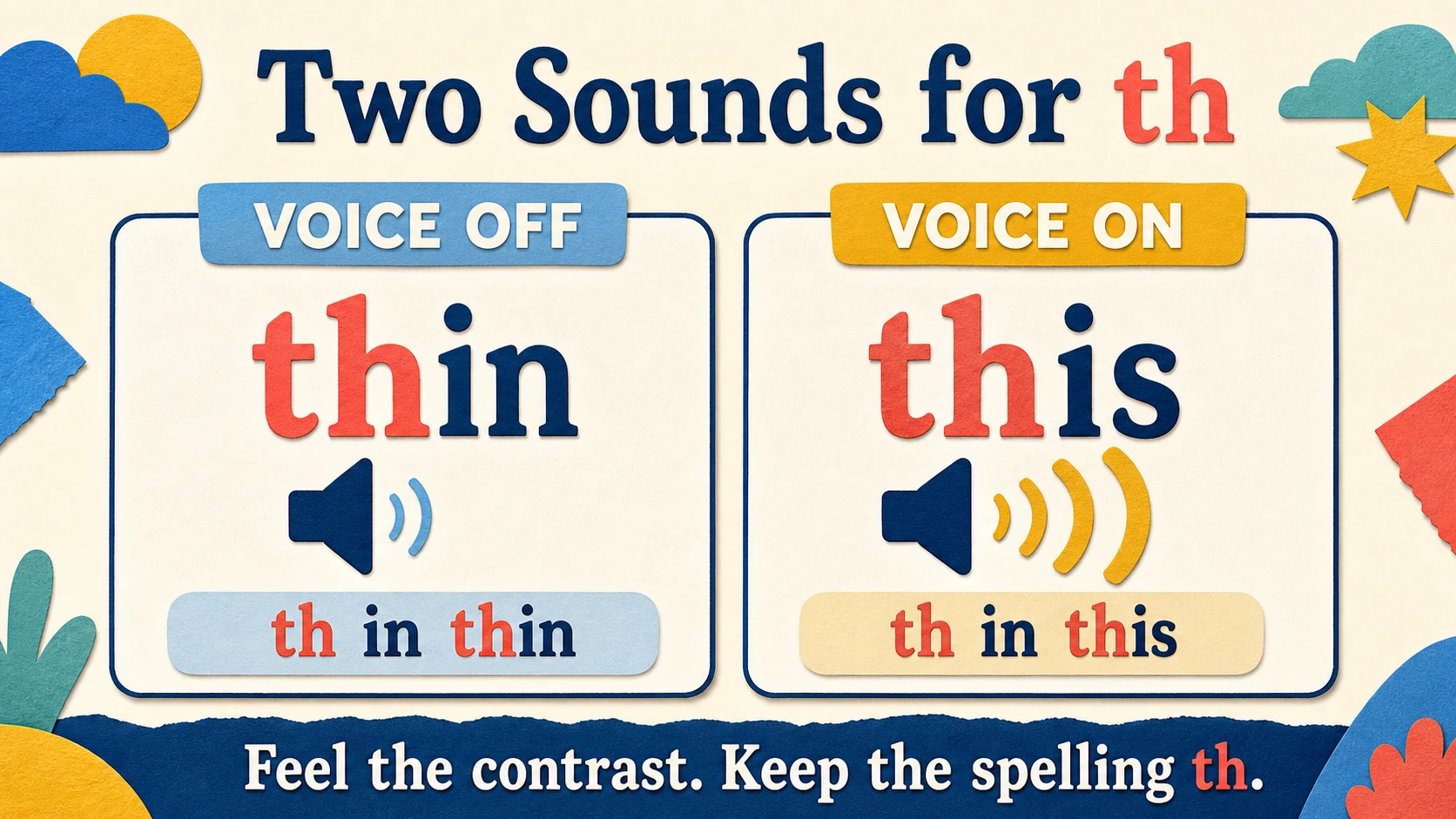
The letters th can represent two pronunciations. Compare thin with this. A learner does not need technical labels for the two sounds, but does need repeated opportunities to hear, read, and use both.
Grade labels describe the intended practice level, not a universal timetable. Local curricula and instructional sequences differ. Some second graders will be consolidating these patterns, while others may need carefully supported instruction beginning with one digraph.
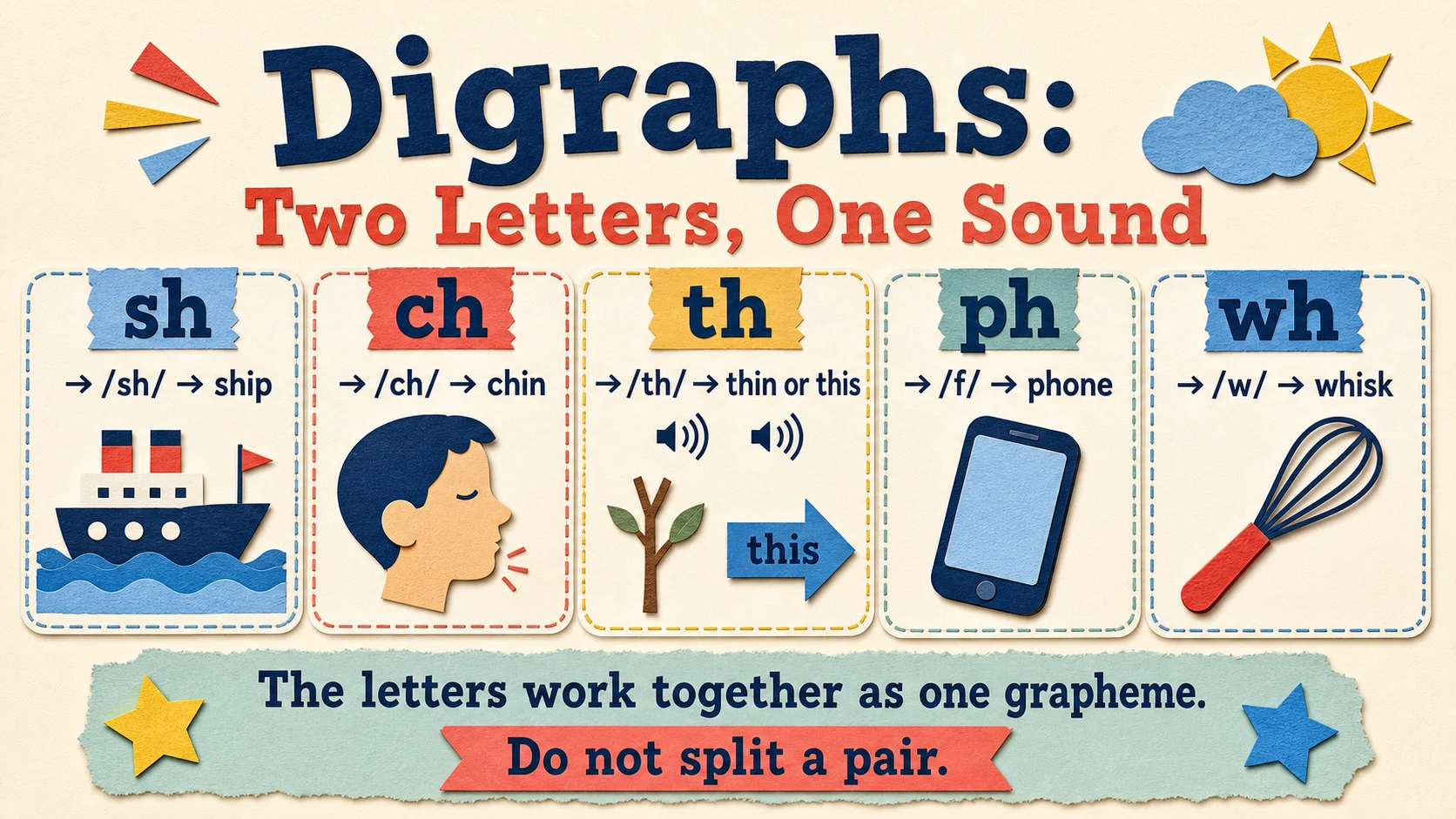
The skill connects sound recognition, letter-pattern recognition, word reading, spelling, and reading in context.
The IES foundational reading guide provides high-level support for explicit work with sound–spelling relationships, word reading, and connected text. It did not evaluate WorksheetWise or this particular worksheet. The Common Core English Language Arts standards provide broader grade-level context for foundational reading, including decoding regularly spelled words and distinguishing vowel sounds. They should not be treated as proof that one activity provides comprehensive standards alignment.
Check the Prerequisites Before Teaching
Digraph practice is most productive after a learner can read straightforward consonant-vowel-consonant words such as map, sit, and hot with reasonable accuracy. Some exposure to blends is also useful because it gives the adult a meaningful contrast.
Sound and letter readiness
Before expecting independent digraph work, check whether the learner can:
- Name or recognize the letters used in the target digraph.
- Hear the first and last sounds in short words.
- Blend a sequence such as /m/ /a/ /p/ into map.
- Segment sit into /s/ /i/ /t/.
- Keep a short vowel in the middle of a one-syllable word.
- Follow the print from left to right.
Use actual responses instead of assuming readiness from age or grade. Ask the learner to read map, fish, stop, and chat. Then say shop and ask for its sounds. This brief check shows whether the main difficulty lies in basic blending, distinguishing a digraph from a blend, or recalling a particular spelling pattern.
Digraphs and blends are not interchangeable
Place ship beside slip. Point beneath each spelling as you pronounce it:
- ship: /sh/ /i/ /p/ — three sounds
- slip: /s/ /l/ /i/ /p/ — four sounds
The word ship has four letters but three sounds because sh represents one sound. The word slip has four letters and four audible sounds because s and l form a blend.
A useful instructional suggestion is to hold two fingers together while saying /sh/ or /ch/. The gesture makes “two letters, one sound” visible. It is a teaching aid, not a required method or a sourced recommendation.
If the learner cannot yet blend ordinary CVC words, return temporarily to that foundation. The 2nd Grade phonics hub can help an adult compare digraph work with other phonics practice rather than presenting every pattern at once.
Use a Deliberate Teaching Progression
Teach for recognition, then reading, then spelling, and finally use in connected text. The learner’s observed work should determine the pace.
| Stage |
Teaching focus |
Example task |
Evidence for moving on |
| 1. Hear the sound |
Notice the target sound in spoken words |
“Does fish end with /sh/?” |
Identifies the sound without looking at print |
| 2. Connect sound and spelling |
Link /sh/ to sh |
Build shop with letter cards |
Chooses the correct two-letter pattern |
| 3. Read words |
Blend through complete words |
Read ship, shed, wish |
Reads accurately without guessing from one letter |
| 4. Contrast patterns |
Separate digraphs from blends or other digraphs |
Sort chin, ship, slip |
Explains or demonstrates the relevant contrast |
| 5. Spell words |
Segment and record each sound |
Hear much and write much |
Represents the digraph and remaining sounds |
| 6. Read in context |
Apply the pattern in a sentence |
“The fish is in the dish.” |
Reads target words while attending to meaning |
| 7. Review cumulatively |
Mix new and earlier patterns |
Sort duck, stop, chat, map |
Maintains earlier learning in mixed practice |
Support can fade from oral modeling and letter tiles to independent reading and spelling.
A practical order for the patterns
A workable sequence is sh, ch, th, wh, and ck. Start with sh because its sound is distinct in words such as ship and wish. Follow with ch, then introduce both pronunciations of th through examples. Add wh and final ck after the learner is successfully reading earlier patterns.
The catalogue suggests introducing one digraph at a time and spending at least a week on each. Treat that as a starting point, not an inflexible schedule. If a learner reads and spells a pattern accurately across several tasks, move into cumulative review. If errors persist, narrow the word set and increase modeling rather than simply assigning more items.
Teach both initial and final positions where the pattern permits them:
| Digraph |
Initial position |
Final position |
| sh |
ship, shop, shed |
fish, wish, dish |
| ch |
chin, chat, chip |
much, rich |
| th |
thin, this, that |
bath, math |
| wh |
when |
— |
| ck |
— |
duck, neck, stick |
The dashes matter. They prevent the table from suggesting that every digraph normally occurs in every position.
Model the Skill With Sounds, Print, and Movement
A concrete model does not require elaborate materials. Use three counters or connected boxes for the sounds in ship:
- Say ship normally.
- Stretch it carefully: /sh/ /i/ /p/.
- Move one counter for each sound.
- Replace the counters with sh, i, and p.
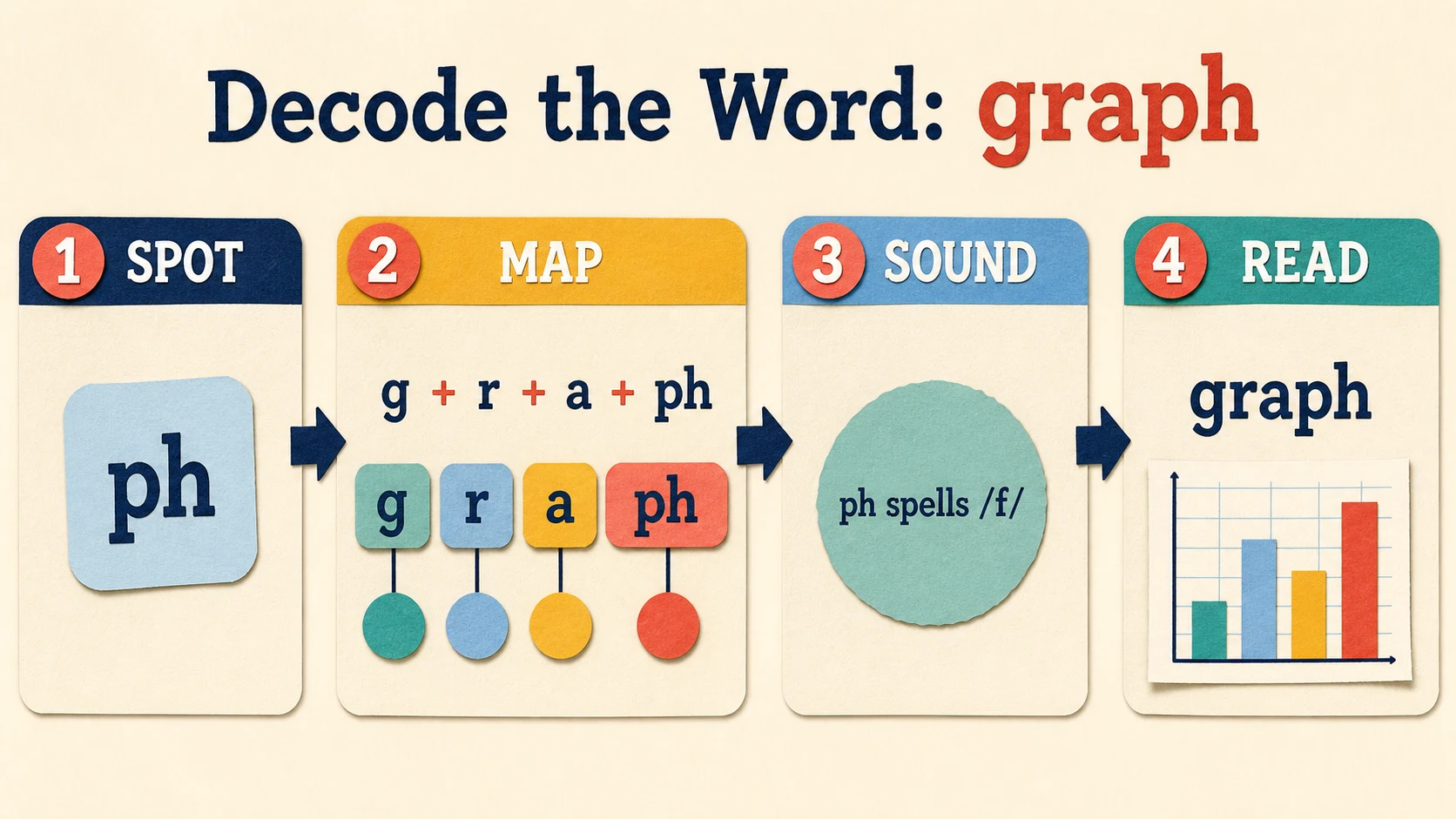
- Sweep a finger beneath the completed word and read ship.
The first sound occupies one sound position but requires two letters. That is the central idea.
Counters represent sounds; letter tiles reveal that one sound may be written with two letters.
Use a sound-to-print sequence
When spelling, begin with the spoken word rather than showing the answer immediately. For fish:
- Say fish.
- Segment it as /f/ /i/ /sh/.
- Count three sounds.
- Map the sounds to f, i, and sh.
- Write fish.
- Read it back to check the result.
When reading, reverse the route:
- Notice the letters f-i-sh.
- Recognize sh as one unit.
- Blend /f/ /i/ /sh/.
- Say fish.
- Use the word in a brief sentence to confirm that it makes sense.
Pictures can establish meaning, but they should not replace attention to all the letters. If a learner sees a picture of a fish and says fish before examining the word, ask the learner to point to f, i, and sh and blend the sounds.
Study Fully Checked Worked Examples
Example 1: Read an initial digraph
Word: shop
Identify sh at the beginning. Treat it as one sound:
/sh/ /o/ /p/
Blend the three sounds: shop.
Check: The written word has four letters, s-h-o-p, but three sounds. The answer is not s-hop with separate /s/ and /h/ sounds.
Example 2: Read a final digraph
Word: wish
Scan the entire word before blending. The final letters are sh:
/w/ /i/ /sh/
Blend: wish.
Check: sh can occur at the end as well as the beginning. The final sound is /sh/, not separate /s/ and /h/.
Example 3: Distinguish a digraph from a blend
Words: chip and clip
For chip:
/ch/ /i/ /p/ = three sounds
For clip:
/k/ /l/ /i/ /p/ = four sounds
Answer: chip begins with a digraph because ch represents one sound. Clip begins with a blend because both /k/ and /l/ remain audible.
Check: Both words contain four letters. Letter count alone does not tell whether the opening pair is a digraph.
Example 4: Spell a word with final ck
Spoken word: duck
Segment it:
/d/ /u/ /k/
The final /k/ follows the short vowel /u/. In the catalogue scope, the final spelling pattern to practice is ck.
Map and write:
/d/ → d
/u/ → u
/k/ → ck
Answer: duck
Check: The word has four letters and three sounds. ck appears after the short vowel and at the end.
Example 5: Compare the two sounds represented by th
Read thin and this:
- thin: th represents the unvoiced sound heard at the beginning of thin.
- this: th represents the voiced sound heard at the beginning of this.
Both words begin with the same spelling, th, even though the pronunciations differ.
Check: Do not require the learner to memorize the labels voiced and unvoiced. The instructional target is hearing, reading, and becoming familiar with both pronunciations.
Example 6: Apply a digraph in a sentence
Sentence: “The fish is in the dish.”
Target words:
- fish → /f/ /i/ /sh/
- dish → /d/ /i/ /sh/
Both end with sh. Read the complete sentence and confirm that the words fit its meaning.
Check: Accurate word reading matters first, but context also helps detect an error. Saying “The fin is in the dish” would fit some letters but would not account for the final sh in fish.
Teach the Boundary Cases Explicitly
A short definition can become misleading if the boundaries are omitted.
Two letters do not always make a digraph
In slip, the pair sl is a blend: /s/ and /l/ are both heard. In ship, sh is a digraph: the pair represents /sh/. Ask, “Do I hear one sound or both consonant sounds?” rather than asking only whether two consonants appear together.
One spelling can have more than one pronunciation
The th in thin does not sound identical to the th in this. Both belong in practice. A rigid rule that assigns only one sound to th will fail on common words.
Position matters for ck
Within this topic scope, ck is taught after a short vowel and at the end of a word, as in duck, neck, and stick. Do not turn that useful practice rule into a claim about every English spelling situation. Keep the learner’s task focused on the words actually being studied.
Familiar words still require careful inspection
A learner may recognize the from memory without being able to read thin. Conversely, a learner may decode thin but hesitate over the. Include both pronunciations of th, but do not assume that success with one word transfers immediately to every other word.
Use a Short, Repeatable Lesson Routine
A focused lesson can be brief. The following routine is an instructional suggestion; it is not a universal timetable.
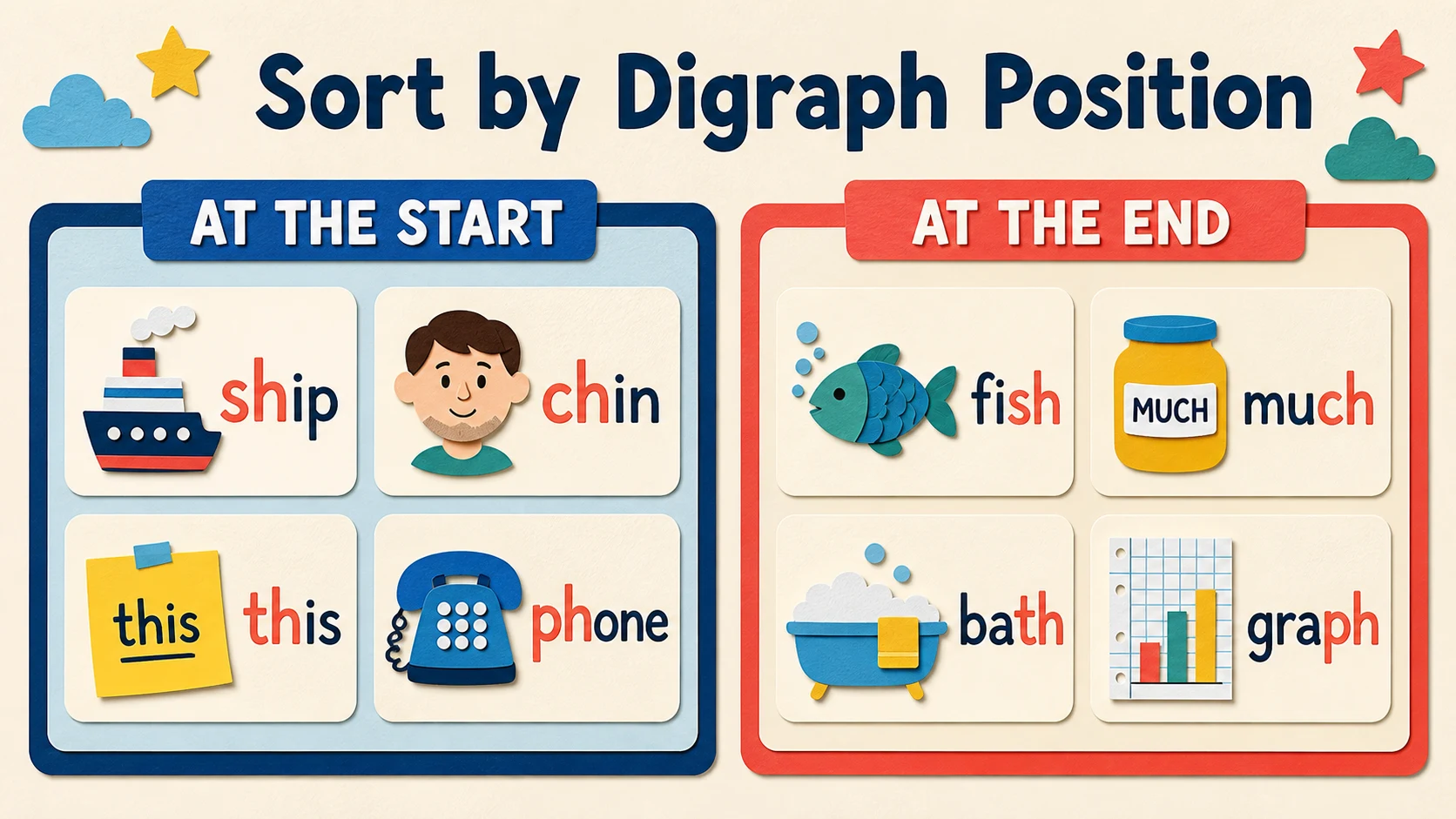
Each lesson moves from listening to explicit modeling, word work, context, and a quick check.
1. Review known patterns
Read or sort three to five previously taught words, including a CVC word or blend word. For example: map, stop, fish, chat.
2. Hear the target sound
Say two or three words containing the target digraph. Ask where the sound occurs. With sh, compare ship, fish, and map.
3. Model one word
Use counters, sound boxes, or letter tiles. Think aloud briefly: “I hear /sh/ first in shop. Two letters, s and h, represent that one sound.”
4. Practice reading and spelling
Have the learner read a small set, then spell two or three words from dictation. Keep the set narrow enough to reveal the target pattern without encouraging guessing.
5. Read in context
Use one controlled sentence containing a target word. After accurate decoding, ask for a simple explanation of the sentence to preserve attention to meaning.
6. Finish with an exit check
Ask for one unfamiliar item or a new contrast, such as ship versus slip. Record the response without turning the check into another long teaching round.
The IES foundational skills guide supports connecting explicit sound–spelling instruction with word reading and connected text. The separate IES elementary writing guide offers high-level framing for explicit writing instruction and practice. In this lesson, a short dictated spelling item can connect phonics with written production, but that does not replace broader writing instruction.
Select Practice That Matches the Error
The best worksheet is not automatically the longest or hardest one. Choose practice based on what the learner can and cannot yet do.
Use identification items when the learner can hear the word but does not reliably locate the digraph in print. Use word reading when the learner recognizes the pattern in isolation but cannot blend the complete word. Use dictation when reading is stronger than spelling. Use sentences when single-word reading is accurate and the next goal is application in context.
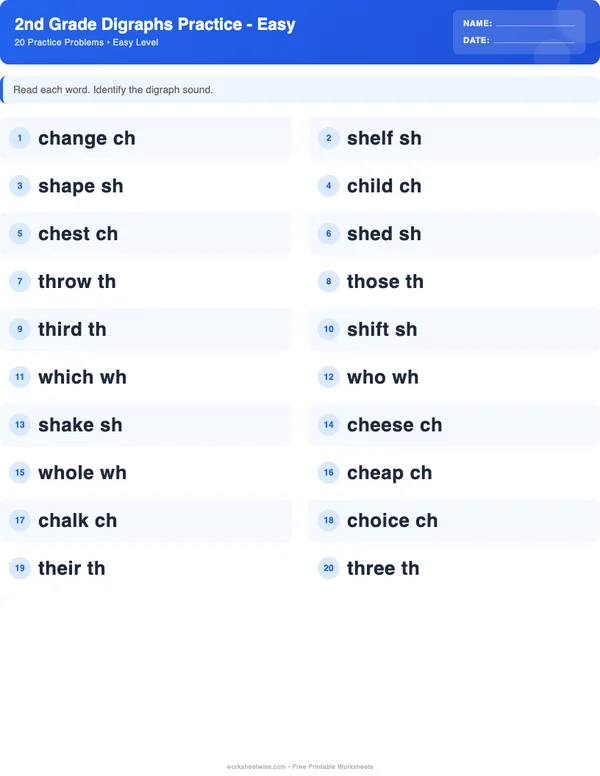
The free easy digraph worksheet contains 20 exercises that ask learners to read each word and identify the digraph sound. It is suited to beginning practice or extra reinforcement in digraph identification, letter combinations, phonics, and word recognition. A separate printable answer key is included.
Adjust support without changing the target
For a learner needing more support:
- Cover all but one line at a time.
- Preview the target digraph.
- Reduce the word set to five items.
- Say each word before asking the learner to identify its digraph.
- Use counters or tiles before pencil work.
- Contrast only two patterns, such as sh and ch.
For a learner ready for greater independence:
- Mix initial and final positions.
- Mix digraph words with CVC and blend words.
- Add short dictation.
- Ask the learner to explain why ship contains a digraph but slip contains a blend.
- Use a brief decodable sentence with several known patterns.
The focused 2nd Grade Digraphs pack contains 18 worksheets. More pages are useful only when they provide needed variation or review. They are not evidence that a learner should complete every page.
Diagnose Common Errors Before Assigning More Work
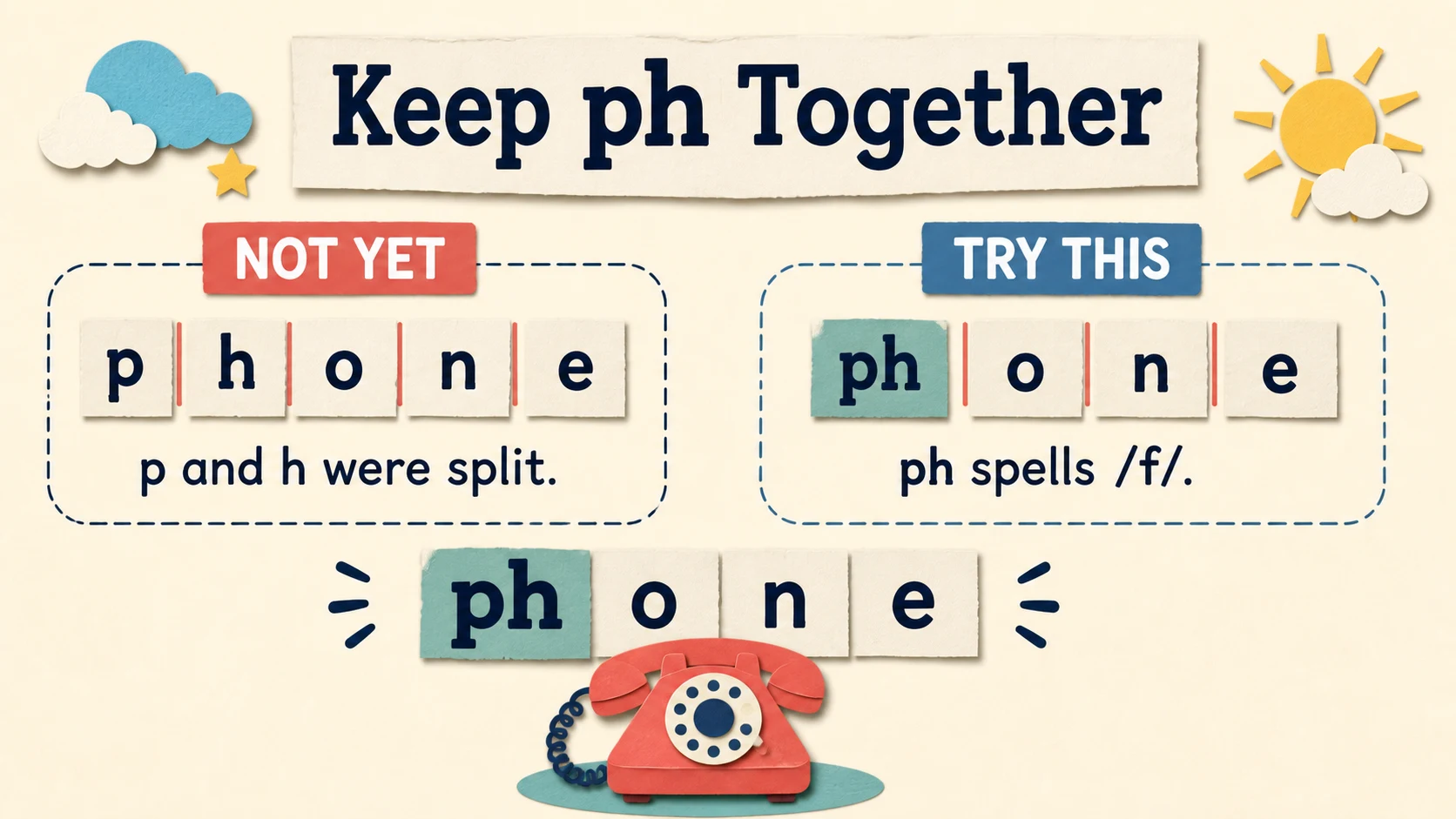
The same wrong answer can arise from hearing, blending, pattern recognition, or attention difficulties.
| Observed response |
Likely instructional issue to check |
Teaching response |
| Reads ship as separate /s/ /h/ sounds |
Does not yet treat sh as one unit |
Rebuild ship with sh on one tile or in one sound box |
| Calls sl in slip a digraph |
Uses “two consonants together” as the definition |
Compare sound counts in ship and slip |
| Reads wish correctly but misses ship |
Recognizes sh only in one position |
Sort initial and final sh words |
| Reads thin but not this |
Expects th to have only one pronunciation |
Model both forms and alternate familiar examples |
| Spells duck as duk |
Represents the sounds but not the target final spelling |
Map /d/ /u/ /k/, then show ck in the final sound position |
| Guesses from a picture or first letter |
Is not inspecting the complete word |
Cover the picture and require a left-to-right blend |
| Reads isolated words but fails in a sentence |
Application is not yet stable |
Use one short sentence and mark the target digraphs before reading |
| Accuracy falls in mixed review |
New learning may be replacing attention to earlier patterns |
Mix a smaller number of old and new words |
These are hypotheses to test, not diagnoses of a child. For example, duk shows that the learner heard all three sounds; the missing c points toward spelling-pattern knowledge rather than failure to hear final /k/. Respond to that specific need.
Avoid repeatedly telling a learner to “look harder.” Give an observable action: underline the two-letter pattern, tap one time for its sound, then blend the whole word.
Monitor Accuracy, Transfer, and Independence
Keep a small record with four columns: date, task, response, and next step. A useful entry might read: “Read 7 of 8 sh words accurately; missed final sh in wish; next lesson begins with initial/final sort.”
Check more than a completed-page score:
- Can the learner hear the sound without print?
- Can the learner find the spelling in a word?
- Can the learner read the whole word?
- Can the learner spell a taught example?
- Can the learner apply the pattern in a short sentence?
- Can the learner retain it when CVC, blend, and other digraph words are mixed?
- How much prompting is required?
A single perfect practice set may reflect memory of the item order. Look for stable performance across different words and on a later day. Conversely, one error does not establish that the pattern is unknown. Ask the learner to try another example and explain or demonstrate the sound mapping.
Increase difficulty only when the learner is accurate enough that the new demand will reveal learning rather than create random guessing. If performance weakens during mixed practice, return to a smaller contrast and then rebuild the mixture.
Follow a Flexible Two-Week Practice Plan
This plan assumes the learner already reads basic CVC words. It is a practical model, not a universal schedule. Shorten, repeat, or rearrange sessions in response to observed work.
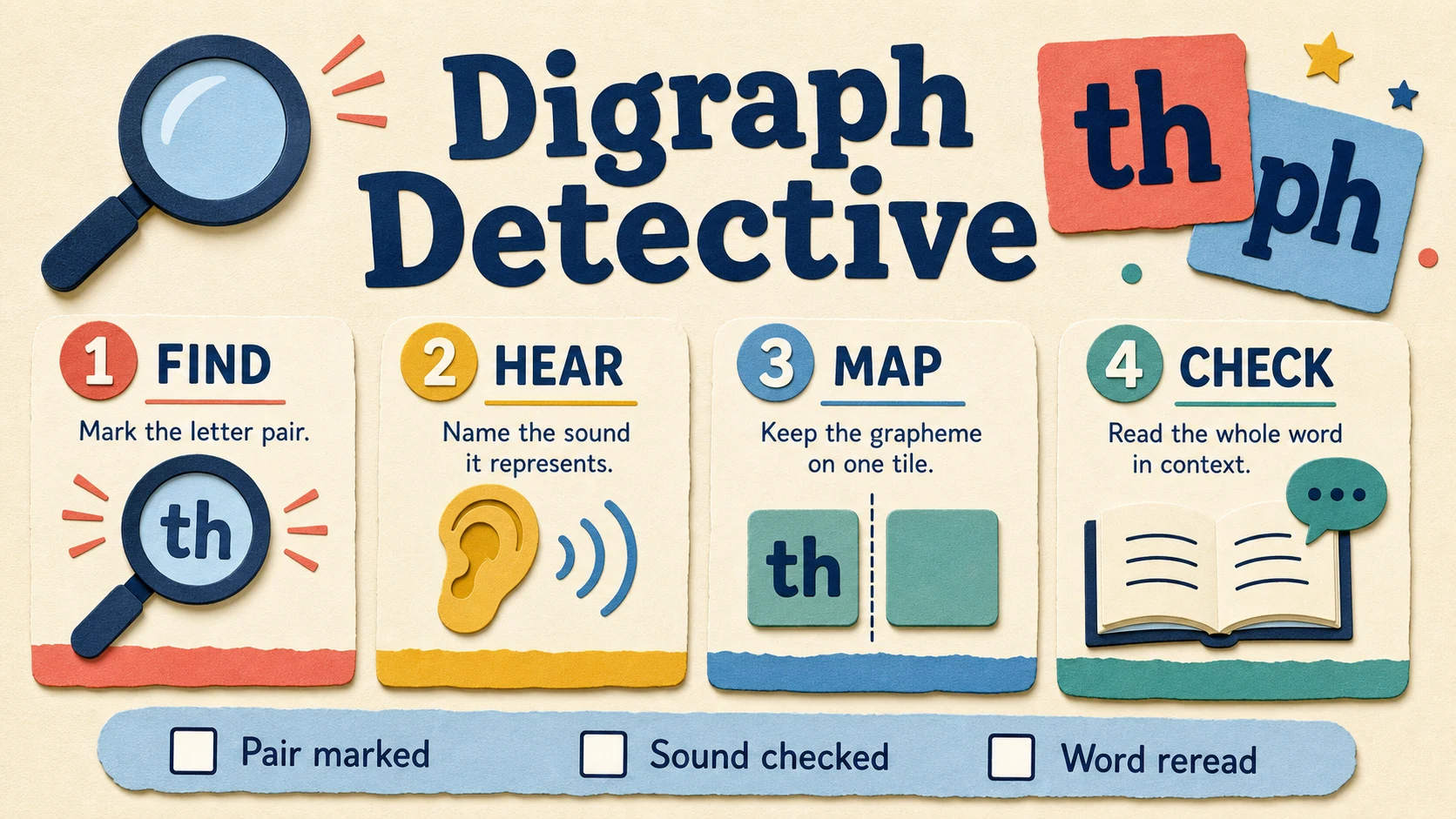
New patterns alternate with cumulative review, spelling, and reading in context.
| Day |
Focus |
Suggested activity |
Quick evidence |
| 1 |
Prerequisite check |
Read CVC, blend, and digraph examples |
Identify the starting point |
| 2 |
sh |
Hear, build, and read ship, shop, fish, wish |
Read initial and final sh |
| 3 |
ch |
Build and read chin, chip, much, rich |
Distinguish ch from sh |
| 4 |
sh/ch contrast |
Sort mixed words; spell two examples |
Select the correct pattern |
| 5 |
Context review |
Read short sentences with known words |
Apply both patterns in text |
| 6 |
th in thin |
Hear, build, read, and spell examples |
Produce and recognize the sound |
| 7 |
th in this |
Compare thin, this, that, and bath |
Accept both pronunciations |
| 8 |
wh |
Read when and practice a small word set |
Recognize initial wh |
| 9 |
Final ck |
Map duck, neck, and stick |
Spell ck after a short vowel |
| 10 |
Cumulative check |
Mix digraph, CVC, and blend words; add a sentence |
Choose the next teaching target |
If Day 4 reveals continuing confusion between sh and ch, repeat that contrast before adding th. If word reading is accurate but spelling is not, retain the known reading work briefly and devote more of the next session to sound-to-print mapping. Pacing follows evidence, not the calendar.
Recognize the Limits of Digraph Practice
Digraph work supports an important part of word reading and spelling, but it is not a complete second-grade literacy program. Learners also encounter short and long vowels, blends, vowel teams, r-controlled vowels, suffixes, irregularly spelled words, vocabulary, fluency, comprehension, and structured writing.
A digraph worksheet can show how a learner performs on the included words and task type. It cannot by itself establish broad reading ability, explain every error, guarantee transfer to books, or determine a child-specific instructional program. This guide does not provide medical or clinical guidance.
The broader 2nd Grade worksheet hub can help adults place phonics practice beside other grade-intended work. Local curriculum expectations should still guide sequencing, and learner performance should guide how much support or repetition is appropriate.
Choose the Next Useful Action
Begin with a five-word check using ship, wish, chip, thin, and duck. Note whether the learner can identify the digraph, read the whole word, and explain that two letters represent one sound. Use the result to select one narrow teaching target.
If identification is the immediate need, complete one short section of the free 2nd Grade Digraphs worksheet, review each error with sound mapping, and revisit two missed patterns the following day. If you need a fresh, smaller practice set tailored to what the learner showed, use the free worksheet generators to create focused follow-up rather than adding unrelated difficulty.