Curated collectionAnswer keys includedPrint-ready PDFs
Worksheets for 10-Year-Olds: Printable Practice Guide
Fifth-grade fraction, decimal and language practice that makes intermediate reasoning inspectable.
Start with a real resource
Browse this worksheet collection
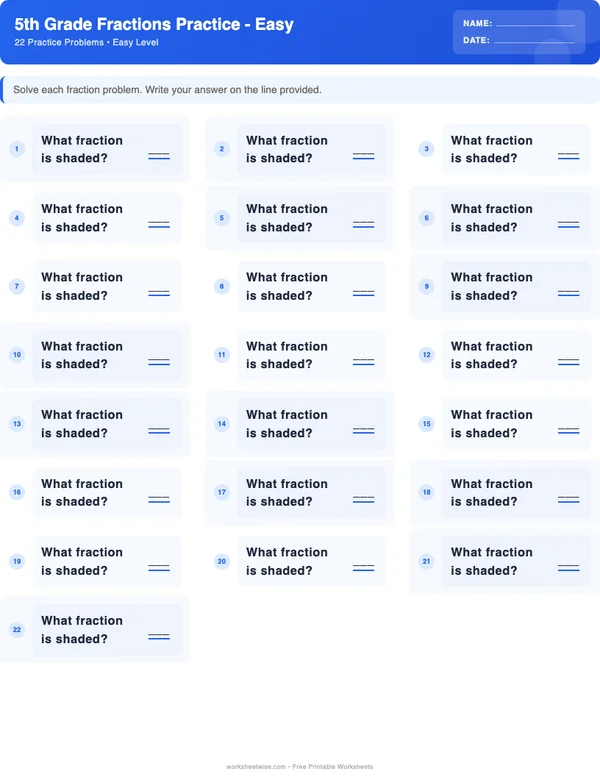
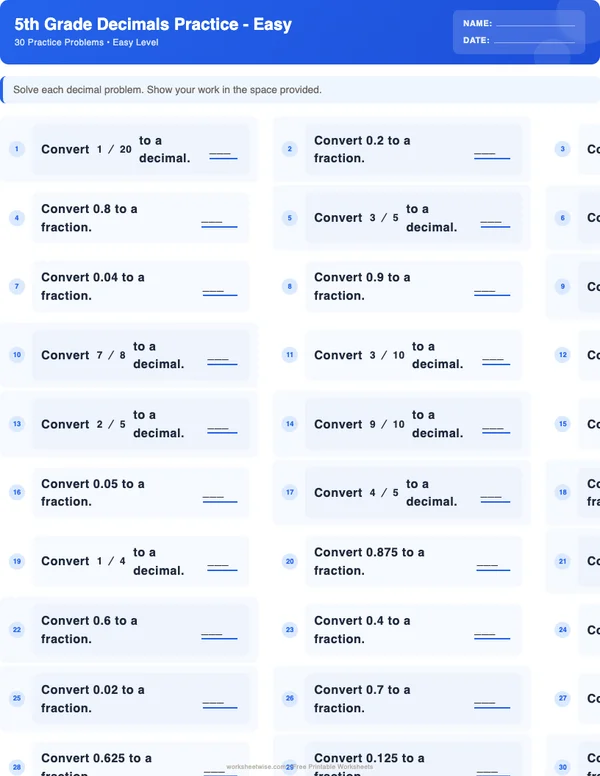
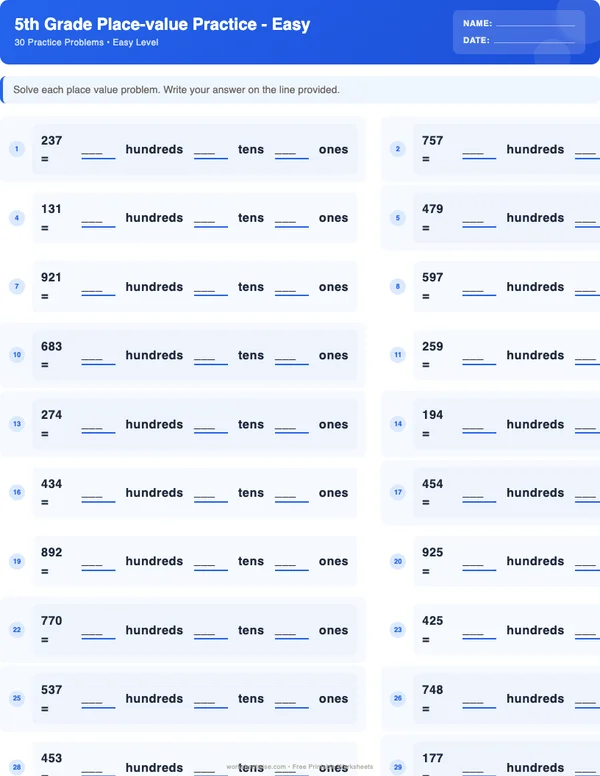
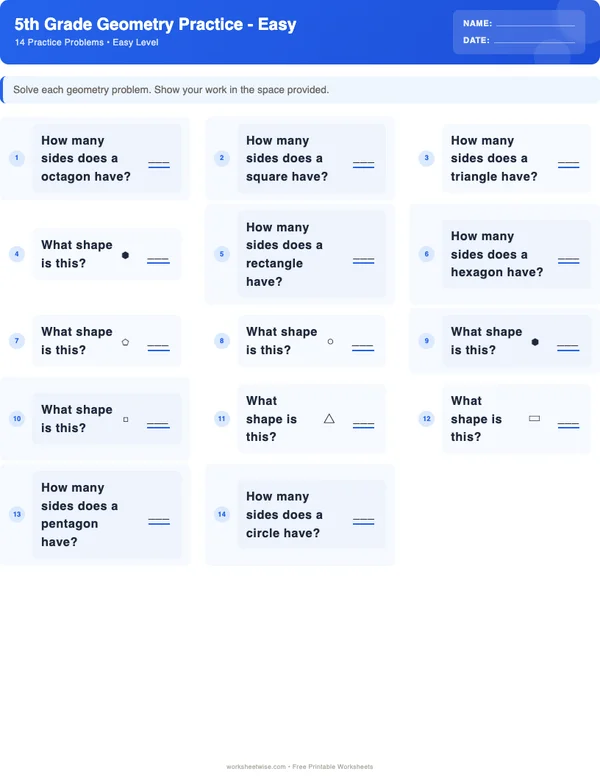
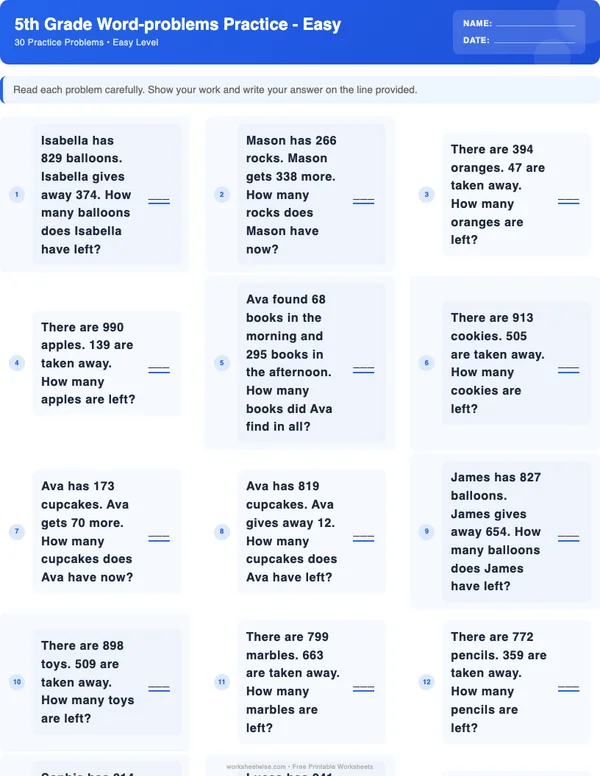
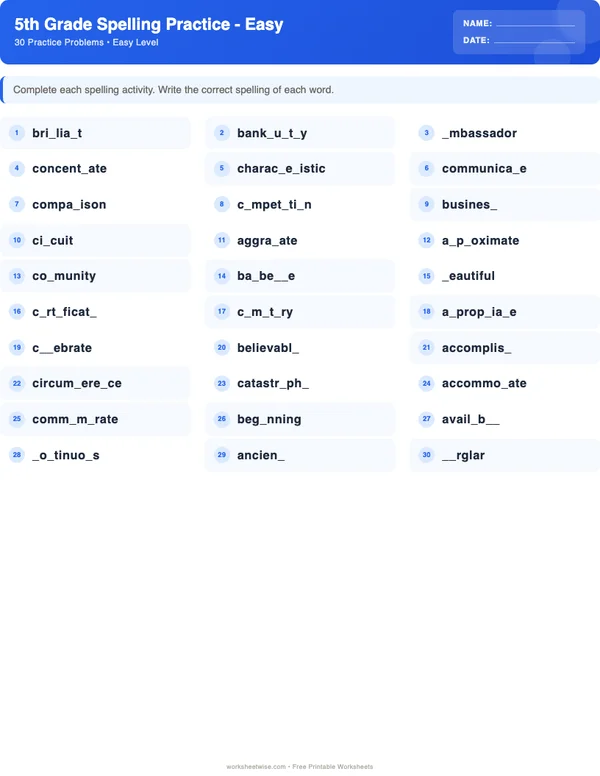
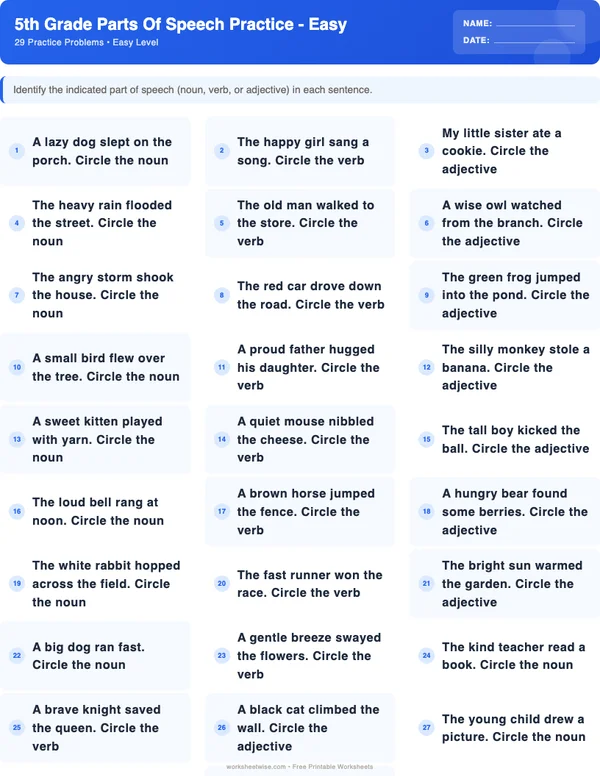
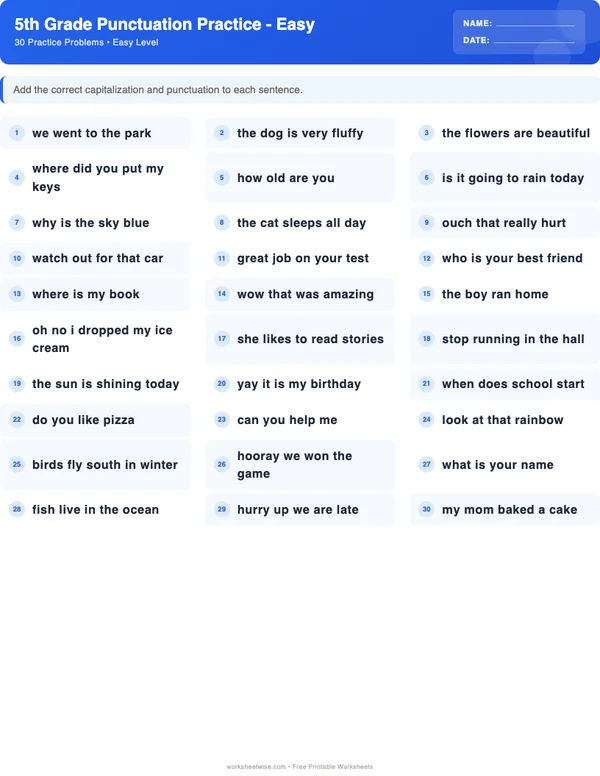
13 relevant free entry points are available. Each one includes a printable learner PDF and separate answer key.
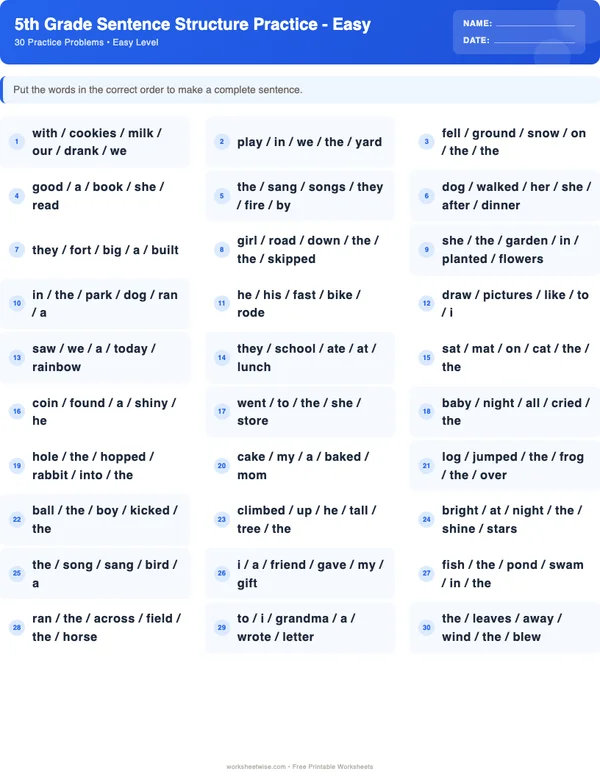
A useful practice loop
Print less. Observe more.
- Choose one skill and model the first item aloud.
- Use a short set and notice the learner’s strategy.
- Change the next task from the work you can see.
Need more than the free sheet?
Plus includes all 234 matching catalogue variations where available, plus saved deterministic generators and the worksheet designer.
See Plus membershipComplete guide
How to teach and practise worksheets for 10 year olds
3,287 words Updated 6 instructional visuals
Choose by the work you can observe, not by age alone
Worksheets for 10-year-olds are most useful when they provide fifth-grade practice and leave enough space for a learner’s reasoning to be seen. Fractions, decimals, place value, computation, spelling, and sentence structure all fit this purpose when an adult looks beyond the final answer: What model did the learner choose? Which step changed the value? Can the learner explain a correction?
Age is a discovery aid rather than a placement decision. Ten-year-olds vary in prior instruction, language experience, confidence, attention, and familiarity with worksheet formats. Start with a likely fifth-grade resource, observe a small sample of work, and then simplify, continue, or stop. Do not assign a level from age alone.
The live catalogue for this page contains 234 worksheet variants across three subjects and 13 topics, with 13 free entry points. Every listed resource is labeled for fifth-grade practice. Grade labels describe intended practice level; local curriculum sequences differ. A sheet can reveal a useful teaching need, but it cannot diagnose a learning condition or establish what an individual “should” know.
What fifth-grade practice should make visible
At this age, an answer-only page hides too much. Useful practice shows whether the learner can connect quantities, notation, and language.
In mathematics, look for written estimates, fraction bars, number lines, place-value labels, partial products, regrouping marks, or equations. In language work, look for spelling-pattern sorts, marked sentence boundaries, identified subjects and predicates, and revisions that improve an original sentence.
The Common Core mathematics standards provide one widely used description of fifth-grade work, including fraction operations, decimal place value and operations, volume, and coordinate geometry. The Common Core English language arts standards describe grade-level language and writing expectations. These are reference points, not proof that a particular page suits a particular learner, and they do not replace local curriculum requirements.
Observe the method before counting correct answers
For the first four to six items, watch for these behaviors:
- Does the learner read the direction and restate the task accurately?
- Does the learner estimate or predict before calculating?
- Are digits aligned by place value?
- Are fraction pieces or number-line intervals equal?
- Can the learner name why two fractions are equivalent?
- Does the learner reread a sentence aloud when checking punctuation?
- Can the learner locate the exact point where an answer stopped making sense?
- After one prompt, can the learner apply the same idea to the next item?
A learner who makes two calculation slips while showing a sound method needs a different response from one who produces correct answers through guessing or an unexplained rule. Record what happened, not a broad judgment such as “bad at fractions.”
Treat “easy” as a task description, not a learner label
The catalogue’s free sheets are marked “easy.” On this page, interpret that label through observable features: the resource is an entry point within a fifth-grade topic, the directions and response format are intended to be accessible, and the item set provides focused practice. The free sheets contain between 16 and 30 problems depending on topic; that count does not mean every problem must be completed in one sitting.
Do not describe a child as easy, developing, or advanced. Instead, describe the work: “solves decimal comparisons accurately when values are written on a hundredths grid,” or “adds unlike denominators without first finding equivalent fractions.” Those statements lead to an instructional decision.
Select a sheet with four concrete criteria
A good selection fits today’s target, reveals the intended reasoning, limits unrelated barriers, and can be sampled briefly.
Match one target, not a broad subject
“Do math” is too broad. Choose a narrower target such as:
- compare decimals by place value;
- explain one fraction equivalence;
- regroup in multi-digit subtraction;
- distinguish area from perimeter;
- combine two complete sentences;
- sort spelling words by a shared pattern.
Use the 5th Grade Fractions guide and free sheet for fraction-specific work and the 5th Grade Decimals guide and free sheet when decimal notation or comparison is the actual target. A child who needs decimal support does not necessarily need simpler whole-number computation.
Check the hidden demands
Before printing, inspect what the learner must do besides the target skill. A fraction word problem may also demand sustained reading. A spelling page may require handwriting endurance. A geometry task may depend on interpreting a diagram. If an unrelated demand would prevent you from observing the target, adapt that demand rather than removing the target.
For example, an adult can read a fraction problem aloud while the learner still chooses the operation, constructs the model, and calculates. That preserves fraction reasoning while reducing the reading load.
Prefer a format that permits explanation
Select items with room for models, labels, or revisions. If the printed page offers little space, add scrap paper. Ask for one annotated example rather than requiring written explanations beside every answer.
Decide the sample before starting
A 30-problem sheet is a resource bank, not a mandatory session. Mark six representative items: two that appear straightforward, two that require the central reasoning step, and two that vary the presentation. For a 22-problem fraction sheet, a six-item sample can show more than a rushed attempt at all 22.
Use a brief, active practice routine
A useful session can take 12 to 18 minutes. That duration is an editorial suggestion for manageable home or small-group use, not a sourced universal limit.
Preview, model, attempt, discuss, decide
- Preview for two minutes. Name the target and examine one item without solving it. Ask, “What will we need to pay attention to?”
- Model one example. The adult demonstrates the relevant representation and says why each step is valid.
- Attempt three to six items. The learner works while the adult watches, withholding immediate correction long enough to see the method.
- Discuss one correct and one incorrect response. Ask for reasoning rather than a defense: “Show me what this digit represents” or “Where does the first complete thought end?”
- Decide the next move. Simplify the representation, continue with two more items, or stop and record what to revisit.
This structure reflects guidance from the IES practice guide on assisting students struggling with mathematics, which supports systematic instruction, clear mathematical language, visual representations, and opportunities for students to explain their thinking. That guidance is general; IES did not assess WorksheetWise or these specific resources.
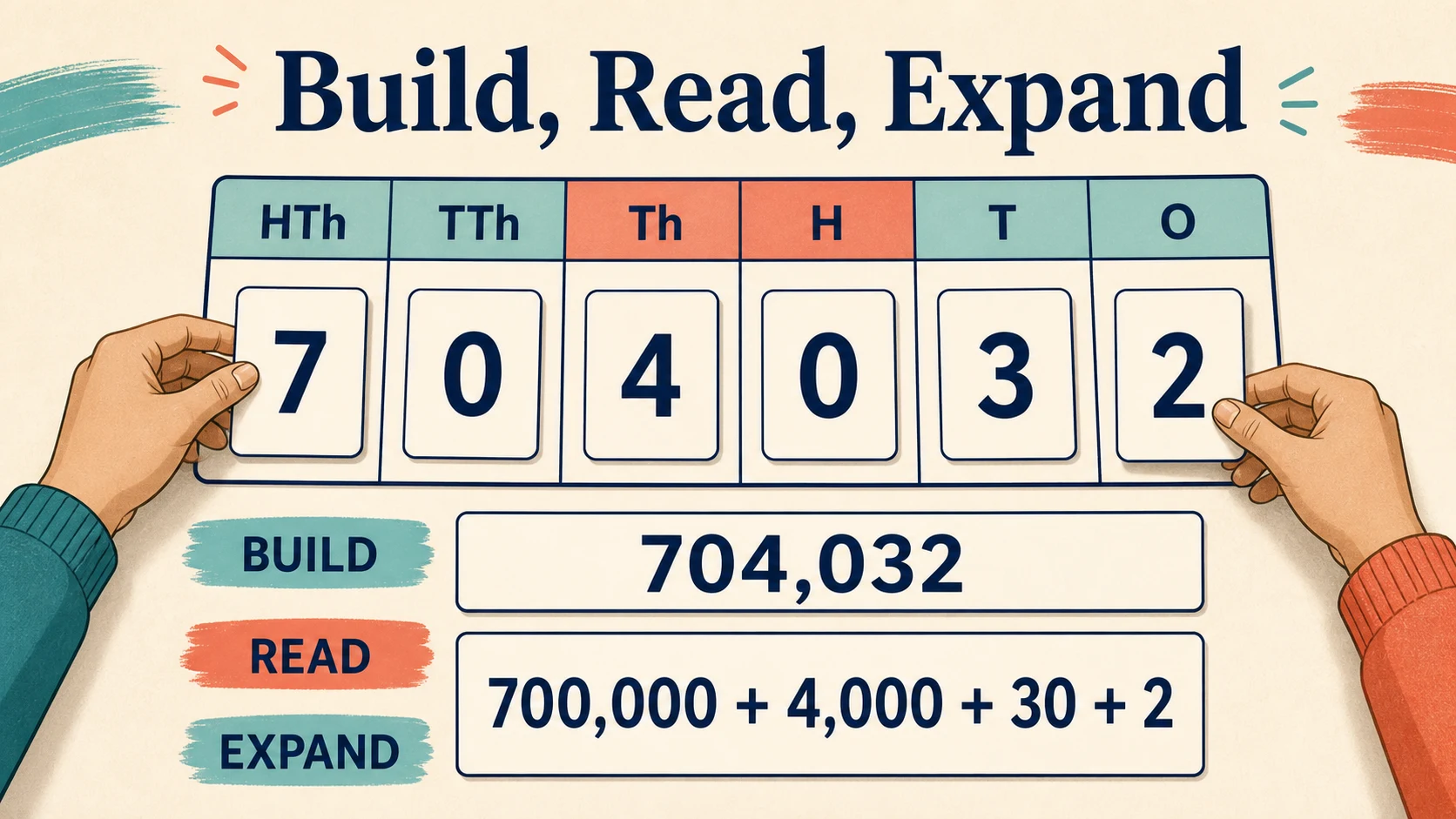
Use the place-value routine to make each digit’s value explicit before asking for independent decimal or computation practice.
Keep the learner physically and verbally involved
Paper should be one part of the task. Invite the learner to:
- build a decimal with base-ten blocks and then write it;
- fold strips to compare fractions;
- point to corresponding positions in two numbers;
- draw and label a number line;
- cut a run-on sentence at a proposed boundary;
- read a revised sentence aloud;
- sort spelling cards and state the shared pattern.
Talking and manipulating materials are not detours from fifth-grade work. They expose relationships that a column of answers can conceal.
Check four page-specific examples
Each example below uses the fifth-grade topics represented in this catalogue and has been checked step by step.
Fraction example: equivalent quantities before an algorithm
Ask the learner to compare and .
Draw two equal-length strips. Partition the first into four equal parts and shade three. Partition the second into eight equal parts and shade six. Both shaded lengths end at the same point, so:
The symbolic check also works: multiplying both numerator and denominator of by 2 gives . The value does not change because .
This belongs here because the catalogue’s fifth-grade fraction resource includes comparison, equivalence, mixed numbers, and operations, and its free sheet contains 22 problems. The example makes equivalence inspectable before a learner relies on a memorized procedure.
If the learner says is larger because 6 and 8 are larger numbers, return to equal-length strips. Preserve the equivalence target; simplify only the representation.
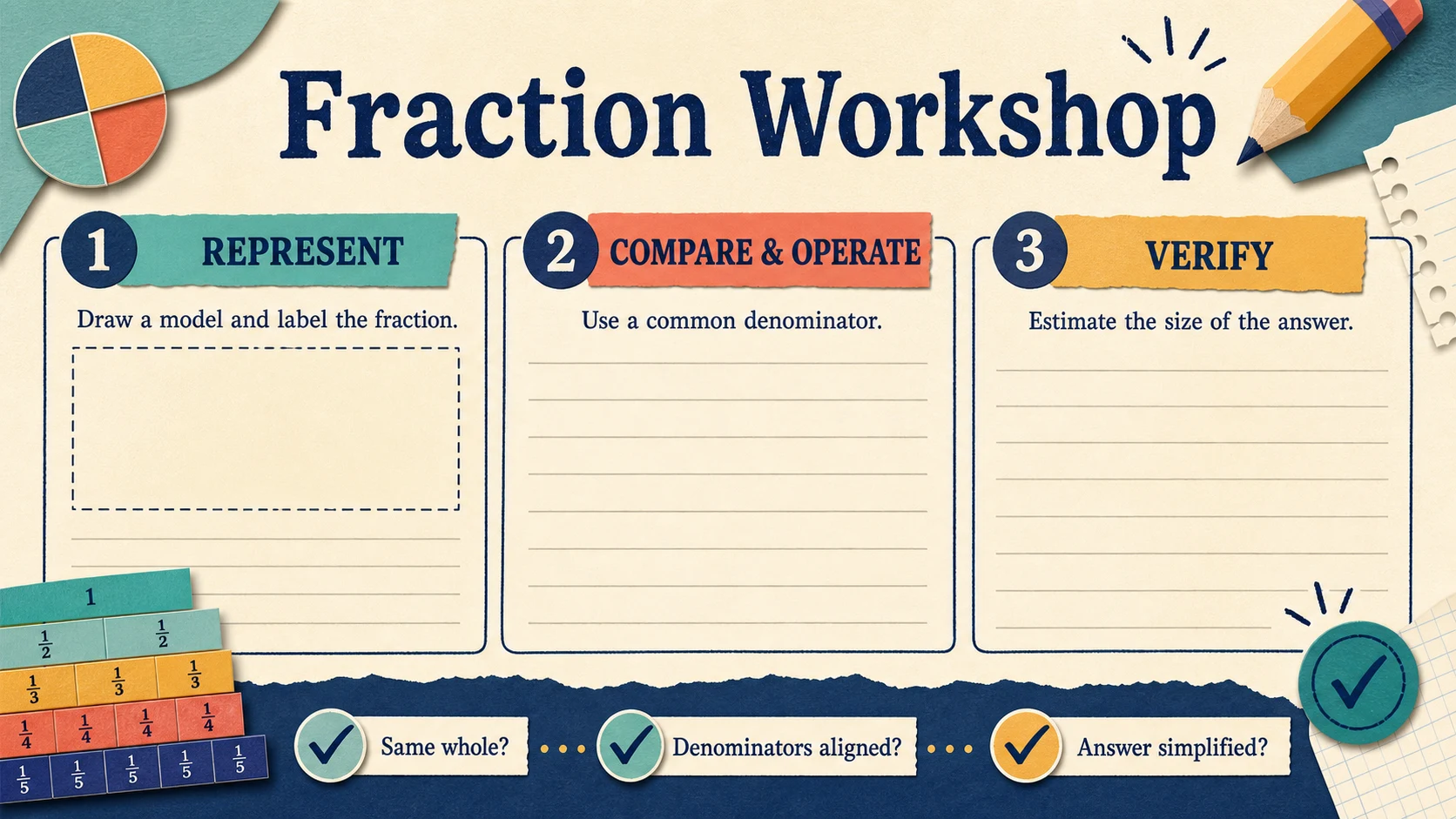
Space fraction practice across two weeks, revisiting representations and explanations instead of treating all 22 free-sheet items as one sitting.
Decimal example: compare by place value
Compare and .
Write as . The tenths digits are 3 and 4, so . On hundredths grids, 36 shaded squares are fewer than 40 shaded squares.
The checked statement is:
This belongs here because the fifth-grade decimal resource covers place value, comparison, rounding, conversion, and computation. It also addresses a particularly revealing error: assuming that a decimal with more digits must be greater.
If the learner chooses because “36 is more than 4,” ask what each digit represents. Do not switch immediately to whole-number comparison; keep the decimal target and add a place-value chart or hundredths grids.
Subtraction example: make regrouping a value-preserving trade
Calculate .
The ones column cannot show using the standard regrouping method. The tens digit is 0, so regroup one hundred as 10 tens:
Then regroup one ten as 10 ones:
Now subtract by place:
- Ones:
- Tens:
- Hundreds:
Therefore:
Check with addition: .
This belongs here because the fifth-grade subtraction resource provides 30 problems and emphasizes multi-digit subtraction, comparison, missing parts, and the inverse relationship with addition. The example reveals why crossing a zero requires two connected trades.
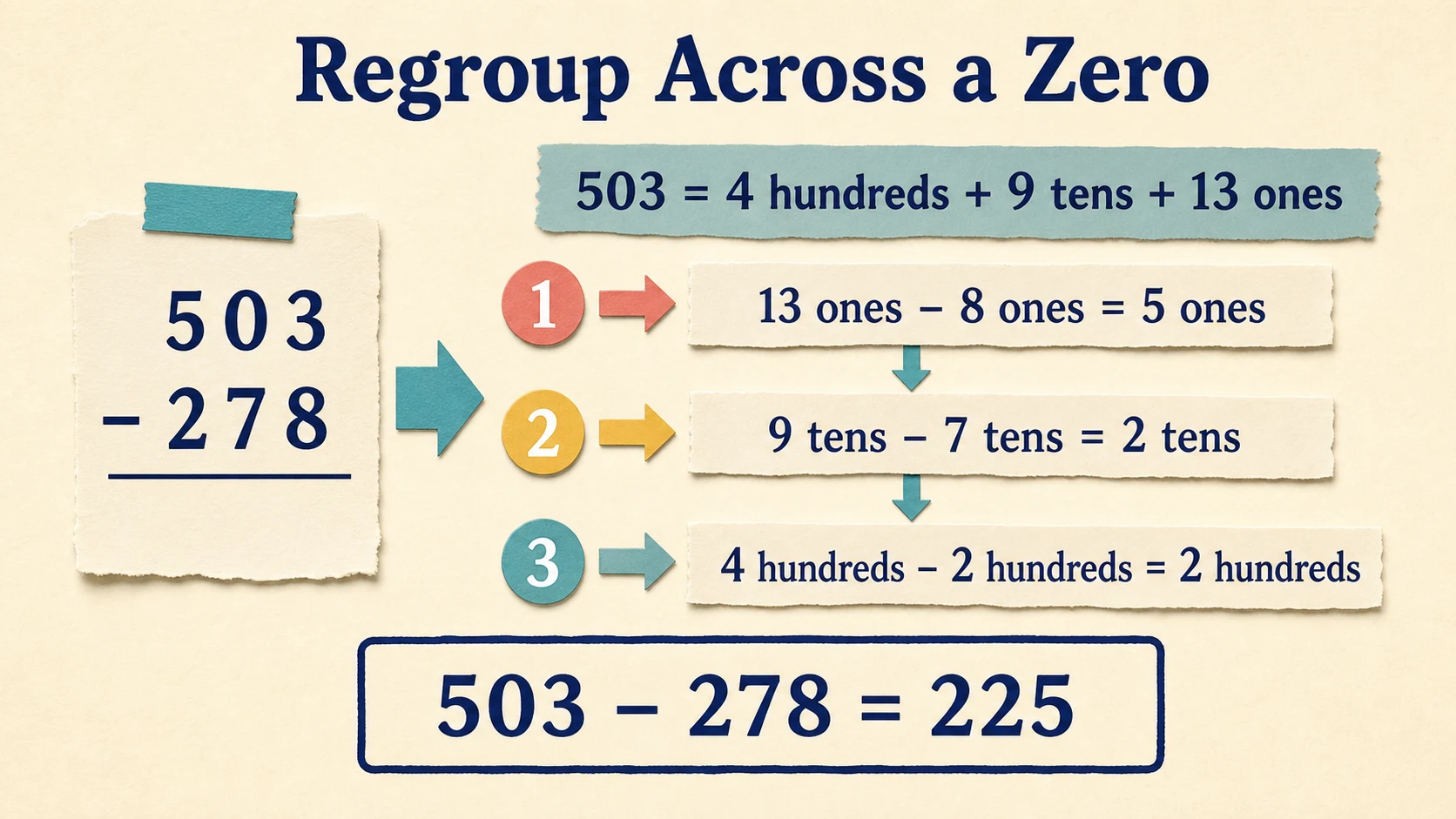
Move from a base-ten trade or labeled drawing to the written algorithm so every crossed-out digit retains a clear value.
Use the 5th Grade Subtraction guide and free sheet when regrouping is the actual practice target. If the learner loses track of the trades, use base-ten blocks or a place-value drawing; do not merely repeat “borrow.”
Sentence example: repair a run-on without changing the ideas
Consider:
Maya finished the model she carried it to the table.
There are two complete thoughts:
- Maya finished the model.
- She carried it to the table.
Several checked revisions are possible:
- Maya finished the model. She carried it to the table.
- Maya finished the model, and she carried it to the table.
- After Maya finished the model, she carried it to the table.
The first uses two sentences. The second uses a comma and coordinating conjunction. The third makes the timing relationship explicit with a dependent clause.
This belongs here because the fifth-grade sentence-structure resource includes complete sentences, fragments, run-ons, subjects and predicates, sentence combining, and sentence expansion. Ask the learner to read each revision aloud and explain how the ideas are connected.
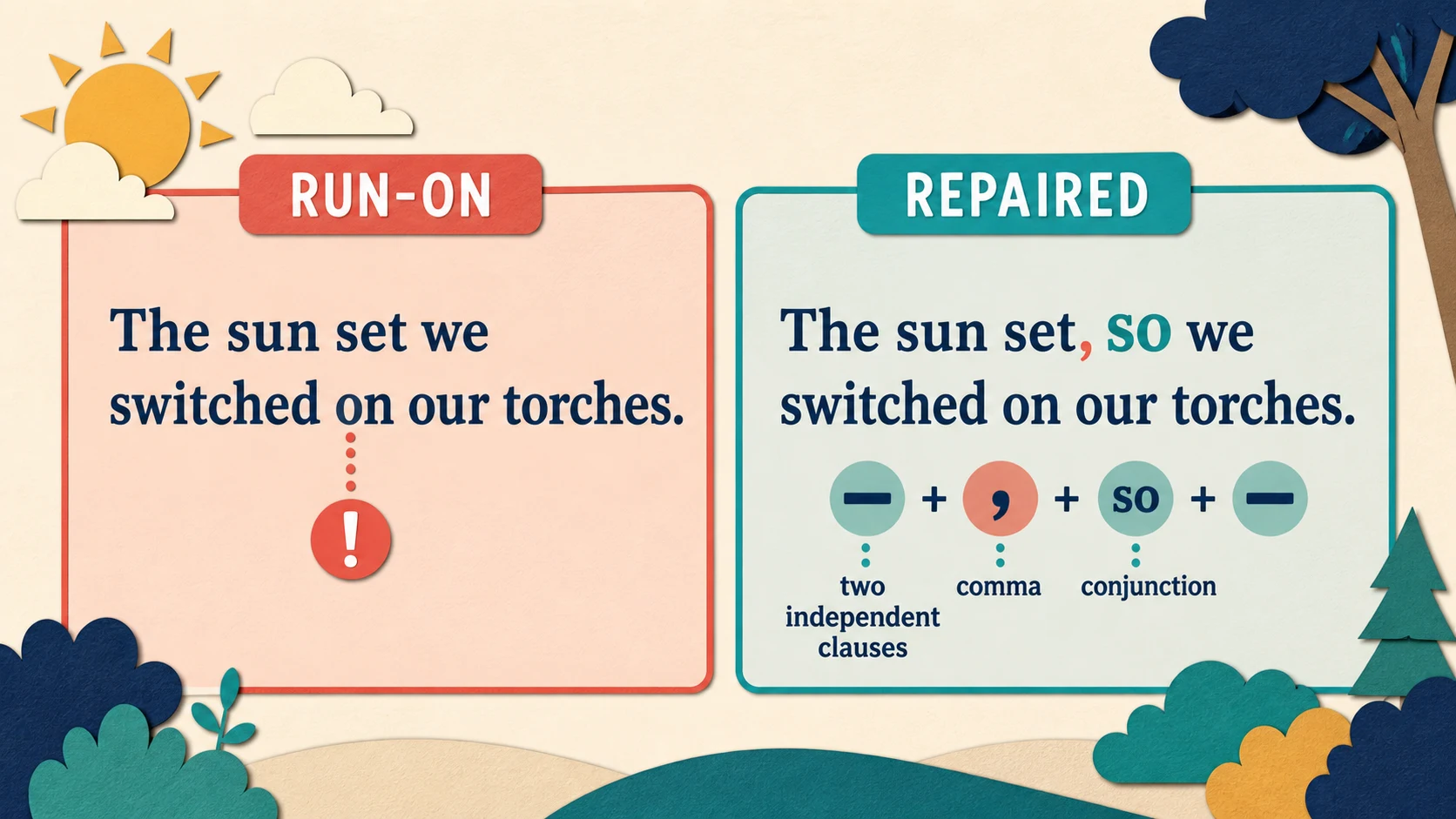
Respond to the visible sentence error—missing boundary, missing subject, or weak connection—rather than assigning more undifferentiated grammar questions.
The IES elementary writing practice guide recommends explicit instruction in the writing process and foundational writing skills, along with supported practice. Here, that means modeling a sentence boundary, letting the learner try a revision, and discussing its effect. It does not mean a worksheet alone constitutes a complete writing program.
Geometry example: separate area from perimeter
A rectangle is 5 units long and 3 units wide.
Its area is:
Its perimeter is:
These values are close, but they measure different attributes. Area counts the unit squares covering the interior; perimeter measures the distance around the boundary.
This belongs here because the catalogue’s fifth-grade geometry resource includes area, perimeter, volume, angles, coordinates, symmetry, and shape properties. A learner who writes 16 square units for area may understand the calculation but not the unit or attribute.
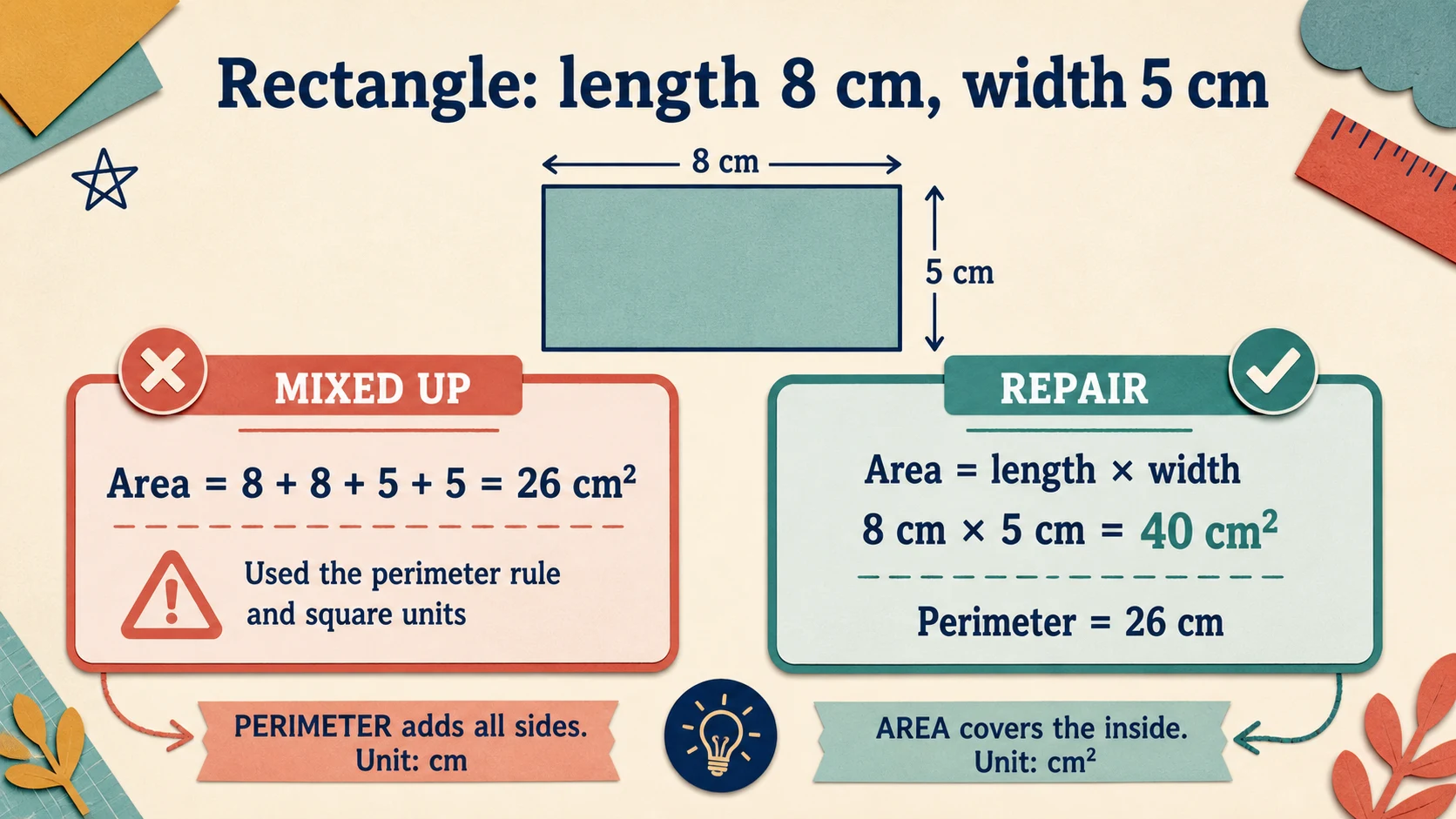
Use the diagram and unit labels to determine whether an error concerns calculation, vocabulary, or confusion between interior coverage and boundary length.
Interpret errors as evidence for the next prompt
Do not treat every wrong answer as evidence that the sheet is too difficult. First classify what is observable.
A representation error
The learner draws thirds of visibly unequal sizes or places at the third tick without checking how the interval was partitioned. Ask the learner to rebuild the model with equal partitions. Continue only after the representation matches the quantity.
A place-value error
The learner aligns by the final digits instead of the decimal points. Ask for expanded forms:
Then rewrite as and align like places. The correct sum is . Preserve decimal addition as the target while making place values visible.
A procedure-without-meaning error
The learner correctly generates equivalent fractions but cannot explain why numerator and denominator change together. Ask for one paper-strip or number-line demonstration. One well-explained equivalence is more useful than ten unexplained correct conversions.
A language or boundary error
The learner inserts punctuation according to where a breath occurs rather than where a complete thought ends. Ask, “Who or what is this part about, and what is happening?” Mark each subject-predicate unit before selecting punctuation.
A transcription or attention slip
The learner explains accurately but copies 178 as 187. Have the learner compare the copied problem with the source and correct it. Do not reteach regrouping unless the work also shows a regrouping misunderstanding.
These descriptions support teaching decisions; they are not diagnoses. Persistent difficulty may justify discussion with the learner’s teacher or another qualified professional, but a worksheet sample alone cannot identify its cause.
Adapt access while preserving the fifth-grade target
An adaptation is useful when it removes an unrelated barrier without doing the central reasoning for the learner.
For fraction work, an adult may cut equal paper strips, but the learner should decide the partitions, shade the quantities, and compare them. For decimal work, provide a place-value chart, but let the learner place the digits and state their values. For a word problem, read the text aloud, but require the learner to retell the situation, choose a model, and calculate.
For sentence work, allow oral rehearsal or adult transcription when handwriting is the barrier. The learner should still decide how the sentence begins, where clauses connect, and which punctuation fits. For spelling, say each word in a sentence and permit movable letter cards, while preserving the task of selecting and ordering the spelling pattern.
Reduce visible load by covering unused rows, folding the page, or presenting one item at a time. Increase writing space. Alternate pencil work with a verbal explanation or material model. None of these changes requires replacing fifth-grade reasoning with an earlier target.
Do simplify the mathematical or language target when the observed prerequisite is missing. A learner who cannot show that is smaller than with equal wholes is not ready to gain much from a full page of unlike-denominator addition. Work first on equal partitions, unit fractions, and comparison.
Decide whether to simplify, continue, or stop
Use evidence from a short sample rather than a preset score.
Simplify the representation when the idea is emerging
Simplify when the learner can describe part of the relationship but cannot yet coordinate the notation or steps. Examples include identifying tenths correctly but losing hundredths, or hearing two ideas in a run-on but not selecting a boundary.
Keep the target and add one support: a number line, fraction strip, place-value chart, color coding, oral rehearsal, or a completed first step. Try one new item. If the learner uses the support productively, continue briefly.
Continue when the method transfers
Continue for two or three additional items when the learner explains the model, corrects a small error, and independently applies the correction to a new example. Vary one feature rather than repeating an identical item. After comparing and , try and . The tenths are equal, so the hundredths decide: .
Stop while the reasoning is still attentive. Finishing every row is not the goal.
Stop when practice is no longer informative
Stop if the learner is guessing repeatedly, cannot state the task after it is reread, becomes too frustrated to discuss a step, or repeats the same error after modeling and a supported retry. Also stop when the sample is uniformly accurate and explanations are secure; more identical items may add little evidence.
Record a neutral note: “Compared tenths independently; needs a grid when tenths match,” or “Found both complete thoughts but needs practice choosing conjunctions.” That note gives the next session a precise starting point.
Build review around retrieval and transfer
A worksheet should reappear as a source of selected examples, not as a one-use packet.
For fractions, revisit one model after two or three days and ask the learner to explain it without looking at the original solution. Then change the numbers. For decimals, alternate comparison, expanded form, and a short computation so place value remains central across formats.
For spelling, organize words by pattern rather than practicing an unrelated list. A two-week plan can include an initial sort, look-cover-write-check, sentence dictation, a pattern hunt in reading, and a cumulative review. The IES foundational reading practice guide supports explicit work connecting sounds, letters, word reading, and connected text in foundational instruction. For an older elementary learner, spelling practice should still connect patterns to reading and authentic writing rather than consist only of copying.
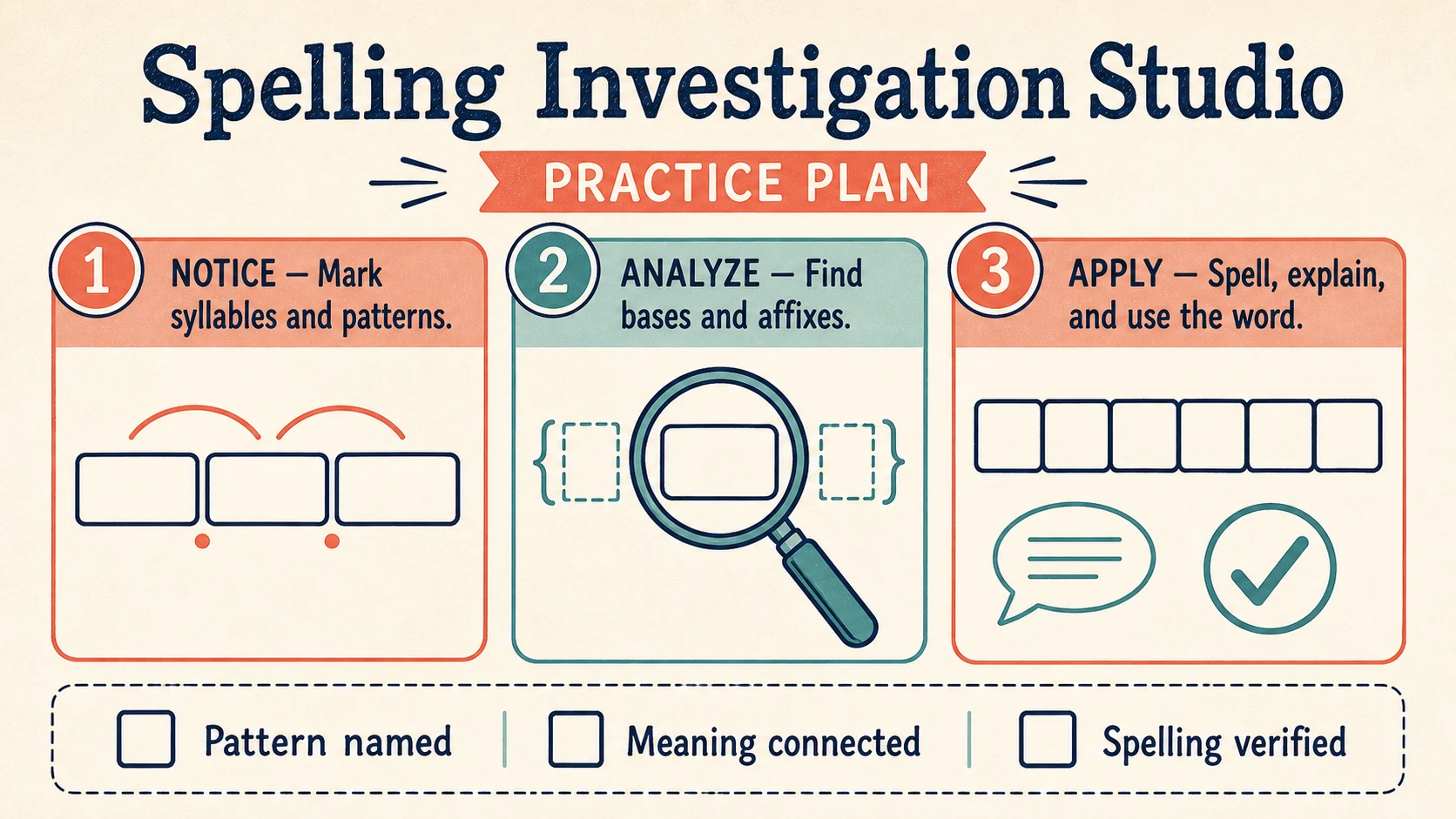
Use the plan to move from noticing a spelling pattern to retrieving it in dictation and applying it in the learner’s own sentence.
Keep the catalogue’s boundaries clear
This age page is filtered to fifth-grade resources. Its 234 variants, 13 topics, and 13 free entry points offer choice, but they do not form an individualized curriculum. The available subject areas and topic counts describe the live catalogue, not everything a 10-year-old may need.
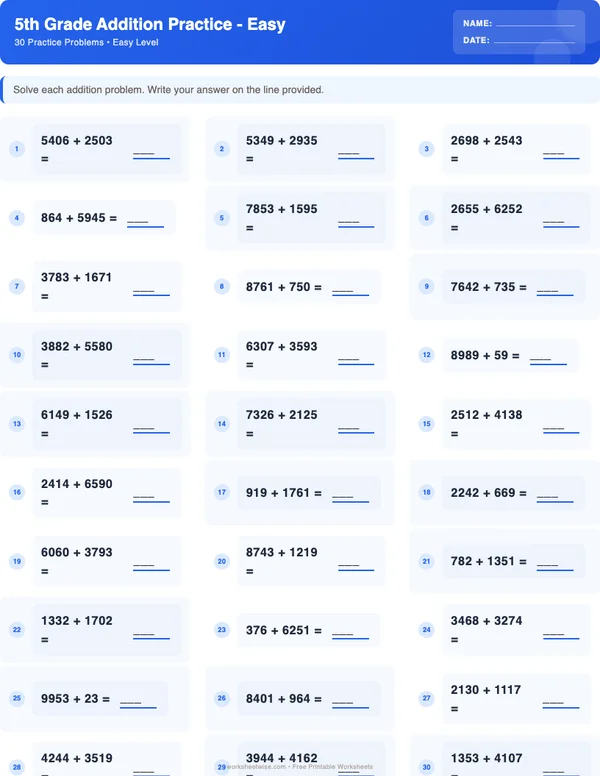
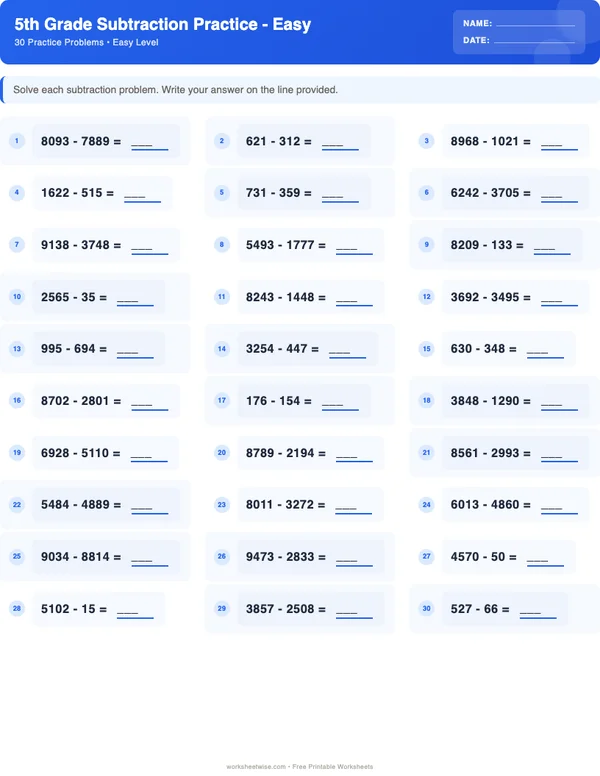
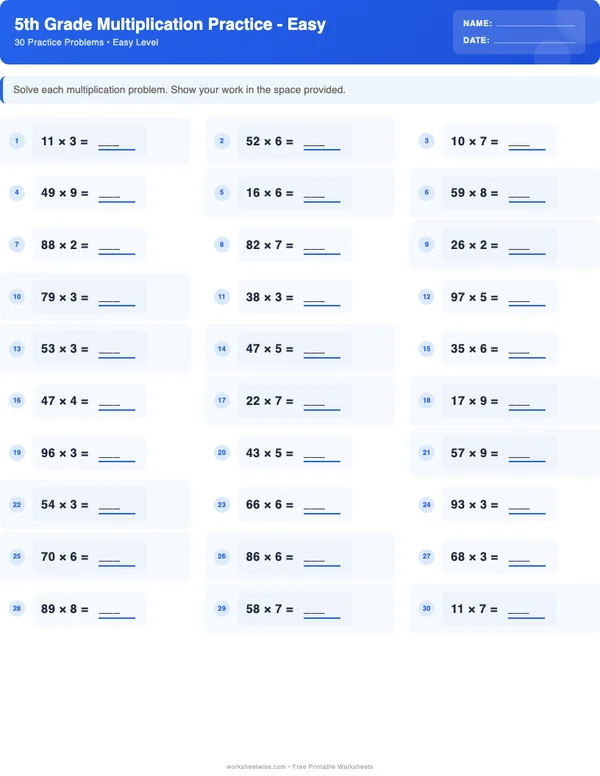
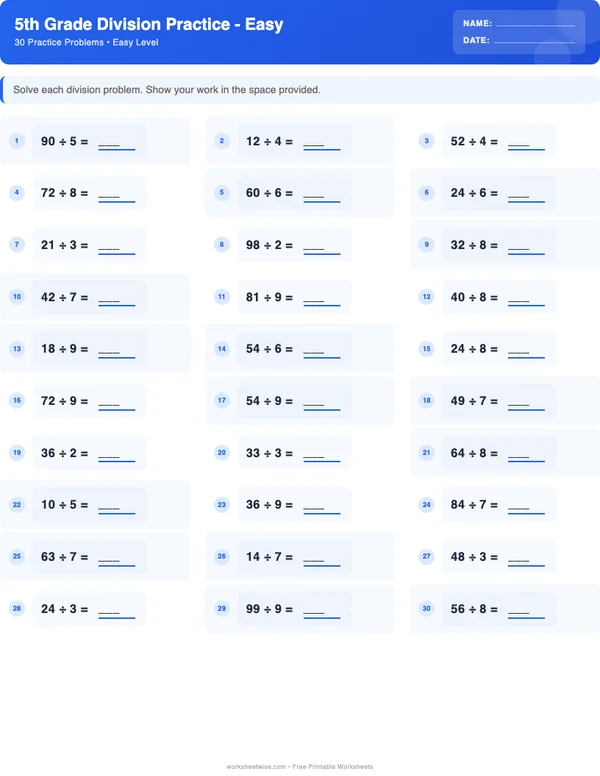
The representative free resources include 30-problem sheets for addition, subtraction, multiplication, division, decimals, place value, geometry, spelling words, punctuation, and sentence structure; a 29-problem parts-of-speech sheet; a 22-problem fraction sheet; and a 16-problem word-problem sheet. Problem counts describe page contents, not an appropriate daily dose.
Worksheet performance can be affected by reading, vision, language familiarity, motor demands, fatigue, prior instruction, or the way a direction is phrased. Do not infer a diagnosis, overall grade placement, or likely future outcome from one page. When school expectations matter, compare the task with the learner’s current instruction and ask the teacher what representations and terminology are being used.
Age pages for 11-year-olds and 12-year-olds may help an adult discover other catalogue options, but moving to an older age page is not automatically “advancing.” Select according to the observed target and task features.
Make the next session one observable experiment
Choose one item from the free deterministic worksheet generators that matches a current target—fraction equivalence, decimal place value, regrouping, or sentence repair. Before printing, decide what evidence you will watch for.
For example: “The learner will compare two decimals, label tenths and hundredths, and explain the choice.” Run the preview-model-attempt-discuss routine with no more than six items. End by writing one factual note and one next action: “Aligned decimal places accurately on four items; next time, compare values with equal tenths and different hundredths.”
Put it into practice
Use the guide with a real printable
Move from explanation to a short, observable practice task. Check the first item together, then adjust the next session from the learner's actual work.
Open the first free worksheetExplore a neighboring collection
Choose by a different teaching need
Worksheets for 11-Year-Olds: Printable Practice Guide Worksheets for 12-Year-Olds: Printable Practice Guide Worksheets for 3-Year-Olds: Printable Practice Guide Worksheets for 4-Year-Olds: Printable Practice Guide Worksheets for 5-Year-Olds: Printable Practice Guide Worksheets for 6-Year-Olds: Printable Practice Guide Worksheets for 7-Year-Olds: Printable Practice Guide Worksheets for 8-Year-Olds: Printable Practice Guide