What 3rd Grade Decimals Should Mean
For a 3rd Grade learner, decimal work should build a careful bridge from familiar whole-number place value and simple fractions to numbers smaller than one. The most useful starting goals are to:
- Recognize tenths and hundredths in concrete and visual models.
- Connect fractions such as 3/10 and 25/100 with 0.3 and 0.25.
- Read and write simple decimals accurately.
- Locate decimals on a number line.
- Compare decimals by value rather than by the number of digits.
- Apply the ideas to familiar measurement and money examples.
The learner does not need to rush through every kind of decimal computation. In the Common Core mathematics progression, formal work with fractions written as decimals and comparisons through hundredths appears in Grade 4, while broader decimal computation follows later. A 3rd Grade decimal lesson is therefore often introductory, preparatory, or enrichment work. Grade labels describe the intended practice level, and local school, state, homeschool, and tutoring sequences differ.
The central question is not “Has the learner completed a decimal worksheet?” It is “Can the learner explain what the decimal represents?” If a learner can shade 0.4, identify it as four tenths, and place it correctly between 0 and 1, the notation has meaning. If the learner can only repeat a rule, return to a model before increasing the difficulty.
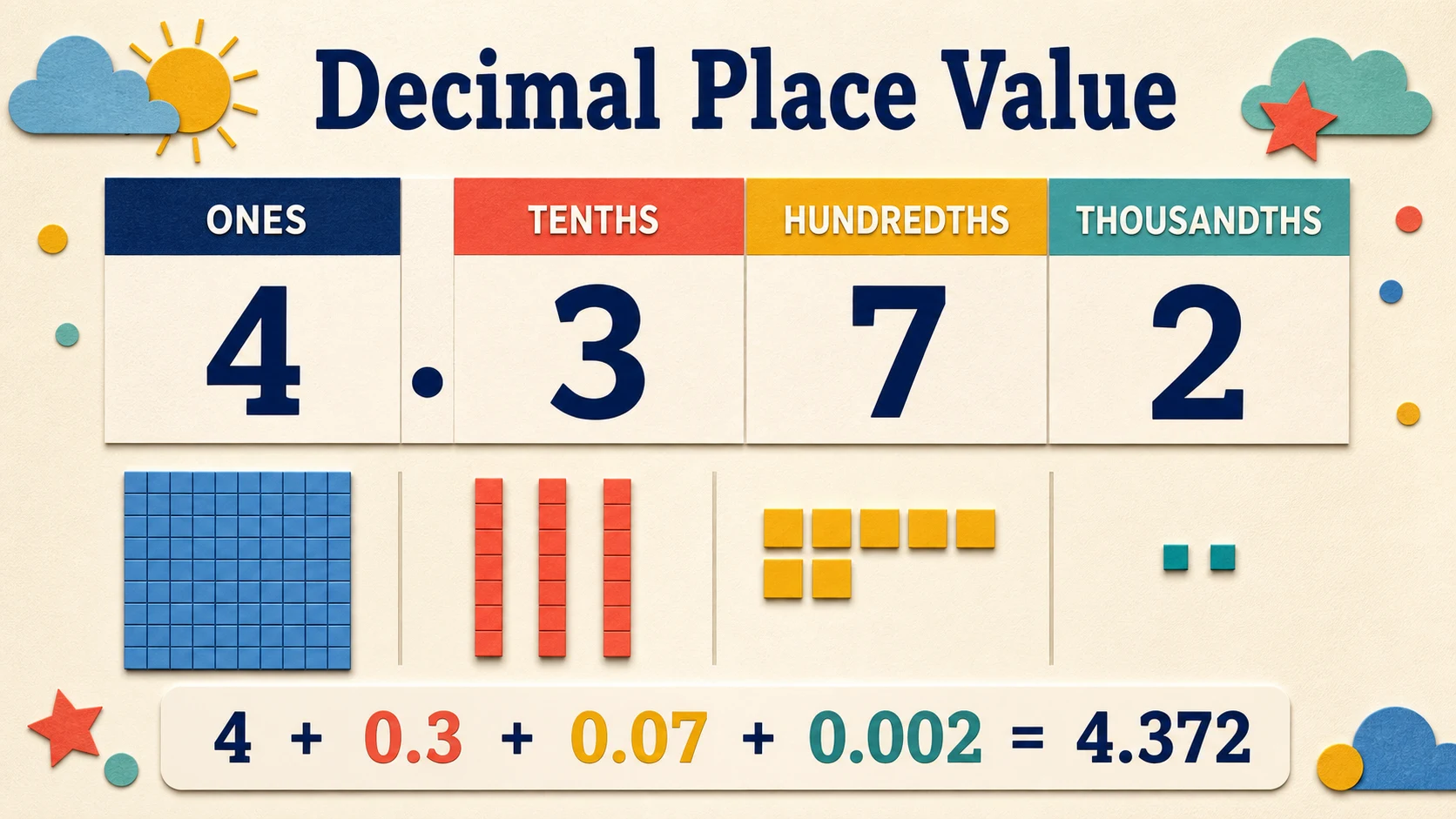
Decimal notation grows from place value, equal parts, visual models, and mathematical language.
Prerequisites to Check First
Decimal instruction becomes more manageable when the learner already has several connected ideas. Check these informally rather than assuming that a completed grade level guarantees readiness.
Whole-number place value
Ask the learner to describe the value of each digit in 352. A secure explanation identifies 3 hundreds, 5 tens, and 2 ones. Then ask what happens when a digit moves one place to the left or right.
The purpose is to establish that position determines value. Decimal places extend this base-ten structure to the right of the ones place. Avoid presenting the decimal point as an unexplained separator.
Equal parts and fraction notation
Use a strip divided into ten equal sections. Shade three and ask:
- How many equal parts are there altogether?
- How many are shaded?
- What fraction is shaded?
A learner ready for the first decimal connection should identify 3/10. Repeat with a hundred grid if hundredths are planned. The learner does not need advanced fraction computation, but must understand that the denominator names the number of equal parts in one whole.
Counting and comparing within one whole
Check whether the learner can count tenths in order:
0/10, 1/10, 2/10,…, 10/10
Confirm that 10/10=1. This boundary matters because decimals are not a separate kind of number detached from whole numbers.
Also ask the learner to compare fractions with the same denominator, such as 3/10 and 7/10. If the learner cannot yet explain why 7/10 is greater, strengthen fraction models before introducing decimal comparison.
Number-line orientation
The learner should know that values increase from left to right and that intervals must be equal. Draw a line from 0 to 1 divided into ten equal intervals. Ask for the locations of 2/10, 5/10, and 9/10.
An incorrect response may reveal a number-line issue rather than a decimal issue. Diagnose that distinction before selecting practice.
A Grade-Appropriate Teaching Progression
The sequence below is an instructional suggestion, not a universal timetable. Move forward when the learner’s explanations and work show readiness.
| Stage |
Teaching focus |
Useful representation |
Evidence to look for |
| 1 |
Revisit one whole and equal parts |
Fraction strips, folded paper |
Identifies tenths as ten equal parts |
| 2 |
Name tenths as fractions and decimals |
Ten-frame strip, base-ten rod |
Connects 4/10 with 0.4 |
| 3 |
Place tenths on a number line |
0-to-1 line split into tenths |
Locates and orders tenths |
| 4 |
Build hundredths |
Hundred grid, base-ten cubes |
Connects 23/100 with 0.23 |
| 5 |
Relate tenths and hundredths |
Paired grids or blocks |
Explains that 0.4=0.40 |
| 6 |
Compare decimals |
Grids, number lines, place-value chart |
Compares by place value |
| 7 |
Use simple contexts |
Money and measurement |
Interprets the decimal in context |
| 8 |
Introduce supported computation |
Models, expanded form, estimation |
Explains an answer and checks whether it is reasonable |
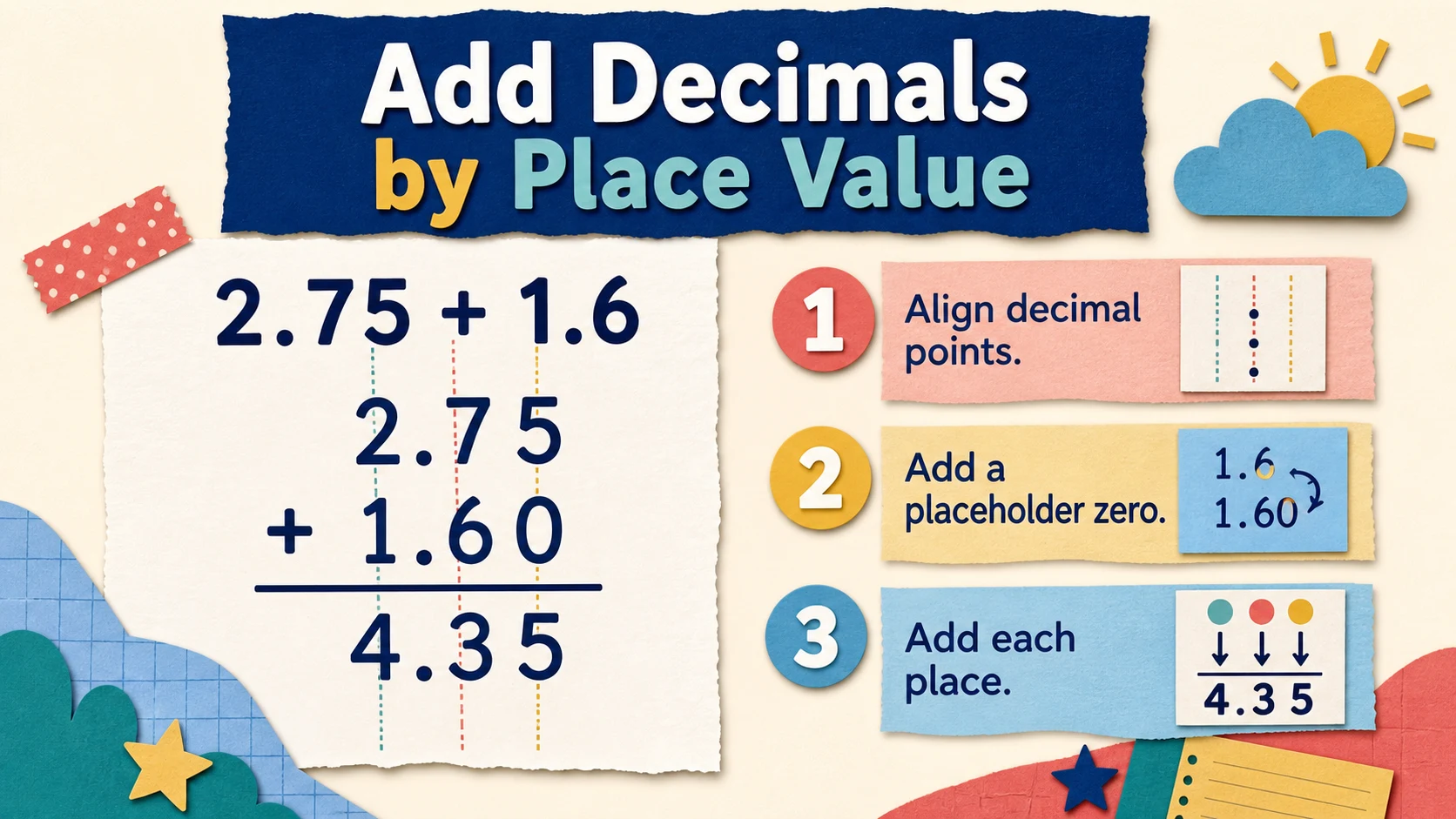
Progress should be based on observed understanding, not on finishing a fixed number of pages.
The IES guide for teaching mathematics to young children provides high-level support for purposeful progressions, mathematical language, progress monitoring, and helping learners connect representations. It does not evaluate WorksheetWise materials or prescribe this exact sequence.
Concrete and Visual Models That Clarify Value
A good model makes the unit visible. State what represents one whole before asking the learner to interpret any smaller piece.
Base-ten blocks
For decimal work, define the flat as 1 whole, a rod as 0.1, and a small cube as 0.01. Under that definition:
- 1 flat represents 1.
- 1 rod represents 1/10=0.1.
- 10 rods represent 1.
- 1 small cube represents 1/100=0.01.
- 10 small cubes represent 1/10=0.1.
The unit assignment must remain consistent. If a learner previously used a small cube as one whole during whole-number work, explicitly explain that the chosen whole has changed.
Tenths strips and hundredths grids
A strip divided into ten equal parts is well suited to tenths. A square divided into 100 equal cells shows hundredths.
To represent 0.36, shade 36 cells on a hundred grid. To represent 0.4, shade 40 cells, not four cells. Placing the two grids side by side makes it visible that 0.40>0.36.
Grids also clarify equivalence. Four shaded tenths cover the same area as 40 shaded hundredths, so:
0.4=0.40
Place-value charts
Use columns labeled ones, tenths, and hundredths.
| Ones |
Tenths |
Hundredths |
| 0 |
4 |
7 |
The chart represents 0.47: zero ones, four tenths, and seven hundredths. Ask the learner to say the value of each digit, not merely read “point four seven.”
Expanded form gives another view:
0.47=0.4+0.07=104+1007
Number lines
Number lines show order and distance. Divide the interval from 0 to 1 into ten equal sections for tenths. For hundredths, enlarge one tenth rather than crowding 100 tiny intervals onto one line.
For example, first locate 0.3 and 0.4. Then enlarge that interval and divide it into ten equal parts to locate 0.36. This shows that 0.36 lies between 0.3 and 0.4.
Money as a supporting context
When one dollar is the whole, a dime is 0.10 dollar and a cent is 0.01 dollar. Thus 25 cents can be written as $0.25, or 25 hundredths of a dollar.
Money is useful, but it should not be the only model. Tenths of a dollar are less visible in ordinary price notation, and familiarity with coins does not automatically establish general decimal place value.
Fully Checked Worked Examples
Example 1: Convert tenths to a decimal
Problem: Write 7/10 as a decimal.
A whole is divided into ten equal parts. Seven parts are selected. The digit 7 belongs in the tenths place:
107=0.7
Check: Seven tenths means 0 ones and 7 tenths. On a ten-part strip, seven sections would be shaded. The answer is between 0 and 1, as expected.
Example 2: Convert hundredths to a decimal
Problem: Write 34/100 as a decimal.
Thirty-four hundredths can be decomposed into 3 tenths and 4 hundredths:
10034=10030+1004
Because 30/100=3/10:
10034=0.3+0.04=0.34
Check: A hundred grid with 34 shaded cells contains three complete groups of ten and four additional cells. The place-value chart shows 3 tenths and 4 hundredths.
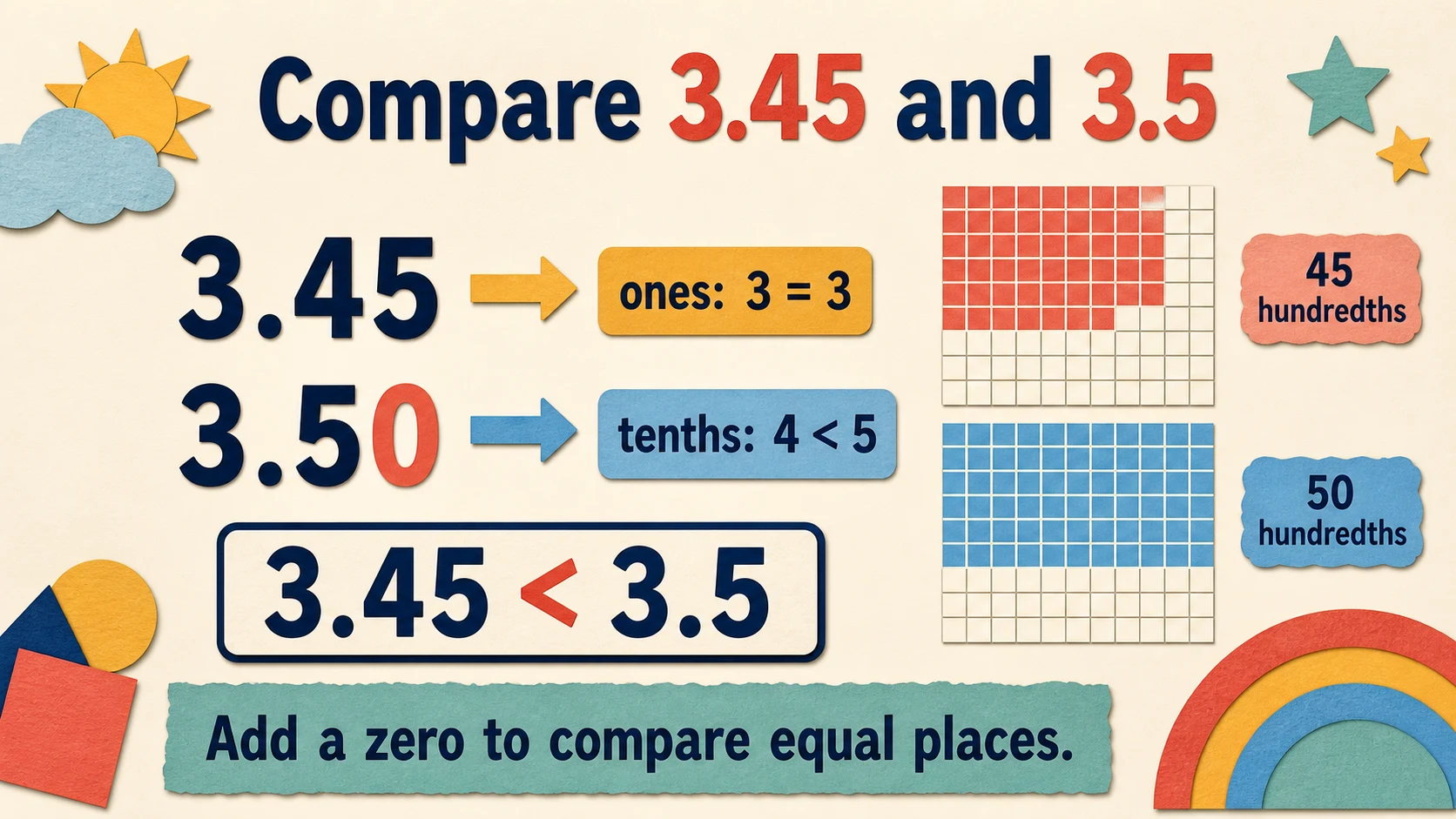
Move from the quantity to the model, then to fraction and decimal notation.
Example 3: Compare decimals of different lengths
Problem: Compare 0.4 and 0.36.
Rewrite four tenths in hundredths:
0.4=0.40
Now compare:
0.40>0.36
Therefore:
0.4>0.36
Check with a model: Forty cells on a hundred grid are more than 36 cells. The longer decimal is not automatically greater; the place values determine the comparison.
Example 4: Order three decimals
Problem: Order 0.8, 0.25, and 0.52 from least to greatest.
Write each number through hundredths:
0.8=0.80,0.25=0.25,0.52=0.52
Compare the tenths digits first:
- 0.25 has 2 tenths.
- 0.52 has 5 tenths.
- 0.80 has 8 tenths.
So:
0.25<0.52<0.8
Check: Their approximate positions on a 0-to-1 number line are one quarter, just over one half, and eight tenths. The order is reasonable.
Example 5: Add decimals with a model
Problem: Find 0.3+0.4.
Three tenths plus four tenths equals seven tenths:
103+104=107
Therefore:
0.3+0.4=0.7
Check: Shade three sections of one tenths strip and then four more. Seven of the ten sections are shaded. Since 0.3 and 0.4 are each less than 1, and their sum is less than 1, 0.7 is reasonable.
Example 6: Subtract across a tenth
Problem: Find 0.50−0.23.
Interpret the numbers as hundredths:
0.50=10050,0.23=10023
Subtract:
10050−10023=10027=0.27
Check by addition:
0.27+0.23=0.50
A hundred grid also confirms that removing 23 shaded cells from 50 leaves 27.
Example 7: A simple multiplication preview
Problem: Find three groups of 0.2.
Represent the problem as repeated addition:
0.2+0.2+0.2=0.6
Thus:
3×0.2=0.6
Check: Each group contains two tenths. Three groups contain six tenths. This example previews decimal multiplication through a model; it is not a reason to move immediately to a general decimal-multiplication algorithm.
Boundary Cases Learners Need to See
Include examples near important boundaries, not only tidy middle values.
Zero and one whole
Make these relationships explicit:
0/10=0,10/10=1
0/100=0,100/100=1
A decimal such as 0.99 is less than 1, while 1.00=1. Ask the learner to locate 0, 0.1, 0.9, 0.99, and 1 on appropriate number lines.
Equivalent decimal forms
Trailing zeros to the right of a decimal do not change its value:
0.5=0.50
This does not mean zeros can be inserted anywhere. For example:
0.5=0.05
The first number is five tenths; the second is five hundredths.
Values around one tenth
Compare:
0.09<0.10<0.11
This set checks whether the learner understands that ten hundredths make one tenth. It also exposes the mistaken idea that 9 hundredths must exceed 1 tenth because 9 is greater than 1.
Decimals greater than one
If the learner is secure within one whole, briefly connect the ideas to a mixed quantity:
1.3=1+103
Use one whole model and three tenths. Do not expand the range merely because the learner can read the notation; check whether the learner can still describe the unit and each digit’s value.
A Short, Repeatable Lesson Routine
A focused lesson can be brief. The times below are flexible instructional suggestions, not sourced requirements or a universal schedule.
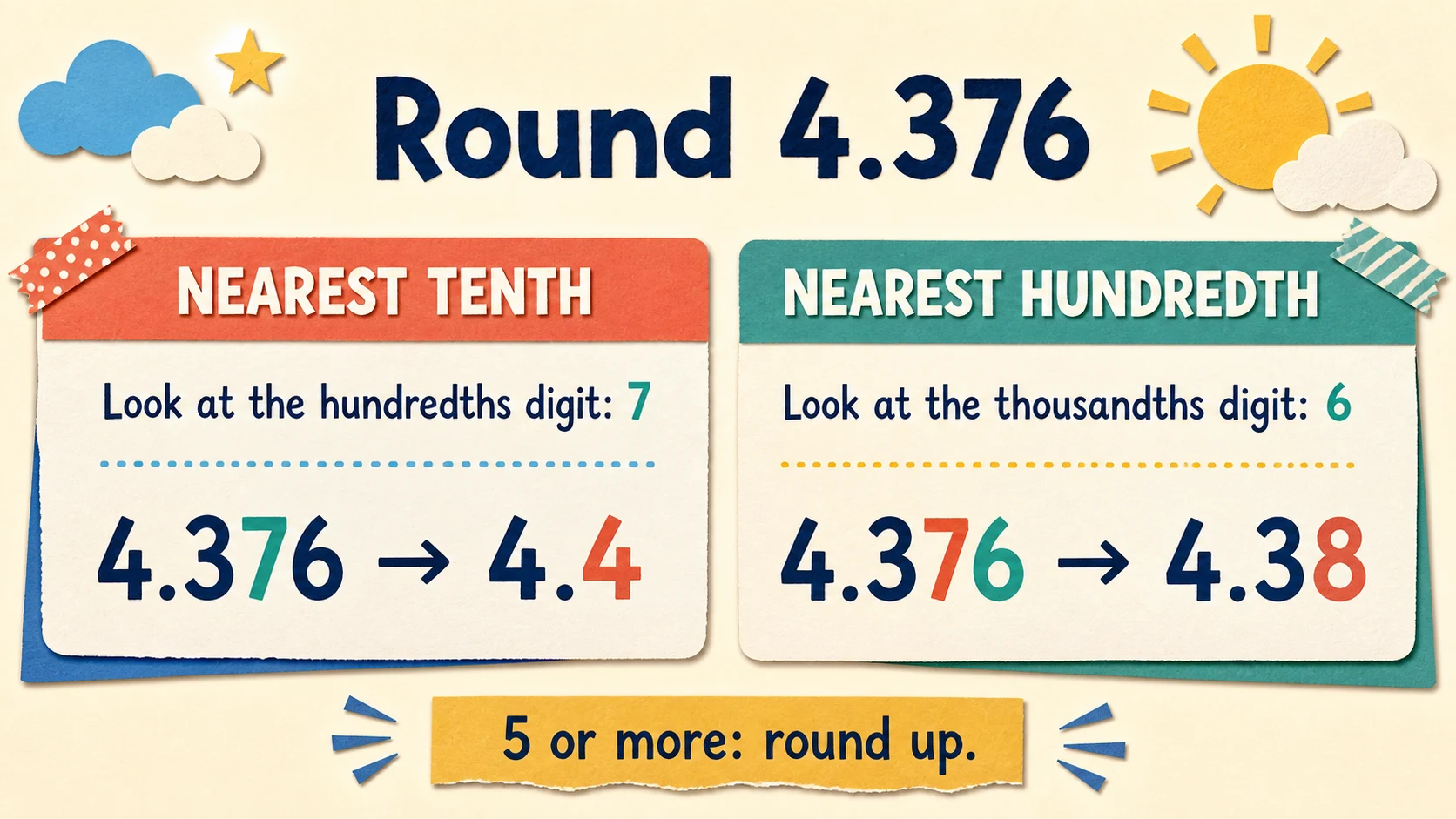
Each lesson moves from retrieval and modeling to explanation, practice, and a quick check.
1. Retrieve a prerequisite
Spend two or three minutes on one connected idea: equal parts, tenths as fractions, whole-number place value, or a previous decimal comparison.
Example prompt: “Show 6/10 on this strip and explain what the 10 tells us.”
2. Model one new idea
Present one example with blocks, a grid, or a number line. Name the whole and think through the place value. Keep the notation attached to the represented quantity.
3. Solve together
Ask the learner to complete a closely related example while explaining each choice. Prompt with “How do you know?” or “What does that digit represent?” rather than supplying the next procedural step immediately.
4. Complete a small practice set
Choose three to six items with a deliberate mix:
- One item matching the model.
- One item with a changed value or representation.
- One comparison or application.
- One boundary case when appropriate.
5. End with an exit check
Use one short problem that the learner completes without help. Record both accuracy and explanation. The IES practice guide on assisting students who struggle with mathematics supports high-level practices such as systematic instruction, mathematical language, visual representations, and monitoring learner performance. That guidance informs the routine’s structure; it is not a review of this worksheet or a child-specific prescription.
Choosing Practice That Matches the Learner
Select practice according to the error pattern, not merely the worksheet’s printed grade.
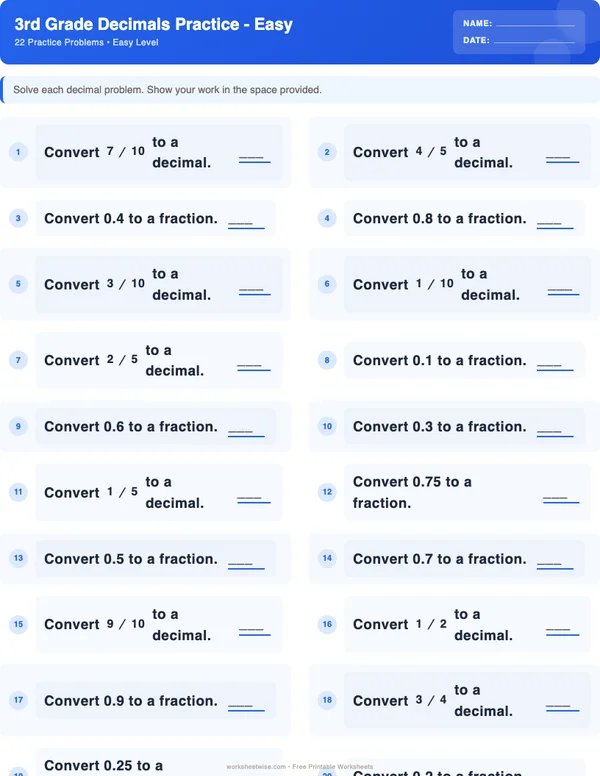
The free 3rd Grade Decimals worksheet contains 22 easy-level exercises covering decimal operations, fraction-decimal conversion, and number sense. It includes addition, subtraction, and multiplication, plus a separate answer key. Because its scope is broader than introductory representation, preview the problems and assign only the items that match the learner’s current understanding.
Use the broader 3rd Grade Math collection when prerequisite work in place value, fractions, multiplication, or related number sense needs attention. The Decimals topic guide is the natural place to compare decimal resources.
A sensible selection pattern is:
- Beginning: matching models, tenths, fraction-decimal pairs, and reading notation.
- Developing: hundredths, number-line placement, equivalent forms, and comparison.
- Secure: mixed representations, ordering, simple contextual problems, and supported operations.
- Extending: explain two methods, correct a false solution, or create a model for a given decimal.
Avoid assigning a large mixed set when the learner’s misconception is still unclear. Four carefully selected items can reveal more than 20 repetitions of the same unexamined method.
Differentiation Without Lowering the Mathematical Goal
When the learner needs more support
Keep the target concept but reduce competing demands.
- Use tenths before hundredths.
- Keep one representation visible.
- Provide a place-value chart.
- Read instructions aloud if reading load interferes with the math.
- Ask the learner to build or shade the quantity before writing it.
- Alternate one adult-modeled example with one learner-completed example.
- Use fewer items and request a spoken explanation for each.
When the learner is ready for independence
Remove support gradually.
- Move from a labeled grid to an unlabeled grid.
- Move from models to symbols, then ask the learner to draw a checking model.
- Mix tenths and hundredths.
- Include equal values written differently, such as 0.6 and 0.60.
- Ask for comparison statements using <, >, and =.
- Include one error-analysis item.
When the learner needs extension
Deepen the reasoning before introducing a later algorithm.
Ask the learner to:
- Find two decimals between 0.4 and 0.5.
- Explain why 0.70=0.7.
- Write a decimal that is greater than 0.36 but less than 0.4.
- Represent 0.45 in two ways.
- Decide whether “a decimal with more digits is always larger” is true and provide a counterexample.
These tasks preserve the focus on magnitude, equivalence, and representation.
Common Errors and Diagnostic Responses
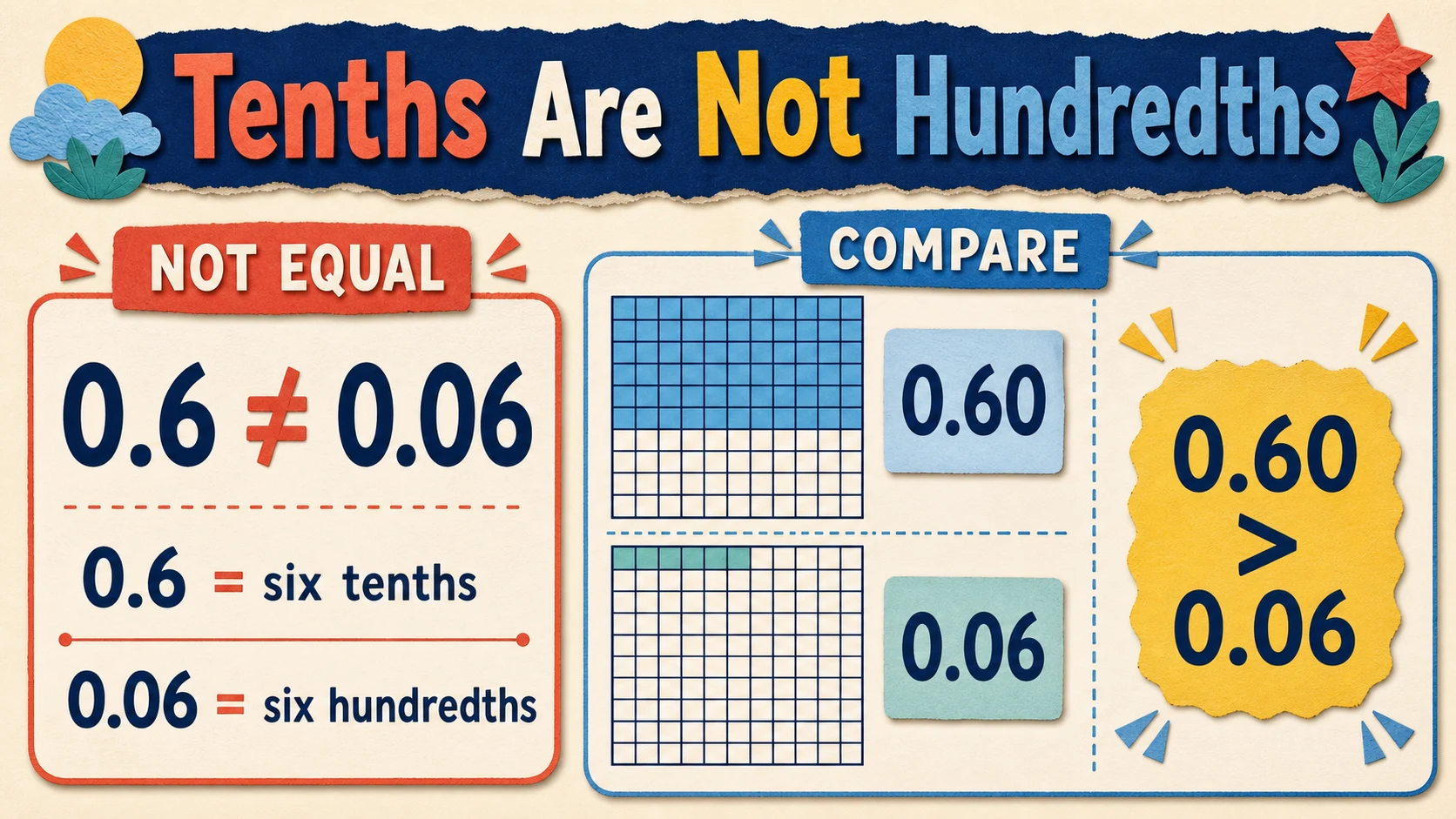
Treat an error as evidence about the learner’s current model, then choose the next representation accordingly.
| Observed work |
Likely issue to investigate |
Teaching response |
| Says 0.36>0.4 because 36 is greater than 4 |
Treating decimal digits as whole numbers |
Compare 36 hundredths with 40 hundredths on grids |
| Writes 7/10=0.07 |
Confusing tenths and hundredths |
Use a place-value chart and a ten-part strip |
| Says 0.5=0.50 |
Believes more digits change the quantity |
Shade both values on separate hundred grids |
| Writes 0.3+0.4=0.7 correctly but cannot explain it |
Procedure or recall without a stable model |
Build three tenths and four tenths |
| Writes 0.3+0.4=0.07 |
Joining digits or confusing place values |
Return to tenths and say the unit in every step |
| Places 0.6 at the sixth tick when the line has unequal or miscounted intervals |
Number-line partitioning difficulty |
Count spaces rather than tick marks |
| Reads 0.25 only as “point two five” |
Weak connection between notation and value |
Ask for “twenty-five hundredths” and model it |
| Treats a base-ten rod as 0.1 without knowing what the whole is |
Unit is unstated or shifting |
Place the whole beside every block model |
Do not diagnose from one response alone. Ask for a model, a verbal explanation, and a second example. A learner who makes a copying error needs a different response from one who consistently reverses tenths and hundredths.
Monitoring Progress and Deciding When to Move On
Keep a simple record with four columns: date, task, accuracy, and explanation. Add a brief note about the support used.
A learner is showing stronger understanding when they can:
- Identify the whole in a model.
- Translate between a model, a fraction, words, and a decimal.
- Explain the value of each digit.
- Compare decimals without relying on digit length.
- Recognize equivalent forms such as 0.3=0.30.
- Use a number line or grid to check an answer.
- Correct an error after explaining why it occurred.
Accuracy matters, but independence and explanation matter too. Three correct answers copied from a model do not show the same control as three correct answers completed with an appropriate self-chosen representation.
If errors cluster around one prerequisite, pause the decimal sequence. If accuracy is strong but explanations are vague, vary the representation rather than simply increasing the number of problems. If the learner explains accurately across models, introduce a modestly less supported task.
A Flexible Two-Week Practice Plan
This plan assumes short sessions across ten practice days. Adjust the pace to the learner’s observed work, available time, and local curriculum.
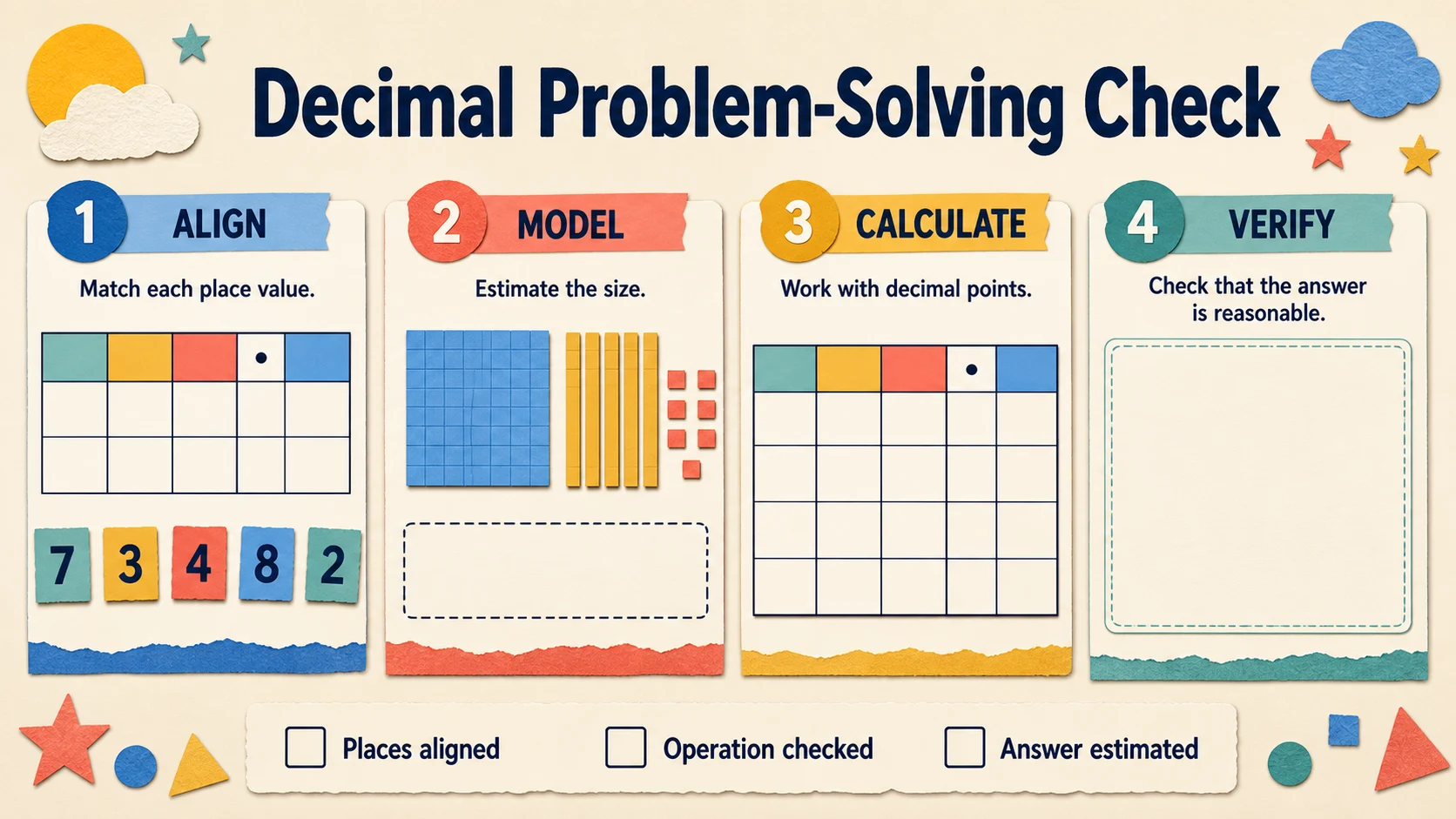
The plan alternates new learning, review, explanation, and brief independent checks.
| Day |
Focus |
Suggested evidence |
| 1 |
Check place value, equal parts, and number lines |
Explain 4/10 with a strip |
| 2 |
Connect tenths fractions and decimals |
Match five models, fractions, and decimals |
| 3 |
Place and order tenths |
Locate three tenths on a 0-to-1 line |
| 4 |
Introduce hundredths with a grid |
Represent 0.24 and explain both digits |
| 5 |
Review tenths and hundredths |
Complete a four-item mixed check |
| 6 |
Connect tenths with equivalent hundredths |
Explain 0.6=0.60 |
| 7 |
Compare decimals |
Use models to compare 0.4 and 0.37 |
| 8 |
Use money or measurement contexts |
Interpret two decimal quantities |
| 9 |
Add or subtract simple like units if ready |
Model and check two operations |
| 10 |
Review, diagnose, and choose the next step |
Complete one model, conversion, comparison, and explanation |
On Day 5, do not automatically continue if the learner still confuses the decimal places. Repeat the tenths-to-hundredths connection with a different model. On Day 9, omit computation if representation and comparison are not yet secure. Replace it with more number-line and grid work.
Families or educators wanting a larger prepared collection can review the 18-worksheet 3rd Grade Decimals pack, listed at $4.79. Select pages by instructional purpose rather than trying to complete the pack in order. For custom quantities or formats, the free worksheet generators provide another next-step option.
Limits and the Honest Next Step
This guide cannot determine an individual learner’s curriculum placement, identify a learning condition, or provide medical guidance. It also does not establish comprehensive standards alignment. The catalogue’s decimal topic extends from tenths and hundredths through later skills such as rounding and all four operations, while the supplied standards span Grades 4 through 6. Those later goals should not be treated as automatic 3rd Grade expectations.
Local sequences differ, and a worksheet labeled for 3rd Grade represents an intended practice level rather than a universal requirement. Use current classroom materials and the learner’s observed work to decide whether decimal study is preview, reinforcement, or an appropriate next topic.
Begin with the free easy 3rd Grade Decimals worksheet. Preview its 22 exercises, choose four to six that match the learner’s present stage, and require a model or explanation for each. Use the answer key to check accuracy, record the error pattern, and let that evidence determine the following lesson.