What 3rd Grade Word Problems Require
Third-grade word problems ask a learner to turn a described situation into mathematics. The learner must understand the story, identify the quantities and their relationships, choose an operation or sequence of operations, calculate accurately, and decide whether the answer fits the situation.
A concise teaching answer is: teach the learner to understand the situation before choosing an operation. Have the learner retell the problem, name what is known and unknown, represent the quantities, write an equation, solve, and check. Do not make keywords the main strategy. A word such as “left” does not always mean subtract, and “altogether” does not guarantee that addition is the required first step.
At this level, practice should include:
- One-step addition and subtraction
- Equal-group and array situations
- Multiplication and division
- Comparison problems
- Problems with the unknown in different positions
- Two-step problems using the four operations
- Problems containing extra or insufficient information
- Written explanations and reasonableness checks
The Common Core State Standards for Mathematics provide broad grade-level context for using multiplication and division in situations and solving two-step problems with the four operations. Grade labels, however, describe an intended practice level, not a universal timetable. Local curricula and teaching sequences differ, so the learner’s observed work should determine when to review, advance, or pause.
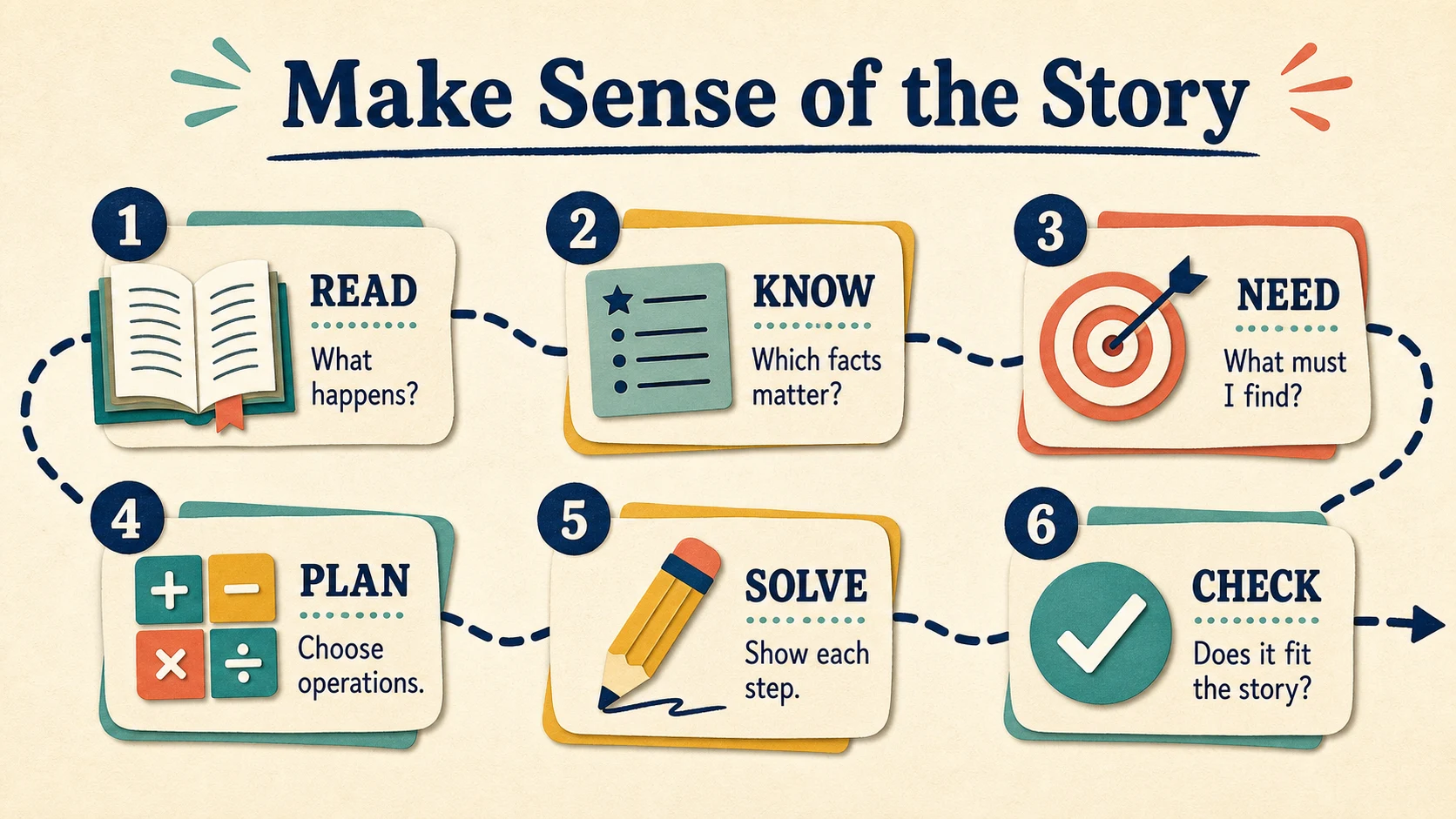
Word-problem success combines comprehension, representation, calculation, and checking.
Prerequisites to Check Before Teaching
A learner can struggle with a word problem for several different reasons. Before assigning a large set, use two or three short problems to see which parts are secure.
Number and operation readiness
Check whether the learner can:
- Add and subtract with the numbers used in the problem
- Interpret multiplication as equal groups or an array
- Connect multiplication and division
- Count groups, objects in each group, and totals without confusing them
- Use a symbol or blank to stand for an unknown quantity
- Complete a short sequence of two calculations
The learner does not need flawless fact recall before solving meaningful problems. However, if every calculation consumes substantial attention, reduce the number size while preserving the same problem structure. For example, change eight boxes of six markers to four boxes of three markers. This isolates interpretation from computation.
Language and comprehension readiness
Ask the learner to retell a problem without solving it. A useful retelling identifies:
- What is happening
- Which quantities are known
- What must be found
- How the quantities are related
Consider this problem: “Noah has 24 cards. He puts the same number into 6 envelopes. How many cards go in each envelope?” A sound retelling is, “Twenty-four cards are split equally among six envelopes, and I need the number in one envelope.”
If the learner repeats isolated numbers but cannot explain their roles, work on comprehension and modeling before requiring independent equations.
Representation readiness
The learner should be able to use objects, sketches, arrays, number lines, or bars to show a relationship. The drawing need not be artistic or perfectly scaled. It must make the quantities and unknown visible.
The IES guide on teaching mathematics to young children offers high-level instructional framing for helping learners connect mathematical ideas, representations, and language. It does not evaluate WorksheetWise materials or prescribe one fixed routine for every child.
A Grade-Appropriate Teaching Progression
Move from visible, single-step relationships toward less supported and multi-step work. Advance when the learner can explain both the operation and the answer, not merely when several answers happen to be correct.
| Stage |
Problem focus |
Helpful representation |
Evidence of readiness to advance |
| 1 |
One-step joining, separating, and part–whole problems |
Counters, quick pictures, part–whole bars |
Retells the situation and identifies the whole and parts |
| 2 |
Comparison problems |
Aligned comparison bars or number line |
Explains which amount is greater and what the difference means |
| 3 |
Equal groups and arrays |
Counters in groups, array, equal-length bars |
Distinguishes number of groups from amount in each group |
| 4 |
Division situations |
Equal sharing or grouping drawings |
Explains whether the unknown is group size or number of groups |
| 5 |
Unknowns in different positions |
Bar model with a blank section or total |
Solves without assuming the answer always comes after the equals sign |
| 6 |
Two-step problems |
Two connected diagrams or a labeled plan |
States the intermediate result and why it is needed |
| 7 |
Extra or missing information |
Information list, crossed-out distractor, question check |
Selects relevant facts or explains why no unique answer is possible |
| 8 |
Mixed independent practice |
Learner-selected representation |
Chooses, solves, checks, and explains with limited prompting |
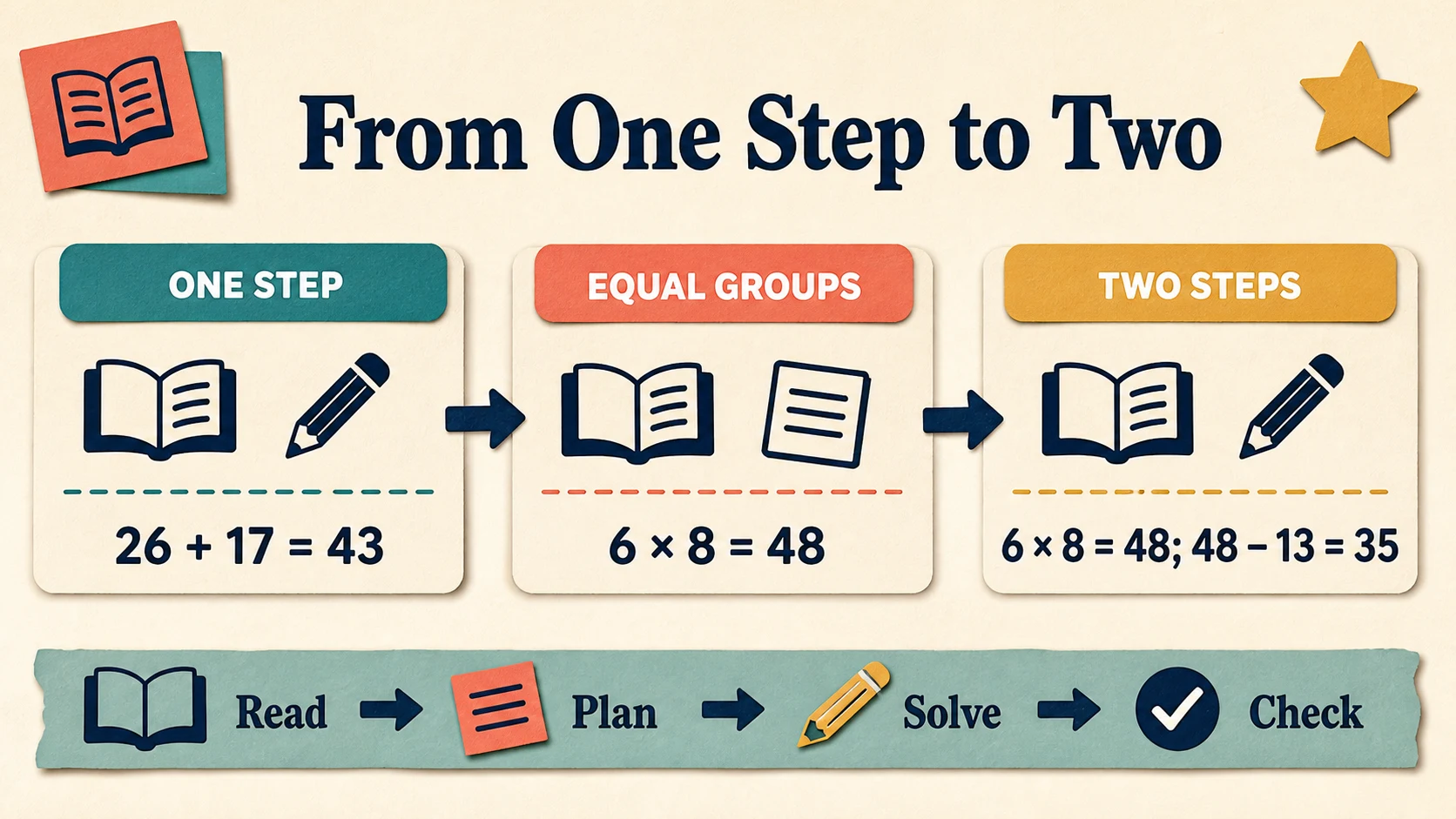
Support should fade as the learner becomes able to select and explain a useful model.
Do not treat the stages as a rigid calendar. A learner might independently solve equal-group problems but need concrete support for comparisons. Teach the relationship that the current work shows is weak.
The broader 3rd Grade Math collection can help separate operation practice from word-problem practice. If calculation is the main difficulty, choose focused arithmetic work. If calculation is accurate but the learner chooses unsuitable operations, stay with stories, representations, and explanations.
Concrete and Visual Models That Reveal the Mathematics
A model is useful when it displays the relationship among quantities. It is not an extra decoration added after the equation has already been chosen.
Objects and acted-out situations
Counters, buttons, cubes, cards, or paper squares work well for early instruction. To model 20 objects shared among 5 children, place one object into each of five groups repeatedly until all 20 have been distributed. The learner can then count 4 in each group.
Acting out the situation makes the meaning of equal sharing visible. Afterward, connect the action to 20 ÷ 5 = 4. Remove the objects only after the learner can explain how the equation matches the action.
Arrays and equal groups
For 4 bags with 6 apples in each bag, draw four circles and place six dots in each. Alternatively, draw a rectangular array with four rows of six. Label both dimensions and the total:
4 groups × 6 in each group = 24 apples
An array can also support division. If 24 objects are arranged in 4 equal rows, each row contains 6. The same quantities can therefore support 4 × 6 = 24, 24 ÷ 4 = 6, and 24 ÷ 6 = 4.
Bar models
A part–part–whole bar shows how smaller quantities combine into a total:
[ 27 red ] [ 15 blue ] = [ ? total ]
A comparison model aligns two quantities:
Mia: [---------------- 38]
Owen: [---------- 25][ ? ]
The unmatched section represents the difference, so 38 − 25 answers “How many more?”
For equal groups, use repeated equal bars:
[ 7 ][ 7 ][ 7 ][ 7 ][ 7 ] = ?
The five equal sections represent five groups of seven.
Bar models are an instructional suggestion drawn from the supplied catalogue guidance. They are especially useful for making relationships visible, but no single representation must be used for every problem. If an array, number line, or brief labeled sketch communicates the structure more clearly, use it.
Number lines
Number lines help with change, difference, and repeated jumps. To show 46 minus 18, a learner might move back 10 to 36, then back 8 to 28. To show 5 groups of 4, the learner can make five jumps of 4 and land on 20.
Ask what each jump represents. Unexplained jumps can conceal a mistaken interpretation even when the arithmetic is correct.
Fully Checked Worked Examples
The examples below make the reasoning visible. In each case, read and represent before calculating.
Example 1: Part–part–whole addition
Problem: A classroom shelf holds 28 mystery books and 17 science books. How many books are on the shelf altogether?
Known quantities: 28 mystery books and 17 science books
Unknown: Total number of books
Relationship: Two parts combine to make one whole
Bar model:
[ 28 mystery ][ 17 science ] = [ ? books ]
Equation:
28 + 17 = ?
Calculation:
28 + 10 = 38
38 + 7 = 45
Answer: There are 45 books on the shelf.
Check: Subtract one part from the total: 45 − 17 = 28. The check returns the other known part, so the quantities are consistent. The answer is also greater than both parts, as a combined total should be.
Example 2: Comparison subtraction
Problem: Lena collected 53 stickers. Amir collected 36 stickers. How many more stickers did Lena collect than Amir?
Known quantities: Lena has 53; Amir has 36
Unknown: The difference between their amounts
Relationship: Two quantities are compared
Comparison model:
Lena: [----------------------- 53]
Amir: [--------------- 36][ ? ]
Equation:
53 − 36 = ?
Calculation by decomposing:
53 − 30 = 23
23 − 6 = 17
Answer: Lena collected 17 more stickers than Amir.
Check: 36 + 17 = 53. The smaller amount plus the difference equals the larger amount.
A keyword shortcut is unreliable here. The word “more” describes the comparison, but the required calculation is subtraction.
Example 3: Equal groups multiplication
Problem: There are 6 tables. Each table has 4 chairs. How many chairs are there in all?
Known quantities: 6 equal groups and 4 chairs per group
Unknown: Total chairs
Relationship: Equal groups combine into a total
Model:
[4] [4] [4] [4] [4] [4]
Equation:
6 × 4 = ?
Calculation:
4 + 4 + 4 + 4 + 4 + 4 = 24
Answer: There are 24 chairs.
Check: If 24 chairs are divided equally among 6 tables, 24 ÷ 6 = 4 chairs per table. The inverse relationship confirms the result.
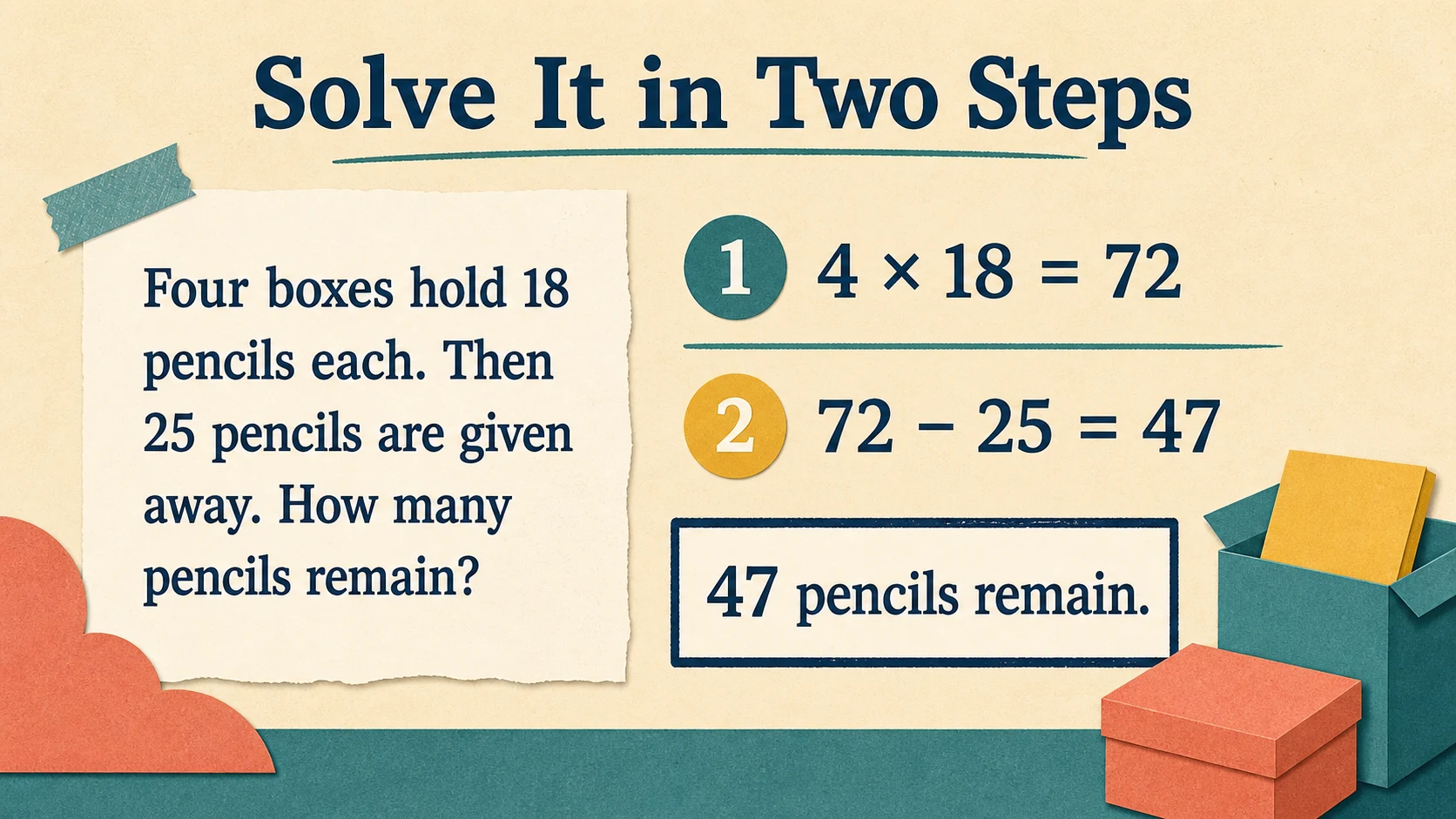
Connect the acted or drawn relationship to an equation, answer, and check.
Example 4: Division with an unknown group size
Problem: A tutor shares 32 counters equally among 8 learners. How many counters does each learner receive?
Known quantities: 32 counters and 8 learners
Unknown: Number of counters in each equal share
Relationship: A total is partitioned into a known number of groups
Equation:
32 ÷ 8 = ?
Use the related multiplication fact:
8 × 4 = 32
Answer: Each learner receives 4 counters.
Check: Eight groups of four contain 8 × 4 = 32 counters. All counters are used, and the groups are equal.
Distinguish this from a grouping problem: “There are 32 counters, and each learner receives 8. How many learners receive counters?” That equation is also division, but now the group size is known and the number of groups is unknown: 32 ÷ 8 = 4 learners.
Example 5: A two-step problem
Problem: A teacher has 5 packs of 9 pencils. She gives 12 pencils to students. How many pencils remain?
Known quantities: 5 packs, 9 pencils per pack, and 12 pencils given away
Unknown: Pencils remaining
Plan: Find the starting total, then subtract the amount given away
Step 1:
5 × 9 = 45
There are 45 pencils before any are given away.
Step 2:
45 − 12 = 33
Answer: 33 pencils remain.
Check: Add the 12 given away to the 33 remaining: 33 + 12 = 45. That matches the starting total. A quick estimate also supports the answer: 45 minus a little more than 10 should be a little less than 35.
Example 6: Unknown at the beginning
Problem: Some students were on the playground. Then 14 more students arrived. Now there are 39 students. How many students were there at first?
Known quantities: 14 arrived; 39 are there now
Unknown: Starting number
Relationship: Start plus change equals result
Equation with the unknown shown honestly:
? + 14 = 39
Solve with subtraction:
39 − 14 = 25
Answer: There were 25 students at first.
Check: 25 + 14 = 39.
This example matters because the unknown is not the final quantity in the story. A learner trained only to combine numbers in reading order might incorrectly calculate 39 + 14.
A Short, Repeatable Lesson Routine
A focused lesson can follow the same sequence while the problem type changes.
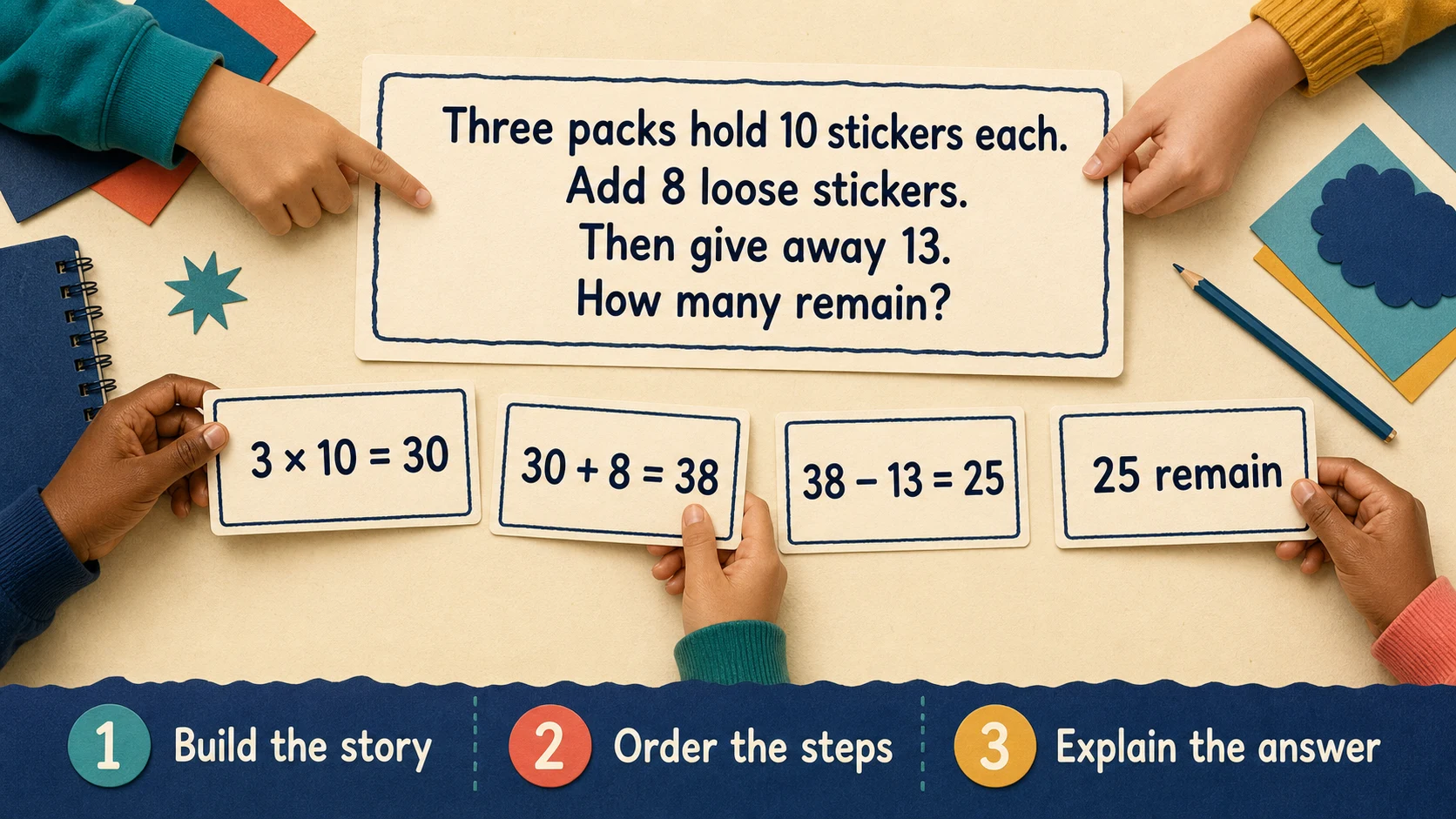
A stable routine reduces unnecessary decision-making while preserving mathematical thinking.
1. Read and retell
Read the complete problem. Ask the learner to retell it without looking at the text if possible. Clarify unfamiliar everyday vocabulary, but do not identify the operation.
2. Name the known and unknown
Record the quantities with units:
5 packs9 pencils per pack12 pencils given away? pencils remaining
Numbers without labels are easy to misuse.
3. Represent the relationship
Let the learner act, draw, or build the situation. Ask, “How does your model show what happens?” If the model does not display equal groups, comparison, joining, or separating accurately, revise it before calculating.
4. Write and solve
Write an equation that matches the representation. In a two-step problem, write each equation separately and label the intermediate result.
5. Check and explain
Use an inverse operation, estimation, or substitution into the original relationship. Finish with a complete answer including the unit. Ask, “Why does this operation fit?” rather than only “What answer did you get?”
The IES practice guide on assisting students struggling with mathematics supplies high-level context for explicit, systematic support and mathematical representations. Use that framing as guidance, not as a claim that one timetable or worksheet is suitable for every learner.
Choosing Practice That Matches the Learner
Start with a brief sample rather than assigning an entire mixed page immediately. Observe whether errors arise during reading, modeling, operation selection, calculation, or checking.
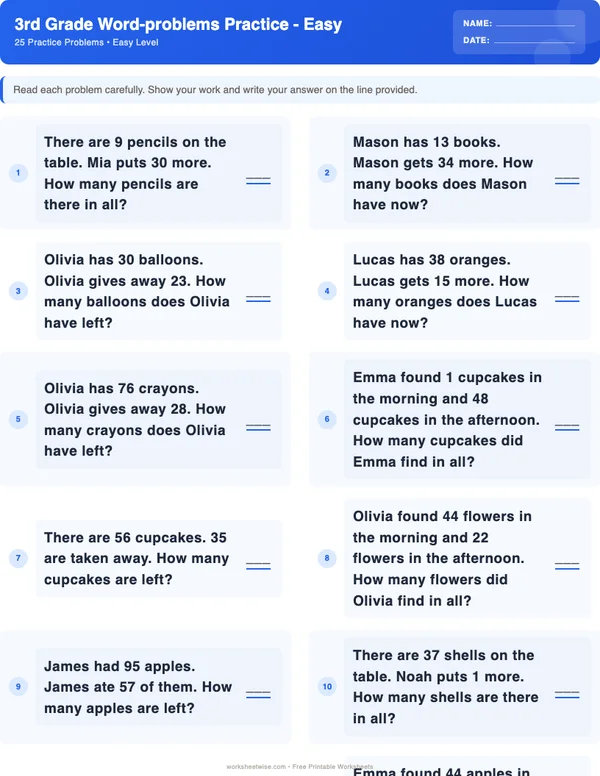
Use the Word Problems topic guide and worksheet collection to choose practice by problem type and support level. The available free easy worksheet contains 14 exercises and covers problem solving, reading comprehension, multi-step reasoning, and mixed operations. It also includes a separate answer key.
When to narrow the practice
Choose a small set of one problem type when the learner:
- Confuses multiplication with addition
- Cannot distinguish sharing from grouping
- Misreads comparisons
- Assumes the unknown must be the final amount
- Loses track of the intermediate result in two-step work
For example, assign four comparison problems with varied wording rather than twelve mixed problems. Once the learner can explain the relationship, interleave comparisons with part–whole and equal-group situations.
When to increase challenge
Increase one feature at a time:
- Use larger numbers
- Change the position of the unknown
- Remove a provided model
- Add a second step
- Include one irrelevant quantity
- Ask the learner to write an equation before calculating
- Require a reasonableness check or written explanation
Avoid changing number size, language complexity, problem structure, and number of steps simultaneously. If performance drops, it will be difficult to identify the cause.
Differentiation without changing the core idea
For additional support, read the problem aloud, reduce number size, provide counters, draw an empty bar model, or offer a choice between two representations. Keep the mathematical relationship intact.
For greater independence, ask the learner to choose the representation, compare two solution methods, write a matching problem, or explain why an incorrect equation does not fit.
Observed work should drive pacing. Accuracy alone is incomplete evidence: a correct answer paired with an unrelated model or unexplained operation may reflect guessing.
Common Errors and Diagnostic Responses
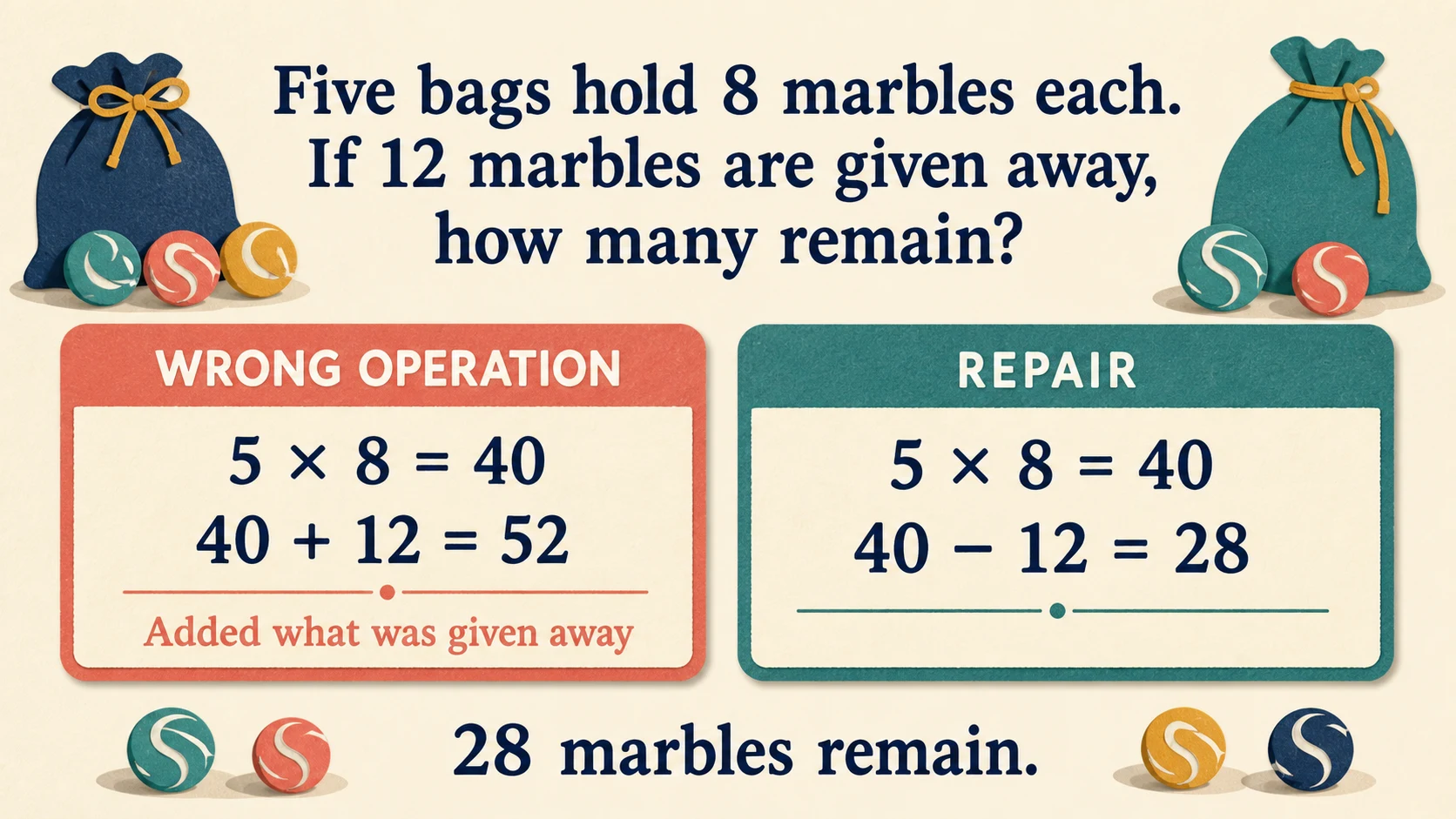
Treat an error as evidence about the point where reasoning broke down.
| Observed work |
Likely difficulty to investigate |
Teaching response |
| Uses every number but cannot retell the story |
Comprehension or quantity roles |
Cover the numbers and retell what happens first |
| Chooses an operation from one keyword |
Surface matching rather than relationship analysis |
Present two problems using the same word but different structures |
| Adds in a “how many more” comparison |
Difference is not represented |
Draw aligned comparison bars and mark the unmatched section |
Writes 4 × 6 but draws six groups of six |
Group count and group size are confused |
Label “number of groups” and “in each group” |
| Divides correctly but gives the wrong unit |
Meaning of the quotient is unclear |
Ask whether the answer counts groups or objects per group |
| Completes only one step |
Intermediate result is mistaken for the answer |
Restate the final question and label a two-step plan |
| Gets an unreasonable answer but stops |
No checking habit |
Require an estimate or inverse check before accepting the response |
| Copies a number incorrectly |
Attention or recording difficulty |
Use a known/unknown list and compare it with the original text |
| Produces a correct number with no explanation |
Strategy may not be stable |
Ask for an equation, labeled model, or oral justification |
Do not diagnose a lasting learning need from one mistake. Look for a pattern across several comparable problems. This guide provides educational instruction, not medical or clinical guidance.
Boundary Cases Learners Should Meet
Not every word problem has a conventional numerical answer. Boundary cases build careful reading.
Extra information
“Sam has 4 boxes with 7 crayons in each. His sister has 3 notebooks. How many crayons does Sam have?”
The notebook count is irrelevant. The equation is 4 × 7 = 28, so Sam has 28 crayons. Ask the learner to explain why the 3 is unused.
Missing information
“A class places markers equally into 6 cups. How many markers are in each cup?”
The total number of markers is missing, so no unique numerical answer can be found. The learner should identify the missing quantity rather than invent it.
More than one possible interpretation
“Jordan made 24 cookies and put some on each plate. How many plates were used?”
The number on each plate is not supplied. Many arrangements could fit 24 cookies. This is another insufficient-information problem.
A remainder that needs interpretation
“Twenty-six students form teams of 4. How many complete teams can they form?”
26 ÷ 4 = 6 complete teams with 2 students left. The answer to the stated question is 6 complete teams, not 6 remainder 2 teams and not 7 complete teams. Remainder situations should be introduced with care because the wording determines how the remainder is reported.
Monitoring Progress Without Over-Testing
Keep a short record after two or three sessions. Note the problem structures attempted, representations chosen, prompts required, calculation accuracy, and quality of checking.
A compact monitoring record might use four categories:
| Category |
What to observe |
| Understand |
Can the learner retell the situation and identify the question? |
| Represent |
Does the model show the correct relationship? |
| Solve |
Are the operation and calculations accurate? |
| Check |
Does the learner verify the result and include the correct unit? |
Mark each category as independent, prompted, or not yet demonstrated. This provides more useful teaching information than a single total score.
Advance when the learner is accurate across several examples, explains the operation, and handles a changed context without depending on a memorized phrase. Review when the same structural error appears repeatedly. If reading load is masking mathematical understanding, read the problem aloud and compare the result with independent reading.
A Two-Week Practice Plan
This plan is an adaptable instructional suggestion, not a universal timetable. Short sessions can be lengthened, shortened, repeated, or separated according to the learner’s responses.
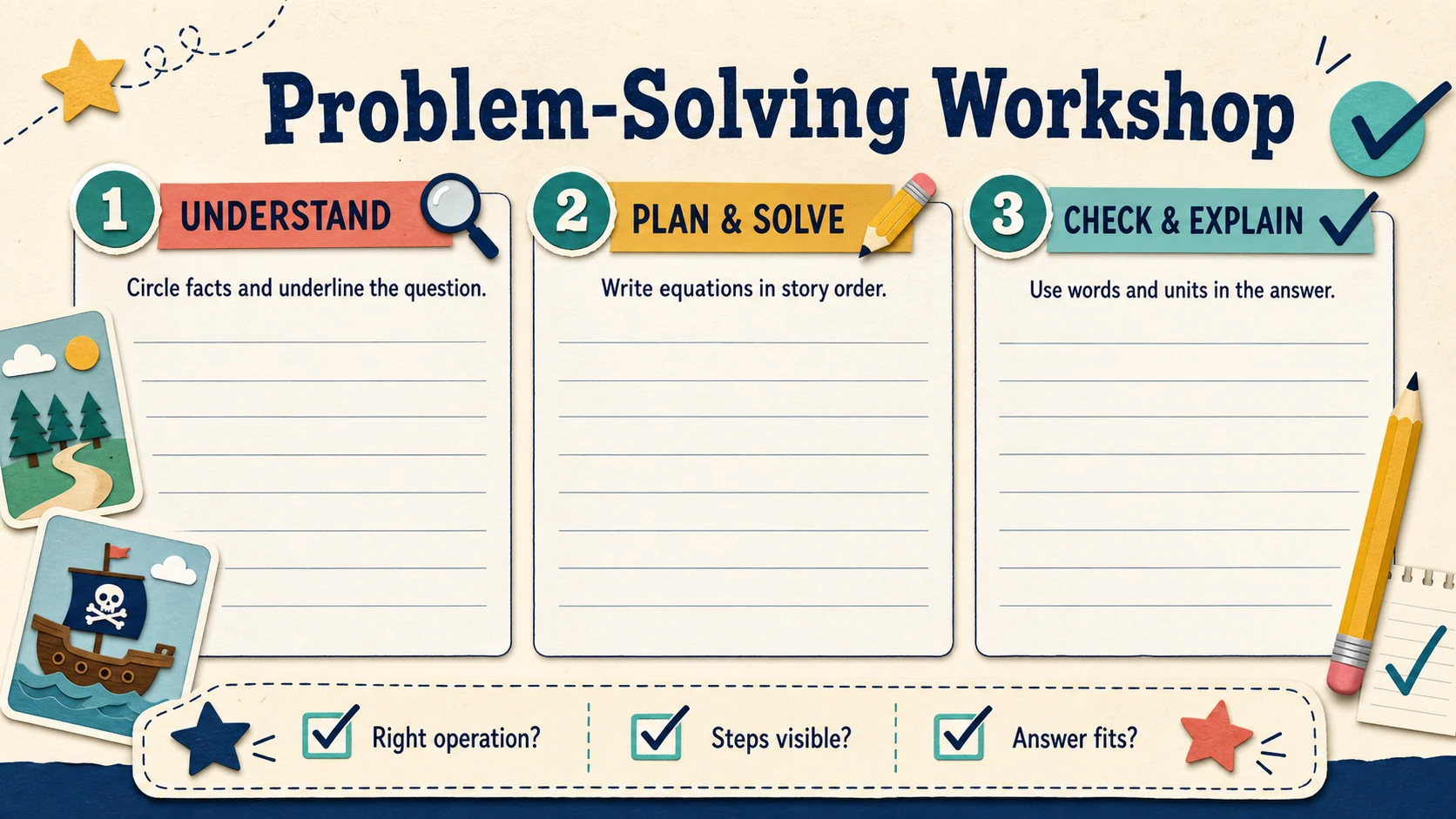
The sequence moves from diagnosis and modeling toward mixed, increasingly independent practice.
| Day |
Focus |
Suggested activity |
Evidence to collect |
| 1 |
Baseline |
Solve one part–whole, one comparison, one equal-group, and one division problem |
Note where prompts are needed |
| 2 |
Part–whole |
Act out and draw joining and separating situations |
Identify parts, whole, and unknown |
| 3 |
Comparison |
Build aligned bars for “more” and “fewer” situations |
Explain the unmatched section |
| 4 |
Multiplication |
Model equal groups and arrays |
Label groups, amount per group, and total |
| 5 |
Review |
Mix the first three structures with modest numbers |
Choose a model without being told which one |
| 6 |
Division |
Compare equal sharing with finding the number of groups |
State what the quotient represents |
| 7 |
Unknown position |
Solve result-, change-, and start-unknown situations |
Write an equation with the blank in the correct place |
| 8 |
Two-step reasoning |
Use a “first/then” plan for two problems |
Label the intermediate answer |
| 9 |
Boundary cases |
Solve problems with extra or missing information |
Justify using or rejecting each quantity |
| 10 |
Independent check |
Complete a short mixed set, explain two solutions, and correct one error |
Compare with Day 1 observations |
Keep the number of problems manageable enough that explanations remain possible. If Day 6 reveals confusion between the two meanings of division, repeat concrete division practice before moving to unknown-position problems. If Day 8 is secure, increase independence rather than simply increasing page length.
Limitations and the Next Useful Step
A worksheet can provide consistent practice, but it cannot by itself reveal why a learner selected an operation, misunderstood a sentence, or abandoned a second step. An answer key confirms results; it does not replace listening to the learner’s explanation. Printed models also should not become permanent templates when the learner is ready to choose a representation independently.
This guide does not establish comprehensive standards alignment, guarantee outcomes, or replace a local curriculum. The listed grade describes the intended practice level, and instructional sequences vary among schools, states, tutors, and homeschool programs.
A practical next action is to give the learner four diagnostic problems from the progression above. If the learner can retell and model them but needs accessible mixed practice, use the free 3rd Grade Word Problems worksheet. Review the work by marking where understanding, representation, calculation, or checking first breaks down. For broader repeated practice after that diagnosis, consider the 18-worksheet focused pack, or create a more targeted set with the free worksheet generators.