What 3rd Grade Money Instruction Should Cover
Third-grade money instruction should help a learner connect coin and bill values with addition, subtraction, place value, and practical purchase situations. A useful sequence moves from identifying and organizing money to counting mixed collections, comparing totals, adding prices, and finding change. Concrete coins, drawings, number lines, tables, and equations should represent the same amounts.
The short answer is: teach the value relationships first, require the learner to explain how a total was counted, and introduce purchase problems only after mixed collections can be counted accurately. Use written practice to reinforce—not replace—handling real or realistic play money.
Grade labels describe an intended practice level, not a universal timetable. Local curricula and instructional sequences differ. The learner’s observed work should determine whether to review an earlier skill, continue at the current level, or introduce a more demanding problem.
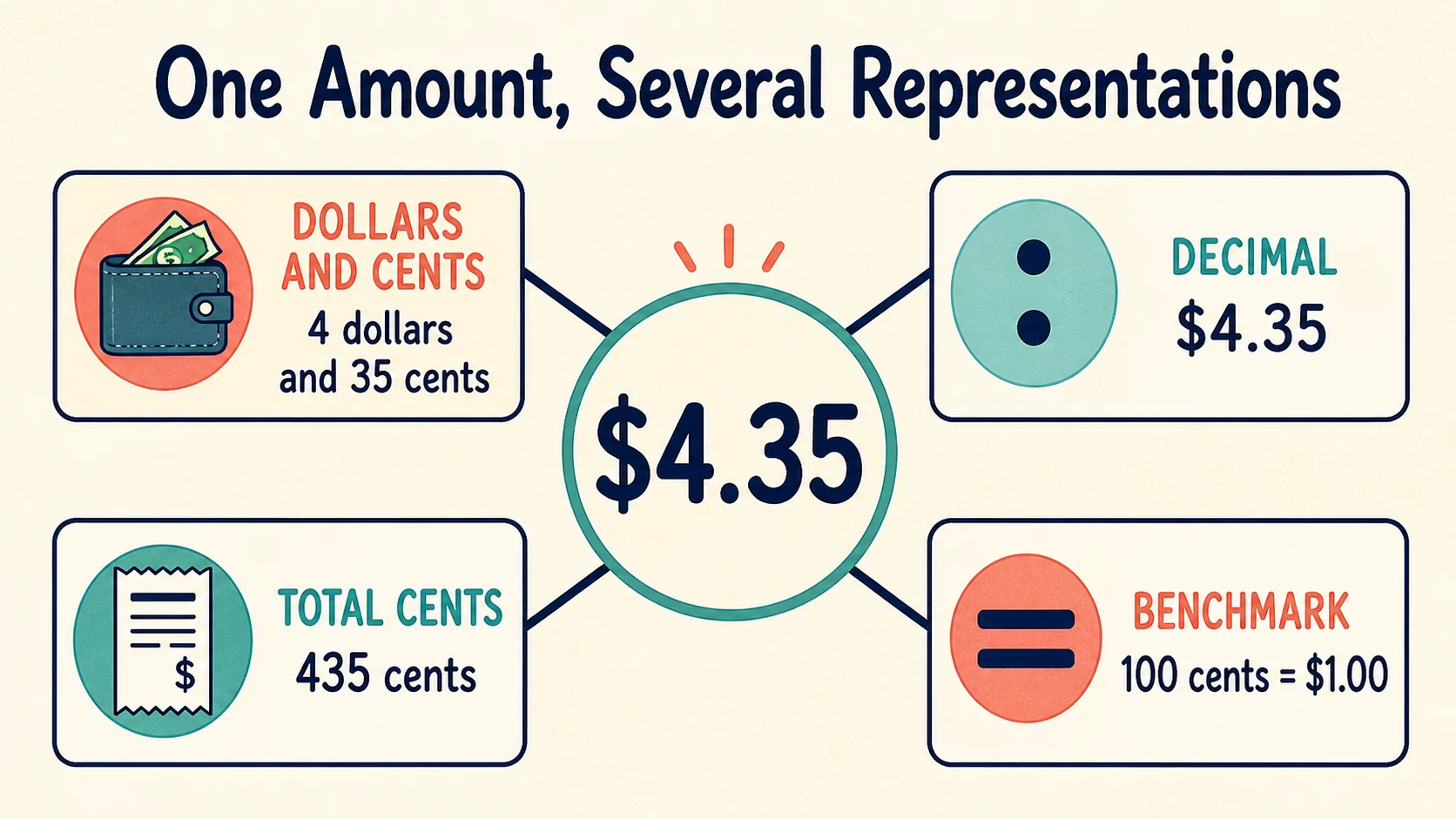
Money work connects coin values, place value, operations, and practical problem solving.
For printable material connected to this sequence, see the 3rd Grade Math hub or the complete Money topic guide and worksheet collection.
Prerequisites to Check Before Teaching Money
A learner does not need perfect calculation fluency before beginning money work. However, several underlying skills make the topic more manageable.
Counting and skip-counting
Check whether the learner can:
- Count forward by ones from a number other than 1.
- Skip-count by 5s and 10s.
- Count by 25s through 100.
- Continue counting after changing from one interval to another.
The final point matters when coins are mixed. A learner might count three dimes as 10, 20, 30, then need to continue by fives for a nickel and by ones for pennies: 35, 36, 37.
If counting by 25s is not secure, use a written sequence—25, 50, 75, 100—beside four quarters. Do not require the learner to memorize several new coin relationships and a difficult counting pattern at the same time.
Place value and equivalent forms
Money offers a practical place-value context:
- 10 pennies equal 10 cents.
- 10 dimes equal 100 cents, or one dollar.
- 100 cents equal one dollar.
- $1.30 means one dollar and thirty cents, not one dollar and three cents.
Ask the learner to show the same value in two forms, such as 125¢ and $1.25. If the decimal notation is confusing, keep amounts in cents during early calculation and translate to dollars afterward.
Addition, subtraction, and comparison
The learner should be able to combine and compare whole-number quantities within the range used in the lesson. For example, adding 25 + 10 + 5 + 3 is fundamentally an addition task represented by coins.
Subtraction supports change problems, but it is not the only strategy. Counting up from a price to the amount paid can reduce notation demands and expose useful money landmarks such as the next ten cents, next quarter, or next dollar.
Reading short problem situations
Before treating a wrong answer as a money error, check whether the learner understood the situation. Words such as costs, altogether, more than, left, paid, and change signal different operations. Read the problem aloud when decoding or language may be masking the mathematical skill.
A Grade-Appropriate Instructional Progression
A progression is a teaching map, not a fixed calendar. Move forward when the learner can represent and explain the current skill with reasonable consistency.
| Stage |
Instructional focus |
Useful model |
Evidence to look for |
| 1 |
Identify pennies, nickels, dimes, and quarters and state their values |
Real or realistic play coins with a value chart |
Names and values are recalled without relying only on coin size |
| 2 |
Count collections of one denomination |
Coin rows and skip-count sequences |
Counting interval matches the coin value |
| 3 |
Build equivalent amounts |
Coin trades, such as five pennies for one nickel |
Learner recognizes that different collections can have equal value |
| 4 |
Count mixed collections |
Coins ordered from greatest to least value |
Learner changes counting intervals accurately |
| 5 |
Compare totals |
Value tables, equations, and comparison symbols |
Comparison is based on total value rather than number or size of coins |
| 6 |
Add prices |
Cents first, then dollar-and-cent notation |
Place values and symbols remain aligned |
| 7 |
Find change |
Counting-up number line and subtraction check |
Learner identifies both the price and amount paid |
| 8 |
Solve multi-step purchase problems |
Bar model, labeled equation, or shopping setup |
Each operation answers a clear part of the situation |
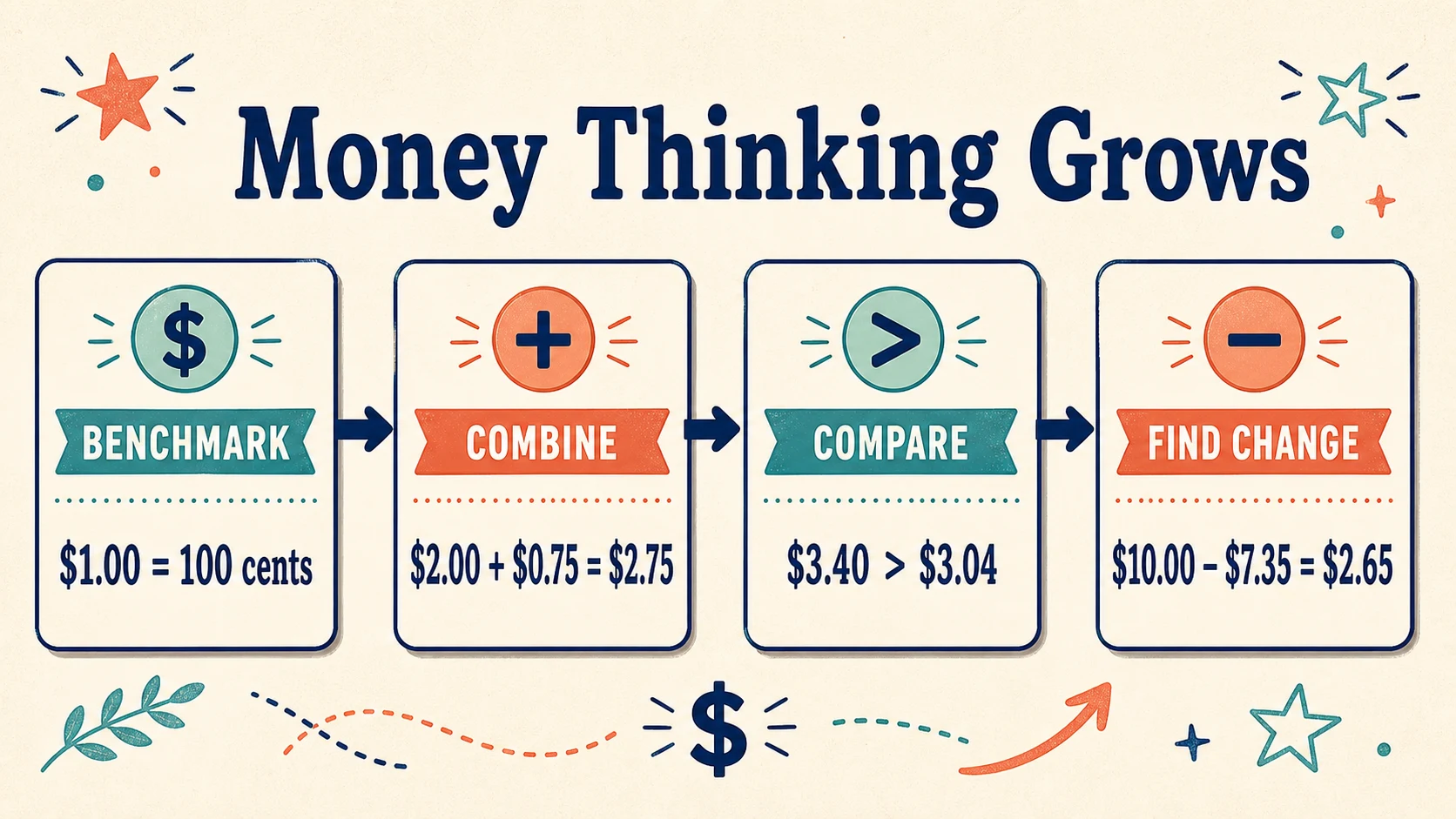
Support can be reduced as the learner counts, represents, and explains amounts accurately.
The catalogue sequence begins with pennies, then dimes, nickels, and quarters. That order allows counting by ones, then tens, fives, and twenty-fives. Once individual values are known, teach the learner to arrange mixed coins from greatest value to least value and count on.
The Common Core State Standards for Mathematics place explicit coin-value and money word-problem work in earlier grade descriptions. This makes third-grade money practice partly an opportunity to consolidate earlier learning and apply stronger addition, subtraction, and multi-step reasoning. It does not mean every local third-grade sequence treats the topic in exactly the same way.
Concrete and Visual Models That Clarify Value
Real or realistic play money
Begin with coins the learner can move. Ask the learner to sort them by denomination, label each group, and build named amounts. Coin size alone is unreliable: a dime is worth more than a nickel even though it is smaller.
Useful prompts include:
- “Build 37 cents in two different ways.”
- “Trade these ten pennies for an equal value.”
- “Which coin could replace five pennies?”
- “Can you use fewer coins without changing the total?”
These are instructional suggestions based on the supplied teaching sequence. They should be adjusted in response to what the learner actually does.
Coin-value tables
A value table separates the number of coins from their monetary value.
| Coin |
Number of coins |
Value of each |
Total value |
| Quarter |
2 |
25¢ |
50¢ |
| Dime |
1 |
10¢ |
10¢ |
| Nickel |
2 |
5¢ |
10¢ |
| Penny |
3 |
1¢ |
3¢ |
| Total |
|
|
73¢ |
This representation is especially useful when a learner counts the objects rather than their value. Seven coins do not necessarily equal seven cents.
Number lines and count-up paths
For change, place the price at the left and the amount paid at the right. Mark convenient steps between them. From $3.67 to $5.00, for example, the jumps can be 3¢ to $3.70, 5¢ to $3.75, 25¢ to $4.00, and $1.00 to $5.00. Adding the jumps gives $1.33.
The number line makes change visible as the distance between two amounts. A subtraction equation can then verify the result.
The IES guide on teaching mathematics to young children supports broad instructional practices such as using representations, helping learners describe mathematical ideas, and monitoring what they understand. The source does not evaluate WorksheetWise or this particular worksheet.
Dollars-and-cents charts
When notation becomes the obstacle, use columns:
For addition, align dollars with dollars and cents with cents. A learner who writes $3.5 for three dollars and five cents needs notation practice: the correct form is $3.05.
Fully Checked Worked Examples
Example 1: Count a mixed coin collection
A collection contains 2 quarters, 3 dimes, 1 nickel, and 4 pennies.
Arrange the denominations from greatest value to least value:
- 2 quarters: 25¢ + 25¢ = 50¢
- 3 dimes: 10¢ + 10¢ + 10¢ = 30¢
- 1 nickel: 5¢
- 4 pennies: 4¢
Now combine the values:
50¢ + 30¢ + 5¢ + 4¢ = 89¢
Answer: 89¢
Check by counting on: 25, 50, 60, 70, 80, 85, 86, 87, 88, 89. Both methods produce 89¢.
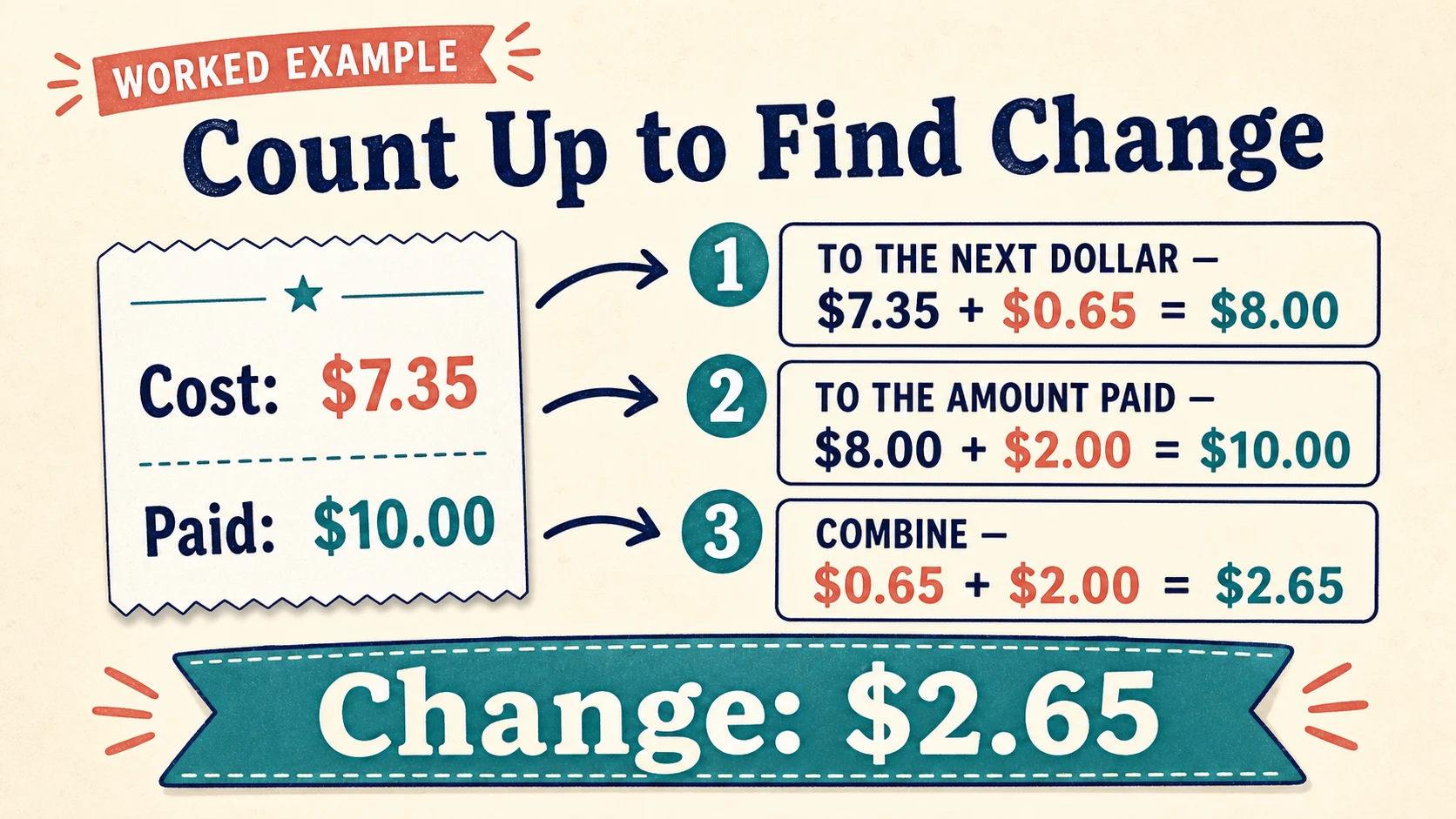
Moving among coins, a drawing, and an equation helps expose how the total was formed.
Example 2: Compare collections with different numbers of coins
Collection A has 3 quarters and 1 penny. Collection B has 7 dimes and 5 pennies.
Find each total:
- Collection A: 3 × 25¢ + 1¢ = 75¢ + 1¢ = 76¢
- Collection B: 7 × 10¢ + 5¢ = 70¢ + 5¢ = 75¢
Therefore:
76¢ > 75¢
Answer: Collection A is worth 1¢ more.
The boundary here is close: the collections differ by only one cent. Counting the number of coins would give the wrong conclusion because Collection B contains more coins but has a smaller total value.
Example 3: Add two prices
A notebook costs $2.45 and a pen costs $1.80. What is the total cost?
One reliable approach is to work in cents:
- $2.45 = 245¢
- $1.80 = 180¢
- 245¢ + 180¢ = 425¢
- 425¢ = $4.25
Answer: $4.25
Check in dollar-and-cent form:
  $2.45
+ $1.80
-------
  $4.25
The cents calculation is 45¢ + 80¢ = 125¢. Regroup 100¢ as $1, leaving 25¢. Then $2 + $1 + $1 regrouped = $4.
Example 4: Find change by counting up
An item costs $3.67. The customer pays $5.00.
Count from the price to the amount paid:
- $3.67 + $0.03 = $3.70
- $3.70 + $0.05 = $3.75
- $3.75 + $0.25 = $4.00
- $4.00 + $1.00 = $5.00
Add the increments:
$0.03 + $0.05 + $0.25 + $1.00 = $1.33
Answer: $1.33 change
Check with subtraction:
$5.00 − $3.67 = $1.33
Check again by recombining:
$3.67 + $1.33 = $5.00
Example 5: Solve a two-step purchase problem
Maya has $6.00. She buys an eraser for $0.85 and a ruler for $1.65. How much money remains?
First find the total spent:
$0.85 + $1.65 = $2.50
Then subtract from the starting amount:
$6.00 − $2.50 = $3.50
Answer: Maya has $3.50 remaining.
A useful equation is:
$6.00 − ($0.85 + $1.65) = $3.50
Check:
$0.85 + $1.65 + $3.50 = $2.50 + $3.50 = $6.00
Example 6: A boundary case with exact payment
A toy costs $4.25. The buyer pays with 4 one-dollar bills and 1 quarter.
The amount paid is:
$4.00 + $0.25 = $4.25
Change is:
$4.25 − $4.25 = $0.00
Answer: No change is due.
Zero is a valid result. Do not train the learner to assume that every purchase problem must produce positive change.
A Short, Repeatable Lesson Routine
A focused lesson can be brief enough to preserve attention while still including explanation, modeling, practice, and checking.
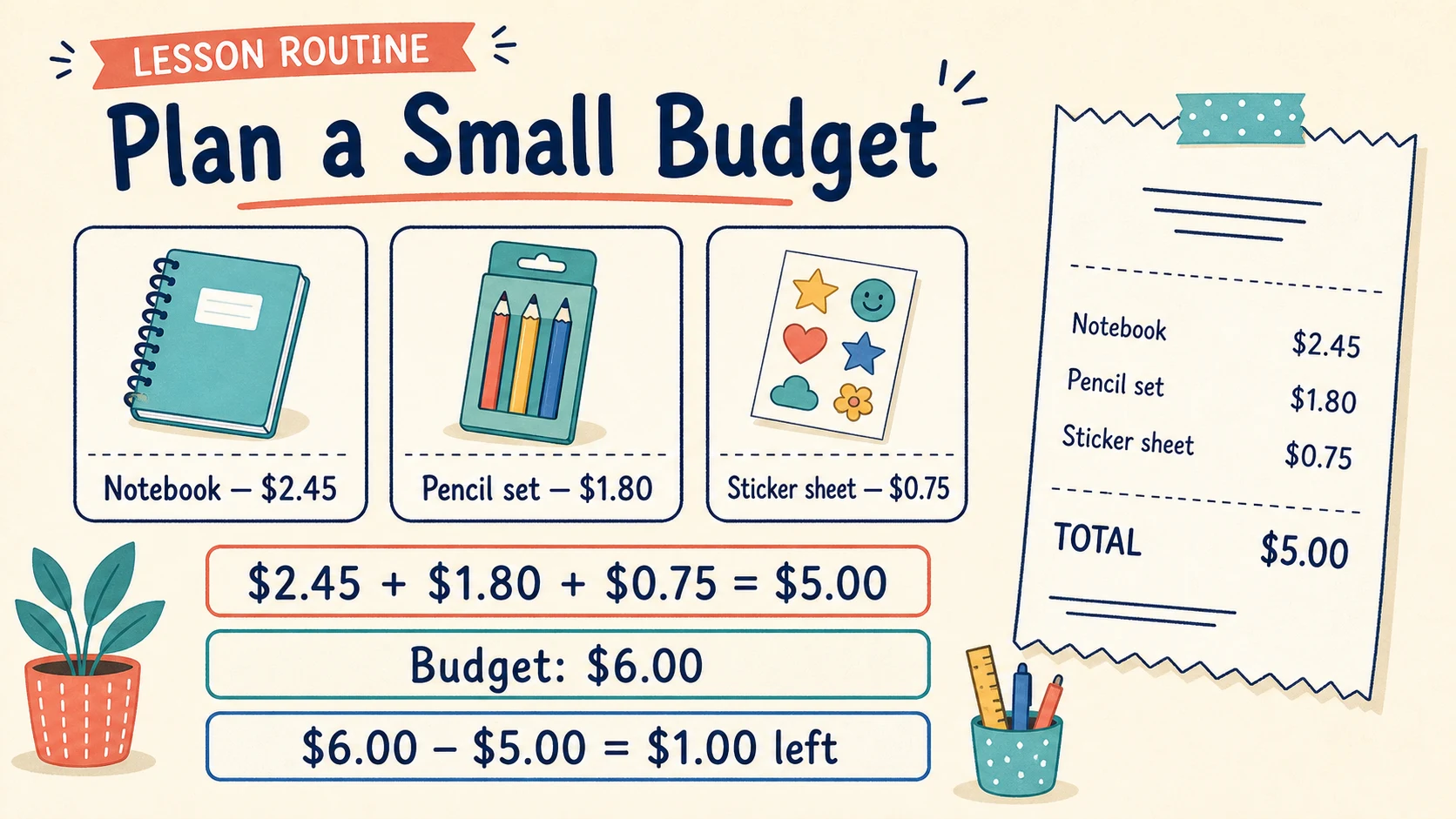
Use the same lesson structure while changing the amounts and level of support.
1. Retrieve a known relationship
Spend two or three minutes reviewing facts that support the day’s task:
- Four quarters make one dollar.
- Ten dimes make one dollar.
- Two nickels equal one dime.
- One hundred cents equal one dollar.
Ask for a model or explanation, not only a spoken answer.
2. Model one problem
Use coins, a drawing, or a number line. Say what each step represents. For mixed coins, demonstrate ordering by value and changing the counting interval. For change, identify the price, amount paid, and distance between them.
3. Solve one together
Let the learner make the next decision. Ask, “Which coin should we count first?” or “What amount should we count up to next?” If the learner hesitates, provide one prompt rather than completing the problem.
4. Complete a small independent set
Choose three to six problems aimed at the exact skill modeled. A short set gives clearer evidence than a long page containing several new demands.
5. Review the strategy
Ask the learner to explain one answer and check it using another representation. A coin count might be checked with an equation; change found by counting up might be checked with subtraction.
The IES practice guide for assisting students who struggle with mathematics provides high-level guidance about systematic instruction, mathematical language, representations, and deliberate review. Use those principles as instructional framing, not as evidence that one routine or timetable fits every learner.
Selecting Practice That Matches the Learner
The best practice set is not automatically the longest or most difficult. Select problems that reveal whether the current idea is understood.
For foundational practice
Choose tasks that use:
- One denomination at a time.
- Totals below one dollar.
- Coin images arranged in clear groups.
- Written skip-count sequences.
- Direct prompts such as “How much money is shown?”
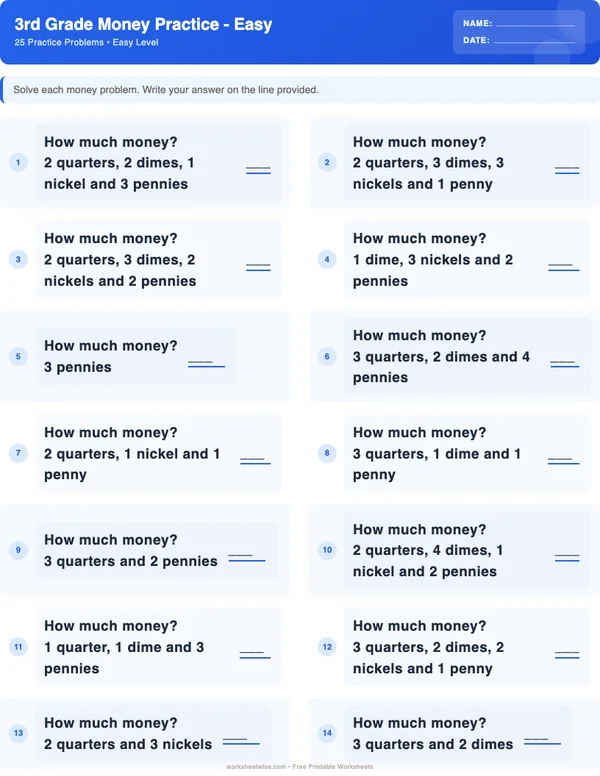
The free easy 3rd Grade Money worksheet contains 25 exercises covering coin values, counting money, money operations, and making change. It includes a separate answer key. Because several skills appear in the worksheet, assign only the items that match the learner’s present goal when a narrower set is needed.
For developing fluency
Choose mixed collections with repeated denominations. Have the learner record subtotal values before writing the total. Include equivalent collections so that counting is connected to value relationships rather than picture recognition alone.
A balanced set might contain:
- Three mixed-coin totals.
- Two equivalent-amount tasks.
- Two comparisons.
- One short purchase problem.
For application and extension
Use price tags, limited budgets, and two-step situations. Examples include choosing two items that cost less than $5.00 or finding two different coin collections for the same amount.
Keep the arithmetic within reach when the goal is reasoning. If a learner understands how to find change but makes repeated calculation errors with large amounts, reduce the numbers temporarily and preserve the problem structure.
For broader review, the 3rd Grade worksheet hub provides access to practice across subjects, while the focused Money pack contains 18 worksheets. The pack is listed at $4.79. More pages are useful only when they are selected from evidence in the learner’s work.
Differentiation Without Changing the Core Idea
When the learner needs more support
Reduce one demand at a time:
- Provide a coin-value chart.
- Sort coins before counting.
- Write the skip-count interval above each denomination.
- Use cents instead of decimal notation.
- Limit collections to two denominations.
- Mark landmark amounts on a number line.
- Read word problems aloud.
- Cover unrelated problems to reduce visual load.
Keep the mathematical goal intact. For example, if mixed-coin counting is the goal, reduce the number of denominations without replacing the task with coin naming alone.
When the learner is ready for more challenge
Increase reasoning rather than merely increasing the number of problems:
- Find two or three ways to make 68¢.
- Build an amount using exactly six coins.
- Decide whether there is enough money before calculating change.
- Find and correct an intentionally incorrect solution.
- Compare two strategies for finding change.
- Create a purchase problem with a specified answer.
Some constraints have no solution. For instance, it is impossible to make 7¢ using only nickels and dimes. Such boundary cases encourage attention to coin values rather than random trial.
When notation is the main difficulty
Allow the learner to demonstrate the value with coins before writing it. Contrast examples such as:
- 5¢ = $0.05
- 50¢ = $0.50
- 105¢ = $1.05
- 150¢ = $1.50
Do not interpret every misplaced zero as failure to understand money. Check whether the learner can build and name the amount accurately.
Common Errors and Diagnostic Responses
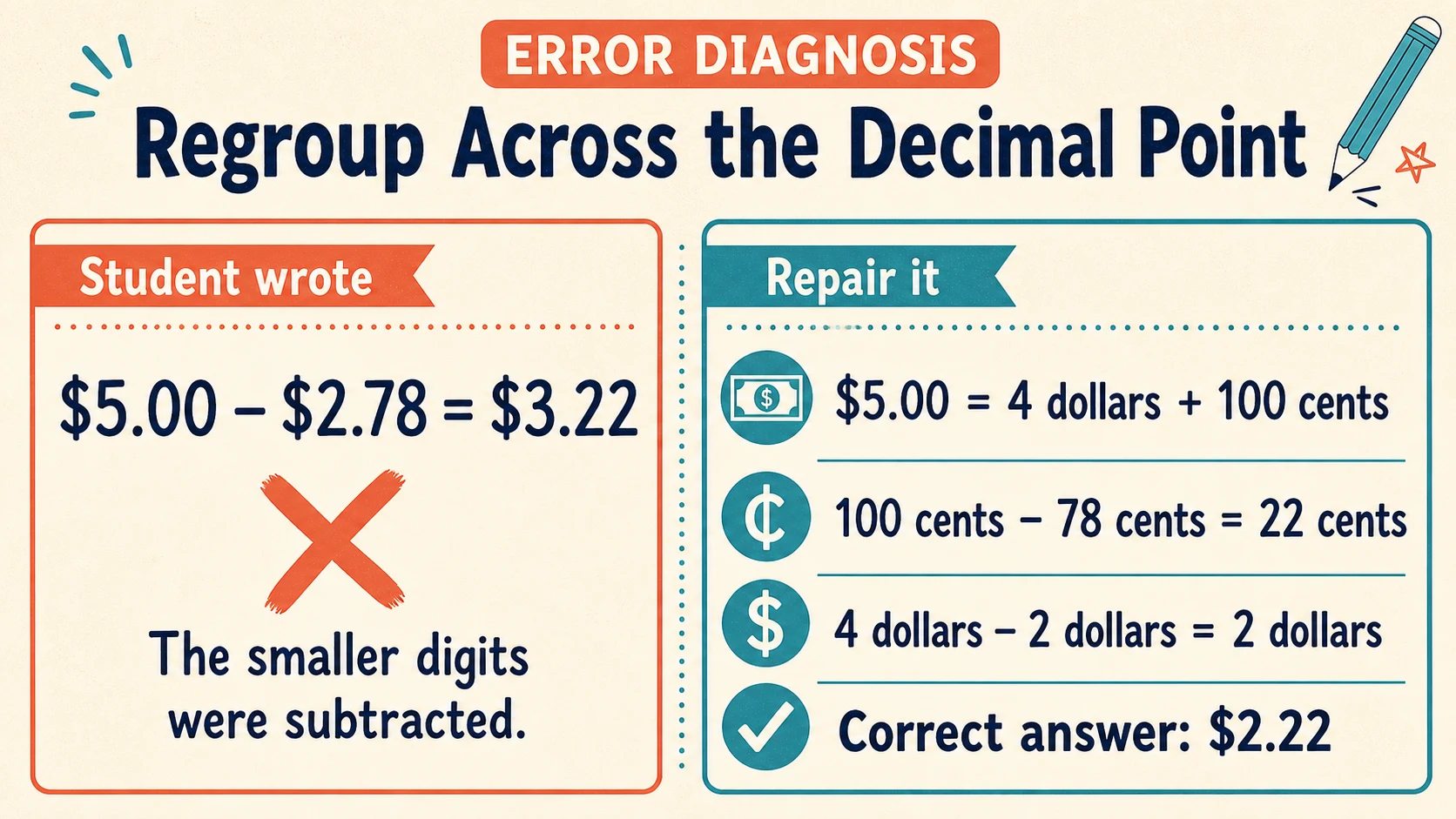
Use the error pattern to choose the next teaching move instead of assigning undirected repetition.
| Observed error |
Likely issue to check |
Instructional response |
| Counts every coin as one cent |
Confuses object count with monetary value |
Use a value table and label each coin before totaling |
| Says a nickel is worth more than a dime |
Relies on physical size |
Compare labeled coins and build 10¢ with one dime and two nickels |
| Loses track in a mixed collection |
Cannot change counting intervals smoothly |
Sort greatest to least and write denomination subtotals |
| Writes 75¢ as $0.075 |
Decimal place value is not secure |
Use dollar and cent columns; connect 75¢ with $0.75 |
| Writes $3.5 for $3.05 |
Treats the digits after the decimal as an unstructured count |
Build $3.05 and contrast it with $3.50 |
| Adds the price and payment in a change problem |
Misreads the relationship in the situation |
Label “cost,” “paid,” and “change”; show change as the gap |
| Subtracts the smaller-looking digits from larger digits independently |
Regrouping is not secure |
Calculate in cents or use counting up, then verify |
| Gives change greater than the amount paid |
Does not estimate or check reasonableness |
Compare the answer with the payment and recombine price plus change |
| Chooses the collection with more coins as greater |
Compares number of objects, not total value |
Record and compare the value of each collection |
| Gets an exact-payment problem wrong |
Assumes change must be positive |
Include examples where the change is $0.00 |
A single mistake does not establish a stable misconception. Ask the learner to solve a similar problem and explain the method. Repeated patterns provide better guidance than one isolated response.
Monitoring Progress and Deciding What Comes Next
Keep a compact record of the skill, support provided, accuracy, and explanation quality. Avoid reducing progress to a score alone.
Useful evidence includes whether the learner can:
- Name coin values without relying on size.
- Count same-denomination groups efficiently.
- Count mixed coins after arranging them.
- Represent one amount in more than one way.
- Translate between cents and dollar notation.
- Compare collections by total value.
- Add prices with aligned place values.
- Find change and verify it.
- Explain what each operation means in a word problem.
Use three broad decisions:
- Review: The learner cannot yet represent the idea accurately, even with a prompt.
- Continue: The learner is mostly accurate but still depends on a model or occasional cue.
- Advance: The learner works independently, explains the method, and checks a nearby variation.
Accuracy can be affected by several factors at once. Record whether an error came from coin recognition, counting, notation, computation, or reading the situation. That distinction determines what to teach next.
A Two-Week Practice Plan
This plan is an adaptable example, not a sourced or universal timetable. Sessions may be shortened, repeated, or reordered according to the learner’s work.
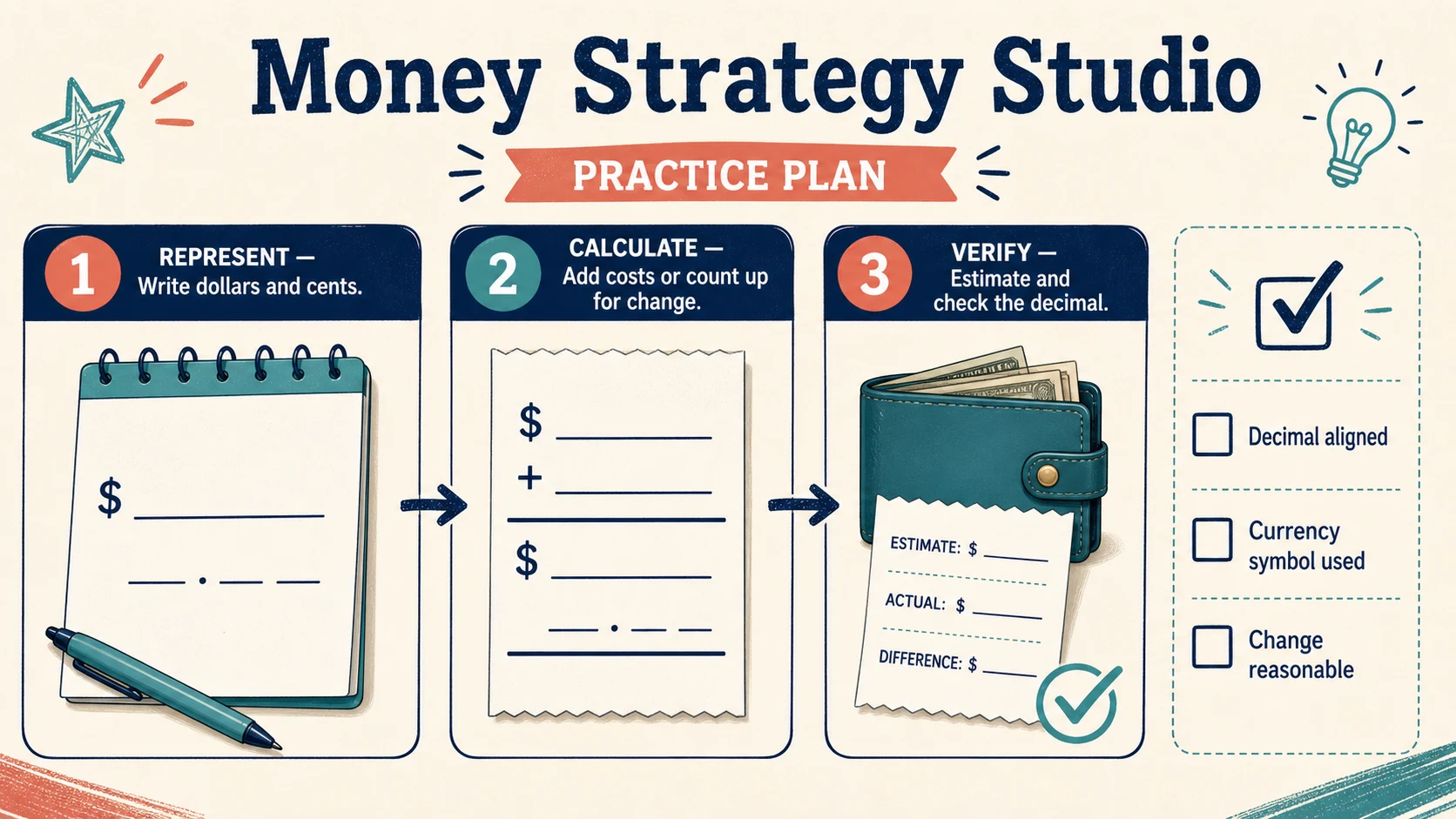
Alternate hands-on work, visual models, written practice, and brief cumulative review.
| Day |
Main focus |
Suggested activity |
Evidence to record |
| 1 |
Coin names and values |
Sort play coins; build a value chart |
Confusions between names, sizes, and values |
| 2 |
Same-denomination counting |
Count groups of pennies, dimes, nickels, and quarters |
Which skip-count intervals are secure |
| 3 |
Equivalent amounts |
Trade coins and build the same amount two ways |
Whether equal value is preserved |
| 4 |
Mixed collections |
Order coins greatest to least and count on |
Ability to change counting intervals |
| 5 |
Review and check |
Complete a short mixed set; explain two answers |
Independent accuracy and explanation |
| 6 |
Compare totals |
Use tables and comparison symbols |
Whether comparison is based on value |
| 7 |
Dollars and cents |
Convert amounts such as 85¢, 105¢, and 250¢ |
Placement of dollar sign, decimal, and zeros |
| 8 |
Add prices |
Combine two prices using cents and column form |
Place-value alignment and regrouping |
| 9 |
Make change |
Count up from price to payment; check by subtraction |
Understanding of the gap between amounts |
| 10 |
Multi-step application |
Run a small store task, then complete selected written problems |
Operation choice, calculation, and checking |
Begin each session with two review items from earlier days. End with one problem that the learner explains aloud or in writing. If errors increase when representations are removed, restore the model and continue at that level rather than pushing ahead because the calendar says to do so.
Limits and an Honest Next Step
A worksheet can provide organized repetition and make patterns in the learner’s work easier to see. It cannot by itself determine why an error occurred, replace discussion, or guarantee that the learner will apply the skill in a new purchase situation. Printed coin images also do not provide the same experience as sorting, exchanging, and counting movable coins.
This guide does not claim comprehensive standards alignment, certification, guaranteed outcomes, medical guidance, or one correct instructional timetable. The supplied catalogue identifies earlier money-related standards, while local third-grade expectations and review sequences may differ.
The practical next step is to give the learner five carefully chosen items from the free 3rd Grade Money worksheet. Ask for a model or explanation with each answer, sort the errors by skill, and use the results to select the next short lesson. If a custom-sized practice set would be more useful, explore the free worksheet generators.