What 3rd Grade Telling Time Includes
Third-grade telling time centers on three connected abilities: reading and writing time to the nearest minute, reasoning about intervals of time, and using time in schedules and word problems. A learner should understand what each clock hand represents, how the hour hand moves between numerals, and why 60 minutes make one hour before being expected to solve elapsed-time problems independently.
A useful teaching sequence is:
- Confirm earlier skills with hours, half-hours, and five-minute intervals.
- Connect clock numerals to minute counts.
- Read analog clocks to the nearest minute.
- Match analog and digital representations.
- distinguish a.m. from p.m. in familiar situations.
- Find elapsed time with visual jumps.
- Determine unknown start or end times.
- Apply the skills to schedules and word problems.
The Common Core State Standards for Mathematics describe a progression from hours and half-hours in grade 1, to five-minute intervals with a.m. and p.m. in grade 2, and then nearest-minute reading and time-interval problems in grade 3. This provides a useful reference point, but local curricula and teaching sequences differ. Grade labels describe the intended practice level, not a guarantee that every learner has already mastered all earlier material.
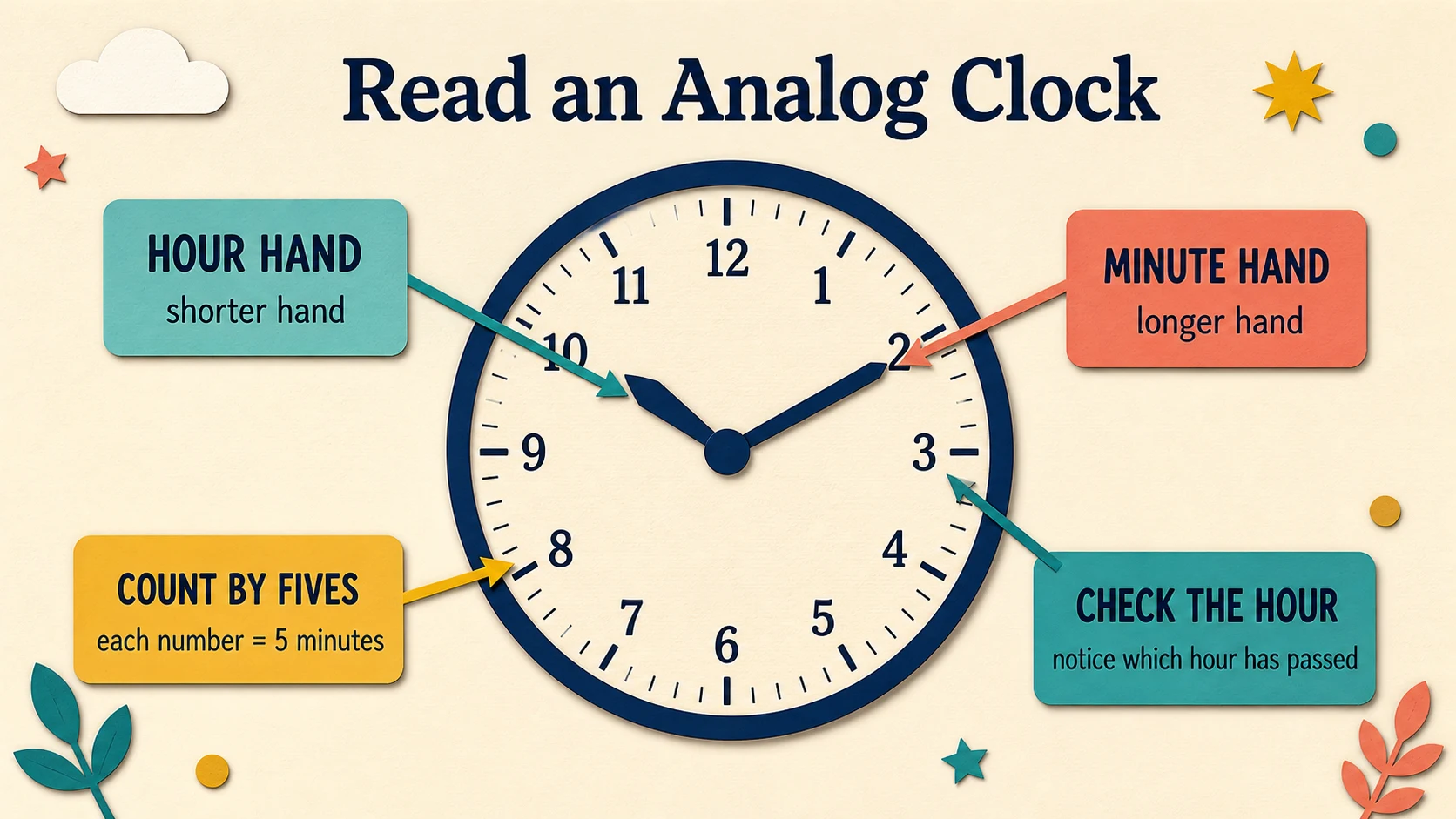
Reading clocks, understanding units, and reasoning about intervals develop together.
Prerequisites to Check Before Starting
A short prerequisite check is more useful than assuming readiness from age or grade placement. Ask the learner to complete a few tasks without prompting, then use the observed work to decide where instruction should begin.
Number and counting knowledge
Check whether the learner can:
- Count forward and backward within 60.
- Skip-count by 5s from 0 to 60.
- Add or subtract small amounts mentally.
- Recognize that 60 can be separated into useful parts such as 30 and 30, or 15, 15, 15, and 15.
Difficulty with skip-counting does not prevent clock instruction, but it changes the support required. The learner may need a clock face labeled with both numerals and minute values rather than being asked to recall all minute positions immediately.
Earlier clock-reading skills
Show analog clocks for 4:00, 7:30, and 2:25. Ask the learner to read each clock and explain how they know. Also ask which hand shows the hour and which shows the minutes.
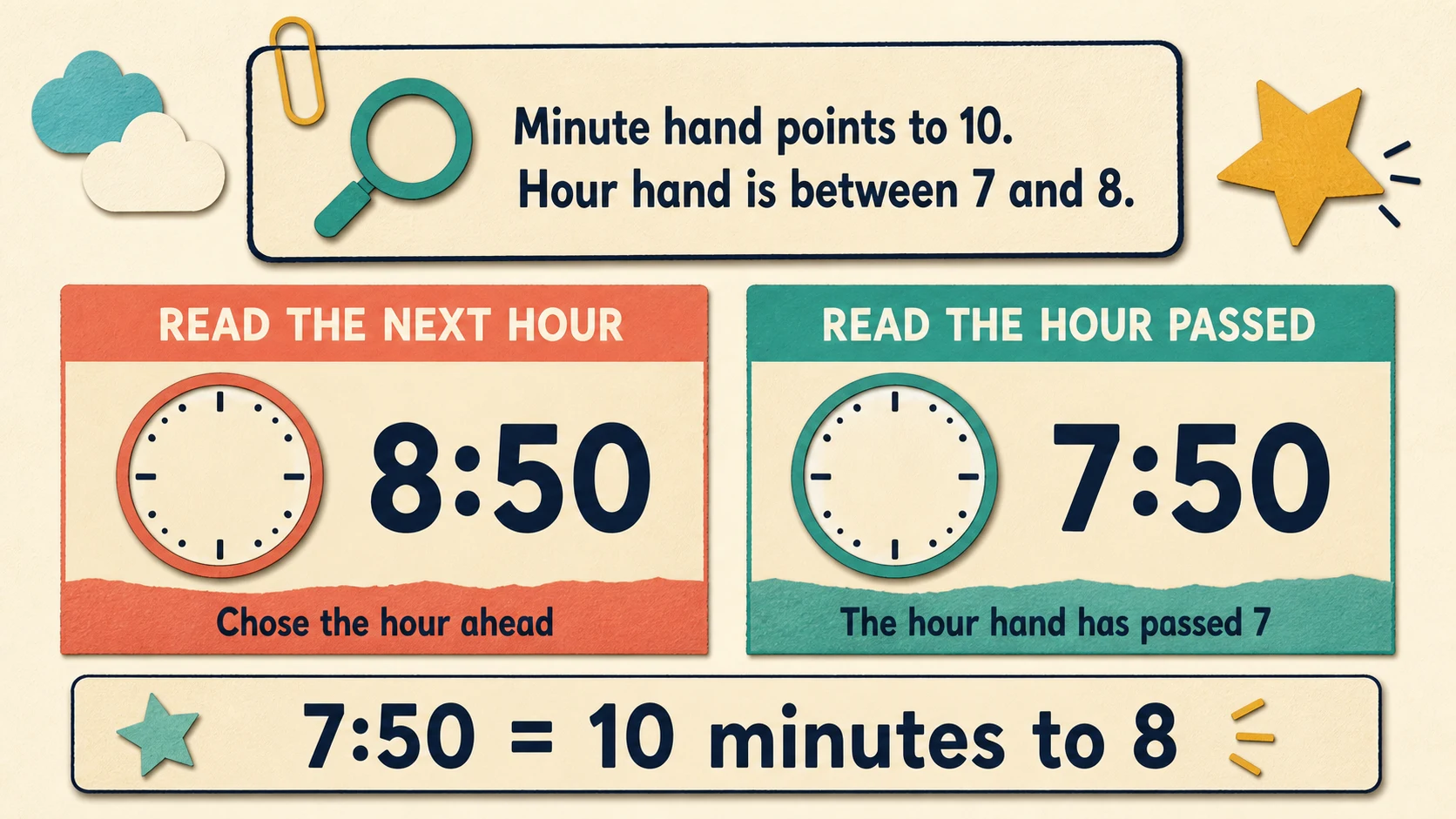
Look beyond whether an answer is correct. A learner who calls 2:25 “five past 2” may understand the hour but be counting clock numerals instead of five-minute groups. A learner who reads 7:30 as 6:30 may not yet understand that the hour hand has passed 7 and is moving toward 8.
Time vocabulary and units
Check the meanings of:
- Before and after
- Earlier and later
- Start time and end time
- Duration or elapsed time
- Minute, hour, day, a.m., and p.m.
The learner should know that an hour contains 60 minutes. Converting larger or mixed units can be taught as needed, but elapsed-time work will be confusing if “one hour later” is treated as 100 minutes later.
If several prerequisite gaps appear, begin with suitable material from the 3rd Grade Math collection and use clock tasks at a supported level. The aim is not to rush through a checklist. It is to identify the first point at which the learner’s reasoning becomes uncertain.
A Grade-Appropriate Teaching Progression
The following progression moves from interpretation to application. The number of sessions is intentionally flexible: advance when the learner’s work is accurate and explainable, not merely when a planned date arrives.
| Stage |
Teaching focus |
Helpful model |
Evidence of readiness to continue |
| 1 |
Review hours and half-hours |
Geared demonstration clock |
Reads both hands and explains whether the hour hand has passed a numeral |
| 2 |
Review five-minute intervals |
Clock with minute values marked |
Counts by 5s accurately around the face |
| 3 |
Read to the nearest minute |
Minute tick marks and movable hands |
Identifies the minute value without treating each numeral as one minute |
| 4 |
Write and match times |
Analog clocks paired with digital notation |
Writes times correctly, including minutes below 10 |
| 5 |
Use a.m. and p.m. |
Familiar daily schedule |
Chooses a reasonable label and explains it from context |
| 6 |
Find elapsed time |
Open number line |
Makes valid hour and minute jumps and combines them |
| 7 |
Find unknown start or end times |
Number line or movable clock |
Works forward or backward without changing the wrong hour |
| 8 |
Solve schedule problems |
Simple timetable |
Selects relevant times and states the interval with a unit |
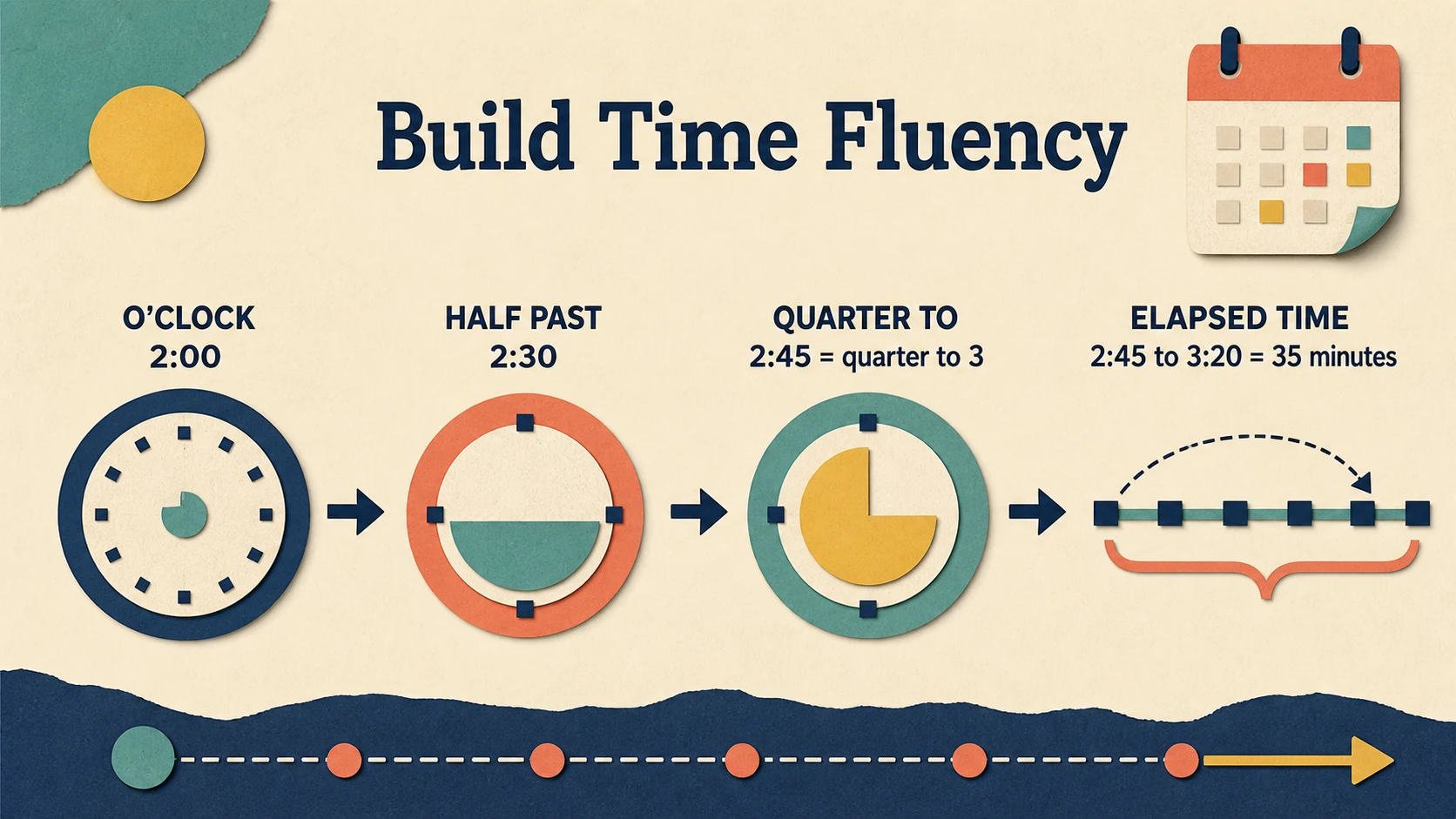
Remove visual support gradually as the learner shows stable understanding.
Why the hour hand needs explicit attention
Many exercises emphasize the minute hand because it travels farther and points directly to minute marks. Yet the hour hand often causes the more revealing errors. At 3:45, it sits closer to 4 than to 3, but the time remains “3 something” because the hand has not reached 4.
Use a geared demonstration clock when possible so moving the minute hand also moves the hour hand. Start with the minute hand covered. Ask, “Which hour has the short hand passed?” and “Which hour is it moving toward?” Then reveal the minute hand and read the complete time.
From five-minute counts to exact minutes
Once the learner can skip-count around the face, connect the numeral positions to cumulative minutes:
- 1 represents 5 minutes past the hour.
- 3 represents 15 minutes past.
- 6 represents 30 minutes past.
- 9 represents 45 minutes past.
- 12 represents 0 minutes past the new hour, or 60 minutes from the previous hour.
For a time such as 6:37, count by 5s to 35 at the 7, then count two additional minute marks. This makes nearest-minute reading an extension of known structure rather than a separate trick.
Concrete and Visual Models That Clarify Time
Clock reading combines a circular scale, two hands with different jobs, and base-60 units. Models should make those relationships visible.
A geared clock
A geared clock shows that the hour hand does not jump abruptly from one numeral to the next. As the minute hand moves through 60 minutes, the hour hand moves gradually toward the following hour. This directly addresses errors at times such as 8:50 or 11:58.
Let the learner move the minute hand through a full turn while watching the hour hand. Pause at quarter-hour points and ask what has changed. Avoid moving the hour hand independently during this demonstration because that hides the relationship being taught.
A labeled clock face
Temporarily write 0, 5, 10, 15, and so on through 55 around the outside of a clock. Use the small tick marks between those labels for individual minutes. Later, remove some labels or ask the learner to create them.
The labels are instructional support, not something to remove on a universal timetable. Reduce them when the learner reads unfamiliar clocks accurately and can explain the minute count.
An open number line
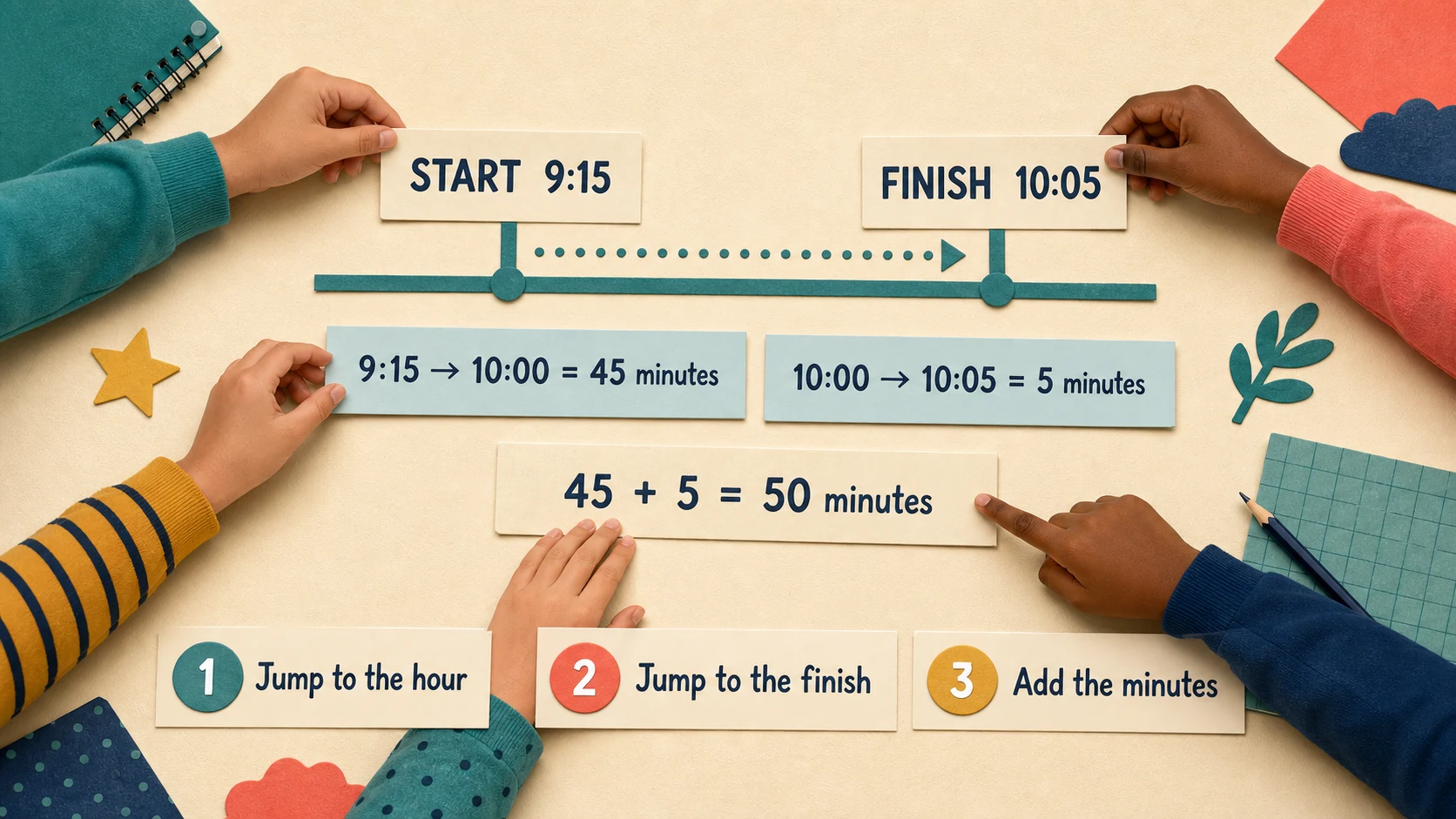
For elapsed time, place the start time on the left and make convenient forward jumps toward the end:
2:38 → 3:00 → 4:00 → 4:17
Label each jump 22 minutes, 1 hour, and 17 minutes. Combining those jumps gives 1 hour 39 minutes.
This approach keeps the meaning of elapsed time visible. The WorksheetWise catalogue specifically recommends open number lines rather than beginning with column subtraction that requires regrouping 60 minutes. That is an instructional suggestion for building understanding, not a claim that every learner must use one method permanently.
The IES guide on teaching mathematics to young children supports broad practices such as using progressions, monitoring what children know, and helping learners connect mathematical ideas and representations. It does not evaluate WorksheetWise or prescribe this exact lesson.
Fully Worked and Checked Examples
Example 1: Read an analog clock to the nearest minute
Suppose the long hand points to the second small tick after 7, and the short hand is between 4 and 5.
- Read the hour hand first. It has passed 4 but has not reached 5, so the hour is 4.
- The 7 represents 35 minutes because
7 × 5 = 35.
- Count two additional minute marks:
35 + 2 = 37.
- The time is 4:37.
Check: At 4:37, more than half of the hour has passed, so the hour hand should be more than halfway from 4 toward 5. That matches the described clock.
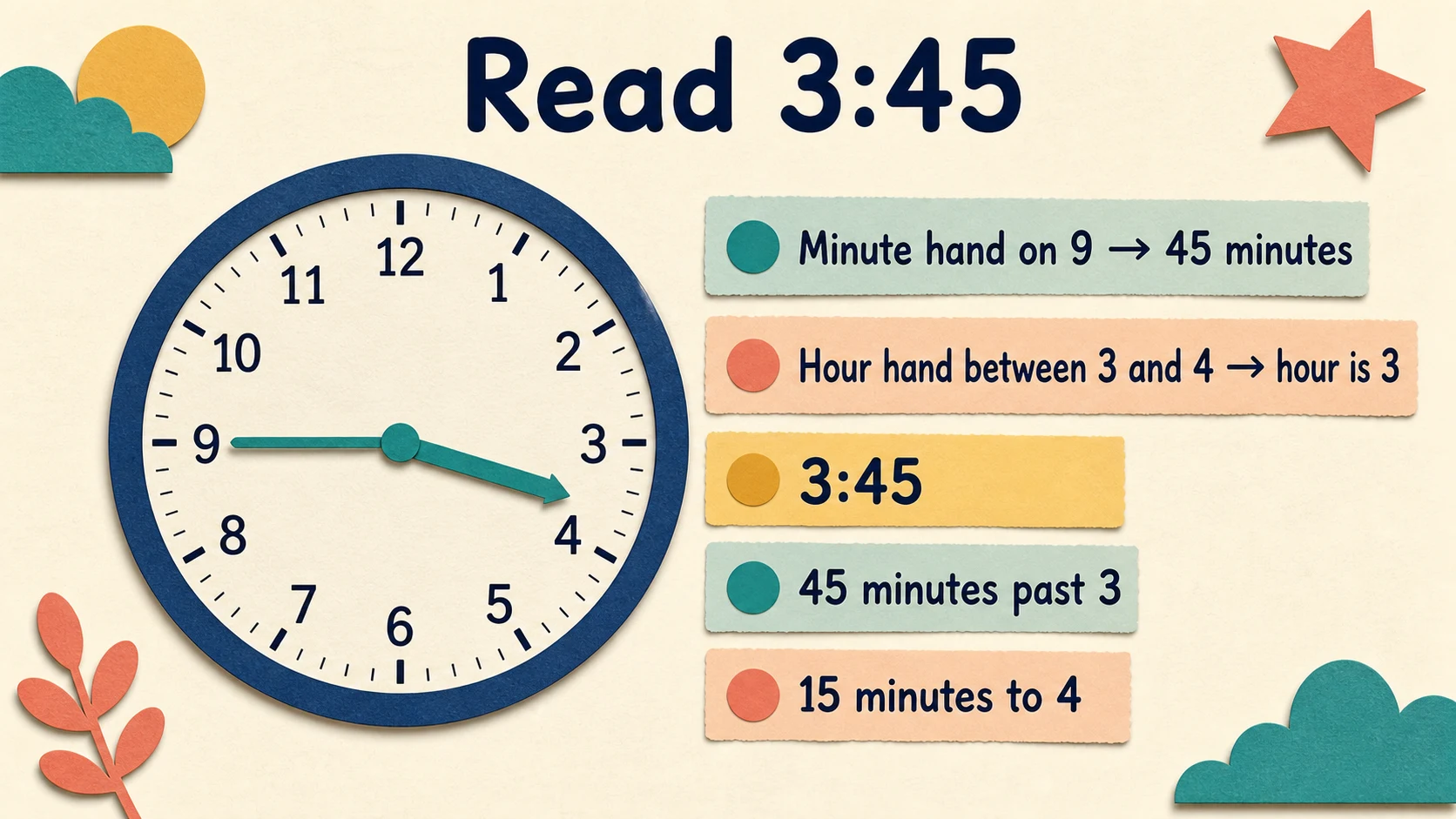
Reading the hour first prevents the nearby numeral from replacing the actual hour.
Example 2: Find elapsed time across an hour
A tutoring session starts at 3:45 p.m. and ends at 5:10 p.m. How long does it last?
Use convenient forward jumps:
- From 3:45 to 4:00 is 15 minutes.
- From 4:00 to 5:00 is 1 hour.
- From 5:00 to 5:10 is 10 minutes.
Combine the shorter intervals:
15 minutes + 10 minutes = 25 minutes
The session lasts 1 hour 25 minutes.
Check by adding the duration to the start time:
3:45 + 1 hour = 4:454:45 + 25 minutes = 5:10
The result matches the stated end time.
Example 3: Find an end time
A reading activity begins at 9:28 a.m. and lasts 47 minutes. When does it end?
First move to the next hour:
- From 9:28 to 10:00 is 32 minutes.
- The activity lasts 47 minutes, so
47 − 32 = 15 minutes remain.
- Move 15 more minutes from 10:00 to 10:15.
The activity ends at 10:15 a.m.
Check by separating 47 minutes another way:
9:28 + 40 minutes = 10:0810:08 + 7 minutes = 10:15
Both methods agree.
Example 4: Find a start time
A lesson ends at 1:05 p.m. after lasting 38 minutes. When did it begin?
Work backward:
- From 1:05 back to 1:00 is 5 minutes.
- There are
38 − 5 = 33 minutes still to move backward.
- From 1:00 back 33 minutes gives 12:27.
The lesson began at 12:27 p.m.
Check by moving forward:
12:27 + 33 minutes = 1:001:00 + 5 minutes = 1:05
The total is 38 minutes, so the answer is correct.
Example 5: Read a schedule and compare durations
A schedule shows:
| Activity |
Start |
End |
| Art |
10:15 a.m. |
10:52 a.m. |
| Music |
11:05 a.m. |
11:48 a.m. |
Find each duration and determine which activity is longer.
For art:
- 10:15 to 10:45 is 30 minutes.
- 10:45 to 10:52 is 7 minutes.
- Total:
30 + 7 = 37 minutes.
For music:
- 11:05 to 11:45 is 40 minutes.
- 11:45 to 11:48 is 3 minutes.
- Total:
40 + 3 = 43 minutes.
Compare: 43 − 37 = 6.
Music is 6 minutes longer than art.
Check: Both activities remain within one hour, and each calculated duration is less than 60 minutes, which is consistent with the schedule.
Boundary Cases Worth Teaching Deliberately
Boundary cases reveal whether a learner understands the system rather than following a surface pattern.
Near the next hour
At 7:58, the hour hand is very close to 8. The time is still 7:58 because it has not yet reached 8. At 8:00, the minute hand reaches 12 and the hour hand reaches 8.
Compare 7:58, 7:59, and 8:00 on a geared clock. Ask what changes by one minute and why both digits change at the hour boundary.
Minutes below 10
Digital time uses a zero in 6:04. Writing 6:4 is not the conventional digital display. Connect the zero to the idea that there are zero groups of ten minutes and four additional minutes.
Crossing noon
If an activity begins at 11:50 a.m. and lasts 20 minutes, it ends at 12:10 p.m.:
- 11:50 a.m. to 12:00 noon is 10 minutes.
- Another 10 minutes reaches 12:10 p.m.
The a.m./p.m. label changes at noon. Keep early tasks within a familiar daytime context before mixing noon with more complicated intervals.
A full hour with matching minute values
From 2:17 to 3:17 is exactly 1 hour. Matching minute values do not mean zero elapsed time because the hour has changed. Similarly, from 9:42 to 11:42 is 2 hours.
Common Errors and Diagnostic Responses
An incorrect answer is most useful when it identifies the learner’s reasoning.
| Observed response |
Likely interpretation |
Teaching response |
| Reads 3:45 as 4:45 |
Chooses the numeral nearest the hour hand |
Ask which hour the hand has passed and which it has not yet reached |
| Reads minute hand at 8 as 8 minutes |
Counts numerals rather than five-minute groups |
Label the outer ring 5, 10, 15, and onward |
| Reads 5:03 as 5:30 |
Reverses the value or place of the minute digits |
Build 3, 30, and 35 minutes on one clock and compare |
| Says 2:50 plus 20 minutes is 2:70 |
Treats time as base 10 or 100 |
Jump 10 minutes to 3:00, then 10 more to 3:10 |
| Subtracts 9:35 from 10:10 as 75 minutes |
Subtracts displayed numbers without respecting 60-minute hours |
Use a number line: 25 minutes to 10:00, then 10 minutes |
| Chooses a.m. or p.m. from appearance alone |
Lacks contextual meaning |
Pair times with plausible events such as breakfast or bedtime |
| Finds the correct duration but omits units |
Treats the answer as a bare number |
Require a complete statement: “The interval is 24 minutes” |
Match the response to the learner’s method instead of assigning more of the same problem.
The IES practice guide for assisting students struggling with mathematics offers high-level guidance on systematic instruction, clear mathematical language, representations, and cumulative review. Applied here, that framing suggests modeling one reasoning step at a time, checking understanding frequently, and revisiting earlier time skills alongside new work. It does not establish a diagnosis or prescribe child-specific intervention.
A Short, Repeatable Lesson Routine
A focused lesson can follow five parts. Adjust the duration and number of problems according to the learner’s attention, accuracy, and explanations.
1. Retrieve a known skill
Begin with two quick items, such as reading 6:30 and identifying the minute value at the 9. If either response is uncertain, address it before introducing a harder interval.
2. Model one new idea
Use a movable clock or open number line. Think aloud briefly: “The hour hand has passed 2, so the hour is 2. The minute hand is one tick after 20, so the time is 2:21.”
3. Solve together
Give a similar problem. Ask the learner to choose the first step and explain it. Prompt only as much as needed. If the learner says 3:55 is 4:55, return attention to the hour hand rather than supplying the answer.
4. Try independently
Use two to four problems with the same central skill but different values. Include one item that tests a likely boundary, such as minutes above 30 or an interval crossing an hour.
5. Review and record
Ask the learner to explain one answer and check another using a second method. Record what was independent, what required a prompt, and what error pattern appeared.
A stable routine leaves more attention available for the mathematics.
Choosing Practice and Differentiating Support
Select practice from evidence, not merely from the grade printed at the top. The 3rd Grade Telling Time topic guide and resources can support the progression, while the broader 3rd Grade worksheet hub provides context for other grade-level work.
When the learner needs more support
Use fewer problems and increase clarity:
- Keep minute labels visible around the clock.
- Use geared clock demonstrations before static pictures.
- Separate reading clocks from elapsed-time work.
- Begin intervals at multiples of 5 before introducing arbitrary minutes.
- Let the learner build a clock time before reading it.
- Use forward number-line jumps before asking for unknown start times.
- Mix only one new demand into otherwise familiar problems.
If 4:35 is repeatedly misread as 5:35, additional elapsed-time worksheets are unlikely to address the immediate gap. Return to interpreting the hour hand.
When the learner is ready for standard practice
Mix representations and question forms:
- Read an analog clock and write the digital time.
- Draw hands for a stated time.
- Match analog and digital clocks.
- Add or subtract an interval.
- Find a missing start or end time.
- Read a short schedule.
- Decide whether a described event is more plausibly a.m. or p.m.
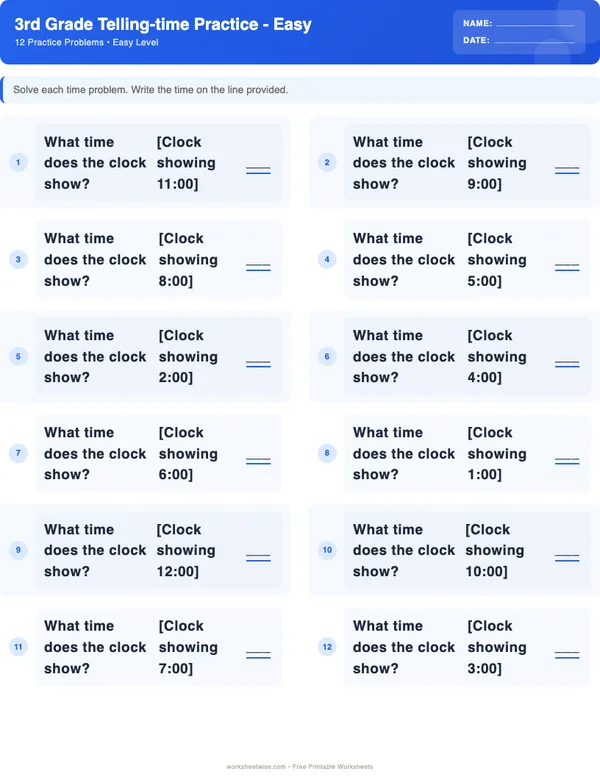
The free easy telling-time worksheet contains 12 exercises covering clock reading, analog and digital time, elapsed time, and time intervals, with a separate answer key. It is intended for introductory or reinforcing practice. Inspect the learner’s work afterward rather than treating completion alone as evidence of mastery.
When the learner needs greater challenge
Increase reasoning rather than simply increasing page length:
- Ask for two methods to find an interval.
- Include an irrelevant time in a schedule.
- Ask the learner to create a start time and duration that produce a given end time.
- Compare two activity lengths.
- Include transitions across an hour or noon.
- Ask the learner to locate and correct an intentionally wrong solution.
For broader repeated practice, the 3rd Grade Telling Time Worksheet Pack contains 18 worksheets. Choose pages by the skill shown in the learner’s work; do not assume that completing all 18 in order is necessary.
Monitoring Progress Without Over-Testing
Keep a simple record with four columns: date, task type, level of support, and observed reasoning. “Correct with minute labels” is more informative than a score alone. So is “found elapsed time independently but changed p.m. incorrectly at noon.”
A learner is showing useful progress when they can:
- Read unfamiliar analog clocks to the nearest minute.
- Explain why the hour is determined by the numeral already passed.
- Match analog and digital times without reversing digits.
- Use 60 minutes as one hour when crossing an hour boundary.
- Find elapsed time and check it by adding the interval back.
- Solve comparable problems after visual support is reduced.
- Retain the skill when it reappears several days later.
Use occasional mixed review because immediate success after a demonstration may reflect short-term imitation. If accuracy falls when problem formats are mixed, identify which representation or question type causes the change.
A Flexible Two-Week Practice Plan
This plan assumes short, regular sessions, but it is not a universal timetable. Repeat, combine, or pause days according to the learner’s observed work.
| Day |
Main focus |
Suggested evidence to collect |
| 1 |
Prerequisite check: hour, half-hour, five-minute counts, units |
Note the first uncertain skill |
| 2 |
Hour-hand movement with a geared clock |
Learner identifies the hour at times past :30 |
| 3 |
Five-minute positions and minute labels |
Learner counts around the face without losing sequence |
| 4 |
Nearest-minute reading |
Learner reads exact ticks beside five-minute marks |
| 5 |
Analog and digital matching |
Learner writes leading zero in times such as 7:06 |
| 6 |
Mixed reading review |
Record whether earlier errors recur |
| 7 |
a.m., p.m., noon, and familiar schedules |
Learner explains labels from context |
| 8 |
Elapsed time within one hour |
Learner makes and labels number-line jumps |
| 9 |
Elapsed time across an hour |
Learner uses 60-minute structure accurately |
| 10 |
Find an end time |
Learner checks by recounting the full interval |
| 11 |
Find a start time |
Learner works backward without changing units |
| 12 |
Schedule comparison problems |
Learner identifies relevant start and end times |
| 13 |
Mixed independent practice |
Note accuracy, explanations, and remaining prompts |
| 14 |
Review, correction, and next-step selection |
Choose consolidation or increased challenge |
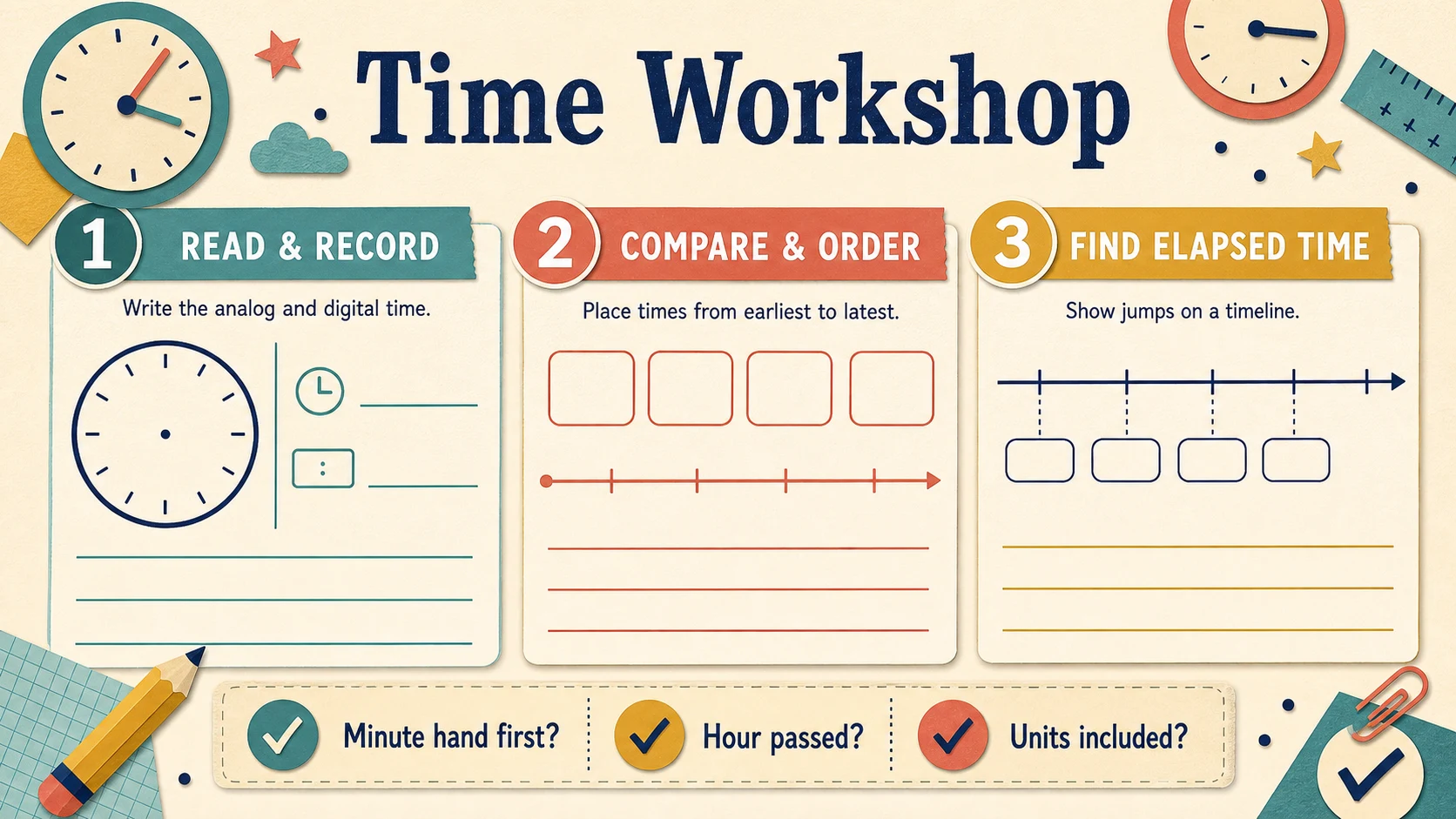
Let performance determine whether the next session advances, reviews, or changes the model.
Limitations and an Honest Next Step
A worksheet can provide clear, sequenced practice, but static clock faces cannot fully demonstrate the continuous movement of geared hands. Written answers also may not reveal whether a learner reasoned correctly or guessed. Adults should ask for brief explanations, observe hand movement on a model, and treat answer keys as checking tools rather than substitutes for instruction.
This guide provides instructional suggestions within the supplied telling-time scope. It does not claim comprehensive standards alignment, guaranteed outcomes, certification, medical guidance, or a schedule appropriate for every learner. Local curriculum expectations differ, and persistent difficulty should be discussed with the learner’s teacher or another qualified education professional who can examine a broader sample of work.
For the next session, choose one unresolved skill and give a brief model followed by three closely matched problems. If the learner is ready for supported mixed practice, begin with the free 3rd Grade Telling Time worksheet. If a more narrowly tailored set is needed, use the free worksheet generators to create practice around the specific clock-reading or interval pattern shown in the learner’s work.