3rd Grade Division: What Learners Need to Understand
3rd Grade Division begins with one central idea: a quantity can be separated into equal groups. A learner should understand both equal sharing and finding the number of equal groups before being expected to rely on symbols or memorized facts.
For example, 12÷3=4 can mean:
- Share 12 objects equally among 3 groups. Each group receives 4.
- Make groups of 3 from 12 objects. There are 4 groups.
These interpretations use the same equation, but they describe different situations. Learners need experience with both.
A practical instructional sequence is:
- Build and separate real or pictured objects.
- Draw equal groups, arrays, or number-line jumps.
- Connect each model to multiplication.
- Write and solve division equations.
- Practice facts within 100.
- Apply division in one-step and two-step situations.
- Interpret remainders only when the context and learner’s readiness make that appropriate.
The Common Core State Standards for Mathematics place Grade 3 division mainly within equal-group interpretations, word problems, unknown-factor reasoning, and multiplication and division facts within 100. Local curricula may introduce or sequence material differently. Grade labels describe the intended practice level, not a universal timetable, and local sequences differ.
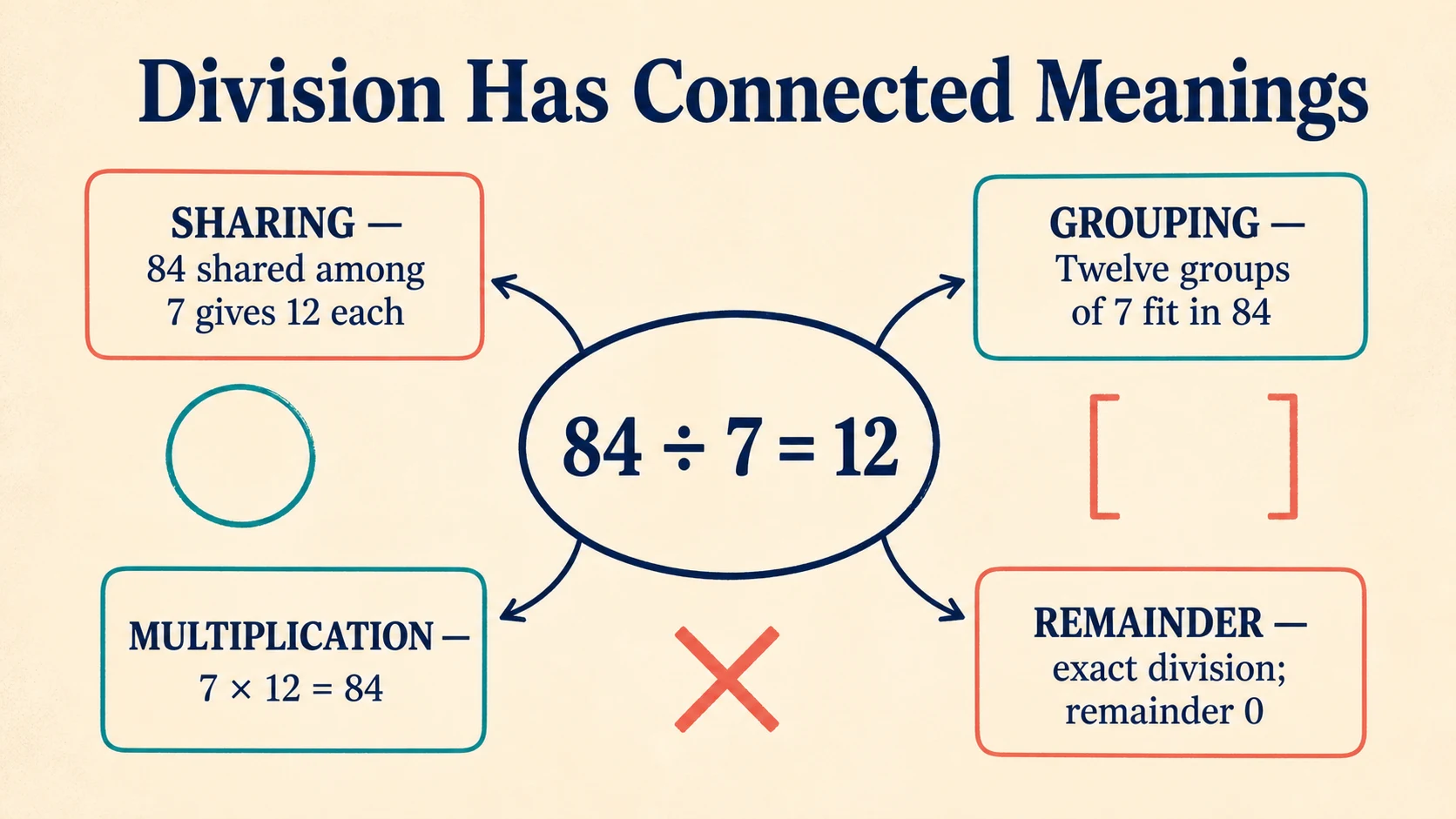
Division develops from equal groups toward equations, fact relationships, and contextual problem solving.
Prerequisites and a Grade-Appropriate Progression
A learner does not need perfect multiplication recall before beginning division. However, several earlier ideas make division much easier to understand.
Readiness skills to check
Before assigning a page of division equations, observe whether the learner can:
- Count a collection accurately.
- Organize objects rather than repeatedly losing track.
- Make groups containing the same number.
- Use addition or skip-counting to find a total.
- Read and write whole numbers used in the task.
- Recognize a simple multiplication expression such as 3×4.
- Explain whether groups are equal or unequal.
- Check a result by recounting or using another operation.
A quick readiness task is to provide 18 counters and ask the learner to make 3 equal groups. Do not supply a procedure immediately. Watch what happens.
A learner who deals the counters one at a time may already understand equal sharing. A learner who makes groups of 3 may be treating the task as repeated grouping. A learner who makes unequal piles may need more work on the meaning of “equal.” These approaches give more useful teaching information than a correct answer alone.
A scannable teaching progression
| Stage |
Instructional focus |
Useful representation |
Evidence to look for |
| 1 |
Equal and unequal groups |
Counters, cubes, small objects |
Identifies whether every group has the same amount |
| 2 |
Sharing a total equally |
Objects placed into labeled groups |
Shares all objects without leftovers when the division is exact |
| 3 |
Finding how many groups fit |
Repeated groups or circles |
Counts complete groups accurately |
| 4 |
Connecting division and multiplication |
Arrays and fact-family triangles |
Uses 3×4=12 to solve 12÷3 |
| 5 |
Recording equations |
Pictures beside equations |
Explains what the dividend, divisor, and quotient represent in the model |
| 6 |
Building fact strategies |
Known facts, doubles, related facts |
Derives an unfamiliar fact instead of guessing |
| 7 |
Solving word problems |
Drawings, bar models, equations |
Chooses sharing or grouping from the situation |
| 8 |
Mixed and independent practice |
Short problem sets |
Selects a method and checks the answer without prompting |
The IES guide on teaching mathematics to young children supports high-level use of developmental progressions and regular attention to what learners currently understand. For this topic, that framing means moving forward because the observed work is ready—not simply because a certain number of days has passed.
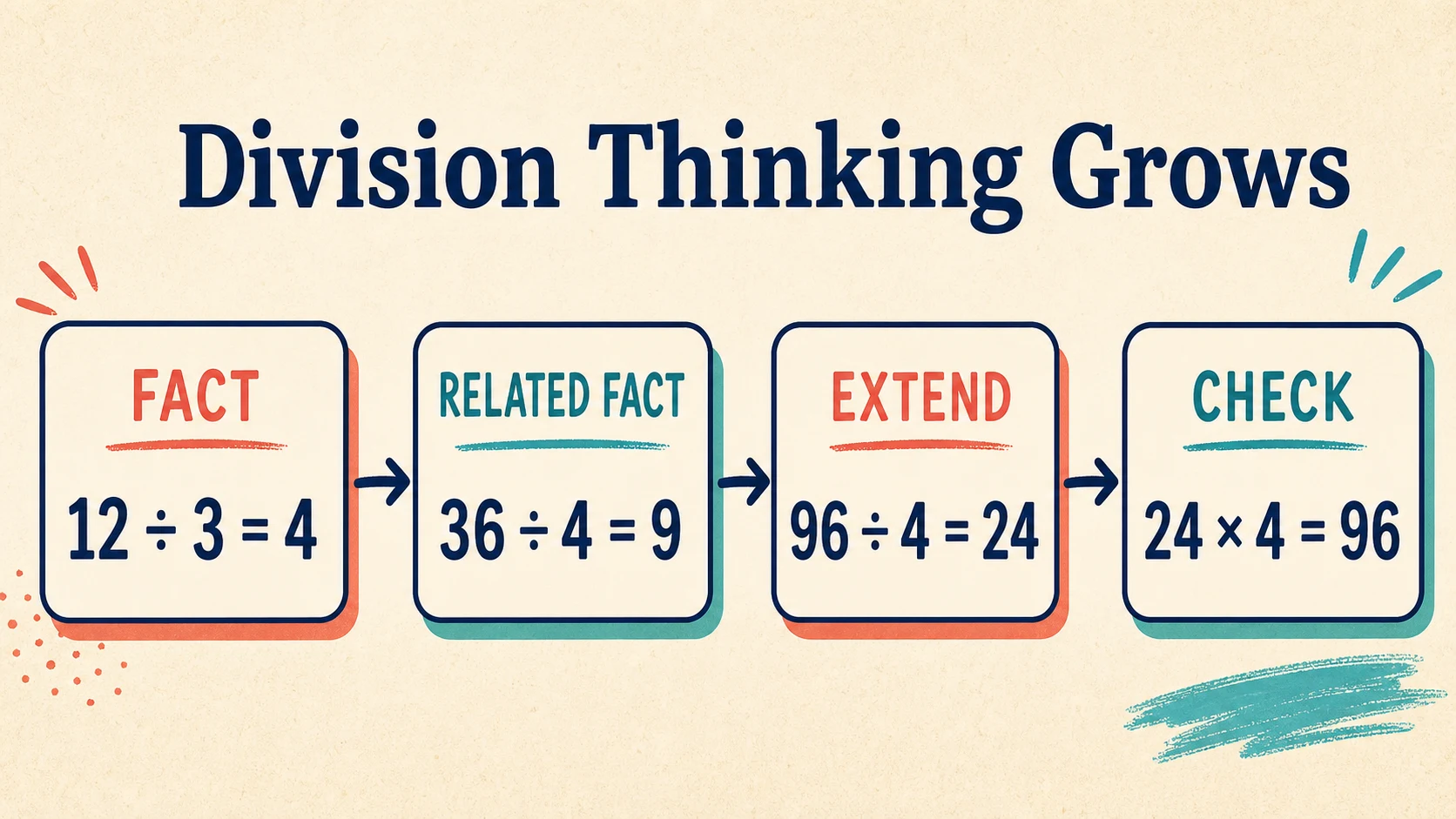
Support should fade as the learner connects models, equations, and multiplication facts.
Concrete and Visual Models That Explain Division
Concrete models are not rewards or decorations. They make the quantities and relationships visible. The goal is eventually to reason without physical objects, but removing a useful model too early can turn division into symbol guessing.
Equal sharing: how many in each group?
In an equal-sharing problem, the number of groups is known. The unknown is the amount in each group.
Consider 20 strawberries shared equally among 5 plates. A learner can:
- Set out 5 plate outlines.
- Place one counter on each plate.
- Continue dealing counters until all 20 have been used.
- Count 4 counters on each plate.
- Record 20÷5=4.
The quotient, 4, describes the amount on each plate.
This model is sometimes called partitive division. The term is useful for adults planning instruction, but the learner can use plain language: “We know the number of groups, and we need to find how many go in each.”
Equal grouping: how many groups can be made?
In a grouping problem, the size of each group is known. The unknown is the number of groups.
Suppose 20 strawberries are packed 5 per container. The learner repeatedly makes groups of 5:
- First container: 5
- Second container: 5
- Third container: 5
- Fourth container: 5
There are 4 containers, so 20÷5=4. Here the quotient describes the number of groups.
The calculation matches the sharing example, but the answer refers to something different. Switching between these two interpretations prepares learners to make sense of varied word problems.
Arrays, number lines, and bar models
An array shows equal rows and columns. An array with 3 rows of 6 contains 18 objects. It can support all four related facts:
3×6=18
6×3=18
18÷3=6
18÷6=3
On a number line, 18÷3 can be shown as six equal jumps of 3 from 0 to 18. The six jumps reveal the quotient. This representation emphasizes the number of groups rather than the amount in each group.
A bar model can show a total bar labeled 18 split into 3 equal sections. Each section is 6. This model is especially useful when moving from objects to word problems because it records the relationship without requiring every individual object to be drawn.
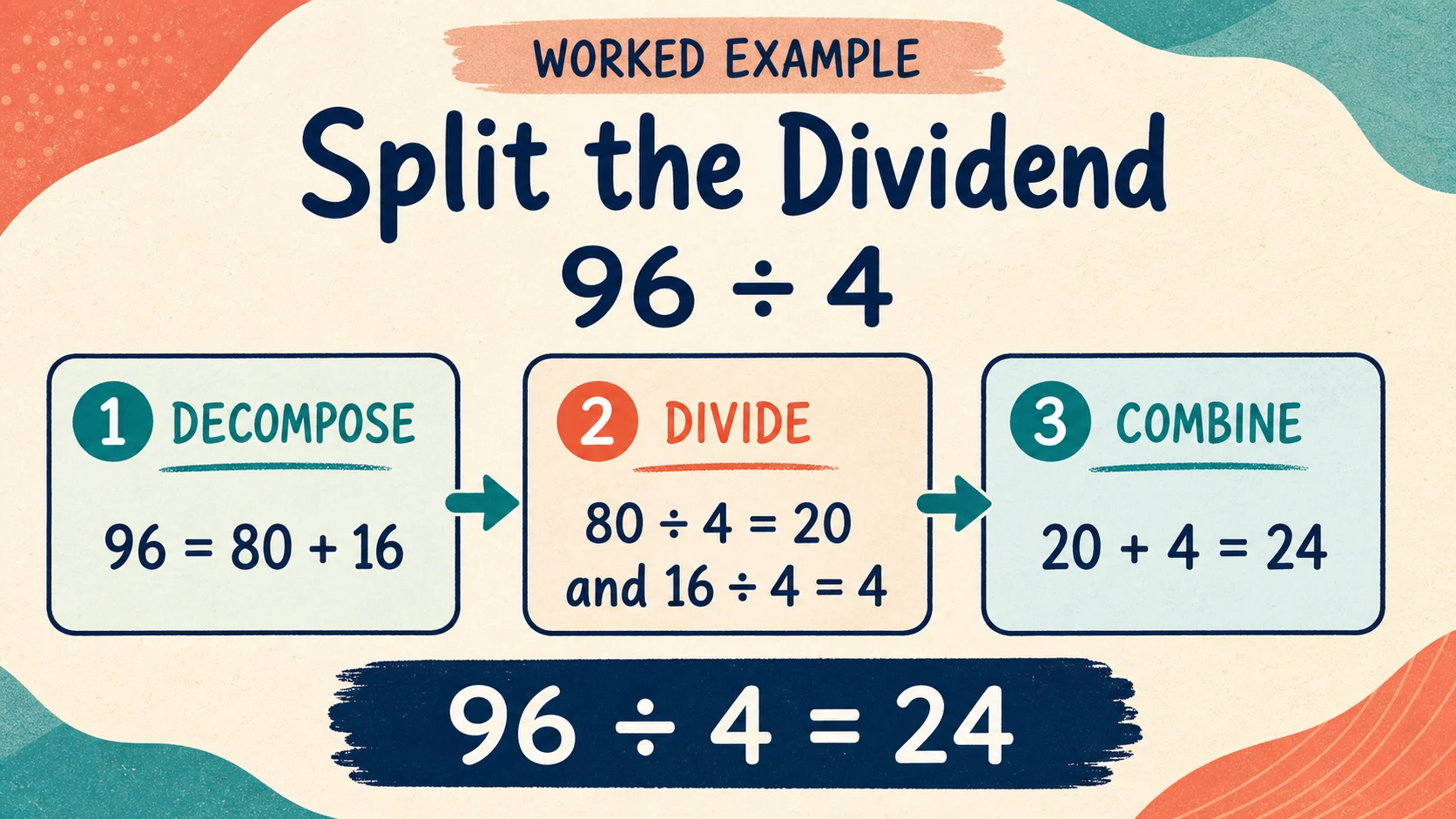
The symbols should summarize a relationship the learner can already show or explain.
Fully Checked Worked Examples
Worked examples should make the reasoning visible. After reading one, the learner can rebuild it with objects, redraw it, cover the solution and try it, or explain why the multiplication check works.
Example 1: Equal sharing
Problem: Eighteen pencils are shared equally among 3 students. How many pencils does each student receive?
There are 18 pencils in total and 3 equal shares:
18÷3=□
Deal or draw the pencils into 3 groups:
6+6+6=18
Each group contains 6 pencils, so:
18÷3=6
Check:
3×6=18
The product returns to the original total. The answer is 6 pencils per student.
Example 2: Finding the number of groups
Problem: Twenty-four blocks are placed into bags with 4 blocks in each bag. How many bags are filled?
The group size is 4. Count groups of 4 until reaching 24:
4, 8, 12, 16, 20, 24
That is 6 groups, so:
24÷4=6
Check:
6×4=24
The answer is 6 bags. Notice that 6 describes the number of bags, not the number of blocks in each bag.
Example 3: Using an unknown factor
Problem: Solve 35÷5.
Rewrite the division equation as a multiplication question:
5×□=35
Because:
5×7=35
it follows that:
35÷5=7
Check:
7×5=35
The quotient is 7.
This unknown-factor approach makes the inverse relationship explicit. It also gives learners a way to derive an answer when the division fact is not recalled immediately.
Example 4: A missing number in an equation
Problem: Find the missing number in 32÷□=4.
This equation asks for the size of the groups when 32 is divided into 4 groups, or for the number that can multiply by 4 to make 32.
Write the related multiplication equation:
4×□=32
Since:
4×8=32
the missing divisor is 8:
32÷8=4
Check:
8×4=32
The missing number is 8. This example matters because not every division exercise places the unknown in the quotient position.
Example 5: A two-step situation
Problem: A tutor has 4 boxes with 6 markers in each box. The markers are shared equally among 8 learners. How many markers does each learner receive?
First find the total number of markers:
4×6=24
Then divide the total into 8 equal shares:
24÷8=3
Check the division:
8×3=24
The answer is 3 markers per learner.
The two operations should be recorded separately. Combining them mentally can hide whether an error occurred while finding the total or while dividing it.
Example 6: A remainder in context
Problem: Twenty-five books are placed on shelves that hold 6 books each. How many shelves are needed for all the books?
Four full shelves hold:
4×6=24
One book remains:
25÷6=4 remainder 1
However, the remaining book still needs a shelf. Therefore, 5 shelves are needed.
Check:
- Four shelves are insufficient because they hold only 24 books.
- Five shelves provide room for all 25 books.
This is an extension beyond exact fact division. The equation alone does not determine the final contextual answer. The meaning of the remainder does.
Boundary Cases Worth Teaching Explicitly
Boundary cases reveal whether a learner understands division or is only following a pattern.
Dividing a number by itself
If 7 objects are put into one group containing 7 objects, exactly one group is made:
7÷7=1
Check:
1×7=7
A common error is answering 0 because the numbers “cancel.” Return to one complete group of 7.
Dividing by one
If 9 objects are placed into groups of 1, there are 9 groups:
9÷1=9
Check:
9×1=9
Learners may confuse this with 9÷9=1. Models make the distinction visible.
Zero divided by a nonzero number
Zero objects shared among 5 groups leaves 0 in every group:
0÷5=0
Check:
5×0=0
Division by zero is not a Grade 3 fact to solve by extending this pattern. No whole number can satisfy 0×□=8, so an expression such as 8÷0 does not have a whole-number quotient. Keep this distinction explicit rather than presenting “anything with zero is zero” as a rule.
Exact division and leftovers
Most early fact practice should use totals that divide exactly. When leftovers are introduced, distinguish among:
- The number of complete groups.
- The amount left over.
- The answer required by the situation.
In 17÷5, there are 3 complete groups with 2 left over. A question about full teams may use 3; a question about containers needed for all items may require 4. Do not expect the notation alone to interpret the context.
A Short, Repeatable Lesson Routine
A focused lesson can be brief. Extend or shorten each part according to the learner’s observed work rather than following a universal timer.
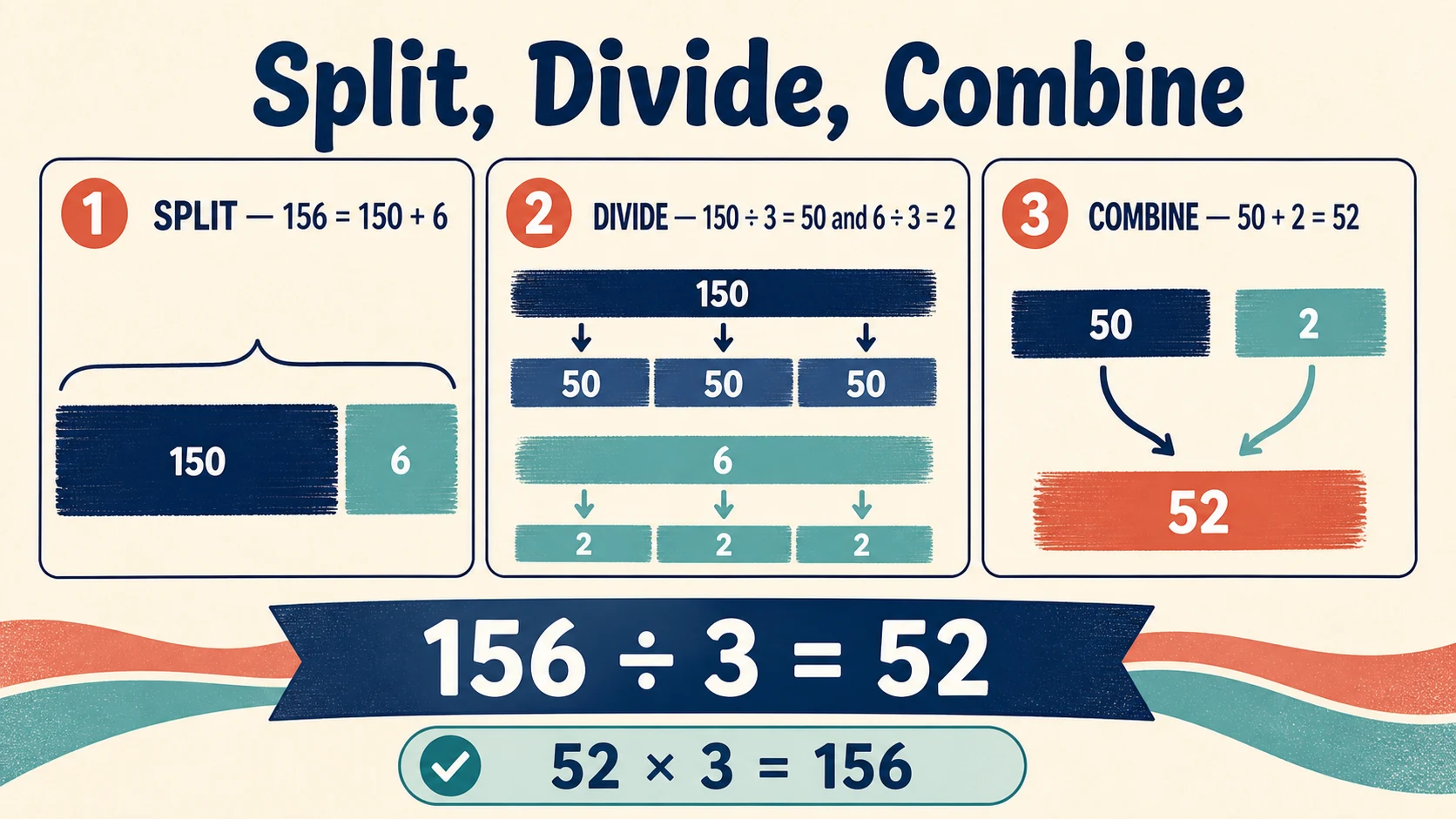
Each lesson moves from retrieval and meaning toward supported and independent application.
1. Retrieve a related fact
Begin with two or three multiplication facts connected to the day’s division work. Before solving 28÷4, recall or build 4×7=28.
If recall is slow, let the learner use an array or skip-counting. The immediate aim is an accurate connection, not pressured performance.
2. Model one new or difficult idea
Use counters, a drawing, or an array for one carefully chosen problem. Ask the learner to identify:
- The total.
- What is known about the groups.
- What must be found.
- What the quotient represents.
Keep the numbers small enough that the model clarifies the concept rather than becoming a counting burden.
3. Solve together
Complete two or three problems with decreasing prompts. One can match the model exactly; another can change the context or position of the unknown.
The IES practice guide for assisting students struggling with mathematics provides high-level support for systematic instruction and the use of visual representations. Applied here, that means making the model-equation connection explicit and checking understanding before removing support.
4. Try a short independent set
Use four to eight problems selected for a clear purpose. For example:
- Four related facts with divisor 5.
- Two picture-to-equation items.
- One word problem requiring equal sharing.
A long mixed page is not necessary to find out whether today’s connection is secure.
5. Explain and check
Finish with one prompt such as:
- “Show how multiplication checks your answer.”
- “What does the 4 mean in this problem?”
- “Draw a different model for the same equation.”
- “How do you know the groups are equal?”
An explanation can reveal sound reasoning even when a counting slip produces the wrong numeral.
Selecting Practice and Differentiating Support
Practice should match the next instructional need. Difficulty is not determined only by larger numbers. A small-number word problem can be harder than a larger bare equation because the learner must interpret the situation.
The 3rd Grade Math worksheet collection can be used to compare division with related multiplication and number-sense work. The dedicated division topic guide and resources narrow the selection to this operation.
When the learner is beginning
Choose practice with:
- Totals that can be represented using a manageable number of objects.
- Exact division without remainders.
- One interpretation at a time.
- Pictures or room to draw.
- Divisors connected to familiar multiplication facts.
- Immediate opportunities to check with multiplication.
Use fewer problems and ask for more explanation. If the learner can solve only by counting every object, continue building arrays and fact relationships before emphasizing speed.
When the learner understands models but lacks fact fluency
Group practice by related facts. A set built around 4 might include:
12÷4,20÷4,28÷4,36÷4
Ask for the related multiplication fact after each answer. Mix in previously learned divisors so that practice includes both current learning and review.
Fact families can also reduce the amount treated as entirely new. From 6×8=48, derive both 48÷6=8 and 48÷8=6.
When the learner is accurate and ready for application
Add:
- Both sharing and grouping problems.
- Missing divisors or dividends.
- Irrelevant wording that does not change the mathematics.
- Two-step problems with clearly manageable calculations.
- Mixed multiplication and division.
- Simple remainder situations that require interpretation.
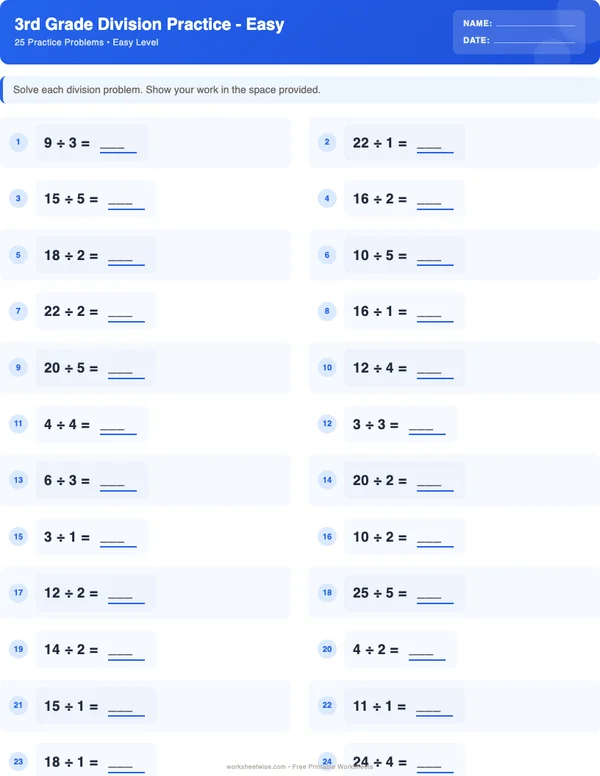
The catalogue’s easy 3rd Grade division worksheet contains 25 exercises and includes an answer key. Its listed skills include division facts, long division, mental math, and number sense. Inspect the actual problems before assigning them. If long-division notation is beyond the learner’s current sequence, select only appropriate items or use a different resource.
The 3rd Grade Division Worksheet Pack contains 18 worksheets. A larger pack can provide variety and review, but quantity should not replace diagnosis. Select pages by the skill visible in the learner’s work.
Common Errors and Diagnostic Responses
An incorrect answer is evidence, but it is not yet a diagnosis. Ask the learner to rebuild or explain the problem before choosing a response.
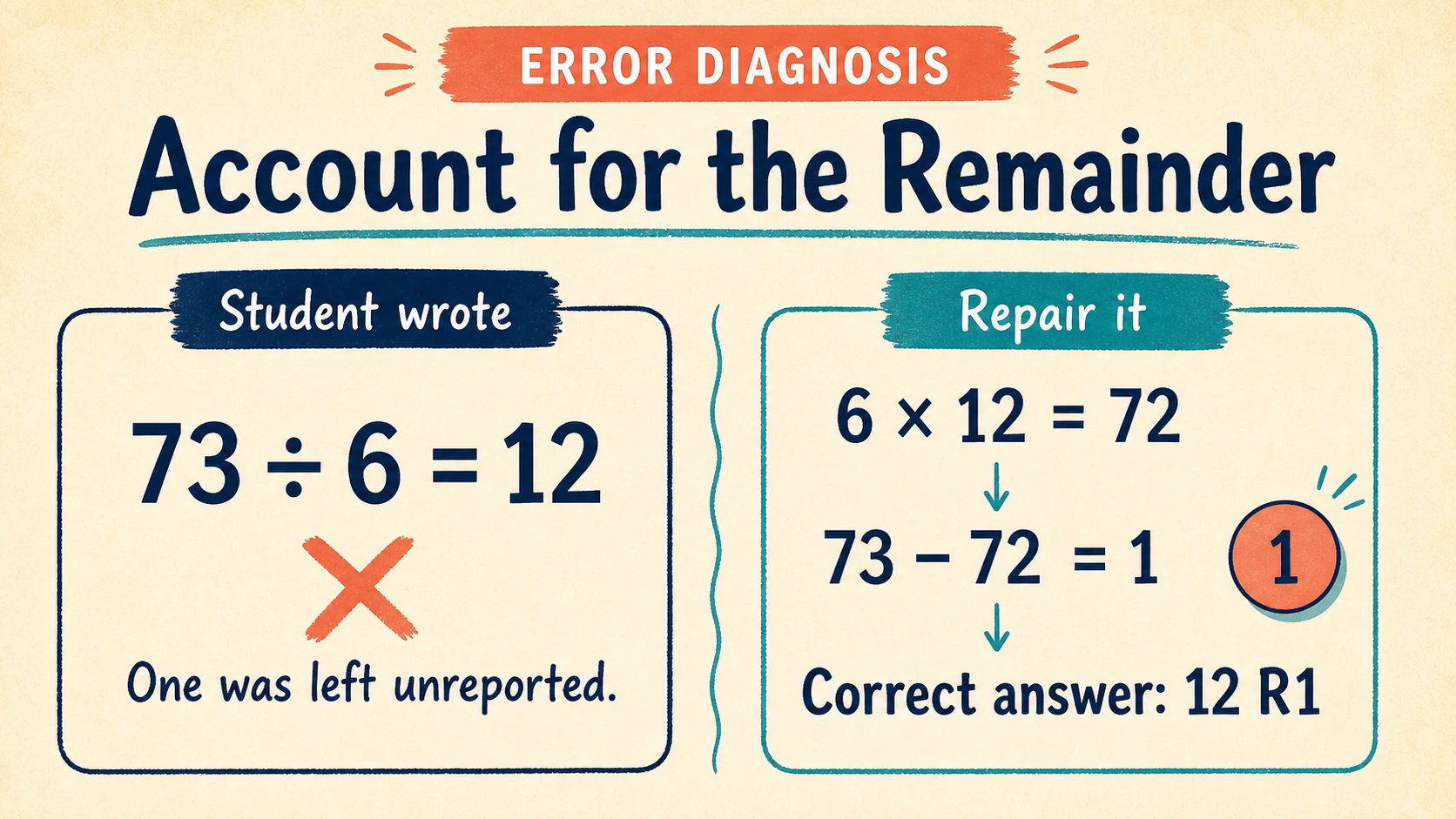
The teaching response should address the reasoning behind the error, not only replace the answer.
| Observed work |
Possible interpretation |
Instructional response |
| Makes unequal groups |
“Equal” is not controlling the model |
Deal one object to each group in repeated rounds, then compare group sizes |
| Solves 18÷3 as 18−3=15 |
Treats division as one subtraction |
Repeatedly remove groups of 3 and count how many removals reach zero |
| Answers 24÷6=5 |
Fact is not secure or counting drift occurred |
Build a 6×4 array and connect it to the division equation |
| Reverses 3 and 4 in a word problem |
Quotient’s meaning is unclear |
Label the total, number of groups, group size, and requested unit |
| Writes 32÷8=4 but cannot explain it |
May know the fact without understanding the relationship |
Ask for an array, equal-group drawing, and multiplication check |
| Counts an array inaccurately |
Organizational or counting error |
Mark rows or columns and use multiplication instead of recounting every item |
| Ignores the remainder |
Has learned to report only complete groups |
Record full groups and leftovers separately, then reread what the situation asks |
| Applies a remembered procedure to every item |
Symbol recognition is stronger than meaning |
Mix equations, pictures, and stories that represent the same fact |
| Is correct with objects but not symbols |
Representation-to-equation connection is incomplete |
Keep the model visible while labeling each number in the equation |
| Is accurate but extremely effortful |
Facts may not yet be efficiently connected |
Practice small related sets and use multiplication as an intentional retrieval path |
Avoid correcting every error with “try again.” A learner who misunderstood the group size needs a different response from one who understood the model but made a counting slip.
Monitoring Progress Without Rushing the Learner
Monitor a small set of indicators across several sessions:
- Modeling: Can the learner make equal groups correctly?
- Interpretation: Can the learner distinguish sharing from grouping?
- Representation: Can the learner connect objects, drawings, arrays, and equations?
- Fact reasoning: Can an unknown division fact be derived from multiplication?
- Accuracy: Are calculations correct?
- Explanation: Can the learner state what the quotient means?
- Application: Can the learner choose division in a word problem?
- Independence: How much prompting or modeling is still needed?
A simple record might use the labels “independent,” “one prompt,” and “full support.” Add a brief note about the method used. “Correct with array; guessed without it” is more informative than a percentage alone.
Look for patterns over time. One mistake does not prove a misconception. Likewise, one perfect set does not prove durable understanding. Revisit a small sample after a gap and in a different format.
Move forward when the learner is generally accurate, can explain the relationship, and no longer depends on a particular model for every problem. Return to an earlier representation when errors become systematic. Pacing should follow the observed work.
A Two-Week Practice Plan
This plan is an adaptable sequence, not a universal timetable. A “day” can be repeated, shortened, or postponed. Use short sets and preserve time for explanation.
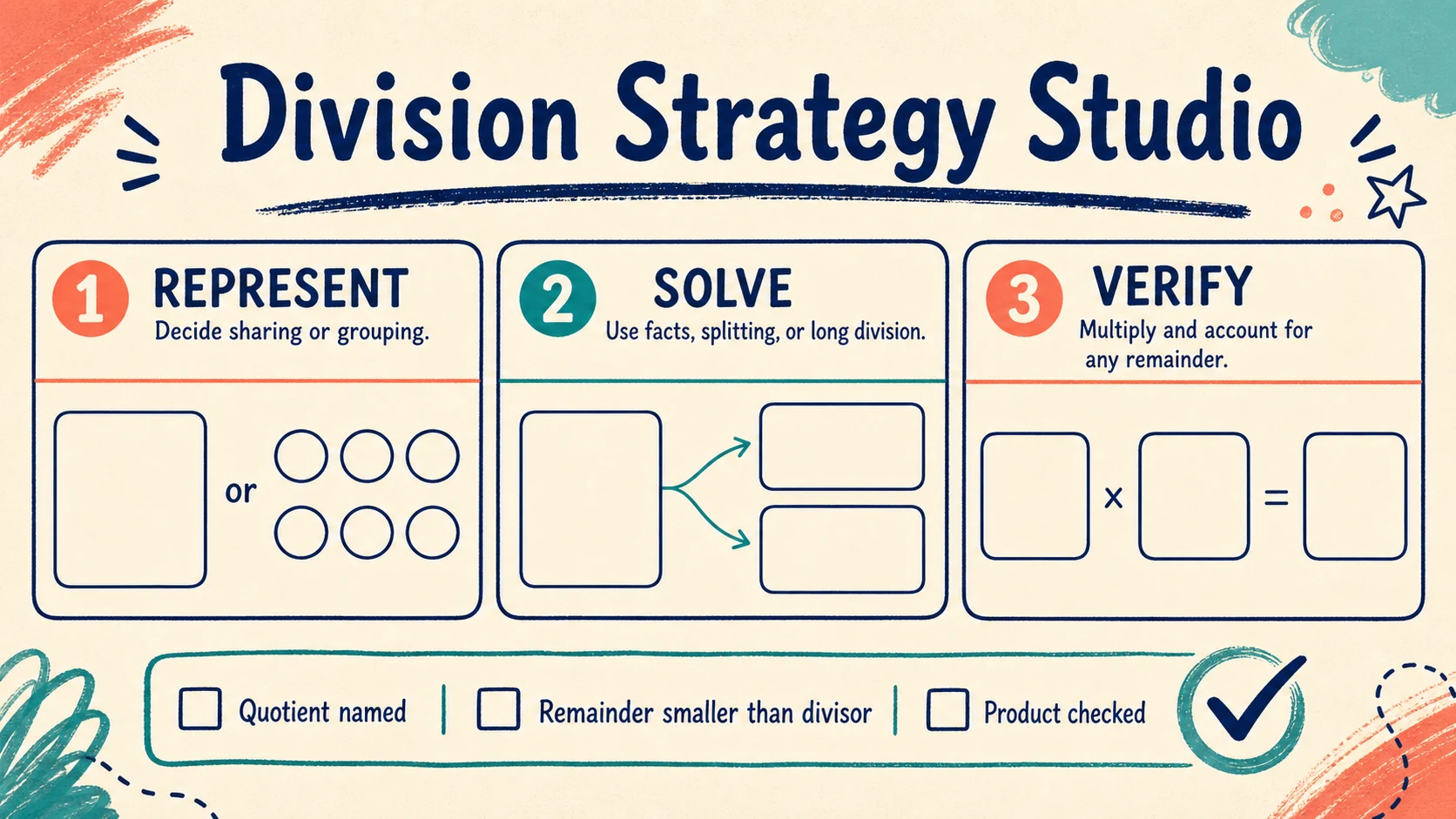
The plan alternates concept building, fact connections, application, and review.
| Day |
Focus |
Suggested activity |
Evidence to record |
| 1 |
Equal groups |
Sort counters into equal and unequal groups |
Identifies and creates equal groups |
| 2 |
Equal sharing |
Share 12, 18, and 20 objects among given groups |
Finds the amount in each group |
| 3 |
Equal grouping |
Make groups of 2, 3, 4, or 5 from a total |
Finds the number of groups |
| 4 |
Arrays |
Write multiplication and division facts for arrays |
Connects rows, columns, and total |
| 5 |
Review |
Mix sharing, grouping, and arrays |
Explains what each quotient represents |
| 6 |
Unknown factors |
Rewrite division as multiplication with a missing factor |
Derives rather than guesses |
| 7 |
Related facts |
Practice a small family of facts, then review older ones |
Shows increasing efficiency |
| 8 |
Word problems |
Compare one sharing and one grouping problem |
Selects an appropriate model |
| 9 |
Missing-number equations |
Solve unknown quotient, divisor, and dividend items |
Tracks the role of each number |
| 10 |
Independent check |
Complete a short mixed set and explain two answers |
Demonstrates accuracy, meaning, and independence |
If Day 3 reveals unequal grouping, repeat concrete grouping before introducing arrays. If Day 6 is secure, Day 7 can include a broader mix. If word-problem errors come from reading rather than the calculation, read the situation aloud and keep the mathematical demand unchanged.
At the end of the two weeks, compare the learner’s current work with the first session. Look for changes in organization, explanations, fact use, and independence—not only the number correct.
Limitations and the Next Instructional Step
A printable worksheet can provide structured practice and a convenient answer key, but it cannot determine why an answer is wrong. It also cannot decide whether a learner needs counters, an array, fact review, simpler language, or a more challenging application. Those decisions depend on observed work.
The catalogue describes division resources extending from equal groups and fact families to long division and remainders. That range spans more than one instructional stage. For a typical Grade 3 starting point, prioritize equal-group meaning, multiplication-division relationships, facts within 100, and appropriate word problems. Treat long division with multi-digit dividends as later or extension material unless the local sequence and the learner’s demonstrated understanding support it.
Do not treat a grade label, worksheet title, or two-week plan as certification of mastery. Grade labels describe intended practice level, and local sequences differ. These materials do not guarantee outcomes, replace local curriculum decisions, or provide child-specific educational or medical guidance.
The most useful next action is to model one equal-sharing problem, one equal-grouping problem, and one related multiplication fact. Then choose five to eight matching items from the free 3rd Grade Division Standard Easy worksheet. Use the learner’s explanations and errors to decide whether the next session should repeat the model, strengthen fact connections, or move into mixed application.