What 3rd Grade Fractions Instruction Should Cover
Third-grade fraction instruction should help a learner understand fractions as numbers built from equal-sized parts. The learner should be able to partition a whole, name unit and non-unit fractions, locate fractions on a number line, recognize simple equivalence, and compare fractions when the wholes are the same. Instruction should move from objects and drawings to number lines and symbols, with the learner’s observed work determining the pace.
At this level, meaning matters more than speed. A learner who can explain why 3/4 represents three copies of 1/4 has a stronger foundation than one who merely recognizes the symbol. Likewise, a correct comparison is more useful when the learner can justify it with equal wholes, a drawing, or a number line.
This guide focuses on the fraction ideas identified for Grade 3 in the Common Core State Standards for Mathematics: understanding fractions as numbers, representing them on number lines, explaining simple equivalence, and comparing fractions in appropriate cases. Grade labels describe an intended practice level, not a universal timetable, and local curriculum sequences differ.
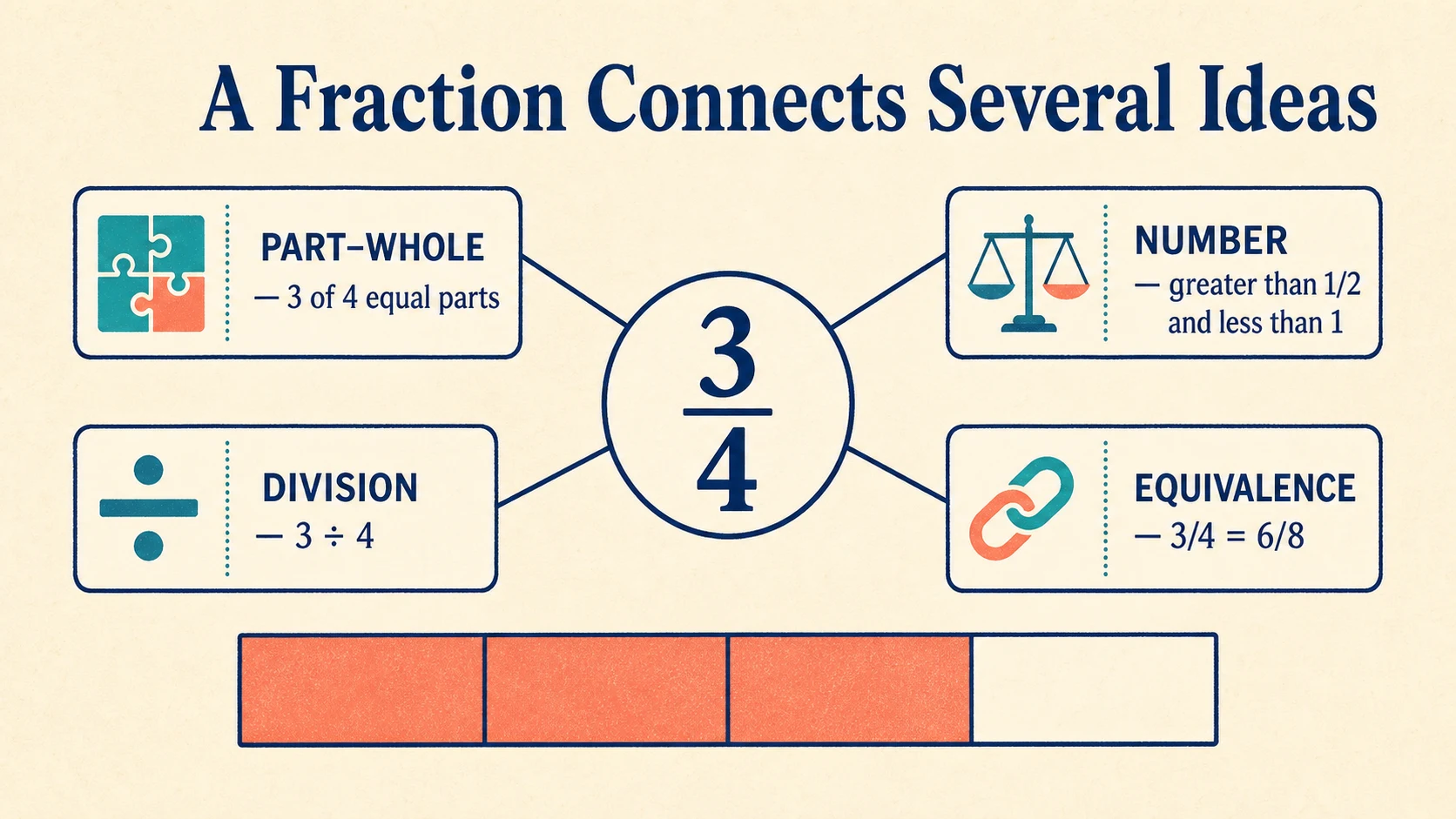
Equal parts, fraction names, number lines, equivalence, and comparison form a connected learning path.
Prerequisites to Check Before Teaching Fractions
A learner does not need advanced arithmetic to begin fractions, but several earlier ideas should be secure enough to support the new work.
Equal groups and fair shares
Check whether the learner can divide a small set or shape into equal groups. Ask the learner to share 12 counters equally among three people. Each person should receive four. Then ask whether shares of five, four, and three counters would be fair. This reveals whether “equal” is being treated as a mathematical condition rather than a loose visual judgment.
Whole-number order and number lines
The learner should be able to place whole numbers such as 0, 1, 2, and 3 in order and recognize equal intervals on a number line. Fractions extend this model: instead of counting only whole-number steps, the learner partitions one unit into smaller equal steps.
Shape partitioning
Give the learner rectangles or paper strips and ask for halves, thirds, and fourths. Look for equal areas, not merely the correct number of regions. A square divided into four regions does not necessarily show fourths if the regions differ in size.
Language for parts and wholes
Check whether words such as whole, equal, part, half, and fourth have stable meanings. Always identify the whole explicitly. One half of a small sandwich and one half of a large sandwich have the same fraction name but not the same physical amount.
If these prerequisites are uneven, begin with short partitioning and number-line activities before assigning a full page of symbolic fraction problems. The broader 3rd Grade Math collection can support related number and equal-group skills.
A Grade-Appropriate Fractions Progression
The following progression is practical rather than mandatory. Move ahead when the learner can model and explain the current idea with reasonable consistency. Return to an earlier representation when an error shows that the underlying concept is not yet secure.
| Stage |
Teaching focus |
Useful model |
Evidence to look for |
| 1 |
Identify the whole and make equal parts |
Paper folds, tiles, rectangles |
Learner rejects unequal partitions |
| 2 |
Name unit fractions |
Fraction strips and circles |
Learner explains 1/b as one of b equal parts |
| 3 |
Build non-unit fractions |
Repeated unit-fraction pieces |
Learner explains a/b as a copies of 1/b |
| 4 |
Place fractions on number lines |
Partitioned lines from 0 to 1 |
Learner counts equal intervals, not tick marks |
| 5 |
Recognize simple equivalence |
Aligned strips and matching number-line points |
Learner shows that two names can mark the same amount |
| 6 |
Compare fractions |
Same-whole models and number lines |
Learner justifies <, >, or = |
| 7 |
Mix representations |
Drawings, words, symbols, and lines |
Learner translates among forms independently |
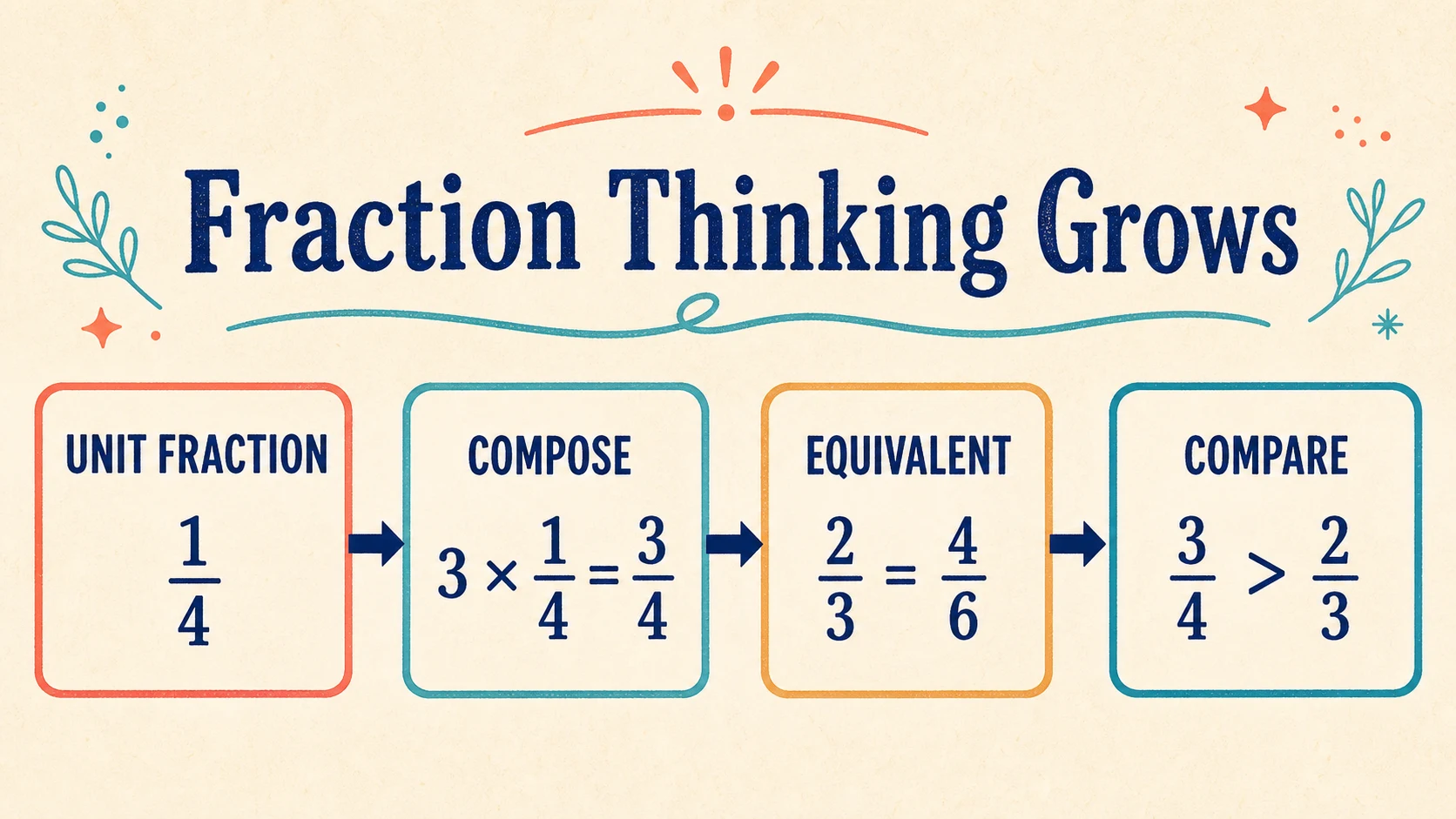
Reduce support gradually while continuing to ask for mathematical explanations.
Begin with unit fractions
A unit fraction has 1 as its numerator: 1/2, 1/3, 1/4, and so on. Build these fractions by partitioning one whole into equal parts. The denominator tells how many equal parts make the whole.
The size of a unit fraction depends on the number of equal parts. If the same whole is cut into more pieces, each piece is smaller. Therefore, 1/8<1/4. This is a central boundary between whole-number thinking and fraction thinking.
Build non-unit fractions from unit fractions
Once 1/4 is understood, make 2/4, 3/4, and 4/4 by joining quarter-sized parts. Read 3/4 as “three fourths”: three copies of 1/4.
Include the whole as a boundary case. Four fourths cover one complete whole, so 4/4=1. Similarly, 2/2=1 and 3/3=1. These examples help the learner see that a fraction can name an entire unit, not only an amount smaller than one.
Move to number lines
Draw a line from 0 to 1. To show fourths, divide the distance into four equal intervals. Label the successive points 1/4, 2/4, 3/4, and 4/4. Emphasize that fractions mark locations and distances from zero.
The learner must count intervals rather than tick marks. A number line divided into four equal intervals has five boundary marks when both 0 and 1 are shown.
Concrete and Visual Models That Clarify Meaning
The IES guide on teaching mathematics to young children supports high-level practices such as teaching through developmental progressions, monitoring what learners know, and helping them connect informal knowledge with mathematical representations. For fractions, that framing can be applied through purposeful movement from objects to drawings and symbols.
Paper strips and fraction bars
Use identical strips so the whole remains constant. Fold one strip into halves, another into fourths, and another into eighths. Align the strips to compare part sizes or locate equivalent amounts.
Identical wholes are essential. Comparing one fourth of a short strip with one third of a long strip does not isolate the fractions because both the partition and the whole have changed.
Fraction circles and area models
Circles and rectangles make part-whole relationships visible. Ask the learner to shade three of four equal regions and label the result 3/4. Then reverse the task: provide 2/3 and ask the learner to create a correctly partitioned model.
Area models have a limitation: learners can focus on shaded pieces without treating the fraction as a number. Pair them with number lines rather than using “pizza” models exclusively.
Number lines
Number lines show magnitude, order, equality, and distance from zero. They also reveal that different labels can occupy the same location. For example, 1/2, 2/4, and 4/8 can all mark the midpoint between 0 and 1.
Sets of objects
A fraction can describe part of a collection, but set models require careful language. If 3 of 12 counters are blue, the blue counters are 3/12 of the set. This model should follow secure work with equal partitions because individual objects are not themselves cut into equal pieces.
Fully Checked Worked Examples
Worked examples should include reasoning, not just completed calculations. After demonstrating one, change the numbers or model and ask the learner to explain the new case.
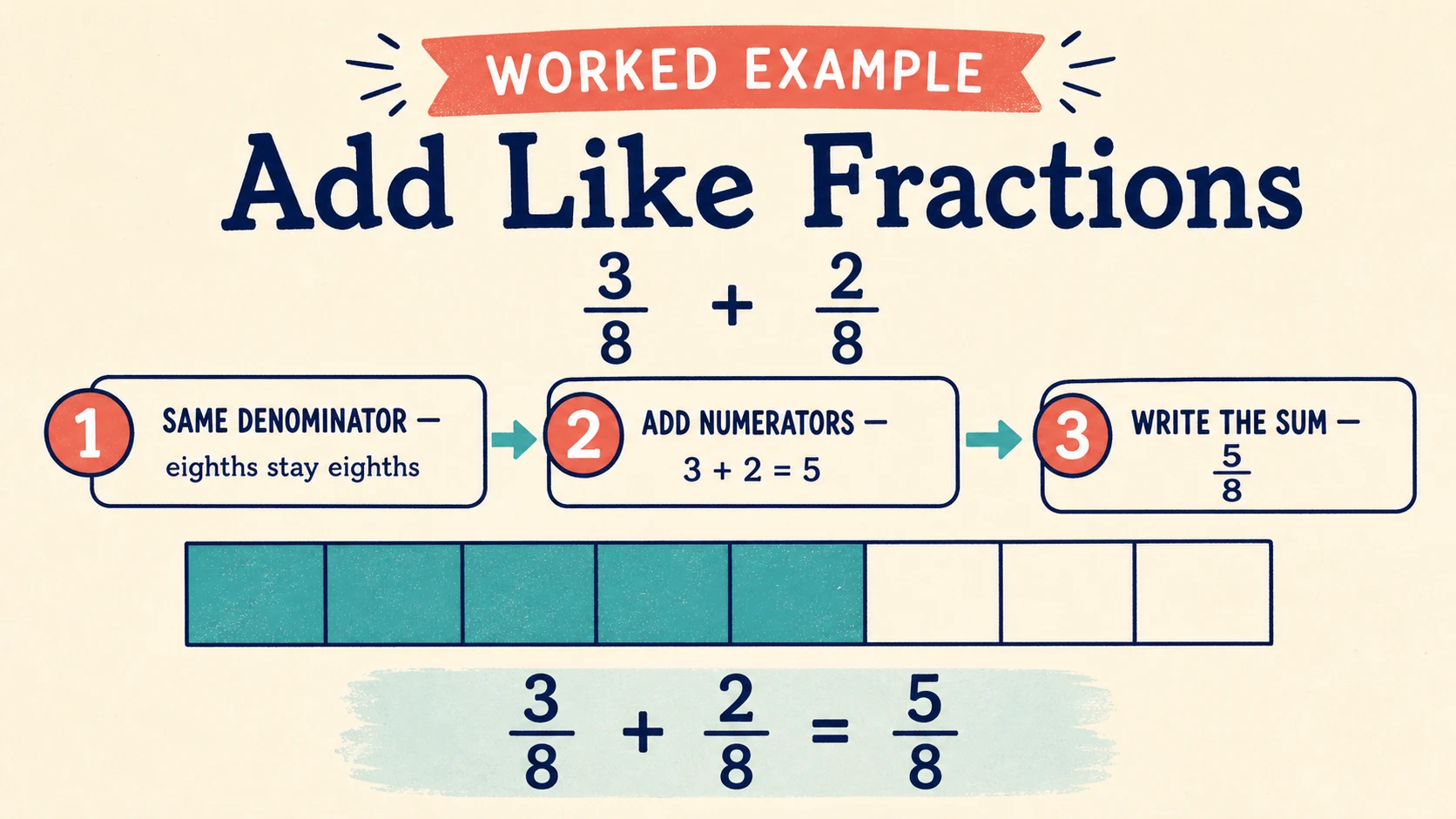
Connect what the learner can see and touch to the fraction symbol and explanation.
Example 1: Name a shaded fraction
A rectangle is divided into 6 equal parts. Four parts are shaded.
- Confirm that the six parts are equal in area.
- The denominator is 6 because six equal parts make the whole.
- The numerator is 4 because four of those parts are shaded.
- The shaded fraction is 64.
Check: Count all equal parts: 6. Count shaded parts: 4. The answer 4/6 matches both counts.
A useful boundary contrast is a rectangle with six regions of unequal size. Even if four are shaded, the picture does not establish 4/6 of the area because the regions are not equal shares.
Example 2: Place a fraction on a number line
Place 43 on a number line from 0 to 1.
- Divide the distance from 0 to 1 into four equal intervals.
- Starting at 0, count three intervals.
- Label that point 43.
The points appear in this order:
0,41,42,43,44=1
Check: The denominator 4 matches the four equal intervals. The numerator 3 matches the three intervals traveled from zero. Because 3/4 is less than 4/4, its point lies before 1.
Example 3: Recognize equivalent fractions
Show that 42=21.
- Partition one identical strip into two equal parts and shade one part.
- Partition a second strip into four equal parts and shade two parts.
- Align the strips.
- Both shaded sections cover the same distance from the same starting point.
On a number line, 1/2 and 2/4 also occupy the same midpoint between 0 and 1.
Check:
42=4÷22÷2=21
The symbolic check confirms what the model shows. At this stage, the model supplies the meaning; division is a check rather than a rule to memorize without context.
Example 4: Compare fractions with the same denominator
Compare 83 and 85.
Both fractions use eighths, so the parts are the same size. Compare the number of eighth-sized parts:
3<5
Therefore:
83<85
Check: On a number line divided into eighths, 3/8 is three steps from zero and 5/8 is five steps from zero. The point for 3/8 lies to the left.
Example 5: Compare unit fractions
Compare 31 and 61 using the same whole.
A whole divided into three equal parts produces larger pieces than the same whole divided into six equal parts. Therefore:
31>61
Check: Express both amounts in sixths. One third covers the same amount as two sixths:
31=62
Since 2/6>1/6, the original comparison is correct.
This case must not be solved by saying “6 is greater than 3, so 1/6 is greater.” Denominators name the number of equal parts in the whole; more parts mean smaller unit fractions.
Example 6: Compare fractions with the same numerator
Compare 43 and 83, using equal wholes.
Both fractions contain three parts, but fourths are larger than eighths. Three larger parts cover more than three smaller parts:
43>83
Check: Convert fourths to eighths visually or symbolically:
43=86
Because 6/8>3/8, the comparison is correct.
Do not generalize this shortcut to fractions where both numerators and denominators differ. For example, comparing 2/3 with 3/5 requires a model or another justified method; neither a numerator-only nor denominator-only comparison is sufficient.
A Short, Repeatable Lesson Routine
A focused lesson can last about 15–25 minutes, but this is an instructional suggestion, not a universal timetable. Shorten, repeat, or extend it according to the learner’s accuracy, explanations, and attention.
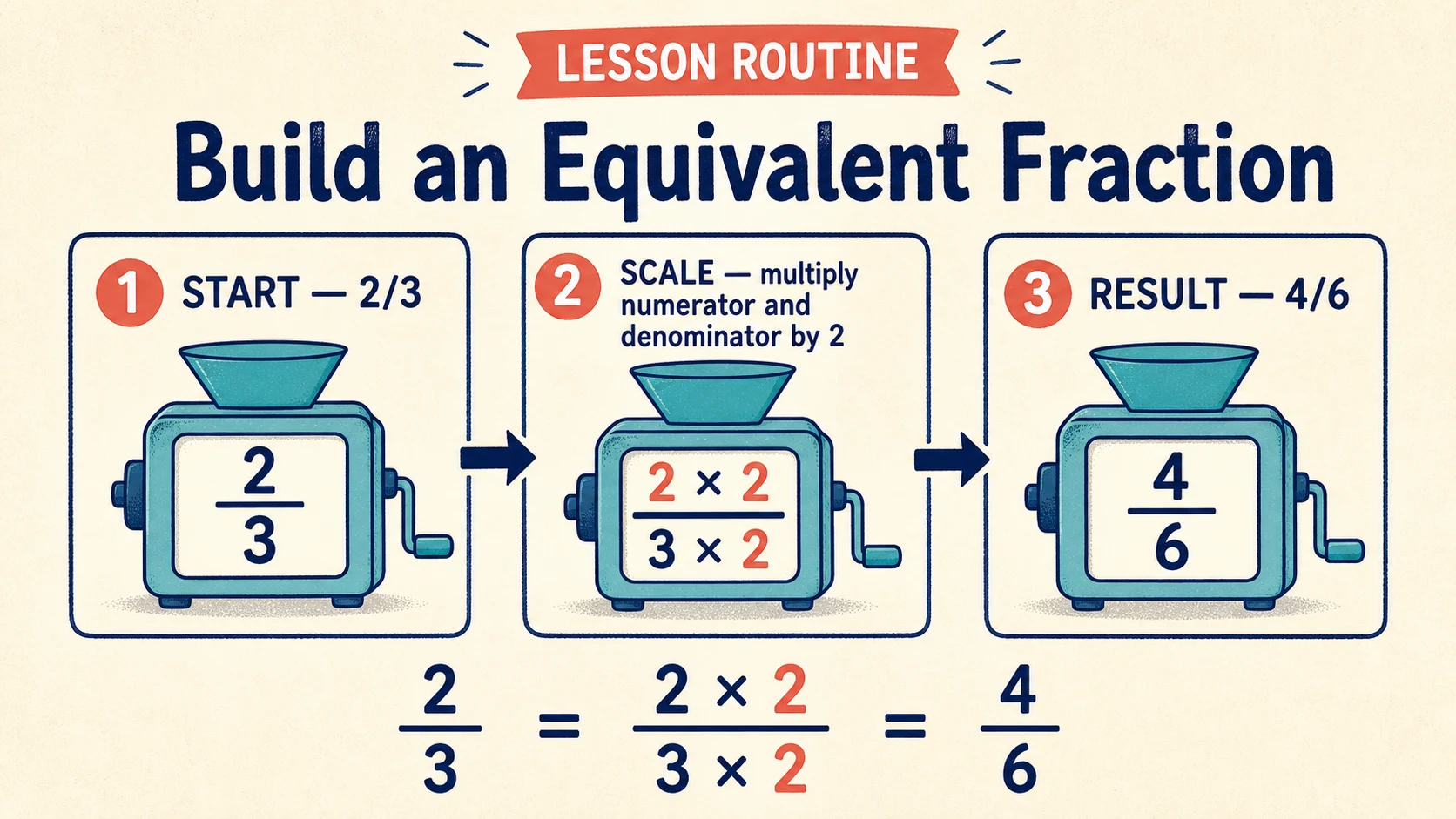
Use a familiar structure so attention stays on the mathematics.
1. Retrieve a prerequisite
Spend two or three minutes on one known idea: identify the whole, recognize equal parts, or place whole numbers on a line. Keep this brief enough to expose readiness without becoming a separate lesson.
2. Model one new idea
Use an object or drawing and narrate the mathematical decisions. For 3/5, identify the whole, verify five equal parts, select three parts, and connect those counts to numerator and denominator.
3. Solve together
Give a closely related problem. Ask the learner to handle one decision at a time: “What is the whole?” “Are the parts equal?” “What does the denominator tell us?” Prompt only as much as needed.
4. Try independently
Assign two to five carefully chosen items. Include one that uses a different representation so the learner must apply the idea rather than copy the demonstration.
5. Explain and check
Ask for a sentence, drawing, or number-line justification. End with one quick review item from an earlier lesson. The IES practice guide for assisting students who struggle with mathematics provides high-level support for systematic instruction, clear mathematical language, representations, and deliberate review; it does not evaluate this guide or any WorksheetWise resource.
Choosing Practice That Matches the Learner
Practice should answer a diagnostic need. A long mixed worksheet is not automatically better than six well-selected problems.
For initial learning, choose items with one changing feature. When teaching fourths, vary the numerator while holding the denominator and whole constant. When comparing unit fractions, hold the numerator at 1 and vary the denominator. This helps the learner notice the intended relationship.
Later, use mixed representations:
- Match a fraction symbol to a shaded model.
- Draw a model for a given fraction.
- Place the fraction on a number line.
- Compare two fractions and justify the symbol.
- Identify two equivalent models.
- Find and correct an inaccurate solution.
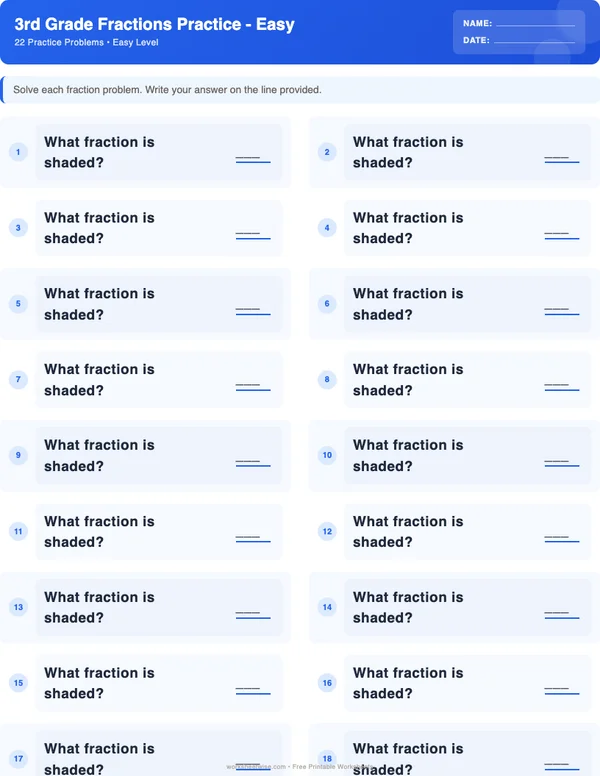
The free easy-level fractions worksheet contains 22 exercises and a separate answer key. Its catalogue includes identification, comparison, equivalence, and fraction-operation practice. Preview the items and select only those that match what the learner has been taught; a listed skill does not mean every item is the right next step for every learner.
The broader 3rd Grade Fractions topic page can help adults locate related material, while the focused fractions pack offers 18 worksheets when a wider practice pool is useful.
Differentiating Without Changing the Mathematical Goal
When the learner needs more support
Keep the target but reduce representational demands. Provide pre-partitioned strips, label 0 and 1 on number lines, or offer two possible fraction names. Use smaller denominators such as 2, 3, and 4 before moving to 6 and 8.
Ask the learner to construct the answer with pieces before drawing it. If symbols cause errors, return briefly to the model and rebuild the symbol from the observed counts.
When the learner is ready for more challenge
Change the reasoning demand rather than merely increasing the number of questions. Ask the learner to:
- Create two different models for 3/4.
- Find multiple fractions at the same number-line point as 1/2.
- Explain why 1/8<1/6 without using decimal notation.
- Write an incorrect comparison and then diagnose it.
- Decide whether a partition truly shows equal shares.
Extension should remain connected to understood fraction meaning. Fraction operations with unlike denominators, general fraction multiplication, and fraction division belong later in the stated catalogue progression and should not replace secure Grade 3 foundations.
Common Errors and Diagnostic Responses
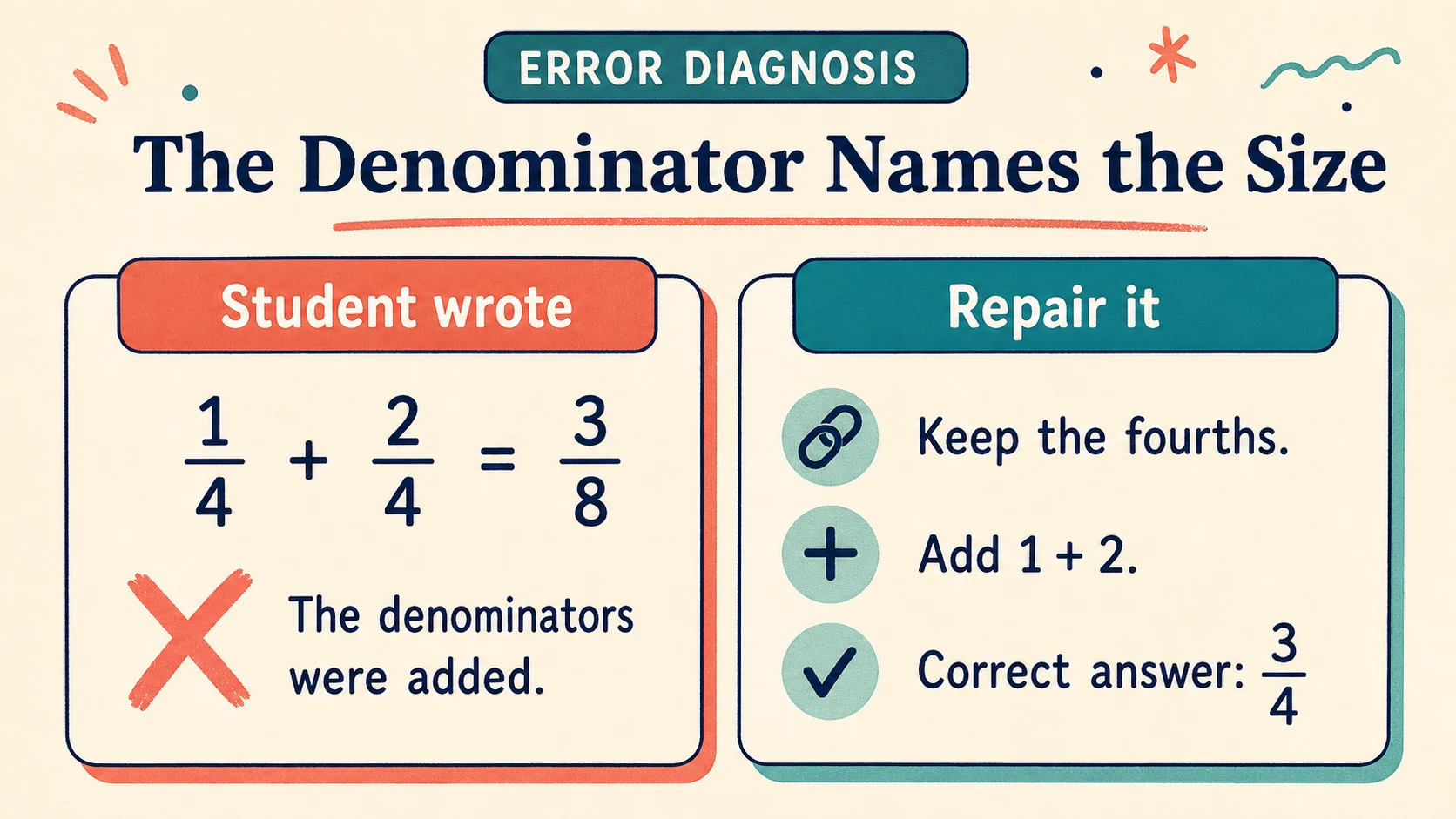
Treat an error as evidence about the learner’s current reasoning, then choose the smallest useful response.
| Observed error |
Likely reasoning to test |
Teaching response |
| Calls four unequal regions “fourths” |
Counts regions but ignores equality |
Repartition identical paper shapes and compare region sizes |
| Writes 6/4 for four shaded parts out of six |
Reverses numerator and denominator |
Say: “six equal parts in the whole; four selected” and rebuild 4/6 |
| Says 1/8>1/4 |
Applies whole-number order to denominators |
Compare equal strips partitioned into fourths and eighths |
| Places 3/4 at the third tick mark without checking intervals |
Counts marks rather than spaces |
Trace each interval from zero and label all fourths |
| Says 2/4 and 1/2 differ because the digits differ |
Treats symbols as names without magnitude |
Align fraction strips and mark both on one number line |
| Compares fractions drawn from different wholes |
Ignores the reference whole |
Redraw both using identical wholes before comparing |
| Uses cross-products without explaining the amounts |
Relies on an ungrounded procedure |
Return to common models, benchmarks, or equivalent fractions |
| Adds denominators automatically |
Extends whole-number addition to fraction notation |
Rebuild the quantities with fraction pieces before discussing any operation |
When a learner answers incorrectly, avoid correcting only the final symbol. Ask for the model or reasoning that produced it. Two identical wrong answers can come from different causes: one learner may reverse numerator and denominator, while another may miscount the total parts.
Monitoring Progress and Deciding What Comes Next
Use a small record rather than relying on a total worksheet score. Track whether the learner can:
- Identify the whole.
- Verify that parts are equal.
- Explain the numerator and denominator.
- Build a fraction from unit fractions.
- Place a fraction on a number line.
- Recognize simple equivalence.
- Compare fractions under stated conditions.
- Justify an answer with words or a model.
A useful instructional checkpoint is three forms of evidence: a correct answer, a valid representation, and a coherent explanation. This is not a certification rule. It is a practical way to distinguish recognition from understanding.
If answers are accurate only with shaded shapes, continue number-line work. If models are accurate but symbols are reversed, focus on connecting mathematical language to notation. If isolated items are correct but mixed practice breaks down, use short interleaved sets and ask the learner to identify the problem type before solving.
Advance when success continues across more than one session and more than one representation. Slow down when a recurring error reveals a missing concept, even if the worksheet percentage appears acceptable.
A Two-Week Fractions Practice Plan
This plan assumes ten short practice sessions. It is an adaptable suggestion, not a promise of mastery or a required schedule. Repeat a day, omit already-secure material, or reduce the number of items according to observed work.
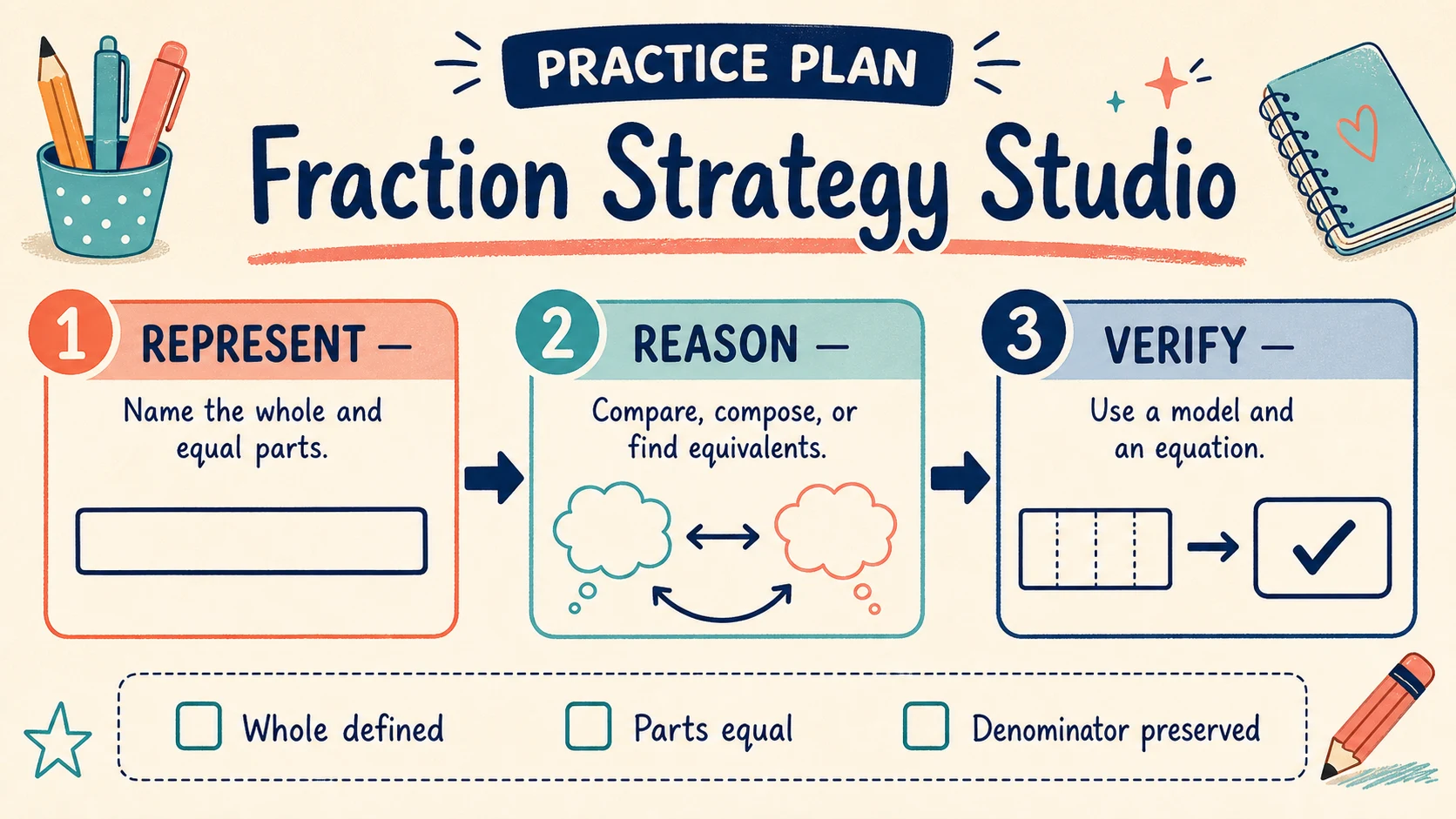
New learning, explanation, and spaced review work together across the two weeks.
| Day |
Main focus |
Suggested activity |
Evidence to record |
| 1 |
Equal parts and wholes |
Fold and sort examples and nonexamples of halves, thirds, and fourths |
Identifies unequal partitions |
| 2 |
Unit fractions |
Build 1/2, 1/3, 1/4, 1/6, and 1/8 with equal strips |
Explains denominator meaning |
| 3 |
Non-unit fractions |
Combine unit pieces to make 2/3, 3/4, and 5/6 |
Connects repeated parts to numerator |
| 4 |
Number lines |
Partition 0-to-1 lines into halves, thirds, and fourths |
Counts intervals correctly |
| 5 |
Mixed review |
Match models, symbols, words, and number-line points |
Translates among representations |
| 6 |
Equivalence |
Align halves, fourths, and eighths; record equal pairs |
Explains same amount with different names |
| 7 |
Same-denominator comparisons |
Compare pairs such as 2/7 and 5/7 |
Uses equal part size and numerators |
| 8 |
Unit and same-numerator comparisons |
Compare 1/3 with 1/6, then 3/4 with 3/8 |
Explains denominator’s effect on part size |
| 9 |
Error analysis |
Correct four deliberately flawed models or comparisons |
Names the error and repairs it |
| 10 |
Independent application |
Complete a selected mixed set, then explain two answers |
Maintains accuracy without immediate prompts |
Keep each session narrow. Begin with one retrieval item, teach or review one idea, and finish with a brief explanation. On Days 5 and 10, include earlier material so retention is visible.
If Day 4 reveals tick-mark counting errors, repeat number-line partitioning before beginning equivalence. If Day 6 equivalence is weak, align concrete strips again rather than introducing a purely symbolic rule. If comparison errors persist, separate comparison types and use the same whole throughout.
Limitations and the Most Useful Next Step
This guide cannot determine an individual learner’s curriculum placement, provide medical or learning-difficulty guidance, or guarantee a particular outcome. It also does not establish comprehensive alignment with every state, district, or homeschool sequence. The cited sources support broad instructional framing; they have not reviewed WorksheetWise, this article, or the linked materials.
The honest next step is to sample the learner’s current understanding. Use four quick tasks: partition a shape into fourths, name 3/4 from a model, place 2/3 on a number line, and compare 1/4 with 1/6. Then choose practice for the first point of uncertainty.
For a ready-made starting set, preview the free 3rd Grade Fractions worksheet, select only the items that match that need, and use its answer key to check accuracy. If a more precisely targeted set is preferable, create one through the free worksheet generators and keep the next session focused on a single observable skill.