What 3rd Grade Multiplication Means
The central goal of 3rd Grade Multiplication is to help a learner understand a product as equal groups, represent those groups in several ways, and calculate multiplication facts within 100 with increasing fluency. A learner should move from objects and drawings to equations and efficient fact strategies—not jump straight to memorizing disconnected answers.
For example, 4×6 can describe 4 equal groups with 6 objects in each group. It can also describe an array with 4 rows of 6, four jumps of 6 on a number line, or the repeated addition 6+6+6+6. Each representation gives 24.
Instruction usually includes:
- Interpreting multiplication as equal groups
- Connecting groups, arrays, repeated addition, number-line jumps, and equations
- Solving multiplication word problems
- Finding an unknown factor or product
- Using the commutative, identity, zero, and distributive properties as calculation strategies
- Building fluent recall of facts within 100
- Connecting multiplication with division
The Common Core State Standards for Mathematics describe Grade 3 work that includes interpreting products, solving multiplication and division problems, using operation properties, and developing fluency within 100. That source provides broad grade-level framing; it does not establish a universal teaching timetable or evaluate any WorksheetWise resource.
Grade labels describe an intended practice level, not a guarantee that every learner has studied the same material. Local curricula and instructional sequences differ. Begin with the learner’s observed work, then choose the next manageable step.
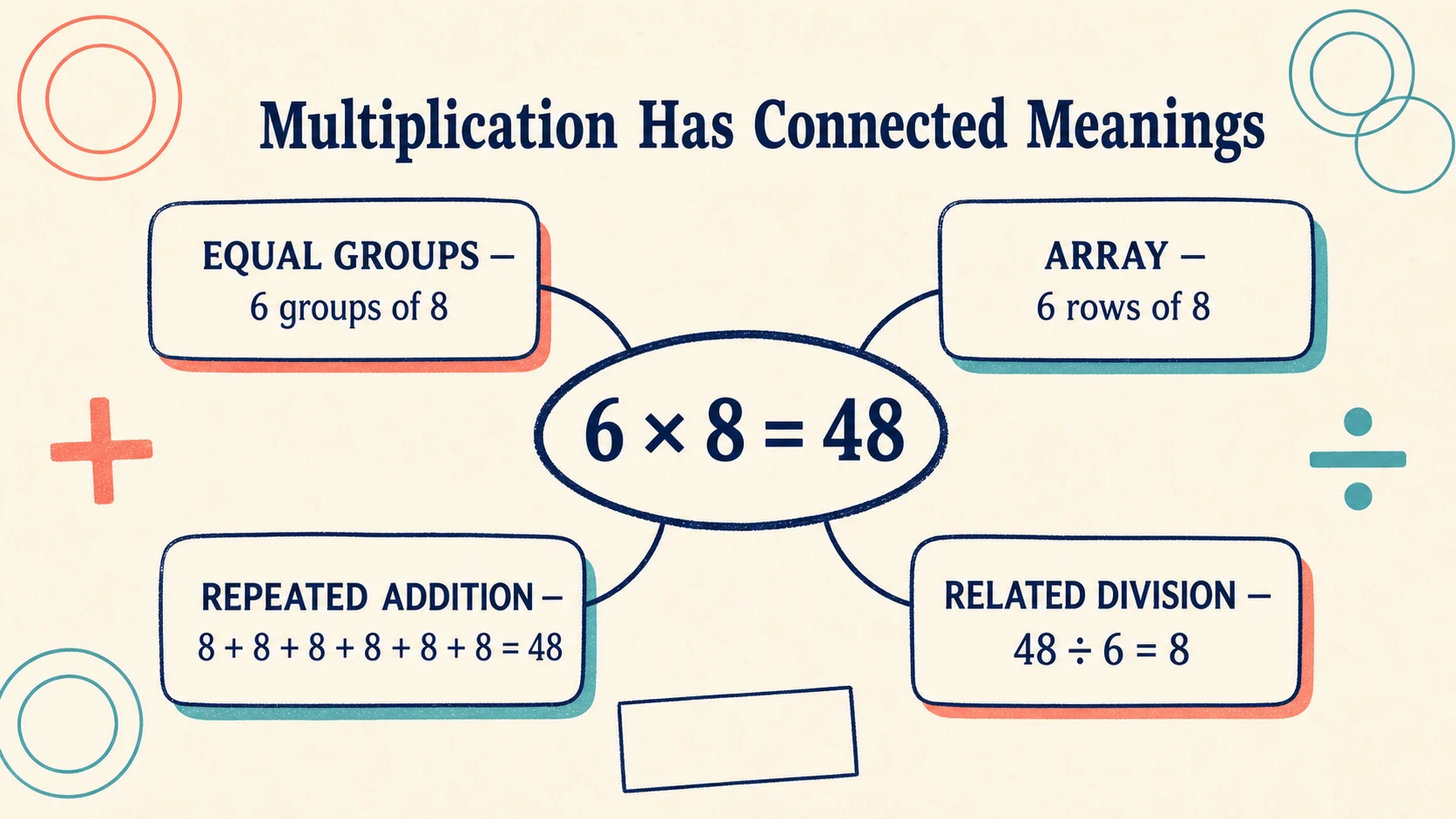
Equal groups, visual models, equations, strategies, and problem solving should develop as connected ideas.
Prerequisites to Check Before Teaching New Facts
A learner does not need perfect addition fluency before beginning multiplication. However, several supporting skills make the new work more understandable.
Counting and grouping
Check whether the learner can:
- Count a set accurately without skipping or counting an object twice
- Make equal groups from a collection
- Recognize when groups are unequal
- Skip-count by 2, 5, and 10
- Add two or more equal addends
- Read and write whole numbers used in the planned problems
A quick check can use 18 counters. Ask the learner to make 3 equal groups, describe how many are in each group, and write an addition equation. A correct response might show 3 groups of 6 and 6+6+6=18.
If the learner makes groups of 5, 6, and 7, the immediate need is not fact memorization. Return to equal sharing, careful counting, and the meaning of “equal.”
Addition as a bridge
Repeated addition helps establish meaning:
5+5+5=15
This can be recorded as:
3×5=15
The 3 tells how many equal groups there are, and the 5 tells how many objects are in each group. Repeated addition is useful at first, but it becomes inefficient for a problem such as 9×7. Multiplication strategies should gradually replace long addition chains.
Language and symbol knowledge
Confirm that the learner understands these terms in context:
- Factor: a number being multiplied
- Product: the result of multiplication
- Equal groups: groups containing the same number
- Array: objects arranged in equal rows and columns
- Row: a horizontal arrangement
- Column: a vertical arrangement
Do not treat vocabulary recall as proof of understanding. Ask the learner to show a term with objects or a drawing. A learner who can build an array but confuses “row” and “column” may need a language correction, not a new multiplication lesson.
A Grade-Appropriate Teaching Progression
Teach through connected stages while allowing movement backward when the learner’s work shows a gap. The following sequence is an instructional suggestion based on the catalogue progression from concrete models toward fact fluency.
| Stage |
Main idea |
Suitable task |
Evidence to look for |
| 1. Equal groups |
Multiplication describes equal-sized groups |
Build 4 groups of 3 counters |
Groups are equal and counted once |
| 2. Repeated addition |
Each group contributes the same addend |
Write 3+3+3+3 |
Number of addends matches number of groups |
| 3. Arrays |
Rows and columns represent factors |
Draw 4 rows of 3 |
Array structure matches the equation |
| 4. Equations |
Factors and products describe the model |
Write 4×3=12 |
Learner explains what each number means |
| 5. Strategic facts |
Known facts help find unknown facts |
Use 5×7 to find 6×7 |
Strategy is accurate and explained |
| 6. Word problems |
Context determines the operation |
Solve equal-group and array situations |
Equation matches the situation |
| 7. Unknowns and division |
A missing factor can be found |
Solve 4×□=28 |
Learner reasons from known products |
| 8. Fluency and review |
Facts become accurate and efficient |
Mixed practice within 100 |
Accuracy holds without a model when appropriate |
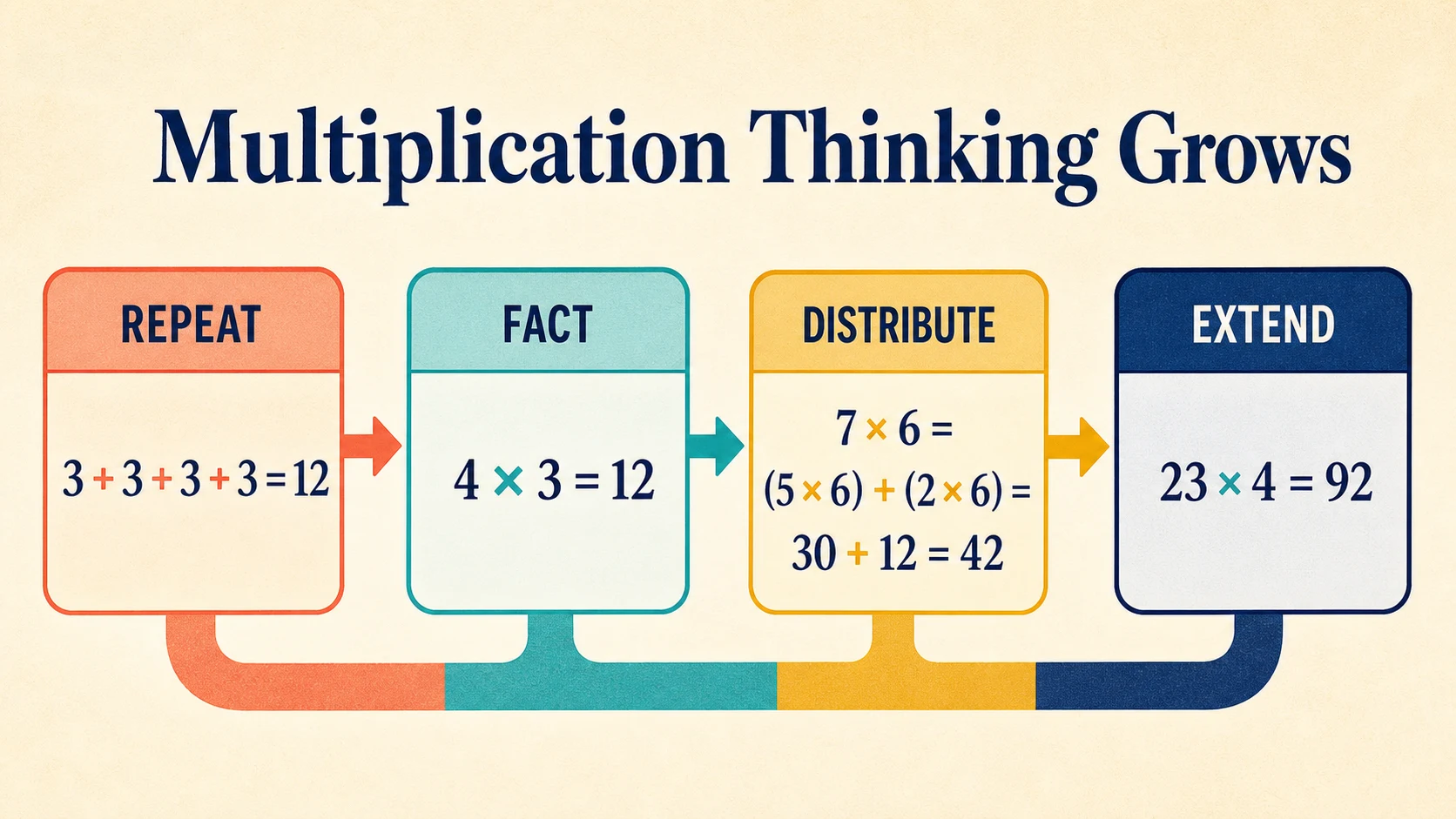
Independence grows through explanation, visual support, strategic calculation, and carefully selected review.
A useful order for fact families
The catalogue teaching guidance suggests beginning with pattern-based facts: ×0, ×1, ×2, ×5, and ×10. Continue with ×3 and ×4, then use known facts and the distributive property to reason about ×6, ×7, ×8, and ×9.
This is more useful than working mechanically from the 0 table through the 10 table. For instance, a learner who knows 5×8=40 can find:
6×8=(5×8)+(1×8)=40+8=48
The strategy preserves meaning: six groups of 8 can be separated into five groups of 8 and one more group of 8.
When to move forward
Advance when the learner can usually:
- Build or draw a matching representation
- Write an equation for the representation
- Explain the factors and product
- Calculate accurately using a reasonable strategy
- Apply the idea to a short word problem
A single correct answer is not enough evidence. Conversely, one slow answer does not prove that the learner lacks understanding. Look for a pattern across several problems.
Concrete and Visual Models That Clarify the Operation
The IES guide on teaching mathematics to young children offers broad instructional guidance that includes using developmental progressions, monitoring learners’ mathematical knowledge, and helping learners connect representations. For a third grader, concrete and visual models can make the structure of multiplication visible before symbols become the main tool.
Equal groups with objects
Use counters, buttons, blocks, bottle caps, or small paper squares. For 3×4, make 3 separate groups with 4 objects in each.
Ask:
- How many groups are there?
- How many objects are in each group?
- Are all groups equal?
- What addition equation matches?
- What multiplication equation matches?
The materials are temporary supports. If the learner consistently interprets equations correctly and calculates efficiently, reduce the need to build every fact.
Arrays
Arrays make both factors visible at once. An array for 3×5 has 3 rows with 5 objects in each row:
● ● ● ● ●
● ● ● ● ●
● ● ● ● ●
The array contains 15 objects. Turning it gives 5 rows of 3, so 3×5=5×3=15. This demonstrates the commutative property without requiring the learner to accept it as an unexplained rule.
Arrays also support later area reasoning. Keep the Grade 3 focus on whole-number facts and the structure of rows and columns rather than introducing a multi-digit algorithm prematurely.
Number-line jumps
For 4×3, start at 0 and make 4 jumps of 3:
0→3→6→9→12
The number of jumps represents the number of groups. The size of each jump represents the amount in each group. A frequent mistake is to count the starting point as a jump, so have the learner mark or number the arcs.
Tape diagrams
A tape diagram for 5×6 can show five equal sections, each labeled 6:
| 6 | 6 | 6 | 6 | 6 |
The unknown total is 30. Tape diagrams are especially helpful when a word problem contains extra language because the diagram separates the number of groups, the size of each group, and the total.
Fully Checked Worked Examples
Example 1: Equal groups to an equation
Problem: There are 4 plates with 6 strawberries on each plate. How many strawberries are there?
There are 4 equal groups. Each group contains 6.
6+6+6+6=24
Therefore:
4×6=24
Check: 6+6=12, another 6+6=12, and 12+12=24. The answer is 24 strawberries.
The unit matters. Writing only “24” gives the numerical product, but “24 strawberries” completes the contextual answer.
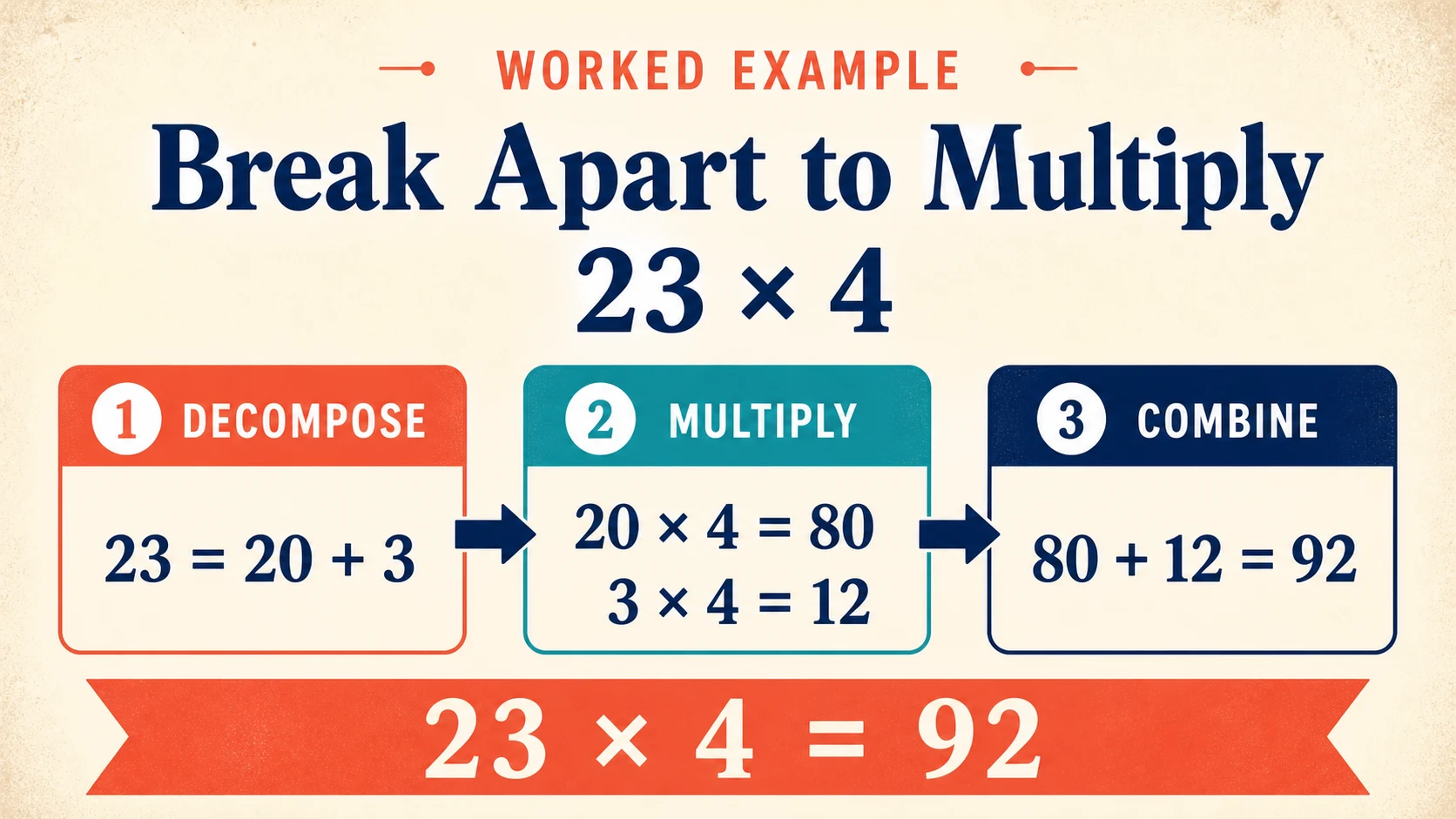
The model, addition equation, multiplication equation, and contextual answer should describe the same quantities.
Example 2: Using an array and the commutative property
Problem: Find 3×8.
Imagine 3 rows with 8 squares in each row. Count by rows:
8+8+8=24
So:
3×8=24
Rotate the array. It now has 8 rows of 3:
8×3=24
Check: Skip-count eight groups of 3: 3, 6, 9, 12, 15, 18, 21, 24. Both arrangements contain 24 squares.
The factors may change order without changing the product. The interpretation changes from 3 groups of 8 to 8 groups of 3, but the total remains equal.
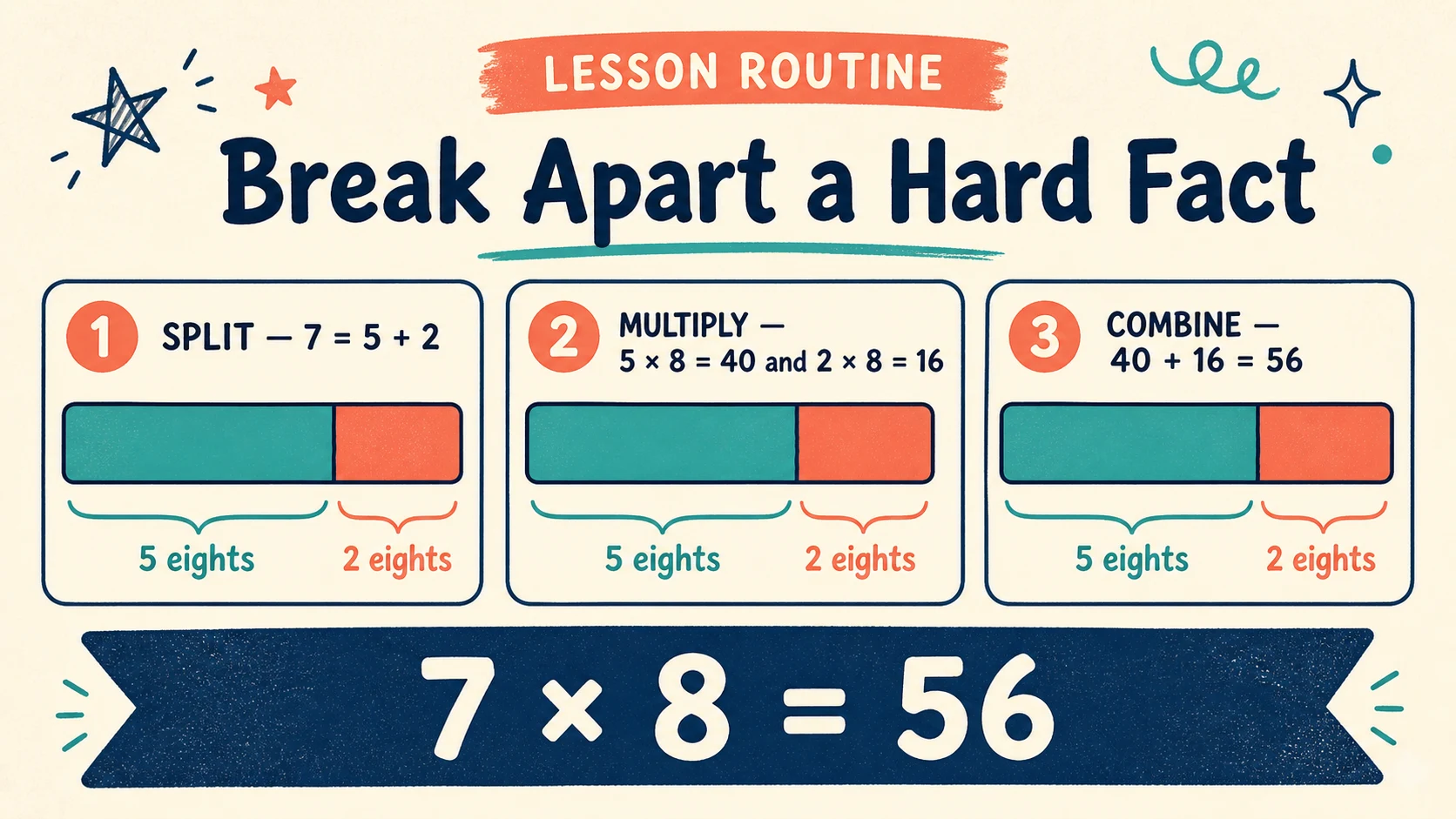
Example 3: Breaking apart an unfamiliar fact
Problem: Find 7×8 using a known fact.
Break 7 groups into 5 groups and 2 groups:
7×8=(5×8)+(2×8)
Calculate each part:
5×8=40
2×8=16
Combine the partial products:
40+16=56
Therefore:
7×8=56
Check: Use a different split:
7×8=(7×4)+(7×4)=28+28=56
Both strategies produce 56. The first uses the distributive property; the second uses doubling.
Example 4: Finding an unknown factor
Problem: Solve 6×□=42.
Ask what number makes 6 equal groups total 42. Count by 6:
6, 12, 18, 24, 30, 36, 42
There are 7 counts, so:
6×7=42
Thus:
□=7
Check: The related division equation is:
42÷6=7
The missing number is 7, not 42. The equals sign shows that both sides have the same value.
Example 5: A two-step situation
Problem: Three boxes contain 8 pencils each. A teacher gives away 5 pencils. How many pencils remain?
First find the number of pencils in the boxes:
3×8=24
Then subtract the pencils given away:
24−5=19
Check: 8+8+8=24, and 24−5=19. The answer is 19 pencils.
The multiplication describes the equal groups. Subtraction describes the later change. Writing 3×8−5=19 is correct, but the two separate equations may make the reasoning clearer.
Boundary Cases Learners Need to Understand
Zero and one
For 5×0, there are 5 groups with 0 objects in each. The total is 0:
5×0=0
For 1×7, there is 1 group of 7. The total is 7:
1×7=7
Do not explain 5×0 as “nothing times five” if the original equation is being interpreted as 5 groups of 0. Precise language helps the learner connect each factor to the model.
Equal versus unequal groups
Three baskets containing 4, 4, and 5 apples do not directly represent 3×4. The groups are unequal, and the total is 13 rather than 12.
A learner may still use multiplication for the equal part:
3×4+1=13
This boundary case tests whether the learner is attending to structure instead of multiplying whenever a problem mentions groups.
Facts outside the immediate practice range
The catalogue describes third-grade work as typically developing facts through 10×10 by year’s end, while the broader multiplication topic includes facts through 12 and later multi-digit methods. Treat ×11, ×12, and multi-digit multiplication as extensions or later-sequence content unless the learner’s local program includes them.
A learner ready for 12×4 can reason:
12×4=(10×4)+(2×4)=40+8=48
That valid extension should not replace unfinished work with core facts within 100.
A Short, Repeatable Lesson Routine
A practical session can last about 15 to 25 minutes, but this is an instructional suggestion rather than a universal timetable. Shorten, extend, or pause according to the learner’s attention, accuracy, explanations, and signs of fatigue.
Keep the routine stable while changing the facts, representations, and level of support.
1. Retrieve a known idea
Spend two or three minutes reviewing a secure fact family or model. Ask for an explanation, not just quick answers.
Example: “Show two ways to represent 5×4.”
2. Model one new connection
Use objects, an array, or a diagram for one carefully selected fact. Think through the quantities explicitly.
Example: connect 6×7 to 5×7+1×7.
3. Solve together
Complete two or three problems with prompts:
- What do the factors mean?
- Which known fact could help?
- How can you check the product?
- Does the answer fit the model?
Reduce prompting as the learner demonstrates control.
4. Try independently
Give three to six closely related problems. Include enough workspace for drawings or partial products. Independent work should reveal whether the learner can use the strategy without copying the adult’s exact steps.
5. Review and record
End with one mixed-review problem and a brief reflection: “Which strategy did you use, and why?” Record the facts or problem types that were accurate, uncertain, or misunderstood.
Choosing Practice That Matches the Learner
Good practice is selected from evidence, not simply from the grade printed on a page. The 3rd Grade Math hub can help an adult compare multiplication work with other available math topics, while the multiplication topic guide keeps the focus on this operation.
Choose practice according to the learner’s current need:
| Observed work |
Best next practice |
Support |
| Makes unequal groups |
Building and sorting equal groups |
Counters and group circles |
| Builds correctly but cannot write an equation |
Model-to-equation matching |
Sentence frame: “___ groups of ___” |
| Understands models but counts every object |
Skip-counting and known-fact connections |
Number line or array |
| Knows ×2, ×5, and ×10 |
Derive ×3, ×4, ×6, and other facts |
Break-apart equations |
| Calculates facts but misreads stories |
Equal-group word problems |
Tape diagrams and unit labels |
| Answers accurately but slowly |
Short mixed retrieval sets |
Immediate checking and strategy review |
| Makes errors only in mixed work |
Interleaved multiplication review |
Include known and newer facts |
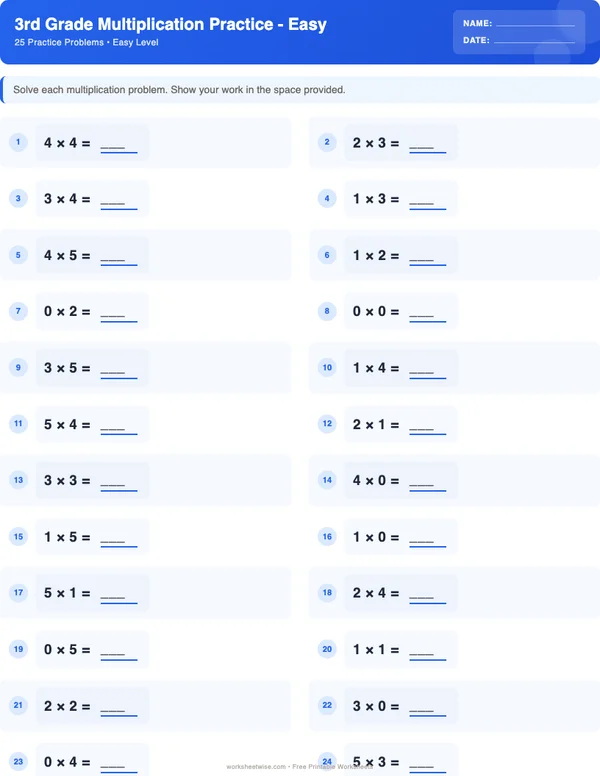
The free easy multiplication worksheet contains 25 exercises focused on multiplication facts, times tables, mental math, and number sense, with a separate answer key. It is suitable when the learner understands the meaning of multiplication and needs foundational reinforcement. It is not, by itself, a full diagnostic or complete curriculum.
The 3rd Grade Multiplication Worksheet Pack contains 18 worksheets. A larger pack can provide more practice choices, but more pages are not automatically better. Select a small set that matches the current strategy or error pattern.
Differentiation Without Changing the Mathematical Goal
When a learner needs more support
The IES practice guide on assisting students who struggle with mathematics provides high-level recommendations concerning systematic instruction, mathematical language, representations, number lines, word problems, and cumulative review. It does not diagnose an individual learner or prescribe this exact lesson sequence.
Useful instructional adjustments include:
- Reduce the number of facts introduced at once.
- Return to objects or an array while keeping the same equation.
- Use consistent language: “number of groups,” “amount in each group,” and “total.”
- Place a known fact beside an unknown fact.
- Ask the learner to explain one correct example before starting a page.
- Mix a few secure items with one newer fact family.
- Allow a multiplication chart during concept practice, then remove it selectively during retrieval practice.
If 6×8 is difficult, do not merely repeat it ten times. Show 5×8=40, add one group of 8, and verify 48 with an array.
When a learner is ready for more challenge
Keep the work connected to multiplication rather than assigning longer pages of identical facts. Ask the learner to:
- Find two strategies for the same product
- Write a word problem for a given equation
- Find the missing factor in several equation positions
- Compare 4×7 and 5×7
- Explain why 8×6=6×8
- Solve a two-step problem and label each operation
- Decide whether a pictured situation represents multiplication
Challenge should deepen reasoning. Speed alone does not show whether the learner can interpret or apply multiplication.
Common Errors and Diagnostic Responses
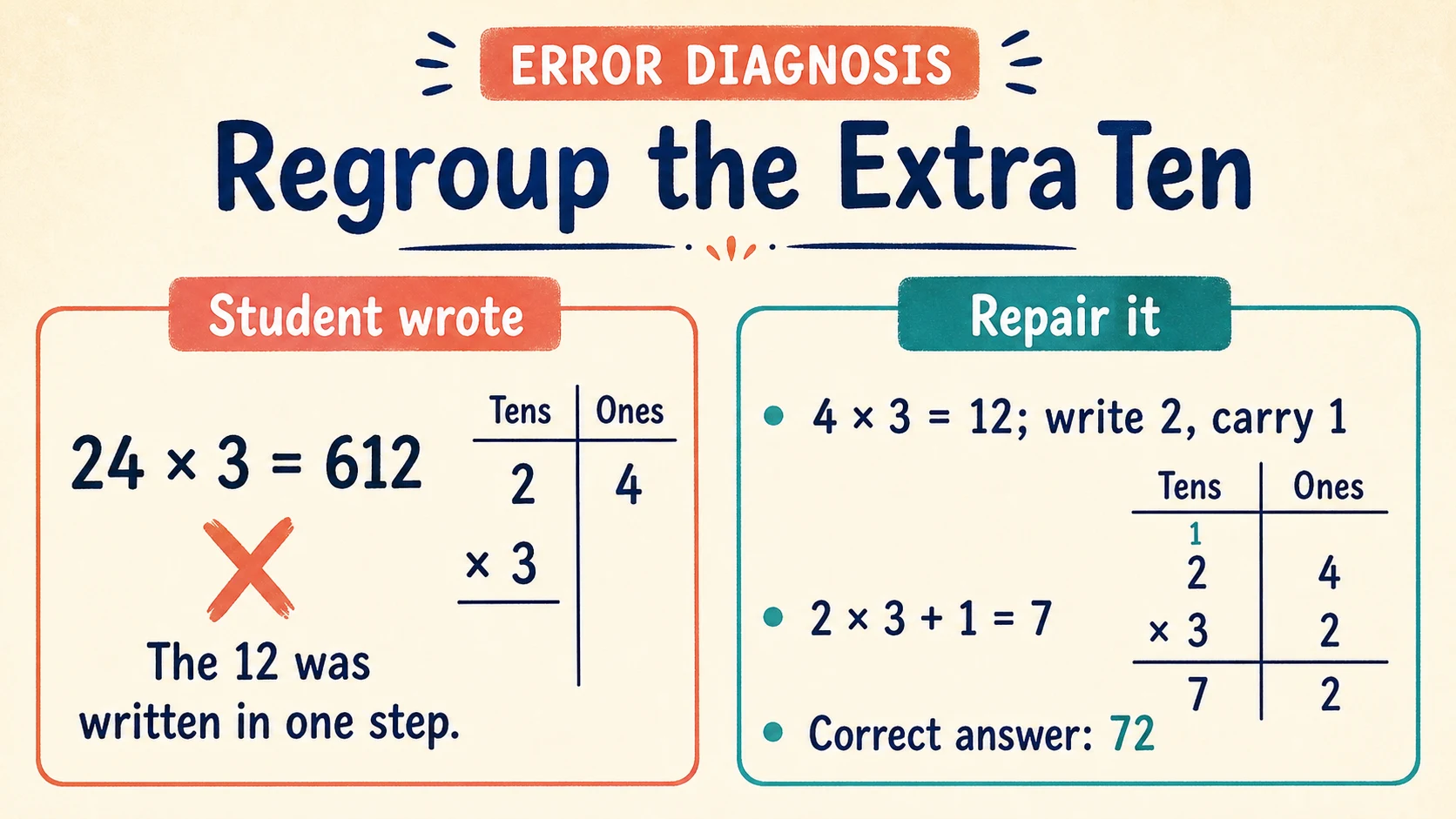
Use the error to choose a response; do not assume every incorrect product has the same cause.
Confusing factors with the product
For 4×6=□, a learner writes 6.
Ask the learner to build 4 groups of 6 and count the total. Emphasize that 4 and 6 describe the groups; the product describes all objects together.
Adding the factors
For 3×5, a learner writes 8.
This often shows that the multiplication symbol has not been connected securely to equal groups. Compare:
3+5=8
with:
3×5=5+5+5=15
Have the learner explain why the operations answer different questions.
Counting an array inaccurately
A learner sees 4 rows of 7 but records 4×6.
Ask the learner to trace one row, count its entries, and mark each completed row. If row and column language is the only issue, correct the label while preserving the valid total.
Reversing a word-problem interpretation
A learner represents 5 bags with 3 marbles each as 3×5. The product is still correct because multiplication is commutative, but the equation does not follow the chosen “groups of” convention.
Acknowledge that both products equal 15. Then ask which factor shows the number of bags and which shows the marbles in each bag. This maintains mathematical accuracy while sharpening interpretation.
Overusing skip-counting
A learner finds 8×9 by making nine uncertain jumps and loses track.
Replace the long count with a nearby known fact:
8×9=(8×10)−8=80−8=72
Then check using another split, such as 5×9+3×9=45+27=72.
Treating the equals sign as “write the answer”
A learner solves 24=6×□ incorrectly because the blank appears at the end of the multiplication expression.
Use a balance interpretation: both sides have the same value. Since 6×4=24, the missing factor is 4 regardless of which side contains the product.
Monitoring Progress Without Overemphasizing Speed
Monitor several dimensions separately:
- Meaning: Can the learner explain the factors and product?
- Representation: Can the learner build or draw the equation?
- Accuracy: Are products calculated correctly?
- Strategy: Can the learner use a known fact rather than guess?
- Application: Can the learner select multiplication in a word problem?
- Independence: How much prompting or visual support is needed?
- Retention: Does the skill remain accurate after several days?
A simple record might use three marks: secure, developing, and revisit. Date each observation and note the task. “Developing—accurate with array, not yet from equation” is more useful than “doesn’t know sixes.”
Speed may be observed once understanding is established, but avoid using a timed result as the only measure. A learner who answers slowly with a sound strategy may need retrieval practice. A learner who answers rapidly but cannot model the fact may need conceptual review.
A Two-Week Practice Plan
This plan is a flexible instructional example, not a required schedule. Each session can use the short routine above. Adjust the number of days and problems according to the learner’s observed work.
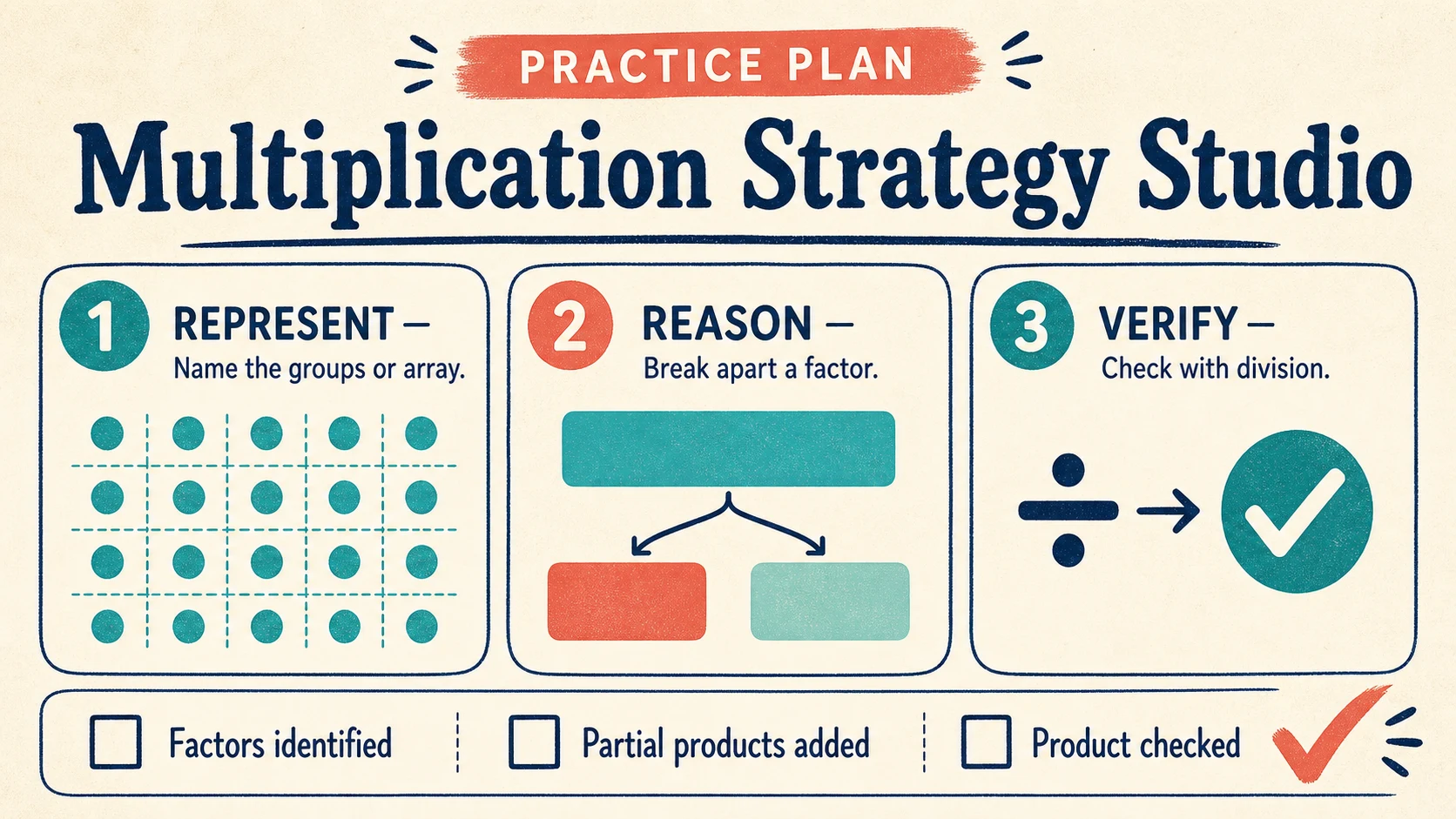
Alternate new learning, mixed review, application, and observation rather than assigning uninterrupted fact drills.
| Day |
Focus |
Suggested activity |
Check |
| 1 |
Baseline |
Build and solve ×2, ×5, and ×10 facts |
Note model use and counting errors |
| 2 |
Equal groups |
Match objects, repeated addition, and equations |
Explain both factors |
| 3 |
Arrays |
Draw ×3 and ×4 facts |
Count rows and columns accurately |
| 4 |
Commutative property |
Rotate arrays and write related equations |
Product stays unchanged |
| 5 |
Review |
Mix ×0, ×1, ×2, ×5, and ×10 |
Separate slips from misunderstandings |
| 6 |
Distributive strategy |
Derive ×6 facts from ×5 facts |
Write both partial products |
| 7 |
Doubling |
Connect ×4 and ×8 facts |
Explain the doubling step |
| 8 |
×7 and ×9 strategies |
Break facts into known parts |
Verify with a second method |
| 9 |
Word problems |
Solve equal-group, array, and two-step situations |
Label units and operations |
| 10 |
Reassessment |
Complete a short mixed set and explain two answers |
Choose review or next-step practice |
If Day 6 shows that the learner cannot explain 5×7, pause the ×6 strategy and revisit the supporting fact. If Day 10 shows accurate, independent reasoning, move toward wider mixed practice, missing-factor equations, and multiplication–division connections.
Limitations and the Honest Next Step
No single guide, worksheet, fact chart, or two-week plan can reveal every reason a learner struggles. Written work may show the result without showing whether the cause was unclear language, inaccurate counting, an unstable addition fact, loss of attention, or a guessed answer. Observe the learner solving a small sample and ask for an explanation before deciding what to teach.
This guide does not claim certification, guaranteed outcomes, comprehensive standards alignment, medical guidance, or one timetable suitable for every setting. Local sequences differ, and adults should coordinate with the learner’s classroom materials when consistency matters.
The honest next step is to select one task that matches the evidence. If the learner can already represent multiplication and needs straightforward fact reinforcement, use the free 3rd Grade Multiplication worksheet. Ask the learner to solve a small section, explain two products, and check the work with the included answer key. Use those observations—not the number of pages completed—to choose the following lesson.