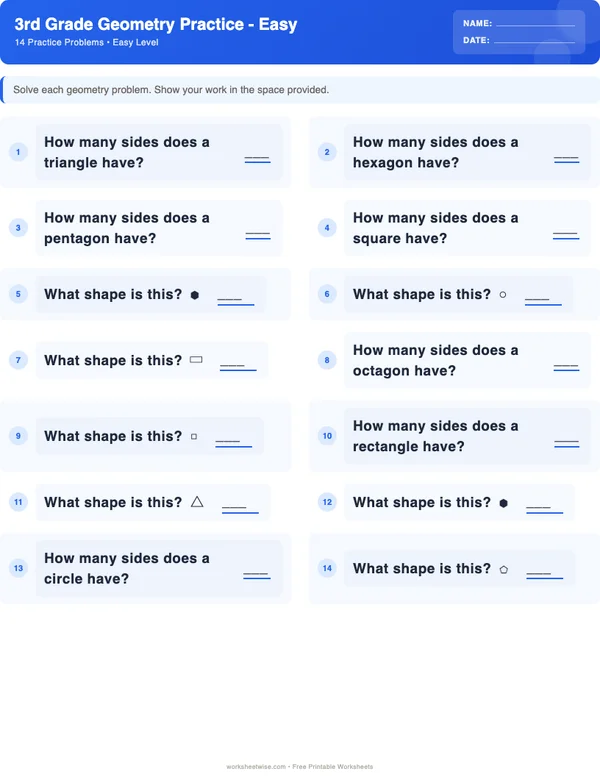
What 3rd Grade Geometry Includes
3rd Grade Geometry develops a learner’s ability to describe shapes by their properties, calculate the area and perimeter of rectangles, and recognize relationships among geometric categories. The central shift is from naming shapes by appearance to reasoning about sides, vertices, right angles, equal lengths, square units, and boundary lengths.
A practical sequence is:
- Review two-dimensional shapes, sides, vertices, and right angles.
- Classify shapes using stated properties.
- Build and measure perimeter as the distance around a figure.
- Cover rectangles with square units to develop area.
- Connect tiled rectangles to multiplication.
- Compare area and perimeter without treating them as interchangeable.
The learner’s observed work should determine the pace. A child who can name a rectangle but cannot explain why it is a rectangle needs classification work before a long page of area calculations. A child who correctly builds tiled rectangles may be ready to connect area to multiplication.
Grade labels describe the intended practice level, not a universal timetable. Local curricula and instructional sequences differ. The Common Core State Standards for Mathematics provide one widely used description of grade-level expectations, including reasoning about shape categories, rectangle area, and perimeter in Grade 3. They do not determine every local lesson order.
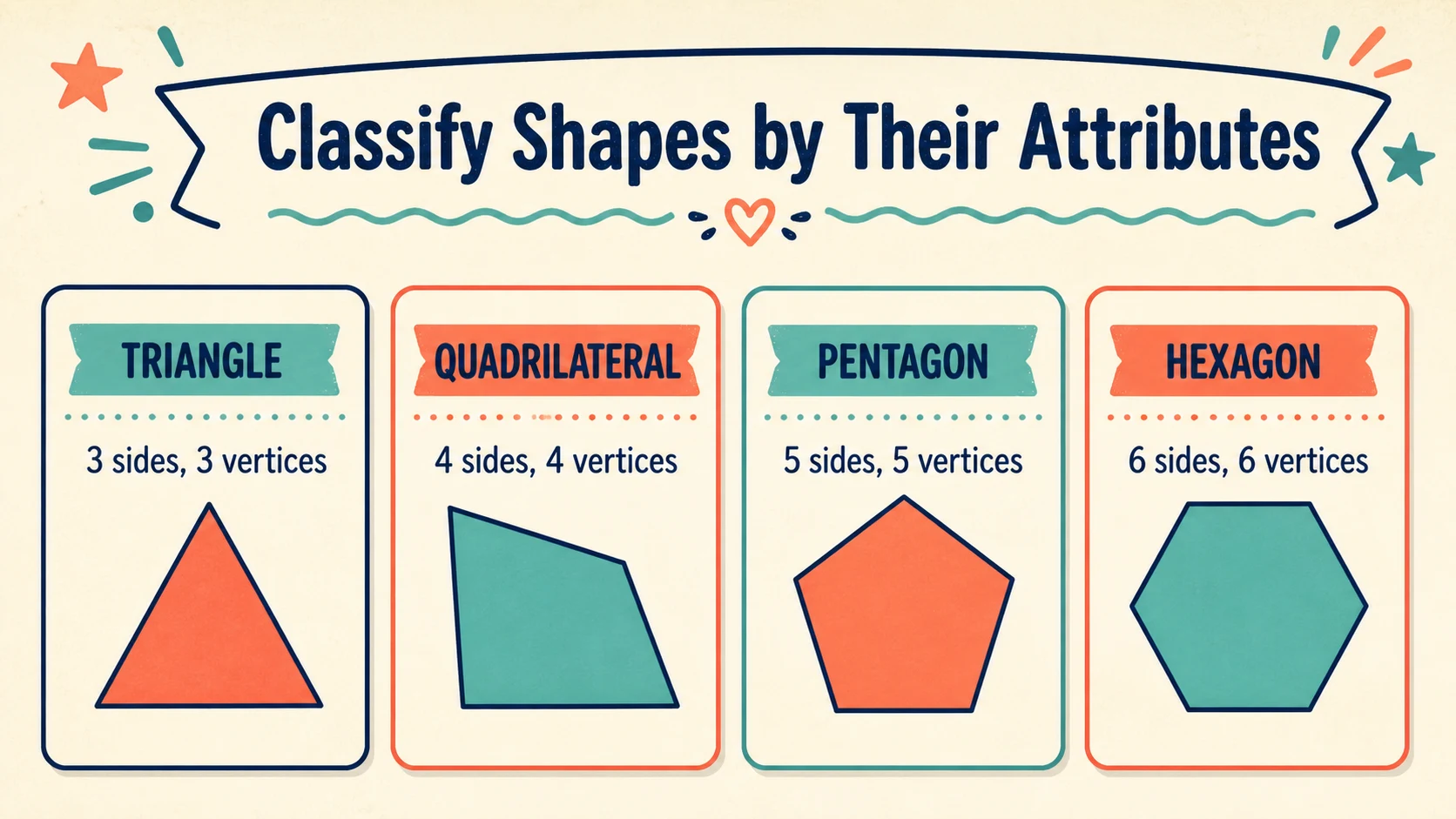
The main strands connect shape properties with measurement, multiplication, and spatial reasoning.
Prerequisites to Check Before Teaching
A short prerequisite check is more useful than assuming that an adult or previous worksheet has already taught each needed skill.
Shape and property language
Ask the learner to draw or identify:
- A triangle, quadrilateral, rectangle, and square
- A side and a vertex
- A right angle, using the corner of a sheet of paper as a comparison
- Two sides that are equal in length
Do not rely only on familiar, upright pictures. Turn a square so that one vertex points upward. Show a long, narrow rectangle. Use triangles with different side lengths and orientations. The goal is to determine whether the learner attends to defining properties rather than to a remembered visual template.
A useful prompt is, “What must be true about this shape?” Answers such as “It looks like a box” are less precise than “It has four sides and four right angles.”
Counting and measurement foundations
Before perimeter work, check that the learner can:
- Add several one- or two-digit lengths
- Recognize repeated equal addends
- Measure a segment from zero on a ruler
- Keep one measurement unit throughout a calculation
Before area work, check that the learner can:
- Count objects arranged in rows and columns
- Interpret multiplication as equal groups or an array
- Cover a region without gaps or overlaps
- Distinguish a length unit from a square unit
The catalogue’s description of third-grade mathematics includes early multiplication and division work using arrays and equal groups. That knowledge supports rectangle area: a 4-by-6 rectangle can be seen as four rows of six square units.
If several prerequisites are weak, use shorter geometry tasks alongside counting, addition, and array practice. Geometry does not need to stop, but the numerical demands should remain manageable.
A Grade-Appropriate Teaching Progression
Geometry develops best when actions and pictures come before compressed rules. The IES guide on teaching mathematics to young children supports high-level practices such as using progressions, monitoring what children know, and helping learners connect representations. For this guide, those principles translate into a concrete-to-visual-to-symbolic sequence. This is instructional framing, not an evaluation of WorksheetWise materials.
| Stage |
Main idea |
Useful model |
Evidence of readiness to continue |
| 1. Describe |
Shapes have observable properties |
Cutouts, drawings, classroom objects |
Names sides, vertices, and right angles accurately |
| 2. Sort |
One shape can belong to a broader category |
Sorting cards or hoops |
Gives a property-based reason for placement |
| 3. Compose |
Shapes can be built or partitioned |
Tiles, tangrams, grid paper |
Identifies component shapes after rearrangement |
| 4. Trace perimeter |
Perimeter follows the outside boundary |
String, tiles, grid paper |
Counts each outside segment once |
| 5. Measure perimeter |
Side lengths can be added |
Labeled drawings |
Includes all sides and preserves units |
| 6. Cover area |
Area measures a surface in square units |
Square tiles |
Covers without gaps or overlaps |
| 7. Multiply for area |
Rows and columns form rectangular arrays |
Grids and equations |
Connects counting tiles to length × width |
| 8. Compare |
Area and perimeter describe different attributes |
Equal-area rectangles |
Explains which measure changed and why |
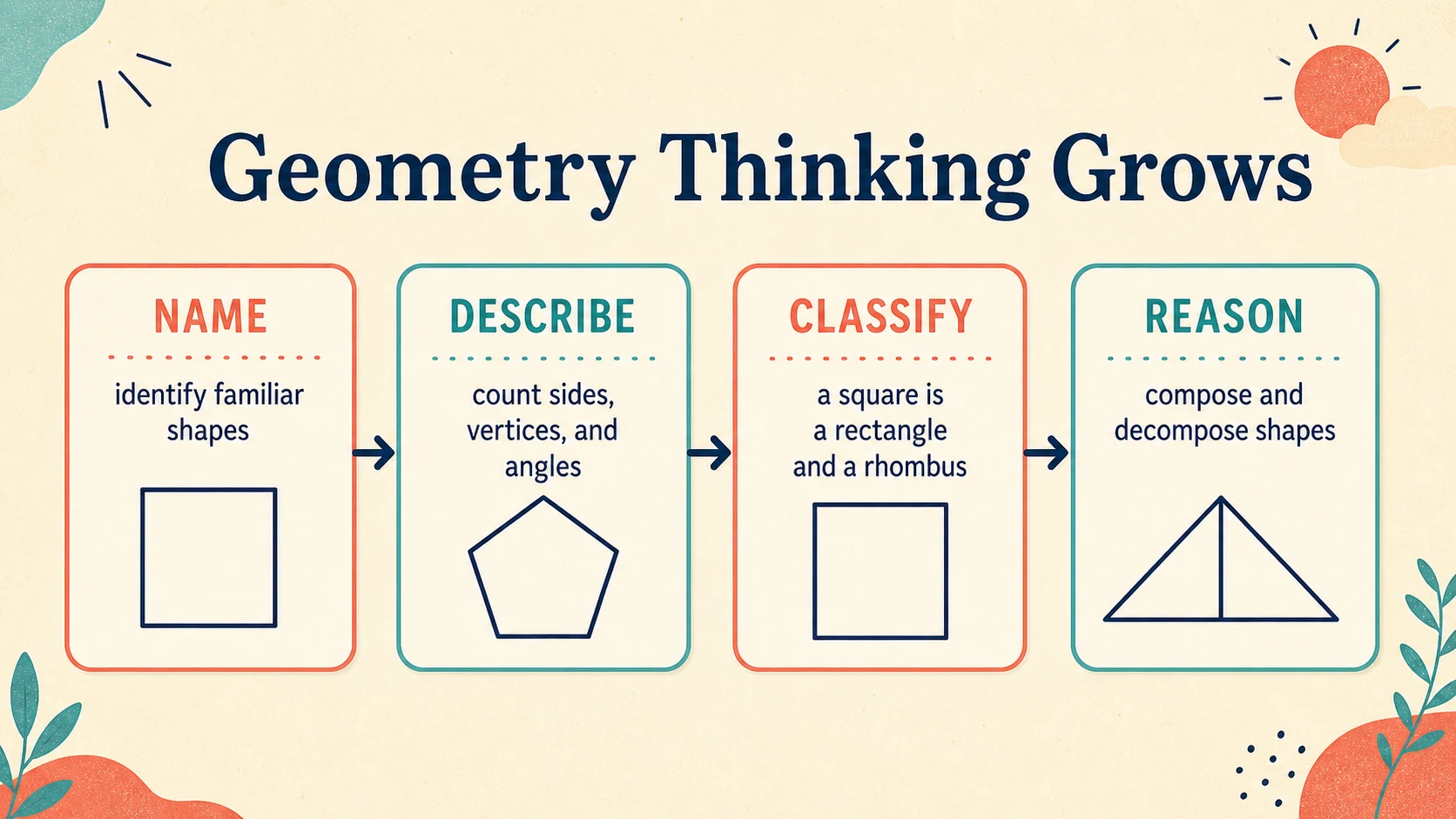
Move forward when the learner’s explanations and representations are secure, not merely when a scheduled day ends.
This sequence is not rigid. A learner may classify shapes confidently but still need tiles for area. Another may multiply accurately while misunderstanding what a square unit represents. Teach the specific connection that is missing.
Teaching Shapes Through Concrete and Visual Models
Build, trace, sort, and rotate
Begin with shapes the learner can handle. Paper cutouts, craft sticks, pattern blocks, tangrams, and a geoboard can make properties visible.
Ask the learner to:
- Build a quadrilateral with four craft sticks.
- Change one property while keeping four sides.
- Trace a triangle, rotate the paper, and identify it again.
- Sort shapes by number of sides.
- Sort the same set again by presence or absence of right angles.
The second sort matters because it shows that a collection can be organized by different valid properties. Require a sentence such as, “These shapes belong together because each has four sides.” The spoken reason reveals more than the final pile.
Treat categories as relationships
A square should not be excluded from rectangles merely because it has four equal sides. A square satisfies the rectangle property of having four right angles. It also has equal side lengths. Thus it belongs to more than one category.
Use a nesting model: place square cards inside a “rectangles” loop, and place that loop inside a broader “quadrilaterals” region. The purpose is not memorizing a diagram. It is understanding that a specific category can satisfy all the properties of a broader category.
Include nonexamples. A four-sided figure with no right angles may be a quadrilateral, but it is not a rectangle. A three-sided figure cannot be a quadrilateral, regardless of its orientation or size.
Making Perimeter and Area Meaningful
Perimeter follows the boundary
Introduce perimeter by physically tracing the outside of a book, tile arrangement, or drawn figure. A finger, piece of string, or washable marker can emphasize that perimeter is a one-dimensional boundary.
For a rectangle with side lengths 8 cm and 3 cm, the complete boundary contains two 8 cm sides and two 3 cm sides:
8+3+8+3=22 cm
The shortened expression 2×8+2×3 is useful only after the learner can explain why each length occurs twice.
Boundary cases expose misunderstandings:
- A labeled side must not be counted twice unless the figure genuinely has another side of the same length.
- An internal grid line is not part of the perimeter.
- A shared edge between two joined squares is inside the combined figure, so it is not counted.
- An irregular figure can have a perimeter even when no area calculation is requested.
Area covers a surface
Cover a rectangle with equal square tiles. Tiles should meet without gaps and should not overlap. Count the squares, then arrange the count by rows and columns.
A rectangle with 3 rows of 5 unit squares has:
3×5=15 square units
The word “square” is essential. Fifteen units could describe length; 15 square units describes area.
Draw the tiled rectangle before presenting an unpartitioned rectangle labeled 3 units by 5 units. This preserves the meaning of multiplication: the factors represent the number of rows and the number of squares in each row.
Compare without confusing the measures
Build rectangles with 12 tiles:
- A 1-by-12 rectangle has area 12 square units and perimeter 26 units.
- A 2-by-6 rectangle has area 12 square units and perimeter 16 units.
- A 3-by-4 rectangle has area 12 square units and perimeter 14 units.
The equal tile count keeps area fixed while the boundary changes. This directly demonstrates the catalogue teaching point that shapes with the same area can have different perimeters.
The reverse also requires care. Equal perimeter does not force equal area. A 1-by-5 rectangle and a 2-by-4 rectangle both have perimeter 12 units:
1+5+1+5=12
2+4+2+4=12
Their areas are 5 and 8 square units.
Fully Checked Worked Examples
Example 1: Classify a shape from its properties
A shape has four sides, four right angles, and four equal side lengths. Classify it as specifically as possible.
- Four sides make it a quadrilateral.
- Four right angles make it a rectangle.
- Four equal sides together with four right angles make it a square.
Answer: The shape is a square. It is also a rectangle and a quadrilateral.
Check: Every square has four sides and four right angles, so all stated properties are accounted for. Calling it only a quadrilateral is true but not the most specific classification.
Example 2: Find a rectangle’s perimeter
A rectangular picture frame is 9 inches long and 4 inches wide. Find its perimeter.
P=9+4+9+4
P=26 inches
An equivalent calculation is:
P=2×9+2×4=18+8=26 inches
Answer: The perimeter is 26 inches.
Check: The boundary includes two long sides and two short sides. The answer uses inches, not square inches, because perimeter measures length.
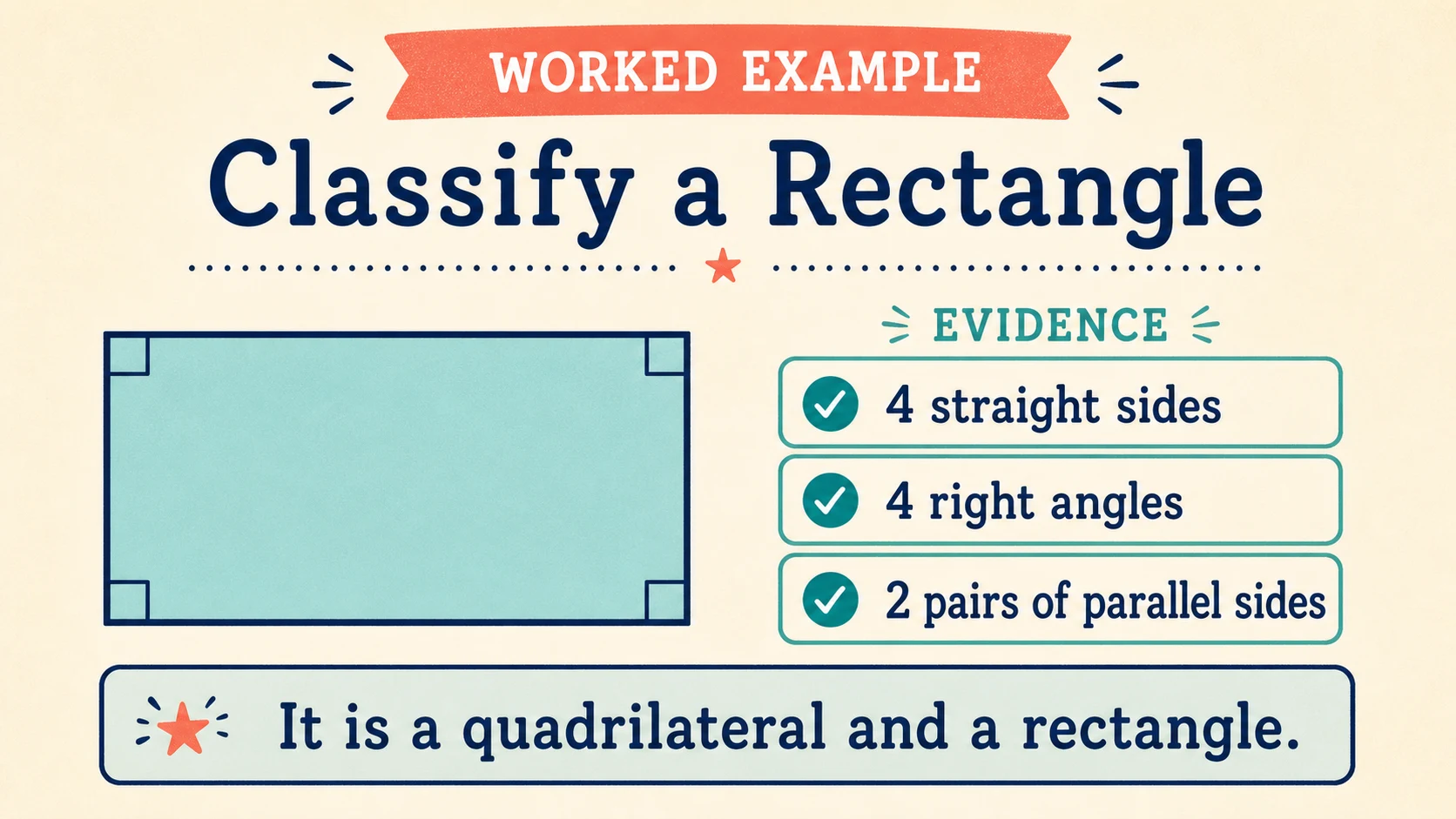
Representing the figure before calculating makes the meaning of each number visible.
Example 3: Find area from rows and columns
A rectangle is covered by 6 rows of 4 one-centimeter squares. Find its area.
Each row contains 4 squares, and there are 6 rows:
6×4=24
Answer: The area is 24 square centimeters.
Check: Repeated addition gives the same count:
4+4+4+4+4+4=24
All tiles are one-centimeter squares, so the correct unit is square centimeters.
Example 4: Find a missing side from perimeter
A rectangle has a perimeter of 30 cm. Each long side is 10 cm. What is the length of each short side?
The two long sides total:
10+10=20 cm
The remaining boundary length is:
30−20=10 cm
The two short sides are equal, so:
10÷2=5 cm
Answer: Each short side is 5 cm.
Check:
10+5+10+5=30 cm
The calculated side length recreates the given perimeter.
Example 5: Compare equal-area rectangles
Rectangle A measures 2 units by 8 units. Rectangle B measures 4 units by 4 units. Compare their areas and perimeters.
Rectangle A:
A=2×8=16 square units
P=2+8+2+8=20 units
Rectangle B:
A=4×4=16 square units
P=4+4+4+4=16 units
Answer: Both areas are 16 square units. Rectangle A has the greater perimeter: 20 units compared with 16 units.
Check: Both products equal 16, while tracing and adding each boundary produces different totals.
A Short, Repeatable Lesson Routine
Use a routine lasting roughly 15 to 25 minutes as an instructional option, not a universal timetable. Shorten or extend it according to the learner’s attention, accuracy, and explanation quality.
1. Retrieve a known idea
Spend two or three minutes on one prerequisite. Ask the learner to name the properties of a rectangle, identify a right angle, or explain the difference between units and square units.
2. Model one new connection
Use an object, tiles, or a drawing. Think aloud briefly: “I am tracing the outside, so I am finding perimeter.” Avoid demonstrating several procedures at once.
3. Solve together
Complete one problem with shared responsibility. Ask the learner to choose a representation or identify the next step. If the learner hesitates, return to the model instead of supplying a rule immediately.
4. Attempt independently
Give two to four carefully selected problems. Include enough workspace for a drawing, equation, label, and unit. Observe the process rather than waiting only for final answers.
5. Explain and review
Ask, “How do you know?” or “What did this number measure?” End with one brief comparison or error correction.
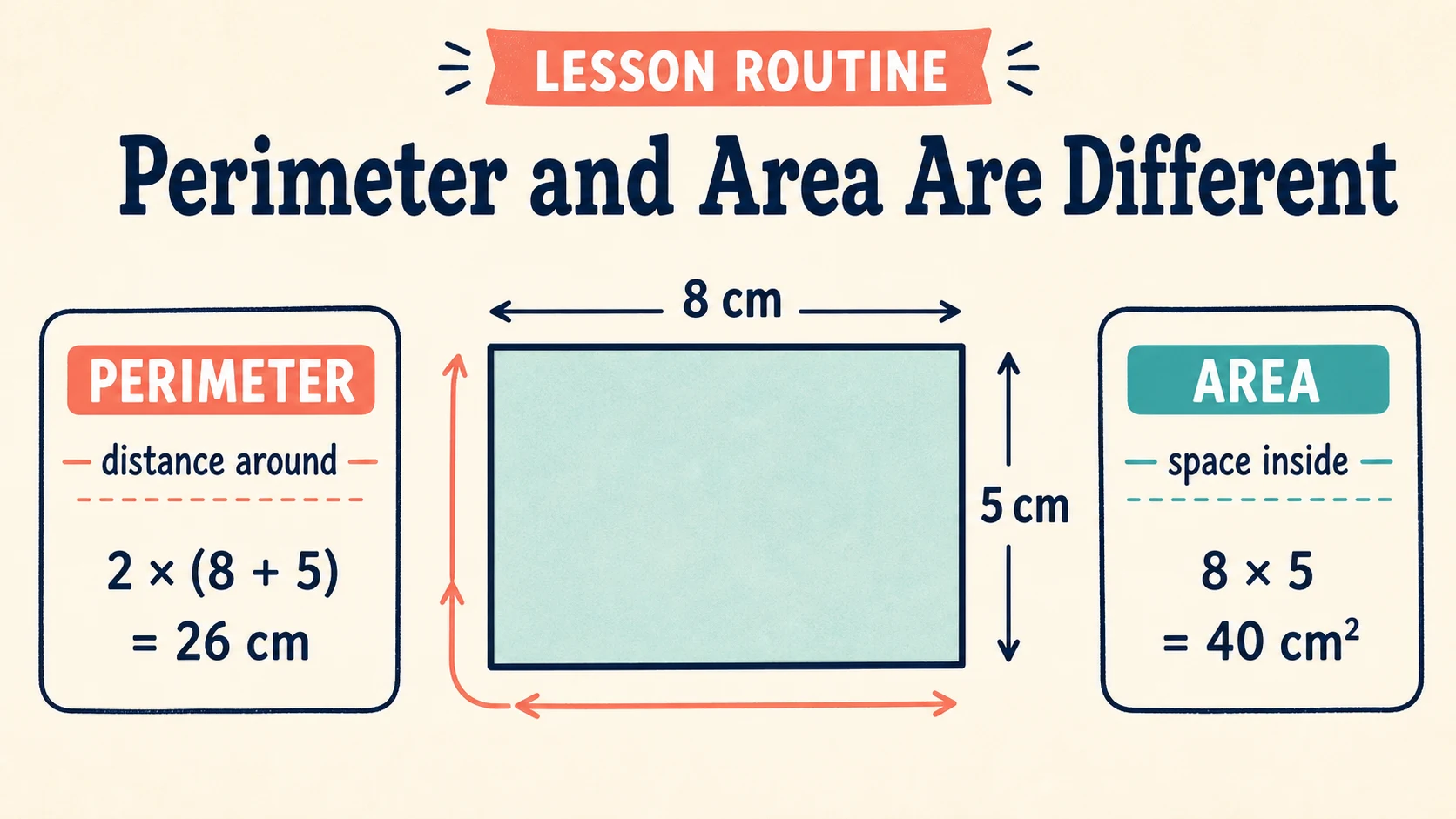
The routine combines retrieval, modeling, guided work, independent practice, and explanation.
The IES practice guide for assisting students struggling with mathematics provides high-level support for systematic instruction, clear mathematical language, representations, and cumulative review. Those ideas can inform the routine, but the learner’s actual responses should determine the amount of prompting and repetition.
Choosing Useful Practice
Choose practice by instructional purpose, not simply by page length.
The 3rd Grade Math hub can help adults place geometry beside related work in multiplication and measurement. The 3rd Grade Geometry topic collection narrows the focus to shape properties, area, and perimeter.
A suitable early set might contain:
- Shape identification in varied orientations
- Counting sides and vertices
- One property-based sorting task
- Perimeter figures with all sides labeled
- Tiled area models
- Rectangles whose dimensions match known multiplication facts
A later set can introduce:
- Missing side lengths
- Rectilinear figures drawn on grids
- Equal-area or equal-perimeter comparisons
- Problems requiring the learner to decide which measure is needed
- Mixed questions without an “area” or “perimeter” heading
Avoid increasing several demands simultaneously. If the new goal is choosing between area and perimeter, keep calculations easy. If the new goal is a more complex boundary, use familiar units and manageable side lengths.
The free standard easy geometry worksheet contains 25 exercises covering shapes, sides and vertices, perimeter, area, and geometric properties, with a separate answer key. It is best used after brief teaching or as a check of foundational skills, not as proof that every geometry idea has been mastered.
Differentiation Based on Observed Work
When the learner needs more support
Reduce abstraction while preserving the mathematical goal.
- Let the learner trace boundaries before adding perimeter lengths.
- Return to square tiles when area units are confused.
- Color-code matching rectangle sides.
- Present fewer shapes in a sorting task.
- Provide sentence frames such as, “This is a ___ because it has ___.”
- Keep multiplication facts within the learner’s secure range.
- Alternate one demonstrated example with one learner attempt.
Do not lower every demand at once. A learner may need a concrete model while still being capable of precise explanations.
When the learner is ready for more challenge
Increase reasoning before increasing number size.
- Ask for two different rectangles with the same area.
- Ask whether a statement is always, sometimes, or never true.
- Omit one side length from a perimeter problem.
- Require two classifications for one shape.
- Ask the learner to create and solve a geometry problem.
- Compare two strategies and identify why both work.
- Have the learner draw a nonexample that fails one named property.
A challenge should expose structure. Larger numbers alone can turn a geometry task into arithmetic practice.
Language and access
Preteach terms with visible referents: point to a vertex, trace a side, cover an area, and walk a perimeter. Allow the learner to demonstrate with objects before giving a full verbal explanation. Then help convert the demonstration into precise language.
For learners who find crowded pages difficult, reveal one problem at a time or copy a problem onto uncluttered paper. These are instructional adjustments, not medical recommendations or child-specific diagnoses.
Common Errors and Diagnostic Responses
An incorrect answer is useful only when the adult identifies the likely reasoning behind it.
| Observed error |
What it may indicate |
Teaching response |
| Rejects a rotated square |
Relies on orientation rather than properties |
Rotate the same cutout and recount sides and right angles |
| Says a square is not a rectangle |
Treats categories as mutually exclusive |
Use nested sorting regions and compare defining properties |
| Adds only length and width |
Counts dimensions rather than the full boundary |
Trace all four sides and mark each as it is counted |
| Counts internal grid lines in perimeter |
Has not isolated the outside edge |
Outline only the exterior with a colored pencil |
| Counts boundary units for area |
Confuses covering with surrounding |
Cover the surface with tiles, then trace the boundary |
| Writes “24 cm” for area |
Omits the two-dimensional unit |
Point to one square centimeter and label the total in square units |
| Uses every visible number |
Chooses operations from numerals rather than meaning |
Ask what attribute the question requests before calculating |
| Leaves gaps between area tiles |
Does not yet understand complete coverage |
Rebuild the model with equal tiles touching edge to edge |
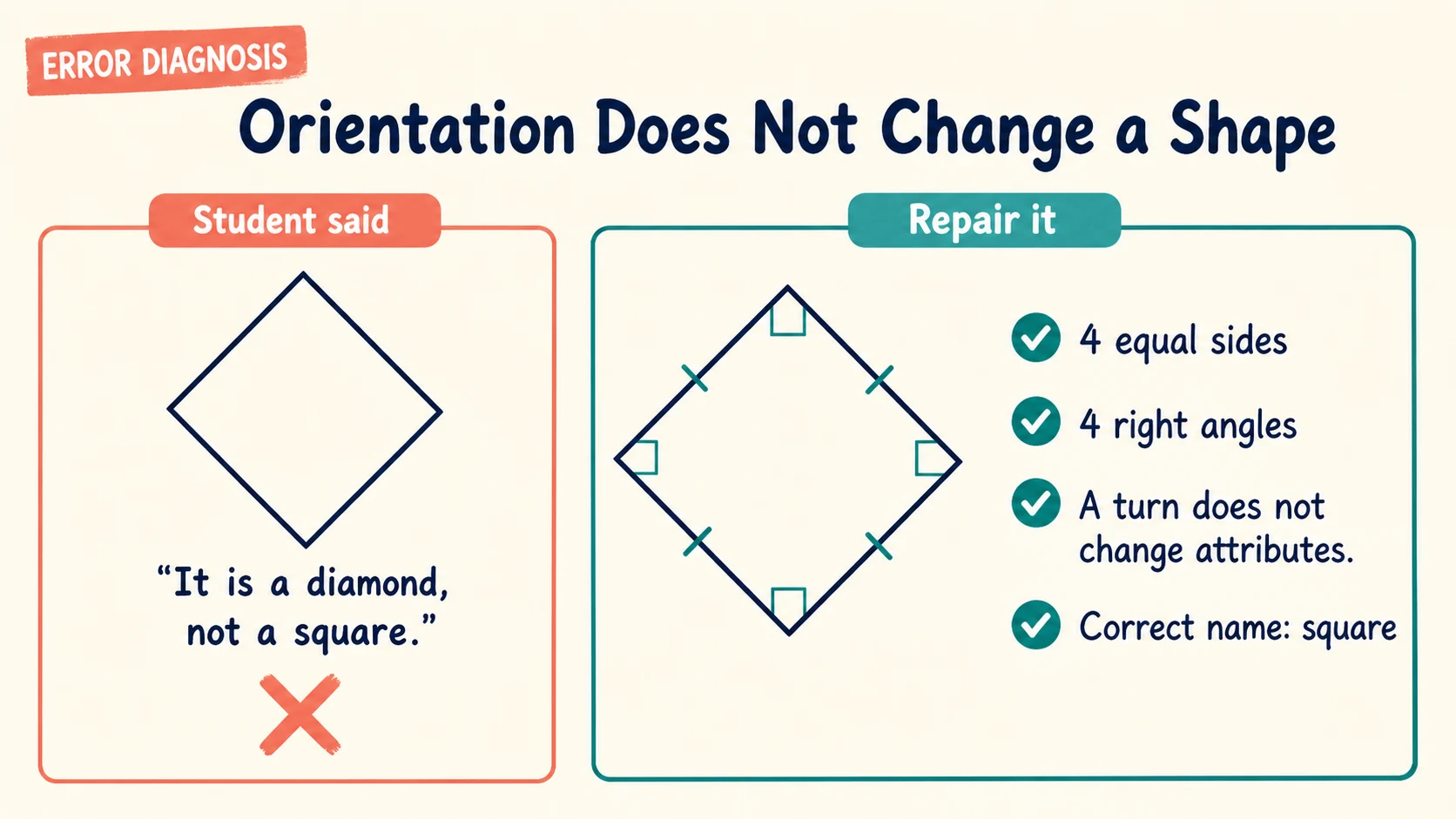
Match the response to the learner’s method; identical wrong answers can come from different misunderstandings.
Correct arithmetic can also conceal weak understanding. A learner may remember l×w and obtain the right area while being unable to show the corresponding rows and columns. Ask for a drawing or explanation occasionally, even after correct answers.
Monitoring Progress Without Over-Testing
Keep brief notes from actual work. Once or twice each week, record whether the learner can:
- Name and describe common two-dimensional shapes
- Recognize shapes in unfamiliar orientations
- Classify a shape using more than one valid category
- Trace and calculate perimeter
- Explain why perimeter uses length units
- Build or draw an array for rectangle area
- Explain why area uses square units
- Compare shapes with equal area or equal perimeter
- Choose the relevant measure in a short context
Use three practical labels: independent, with a prompt, and not yet. A single correct answer does not necessarily establish independence. Look for accuracy across differently presented examples and for explanations that remain connected to the model.
After an error, change one feature and try again. If a learner counts internal lines in a grid’s perimeter, present a simpler grid figure and ask for the outside outline only. If that succeeds, return to the original complexity. This gives more diagnostic information than immediately assigning ten similar questions.
A Two-Week Practice Plan
The following plan assumes short sessions on ten instructional days. It is a flexible example, not a prescribed schedule.
| Day |
Focus |
Suggested activity |
Quick evidence |
| 1 |
Shape properties |
Build and sort triangles and quadrilaterals |
Gives one property-based reason |
| 2 |
Category relationships |
Place squares, rectangles, and quadrilaterals in nested groups |
Explains why a square fits more than one group |
| 3 |
Perimeter meaning |
Trace objects and grid figures |
Counts only the outside boundary |
| 4 |
Rectangle perimeter |
Add four labeled sides |
Includes both pairs of equal sides |
| 5 |
Perimeter review |
Mix direct and missing-side problems |
Checks the result against the full boundary |
| 6 |
Area meaning |
Cover rectangles with square tiles |
Uses no gaps or overlaps |
| 7 |
Area and arrays |
Connect tiled rectangles to multiplication |
Matches factors to rows and columns |
| 8 |
Equal area |
Build several rectangles with the same tile count |
Notices that perimeters may differ |
| 9 |
Mixed measurement |
Decide whether each context asks for area or perimeter |
Names the attribute before calculating |
| 10 |
Independent check |
Complete a varied short set and explain two answers |
Solves accurately with appropriate units |
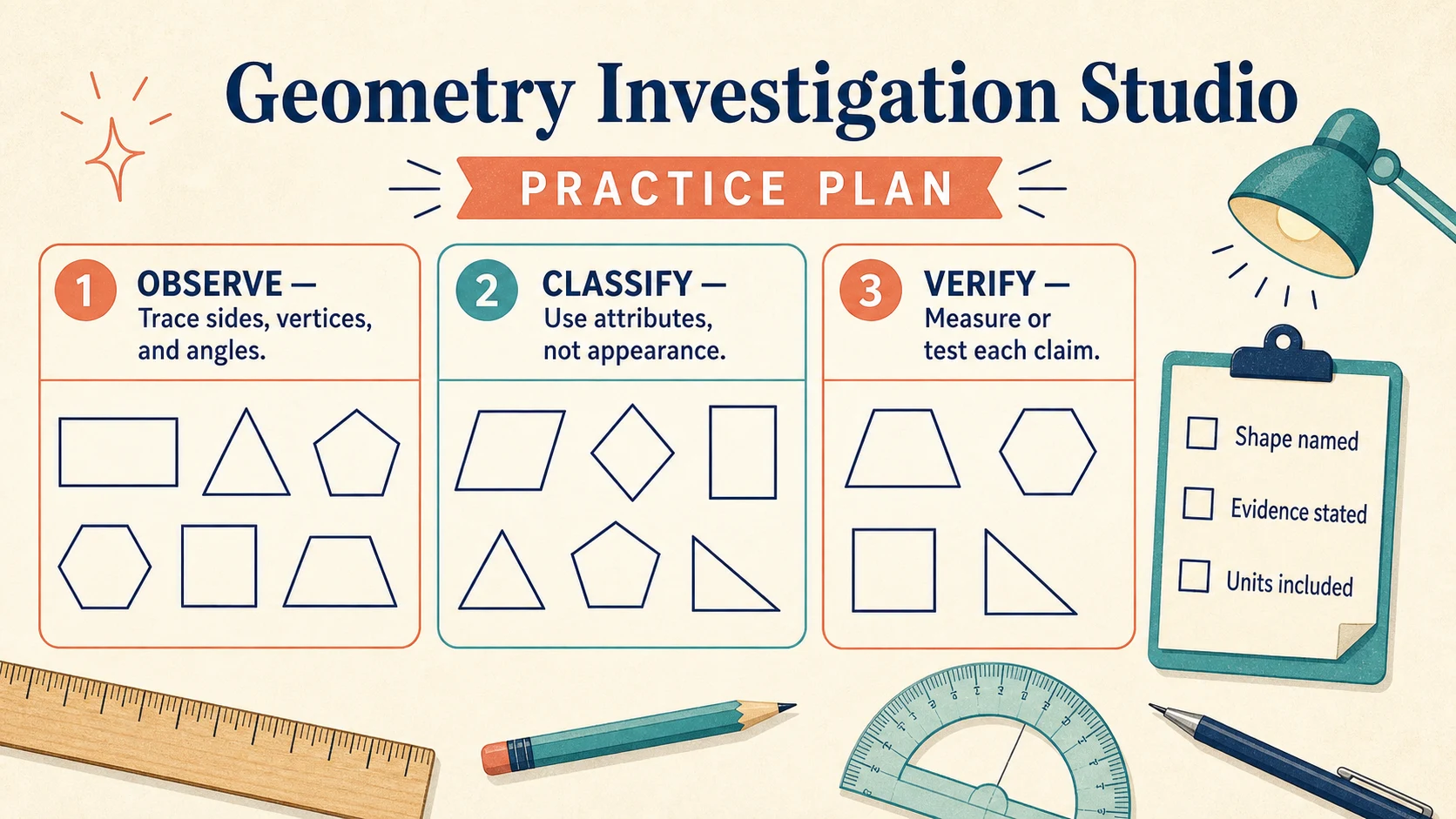
Revisit a stage when the learner’s model or explanation shows that the underlying idea is not secure.
Keep review cumulative. On an area day, include one shape-property question. During perimeter review, rotate a familiar shape or ask for a classification. If accuracy drops sharply when topics are mixed, return briefly to explicit contrasts: “around” versus “cover,” and “units” versus “square units.”
Limitations and the Next Instructional Step
No single guide, worksheet, or two-week plan can capture every local curriculum sequence or every learner’s needs. The catalogue covers shape identification, attributes, area, perimeter, angles, symmetry, transformations, volume, and coordinate geometry across multiple grade levels; not all of those topics are intended to be developed fully in Grade 3. Formal angle measurement, coordinate-plane work, and later shape classification belong to later parts of the stated progression.
Worksheet results also have limits. They show performance on the included representations and problem types. They do not by themselves establish durable understanding, transfer to unfamiliar contexts, or comprehensive standards alignment. Pair written work with brief explanations, drawings, tiles, sorting, and observation.
The honest next step is to identify the weakest current link. If the learner confuses shape names or properties, begin with the free 3rd Grade Geometry standard easy worksheet and pause to discuss classifications. If foundational skills are already independent, select more varied practice from the focused 3rd Grade Geometry pack, which contains 18 worksheets, or create targeted review through the free worksheet generators. Choose only enough practice to test the next idea, examine the learner’s method, and let that evidence determine what to teach next.