What 3rd Grade Addition Includes
3rd Grade Addition centers on using place value to add whole numbers accurately and explain why a method works. A learner should connect quantities, drawings, expanded form, mental strategies, and written equations—not merely memorize a carrying procedure.
A useful instructional sequence is:
- Confirm addition facts and combinations that make 10.
- Review ones, tens, and hundreds.
- Add without regrouping.
- Regroup 10 ones as 1 ten.
- Regroup 10 tens as 1 hundred.
- Solve mixed problems and explain the chosen strategy.
- Apply addition in word problems.
- Build accuracy, efficiency, and independence through cumulative review.
The learner’s observed work should determine the pace. Move forward when the learner can solve and explain the current type of problem consistently. Return to a model when errors show that place value or regrouping is not yet secure.
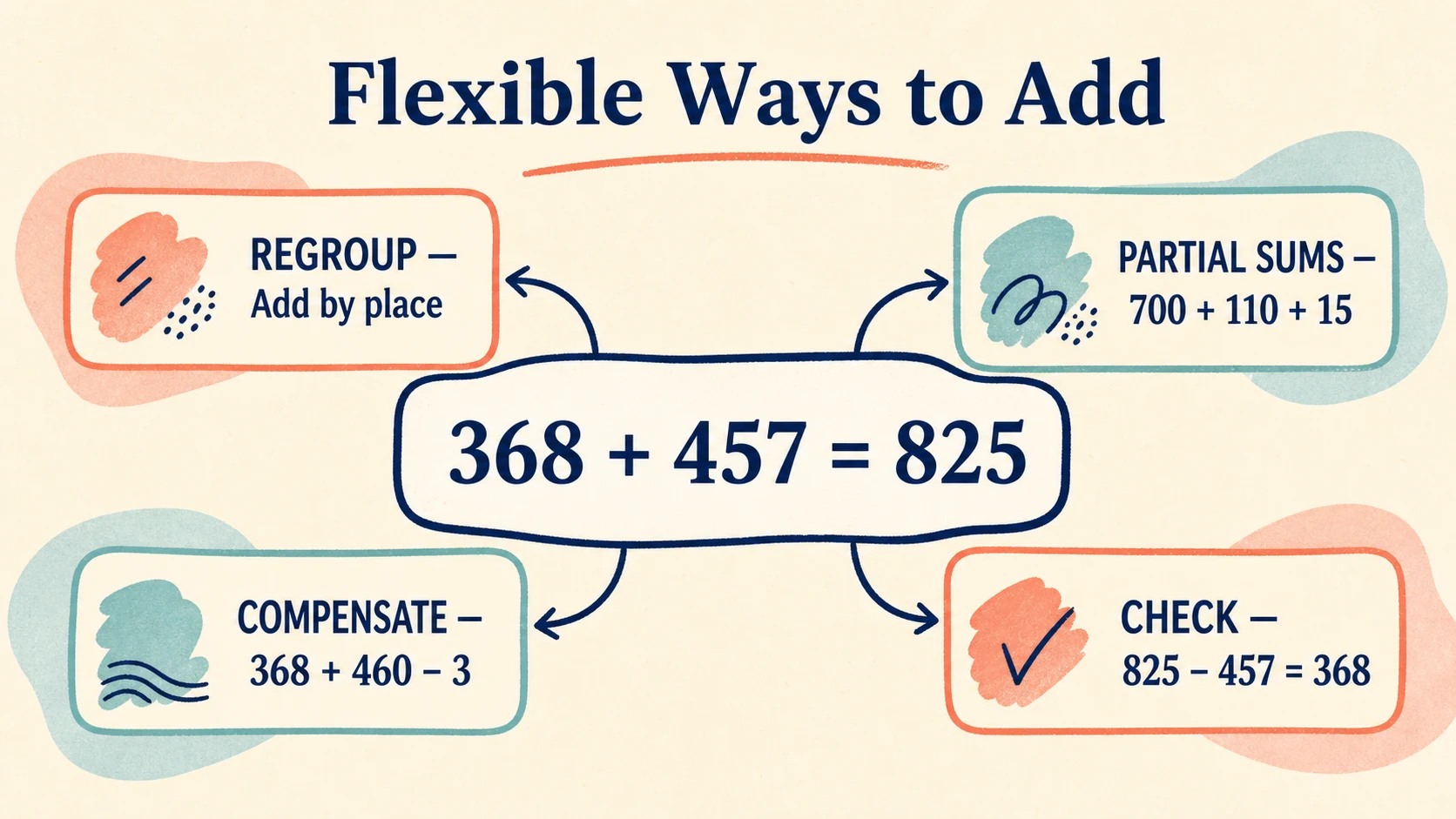
Addition facts and place value support mental strategies, written methods, and problem solving.
Grade labels describe the intended practice level, not an exact timetable for every learner. Local curricula and teaching sequences differ. The Common Core mathematics standards describe both conceptual understanding and procedural skill as important; within the supplied catalogue, the relevant third-grade expectation is fluent addition within 1,000 using place-value strategies and algorithms. This guide does not claim comprehensive standards alignment.
Prerequisites to Check Before Multi-Digit Addition
A learner does not need perfect speed before beginning larger addition, but several foundations should be dependable enough that they do not consume all the learner’s attention.
Addition facts and making 10
Check whether the learner can represent and solve combinations within 10 and use known facts to reason about nearby facts. Examples include:
- Knowing 6+4=10
- Seeing 6+5 as 6+4+1=11
- Using 7+7=14 to find 7+8=15
- Decomposing 8 as 3+5, 6+2, or 7+1
Do not treat slow recall alone as proof that the learner lacks understanding. Ask for a model or explanation: “How could you make a 10?” or “Which fact do you already know?” If the learner can reason correctly but slowly, continue short fact practice while introducing supported place-value work.
The catalogue recommends teaching “making ten” early because the same composition idea supports regrouping. For example, the calculation 8+7 can be seen as 8+2+5. In a larger problem, 8 ones plus 7 ones similarly become 1 ten and 5 ones.
Place-value understanding
Before expecting a reliable written algorithm, check whether the learner can:
- Read a three-digit number as hundreds, tens, and ones.
- Explain that the 6 in 364 represents 6 tens, or 60.
- Compose 10 ones as 1 ten.
- Compose 10 tens as 1 hundred.
- Write a number in expanded form, such as 364=300+60+4.
- Align numbers by place rather than by their left or right edges indiscriminately.
A quick check is to ask the learner to build or draw 243, then add one ten. A correct response is 253, with an explanation that only the tens value changed. If the learner says 244, the immediate teaching need is place value, not more multi-digit worksheets.
Meaning of the operation
The learner should recognize addition as combining quantities or finding a total. In a story such as “There are 126 red tiles and 241 blue tiles,” the two amounts are parts and the unknown is the combined amount.
Do not rely only on signal words such as altogether. Words can help, but the quantities and their relationship determine the operation. Ask the learner to state what each number represents and what the answer will represent before calculating.
A Grade-Appropriate Teaching Progression
This progression is an instructional suggestion based on the supplied catalogue sequence. It is not a universal timetable. A learner may need to move backward for one component while continuing forward in another.
| Stage |
Example |
Useful representation |
Evidence to look for |
| Fact reasoning |
8+6 |
Counters or ten frame |
Makes 10 or uses a known fact |
| Tens and ones, no regrouping |
23+45 |
Base-ten blocks or quick drawings |
Combines like places correctly |
| Hundreds, tens, and ones, no regrouping |
312+476 |
Place-value chart |
Keeps columns aligned |
| Regroup ones |
146+237 |
Blocks and written notation |
Trades 10 ones for 1 ten |
| Regroup tens |
264+581 |
Blocks or expanded form |
Trades 10 tens for 1 hundred |
| Regroup twice |
368+247 |
Place-value chart and equation |
Records both new units correctly |
| Mental adjustment |
198+37 |
Open number line |
Adds 2, then compensates |
| Application |
A total from two quantities |
Bar model or labeled drawing |
Chooses addition and interprets the sum |
| Independent mixed review |
Several problem types |
Learner’s chosen method |
Works accurately and explains choices |
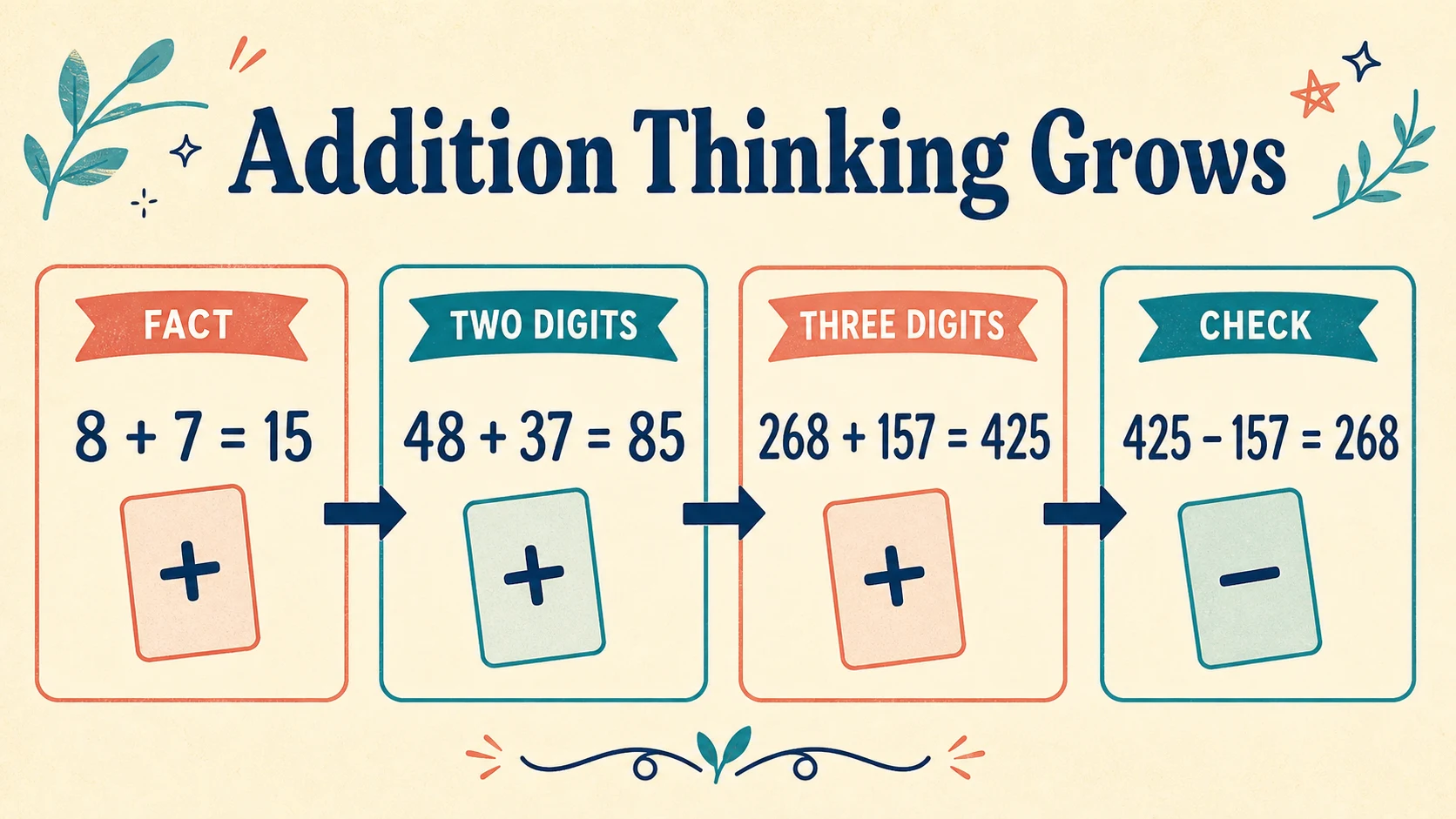
Support should fade in response to successful work, not simply because a certain number of days has passed.
The IES guide on teaching mathematics to young children addresses preschool through kindergarten rather than third grade. Its high-level recommendations include using a developmental progression and monitoring what children know. Those principles provide useful background for checking prerequisites, but the guide does not evaluate this page or any WorksheetWise resource.
Concrete and Visual Models That Explain the Mathematics
Models are most useful when they clarify a specific idea. A learner should eventually connect the model to numbers and notation instead of treating the model as a separate activity.
Base-ten blocks or bundled objects
Use small units for ones, rods or bundles for tens, and flats or grouped bundles for hundreds. To model 146+237:
- Build 1 hundred, 4 tens, and 6 ones.
- Add 2 hundreds, 3 tens, and 7 ones.
- Combine the ones: 13 ones.
- Exchange 10 ones for 1 ten, leaving 3 ones.
- Combine the tens: 4+3+1=8 tens.
- Combine the hundreds: 1+2=3 hundreds.
- Read the result as 383.
The exchange is the central point. The quantity has not changed: 10 individual ones and 1 group of ten have equal value.
Place-value drawings and charts
When physical materials are no longer necessary, draw squares for hundreds, lines for tens, and dots for ones. A three-column chart labeled hundreds, tens, and ones keeps units organized.
Require the learner to name the regrouped unit. “I carried a 1” is incomplete. “I regrouped 10 ones as 1 ten” states both the action and the value.
Ten frames and open number lines
Ten frames are appropriate when fact combinations or making 10 remain uncertain. For 8+7, fill the two open spaces in the first frame using 2 of the 7 counters. Five remain, so the total is 15.
An open number line can show larger mental steps. For 198+37, begin at 198, jump 2 to 200, then add the remaining 35:
198+2=200,200+35=235.
The written equation should accompany the jumps so that the learner connects the visual movement with numerical decomposition.
Expanded form
Expanded form makes each unit explicit:
243+326=(200+40+3)+(300+20+6).
Combine like units:
(200+300)+(40+20)+(3+6)=500+60+9=569.
This method is especially useful when a learner produces correct digits in incorrect places. It exposes the difference between 4 tens and 4 ones.
The IES elementary mathematics intervention guide recommends systematic instruction, clear mathematical language, well-chosen representations, number lines, and deliberate work with word problems for learners who struggle. That source supports this general instructional framing; it does not endorse this exact sequence or worksheet.
Fully Checked Worked Examples
Example 1: Add without regrouping
Find 243+326.
Align like places:
  243
+ 326
-----
Add the ones:
3+6=9.
Add the tens:
4 tens+2 tens=6 tens.
Add the hundreds:
2 hundreds+3 hundreds=5 hundreds.
Therefore:
243+326=569.
Check by subtraction:
569−326=243.
The check returns the other addend, so the sum is consistent.
Example 2: Regroup ones once
Find 146+237.
    1
  146
+ 237
-----
  383
Start with the ones:
6+7=13.
Write 3 in the ones place and regroup 10 ones as 1 ten. Then add the tens:
1+4+3=8 tens.
Add the hundreds:
1+2=3 hundreds.
Thus:
146+237=383.
Expanded-form check:
(100+40+6)+(200+30+7)=300+70+13=300+80+3=383.
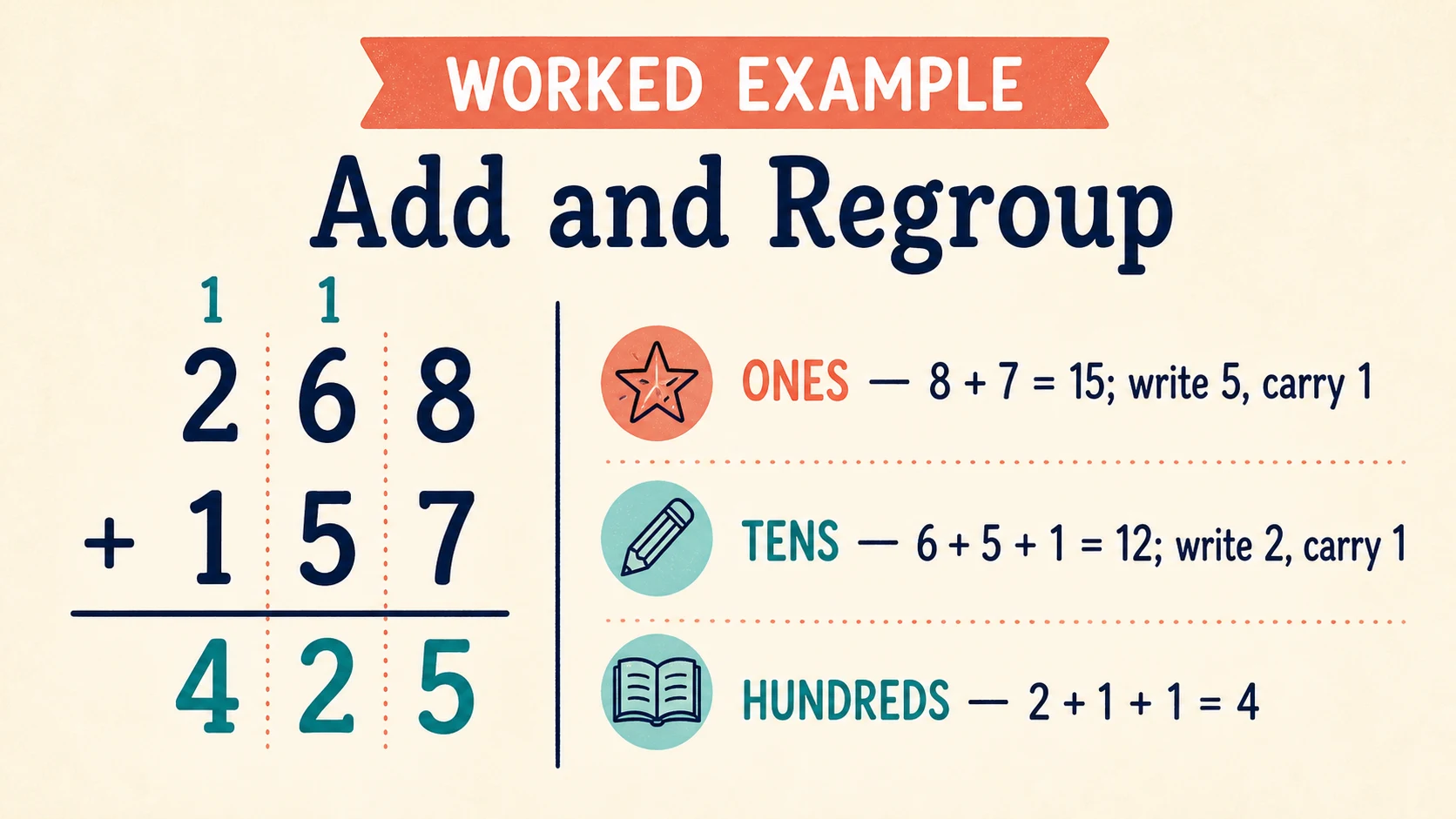
The regrouped ten should be visible in the model, the explanation, and the written notation.
Example 3: Regroup ones and tens
Find 368+247.
   11
  368
+ 247
-----
  615
Ones:
8+7=15.
Write 5 ones and regroup 1 ten.
Tens:
1+6+4=11 tens.
Write 1 ten and regroup 10 tens as 1 hundred.
Hundreds:
1+3+2=6 hundreds.
Therefore:
368+247=615.
Check with a different decomposition:
368+200=568,
568+40=608,
608+7=615.
Both methods give 615.
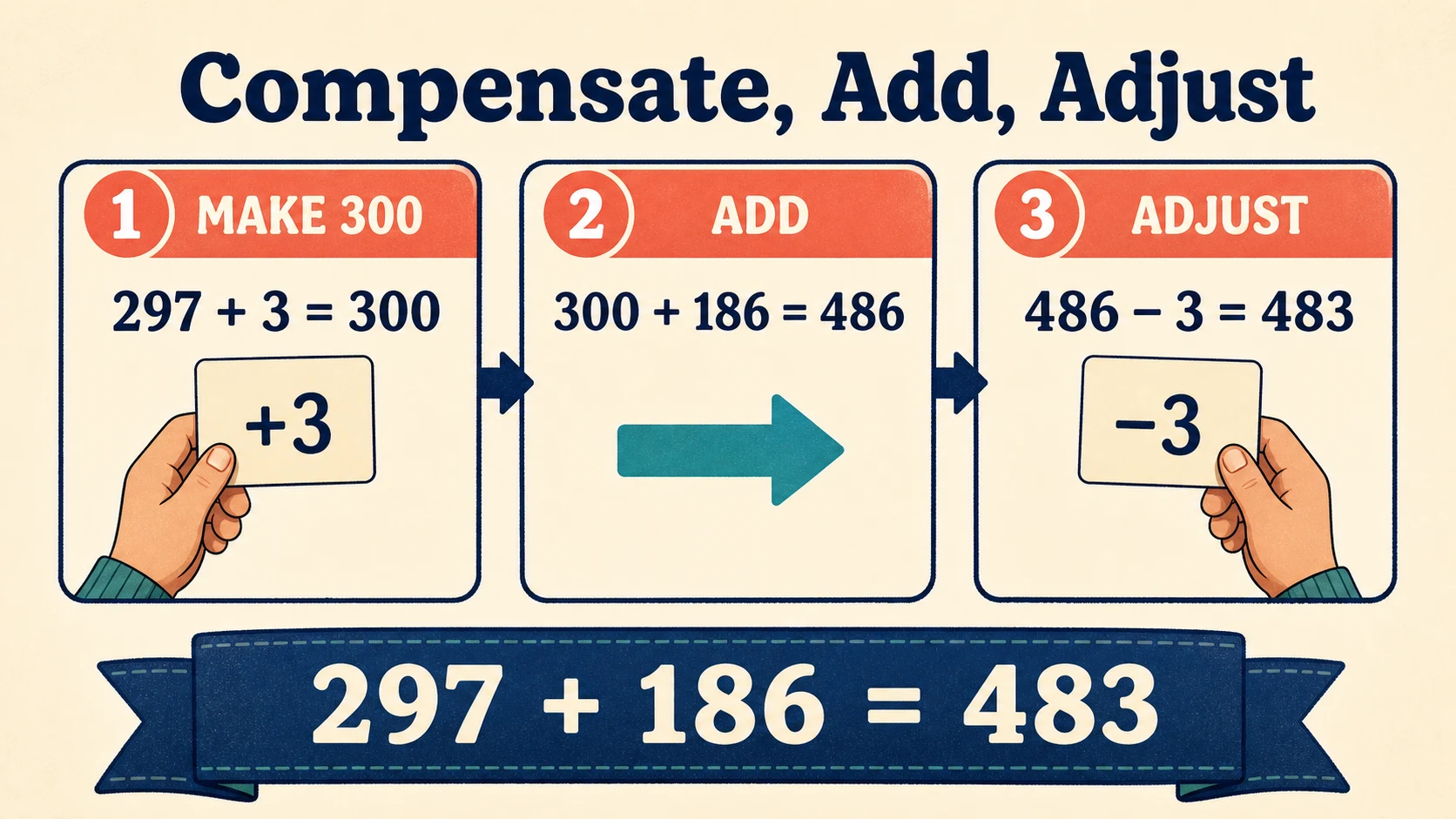
Example 4: Use compensation for mental addition
Find 198+37.
Move 2 from 37 to 198:
198+37=(198+2)+(37−2).
Then:
200+35=235.
So:
198+37=235.
A boundary mistake would be adding 2 to 198 without removing 2 from 37, which produces 237. Compensation changes the form of the addends but must preserve their total.
Check:
235−37=198.
Example 5: Interpret a word problem
A reading room has 238 picture books and 164 informational books. How many books are represented altogether?
The two known quantities are parts of one collection, so addition is appropriate:
238+164.
Calculate:
   11
  238
+ 164
-----
  402
Ones:
8+4=12,
so write 2 ones and regroup 1 ten.
Tens:
1+3+6=10 tens,
so write 0 tens and regroup 1 hundred.
Hundreds:
1+2+1=4 hundreds.
The reading room has 402 books represented altogether.
Check by estimation: 238 is close to 240, and 164 is close to 160. Since 240+160=400, an exact answer of 402 is reasonable.
Boundary Cases Learners Need to See
Practice sets should not contain only problems whose sums have a nonzero digit in every place. Include carefully chosen boundaries once the underlying procedure is understood.
A zero in an addend
For 304+125, the 0 means there are no tens in 304:
304+125=429.
It is a place holder, not permission to shift 125 left or right. A place-value chart can prevent misalignment.
A zero in the sum
For 238+164, the tens digit in the answer is 0 because 10 tens were regrouped as 1 hundred. The answer is 402, not 42 and not 412.
A sum near a hundred
For 299+301:
299+301=(300−1)+(300+1)=600.
This example develops attention to structure. A learner may also use the standard algorithm, but the compensation method makes the exact hundred visible.
Different numbers of digits
For 58+327, align ones with ones:
   58
+ 327
-----
  385
Writing 58 as 058 can make the places explicit. The correct sum is 385.
A result at the edge of the current range
Within the supplied third-grade catalogue scope, practice may include addition within 1,000. For example:
642+358=1,000.
This is a useful boundary case because each column regroups. It should follow successful work with simpler examples, not serve as the first introduction to regrouping.
A Short, Repeatable Lesson Routine
A focused session can be brief. The following routine is an instructional suggestion, not a sourced or universal schedule. Adjust the time, number size, and level of support according to the learner’s work.
One example, a clear model, guided practice, and a short check can reveal more than a long undifferentiated assignment.
1. Retrieve a prerequisite
Use two or three oral items connected to the day’s skill:
- “What makes 8 into 10?”
- “How many ones equal one ten?”
- “Write 352 in expanded form.”
If these are difficult, reduce the complexity of the main example.
2. Model one problem
Solve one carefully selected problem. Speak in place-value language and connect the model to the written notation. Keep the explanation focused on the new feature, such as regrouping ones.
3. Solve one together
Invite the learner to direct each step. Ask, “What unit are we adding?” and “Do we have enough to regroup?” Correct unclear language gently by restating it precisely.
4. Give two to four independent items
Begin with a problem similar to the modeled example, then vary one feature. Avoid assigning 25 items merely to discover whether the learner understood the first one.
5. End with an exit check
Use one problem and one explanation prompt. For example:
275+148= ?
Then ask, “Why did the 1 written above the tens column represent one ten?” Save the work or record the error pattern for the next lesson.
Choosing Practice That Matches the Learner
Practice should target the smallest unresolved skill while preserving previously learned material.
A learner who miscalculates 7+8 but understands columns needs fact-strategy work embedded in multi-digit practice. A learner who writes 243+56 with the 5 under the hundreds digit needs place-value alignment. A learner who completes procedures accurately but cannot select addition in a story needs application and explanation tasks.
Use this selection guide:
| Observed work |
Best next practice |
Avoid for now |
| Counts every object from one |
Making 10, doubles, and counting-on tasks |
Long mixed worksheets |
| Knows facts but misaligns digits |
Place-value charts and vertically aligned problems |
Crowded horizontal calculations |
| Adds each column but ignores regrouping |
Block exchanges and one-regroup problems |
Two-regroup problems |
| Regroups once reliably |
Mixed one- and two-regroup problems |
Immediate speed emphasis |
| Calculates accurately but cannot explain |
Worked-example comparison and explanation prompts |
More identical calculations only |
| Misreads word problems |
Labeled drawings and part-part-total situations |
Keyword drills |
| Works accurately with support |
Short independent mixed sets |
Removing all support at once |
| Shows stable accuracy and explanations |
Cumulative review and reasonable mental strategies |
Repeating only easy items |
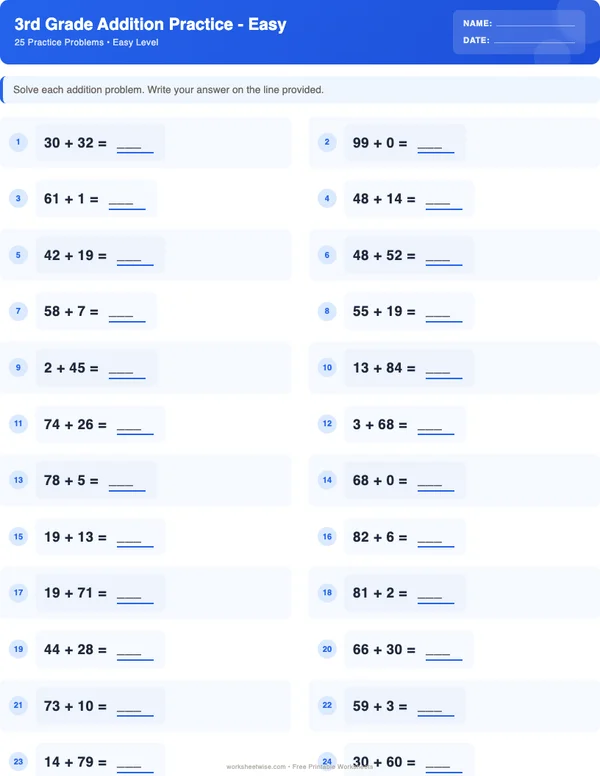
The free standard easy addition worksheet contains 25 exercises and an answer key. According to the catalogue, it targets addition facts, mental math, number sense, and place value. It can serve as initial or reinforcing practice, but the title’s “easy” label does not establish that every learner is ready for every item.
For broader navigation, use the 3rd Grade Math hub. The focused addition pack contains 18 worksheets and is listed at $4.79; select pages by instructional need rather than assigning the pack in order automatically.
Differentiation Without Lowering the Mathematical Goal
When the learner needs more support
Keep the addition goal while reducing avoidable demands:
- Use smaller numbers to isolate the regrouping idea.
- Provide a labeled place-value chart.
- Let the learner build the first problem with blocks.
- Color-code hundreds, tens, and ones consistently.
- Present one problem at a time.
- Ask for an oral explanation before a written one.
- Alternate a modeled item with an independent item.
- Return to combinations within 10 if regrouping repeatedly breaks down.
The source-backed framing from the IES elementary intervention guide favors systematic instruction, clear language, representations, and number lines. The specific activities above are practical instructional suggestions derived from the catalogue content.
When the learner is ready for greater challenge
Increase reasoning before increasing volume:
- Ask for two methods and a comparison.
- Hide one addend: 348+□=600.
- Present an incorrect solution for analysis.
- Ask for an estimate before an exact calculation.
- Let the learner create a word problem matching 276+145.
- Mix mental and written problems so the learner must choose an efficient method.
- Include boundary cases such as a zero in the sum or a total of 1,000.
A challenge should remain interpretable. More digits, more pages, or tighter time limits do not automatically produce better reasoning.
Common Errors and Diagnostic Responses
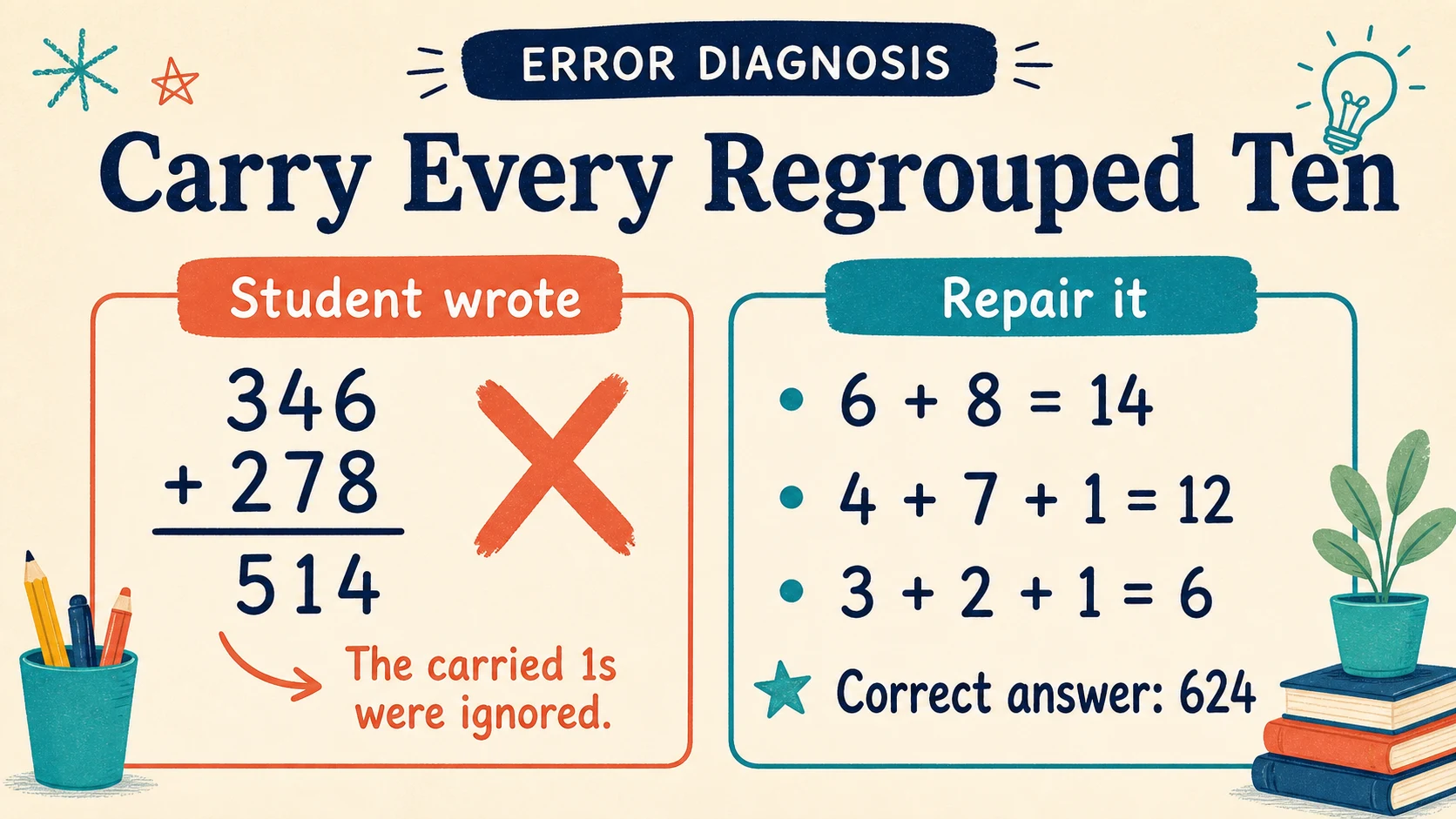
Treat a wrong answer as evidence about the next teaching decision, not merely as an item to mark incorrect.
| Error pattern |
Example |
Likely issue to check |
Instructional response |
| Adds digits without place alignment |
58+327=907 or another irregular result |
Ones and tens are not aligned |
Use a place-value chart; rewrite 58 as 058 |
| Writes 13 in one column |
146+237=3713 |
Does not compose 10 ones as 1 ten |
Exchange 10 objects for one ten |
| Forgets the regrouped unit |
368+247=505 |
Regrouping notation is disconnected from value |
Have the learner point to and name the new ten or hundred |
| Regroups when the sum is below 10 |
Treats 4+3 as 17 |
Procedure memorized without quantity sense |
Build and count 4 plus 3; compare with 10 |
| Adds the regrouped digit twice |
Gets an answer 10 or 100 too large |
Loses track of notation |
Mark each regrouped unit as used after combining it |
| Treats 0 as if the place does not exist |
Misaligns 304+125 |
Placeholder role is uncertain |
Expand 304 as 300+0+4 |
| Chooses addition from a keyword alone |
Adds quantities even when a story asks for a difference |
Operation meaning is weak |
Identify the whole, parts, and unknown before calculating |
| Correct answer, no explanation |
Cannot describe why regrouping works |
Procedure may be fragile |
Ask for a drawing, expanded form, or place-value explanation |
Do not infer a broad learning difficulty from one worksheet. First check whether the directions, layout, fatigue, fact demand, or unfamiliar representation affected the performance. This guide offers educational guidance, not medical or diagnostic advice.
Monitoring Progress and Deciding When to Move On
Monitor three dimensions separately:
- Accuracy: Is the calculation correct?
- Understanding: Can the learner explain units and regrouping?
- Independence: How much prompting or modeling was required?
A simple record might note the problem type, number correct, kind of error, representation used, and level of help. Compare patterns across several short sessions rather than relying on one score.
Consider advancing when the learner handles a small mixed set accurately, explains at least one regrouping step in place-value language, and does not depend on immediate prompting. Continue review after advancing so that earlier skills remain available.
If work is accurate but slow, examine the source of the time. Slow fact recall suggests short strategy practice. Slow but careful organization may simply call for repeated experience. If the learner rushes and makes alignment errors, reducing the item count and requiring an estimate may be more useful than imposing a faster pace.
Timed activity is one option mentioned in the IES elementary intervention guide, but it should not replace teaching, representations, or error analysis. The catalogue likewise places timed fact practice after conceptual understanding and strategy development.
A Two-Week Practice Plan
This plan assumes short, regular sessions, but it is not a universal timetable. Repeat, combine, or pause days according to observed work.
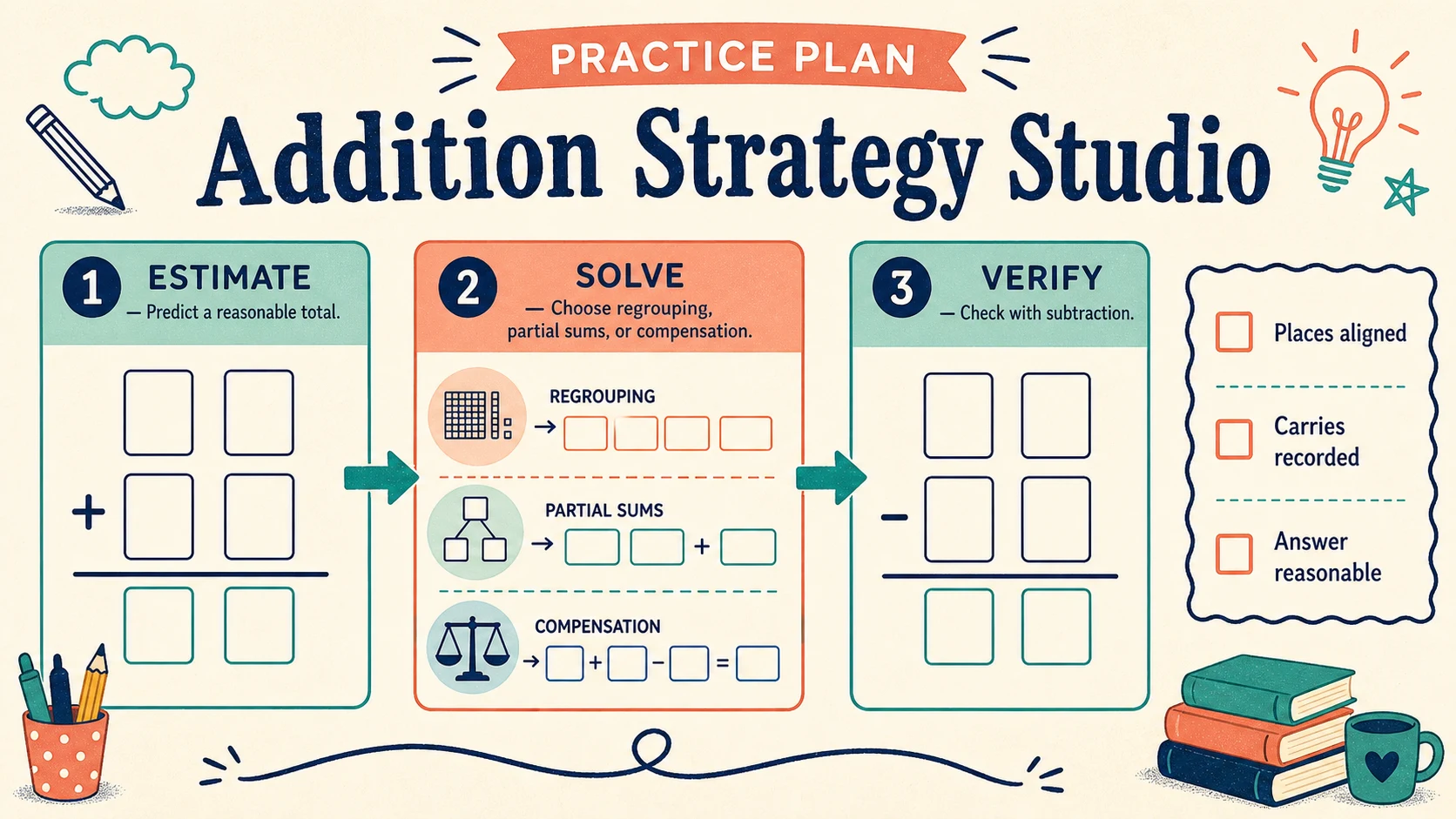
Each day uses prior work to determine whether the next session should advance, repeat, or simplify.
| Day |
Main focus |
Suggested activity |
Evidence to record |
| 1 |
Baseline |
Facts, place-value reading, one no-regroup problem, one regroup problem |
Which component causes errors? |
| 2 |
Make 10 |
Ten-frame facts and related mental sums |
Can the learner decompose an addend? |
| 3 |
Place value |
Build, draw, and expand three-digit numbers |
Are hundreds, tens, and ones named correctly? |
| 4 |
No regrouping |
Add with blocks, expanded form, and vertical notation |
Are like units combined? |
| 5 |
Review |
Mixed facts and no-regroup problems; explain one solution |
Is support decreasing? |
| 6 |
Regroup ones |
Exchange 10 ones for 1 ten in two or three examples |
Can the learner explain the exchange? |
| 7 |
Regroup tens |
Exchange 10 tens for 1 hundred |
Is the new hundred recorded correctly? |
| 8 |
Regroup twice |
Model one, solve one together, then try two independently |
Which regrouping step is secure? |
| 9 |
Word problems |
Draw and solve part-part-total situations |
Can the learner identify what the sum represents? |
| 10 |
Mixed check |
Facts, mental strategy, written calculation, boundary case, and explanation |
What is the precise next teaching need? |
If Day 6 work shows that the learner still writes 13 ones without exchanging, repeat that concept with materials on Day 7. Do not move to double regrouping simply to preserve the calendar. Conversely, if the learner demonstrates secure understanding early, introduce explanation, estimation, missing-addend tasks, and mixed strategy selection rather than assigning unnecessary repetition.
Limitations and the Next Useful Step
No single worksheet or topic guide can establish complete mastery. Written pages may show answers and some strategy use, but they cannot fully reveal how a learner reasons unless an adult also listens, asks for an explanation, or observes the method. A worksheet score can also conceal distinct needs: fact recall, place-value alignment, regrouping, operation choice, and attention can produce different error patterns.
This guide does not promise outcomes, prescribe one schedule, provide child-specific or medical advice, or establish comprehensive alignment with every local curriculum. It uses the supplied catalogue scope and verified arithmetic examples. Grade labels describe intended practice level, and local sequences differ.
The honest next step is to observe one short sample of work. Begin with the free 3rd Grade Addition standard easy worksheet, stop after a manageable group of problems, and note the first recurring error. Use that evidence to choose the next model or practice type. If a custom problem set would better isolate the need, explore the free worksheet generators.