What 3rd Grade Spelling Words Practice Should Teach
Third-grade spelling instruction should help a learner notice useful letter patterns, connect sounds with spellings, study high-frequency words, build longer words from meaningful parts, and use correct spellings in sentences. The goal is not merely to memorize a Friday list. It is to recognize a pattern, explain it, apply it to another word, and carry the spelling into everyday writing.
A strong sequence usually moves through:
- Review of short- and long-vowel spellings
- Consonant doubling and silent letters
- R-controlled vowels
- Prefixes, suffixes, and base words
- Common multisyllabic words
- High-frequency words that need focused attention
- Application through dictation, editing, and independent writing
The learner’s observed work should determine the pace. If a student spells hoping as hopping, for example, more work on base words and suffix changes is useful before introducing a larger set of unrelated words. If the learner sorts a pattern accurately but misses it in sentences, the next step is contextual practice rather than a harder list.
Grade labels describe the intended practice level; local curricula and instructional sequences differ. Check school materials when coordination with classroom instruction matters.
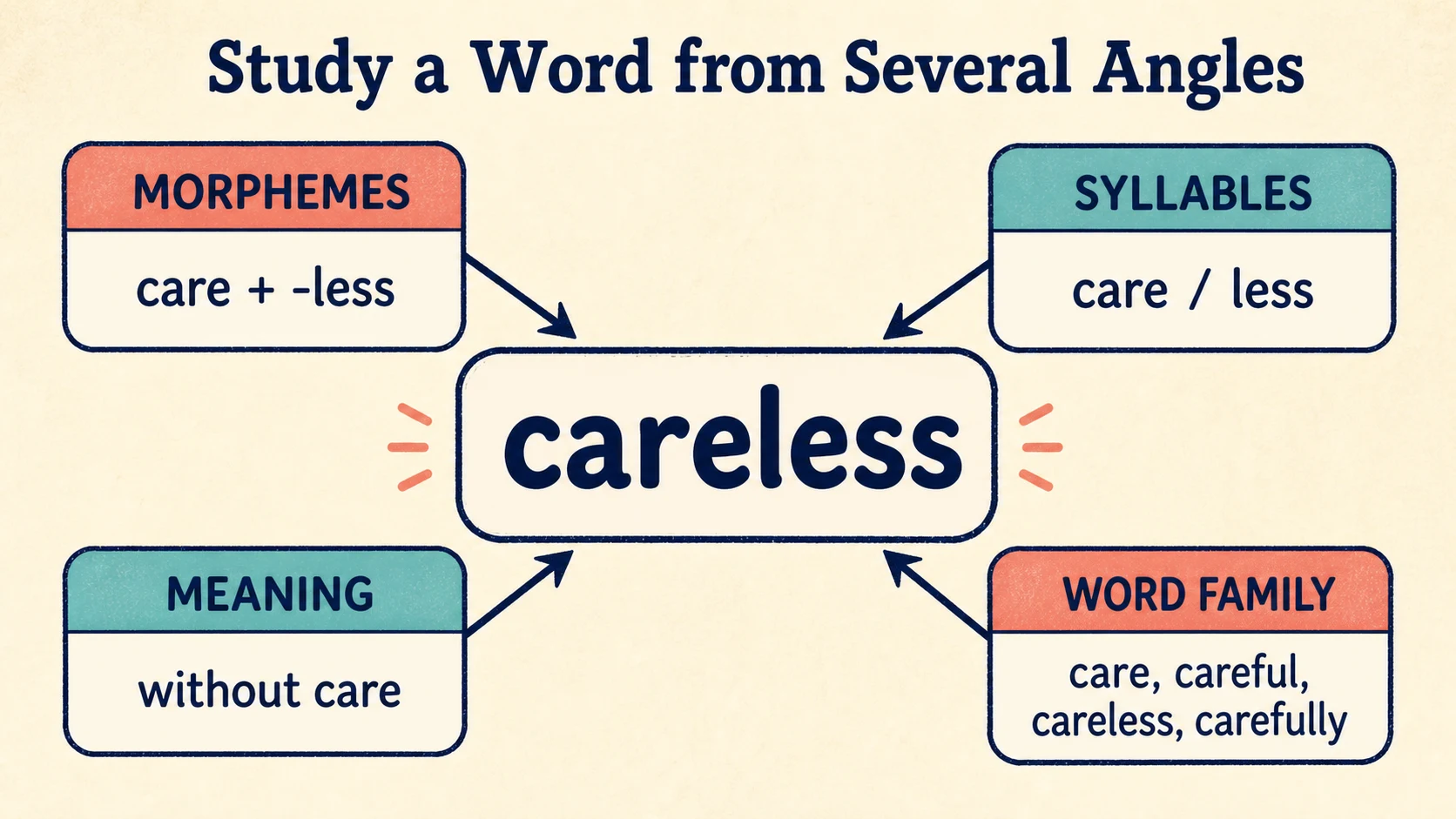
The strands work together: sound, pattern, word meaning, memory, and written application.
The IES foundational reading guide recommends connecting speech sounds with letters and teaching learners to decode words, analyze word parts, and write and recognize words. That high-level framing supports pattern-based spelling instruction. It does not mean that IES evaluated WorksheetWise or this particular worksheet.
Prerequisites to Check Before Choosing a List
A learner does not need perfect mastery of every earlier spelling skill. However, several foundations make third-grade word study more productive.
Sound and letter awareness
Ask the learner to say a word slowly and identify its sound parts. For stamp, the learner might segment /s/ /t/ /a/ /m/ /p/. For sunset, the learner can first separate the two syllables, sun and set, and then examine each syllable.
Watch for consonant blends. A student who writes sip for slip may not be representing every sound. That is different from a student who writes slipp, which includes the sounds but applies an unnecessary final consonant.
Familiar vowel patterns
Check whether the learner can compare words such as:
- cap and cape
- kit and kite
- hop and hope
- rain and play
The last pair is especially useful because the same long-a sound has different spellings. A learner should not be told that one sound always has one letter pattern. Instead, teach a manageable group, sort examples, and identify which spellings need to be remembered word by word.
Basic word-part awareness
A learner should be able to find a familiar base in a longer word:
- help in helpful
- kind in unkind
- paint in repainted
- quick in quickly
This habit reduces the amount of a long word that must be handled at once. It also prepares the learner to notice spelling changes when endings are added.
Readable handwriting and checking habits
If letter formation is effortful, separate handwriting demands from spelling diagnosis. Let the learner spell orally with letter tiles before assuming that every written error reflects weak word knowledge. Also check whether the student can compare an attempt with a model one letter group at a time.
The IES elementary writing guide includes fluency with spelling among the skills that support effective writing. It also recommends regular writing time. This provides a reason to connect word-list practice with sentences and short compositions rather than keeping spelling isolated.
A Grade-Appropriate Progression
The following sequence is an instructional suggestion based on the supplied catalogue scope. It is not a universal timetable. Begin at the first stage where the learner’s work is inconsistent, and move forward when the pattern appears both in direct practice and in writing.
| Stage |
Main focus |
Supported task |
More independent task |
Evidence to collect |
| 1 |
Short and long vowels |
Sort cap/cape, kit/kite, and similar pairs |
Spell an unfamiliar example after hearing it |
Correct pattern choice and all sounds represented |
| 2 |
Common long-vowel spellings |
Sort words such as rain, play, cake, and break by letters |
Use selected words in sentences |
Correct spelling without a visible model |
| 3 |
R-controlled vowels and silent letters |
Mark the relevant letter group in each word |
Edit a short list containing misspellings |
Learner identifies the incorrect part |
| 4 |
Consonant doubling |
Compare base words before adding endings |
Explain hoping/hopping or similar pairs |
Explanation matches the written form |
| 5 |
Prefixes and suffixes |
Box the base and underline the affix |
Build and spell related words |
Base remains visible when appropriate |
| 6 |
Multisyllabic words |
Divide a word into spoken and meaningful parts |
Spell the whole word from dictation |
All syllables and key patterns represented |
| 7 |
Transfer and cumulative review |
Complete guided dictation and editing |
Apply words in independent writing |
Previously taught patterns remain accurate |
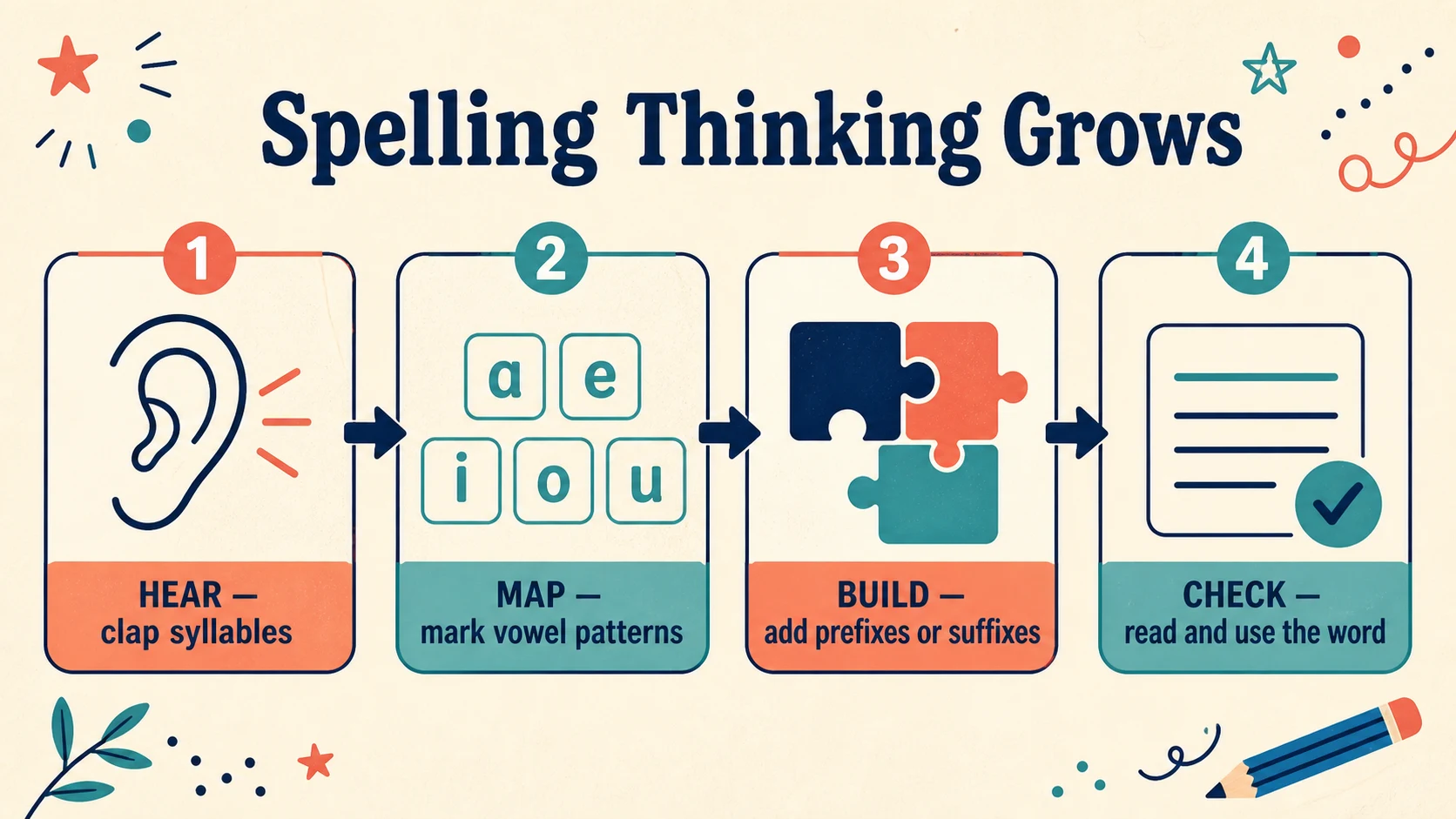
Support can fade from visible models and guided sorts to dictation, editing, and independent writing.
The Common Core English Language Arts standards organize literacy expectations by grade and include language use alongside reading and writing. The supplied catalogue summarizes relevant third-grade work as conventional spelling of high-frequency words, adding suffixes to base words, and consulting references when necessary. Local standards and teaching orders may differ, so this guide should not be treated as a claim of comprehensive standards alignment.
For a broader view of available material, compare the 3rd Grade worksheet hub with the more focused third-grade spelling collection.
Concrete and Visual Models for Word Study
A useful model makes the part being studied visible. Copying an unmarked word five times may preserve its appearance, but it does not necessarily show the learner what to attend to.
Sound boxes
Draw one box for each sound, not automatically for each letter:
ship → [sh] [i] [p]
The first box contains two letters because sh represents one sound in this word. Contrast that with:
slip → [s] [l] [i] [p]
Here, s and l are separate sounds. This comparison helps diagnose whether a missing letter came from weak sound segmentation or uncertain spelling.
Pattern sorts
Give the learner words such as cake, rain, play, and break. Ask for a sort by written long-a pattern:
| a_e |
ai |
ay |
ea |
| cake |
rain |
play |
break |
The learner should read each column and state what is the same. Do not turn the categories into absolute rules. Break is useful precisely because its long-a spelling does not match the more common-looking choices in the other columns.
Word-part maps
Show longer words as structures:
un + kind → unkind
help + ful → helpful
re + paint + ed → repainted
Then have the learner cover the completed word and rebuild it. Color may be used to distinguish the base, prefix, and suffix, but the colors themselves are not the learning target.
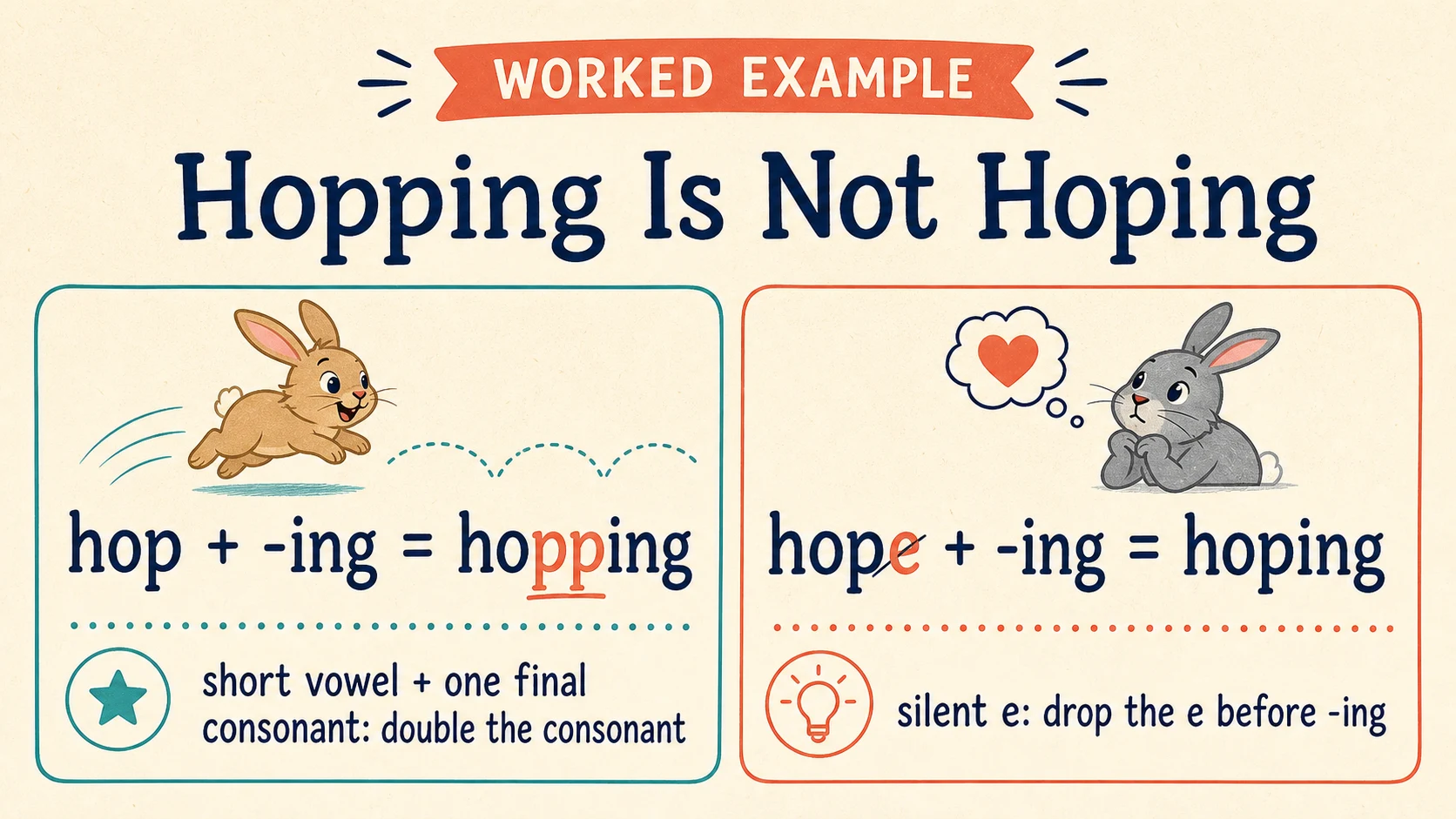
The learner first identifies sounds or word parts, then writes and checks the complete word.
Fully Checked Worked Examples
These examples demonstrate the reasoning an adult can make visible. They are not proposed as a complete weekly list.
Example 1: Sorting long-a spellings
Task: Sort cake, rain, play, and break by the letters that represent the long-a sound.
- Say each word and locate the long-a sound.
- Inspect the letters used for that sound.
- Place each word under its spelling pattern.
Checked result:
- cake uses
a_e.
- rain uses
ai.
- play uses
ay.
- break uses
ea.
Why the answer is correct: Every word contains the target sound, but the visible spelling differs. The sort is based on letters, not on meaning or word length.
Boundary case: Do not tell the learner that ea always represents long a. In team, the same letters represent a different vowel sound. The safe conclusion is narrower: break belongs in the ea column in this sort.
Example 2: Distinguishing hoping and hopping
Task: Add -ing to hope and hop.
For hope:
- Begin with the base word hope.
- Remove the final silent
e.
- Add
ing.
- Result: hoping.
For hop:
- Begin with hop.
- The ending begins immediately after the short-vowel base.
- Double the final
p.
- Add
ing.
- Result: hopping.
Checked result: hoping has one p; hopping has two.
Meaning check: Hoping means wishing for something. Hopping describes jumping. The spelling difference preserves a difference that is clear in pronunciation and meaning.
Boundary case: Doubling is not a command to double the last letter of every word before -ing. For example, help becomes helping, not helpping. Teach doubling with carefully chosen contrasts rather than an overbroad slogan.
Example 3: Building a word from meaningful parts
Task: Spell repainted by identifying its parts.
- The prefix is
re-.
- The base word is
paint.
- The ending is
-ed.
- Combine the parts:
re + paint + ed.
- Result: repainted.
Checked result: repainted.
Why the answer is correct: All three supplied parts remain visible in the finished word. The learner can check the result by covering one part at a time: re | paint | ed.
A reasonable dictation sentence is: “We repainted the old chair.” After writing, the learner should locate the target word and verify each part rather than merely asking whether it “looks right.”
Example 4: Correcting a misspelled word
Task: Correct freind in the sentence “My freind brought a book.”
- Read the sentence to establish the intended word.
- Compare
freind with the known spelling friend.
- Locate the incorrect part:
ei.
- Replace it with
ie.
- Rewrite the corrected sentence: “My friend brought a book.”
Checked result: friend.
This word should not be forced into a dependable sound-to-letter rule if the learner cannot derive it from one. Treat the uncertain letter order as the part to remember. A visual cue can be as simple as boxing ie in friend.
Boundary case: A corrected word in an editing task does not yet prove independent mastery. Check it later without displaying the answer and then look for it in ordinary writing.
Example 5: Segmenting a compound word
Task: Spell sunset.
- Say the word and identify two spoken parts: sun and set.
- Spell each familiar short-vowel word.
- Join them without a space:
sun + set.
- Result: sunset.
Checked result: sunset.
This example shows why multisyllabic does not always mean difficult. A longer word may become manageable when it contains two familiar words.
A Short, Repeatable Lesson Routine
A compact routine can be repeated with different patterns. The timings below are flexible instructional suggestions, not a universal schedule.
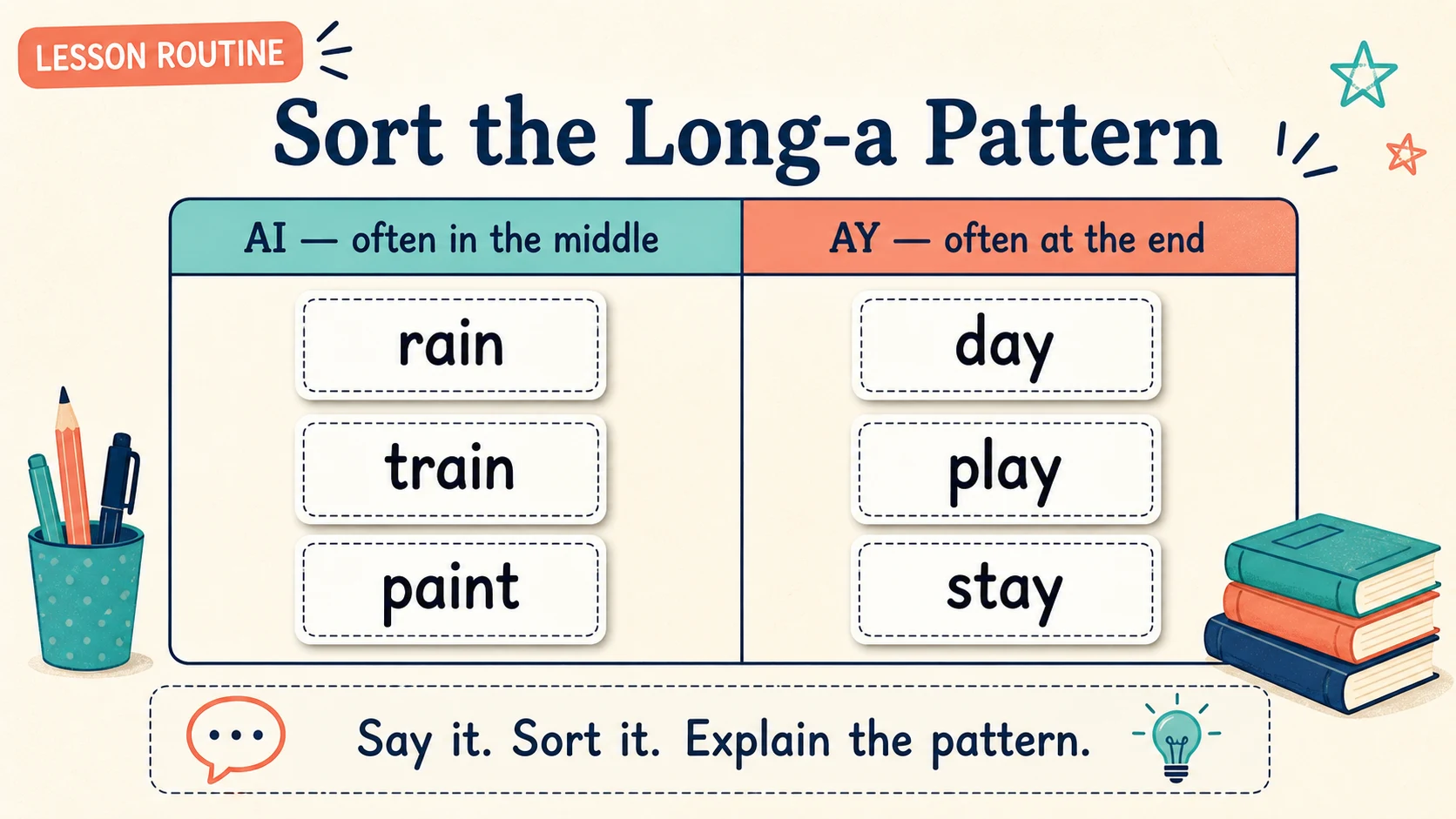
Notice, sort, recall, apply, and record what needs another encounter.
Notice and compare
Display three to six related words. Read them together, identify the target sound or word part, and mark the relevant letters. Include a contrast when it clarifies the pattern, such as hoping beside hopping.
Sort and explain
Have the learner sort words by spelling pattern. Ask, “What is the same in this group?” and “Why did this word go here?” An explanation reveals more than a completed sort alone.
Look, cover, write, check
The catalogue recommends this sequence:
- Look carefully at the word.
- Cover it.
- Write it from memory.
- Uncover and check it letter by letter.
- Repeat missed words after identifying the incorrect part.
Keep correction specific. Instead of “Wrong—try again,” say, “Your sounds are present. Check the long-a letter group.”
Apply in context
Dictate one sentence containing one or more studied words. Then allow a brief piece of independent writing. Sentence work matters because a learner may spell a word correctly in a list but miss it while managing ideas, capitalization, punctuation, and handwriting.
Record the next target
Keep a small word-study notebook. Record patterns, examples, and repeatedly missed words. Review earlier entries cumulatively rather than discarding them after one successful test.
Selecting Practice That Matches the Learner
The best activity is the one that addresses the error currently visible.
| Observed work |
Productive next practice |
| Sounds or consonants are omitted |
Oral segmentation, sound boxes, and short words |
| A known sound is represented with the wrong vowel pattern |
Pattern sorts and comparison words |
| Words are correct when copied but not from memory |
Look-cover-write-check and delayed recall |
| Base words are lost when endings are added |
Word-part maps and base-plus-suffix practice |
| Lists are accurate but sentences are not |
Dictation, editing, and short independent writing |
| Previously learned words begin to slip |
Cumulative mixed review |
| Work is consistently accurate and explanations are clear |
Two or three challenge words extending the same pattern |
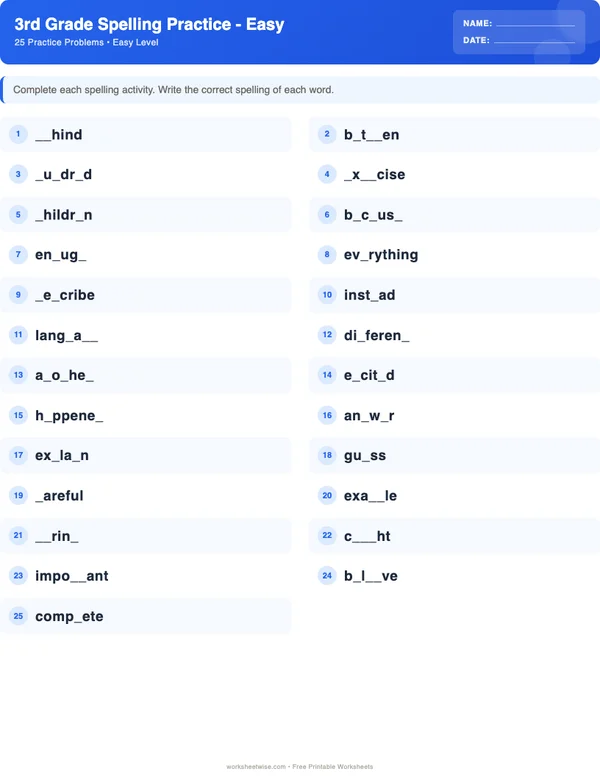
The free easy spelling worksheet contains 25 exercises using fill-in-the-blank, word scrambles, and misspelling correction. Its stated skills include spelling, word recognition, vocabulary, and letter patterns, and it includes a separate answer key. It is a reasonable choice for a learner beginning this level or needing reinforcement. It should not be used as the sole measure of spelling ability.
The focused 3rd Grade Spelling Words pack contains 18 worksheets. A larger set is useful when varied or repeated practice is needed, but more pages should not automatically mean a faster pace.
Support for a learner who is struggling
Reduce the number of new words, not the clarity of the thinking. Work with a small, related group. Say the words aloud, mark the target letters, and keep the model visible during the first sort. Later, remove it for recall.
If the learner represents sounds inconsistently, return to sound segmentation. If the sounds are present but the conventional pattern is wrong, compare spellings visually. These are different needs.
Extension for a secure learner
Add two or three challenge words that extend the same pattern. Ask the learner to predict a spelling, verify it with an appropriate reference, sort it, and use it in a sentence. Another useful extension is editing a short passage containing both correct and incorrect examples.
Do not advance solely because the learner completed one page quickly. Look for accurate explanation, delayed recall, and transfer into writing.
Diagnosing Common Errors and Misconceptions
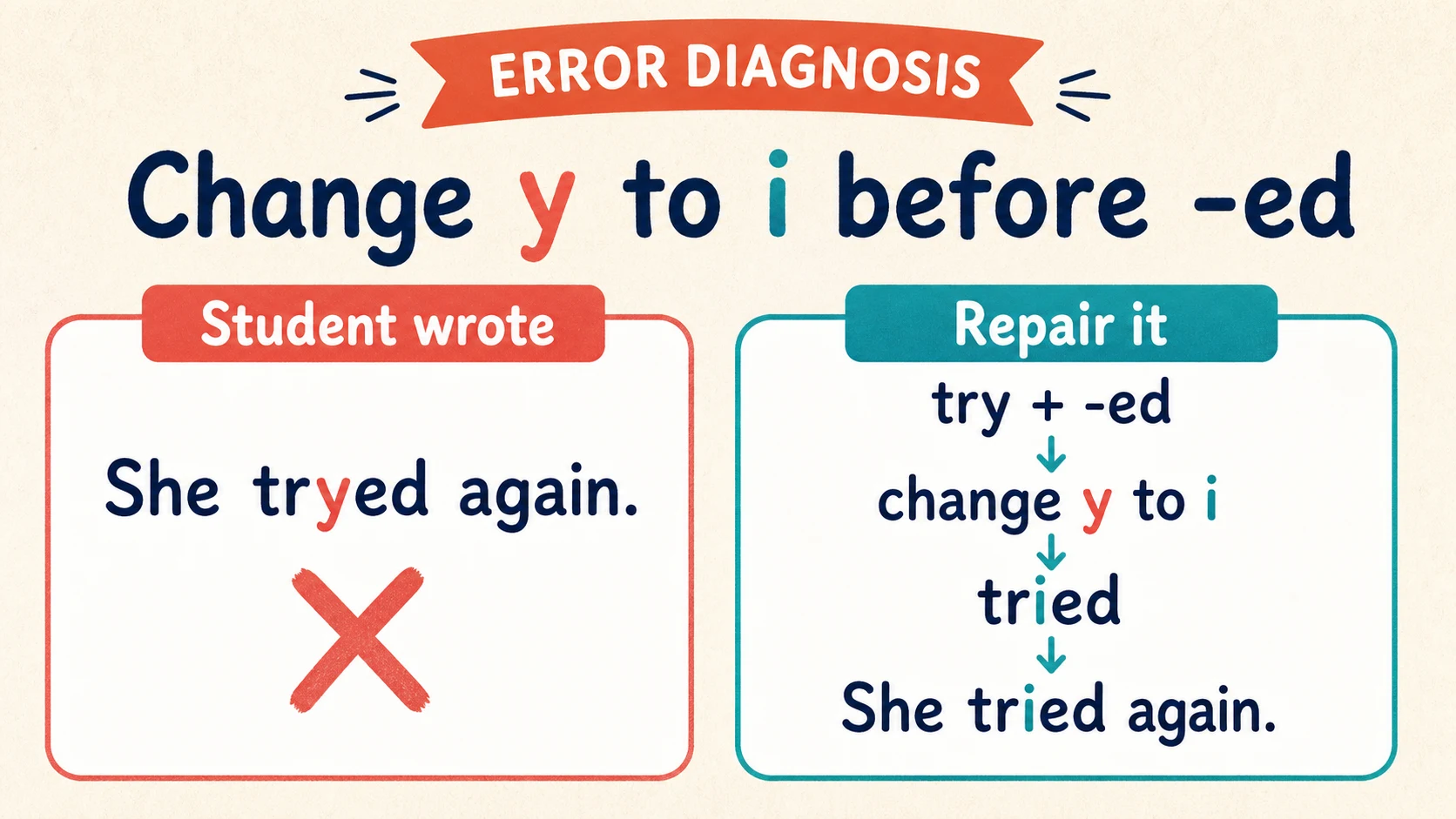
Different errors call for different responses; the marked page is the beginning of diagnosis.
“Spelling is just memorizing a list”
Some words require focused visual memory, but many words also contain reusable patterns or meaningful parts. Organize most practice around a shared feature and identify the specific section of an irregular word that needs remembering.
“One sound always has one spelling”
The worked long-a sort disproves this: cake, rain, play, and break use four written patterns. Teach the spelling found in each word group without promising a one-to-one system.
“If it sounds right, it is spelled right”
A phonetic attempt can show useful sound knowledge without being conventionally correct. Frend represents much of friend, but it still needs correction. Acknowledge what is accurate, then teach the uncertain letter pattern.
“Copying correctly means the word is mastered”
Copying leaves the answer visible. Check recall after the model is covered, then check the word again later in dictation or writing. A learner who succeeds only with the model needs memory and application practice, not necessarily a harder list.
“Every mistake should be corrected the same way”
Consider these attempts:
sip for slip: a sound may be omitted.freind for friend: the internal letter order is reversed.hopping for hoping: the suffix convention or base word is confused.repaned for repainted: syllables, word parts, or the base spelling may be unstable.
Simply rewriting each whole word three times hides these differences. First identify the incorrect part. Then choose segmentation, pattern comparison, word-part building, or memory practice accordingly.
Monitoring Progress Without Over-Testing
Use a small record with four kinds of evidence:
- Pattern recognition: Can the learner sort and explain examples?
- Immediate recall: Can the word be written after the model is covered?
- Delayed recall: Is it correct during a later review?
- Transfer: Does it appear correctly in a dictated sentence or independent writing?
Mark a word as “secure for now” only after success in more than one context. Keep occasional review in the schedule because the catalogue specifically calls for cumulative tests and sorts.
A weekly score alone can be misleading. Ten correct copied answers measure something different from ten words recalled in sentences. Save one or two dated writing samples and note recurring error types. Compare patterns of work rather than drawing a conclusion from a single misspelling.
When a learner’s errors remain broad or difficult to interpret despite clear, appropriately paced instruction, this guide cannot determine the cause. Coordinate with the learner’s teacher or another qualified education professional for a fuller review. This is instructional guidance, not medical or child-specific diagnostic advice.
A Flexible Two-Week Practice Plan
This plan assumes short sessions and one main pattern or closely related set. Adjust the number of words and repetitions according to observed work.
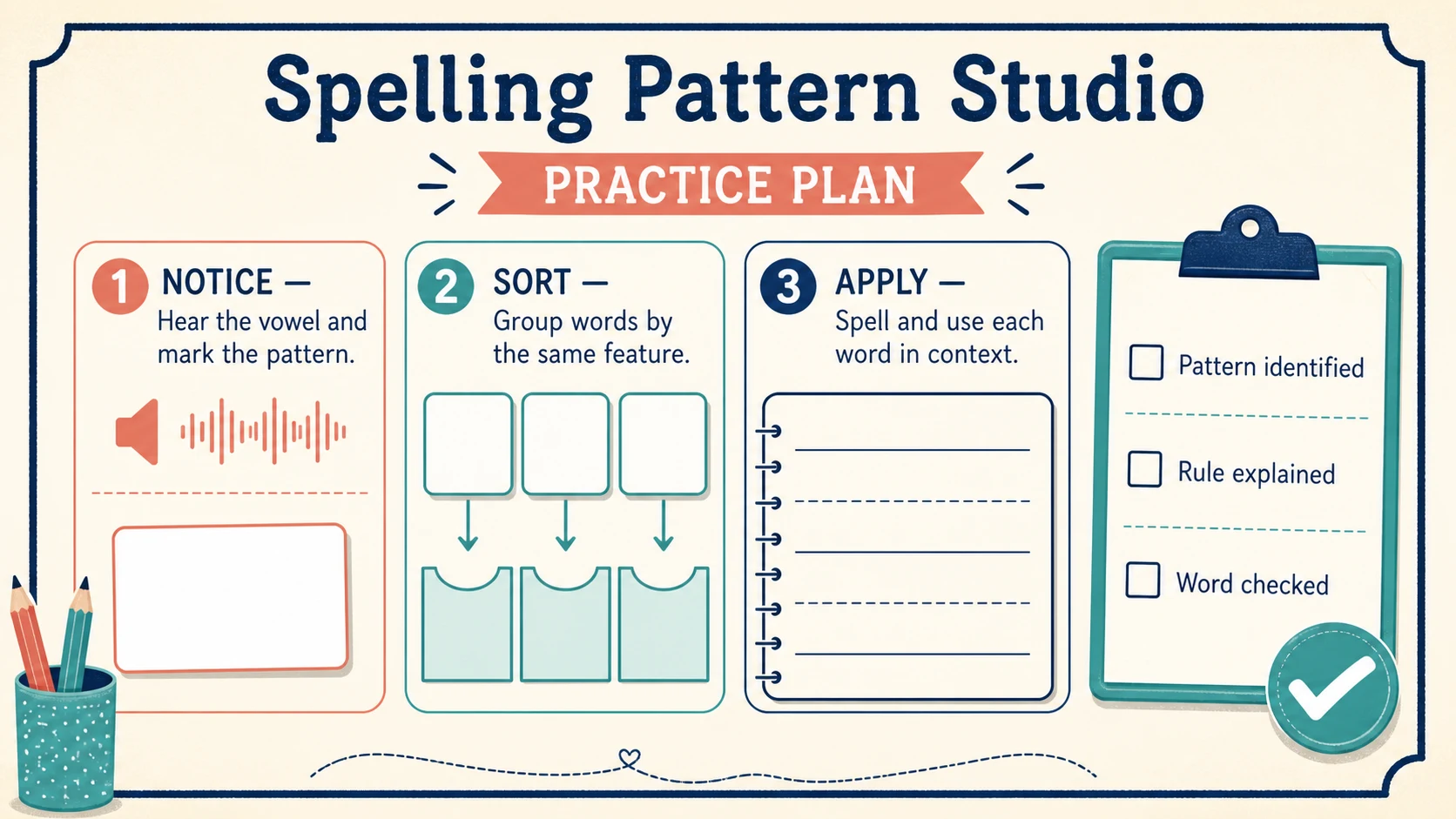
New learning, application, and cumulative review alternate across the two weeks.
| Day |
Focus |
Suggested activity |
What to observe |
| 1 |
Establish a starting point |
Dictate several candidate words and ask for a brief sentence |
Which errors involve sounds, patterns, or word parts? |
| 2 |
Introduce the feature |
Read, mark, and sort a small related set |
Can the learner state what the words share? |
| 3 |
Build recall |
Use look-cover-write-check |
Which letter group changes after the model is hidden? |
| 4 |
Contrast examples |
Compare two patterns or forms, such as hoping/hopping |
Can the learner explain the difference? |
| 5 |
Apply |
Dictate one or two sentences and correct by word part |
Does accuracy transfer beyond the list? |
| 6 |
Light cumulative review |
Mix studied words with earlier words |
Which earlier spellings remain stable? |
| 7 |
Read and notice |
Find studied patterns in an appropriate book or passage |
Can the learner recognize the pattern in connected text? |
| 8 |
Retrieve after a gap |
Dictate the words without showing the list first |
What was retained over time? |
| 9 |
Repair one weak area |
Use sound boxes, a sort, or a word-part map |
Does targeted support change the error? |
| 10 |
Add limited challenge |
Introduce two or three words extending the same feature |
Is the learner applying the pattern or guessing? |
| 11 |
Edit |
Correct a short set of misspelled words or sentences |
Can the learner locate the incorrect part? |
| 12 |
Write |
Compose several sentences using selected words naturally |
Are spellings maintained while ideas are being written? |
| 13 |
Cumulative check |
Mix new words, earlier words, and one unfamiliar example |
Which skills transfer and which require review? |
| 14 |
Reflect and choose |
Review the notebook and select the next focus |
What does the learner’s actual work indicate? |
If accuracy falls sharply in sentences, repeat application days before increasing difficulty. If the learner recalls and explains the pattern consistently, move to a related pattern or a small number of challenge words. The calendar serves the evidence; the evidence does not have to fit the calendar.
Limitations and the Next Useful Step
No single worksheet, list, sort, or two-week plan can establish complete spelling mastery. Word recognition, vocabulary, letter patterns, memory, handwriting, and writing demands interact. A learner may also know a spelling one day and need later review. Use errors as information, keep patterns visible, and revisit words in connected writing.
Start with the free 3rd Grade Spelling Words worksheet. Review the completed page by error type rather than score alone. Choose one pattern for the first week, record what happens in dictation and writing, and let that evidence determine the next worksheet or activity.