What 3rd Grade Place Value Means
Direct answer: A learner understands 3rd Grade Place Value when they can explain that a digit’s value depends on its position, compose and decompose whole numbers, move between standard, expanded, and word forms, compare numbers, and round to the nearest 10 or 100. Correct answers matter, but explanations and representations show whether the learner understands the number system or is following a memorized procedure.
For example, in 4,352, the digit 4 represents 4 thousands, not simply 4. The complete number can be decomposed as:
4,352 = 4,000 + 300 + 50 + 2
That structure supports later work with multi-digit computation, estimation, rounding, and number sense. The central relationship is multiplicative: one hundred can be exchanged for ten tens or one hundred ones. A place-value chart displays those relationships, while blocks, bundled objects, disks, and number lines make them visible.
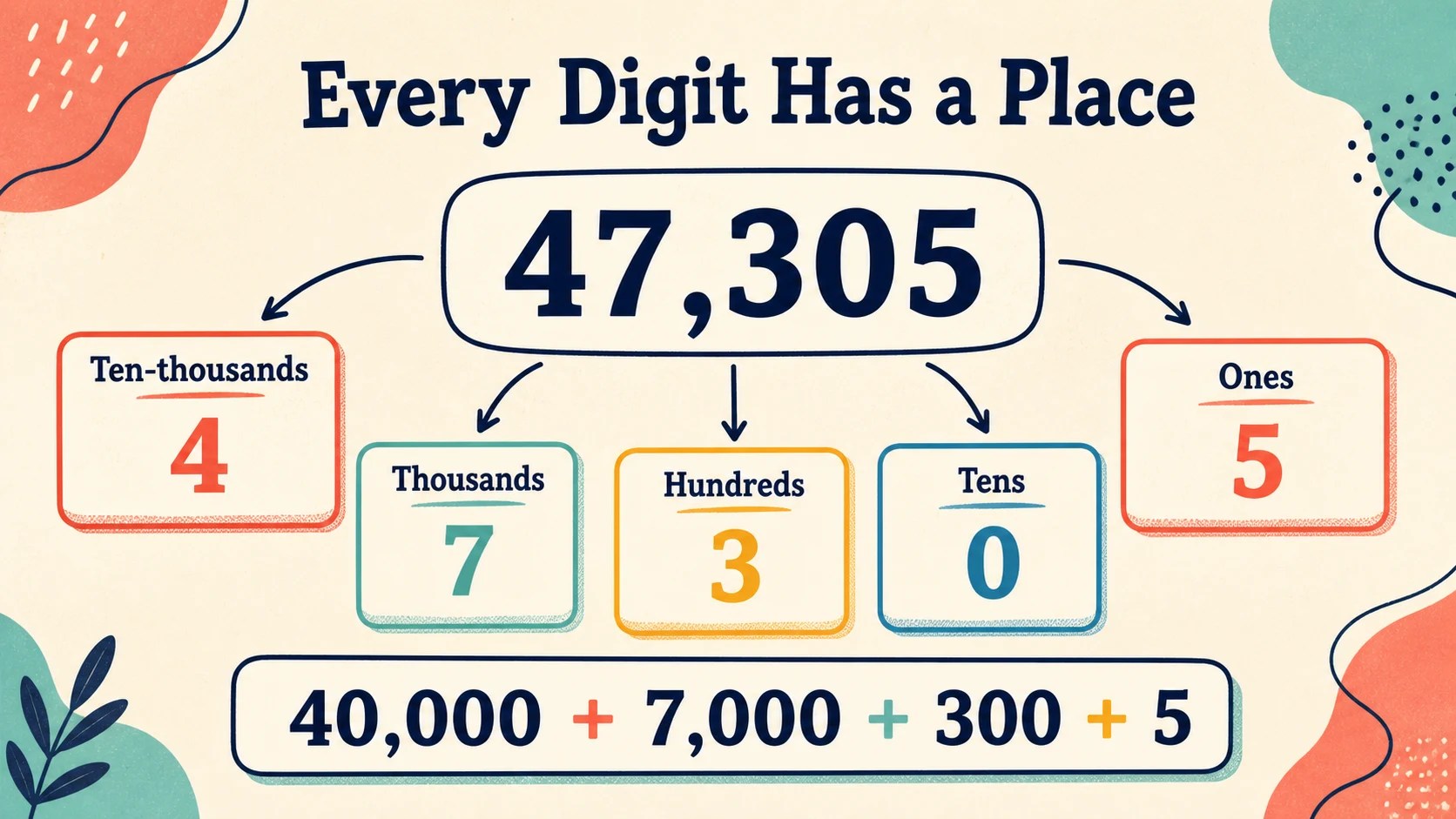
Place-value knowledge connects number representation, comparison, rounding, and computation.
Grade labels describe the intended practice level, not a fixed timetable for every learner. Local curricula and instructional sequences differ. Use the learner’s observed work—not age alone—to decide whether to review prerequisites, continue at this level, or introduce a more demanding task.
The WorksheetWise 3rd Grade hub provides broader grade-level practice, while the 3rd Grade Math collection narrows the selection to mathematics.
Prerequisites to Check Before Teaching
A short prerequisite check prevents an adult from treating every mistake as a third-grade place-value problem. Ask the learner to complete or explain several small tasks without coaching.
Counting and grouping
Check whether the learner can:
- Count forward and backward within familiar ranges.
- Make a group of 10 objects and identify leftover ones.
- Explain that ten ones can be exchanged for one ten.
- Explain that ten tens can be exchanged for one hundred.
- Count by tens and hundreds from both zero and nonzero starting points.
For example, ask the learner to continue 340, 350, 360, … and then 340, 440, 540, …. Confusing these sequences may indicate that the learner is not yet tracking which place changes.
Reading and writing smaller numbers
Ask the learner to read 47, 304, and 680. Then dictate those numbers for the learner to write. The zero in 304 is especially informative: it holds the tens place even though the number contains no tens.
Also check whether the learner can identify the greater of two two-digit numbers and explain the decision. A learner who compares 47 and 52 by looking only at 7 and 2 needs more work with tens before moving to larger comparisons.
Addition knowledge that supports decomposition
The learner should be able to connect a number such as 286 with 200 + 80 + 6. Perfect recall of every addition fact is not required for beginning this topic, but the learner needs to understand that the parts recombine to make the whole.
If these prerequisites are uneven, return briefly to physical grouping and two-digit examples. That is an instructional suggestion, not a claim that every learner must follow the same sequence. Resume larger numbers when the learner can explain the exchanges reliably.
A Grade-Appropriate Teaching Progression
Place value should develop as a connected idea rather than a list of unrelated worksheet formats. The progression below moves from quantity and grouping toward notation, comparison, and rounding.
| Stage |
Main idea |
Useful task |
Evidence to look for |
| 1. Build and trade |
Ten units in one place equal one unit in the place to the left |
Trade 10 ones for 1 ten or 10 tens for 1 hundred |
Learner preserves the total during a trade |
| 2. Name each place |
A digit’s position determines its value |
Identify the value of each digit in 3,746 |
Learner says “700,” not only “7” |
| 3. Compose and decompose |
A number is the sum of its place-value parts |
Build 526 from 500, 20, and 6 |
Learner connects model, spoken number, and numeral |
| 4. Change forms |
The same quantity can be represented in several ways |
Match standard, expanded, and word forms |
Learner handles places containing zero |
| 5. Compare and order |
Compare the greatest place first |
Order 489, 498, and 408 |
Learner explains the first place that differs |
| 6. Locate on a number line |
Numbers have magnitude and distance from benchmarks |
Place 347 between 300 and 400 |
Placement is proportional enough to support reasoning |
| 7. Round |
Choose the nearest multiple of 10 or 100 |
Round 347 to the nearest 10 and 100 |
Learner names both benchmarks and compares distances |
| 8. Apply independently |
Select a representation or method without prompting |
Solve mixed place-value tasks |
Learner explains and checks the result |
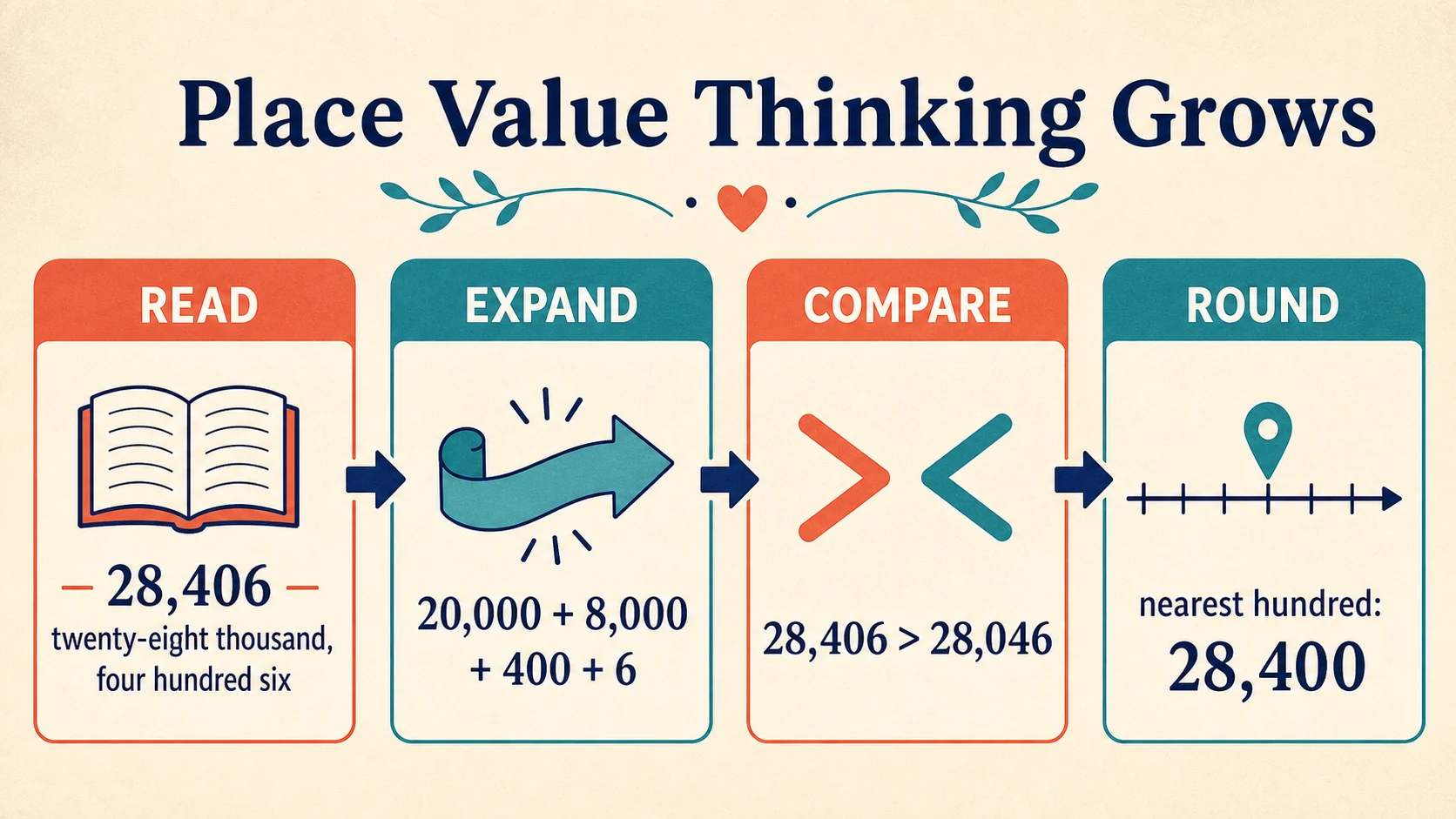
Support should decrease as the learner connects quantities, representations, and written procedures.
The Common Core mathematics standards frame mathematical learning as both understanding and procedural skill, with learners expected to explain reasoning at an appropriate level. Within the supplied catalogue scope, the specifically listed third-grade place-value standard is rounding to the nearest 10 or 100. Other representation and comparison work in this guide strengthens the underlying place-value understanding and reviews earlier learning; it should not be presented as comprehensive alignment with every local standard.
Concrete and Visual Models That Clarify the System
The model should reveal the mathematics, not become an extra decoration. Use a small, consistent set and ask the learner to connect each model to numbers and words.
Bundled objects and base-ten blocks
Bundle 10 craft sticks with a rubber band to make a ten. Bundle or group 10 tens to represent a hundred. Base-ten blocks provide the same structure with units, rods, flats, and—when available—larger pieces.
Build 243 as 2 hundreds, 4 tens, and 3 ones. Then trade one hundred for 10 tens. The quantity remains 243 even though the model now contains 1 hundred, 14 tens, and 3 ones. This exchange is valuable because it shows that decomposition is not limited to the usual expanded form.
Ask:
- “What stayed the same after the trade?”
- “What changed?”
- “How do you know the total is still 243?”
Place-value charts and disks
A chart organizes thousands, hundreds, tens, and ones into columns. Place disks or counters labeled with their values in the correct columns. When recording 4,052, leave the hundreds column empty while still writing a zero in that position.
| Thousands |
Hundreds |
Tens |
Ones |
| 4 |
0 |
5 |
2 |
The chart helps separate two ideas: there are no hundreds in 4,052, but the hundreds place still exists.
Open number lines
An open number line does not need every number labeled. For 347, mark 300 and 400, then locate 347 approximately. For rounding to the nearest hundred, compare its distance from the two benchmarks:
- 347 is 47 away from 300.
- 347 is 53 away from 400.
- Therefore, it is nearer to 300.
For rounding to the nearest ten, use 340 and 350 instead. This preserves the meaning of “nearest” and avoids relying solely on a digit-marking trick.
The IES guide for assisting elementary students who struggle with mathematics recommends systematic instruction, clear mathematical language, well-chosen concrete or semi-concrete representations, and number lines. That source offers high-level instructional framing; it did not evaluate WorksheetWise or this particular guide.
Fully Worked and Checked Examples
Example 1: Identify a digit’s value
Problem: What is the value of the digit 7 in 3,746?
-
Write the place names: thousands, hundreds, tens, ones.
-
Match each digit to its place:
- 3 is in the thousands place: 3,000.
- 7 is in the hundreds place: 700.
- 4 is in the tens place: 40.
- 6 is in the ones place: 6.
-
Therefore, the value of the 7 is 700.
Check: Recompose the number:
3,000 + 700 + 40 + 6 = 3,746
A response of “hundreds” identifies the place, while “700” gives the digit’s value. Both ideas are useful, but they answer different questions.
Example 2: Move among standard and expanded forms
Problem: Write 5,083 in expanded form.
- The 5 represents 5,000.
- The 0 represents 0 hundreds.
- The 8 represents 80.
- The 3 represents 3.
So:
5,083 = 5,000 + 80 + 3
Writing 5,000 + 0 + 80 + 3 is also mathematically correct, although the zero term is usually omitted.
Check: Add the parts:
5,000 + 80 = 5,080
5,080 + 3 = 5,083
Boundary case: do not write 5,000 + 800 + 3. The 8 is in the tens place, even though the hundreds place contains zero.
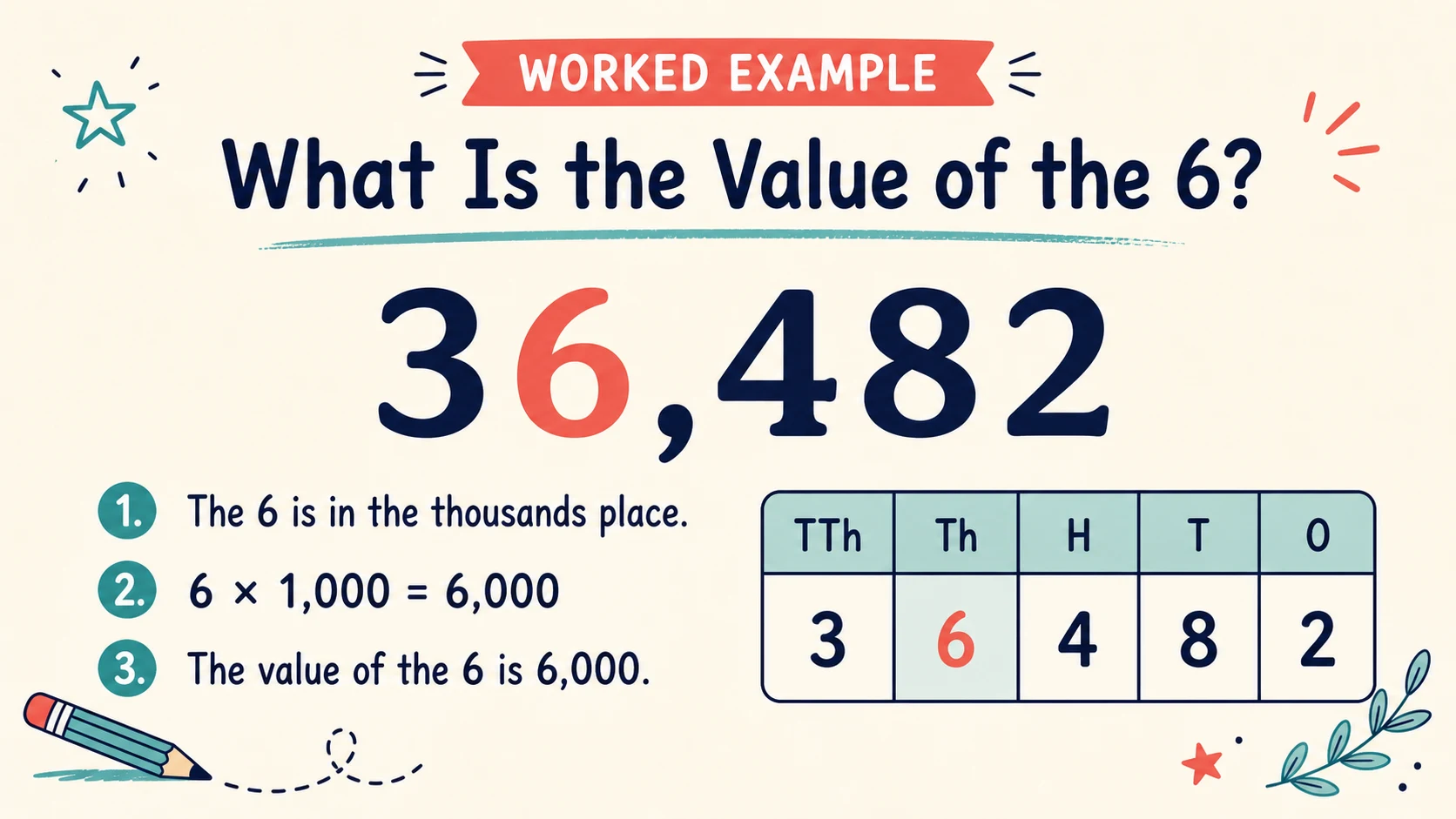
Connecting a model to an equation makes the value of each digit explicit.
Example 3: Compare numbers with the same digits
Problem: Compare 509 and 590 using <, >, or =.
- Compare the hundreds: both numbers have 5 hundreds.
- Move to the tens: 509 has 0 tens; 590 has 9 tens.
- Because 0 tens is less than 9 tens, 509 < 590.
Check by decomposition:
509 = 500 + 0 + 9
590 = 500 + 90 + 0
Both contain 500, but the second number has 90 more in the tens place. The position of the digits, not the set of digits alone, determines the value.
Example 4: Round to the nearest ten
Problem: Round 347 to the nearest 10.
The neighboring multiples of 10 are 340 and 350.
- Distance to 340: 347 − 340 = 7
- Distance to 350: 350 − 347 = 3
Because 3 is less than 7, 347 is closer to 350.
Answer: 347 rounds to 350.
Check: The rounded answer must be a multiple of 10. Since 350 ends in zero and is the nearer benchmark, the result is reasonable.
Example 5: Round to the nearest hundred at a midpoint
Problem: Round 350 to the nearest 100.
The neighboring hundreds are 300 and 400.
- Distance to 300: 350 − 300 = 50
- Distance to 400: 400 − 350 = 50
The number is exactly halfway. Under the usual whole-number rounding convention used in this grade-level work, a midpoint rounds to the greater hundred.
Answer: 350 rounds to 400.
This is a boundary case. Compare it with 349, which is 49 away from 300 and 51 away from 400, so 349 rounds to 300.
Example 6: A number already at a benchmark
Problem: Round 600 to the nearest 100.
600 is already a multiple of 100. Its distance from 600 is zero, so rounding does not change it.
Answer: 600 rounds to 600.
This example checks whether the learner understands rounding as finding the nearest benchmark rather than as a command to change the number.
A Short, Repeatable Lesson Routine
A focused lesson can be brief. The timing below is a practical suggestion, not a universal timetable. Extend, shorten, or repeat a phase in response to the learner’s work.
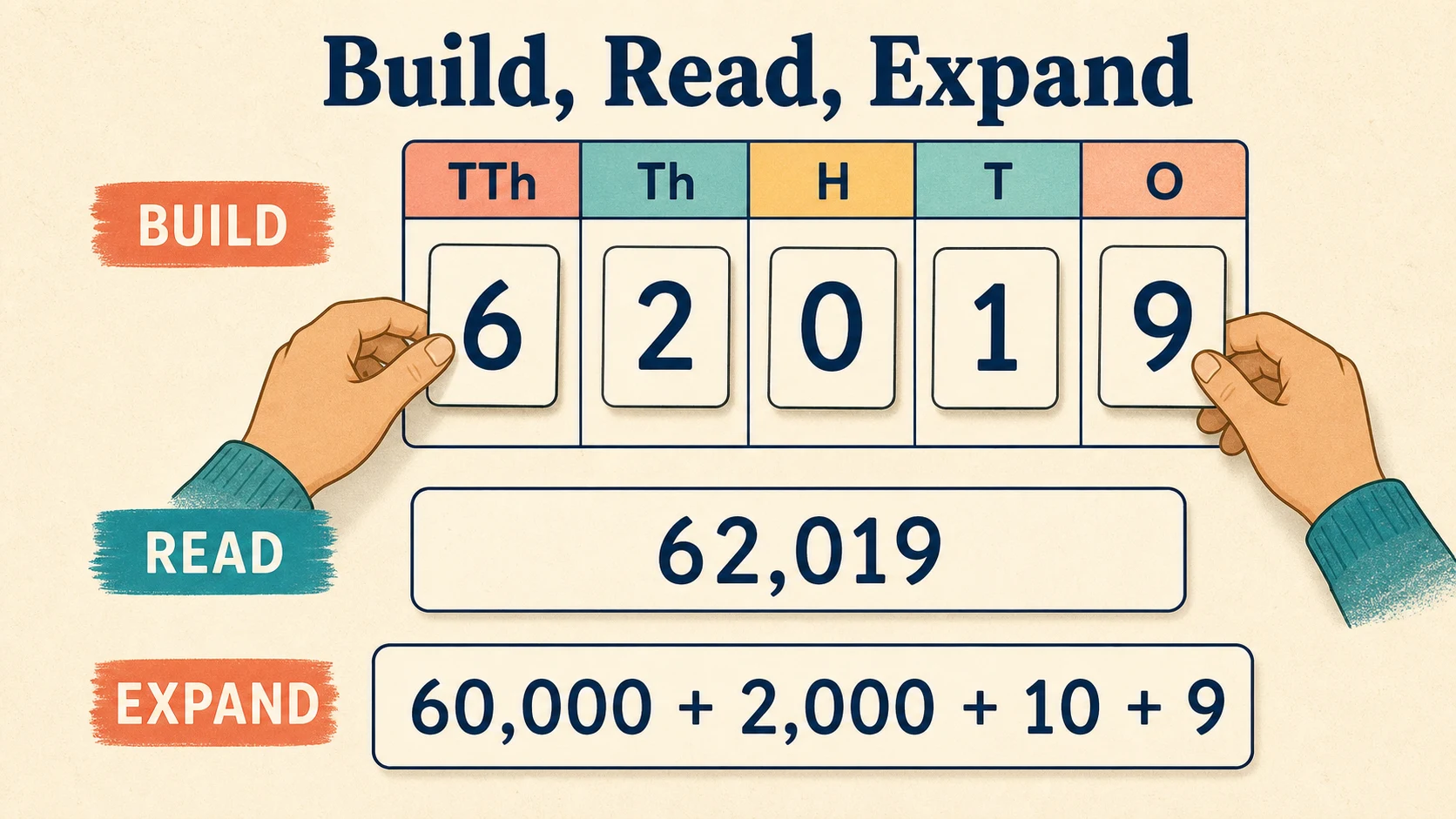
A stable routine leaves more attention available for mathematical thinking.
1. Retrieve a known idea
Begin with two or three oral prompts:
- “How many ones equal one ten?”
- “What is the value of 6 in 264?”
- “Which is greater, 308 or 380? Why?”
Do not turn this opening into a speed test. Its purpose is to reveal what the learner can use today.
2. Model one connection
Choose one example and show it in two representations. Build 426 with blocks, place the digits on a chart, and record 400 + 20 + 6. Speak precisely: “The 2 is in the tens place, so its value is 20.”
3. Solve together
Give a nearby example, such as 462. Let the learner move the materials or fill in the chart. Prompt only as much as needed:
- “Which place comes first?”
- “What does that digit represent?”
- “How could you check?”
If an answer is wrong, return to the representation before giving a rule.
4. Try independently
Use two to four problems that test the same idea with a small variation. Include a zero placeholder only after the learner succeeds with all places occupied.
5. Explain and record
Ask the learner to explain one answer in words, with a model, or through an equation. Record the type of error, the prompt required, and whether the correction was independent. This information should determine the next lesson.
The IES early mathematics practice guide concerns preschool through kindergarten, not third grade. Its high-level emphasis on developmental progression and progress monitoring is still useful background for checking what a learner knows before choosing the next task. It does not validate this guide or any WorksheetWise worksheet.
Choosing Practice That Matches the Learner
Practice should be selected by skill and error pattern, not merely by filling a page.
Beginning or rebuilding understanding
Choose tasks with one demand at a time:
- Match models to three-digit numbers.
- Name the place and value of an underlined digit.
- Compose numbers from hundreds, tens, and ones.
- Write expanded form without zero placeholders at first.
- Compare numbers whose hundreds digits differ clearly.
Keep blocks or a place-value chart available. Ask for an explanation after a small set rather than after every item.
Developing reliable connections
Mix closely related forms:
- Standard form to expanded form.
- Expanded form to standard form.
- Numbers containing an internal zero.
- Comparisons in which the first digit is the same.
- Placement between two multiples of 10 or 100.
- Rounding with numbers below, above, and exactly at a midpoint.
The learner should gradually decide which model is helpful instead of being told which one to use.
Ready for independent mixed practice
Select a mixture of place identification, expanded form, comparison, and rounding. Include boundary cases, but avoid changing every feature at once. A learner who succeeds on blocked sets may still need support when problem types are mixed.
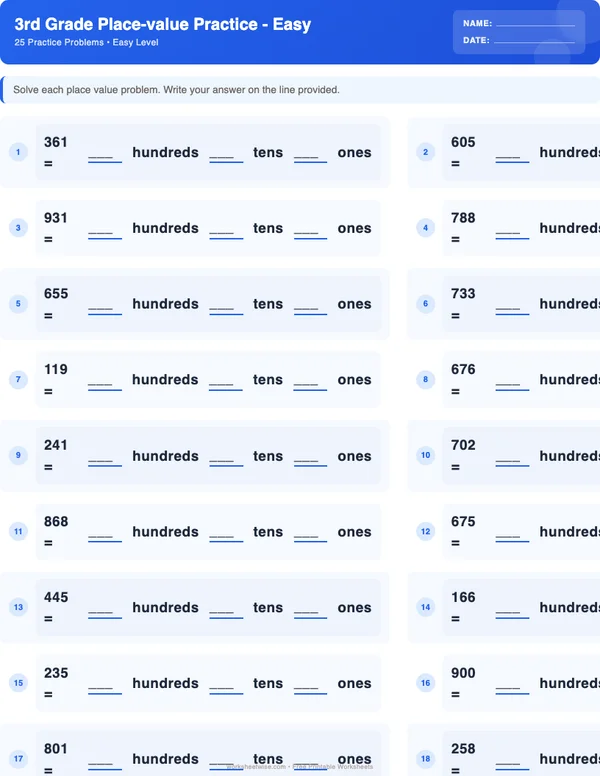
The free easy-level 3rd Grade Place Value worksheet contains 25 exercises covering place value, expanded form, number comparison, and rounding, with a separate printable answer key. It is suitable for checking a range of foundational skills, but one completed page should not be treated as a complete assessment of understanding.
For broader repeated practice, the 3rd Grade Place Value Worksheet Pack contains 18 worksheets. Use only the pages or problem types that match the current instructional need.
Differentiation Without Changing the Core Idea
When the learner needs more support
Reduce the number size, not the mathematical explanation. If 4,052 is overwhelming, use 405 or 250 while preserving attention to zero as a placeholder.
Other useful adjustments include:
- Letting the learner build before writing.
- Keeping place headings visible.
- Color-coding places consistently across a model and equation.
- Using fewer problems in one sitting.
- Giving a choice between explaining orally and drawing a model.
- Returning to one comparison step at a time.
- Placing rounding numbers on an open number line.
The objective remains understanding place, value, grouping, and magnitude.
When the learner is ready for more challenge
Increase reasoning before increasing the number of exercises:
- Find two different decompositions of 326.
- Explain why 4,099 is less than 4,100.
- Write a number with 6 hundreds, no tens, and 8 ones.
- Find every whole number that rounds to 470 to the nearest 10.
- Correct an intentionally incorrect expanded form.
- Create two numbers that use the same digits but have different values.
For the rounding challenge, whole numbers from 465 through 474 round to 470 under the usual convention. Check the boundaries: 464 is closer to 460, and 475 is a midpoint that rounds to 480.
Common Errors and Diagnostic Responses
An incorrect answer identifies where to investigate; it does not by itself explain the cause.
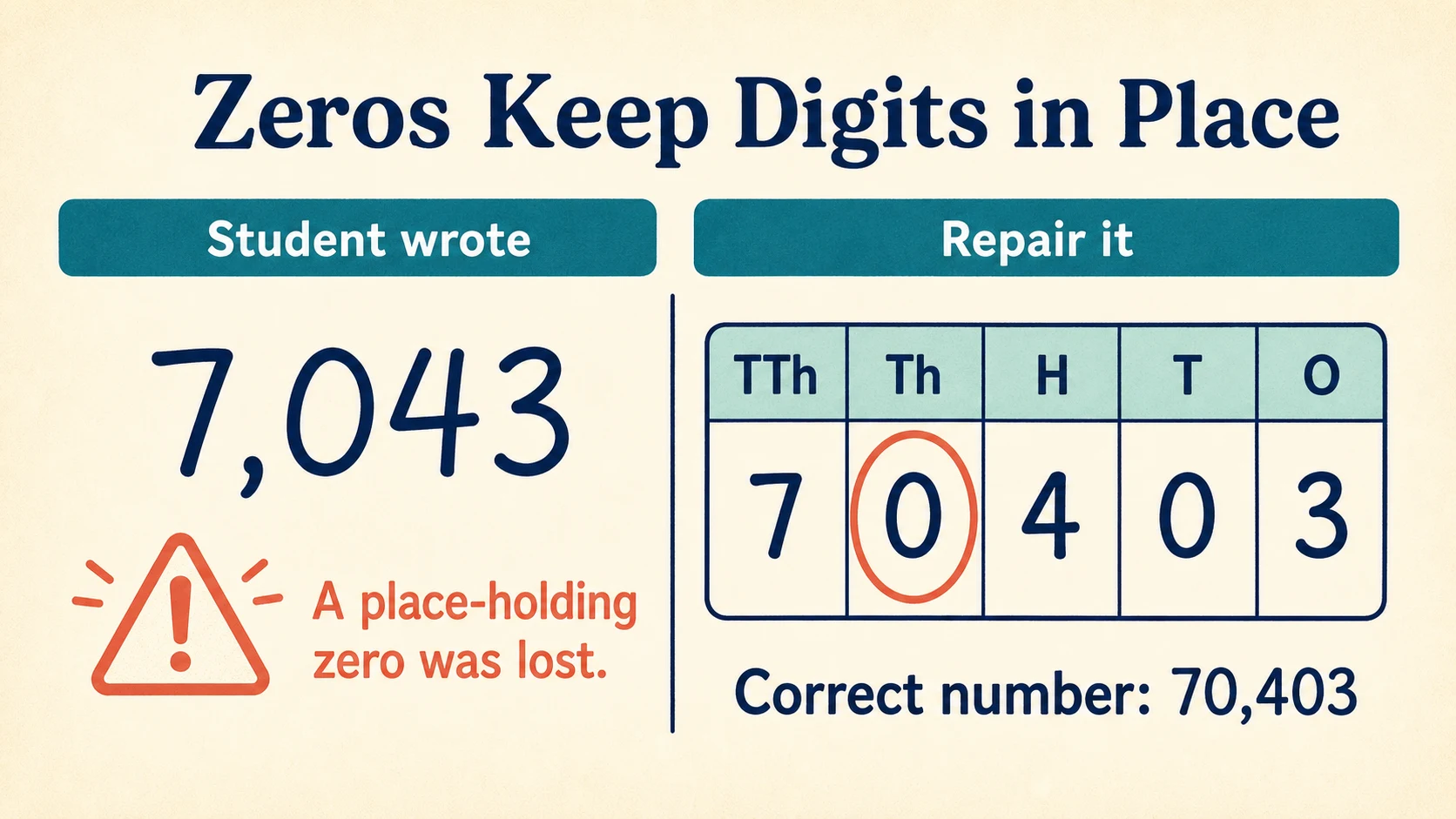
Diagnose the reasoning behind an error before assigning more of the same practice.
| Observed work |
Possible interpretation |
Diagnostic prompt |
Teaching response |
| Says the value of 7 in 372 is “7” |
Confuses digit with value |
“What does one 7 represent in that position?” |
Build 372 and connect the 7 tens to 70 |
| Writes 4,062 as 4,000 + 600 + 2 |
Ignores the zero placeholder |
“Which column contains the 6?” |
Use a labeled chart and keep the hundreds column empty |
| Says 509 > 590 because 9 > 0 |
Compares ones before higher places |
“Where is the first place the numbers differ?” |
Compare from the greatest place and decompose both numbers |
| Writes 800 + 4 as 84 |
Does not preserve empty places |
“How many tens are present?” |
Record 8 hundreds, 0 tens, and 4 ones as 804 |
| Rounds 347 to 300 when asked for nearest 10 |
Uses the wrong unit |
“Which multiples of 10 surround 347?” |
Mark 340 and 350 on a number line |
| Always rounds a number upward |
Treats rounding as increasing |
“Which benchmark is closer?” |
Compare distances on both sides |
| Changes 600 to 700 when rounding |
Applies a memorized action to a benchmark |
“How far is 600 from 600?” |
Include numbers already at multiples of 10 or 100 |
| Gives correct answers but cannot explain |
May rely on an unexamined procedure |
“Show the same number another way” |
Connect numeral, model, words, and equation |
Do not infer a learning condition from worksheet errors. This guide is educational guidance, not medical or diagnostic advice. Persistent difficulty may warrant discussion with the learner’s teacher or another qualified educational professional who can review a fuller body of work.
Monitoring Progress and Deciding What Comes Next
Use a small record across several sessions. Note:
- Accuracy by skill, not just total score.
- Whether the learner used a model independently.
- The kind of prompt needed.
- Whether a corrected answer remained correct on a later example.
- Whether the learner could explain the value of a digit.
- Performance on zero placeholders and rounding boundaries.
- Whether understanding transferred to a mixed set.
A useful check contains one familiar item, one small variation, and one boundary case. For rounding to the nearest hundred, that might be 243, 680, and 650. Do not move on because one page is complete. Move on when the learner can solve and explain representative tasks with decreasing support.
If errors cluster around a single feature, teach that feature directly. If they are scattered, reduce the number of simultaneous demands and revisit the concrete model. If the learner is consistently accurate and explanatory language is secure, move toward mixed practice and applications.
A Two-Week Practice Plan
This plan assumes ten short practice days, but it is not a required schedule. Repeat a day when the learner needs it, combine days when the work is already secure, and pause if fatigue makes the results uninformative.
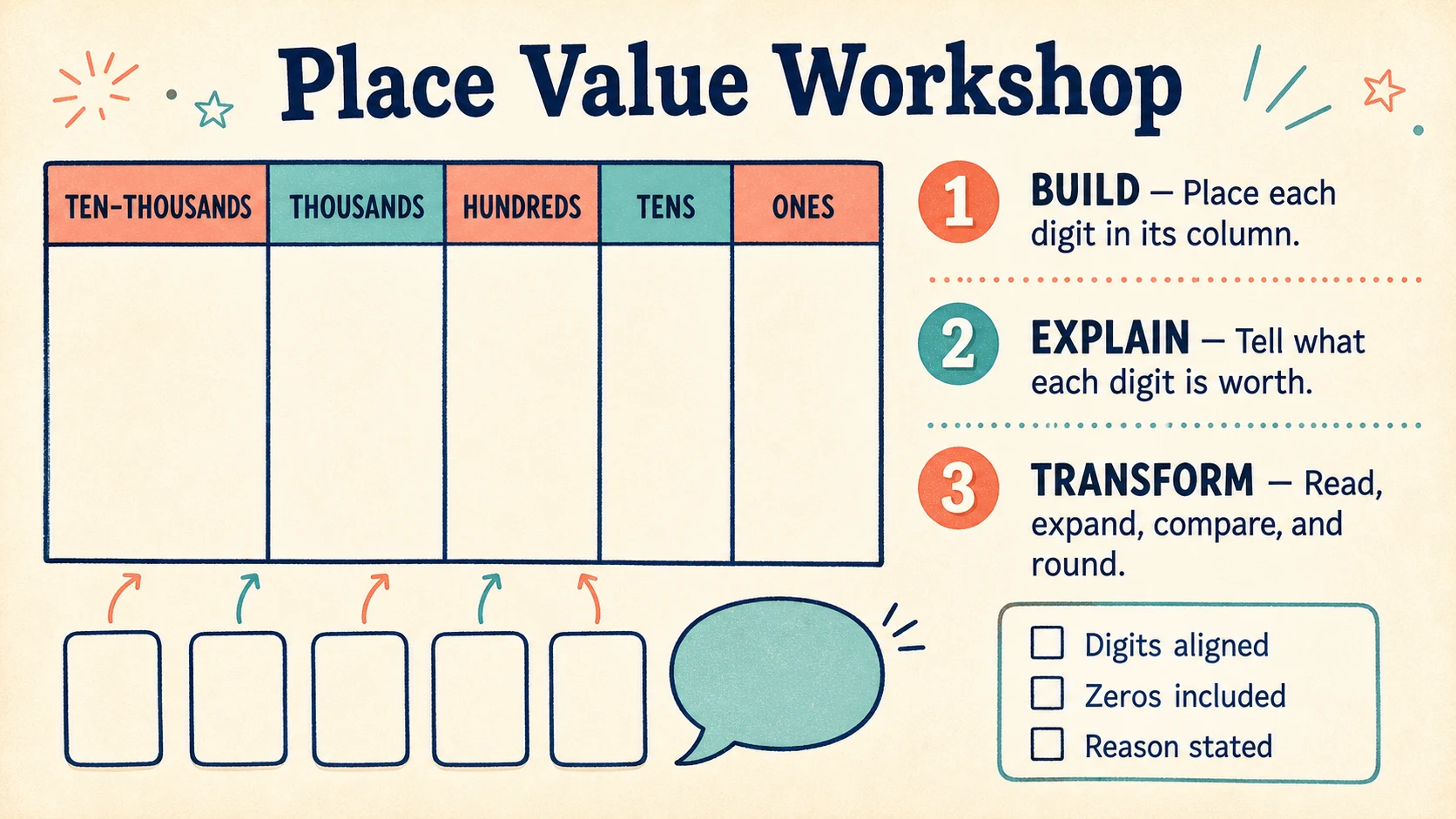
The plan alternates focused instruction, retrieval, mixed practice, and review.
| Day |
Focus |
Suggested activity |
Check before continuing |
| 1 |
Prerequisites |
Bundle ones into tens and tens into hundreds; read several numbers |
Can the learner explain each trade? |
| 2 |
Place and value |
Build and label three-digit numbers |
Can the learner distinguish “hundreds place” from a value such as 500? |
| 3 |
Composition |
Make numbers from stated hundreds, tens, and ones |
Can the learner record an empty place with zero? |
| 4 |
Expanded form |
Move between models, standard form, and expanded form |
Can the learner recompose the parts correctly? |
| 5 |
Review |
Mix Days 1–4 and explain one answer |
Which skill still requires prompting? |
| 6 |
Comparison |
Compare from the greatest place; order three numbers |
Can the learner identify the first differing place? |
| 7 |
Number lines |
Locate numbers between tens and hundreds |
Does the learner identify appropriate benchmarks? |
| 8 |
Rounding |
Round to the nearest 10 using distance |
Can the learner handle numbers ending in 5? |
| 9 |
Rounding and boundaries |
Round to the nearest 100; include midpoints and exact benchmarks |
Can the learner explain why 350 and 600 behave differently? |
| 10 |
Mixed application |
Complete a short mixed set and correct one error |
Is the work accurate without a model, and can the learner explain it? |
Keep the final check short enough that attention does not obscure understanding. When reviewing, ask the learner to correct only a few carefully selected errors and explain the change.
Scope, Limitations, and the Next Useful Step
Place value develops across grades. This guide concentrates on foundational whole-number representation, comparison, and rounding appropriate to the supplied third-grade catalogue scope. It does not cover every local curriculum, certify mastery, guarantee an outcome, or establish comprehensive standards alignment. It also does not prescribe one pace for classrooms, tutoring sessions, or homeschool instruction.
The most honest next step is to collect current evidence. Give the learner a brief mix of place-value, expanded-form, comparison, and rounding problems. Use the answer key to check accuracy, then ask for an explanation of one correct answer and one correction. Start with the free 3rd Grade Place Value worksheet, and use the results to choose the next model, lesson, or practice set.