What 3rd Grade Subtraction Includes
3rd Grade Subtraction develops a learner’s ability to find differences, compare quantities, identify missing parts, and subtract multi-digit numbers using place-value reasoning. At this practice level, the central goal is accurate subtraction within 1,000 using understandable strategies and algorithms—not merely following a borrowing rule.
A learner should gradually be able to:
- Recall or efficiently derive basic subtraction facts.
- Explain subtraction as removal, comparison, or finding a missing part.
- Use addition to check a subtraction result.
- Break numbers apart by hundreds, tens, and ones.
- regroup one hundred as ten tens or one ten as ten ones.
- Estimate before calculating.
- Interpret subtraction in one-step and suitable two-step word problems.
- Record work clearly enough that another person can follow the reasoning.
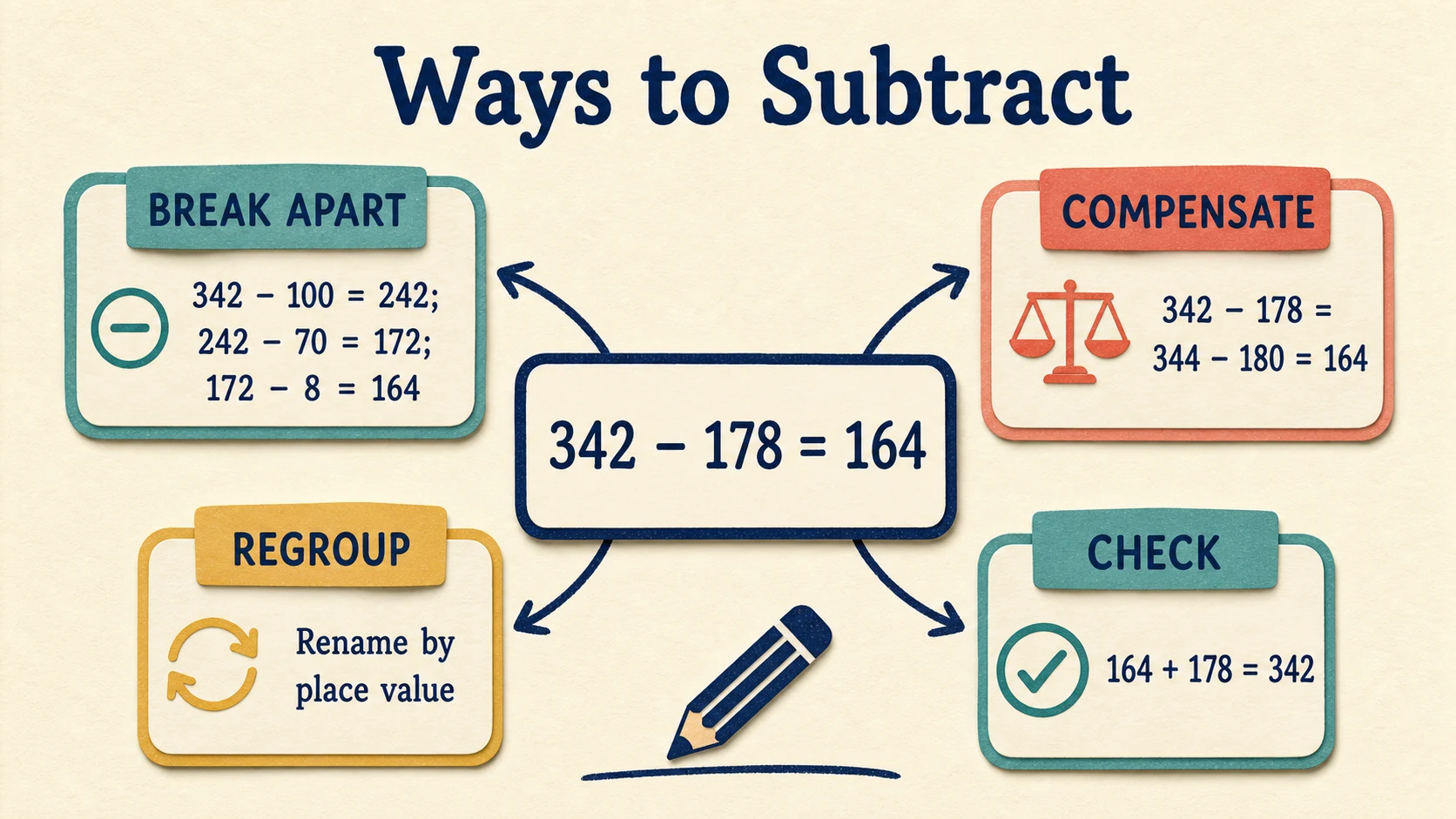
The skill combines number sense, place value, calculation, modeling, and problem interpretation.
Grade labels describe an intended practice level; local curricula and teaching sequences differ. The Common Core State Standards for Mathematics place fluent addition and subtraction within 1,000 in the Grade 3 number-and-operations progression. That reference helps define the broad instructional destination, but it does not mean every learner must follow the same timetable or use one fixed method.
Use the learner’s observed work to set the pace. A child who can calculate accurately but cannot explain a regrouping step needs different instruction from one who understands the model but makes fact errors.
Prerequisites to Check Before Teaching the Algorithm
Multi-digit subtraction depends on several smaller understandings. A brief prerequisite check is more useful than beginning with a long page of mixed problems.
Quantity, counting, and basic facts
Ask the learner to solve a small set such as:
- 9−4
- 13−6
- 15−8
- 20−7
Notice how the answers are found. Counting back can work, but counting back eight steps from 15 is inefficient and easy to lose track of. A related-addition strategy is more dependable: “What plus 8 equals 15?” Because 7+8=15, 15−8=7.
Useful fact strategies include:
- Taking away to reach 10, then subtracting what remains.
- Using a known addition fact.
- Using a nearby fact, such as deriving 14−6 from 14−7=7.
- Recognizing fact-family relationships.
Do not require instant recall before allowing multi-digit work. Instead, distinguish between a place-value misunderstanding and slow fact retrieval. A learner may understand 63−28 perfectly yet pause at 13−8.
Place value and equivalence
Check whether the learner can:
- Read and write three-digit numbers.
- Identify the value of a digit by its position.
- Decompose 352 as 300+50+2.
- Explain that 1 ten has the same value as 10 ones.
- Explain that 1 hundred has the same value as 10 tens.
- Compare numbers and identify a reasonable interval for an answer.
Regrouping depends on equivalence. In 52, changing five tens and two ones into four tens and twelve ones changes the representation, not the total:
52=50+2=40+12
If this equality is unclear, pause the written algorithm and use objects or drawings.
Addition as an inverse operation
Subtraction and addition describe related relationships. For example:
47−19=28
can be checked with:
28+19=47
This inverse relationship is especially valuable when the context involves a missing part. “There are 47 seats, and 19 are occupied” may be represented as either 47−19=? or 19+?=47.
The IES guide on teaching mathematics to young children supports broad practices such as connecting mathematical ideas to representations and helping learners describe their reasoning. For a third grader, that framing can be applied by moving among objects, drawings, equations, and spoken explanations.
A Grade-Appropriate Teaching Progression
Subtraction instruction works best when the numerical difficulty and the representational difficulty do not increase at the same time. Begin with quantities the learner can reason about, establish the meaning of each step, and then vary the numbers.
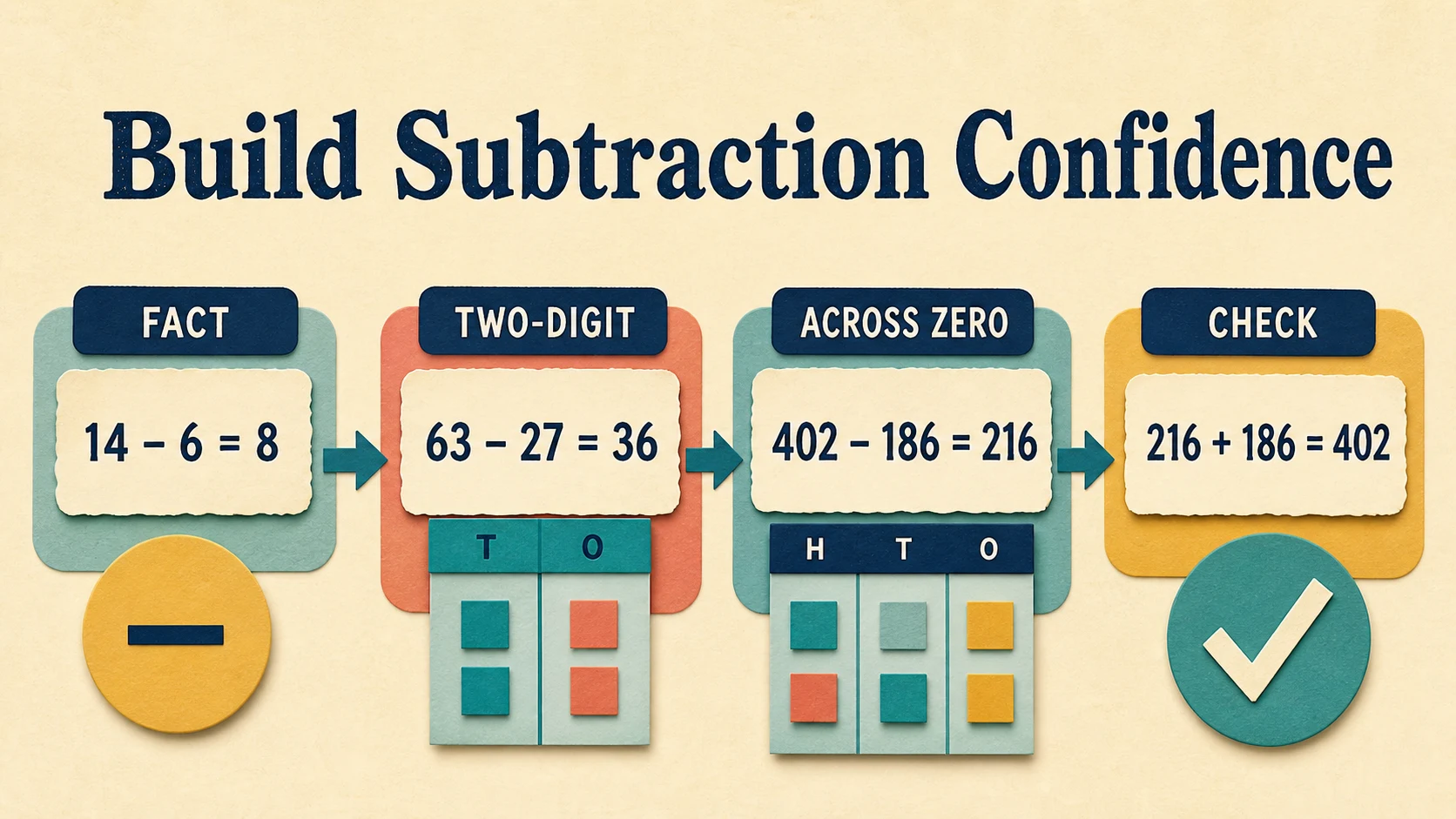
Support can be reduced as the learner demonstrates accurate, explainable work.
| Stage |
Main focus |
Suitable examples |
Evidence for moving on |
| 1. Meaning |
Removal, comparison, and missing-part situations |
14−6, 18−?=11 |
Chooses subtraction or missing-addend reasoning appropriately |
| 2. Facts and mental strategies |
Facts within 20 and friendly multiples of ten |
16−9, 70−30 |
Uses a workable strategy without losing track |
| 3. Place-value subtraction |
Subtract hundreds, tens, and ones without regrouping |
487−235 |
Keeps place values aligned and explains each partial difference |
| 4. One regrouping |
Trade a ten for ones or a hundred for tens |
63−28, 352−170 |
Regroups without changing the total |
| 5. Multiple regroupings |
Regroup across more than one place |
532−178 |
Records each changed place value accurately |
| 6. Zeros and boundary cases |
Regroup through a zero and subtract equal or near-equal numbers |
400−156, 305−297 |
Handles zeros through place-value reasoning |
| 7. Context and selection |
Word problems, estimation, and mixed operations |
“How many fewer?” |
Identifies the relationship before calculating |
| 8. Independent practice |
Mixed examples with checks and explanations |
Varied problems within 1,000 |
Maintains accuracy after supports are removed |
A learner does not have to complete each stage as a separate unit. The table is a decision guide. If work at Stage 5 reveals unreliable facts, briefly return to Stage 2 while continuing to model place value.
The catalogue’s 3rd Grade Math hub can help an adult place subtraction beside related number work. The broader 3rd Grade worksheet hub is useful when planning across subjects, but subtraction practice should still be selected from actual calculation evidence.
Concrete and Visual Models That Preserve Meaning
Models should clarify the mathematics and eventually lead to efficient written work. They are not rewards or decorations. Choose the simplest model that reveals the learner’s current point of confusion.
Base-ten blocks and place-value drawings
Base-ten blocks make regrouping visible. Suppose a learner is solving 43−25. Build 43 with four tens rods and three ones cubes. Five ones cannot be physically removed from three ones, so trade one tens rod for ten ones. The quantity is now represented as three tens and thirteen ones.
Remove five ones, leaving eight. Remove two tens, leaving one ten. The difference is 18.
The trade changes the form of 43 while preserving its value.
A quick place-value drawing can replace physical blocks once the learner understands the trade. Draw hundreds squares, tens lines, and ones dots. Cross out and redraw a traded unit rather than asking the learner to imagine it.
Open number lines
An open number line is especially useful for comparison and counting-up strategies. To find 82−57, start at 57 and count to 82:
57→60(+3)
60→80(+20)
80→82(+2)
The total distance is:
3+20+2=25
Therefore:
82−57=25
This representation emphasizes difference rather than removal. It also provides a practical alternative when counting up is easier than decomposing the minuend.
Bar models and part-whole diagrams
A bar model can distinguish three common subtraction situations:
- Removal: A total is known, a part is taken away, and the remaining part is unknown.
- Comparison: Two quantities are known, and the difference between them is unknown.
- Missing part: The total and one part are known, and the other part is unknown.
For “A shelf holds 65 books, and 38 are nonfiction,” draw one bar for 65 divided into a known part of 38 and an unknown part. The diagram supports both 65−38=? and 38+?=65.
A model is no longer helping if the learner spends more effort reproducing it than reasoning with it. Reduce detail gradually: objects, quick drawings, labeled equations, and then independent notation.
Fully Checked Worked Examples
The following examples show different structures and boundary conditions. Encourage the learner to estimate first, calculate second, and verify last.
Example 1: No regrouping
Find:
684−253
Estimate using nearby hundreds:
700−300≈400
Subtract by place value:
600−200=400
80−50=30
4−3=1
Combine the partial differences:
400+30+1=431
Check with addition:
431+253=684
Therefore:
684−253=431
The answer is close to the estimate of 400, and the inverse check returns the original total.
Example 2: Regrouping one ten
Find:
63−28
The ones calculation 3−8 cannot be completed by removing eight ones from three ones. Regroup one ten:
63=50+13
Now subtract the ones and tens:
13−8=5
50−20=30
30+5=35
Check:
35+28=63
Therefore:
63−28=35
The important statement is not “borrow one.” It is “six tens and three ones are renamed as five tens and thirteen ones.”
Example 3: Regrouping a hundred and a ten
Find:
532−178
Estimate:
500−200≈300
Regroup for the ones. Change 532 from five hundreds, three tens, and two ones to five hundreds, two tens, and twelve ones:
12−8=4
The tens place now has two tens, but seven tens must be removed. Regroup one hundred as ten tens. The number is represented as four hundreds, twelve tens, and twelve ones:
12−7=5 tens
4−1=3 hundreds
So:
532−178=354
Check:
354+178=532
Therefore:
532−178=354
The exact answer, 354, is reasonably close to the rough estimate of 300.
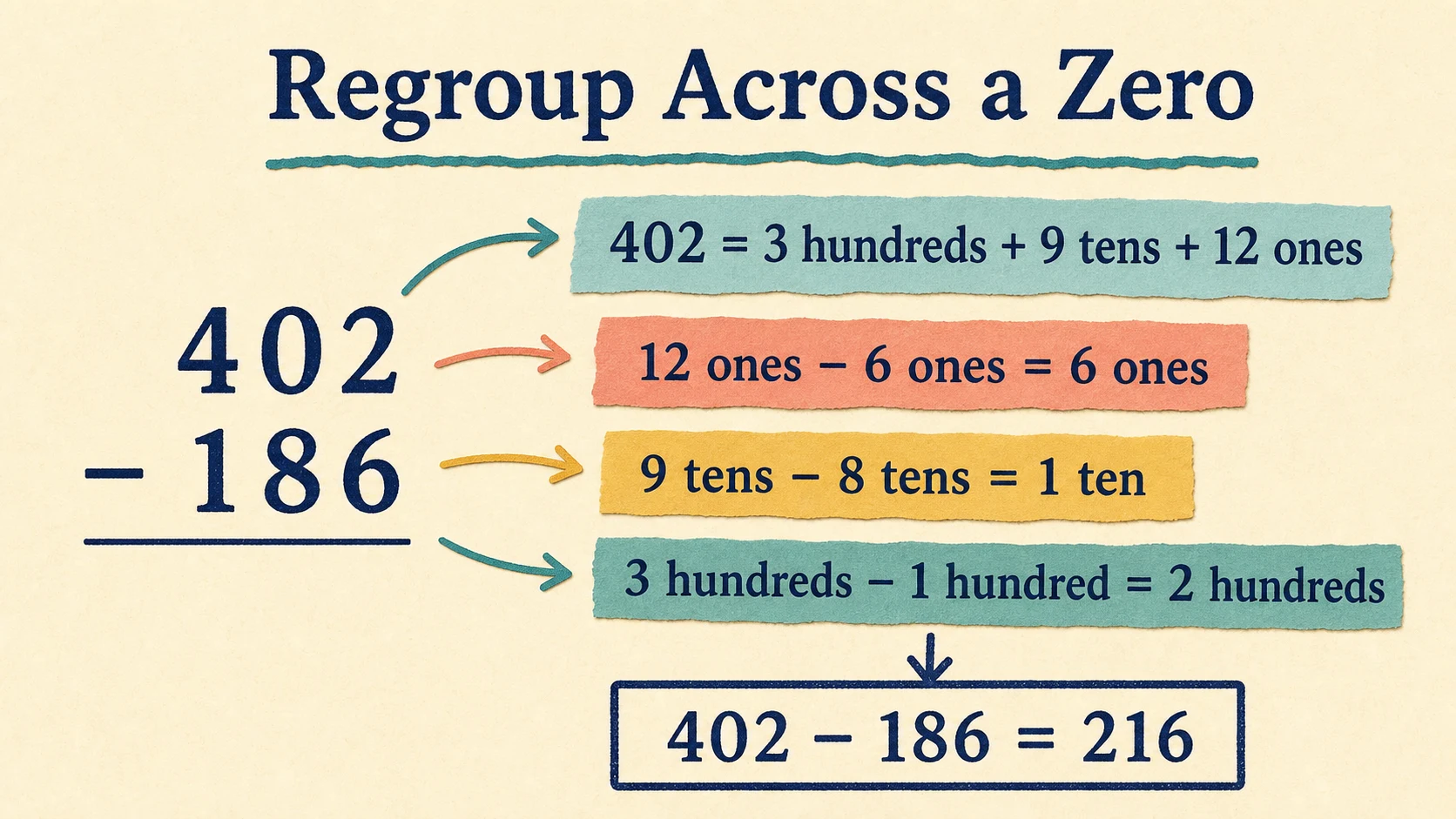
Example 4: Regrouping through zeros
Find:
400−156
Four hundred contains no recorded tens or ones. Regroup one hundred:
400=300+100
Then regroup that hundred into ten tens and trade one ten for ten ones:
400=300+90+10
Now subtract:
10−6=4
90−50=40
300−100=200
Combine:
200+40+4=244
Check:
244+156=400
Therefore:
400−156=244
Crossing out zeros without explaining the changes can produce fragile rules. The expanded equation shows where the new tens and ones come from.
Example 5: A comparison problem
Mina collected 326 counters. Luis collected 189 counters. How many more counters did Mina collect?
The phrase “how many more” signals a comparison. Both quantities are known, and their difference is unknown:
326−189
Estimate:
300−200≈100
Regroup and subtract:
16−9=7
After regrouping a ten, there is one ten left. Regroup one hundred to make eleven tens:
11−8=3
2−1=1
Thus:
326−189=137
Check:
189+137=326
Mina collected:
137 more counters
The unit belongs in the answer because this is a contextual problem.
Example 6: Equal numbers and zero difference
Find:
275−275
A quantity minus itself leaves no difference:
275−275=0
Check:
0+275=275
This boundary case matters because some learners assume a subtraction answer must be positive and nonzero. Zero is the correct difference when the two quantities are equal.
A Short, Repeatable Lesson Routine
A focused lesson can be brief. Its length should depend on the learner’s attention, accuracy, and need for explanation rather than a universal timetable.
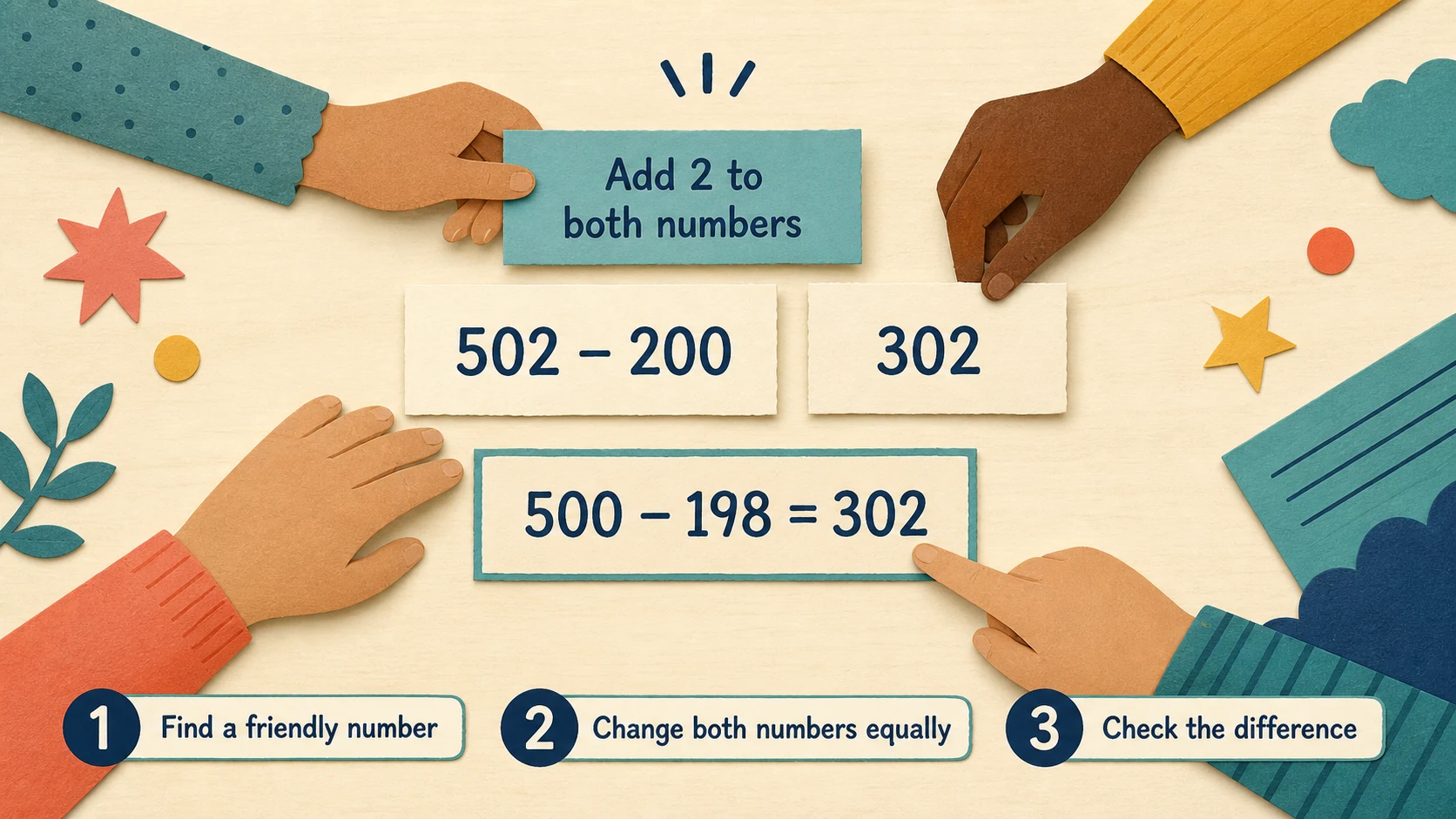
Each lesson moves from retrieval and modeling to guided and independent evidence.
1. Retrieve one prerequisite
Begin with two or three related facts or place-value prompts. Before teaching 74−38, for example, review 14−8, the value of seven tens, and the equivalence 74=60+14.
This warm-up should reveal readiness, not become a speed contest.
2. Present one problem and predict
Show one carefully chosen example. Ask the learner to estimate an interval:
- Is the answer greater or less than 50?
- Will regrouping be needed?
- Which place causes the first difficulty?
Prediction makes the later answer easier to evaluate.
3. Model and explain
Use blocks, a drawing, a number line, or expanded notation. Describe the quantity changes precisely. Then connect the model to the written record.
The IES practice guide for assisting students struggling with mathematics provides high-level support for systematic instruction, clear mathematical language, representations, and cumulative review. Applied here, that means demonstrating a small step, checking understanding, and revisiting previously learned subtraction rather than assigning an unexamined page of problems.
4. Solve together, then release
Complete one problem with prompts. Let the learner complete a structurally similar problem while explaining the decision points. Then offer one independent problem.
A useful prompt is, “What changed in the number when you regrouped?” A less revealing prompt is, “What do you do next?” The first checks meaning; the second may only test rule recall.
5. Check and record one observation
Use estimation or addition to verify the result. Record a short instructional note such as:
- Accurate without regrouping; needs a drawing when ones regroup.
- Place values aligned, but fact 15−7 was incorrect.
- Calculation correct; comparison sentence was misinterpreted.
That note should determine the next practice choice.
Selecting Practice and Differentiating Support
A worksheet is most useful when its problem structure matches the instructional need. More problems are not automatically better evidence.
Choosing the right practice set
Select a narrow set when introducing or repairing a skill:
- No-regrouping problems for place-value alignment.
- One-regrouping problems to establish a single trade.
- Problems containing zeros for regrouping across places.
- Comparison stories when operation selection is weak.
- Mixed forms only after individual forms are stable.
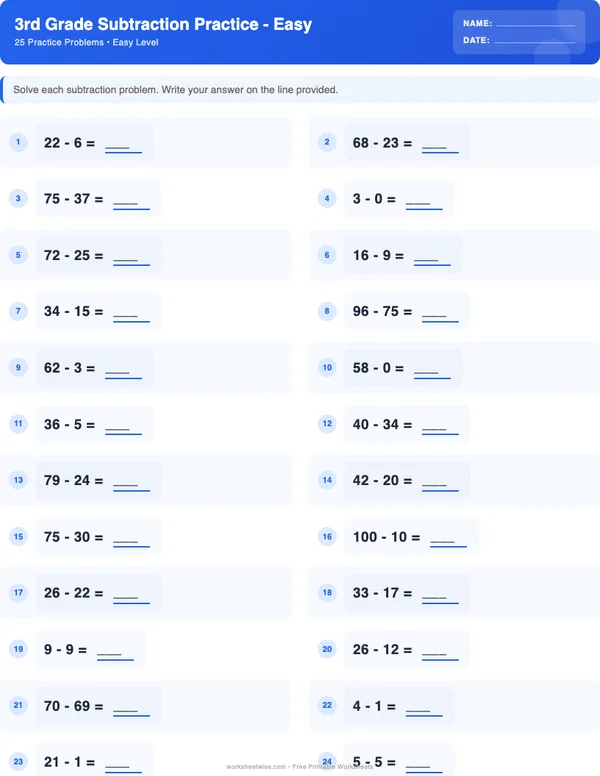
The free easy 3rd Grade Subtraction worksheet contains 25 exercises covering subtraction facts, mental math, number sense, and regrouping, with a separate answer key. It can provide initial or reinforcing practice, but the learner does not have to complete all 25 problems in one sitting. Choose a subset that supplies interpretable evidence.
For broader practice, the focused subtraction pack contains 18 worksheets and is listed at $4.79 in the catalogue. A larger collection is useful only when the adult selects pages intentionally; it should not replace diagnosis.
Increasing support without lowering the mathematical goal
When a learner is stuck:
- Reduce the number size while preserving the same subtraction structure.
- Provide a place-value chart.
- Allow base-ten blocks or quick drawings.
- Supply an addition fact to connect with the subtraction fact.
- Cover unrelated problems so attention stays on one calculation.
- Ask for an estimate before written computation.
- Alternate one modeled problem with one learner-completed problem.
For 402−187, a learner who is overwhelmed by zeros could first solve 42−17, then 302−187, and finally return to 402−187. The support changes the path, not the underlying expectation that regrouping must preserve value.
Extending secure understanding
When calculation is consistently accurate, increase reasoning rather than merely increasing the number of digits:
- Ask for two methods and compare their efficiency.
- Provide a wrong solution to analyze.
- Hide a digit in a subtraction equation.
- Ask the learner to write removal, comparison, and missing-part stories.
- Give an answer and ask for possible starting equations.
- Mix addition and subtraction so the operation cannot be guessed from the page title.
For example, if 600−?=247, the missing subtrahend can be found through 600−247=353. Verify:
247+353=600
Common Errors and Diagnostic Responses
An error is evidence about the learner’s current reasoning. Correcting the answer without identifying that reasoning may leave the cause untouched.
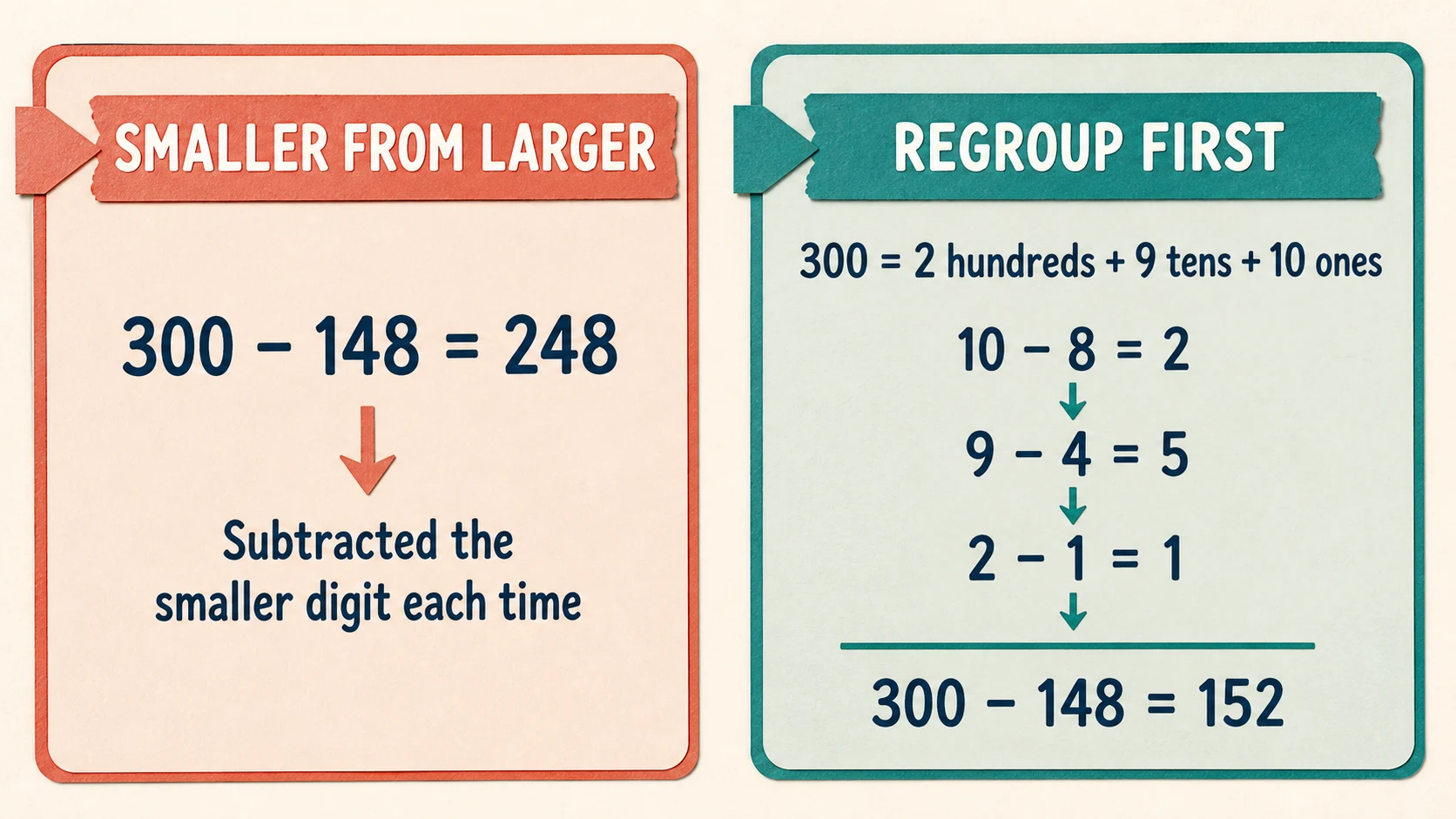
Match the teaching response to the demonstrated error pattern.
| Observed work |
Likely issue to investigate |
Teaching response |
| 43−25=22 from calculating 5−3 and 4−2 |
Smaller-from-larger rule used regardless of position |
Build 43 with base-ten blocks and physically attempt to remove 25 |
| 63−28=45 after changing 3 to 13 but leaving 6 tens unchanged |
Regrouping treated as adding ten ones |
Show that one ten was exchanged: 63=50+13 |
| 400−156=356 |
Zero crossing handled as a memorized mark-changing procedure |
Expand 400 as 300+90+10 |
| 302−187=225 |
Multiple regroupings not tracked consistently |
Use a place-value chart and record one trade at a time |
| Correct computation but wrong operation in “how many more” |
Comparison structure is not understood |
Draw two bars with aligned starting points and mark the difference |
| Answer is greater than the starting quantity |
No magnitude check |
Estimate before calculating and compare the answer with the minuend |
| Accurate model, incorrect written algorithm |
Representation-to-symbol connection is incomplete |
Label each block or drawing with its corresponding written digit |
| Frequent isolated fact errors |
Basic facts are not yet efficiently derived |
Practice related addition facts and fact families separately |
One wrong answer is not enough to establish a pattern. Ask the learner to solve a similar problem and explain it. If 52−27 is wrong but 61−36 is correct and well explained, the first result may be a recording slip rather than a conceptual gap.
Avoid diagnosing a learner from speed alone. Slow, accurate reasoning may represent developing control. Conversely, fast answers based on subtracting the smaller digit from the larger can conceal a significant misunderstanding.
Monitoring Progress Without Over-Testing
Progress monitoring should answer a practical question: what should be taught next?
Keep a simple record with four categories:
- Meaning: Does the learner identify removal, comparison, or a missing part?
- Representation: Can the learner model a trade and explain equivalence?
- Calculation: Are place-value steps and facts accurate?
- Verification: Does estimation or addition confirm the answer?
At the end of every few sessions, give a small mixed check:
- One fact-based problem.
- One multi-digit problem without regrouping.
- One problem with regrouping.
- One problem involving a zero.
- One short contextual problem.
Do not average all errors into a single impression. A result of four out of five could mean the learner is ready to move forward, or it could reveal a repeated failure on every zero-regrouping problem. The type of error matters more than the raw total.
Look for independence across several opportunities. Useful evidence includes selecting a method without prompting, explaining a trade, detecting an unreasonable result, and correcting work through an addition check. Mastery should not be inferred from one copied example or one unusually easy page.
A Two-Week Practice Plan
This plan is an instructional suggestion, not a sourced or universal schedule. Shorten, repeat, or reorder sessions according to the learner’s work. A day may include only a few carefully selected problems if discussion and modeling are productive.
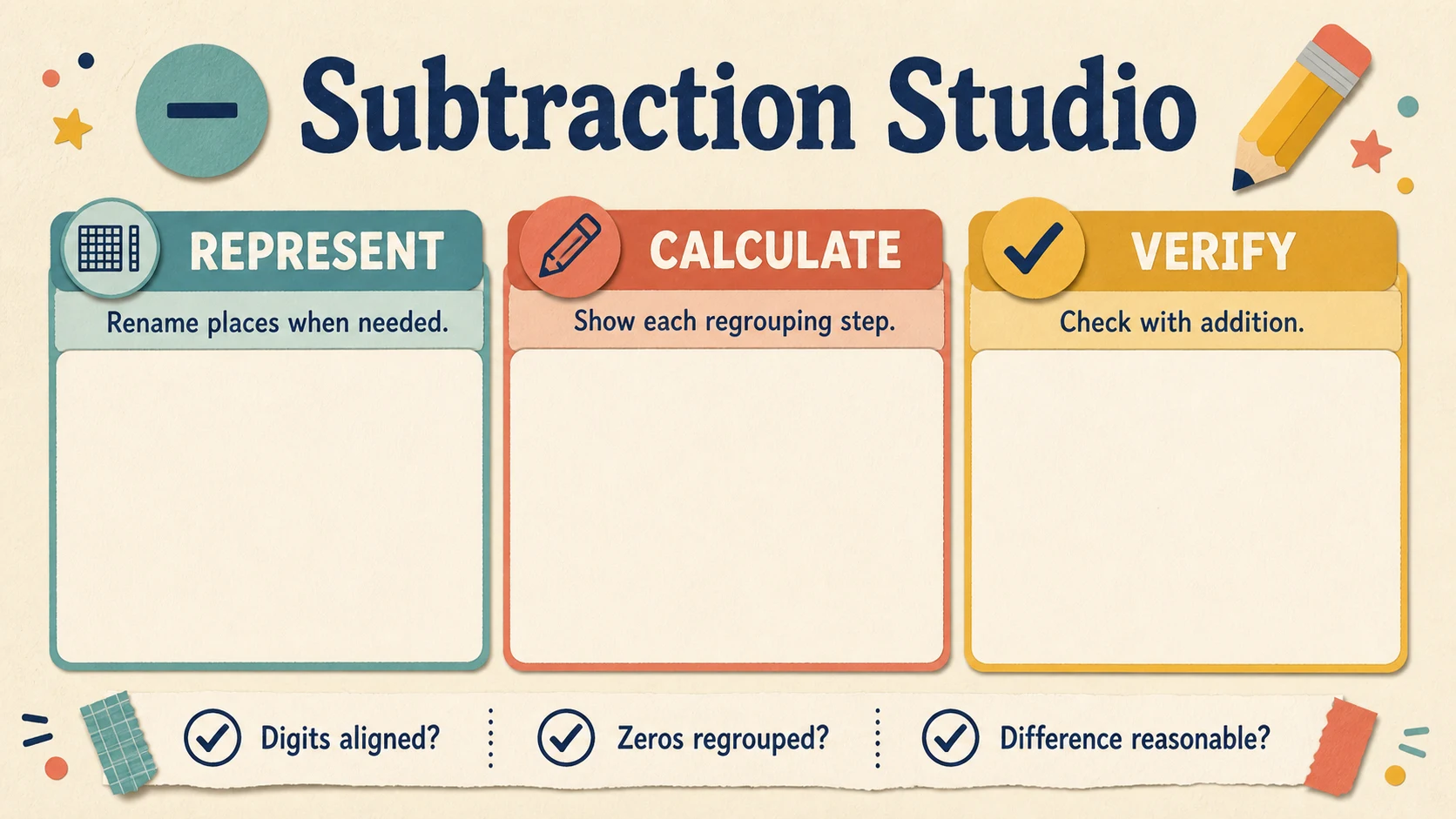
The plan alternates focused instruction, cumulative review, context, and monitoring.
| Day |
Focus |
Suggested activity |
Decision point |
| 1 |
Baseline |
Solve facts, one no-regrouping problem, one regrouping problem, and one story problem |
Identify fact, place-value, or interpretation needs |
| 2 |
Meanings |
Sort removal, comparison, and missing-part situations; write matching equations |
Can the learner explain why subtraction fits? |
| 3 |
Place value |
Build and draw three-digit numbers; subtract without regrouping |
Are digits aligned and decomposed correctly? |
| 4 |
Regroup ones |
Use blocks for examples such as 72−46 |
Does the learner preserve the total during a trade? |
| 5 |
Review |
Mix facts, no-regrouping work, and one-regrouping work |
Repeat Day 4 if the trade cannot be explained |
| 6 |
Regroup hundreds |
Solve examples requiring a hundred to become ten tens |
Is each changed place recorded? |
| 7 |
Multiple trades |
Work through problems such as 532−178 |
Can support shift from blocks to quick drawings? |
| 8 |
Zeros |
Model 300−128, 405−167, and similar cases |
Does the learner know where new units come from? |
| 9 |
Word problems |
Compare removal, comparison, and missing-part stories |
Is the operation chosen from the relationship? |
| 10 |
Mixed check |
Complete five varied problems, explain one, and verify two |
Select the next worksheet or reteaching focus from the errors |
Keep cumulative review small but regular. On a day focused on zeros, include one earlier no-regrouping problem and one basic fact. This shows whether earlier learning remains available without turning the session into an indiscriminate mixture.
Limits and a Responsible Next Step
A topic guide can organize instruction, examples, and practice choices, but it cannot determine why a particular learner is struggling from a single score. It is not medical guidance, a guarantee of outcomes, or a claim of comprehensive alignment with every local curriculum. The cited sources provide broad instructional framing; they have not evaluated WorksheetWise, this guide, or the downloadable worksheet.
Printed work also captures only part of mathematical understanding. Listen to the learner’s explanation, observe whether a model is used meaningfully, and note whether an answer is checked. If persistent difficulty extends beyond the practice you can interpret confidently, share specific work samples and error patterns with the learner’s teacher or another qualified education professional.
For the immediate next step, give the learner five selected problems from the free 3rd Grade Subtraction worksheet: one fact, one no-regrouping example, two regrouping examples, and one problem involving zero if available. Check the answers with the included key, but also ask for an explanation of one trade. Use that evidence to revisit this Subtraction topic guide, choose focused practice from the pack, or create a more narrowly targeted set with the free worksheet generators.