3rd Grade · 11 live skills
3rd Grade math worksheets
Pick the exact skill below. Each page combines a real free download, a separate answer key, practical teaching guidance and an optional focused pack.
See all 3rd Grade subjects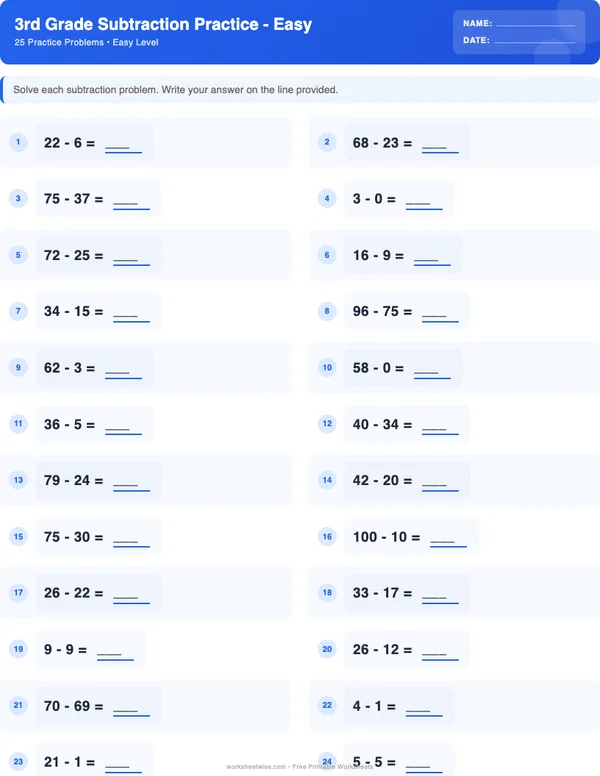
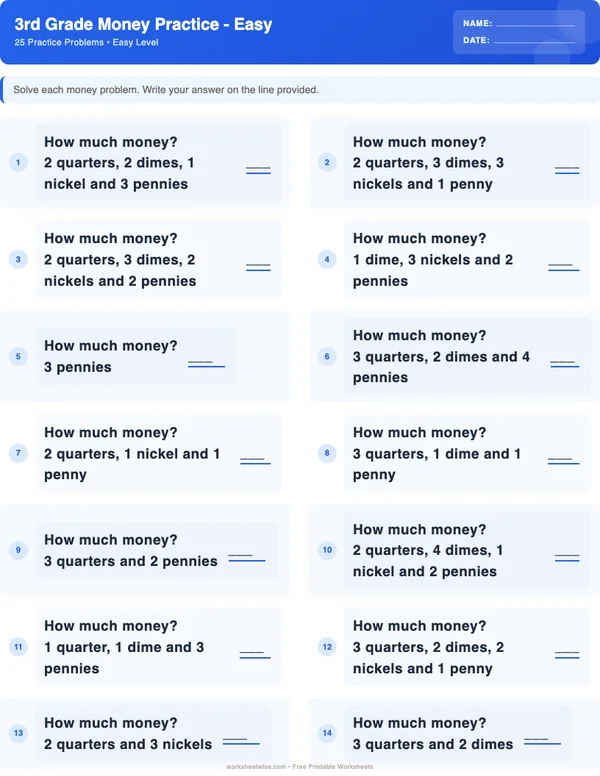
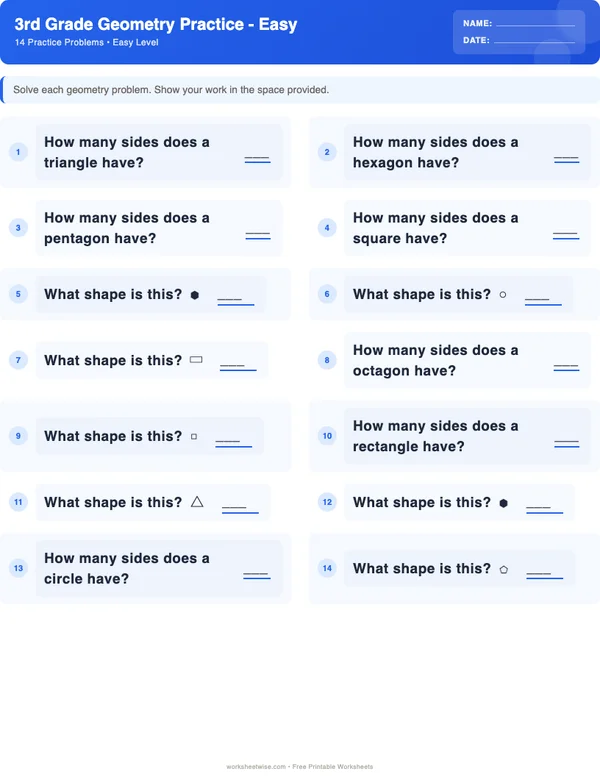
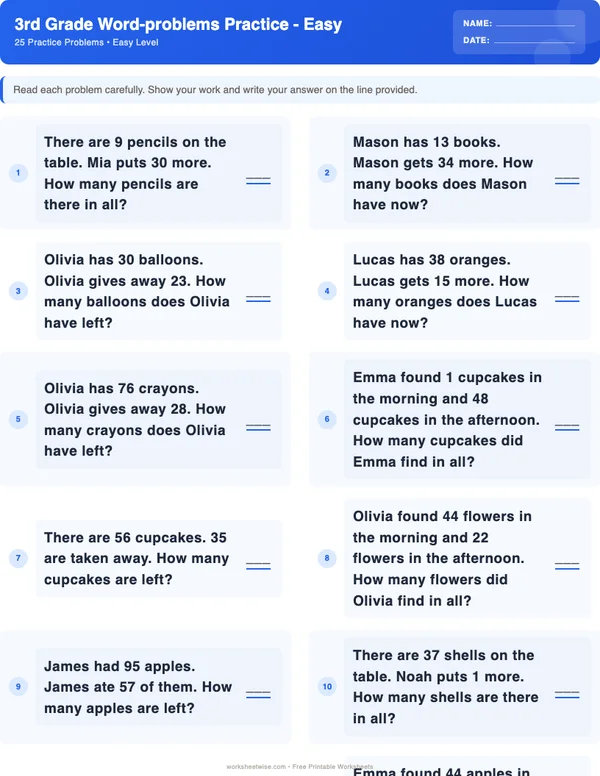
Complete guide
How to teach and practise 3rd grade math worksheets
3,475 words Updated 6 instructional visuals
Choose one skill before printing a worksheet
The live 3rd grade math catalogue contains 198 worksheet variants across 11 topics, with one free entry point for each topic. The useful starting question is not “Which worksheet is 3rd grade?” It is “What specific mathematical action should the learner practice next?”
Choose one bounded target, such as:
- Add two three-digit numbers and explain one regrouping.
- Interpret multiplication as equal groups.
- Use a related multiplication fact to solve division.
- Locate a fraction on a number line.
- Read an analog clock when the minute hand has passed 30.
- Distinguish area from perimeter.
- Represent a word problem before choosing an operation.
Then sample three to five items rather than assigning an entire page immediately. Watch how the learner works, check the answers, and use the error pattern to decide whether to continue, add a model, or move to a prerequisite.
Grade labels describe intended practice level; local curriculum sequences differ. “3rd Grade” is therefore a catalogue guide, not proof that every learner has already been taught every listed skill. Likewise, age is a discovery aid rather than a placement decision. For ages three and four, prioritize brief adult-led oral, matching, manipulative, and movement work over desk work.
The free sheets in this catalogue are marked “easy.” Here, that label is useful only when translated into observable task features: the free sheets provide introductory entry points, contain bounded sets of problems, and are intended to make a topic accessible for initial practice. Do not label a learner “easy,” “developing,” or “advanced.” Describe the work instead: “She represented every group correctly but calculated two facts inaccurately,” or “He can read times to five minutes but changes the hour too soon after :30.”
Read the catalogue as a connected progression
The 11 live topics are Addition, Subtraction, Multiplication, Division, Fractions, Decimals, Place Value, Telling Time, Money, Geometry, and Word Problems. They are related, but they are not interchangeable.
Place value supports multi-digit addition and subtraction. Addition supports multiplication as equal groups, while multiplication supplies facts that can unlock division. Fractions and decimals both describe quantities between whole numbers, but their representations and common errors differ. Telling time and money apply number relationships within specialized systems. Geometry asks learners to reason about attributes and measures, not merely calculate. Word problems require the learner to represent a situation and select an operation; a correct calculation alone may not show that the situation was understood.
The Common Core mathematics standards provide one reference sequence for grade-level work, including place value, operations, fractions, measurement, and geometry. They do not determine the exact order used by every school or local curriculum. Use the standards as sourced orientation, not as evidence that a particular worksheet has taught or assessed mastery.
Place value before a procedure
A learner who writes may not need “more addition” in general. The learner may need to coordinate ones, tens, and hundreds while regrouping. Ask for a decomposition:
Combine by place:
This checked example belongs in 3rd grade practice because the live Addition and Place Value resources both progress toward multi-digit work, and the addition guidance explicitly connects regrouping to place-value understanding. If the learner can obtain 541 but cannot explain why 11 ones can be renamed as 1 ten and 1 one, retain the addition target while adding base-ten blocks or a quick drawing.
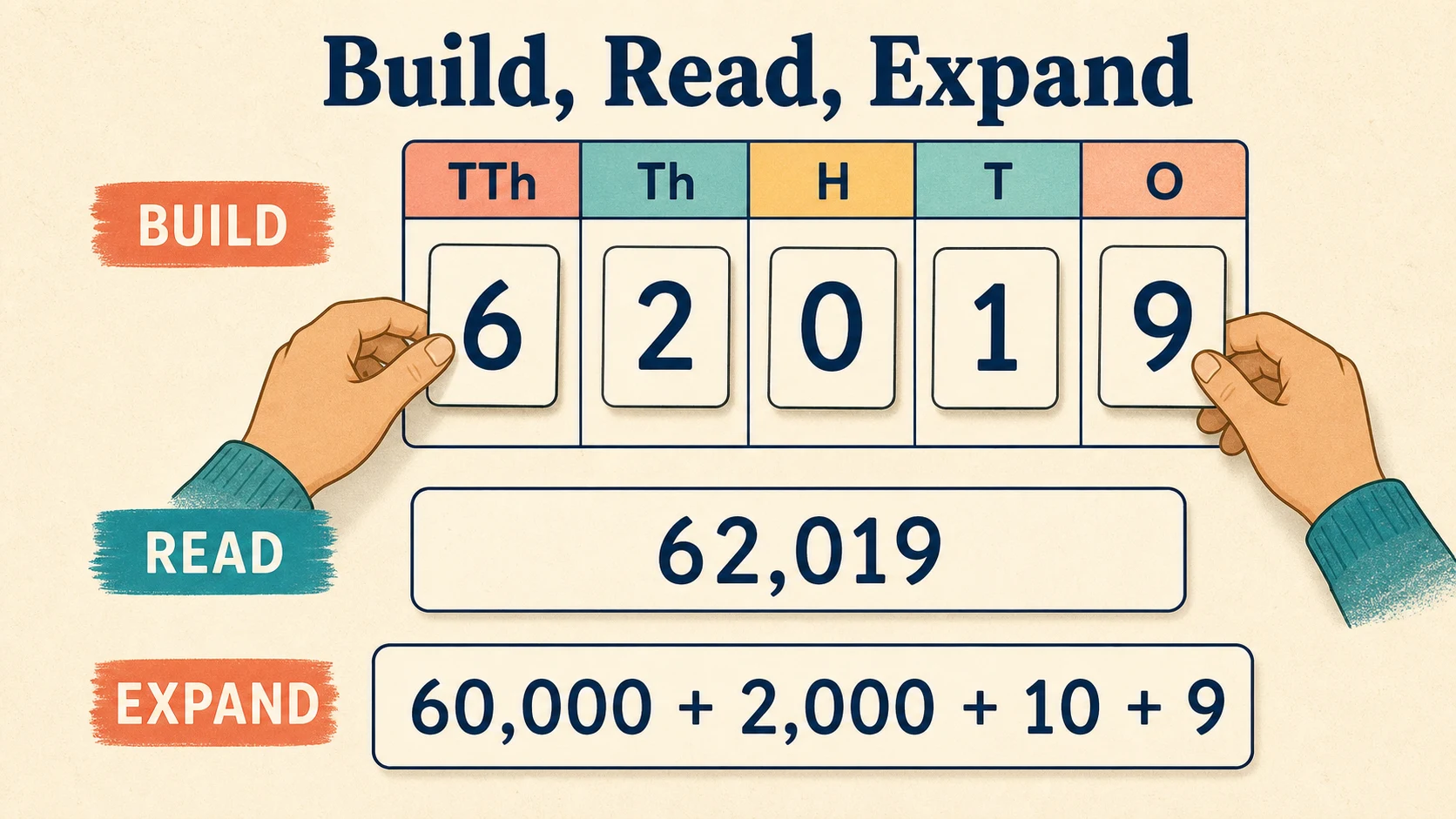
Use a place-value routine to expose the meaning of a trade before asking for repeated written computation.
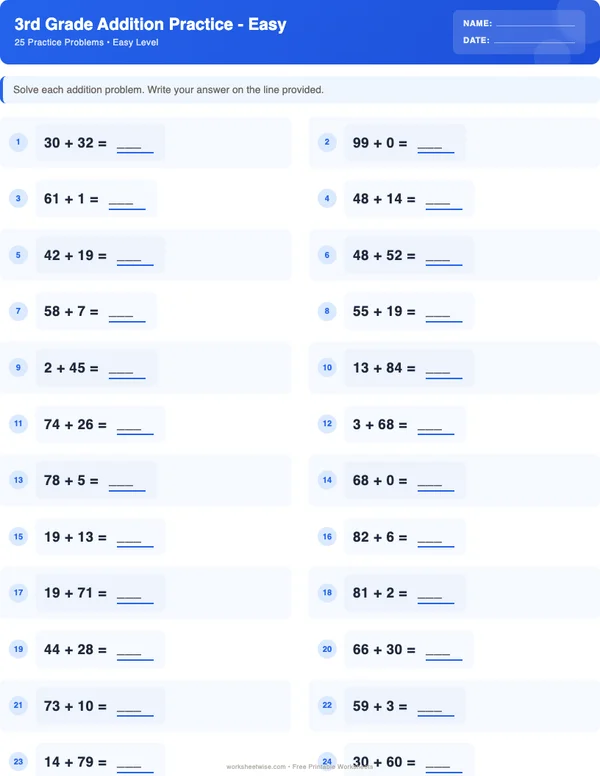
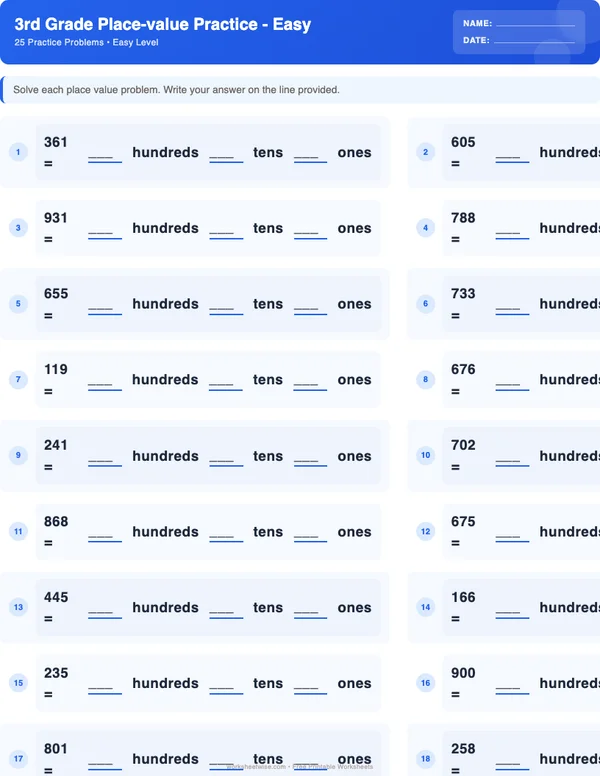
The live free Place Value sheet contains 25 problems. Start there when the learner cannot reliably state the value of a digit, compose or decompose a number, compare nearby numbers, or explain a regrouping. Start with the 3rd Grade Addition guide and free sheet when place values are secure and the remaining need is accurate addition practice.
Addition and subtraction are inverse relationships
Addition and subtraction should be compared through the same quantities. For example:
Check with subtraction:
For the addition, , so write 3 ones and regroup 1 ten. Then tens, and hundreds. The result is 383. The inverse calculation returns the starting addend, so the pair is internally consistent.
This example belongs here because both live free sheets have 25 problems, but they exercise different actions. Addition combines quantities; subtraction may represent removal, comparison, or a missing part. If a learner sees only as “take away,” also ask: “136 plus what equals 383?” That reframing can separate an operation-choice problem from a calculation problem.
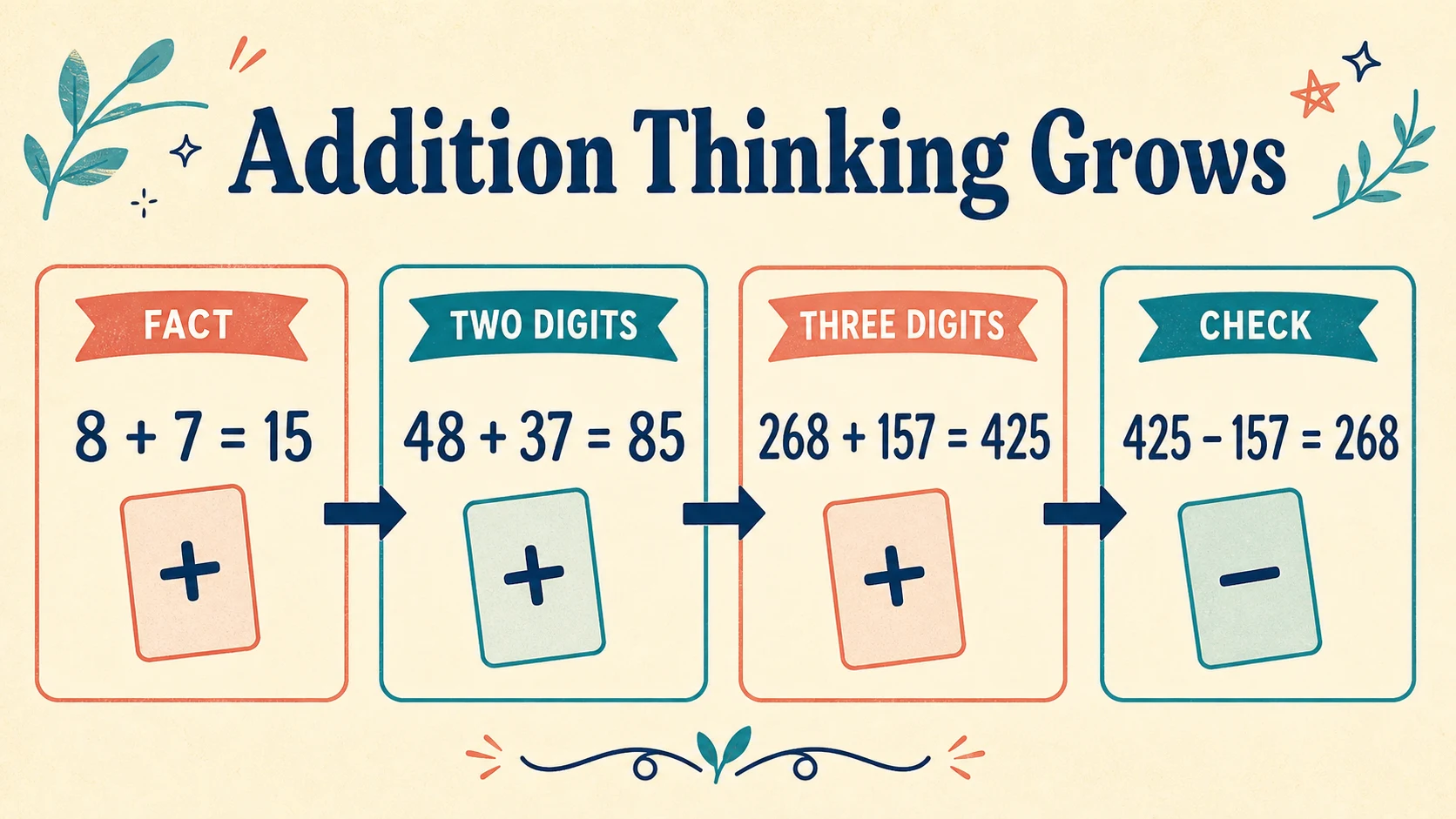
Move from a place-value model to an equation, then remove the model only after the learner can explain the regrouping.
Separate equal groups from fact recall
The live Multiplication and Division topics form a closely related pair. Multiplication begins with equal groups and arrays; division includes both sharing equally and finding how many groups can be made. A learner can know a fact but still misinterpret a situation, or understand a model while recalling facts slowly.
Check the model before timing facts
Suppose there are 4 trays with 6 muffins on each tray.
The answer is 24 muffins. It can be checked by repeated addition:
It can also be shown as a 4-row-by-6-column array. Turning the array gives 6 rows of 4, which still contains 24 objects:
This example belongs in the 3rd grade multiplication progression because the live topic starts with equal groups and arrays before fact fluency and later computation. If the learner writes , the issue is not necessarily arithmetic weakness; the response suggests that the learner has not yet represented “4 groups of 6.” Build or draw the groups, then write the equation beneath them.
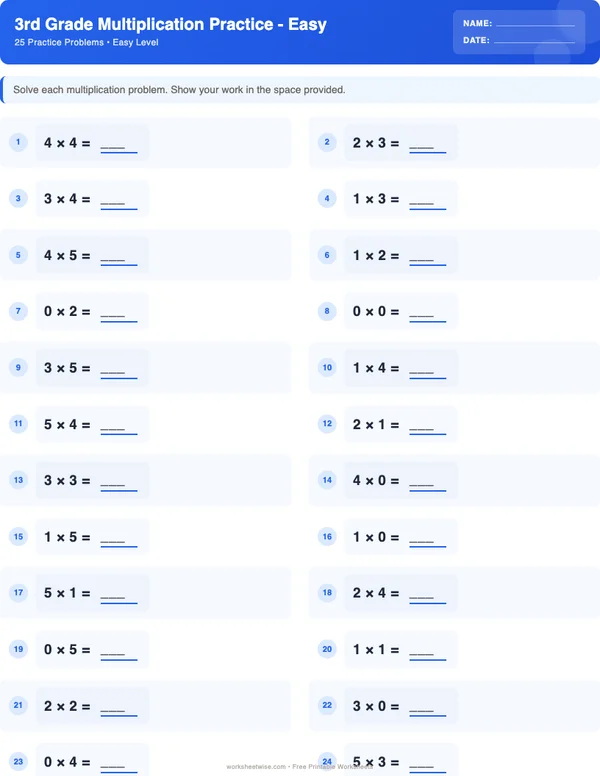
The 3rd Grade Multiplication guide and free sheet offers a 25-problem entry point. Use it when the learner can interpret equal groups and now needs practice applying multiplication facts. If the representation itself is uncertain, begin with fewer oral and drawn situations rather than requiring all 25 answers.
Division requires two distinct interpretations
Consider 24 counters and 6 bags.
In an equal-sharing interpretation, place the 24 counters equally into 6 bags:
Each bag receives 4 counters.
In a grouping interpretation, ask how many groups of 6 can be made from 24:
There are 4 groups.
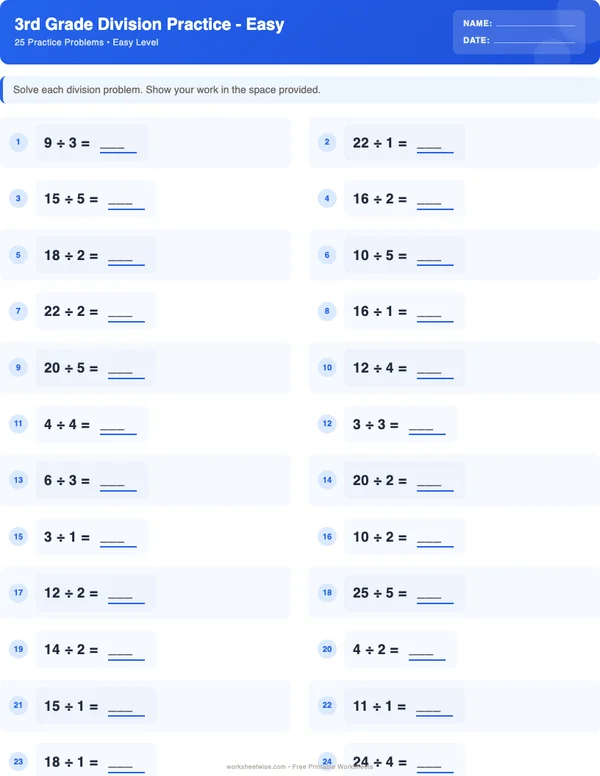
The numerical equation is identical, but the meaning of 4 changes. This checked example belongs here because the live Division resource explicitly includes both sharing and grouping situations and connects division to multiplication.
Check with:
If the learner makes 6 groups of 4 when asked “How many groups of 6?” the total and fact family may be correct, but the model answers a different question. Ask the learner to point to what the divisor represents in the story before correcting the equation.
Build fractions as numbers, not decorated shapes
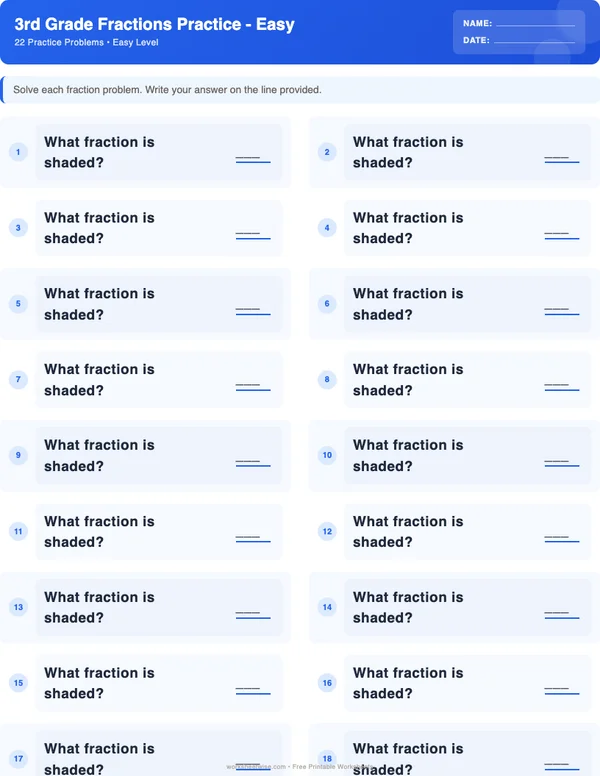
The live Fractions resource has 22 problems and covers identification, comparison, equivalence, mixed numbers, and operations across its broader progression. A sensible 3rd grade starting target is narrower: partition a whole into equal parts, name a fraction, locate it on a number line, or compare fractions with a shared numerator or denominator when that comparison has been taught.
Work a number-line comparison
Compare and .
Both fractions have 3 as the numerator, but the whole is partitioned differently. Fourths are larger pieces than eighths. On equal-length number lines:
Therefore:
The decimal conversions verify the comparison, but they need not be the teaching method. A fraction strip or number line shows the relationship more directly: three fourth-size steps travel farther from zero than three eighth-size steps.
This example belongs here because the catalogue’s fraction progression explicitly includes number lines and comparison. If the learner says because 8 is greater than 4, the response points to a denominator interpretation error. Return to equal wholes divided into four and eight equal sections. Do not respond with a rule alone.
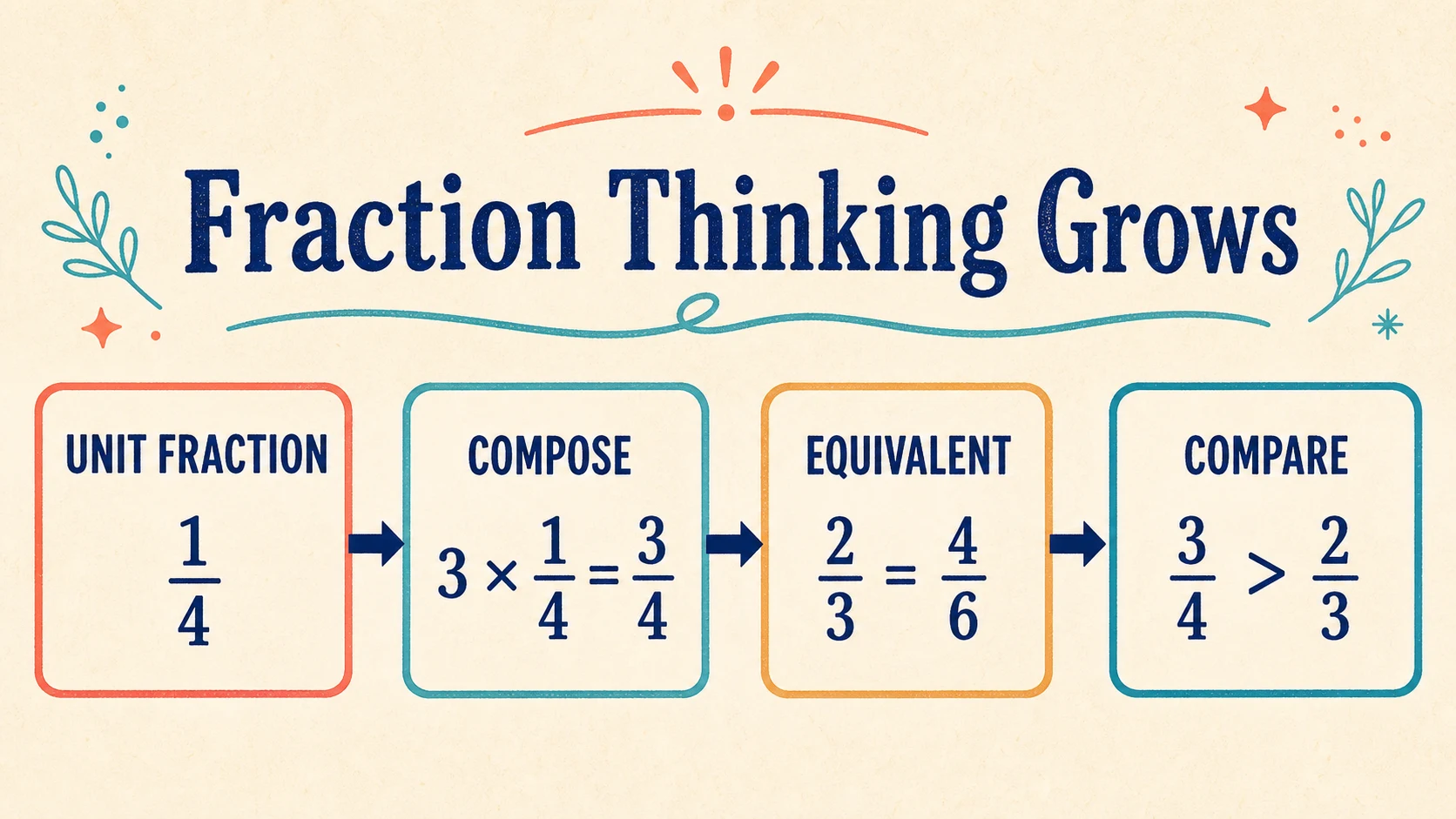
Keep the whole constant while moving from partitioned models to number-line locations and then to symbols.
The IES guide on assisting students who struggle with mathematics recommends systematic instruction that includes clear mathematical language, representations, worked examples, and deliberate practice. That guidance is not an evaluation of WorksheetWise. Applied here, it supports a short sequence in which an adult models one comparison, completes one with the learner, and then observes one independent attempt.
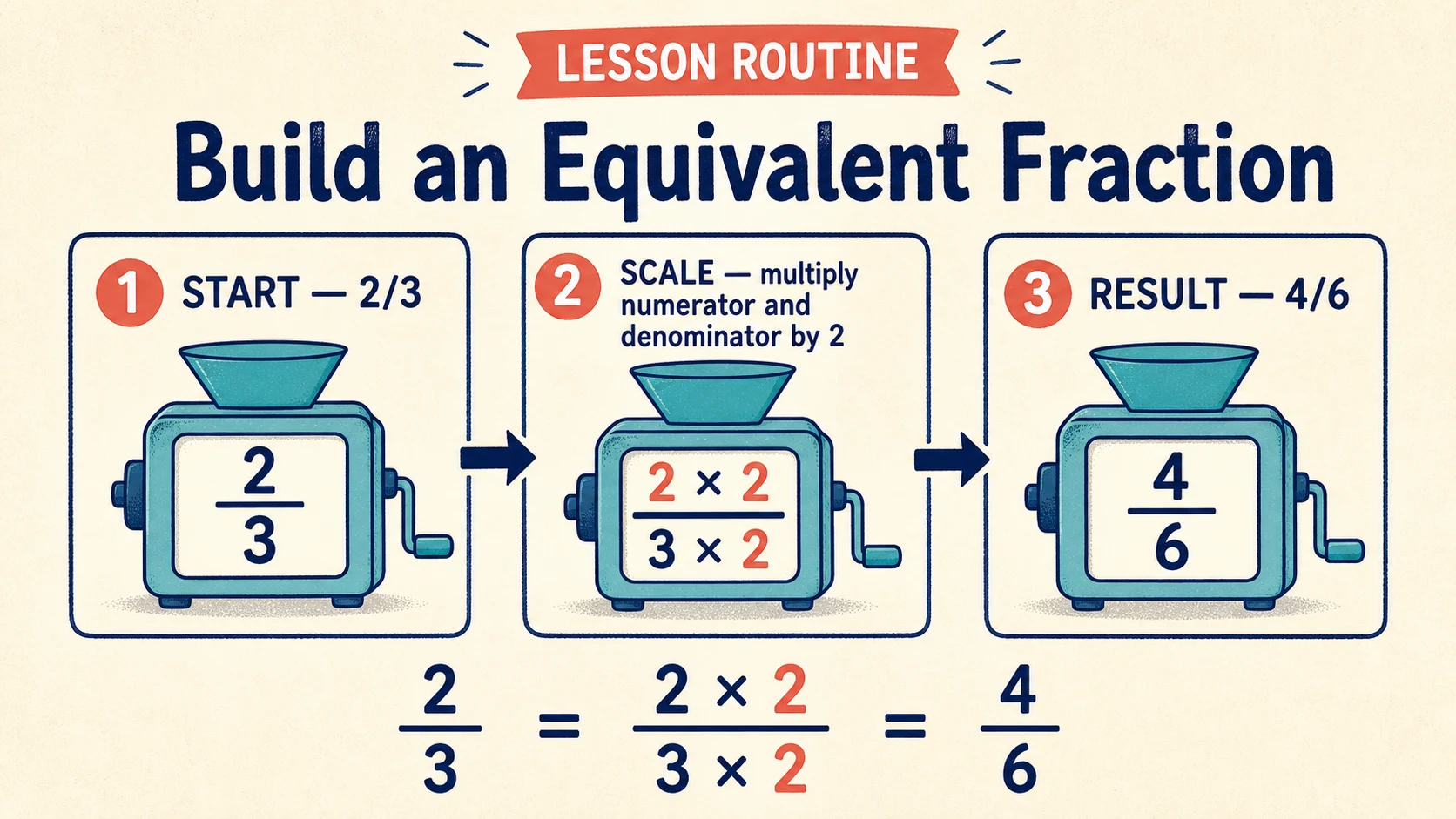
Repeat a compact model-explain-try-check cycle instead of mixing identification, equivalence, and operations in one sitting.
Use the 3rd Grade Fractions guide and free sheet when the learner can maintain equal wholes and needs a focused set of symbolic and visual fraction tasks. Pause if the learner treats unequal pieces as equivalent merely because the number of pieces matches.
Treat decimals as place value extending rightward
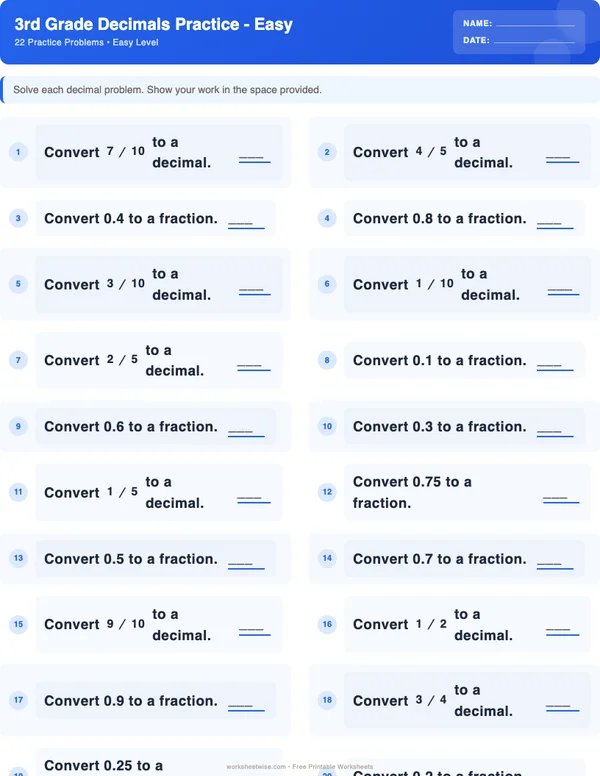
The live Decimal resource also has 22 problems. It connects decimal notation with tenths, hundredths, fractions, comparison, rounding, and computation across the topic progression. Before asking for decimal operations, check whether the learner understands each digit’s value.
Compare by equivalent place values
Compare and .
Rewrite as . Now compare hundredths:
Thus:
A hundredths grid would show 40 shaded cells versus 36. This example belongs here because the live decimal guidance specifically identifies the mistaken belief that a longer decimal must be larger.
If the learner chooses , ask, “Which is greater: 40 cents or 36 cents?” Then connect the money representation back to and . Money is a bridge, not a substitute for place-value language: the learner should ultimately be able to say “four tenths equals forty hundredths.”
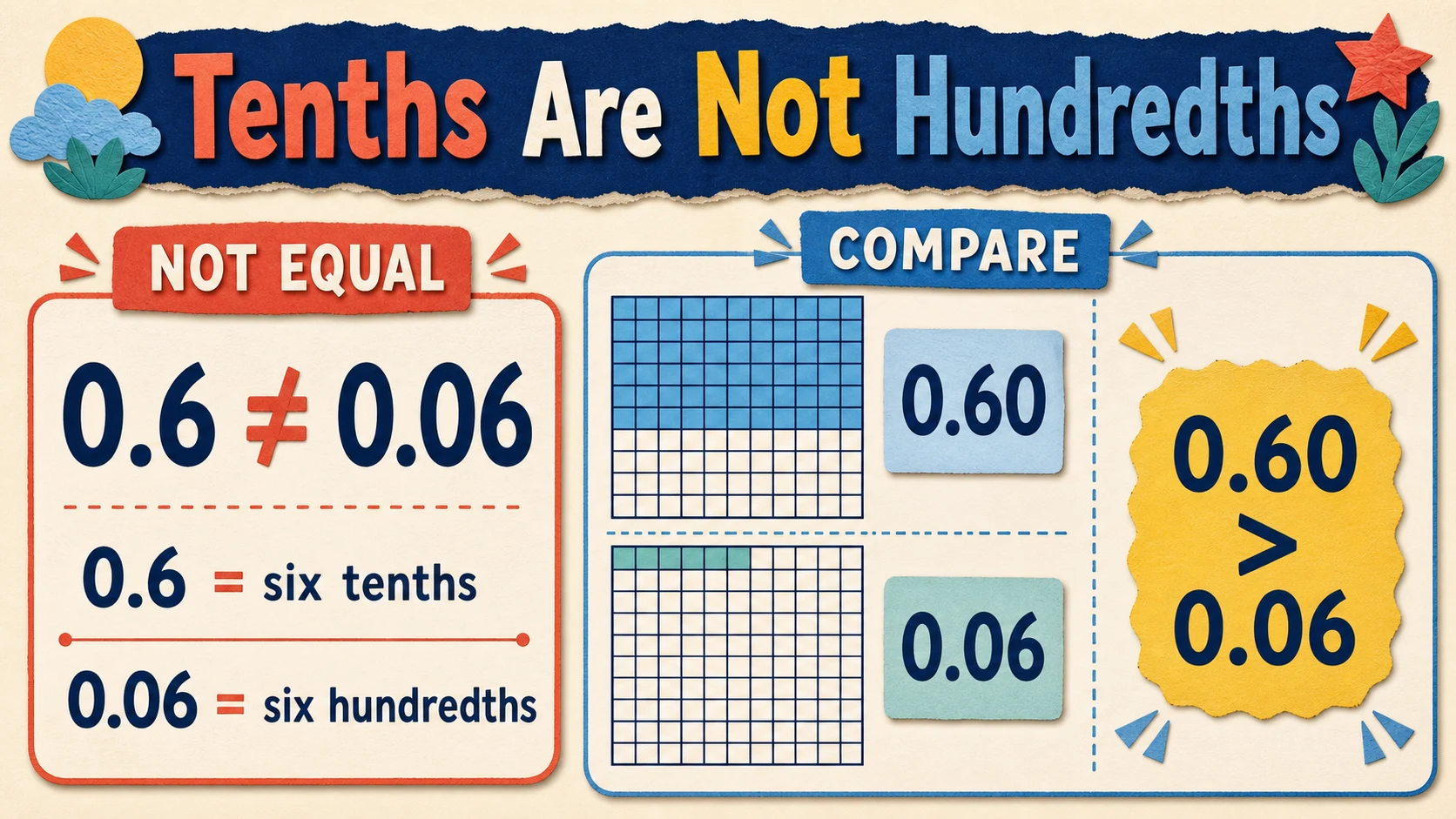
Match the response to the observed misconception: align place values, model hundredths, and compare quantities before practicing more items.
The 3rd Grade Decimals guide and free sheet is a reasonable entry point if decimal notation is already part of the learner’s local sequence. If it has not been taught, choose place value, fractions, or money rather than treating the grade label as a mandate.
Use time, money, and geometry without losing the mathematics
Applied topics can reveal whether a learner transfers number knowledge, but familiar contexts can also conceal different mathematical demands.
Read the hour hand before counting minutes
Suppose an analog clock’s minute hand points to 9 and its hour hand lies between 3 and 4.
The minute hand at 9 represents:
The hour hand has passed 3 but has not reached 4. The time is:
It is not 4:45. This checked example belongs here because the live Telling Time resource progresses through five-minute intervals and identifies premature hour changes after :30 as a common error.
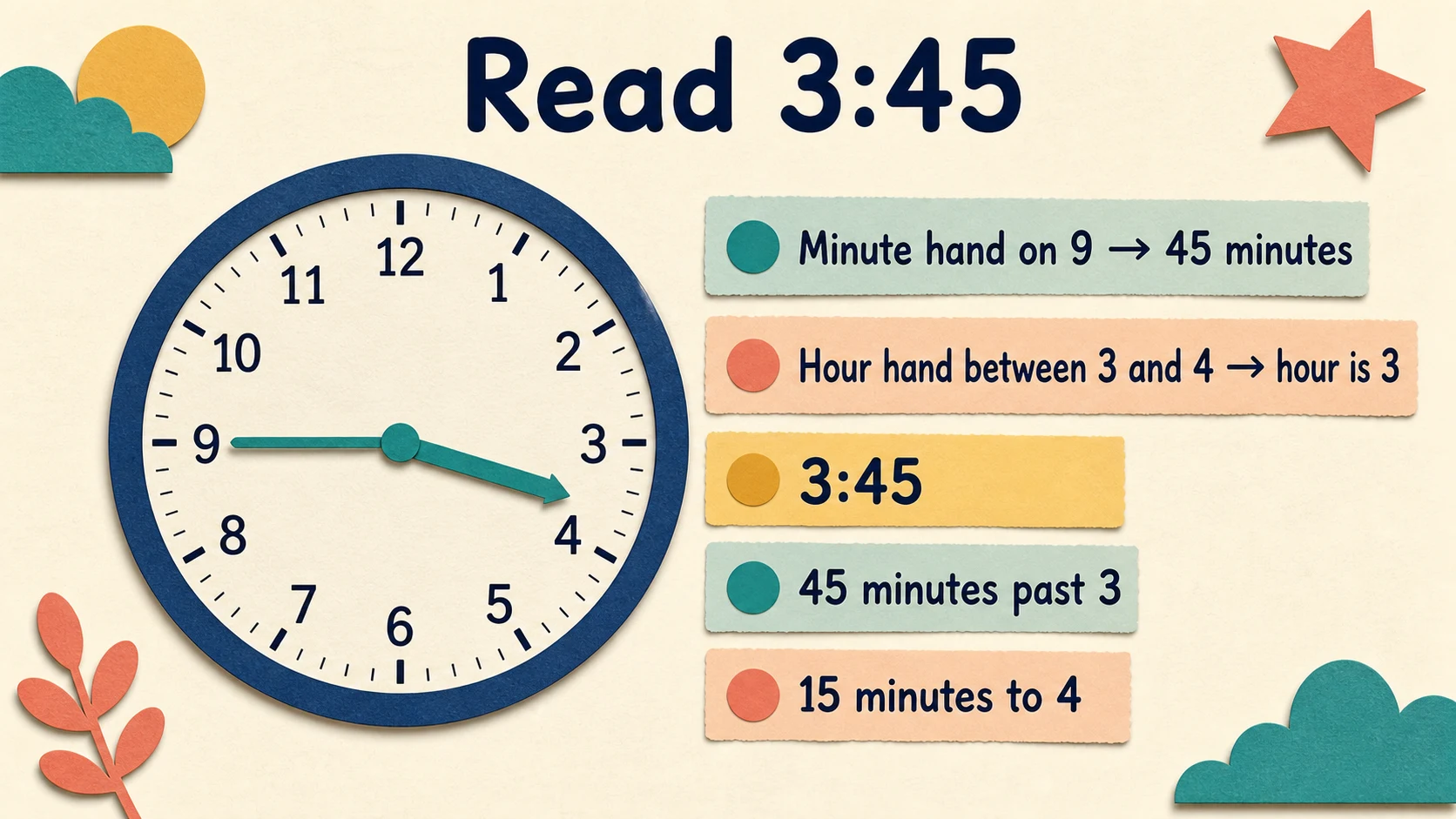
Read the slowly moving hour hand in relation to two numerals, then determine the minutes.
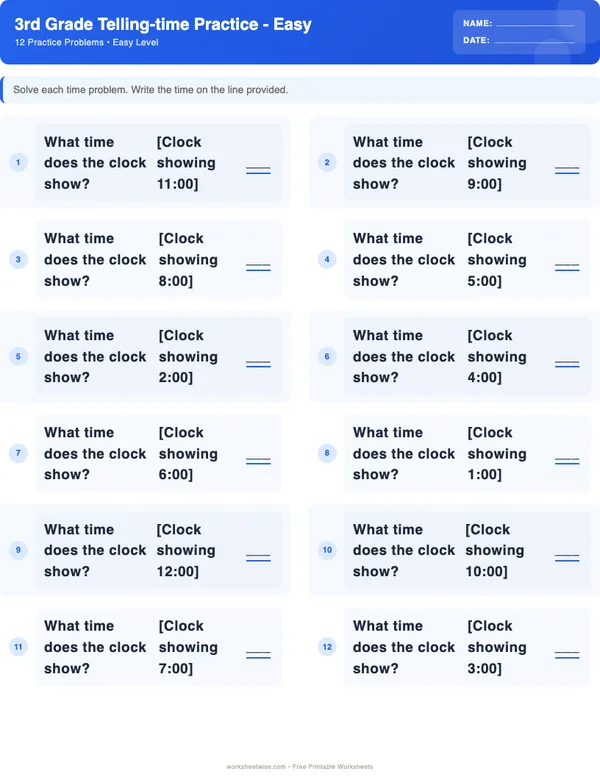
The free Telling Time sheet has 12 problems, fewer than most other topic entry points. That count does not make it simpler; analog clocks require coordinating two hands with different units and rates of movement. Use a geared demonstration clock if available, or move paper hands together so the hour hand does not remain fixed.
Keep area and perimeter physically distinct
Build a rectangle 3 units by 4 units.
Area counts square units:
Perimeter measures the boundary:
This example belongs in the live Geometry progression because that topic includes both area and perimeter and recommends beginning with square tiles. If a learner answers 12 for both measures, ask the learner first to cover the surface with tiles and then trace the outside edge. Preserve the same rectangle while changing the action.
For money, similarly distinguish calculating a total from making change. If an item costs $3.67 and the customer pays $5.00, count upward:
The change is:
Check:
This verified example fits the catalogue’s Money progression, but it may exceed an individual learner’s current starting point. If so, retain the money context while reducing the target to counting a mixed coin collection or finding a total without change.
Make word problems a representation task
The live Word Problems entry point contains 14 problems. The topic spans all operations, so “word problems” is too broad to be a useful target. Select one situation type: part-part-whole, comparison, equal groups, equal sharing, or a two-step sequence.
Consider: “A class packs 6 markers into each box. It fills 4 boxes and has 3 markers left. How many markers are there?”
Represent the filled boxes:
Add the unpacked markers:
There are 27 markers.
Check the story, not merely the calculations: four groups of six account for 24, and the additional three produce 27. A learner who computes has treated every numeral as a quantity to add without representing the relationships. A learner who answers 24 has completed only the first step.
Do not teach “each means multiply” as a universal keyword shortcut. Ask the learner to retell the situation, draw boxes or a bar model, label known quantities, and state what must be found. The IES mathematics intervention guide supports instruction that makes mathematical structure explicit and uses visual representations; it does not claim that any single diagram works automatically for every learner.
Interpret errors before assigning another page
An incorrect answer is evidence about one attempt, not a diagnosis. Look for a repeated, explainable pattern across a small sample.
Operation-choice errors
If the computation is accurate but the selected operation does not match the situation, ask for a retelling and model. For example, is numerically correct but irrelevant if the question asks for the total in 6 groups of 24. Keep numbers small enough that calculation does not obscure interpretation.
Place-value errors
Digits may be misaligned, trades may be performed without conserving quantity, or decimals may be compared by length. Use a place-value chart, expanded form, or base-ten representation. After the model, return to one closely matched symbolic item to see whether the idea transfers.
Fact-recall errors
A learner may build groups of correctly and then state 40. The model is sound; the fact is not. Use a derived fact:
Then check with . This calls for fact-strategy practice, not reteaching the meaning of equal groups from the beginning.
Representation errors
Unequal fraction parts, a stationary hour hand, or perimeter counted in square units indicate that the representation itself is inaccurate. Rebuild the representation with the learner. Merely marking the final answer wrong will not expose what must change.
Isolated slips
If the learner explains the method, completes nearby items correctly, and catches the error when checking, treat it as an isolated slip. Ask for a correction and one confirming item. Do not infer a broad weakness from a reversed digit or one skipped step.
Use a short worksheet routine that produces evidence
The IES early mathematics practice guide emphasizes building instruction around developmental progressions, monitoring what children know, and helping them describe mathematical ideas. Although the guide focuses on young children, those principles can inform adult support without implying that IES reviewed these worksheets.
Use this 12- to 18-minute routine:
Preview one target
State the action in observable language: “Today you will compare decimals by place value,” not “Today we will do decimals.” Scan the page and circle only items that match that target.
Model one example
Think aloud briefly. Name the quantities, select a representation, calculate, and check. Avoid completing half the page while the learner watches.
Solve one together
Have the learner make the next decision. Ask, “What does the 6 represent?” or “Where is the whole?” Prompt only enough to keep the target visible.
Observe three independent items
Do not correct each mark immediately. Note whether the same error repeats, whether a model is used appropriately, and whether the learner checks the result.
Review the evidence
Sort the attempts into correct and explained, correct but unexplained, incorrect with a consistent pattern, or isolated slip. Use the answer key to verify results quickly, but ask for reasoning when the method matters.
Choose the next task
Continue with three similar items if the method is sound but not yet steady. Add a representation if the error is conceptual. Move to a related prerequisite if the learner cannot perform the component skill. Increase complexity only when the learner can explain and apply the current target without heavy prompting.
Adapt the task without replacing its target
An adaptation should reduce an incidental barrier while preserving the mathematical action being observed.
For a learner comparing fractions, enlarge the number line, provide fraction strips, or reduce visual clutter—but still require a comparison. For multi-digit addition, allow graph paper to align digits—but still require place-value computation. For word problems, read the text aloud if decoding is obscuring mathematical reasoning—but do not paraphrase away the relationship the learner must interpret. For multiplication, permit counters or an array—but do not turn every item into an addition-only exercise if the target is interpreting multiplication.
Other useful adaptations include:
- Cover unused sections of a page and reveal one row at a time.
- Replace a long written explanation with an oral explanation while recording the learner’s exact reasoning.
- Provide additional workspace without changing the numbers.
- Use manipulatives first, then repeat one matched item without them.
- Split a 25-problem sheet across several sessions.
- Remove time pressure when the target is reasoning rather than fluency.
These are editorial suggestions for using the catalogue, not claims drawn from an assessment of an individual learner. If persistent difficulty affects instruction across settings, share specific work samples and observations with the learner’s teacher or another qualified professional. A worksheet cannot establish a diagnosis.
Set boundaries on what the worksheet can tell you
A completed page can show how a learner responded to those items under those conditions. It cannot by itself establish mastery, standards attainment, a learning condition, or future performance. Correct answers may come from guessing, imitation, or an unexamined procedure. Incorrect answers may reflect unfamiliar notation, reading load, fatigue, crowded formatting, or a concept that has not yet been taught.
Answer keys confirm results, not reasoning. Ask for an explanation on representative items and change the numbers once. If a learner solves with an array, try and ask what remains the same. If is understood, try versus . If 3:45 is read correctly, move the minute hand to 8 and the hour hand between 6 and 7.
The 198 variants provide choice, not a requirement to progress through every page. The 11 free resources are entry points, not a complete placement system. Use the formative assessment Math Worksheets when your purpose is to gather a small sample of current reasoning, and the full worksheet library when you already know the specific skill and need a different practice set.
Make the next move observable and small
Choose one real task now. If the learner’s recent work shows uncertain regrouping, open the 3rd Grade Addition guide and free sheet. Select three problems that require the same kind of place-value decision. Ask the learner to solve the first with a drawing or base-ten model, explain one trade, and solve the next two independently.
Your next decision should come directly from what you observe: continue addition if the explanation is sound, move to place-value decomposition if the trade changes the quantity, or use the related 3rd Grade Subtraction guide and free sheet to check the result through an inverse operation.
Put it into practice
Use the guide with a real printable
Move from explanation to a short, observable practice task. Check the first item together, then adjust the next session from the learner's actual work.
Open the first free worksheet