Kindergarten · 6 live skills
Kindergarten phonics worksheets
Pick the exact skill below. Each page combines a real free download, a separate answer key, practical teaching guidance and an optional focused pack.
See all Kindergarten subjects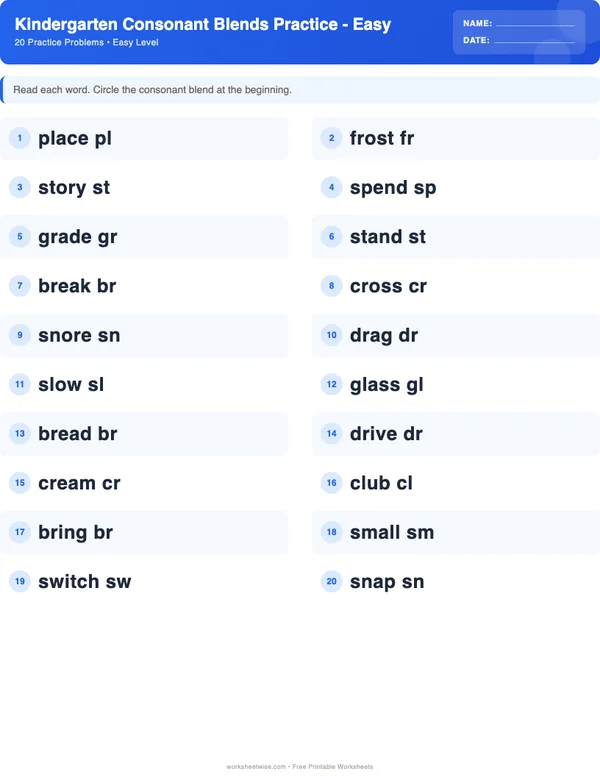
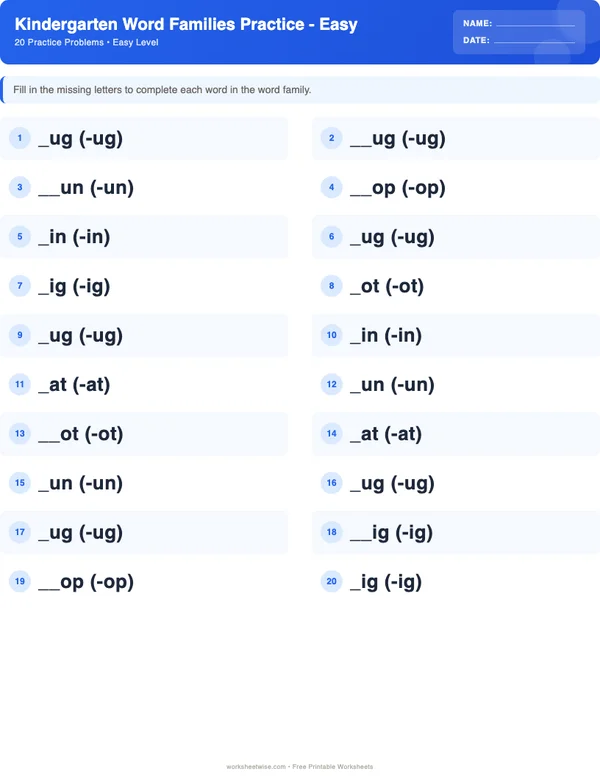
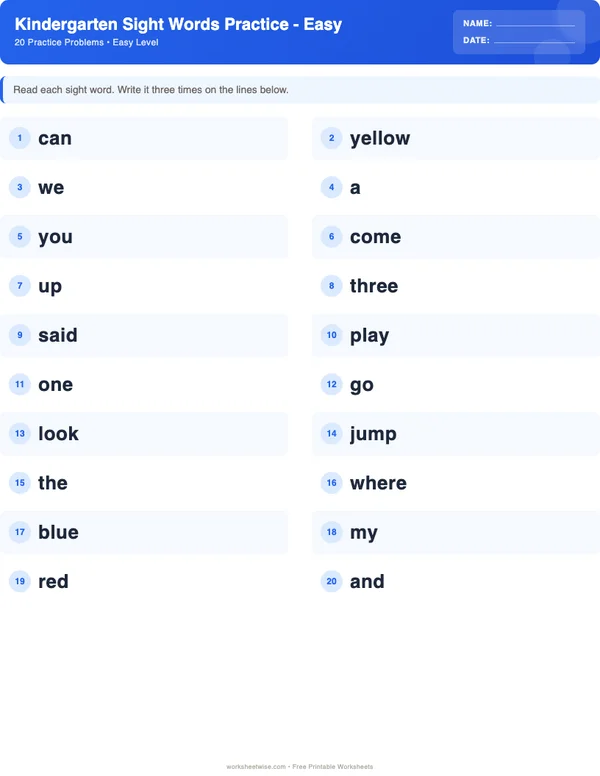
Complete guide
How to teach and practise kindergarten phonics worksheets
3,119 words Updated 6 instructional visuals
Choose one phonics decision, not a stack of worksheets
The useful starting point in this kindergarten phonics catalogue is the smallest skill that explains the learner’s current work. Choose among six live topics: CVC words, consonant blends, digraphs, short vowels, word families, and sight words. Then use one short task to answer a specific question:
- Can the learner connect letters with the sounds in a simple word?
- Can they hear and record the middle vowel?
- Can they retain every sound in a blend?
- Can they treat a digraph as one sound?
- Can they use a shared ending without guessing from it?
- Can they read a taught high-frequency word in a sentence?
The catalogue contains 108 worksheet variants and six free entry points, all labeled for kindergarten phonics. Each representative free sheet has 20 problems. That is the available practice inventory, not a recommendation to complete every problem or follow the topics in a fixed six-step order.
Grade labels describe an intended practice level; local curriculum sequences differ. Age is a discovery aid rather than a placement decision. A learner’s observed response should determine the starting task. For ages three and four, prioritize brief adult-led oral, matching, manipulative, and movement work over desk work: say sounds, move counters, match pictures, and build one or two words before considering a written page.
The catalogue calls each free sheet “easy.” Here, that label should be read through observable task features: a single named topic, familiar one-syllable examples, a repeated response format, and limited competing demands. It must not become a label for a learner. Twenty items can still be too many when the letter formation, picture interpretation, vocabulary, or visual layout consumes attention needed for the phonics target.
Map the six live skills before selecting a page
These topics overlap, but they are not interchangeable. A CVC task asks a learner to coordinate three phonemes and three letters, as in map. A short-vowel task narrows attention to the medial vowel, perhaps distinguishing map from mop. A word-family task holds an ending stable while the onset changes, as in map, cap, and tap.
Blends and digraphs create a different contrast. In the initial blend in stop, both /s/ and /t/ remain audible. In ship, the letters sh represent one consonant sound. Sight-word work can include both decodable high-frequency words and words containing an irregular letter-sound relationship; it should not replace decoding practice.
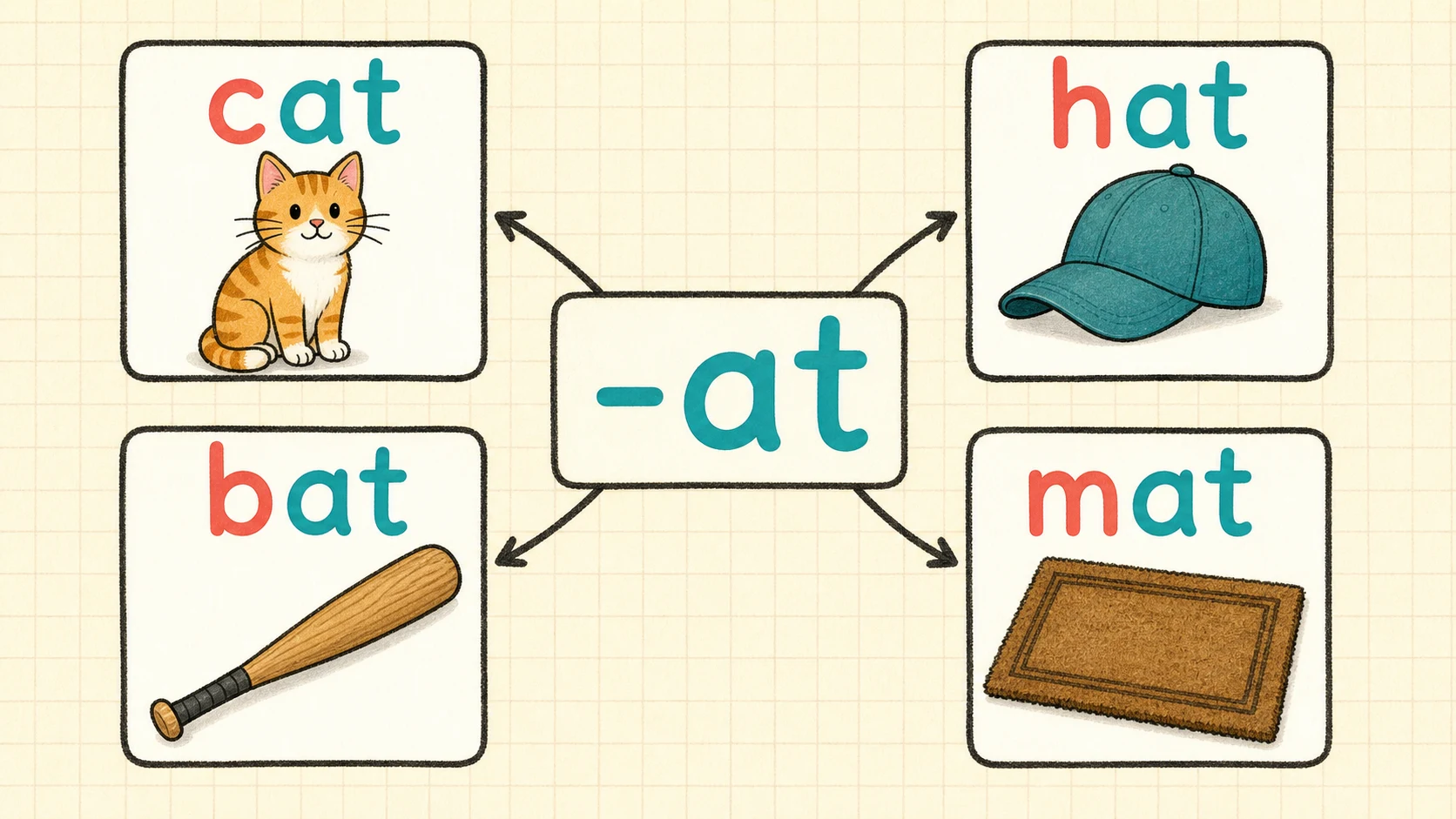
Word-family work connects onset changes, stable endings, short-vowel patterns, sorting, and sentence reading without making all of those tasks equivalent.
A sensible progression is conditional rather than rigid:
- Establish enough letter-sound knowledge to work with spoken and printed words.
- Blend and segment simple CVC words while attending to short vowels.
- Use word families to compare patterns, while continuing to read every sound.
- Add blends, where two adjacent consonant sounds must both be retained.
- Add digraphs, where two letters represent one sound.
- Teach selected high-frequency words alongside the decodable sequence.
This is broadly consistent with the IES foundational reading practice guide, which recommends explicit work with sound segments, letter-sound relationships, word decoding, and connected text. That source offers general instructional guidance; it did not examine or endorse WorksheetWise.
CVC words coordinate the whole decoding process
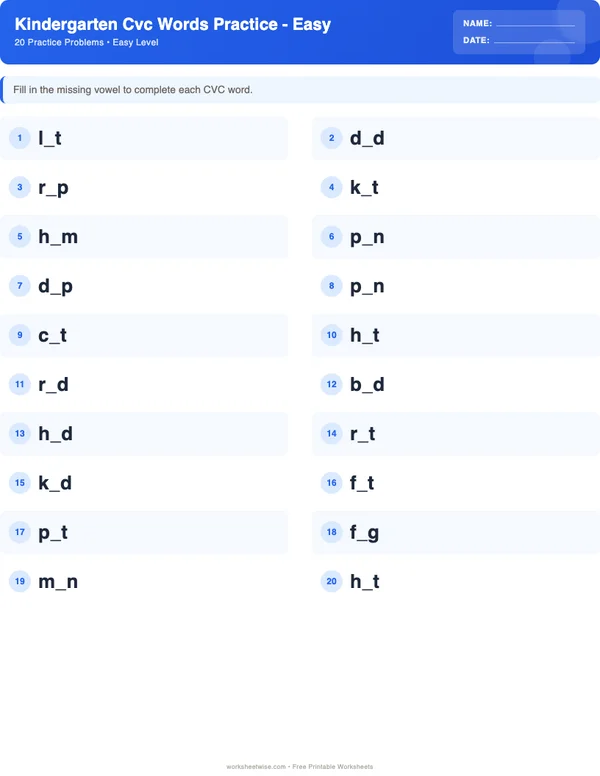
A CVC word has a consonant-vowel-consonant structure, such as cat, pin, or hug. The learner must identify three phonemes, connect them to letters, and blend them in order. The Kindergarten CVC Words guide and free sheet is a useful entry point when the adult needs to see whether the learner can perform that complete sequence.
CVC work is not merely “knowing three sounds.” A learner can name c, a, and t yet still say the sounds separately without arriving at cat. Conversely, a learner might recognize cat from memory or a picture but be unable to decode an unfamiliar form such as nib. Use an unfamiliar but pronounceable CVC form sparingly when you need to separate decoding from memorized recognition; explain that it is a made-up word so meaning is not expected.
Short vowels isolate the unstable middle
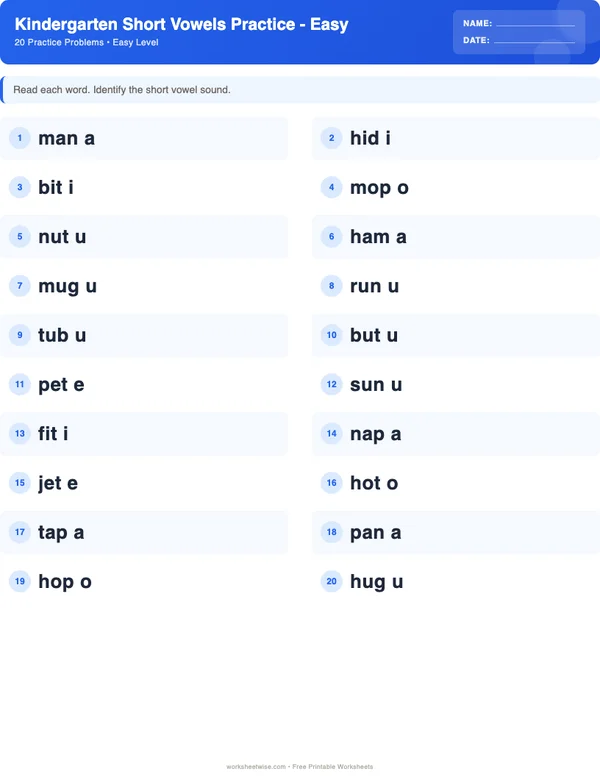
The Kindergarten Short Vowels guide and free sheet is the narrower choice when consonants are mostly secure but the learner substitutes the medial vowel. The live topic covers a, e, i, o, and u in closed syllables, using picture sorting, reading, spelling, and fill-in-the-middle formats.
Do not assume that incorrect reading of pin as pen is a general CVC failure. Ask the learner to segment both words orally and identify what changed. If the first and final phonemes remain stable, a two-vowel contrast is more informative than another mixed CVC page.
Word families emphasize a reusable ending
Word-family practice holds a rime constant: -at in cat, bat, hat, and mat, or -ig in big, dig, and pig. This can reduce the amount that changes from word to word and make patterns visible.
That advantage also creates a guessing risk. A learner who sees -at and says any familiar family member is noticing the pattern but not reading the onset accurately. The Kindergarten Word Families guide and free sheet fits when the learner can blend individual CVC words and is ready to compare stable endings across several words.
Work four representative examples before assigning independent practice
A checked example should reveal exactly what the target requires. Model the reasoning aloud, then change only one feature for the learner’s attempt.
Example 1: blend and spell map
Say map naturally. Repeat it slowly as /mmm/ /ă/ /p/. Move one counter into each of three connected boxes:
| Sound position | Heard sound | Letter |
|---|---|---|
| First | /m/ | m |
| Middle | /ă/ | a |
| Last | /p/ | p |
Sweep beneath the boxes and blend: /mmmaaap/ → map. Then remove the printed word and ask the learner to build or write map.
This example belongs in CVC practice because it contains three phonemes in a simple consonant-vowel-consonant sequence. Reading it checks decoding; rebuilding it checks encoding. If the learner writes mp, the missing letter is specifically the medial vowel, so a short-vowel follow-up is more useful than simply marking the whole word wrong.
Example 2: distinguish pin and pen
Present the spoken words without print first. Say pin, then pen. Ask what remains the same and what changes:
- pin: /p/ /ĭ/ /n/
- pen: /p/ /ĕ/ /n/
Both have three phonemes. The first and final sounds match; only the middle vowel differs. Next, show the two printed words and ask the learner to point while you say one. Finally, dictate one word for spelling.
This belongs in short-vowel practice because the task deliberately controls the consonants. If the learner can hear the difference but chooses the wrong printed vowel, review the letter-sound connection. If the learner reports no oral difference, return to listening and matching rather than increasing the amount of writing.
Example 3: account for every sound in stop
Segment stop as /s/ /t/ /ŏ/ /p/: four phonemes represented by four letters. Compare it with sop: /s/ /ŏ/ /p/. The words are not interchangeable; stop contains the additional /t/.
Have the learner touch four counters while saying stop, then sweep and blend the whole word. A word chain makes each change visible:
top → stop → step
Check the chain carefully. Adding s changes top to stop. Changing o to e changes stop to step. The /s/ and /t/ remain separate sounds throughout.
This belongs in consonant-blend practice because st is an initial blend: both consonant phonemes are retained. If the learner reads stop as sop, the immediate target is retaining the second sound, not memorizing the printed word. The Kindergarten Consonant Blends guide and free sheet provides a bounded place to continue that work.
Example 4: compare the blend in slip with the digraph in ship
Count sounds, not letters:
- slip: /s/ /l/ /ĭ/ /p/ — four letters and four phonemes
- ship: /sh/ /ĭ/ /p/ — four letters but three phonemes
In slip, s and l each retain a sound. In ship, s and h work together as sh for one sound. Put the letters s and h on separate tiles, slide the tiles together, and move one counter for /sh/. The joined tiles preserve the fact that the spelling uses two letters while the counter records one phoneme.
This example belongs here because it tests the defining difference between a blend and a digraph. If the learner says /s/ /h/ /ĭ/ /p/, do not add several new digraphs. Keep sh as the one bounded target and contrast ship with familiar CVC words such as sip.
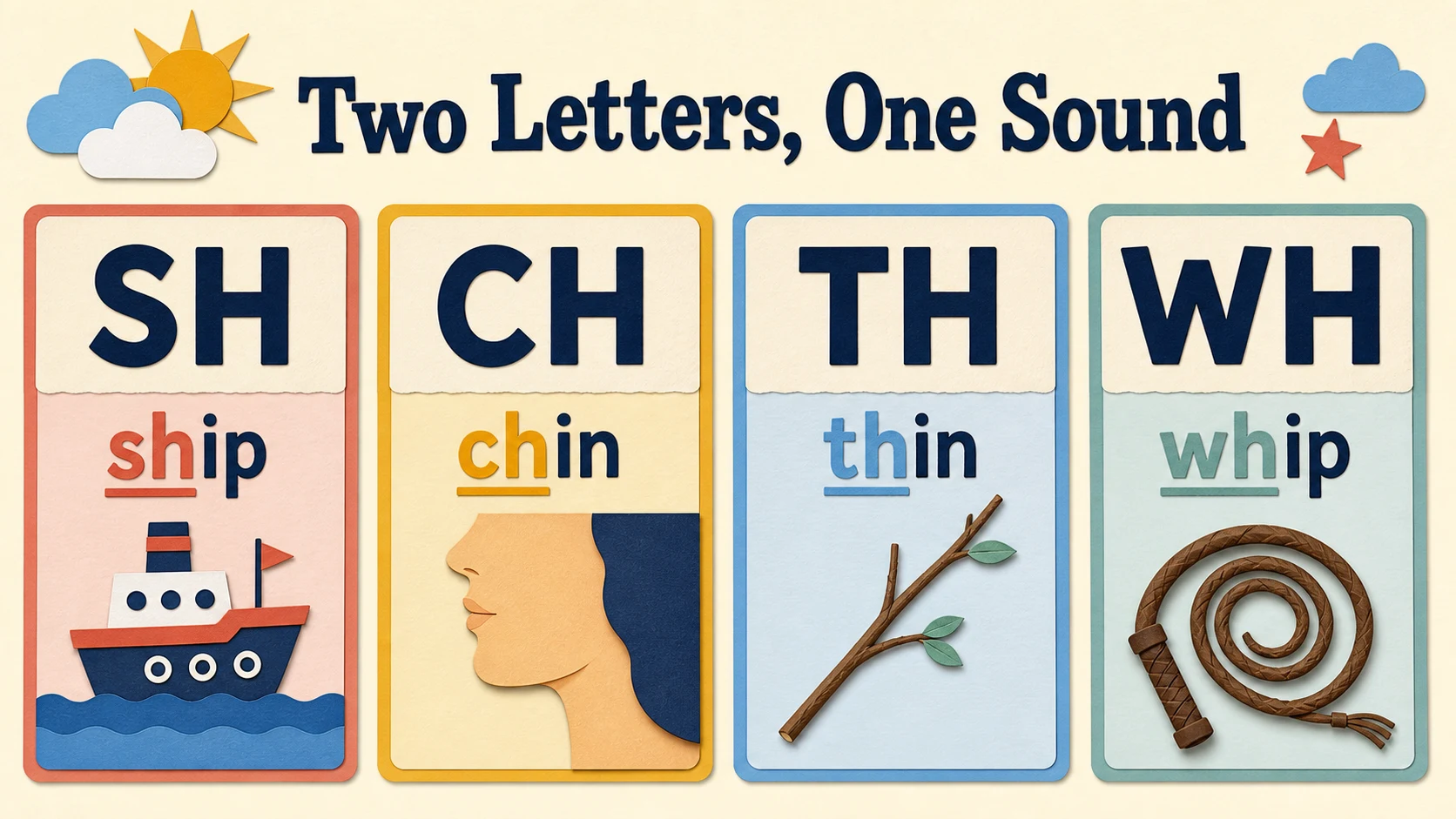
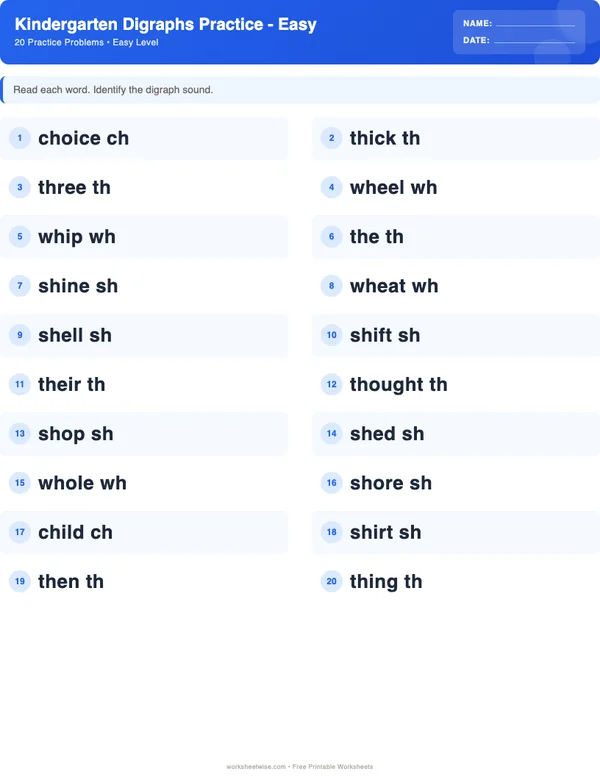
The digraph map should clarify the route from hearing one sound to reading and spelling two-letter representations in initial and final positions.
Treat sight words as analyzable words
Sight-word practice is most useful when the adult asks what can be explained by taught phonics and what must be remembered in the particular word. Avoid presenting every high-frequency word as an indivisible visual shape.
Take said. The beginning s and ending d represent expected sounds. The middle spelling ai does not represent its usual sound in this word; here the spoken vowel is /ĕ/. A checked routine is:
- Say said in a sentence: “I said hello.”
- Segment its three phonemes: /s/ /ĕ/ /d/.
- Map the expected beginning and ending.
- Draw attention to ai as the part requiring word-specific memory.
- Cover the word, rebuild or write it, and read it again in the sentence.
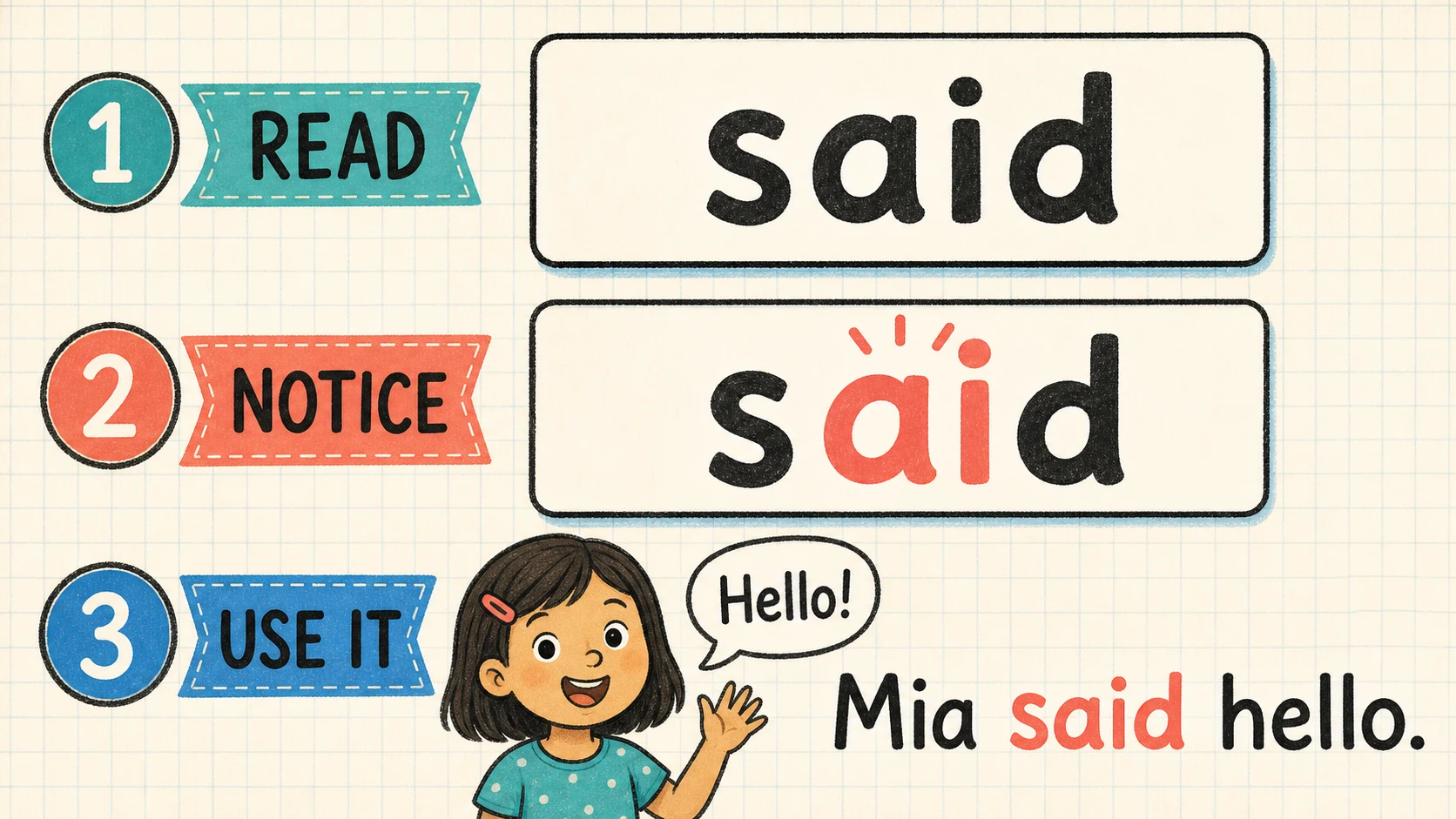
The worked model makes the regular and word-specific parts visible before the learner produces the whole word.
This belongs in the kindergarten catalogue because the live sight-word topic includes tracing, writing, sentence finding, contextual use, and passage reading. It differs from a CVC task: the learner cannot derive every part of said from the basic correspondences used in map.
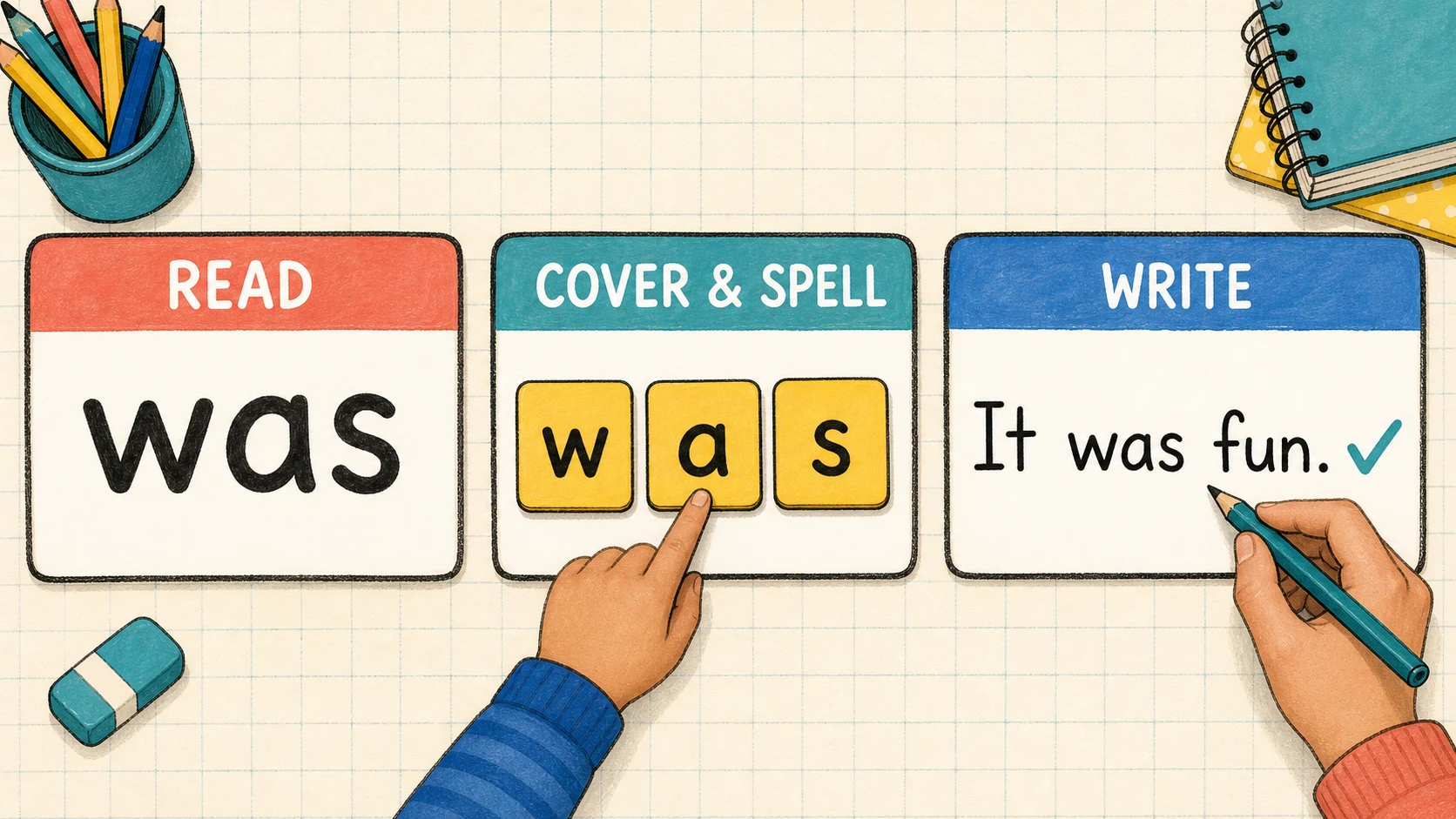
Use the sight-word routine for a few selected words, with retrieval and sentence reading, rather than as an extended copying session.
The Kindergarten Sight Words guide and free sheet is appropriate when the adult has selected specific high-frequency words from the learner’s reading context. It is not evidence that a large memorized list should precede decoding.
Use a short routine that exposes the learner’s reasoning
A repeatable session can take 8–12 minutes. This timing is a practical editorial suggestion, not a sourced requirement.
Hear and identify
State one target: “Today we will listen for the middle sound in short-a words,” or “Today sh represents one sound.” Give two oral examples and one contrast. Ask the learner to repeat, segment, or sort. This keeps vocabulary, handwriting, and visual scanning from concealing what the learner can hear.
Build and read
Model one item with counters or letter tiles. Have the learner build two or three related items. Move from sounds to letters, then sweep through the complete word. If using a worksheet, cover the unused rows so the visible field contains only the current work.
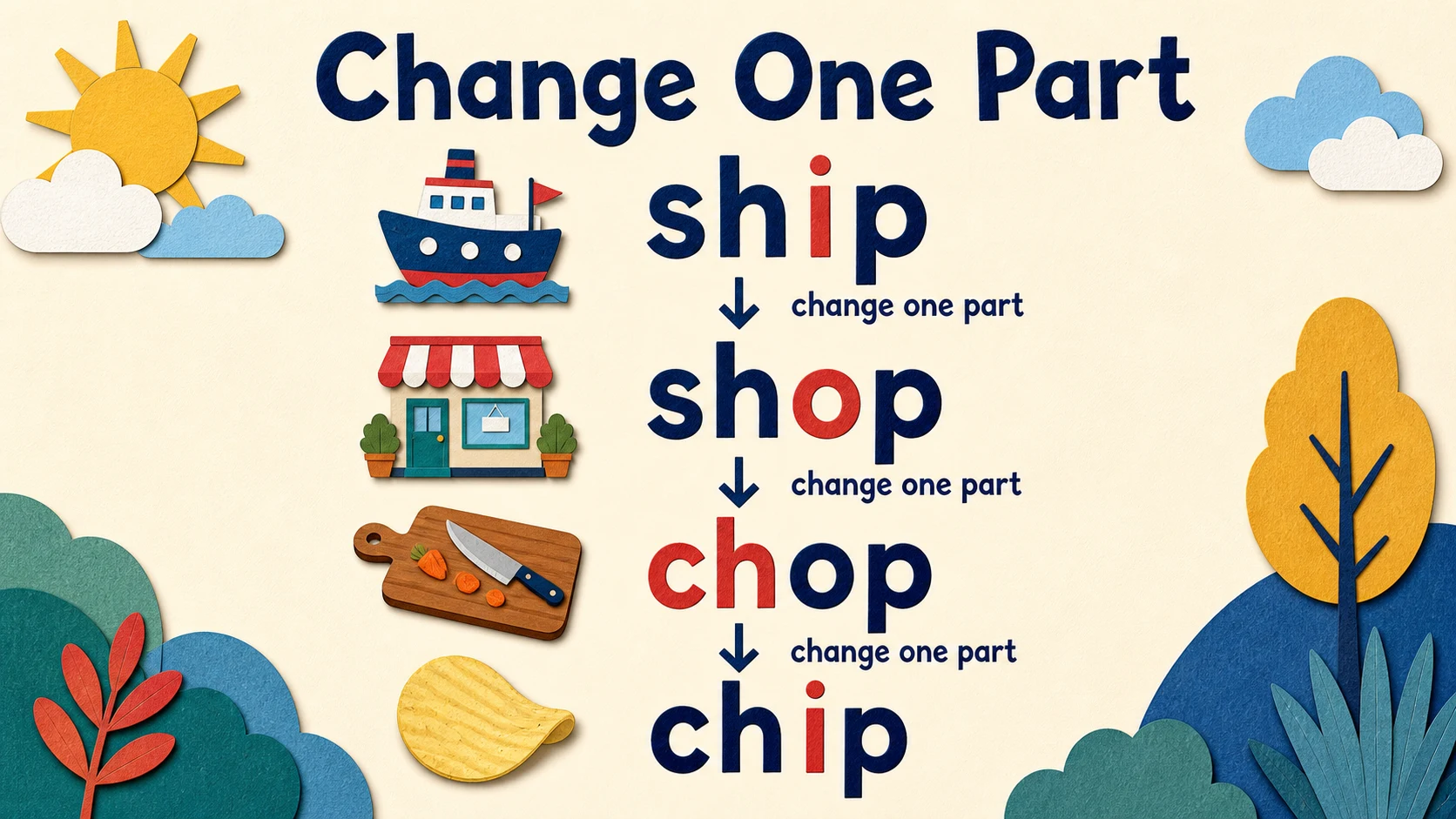
The digraph routine keeps the sequence explicit: hear the target sound, connect it to two letters, read it in a word, and retrieve it through spelling.
Write and reconnect
Dictate one word that uses the same target. Letter tiles are acceptable if handwriting would obscure the phonics decision. Then place the word in a short phrase or sentence the learner can read with available support.
The IES writing practice guide addresses elementary writing more broadly and recommends explicit teaching of writing processes and foundational skills. In this phonics context, the modest application is to include a purposeful spelling or sentence response—not to claim that a phonics sheet constitutes a complete writing program.
Record one observation
Write down the exact response, not a judgment: “Read stop as sop twice,” “Distinguished pin/pen orally but selected i for both,” or “Read ship after joining s-h tiles.” That note should determine the next task.
Read errors as evidence, not scores
A total such as 14/20 can hide several different instructional needs. Examine the response pattern before deciding whether to repeat, narrow, or advance.
| Observed response | Plausible task-level interpretation | Useful next check |
|---|---|---|
| Reads map as mat | Final phoneme or letter was not retained | Contrast map/mat orally, then with print |
| Writes mp for map | Medial vowel was omitted | Use three sound boxes and two short-a words |
| Reads pin as pen repeatedly | Short i/e discrimination or mapping needs checking | Separate oral discrimination from printed choice |
| Reads stop as sop | One phoneme in the initial blend was dropped | Tap four sounds before blending |
| Reads ship as /s/ /h/ /ip/ | Treats the digraph letters as separate consonants | Rebuild sh with joined tiles and one sound counter |
| Sorts cat into -at but reads it as hat | Recognizes the rime but guesses the onset | Mix cat, hat, and mat; require pointing to the first letter |
| Copies said accurately but cannot retrieve it | Copying did not establish recall | Cover, build from memory, and read in a sentence |
These are instructional hypotheses, not diagnoses. A single error may result from losing place, misunderstanding a picture, not knowing the pictured vocabulary, fatigue, hearing differences, language experience, or the motor demands of writing. Confirm a pattern with a few carefully chosen items.
Correct immediately when the response would otherwise be rehearsed incorrectly, but preserve productive thinking. For stop read as sop, say, “Point to each letter and tell me every sound you hear.” For ship sounded letter by letter, say, “These two letters work together here. Join them and say the one sound.”
Adapt the format without replacing the phonics target
An adaptation is sound when it reduces an irrelevant barrier while leaving the intended letter-sound decision intact.
For a learner who tires during 20 written problems, present four items, pause, and return later. For handwriting difficulty, allow movable letters or oral pointing, then ask for one written response if appropriate. For visual crowding, mask all but one row. For unfamiliar pictures, name each picture before the phonics task begins; otherwise the activity may test vocabulary rather than decoding.
For ages three and four, convert a page into adult-led play:
- Say map and let the child step once for each sound.
- Place three hoops or paper squares on the floor for /m/ /ă/ /p/.
- Match two pictures that begin with /sh/.
- Build cat and hat by swapping the first letter.
- Stop after a few accurate, engaged responses.
Preserve the target precisely. If the target is short-i versus short-e, naming every picture is an access support; telling the learner which vowel belongs in each word removes the target. If the target is decoding ship, reading the word aloud for the learner changes the task into repetition. Instead, supply unknown vocabulary or directions while leaving the word-reading decision to the learner.
Plan cumulative practice without flattening the sequence
Cumulative review should combine mastered or recently taught material while keeping the new target identifiable. A digraph page can include a few CVC words for review, but an error on sh should not trigger simultaneous lessons on ch, th, wh, and ck.
A practical two-week word-family cycle might use short sessions:
| Day | Bounded focus | Evidence to collect |
|---|---|---|
| 1 | Build -at words | Reads each onset rather than guessing |
| 2 | Read and spell two -at words | Maps all three phonemes |
| 3 | Contrast -at and -an | Sorts by the actual ending |
| 4 | Read a short phrase or sentence | Maintains accuracy in context |
| 5 | Brief mixed review | Retrieves without the original order |
| 6 | Add one familiar short-i family | Keeps vowel families distinct |
| 7 | Build and sort | Explains the sorting decision |
| 8 | Add a blend only if previously taught | Retains both blend sounds |
| 9 | Sentence reading and one dictated word | Transfers between reading and spelling |
| 10 | Recheck the original trouble item | Shows what changed and what still needs support |
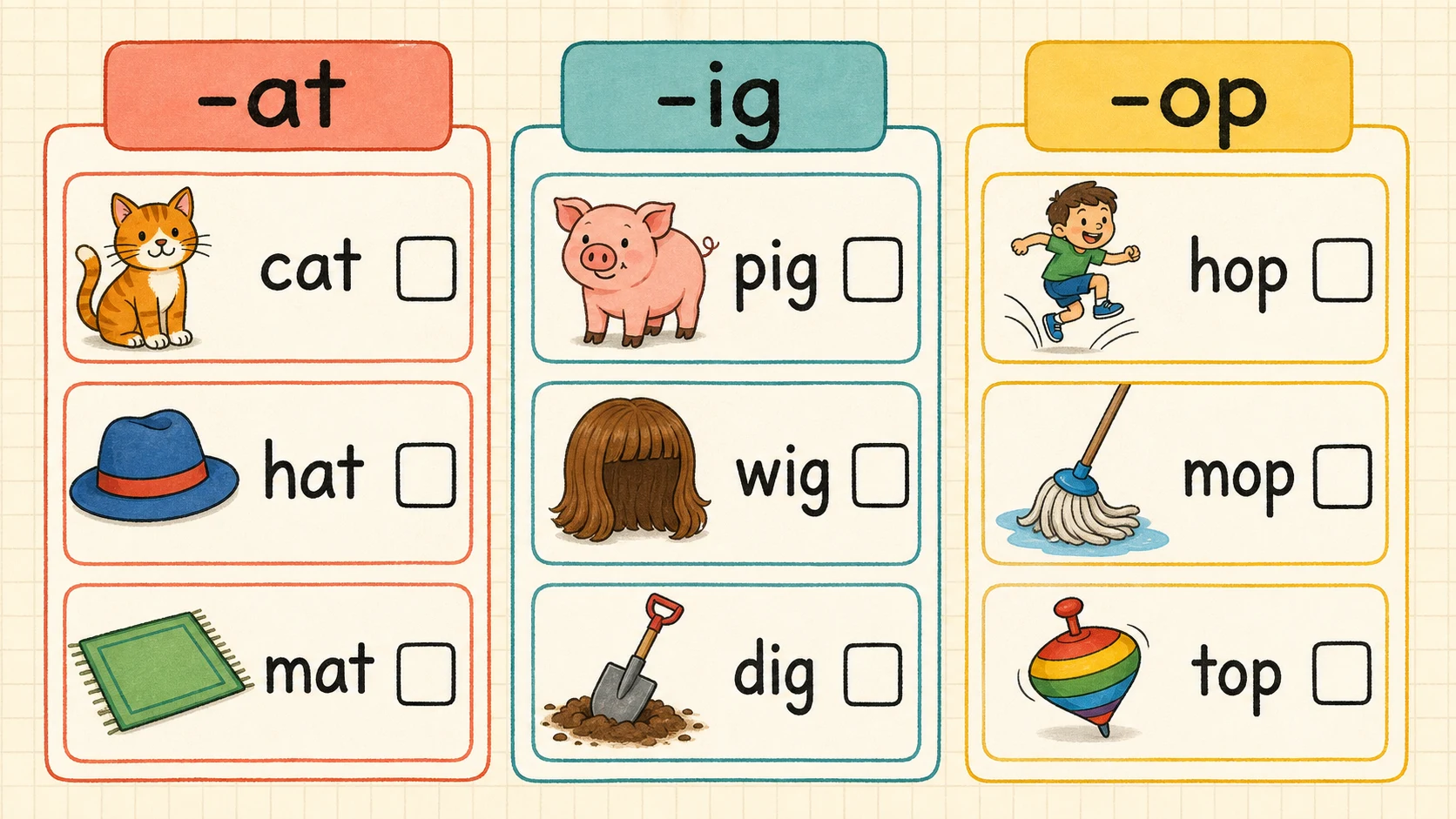
The plan alternates building, sorting, reading, spelling, and retrieval while keeping word-family patterns tied to complete words.
This schedule is a suggested structure, not a catalogue promise or mandated sequence. If Day 3 shows unstable short vowels, return to a two-family contrast. If the learner reads the families accurately but struggles only in the sentence, reduce sentence complexity and check whether untaught words are causing the interruption.
Decide when to repeat, narrow, or move forward
Repeat the same task format when the learner understands the target but needs another opportunity to retrieve it. Narrow the task when errors cluster around one contrast, such as e/i, omission of the second sound in st, or confusion between sh and separate s-h. Move forward when the learner demonstrates the target in more than one form: for example, reading map, spelling tap, and locating cap in a short sentence.
Do not require perfection on every mixed page before proceeding. Instead, look for:
- accurate attention to all relevant sounds;
- use of the taught correspondence rather than picture guessing;
- recovery after a brief prompt;
- transfer between reading and spelling;
- retention when items appear in a different order;
- accurate use in a short phrase or sentence.
The Common Core English Language Arts standards include kindergarten foundational-skills expectations involving sound awareness, letter-sound correspondences, high-frequency words, and decoding regularly spelled one-syllable words. They are a broad reference point, not proof that a particular WorksheetWise page matches every local sequence or that completion demonstrates standards mastery.
Keep the worksheets inside their proper boundaries
A phonics worksheet can provide controlled practice and visible work samples. It cannot by itself establish why a learner is struggling, replace interactive modeling, guarantee transfer to connected reading, or determine placement. The six live topics also do not represent every component of early literacy.
Picture matching may be influenced by vocabulary. Tracing may show pencil control rather than independent word retrieval. A correct answer can result from guessing, copying, or remembering the item’s location. An incorrect answer can reflect directions or layout rather than the intended phonics relationship. Confirm important decisions orally, with manipulatives, and through fresh examples.
The catalogue spans kindergarten-labeled practice, despite the broader editorial discussion of skills that may be encountered from Pre-K through second grade. Do not infer that every live sheet is suitable for every learner in that age range. Likewise, terms such as targeted intervention describe a use context, not a diagnosis or evidence that worksheets alone constitute an intervention program.
For classroom use, the formative assessment phonics worksheets can help organize work samples, provided the adult records the actual error pattern. At home, brief practice from the Kindergarten Homeschool Worksheets collection should remain connected to shared reading, conversation, and oral word play.
Make the next task observable
Choose one word the learner attempted today and write an exact note about what happened. Then select the narrowest matching free entry point.
If the learner omitted the vowel in map, open the Kindergarten Short Vowels guide and free sheet, present only four short-a items, and record whether the learner can hear, choose, and write the medial vowel. If the learner mapped all three sounds, the next session can contrast short a with one other taught vowel. If the vowel is still omitted, return to three oral sound boxes before asking for another written answer.
Put it into practice
Use the guide with a real printable
Move from explanation to a short, observable practice task. Check the first item together, then adjust the next session from the learner's actual work.
Open the first free worksheet