13 free PDFs with answer keys
Kindergarten worksheets
Choose only from subjects and skills with real files in the current Kindergarten catalogue. Start with the free standard sheet, then add more practice only if you need it.
Complete guide
How to teach and practise kindergarten worksheets
3,367 words Updated 6 instructional visuals
Choose kindergarten practice by what the child does, not by the label
The most useful kindergarten worksheet is not simply the one marked “Kindergarten.” It is the task whose language, representation, motor demands, and amount of independence fit what the child can do today. Begin with a brief preview: ask the child to explain one example, solve or read two items, and show how they know. Then choose practice that is close enough to be understood but still requires thought.
WorksheetWise’s live kindergarten catalogue contains 234 variants across three subjects and 13 topics, with 13 free entry points. The available topics cover math, phonics, and grammar. Use that range to change the task—not to assign more pages—when a work sample shows a specific need.
Grade labels describe an intended practice level; local curriculum sequences differ. Age is a discovery aid rather than a placement decision. A five-year-old may count accurately but not yet form numerals comfortably, or decode CVC words while needing adult help to understand written directions. Those differences call for different supports, not a different judgment about the child.
For ages three and four, prioritize brief adult-led oral, matching, manipulative, and movement work over desk work. A young child can match three counters to the numeral 3, hop while counting, or sort pictures by beginning sound without completing a 20-item written page. Readiness for an idea and endurance for worksheet work are separate questions.
Map the live catalogue before selecting a page
The catalogue’s math topics are counting, addition, subtraction, place value, geometry, and word problems. Phonics includes CVC words, consonant blends, digraphs, short vowels, word families, and sight words. Grammar currently contributes punctuation. Science and social studies may be part of a child’s classroom day, but they are not verified subjects in this page’s live catalogue, so this guide does not imply that corresponding WorksheetWise resources are available here.
Start with the smallest relevant skill
Choose counting when the child needs to connect spoken number words, objects, and written numerals. Choose addition only when joining groups is the target. Choose word problems when interpreting a situation is the target—even if the arithmetic is easy.
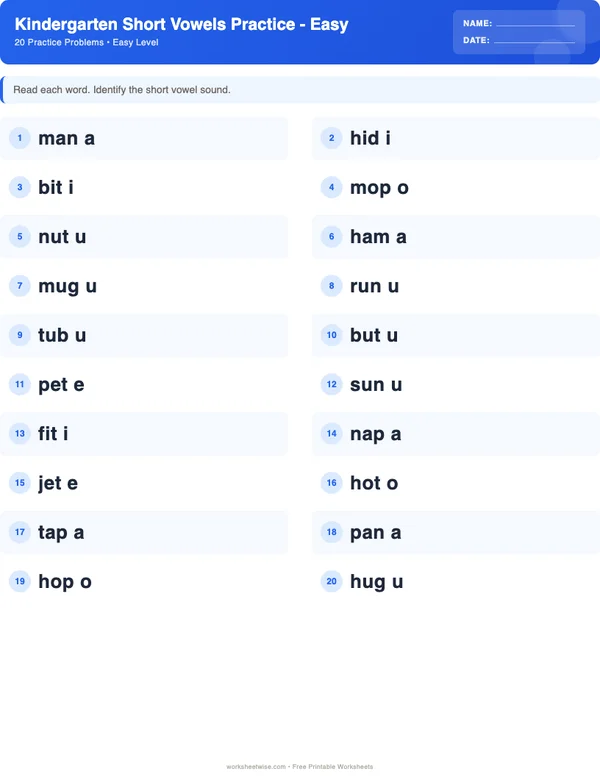
The same distinction matters in reading. Choose short-vowel work when the middle sound is unstable. Choose CVC work when the child must segment and blend the entire word. Move to blends only when three-sound words are reasonably secure and the child can retain an added consonant sound.
Punctuation is appropriate when a learner can attend to the meaning of a short sentence. If reading every word consumes all the child’s attention, read the sentence aloud so that the task remains choosing a period, question mark, or exclamation point.
Treat “easy” as a task description
Every representative free sheet in the supplied catalogue is marked “easy,” but that word must describe observable features rather than a learner. In this catalogue, those sheets contain either 20 problems or, for word problems and punctuation, 12 problems. The label alone does not tell us whether a page uses pictures, requires independent reading, presents mixed operations, or demands extensive handwriting.
Before assigning one, inspect:
- how many directions the child must retain;
- whether the child handles objects, interprets pictures, or works only with symbols;
- whether examples remain within a familiar number range or spelling pattern;
- whether items repeat one format or switch among formats;
- how much reading and handwriting the page adds;
- whether the adult will model, prompt, or remain silent; and
- whether 12 or 20 items exceed the child’s useful practice span.
A task becomes more demanding when objects disappear, numbers increase, layouts vary, language carries more of the meaning, similar patterns are mixed, or the child must explain and check without prompting.
Establish readiness without turning the preview into a test
A two- or three-item preview usually reveals more than a grade label. Keep it neutral: “Let’s see what this page asks you to do.” Avoid teaching every item during the preview, because then you are measuring imitation rather than current strategy.
Preview math through action, picture, and symbol
For counting, place seven buttons in a scattered arrangement. Ask, “How many are there? Show me how you know.” Watch whether the child touches or moves each object once, organizes the set, recounts repeatedly, or merely recites numbers. Scattered objects expose one-to-one correspondence more clearly than a tidy row.
Next, show the numeral 7 and ask the child to match it to the set. If the child counts correctly but cannot identify the numeral, the next task should connect quantity and symbol. It should not demand harder counting.
For addition or subtraction, tell a tiny story and provide counters. “There are five frogs. Two hop away. How many stay?” If the child can act out the change but cannot read 5 − 2 = __, use a task that preserves removal while linking the model to the equation.
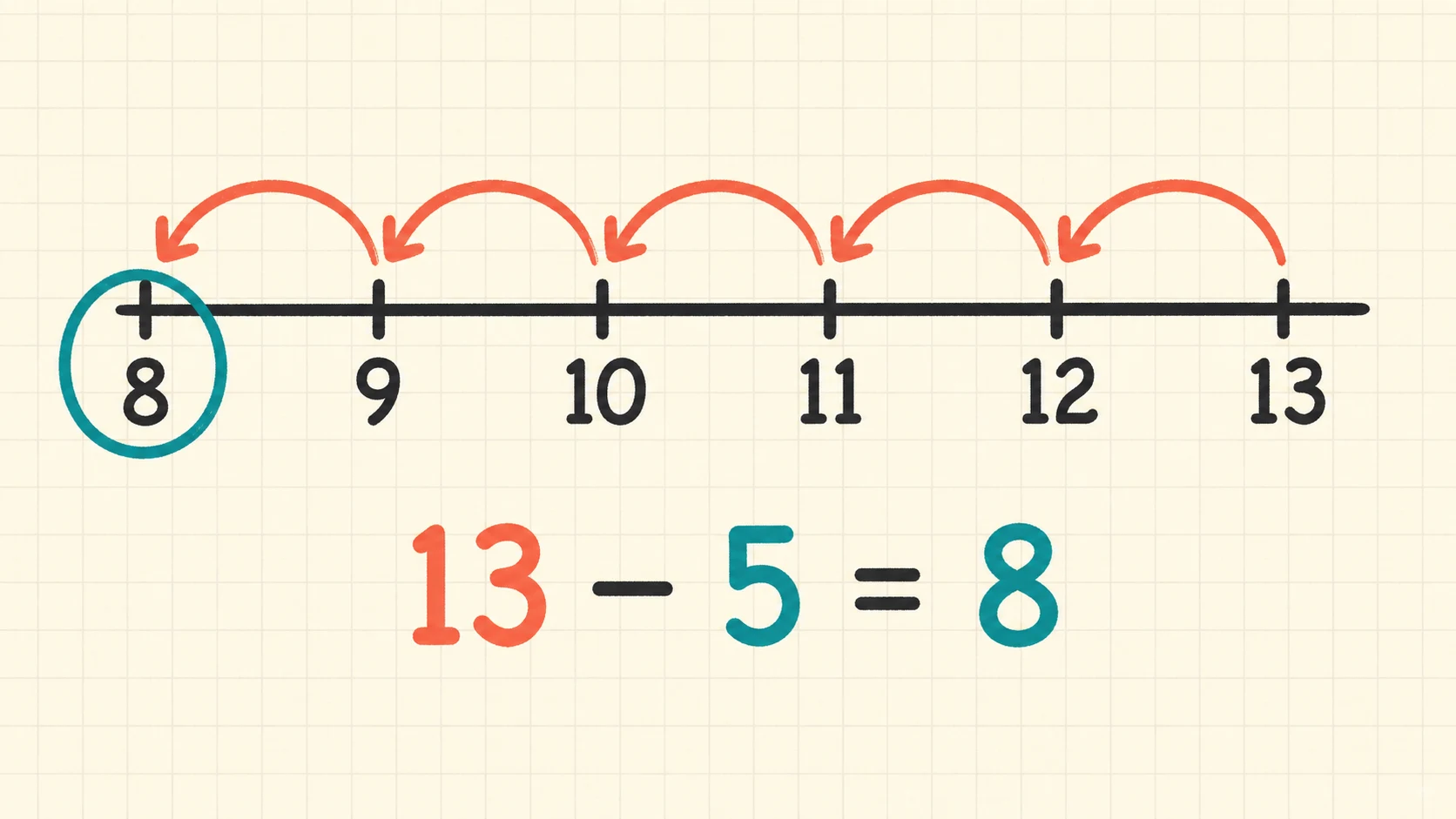
Use the concrete model to verify that “take away” is understood before expecting the subtraction symbol to carry the meaning.
This example belongs in kindergarten because it uses a small quantity, a visible removal action, and a one-step answer. It checks conceptual access without requiring multidigit procedures or memorized facts.
Preview phonics orally before adding print
Say map slowly and ask the child to push one token for each sound. A checked segmentation is /m/ /ă/ /p/: three phonemes. Then place the letters m, a, and p in order and ask the child to blend them. A child who can hear three sounds but cannot match the middle sound to a needs a short-vowel connection. A child who names all three letters but says no word needs explicit blending practice.
For stop, the checked segmentation is /s/ /t/ /ŏ/ /p/: four sounds. A child who reads it as sop has omitted /t/, so CVC review alone may not address the problem. The consonant-blends topic is the closer match, provided ordinary CVC blending is already stable.
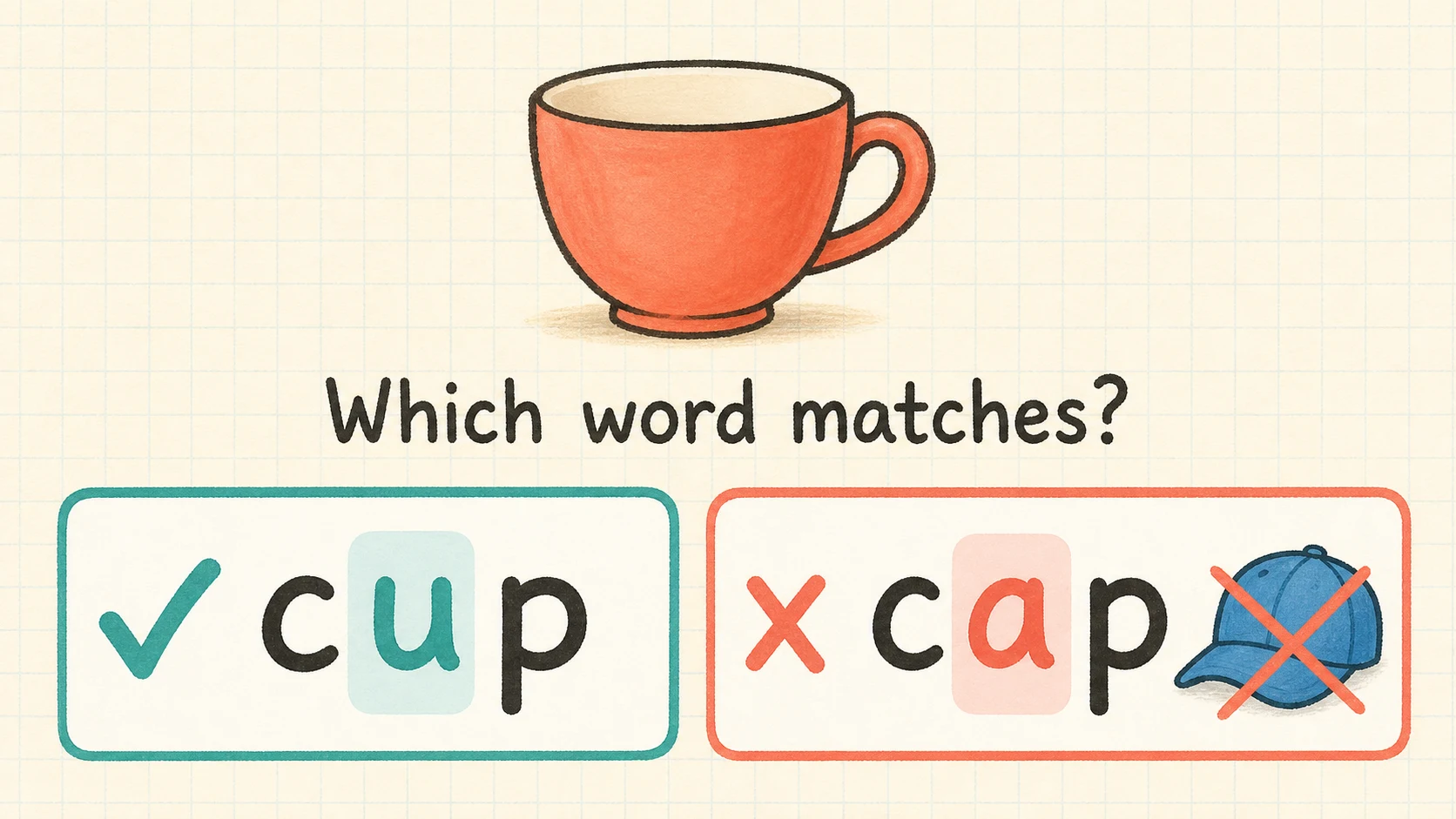
Match the response to the observed sound-level error: middle-vowel confusion, lost consonant, guessing, and slow blending require different practice.
This preview is not a reading diagnosis. It is a selection check for the next practice task. Persistent concerns about hearing, speech, vision, language, or learning require discussion with the child’s teacher and an appropriately qualified professional.
Follow the changing mathematical demand across kindergarten
Kindergarten mathematics can move from counting concrete sets to writing numerals, comparing quantities, composing teen numbers, and solving addition or subtraction situations. The supplied editorial context identifies counting to 100 by ones and tens, writing 0 through 20, and solving within 10 as central expectations. The Common Core mathematics standards similarly organize kindergarten work around counting and cardinality, operations, number relationships, measurement, and geometry. That source describes a standards framework; it did not evaluate WorksheetWise.
The IES guide to teaching mathematics to young children recommends systematic attention to number and operations, progress monitoring, developmental progressions, and mathematical language. A practical implication is to select tasks from evidence of the child’s current representation and strategy, not merely from a calendar month.
Counting before calculation
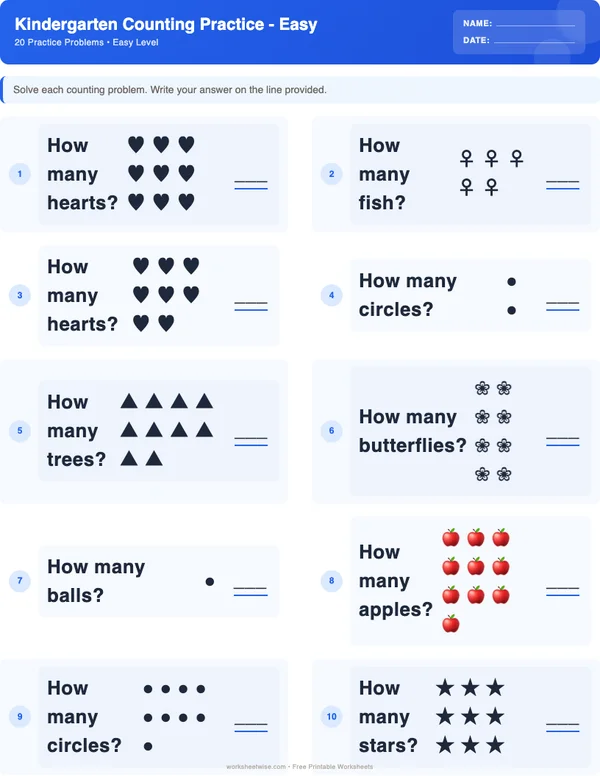
Use the Kindergarten Counting guide and free sheet when the child skips objects, counts one object twice, cannot answer “how many?” after counting, or loses the sequence at a predictable point.
Consider this checked example: eight counters are scattered on a table. The child says 1, 2, 3, 4, 5, 6, 7, 8 while moving each counter into a line, then answers “eight” without recounting. That shows one-to-one correspondence and cardinality for this set. The next action might be counting a different arrangement, matching 8 to its numeral, or counting forward from 8. It is not automatically addition within 10.
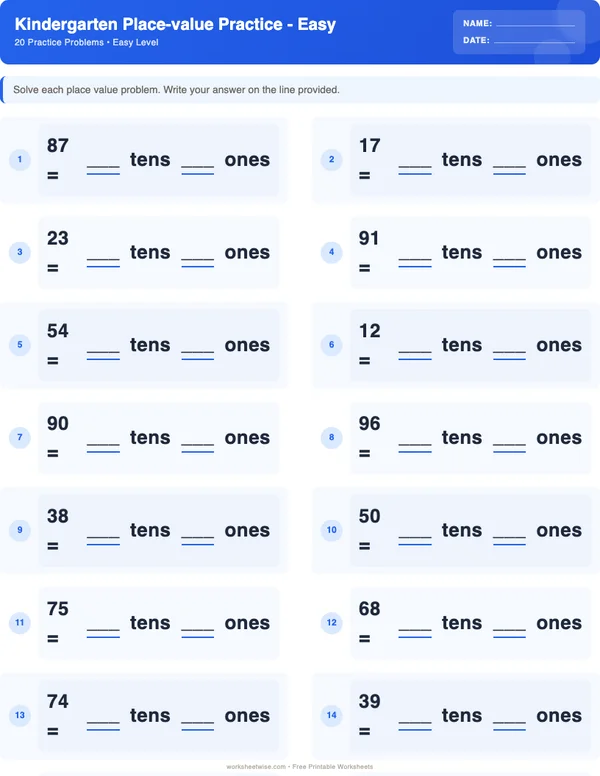
Teen numbers introduce another boundary. If the child builds 14 as one bundle of ten and four single objects, then identifies 14, a beginning place-value task is reasonable. If the child counts all 14 objects but does not recognize a group of ten as a unit, stay with bundling and “ten and some ones” through the Kindergarten Place Value guide and free sheet.
Join, remove, and interpret
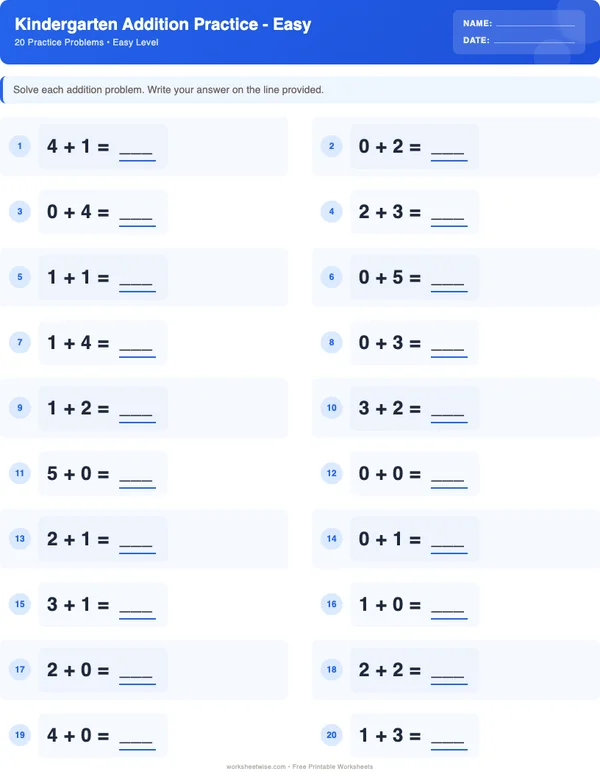
For addition, begin with joined sets. Put down three red counters and add two blue counters. The checked total is five, so 3 + 2 = 5. This belongs in kindergarten because the quantities are within 5, the action is visible, and the equation records a relationship already modeled.
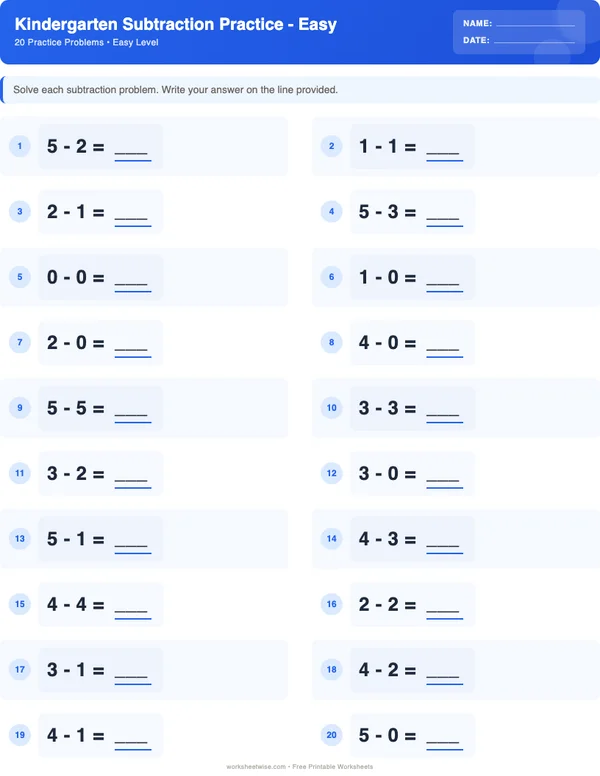
For subtraction, distinguish among removal, comparison, and a missing part. 5 − 2 = 3 can represent five birds with two flying away. “Mia has five blocks and Leo has three; how many more does Mia have?” also has an answer of two, but the quantities are compared rather than removed. A child who succeeds with removal may still need objects or drawings for comparison.
Use the Kindergarten Addition guide and free sheet or Kindergarten Subtraction guide and free sheet according to the situation the child understands. Do not select by scanning for a word such as “left.” Ask the child to retell what changes.
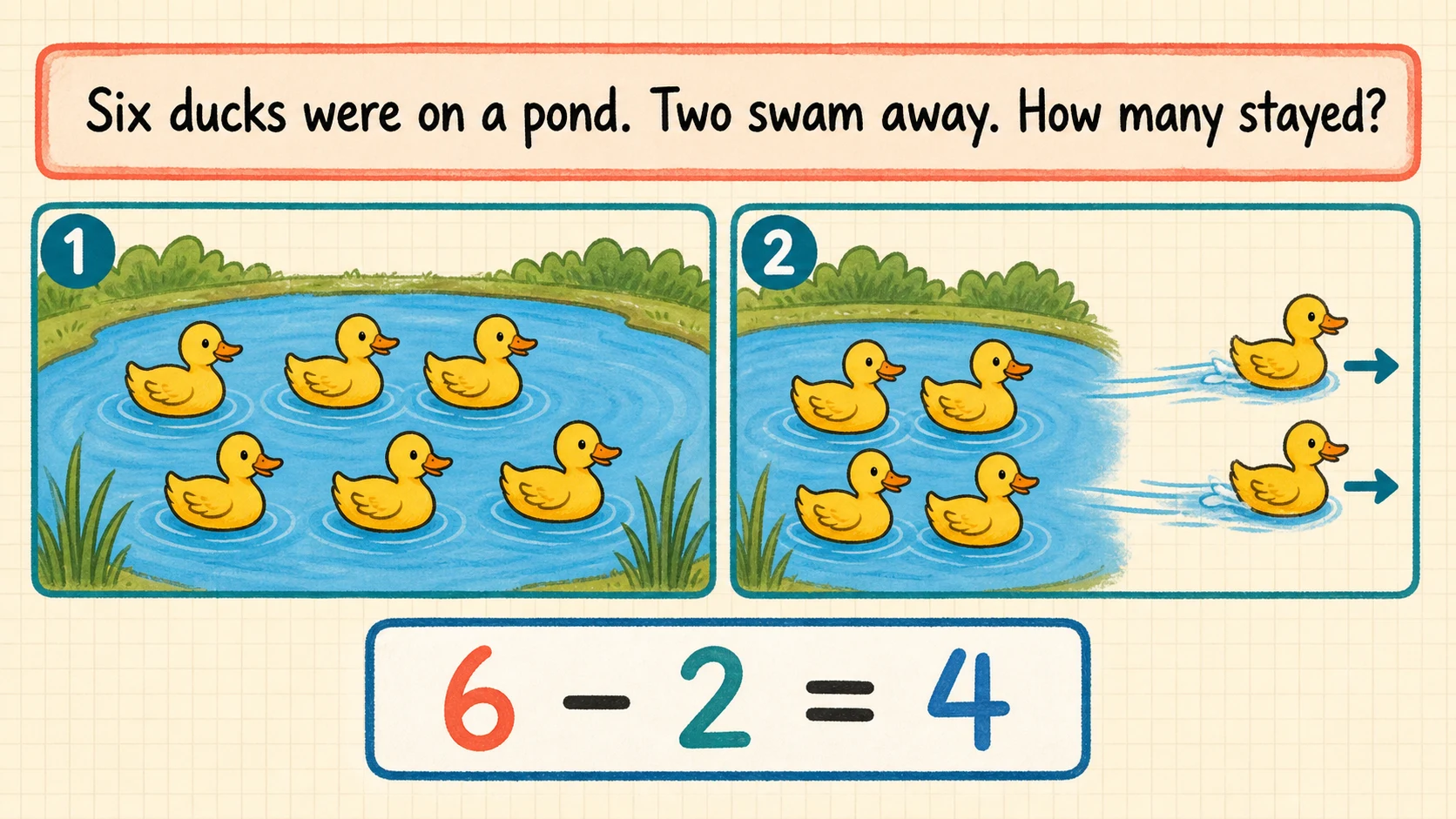
The model should represent the story’s quantities and action before the child chooses an equation.
A checked kindergarten word-problem example is: “There are four apples in a bowl. Two more are added. How many apples are there now?” The child can place four counters, add two, count six, and record 4 + 2 = 6. It belongs here because it is one step, uses joining, remains within 10, and allows action, drawing, and equation to represent the same event.
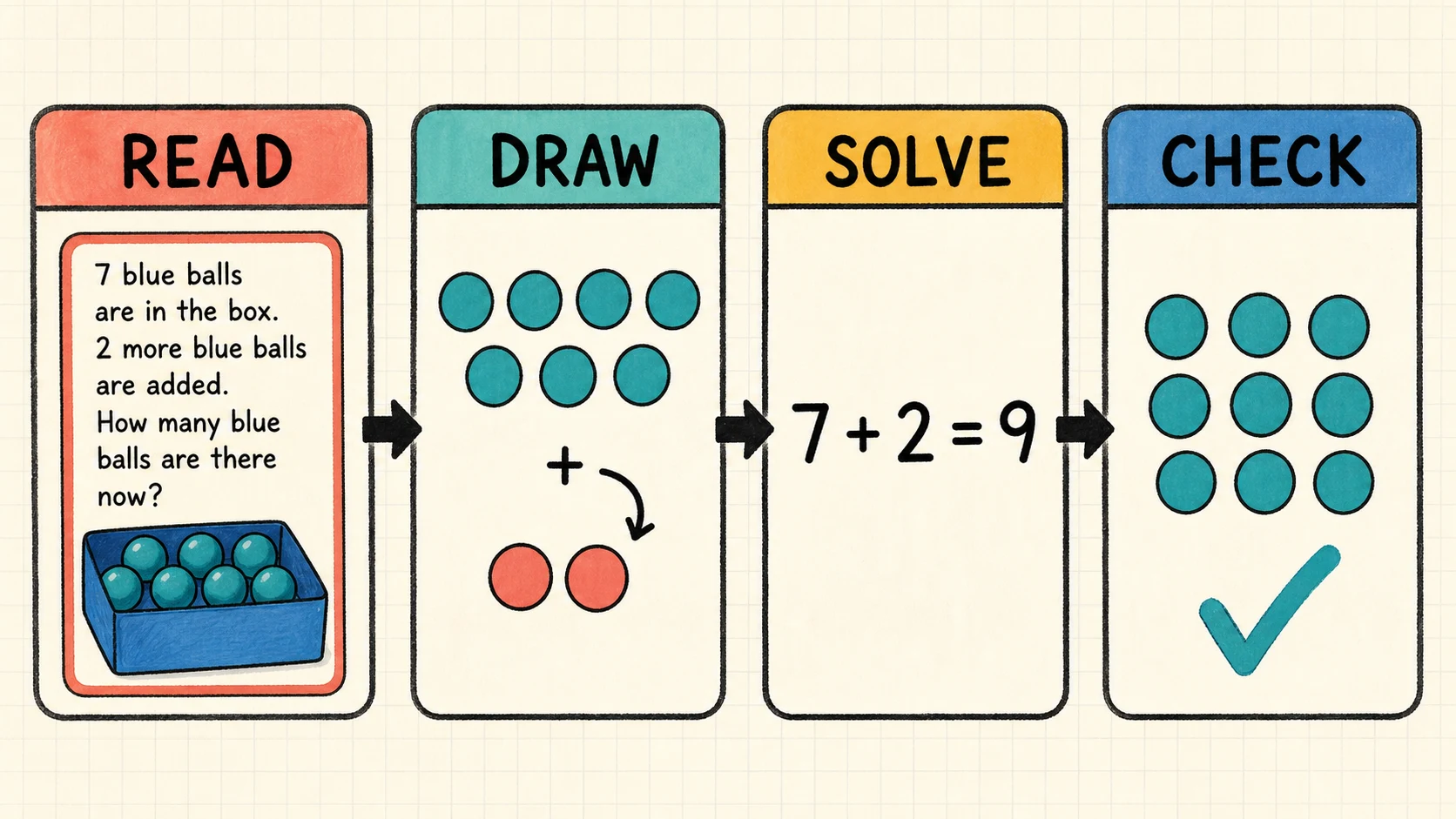
Reduce support one feature at a time: adult retelling, ready-made model, child-drawn model, equation, and independent check.
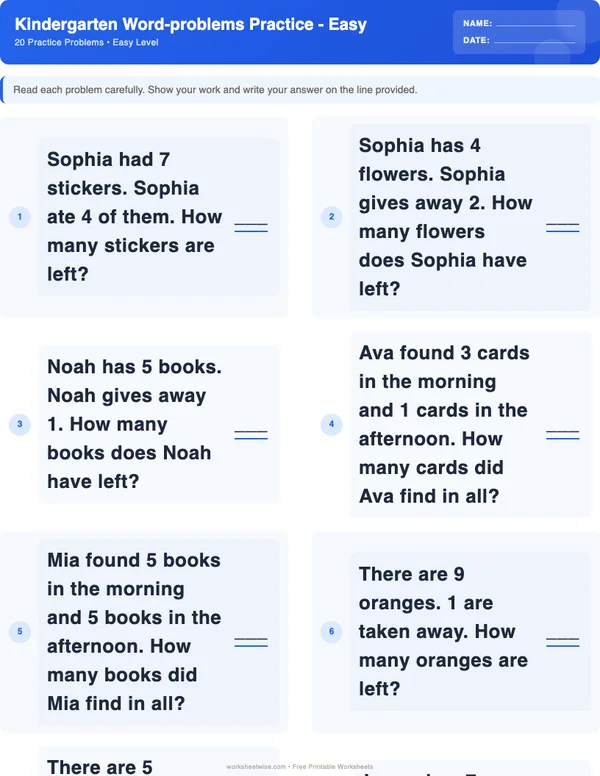
Choose the Kindergarten Word Problems guide and free sheet when computation is accessible but story interpretation needs practice. Its free entry point has 12 problems, so previewing and dividing the sheet may be more useful than requiring completion in one sitting.
Build early reading from sounds to connected meaning
The catalogue supports a coherent path: short-vowel discrimination, CVC blending and spelling, word-family pattern recognition, then consonant blends and digraphs as the child can hold more sounds or letter relationships. Sight words should support connected reading rather than replace decoding.
The IES foundational reading guide supports teaching sound segments linked to letters, decoding and word analysis, and daily reading of connected text. That guidance supports a sequence of oral sound work, explicit print connections, word reading, and brief sentence reading. It does not certify a particular WorksheetWise sequence.
Separate vowel confusion from blending difficulty
Suppose a child reads pin as pen. Both are real CVC words, but the substitution changes the middle phoneme and vowel letter. Check orally with a minimal pair: say pin, then pen, and ask whether the words sound the same or different. If the child hears the difference but misreads the print, select short-vowel letter-sound practice. If the child cannot hear the contrast reliably, stay with adult-led listening and picture sorting before expecting independent written work.
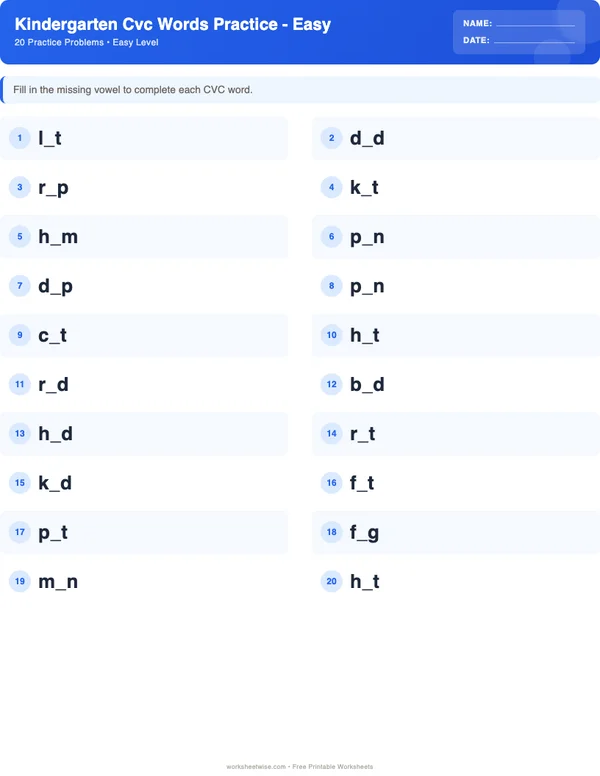
Now compare a child who says /c/ /ă/ /t/ correctly but cannot combine the sounds into cat. The vowel is not necessarily the problem. Model continuous blending, draw the sounds together, and select a CVC task with a small, consistent set. That task belongs in kindergarten because cat uses three common sound-letter correspondences and requires the foundational operation of blending, not a more complex spelling pattern.
Pair reading with spelling. After the child reads map, remove the letters and ask them to rebuild or write it from the spoken word. Reading checks decoding; building or writing checks encoding. If handwriting obscures the result, use magnetic letters so letter formation does not replace the phonics target.
Know when blends and digraphs are premature
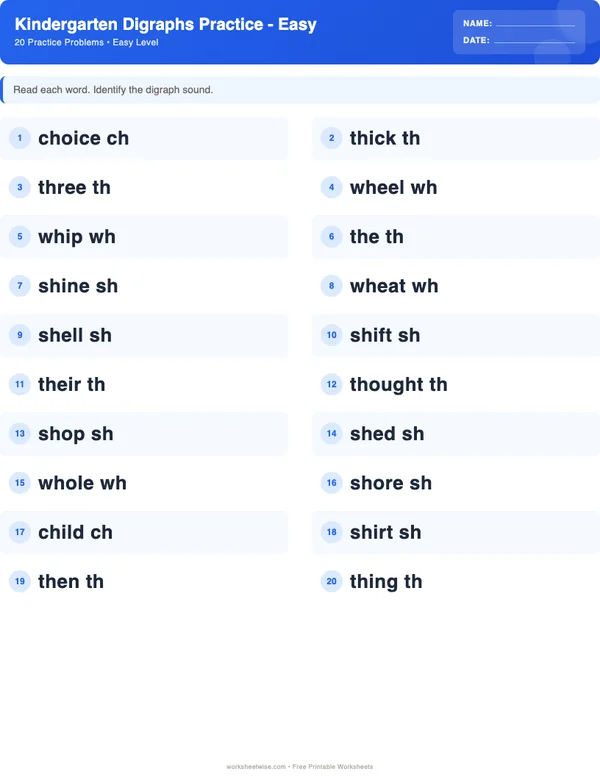
In a blend, each consonant sound remains audible: slip begins /s/ /l/. In a digraph, two letters represent one sound: ship begins /sh/. A child who still guesses ordinary CVC words from the first letter is not ready for a mixed page of sl, br, sh, and ch.
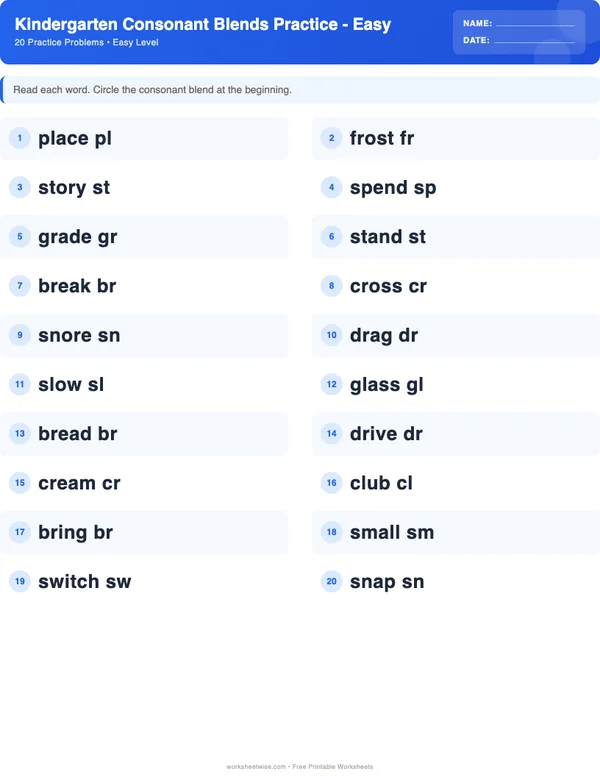
When CVC reading is accurate with reasonable effort, introduce a narrow contrast. For example, compare sip and slip. The added /l/ creates a four-phoneme word. If the child drops it, use tokens or finger taps for all four sounds. For a digraph, compare sip with ship; explain that s and h work together for /sh/. Do not tell the child that every two adjacent consonants form the same kind of unit.
Use word families as pattern practice, not guessing practice
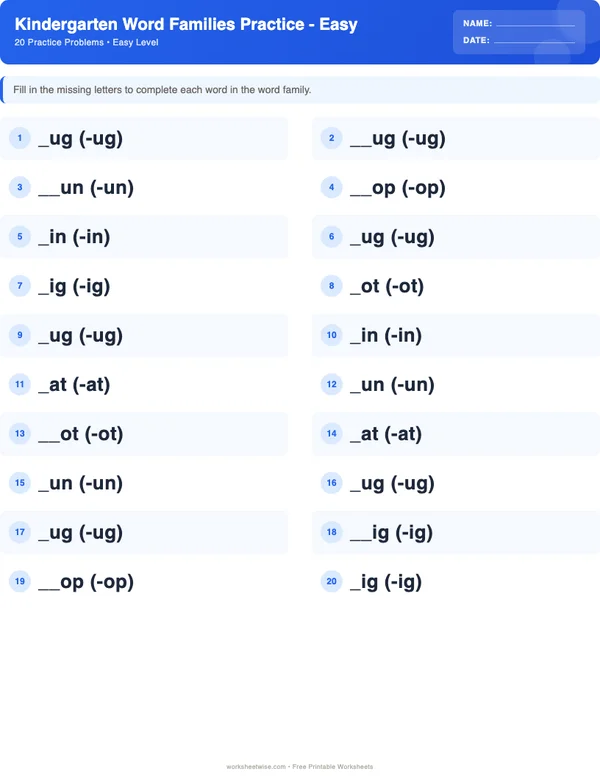
A word-family sequence such as cat, mat, sat holds -at constant while the initial consonant changes. It can build efficient recognition, but ask the child to confirm every sound. Pictures should verify meaning after decoding, not permit guessing before looking through the word.
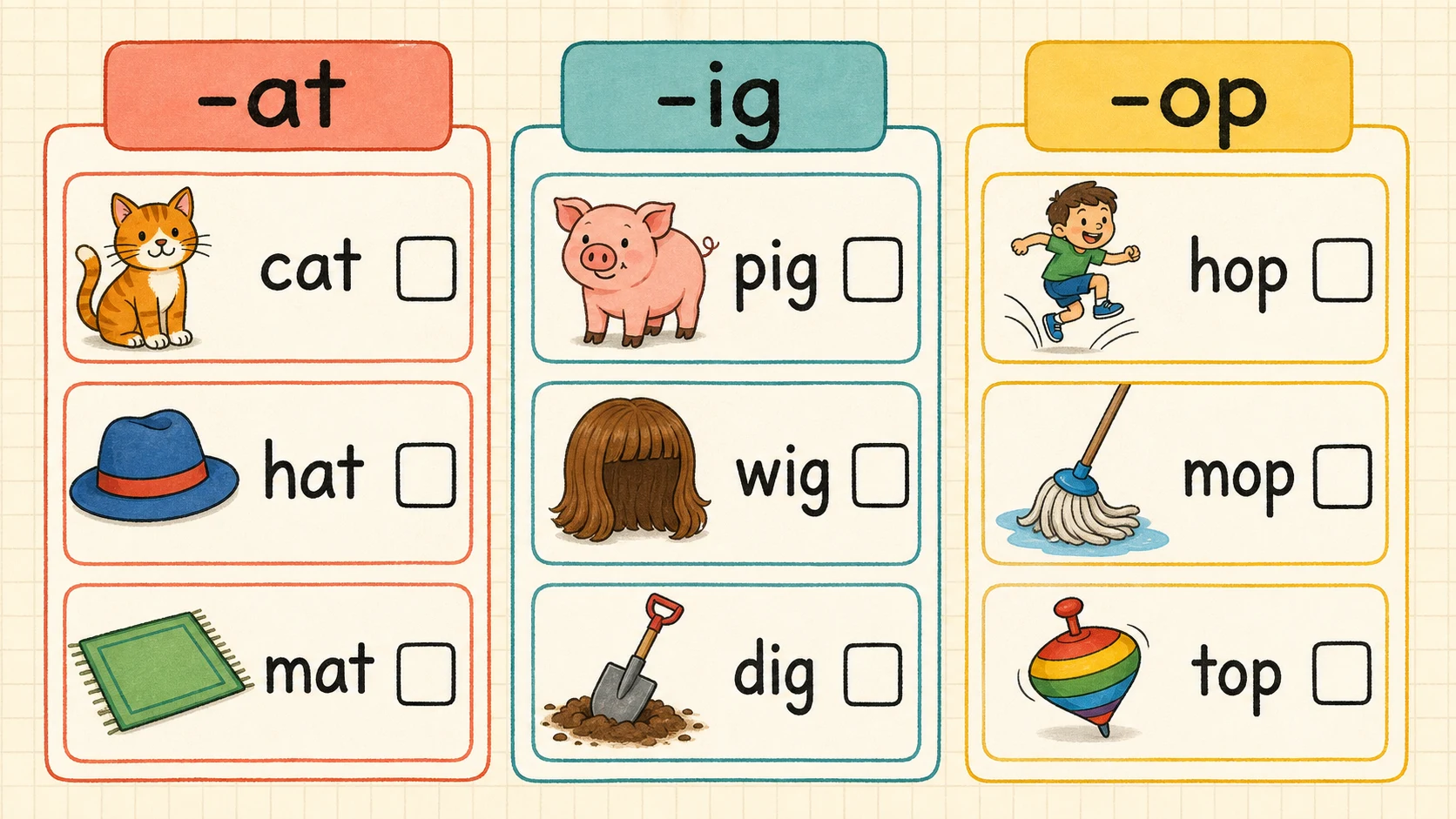
Alternate building, reading, sorting, sentence use, and cumulative review so a familiar ending transfers beyond one worksheet format.
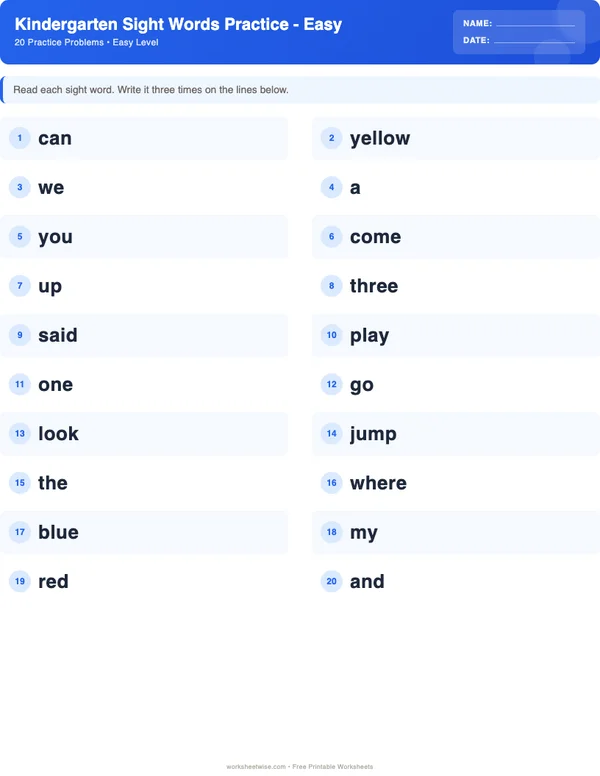
Sight-word practice needs similar care. Words such as the, and, is, and can are part of the supplied kindergarten context, but do not assume an exact list or fixed total applies in every school. Ask the teacher which words have been introduced. Let the child notice regular letter-sound parts and learn only the unexpected portion by close attention, then encounter the word in a short sentence.
Develop geometry, punctuation, writing, and motor access
Geometry moves from noticing and matching whole shapes to naming attributes, sorting examples, and composing shapes. A child who recognizes only an upright, equilateral-looking triangle may have memorized one visual prototype rather than the defining idea.
Show a triangle in several orientations and ask, “What makes all of these triangles?” A useful kindergarten answer is that each closed shape has three straight sides and three corners. Then include a non-example, such as an open three-segment figure. This example belongs here because it replaces superficial matching with an observable property while remaining within early two-dimensional geometry.
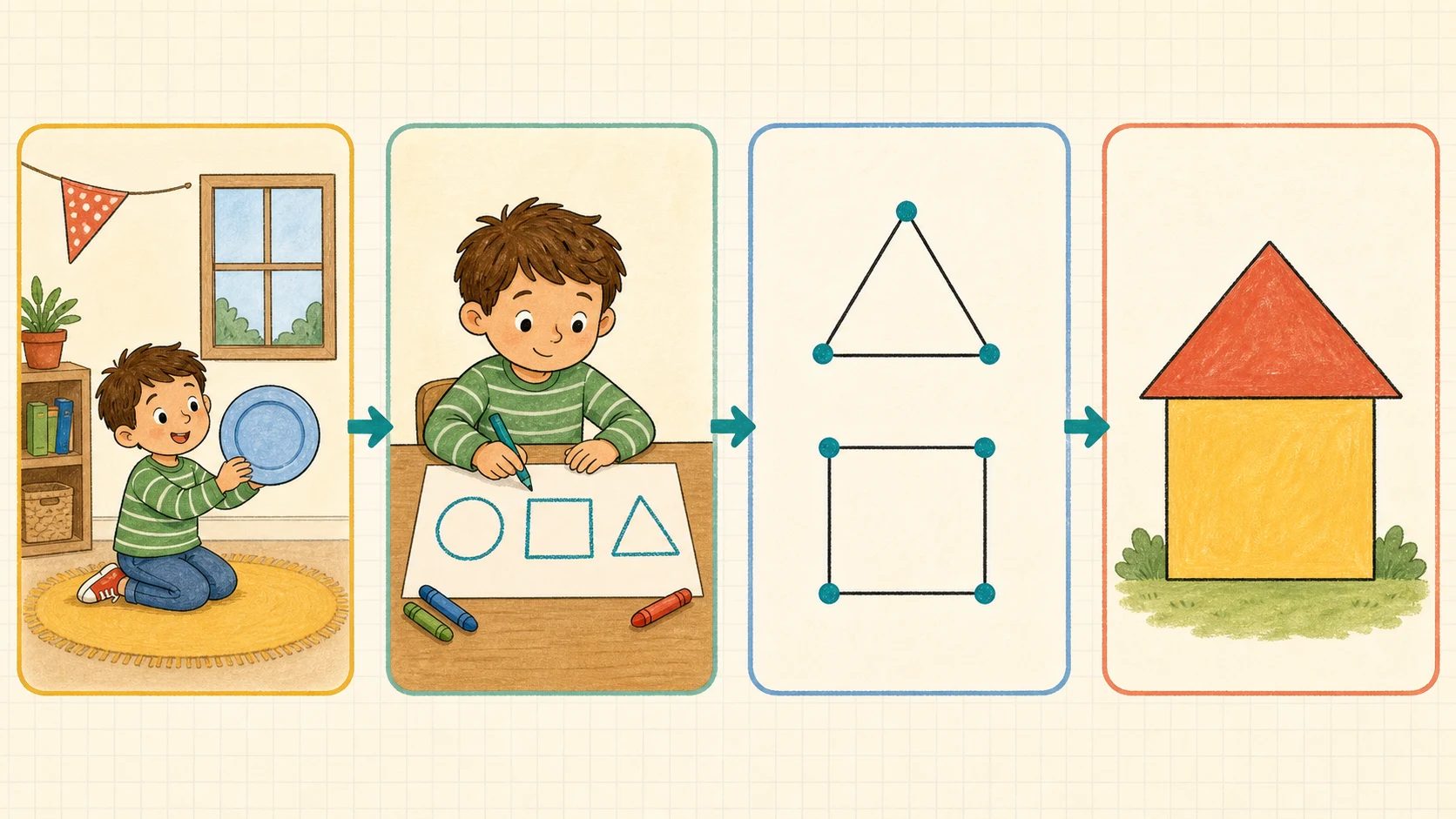
Move from handling and sorting shapes to naming attributes and recognizing unfamiliar orientations before expecting independent paper classification.
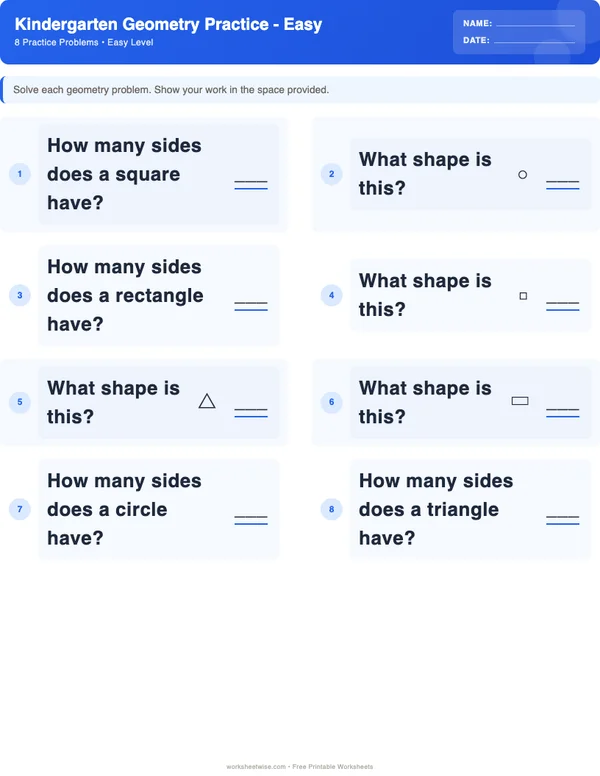
The Kindergarten Geometry guide and free sheet is appropriate after a hands-on preview with blocks, cutouts, or classroom objects. Preserve geometry as the target by letting a child point, sort, trace, or dictate instead of requiring extensive writing.
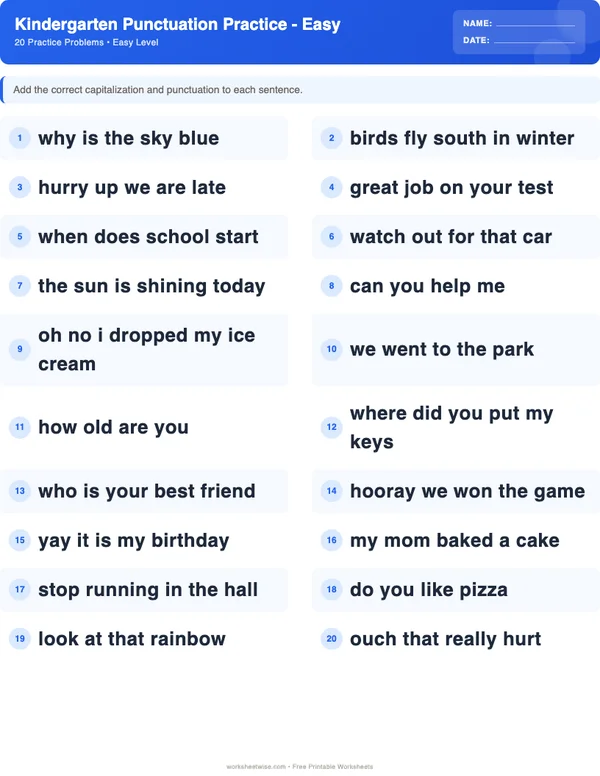
For punctuation, read three checked examples aloud:
The dog is wet.makes a statement and ends with a period.Is the dog wet?asks a question and ends with a question mark.Look at that huge dog!expresses strong feeling or emphasis and can end with an exclamation point.
These belong in kindergarten because each is a complete, short sentence whose purpose can be heard. The child does not need terminology such as “declarative sentence” to choose and explain the mark.
Writing may progress from labels to simple sentences, but composition and handwriting should be observed separately. The IES elementary writing guide recommends daily time for writing, explicit instruction in the writing process, and development of handwriting, spelling, and sentence construction. For a child with a strong spoken sentence but laborious letter formation, let the child dictate first, then copy or complete one manageable part. That preserves the idea-generation target while still providing a bounded handwriting opportunity.
Use a short routine that produces evidence
Preview, practice, inspect, decide
Use this routine for one brief session:
- Name the target. Say, “Today we are checking that each object gets one count,” or, “Today we are listening for the middle vowel.”
- Preview two items. Complete one together. Let the child attempt the second with minimal prompting.
- Select a workable portion. Cover unused rows or fold the page. Six attentive items can provide better evidence than 20 rushed marks.
- Invite a representation. Offer counters, letter tiles, a sound-box strip, or shape cutouts when these expose the target strategy.
- Record help given. Note “directions read aloud,” “used counters,” “one reminder to touch each object,” or “independent.”
- Inspect one success and one error. Ask, “How did you figure this out?” and “What happened here?”
- Choose one next action. Repeat with one support removed, change the representation, narrow the contrast, or step back to a prerequisite.
Stop when accuracy falls because of fatigue, the child begins guessing, frustration replaces thinking, or motor effort overwhelms the academic task. Finishing the page is not the objective.
Read errors as clues, not scores
A total such as 14 out of 20 hides the information needed for selection. Mark the type, consistency, representation, and level of help.
What common work-sample patterns suggest
If a child counts a row correctly but double-counts scattered objects, the likely next action is moving or marking objects during counting—not a longer number sequence.
If the child solves 3 + 2 with counters but writes 4, check numeral formation and whether the counted total was transferred correctly. Do not assume the joining concept is absent.
If every subtraction story is added, ask the child to act out one story. Failure to interpret the action calls for oral retelling and concrete modeling. Correct acting with an incorrect equation calls for model-to-symbol linking.
If cat, map, and sat are read correctly but pin and sit are read with short e, select a narrow short-i versus short-e contrast. Repeating short a pages will not address the observed pattern.
If stop becomes sop and best becomes bes, final or internal consonants are being omitted. Return to sound-by-sound mapping with four tokens and a limited blend set.
If every sentence receives a period, read the sentences aloud and ask whether each one tells, asks, or exclaims. This preserves punctuation as the target while removing decoding as a barrier.
These are instructional interpretations, not diagnoses. One page may reflect fatigue, unfamiliar directions, distraction, limited English exposure, or motor difficulty. Look for the same pattern across at least a few examples and contexts before changing the practice path.
Adapt access without erasing the skill
An adaptation is useful when it removes an irrelevant barrier but keeps the decision the child must make.
For counting, enlarge crowded pictures, use movable counters, or let the child point while the adult records. Do not tell the total.
For phonics, read directions aloud and replace handwriting with letter tiles. Do not pronounce the target vowel or reveal the word.
For word problems, read the story exactly, let the child act it out, and ask for a retelling. Do not choose the operation.
For geometry, allow sorting or pointing when cutting is difficult. Do not sort by the relevant attribute first.
For punctuation, read the sentence with natural meaning but avoid dramatically signaling the answer every time. Ask the child to explain the mark.
For all subjects, reduce the number of items, increase spacing, offer a movement break, or alternate oral and written responses. These changes preserve the academic target. Replacing every response with adult demonstration does not.
Respect the limits of a worksheet sample
A worksheet can show how a child responded to a particular format on a particular day. It cannot establish a diagnosis, measure every part of kindergarten readiness, or prove independent mastery after extensive prompting. It also cannot replace conversation, play, read-alouds, manipulatives, movement, drawing, or connected reading.
The catalogue’s 13 free resources provide entry points, not a required course sequence. Its 234 variants provide selection options, not evidence that more practice always produces better learning. Use classroom information when available, especially the teacher’s current sound sequence, word list, number range, and notation.
To act on today’s evidence, open the full worksheet library, choose one kindergarten topic that matches a documented error, and preview only two items. Write down the representation used and the help given. After a short practice set, select the next page only from what the child independently explains or shows—not from age, page completion, or the kindergarten label alone.
Put it into practice
Use the guide with a real printable
Move from explanation to a short, observable practice task. Check the first item together, then adjust the next session from the learner's actual work.
Open the first free worksheet