Kindergarten · 1 live skills
Kindergarten grammar worksheets
Pick the exact skill below. Each page combines a real free download, a separate answer key, practical teaching guidance and an optional focused pack.
See all Kindergarten subjectsComplete guide
How to teach and practise kindergarten grammar worksheets
3,725 words Updated 6 instructional visuals
Start with end punctuation, because that is the live kindergarten skill
The live Kindergarten Grammar catalogue currently offers one bounded topic: punctuation. It contains 18 worksheet variants and one free 12-problem sheet. Although grammar eventually includes sentence structure, nouns, verbs, pronouns, agreement, sentence combining, and more advanced punctuation, those areas are not separate live skills on this page. For a learner using this catalogue today, the practical starting decision is narrower: work on choosing and applying a period, question mark, or exclamation point at the end of a sentence.
That narrow focus is useful. A young learner must coordinate several ideas to punctuate even a short sentence:
- The words express a complete message.
- The message has a purpose: telling, asking, or exclaiming.
- The written sentence needs a mark that communicates that purpose.
- The reader’s voice should make sense with the chosen mark.
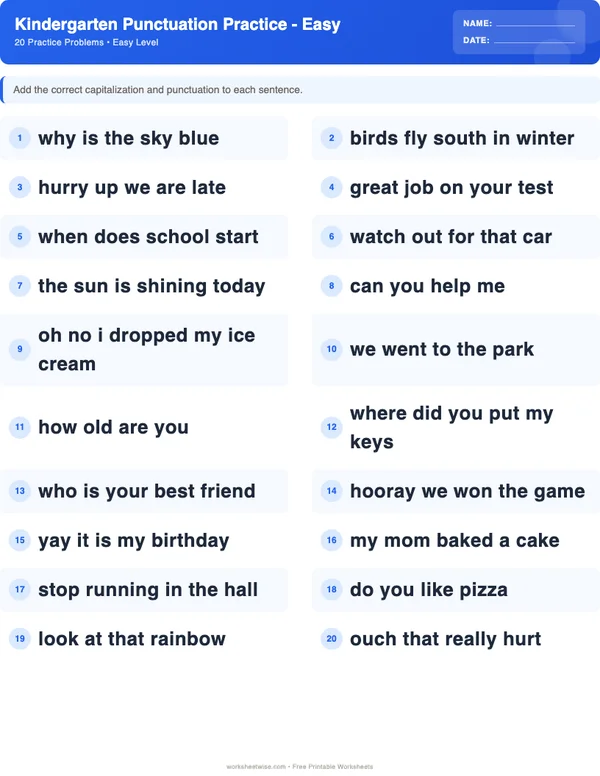
Start with the free sheet if the learner can listen to or read a short sentence and discuss what it is doing. Do not begin by asking the learner to memorize three symbol names in isolation. Read the sentence aloud, identify its communicative purpose, and then choose the mark.
The catalogue labels the free sheet “easy,” but that label should describe the task rather than the child. Here, an easier task would have short, familiar sentences; an obvious statement, question, or exclamation; one missing mark at the end; limited writing; and adult support available for reading. A more demanding task would weaken those supports by mixing less obvious meanings, asking the learner to edit several sentences, or requiring original writing.
Grade labels describe intended practice level; local curriculum sequences differ. Age is a discovery aid rather than a placement decision. What matters most is the learner’s observable response to the task.
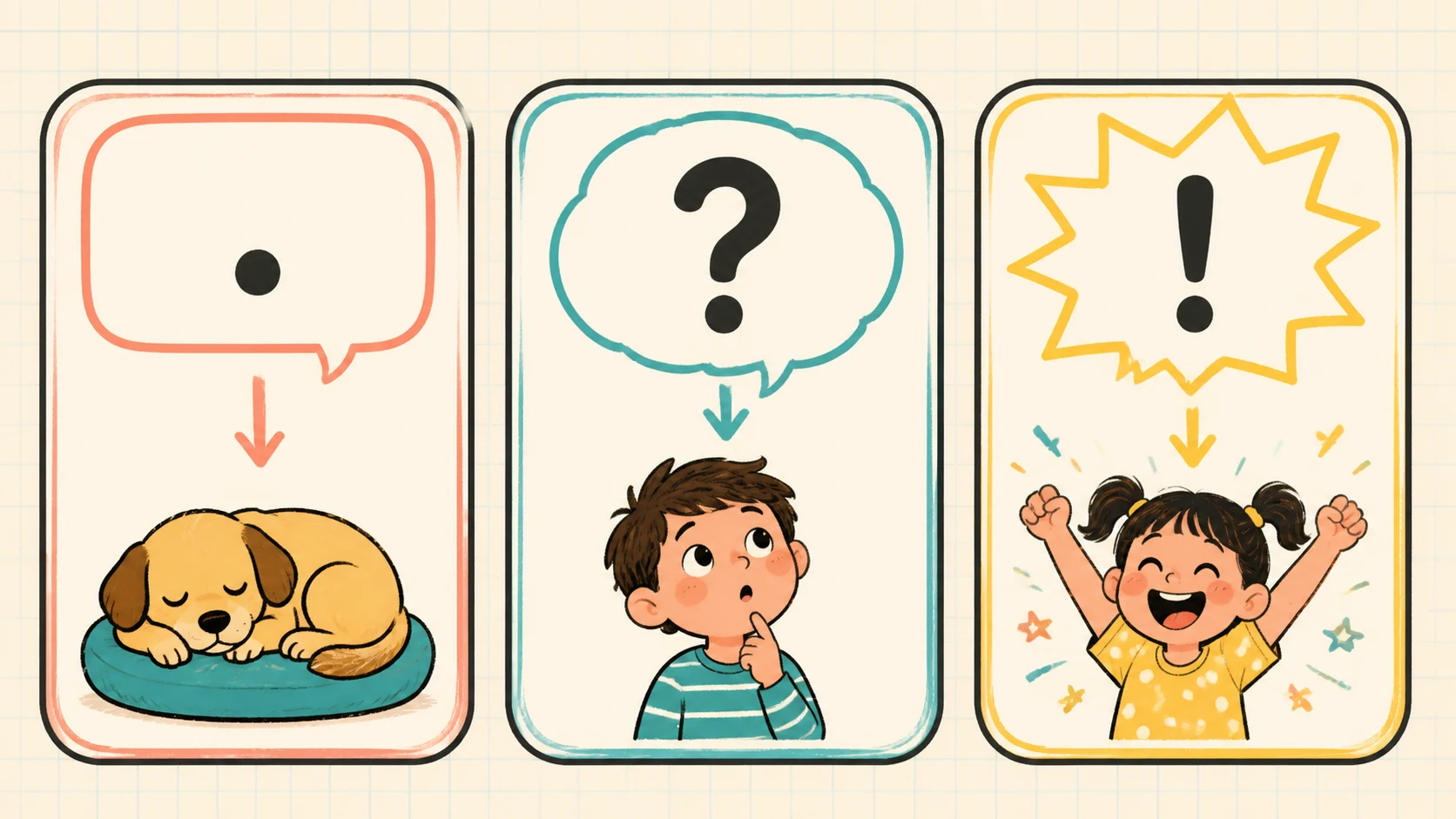
The live kindergarten path is concentrated: sentence meaning leads to sentence type, voice, and one appropriate end mark.
What belongs in this kindergarten progression—and what does not yet
The verified catalogue has one grade, one subject, and one topic:
- Grade: Kindergarten
- Subject: Grammar
- Topic: Punctuation
- Free entry point: one 12-problem sheet
- Available variants: 18
That means this page supports a progression within early punctuation, not a comparison among live kindergarten noun, verb, sentence-combining, and pronoun worksheets. Those broader grammar topics may be reasonable future areas of study, but treating them as current catalogue choices would misrepresent what is available.
Within punctuation, however, adults can make meaningful comparisons. A learner may be working on recognition, selection, explanation, correction, or application. Those are different demands even when all of them use the same three marks.
Recognition: connect a mark with a purpose
At the most supported point, show one mark at a time. Name it, trace it, and attach it to an oral example:
- Period: “The bus is here.”
- Question mark: “Is the bus here?”
- Exclamation point: “The bus is here!”
The words in the first and third examples are identical, but the intended force changes. That comparison prevents the period from becoming merely “the mark I use most often.”
Selection: choose among visible options
Next, present a sentence with its end mark missing and display ., ?, and !. The learner decides what the sentence is doing before selecting a symbol.
This is more demanding than matching identical marks because the answer must be inferred from language. Yet it remains well bounded: the sentence is supplied, the response options are visible, and the learner adds only one mark.
Correction: find and repair an error
Editing reverses the task. Instead of filling an empty space, the learner sees an existing mark and decides whether it works:
Can the dog swim.
The learner must notice the period, recognize that the sentence asks something, and replace the period with a question mark. A correct repair provides stronger evidence than naming a question mark on a flash card.
Application: punctuate an original message
Original writing requires the learner to generate a message, keep it in mind, write it, and punctuate it. Those demands can obscure the target. A child who forgets the final mark while concentrating on spelling has not necessarily misunderstood punctuation.
Use original writing after the learner can reliably punctuate supplied sentences. Keep the writing demand small: one telling sentence, one asking sentence, and one excited or emphatic sentence.
Compare task features before choosing a worksheet
The best starting task is not automatically the first sheet in a sequence. Compare what the learner must notice, hold in mind, and produce.
Choose a recognition or matching task when symbols are not secure
Start here if the learner:
- Confuses the names of
?and!. - Cannot locate the end of a written sentence.
- Benefits from pointing, moving a card, or copying one symbol.
- Can discuss a sentence orally but is not ready to write several responses.
Make three punctuation cards. Read a sentence, and let the learner hold up a mark. This preserves the punctuation decision while removing handwriting as a barrier.
For ages three and four, prioritize brief adult-led oral, matching, manipulative and movement work over desk work. A child might walk to a period card after hearing a statement, jump beside a question mark after hearing a question, or place a wooden token on the appropriate symbol. This guidance changes the response mode, not the target.
Choose a missing-mark task when sentence purpose is emerging
Use a one-blank format when the learner recognizes the marks but needs practice connecting meaning to notation. Look for:
- One complete sentence per item.
- The missing mark placed only at the end.
- Familiar vocabulary.
- A clear distinction among telling, asking, and exclaiming.
- Enough spacing to write a single symbol.
The live free sheet’s 12-problem length offers a practical sample, but it need not be completed in one sitting. Six thoughtful decisions with explanations can be more informative than 12 rushed marks.
Choose editing when correct answers have become automatic
Move to error correction when the learner accurately completes direct items and can explain the choices. Editing asks the learner not to trust what is printed. Begin with one incorrect mark per sentence; later, mix correct and incorrect sentences so that “change everything” stops being a successful strategy.
Choose original writing only when it still measures punctuation
If sentence generation, spelling, letter formation, or idea selection consumes the learner’s attention, the task no longer isolates end punctuation. Let the learner dictate a sentence while the adult writes the words and leaves the final mark blank. That is still application: the message belongs to the learner, while transcription support preserves the target.
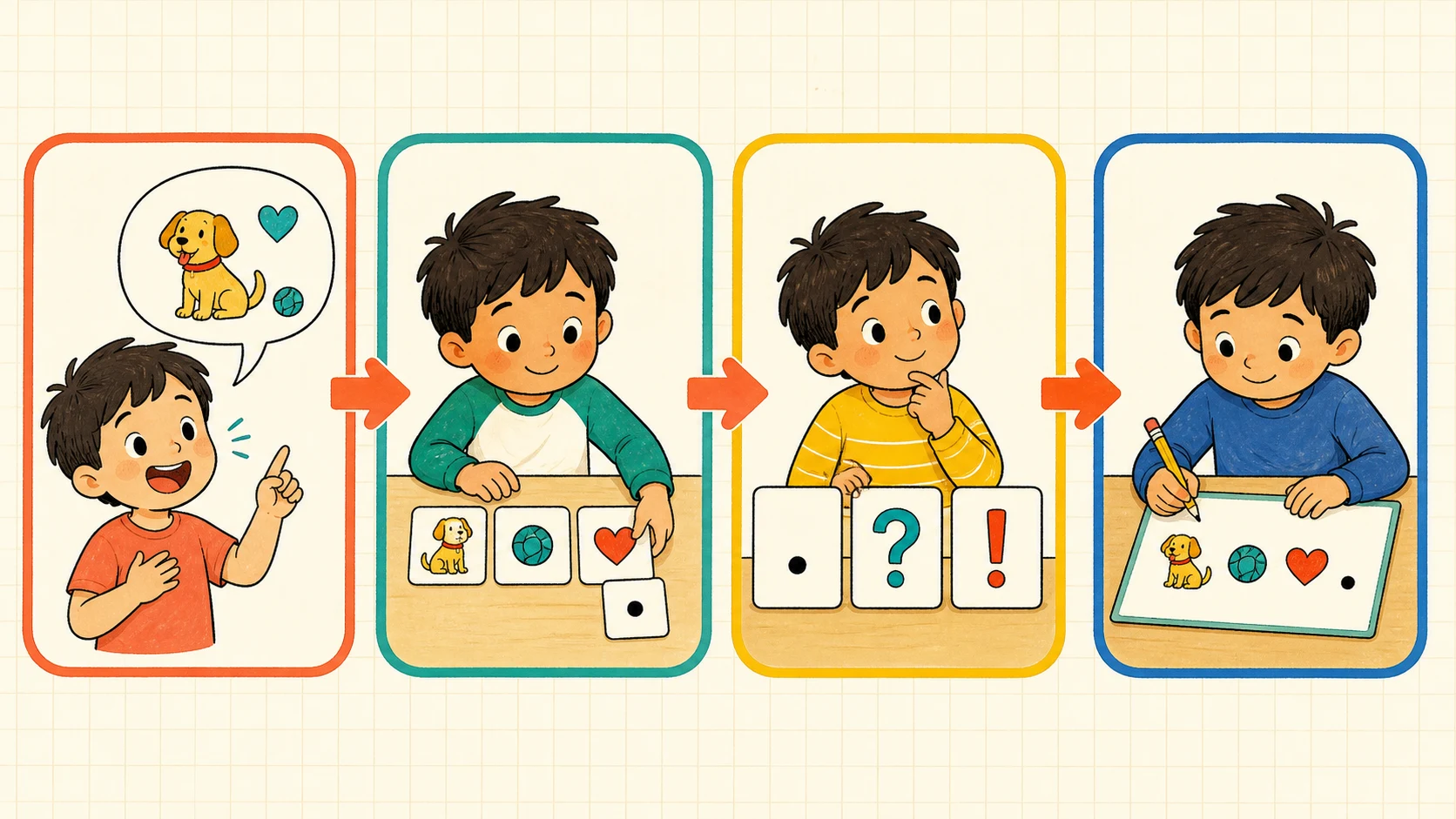
Support should fade by changing one task feature at a time: visible choices, oral rehearsal, printed sentences, editing, and finally original use.
Four checked examples reveal different kinds of understanding
Each example below uses short language and the three end marks appropriate to the live kindergarten topic. The answer is checked against the sentence’s communicative purpose, not merely its last word or the way an adult happens to perform it.
Example 1: a direct question
Where is my red hat__
Correct answer:
Where is my red hat?
The sentence asks for information about a location. A question mark is therefore required. The word “where” is a useful clue, but the reason is the sentence’s function: the speaker wants an answer.
Why it belongs here: the vocabulary is familiar, only one mark is missing, and the question is unambiguous. It is a suitable early selection item.
Check understanding by changing the wording:
My red hat is here.
Now the correct mark is a period because the sentence tells information. If the learner still chooses a question mark after seeing “hat” and “here,” the learner may be remembering the previous answer instead of interpreting the new sentence.
Example 2: a straightforward statement
The frog sits on a log__
Correct answer:
The frog sits on a log.
This sentence tells what the frog does. It does not request an answer or present the message as a strong exclamation. A period closes the statement.
Why it belongs here: it has a simple subject and action, familiar imagery, and no distracting internal punctuation. The adult can focus the conversation on “telling” rather than on grammar terminology.
A common weak explanation is “It gets a period because it is a sentence.” That is incomplete because questions and exclamations are sentences too. Prompt once: “What kind of message does this sentence give?” A stronger response is “It tells us about the frog, so it ends with a period.”
Example 3: an exclamation with a clear emotional cue
That tower is so tall__
Correct answer:
That tower is so tall!
The word “so” strengthens the description, and the sentence naturally expresses surprise or emphasis. An exclamation point fits that intended meaning.
Why it belongs here: it contrasts a strong reaction with an ordinary statement without requiring advanced vocabulary. It also demonstrates that an exclamation does not have to be a shouted command.
There is a legitimate context issue worth discussing. A writer could calmly report, “That tower is so tall.” Punctuation partly communicates intended voice. For a worksheet item to have one defensible answer, its wording or picture should make the strong reaction clear. If context is genuinely ambiguous, accept a reasoned choice rather than pretending punctuation is mechanical.
Example 4: correct an incompatible mark
Do you see the moon!
Corrected sentence:
Do you see the moon?
The sentence requests an answer, so the question mark is the conventional choice. The exclamation point may suggest an excited voice, but it does not clearly represent the basic sentence purpose in this introductory task.
Why it belongs here: unlike filling a blank, the learner must inspect and reject a supplied mark. That makes it an appropriate step after direct selection.
Ask, “What would the listener do next?” If the answer is “Say yes or no,” the learner has identified the question function. That oral reasoning is more useful than asking whether the voice “goes up,” because speakers do not give every English question the same pitch pattern.
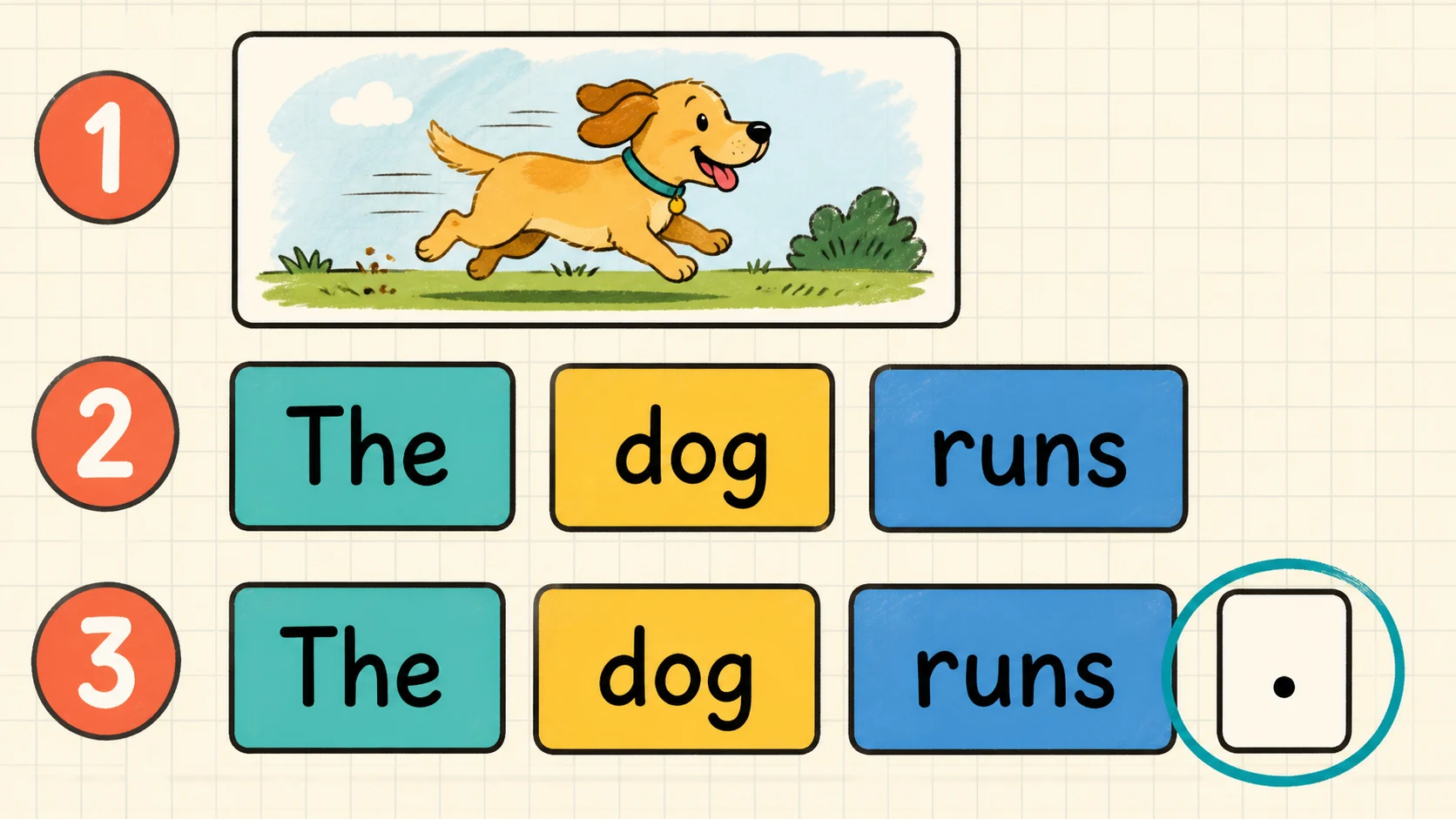
The useful work is not drawing the symbol; it is connecting a complete message to the mark that helps a reader interpret it.
Use voice as a bridge, then return to meaning
The catalogue teaching guidance recommends connecting end marks with voice: a steady ending for a statement, a questioning voice for a question, and an emphatic voice for an exclamation. This is a useful teaching suggestion, especially in an oral warm-up, but it should remain a bridge rather than the complete rule.
Read one sentence in contrasting ways:
You found it.
First, read it as calm information. Then read it as an excited discovery and show:
You found it!
Ask what changed and what stayed the same. The words stayed the same; the intended expression and final mark changed.
Then use a sentence whose grammar makes the purpose clearer:
Did you find it?
Even if an adult deliberately reads this with an unusually flat voice, it still asks a question. Meaning and sentence structure are firmer evidence than pitch alone.
The Institute of Education Sciences recommends connecting foundational reading instruction with opportunities to understand how language works in meaningful text. Its foundational-skills guide does not evaluate WorksheetWise, but it supports purposeful work with language rather than isolated symbol recitation. See IES, Foundational Skills to Support Reading for Understanding.
The catalogue also suggests looking at punctuation in read-aloud books. Treat that as observation, not a hunt for decorative symbols. Pause after a short line, cover the final mark, and ask:
- Is the character telling, asking, or exclaiming?
- Which mark would tell the reader that?
- Reveal the printed mark. Does the author’s choice match the prediction?
Published books may contain dialogue, fragments, ellipses, or expressive punctuation beyond the current target. Select a clean example rather than trying to explain every mark on the page.
A repeatable eight-minute teaching routine
A short routine makes the learner’s decisions visible without turning punctuation into a long handwriting session.
Minute 1: hear and sort
Read three short sentences aloud—one statement, one question, and one exclamation. The learner points to or holds up a punctuation card. Do not show printed sentences yet.
Minutes 2–3: model one complete decision
Write:
Is the gate open__
Think aloud briefly: “This sentence asks whether the gate is open. The reader expects an answer. I will use a question mark.”
Keep the explanation tied to message purpose. Avoid adding unrelated corrections about capitalization or spelling during this model.
Minutes 4–6: guide three decisions
Present three items. Before the learner writes a mark, ask for one of these responses:
- “It tells.”
- “It asks.”
- “It shows a strong feeling.”
If the learner is unsure, read the item aloud and offer two mark cards rather than supplying the answer. Reduce only the part causing difficulty.
Minute 7: try one without prompting
Give one fresh sentence with three visible mark choices. Wait. The learner selects the mark and explains the decision.
Minute 8: record one observation
Write a factual note such as:
- “Selected 4 of 4 marks and explained each purpose.”
- “Questions were correct; periods and exclamation points were mixed.”
- “Oral choices were accurate, but two written symbols were reversed.”
- “Needed every item read aloud.”
These observations point toward the next task. Labels such as “weak at grammar” do not.
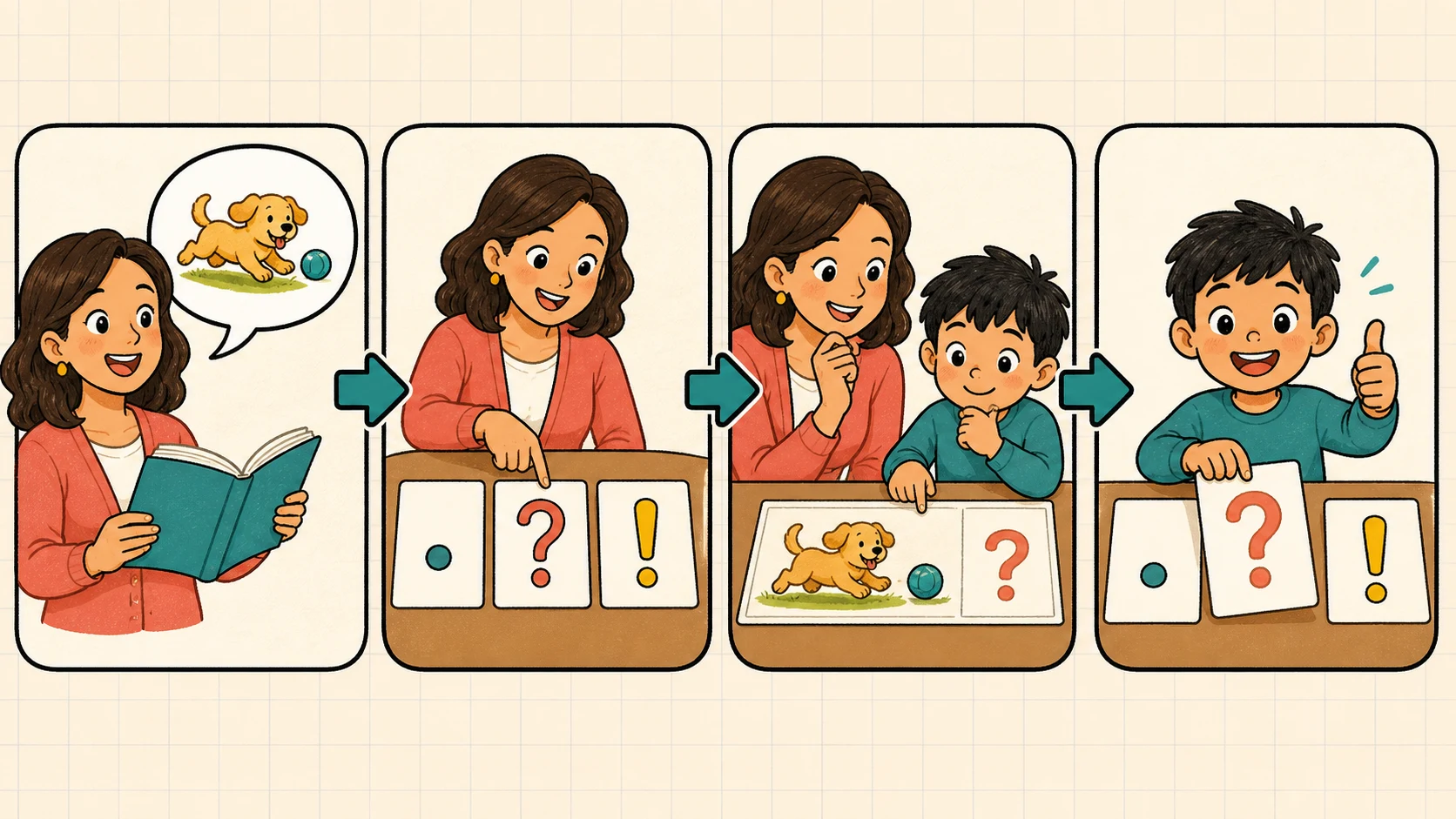
An efficient punctuation lesson moves from hearing a message to seeing, choosing, explaining, and independently applying one end mark.
For school use, the routine can become a brief warm-up before writing; see the Classroom Grammar Worksheets. At home, an adult can split the routine across a read-aloud and a later written item using the Kindergarten Homeschool Worksheets.
Interpret errors before assigning more problems
An incorrect mark does not identify its own cause. Look at the response, ask one neutral question, and change the next item to test an explanation.
The learner uses a period for everything
Possible interpretation: the period is the most familiar mark, or the learner thinks every sentence ends with it.
Test it orally. Say, “Are your shoes wet?” and ask whether you told something or asked something. If the learner identifies a question but still writes a period, symbol selection may be the issue. If the learner calls it “telling,” return to contrasting oral messages.
Next task: sort six spoken sentences into “tells” and “asks” before writing any marks. Introduce exclamations again only after that contrast is stable.
The learner chooses by volume alone
A learner may select ! whenever the adult reads loudly and ? whenever the voice rises.
Possible interpretation: the voice cue has become the rule rather than a support.
Test it with a calm question: “Can you pass the blue block?” Ask what response the speaker wants. Then read “The baby is asleep!” enthusiastically and discuss whether strong expression can accompany a statement.
Next task: require a purpose statement—“asks,” “tells,” or “strong feeling”—before selecting a mark.
The learner answers the question instead of punctuating it
For “Where is the cat__,” the learner says “under the bed.”
Possible interpretation: the learner understood the sentence perfectly but interpreted the adult’s request as conversational.
Next task: say, “You answered the question. Now show the mark that tells a reader it is a question.” Keep the response options visible. This is a direction-following issue in that moment, not evidence of missing punctuation knowledge.
The oral answer is right, but the written mark is malformed
A reversed or incomplete question mark can coexist with correct conceptual understanding.
Next task: let the learner choose a printed card, stamp the mark, trace a large model, or dictate the answer. Add brief symbol-formation practice separately. Do not replace the punctuation lesson with prolonged handwriting correction.
The learner changes every mark during editing
Possible interpretation: the child has inferred that an “editing” page always contains errors.
Next task: mix correct and incorrect sentences. Ask the learner to mark each with “keep” or “change,” then repair only those marked “change.” This makes evaluating the printed choice part of the task.
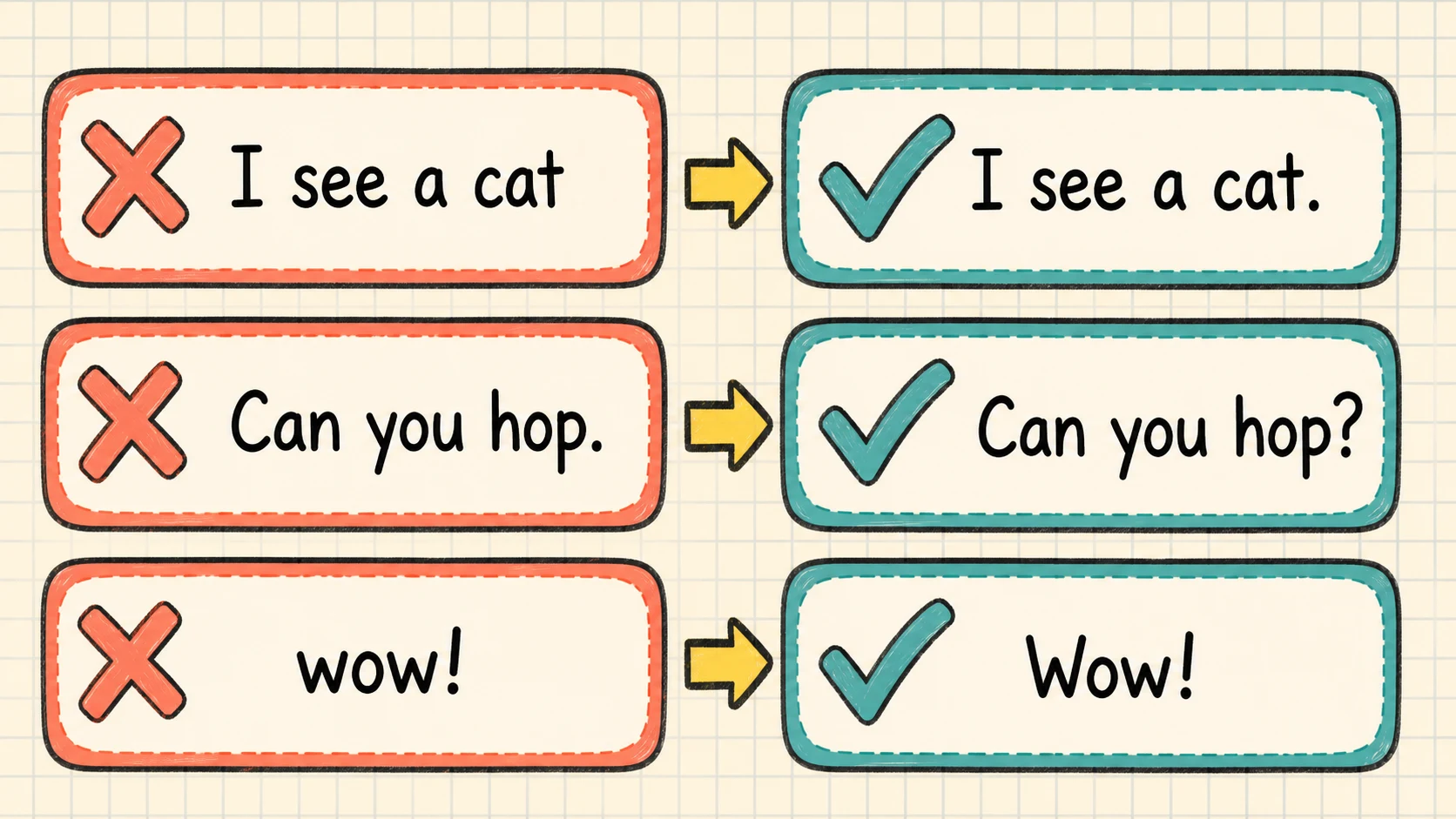
The same wrong symbol can reflect a meaning error, an overlearned cue, a misunderstood direction, or a handwriting barrier; the next prompt should test which explanation fits.
Adapt the work without removing punctuation reasoning
An adaptation preserves the decision “Which end mark communicates this message?” while changing access or response demands.
For a learner who cannot yet read the sentences independently, read each item exactly as written and let the learner select the mark. This supports decoding without answering the punctuation question.
For a learner with limited handwriting stamina, cut out ., ?, and ! cards or use reusable tiles. The learner still interprets every sentence.
For a learner who needs reduced visual load, cover all but one problem. Keep the original sequence and choices; reveal the next item after the response.
For a learner who benefits from movement, place three mark cards in different locations. Read one sentence, have the learner move to a card, and ask for a brief reason.
For a multilingual learner, confirm the sentence vocabulary before assessing the punctuation decision. A child cannot reliably classify “The enormous machine rumbled” if “enormous” and “rumbled” are unfamiliar. Use known language while keeping the same sentence purpose.
For a learner ready for additional challenge, do not jump immediately to commas, apostrophes, or quotation marks. Remove a support within the current target:
- Hide the three mark choices.
- Mix correct and incorrect endings.
- Ask the learner to explain why another mark would change the message.
- Dictate two versions of the same words with different intended expression.
- Have the learner compose one question for an adult to answer.
The IES elementary writing guide recommends explicit teaching, supported practice, and regular opportunities to write. It did not assess these worksheets. In this context, its guidance supports a gradual move from an adult model to guided choices and then a small, purposeful writing application.
Use a two-week plan only as a decision framework
A two-week sequence should respond to evidence rather than require ten identical sessions.
Week one: establish meaning and marks
- Day 1: Sort oral statements and questions.
- Day 2: Match periods and question marks to short printed sentences.
- Day 3: Add clear exclamations and compare them with calm statements.
- Day 4: Complete several missing-mark items and explain each choice.
- Day 5: Review a mixed set; note which contrast still needs support.
If the learner cannot yet distinguish telling from asking on Day 5, repeat that contrast with fresh language. Do not add harder punctuation simply because the calendar says a week has passed.
Week two: vary the form of the same decision
- Day 6: Correct one wrong mark at a time.
- Day 7: Judge a mixture of correct and incorrect endings.
- Day 8: Punctuate adult-written sentences dictated by the learner.
- Day 9: Write or dictate one statement, one question, and one exclamation.
- Day 10: Complete a short mixed check without immediate prompts.
Record accuracy together with the conditions. “Five of six with sentences read aloud” is different from “five of six read independently,” yet both may show sound punctuation judgment.
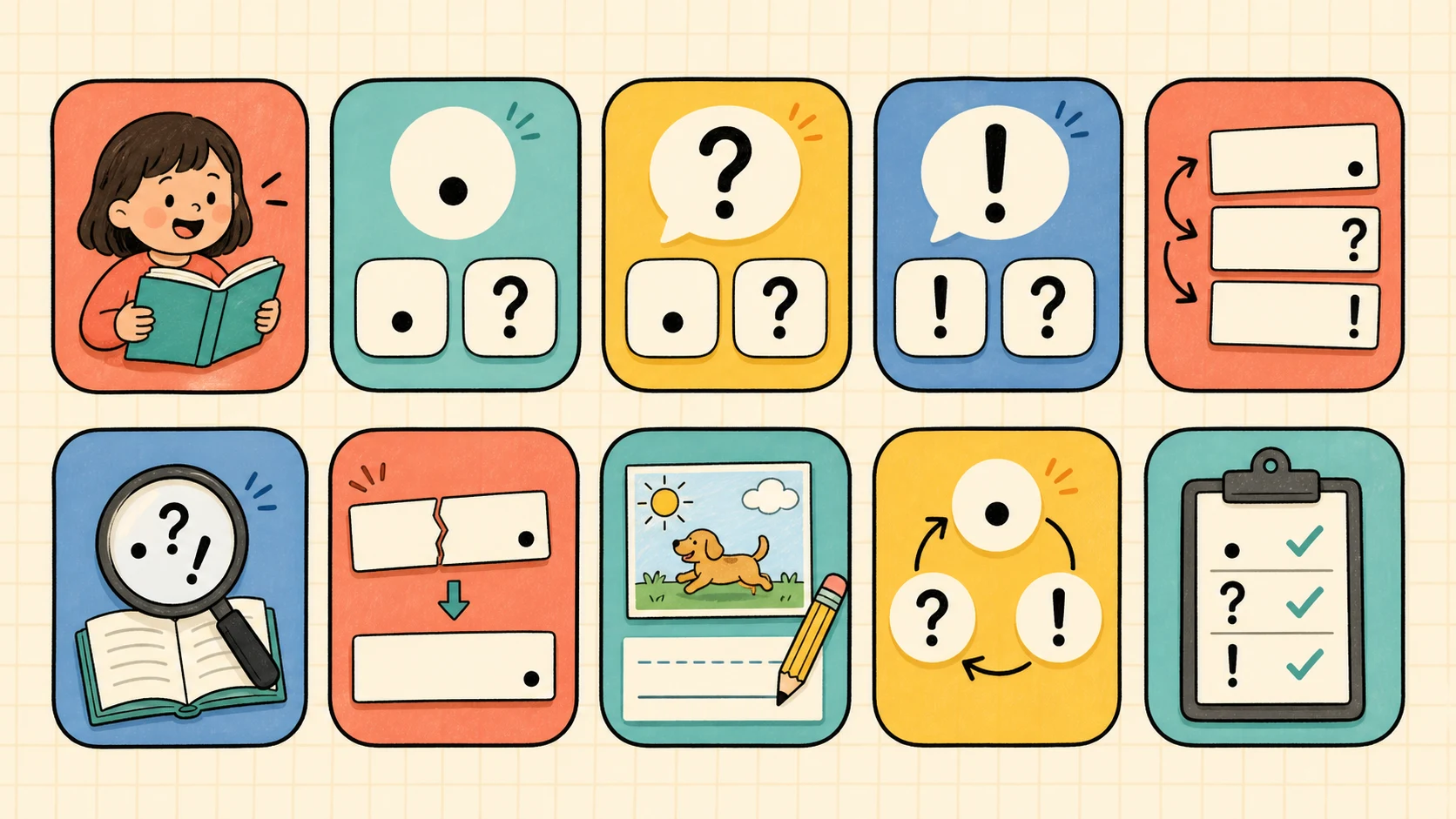
Across two weeks, vary the response demand while repeatedly checking the same core relationship among meaning, sentence purpose, and end mark.
Know the boundary of this worksheet evidence
A punctuation sheet shows how a learner handled a particular set of printed items under particular conditions. It does not diagnose a language, reading, attention, motor, or learning condition. It also cannot establish broad grammar mastery.
Correct answers may come from genuine reasoning, recognizable clue words, copying a pattern, guessing, or adult prompting. That is why a brief explanation and one transfer item matter. If the learner punctuates “Can we go now__” correctly, follow with a question that does not begin with “can”:
Where did Sam go__
Similarly, an incorrect answer may reflect unfamiliar vocabulary, difficulty reading the sentence, an unclear picture, symbol formation, or confusion about directions. Preserve the marked page, note the help provided, and test a simpler contrast before drawing a conclusion.
The Common Core English Language Arts standards include grade-specific language conventions, including capitalization and end punctuation in kindergarten. That source defines public standards; it does not verify this catalogue’s alignment or determine the correct sequence for every school. Use local curriculum requirements when alignment decisions matter.
The live topic description mentions later punctuation such as commas in lists and dates, apostrophes, quotation marks, colons, and semicolons. Those are part of a broader punctuation progression, not a signal to teach them all in kindergarten. The catalogue’s own teaching guidance recommends end punctuation first and one comma rule at a time later. For this page, a learner who is still deciding among ., ?, and ! benefits more from clearer contrasts than from a larger inventory of marks.
Make one observable next decision
Use the learner’s first six responses to choose one path:
- If fewer than four choices are correct, or explanations do not match the sentence purpose, return to oral sorting with “tells” and “asks.”
- If four or five are correct, reteach the specific confused contrast and try three fresh items.
- If all six are correct with explanations, move to mixed editing rather than another identical fill-in set.
- If oral choices are accurate but written answers are not, retain the punctuation target and change the response mode.
- If every direct item is secure, ask for one original statement, question, and exclamation, with transcription support if needed.
Do not require the learner to finish all 12 problems before responding to a clear pattern. Stop, teach the contrast, and resume later with a fresh item. The objective is not page completion; it is a defensible punctuation decision the learner can repeat in a new sentence.
For the next session, open the Kindergarten Punctuation guide and free sheet. Present the first six items, ask “Is it telling, asking, or showing strong feeling?” before each mark is added, and record the exact contrast that needs the next three-item lesson.
Put it into practice
Use the guide with a real printable
Move from explanation to a short, observable practice task. Check the first item together, then adjust the next session from the learner's actual work.
Open the first free worksheet