5 free PDFs with answer keys
Pre-K worksheets
Choose only from subjects and skills with real files in the current Pre-K catalogue. Start with the free standard sheet, then add more practice only if you need it.
Complete guide
How to teach and practise pre-k worksheets
3,494 words Updated 6 instructional visuals
Choose Pre-K Practice by What the Child Can Show
The right Pre-K worksheet is the one that asks a child to take one manageable step beyond what they can already demonstrate with objects, pictures, spoken words, or letters. Start with a brief, adult-led preview. Watch how the child begins, what representation helps, and how much prompting is needed. Then select practice by observed strategy and independence—not by the Pre-K label alone.
Age is a discovery aid rather than a placement decision. For ages three and four, prioritize brief adult-led oral, matching, manipulative, and movement work over desk work. A child who cannot yet count five buttons accurately does not need a longer counting page. A child who can hear that cat and hat rhyme but cannot identify the letters in -at may be ready for oral word-family play, not independent word reading.
The live WorksheetWise Pre-K catalogue currently covers two subjects and five topics: Math Counting plus Phonics CVC Words, Short Vowels, Word Families, and Sight Words. It contains 90 worksheet variants and five free entry points. Each representative free sheet has 20 problems and carries the catalogue difficulty label “easy.” Here, that label should be interpreted through observable task features: familiar content, direct directions, limited steps, a stable response format, and substantial adult modeling if needed. It does not describe the learner, guarantee independent completion, or establish curriculum placement.
Grade labels describe an intended practice level; local curriculum sequences differ. Use the catalogue to find a possible task, then let the child’s response determine whether to simplify, repeat, vary, or move forward.
Establish Readiness Before Printing a Full Page
Pre-K readiness is uneven by design. A child may count objects reliably while still using a whole-hand crayon grip. Another may recognize several words in a favorite book without being ready to blend unfamiliar CVC words. Treat math, oral language, print knowledge, sound awareness, and fine-motor control as separate observations.
Look for a starting strategy
Before presenting a worksheet, offer a version of the task that does not depend on pencil control.
For counting, place five buttons in a loose group and ask, “How many are here?” Notice whether the child:
- recites numbers without touching the objects;
- touches one button for each number word;
- counts a button more than once;
- moves counted buttons aside;
- states the total after counting; or
- answers correctly only when the objects are arranged in a row.
These behaviors are more useful for selection than the answer alone. The IES guide for young children recommends teaching number and operations through a developmental progression and using progress monitoring to build on what each child knows. It also encourages adults to integrate mathematical description into everyday activity. Those are sourced recommendations, not claims about a particular WorksheetWise page. Read the IES practice guide on teaching math to young children.
For phonics, show or say only one item at a time. Ask the child to match two rhyming pictures, name the first sound in map, or choose which of two spoken words contains the short a sound. If the child cannot perform the oral version, adding printed letters and handwriting creates extra demands without addressing the underlying sound task.
Separate knowledge from response demands
A crossed-out answer may reflect uncertainty about the concept, but it can also reflect visual scanning, language comprehension, fatigue, or motor control. Check the same idea in another form:
- Let the child point instead of circle.
- Let the child move a token instead of draw a line.
- Read the directions aloud without naming the answer.
- Cover all but one problem.
- Ask for an oral response before requesting writing.
- Replace small pictures with real objects.
These are editorially recommended adaptations. They preserve the target skill while reducing unrelated demands. They are not diagnoses or standardized assessment procedures.
Fine-motor readiness matters because tracing, circling, cutting, and writing can obscure what a child knows. Name writing and line tracing can be useful practice, but neither should become a gatekeeper for counting or sound work. The IES elementary writing guide recommends developing transcription skills such as handwriting and spelling; because that guide concerns elementary writers rather than Pre-K placement, use it as broad instructional context, not as proof that a particular preschooler should complete a particular page. Review the IES writing recommendations.
Map the Live Subjects Without Treating Them as a Sequence
The catalogue’s five topics are choices, not five required stages. Counting addresses early number work. CVC Words, Short Vowels, Word Families, and Sight Words divide early reading practice into different tasks that can overlap.
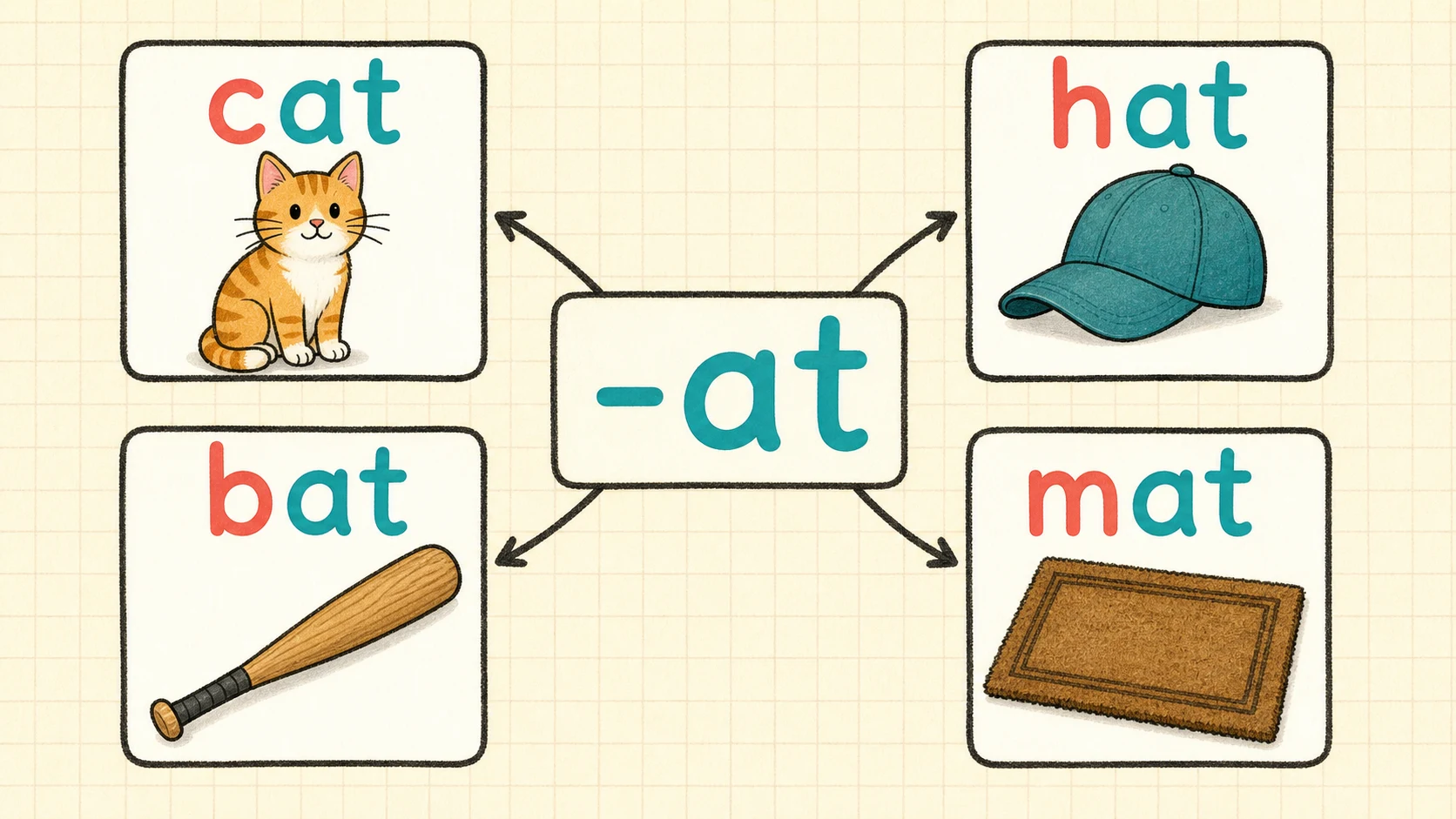
Use the map to distinguish hearing a shared ending, recognizing the printed chunk, changing the first sound, and reading the resulting word; those are related but separate performances.
Math: counting objects, sequences, and small groups
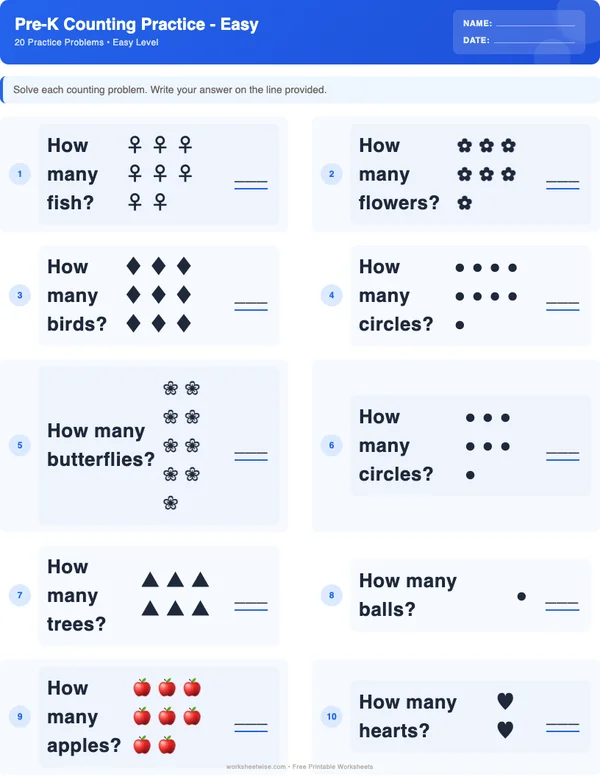
The Pre-K Counting guide and free sheet is the catalogue’s math entry point. Its description includes concrete-object counting, number sequences, missing numbers, and pictured sets. For this page, begin with the narrowest meaningful demand: coordinate one spoken number with one object and understand that the final number names the total.
Checked example 1: five counters. Put out five counters. Ask the child to slide each counter into a cup while saying “one, two, three, four, five.” Then ask, “How many went into the cup?” The verified answer is five because exactly five objects were moved once, with one number word assigned to each object. This belongs in Pre-K because it tests one-to-one correspondence and total quantity using concrete objects, both central to the page’s stated counting focus.
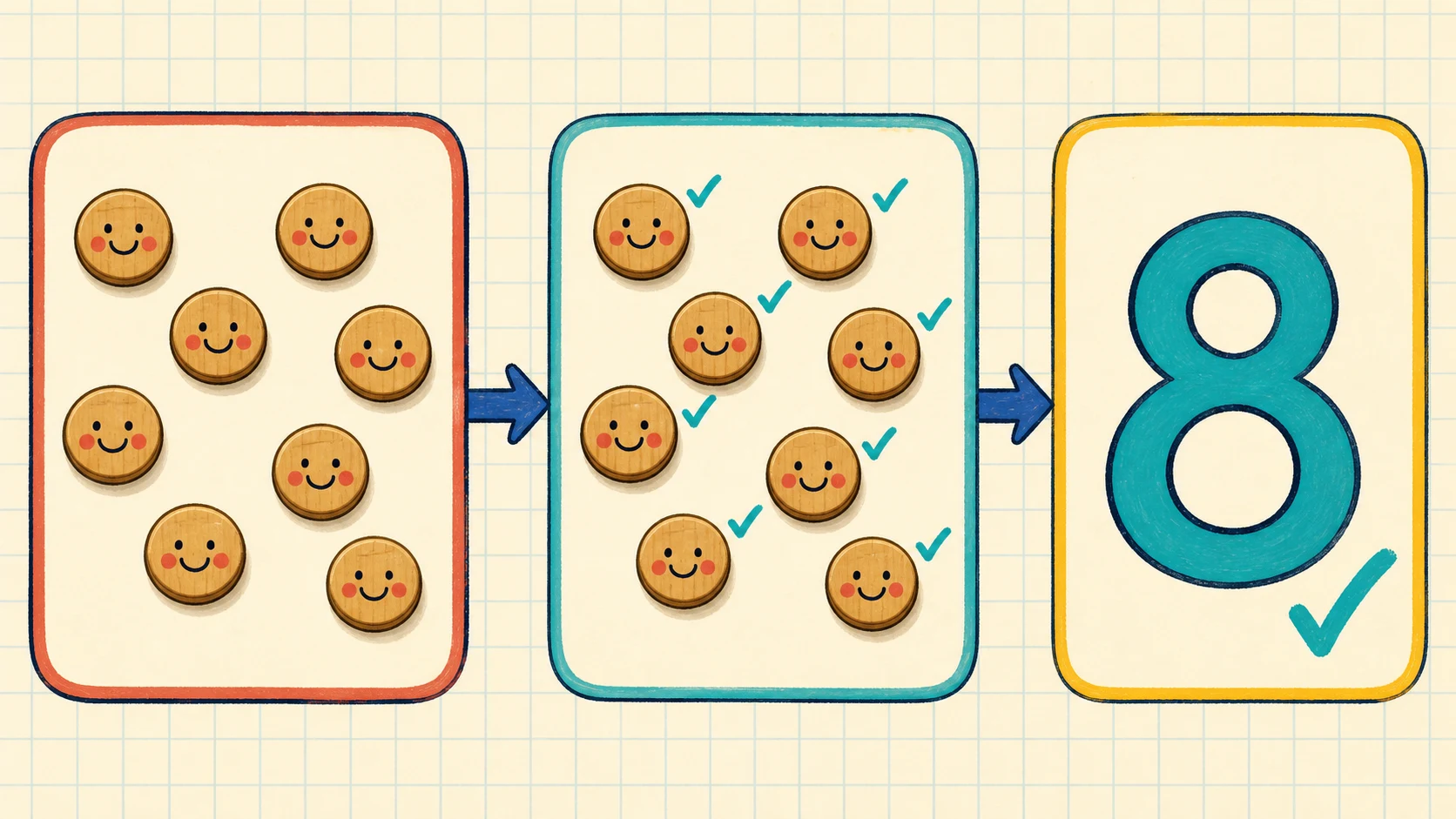
The useful transition is objects the child can move, then pictured objects, then a numeral response—not an immediate jump from reciting the count sequence to filling a page.
After success with a neat row, scatter the same five counters. The quantity is unchanged, but the tracking demand rises. Next, mix a group of four with a group of six and ask which has more. A child can compare by matching objects one-to-one even before consistently naming both totals.
Do not infer that the Pre-K page requires counting to 100, skip counting, or mastery of teen-number notation. Those demands appear in the broader catalogue description, but the verified Pre-K focus is counting to 20 with concrete objects, while the editorial thesis emphasizes recognition and comparison within 1 through 10. Select the smaller range when the child is still coordinating touch and count.
Phonics: four different reasons for choosing a page
Use the phonics topics according to the operation the child is practicing:
- Short Vowels: hear or identify the middle vowel sound in a spoken or printed word.
- CVC Words: connect three sounds to three letters and blend or segment the whole word.
- Word Families: notice and use a recurring ending such as -at or -ig.
- Sight Words: recognize and examine selected high-frequency words, including words with regular and irregular spelling parts.
The IES foundational reading guide recommends developing awareness of speech-sound segments and their links to letters, followed by explicit work in decoding, word parts, writing, and word recognition. Its formal grade range begins at kindergarten, so it should inform the direction of Pre-K support without being treated as a Pre-K placement standard. See the IES foundational reading guide.
Match the Phonics Page to the Operation
A page can look familiar while asking for a new mental action. Matching pictures that rhyme is not the same as reading printed words. Naming the vowel in cat is not the same as blending /k/ /ă/ /t/. Recognizing the in a repeated book is not proof that the child can identify it in isolation.
Short vowels before full-word decoding
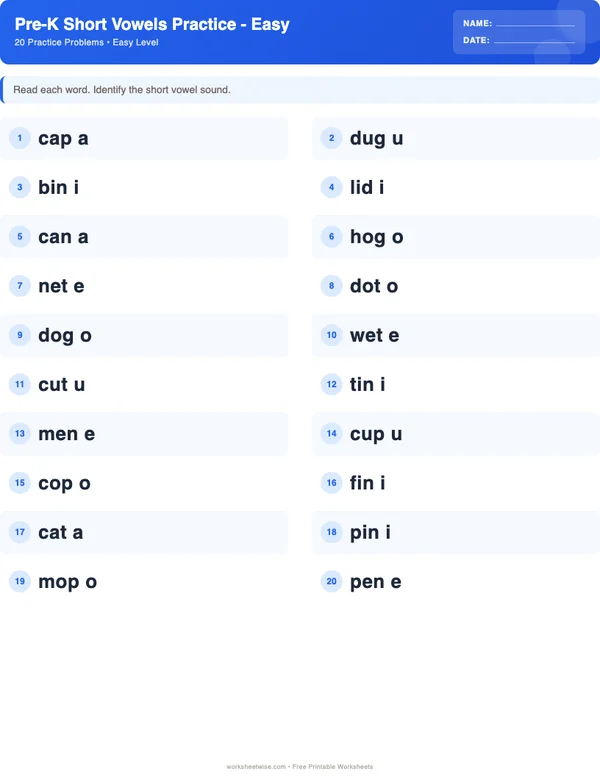
Start the Pre-K Short Vowels guide and free sheet when the child can attend to the middle sound of a short spoken word with support. Use words with three clearly articulated sounds and pictures the child can name.
Checked example 2: sort map and sit. Say each word naturally, then slowly: map, /m/ /ă/ /p/; sit, /s/ /ĭ/ /t/. Map belongs with short a and sit with short i. Each is a CVC word with the vowel between two consonants. This belongs here because the decision concerns the medial vowel sound, not independent sentence reading or memorization.
If the child chooses i for map, do not merely repeat “wrong.” First ask the child to name the picture. A vocabulary mismatch changes the task. Then contrast the middle sounds orally while hiding the letters. If the oral distinction is accurate but the printed choice is not, return to linking the known sound with its letter.
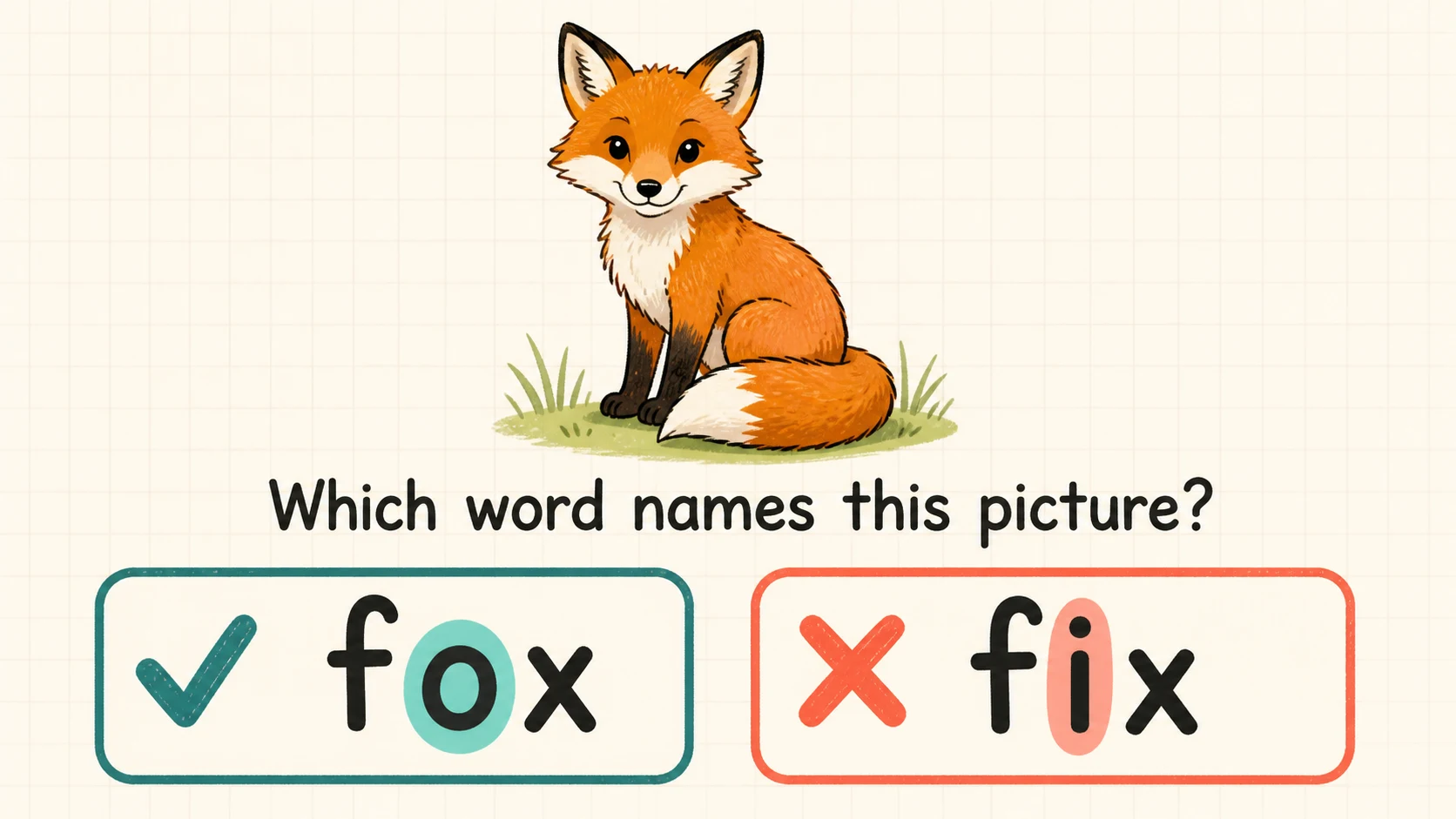
Interpret a vowel error by checking picture naming, sound discrimination, letter recall, and visual scanning separately before selecting another sheet.
CVC words when three sounds can be coordinated
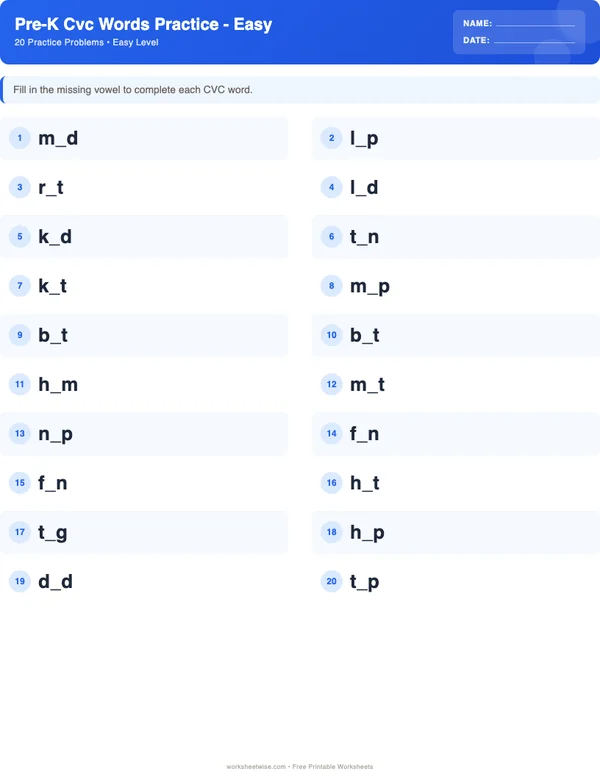
Choose the Pre-K CVC Words guide and free sheet when the child can hear or produce the sounds in a simple word and knows enough sound-letter correspondences to attempt blending. Preserve the three-part structure with tokens or letter tiles.
Checked example 3: build and blend cat. Place c, a, and t in three boxes. Point under the letters while producing /k/ /ă/ /t/, then sweep under the word and say cat. The spelling and blend are correct: initial c represents /k/, a represents the short a sound, and final t represents /t/. This belongs at this level because it makes the three sounds visible and combines them into one familiar CVC word.
If the child says the three sounds but cannot blend them, keep the target as blending. Do not add handwriting, a word search, and a sentence simultaneously. Model the sounds with less separation and invite the child to repeat. If the child guesses from the picture before looking at the letters, briefly hide the picture and point through the spelling.
Word families when a stable ending is useful
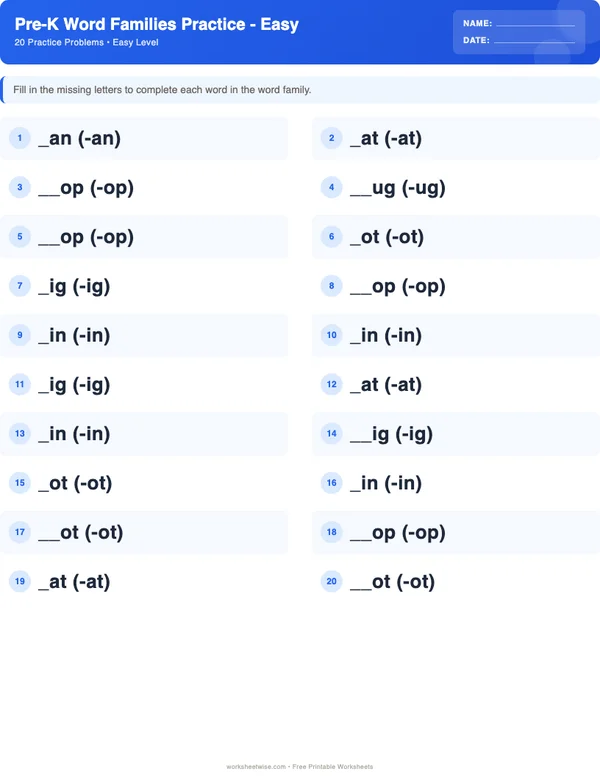
The Pre-K Word Families guide and free sheet is appropriate when the child can hear rhymes and is beginning to connect a repeated ending with print. The instructional purpose is to hold one chunk steady while changing the beginning.
Checked example 4: change cat to hat. Keep at fixed and replace c with h. The first word is /k/ + /at/ = cat; the second is /h/ + /at/ = hat. Both rhyme and share the printed ending at. This belongs here because the child makes one controlled change while preserving the rime, a more focused demand than sorting a large mixed word list.
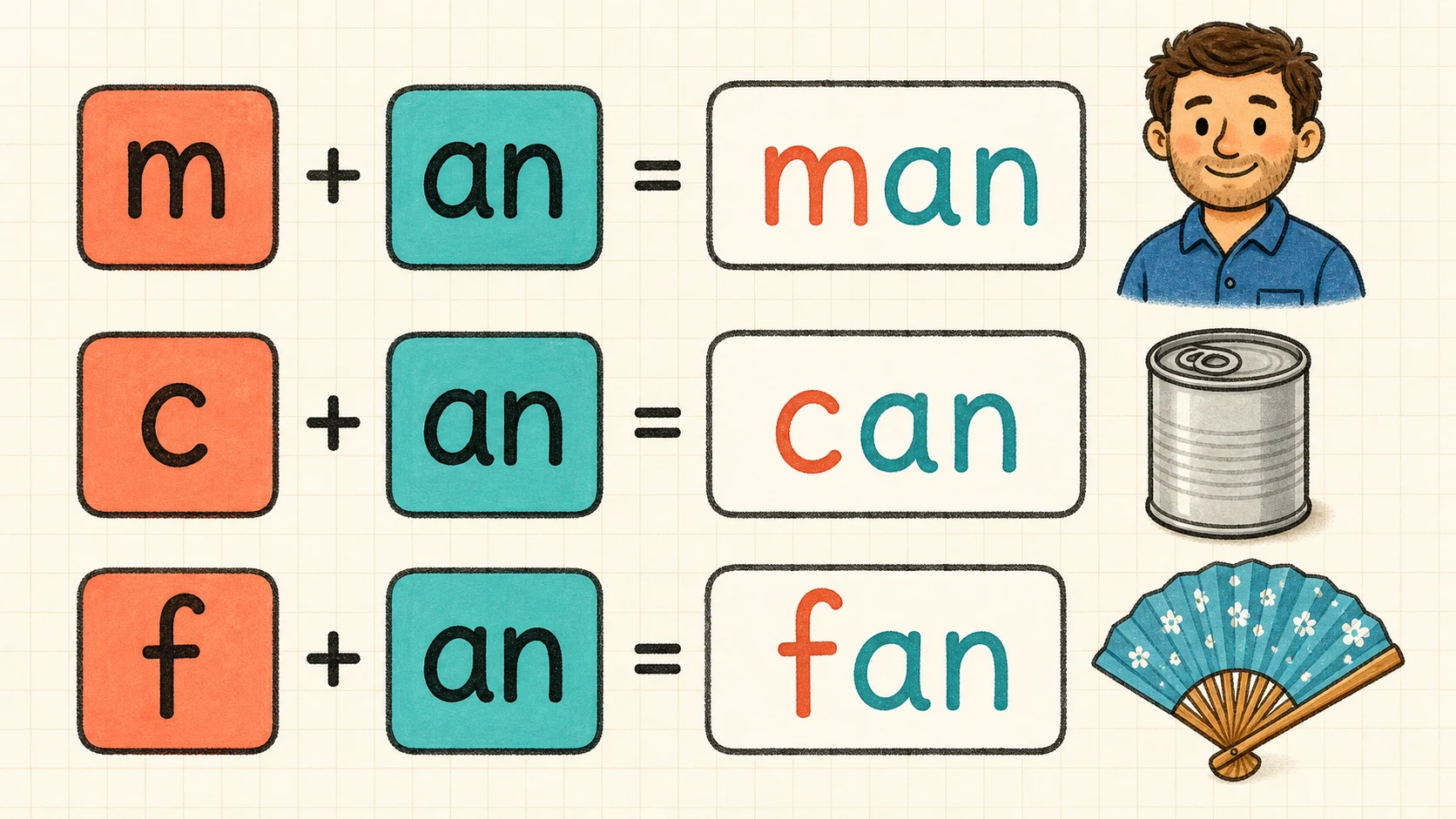
Keeping -at visible while swapping one initial letter reveals whether the child can use the shared pattern rather than recall one whole word.
Word-family recognition should accompany sound-by-sound phonics, not replace it. If the child calls every -at word cat, return to the first letter and ask what changed. If the child can orally produce bat, hat, and mat as rhymes but cannot read them, the next step is linking the onset and rime to letters—not introducing families with blends or digraphs.
Sight words only in a small, meaningful set
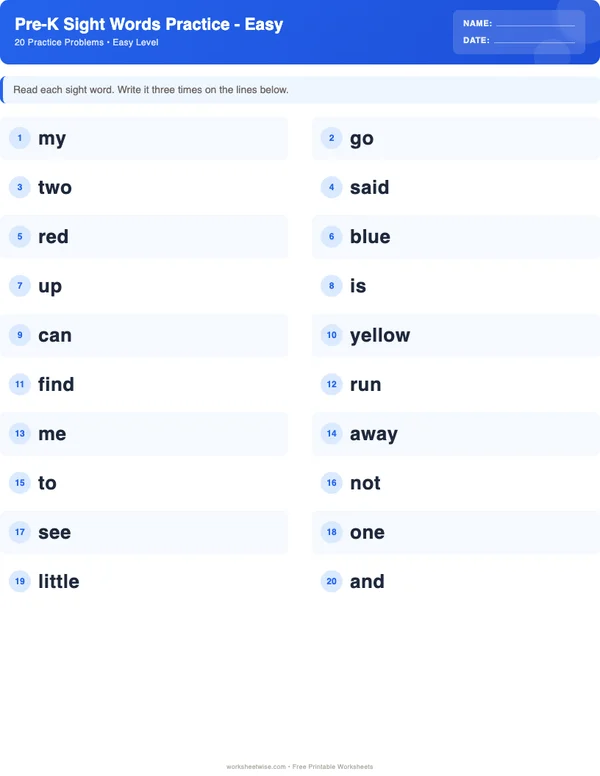
Use the Pre-K Sight Words guide and free sheet after confirming which word or words the child is actually learning. A 20-problem page may provide repeated encounters, but it should not introduce 20 unfamiliar words at once.
Checked example 5: examine said. The first letter s and final letter d correspond to their expected sounds, while the middle spelling ai does not represent its usual sound in this word; said is pronounced with the vowel heard in bed. This example belongs in sight-word work because the child can attend to both the explainable letter-sound parts and the part that must be remembered in this particular word.
Contrast that with a regular CVC word such as sit, which should be blended rather than taught only as a visual shape. A correct flashcard response is one observation. Check the word again in a short, adult-read sentence and on a later day before treating recognition as stable.
Preview Every Worksheet in Under Two Minutes
A useful preview exposes the target without turning the entire page into a test.
Use a show–try–decide routine
- Name one target. Say, “We are counting each picture once,” or “We are listening for the middle sound.” Avoid broad directions such as “Do your phonics.”
- Model one item. Think aloud briefly: “I move this counter as I say one. Now it cannot be counted again.”
- Invite one comparable item. Do not help immediately. Wait long enough to see how the child starts.
- Ask for an explanation or demonstration. “Show me how you kept track,” or “Which sound did you hear in the middle?”
- Decide the format. Continue on paper, shift to objects or oral practice, reduce the number of items, or stop and revisit later.
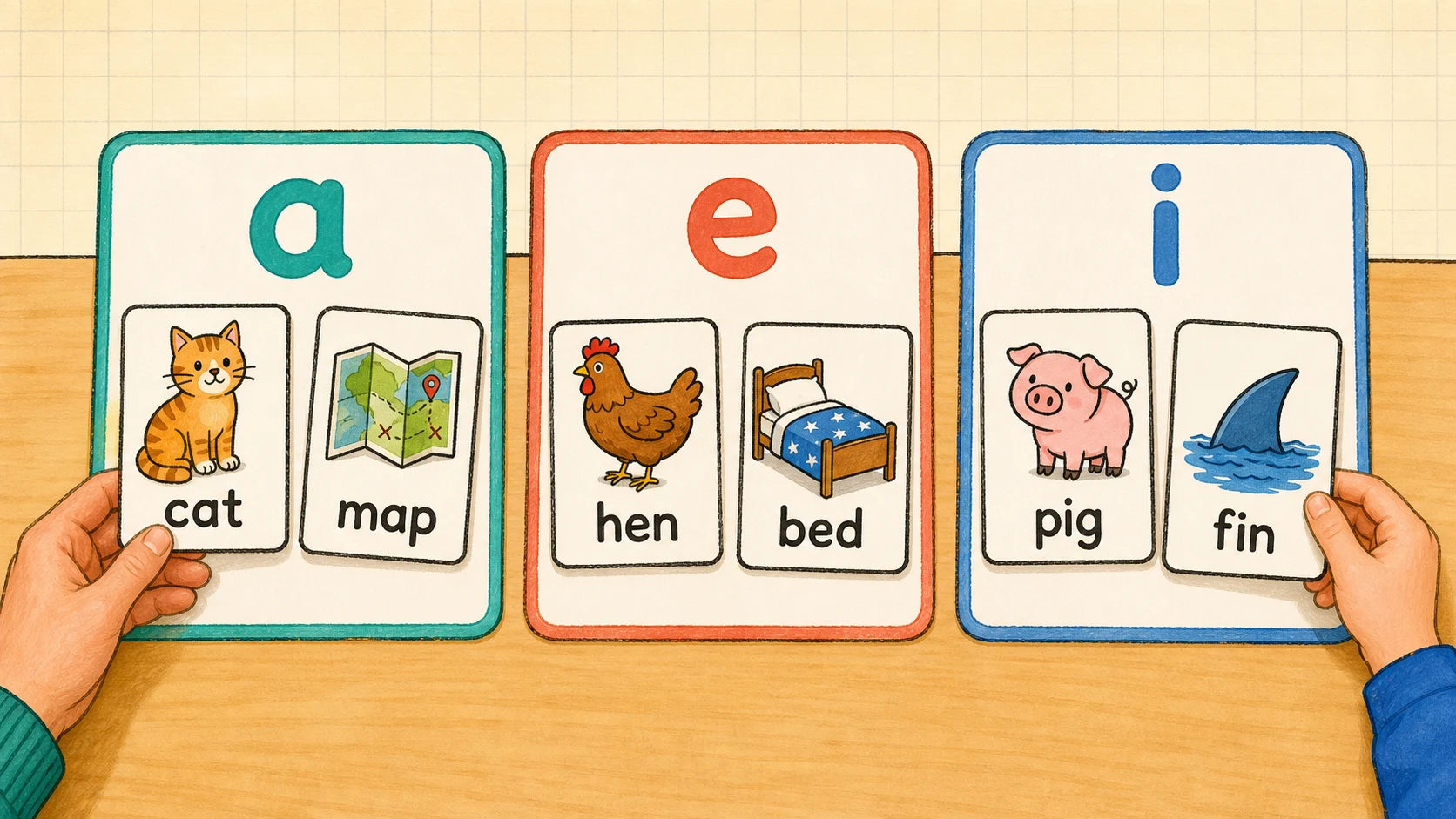
For a short-vowel page, hear and say the word first, locate the middle sound, connect it to a letter, and complete only enough items to observe a consistent strategy.
For ages three and four, a suitable session may be one model and two attempts followed by movement or play. Completion is not the goal. A short sample that clearly reveals a strategy is more useful than a finished page produced through repeated prompting.
A page is ready for independent use only when the child understands the directions, recognizes the response format, and can begin the target operation without the adult supplying the key information. Independence can vary by day and topic.
Let Demand Increase One Feature at a Time
Within Pre-K, difficulty changes through task design rather than through labels attached to children. A task becomes more demanding when it includes more items to track, less familiar vocabulary, smaller pictures, more answer choices, mixed skill types, additional directions, weaker visual cues, or a written rather than oral response.
For counting, a practical progression is:
- Move three to five objects while counting.
- Touch objects arranged in a row.
- Count the same quantity in a scattered group.
- Choose the matching numeral.
- Compare two small groups as more, less, or the same.
- Count a larger set within the child’s demonstrated range.
For phonics, a practical progression is:
- Hear whether two spoken words rhyme.
- Identify a beginning or middle sound orally.
- Match that sound to a letter.
- Blend a modeled CVC word with tiles.
- Blend a printed CVC word with reduced prompting.
- Sort or build words while attending to a vowel or family pattern.
These progressions are selection suggestions derived from the page’s verified skill descriptions. They are not universal standards or a promise that every child will move through them in the same order.
Do not increase the number range, motor demand, vocabulary difficulty, and independence requirement together. If a child succeeds with five movable counters, the next useful challenge may be five scattered pictures—not 15 tiny pictures plus numeral writing.
Adapt the Format Without Replacing the Skill
An adaptation preserves the mental operation being observed. If the target is counting, the child must still coordinate objects and number words. If the target is short-vowel discrimination, the child must still listen to and compare vowel sounds.
Useful counting adaptations include spacing pictures farther apart, letting the child cover each counted picture with a token, cutting one row from the page, or accepting a pointed numeral instead of requiring its formation. Do not count for the child and then ask them to trace your answer; that replaces counting with tracing.
Useful phonics adaptations include naming unclear pictures, saying the word without emphasizing the answer, using letter tiles instead of handwriting, limiting choices, or covering later rows. Do not pronounce the target vowel in an exaggerated way that makes the answer automatic.
Movement can preserve the target. Put numeral cards on the floor and have the child carry a matching set of counters to each card. Place two vowel cards across the room and let the child move a picture to the card representing its middle sound. Oral and manipulative responses are especially appropriate for ages three and four because they reduce desk demands while keeping the reasoning visible.
When a child benefits from predictable setup, select from No-Prep Worksheets only after checking that the printed response format is already familiar. “No prep” describes adult preparation; it does not mean no preview, no modeling, or automatic independence for the child.
Read Errors as Evidence, Not Scores
A work sample should answer, “What did the child do?” before it answers, “How many were correct?” Mark the point where the strategy changed, not only the final response.
Counting errors and what to check next
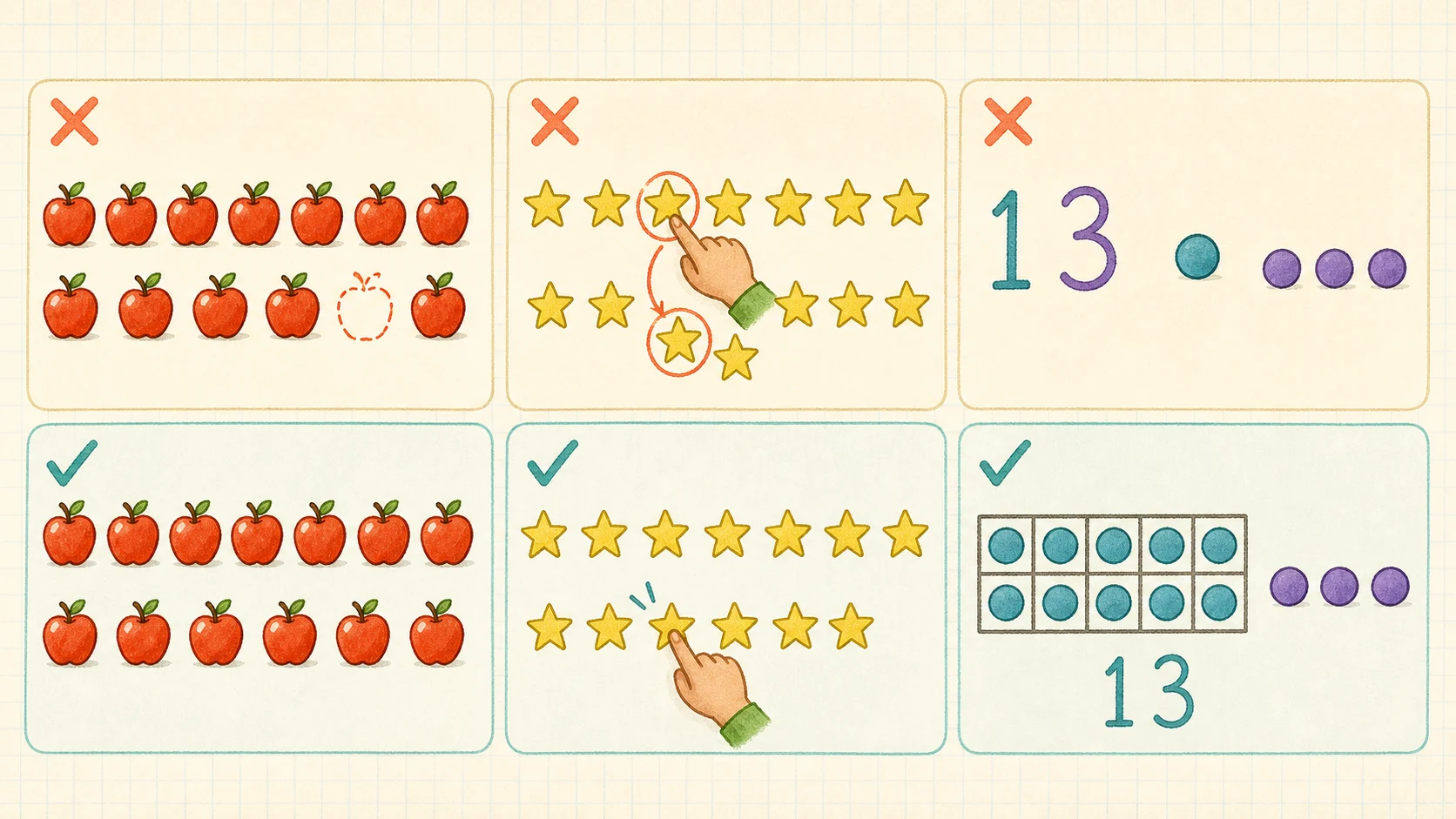
Use a counting error to choose the next representation: movable objects for one-to-one matching, spacing or tokens for tracking, and a separate numeral match when quantity is secure.
If a child says “one, two, three, four, five” over four objects, observe whether one object received two number words. The next action is to have the child move each object once into a new space. If the child counts five objects correctly but answers “four” when asked how many, repeat the count and emphasize that the last number names the whole set. If a row is accurate but a scattered group is not, preserve the same quantity and teach a tracking plan.
These patterns identify instructional next steps; they do not establish a diagnosis.
Phonics errors and what to check next
If a child sorts map under short i, first verify that the picture was named map. Then compare the spoken middle sounds in map and sit. If the child hears the difference but chooses the wrong letter, practice sound-to-letter matching. If the child cannot hear the difference, remain oral and use two strongly contrasting vowels before returning to print.
If a child reads hat as cat in an -at set, point to the first letter and ask for its sound. A repeated whole-word guess suggests that the stable ending is attracting attention while the changing onset is being ignored. The next sample should contain only two -at words with clearly different first sounds.
If a child reads a practiced sight word on a card but not in a sentence, do not erase the first success. Record the context: “read in isolation; not yet located in connected print.” Then reduce visual competition by pointing to the word in a short line.
Use Work Samples to Make the Next Decision
Keep one small sample rather than a stack of completed pages. Date it and add three notes:
- Representation: objects, pictures, spoken words, letter tiles, or print;
- Support: modeled, prompted, or independent;
- Strategy: what the child visibly or audibly did.
A useful note might read: “Counted six scattered dots independently by covering each with a token; matched 6 after one reminder.” The next action is to try a different arrangement with six or seven objects while keeping tokens available.
A phonics note might read: “Heard that cat and hat rhyme; read cat after blending; guessed hat from the picture.” The next action is to build the two words with tiles and cover the pictures.
Move forward when the strategy holds across a small change: different objects, another layout, a new word with the same pattern, or less prompting. Repeat with variation when the child has the right idea but loses track. Step back in representation when the child waits for the adult, guesses repeatedly, or cannot explain or demonstrate the operation.
A 20-problem free sheet is a resource bank, not a required sitting. Select a row, cut or cover the rest, and retain the unused items for later comparison. For broader browsing, the full worksheet library can help locate another representation or topic, but the next selection should still follow the recorded work sample.
Keep the Boundary Clear
These worksheets can provide structured practice and observable samples. They do not diagnose learning, language, attention, vision, hearing, or motor conditions. They do not establish school readiness, guarantee academic outcomes, or replace play, conversation, shared reading, movement, manipulatives, or professional judgment.
Pre-K is also broader than the live catalogue. The page’s editorial scope includes sorting, shape and size comparison, print direction, alphabet recognition, rhyme, syllables, beginning sounds, fine-motor development, following directions, turn-taking, and expressing needs. The verified live resources on this page, however, cover only Counting, CVC Words, Short Vowels, Word Families, and Sight Words. Do not treat those five topics as a complete Pre-K curriculum.
For the next session, choose one observed need and open one real entry point. If the child is still coordinating one object with one number word, begin with the Pre-K Counting guide and free sheet, preview one item with counters, and save a three-item work sample noting the representation, support, and strategy.
Put it into practice
Use the guide with a real printable
Move from explanation to a short, observable practice task. Check the first item together, then adjust the next session from the learner's actual work.
Open the first free worksheet