19 free PDFs with answer keys
2nd Grade worksheets
Choose only from subjects and skills with real files in the current 2nd Grade catalogue. Start with the free standard sheet, then add more practice only if you need it.
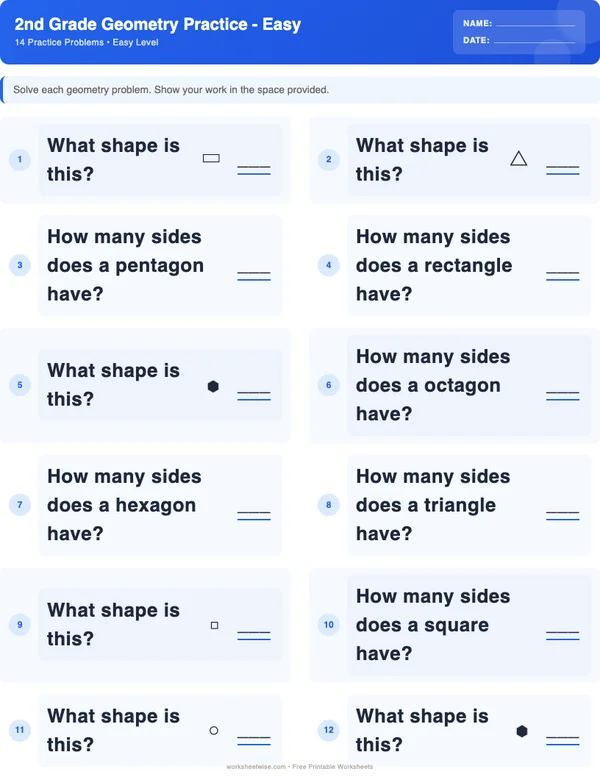
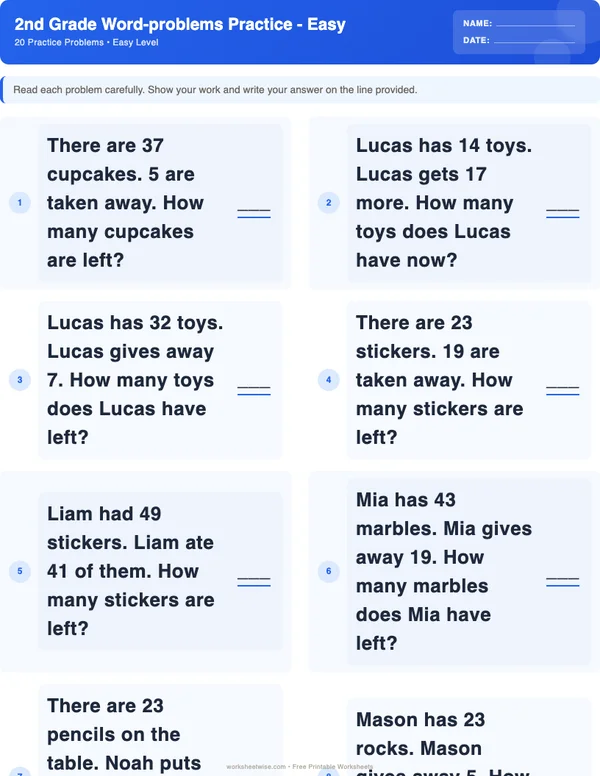
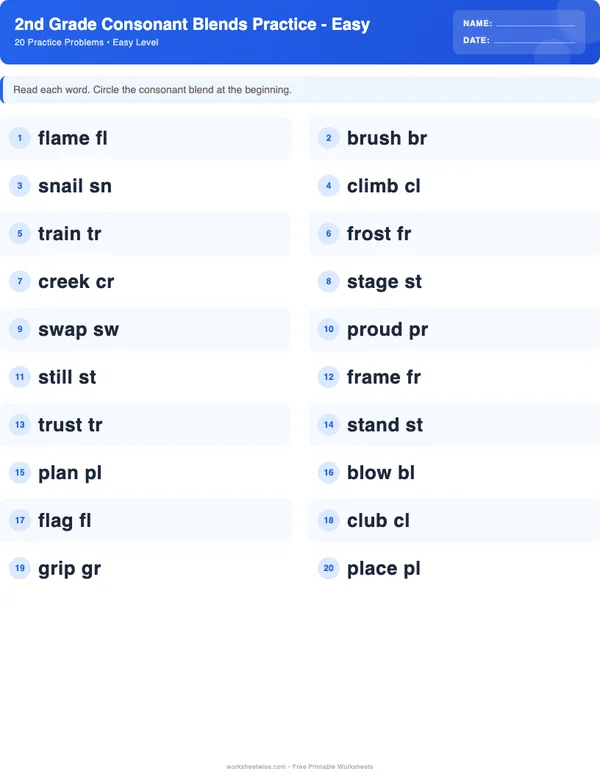
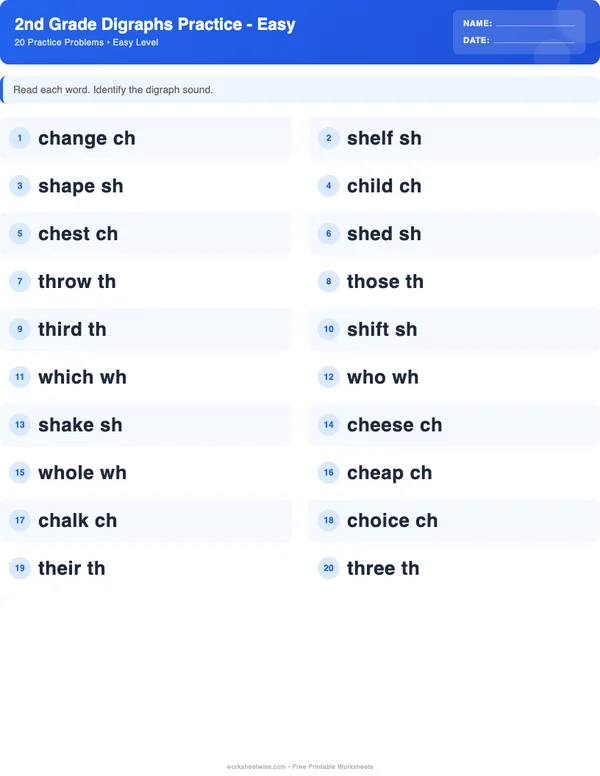
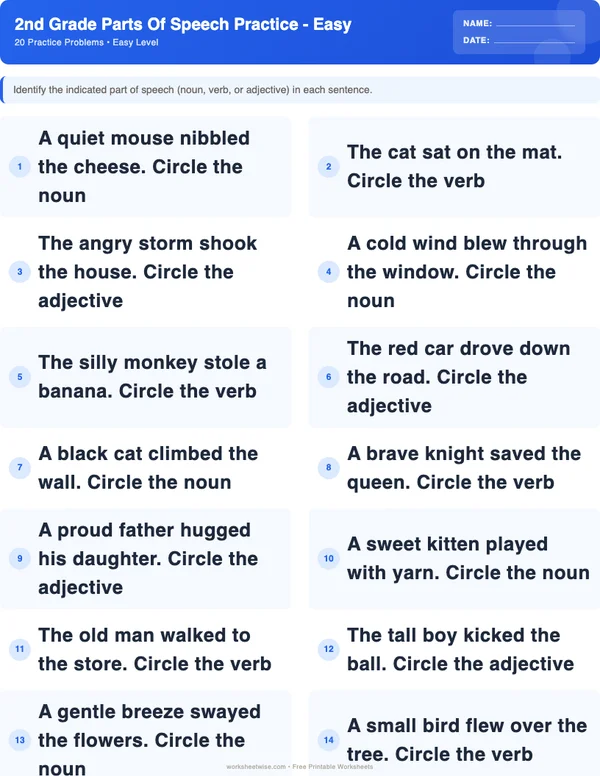
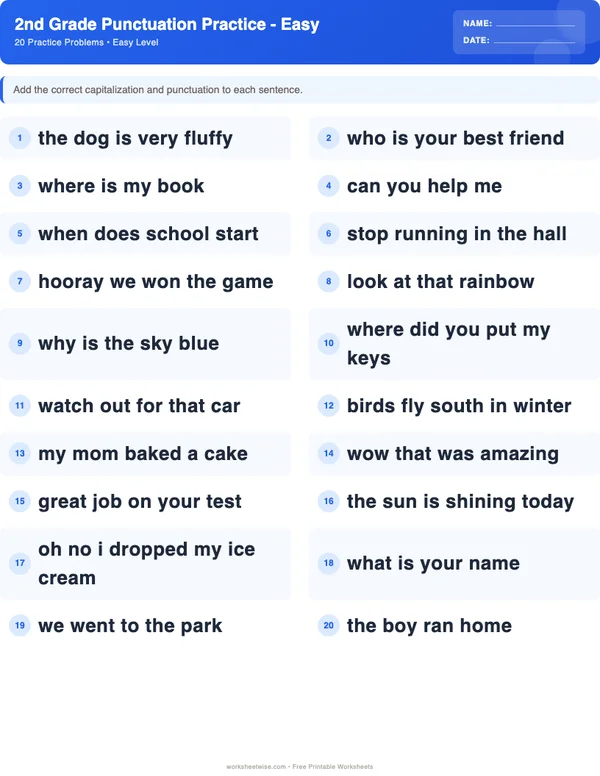
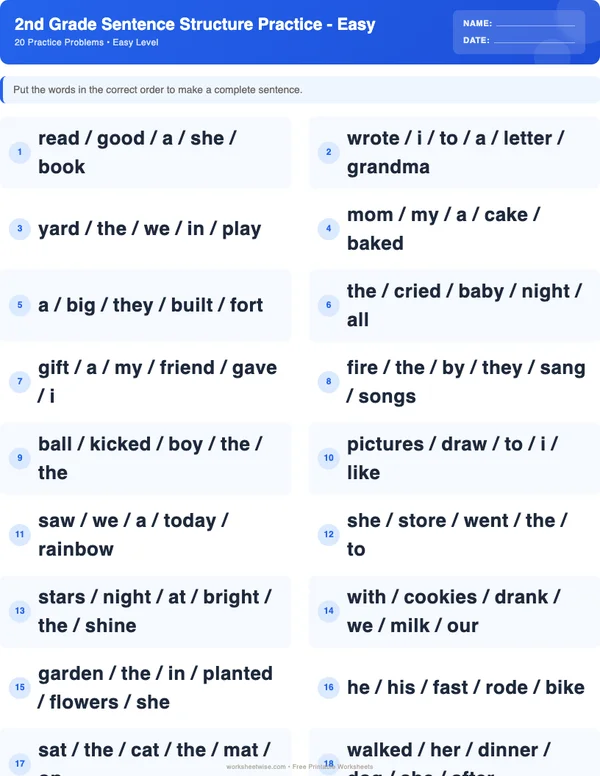
Complete guide
How to teach and practise 2nd grade worksheets
3,635 words Updated 6 instructional visuals
Choose by the work a child can show, not by the grade label
The most useful 2nd grade worksheet is the one that asks a learner to take one manageable step beyond what they can already do independently. Start with a work sample, identify the strategy or representation the child uses, and then select practice that preserves that mathematical or literacy target without adding avoidable barriers.
The live WorksheetWise catalogue currently contains 342 second-grade variants across four subjects and 19 topics, including 19 free entry points. The verified examples on this page cover math topics such as addition, subtraction, place value, time, money, geometry, fractions, equal groups, division, and word problems, plus phonics work with short vowels, long vowels, blends, and digraphs. Because the supplied catalogue extract does not name every live subject and topic, this guide does not invent the missing labels or imply coverage beyond the verified entries.
“2nd Grade” describes the intended practice level, not a placement decision. Local curriculum sequences differ, and children often show different levels of independence across skills. A child might read a short passage comfortably, need oral support to explain unfamiliar vocabulary, add within 100 with drawings, and still confuse the hour and minute hands. Select separately for each of those needs.
Age can help an adult discover likely resources, but age is not a placement decision either. The worksheets for 7-year-olds guide is a browsing route, not evidence that every seven-year-old should receive the same page.
Readiness has three boundaries
Before printing a worksheet, check conceptual readiness, task readiness, and independence. These boundaries prevent a page from testing several unestablished skills at once.
Conceptual readiness: can the child explain the idea?
Ask for a demonstration without beginning with written symbols.
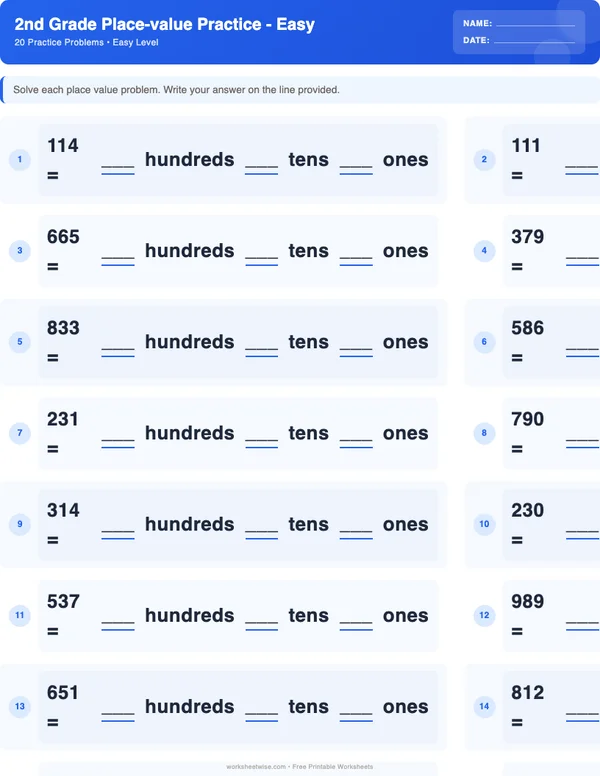
For addition, place 28 counters or base-ten pieces in front of the child, add 15, and ask what happens to the ones. A child ready for written regrouping should be able to show that 8 ones plus 5 ones makes 13 ones and that 10 of those ones can be exchanged for 1 ten. The explanation may be informal, but it should connect the exchange to the quantity.
For digraphs, say ship, chin, and thin. Ask the child to identify the opening sound and then match it to sh, ch, or th. If the child hears two separate sounds in sh, isolated digraph identification is premature; return to listening, mouth formation, and picture matching.
Task readiness: can the child access the page?
A learner may understand the target but be blocked by directions, visual density, handwriting demands, or unfamiliar vocabulary. Preview one item together and ask the child to tell you what the page expects. If they can solve the item orally but cannot parse the direction, clarify the direction without teaching the answer.
Consider a word problem: “Maya has 34 stickers. Her aunt gives her 18 more. How many stickers does Maya have now?” The mathematics is addition within 100, but the task also requires reading, identifying the changed quantity, and recording an equation. Reading the problem aloud preserves the mathematics when decoding is not the target. Telling the child to “look for more and add” does not; that replaces situation analysis with an unreliable keyword shortcut.
Independence: what happens after the example disappears?
After one modeled item, let the child attempt two comparable items without prompting. Watch for whether they:
- begin without asking what operation or pattern to use;
- choose a relevant tool, drawing, or strategy;
- keep track of place value, sounds, or units;
- notice an unreasonable answer;
- explain enough of the work for an adult to interpret it.
Independence is not the absence of counters, a number line, sound boxes, or a clock model. A child who deliberately selects an appropriate representation may be working more independently than one who imitates an unexplained written procedure.
Define difficulty through the page, not the learner
The free representative sheets in the supplied catalogue are marked “easy,” but that label must be translated into observable features. It does not describe a child.
A lower-demand task may use fewer items, familiar directions, one operation, small numbers, visible models, ample writing space, or a single phonics contrast. Demand rises when a page removes representations, mixes problem types, increases the number range, changes the position of an unknown, introduces less familiar spelling patterns, or expects an explanation.
A 20-problem addition sheet and a six-problem fractions sheet are not comparable merely by item count. One addition item could require a familiar fact, while one fraction item could require careful partitioning and explanation. Examine what each item makes the child think about.
How demands change within second-grade math
A sensible addition path might move through these observable changes:
- Combine objects or drawings and state the total.
- Add within 20 using counting on or making ten.
- Add tens and ones without regrouping.
- Add within 100 and compose a new ten.
- Solve the same computation inside a word problem.
- Explain why the answer is reasonable or solve it a second way.
The sequence is not a rigid calendar. Move according to evidence. The Common Core mathematics expectations place second-grade attention on base-ten understanding and addition and subtraction within 100, but standards describe learning goals rather than a prescription for which WorksheetWise page a particular child needs. Local sequences may differ. See the Common Core mathematics standards for the source framework.
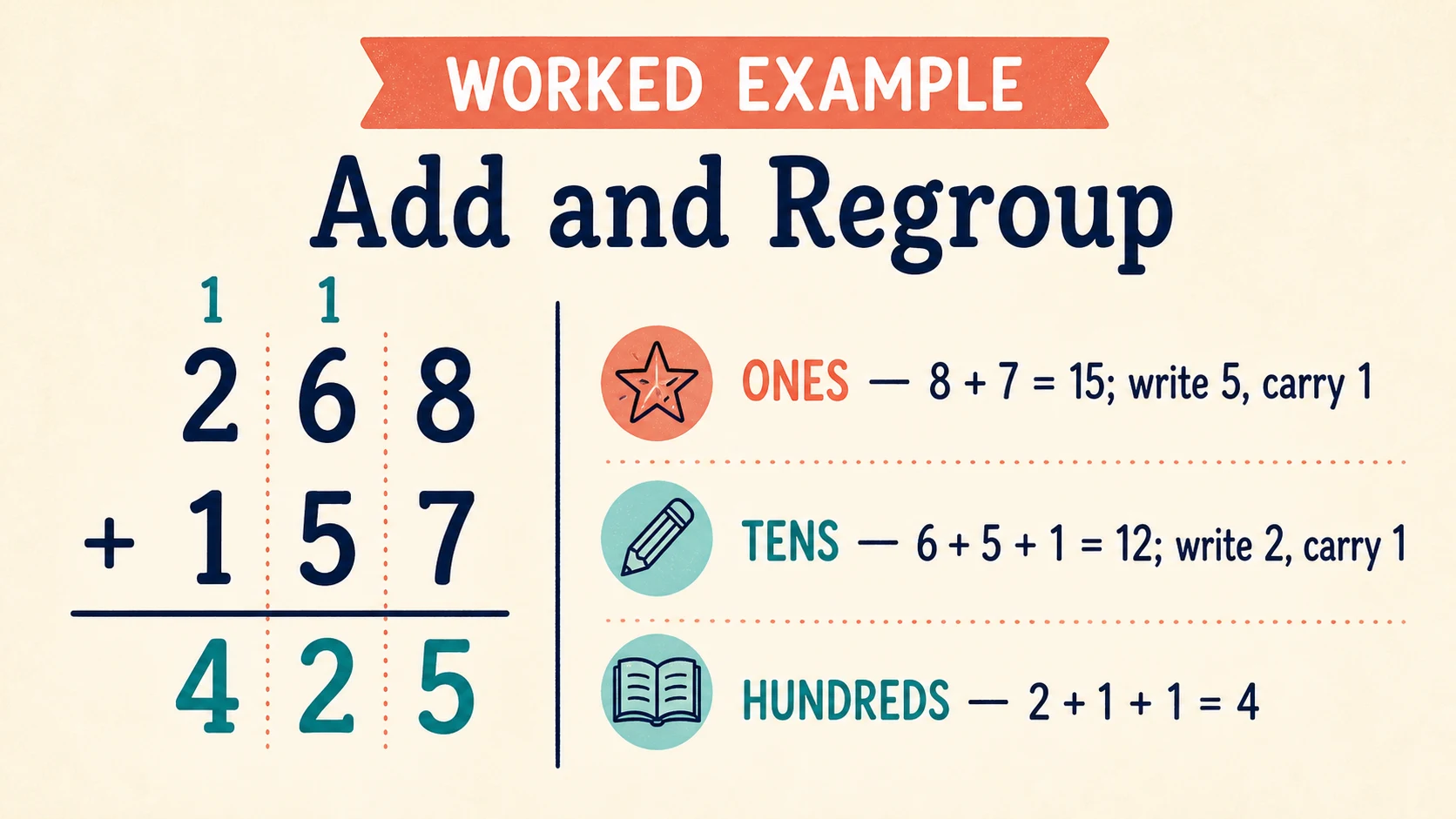
Use this progression to check whether the written answer is supported by an exchange the child can model and explain.
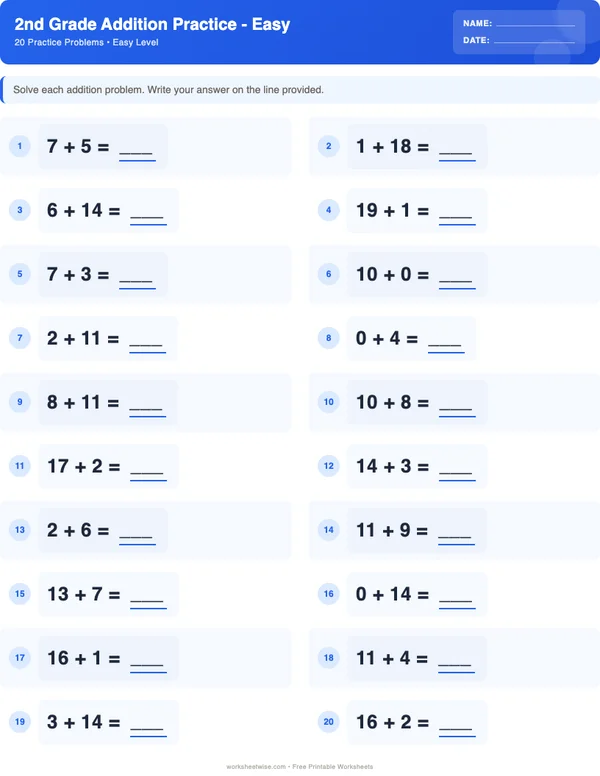
The 2nd Grade Addition guide and free sheet provides a focused entry point when the work sample shows an addition need. Do not choose it solely because the child is in second grade.
How demands change within phonics and reading
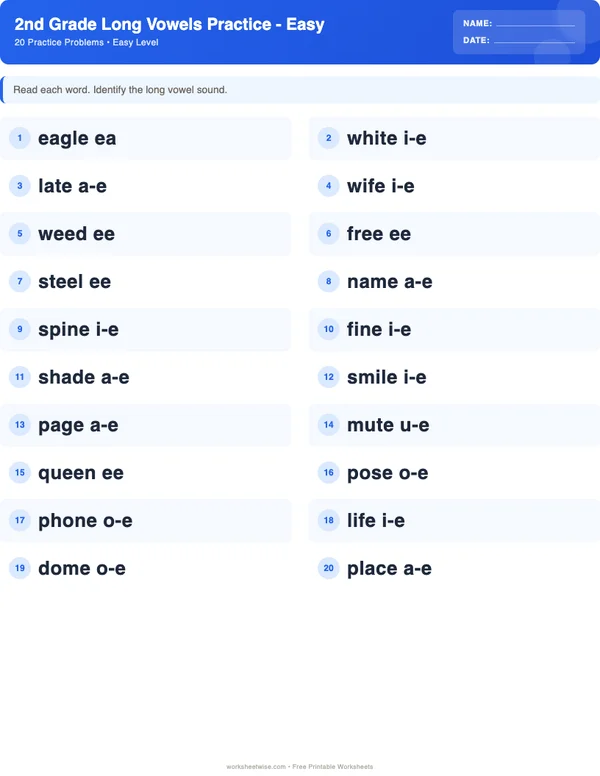
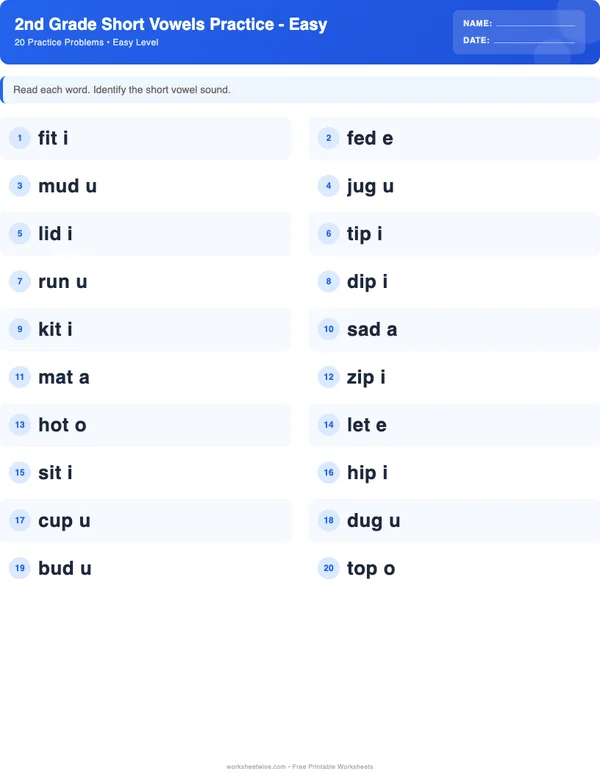
Phonics practice should build cumulatively. A child who reads CVC words accurately may next work with blends, where both consonant sounds remain audible, or digraphs, where two letters represent one sound. Long-vowel work adds another demand: selecting among spelling patterns such as silent e and vowel teams.
Check these distinctions with actual words:
- In stop, the child should preserve both /s/ and /t/. Reading sop indicates a dropped sound in a blend.
- In ship,
shrepresents one sound. Producing separate /s/ and /h/ sounds indicates that the digraph has not been consolidated. - In cape, the final
echanges the vowel pattern compared with cap. - In feet and cake, the long-vowel sound is represented in different ways.
These examples belong in second-grade selection because the verified catalogue includes short vowels, long vowels, consonant blends, and digraphs. They are diagnostic teaching checks, not diagnoses.
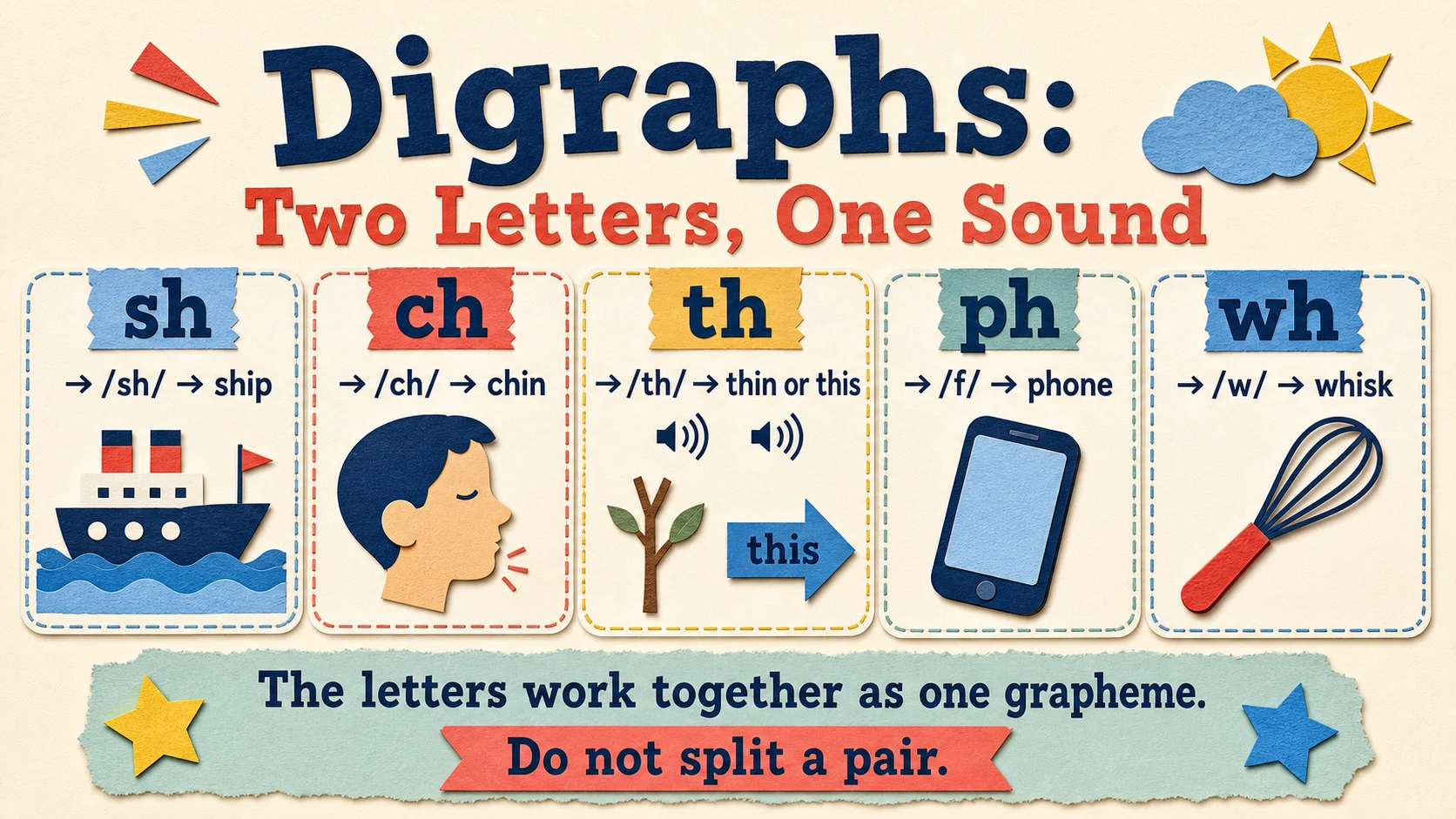
The useful path runs from hearing one sound, to connecting that sound with two letters, to reading and spelling the pattern in words and connected text.
The Institute of Education Sciences recommends explicit work that connects sounds with letters, decoding and word analysis, and daily reading of connected text. That guidance supports using a phonics worksheet as one part of instruction rather than treating isolated word completion as the final goal. See the IES guide on foundational skills for reading understanding.
Fluency also includes accuracy, appropriate pacing, expression, and understanding. Do not respond to slow but accurate decoding by imposing speed as the only goal. Let the child reread a short, accessible passage, then ask for a retelling or explanation. Independent book choice can sustain reading interest, but interest does not remove the need to check whether the text is decodable and understandable for the intended purpose.
Preview a page in four minutes
A preview should reveal whether the page fits before the child completes an entire row incorrectly.
Minute one: inspect the hidden demands
Look at the number range, vocabulary, response format, visual supports, and number of decisions per item. Ask:
- Is the child identifying, computing, comparing, explaining, or doing several at once?
- Does the page mix previously taught and new content?
- Is handwriting likely to obscure what the child knows?
- Will reading difficulty interfere with a math target?
- Are models supplied, optional, or absent?
Minute two: complete one item aloud
Model the decision, not merely the finished marks. For 36 + 27, an adult might say: “I see 3 tens and 6 ones, plus 2 tens and 7 ones. The ones make 13, so I exchange 10 ones for a ten. Now I have 6 tens and 3 ones: 63.”
This example is fully checkable: . It belongs here because addition within 100, place-value strategies, and regrouping are central demands in the verified second-grade material.
Minute three: ask for an adjacent item
Give a similar item, such as 45 + 18. Watch the strategy rather than immediately correcting the answer. A child might decompose 18 into 5 and 13, add to the next ten, or combine tens and ones. The result is 63 because and .
If the child writes 513 by placing the separate results for tens and ones side by side, the next action is not more of the same worksheet. Rebuild 45 and 18 with base-ten pieces and exchange 13 ones for 1 ten and 3 ones.
Minute four: decide the support level
Choose one of four responses:
- Proceed independently: The child understands the directions and starts with a suitable strategy.
- Proceed with a tool: Keep a number line, base-ten pieces, clock, coin set, or sound boxes available.
- Reduce the task: Cover part of the page or assign a short, representative set.
- Step back: Teach the prerequisite orally or concretely before returning to print.
IES mathematics guidance supports systematic instruction, clear mathematical language, representations, number lines, and attention to word problems. Those are sourced instructional principles, not claims that IES evaluated WorksheetWise. Consult Assisting Students Struggling with Mathematics.
Make representations do intellectual work
A model should expose the relationship in the problem. Decorative pictures or a model completed entirely by the adult do not provide the same evidence.
Addition, subtraction, and place value
Use base-ten pieces when the question concerns composing or decomposing tens. For 43 − 25, build 43 as 4 tens and 3 ones. Because 3 ones cannot supply 5 ones, exchange 1 ten for 10 ones. Then subtract 2 tens and 5 ones, leaving 1 ten and 8 ones: 18.
This checked example belongs here because the verified subtraction guidance identifies regrouping and the common place-value error that produces 26 by subtracting the smaller digit from the larger digit in each column. If a child writes 26, ask them to compare 43 and 25 on a number line. Since 25 plus 20 would already be 45, a difference of 26 cannot be reasonable.
Time requires coordination, not hand naming alone
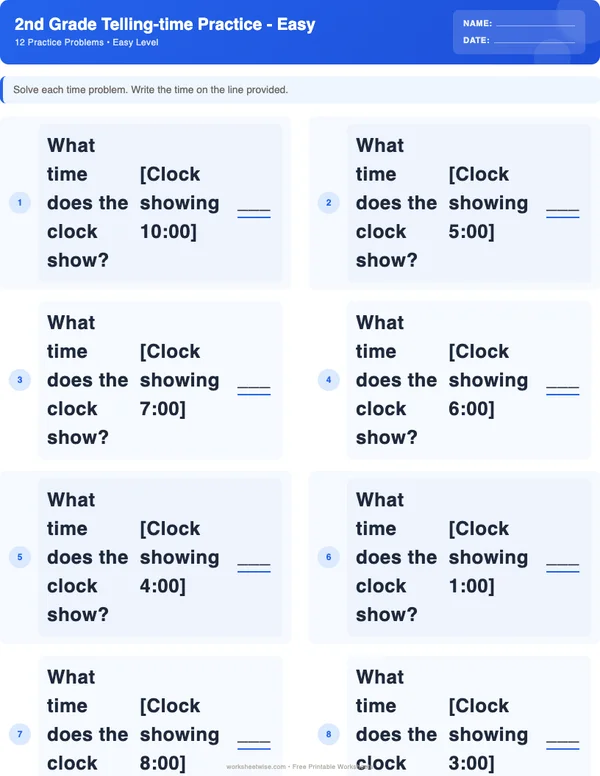
Second-grade time work can progress from hour and half-hour readings toward five-minute intervals. With a geared demonstration clock, set the minute hand at 9 and the hour hand between 3 and 4. The time is 3:45, not 4:45: the hour hand is approaching 4 but has not reached it.
This example belongs here because telling time to the nearest five minutes is part of the supplied grade description, and the catalogue specifically notes confusion when the minute hand has passed 30. A useful follow-up is to ask the child to draw 3:45 and explain why it is still “three something.”
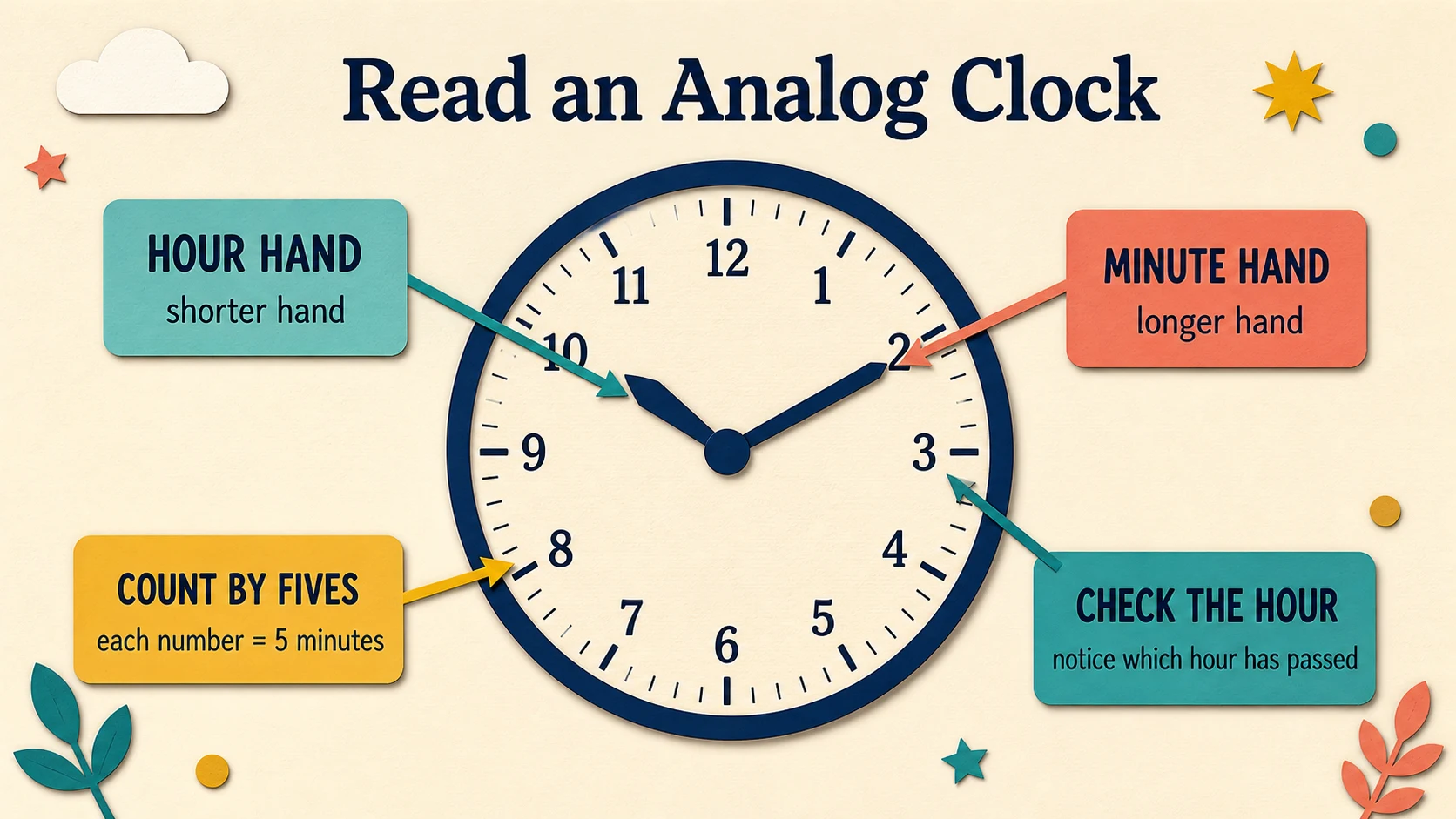
Use the map to separate reading each hand, coordinating the hands, skip-counting by fives, and applying time to a schedule.
Fractions begin with equal parts
Give a paper rectangle and ask the child to show one half. If it is divided into two unequal regions and one is shaded, the obstacle is equal partitioning, not writing 1/2. Fold or draw two equal parts, shade one, and have the child explain that the denominator names the number of equal parts.
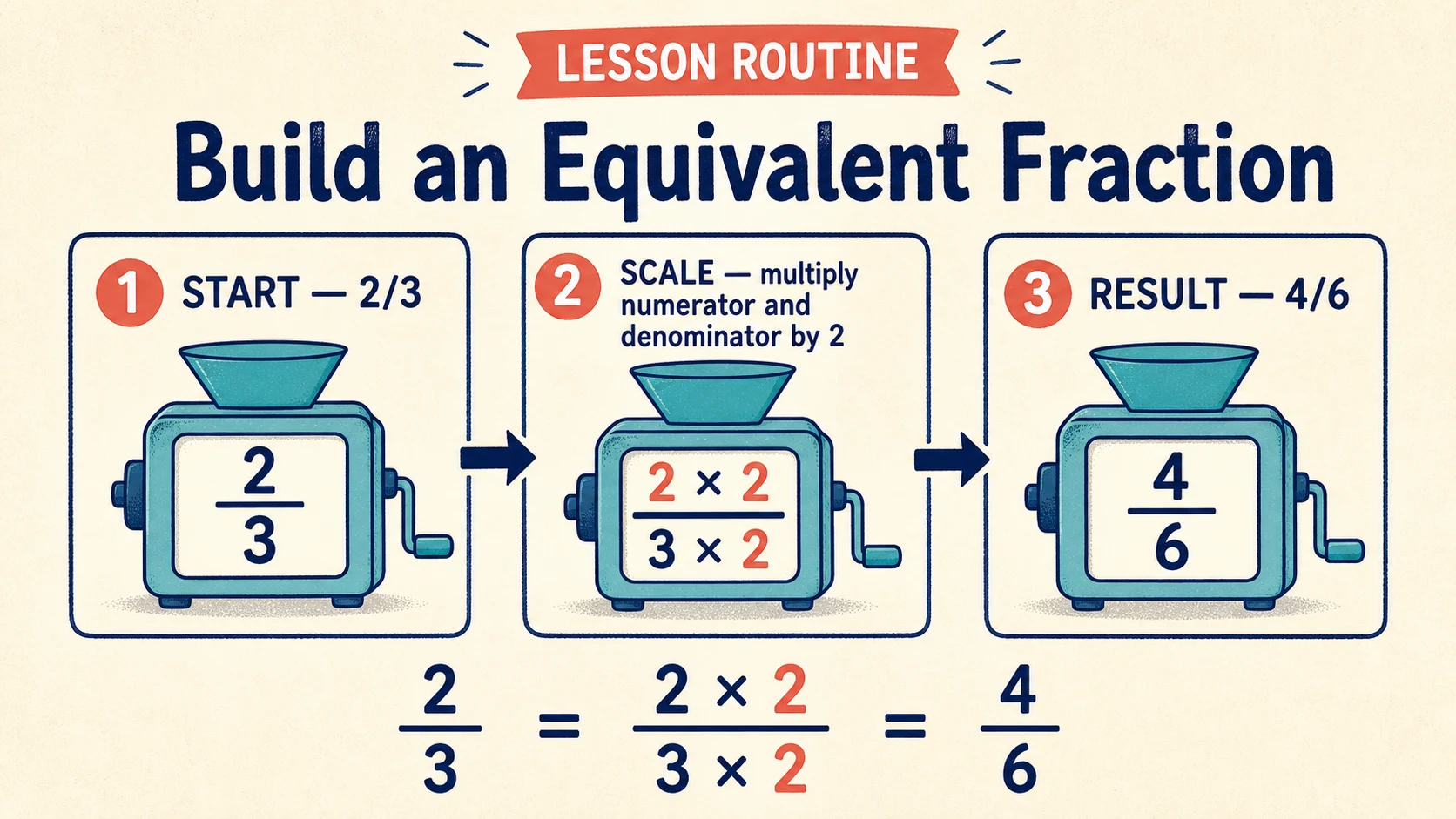
Repeat the cycle with folding, naming, drawing, and explaining so the fraction symbol remains connected to equal parts.
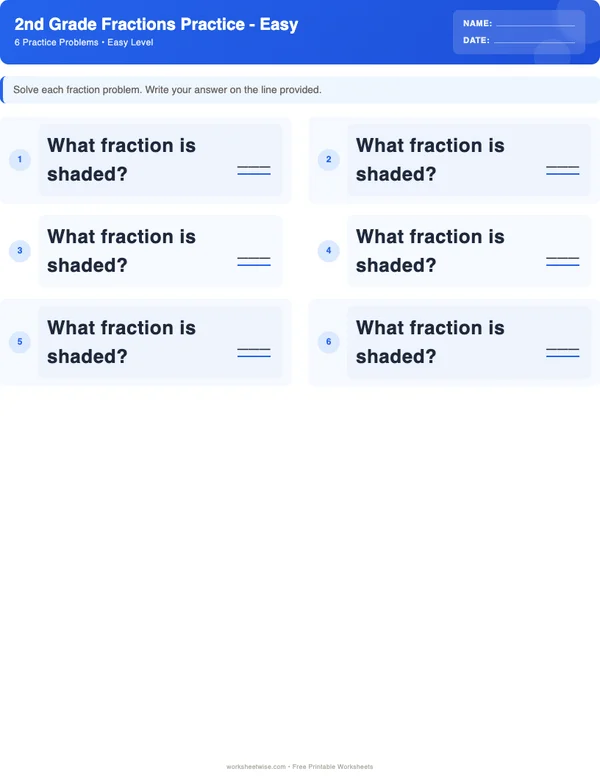
The verified free fractions sheet contains six problems. That smaller count is a reason to inspect each task closely, not evidence that the page is automatically easier than a 20-item computation sheet. Use the 2nd Grade Fractions guide and free sheet when a work sample shows readiness to identify or represent equal parts.
Equal groups can introduce multiplication and division
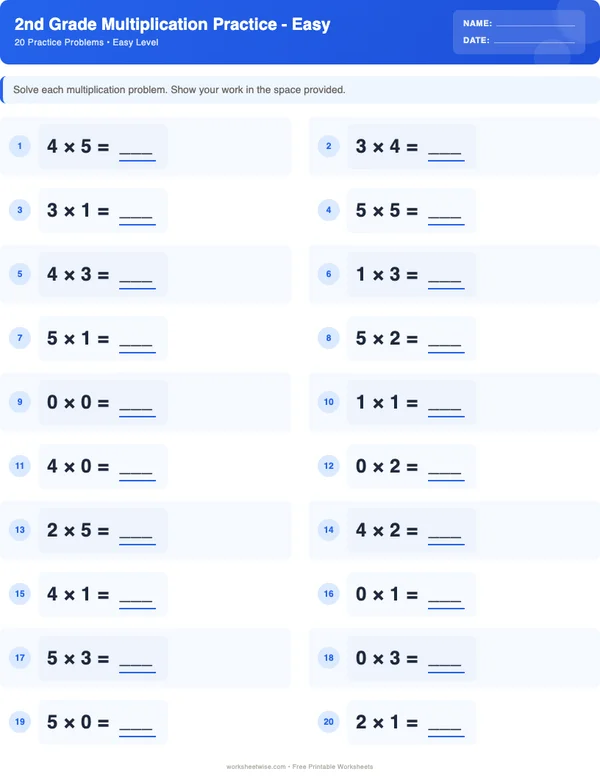
Second-grade multiplication work should begin with equal groups or arrays rather than a demand to memorize a full fact table. Three rows of four counters contain 12 counters because . Turning the array shows four rows of three, still 12. The representation makes the equal groups visible.
Division can be previewed through sharing or grouping without implying that second graders should perform long division. For example, share 12 counters equally among 3 plates. Each plate receives 4 because . Alternatively, ask how many groups of 4 can be made from 12; the answer is 3 groups. Both calculations are correct, but the questions interpret the quotient differently.
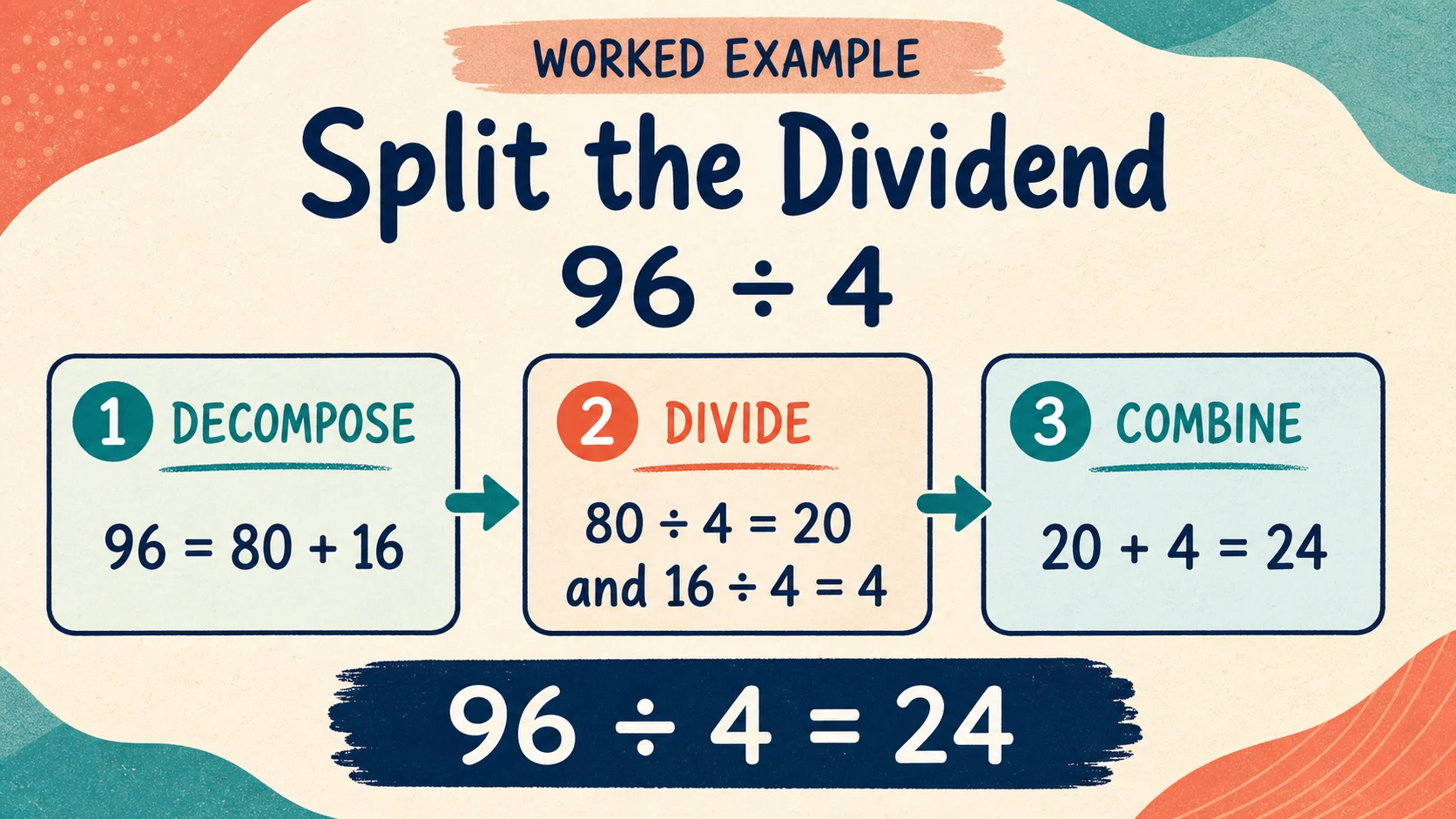
Keep the counters and the story visible so the child can distinguish sharing among groups from finding how many groups fit.
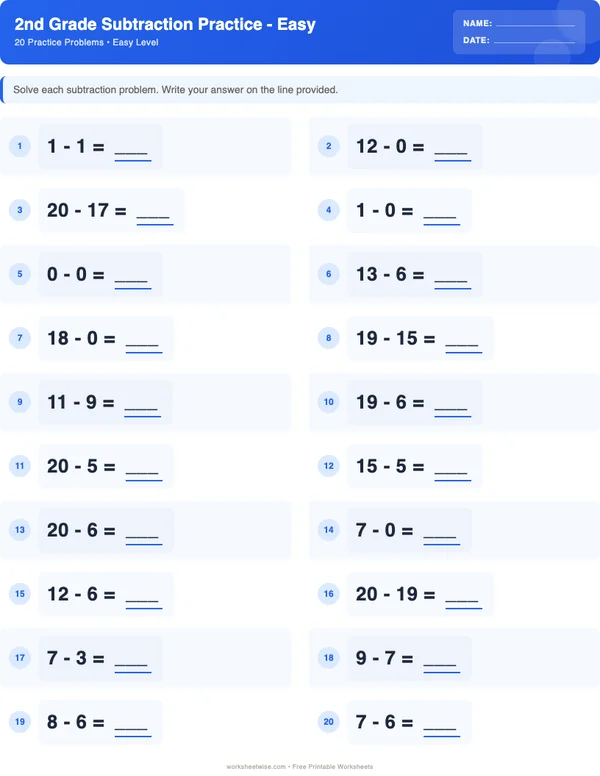
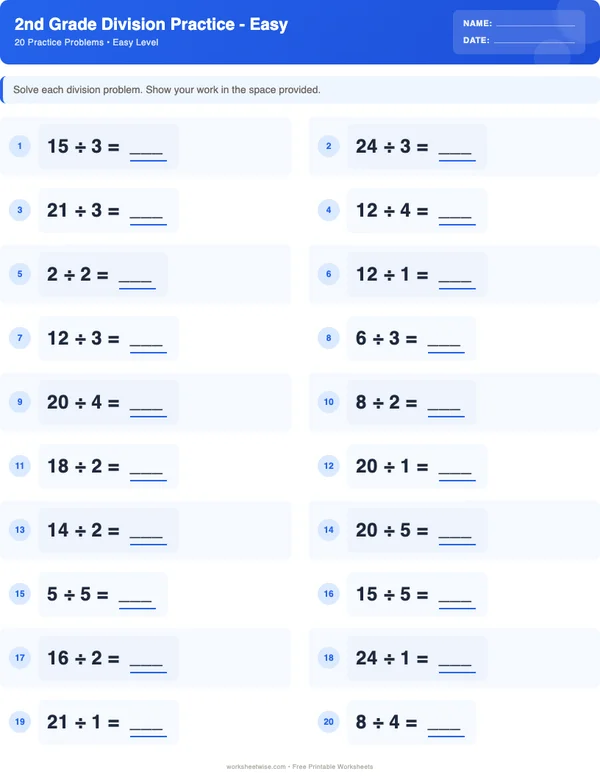
This is an introductory boundary. The broad catalogue description includes later division content such as long division and remainders, but that does not make those tasks appropriate for every second-grade learner. Use the 2nd Grade Division guide and free sheet only after inspecting whether the selected items actually match the child’s equal-group understanding.
Treat word-problem errors as evidence
A wrong answer does not identify its own cause. Preserve the original marks, ask the child to retell the situation, and determine where the reasoning changed.
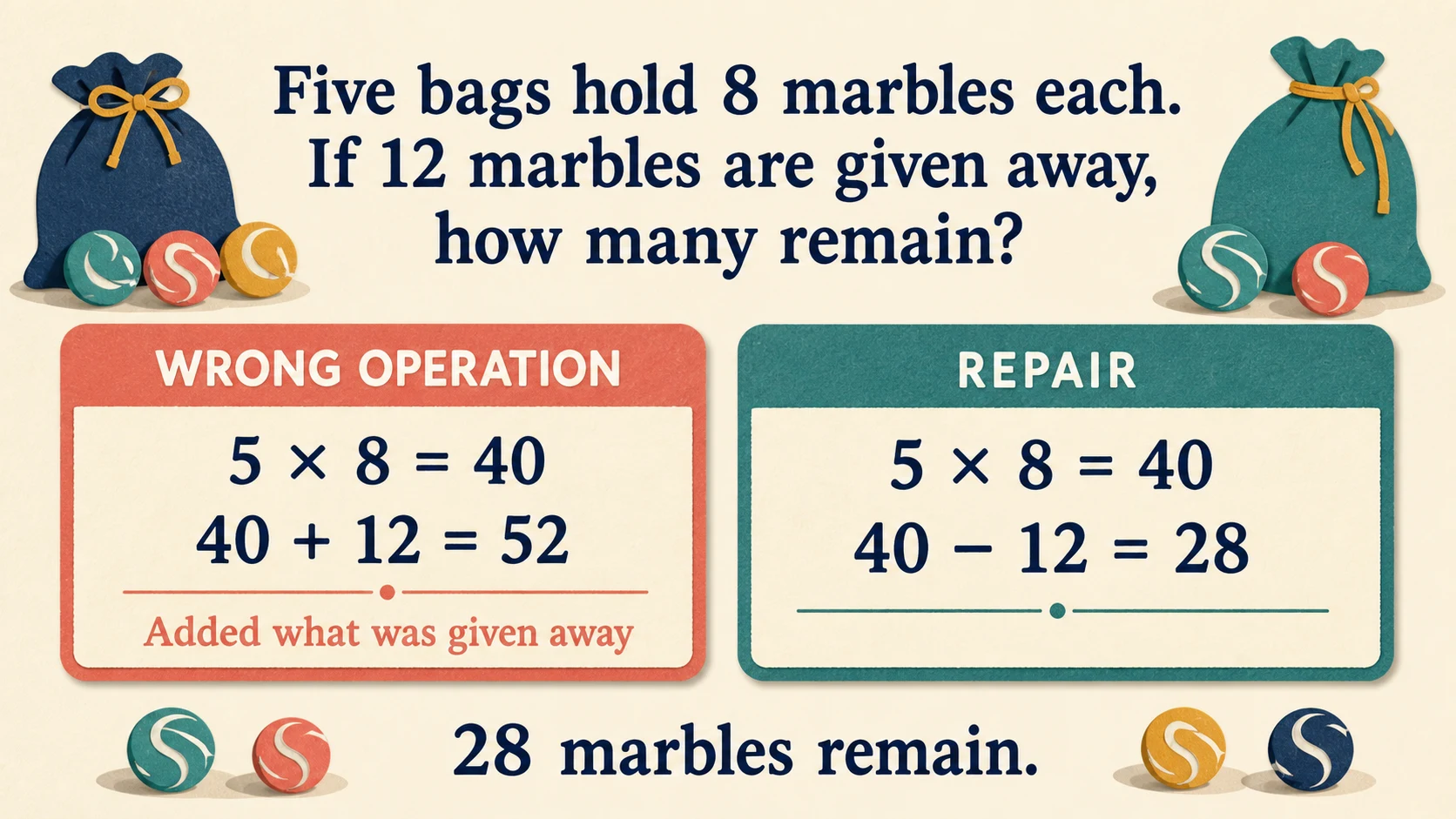
Match the teaching response to the observed breakdown—story comprehension, relationship, computation, unit, or answer check.
Suppose a problem says: “Noah has 18 red blocks and 27 blue blocks. How many blocks does he have altogether?” A child writes 27 − 18 = 9.
The computation is correct, but the operation does not represent the story. Ask the child to build or sketch both collections and retell what happens. Nothing is removed or compared; the two parts are combined. The matching equation is .
Now change the wording: “Noah has 27 blue blocks and 18 red blocks. How many more blue blocks than red blocks does he have?” Here is correct. This pair belongs in a second-grade guide because it isolates part-part-whole from comparison while keeping the numbers constant. It also demonstrates why keyword hunting fails: the mathematical relationship, not a single word, determines the operation.
Interpret other errors with similar care:
- Correct equation, incorrect fact: Keep the story work and address the computation with a number line or known fact.
- Correct number, missing or wrong unit: Ask, “Nine what?” and require an answer sentence.
- Copies the numbers but cannot retell the event: Reduce reading demand, act out the story, and rebuild the relationship.
- Answers the first quantity mentioned: Cover the numbers and ask what the question wants found.
- Gets a plausible result through unexplained marks: Ask for a drawing, equation, or oral explanation before deciding what comes next.
A worksheet can reveal patterns, but it cannot diagnose a learning disability, language disorder, attention condition, or other cause. Persistent difficulty across settings warrants discussion with the child’s teacher or an appropriately qualified professional, not a label inferred from one page.
Preserve the target when adapting a worksheet
An adaptation is useful when it removes an irrelevant obstacle while leaving the intended thinking intact.
For a math page targeting operation choice, an adult may read the problem aloud, define a nonmathematical word, or let the child dictate an explanation. Do not identify the operation or circle the relevant numbers for them; those actions remove part of the target.
For a phonics page targeting digraph recognition, reduce visual clutter by covering all but one row, enlarge the print, or let the child point instead of write. Do not pronounce the target sound before every answer if sound identification is what the page is meant to reveal.
For handwriting-heavy writing practice, allow oral rehearsal or keyboarding when idea organization is the target. If spelling, capitalization, or sentence construction is the target, retain enough handwritten or typed production to observe that feature.
The IES elementary writing guide recommends daily time for writing, explicit instruction in the writing process, fluency with foundational writing skills, and an engaged community of writers. That supports separating planning, drafting, revising, and editing rather than marking every feature at once. See Teaching Elementary School Students to Be Effective Writers. These are general recommendations, not an evaluation of any catalogue page.
Useful adaptations include:
- completing 6 representative items instead of all 20;
- alternating oral and written responses;
- adding a blank number line without placing the jumps;
- supplying counters without arranging them;
- highlighting place-value columns without performing exchanges;
- using a movable clock instead of naming the time;
- allowing a phonics word to be tapped into sounds before spelling;
- asking the child to revise one paragraph for details before editing mechanics.
Stop if the page requires repeated guessing, produces visible distress, or depends on several untaught prerequisites. Stopping is a selection decision, not a judgment about effort or ability.
Let the work sample choose the next page
Review a completed sample for patterns across three to five representative items. Record what the child did, not an impression such as “careless” or “doesn’t get math.”
If the strategy is sound but execution varies
Keep the skill and shorten the set. A child who models regrouping correctly in four items but makes two arithmetic slips may need deliberate practice with checking rather than a conceptual restart. Ask for an estimate, an inverse-operation check, or a second method on selected problems.
If the representation is copied but unexplained
Return to manipulatives or drawings and change the numbers. If a child reproduces a bar model but cannot say what each part represents, the model has become a template. Let the child act out a new story and build the model from the quantities.
If performance collapses only when contexts are mixed
Practice identifying the situation before calculating. Mix one combine problem, one comparison problem, and one missing-part problem. Ask for a retelling and representation, but delay computation until the child has selected the relationship.
If the child succeeds accurately and independently
Increase one demand at a time. Remove a supplied model, vary the unknown’s position, mix a new pattern with cumulative review, or request an explanation. Do not leap from equal groups to formal long division, from identifying halves to fraction operations, or from slow accurate decoding to speed drills.
For families or teachers who need multiple observable levels of support, Differentiated Worksheets With Answer Keys can help compare task versions. Difficulty should still be judged from features such as number range, representation, directions, item variety, and response demand.
Use a repeatable 15-minute practice routine
A short routine makes the child’s independence visible and gives the adult a consistent basis for choosing the next task.
Reconnect for three minutes
Begin orally or with objects. Revisit one known example and ask the child to explain it. For phonics, read three cumulative-review words. For addition, build one number with tens and ones. For time, connect an analog time to a familiar daily event.
Model one decision for three minutes
Think aloud through the page’s crucial choice: identifying the spelling pattern, exchanging a ten, selecting a comparison model, or reading the hour hand before the minute hand. Keep the model close enough to the worksheet to transfer, but use a different item.
Watch independent work for six minutes
Avoid coaching every line. Note the start, chosen strategy, self-corrections, and point of breakdown. Six carefully observed items can provide better selection evidence than 20 items completed through continuous prompting.
Review and choose for three minutes
Ask:
- “Which item best shows your strategy?”
- “Where did the representation help?”
- “Which error can you correct without a hint?”
- “What should stay available next time?”
Then make one decision: repeat with less prompting, retain the skill with a tool, step back to a prerequisite, or increase one task demand.
Set limits on what a worksheet can tell you
Worksheets are useful for focused practice, recording strategies, and comparing work over time. They do not show the whole of reading, writing, or mathematical understanding. Oral explanation, manipulation, discussion, connected reading, authentic writing, and application in daily situations supply evidence that a printed response cannot.
Do not infer standards mastery from one successful sheet. Do not infer a diagnosis from repeated errors. Do not promise that completing a certain number of pages will produce fluency or grade-level performance. Standards documents, including the Common Core English language arts standards, can clarify broad expectations, but local curricula decide sequence and emphasis.
Keep dated samples and write one neutral observation on each: “Used tens and ones; forgot to exchange in two items,” “Read sh accurately initially but separated the sounds at word endings,” or “Read the clock as the next hour after :30.” Those notes make the next selection concrete.
For the next practice session, open the full worksheet library, choose one verified second-grade skill, preview two items using the four-minute check, and assign only a short set that matches the strategy, representation, and independence shown in the child’s latest work sample.
Put it into practice
Use the guide with a real printable
Move from explanation to a short, observable practice task. Check the first item together, then adjust the next session from the learner's actual work.
Open the first free worksheet