13 free PDFs with answer keys
5th Grade worksheets
Choose only from subjects and skills with real files in the current 5th Grade catalogue. Start with the free standard sheet, then add more practice only if you need it.
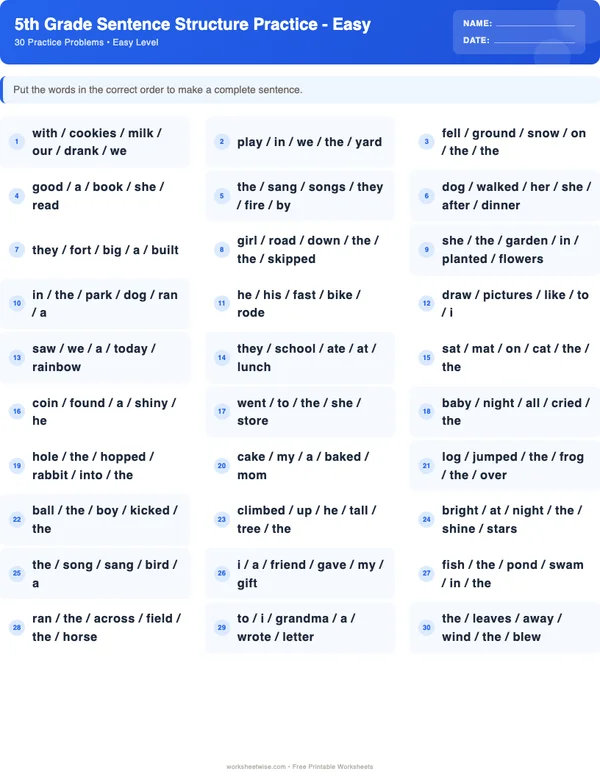
Complete guide
How to teach and practise 5th grade worksheets
3,779 words Updated 6 instructional visuals
Choose fifth-grade practice by evidence, not by the label
The useful fifth-grade worksheet is not simply the one marked “5th Grade.” It matches what the learner can represent, explain, and complete with an appropriate degree of independence. Begin with a short preview, watch the strategy used on the first few items, and inspect the work afterward. Then choose the next sheet based on evidence: strengthen a prerequisite, repeat the same target with lighter support, vary its representation, or increase complexity.
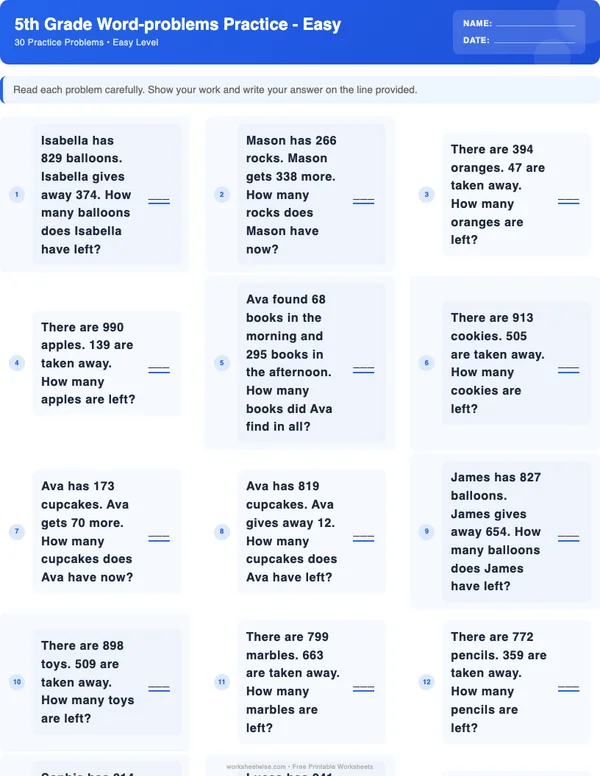
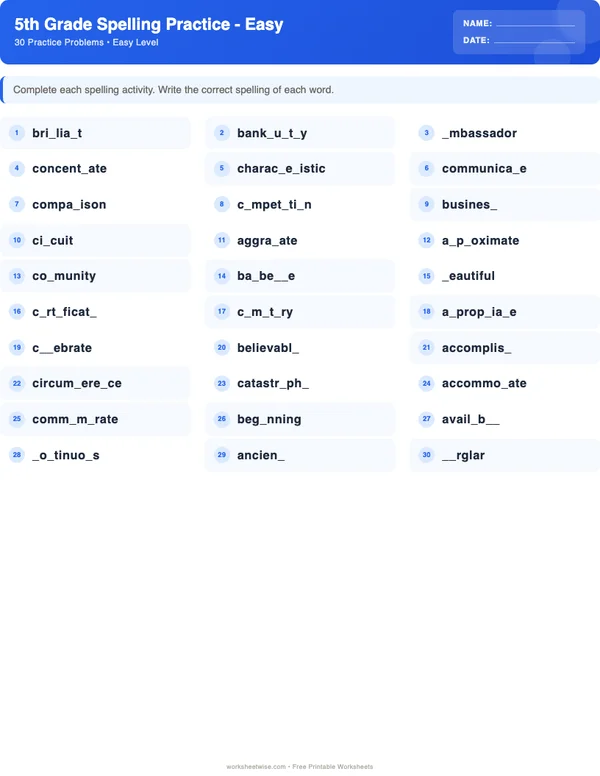
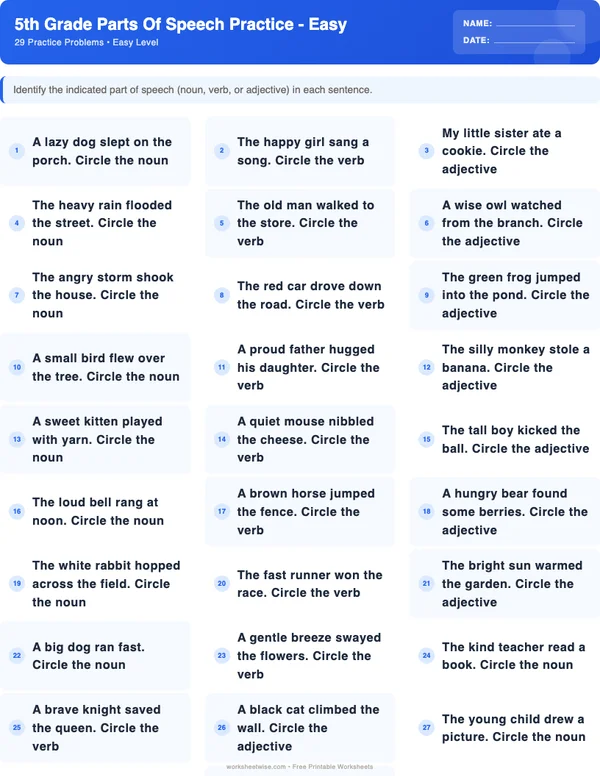
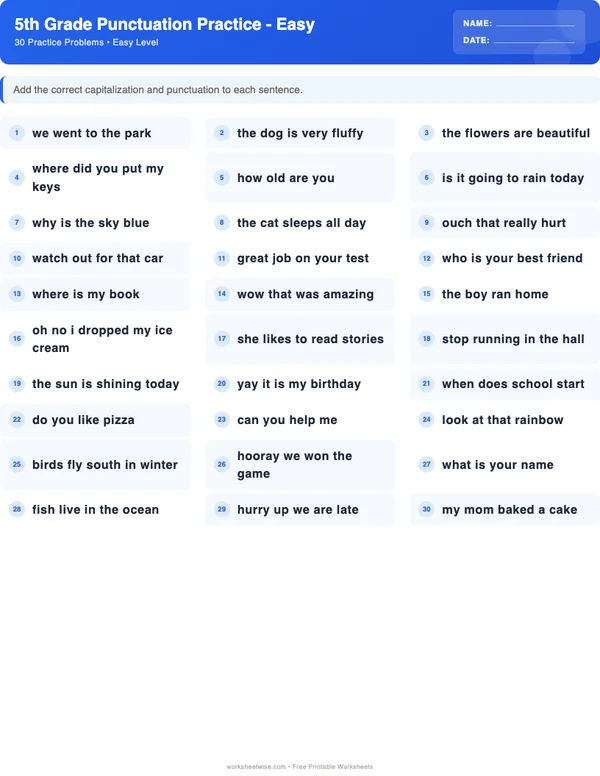
The live WorksheetWise catalogue currently contains 234 fifth-grade worksheet variants across three subjects and 13 topics, with 13 free entry points. The available subject areas are math, spelling, and grammar. Math includes addition, subtraction, multiplication, division, fractions, decimals, place value, geometry, and word problems. Spelling includes spelling-word practice. Grammar includes parts of speech, punctuation, and sentence structure.
These resources provide practice, not a complete fifth-grade curriculum. The catalogue does not currently establish a reading-comprehension or essay-writing sequence for this page, even though those are important fifth-grade responsibilities. Use other instruction and authentic reading and writing alongside worksheets.
Grade labels describe an intended practice level; local curriculum sequences differ. Age is a discovery aid rather than a placement decision. A page for 10-year-olds may help an adult locate plausible material, but a learner’s work is the better placement evidence. No worksheet result diagnoses a learning condition or guarantees an outcome.
Establish the readiness boundary before printing a full set
Fifth-grade demands rise because familiar skills are applied to less forgiving numbers, representations, and contexts. A learner may calculate whole-number sums accurately yet be unready to add fractions with unlike denominators. Another may identify nouns and verbs but lose control of sentence boundaries while writing a paragraph. Treat those as different instructional decisions.
A practical readiness boundary has three parts:
- Meaning: Can the learner explain what the symbols, quantities, or sentence parts represent?
- Method: Can the learner choose and carry out a defensible strategy?
- Independence: Can the learner begin, persist, and check without continuous prompting?
Do not require perfection in all three. Instead, identify which part is limiting performance. If a learner can explain decimal tenths with a model but misaligns digits during written addition, the next task should preserve decimal meaning while supporting the written layout. Returning all the way to basic whole-number place value would discard useful competence.
Conversely, procedural success can conceal a weak foundation. A learner who says, “I added zeros because that is the rule,” when comparing 0.4 and 0.36 may need a hundredths grid or place-value chart before more comparison items.
Define difficulty through visible task features
The free sheets in this catalogue are labeled “easy,” but that label should describe the task, never the learner. Determine actual demand by looking at observable features:
- number size and number of computation steps;
- presence or absence of regrouping;
- like or unlike fraction denominators;
- whole-number, fraction, or decimal remainders and answers;
- visual models, worked examples, or blank workspace;
- familiar or unfamiliar vocabulary;
- isolated sentences versus connected passages;
- recognition, correction, explanation, or original production;
- one operation named in advance versus an operation selected from context;
- oral support, occasional prompts, or fully independent completion.
An “easy” 30-problem division sheet may still overload a learner who understands equal groups but cannot yet organize long division. A 16-item word-problem sheet may be more demanding than 30 calculations because the learner must interpret the situation and select operations. Problem count measures volume, not conceptual difficulty.
Preview one task before assigning many
A preview should take three to five minutes. It is not a disguised lesson or a graded test. Its purpose is to expose the task’s representations, language, and independence demands before an adult commits the learner to an entire page.
Use a four-question preview
Show one representative item and ask:
- “What is this asking you to find or change?”
- “What could you draw, build, mark, or write to show the idea?”
- “What will you do first?”
- “How could you check whether your answer makes sense?”
Listen for more than the answer. Does the learner identify place values, describe equal groups, locate a subject and predicate, or explain what punctuation changes for the reader? If the learner cannot name a first move, offer one bounded support—such as a place-value chart, fraction strip, multiplication fact chart, or two color pencils—and preview again.
Do not explain the entire page and then call the work independent. Record the support given. “Completed with a denominator prompt” is different evidence from “completed after an adult modeled every item.”
Example 1: Preview decimal comparison
Ask the learner to compare and . A correct, checkable explanation is:
- ;
- is 40 hundredths;
- is 36 hundredths;
- therefore, .
This example belongs in fifth-grade selection because the live decimal resources cover place value, comparison, rounding, conversion, and decimal operations. It also reveals a characteristic readiness boundary. If the learner chooses 0.36 because “36 is greater than 4,” more naked comparison problems are unlikely to help. Use a hundredths grid or place-value chart while preserving the same comparison target.
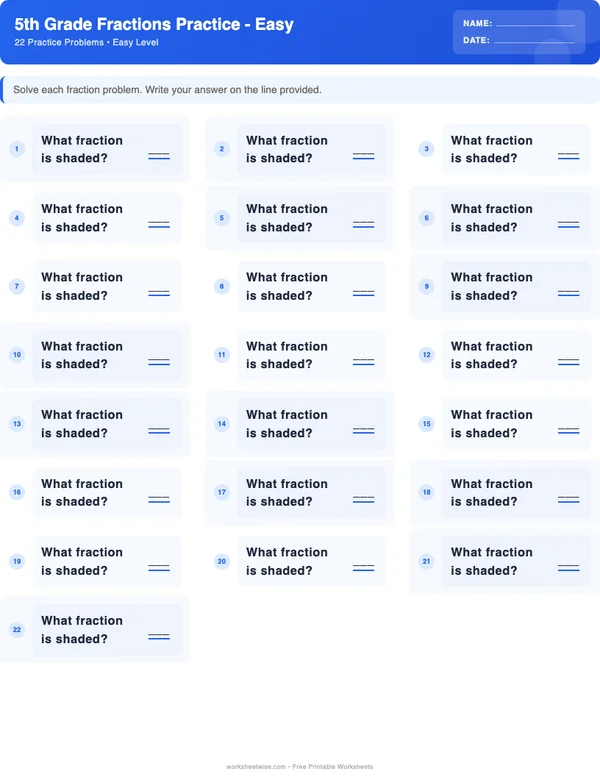
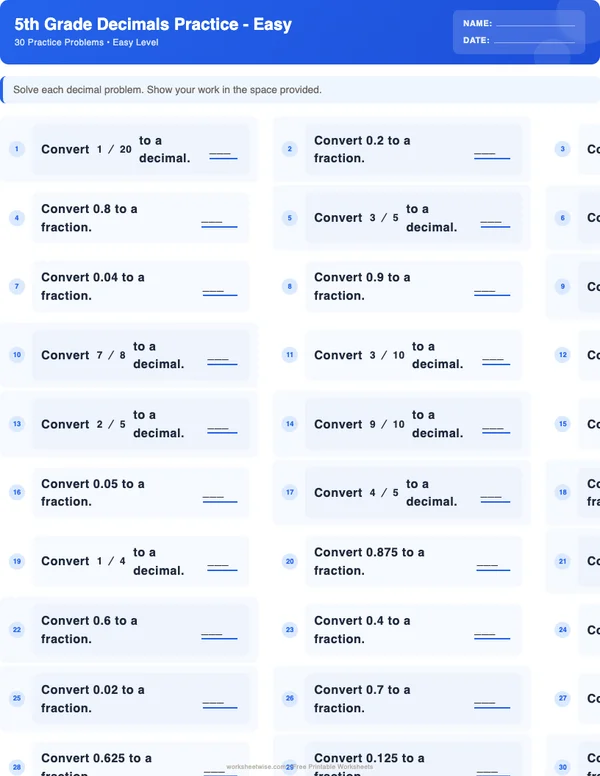
The 5th Grade Decimals guide and free sheet is a suitable next entry point once the learner can explain tenths and hundredths. This recommendation is based on the catalogue’s stated content, not on a claim that the resource has been independently evaluated.
Select math practice by representation and operation
The mathematics catalogue spans foundational computation and fifth-grade extensions. Selection should follow the learner’s demonstrated strategy rather than a fixed topic order.
Reconnect place value to whole-number computation
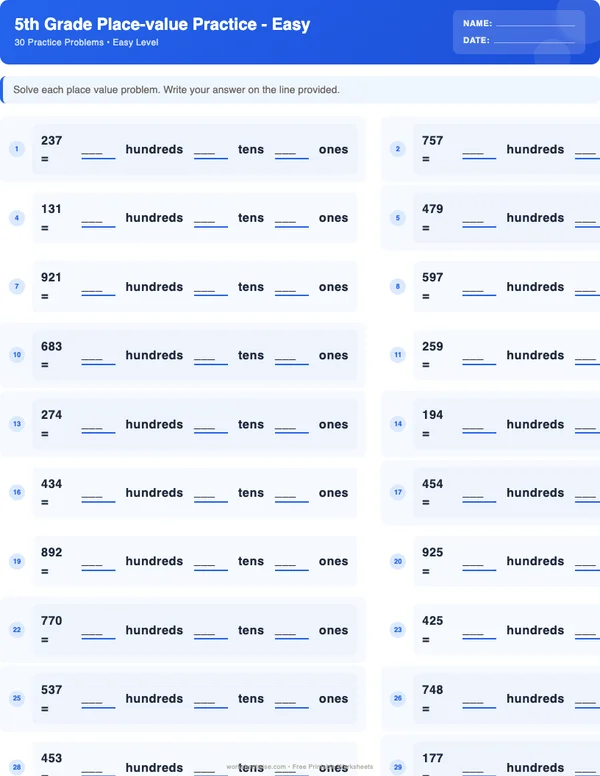
Place value organizes addition, subtraction, multiplication, division, rounding, and decimal work. A learner ready for fifth-grade computation should be able to explain that moving one place left multiplies a digit’s value by ten and moving one place right divides it by ten. When regrouping, the learner should understand the exchange, not merely recite “carry” or “borrow.”
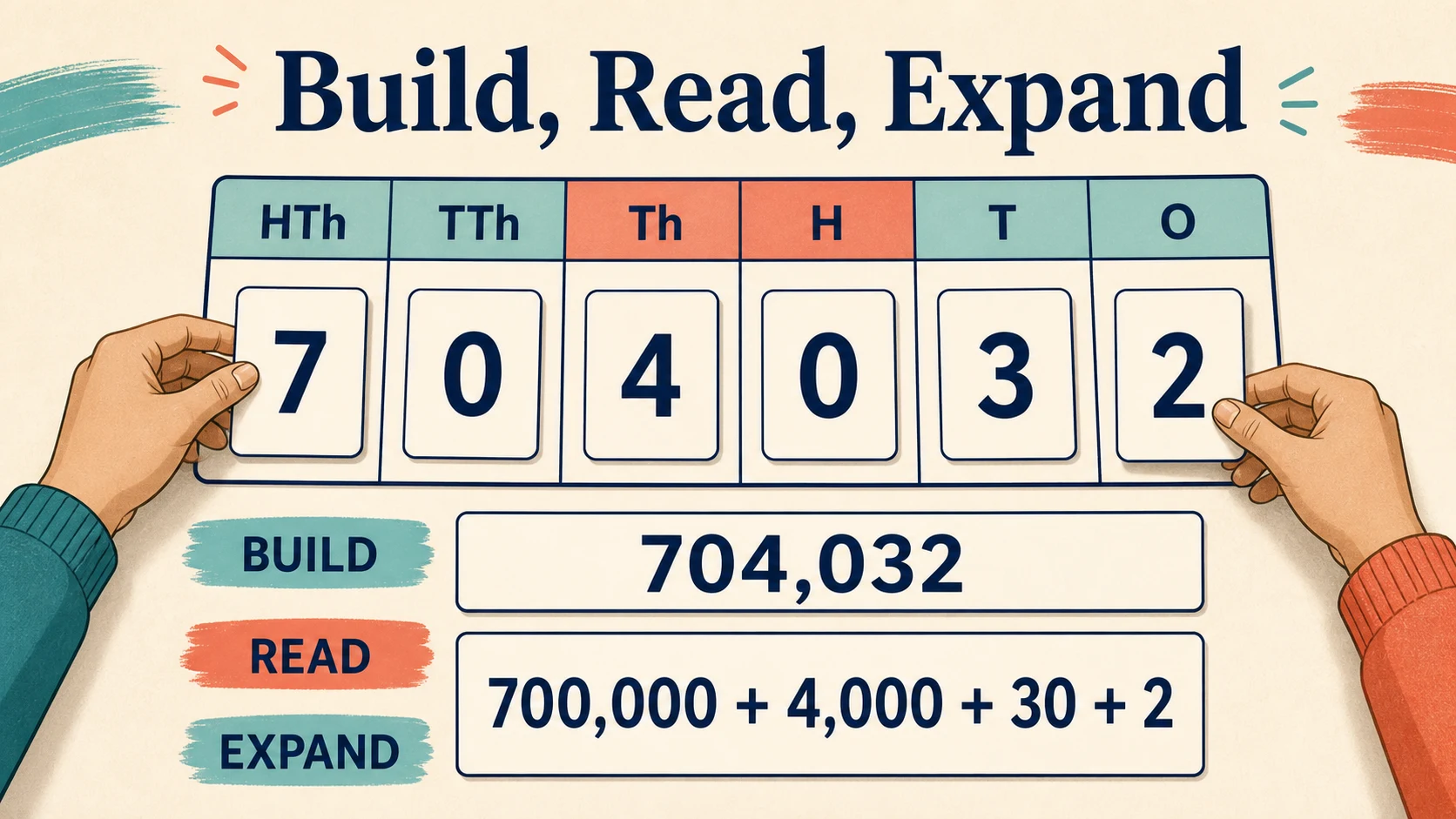
Use the routine to make the learner name a place, represent its value, solve, and check before adding more items.
A useful place-value routine is:
- read the number aloud;
- identify the value of one selected digit;
- write an expanded form;
- compare or round using a benchmark;
- explain how the value would change if that digit moved one place.
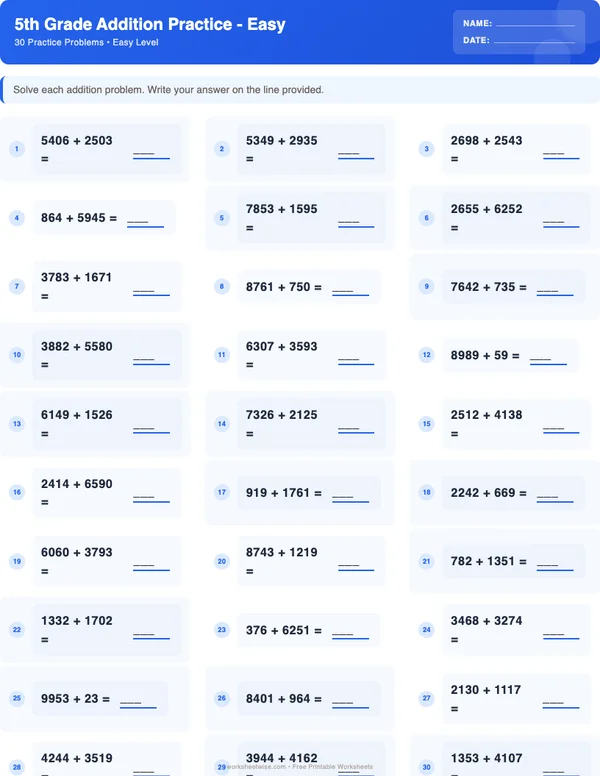
The 5th Grade Addition guide and free sheet contains a 30-problem free entry sheet. Before assigning all 30, sample three items that represent the page’s actual regrouping demand.
Example 2: Diagnose a multi-digit addition result
For , the checked sum is .
One defensible decomposition is:
An estimate also supports the result: .
This example belongs here because fifth-grade whole-number fluency should include multi-digit addition, and the catalogue explicitly connects addition to place-value understanding. If a learner writes , inspect the columns and exchanges. The error suggests that regrouped units were recorded without recomposing them into the next place. If the estimate is also absent, teach a reasonableness check; if the estimate is sound but notation fails, support alignment rather than reteaching addition meaning.
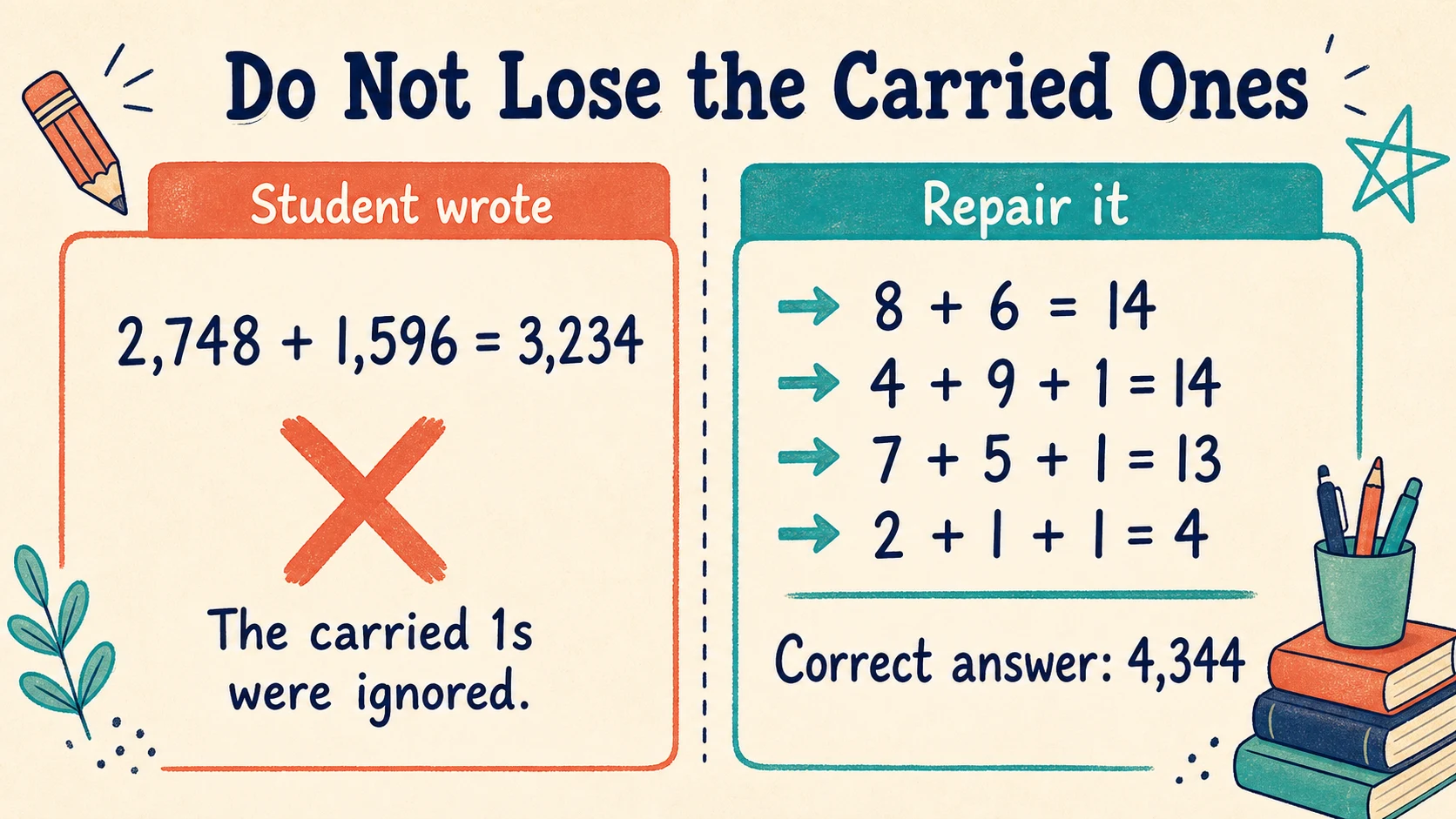
Match the response to the visible error: place-value misalignment, an unrecorded exchange, or an answer that was never estimated.
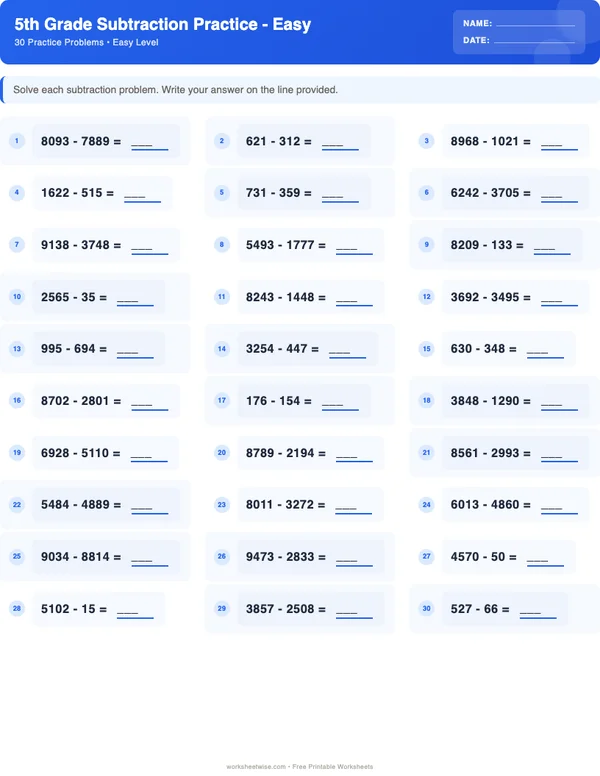
For subtraction, increase demand from direct calculation to regrouping across places and then to selecting subtraction in context. Keep the inverse relationship with addition visible.
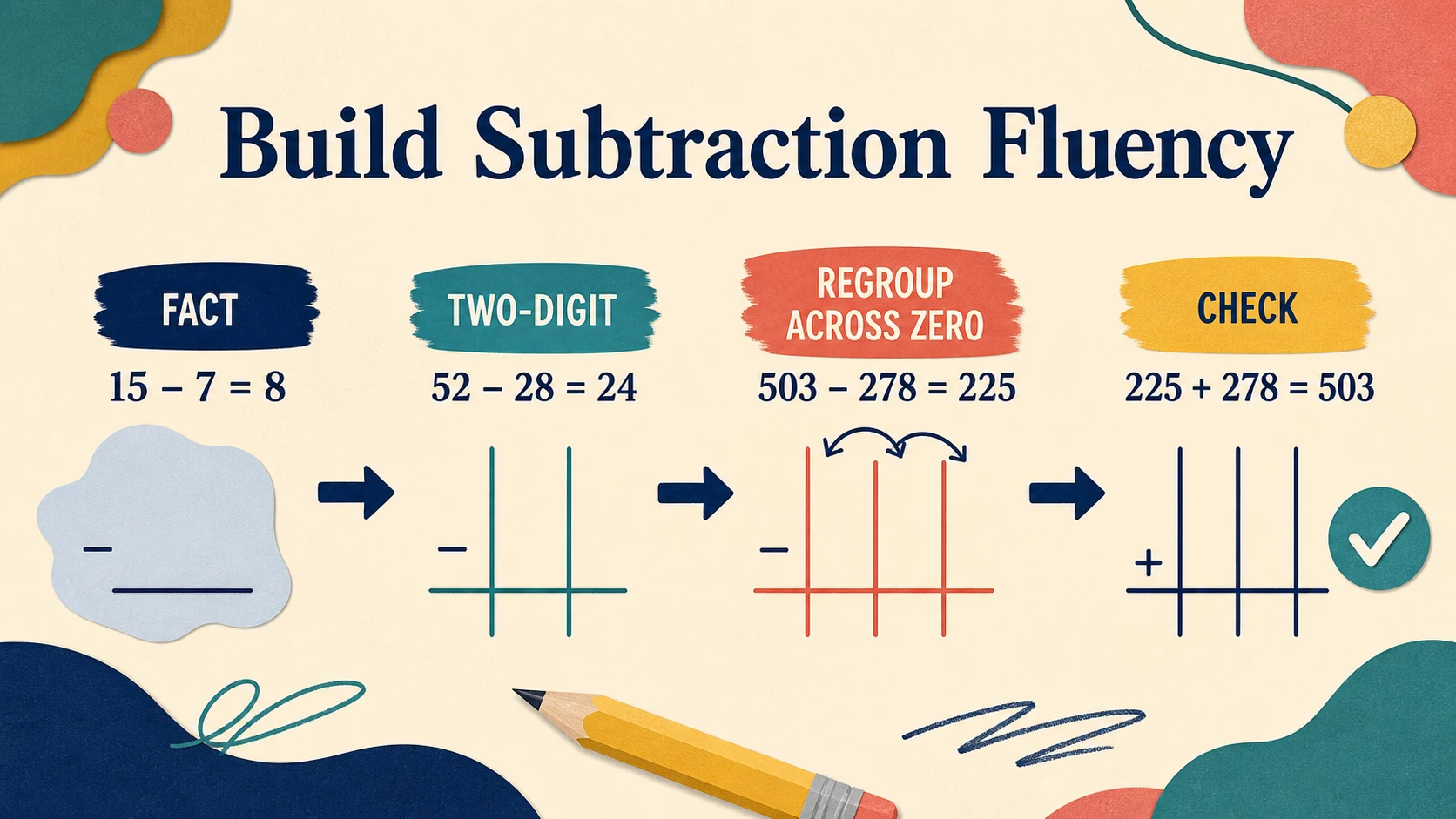
Move forward when the learner can explain an exchange and verify the difference with addition, not merely after finishing a page.
Connect multiplication and division before emphasizing algorithms
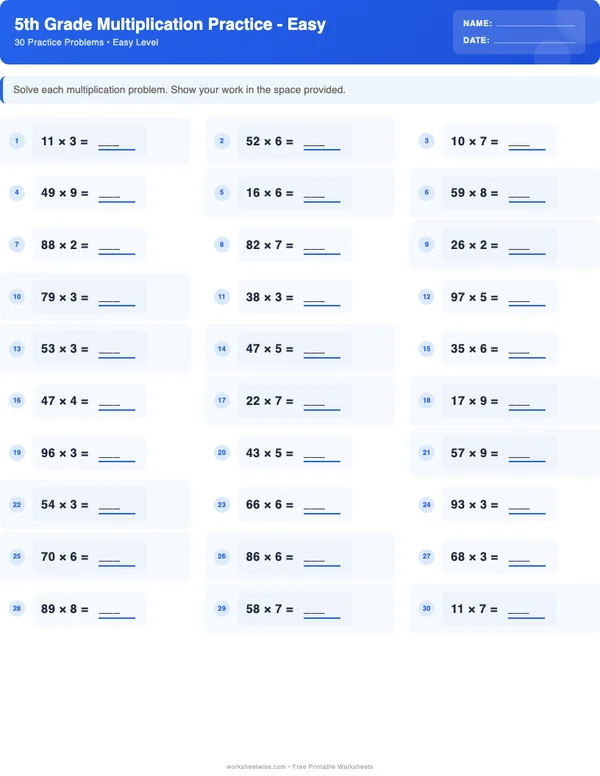
The live multiplication sequence moves from equal groups and arrays to facts, properties, partial products, and multi-digit computation. Division includes sharing, grouping, fact families, long division, and interpretation of remainders.
For , a checked partial-products solution is:
This belongs at fifth grade because it tests whether the learner can connect the distributive property to multi-digit multiplication. If the learner writes 232, ask them to label each partial product and estimate . The estimate exposes the implausible answer without replacing conceptual instruction.
For division, do not treat every remainder alike. In “25 students ride in vans that hold 6,” remainder , but five vans are required. In “25 stickers are shared equally among 6 learners,” each receives four, with one sticker left. The calculation is the same; the context determines the answer.
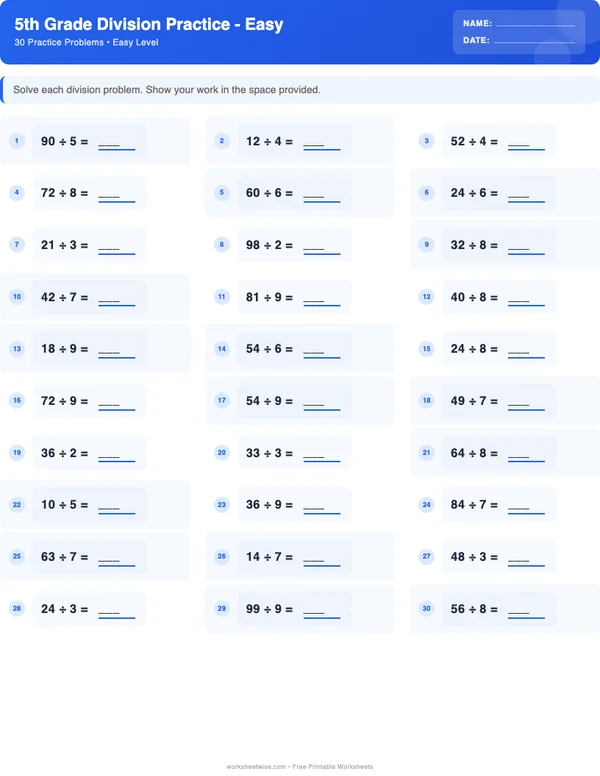
The 5th Grade Division guide and free sheet is appropriate when the learner can connect division to multiplication and interpret what the quotient and remainder mean.
The IES practice guide on assisting students struggling with mathematics recommends systematic instruction, clear mathematical language, representations, number lines, and deliberate attention to word problems. That is sourced general guidance; it is not an evaluation of WorksheetWise.
Treat fractions and decimals as numbers, not symbol rules
Fifth-grade fraction work becomes substantially more demanding: learners add and subtract fractions with unlike denominators, multiply fractions by whole numbers and fractions, and interpret division involving fractions and whole numbers. Decimal work extends place value into all four operations. In both topics, estimation and visual representation should remain available even after algorithms appear.
Example 3: Check unlike-denominator addition
For , twelfths provide a common unit:
The answer is reasonable because and are each greater than , so their sum must exceed 1; each is less than 1, so the sum must be less than 2.
This example belongs here because the fifth-grade thesis specifically includes adding fractions with unlike denominators, while the live fraction catalogue covers equivalence, mixed numbers, and all four operations. If a learner produces , do not merely say “never add denominators.” Ask the learner to draw both fractions on equal-length bars. The drawing reveals that thirds and fourths are different-size units. Next, practice equivalent fractions and common units before returning to addition.
The 5th Grade Fractions guide and free sheet has 22 problems, fewer than the 30 on several computation sheets. That does not automatically make it lighter: representation changes and unlike denominators can raise cognitive demand.
The Common Core mathematics standards provide one authoritative description of grade-level expectations, including fifth-grade fraction operations, decimal place value, volume, coordinate graphing, and numerical expressions. They are a reference point, not proof of alignment for any individual WorksheetWise sheet. Local sequences may place or emphasize content differently.
Preserve the target when adapting fraction work
If the target is adding unlike denominators, acceptable adaptations include:
- providing fraction strips;
- marking equivalent partitions on a number line;
- reducing the number of items;
- supplying a multiplication chart;
- reading directions aloud;
- allowing oral explanation before symbolic work.
Changing every problem to like denominators would remove the target. Giving the common denominator in early items may scaffold the target, but record that support and fade it deliberately.
Use geometry and word problems to test transfer
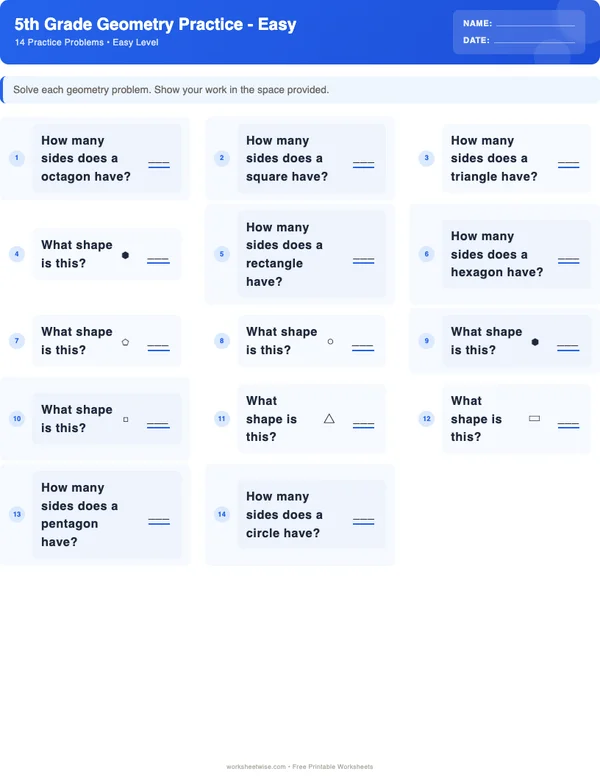
Geometry and word problems reveal whether computation can be used outside a familiar column or equation. Fifth-grade geometry includes volume, coordinate-plane points, shape properties, area, perimeter, and angles. These tasks require learners to connect a diagram, unit, and operation.
A volume prompt such as “A rectangular prism is 4 units long, 3 units wide, and 5 units high” has the checked result:
The answer is 60 cubic units, not 60 square units. This belongs in fifth grade because volume is part of the page’s stated instructional scope. If the learner calculates 12, ask what the five layers contribute. Building or sketching layers preserves the volume target. If the learner calculates 60 but writes “units,” focus next on distinguishing linear, square, and cubic measures.
For coordinate work, check whether the learner reads an ordered pair as , moves horizontally first, and then vertically. Reversing to is a representation error, not an arithmetic failure.
Word problems add a reading and decision layer. Preview them by asking the learner to retell the situation, identify what is known, state what must be found, draw a bar model or diagram, select an operation, and estimate. Avoid operation-keyword shortcuts: “left” does not always mean subtract, and “in all” does not settle a multi-step problem.
When computation is correct but the operation does not fit the story, the next task should emphasize modeling and retelling—not harder arithmetic.
Build spelling and grammar toward connected writing
The live language catalogue offers spelling words, parts of speech, punctuation, and sentence structure. These can strengthen component skills, but isolated accuracy is not the endpoint. Ask learners to apply the same feature in an original sentence or short paragraph.
Teach spelling patterns, then test transfer
The spelling resource contains 30 items and covers patterns such as vowel spellings, consonant doubling, silent letters, prefixes, suffixes, and multisyllabic words. Select a pattern from actual writing. If a learner spells hopping as hoping while intending the action of jumping, compare the pair:
- hop becomes hopping by doubling the final consonant before -ing;
- hope becomes hoping by dropping final e.
A useful cycle is look, cover, write, check, identify the incorrect part, and use the corrected word in a meaningful sentence. Sorting words by pattern is more informative than copying each word repeatedly. After isolated practice, inspect ordinary writing for transfer. Correct spelling on a list but not in a paragraph indicates that the learner needs retrieval during composition, not simply a longer list.
Use parts of speech to improve choices
Fifth graders need more than labels. They should notice how a word functions in a specific sentence and revise vague language.
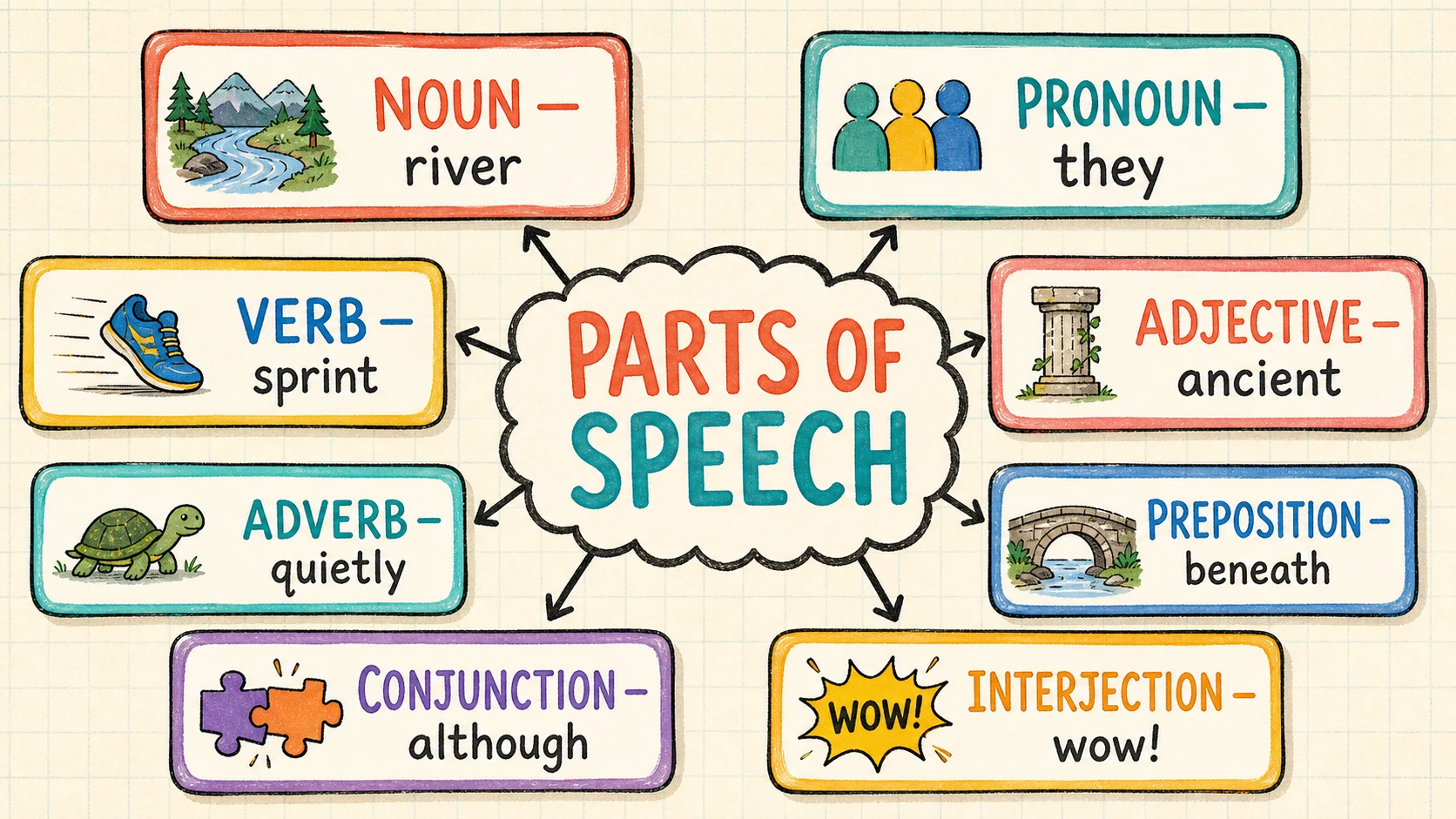
Use the map to connect identification with sentence decisions: precise nouns, strong verbs, clear pronouns, modifiers, relationships, and clause connections.
Consider light:
- “Turn on the light.” — noun
- “Please light the candle.” — verb
- “Carry the light bag.” — adjective
This checked example belongs here because the catalogue explicitly notes that English words can perform different grammatical functions depending on context. If a learner labels words from memory without reading the sentence, contrast two uses and require an explanation of the word’s job.
Fifth-grade grammar also includes perfect verb tenses, correlative conjunctions, and control of tense shifts, although those features are not separately represented in the verified topic list. Do not assume the parts-of-speech sheet teaches them. Use the full worksheet library to inspect available resources, or provide direct instruction and authentic editing elsewhere.
Move sentence work from recognition to control
Sentence structure is the clearest bridge between grammar practice and fifth-grade writing. The catalogue includes sentence types, subjects and predicates, fragments, run-ons, sentence combining, and expansion. Within the grade, demand changes from identifying a feature to correcting it, explaining the correction, and applying it during composition.
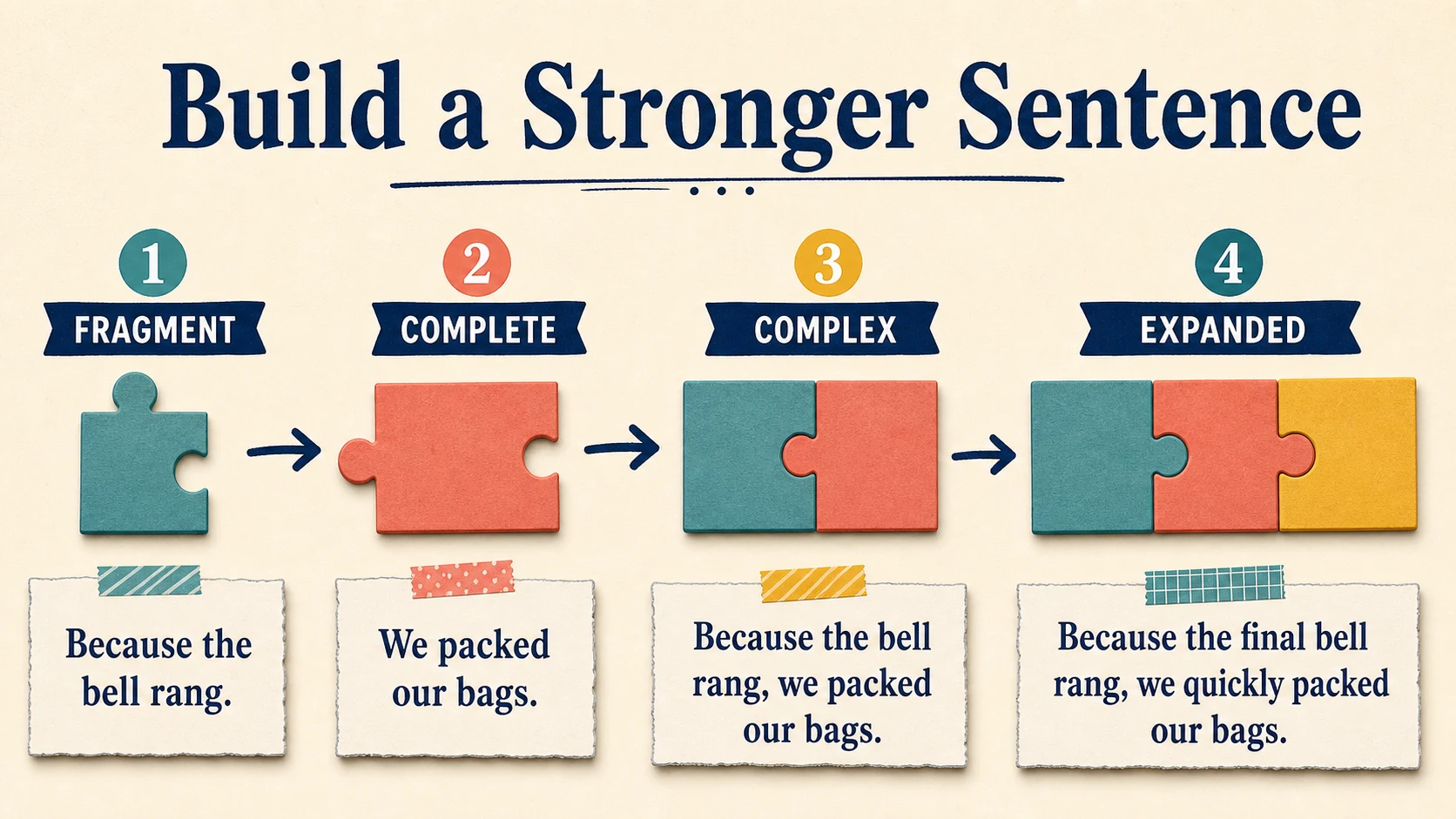
Advance from marking sentence parts to revising supplied sentences and finally controlling structure in an original paragraph.
Example 4: Repair a run-on without changing its meaning
Start with:
Maya finished her model she carried it carefully to school.
Two complete thoughts have been joined without suitable punctuation or a conjunction. Valid revisions include:
Maya finished her model, and she carried it carefully to school.
After Maya finished her model, she carried it carefully to school.
Maya finished her model. She carried it carefully to school.
This belongs here because fifth-grade writers should control complete, compound, and complex sentences rather than merely recognize a subject and predicate. Each correction produces a different rhythm, so ask which version best fits the surrounding paragraph.
If the learner inserts only a comma—“Maya finished her model, she carried it…”—the error is a comma splice. The next action is a short sentence-boundary lesson using two complete thoughts, not a broad review of every punctuation mark.
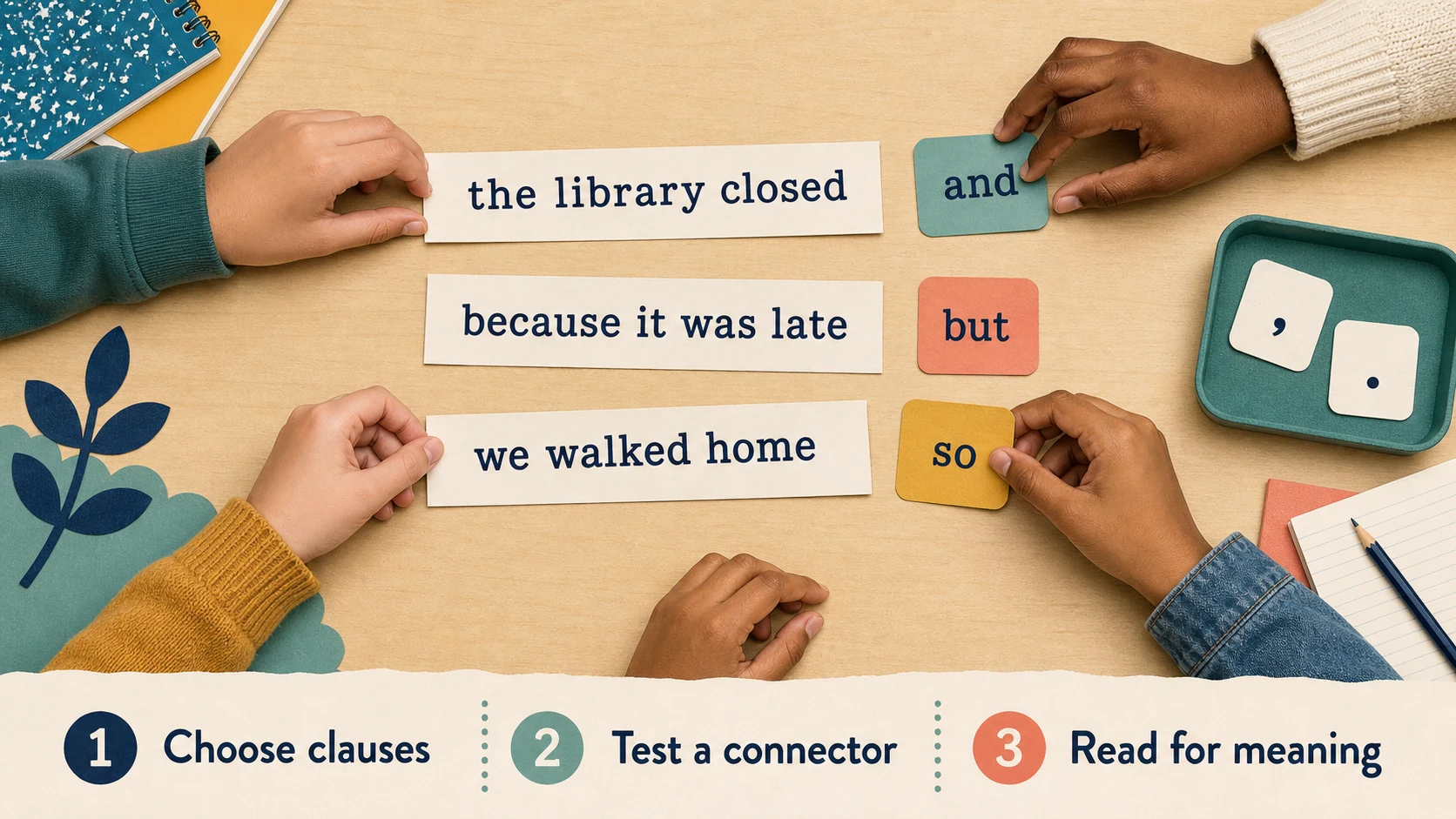
Repeat a tight cycle: read aloud, locate complete thoughts, combine or separate them, explain the punctuation, and apply the pattern in new writing.
The IES guide on teaching elementary students to be effective writers recommends daily time for writing, explicit teaching of the writing process, support for fluency with core writing skills, and a community of writers. Those recommendations support using a worksheet as one short component within drafting, revising, sharing, and feedback—not as a substitute for sustained writing.
A fifth grader working toward a five-or-more-paragraph essay needs help planning sections, developing body paragraphs, paraphrasing sources, and revising for coherence. The live catalogue facts do not establish that these worksheets provide a complete research-writing program.
Read the work sample before choosing what comes next
Marking correct and incorrect answers is only the first pass. A useful work-sample review separates conceptual errors, procedural errors, representation errors, language errors, attention slips, and independence needs.
Use an evidence-to-action record
For each short sample, record:
- Target: What exact skill was being practiced?
- Conditions: What model, prompt, reading help, or reference tool was available?
- Strategy observed: What did the learner draw, say, or write?
- Error pattern: Was the error repeated or isolated?
- Explanation: Could the learner justify a correct answer or detect an unreasonable one?
- Next action: What single change should occur in the next practice?
For example:
- Observed: Three decimal sums are wrong because digits were aligned from the right edge rather than by decimal point.
- Interpretation: Written place-value alignment is unstable; this is not evidence that all addition is weak.
- Next action: Complete four decimal additions on a labeled place-value grid, estimate first, and explain one regrouping.
Or:
- Observed: A learner correctly identifies conjunctions but writes four run-ons in an original paragraph.
- Interpretation: Recognition has not transferred to sentence construction.
- Next action: Revise two run-ons, then write three connected sentences using one coordinating and one subordinating conjunction.
Move up in complexity only when performance is accurate enough to inspect strategy and the learner can explain or check the work with decreasing support. Repeat at the same level when the strategy is sound but inconsistent. Step back to a prerequisite when errors show that the representation itself is misunderstood.
Use a short routine that builds independence
Fifth graders are preparing for more independent schedules and multi-step assignments. Independence should be taught explicitly rather than demanded all at once.
Use this repeatable practice routine:
- Set one target. “Today you will add fractions with unlike denominators and justify the common unit.”
- Preview one item. Ask the four preview questions without completing the whole problem for the learner.
- Complete a small batch. Start with three to six items, not automatically the full sheet.
- Pause for explanation. Have the learner explain one answer and check another by estimation, inverse operation, model, or rereading.
- Respond to the pattern. Add a representation, correct a misconception, or remove support.
- Finish or stop deliberately. More items are useful only when they rehearse a defensible method.
- Record the next action. Write one sentence that determines tomorrow’s task.
A learner can also manage a simple checklist: gather materials, read directions, circle uncertain items, check one answer, and ask a specific question. “I do not understand number 6 because I cannot tell whether the remainder changes the number of vans” is stronger self-advocacy than “I can’t do division.”
Preserve the skill while adjusting access
Adaptations should remove incidental barriers without silently replacing the intended learning.
Useful access changes include enlarged print, extra workspace, fewer visible items, a reading window, oral directions, movement breaks, color-coded place-value columns, manipulatives, reference charts, keyboarded responses, or oral explanations recorded by an adult. A learner practicing punctuation can dictate a sentence and then punctuate the transcript; the punctuation target remains intact.
Be cautious when an adaptation supplies the very decision being assessed. If the target is choosing an operation in a word problem, highlighting “multiply” removes the choice. If the target is identifying sentence boundaries, adding all capital letters and end marks converts the task into copying. If the target is recalling multiplication facts, unrestricted calculator use changes the evidence—though a calculator may be appropriate when fact recall is incidental to a fraction or volume problem.
The catalogue’s 13 free entry sheets provide a practical sampling route, while differentiated worksheets with answer keys can help adults compare task versions and give prompt feedback. An answer key confirms a result; it does not explain the learner’s reasoning or determine placement.
Know what these pages cannot establish
A worksheet sample can show what happened on particular items under particular conditions. It cannot establish a diagnosis, intelligence level, disability, motivation, or complete command of a grade. Fatigue, unfamiliar directions, language demands, visual layout, and prior instruction all affect performance.
The authoritative standards and IES guides cited here describe expectations or evidence-based instructional recommendations. They have not assessed WorksheetWise, verified individual sheets, or promised results from their use.
Reading and writing also require work beyond this live catalogue: full texts, discussion, comparison across sources, argument evaluation, vocabulary in context, sustained drafting, research notes, paraphrasing, and revision. The Common Core English language arts standards provide one reference for fifth-grade reading, writing, speaking, listening, and language expectations. Local curricula may organize these demands differently.
When errors persist despite clear instruction, varied representations, appropriate access, and repeated opportunities, document examples and consult the learner’s teacher or relevant school professional. Share the work, supports provided, and exact questions the learner could and could not answer; do not attach a diagnosis to the pattern.
Make tomorrow’s choice from one small sample
Choose one live topic, print only its free entry sheet, and preview one representative item. Have the learner complete three to six items, explain one strategy, and check one answer. Record the support used and select exactly one next move: prerequisite instruction, same target with a model, same target independently, or greater complexity.
A concrete starting point is the 5th Grade Fractions guide and free sheet. Use one unlike-denominator item to check whether the learner recognizes the need for a common unit. Tomorrow’s worksheet should follow from that observed explanation—not from the fifth-grade label alone.
Put it into practice
Use the guide with a real printable
Move from explanation to a short, observable practice task. Check the first item together, then adjust the next session from the learner's actual work.
Open the first free worksheet