Kindergarten · 6 live skills
Kindergarten math worksheets
Pick the exact skill below. Each page combines a real free download, a separate answer key, practical teaching guidance and an optional focused pack.
See all Kindergarten subjects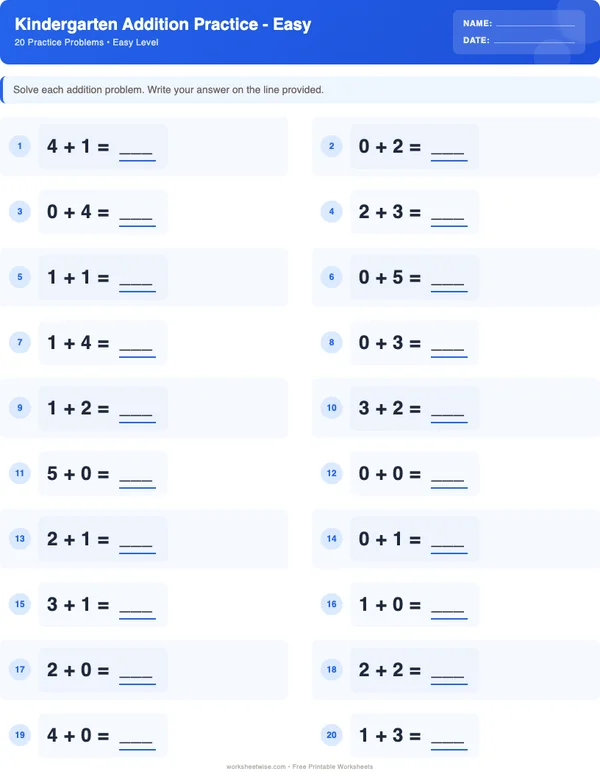
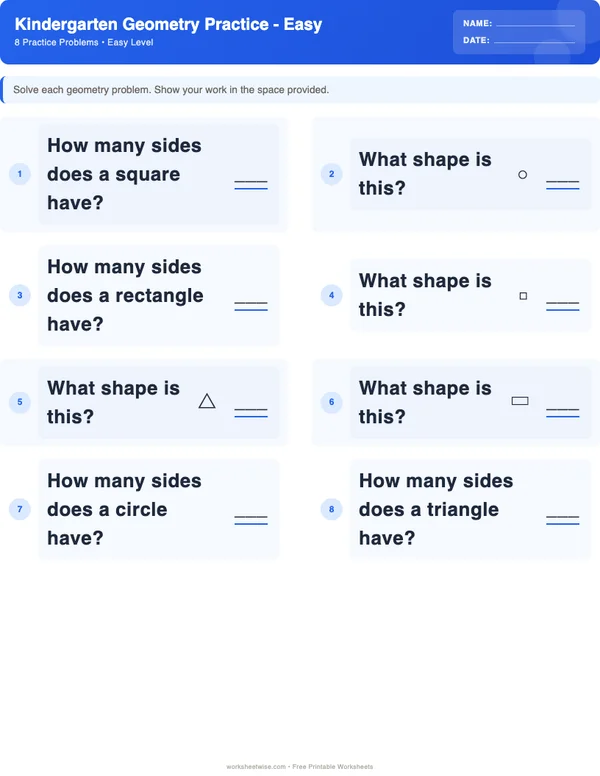
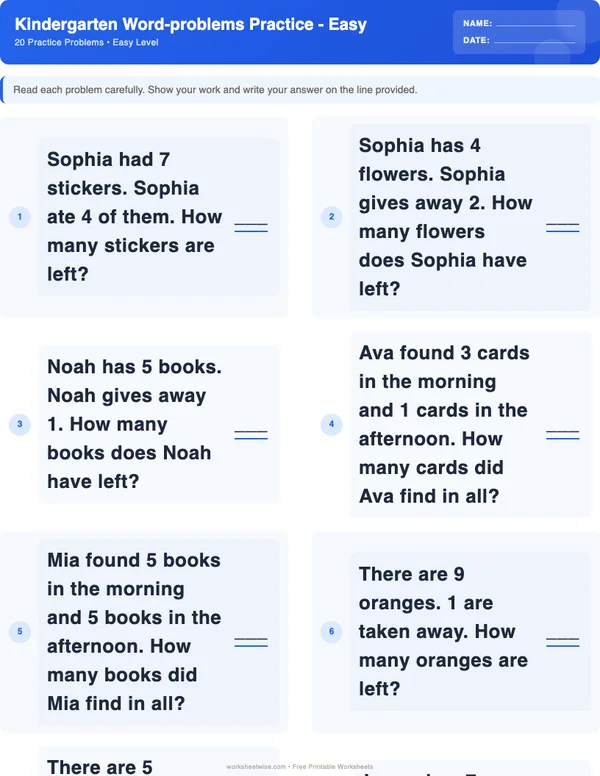
Complete guide
How to teach and practise kindergarten math worksheets
3,506 words Updated 6 instructional visuals
Choose one skill before you choose a worksheet
Kindergarten math practice is most useful when the adult selects one bounded target, watches how the learner solves a few problems, and uses that evidence to choose the next task. On this page, the live choices are counting, addition, subtraction, place value, geometry, and word problems. They are connected, but they are not interchangeable.
Start with the question the learner needs to answer:
- “How many are there?” points to counting.
- “How many altogether?” points to addition.
- “How many remain, how many more, or what part is missing?” points to subtraction.
- “How is 14 made from one ten and four ones?” points to place value.
- “What properties make this a triangle?” points to geometry.
- “What is happening in this story, and what must we find?” points to word problems.
The live catalogue contains 108 kindergarten math variants across these six topics, with one free entry point per topic. The five computation or concept sheets contain 20 problems each; the word-problem sheet contains 12. Those counts describe available practice, not an appropriate sitting length. A learner may show more useful thinking on four carefully discussed problems than on a completed page.
The catalogue labels each free sheet “easy.” Treat that label as a description of task features, not of a child. Here, an easier entry task should have a single visible target, small quantities, familiar representations, short directions, limited reading, and no unnecessary operation changes. A more demanding task might remove pictures, scatter objects, move the unknown, combine two decisions, or require an explanation. Never call a learner “easy,” “developing,” or “advanced.”
Grade labels likewise describe an intended practice level. Local curriculum sequences differ, and a kindergarten label is neither a diagnosis nor proof that the sheet matches a particular learner. Age can help an adult discover plausible activities, but it is not a placement decision. For ages three and four, prioritize brief adult-led oral, matching, manipulative, and movement work over desk work.
See the six live skills as a progression, not a checklist
The six topics form several overlapping paths. Counting supports early operations because a learner must coordinate number words with objects before “three and two more” has stable meaning. Place value reorganizes counting around groups of ten. Addition and subtraction describe related changes and relationships. Word problems ask the learner to recognize those relationships in language. Geometry develops a different but equally important line of reasoning through properties, composition, position, and spatial structure.
The IES guide for teaching math to young children recommends developmental progressions for both number-and-operation content and geometry, along with progress monitoring that builds on what a child already knows. That is authoritative general guidance; it is not an evaluation of WorksheetWise.
Counting: coordinate words, objects, and totals
Rote counting means saying number words in order. Rational counting adds one-to-one correspondence: each object receives exactly one count. Cardinality is visible when the learner understands that the last number said tells how many objects are in the set.
A child who recites to 20 but counts seven scattered buttons as eight needs a counting task, not an addition page. Ask the learner to move each button into a cup while counting. Movement separates counted from uncounted objects. Then rearrange the same seven buttons and ask, “How many now?” If the learner recounts accurately, that is fine; if the learner predicts that the total remains seven, you have also seen an early understanding that arrangement does not change quantity.
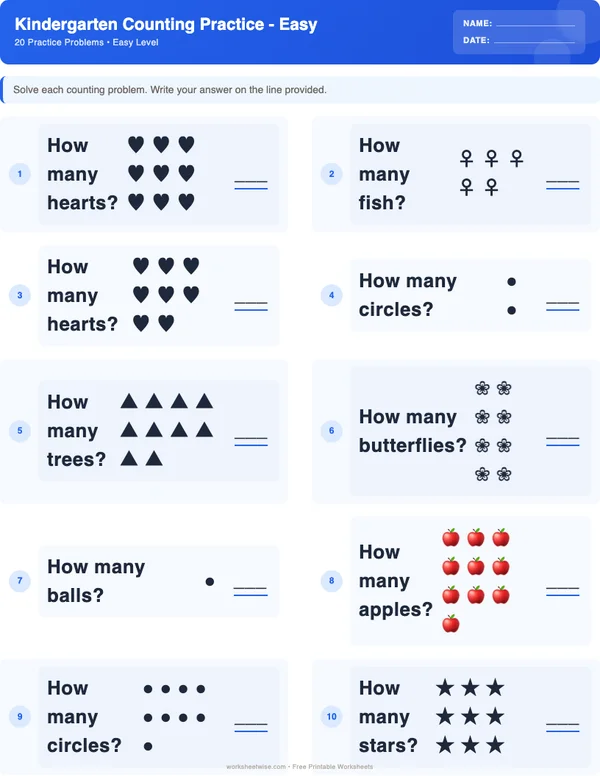
The Kindergarten Counting guide and free sheet includes 20 problems and is the clearest entry point when one-to-one matching, missing numbers, or continuing a sequence is the actual target.
Addition: join or compose quantities
Addition begins here with small groups that can be combined, drawn, and written as a number sentence. It is not merely the ability to recite a memorized fact. The learner should be able to connect an action or picture to the quantities and the total.
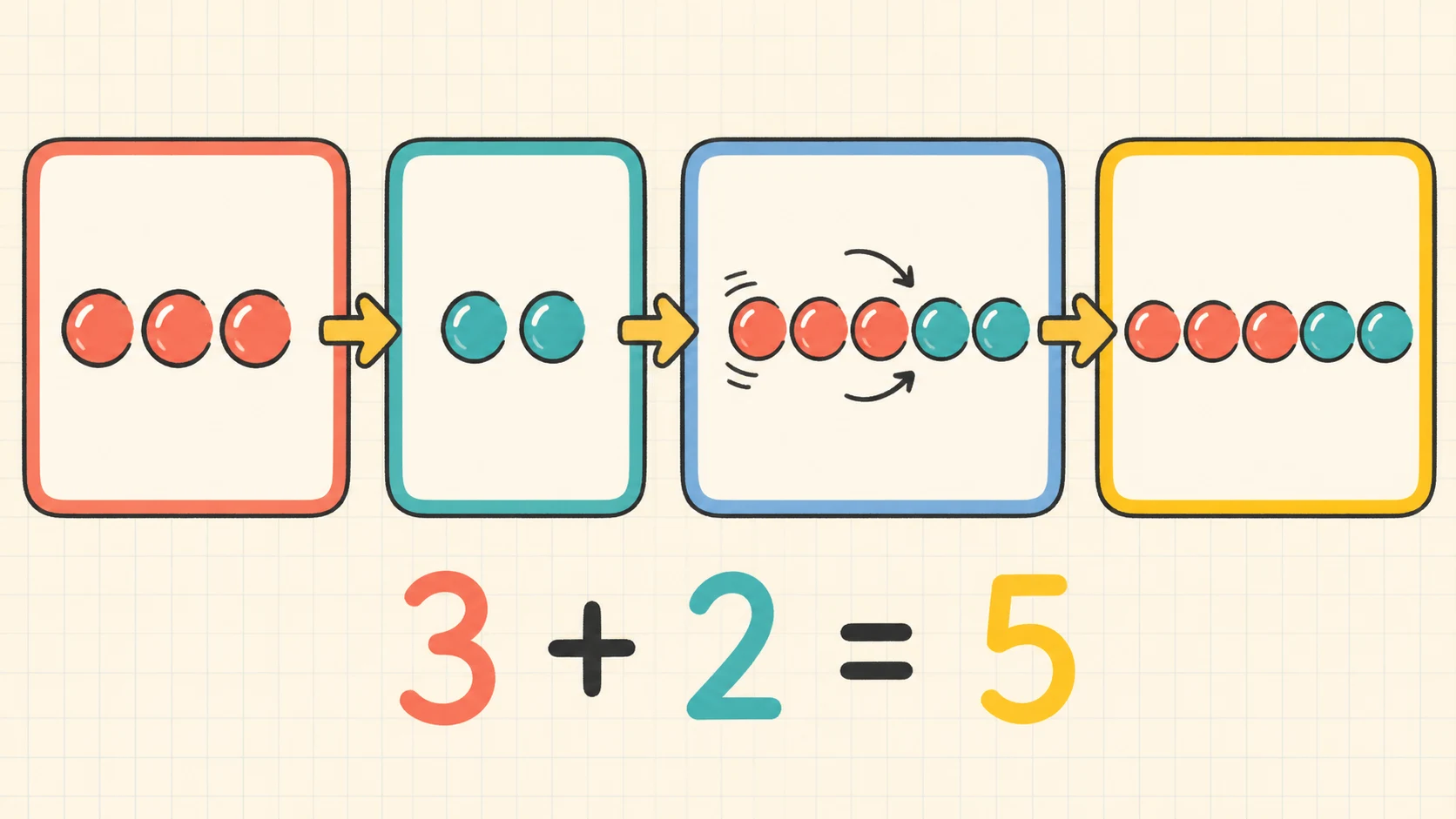
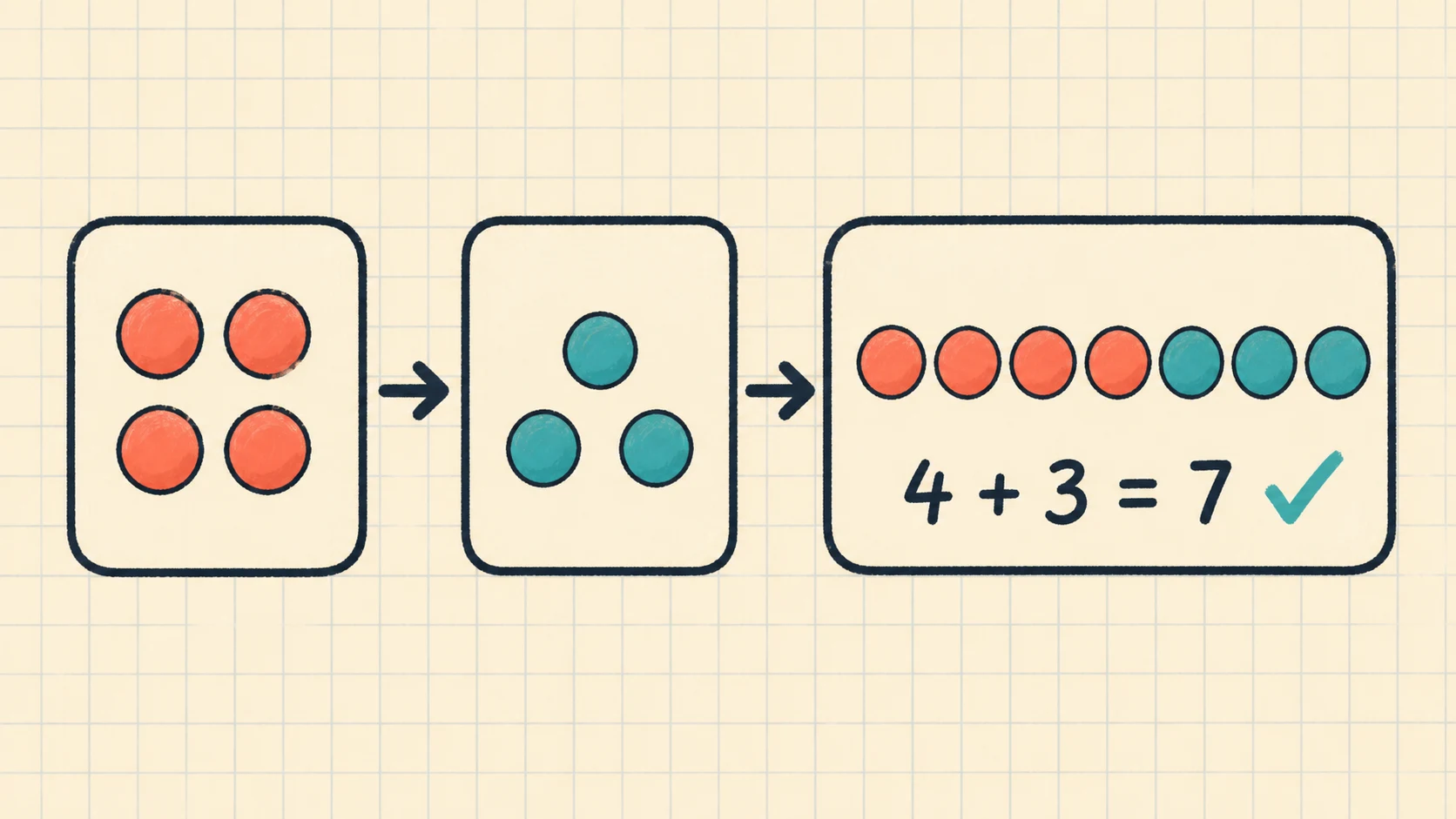
Counting objects supports joining groups; joining groups supports drawings and equations; equations eventually become usable without the original objects.
The catalogue’s broader addition description continues through addition within 10 and 20, making ten, and later multi-digit work. That describes the long elementary progression. It does not mean a kindergarten learner should begin at every point in it. Choose the smallest part that produces informative work.
Subtraction: removal is only one meaning
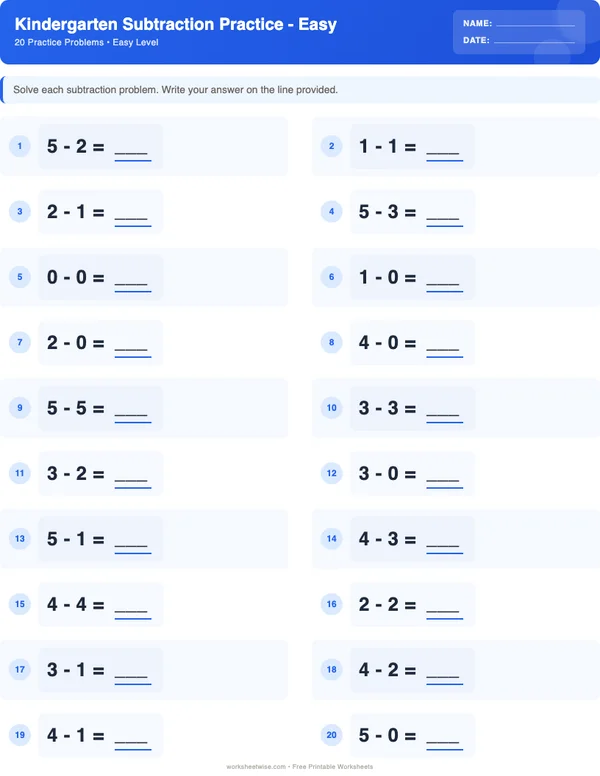
Subtraction can describe taking away, comparing two quantities, or finding a missing part. Those situations require different interpretations even when they use the same calculation.
For example, 5 − 2 = 3 can mean:
- Five counters were present and two were removed.
- One person has five counters and another has two; the difference is three.
- Five is the whole, two is one part, and the missing part is three.
If a learner succeeds only when objects physically disappear, keep the numbers small and introduce comparison or missing-part situations with visible groups. The Kindergarten Subtraction guide and free sheet is the relevant starting resource; later regrouping material mentioned in the catalogue belongs to the wider elementary progression, not the first kindergarten task.
Place value: make teen numbers visible
Kindergarten place-value work should center on the structure of teen numbers: one group of ten and some ones. It is not a cue to introduce thousands, formal rounding, or decimal notation merely because those topics occur later in the K–8 progression.
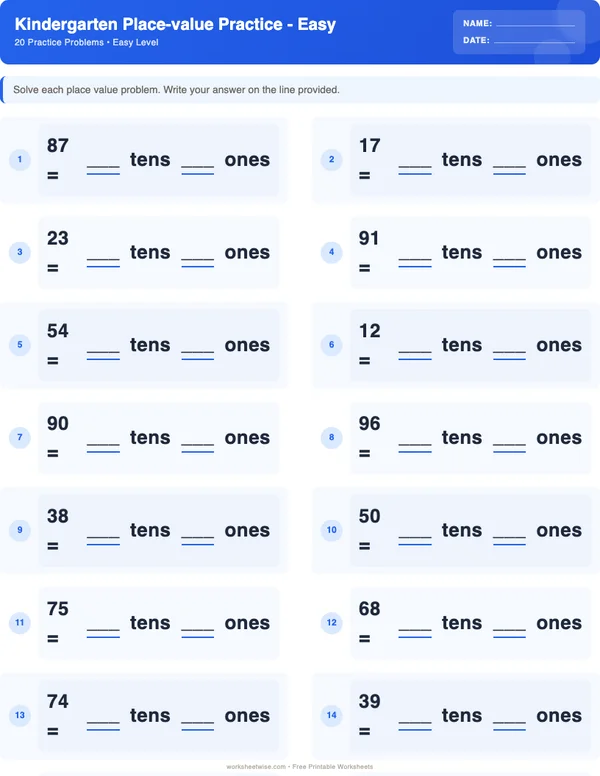
Show 14 with a bundle of ten craft sticks and four single sticks. Ask, “How many tens? How many ones? How many altogether?” A correct answer of 14 without identifying the ten and four ones shows number recognition, but not yet the specific structure being checked. The Kindergarten Place Value guide and free sheet keeps that target distinct from general counting.
Geometry: identify by properties across orientations
Early geometry involves naming, describing, sorting, building, and composing two-dimensional shapes and three-dimensional solids. Recognition should survive a change in size, color, or orientation.

Kindergarten geometry connects shape names to observable properties, then tests whether those properties still hold when a shape is turned or composed.
A triangle remains a triangle when it points sideways. A square remains a square when it looks like a “diamond.” If a learner sorts by color when asked to sort by shape, the issue may be attention to the chosen attribute rather than failure to know the shape names.
Word problems: interpret before calculating
Word problems combine mathematical relationships with listening or reading comprehension. A wrong operation does not automatically reveal a computation weakness. Read the story aloud if decoding is not the target, and ask the learner to retell what happened before writing any equation.
The live word-problem sheet has 12 problems rather than 20. That still may be too many for one discussion. The Kindergarten Word Problems guide and free sheet is best used after selecting a familiar quantitative relationship, such as joining two small groups or removing objects from a known starting amount.
The IES elementary mathematics intervention guide separately recommends deliberate word-problem instruction, clear mathematical language, systematic teaching, and well-chosen concrete or semi-concrete representations. These are sourced instructional recommendations, not claims about the effectiveness of any catalogue sheet.
Work four representative examples before assigning more practice
The following examples are editorial demonstrations checked against the arithmetic and the six live topic descriptions. They are not copied claims about what appears on every worksheet.
Example 1: count a scattered set without double-counting
Place seven buttons irregularly on a table:
● ● ● ●
● ● ●
Ask, “How many buttons are there? Show me how you know.”
A reliable solution touches or moves each button once while saying 1, 2, 3, 4, 5, 6, 7. Therefore, the total is 7. To check, line up the same buttons and count again. The total remains 7 because no button was added or removed.
This belongs in kindergarten counting because the target is one-to-one correspondence and cardinality, not addition. Scattering matters: a neat row can allow a learner to coordinate position and number words without showing a strategy for keeping track of a less organized set.
Interpret the work carefully:
- Saying “seven” immediately may indicate recognition, but ask for a check.
- Counting one button twice suggests a tracking problem; move counted objects aside.
- Ending at seven but answering “six” suggests the learner may not yet use the final number as the set’s total.
- Recounting accurately after rearrangement is acceptable evidence, even if conservation of quantity is not yet stated.
Example 2: move from two groups to an addition sentence
Give the learner three red counters and two blue counters. Ask, “How many counters altogether?”
First count each part: 3 red and 2 blue. Join the groups, then count all five or count on from three: 4, 5. The checked equation is:
3 + 2 = 5
To verify it, separate the five counters back into the original groups: three and two still account for every counter.
The objects, drawing, spoken explanation, and equation should refer to the same three, two, and five—not four unrelated activities.
This belongs in kindergarten addition because the quantities are small, the joining action is visible, and the abstract notation follows the model. If the learner writes 3 + 2 = 6, do not begin with another row of facts. Ask the learner to match one written number to each group and recount the combined set. If the learner counts five but writes 6, numeral recording—not the joining concept—may be the immediate error.
Example 3: distinguish subtraction situations
Use six toy animals and remove two. Ask, “There were six animals. Two walked away. How many remain?”
Begin with 6. Remove exactly 2. Count the remaining animals: 1, 2, 3, 4. Thus:
6 − 2 = 4
Check through addition: return the removed pair to the remaining four.
4 + 2 = 6
Now change the situation without changing the calculation: “Sam has six animals. Lee has two. How many more does Sam have?” Pair one of Lee’s animals with one of Sam’s. Four of Sam’s remain unmatched, so the difference is 4.
This belongs in kindergarten subtraction because it contrasts removal and comparison within the same small quantities. A learner may solve the take-away version and hesitate on the comparison version. That pattern does not justify a diagnosis; it tells the adult to model comparison with matched rows before increasing the numbers.
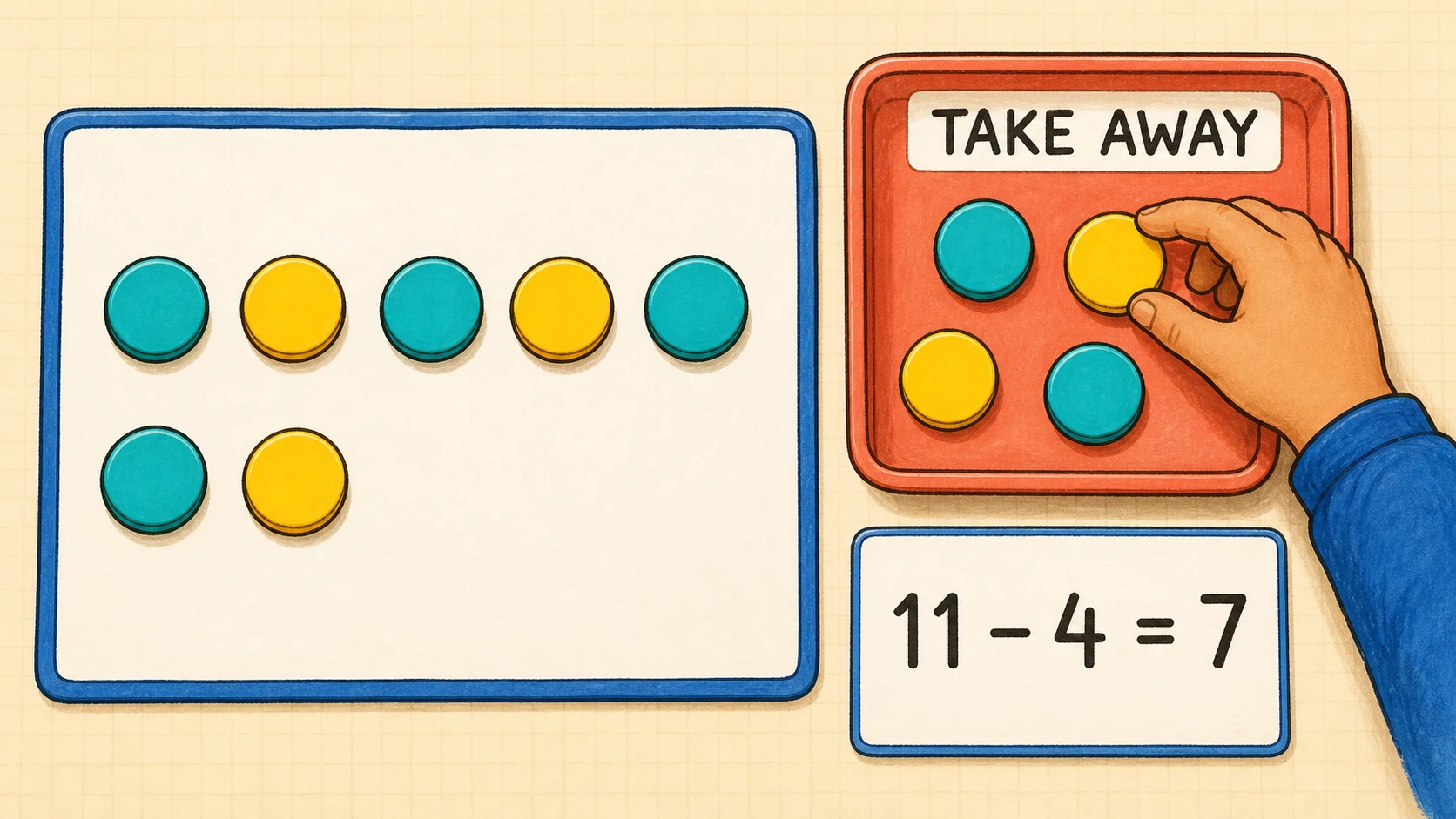
Keep the subtraction routine stable—hear the situation, model it, state what changed, write the equation, and check—while varying the problem meaning deliberately.
Example 4: compose a teen number
Place ten linking cubes in one connected train and four loose cubes beside it. Ask three questions:
- “How many are in the train?” 10
- “How many loose ones?” 4
- “How many altogether?” 14
The structure is:
14 = 10 + 4
Check by counting all cubes: the ten-cube train accounts for counts 1 through 10, followed by 11, 12, 13, 14 for the four loose cubes.
This belongs in kindergarten place value because it makes “one ten and four ones” physically visible. It is more specific than simply counting 14 separate cubes. If the learner says 14 but calls the model “14 ones,” accept that fourteen ones is quantitatively true, then restate the target: the ten connected cubes can also be treated as one group of ten.
Example 5: reject a misleading shape prototype
Draw or build a triangle turned so that one vertex points right. Ask, “Is this still a triangle? Why?”
The checked reasoning is: it is a triangle because it is a closed two-dimensional shape with three straight sides and three vertices. Its orientation does not change those properties.
Then show a nearly triangular shape with a small gap between two sides. It is not closed, so it does not meet the stated description. This comparison belongs in kindergarten geometry because it replaces “it looks like the usual classroom triangle” with observable attributes.
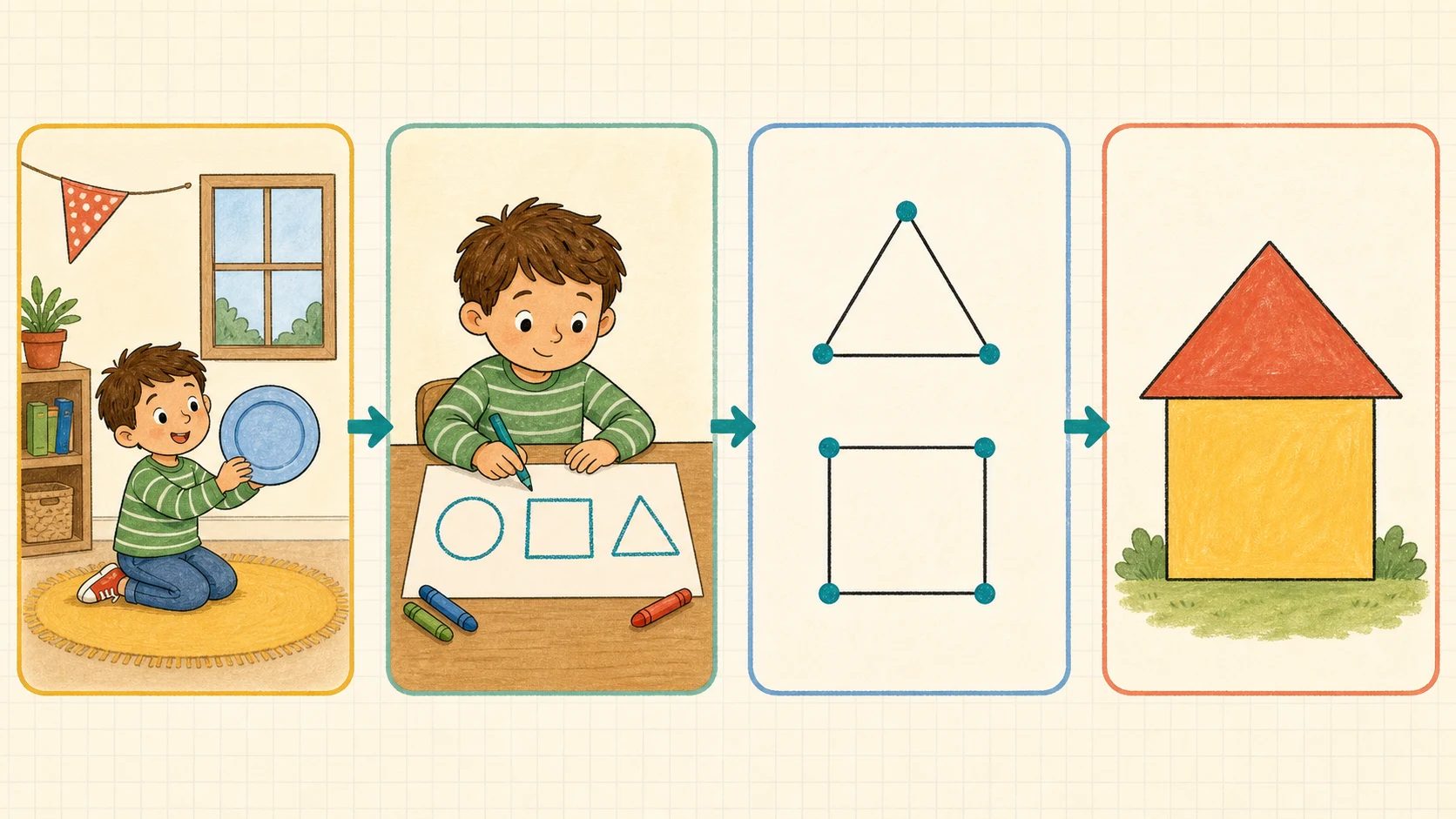
Support can fade from handling and sorting shapes to explaining a property independently, while the geometric target stays unchanged.
Select the first sheet from observable evidence
Use a two-minute probe before printing. Keep it conversational and stop once the starting point is clear.
| What you observe | Start with | Keep the first target bounded |
|---|---|---|
| Recites number words but loses track of objects | Counting | Count sets within a known range, moving each object once |
| Counts two groups accurately but does not combine them | Addition | Join groups with totals within 5 |
| Can join groups but treats every story as addition | Subtraction | Act out take-away situations within 5 |
| Reads teen numerals but cannot show a ten and ones | Place value | Build 11–19 as one ten and some ones |
| Names only upright prototype shapes | Geometry | Sort the same shape in varied orientations |
| Calculates facts but cannot explain a story | Word problems | Retell and model one familiar one-step situation |
Choose the row that describes the earliest unstable connection, not the topic with the most appealing page. If two rows apply, prefer the prerequisite: counting before addition, a concrete operation before an operation-heavy story, or shape properties before an independent classification page.
The Common Core mathematics standards emphasize focused, connected learning and describe understanding as more than obtaining a correct answer; age-appropriate justification matters too. Use that principle to ask “How do you know?” without claiming that a catalogue label proves standards mastery or local alignment. The supplied catalogue says its math worksheets target specific Common Core standards, but this guide does not have sheet-level standard codes to verify. Consult the individual resource and your local sequence when alignment is required.
Use a short routine that turns work into a next decision
Before the sheet: establish the meaning
Name one target in adult language: “Today I want to see whether Maya can count each object once,” or “Today I want to see whether Jordan can show six take away two.” Prepare only the representation needed: counters, cubes, shape pieces, or a number line.
Model one example, then ask the learner to explain or reproduce it. Do not model every item; that can turn independent practice into copying.
During the sheet: sample, pause, and ask
Begin with three or four problems, even on a 20-problem sheet. Watch the process rather than waiting for the answer key.
Use neutral prompts:
- “Show what this number represents.”
- “What happened to the objects?”
- “Which have you counted already?”
- “How could you check?”
- “What makes that shape belong in this group?”
Avoid prompts that disclose the procedure, such as “Count them again and write five.” If reading, handwriting, or visual scanning is obscuring the mathematics, adapt that access demand immediately.
After the sample: sort the evidence
Mark each sampled item with a brief process note:
- Independent: correct representation, answer, and explanation.
- Prompted: correct after a neutral question or reminder.
- Not yet stable: representation and answer conflict, or the learner cannot explain the relationship.
These are session notes, not learner labels. If three similar items are independent, vary one task feature rather than assigning 17 near-duplicates automatically. If errors repeat, return to a smaller quantity or clearer representation while preserving the same mathematical goal.
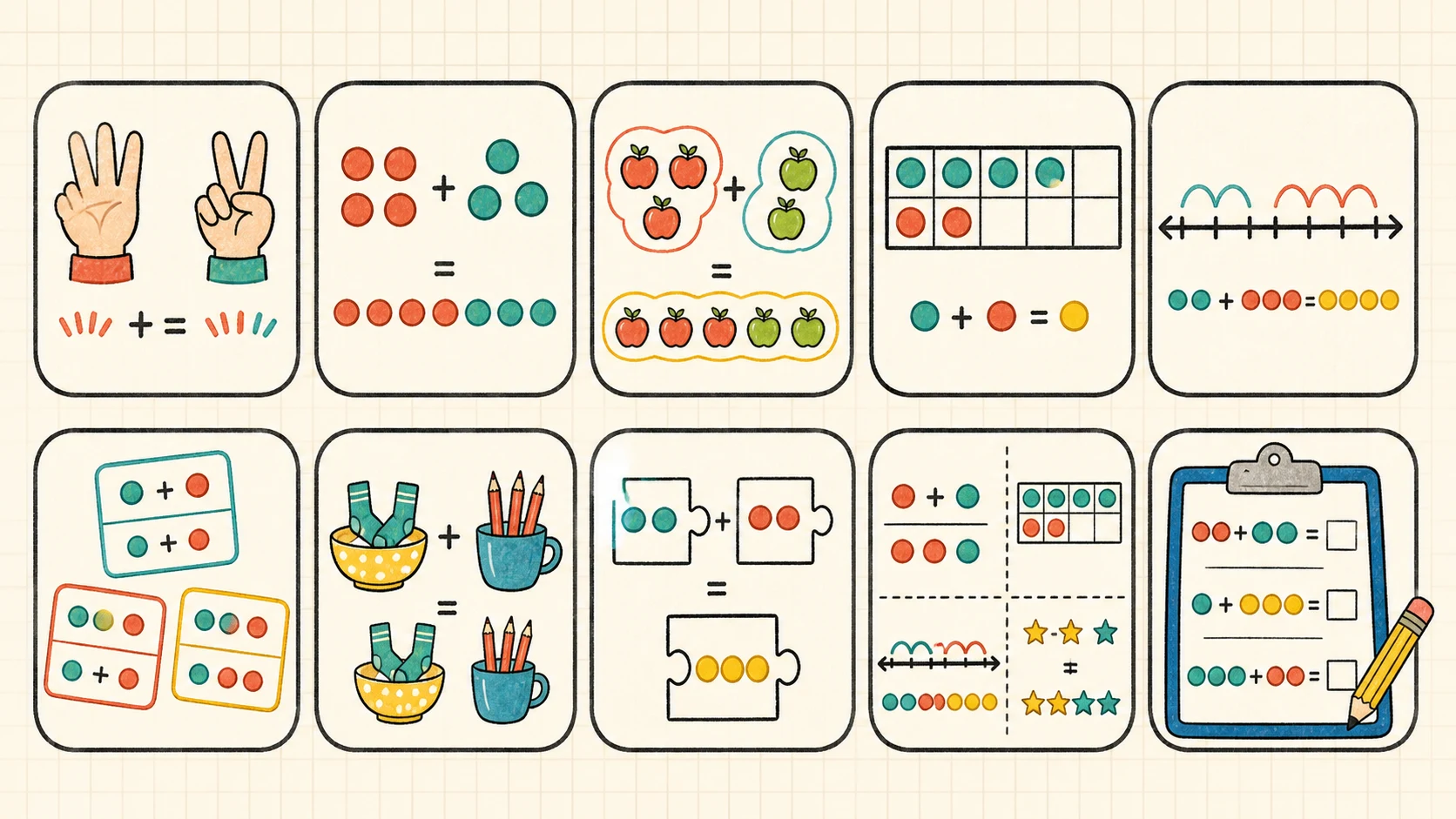
Across repeated addition sessions, revisit the same relationship with objects, drawings, equations, and spaced checks instead of treating one completed page as permanent mastery.
Interpret errors without turning them into diagnoses
An error is evidence about this task under these conditions. Look for the smallest plausible mismatch and test it with one follow-up item.
| Observed response | Possible interpretation to test | Immediate follow-up |
|---|---|---|
Counts 1, 2, 3, 4, 5, 6 for five objects |
An object was double-counted | Have the learner slide each counted object across a line |
Solves 2 + 3 as 4 |
One group, the joining action, or the count was lost | Build two and three in different colors, join, recount |
Answers 6 − 2 as 8 |
The minus sign or removal action may be confused with joining | Act out “two walk away” before rewriting the equation |
| Calls 14 “one and four” | Digit names may not yet connect to one ten and four ones | Build a ten-stick and four single cubes |
| Rejects a rotated square | Recognition may depend on orientation | Turn the same physical square slowly and recount sides |
| Adds because a story says “altogether,” without retelling it | A keyword may be controlling the choice | Cover the question, act out the story, then identify the unknown |
Do not infer a learning disability, attention condition, vision problem, or developmental delay from worksheet performance. Persistent concerns require broader evidence and, where appropriate, consultation with the learner’s teacher or a qualified professional.
Also separate carelessness from overload. A page can create avoidable errors through dense print, too many items, small workspace, unfamiliar language, or fatigue. The catalogue describes clear formatting and adequate workspace, but suitability still depends on the individual learner, printing conditions, and task. Observe rather than assume.
Answer keys can confirm the final response quickly; they cannot establish how the learner reasoned. A correct answer obtained by guessing, copying, or an inapplicable rule needs a follow-up explanation. An incorrect written answer paired with a correct model may point to recording rather than conceptual understanding.
Adapt access while preserving the mathematics
A useful adaptation removes an irrelevant barrier without solving the target for the learner.
For counting, enlarge or cut apart object sets, let the learner move objects, or replace pictures with real counters. Do not point to each object for the learner if one-to-one tracking is what you are assessing.
For addition or subtraction, read directions aloud, allow counters, or let the learner dictate the equation while an adult records it. Do not tell the learner which operation to use when operation selection is the target.
For place value, use connected cubes, bundled sticks, or a ten frame. Keep the request “show one ten and four ones”; merely asking for a count of 14 changes the skill.
For geometry, provide larger shape cards, allow touching and turning, and use high-contrast outlines. Preserve the demand to identify or explain the defining property.
For word problems, read the story aloud when decoding is not being assessed, substitute familiar names, and let the learner act it out. Keep the quantities and mathematical relationship unchanged. If the target is interpreting a comparison, changing it to a take-away story is not an access adaptation; it is a different problem.
Shorten the session before simplifying the idea. Four well-spaced items can preserve the full reasoning demand better than 20 rushed items. For home practice, a five- to ten-minute routine may be more informative than requiring page completion. In a classroom, use the same bounded probe with a small group while other learners work independently.
Know what these worksheets can and cannot show
A worksheet can provide a stable sample of numeral recognition, counting, calculation, shape classification, or written problem solving. It can help an adult notice patterns, compare representations, and decide what to revisit. It cannot by itself measure all kindergarten mathematics.
Paper practice may underrepresent oral counting, movement, spatial construction, mathematical conversation, estimation, and spontaneous use of mathematics during play. A learner may understand a relationship with objects before being able to draw or write it. Conversely, a learner may complete familiar symbols without being able to model their meaning.
The catalogue’s larger descriptions mention later elementary content such as multi-digit computation, fractions, decimals, ratios, area, perimeter, angles, coordinate geometry, and linear equations. Those topics show where mathematical ideas eventually lead; they are not kindergarten starting tasks. Keep the present choice tied to the live kindergarten entry points.
Nor does successful completion promise a future outcome. Recheck the idea after a delay, in a new arrangement, and with a brief explanation. Use worksheets alongside objects, conversation, games, classroom observation, and ordinary activities such as sharing snacks, comparing block towers, or finding shapes in a room.
Make the next task visible before you stop
End each session with one written decision:
“Today, the learner counted six scattered objects accurately when moving each object. Next time, try a set of eight without moving them, while allowing pointing.”
That statement records the target, the observed support, and one controlled change. It is more actionable than “good at counting” or “needs more math.”
For a first session, open the Kindergarten Counting guide and free sheet, sample only four problems, and place counters nearby. If the learner counts each object once and states the total, make the next task slightly less supported or move to joining two small counted groups. If tracking breaks down, keep the same quantity range and practice moving each counted object before returning to the sheet.
Put it into practice
Use the guide with a real printable
Move from explanation to a short, observable practice task. Check the first item together, then adjust the next session from the learner's actual work.
Open the first free worksheet