9 free PDFs with answer keys
6th Grade worksheets
Choose only from subjects and skills with real files in the current 6th Grade catalogue. Start with the free standard sheet, then add more practice only if you need it.
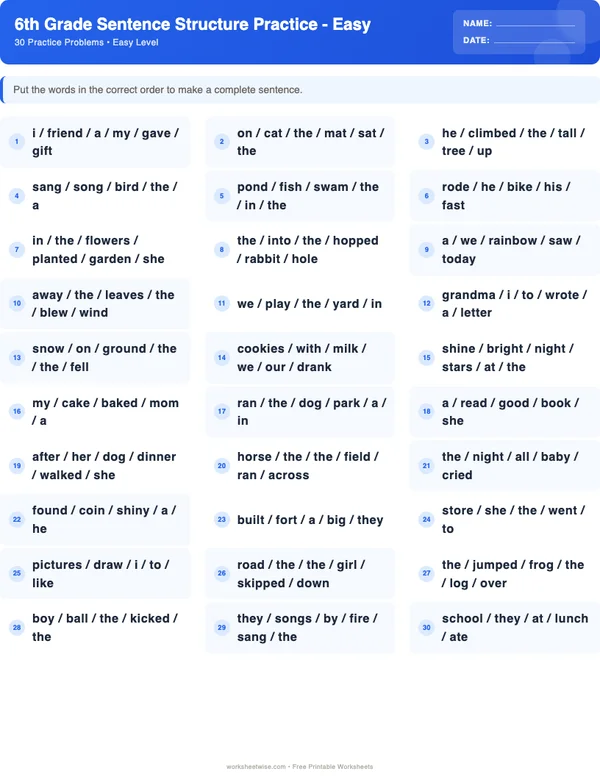
Complete guide
How to teach and practise 6th grade worksheets
3,518 words Updated 6 instructional visuals
Choose sixth-grade practice by the work a student can explain
The most useful sixth-grade worksheet is not automatically the one with “6th Grade” in its title. Choose from the live catalogue by looking at three things: the strategy the student uses, the representation the task requires, and how independently the student can complete and check the work.
WorksheetWise currently lists 162 sixth-grade variants across two live subjects—Math and Grammar—and nine topics. Each topic has one free entry point, for nine free resources total. The live math topics are multiplication, division, fractions, decimals, geometry, and word problems. The live grammar topics are parts of speech, punctuation, and sentence structure. This catalogue does not currently represent every subject or every expectation a student may encounter in school.
Grade labels describe an intended practice level; local curriculum sequences differ. A sixth-grade label therefore narrows the search but does not settle placement. Age works the same way: the worksheets for 11-year-olds guide can help families discover likely material, but age is a discovery aid rather than a placement decision.
Start with a short preview, observe one work sample, and then decide whether the next task should:
- reduce the number of steps while preserving the concept;
- add a model such as a number line, table, diagram, or sentence frame;
- repeat the same demand with new content;
- remove a scaffold;
- or increase the reasoning demand.
That decision is more informative than a percentage score by itself.
Know what changes during sixth grade
Sixth grade often shifts students from carrying out familiar procedures to explaining relationships among quantities, expressions, texts, and sentences. A student may compute accurately yet struggle to decide what a problem means. Another may discuss a passage insightfully but produce unclear written evidence. Practice should reveal these differences rather than hide them inside a mixed score.
Mathematics moves from arithmetic answers to connected representations
Important sixth-grade mathematics commonly includes ratios, fraction division, negative numbers, coordinate-plane work, expressions, one-step equations and inequalities, variables, and introductory statistics. Those broader expectations are reflected in the Common Core mathematics standards, but the live WorksheetWise catalogue should not be mistaken for a complete standards-aligned course.
The six live math topics provide useful supporting practice:
- Multiplication and division support efficient computation and relationships between operations.
- Fractions and decimals support rational-number reasoning.
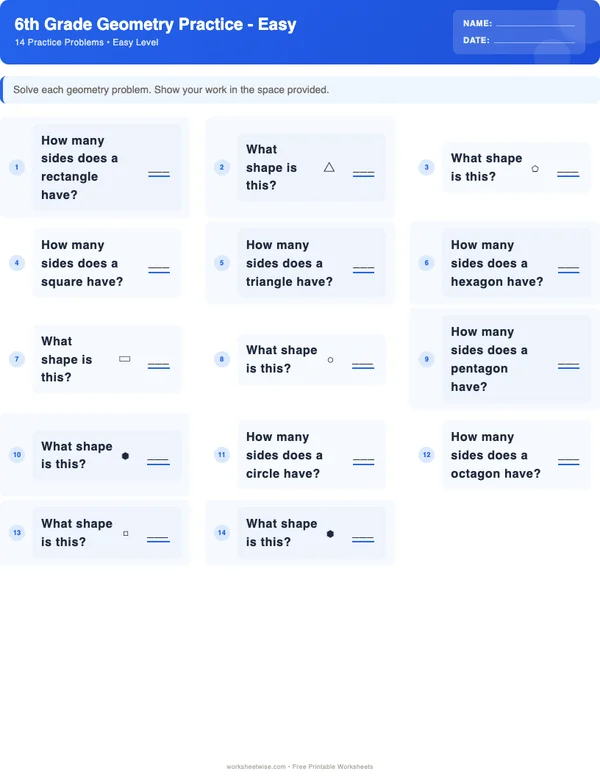
- Geometry supports area, volume, angles, and coordinate work.
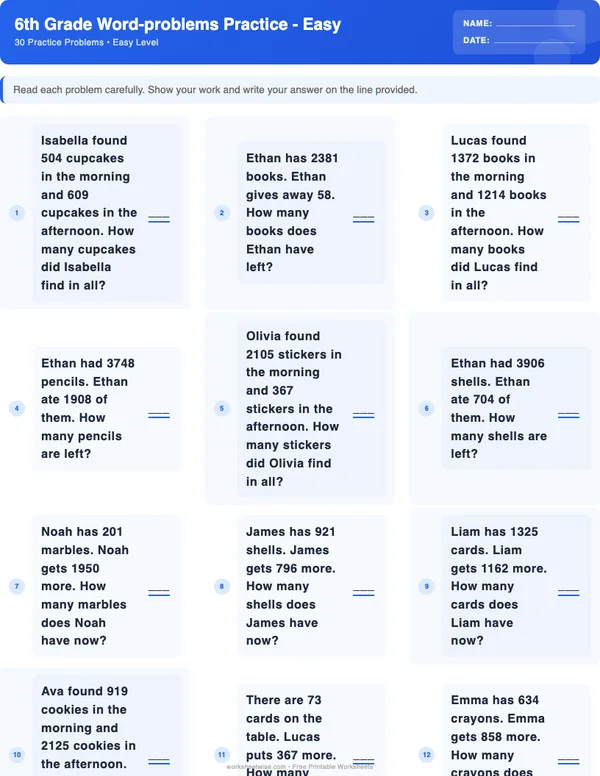
- Word problems require students to interpret quantities and choose operations.
The demand changes within the grade when a task moves from one representation to another. Finding 3 × 24 is different from explaining why 3(20 + 4) gives the same product. Plotting (−2, 3) is different from identifying which coordinate must change to reflect the point across an axis. Both pairs use related knowledge, but the second task in each pair requires an explicit relationship.
Literacy moves from identifying features to using evidence
Sixth-grade readers are increasingly expected to cite textual evidence, draw inferences, trace how theme develops, and examine how word choice or sentence structure affects meaning. Writers must make claims, organize evidence, and respond to another position. The Common Core English language arts standards describe these broader reading and writing demands.
The live catalogue’s Grammar subject supports the sentence-level control needed for that work, but it does not currently constitute a complete reading, argument-writing, science, or social studies program. Parts of speech, punctuation, and sentence structure can help a student express an analysis clearly; they cannot replace reading a substantial text or developing an evidence-based argument.
The IES guide on teaching elementary students to be effective writers recommends explicit instruction in the writing process and sentence construction, along with frequent opportunities to write. In practice, that means a correction sheet should lead back into real writing: after repairing sentence boundaries, the student applies the same decision to a paragraph of their own.
Read the catalogue before choosing a sheet
Each of the nine free entry points is marked “easy” in the supplied catalogue. Treat that label as a description of task features, never as a description of a learner.
For this page, an easier entry task should be understood through observable features such as familiar notation, direct directions, one dominant skill, limited inference, and fewer interacting steps. A task becomes more demanding when it adds unfamiliar representations, mixed operations, irrelevant information, multiple reasonable strategies, required explanations, or independent editing.
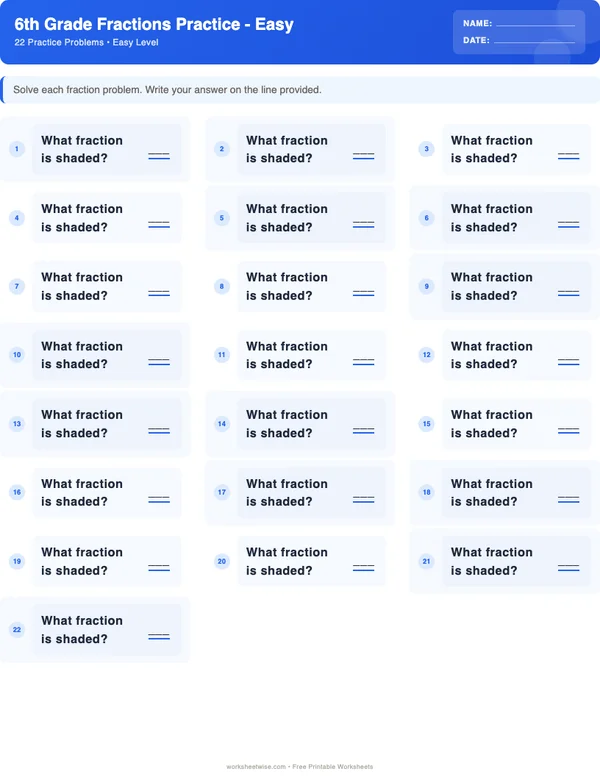
Problem count also matters, but only after task demand is considered. The free fractions sheet contains 22 problems. Each of the other eight free sheets contains 30. Thirty direct calculations may impose less reasoning than six multi-step situations, while 22 fraction items may be too many if every response requires a model and written explanation.
Use these selection questions:
- Can the student explain the directions without an adult rephrasing them?
- Does the first item test the intended skill, or does reading, notation, or page layout become the main obstacle?
- Can the student represent the idea before applying a memorized procedure?
- Can the student check whether an answer is reasonable?
- After one prompt, can the student continue without repeated coaching?
- Is the page short enough to preserve attention for correction and explanation?
If the answer to the first two questions is no, do not assign the full page yet. Preview or adapt it. If the student succeeds only because an adult supplies every next step, the completed page is not evidence of independent readiness.
Preview a task in five minutes
A preview should expose the demand without turning into a full lesson. Select three items: one typical item, one item that changes representation, and one item near the highest demand on the page.
Use a predict–represent–solve–check sequence
Ask the student to:
- predict what kind of answer would make sense;
- represent the relationship with a sketch, table, model, or marked sentence;
- solve or revise;
- check the result using a different method;
- explain one decision.
For the first item, the adult may model the sequence aloud. On the second, give only a brief prompt. On the third, remain silent unless the student cannot begin. Record the kind of help given: rereading a direction, naming a strategy, supplying a fact, drawing the model, or correcting the work. Those supports are not equivalent.
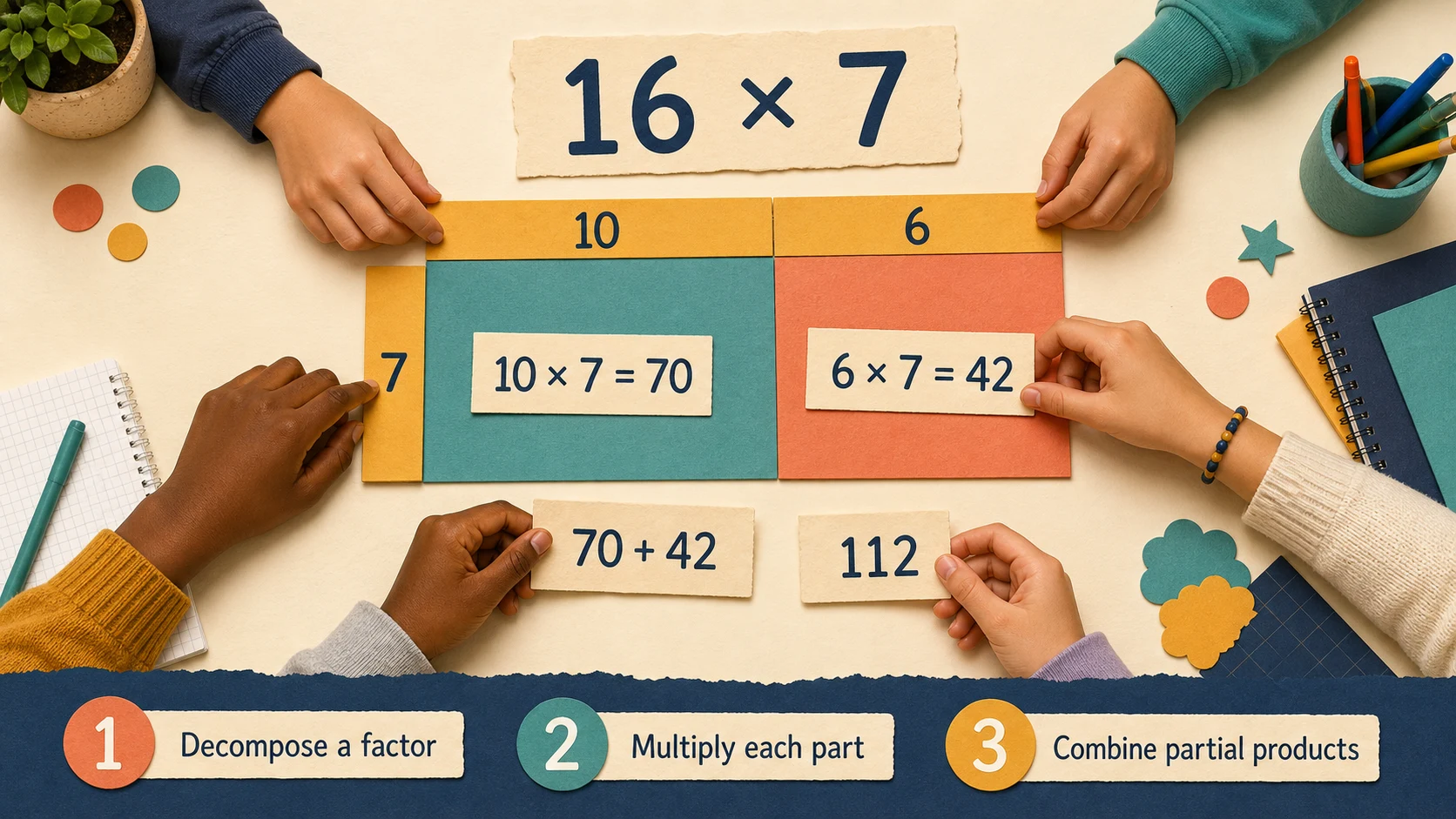
Use the routine to see whether multiplication difficulty lies in choosing a decomposition, carrying out partial products, or checking the result—not merely whether the final product is correct.
Suppose the item is 36 × 24. A useful preview asks for an estimate first: 36 × 24 should be a little less than 40 × 25 = 1,000. The student might then use partial products:
36 × 24 = 36 × 20 + 36 × 4 = 720 + 144 = 864
This example belongs in sixth-grade selection because multiplication is a live catalogue topic and multi-digit computation supports later work with expressions, area, and multi-step problems. The arithmetic checks: 864 is reasonably close to the estimate of 1,000. If a student writes 720 + 104 = 824, the next task should target 36 × 4 or addition accuracy, not reteach the meaning of the distributive decomposition.
Select math practice by the source of the difficulty
Multiplication and division: distinguish concept, facts, and procedure
A multiplication work sample can reveal at least three different needs:
- The student cannot represent equal groups or explain multiplication.
- The representation is sound, but basic facts interrupt a longer procedure.
- Facts are available, but place-value alignment or partial products are unreliable.
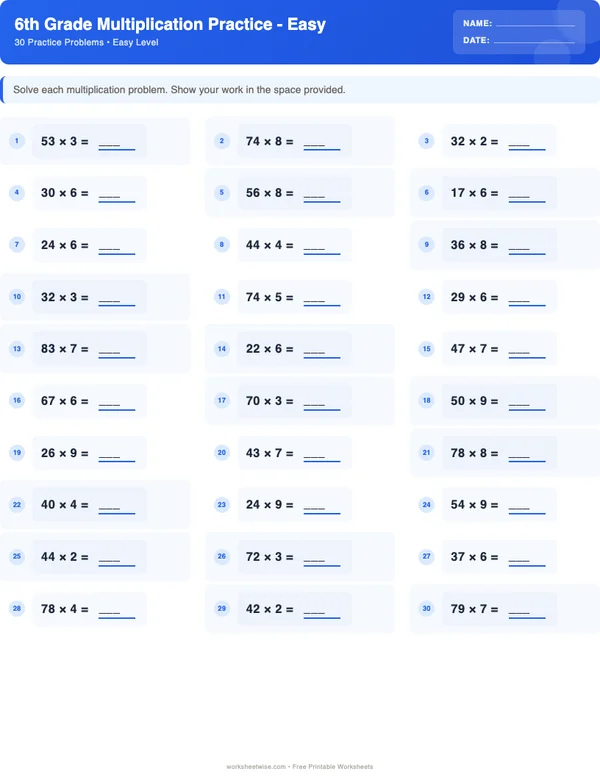
These require different next steps. Arrays or equal groups address meaning. Short fact practice addresses retrieval after strategies are understood. An area model or partial-products page addresses place-value structure. The sixth-grade multiplication guide and free sheet is the relevant catalogue entry when multiplication is the observed constraint.
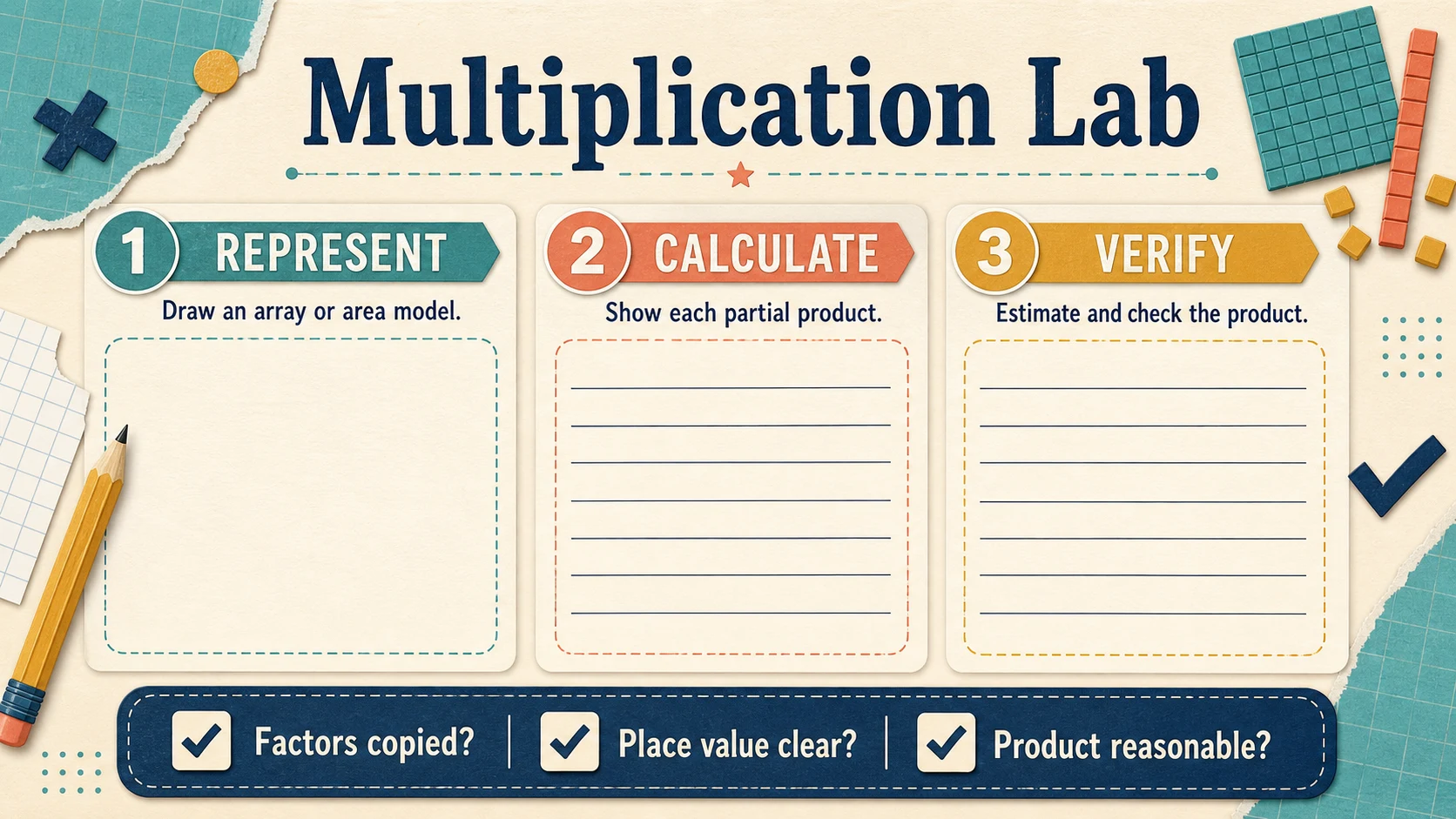
Alternate computation, explanation, and delayed review; do not interpret one fluent day as proof that the strategy will transfer to a mixed problem next week.
Division requires another distinction: sharing, grouping, and written procedure. For 25 ÷ 6, the numerical result is 4 remainder 1, but context determines the usable answer. If 25 students need vans holding six students each, five vans are required. Four vans leave one student without a seat. This checked example belongs here because division and word problems are both live sixth-grade topics, and it shows why interpreting a remainder is a separate skill from calculating it.
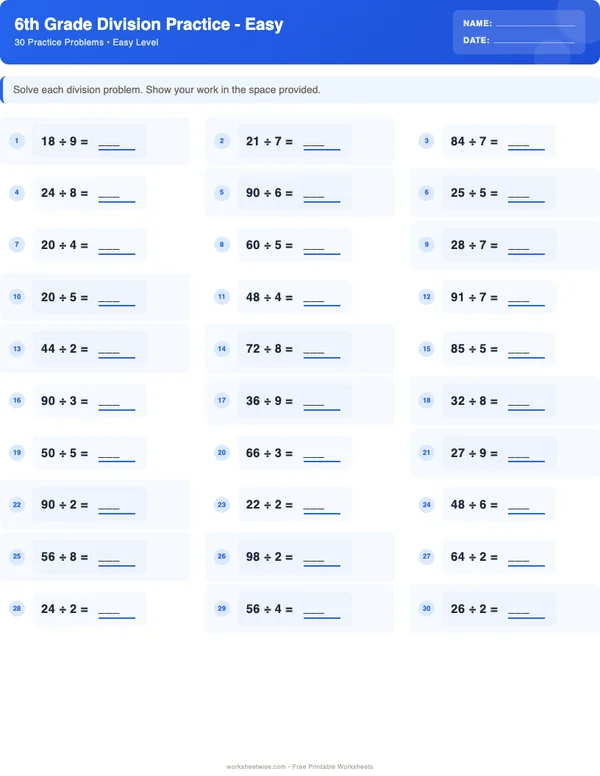
If the quotient is wrong, ask the student to verify with multiplication. If the quotient is correct but the contextual answer is “4 R1 vans,” select another remainder-interpretation problem from the division guide, not a page of context-free long division.
Fractions and decimals: require magnitude before procedure
Before assigning fraction operations, check whether the student treats fractions as numbers with magnitude. Ask the student to place 3/4 on a number line, estimate the result, and then solve:
3/4 ÷ 1/8 = 6
The check is concrete: six pieces of size 1/8 fit into 3/4, because 3/4 = 6/8. The standard computation agrees:
3/4 × 8/1 = 24/4 = 6
This belongs in sixth grade because division of fractions by fractions is a central transition described in the page thesis, while fractions are a live catalogue topic. A student who obtains 3/32 may be multiplying both original fractions or applying an incomplete rule. Return to a number line or fraction strips before offering more symbolic division.
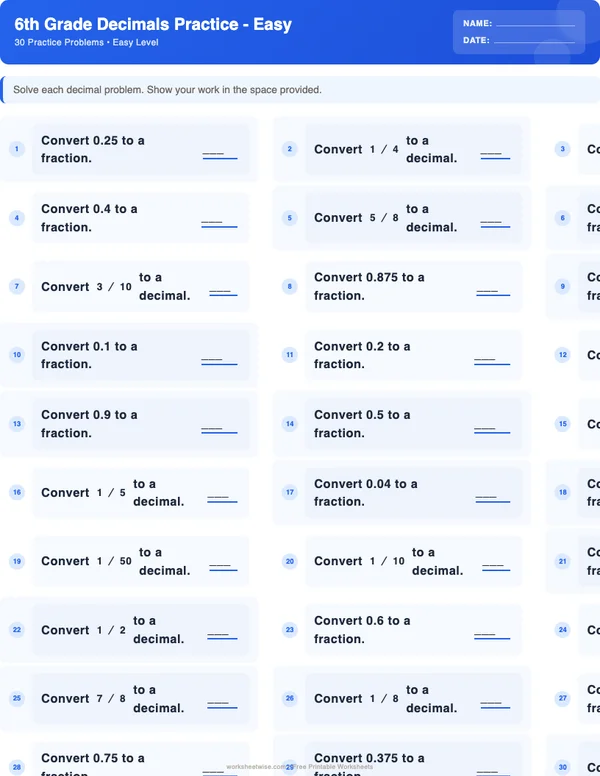
For decimals, use place value and estimation. Compare 0.36 and 0.4 by rewriting 0.4 as 0.40; therefore, 0.36 < 0.40. If a student chooses 0.36 because “36 is bigger than 4,” the error indicates whole-number reasoning applied to decimal notation. Preserve the comparison target by adding a hundredths grid or place-value chart. Do not replace the task with unrelated whole-number review.
The IES practice guide on assisting students struggling with mathematics supports systematic instruction, clear mathematical language, visual representations, and deliberate work with word problems. That source did not evaluate WorksheetWise; it informs the teaching decisions around a selected sheet.
Geometry: separate coordinate reasoning from drawing accuracy
A geometry task may test properties, measurement, area, volume, or coordinates. Identify which one before interpreting an error.
Consider the points A(−2, 3) and B(−2, −3). They share an x-coordinate, so they lie on the same vertical line. Point A is in Quadrant II and point B is in Quadrant III. Reflecting A across the x-axis produces B because the x-coordinate stays −2 and the y-coordinate changes from 3 to −3.
This checked example belongs here because sixth-grade work extends ordered pairs into all four quadrants and geometry is a live topic. If the student reverses coordinates and plots A at (3, −2), the next action is to rehearse “move along x, then move along y” on a labeled grid. If the coordinates are interpreted correctly but the point is one square off, enlarge the grid while keeping all four quadrants and the same ordered pairs.
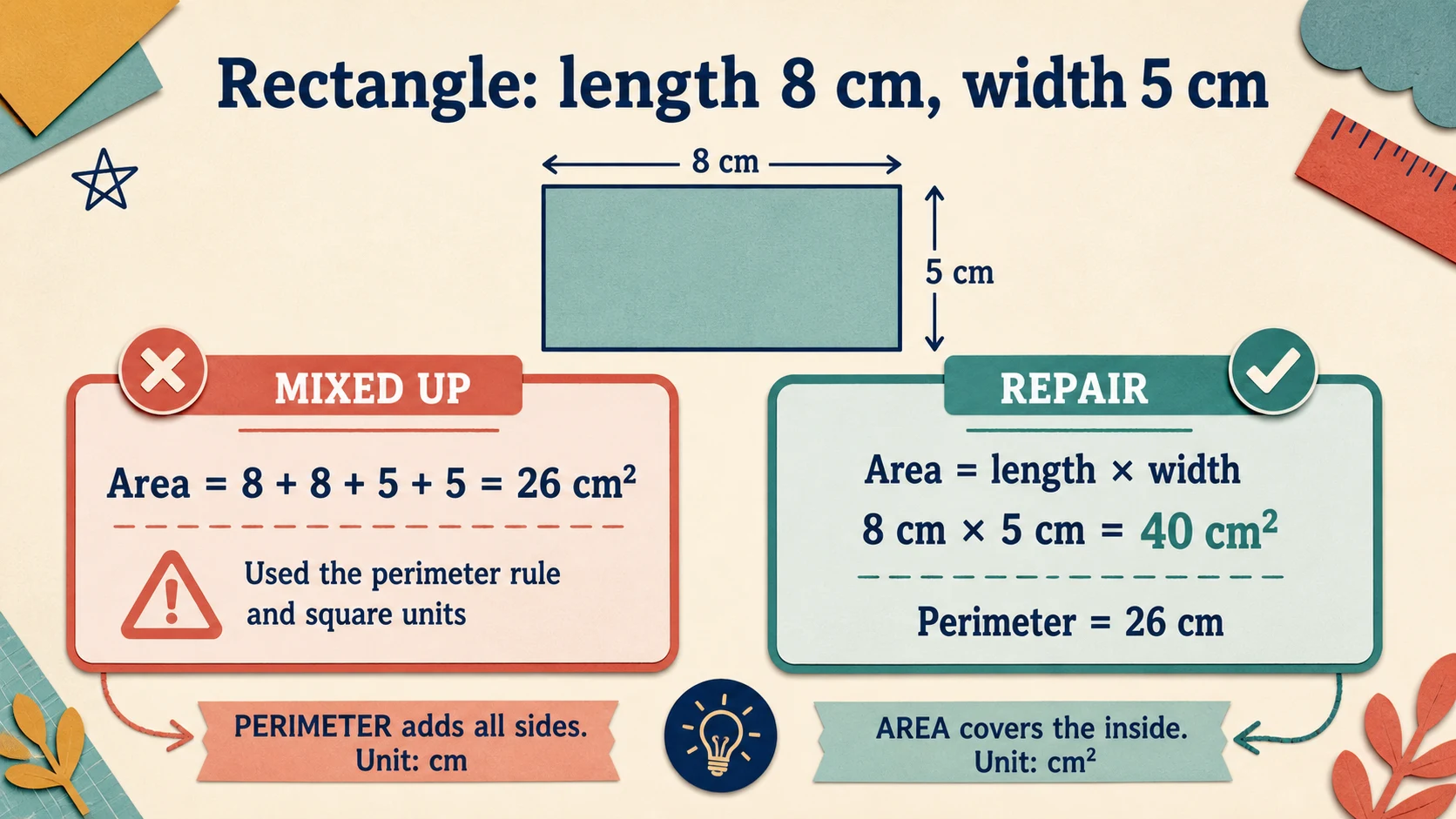
Match each visible error to a narrowly targeted response: coordinate order, sign, scale, formula choice, or measurement precision.
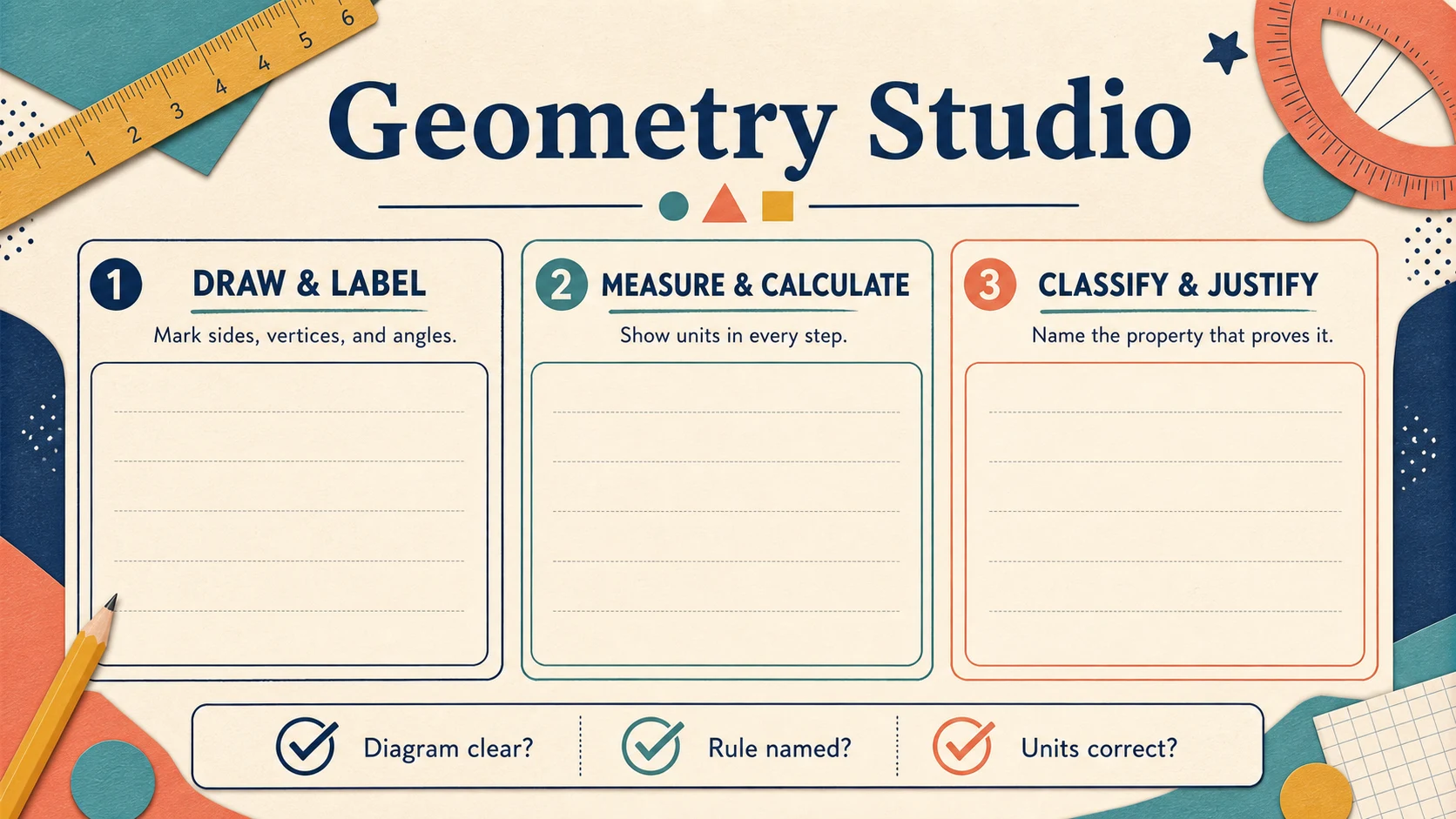
Use spaced review to revisit coordinate signs and geometric reasoning after the visual scaffold has been reduced.
Word problems: judge the model before the arithmetic
A correct operation selected for the wrong reason is fragile. Ask students to retell the situation, name what is known and unknown, draw a table or tape diagram, write an equation, solve, and check against the context.
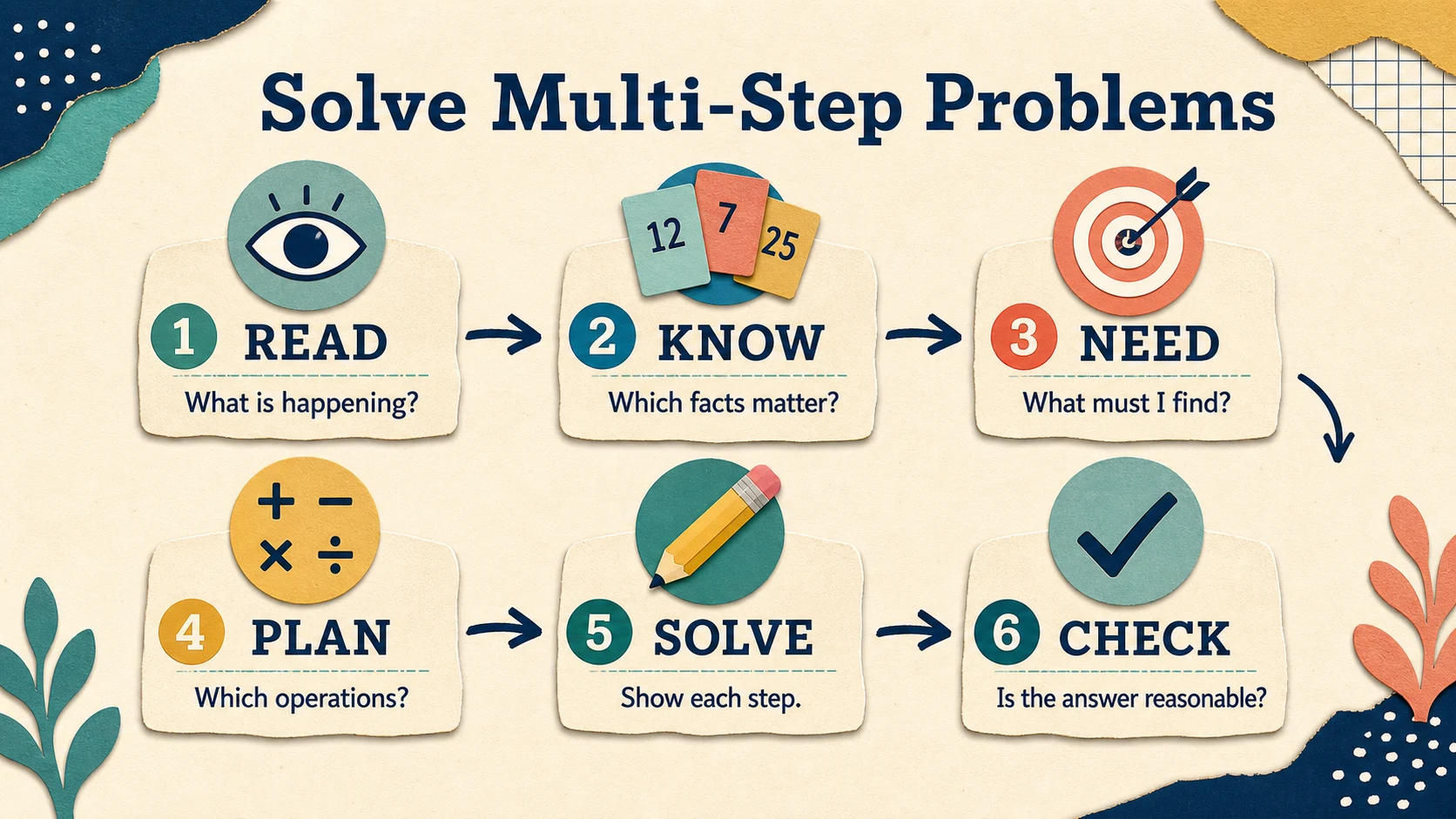
Use the map to locate the break in the chain from reading the situation to representing quantities, calculating, and interpreting the answer.
For example: “A drink mixture uses 3 cups of concentrate for every 5 cups of water. How much water is needed with 12 cups of concentrate?” A ratio table gives:
| Concentrate | Water |
|---|---|
| 3 | 5 |
| 6 | 10 |
| 12 | 20 |
The answer is 20 cups of water. Both quantities were multiplied by four, so the 3:5 relationship was preserved. This example belongs in sixth-grade practice because proportional reasoning and ratio tables are prominent new demands, even though “Ratios” is not one of the nine current catalogue topics. Use the word-problems guide and free sheet for related interpretation practice, but do not assume every live sheet directly teaches ratios.
If the student adds nine to both quantities and answers 14, computation is not the issue. The student has not preserved the multiplicative relationship. The next task should use a table, double number line, or batches of a concrete mixture—not a harder set of arithmetic.
Use grammar practice to strengthen real reading and writing
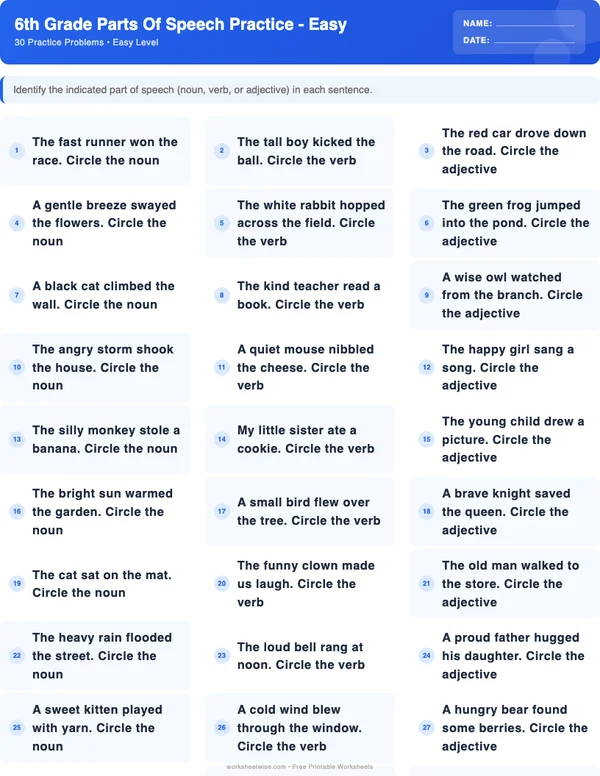
Parts of speech: classify words in context
Do not ask only for memorized definitions. English words can change function by sentence.
Compare:
- “We light the lantern.” Here, light is a verb.
- “The light filled the room.” Here, light is a noun.
- “She carried a light backpack.” Here, light is an adjective.
This checked example belongs in the live Parts of Speech topic and matches the increased sixth-grade need to examine how word choice functions in a sentence. If a student labels light the same way every time, the next step is to identify what the word is doing in each sentence. A color-coded subject–verb–modifier frame preserves grammatical analysis without reducing the work to isolated vocabulary.
Punctuation: connect rules to sentence boundaries and meaning
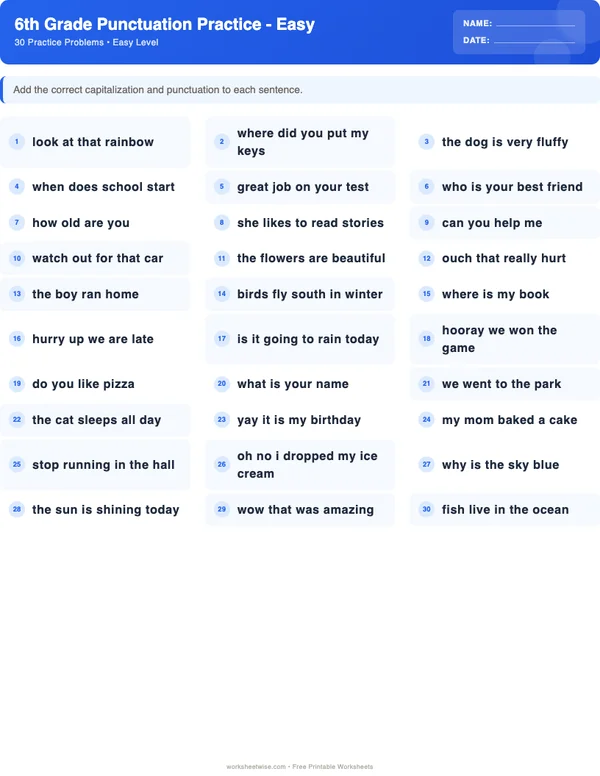
A punctuation page should reveal whether the student recognizes clause boundaries, understands dialogue conventions, or merely remembers the name of a mark.
Compare:
- Incorrect:
After the experiment ended we recorded the temperature. - Revised:
After the experiment ended, we recorded the temperature.
The introductory dependent clause is separated from the main clause with a comma. Then compare:
- Incorrect:
The temperature fell, we recorded the change. - Revised:
The temperature fell, and we recorded the change. - Also correct:
The temperature fell; we recorded the change.
If the student inserts commas wherever a reader might pause, select work that contrasts sentence structures, not another page that asks for definitions of comma and semicolon. Have the student apply the correction to two sentences from a science or social studies response.
Sentence structure: move from identification to deliberate revision
Sixth-grade sentence work should go beyond labeling fragments and run-ons. Students need to combine ideas, control subordination, and vary emphasis.
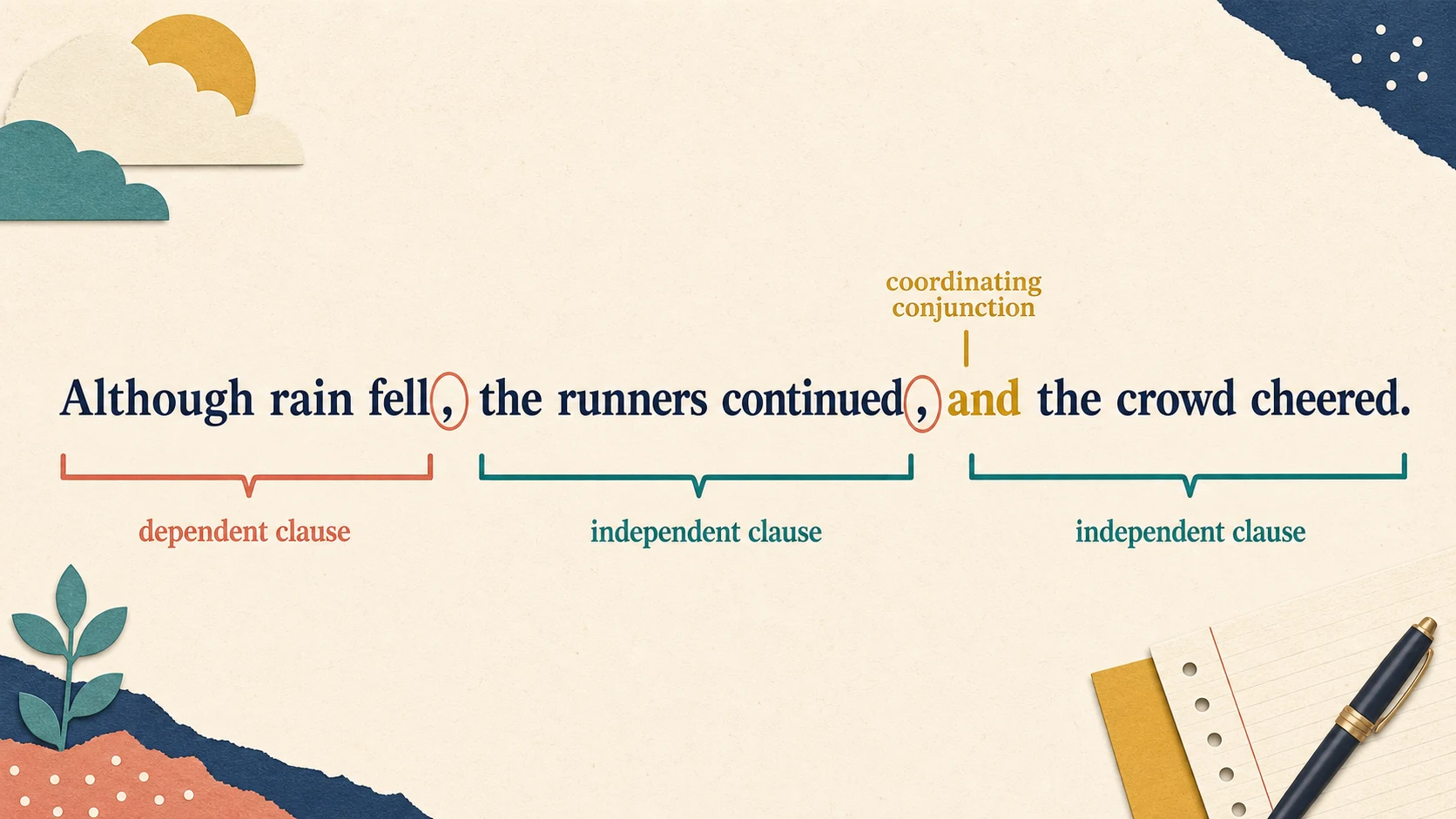
Trace how a student combines complete ideas while preserving the logical relationship between them.
Start with:
Maya disagreed with the proposal. She listened to the other speaker. She revised one part of her claim.
A coherent revision is:
Although Maya disagreed with the proposal, she listened to the other speaker and revised one part of her claim.
The revision is not automatically better because it is longer. It is better for this purpose because although makes the contrast explicit and and joins two related actions. This example belongs here because Sentence Structure is a live topic and argumentative writing requires students to express relationships among claims, evidence, and counterarguments.
If the student produces Although Maya disagreed with the proposal. the student recognizes a contrast but has written a fragment. Provide the main clause and ask the student to join the two. If the sentence is grammatically complete but changes the original meaning, return to oral paraphrase before further combining.
Adapt access without removing the target skill
An adaptation is useful only if the intended decision remains visible. Before changing a task, state the target in one sentence: “The student will interpret a remainder,” “compare decimal magnitude,” “plot signed coordinates,” or “repair a comma splice.”
Appropriate adaptations include:
- reading directions aloud when decoding is not the target;
- enlarging a coordinate grid while retaining negative values and all four quadrants;
- reducing a 30-item page to six representative items;
- allowing fraction strips while still requiring the student to explain the quotient;
- providing a multiplication chart during a ratio task when fact recall is not being assessed;
- highlighting clauses without inserting the punctuation;
- allowing oral rehearsal before a written sentence;
- using graph paper to support place-value alignment;
- covering later problems so the student sees one item at a time.
An adaptation removes the target when an adult draws the entire ratio table, names the operation, places the coordinate, or dictates the revised sentence. In those cases, the resulting work shows supported completion, not independent performance.
The catalogue’s free sheets are entry points, not tests or diagnoses. A low score may reflect unfamiliar directions, reading load, fatigue, missing prerequisite knowledge, or the specific representation used. A high score on repeated, direct items does not prove transfer to mixed or contextual work. Use school assignments, teacher feedback, discussion, and more than one work sample when decisions carry greater weight.
Turn errors into the next assignment
Do not begin with “How many were wrong?” Sort errors by what the work shows.
| Work-sample pattern | Likely instructional question | Observable next action |
|---|---|---|
| Correct model, arithmetic slip | Is computation interrupting sound reasoning? | Give three similar items with estimation and a written check. |
| Wrong operation, accurate calculation | Did the student understand the relationship? | Retell and diagram two problems before calculating. |
| Correct with repeated adult prompts | Is the strategy independent? | Repeat the same demand with prompts faded. |
| Accurate direct items, weak transfer | Can the student recognize the skill in context? | Add one mixed or word-based item. |
| Same notation error across items | Is the convention understood? | Model one contrast, then ask for immediate independent application. |
| Random errors late on the page | Is page length obscuring competence? | Use a shorter set and compare accuracy plus explanation. |
| Correct answer, no explanation | Was the method reasoned or guessed? | Ask for a model, estimate, or second method. |
A practical rule is to change one demand at a time. If a student can compare decimals with a grid, repeat the comparison without the grid before adding decimal operations. If a student can repair comma splices in supplied sentences, ask for the same repair in personal writing before moving to semicolons in more complex prose.
For independent practice, choose pages the student can begin, sustain, and check with limited assistance. For teaching, choose a page that exposes one manageable gap and leaves time for explanation. For review, mix previously learned forms and include at least one delayed item rather than repeating a full page immediately.
Build a routine that transfers ownership
Sixth graders may be managing different teachers, texts, deadlines, and assessment formats. A home routine should make that work visible while gradually transferring responsibility.
Use a plan–work–check–file cycle
Plan: The student names the subject, target, estimated time, and help allowed. Write one concrete goal: “I will plot eight ordered pairs and check signs before asking for help.”
Work: Complete a short set without correction after every item. Mark uncertain answers with a question mark so hesitation remains visible.
Check: Use an answer key, estimate, inverse operation, model, or rereading strategy. Circle one corrected error and write what changed.
File: Place the work in the relevant binder section or digital folder, record any unfinished item in a planner, and choose the next action.
An adult can initially ask the four routine questions, then move to a written checklist, and finally review only the completed plan and correction. Stepping back should be tied to observable independence, not a calendar date.
The worksheets with answer keys collection can support this cycle when the key is used after an honest attempt. An answer key identifies agreement with an expected response; it does not explain why an error occurred. The student still needs to compare methods and state the correction.
Make the next selection from evidence
After a short session, keep the original work rather than recording only the score. Annotate three details:
- the first point at which help was needed;
- the representation or strategy the student chose;
- whether the student could find and explain an error.
Then choose one next move:
- Repeat with reduced support when the strategy was correct but prompted.
- Return to a model when notation or a procedure had no visible meaning.
- Practice a prerequisite briefly when facts or place value blocked a sound approach.
- Increase variation when direct items were accurate and independently checked.
- Apply in context when isolated grammar or computation was secure.
- Pause and coordinate with the teacher when home practice conflicts with classroom methods or the pattern persists across different tasks.
Do not use these observations to diagnose a learning condition or promise a particular outcome. They are practical evidence for choosing the next practice task.
For the next session, open the full worksheet library, choose one of the nine live sixth-grade topics that matches an error visible in the student’s latest work, and preview three items before printing or assigning the full sheet.
Put it into practice
Use the guide with a real printable
Move from explanation to a short, observable practice task. Check the first item together, then adjust the next session from the learner's actual work.
Open the first free worksheet