3rd Grade · 1 live skills
3rd Grade spelling worksheets
Pick the exact skill below. Each page combines a real free download, a separate answer key, practical teaching guidance and an optional focused pack.
See all 3rd Grade subjectsComplete guide
How to teach and practise 3rd grade spelling worksheets
3,216 words Updated 6 instructional visuals
Choose one spelling decision, not a longer word list
The most useful starting point on this page is a worksheet that asks a third-grade learner to make one bounded spelling decision: distinguish two long-vowel spellings, apply a doubling pattern, notice a silent letter, or attach one prefix or suffix. Do not begin by assigning all 25 problems simply because they are available. First compare the live skills, choose one target, watch how the learner handles several examples, and use the errors to decide what comes next.
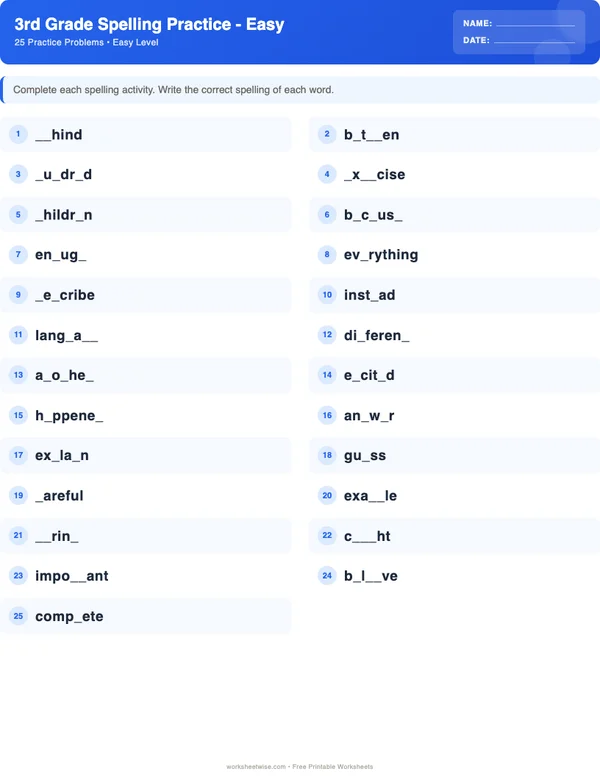
The current catalogue contains 18 worksheet variants within one third-grade spelling topic and one free resource. The representative free sheet has 25 problems and is labeled “easy.” Here, that difficulty label should be understood through observable task features: familiar directions, a single main spelling demand at a time, substantial pattern repetition, and limited need to compose original text. It does not label the learner or guarantee that every item will feel easy.
Grade labels also describe an intended practice level, not a placement decision. Local curriculum sequences differ, and third graders arrive with different reading, writing, and language experiences. A learner who spells jumped accurately but writes hoping as hopping needs a focused comparison, not a judgment about being ahead or behind.
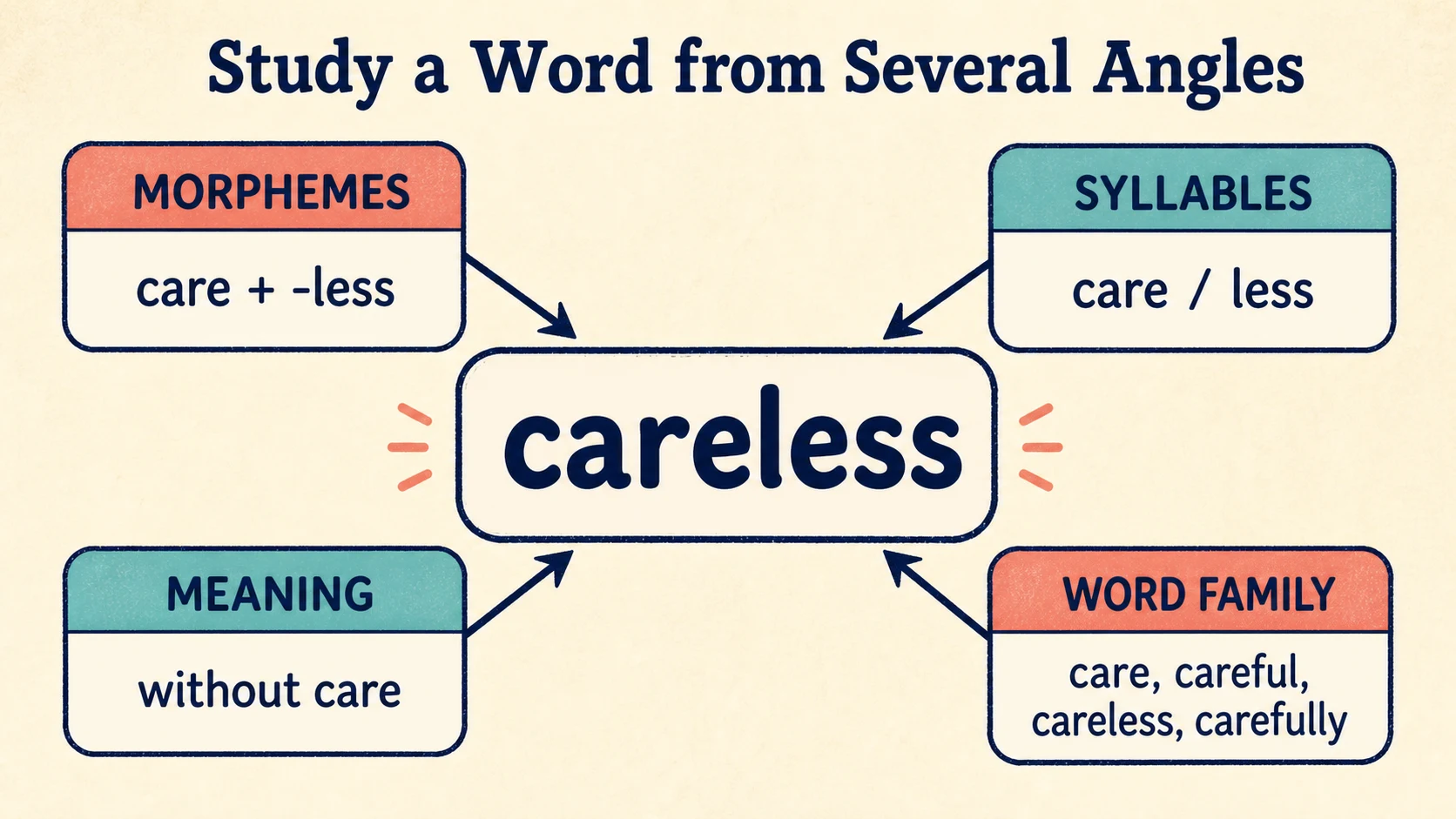
The live topic spans sound–letter patterns, meaningful word parts, multisyllabic words, memory practice, sorting, sentence use, and proofreading.
What the live catalogue actually offers
The verified topic description names these targets:
- short vowels;
- long-vowel spellings;
- consonant doubling;
- r-controlled vowels;
- silent letters;
- prefixes;
- suffixes;
- multisyllabic words; and
- high-frequency words encountered in reading and writing.
The listed activity forms are look-cover-write-check, rainbow writing, word sorting by pattern, using words in sentences, and identifying misspelled words. These forms are not interchangeable. Each reveals something different.
A copied or rainbow-written word shows whether the learner can attend to its letter sequence while a model remains visible. Look-cover-write-check adds a short memory demand. A sort shows whether the learner notices a shared feature. A sentence asks the learner to retrieve the spelling while also managing meaning, grammar, capitalization, and punctuation. Proofreading reverses the task: instead of producing a spelling, the learner must recognize that something is wrong and repair it.
The page’s editorial focus also mentions word searches as review. However, the supplied representative-resource record does not verify that the free sheet contains a word search. Treat a word search as an optional review format when one is actually present, not as a confirmed capability of every resource on this page.
The 3rd Grade Spelling Words guide and free sheet is the concrete entry point for examining the available 25-problem resource. Adults who need a different subject or grade can browse the full worksheet library, but the choice within this hub should stay anchored to third-grade spelling work.
How the spelling skills progress without becoming one ladder
The catalogue skills do not form a perfectly straight sequence. Long-vowel spellings, r-controlled vowels, affixes, and multisyllabic words involve different kinds of attention. A learner may handle one well and still need support with another. Compare the decision inside each task rather than treating every longer-looking word as harder.
From hearing a vowel to choosing its spelling
Short-vowel work asks the learner to connect a vowel sound with a familiar letter pattern, as in map, step, fish, hot, and sun. Long-vowel work adds a choice because the same broad sound may appear in different spellings: long a occurs in cake, rain, play, and break. The catalogue’s teaching tip supplies those four examples specifically to show a pattern-based list.
That set should not be taught as if one rule mechanically predicts every spelling. The useful question is, “Which long-a spelling does this known word use?” Sorting cake, rain, play, and break into four columns makes the alternatives visible. It does not establish that the learner can infer the correct spelling of an unfamiliar word from sound alone.
R-controlled vowels require another comparison. In a word such as farm, the vowel does not behave like the short a in map. The task is to hear and see the vowel-plus-r unit rather than searching for an ordinary short-vowel match.
From base words to changed forms
Consonant doubling and suffix work meet when an ending is attached to a base word. The learner must preserve the base, consider its ending, and then write the changed form. Prefix work usually places a meaningful unit before the base, while suffix work places one after it. These are word-structure decisions, not merely exercises in copying more letters.
For example, unhelpful can be segmented as un + help + ful. The spelling task becomes manageable when the learner identifies the stable base help and the two affixes. That is different from spelling the entire word from an undivided memory trace.
From a word list to connected writing
A word can be correct during copying and incorrect in a sentence. That change does not erase the first success; it shows that retrieval becomes less secure when attention is divided. Sentence use and proofreading therefore belong later in a practice cycle, after the target pattern has been noticed and rehearsed.
The IES foundational reading guide recommends helping kindergarten-through-third-grade students connect speech sounds with letters, analyze word parts, and write and recognize words. That sourced guidance supports work across sounds, written patterns, and meaningful parts. The particular sorts and prompts below are editorial suggestions for using this catalogue; IES did not review WorksheetWise.
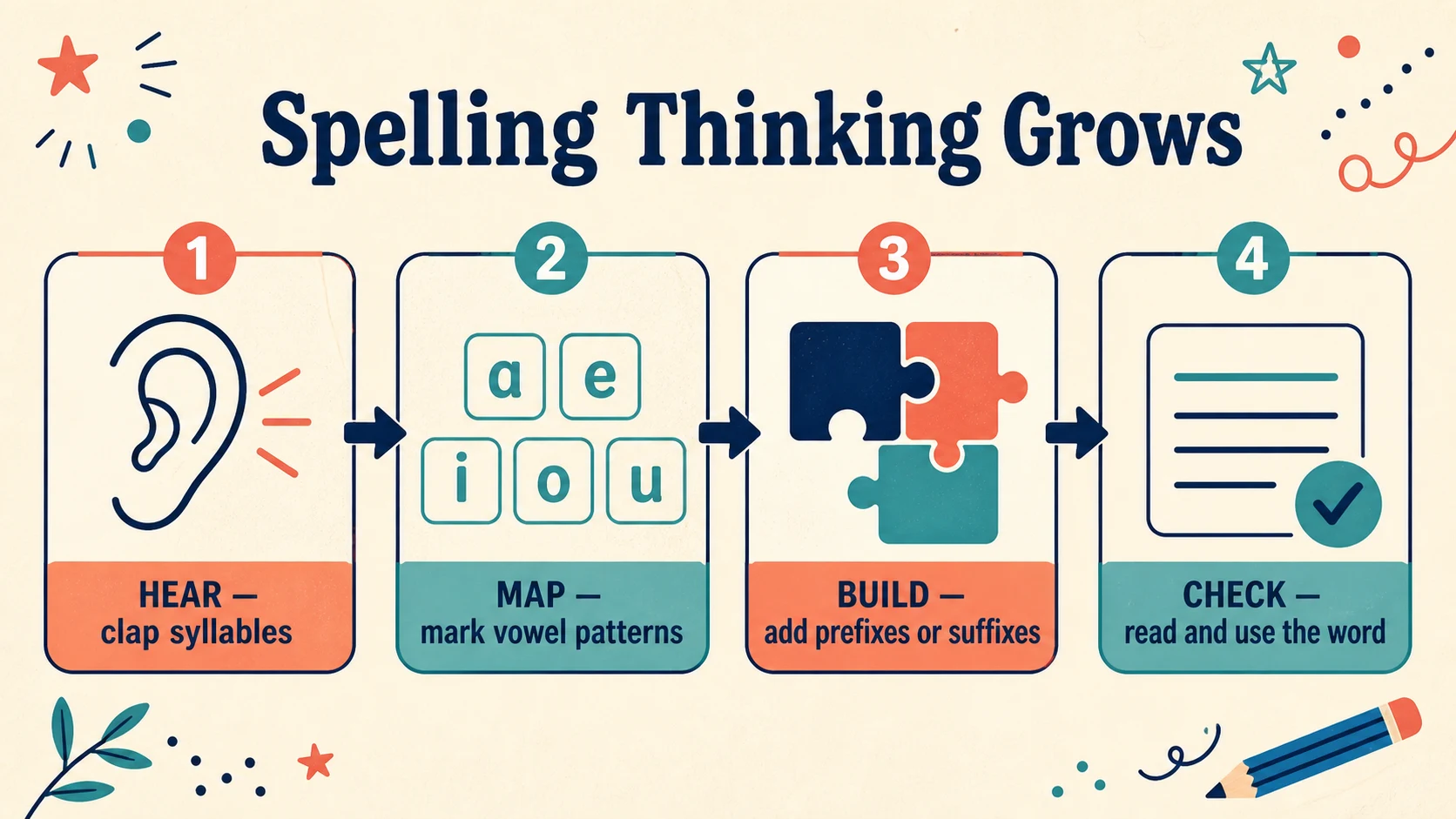
A spelling target can move from visible-model comparison to memory, sentence use, and independent proofreading without changing the target halfway through.
Four checked examples that expose different decisions
Worked example 1: sort long-a words by visible pattern
Use the catalogue’s examples: cake, rain, play, break.
- Say each word naturally.
- Underline the letters representing the long-a sound.
- Sort by spelling: a_e, ai, ay, and ea.
- Place the words: cake under a_e, rain under ai, play under ay, and break under ea.
- Cover the words and write one from each column.
All four spellings have been checked. The words share the broad vowel sound but not the same letter pattern. This example belongs on this page because long-vowel spellings and sorting by pattern are both verified catalogue features.
If the learner puts play in the ai column, ask what letters are actually present rather than repeating the word more loudly. If the learner writes plai, the sound has been represented plausibly, but the conventional spelling has not been recalled. That calls for a visual comparison between play and rain, followed by another covered attempt.
The checked long-a sort turns one spoken sound into four visible spelling choices before asking for recall.
Worked example 2: distinguish doubling from no doubling
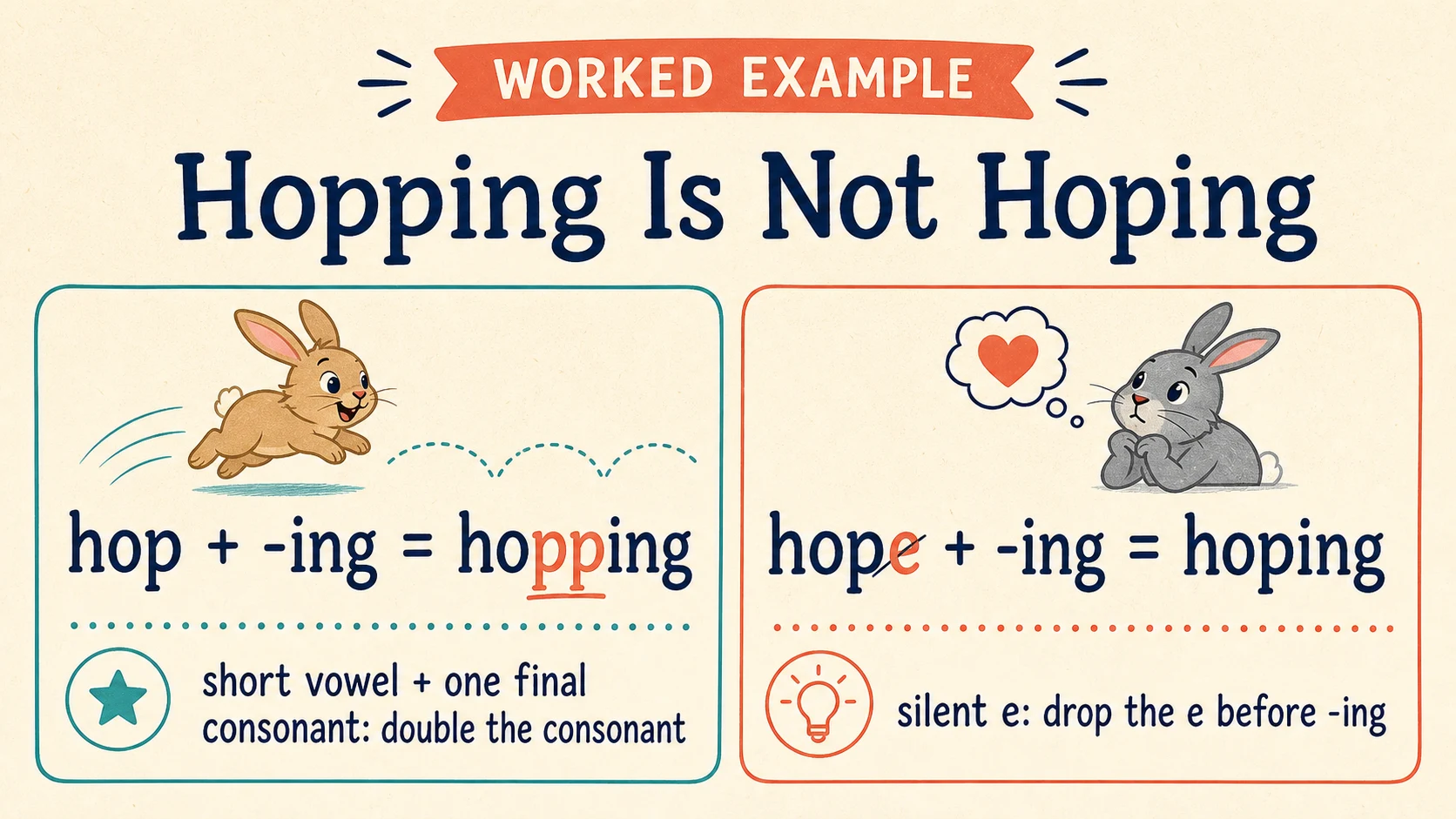
Compare hop → hopping with hope → hoping.
For hop, remove nothing, double the final p, and add -ing: hopping. For hope, drop the final silent e and add -ing: hoping. These spellings are checked, and the resulting words differ in both spelling and meaning.
Ask the learner to read these sentences:
- “The rabbit is hopping across the yard.”
- “Mia is hoping for sunshine.”
This example belongs here because it combines the verified targets of consonant doubling and suffixes with the verified activity of using words in sentences. It also prevents an oversimplified instruction such as “Always double before -ing.”
If the learner writes hopeing, the base word is visible but the final-e change was not applied. If the learner writes hoping for the rabbit sentence, the error may reflect either the spelling change or a missed meaning cue. Ask the learner to read the sentence and identify the intended base word before assigning more items.
Worked example 3: preserve a base while adding affixes
Build unhelpful from three cards or written parts:
un + help + ful = unhelpful
Check each part aloud: un- means “not,” help carries the main meaning, and -ful means “full of” or “having.” In the completed word, help remains intact and full contributes only one l in the suffix -ful. The checked spelling is unhelpful, not unhelpfull.
This example belongs here because both prefixes and suffixes appear in the live skill description. It also demonstrates why meaningful word parts should not be flattened into a generic “long word” category.
If help is correct but -ful becomes -full, the learner has preserved the base and used a reasonable connection to the separate word full. The next task should contrast helpful, careful, and playful with the independent word full. If the learner omits un-, return to meaning: “Does helpful mean the same thing as unhelpful?”
Worked example 4: proofread a bounded passage
Use this short adult-created passage:
On a rainy day, Jay was hoping to play inside. He made a helpful sign and hung it by the door.
Now present a practice version with three target errors:
On a rainy day, Jay was hopeing to plai inside. He made a helpfull sign and hung it by the door.
The checked corrections are hoping, play, and helpful. Rainy is already correct and should remain unchanged.
This example belongs here because identifying misspelled words is a verified activity, while the selected words revisit long-a, suffix, and final-e decisions. Including one tempting but correct word matters: proofreading should require inspection, not an assumption that every highlighted or unfamiliar word is wrong.
If the learner changes rainy unnecessarily, recognition is not yet stable. Ask for evidence: “Which exact letters would you change, and which known pattern supports that change?” If the learner finds plai but not hopeing, use two separate follow-ups. One sort should compare play/rain; another should compare hope/hoping.
Read errors as evidence, not a score label
A total such as “18 out of 25” hides the information needed for the next lesson. Record the error by feature and by task condition.
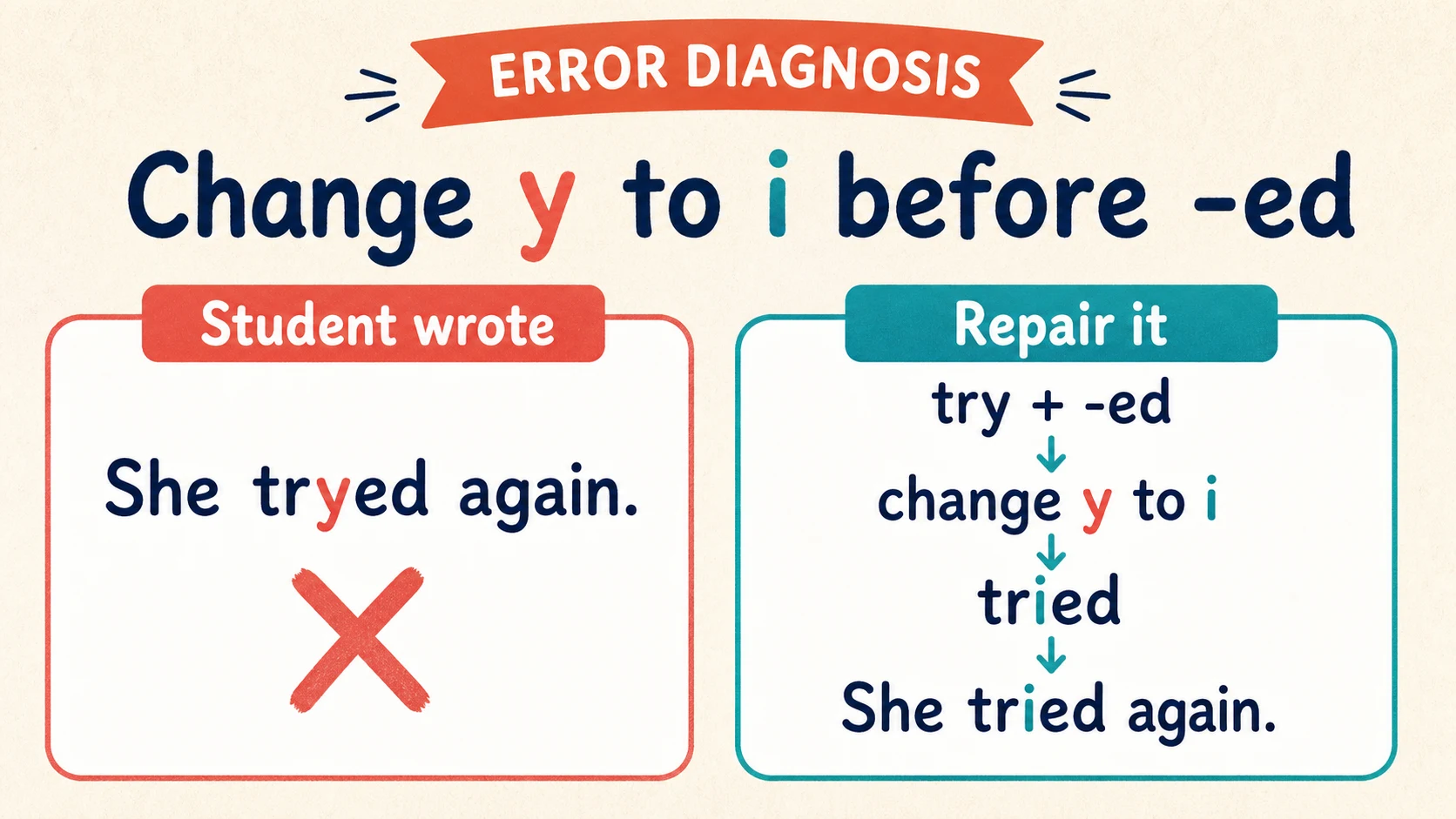
The next response should match the observed error: sound omission, pattern confusion, unstable word part, memory lapse, or proofreading miss.
The spelling does not represent all the sounds
If stamp becomes sap, ask the learner to stretch the word orally and move one counter for each heard sound before writing. Keep the target on sound segmentation; do not simultaneously introduce a new suffix pattern.
This response is consistent with the IES recommendation to develop awareness of sound segments and their links to letters. It is not a diagnosis of a reading disorder, hearing issue, or language condition.
The sound is represented with the wrong conventional pattern
A spelling such as plai represents the sounds of play reasonably but selects the wrong spelling pattern. Compare known alternatives visually, sort them, and then ask for one retrieval attempt. Repeating the spoken word alone will not reveal whether its long-a spelling is ai or ay.
The base is stable but the ending changes incorrectly
Helpfull shows that help is secure while the suffix needs attention. Hopeing likewise preserves hope but misses the final-e change. Praise is not the instructional decision here; contrast is. Put the correct and incorrect forms side by side, identify the changed part, and try a related word.
The word is correct alone but wrong in a sentence
This pattern suggests that the spelling is not yet consistently retrievable while the learner manages other writing demands. Return briefly to look-cover-write-check, then dictate a short sentence containing the same word. Do not replace all writing with isolated lists.
The IES elementary writing guide recommends teaching fluency with spelling and sentence construction alongside providing regular writing opportunities. A short sentence-transfer check reflects that broad guidance. It does not establish that one WorksheetWise activity will produce a particular outcome.
The learner cannot explain why a correct answer is correct
A correct response may come from recognition, memory, a partial rule, or chance. Ask for a simple explanation: “Show me the base,” “Circle the suffix,” or “Which column does this spelling match?” Explanations should remain brief; the goal is to expose the decision, not require a formal linguistic lecture.
Select the first worksheet by evidence you can see
Start from recent independent writing, a teacher note, or three quick oral-and-written probes. Choose the worksheet whose main demand matches the repeated issue.
Use these criteria:
- One target dominates. A long-a sort is preferable when play, rain, and cake spellings are confused. A mixed review is more useful only after several patterns have already been taught.
- The response form fits the evidence needed. Choose sorting to inspect classification, look-cover-write-check to inspect recall, sentence use to inspect transfer, or proofreading to inspect recognition and repair.
- The learner can read the directions and most target words. If decoding every item consumes the session, read directions and words aloud while preserving the spelling decision.
- The amount permits checking. Five examined responses can be more informative than 25 hurried ones.
- Old learning remains visible. After focused practice, include two or three previously taught words to see whether the new target holds beside older material.
- The setting is realistic. The same worksheet may be used differently as homework spelling practice, in a classroom, or after school. At home, a five-minute checked segment may be more workable than completing every problem.
A useful three-item starting probe for long-a is: sort cake, rain, and play by visible pattern; cover them; then write “We will play today.” If sorting succeeds but sentence spelling fails, begin with retrieval and context rather than another visible sort.
The Common Core ELA framework presents grade-specific expectations within a broader progression of reading, writing, speaking, listening, and language. Its ELA standards overview can help adults understand why spelling should connect with reading and writing. It does not mean every local third-grade curriculum uses the same weekly order, and the supplied catalogue facts do not establish formal standards alignment for a particular sheet.
Use a short routine that preserves the target
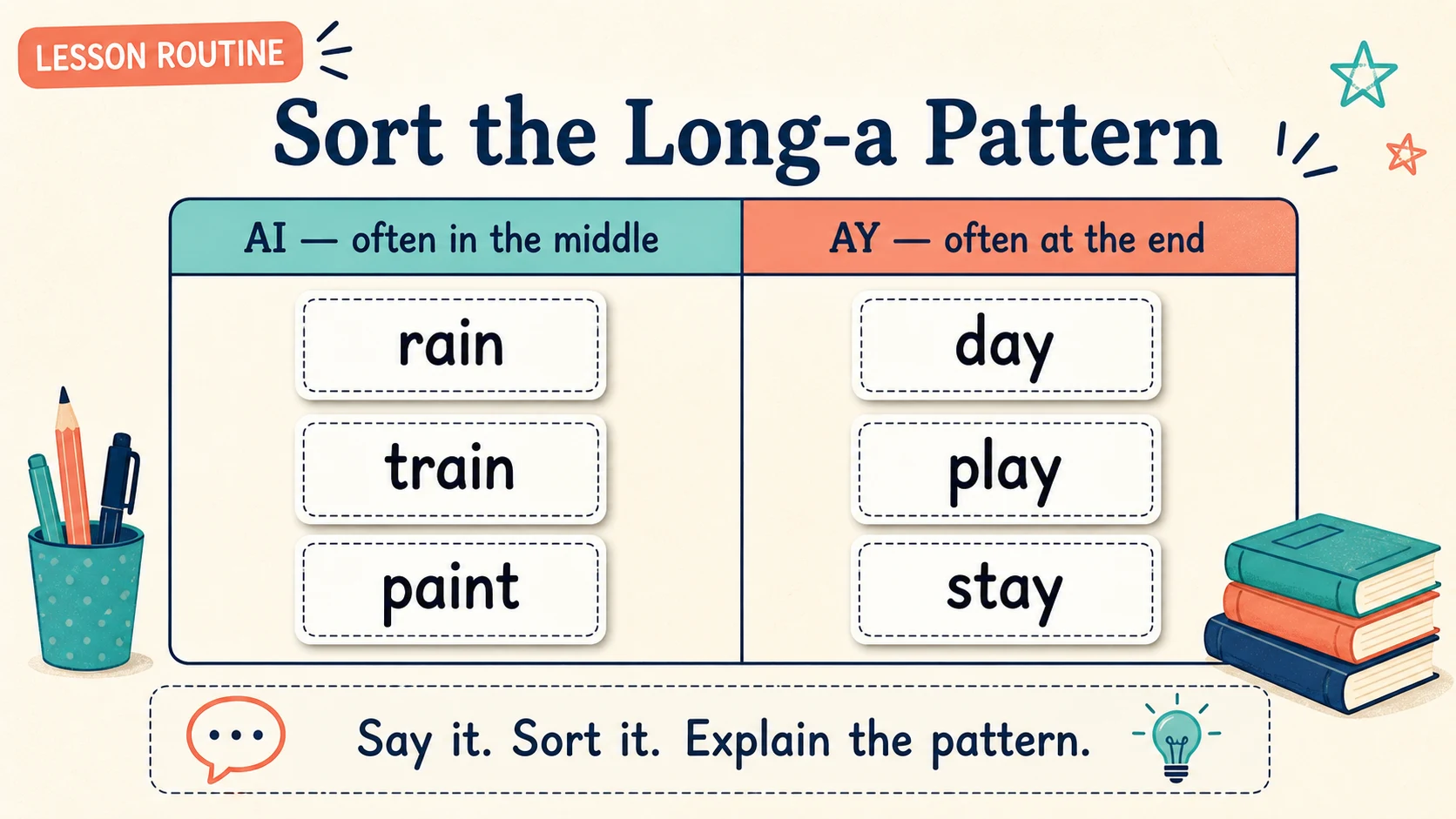
Notice, practice, retrieve, apply, and record one next step in a routine short enough to repeat.
A 10-to-15-minute practice cycle
Notice for two minutes. Name the single target: “Today we are comparing ai and ay.” Read two examples and mark the relevant letters.
Sort or build for three minutes. Place four to six words into pattern columns, or construct a prefixed or suffixed word from parts. Ask for one short explanation.
Retrieve for three minutes. Use look-cover-write-check with two or three words. The learner looks carefully, covers the model, writes from memory, and checks against the original. For a missed word, identify the incorrect part before trying again.
Apply for three minutes. Dictate one sentence containing one or two target words, or ask the learner to compose a sentence. Keep the sentence short enough that spelling remains observable.
Record for one minute. Write one factual note: “Sorted ai/ay accurately; wrote play as plai from memory.” That note determines tomorrow’s opening task.
Rainbow writing can provide additional visible and motor rehearsal, but color should serve the pattern. Ask the learner to keep the target letter unit in one color rather than decorating every letter differently. Multi-sensory practice remains purposeful when saying, seeing, moving, and writing all point to the same spelling feature.
Adapt access without replacing the spelling work
An adaptation preserves the intended decision while reducing an unrelated barrier.
For a learner who tires during handwriting, reduce the number of written repetitions, allow letter tiles for the initial sort, and retain at least one handwritten retrieval attempt. If the target is choosing ai or ay, the learner must still make that choice.
For a learner who struggles to read directions, read the directions aloud and demonstrate one non-target example. Do not pronounce the answer letter by letter. Oral access removes a directions barrier without solving the spelling.
For a learner who is learning English, confirm the meaning and pronunciation of each target word before testing its spelling. A learner cannot reliably use a word in context if the word itself is unfamiliar. Keep the same written pattern, but provide a picture, gesture, or plain-language definition where appropriate.
For a learner who finishes quickly and accurately, add two or three words that extend the already taught pattern, as the catalogue teaching tip suggests. Then ask for a sentence or a mixed sort. Do not jump to an unrelated spelling feature merely to make the page longer.
For attention or visual-load needs, cover unused rows and reveal one item at a time. Keep the original word and checking point available when the task is look-cover-write-check. Enlarging print, spacing items, or giving a movement break changes access, not the target.
These are instructional suggestions, not diagnoses or individualized clinical recommendations. Persistent, broad, or concerning difficulties should be discussed with the learner’s teacher or an appropriately qualified professional using evidence from more than one worksheet.
Plan review across two weeks
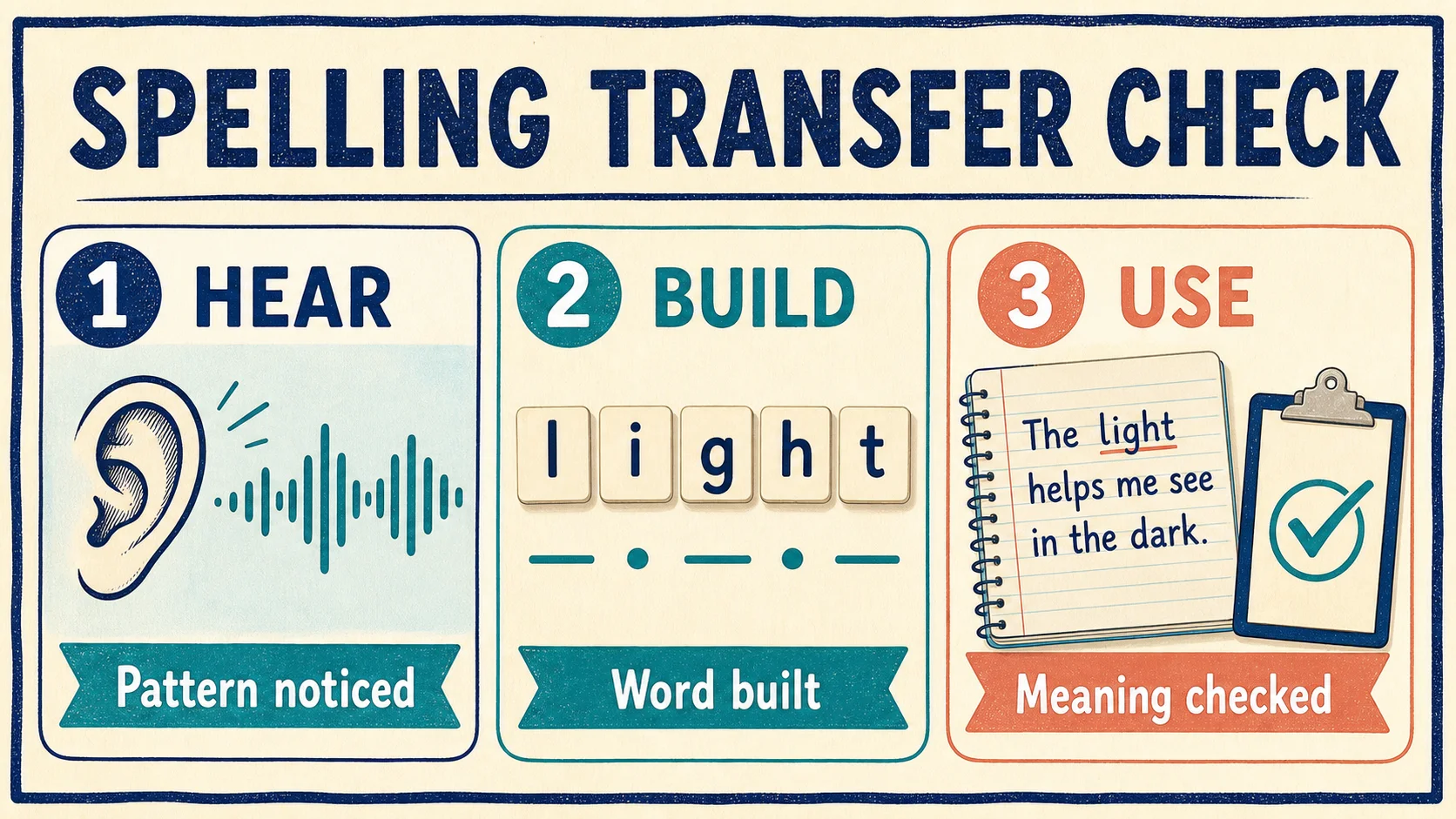
Check transfer by asking the learner to hear the pattern, build the word, and use it meaningfully after a delay—not merely repeat one correct page.
In week one, introduce one pattern, sort examples, practice retrieval, and use two words in a dictated sentence. End the week with a short mixed check that includes previously taught material.
In week two, reopen with two unprompted examples from the same pattern. Then shift the response form: words first sorted may appear in a sentence or proofreading passage. If accuracy falls only when context is added, return to a brief retrieval step and try another sentence. If the target remains stable, move to the next bounded feature while retaining two old examples in review.
Word searches, when an actual selected resource includes one, are best treated as recognition review. Ask the learner to read each found word, mark its target pattern, and later spell one or two without looking. Finding a printed sequence is not the same as producing it independently.
Know what one worksheet cannot establish
A worksheet can show what happened on a particular set of words under particular conditions. It cannot by itself establish mastery, explain every cause of an error, diagnose a learning need, or predict spelling in everyday writing.
The catalogue’s “easy” label does not establish developmental placement. The 25-problem count does not mean all 25 must be completed in one sitting. The 18 variants indicate choice, not a required sequence. The single free resource is an entry point, not evidence that it represents every activity or target in the topic description.
Avoid three common overclaims:
- A correct copied word does not prove independent recall.
- A correct weekly test does not prove transfer to original writing.
- One incorrect spelling does not prove that the learner lacks the whole pattern.
Check the same target in at least two forms, such as sorting plus covered writing, or isolated spelling plus a sentence. Compare errors at the letter-pattern level. Then make the smallest reasonable next decision.
Make tomorrow’s task observable
Open the 3rd Grade Spelling Words guide and free sheet and inspect the 25 problems before assigning them. Circle one bounded target represented on the page. Ask the learner to complete the first five relevant items, explain one answer, and write one target word in a sentence.
Record exactly what occurred—for example, “Sorted cake, rain, and play correctly; recalled cake and rain; wrote plai in the sentence.” Tomorrow, begin with a two-word ai/ay contrast and one covered attempt at play. That is a specific next task chosen from the learner’s work, not from a label, a score, or an assumption.
Put it into practice
Use the guide with a real printable
Move from explanation to a short, observable practice task. Check the first item together, then adjust the next session from the learner's actual work.
Open the first free worksheet