15 free PDFs with answer keys
3rd Grade worksheets
Choose only from subjects and skills with real files in the current 3rd Grade catalogue. Start with the free standard sheet, then add more practice only if you need it.
Complete guide
How to teach and practise 3rd grade worksheets
3,470 words Updated 6 instructional visuals
Choose third-grade practice by evidence, not by the label
The useful question is not “Which third-grade worksheet should I print?” It is “What can this learner already represent, explain, and complete without help?” Start there, then choose a task that adds one manageable demand.
The live WorksheetWise third-grade catalogue contains 270 variants across three subjects—math, spelling, and grammar—with 15 free entry points. The available topics span addition, subtraction, multiplication, division, fractions, decimals, place value, telling time, money, geometry, word problems, spelling words, parts of speech, punctuation, and one additional catalogue topic. These are intended practice levels, not a prescribed teaching sequence.
Third grade is often where arithmetic broadens into multiplication, division, fractions, and multi-step situations while reading and writing demands become less forgiving. A child may calculate accurately but misread a word problem, identify nouns but struggle to revise a sentence, or spell a weekly list correctly without transferring the pattern into original writing. Those differences should determine the next worksheet.
Age is a discovery aid rather than a placement decision. A family browsing worksheets for 8-year-olds should still inspect the representation, directions, vocabulary, number range, and expected independence before assigning a page. Grade labels describe intended practice level; local curriculum sequences differ. A worksheet can reveal an instructional need, but it cannot diagnose a learning condition or promise an outcome.
Readiness has three dimensions
A learner is ready for a worksheet when the underlying idea, the page’s representation, and the required level of independence are reasonably aligned. Checking only whether the answer is correct misses too much.
Strategy: what does the learner do?
Ask the child to solve one representative item aloud. Listen for a usable strategy rather than a memorized phrase.
For 7 × 6, a third grader might:
- build six groups of seven;
- draw a 6-by-7 array;
- reason that
5 × 7 + 1 × 7 = 42; - retrieve 42 and verify it with a related fact.
All four can be mathematically sound. Repeatedly guessing multiples is different: it suggests that a 25-item fact page may rehearse uncertainty rather than strengthen a known strategy.
For spelling, strategy appears when the learner notices a pattern, marks the difficult part, or compares a new word with a known word. For punctuation, it appears when the learner reads a sentence for meaning and identifies why a comma or quotation mark is needed.
Representation: can the learner connect the forms?
Third-grade work increasingly asks children to move among objects, diagrams, words, and symbols. Readiness is stronger when those forms describe the same idea to the learner.
A child who can make four groups of three counters but cannot connect the model to 4 × 3 needs the connection made explicit. A child who can calculate 43 − 25 but cannot show why one ten becomes ten ones may have a fragile regrouping procedure. A child who names 3/4 in a shaded shape but places it incorrectly on a number line understands one fraction representation, not yet the full demand.
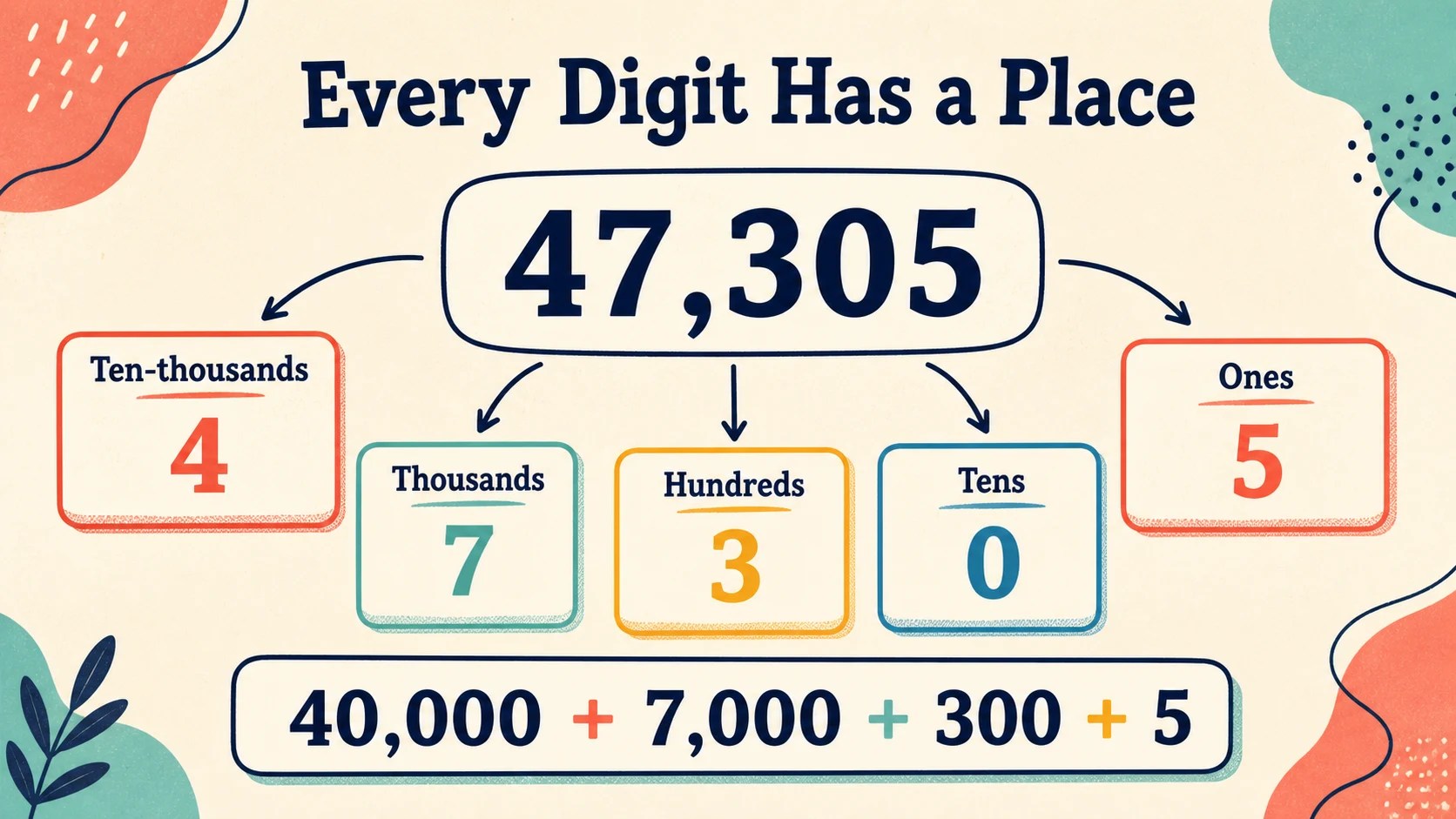
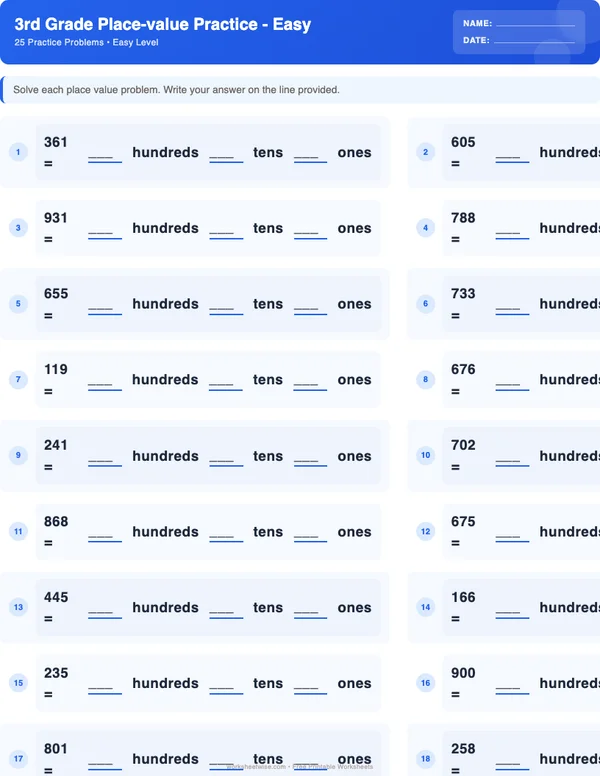
Use the map to locate the needed connection—digit value, decomposition, comparison, or rounding—before selecting general place-value practice.
Independence: what support is actually required?
Observe whether the learner:
- starts after reading the directions;
- sustains attention through a short set;
- chooses a tool without being prompted;
- checks an answer against the question;
- explains an error after feedback.
Independence is task-specific. A child may complete addition independently but need an adult to organize a two-step word problem. Record the support used: “read directions aloud once” is more informative than “needed help.”
Catalogue sheets described as “easy” should not lead adults to label a learner that way. Here, difficulty must be read through observable task features: number size, number of steps, amount of text, familiarity of the model, presence of regrouping, similarity of answer choices, and whether a strategy cue is provided. Increase one feature at a time when possible.
Preview a worksheet before handing it over
A two-minute adult preview prevents many poor matches. Do not judge a page only by its title or number of problems.
Inspect one item from beginning, middle, and end
Check whether the demand stays stable. A page may begin with direct facts and finish with application problems. Look for:
- the exact action required;
- the knowledge assumed;
- the representation used;
- the reading and writing load;
- the amount of independent work expected.
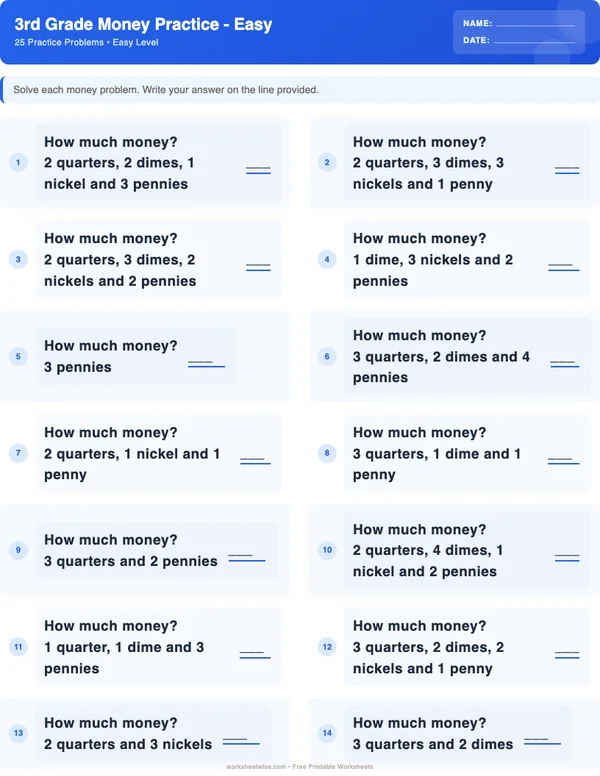
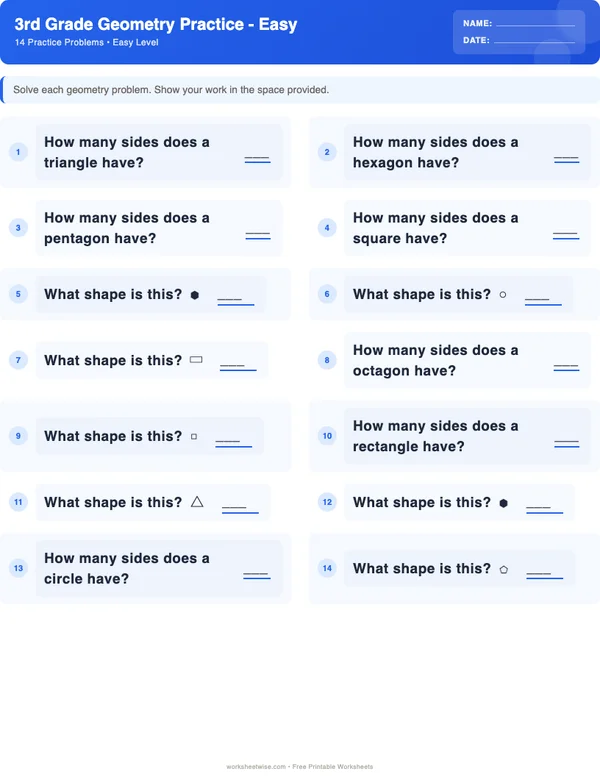
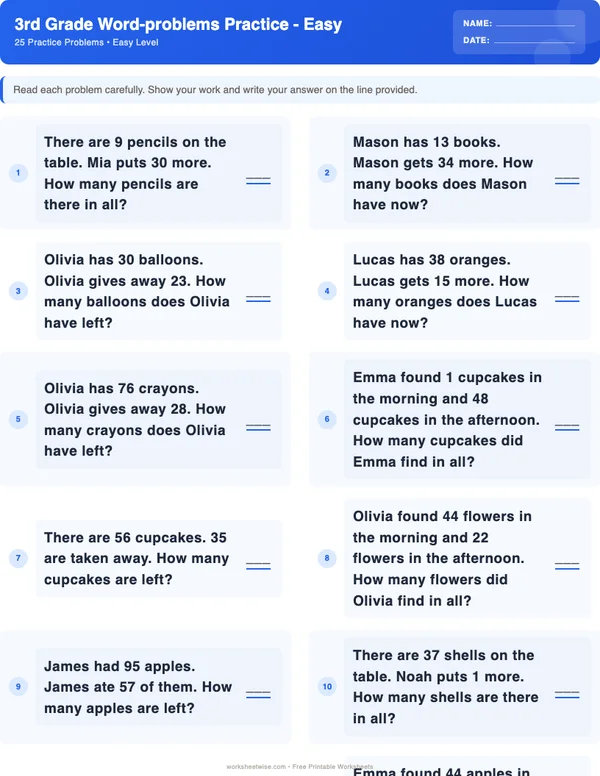
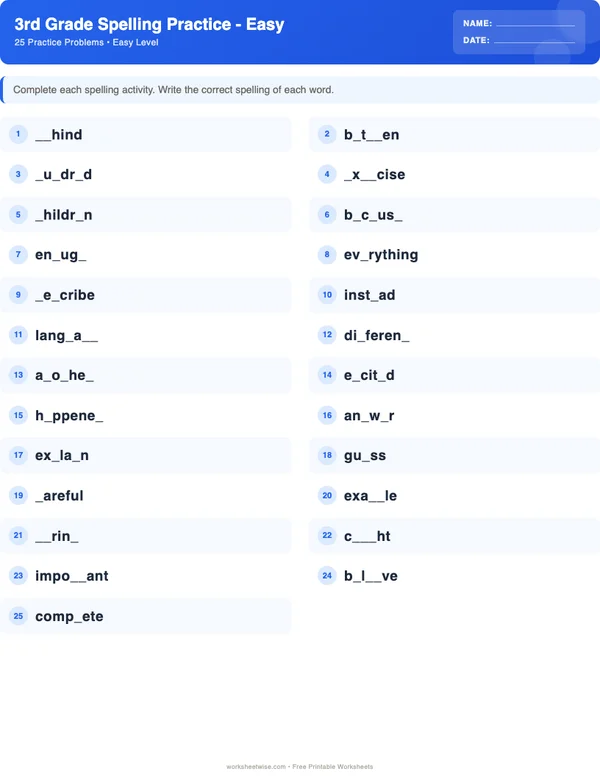
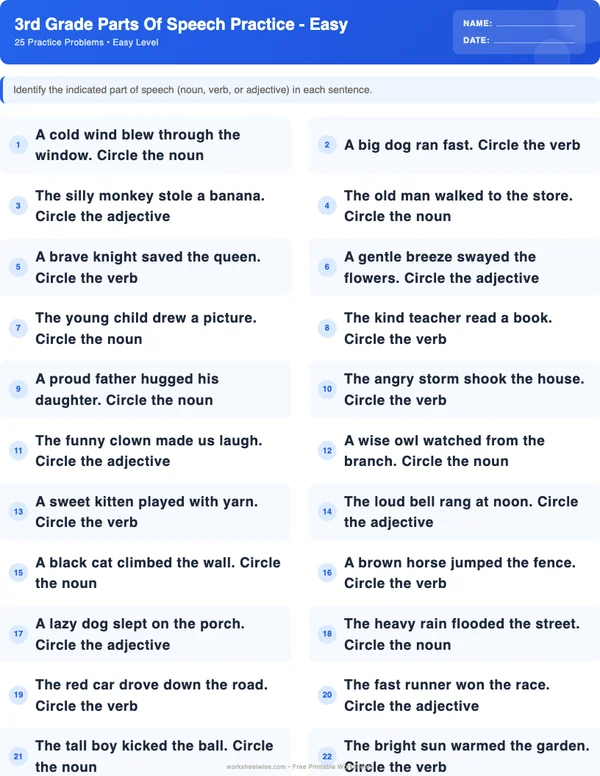
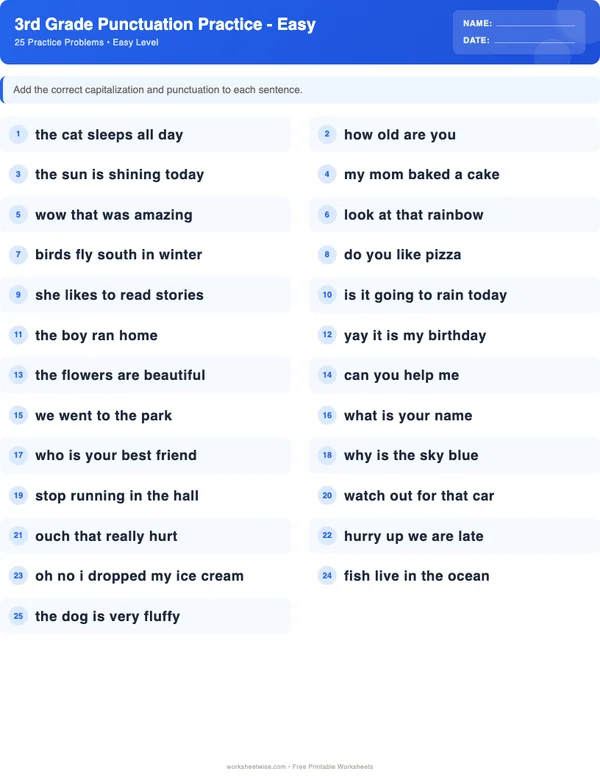
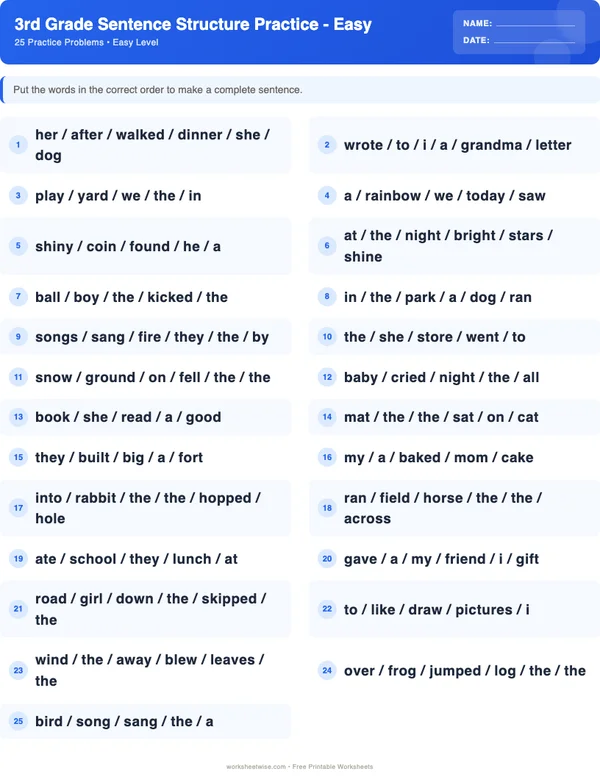
The live free sheets vary in length. Addition, subtraction, multiplication, division, place value, money, geometry, and spelling-word entry sheets each contain 25 problems. Fractions and decimals contain 22. Telling time contains 12. Word problems, parts of speech, and punctuation contain 14. A shorter page is not automatically easier: fourteen language-heavy word problems may demand more sustained interpretation than twenty-five direct calculations.
Run a three-item readiness check
Choose three representative items without teaching the page first.
- If all three are correct and the learner explains a stable strategy, use the worksheet for independent practice or choose a task with one added demand.
- If one is correct and two reveal the same missing connection, teach that connection before assigning the page.
- If the learner understands orally but cannot manage the notation or directions, preserve the skill and adapt the response format.
- If errors are unrelated, reduce the page length and inspect fatigue, attention, vocabulary, and notation separately.
This is an editorial selection routine, not a sourced assessment protocol. It is a practical way to avoid using a full worksheet as the first test of readiness.
Build arithmetic from place value and relationships
Third-grade arithmetic should become more flexible, not merely longer. Addition and subtraction now support multiplication, division, measurement, money, and word problems. Place value explains why multi-digit procedures work.
Addition and subtraction: inspect regrouping, not just totals
Consider 347 + 186.
A checked solution is:
- ones:
7 + 6 = 13, so write 3 ones and regroup 1 ten; - tens:
4 tens + 8 tens + 1 ten = 13 tens, so write 3 tens and regroup 1 hundred; - hundreds:
3 + 1 + 1 = 5; - answer:
533.
This belongs in third-grade selection because it tests place-value understanding across two regroupings, not basic counting-on alone. If a child writes 423, inspect the work rather than assigning more of the same. The learner may have discarded each composed unit or applied a partially remembered procedure. Return to base-ten blocks, a place-value chart, or expanded form before using a 25-problem page.
For 43 − 25, the checked answer is 18: trade one ten so that 43 becomes 3 tens and 13 ones; then 13 − 5 = 8 and 3 tens − 2 tens = 1 ten. An answer of 22 may show that the child subtracted each smaller digit from the larger digit. That is a place-value and operation-direction error, not evidence that the learner needs faster work.
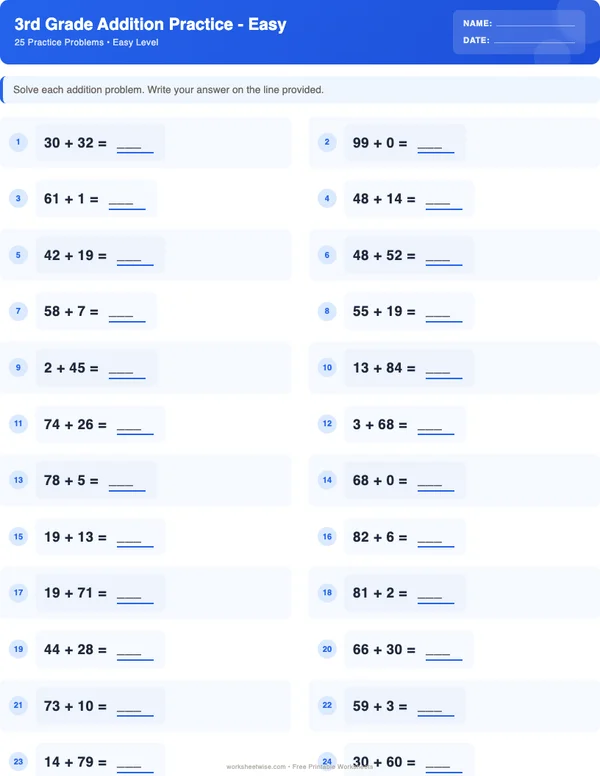
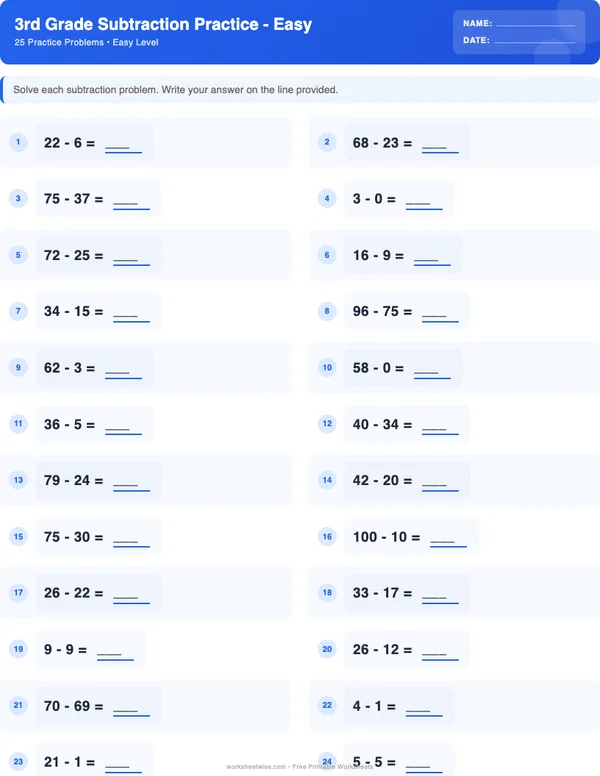
Use the 3rd Grade Addition guide and free sheet when the learner can explain composition but needs accurate repetition. Use the 3rd Grade Subtraction guide and free sheet when subtraction situations or regrouping need focused practice.
The IES mathematics practice guidance recommends systematic instruction, clear mathematical language, representations, and deliberate connections among representations. That sourced guidance supports moving between objects, drawings, and notation; the exact worksheet sequence remains an adult’s selection decision. See IES, Assisting Students Struggling with Mathematics.
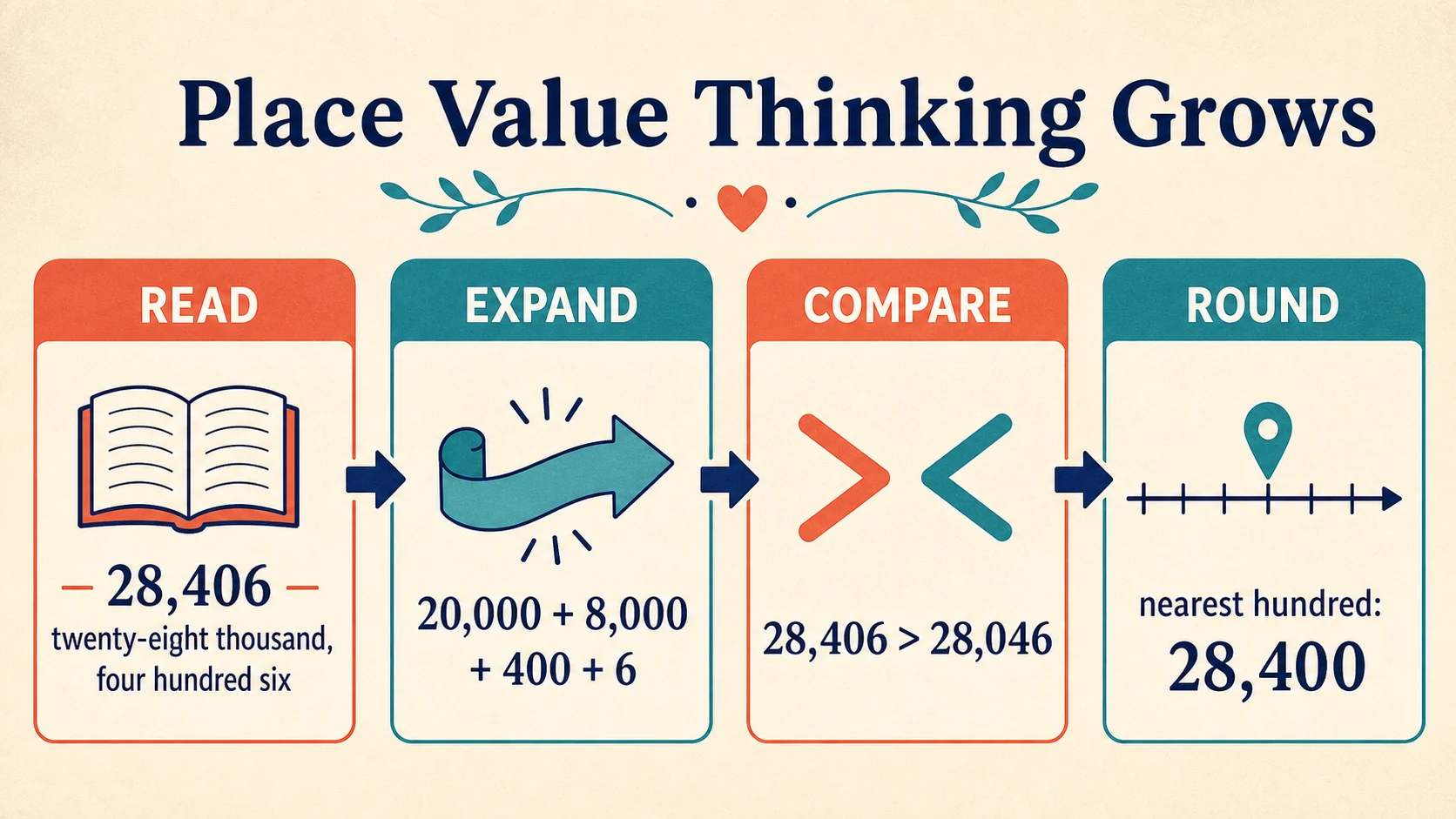
Move forward when the learner can explain a trade or decomposition, then reproduce it without a model—not merely after finishing a page.
Multiplication and division: begin with equal groups
Check 4 × 6 with an array: four rows containing six objects make 24. Turn the same array to see six rows of four; the total remains 24. From that model, derive 24 ÷ 4 = 6 and 24 ÷ 6 = 4.
This example belongs here because it joins four third-grade demands: equal groups, arrays, the commutative relationship, and inverse operations. It also reveals more than a fact-only question. If the child counts every dot correctly but cannot write the matching equation, keep the array and add equation matching. If the equations are fluent, remove the pictured array and ask the learner to sketch one only when checking.
Division must include both meanings. “Share 12 counters among 3 children” asks how many are in each share: 4. “Make groups of 3 from 12 counters” asks how many groups can be made: also 4. The quotient matches, but the story structure differs. Ask the learner to state what the 4 represents.
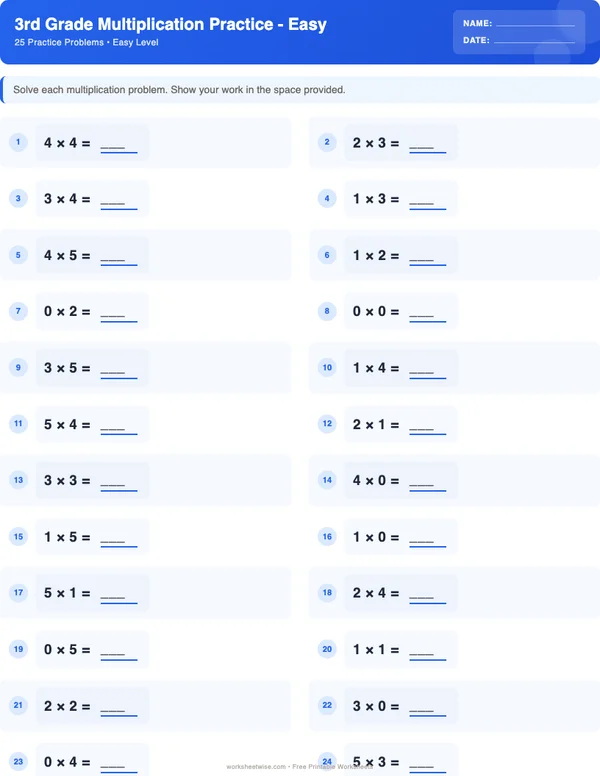
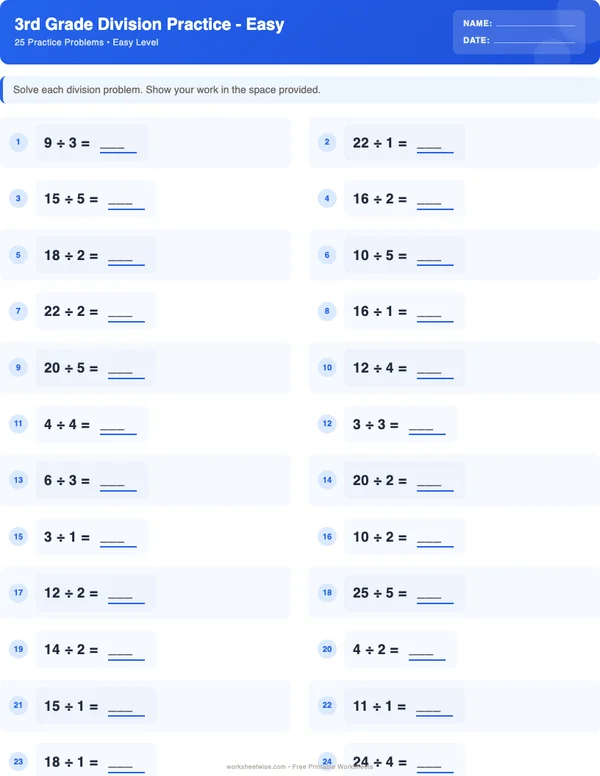
The 3rd Grade Multiplication guide and free sheet is a sensible entry point after the learner can model equal groups. The 3rd Grade Division guide and free sheet fits when the child can connect a division fact to a known multiplication fact. Fact speed should not replace understanding.
Treat fractions and decimals as extensions of number
Fraction readiness is not established by naming shaded pieces alone. The parts must be equal, the whole must be identified, and the fraction must be treated as a number.
For a checked number-line example, divide the interval from 0 to 1 into four equal lengths. The third mark after 0 is 3/4. It is not 3/3, because the denominator names the four equal intervals in the whole. This belongs in third grade because it moves beyond “three shaded pieces” to locating a fraction as a number.
To compare 3/4 and 3/8, hold the numerator constant: both describe three parts, but fourths are larger than eighths, so 3/4 > 3/8. A learner who chooses 3/8 because 8 is greater than 4 is applying whole-number reasoning to denominators. Use equal-length paper strips or aligned number lines before another symbolic comparison page.
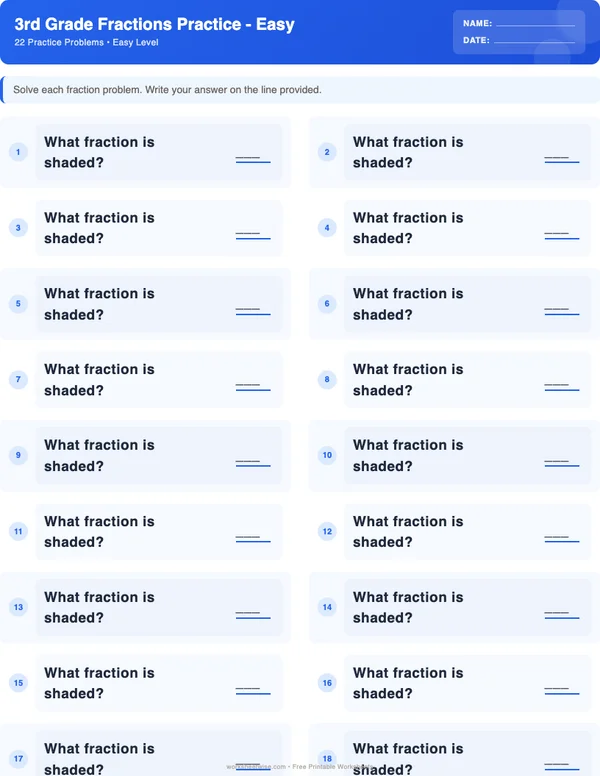
The 3rd Grade Fractions guide and free sheet provides a 22-problem entry sheet. Preview whether its representations match what the child has already used. The Common Core mathematics standards describe grade-level expectations involving fractions on number lines and comparisons in specified cases, but those standards do not establish a universal local teaching order. Consult Common Core State Standards for Mathematics as a reference, not as a claim that WorksheetWise materials were evaluated for alignment.
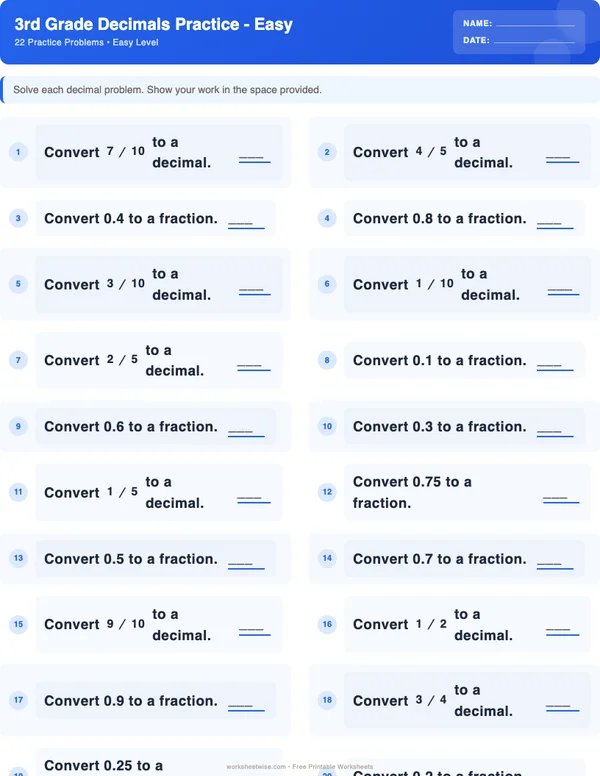
Decimals are present in the live catalogue, but placement deserves restraint. Catalogue coverage extends beyond what every local third-grade sequence will teach. Before selecting the 3rd Grade Decimals guide and free sheet, check whether the learner can decompose whole numbers by place value and connect tenths or hundredths to fractions or measurement contexts.
For example, 0.4 > 0.36. Rewrite 0.4 as 0.40; forty hundredths exceeds thirty-six hundredths. A child who chooses 0.36 because 36 is greater than 4 needs aligned place-value models, not a rule about counting digits.
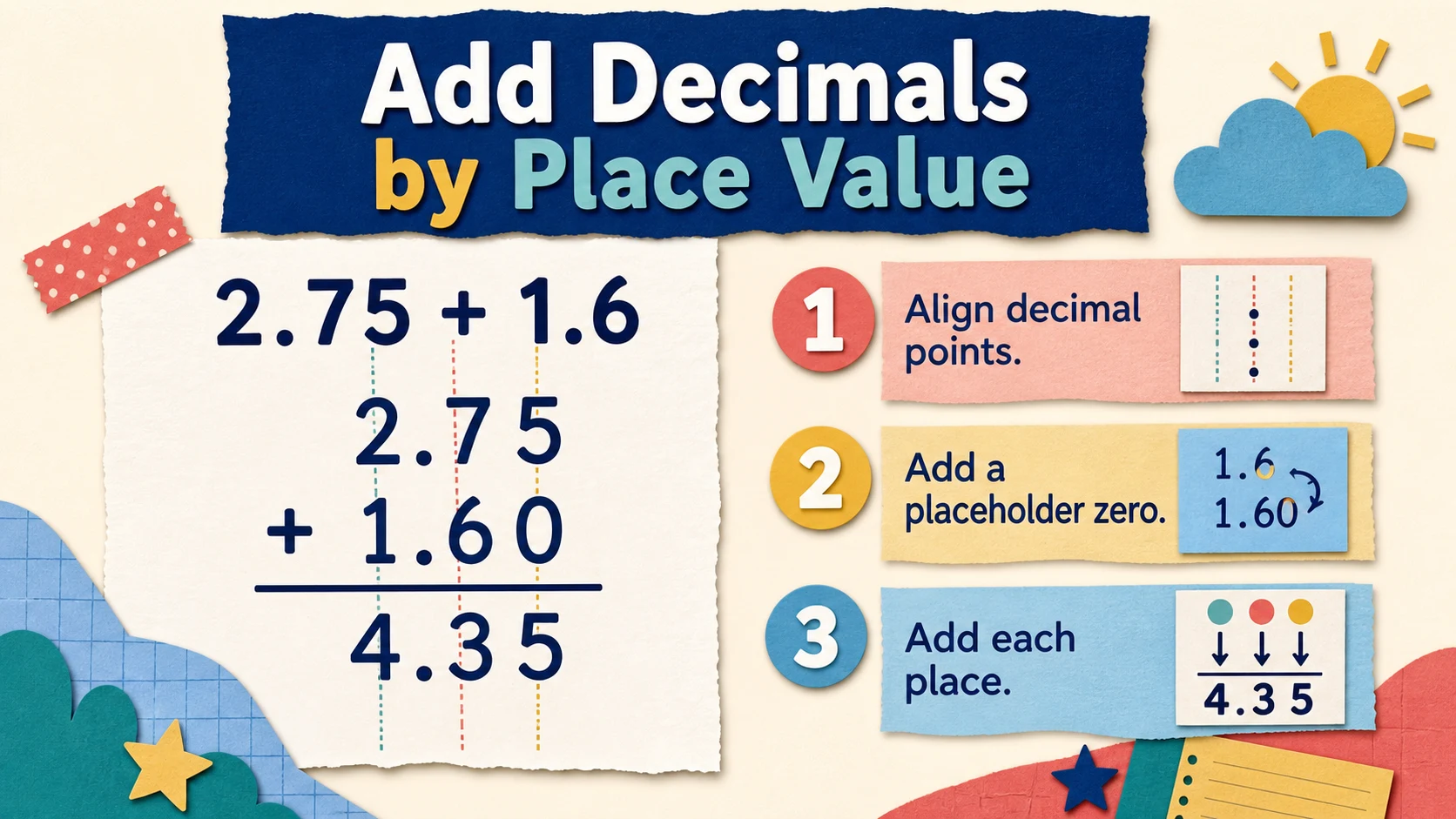
Treat decimals as an optional catalogue pathway whose readiness depends on place-value and fraction connections, especially where local third-grade sequences differ.
Select measurement, time, money, and geometry by the hidden demand
Practical-looking topics often combine several skills. Determine which one the worksheet is truly testing.
Telling time: separate clock reading from elapsed time
A learner may read 3:45 correctly on a digital display yet call an analog clock 4:45 because the hour hand sits near 4. The useful prompt is: “Has the hour hand reached 4?” If not, the time is still in the 3 o’clock hour.
Now check an elapsed-time example: a lesson begins at 2:35 p.m. and ends at 3:20 p.m. From 2:35 to 3:00 is 25 minutes; from 3:00 to 3:20 is 20 minutes; total elapsed time is 45 minutes. This belongs in third-grade selection because it combines clock interpretation, partitioning an interval, and addition without requiring column subtraction in base 60.
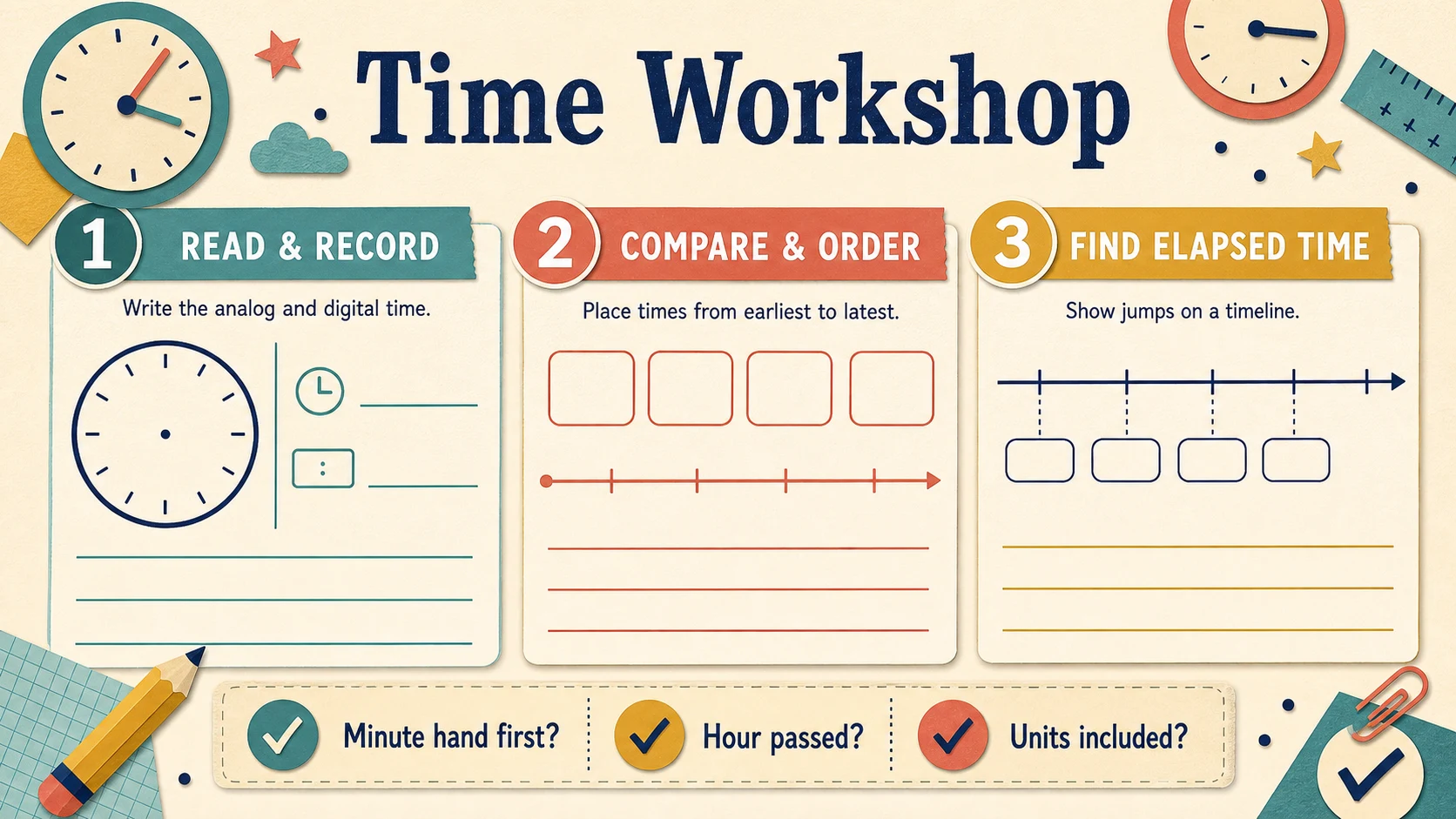
Use the spaced plan only after identifying whether the learner needs clock-face reading, five-minute counting, or elapsed-time reasoning.
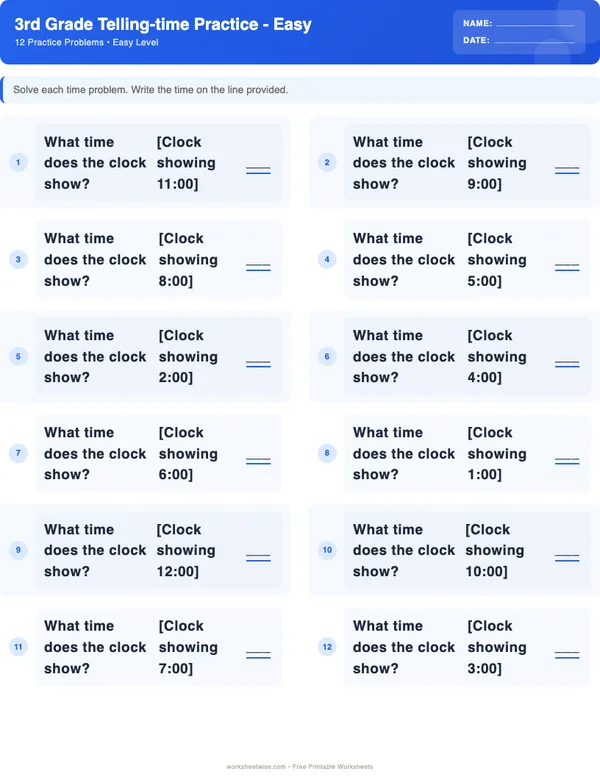
The free telling-time entry sheet has 12 problems. Twelve is still too many if the learner confuses the hands. Cover all but three clocks, use a demonstration clock, and preserve the target by asking the same time-reading question.
Money and word problems: check the story structure
For $5.00 − $3.67, counting up gives a checked difference of $1.33: add 3 cents to reach $3.70, 5 cents to reach $3.75, 25 cents to reach $4.00, and $1.00 to reach $5.00. This example belongs here because money combines decimal notation, subtraction, coin values, and a real interpretation of change.
Do not infer an operation from a keyword. “Maya has 18 stickers, which is 6 more than Luis” contains “more,” but finding Luis’s amount requires 18 − 6 = 12. Ask the child to retell who has the greater quantity, draw a bar model, label the unknown, and then choose an operation.
When a learner calculates correctly after an adult retells the problem, the next worksheet should reduce reading load or include supported retelling—not reduce the arithmetic automatically.
Geometry: require properties and measurement
A shape is not a rectangle because it “looks like a door.” Ask for properties: four sides, four right angles, and opposite sides of equal length. Rotate examples so orientation does not become an accidental rule.
For a 3-by-4 rectangle, area is 3 × 4 = 12 square units. Perimeter is 3 + 4 + 3 + 4 = 14 units. This checked example belongs in third grade because it exposes a frequent selection boundary: a learner may know multiplication facts yet confuse covering a region with measuring its boundary.
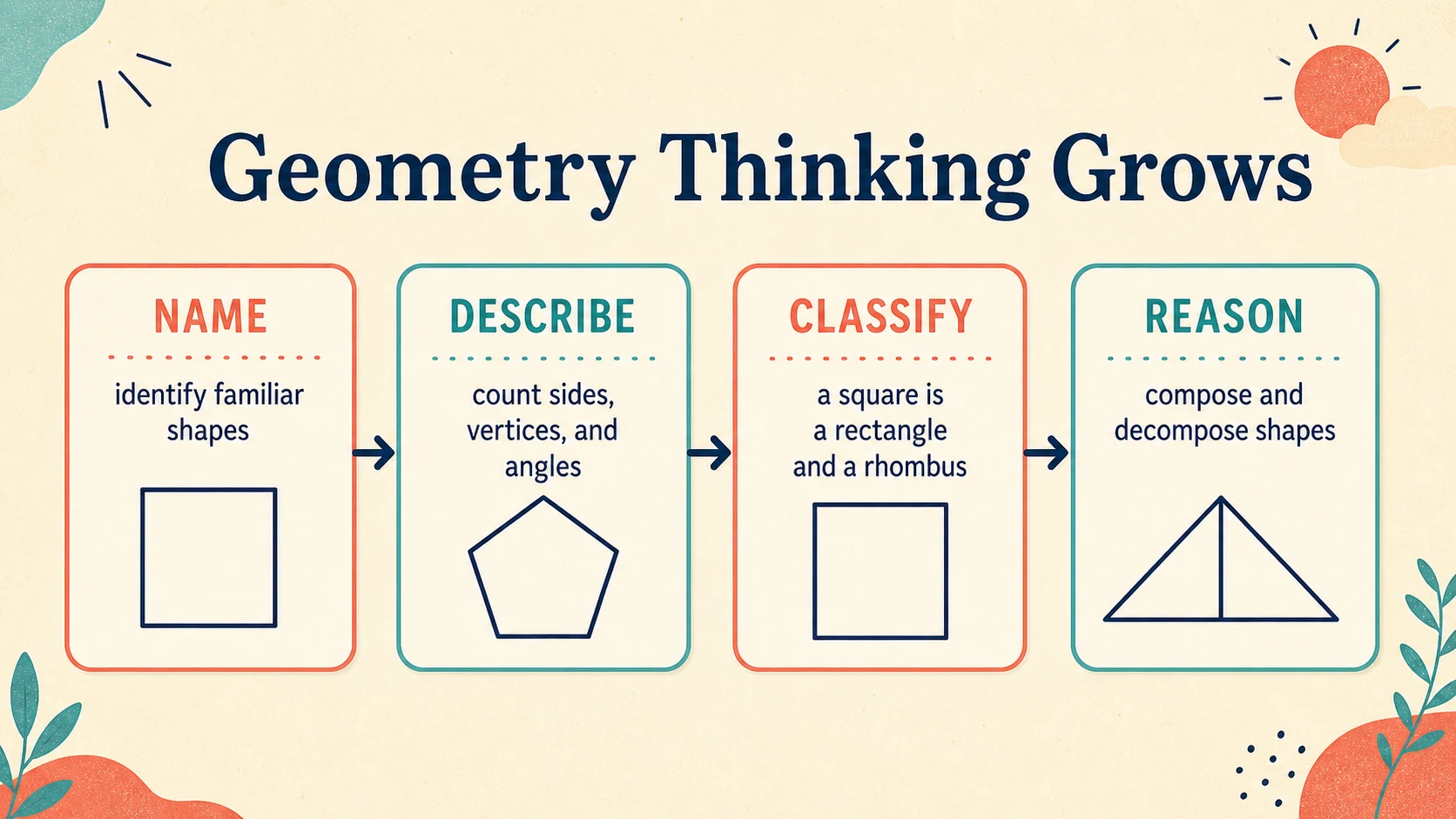
Begin with building and counting, then require labeled drawings and equations only after area and boundary have distinct meanings.
Make spelling and grammar serve real writing
Language worksheets should lead back to sentences and paragraphs. Identification is a starting point, not the final performance.
Spelling: select a pattern, then test transfer
Suppose the target set is rain, train, paint, and wait. The shared pattern is ai representing the long-a sound in these words. A useful sequence is:
- read each word;
- underline
ai; - sort the words against another long-a spelling such as
play; - use one target word in a dictated sentence;
- later, inspect original writing for transfer.
This belongs in third-grade practice because the learner must notice an orthographic pattern and apply it beyond copying. If rain is correct on the list but becomes ran in a paragraph, more rainbow writing may not address the gap. Ask the learner to reread the sentence, locate the long-a sound, and consult the recorded pattern.
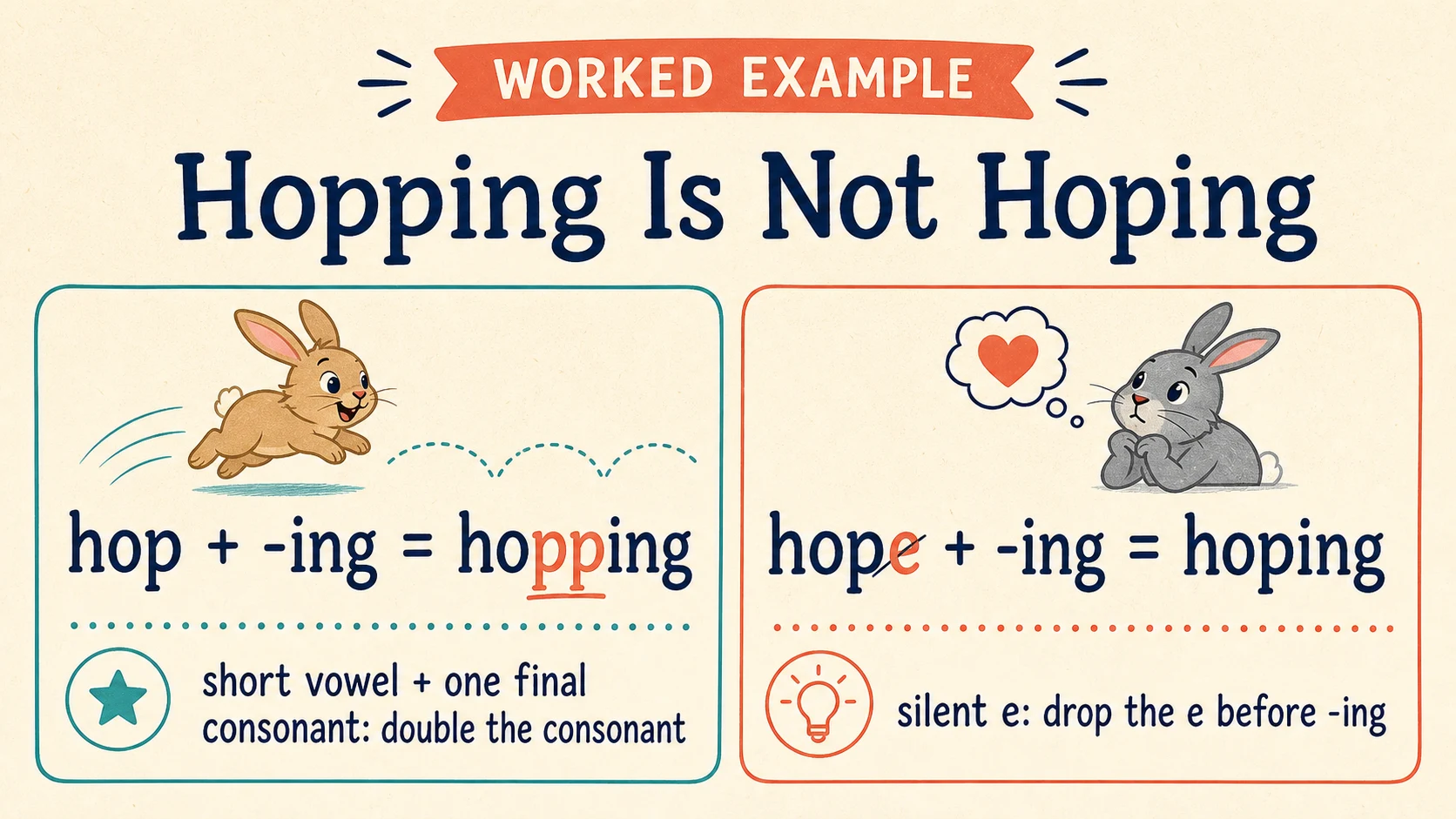
Use the worked sequence to reveal the spelling decision, then check whether the pattern appears in dictated and self-generated writing.
The IES foundational reading guide emphasizes explicit work with sound–spelling relationships and decoding, while its writing guide recommends regular writing, explicit strategy instruction, and support for transcription skills. These are sourced principles, not proof that a particular WorksheetWise page produces a result. See IES, Foundational Skills to Support Reading for Understanding and IES, Teaching Elementary School Students to Be Effective Writers.
Parts of speech and punctuation: move from naming to revising
In “The bright lantern glowed softly,” lantern is a noun, bright is an adjective describing the lantern, glowed is a verb, and softly is an adverb describing how it glowed. This example belongs here because it connects labels to jobs within one sentence.
Then revise: “The lantern glowed” becomes more precise when the writer chooses details intentionally. Do not reward adding adjectives merely to make a sentence longer.
For dialogue, check: Mia said, “I found the map.” The comma separates the dialogue tag from the quotation, quotation marks enclose the spoken words, and the period sits inside the closing quotation mark in standard US usage. If every mark is misplaced, model one complete sentence. If only the comma is missing, keep the original writing demand and target that single convention.
The Common Core English language arts standards provide one widely used description of grade-level reading, writing, and language expectations. They do not override local curriculum or show that these worksheets have been independently aligned. See Common Core State Standards for English Language Arts.
Use adaptations that preserve the target skill
An adaptation is useful only if it removes an irrelevant barrier without answering the question for the learner.
If the target is multiplication reasoning, allow counters, an array frame, or graph paper. Do not replace 6 × 7 with repeated adult prompting that supplies every group.
If the target is punctuation, an adult may read the sentence aloud when decoding load interferes. Do not exaggerate the pauses so strongly that the punctuation answer is given away.
If the target is fraction placement, enlarge the number line or let the learner fold a paper strip. Do not premark the exact answer.
Other defensible adaptations include:
- cover unused rows to reduce visual crowding;
- complete five problems, pause, and then decide whether to continue;
- permit oral explanations before written equations;
- provide manipulatives already familiar from instruction;
- separate copying demands from spelling recall;
- let the learner type a paragraph when handwriting is not the target;
- ask the child to circle relevant quantities in a word problem.
Keep the original learning target in your notes. “Completed with number line and directions read aloud” is a clearer work-sample record than “completed with support.”
Adults using 3rd Grade Homeschool Worksheets can apply the same rule: modify access before changing the mathematical or language decision the child must make.
Interpret errors before choosing the next page
A score summarizes a page; an error pattern guides teaching. Sort errors into categories while the work is still fresh.
Concept, procedure, language, or independence?
A conceptual error shows a mistaken idea: treating 1/8 as larger than 1/4 because 8 is larger than 4.
A procedural error appears when the idea is understood but execution breaks down: correctly explaining regrouping, then forgetting to include the regrouped ten.
A language error occurs when vocabulary or sentence structure blocks access: computing accurately after “difference” is restated as “how far apart.”
An independence error occurs when the learner can perform the task after each prompt but does not initiate the steps alone.
Also note isolated slips. One copied digit in an otherwise coherent solution should not automatically trigger a lower-level worksheet.
Decide what comes next from the sample
Use this decision rule after checking corrections with the learner:
- Same misconception on three or more items: reteach with a different representation, then give two fresh checks.
- Accurate with a model but inaccurate without it: keep the number range and fade the model gradually.
- Accurate early, deteriorating late: shorten the set before lowering the conceptual demand.
- Correct answers with no explainable strategy: ask for a model or justification before increasing complexity.
- Accurate isolated skills but weak application: choose word problems, editing, or sentence construction using those same skills.
- Accurate independently across two brief sessions: add one new demand, such as a larger number range, a second step, or less visual support.
These thresholds are practical suggestions for page selection, not diagnostic cutoffs or research claims. If a persistent concern affects school participation or appears across settings, bring dated work samples and specific observations to the child’s teacher or an appropriate qualified professional.
Run a short practice cycle and act on the evidence
Use a repeatable routine that is small enough to sustain:
- Preview: inspect the page and select three representative items.
- Observe: let the learner attempt them without coaching.
- Name the target: state one purpose, such as “show equal groups” or “punctuate dialogue.”
- Model once: demonstrate only the missing connection.
- Practice briefly: assign a manageable portion, not automatically the entire page.
- Check together: ask the learner to explain one correct response and repair one error.
- Record support: note tools, prompts, accuracy pattern, and independence.
- Choose the next demand: reteach, repeat with faded support, apply the skill, or extend it.
Avoid turning every page into a timed test. Do not use the catalogue to diagnose, substitute for instruction, or assume that completing more variants means deeper understanding. Standardized assessment pressure may make volume feel urgent, but accurate interpretation of a short work sample is more useful than a long page completed through guessing.
For the next session, open the free deterministic worksheet generators, create a short set for the single skill revealed by today’s sample, and compare the learner’s strategy and independence—not just the score—with the notes from the first three-item check.
Put it into practice
Use the guide with a real printable
Move from explanation to a short, observable practice task. Check the first item together, then adjust the next session from the learner's actual work.
Open the first free worksheet