4th Grade · 9 live skills
4th Grade math worksheets
Pick the exact skill below. Each page combines a real free download, a separate answer key, practical teaching guidance and an optional focused pack.
See all 4th Grade subjects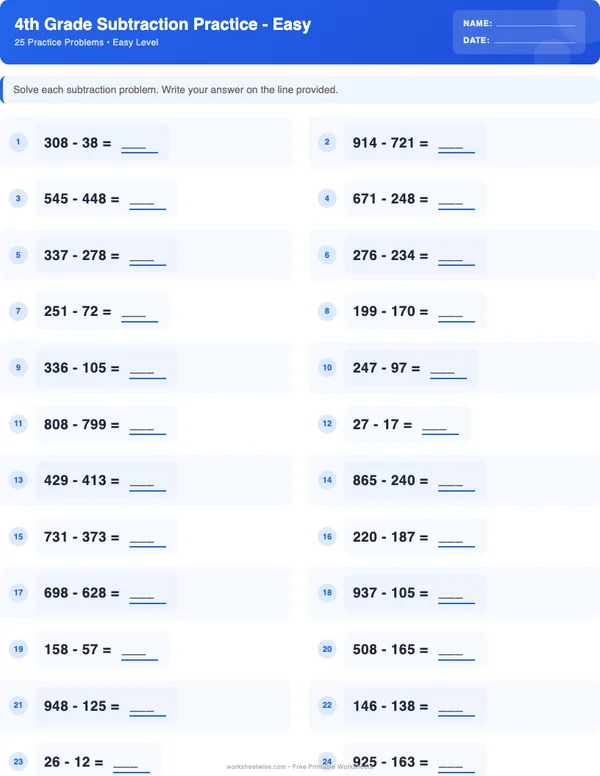
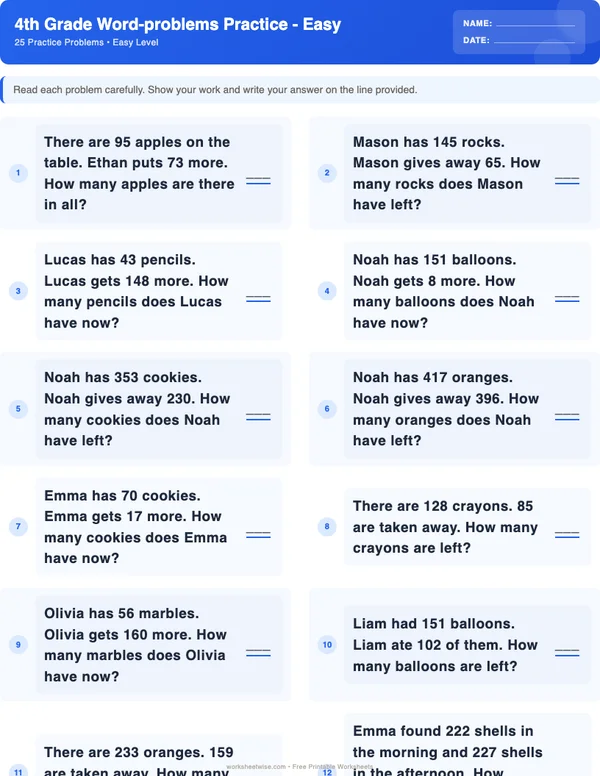
Complete guide
How to teach and practise 4th grade math worksheets
3,737 words Updated 6 instructional visuals
Choose one 4th grade math target before choosing a worksheet
A useful starting worksheet matches one skill the learner is ready to practice—not every topic associated with fourth grade. The live WorksheetWise catalogue has 162 fourth-grade math variants across nine topics: addition, subtraction, multiplication, division, fractions, decimals, place value, geometry, and word problems. Each topic has a free entry point, but those entry points differ in what they ask the learner to notice and do.
Start by looking at recent work or asking the learner to solve two or three short problems aloud. Then choose one bounded target, such as:
- Decompose a whole number by place value.
- Explain one regrouping step in addition or subtraction.
- Represent a multiplication problem with an array.
- Connect a division equation to a known multiplication fact.
- Compare two fractions using a model.
- Compare tenths and hundredths by place value.
- Distinguish area from perimeter.
- Represent a word problem before calculating.
Grade labels describe the intended practice level; they are not placement decisions. Local curriculum sequences differ, and age is best treated as a discovery aid rather than evidence that a particular worksheet is appropriate. Observe the task itself: the numbers, representations, number of steps, reading demand, and amount of independent reasoning required.
The catalogue calls each free sheet “easy,” but that label should describe observable features, not a learner. Here, the free sheets provide entry-level practice within the fourth-grade collection: 14 to 25 problems focused on a named topic. Before assigning a full sheet, inspect whether its representations, number sizes, and directions fit the learner’s current target. A learner may handle multiplication facts confidently while still needing a concrete model for subtraction regrouping.
See how the nine live skills connect without treating them as interchangeable
The nine topics form a connected practice system, but each makes a different demand.
Place value supports multi-digit computation, estimation, rounding, and decimal understanding. Addition and subtraction require attention to units and regrouping; multiplication and division introduce equal groups, arrays, fact families, and increasingly complex computation. Fractions and decimals extend number sense below and between whole numbers. Geometry asks the learner to reason about properties and measurement. Word problems require the learner to interpret relationships before selecting operations.
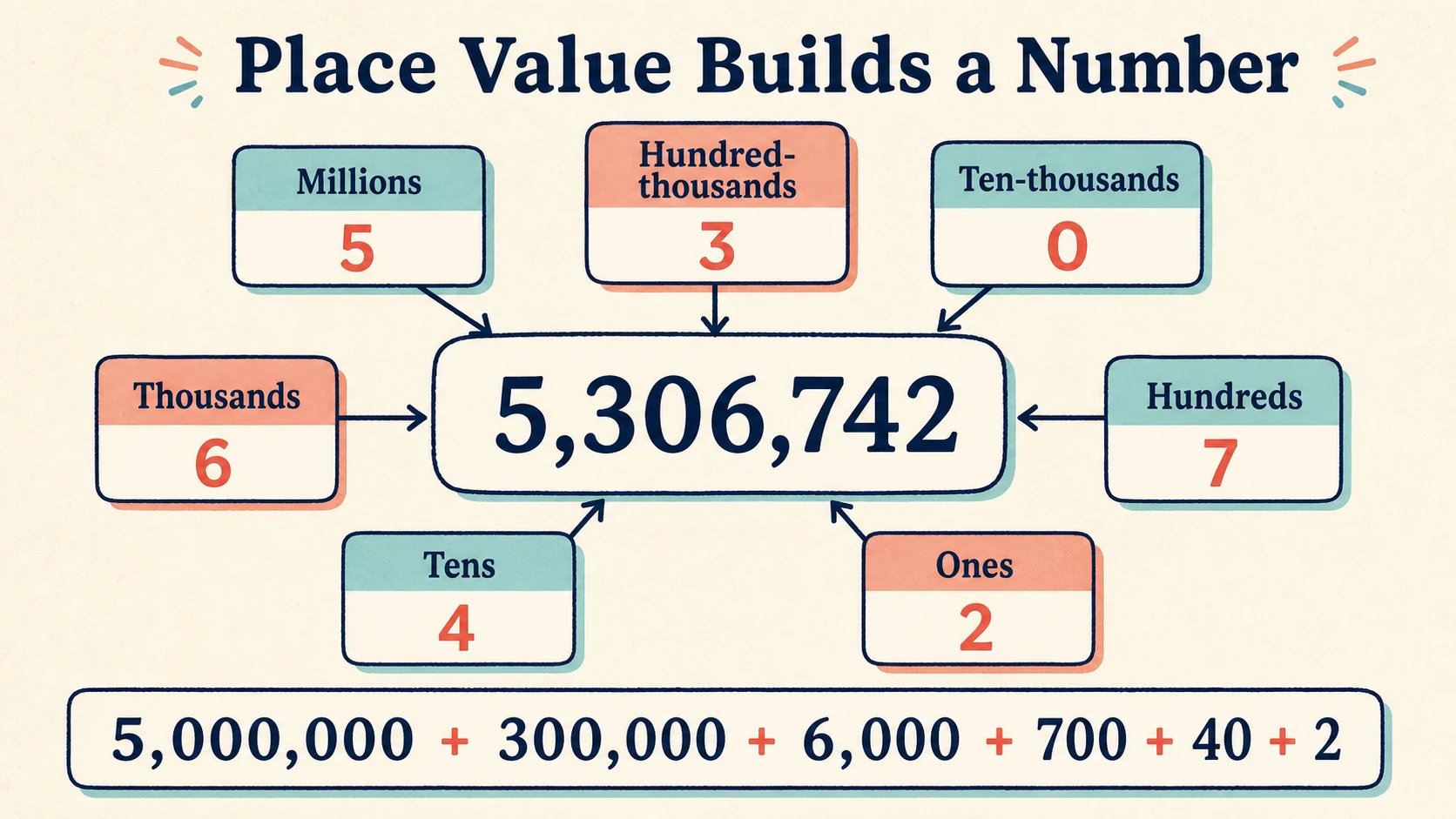
Place value links number form, comparison, rounding, and computation, but each branch still needs its own evidence of understanding.
The Common Core State Standards for Mathematics identify fourth-grade work involving multi-digit whole-number arithmetic, fraction equivalence and operations, decimal notation for fractions, measurement, and geometric reasoning. That source describes standards, not an evaluation of WorksheetWise. It is also not a substitute for checking a local curriculum’s order and emphasis.
Place value is a structural skill, not just number naming
The live place-value resource covers composing and decomposing numbers, standard form, expanded form, word form, comparison, ordering, and rounding. Those tasks are related, but success on one does not prove success on all of them.
Consider this checked example:
Write 47,306 in expanded form.
The correct decomposition is:
The tens digit is zero, so there is no term. Check by adding the parts:
This example belongs here because it tests whether the learner connects each digit to its positional value, including a zero placeholder. An answer such as suggests that the learner may be reading digits in sequence without accounting for their places. An answer of is mathematically valid; omitting the zero term is simply more concise.
Before moving to a larger number, ask: “What value does the 7 have, and how do you know?” A correct explanation—“It is in the thousands place, so it represents 7,000”—provides stronger evidence than a copied expansion.
Addition and subtraction share place-value demands but express different relationships
Addition combines quantities. Subtraction may represent removal, comparison, or a missing part. Treating subtraction as merely “addition backward” can obscure those distinct situations, even though related facts are valuable for checking.
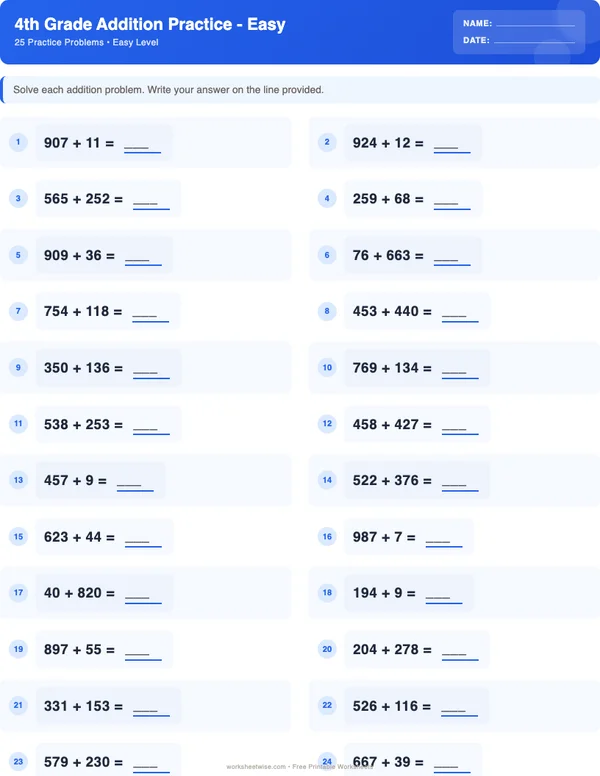
The catalogue’s fourth-grade addition and subtraction free sheets each contain 25 problems. That count may suit independent practice after a strategy is understood, but it is too much for an initial diagnostic look. Use three or four selected items first.
Multiplication and division require equal-group reasoning
Multiplication can be represented with equal groups, arrays, repeated addition, area models, or partial products. Division can ask either how many are in each group or how many groups can be made. Those interpretations should remain visible even when the same three numbers appear in a fact family.
For example, , , and are related equations. They do not tell identical stories. “Twenty-four counters shared among six children” asks for the size of each group. “Twenty-four counters placed four to a bag” asks for the number of bags.
Fractions and decimals extend place value in different ways
Fractions involve equal partitioning, number-line positions, comparison, and equivalence. Decimals use base-ten places to represent tenths and hundredths and can be connected to fractions with denominators of 10 and 100. A learner who reads correctly may still compare it incorrectly with , while a learner who recognizes one-fourth of a shape may not yet locate on a number line.
Geometry and word problems change what counts as evidence
Geometry requires attention to attributes, units, and spatial relationships. Word problems combine reading, representation, operation choice, computation, and interpretation. A wrong word-problem answer therefore does not automatically indicate a computation weakness. The adult must find where the reasoning changed course.
Begin with place value when regrouping or decimal comparison is unstable
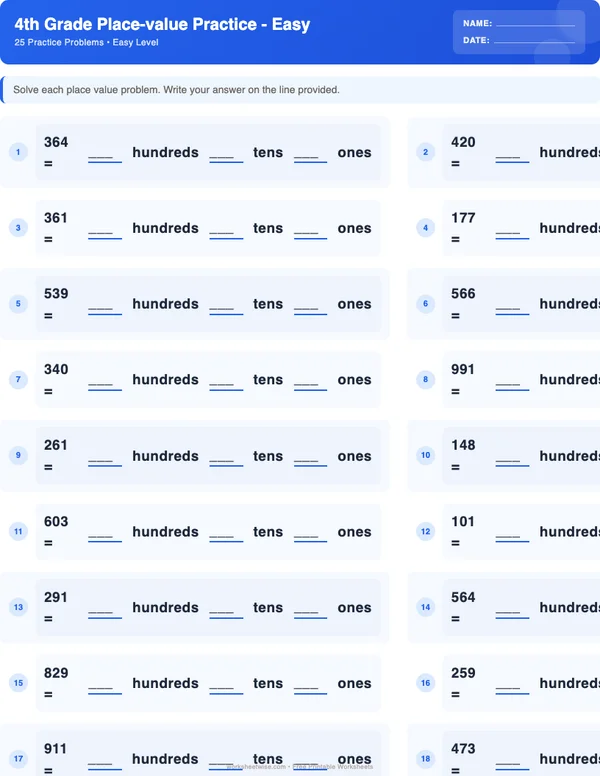
Use the 25-problem place-value entry sheet when the immediate target is number form, decomposition, comparison, ordering, or rounding. Do not assign it merely because place value “comes before” other topics. Choose it when the learner’s work gives a specific reason.
Useful signals include:
- Digits shift or disappear when numbers are copied.
- Expanded form records digits rather than their values.
- Regrouping is performed without an explanation of the exchanged unit.
- Decimal comparisons are based on the number of digits.
- Rounding answers do not identify the target place or nearby benchmarks.
A short place-value routine
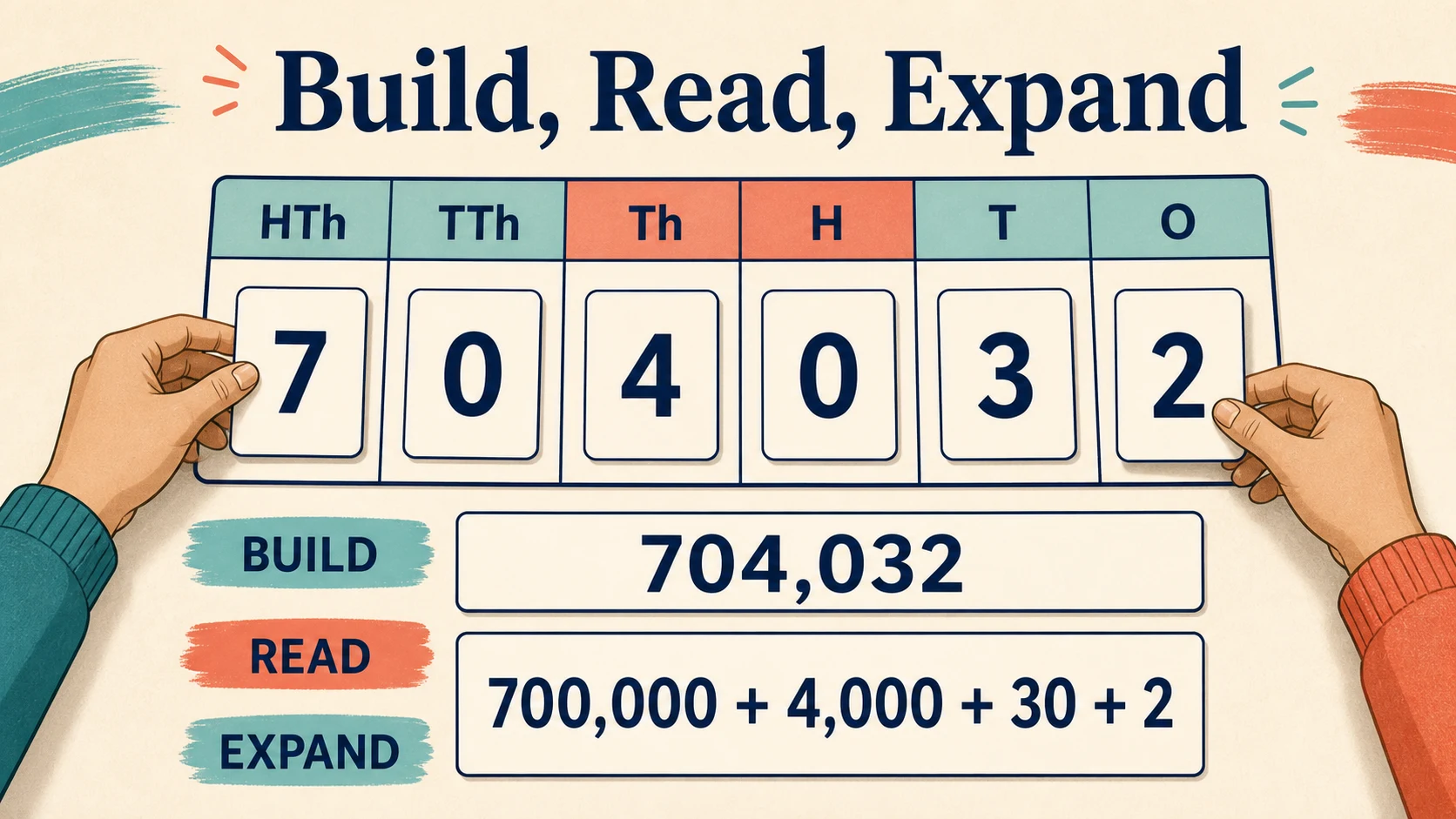
Use one number, one representation change, and one explanation before asking for repeated independent practice.
Try this eight- to twelve-minute routine:
- Write one number, such as .
- Ask the learner to read it and point to the digit named in a prompt: “Which digit represents 3,000?”
- Represent the number in a place-value chart or with place-value disks.
- Write one equivalent form: .
- Change one condition: “What is 10 times the value of the 8 in this number?”
- Ask for a spoken justification.
- Complete two matching worksheet items independently.
- Use the second response—not speed—to choose the next task.
The answer to step 5 is , because the 8 represents 80 and . If the learner answers 80, ask them to show one group of 80 and then ten such groups. Preserve the target by offering a chart; do not replace the question with an unrelated easier fact.
Separate addition accuracy from understanding of regrouping
The 4th Grade Addition guide and free sheet is a sensible entry point when the learner can identify place values but needs focused practice combining multi-digit quantities. Its 25 problems can provide repetition after a worked example and a brief independent check.
Consider:
Add by place:
- Ones: . Record 5 ones and regroup 10 ones as 1 ten.
- Tens: . Record 2 tens and regroup 10 tens as 1 hundred.
- Hundreds: . Record 2 hundreds and regroup 10 hundreds as 1 thousand.
- Thousands: .
Therefore:
Check by compensation:
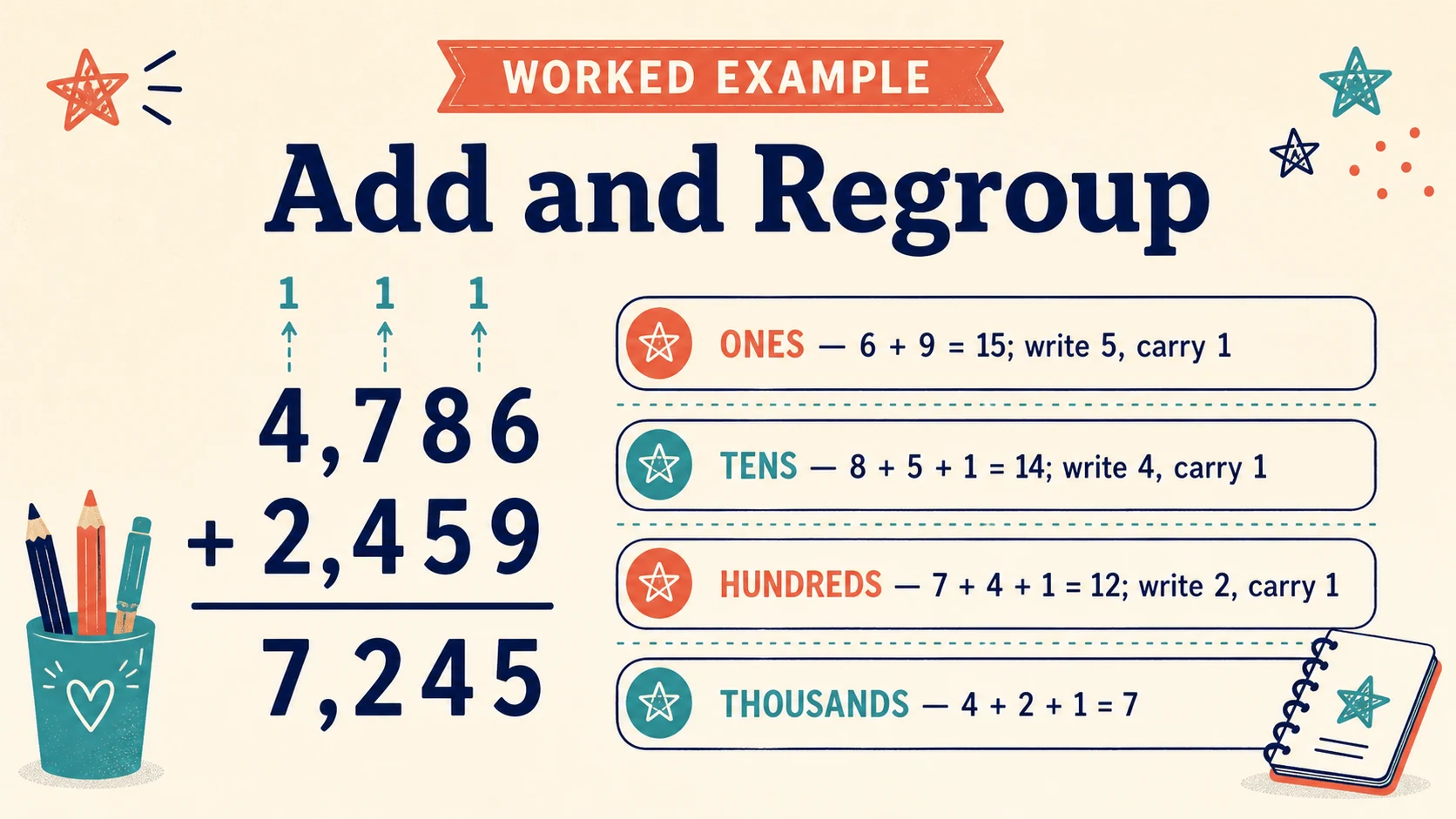
The representation should make each exchanged group visible before the compact algorithm carries the same idea symbolically.
This example belongs in fourth-grade practice because it joins place-value reasoning with several regrouping steps. If the learner writes 5 in the ones place but loses the regrouped ten, the issue is not necessarily fact recall; they may need a visible record of the exchange. If the columns drift, provide lined or graph paper. That adaptation preserves multi-digit addition while reducing a layout burden.
Do not immediately assign all 25 problems after an error. First ask the learner to estimate. Since is about and is about , a total near is reasonable. An answer such as 622 or 62,250 should trigger a place-value check before more repetition.
Use subtraction work to identify the meaning of an exchange
The 4th Grade Subtraction guide and free sheet is appropriate when the learner needs practice finding differences, comparing quantities, or handling missing parts. Its 25-problem free sheet should follow a check that the learner understands why regrouping preserves the total.
Solve:
Because the ones place cannot subtract from , an exchange must travel across the zero tens and zero hundreds:
- Exchange 1 thousand from 5 thousands, leaving 4 thousands and creating 10 hundreds.
- Exchange 1 of those hundreds, leaving 9 hundreds and creating 10 tens.
- Exchange 1 ten, leaving 9 tens and creating 12 ones.
- Ones: .
- Tens: .
- Hundreds: .
- Thousands: .
Thus:
Check with addition:
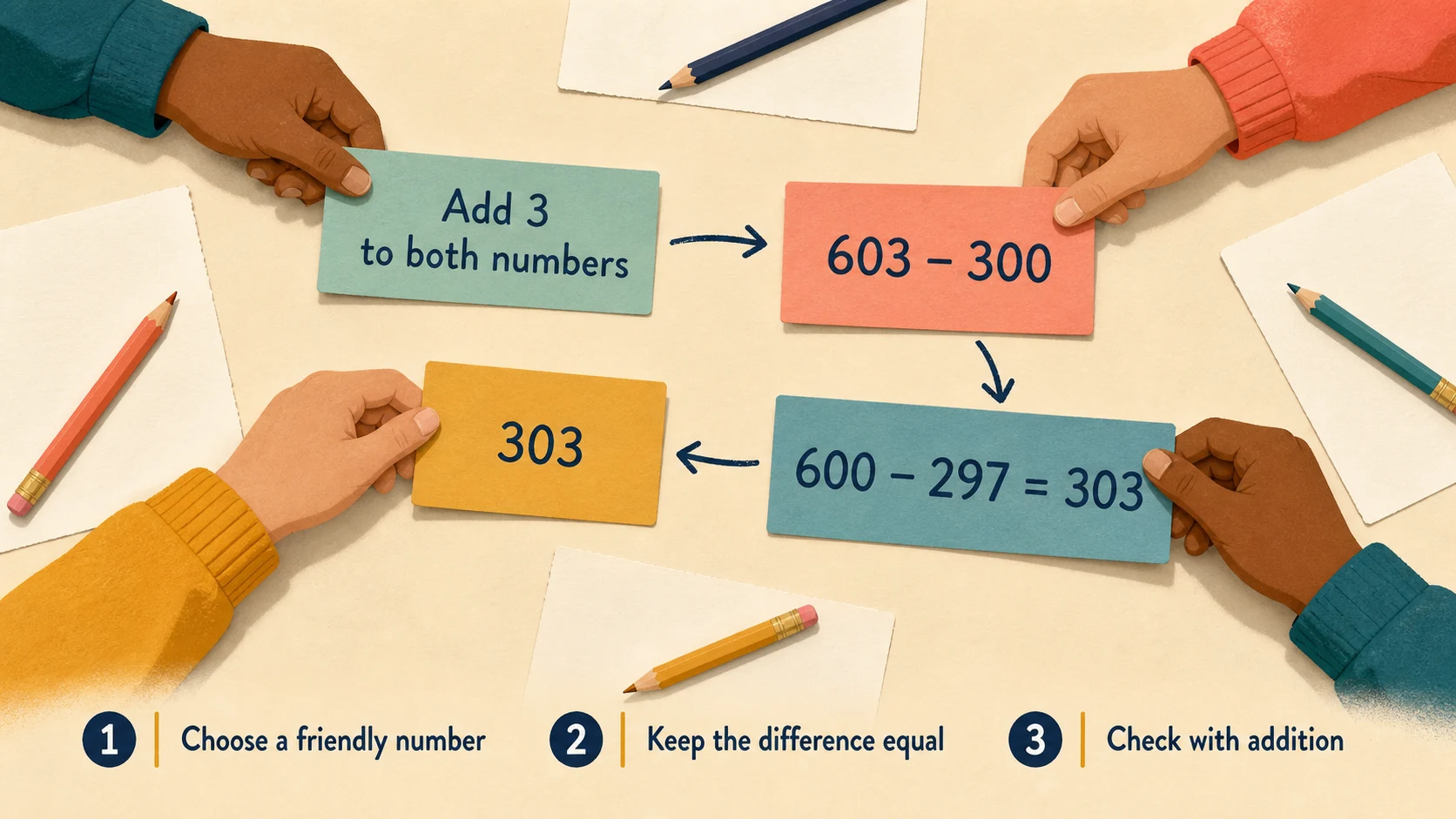
Crossing zeros is a place-value exchange problem, so pause for a model and an inverse-operation check.
This example belongs here because crossing internal zeros exposes whether regrouping is understood or merely imitated. If the learner subtracts the smaller digit from the larger digit in each column and obtains an incorrect result, ask them to represent 5,002 with place-value blocks or disks and physically exchange units. If they calculate correctly but cannot explain the exchanges, assign one more modeled item before independent repetition.
A useful adaptation is to preprint place-value columns. Do not remove the zeros or change to a no-regrouping problem if crossing zeros is the chosen target. Shorten the set instead: three carefully chosen examples provide better evidence than 25 completed through an unexamined rule.
Move from arrays to partial products in multiplication
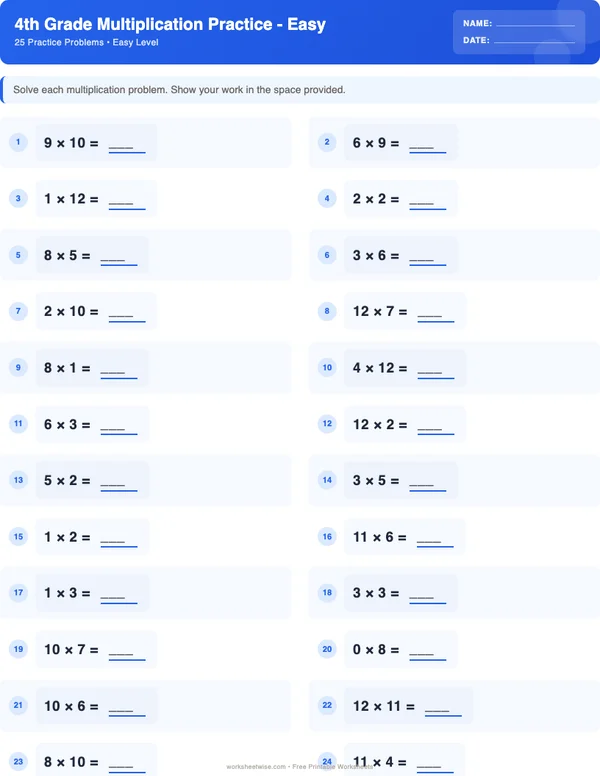
Use the 4th Grade Multiplication guide and free sheet when the learner understands equal groups and needs to connect that meaning to facts or multi-digit computation. The free entry sheet contains 25 problems, but the correct starting representation depends on the observed task feature.
Solve:
Decompose both factors:
Find the four partial products:
Combine them:
So:
Check by another decomposition:
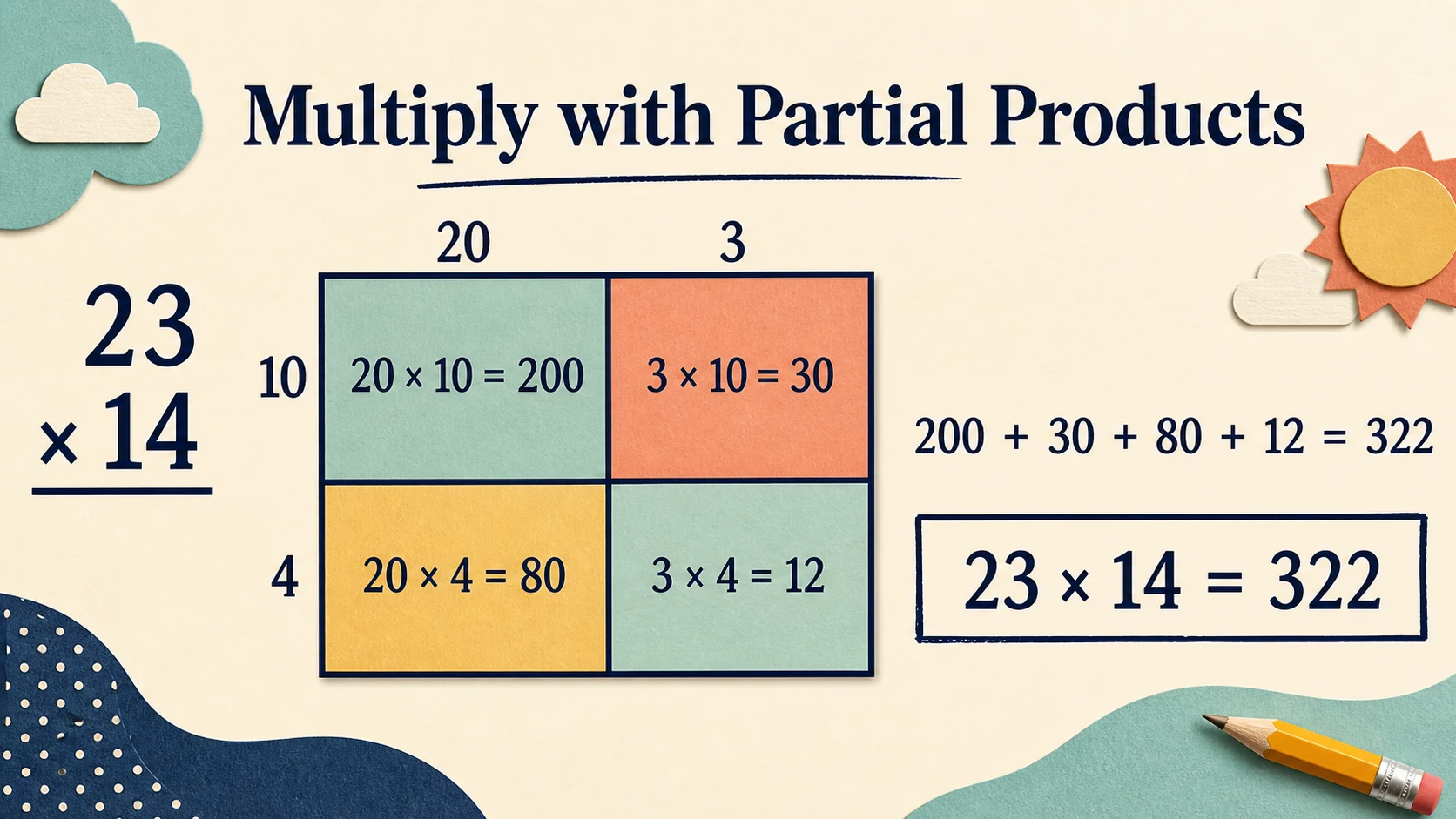
An area model makes all four partial products visible, including the easily omitted term.
This example belongs here because it bridges arrays, the distributive property, and multi-digit multiplication. A result of 292 may come from adding while omitting . That pattern calls for labeling every side length and every rectangle—not simply drilling more multiplication facts.
If the learner’s fact recall is slow but their model is correct, allow a multiplication chart while assessing whether they can decompose the factors. This preserves the target of partial-product reasoning. Remove the chart later when fact fluency becomes the bounded target.
The IES practice guide on assisting students who struggle with mathematics recommends systematic instruction that includes clear models, verbalization of mathematical thinking, representations, and cumulative review. That guidance supports using a model and asking for an explanation; it does not constitute an assessment of these worksheets.
Connect division to multiplication and interpret the remainder
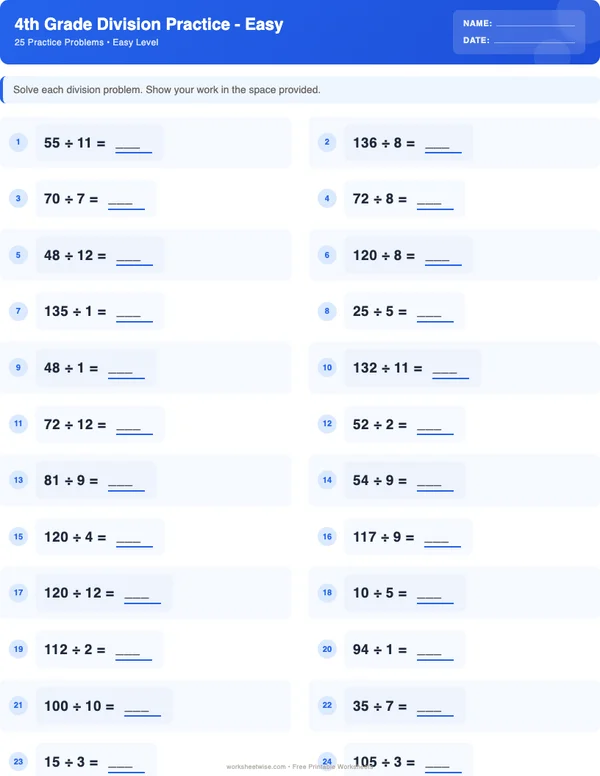
Division deserves its own selection decision even when multiplication facts are involved. Use the 4th Grade Division guide and free sheet when the target is equal sharing, making equal groups, fact-family reasoning, a division procedure, or interpreting remainders.
Consider:
A class has 53 notebooks. Each table receives 6 notebooks. How many tables can receive a full set, and how many notebooks remain?
Find the greatest multiple of 6 that does not exceed 53:
Then:
Therefore:
Eight tables receive full sets, with five notebooks remaining. Check:
This example belongs here because the remainder has to be interpreted in context. If the question instead asked how many boxes were needed to hold all 53 notebooks, with six notebooks per box, the answer would be nine boxes: eight full boxes and one partly filled box. The calculation is related, but the decision changes.
An answer of “8 R5 tables” shows incomplete interpretation even if the computation is correct. Ask, “What does the 5 count?” If the learner cannot answer, return to counters grouped in sixes. Keep the numbers and context; the manipulation supports the intended division reasoning.
Compare fractions and decimals with a common representation
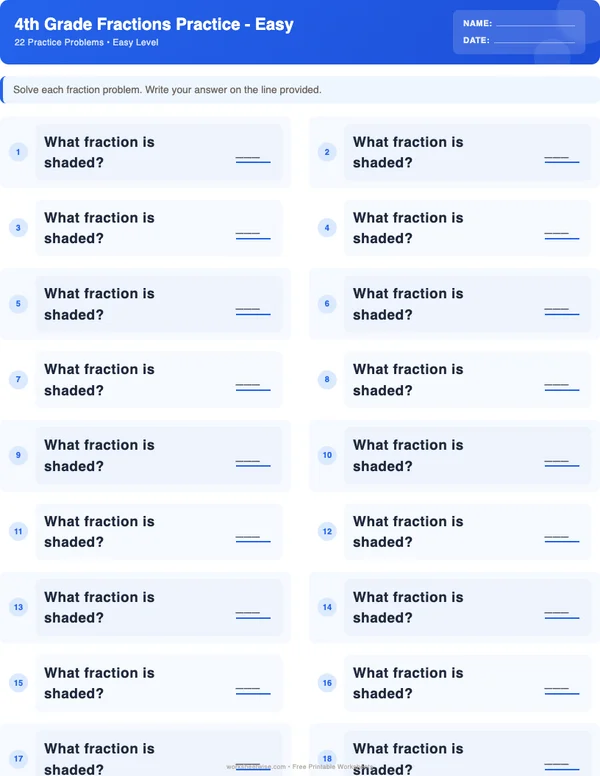
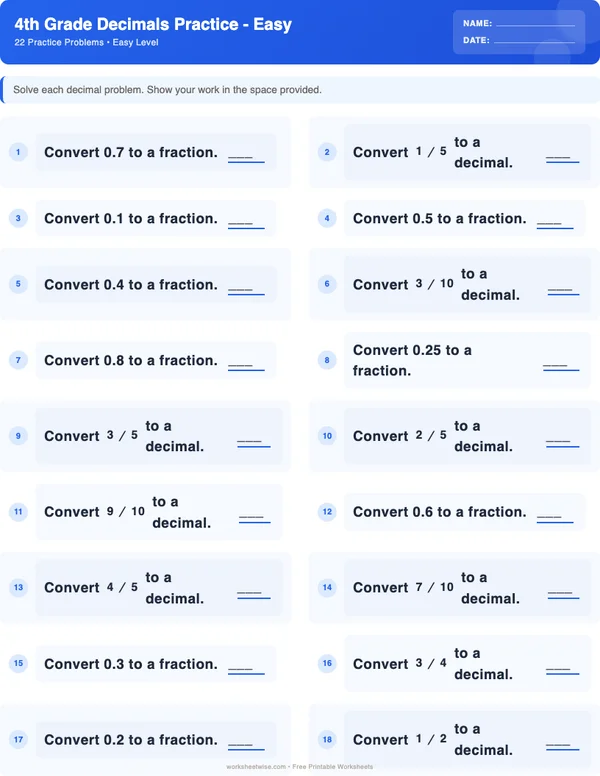
The live fractions and decimals entry sheets each contain 22 problems. Use the 4th Grade Fractions guide and free sheet for equal parts, number-line positions, comparisons, equivalence, or fraction operations. Use the 4th Grade Decimals guide and free sheet for tenths, hundredths, decimal comparison, conversions, rounding, or decimal computation.
Checked fraction comparison
Compare:
Rename fourths as eighths:
Since:
it follows that:
A fraction strip or number line confirms the result. This example belongs here because the fractions have different denominators but a convenient common unit. If the learner says is larger because 5 and 8 are larger than 3 and 4, the error suggests whole-number reasoning is being applied separately to the numerator and denominator. Ask the learner to partition equal-length strips into fourths and eighths.
Checked decimal comparison
Compare and . Write both to the hundredths place:
Now compare:
Therefore:
This example belongs here because it tests decimal place value rather than string length. If the learner selects as greater because 36 is greater than 4, use a hundredths grid or connect the values to 36 cents and 40 cents. The money context is a representation, not proof that every decimal task should be taught through currency.
Preserve the comparison target by allowing fraction strips, number lines, or hundredths grids. Do not turn the task into isolated numerator facts or whole-number comparison.
Keep geometry grounded in attributes and units
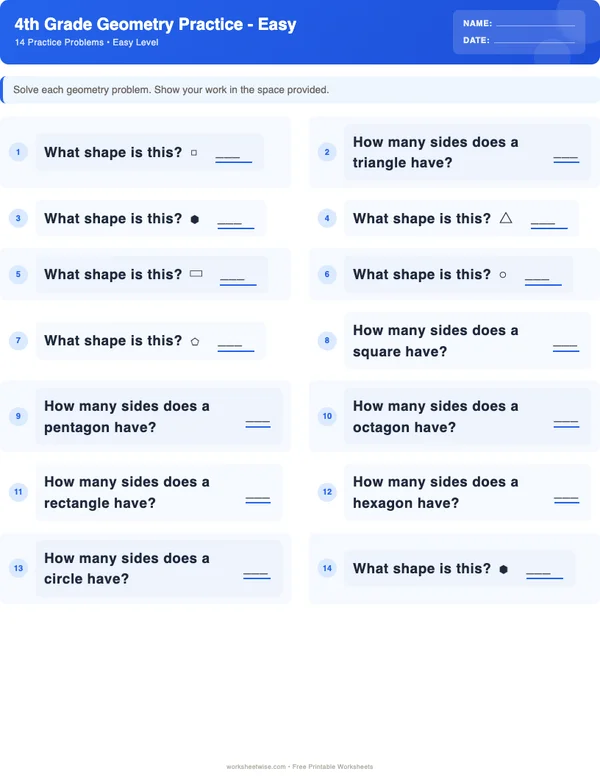
The geometry free sheet contains 25 problems across the catalogue topic’s broader scope: shape attributes, symmetry, area, perimeter, volume, angles, and coordinate geometry. Inspect the actual sheet before assigning it; those subskills are not interchangeable.
Try this checked comparison:
A rectangle has length units and width units.
The different units matter. Area counts unit squares covering the interior; perimeter measures distance around the boundary. This example belongs here because fourth-grade geometry practice often requires the learner to coordinate multiplication with a spatial meaning.
If the learner answers 24 for both measures, build the rectangle on grid paper. Shade the 24 squares, then trace and count the 22 boundary units. If the formulas are remembered but the units are reversed, ask, “Would tiles cover this quantity, or would a piece of string measure it?” That question preserves the geometric distinction without supplying the operation.
Treat word problems as relationship-reading tasks
The word-problems entry sheet has 14 problems, fewer than the 22- or 25-problem topic sheets. Problem count alone does not determine demand: each item can require reading, selecting information, representing a relationship, calculating, and interpreting the result.
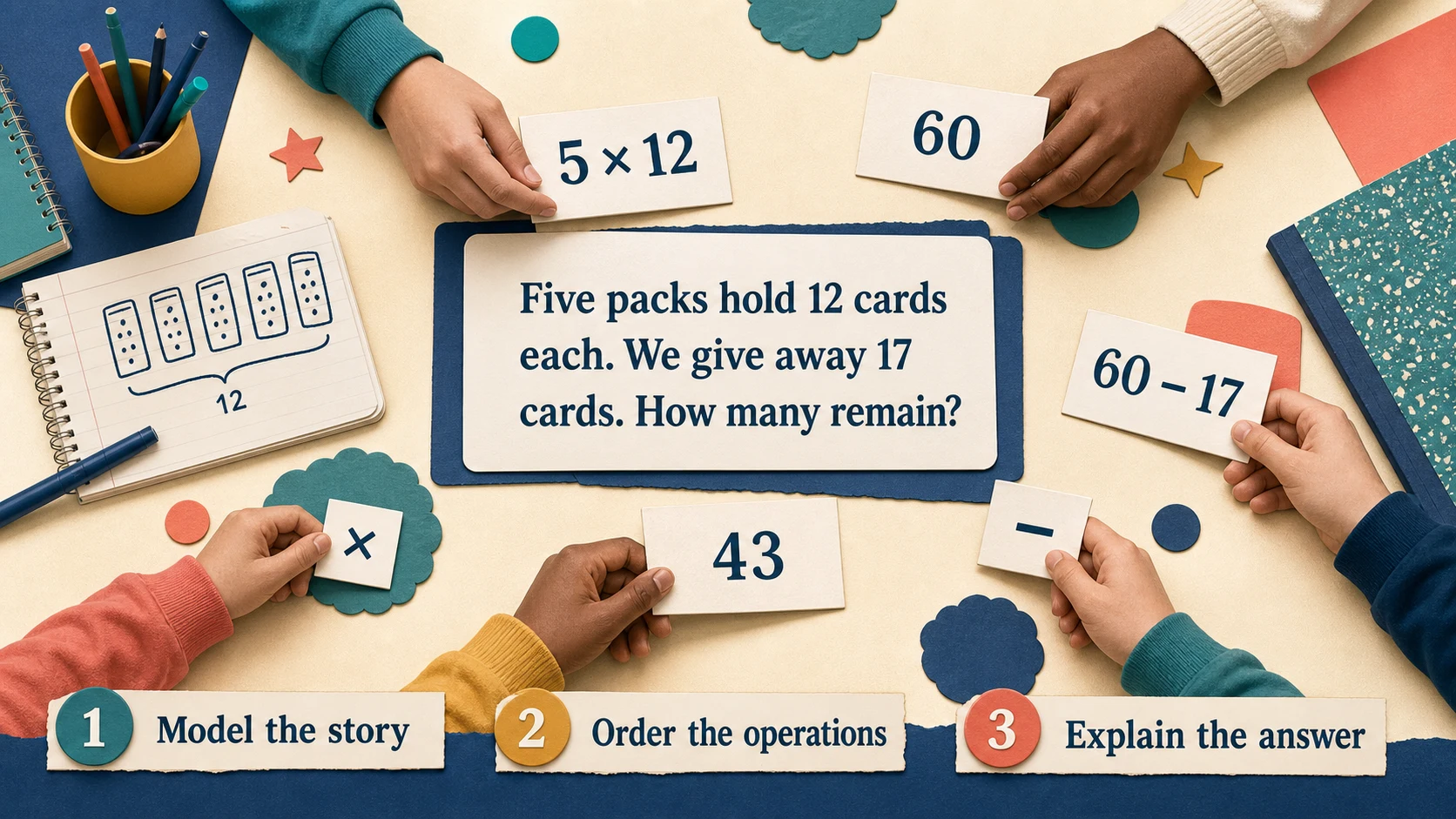
Retell, represent, solve, and check; operation selection should follow understanding of the quantities.
Use this routine:
- Read the full problem without calculating.
- Retell what is happening.
- Name what is known and what must be found.
- Draw a bar model, array, diagram, or table.
- Write an equation.
- Solve.
- State the answer with a unit.
- Check whether the answer fits the situation.
Avoid assigning operations from keywords alone. “Left” does not always mean subtract, and “in all” does not remove the need to understand the relationship.
The IES guide Teaching Math to Young Children emphasizes mathematical language, representations, patterns, and integrating mathematics into everyday activities. Although that guide addresses younger children rather than fourth-grade placement, its emphasis supports asking learners to describe quantities and show relationships. It did not review WorksheetWise.
For ages three and four, if an adult explores earlier mathematical ideas through the broader worksheet library, prioritize brief adult-led oral, matching, manipulative, and movement activities over desk work. Age remains a discovery aid, not a placement decision. That early-years guidance should not be used to infer that a fourth-grade sheet suits a young child.
Read errors as evidence, not diagnoses
A worksheet response can indicate where to look next, but one error cannot establish a diagnosis. Record the problem, the learner’s representation, the answer, and a brief explanation in their own words.
Errors that point back to representation
Return to a model when the learner:
- Treats digits independently of place.
- Regroups without preserving the total.
- Omits one region in a multiplication area model.
- Cannot explain what a division remainder counts.
- Compares fractions by numerator or denominator size alone.
- Compares decimals by the number of digits.
- Uses area and perimeter as interchangeable labels.
Errors that may reflect execution rather than concept
A learner may choose the correct operation and representation but make one arithmetic slip. Ask them to estimate, recalculate using another method, or use the inverse operation. If they independently locate and repair the error, the next task can remain on the same skill with slightly less support.
Errors caused by task access
Crowded columns, dense directions, handwriting demands, or unfamiliar vocabulary can obscure the mathematical target. Suitable adaptations include graph paper, enlarged print, one problem displayed at a time, oral reading of directions, manipulatives, or reduced problem quantity.
These adaptations preserve the target when they remove an unrelated obstacle. Reading a word problem aloud is appropriate when mathematical modeling—not independent reading—is being observed. Supplying the operation would change the target if operation selection is the skill under review.
Use a repeatable worksheet routine instead of assigning the whole page automatically
A practical session can take 15 to 25 minutes:
Preview one target
State the target as an action: “Today we will explain exchanges across zeros,” not “Today we will do subtraction.”
Model one example
The adult solves while naming decisions and showing a representation. Keep the explanation specific to the selected skill.
Solve one together
Ask the learner to choose the next step and explain why. Prompt with questions rather than completing the reasoning.
Try two independently
Two adjacent items often reveal more than a long set completed with fading attention. Check both the answer and the method.
Respond to the pattern
- Two accurate, explained solutions: continue with a short set or introduce one controlled variation.
- One accurate and one incorrect solution: compare the two methods and try one parallel item.
- Two incorrect solutions with the same pattern: return to a model.
- Different errors: reduce the number of simultaneous demands and identify the first point of divergence.
Close with a visible next decision
Write one sentence: “Next time, compare decimals to hundredths using a grid,” or “Next time, solve division facts without counters but keep the multiplication check.” This turns completed work into a selection tool.
For a classroom check, the formative assessment math worksheets can help organize brief evidence gathering. Use them to observe current work, not to attach a fixed ability label or predict an outcome.
Set boundaries around what a worksheet can establish
A worksheet can provide structured practice and a sample of written performance. It cannot, by itself, explain why an error occurred, establish mastery across contexts, diagnose a learning condition, or guarantee progress.
Answer keys can confirm final answers quickly, but adults should also inspect representations, units, explanations, and corrections. A correct answer obtained through an unreliable rule may need another example. An incorrect answer paired with sound reasoning and one arithmetic slip needs a different response from a misconception.
The catalogue facts establish nine free entry points and the stated problem counts. They do not establish completion times, research outcomes, standards mastery, or suitability for every fourth-grade learner. Likewise, a Common Core target on a worksheet does not prove that completing the sheet demonstrates full mastery of that standard.
Make the next worksheet earn its place
Take one recent piece of learner work and identify the first step that became uncertain. Choose the matching topic—not the broadest possible review—and preview three items before printing or assigning the full sheet.
If no recent work is available, begin with the free 4th Grade Place Value guide and sheet. Ask the learner to decompose one number, compare two numbers, and explain one rounding decision. Use that evidence immediately: stay with place value if positional reasoning is uncertain, or move to addition, subtraction, multiplication, fractions, decimals, geometry, division, or word problems only when the observed work gives a specific reason.
Put it into practice
Use the guide with a real printable
Move from explanation to a short, observable practice task. Check the first item together, then adjust the next session from the learner's actual work.
Open the first free worksheet