20 free PDFs with answer keys
1st Grade worksheets
Choose only from subjects and skills with real files in the current 1st Grade catalogue. Start with the free standard sheet, then add more practice only if you need it.
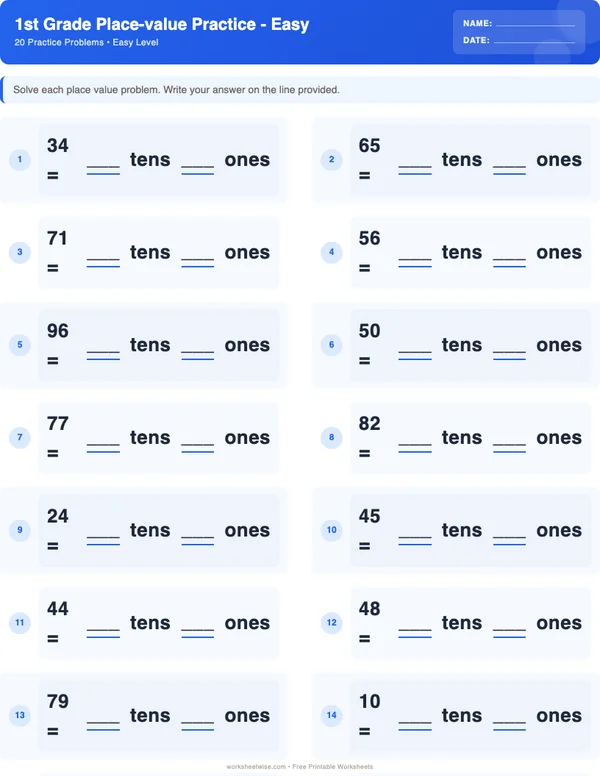
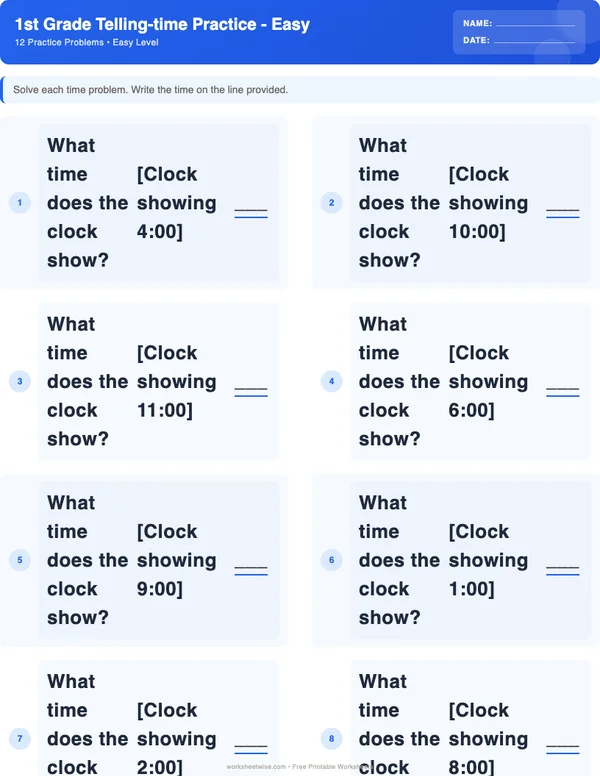
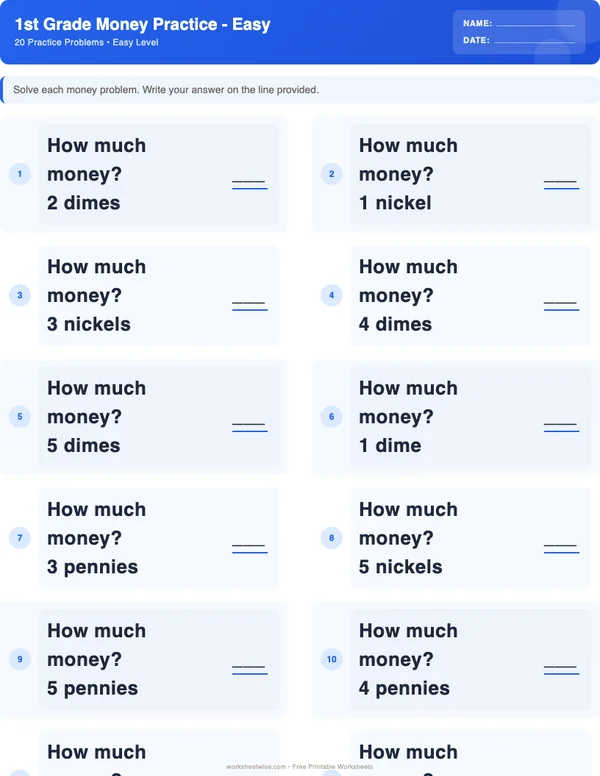
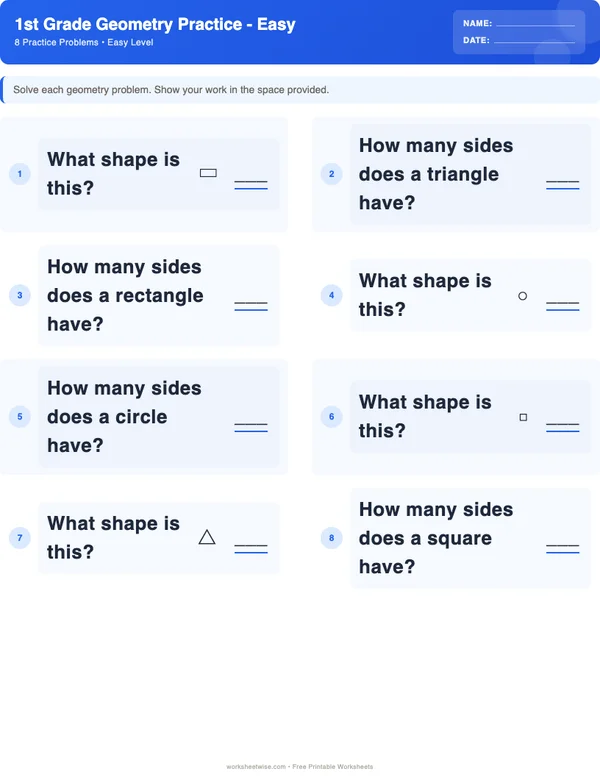
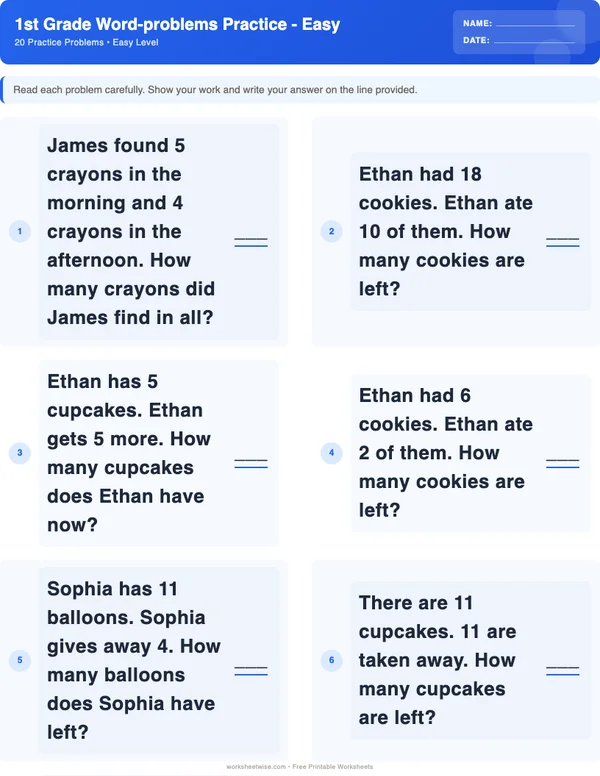
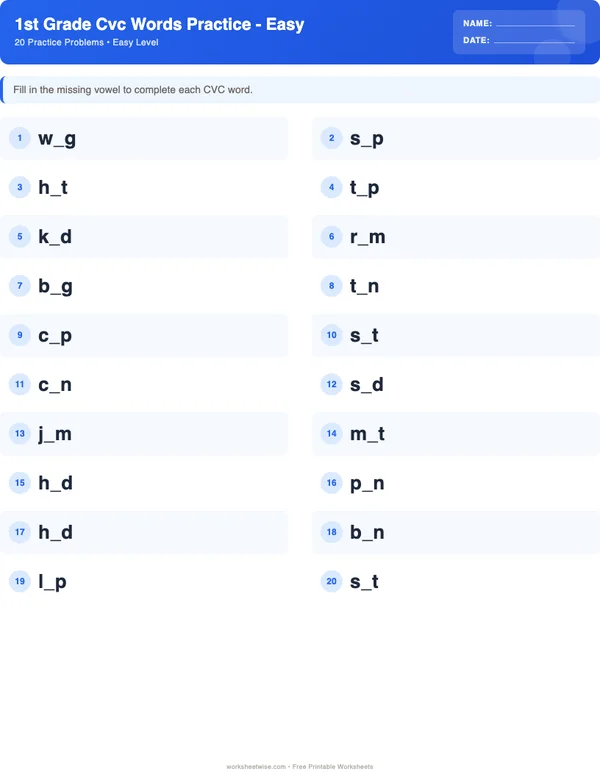
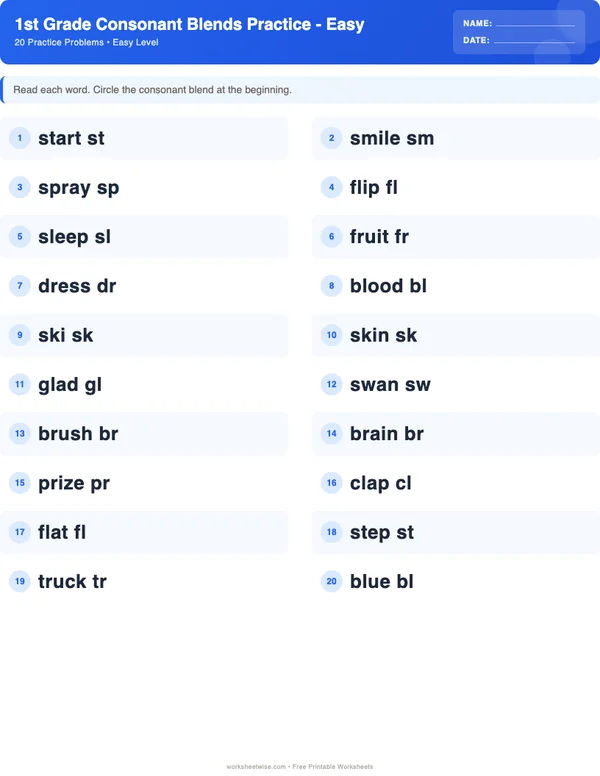
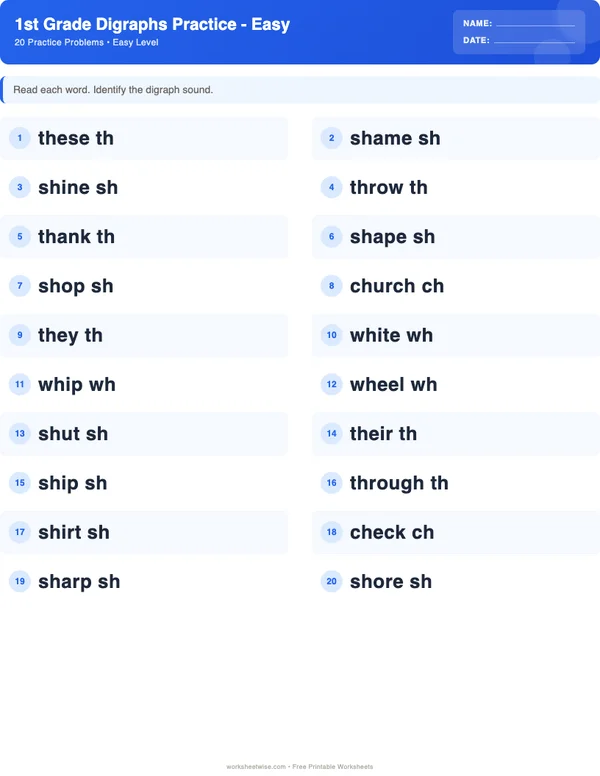
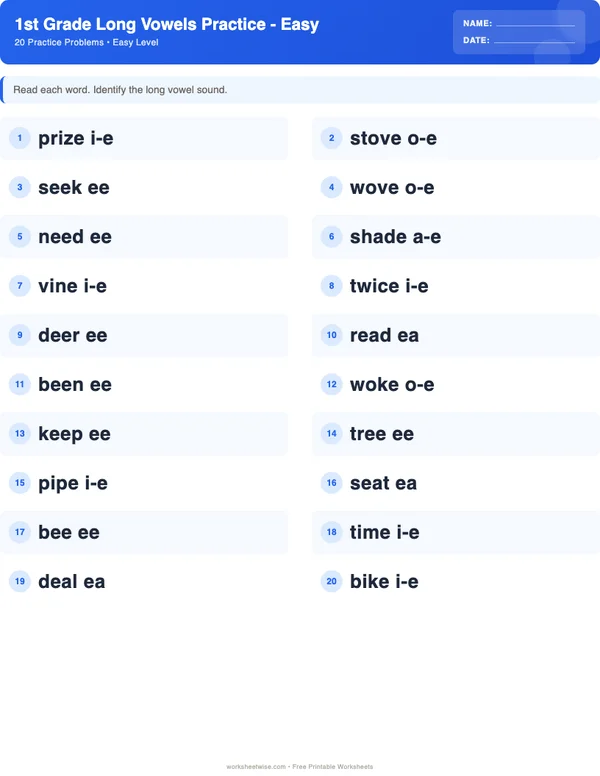
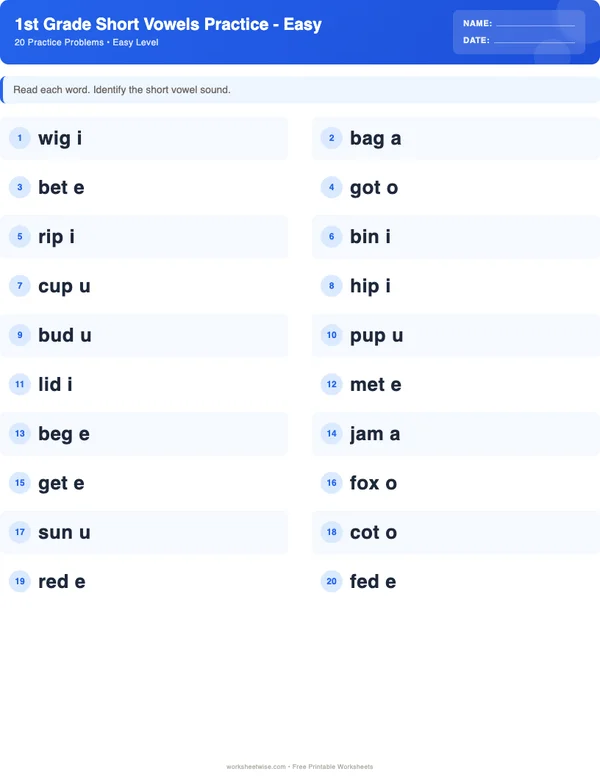
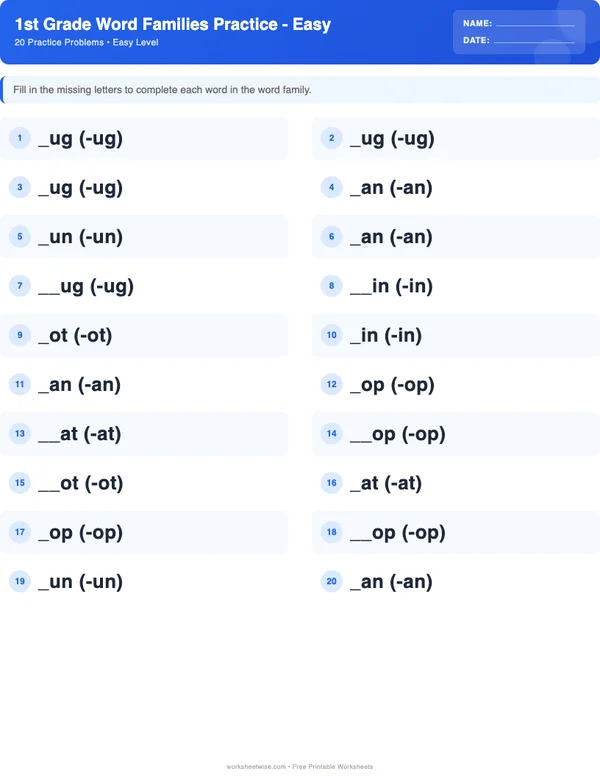
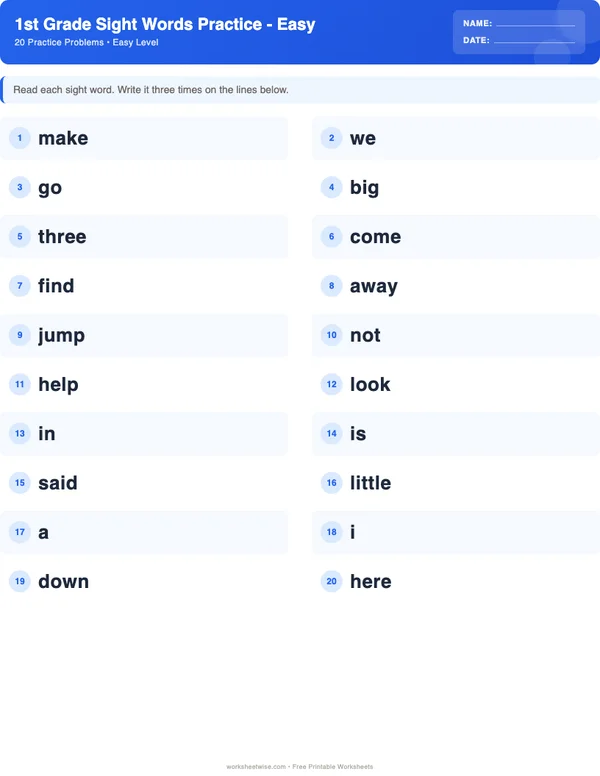
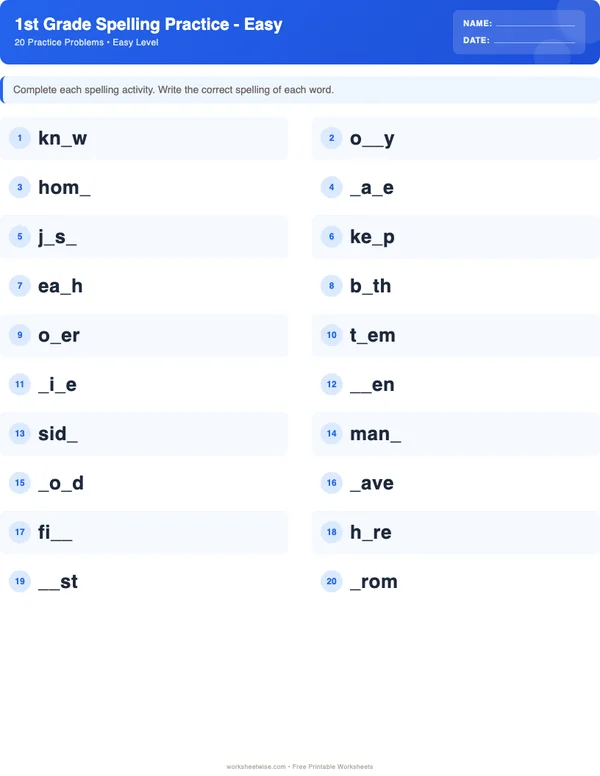
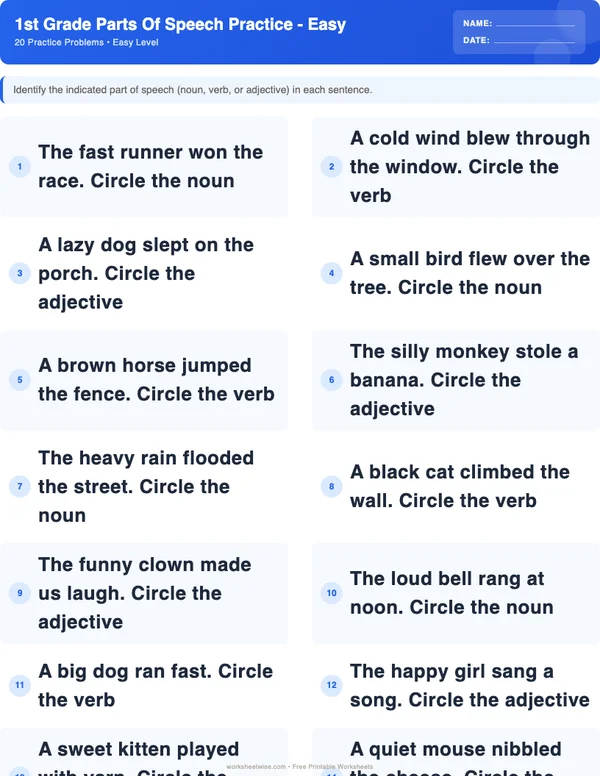
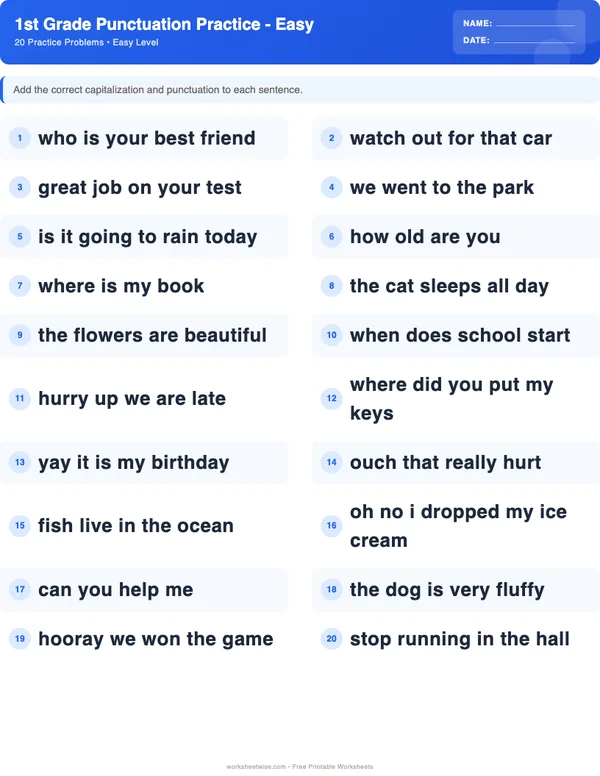
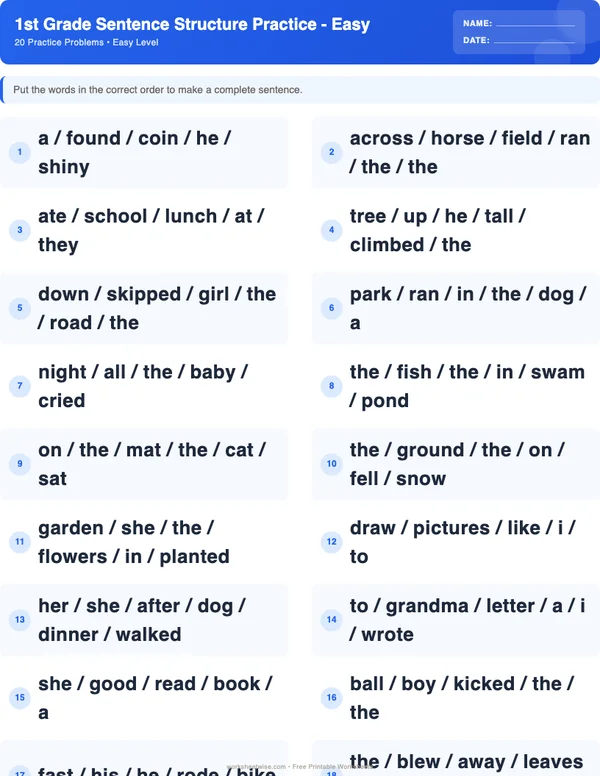
Complete guide
How to teach and practise 1st grade worksheets
3,496 words Updated 6 instructional visuals
Choose first-grade practice by what the child can show
The best first-grade worksheet is not simply one labeled “1st Grade.” Choose it by watching how the child handles the exact demand: Can they explain a strategy, use the representation on the page, and complete several items without repeated prompting? Those observations tell you whether to step back, provide a temporary support, continue at the same level, or introduce the next variation.
WorksheetWise’s live first-grade catalogue currently contains 360 variants across four subjects and 20 topics, with 20 free entry points. That breadth is useful only when selection remains focused. Begin with one current need—such as blending consonant clusters, representing tens and ones, or deciding whether a story calls for addition or subtraction. Preview the page, complete a few items, inspect the work, and then make one deliberate next choice.
Grade labels describe an intended practice level; local curriculum sequences differ. They do not establish placement, readiness, or a diagnosis. Age is also a discovery aid rather than a placement decision. A family browsing worksheets for 6-year-olds should still select from observed strategy, representation, and independence. For ages three and four, prioritize brief adult-led oral, matching, manipulative, and movement work over desk work.
Establish the readiness boundary before printing
First-grade work commonly builds from secure oral language, letter-sound knowledge, CVC decoding, one-to-one counting, and small-quantity reasoning. A child does not need every earlier skill to be flawless. They do need enough control of the prerequisite that the worksheet’s new target remains visible.
Use three readiness questions:
- Strategy: What does the child do when the answer is not immediate? A useful strategy might be sounding through a word, counting on, drawing a model, or physically making two groups.
- Representation: Can the child interpret the page’s pictures, numerals, clock faces, equations, or word boxes?
- Independence: After one modeled item, can the child begin the next item without being told each step?
Suppose a page asks the child to read stop, spin, and step. If the child can blend top, pin, and pet but drops the first sound in every blend, the target is well chosen: CVC reading is available, and the new demand is retaining an additional consonant. If the child cannot blend the simpler words, return to CVC work. If all three blend words are read instantly and accurately in sentences, isolated matching practice may be too narrow; connected reading or spelling is the more useful next demand.
The IES foundational reading guide recommends explicit work with sound segments, sound-letter relationships, decoding, and connected text. That guidance supports a sequence from oral analysis to word reading and then text use; it does not constitute an assessment of WorksheetWise materials.
Track how demands change across first grade
First grade is not a single difficulty level. Early work may ask a child to act, match, trace, count, or blend with visible support. Later work can require choosing a strategy, holding more information in mind, explaining a relationship, or transferring a skill into a sentence or story problem.
Reading moves beyond one short-vowel word at a time
A practical phonics progression begins with hearing and representing the sounds in CVC words such as cat, pin, and hug. It then adds short-vowel contrasts, consonant blends, digraphs, silent-e words, vowel teams, and eventually longer words and connected text. The important change is not merely word length. Children must notice which letters retain separate sounds and which letters work together.
In stop, four letters represent four sounds: /s/ /t/ /o/ /p/. In shop, four letters represent three sounds because sh represents one sound. This checked contrast belongs in first-grade practice because the catalogue includes both consonant blends and digraphs, and confusing those patterns changes how a child blends the word.
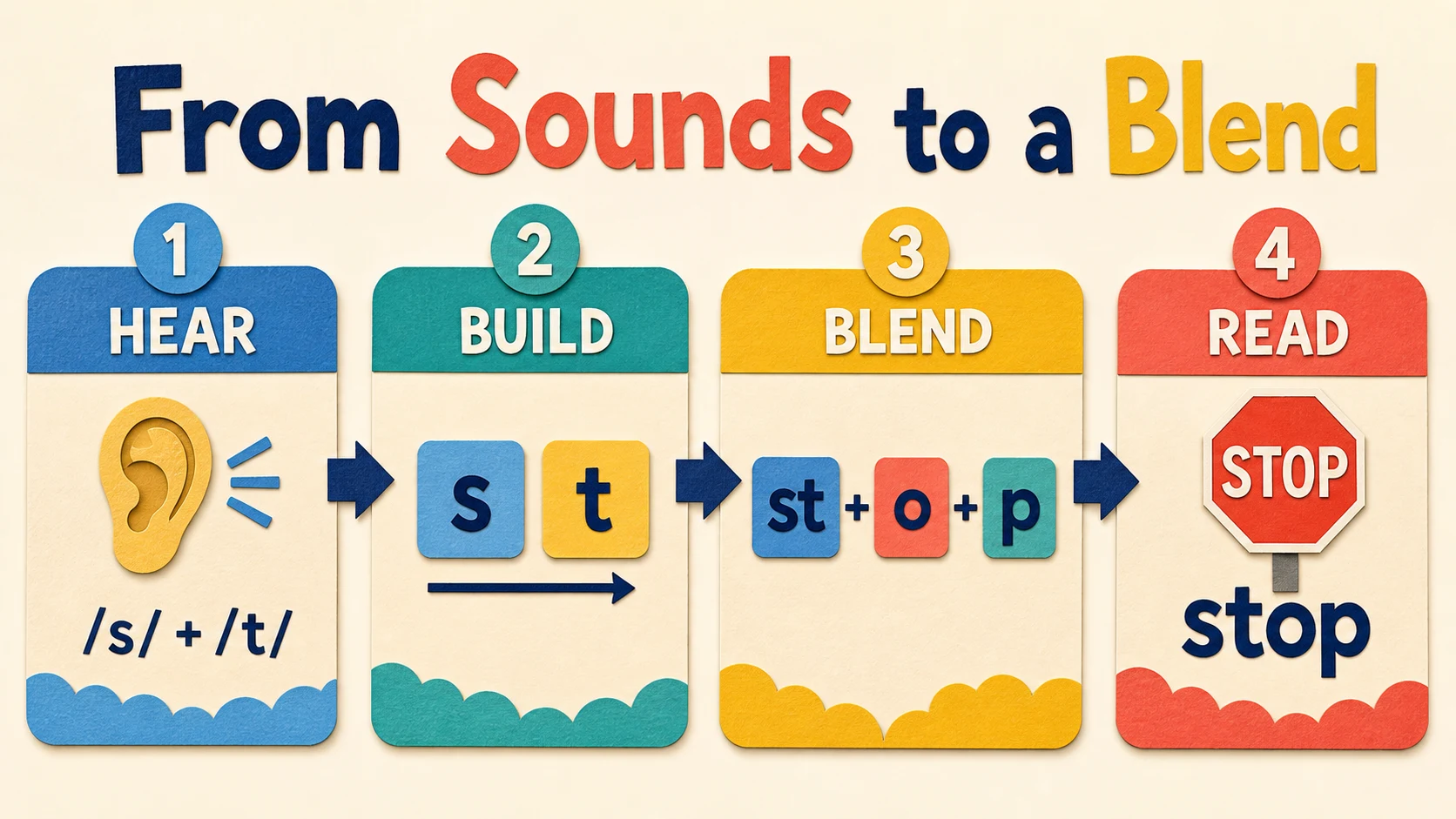
A first-grade blend sequence should remove support only after the child can retain both consonant sounds in a whole word.
A useful word-family example is at → cat → flat. The base pattern remains visible while one consonant and then a blend are added. Check the sounds aloud: cat has three phonemes, while flat has four; neither requires a digraph or long-vowel rule. That makes the chain appropriate when the child reads CVC words but needs practice holding an initial blend.
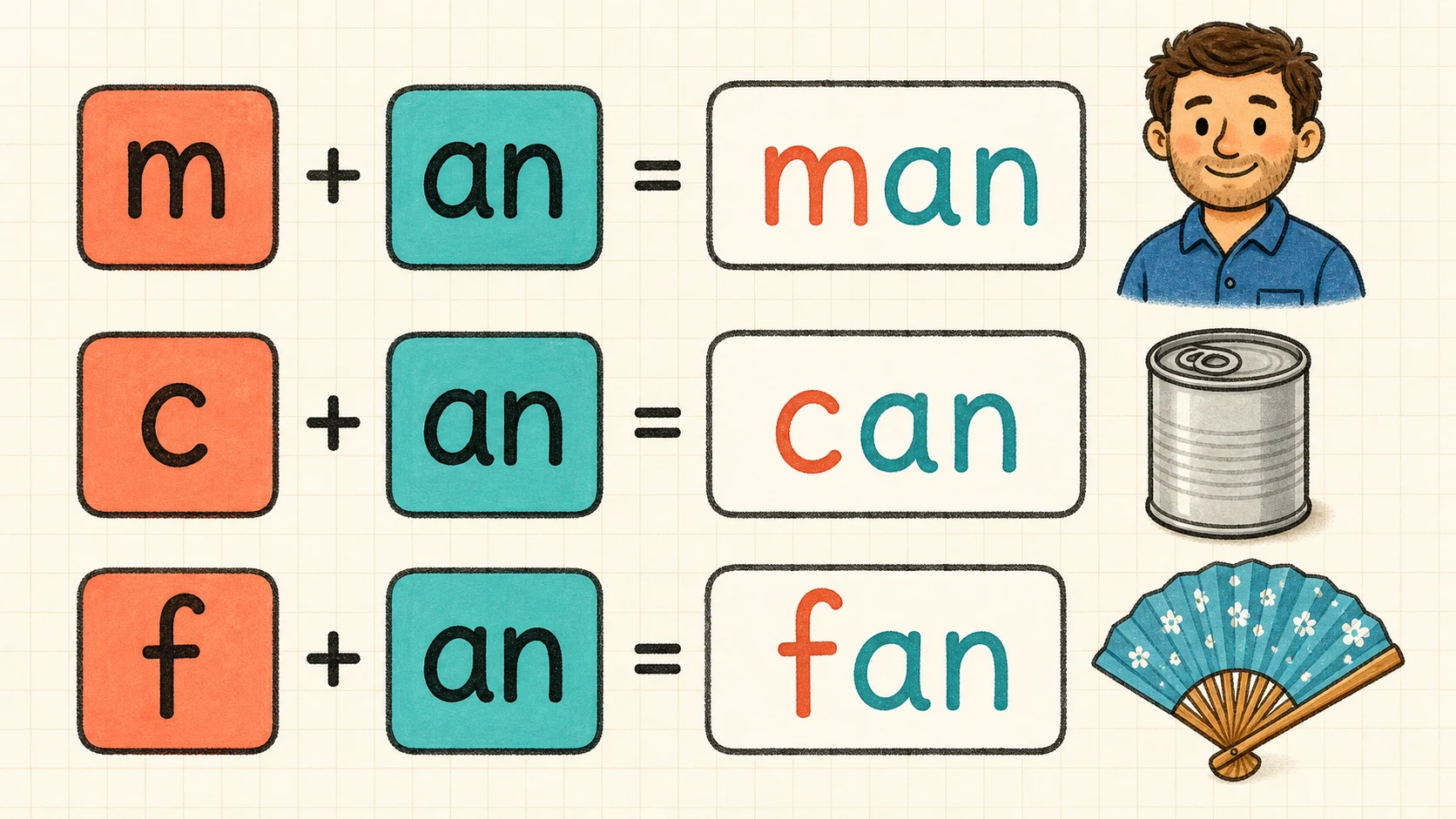
Changing one controlled feature at a time lets an adult see whether the vowel pattern, added consonant, or blending process caused the error.
Do not treat a memorized list as proof of decoding. Ask the child to read a familiar pattern in an unfamiliar word, build a dictated word with letters, and then read the word in a short sentence. Nonsense words can reveal whether a child is applying a pattern, but explain that the item is a pretend word so vocabulary knowledge is not confused with decoding.
Math shifts from quantities to relationships
Early first-grade mathematics should keep quantities visible. Children can count objects, join or remove counters, organize ten frames, bundle groups of ten, and compare lengths directly. As understanding strengthens, pictures and equations can replace some of the physical materials.
Consider . A child may place eight counters on two ten frames, move two counters from the group of five to complete ten, and see . The arithmetic checks: , five decomposes into two and three, and . This example belongs in first grade because it works within 20 and makes “make ten” visible instead of requiring recall alone.
The IES guide to teaching mathematics to young children emphasizes developmental progressions, monitoring children’s mathematical understanding, and helping them view and describe their world mathematically. The Common Core mathematics standards also describe first-grade work involving addition and subtraction within 20, place value, measurement, time, and shape composition. These are reference points, not claims that every locality teaches each topic in the same month.
Writing turns sentence knowledge into purposeful composition
A child may first need to say a complete sentence orally, count its words, and arrange word cards. The next demand is writing the sentence with a capital letter, spaces, and an ending mark. Later, the child can connect two or more sentences for a narrative, opinion, or informational purpose.
For example, start with the oral statement, “The red fox runs.” It has a naming part (The red fox) and an action (runs). The written version requires a capital T, spaces between four words, and a period. “Red fox runs” may communicate an idea, but it omits the determiner used in the modeled sentence; “The red fox.” has capitalization and punctuation but lacks an action. These different work samples require different responses.
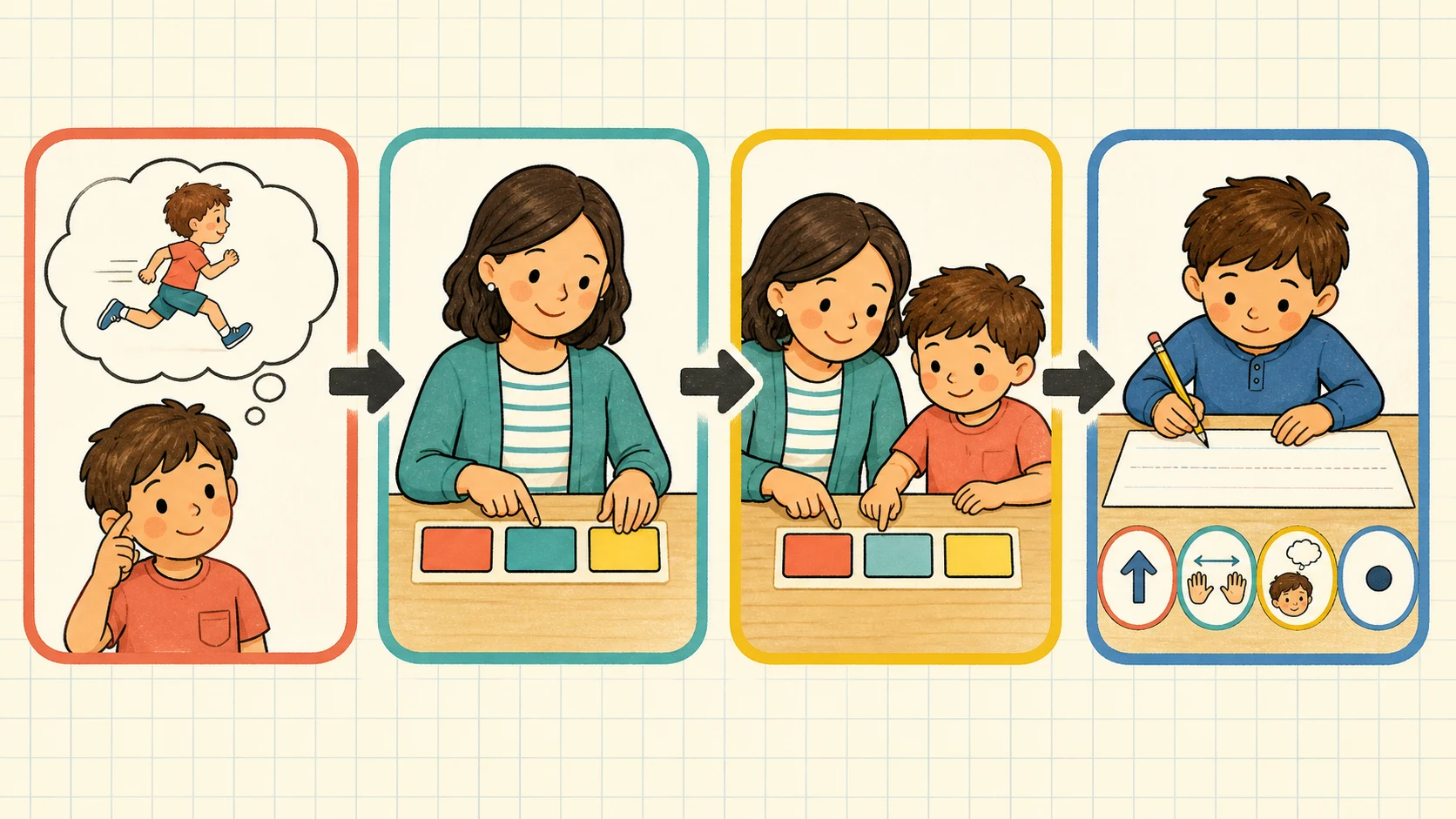
A repeatable say-build-write-read routine separates sentence formation from handwriting load while preserving the goal of producing a complete thought.
The IES elementary writing guide recommends daily writing time, explicit instruction in the writing process, fluency with foundational writing skills, and an engaged community of writers. At home, that can mean a short, purposeful note rather than a long copying session.
Preview the task before handing it over
A two-minute preview prevents adults from discovering halfway through a page that it combines several unready demands.
Inspect the directions and the response mode
First, identify the page’s actual target. “Circle the word that names the picture” may test decoding plus vocabulary and picture interpretation. “Write the missing number” may require numeral formation as well as sequence knowledge. If handwriting is not the target, allow pointing, movable number cards, or oral answers during the preview.
Next, complete one item yourself. Verify that the directions match what the item requires and that the answer is unambiguous. Check whether crowded layout, small type, unfamiliar illustrations, or a large problem set could conceal what the child knows.
The catalogue’s representative free sheets vary in length: the listed fractions sheet has six problems, telling time and word-problem sheets have 12, and many counting, operation, place-value, money, geometry, and phonics sheets have 20. Problem count is not a measure of instructional value. A six-item page can be demanding if each item requires careful partitioning and explanation; 20 familiar matches may be manageable in shorter sets.
Define difficulty through visible features
The catalogue identifies the representative free sheets as “easy,” but that word describes task features, not a learner. For selection purposes, define the entry level observably:
- one familiar skill is emphasized;
- directions and response types remain consistent;
- numbers, words, or shapes stay within a controlled range;
- visual support is available;
- little information must be held between steps;
- most items can be attempted after one example.
A task becomes more demanding when it mixes patterns, removes pictures, changes the unknown’s position, embeds computation in text, asks for an explanation, or requires transfer to a new context. Describe those changes directly. Never label a child “easy,” “developing,” or “advanced.”
Run a three-item readiness check
Ask the child to try three representative items:
- On the first, read the direction and model the procedure.
- On the second, offer only a neutral prompt: “Show me how you would start.”
- On the third, remain quiet and observe.
If the child completes the third accurately and can explain or demonstrate the strategy, continue with a small set. If the representation causes confusion, teach how to read the representation. If the target skill itself is missing, select an earlier task. If the child is accurate but laborious, keep the level and reduce the amount rather than jumping ahead.
Select mathematics from the strategy being used
The first-grade math catalogue includes counting, addition, subtraction, fractions, place value, telling time, money, geometry, and word problems. Choose among them by asking what mathematical relationship needs attention.
Counting and place value
Counting readiness is more than reciting a number sequence. Place seven objects in a scattered arrangement and ask the child to count them. Watch whether each object is touched or moved once and whether the final count word is understood as the total. Double-counting an object suggests an organization problem; saying “one through seven” accurately but answering “I don’t know” when asked “How many?” points to cardinality rather than sequence recall.
Move to place value when the child can coordinate counting with grouping. For 47, build four bundles of ten and seven single objects. The checked relationship is , not “4 and 7” without place names. Ask, “What would change if we added three ones?” Combining the seven ones with three more makes another ten, producing five tens or 50. This example belongs here because first-grade place-value work centers on tens and ones and supports later addition strategies.
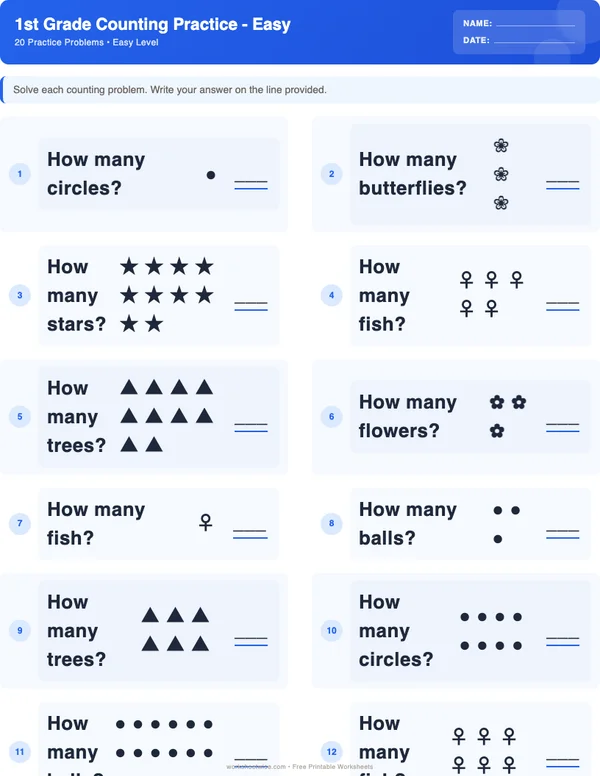
Use the 1st Grade Counting guide and free sheet when one-to-one correspondence, forward sequences, missing numbers, or skip-counting patterns are the target. Choose the 1st Grade Place Value guide and free sheet when the child needs to compose, decompose, compare, or explain two-digit quantities.
Addition, subtraction, and story structure
For subtraction, distinguish removal, comparison, and missing-part situations. With , a child might remove five counters from 13, count back five steps, or use the related addition fact . Each gives the checked answer 8, but each reveals different understanding.
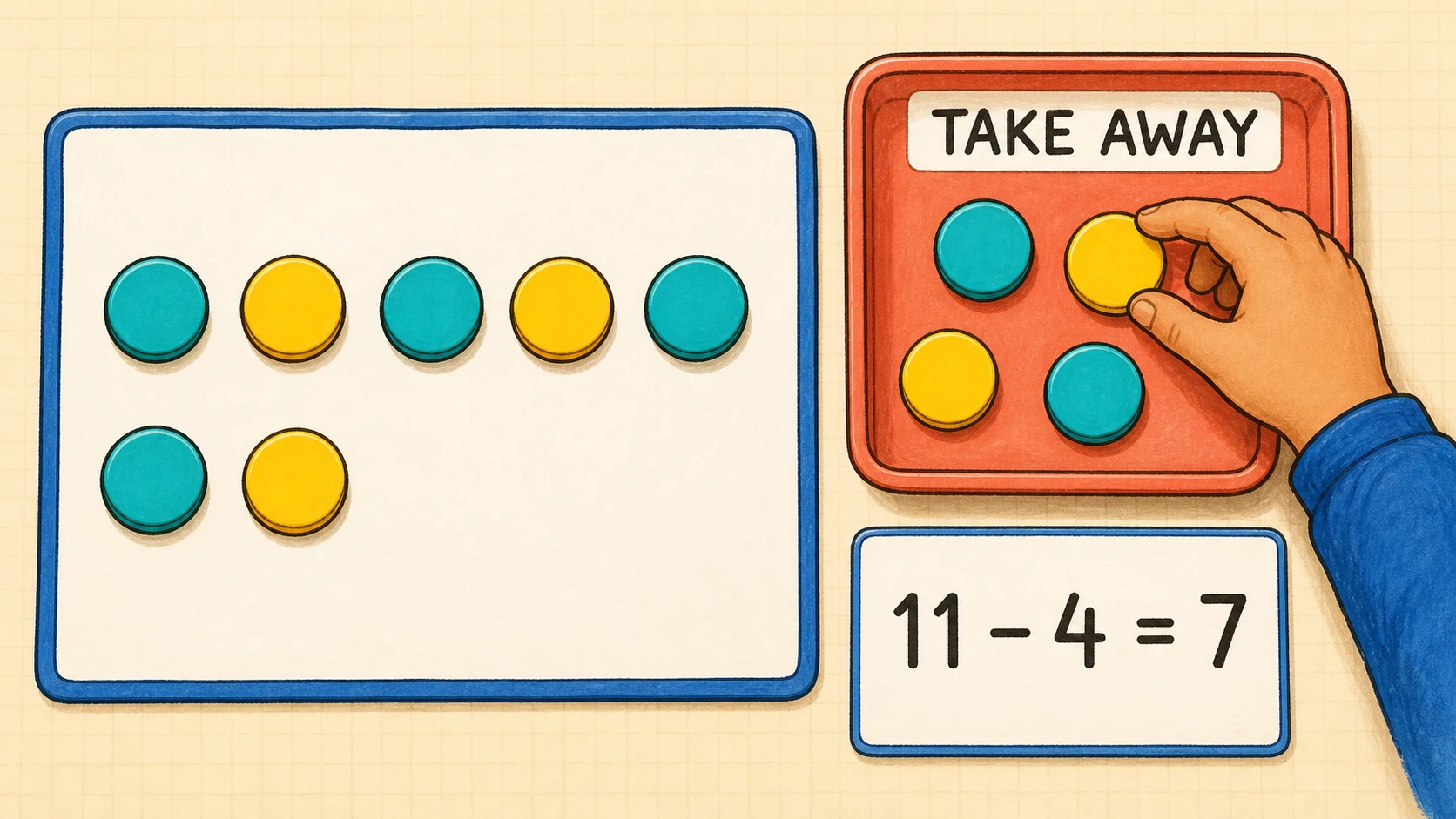
A first-grade subtraction routine should connect an acted situation, a drawing, an equation, and an explanation without requiring every representation forever.
Do not teach operation choice through keywords alone. “Mia has 5 shells. Noah has 8 shells. How many more does Noah have?” calls for comparing the quantities even though nothing is physically taken away. The difference is . Ask the child to retell the situation and draw two aligned bars or rows before choosing an operation.
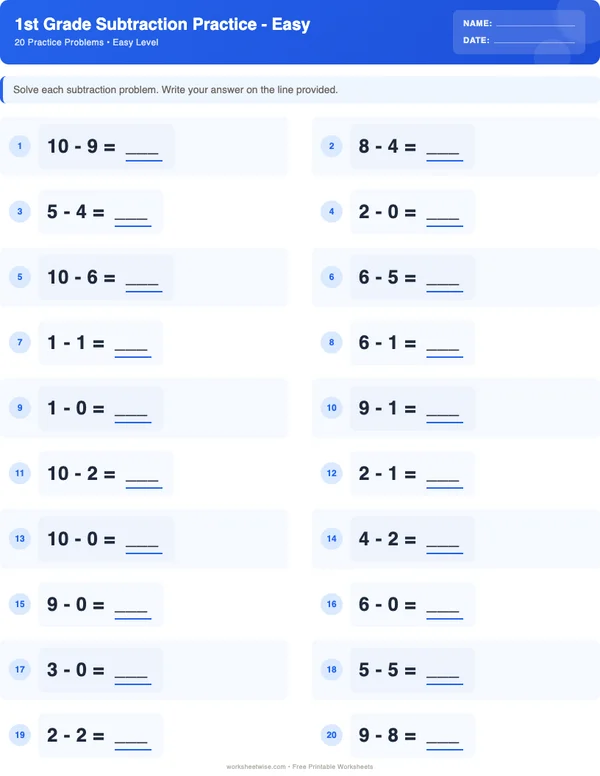
Use the 1st Grade Addition guide and free sheet for joining, part-part-whole relationships, counting on, or making ten. Use the 1st Grade Subtraction guide and free sheet when the work sample shows difficulty with removal, comparison, missing parts, or related facts.
Fractions, clocks, and equal relationships
At this level, fraction work should emphasize equal parts rather than broad symbolic procedures. Fold one identical paper rectangle into two equal parts and another into two visibly unequal parts. Only the first shows halves. If a child calls either piece in the second rectangle “one half,” the issue is not the word half; it is the requirement that the two shares be equal.
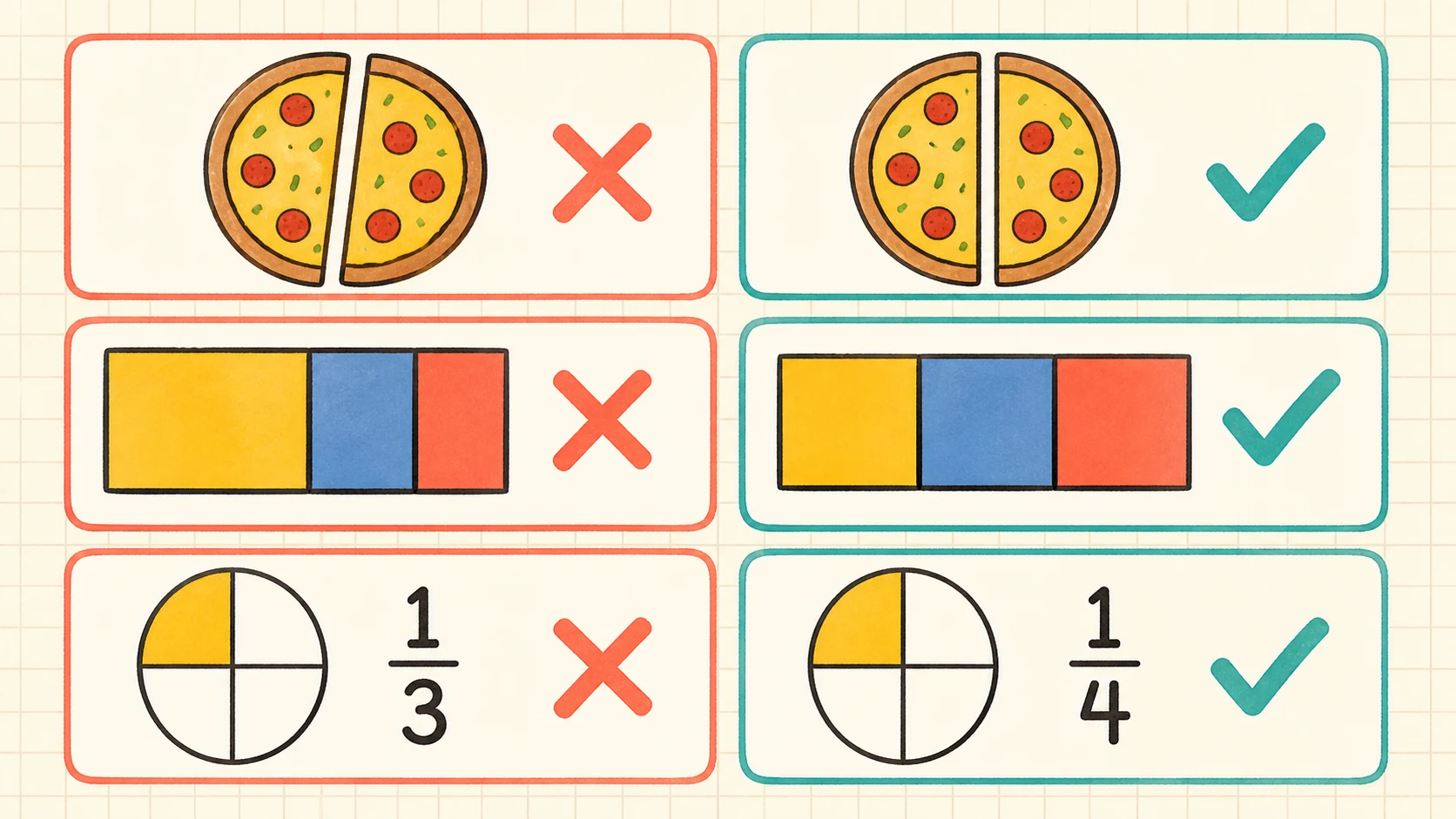
Fraction errors become actionable when the adult checks equality, number of shares, and the whole being partitioned separately.
For time, begin with hour and half-hour positions. At 3:30, the minute hand points to 6 and the hour hand sits between 3 and 4. It is still “three thirty,” not “four thirty,” because the hour hand has not reached 4. This checked example belongs in first grade because it combines half-hour reading with the often-missed movement of the hour hand. The 1st Grade Telling Time guide and free sheet is the appropriate entry point when that clock relationship—not numeral recognition—is the target.
The equal sign also deserves direct attention. Ask whether is true. Both sides equal 9, so it is. A child who accepts only equations with a single answer after the sign may be reading “=” as “write the answer” rather than “has the same value as.”
Select phonics by the sound pattern, not page appearance
A colorful word page is not necessarily accessible, and a plain list is not necessarily difficult. Identify the pattern being decoded and how many patterns are mixed.
Start with short-vowel discrimination and CVC blending when the child cannot reliably read or spell words such as map, sit, hot, and sun. Move to blends when every consonant must remain audible, as in clap or best. Choose digraph work when two letters represent one sound, as in ship, chin, or bath. Introduce silent-e contrasts such as cap/cape or hop/hope only after short-vowel CVC reading is reasonably stable.
A useful blend progression is:
- Build lap with letters and read it.
- Add c to make clap; tap /k/ /l/ /a/ /p/.
- Change the final consonant to make clam.
- Add p to make clamp.
- Read one short sentence containing a practiced word.
Each step is checked: only the named letter change occurs, and the child must preserve all sounds. This sequence belongs in first-grade practice because it moves from a CVC base to initial and final blends without introducing a new vowel pattern at the same time.
When a child reads stop as sop, do not assign a longer list immediately. Return to four counters or finger taps, one per sound, then blend continuously. When ship becomes sip, contrast sh and s orally and in print. The remedy should match the error.
Use punctuation to make meaning visible
Capitalization, spaces, and punctuation should be inspected separately. A page covered in corrections does not tell a first grader which decision mattered.
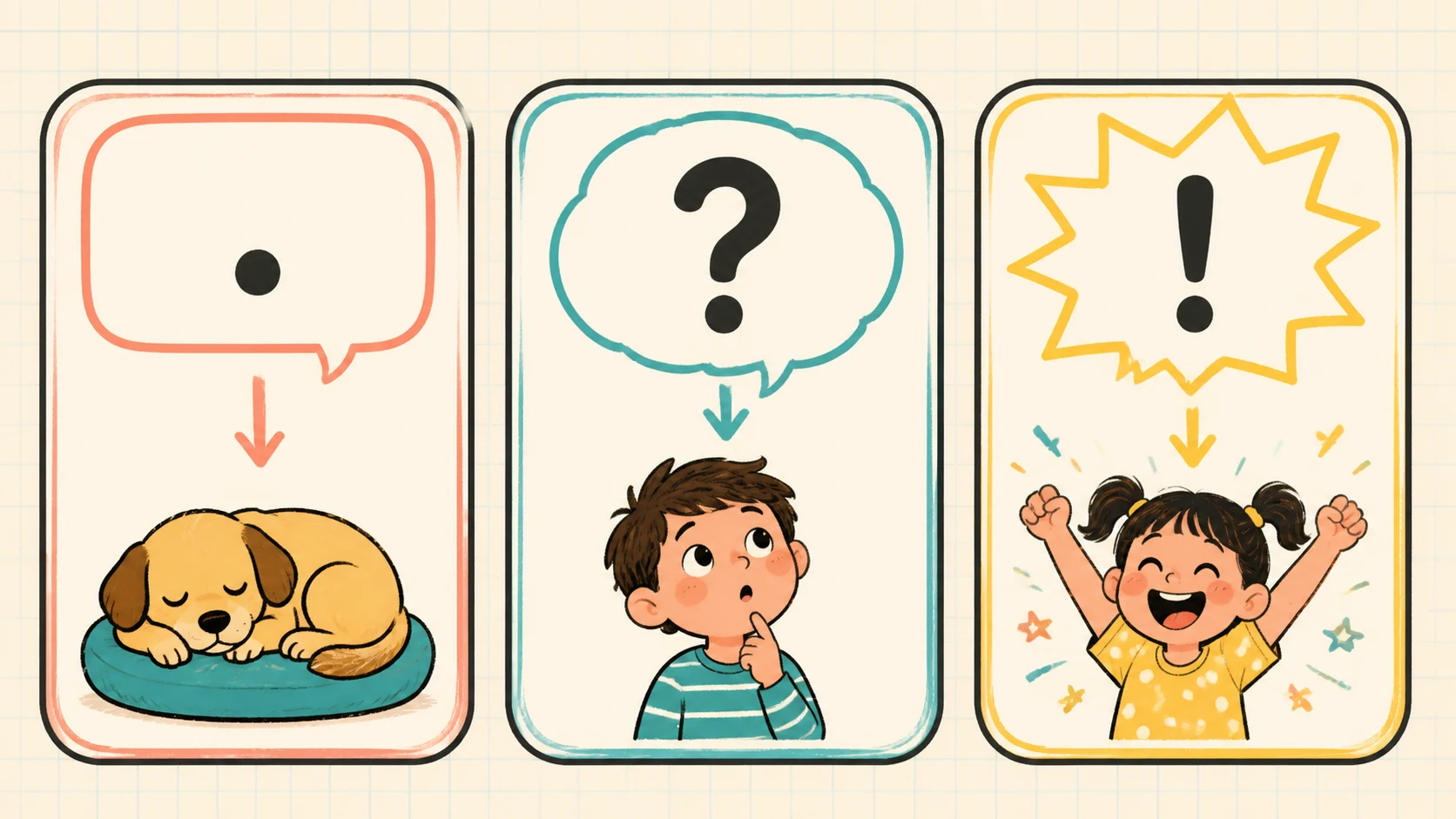
First-grade punctuation practice should connect the sentence’s purpose to a specific ending mark while keeping capitals and spacing visible as separate checks.
Compare:
- “The dog ran.” states something.
- “Did the dog run?” asks something.
- “Stop!” expresses a forceful command.
Read each aloud and discuss its purpose before naming the mark. Then ask the child to write one example of the same type. If the child selects the correct ending mark orally but omits it while writing, the concept may be present while transcription and self-checking need support. If every sentence receives a period, contrast purposes before assigning more copying.
For a longer composition, preserve first-grade expectations by reducing competing demands. Let the child orally rehearse a three-sentence story, draw the sequence, and then write one sentence at a time. Provide a small editing card—capital, spaces, ending mark—after drafting. Do not interrupt every invented spelling when the current target is sentence structure; select one or two spelling patterns for feedback.
Adapt the work without removing its target
An adaptation is useful only if the intended thinking remains necessary.
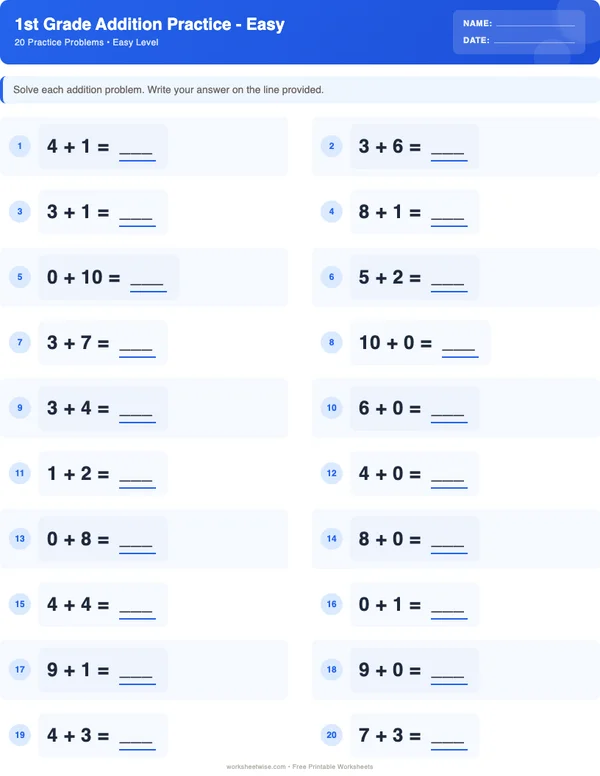
For a 20-item addition page, cover all but five items. This reduces stamina and visual load while preserving addition. Let the child use a ten frame if strategy development is the target; remove it later only after the child can explain the internalized structure. Read a word problem aloud when mathematical reasoning, rather than independent reading, is being examined.
For phonics, replace handwriting with movable letters if letter formation is consuming the entire task. The child must still segment and select the letters. For writing, take oral dictation only when gathering ideas is the target; if sentence transcription is the target, shared writing cannot replace the child’s attempt.
Helpful adaptations include:
- enlarging or isolating items;
- shortening the set while retaining representative item types;
- allowing counters, letter tiles, a number line, or a demonstration clock;
- reading directions without explaining the answer;
- scheduling two brief sessions instead of one long sitting;
- asking for an oral explanation when handwriting obscures reasoning.
Avoid adaptations that disclose the answer, eliminate the required sound or number relationship, or turn every item into imitation. A model should open the task, not complete it.
Read errors as evidence, not a score
Marking correct and incorrect answers is only the first pass. Group errors by what the child actually did.
A child who writes and shows eight counters plus only four more may have lost track while counting. A child who counts all 13 correctly but writes 31 likely has a numeral-order issue. Those work samples should not receive the same follow-up.
Use four categories:
- Concept error: The child does not yet understand the relationship, such as calling unequal shares halves.
- Strategy error: The concept is plausible, but the chosen process breaks down, such as counting backward inaccurately.
- Representation error: The child misreads a clock hand, ten frame, symbol, or diagram.
- Execution error: The strategy is sound, but a sound, object, numeral, or punctuation mark is omitted.
Also record independence. “Correct after I pointed to every sound” differs from “correct after one reminder to check the blend.” Preserve one dated sample and add a short note describing the prompt. On the next attempt, use a similar item with one feature changed. That comparison is more informative than a percentage alone.
If errors remain broad across oral language, reading, writing, attention, hearing, vision, or number tasks, a worksheet cannot determine the cause. Share specific observations and samples with the child’s teacher or another qualified professional. Do not use worksheet performance to make a diagnosis or promise an outcome.
Follow a short practice-and-decision routine
Use this routine three or four times before changing resources:
Set the target
Name one observable goal: “Keep both sounds in an initial blend,” “Show 14 as one ten and four ones,” or “Choose a period or question mark from sentence meaning.”
Model one example
Think aloud briefly. Use the representation the child will use, then ask the child to explain what changed or why the answer works.
Practice a small set
Complete three to six items initially. Prompt from least to most help: pause, ask the child to show a start, point to the relevant feature, then model if necessary.
Check through explanation
Ask, “How do you know?” or “Can you show it another way?” Do not require sophisticated vocabulary. Counters, pointing, a drawing, or a correctly read word can provide evidence.
Record and choose
Write one factual note: “Read 4 of 5 st-words; omitted /t/ in step until using sound taps.” Then choose exactly one next action:
- repeat with the same support;
- keep the skill but change the examples;
- remove one support;
- return to a prerequisite;
- transfer the skill into a sentence or story.
Make the next page answer the work sample
Do not finish a worksheet session by asking whether the page felt easy or hard. Ask what the sample now justifies.
If a child solves by counting every object accurately, retain addition within 20 but teach counting on or making ten. If the child explains as across several examples, introduce mixed equations or a simple story problem. If a child reads clap, flag, and slip but drops consonants in best and tent, shift from initial to carefully supported final blends. If sentence endings are accurate but every sentence begins lowercase, isolate capitalization rather than repeating the whole punctuation page.
When a stable skill needs independent review, worksheets with answer keys can support prompt feedback, but an answer key shows the expected response—not the child’s reasoning. For additional controlled practice, use the free deterministic worksheet generators to create a small follow-up set around the exact observed need. Start with five items, note the strategy and prompts used, and let that work sample—not the grade label—determine tomorrow’s page.
Put it into practice
Use the guide with a real printable
Move from explanation to a short, observable practice task. Check the first item together, then adjust the next session from the learner's actual work.
Open the first free worksheet