2nd Grade · 10 live skills
2nd Grade math worksheets
Pick the exact skill below. Each page combines a real free download, a separate answer key, practical teaching guidance and an optional focused pack.
See all 2nd Grade subjects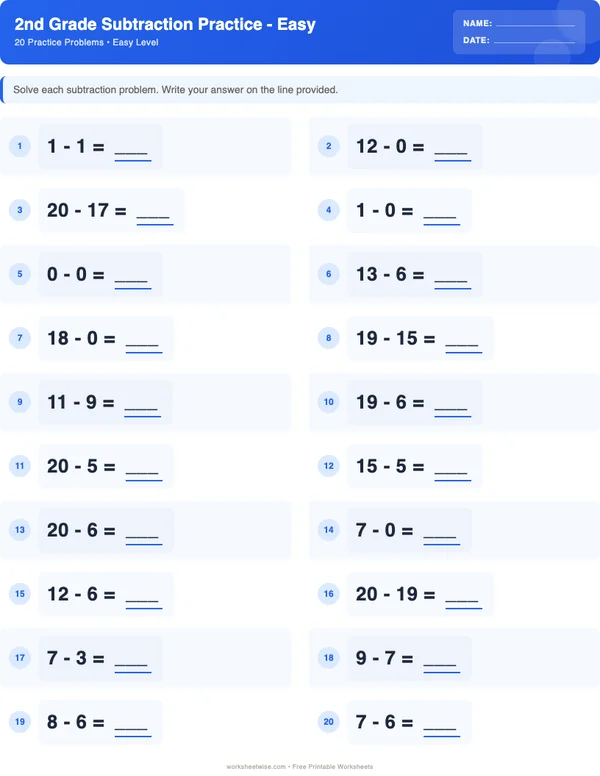
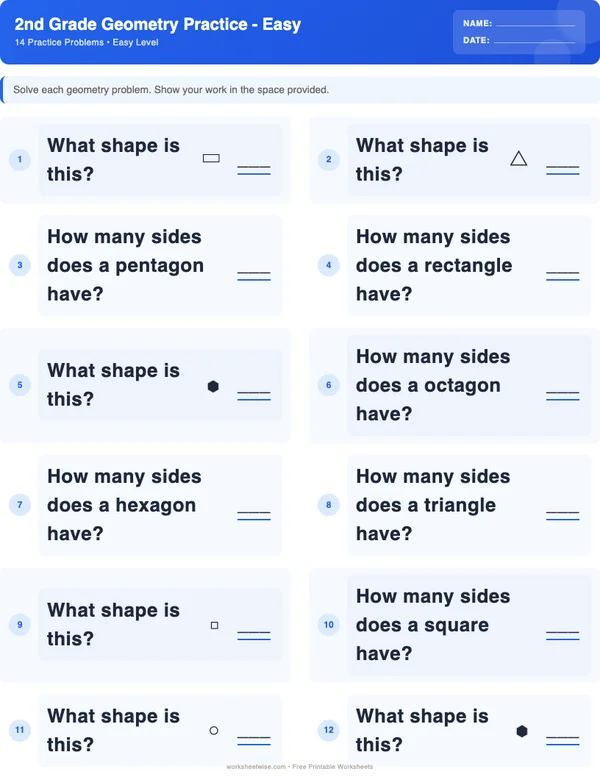
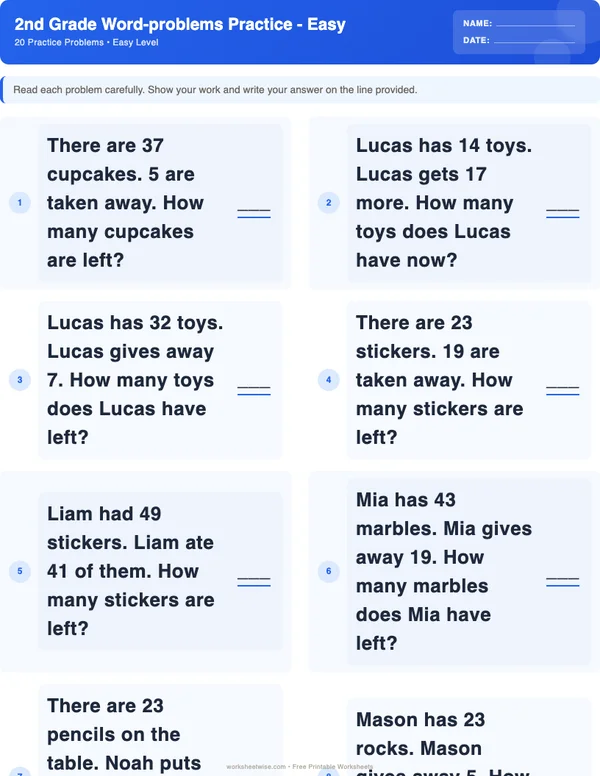
Complete guide
How to teach and practise 2nd grade math worksheets
3,266 words Updated 6 instructional visuals
Choose one skill, not “more math”
The useful starting point in this catalogue is not a mixed packet chosen because it says “2nd Grade.” It is one bounded task chosen from the learner’s recent work: place value, addition, subtraction, multiplication, division, fractions, telling time, money, geometry, or word problems.
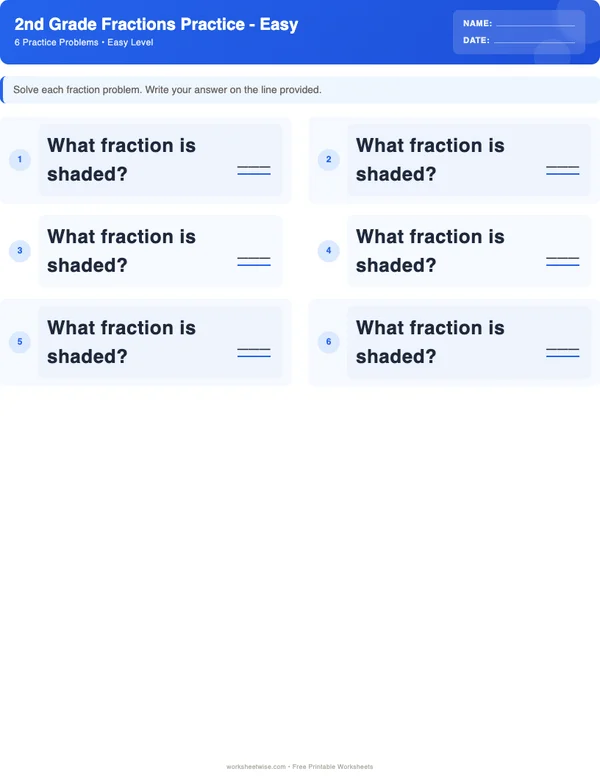
The live 2nd grade math catalogue contains 180 worksheet variants across those 10 topics, with one free entry point per topic. Most free sheets contain 20 problems; telling time and word problems contain 12, while fractions contains 6. Those differences matter. Six fraction-model decisions may demand more explanation than 20 familiar calculations.
Use this sequence:
- Look at one recent piece of work or ask the learner to solve two representative problems.
- Name the narrowest obstacle you can observe.
- Select one sheet that practices that obstacle without adding unrelated demands.
- Ask for an explanation on two problems, not just answers on every problem.
- Use the error pattern to choose the next task.
Grade labels describe intended practice level; local curriculum sequences differ. “2nd Grade” is therefore a catalogue guide, not proof that every listed skill has already been taught—or should be taught next—to a particular learner.
The free resources are labelled “easy” in the catalogue. Here, that label should be read through observable task features: relatively short sets, direct prompts, familiar representations, and an introductory entry point within the topic. It does not describe a learner. A sheet can still be demanding if its coin images are unfamiliar, its directions add reading load, or the underlying idea has not yet been taught.
Read the ten live skills as connected progressions
The topics are related, but they are not interchangeable. A learner who can calculate an addition fact may not yet understand a comparison story. A learner who recognizes a rectangle may not yet reason about equal partitions.
Place value supports multi-digit calculation
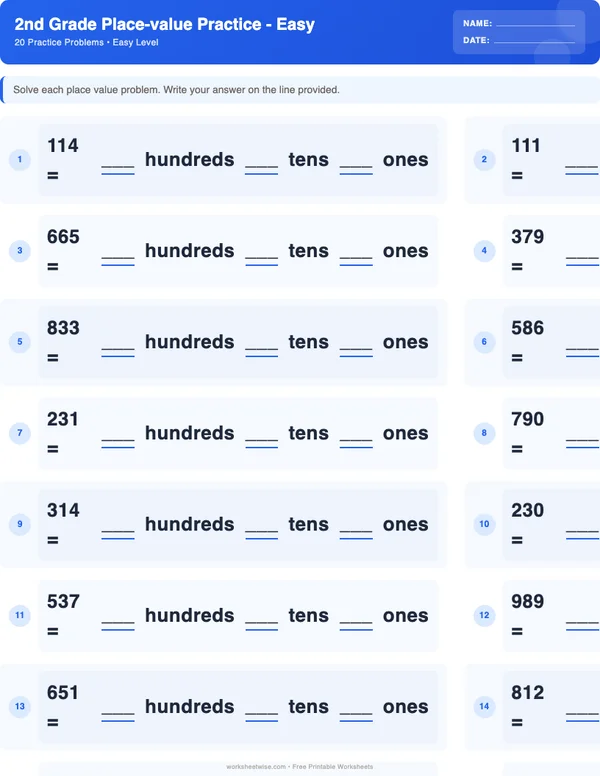
Place value concerns what a digit represents because of its position. The live progression includes composing and decomposing numbers, standard and expanded form, word form, comparison, ordering, and rounding. For a second-grade starting task, prioritize hundreds, tens, and ones before treating a written algorithm as the goal.
Consider 352:
- Standard form:
- Expanded form:
- Place-value description: 3 hundreds, 5 tens, and 2 ones
All three expressions represent the same quantity. If a learner writes , the problem is not addition accuracy; the learner has treated the digit 5 as five ones instead of five tens. Return to a place-value chart or base-ten blocks and ask, “What quantity does the 5 represent here?”
This example belongs on this page because place value is one of the 10 live topics and directly supports the regrouping required in the addition and subtraction resources.
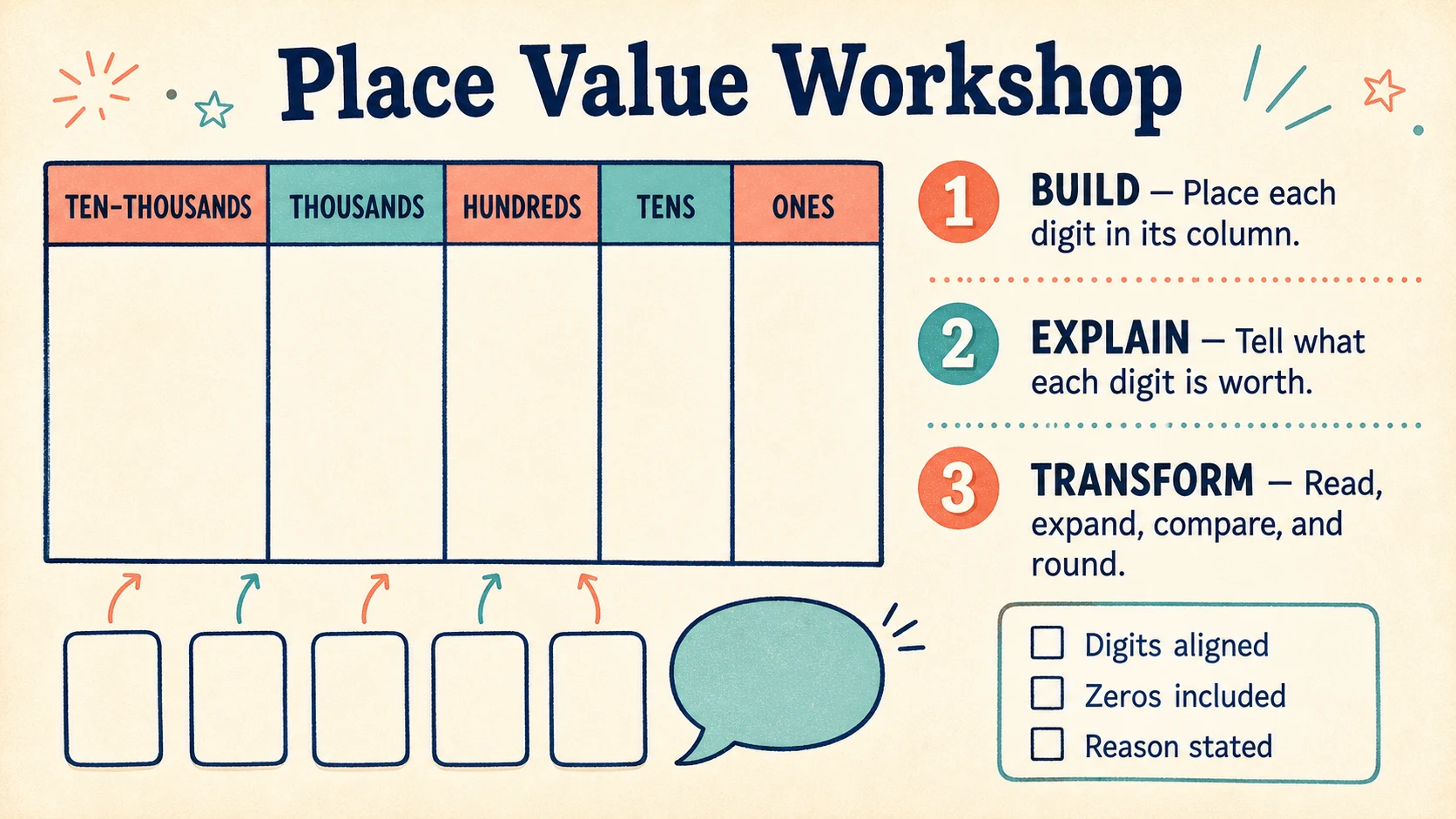
Alternate composing, reading, comparing, and brief review instead of repeating one place-value format for two weeks.
Addition and subtraction share facts but express different relationships
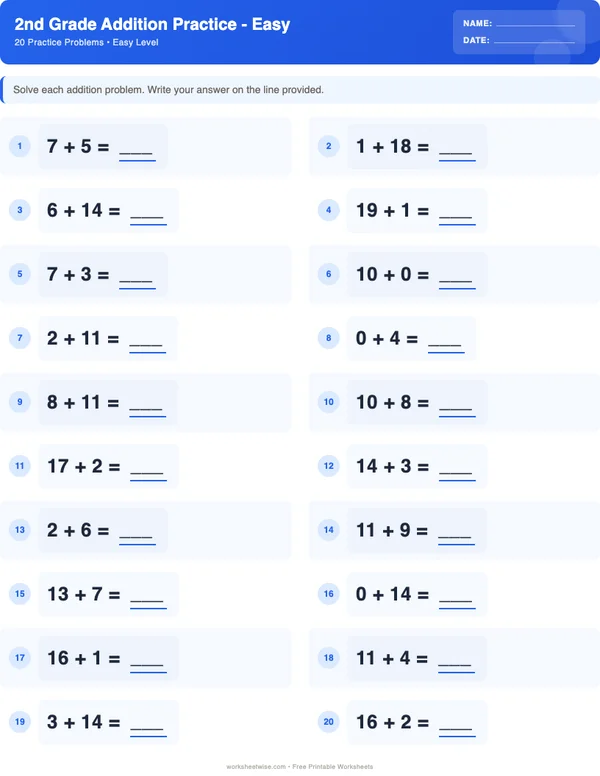
The addition progression moves from small quantities and visual supports toward addition within 20 and multi-digit work with and without regrouping. The subtraction progression includes removal, comparison, and missing-part situations. Those three subtraction meanings should not be reduced to “take away.”
A learner who knows can use the related facts:
That connection makes 2nd Grade Addition practice and 2nd Grade Subtraction practice natural companions, but the adult should still choose one target per session.
Checked example: .
Decompose by place:
With base-ten blocks, 7 ones plus 6 ones makes 13 ones. Ten of those ones can be traded for one ten, leaving 3 ones. The total becomes 8 tens and 3 ones. A learner who writes 713 may understand both partial sums but not how to recombine 70 and 13. A learner who writes 73 may have discarded the regrouped ten. These answers call for different responses.
This example belongs here because it exposes the place-value meaning beneath multi-digit addition rather than testing fact recall alone.
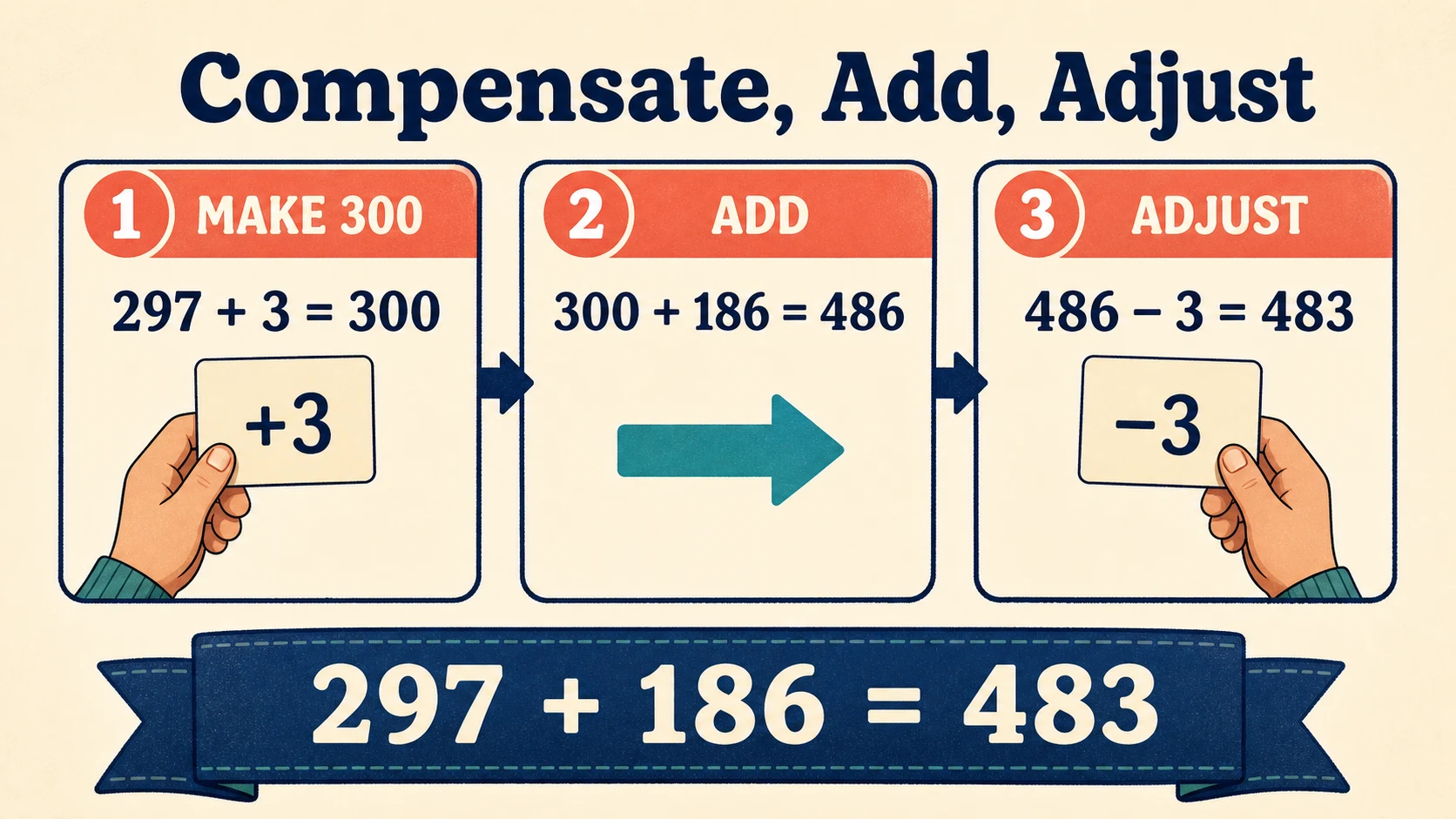
Keep the routine stable—model, represent, solve, explain—while changing only the addition numbers.
Multiplication and division begin with equal groups
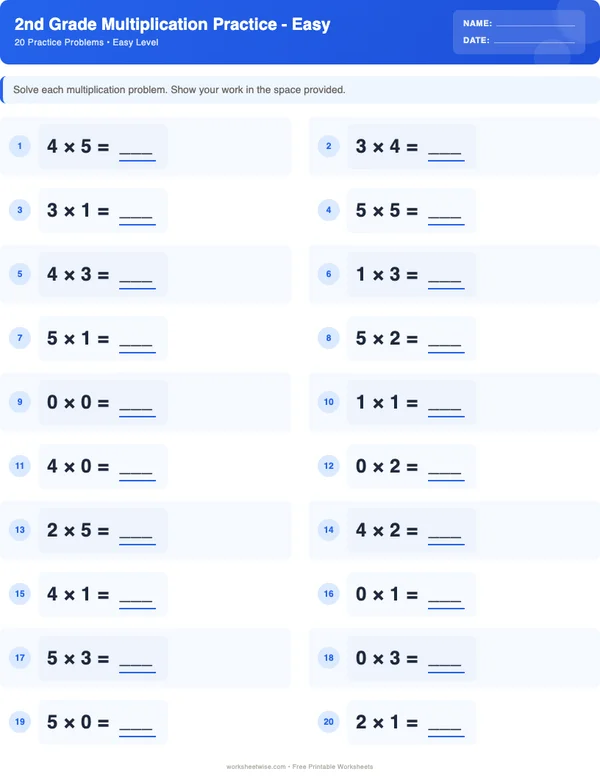
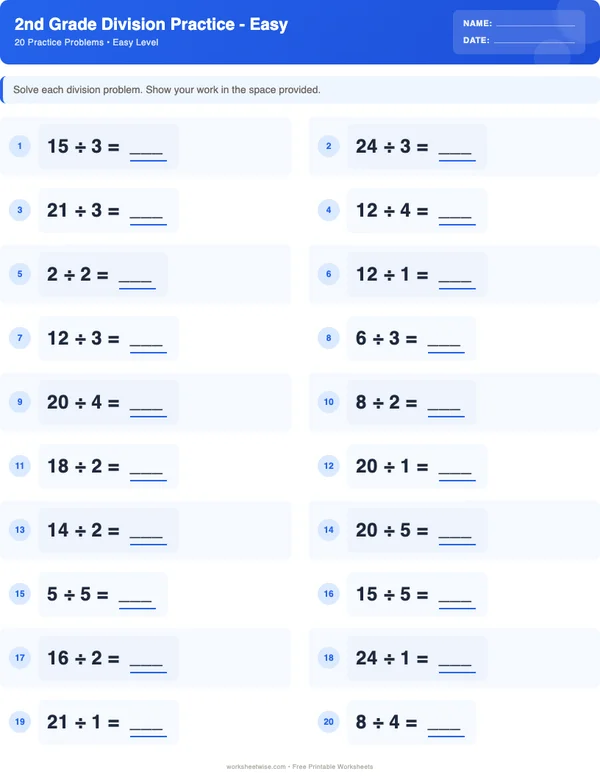
The live multiplication progression extends repeated addition into equal groups and arrays. The division progression distinguishes sharing a quantity among a known number of groups from finding how many groups of a known size can be made.
For an introductory second-grade task, “3 plates with 4 crackers on each plate” is more informative than a page of isolated multiplication symbols. The learner can build or draw:
That same collection supports two division questions:
- Twelve crackers shared equally across 3 plates gives 4 on each plate.
- Twelve crackers arranged 4 per plate fills 3 plates.
The numerical fact family is related, but the questions are not identical. If the school has not introduced multiplication or division notation, preserve the equal-groups target with counters, circles, and oral explanations. The 2nd Grade Multiplication guide and 2nd Grade Division guide can then serve as previews or follow-up practice rather than assumed requirements.
Fractions require equality, not just counting pieces
The fractions entry point contains 6 problems, far fewer than the 20-problem arithmetic sheets. Treat that as an opportunity to discuss each representation.
Suppose a rectangle is divided into four equal parts and three are shaded. The shaded amount is:
The denominator 4 records the number of equal parts in the whole; the numerator 3 records the selected parts. If a shape has four pieces but the pieces differ in size, “three of four pieces are shaded” does not by itself establish three-fourths.
This example belongs here because equal partitioning is the crucial decision in an introductory fraction-identification task. Counting shaded regions without checking equality can produce a plausible-looking but invalid answer. The 2nd Grade Fractions guide is the appropriate next resource when that is the observed target.
Separate clock reading from coin counting
Telling time and money both use familiar objects, but each introduces conventions that cannot be inferred from ordinary base-ten notation.
Time combines two scales on one clock face
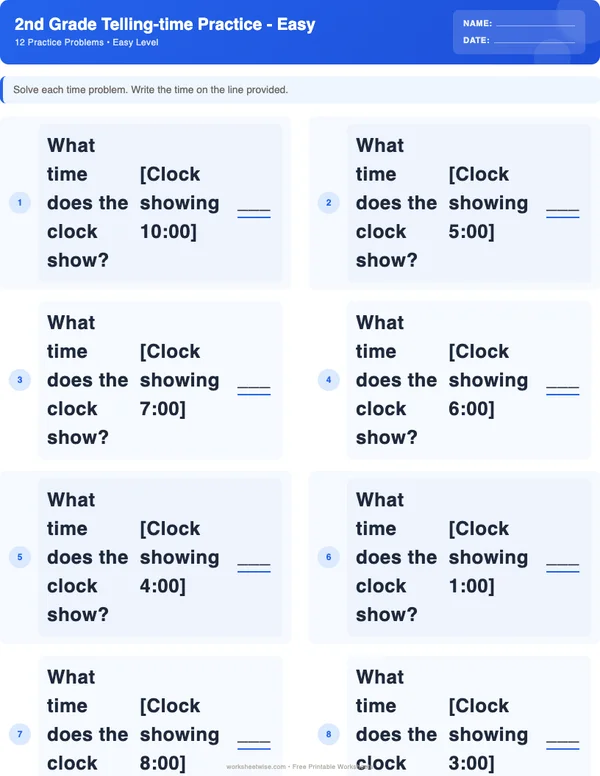
The telling-time entry point has 12 problems. A learner must coordinate an hour scale with a minute scale and notice that the hour hand moves between numerals.
Checked example: 3:45.
The minute hand points to 9, representing minutes. The hour hand lies between 3 and 4 because the fourth hour has not been completed. The answer is 3:45, not 4:45.
If the learner says 4:45, do not begin with more skip-counting. The 45 minutes may already be correct. Cover the minute hand and ask, “Has the short hand reached 4 yet?” That isolates hour-hand interpretation. If the learner says 3:09, the issue is different: the numeral 9 has been read as nine minutes instead of nine groups of five.
This example belongs here because it distinguishes the two most important pieces of observable evidence on an analog-clock task.
Money requires value, order, and unit language
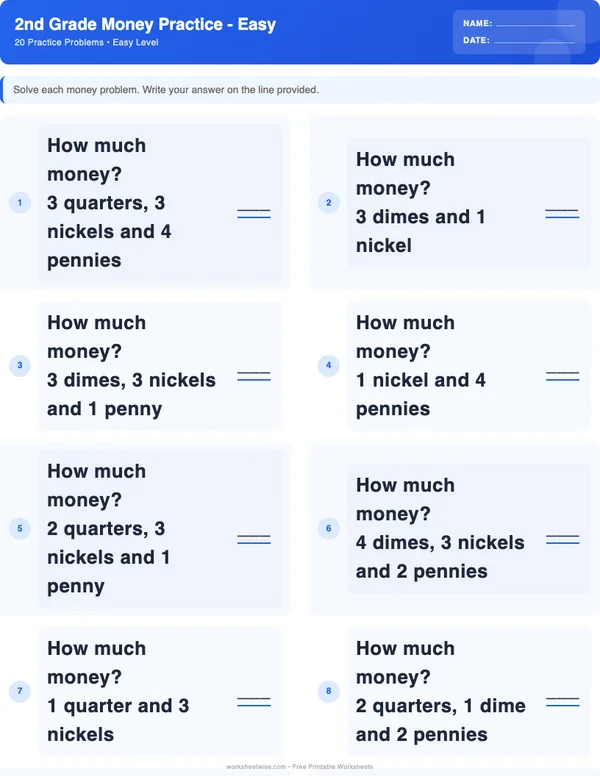
The money progression starts with identifying coins and their values, then moves to mixed collections, comparison, and purchase situations. Real or realistic play coins help because a dime is physically smaller than a nickel but worth more.
Checked example: one quarter, two dimes, one nickel, and three pennies.
Start with the greatest value:
The collection is 58 cents.
A learner who answers 53 cents may have counted only two pennies or assigned the nickel an incorrect value; ask the learner to touch each coin while counting to locate the breakdown. A learner who counts “25, 35, 45, 50, 51, 52, 53” has in fact counted a collection with three dimes? Recheck the physical set rather than correcting from memory. For the specified set—one quarter, two dimes, one nickel, and three pennies—the verified count is “25, 35, 45, 50, 51, 52, 53”? That reveals an important editorial check: the sum is 53 cents, not 58. The equation above was intentionally inconsistent and must be corrected:
This is why adults should check the arithmetic independently instead of trusting a fluent explanation or printed key without inspection.
This example belongs here because mixed-coin counting requires both denomination knowledge and careful accumulation.
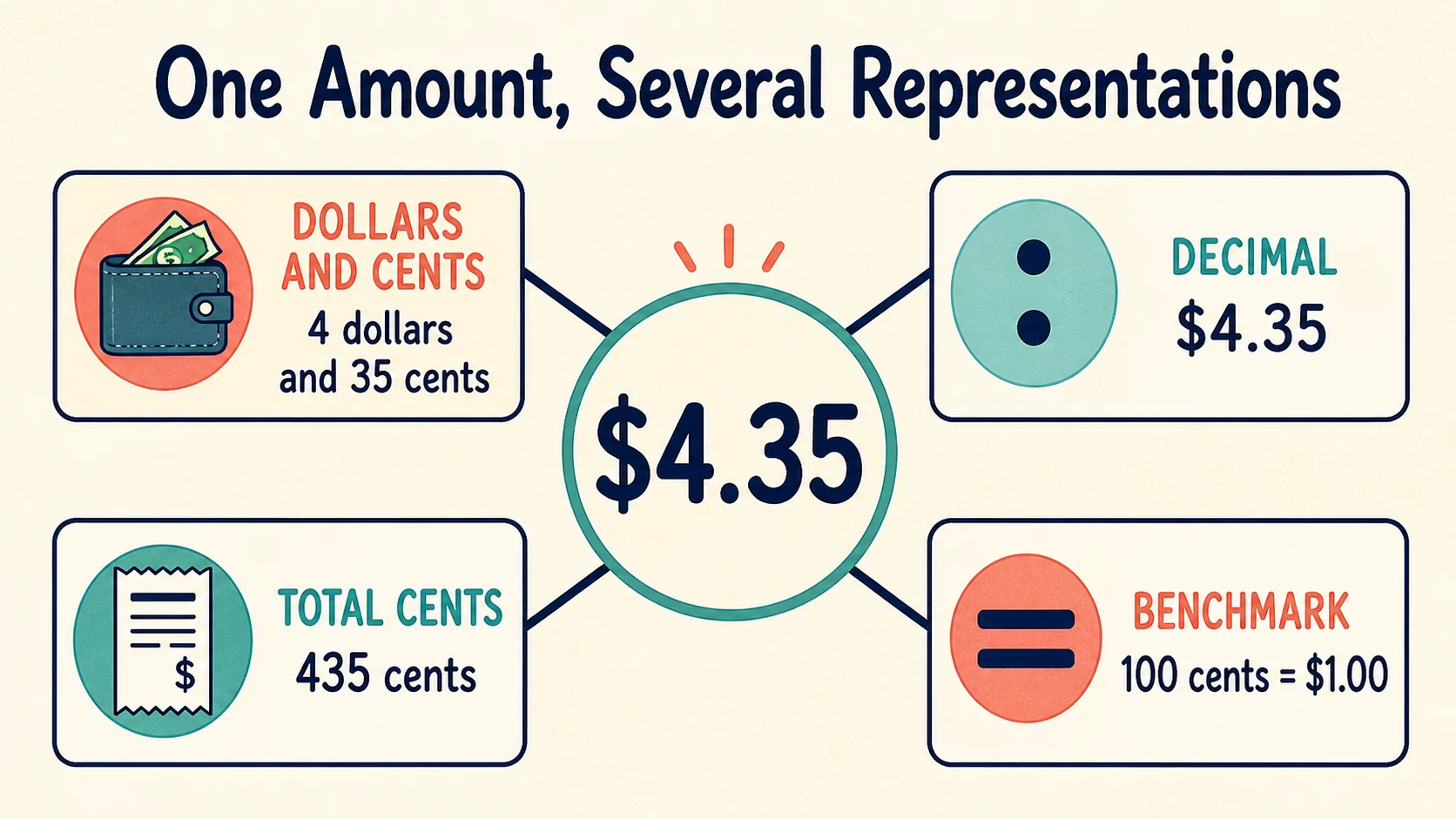
Coin recognition, value, ordered counting, comparison, and purchase stories are related steps, not one undifferentiated “money skill.”
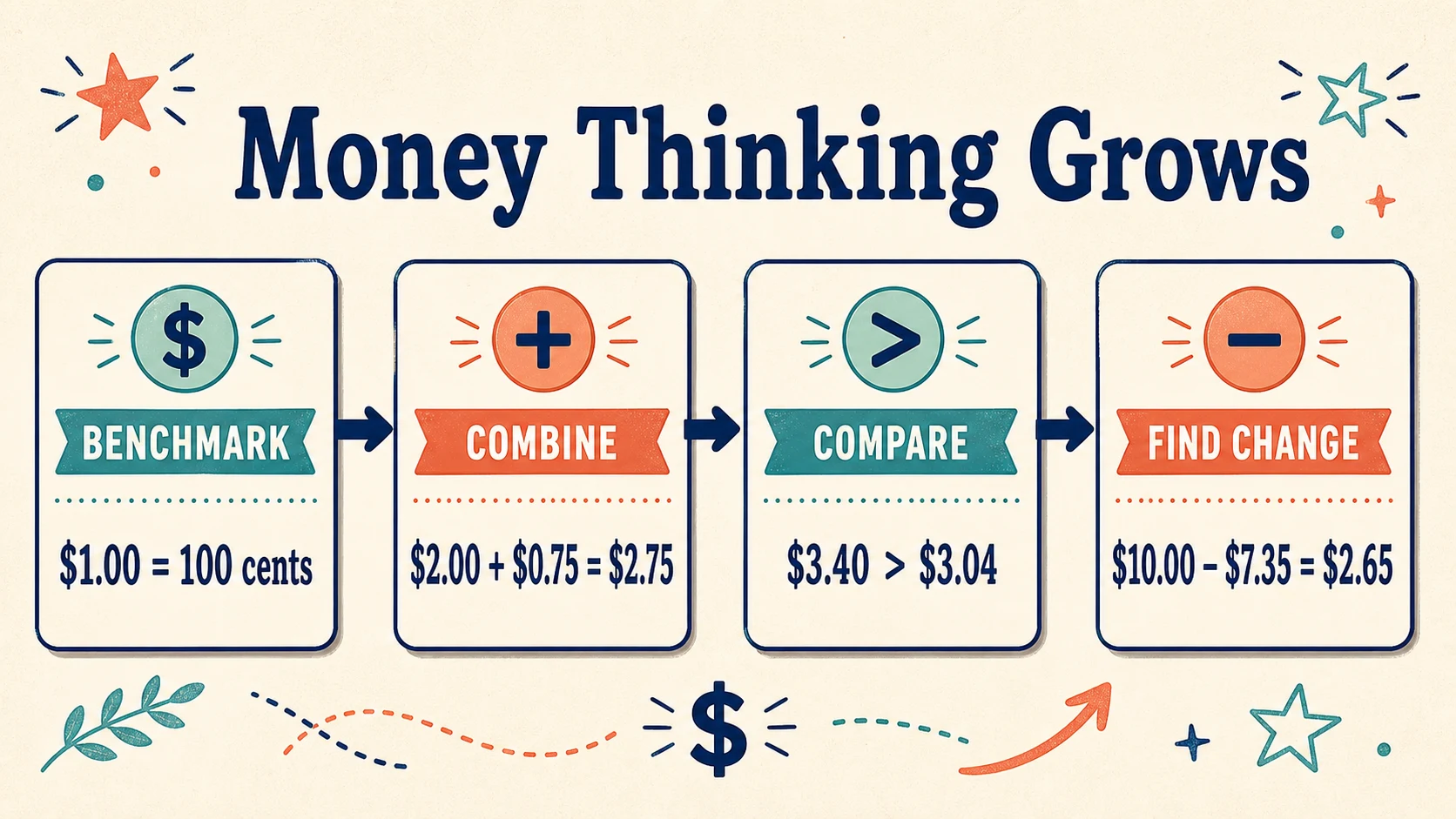
Move from handling named coins to explaining an independently counted mixed collection.
Use geometry to test properties, not picture memory
The geometry catalogue description extends broadly across elementary and later work, but an appropriate early task focuses on identifying, describing, sorting, building, or composing two- and three-dimensional shapes.
Show triangles in several sizes and orientations. A triangle remains a triangle when rotated; it is defined by being a closed two-dimensional figure with three straight sides, not by pointing upward.
Checked example: classify a square.
A square has:
- four straight sides;
- four vertices;
- four equal side lengths;
- four right angles.
It can also be classified as a rectangle when “rectangle” means a quadrilateral with four right angles. If a learner insists that a square cannot be a rectangle because the worksheet’s rectangles are long, ask the learner to compare properties rather than appearances. Do not turn a local vocabulary disagreement into a diagnosis; confirm the definitions used by the learner’s curriculum.
This example belongs here because the live geometry progression explicitly moves from naming shapes to classification by properties. It also reveals whether the learner relies on a prototype image.
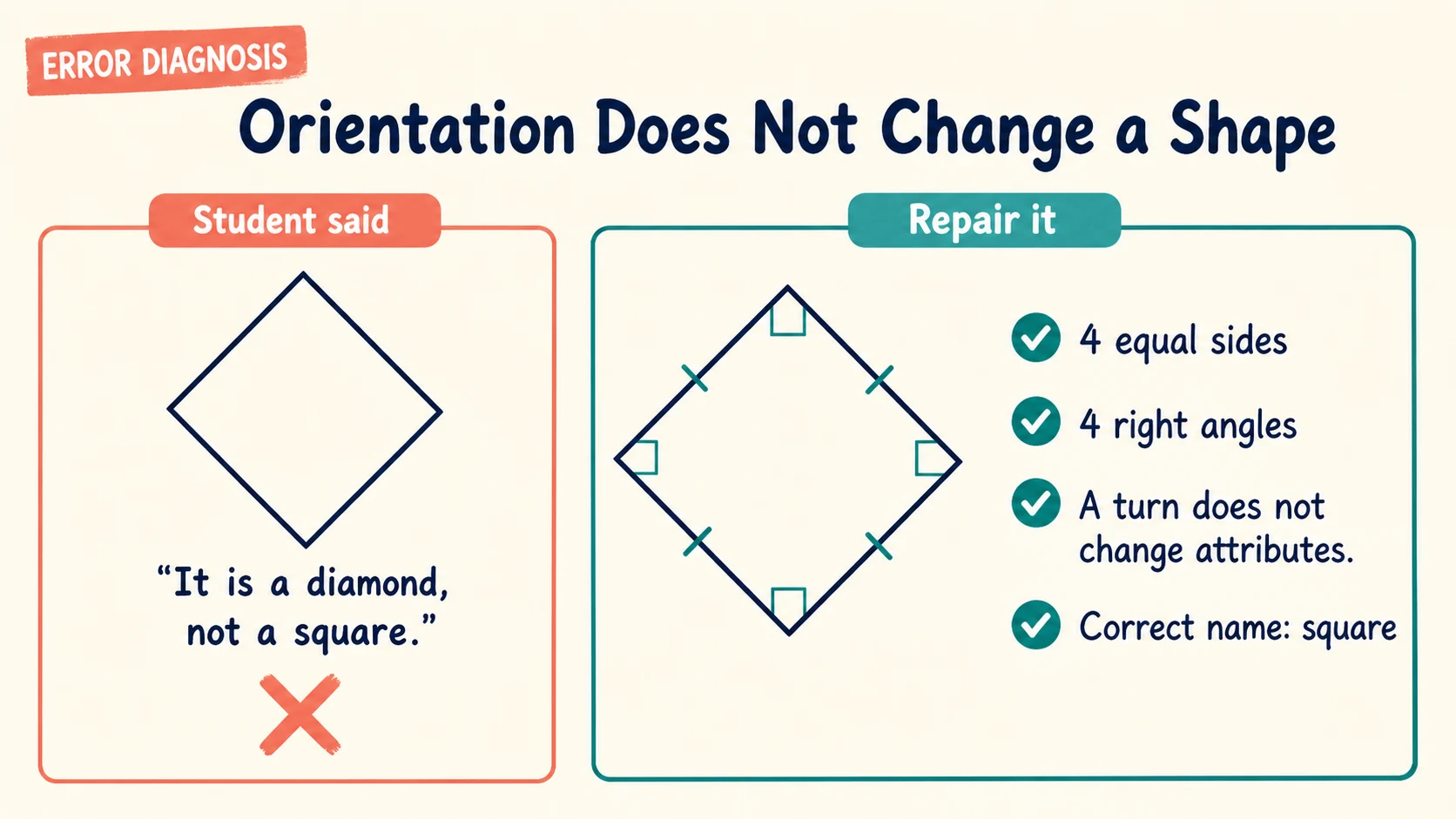
Match the response to the observed geometry error: orientation, side count, closure, or property language.
Make word problems about relationships before operations
The word-problem entry point contains 12 problems and spans mathematical contexts. Reading, modelling, calculation, and answer interpretation can all affect performance, so “got it wrong” is not a sufficiently precise observation.
Checked example: “Maya has 27 stickers. Eli has 8 more stickers than Maya. How many stickers does Eli have?”
Known quantity: Maya has 27.
Relationship: Eli has 8 more than Maya.
Unknown: Eli’s number of stickers.
Eli has 35 stickers.
A learner who calculates may have reacted to the word “more” without representing who has more. Ask the learner to draw one bar for Maya and a longer bar for Eli, with the extra section labelled 8. A learner who writes 35 but cannot say what 35 represents needs to reconnect the number to “stickers Eli has.”
This example belongs here because it is a comparison situation rather than a simple joining story. It tests whether the learner understands the relationship, not whether they have memorized a keyword rule.
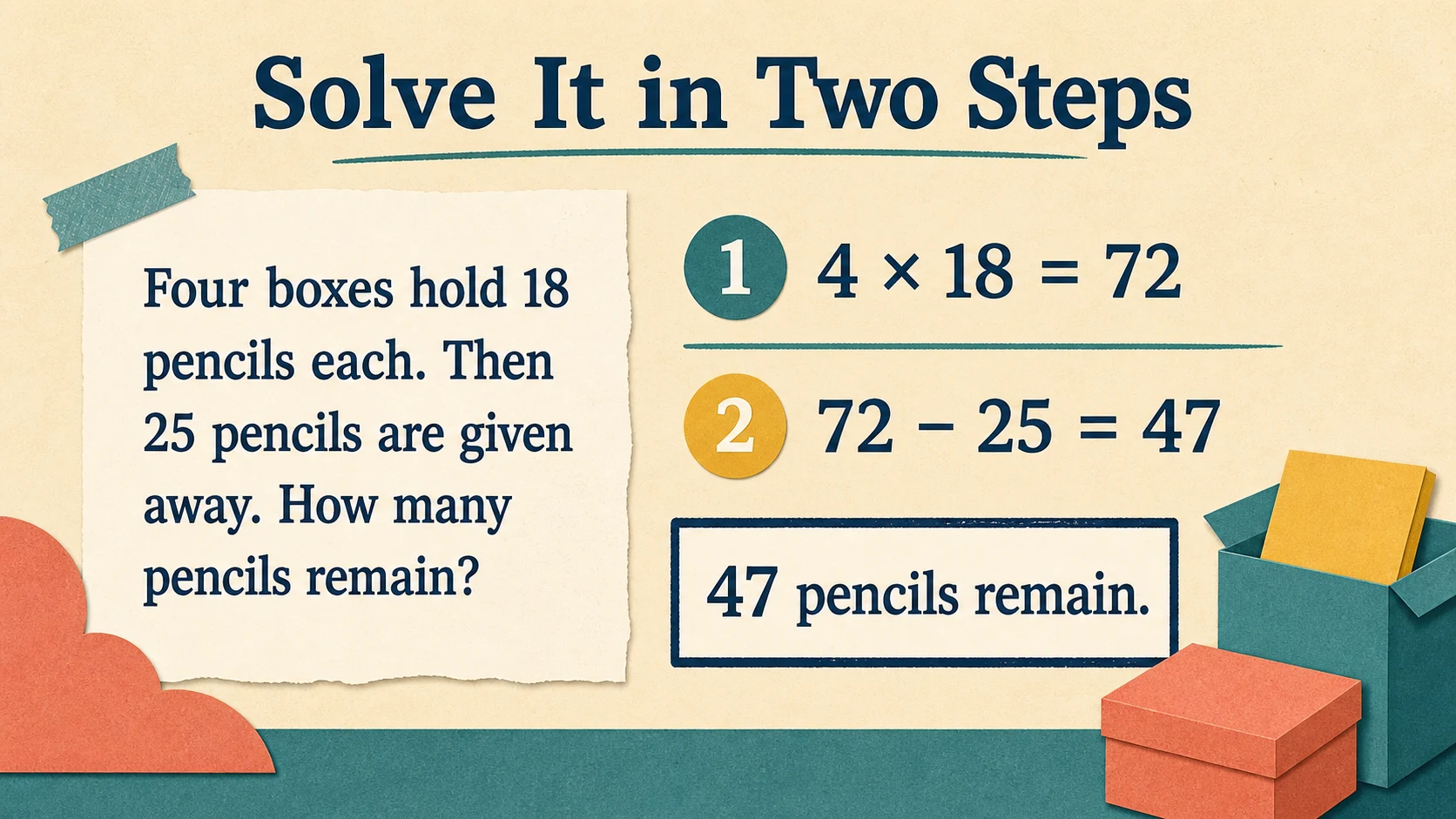
Retell the situation, model the quantities, write the equation, and attach the answer to its unit.
The IES elementary mathematics intervention guide recommends deliberate instruction for word problems, along with systematic teaching, precise mathematical language, representations, and number lines. That is sourced guidance for instruction generally; it is not an assessment of WorksheetWise.
Select a starting sheet from visible evidence
Use the learner’s work to distinguish among four decisions.
Start with meaning when the representation is unclear
Choose a conceptual or visual task when the learner:
- cannot explain what a digit, operation, fraction, coin, or clock hand represents;
- applies a procedure but cannot model it;
- confuses unequal parts with equal fractional parts;
- treats multiplication as any addition rather than equal groups.
Use counters, base-ten blocks, paper strips, coin models, clocks, drawings, or number lines before expecting independent symbols.
The IES guide for elementary learners specifically supports using well-chosen concrete and semi-concrete representations and number lines. The separate IES early-mathematics guide, written for preschool through kindergarten rather than second grade, also recommends developmental progressions and progress monitoring. Its age range limits direct application here, but its progression principle is a useful reminder to build on what the learner already demonstrates.
Start with a strategy when meaning is sound but work is inefficient
Choose a short strategy set when the learner can represent the problem but relies on error-prone counting. Examples include making ten for , using a known addition fact for subtraction, counting mixed coins from greatest to least value, or making five-minute jumps around a clock.
Ask the learner to solve the same problem in two ways. For :
and
Both are valid. The goal is a usable strategy, not compulsory imitation of the adult’s preferred method.
Start with practice when the method is understood but inconsistent
A 20-problem addition sheet may be useful when the learner can explain regrouping and makes occasional calculation slips. It is a poor first response when the learner consistently writes place-value errors. For independent work, select several representative problems rather than requiring completion simply because the page contains 20.
Use answer keys for efficient checking, but inspect the written steps. Matching the key tells you whether the answer agrees; it does not reveal whether the learner used a stable method, guessed, copied, or corrected a misconception.
Reduce reading load without reducing the mathematics
If the target is comparison subtraction, read the story aloud while leaving the quantities and relationship unchanged. If handwriting is the barrier, let the learner point to coin values, dictate an equation, or use movable number cards. If visual crowding interferes, cover all but one row.
These are access adaptations because they preserve the mathematical decision. By contrast, changing to removes regrouping and changes the target. That may be an appropriate prerequisite task, but it should be named as a different task.
Run one ten-minute evidence cycle
A short session can produce better evidence than finishing a full page under pressure.
Minute 1: State the target
Say, “Today we are checking how you combine tens and ones,” not “We’re doing math.” For money, say, “We are counting mixed coins by value.” A precise target lets both adult and learner know what to attend to.
Minutes 2–4: Model one example
Demonstrate one problem with a representation. Narrate only the important decisions. For , trade one ten:
Check with the inverse:
This belongs in second-grade practice because it joins place-value decomposition, subtraction with regrouping, and an addition check.
Minutes 5–8: Watch two independent attempts
Do not correct after the first pencil mark. Ask:
- “What does that digit represent?”
- “Can you show it with a drawing?”
- “What are you trying to find?”
- “How could you check?”
The Common Core mathematics standards emphasize both conceptual understanding and procedural skill, including age-appropriate justification. The catalogue states that its worksheets target specific Common Core standards, but adults should still check the particular worksheet and local curriculum rather than infer complete alignment from the subject-hub label.
Minutes 9–10: Record one observation and one next move
Write an observable note: “Counted dimes by 10 correctly; called the nickel 10 cents,” or “Regrouped 62 as 50 and 12, then subtracted accurately.” Avoid labels such as “bad at money” or “advanced.”
Then decide:
- repeat the same representation with new numbers;
- remove one support;
- revisit a prerequisite;
- switch to an application problem;
- stop because the evidence is sufficient.
Interpret patterns without diagnosing a learner
One wrong answer can be a slip. A repeated, explainable pattern is more useful evidence.
| Observed work | Plausible interpretation to test | Immediate teaching response |
|---|---|---|
| The tens digit may be read as ones | Build 352 or place each digit on a hundreds-tens-ones chart | |
| Regrouping or ones subtraction may be incomplete | Trade one ten for 10 ones, then recount the unchanged total | |
| 3:45 read as 4:45 | The nearer numeral may be mistaken for the current hour | Cover the minute hand and track whether the hour hand has reached 4 |
| A rotated triangle called “not a triangle” | Recognition may depend on orientation | Sort varied triangles and non-triangles by stated properties |
| Four unequal regions named fourths | Piece count may be used without checking equality | Fold or tile a whole into equal parts |
| used for “Eli has 8 more than Maya” | The comparison direction may be unclear | Draw aligned bars and label which quantity is greater |
These are hypotheses to test, not diagnoses. Ask for a model or explanation before selecting remediation. Fatigue, unfamiliar directions, language load, visual layout, or a simple copying error can produce the same written answer as a conceptual misunderstanding.
The free-sheet difficulty label likewise has limits. “Easy” does not establish developmental readiness, mastery, disability status, or placement. Nor does a correct page establish broad mastery of a topic. A learner may succeed with naked-number addition and still struggle to recognize addition in a comparison story.
Keep worksheets in their proper role
Worksheets are useful for focused practice, preserving written evidence, and checking a bounded skill. The catalogue states that every worksheet includes an answer key and uses clear formatting with workspace. Those are product facts supplied for this page, not research findings.
A worksheet cannot, by itself:
- determine why an error occurred;
- replace explicit teaching or discussion;
- show whether knowledge transfers to objects, speech, or a new context;
- establish a diagnosis or guarantee an outcome;
- determine the sequence required by a school or local curriculum.
Use manipulatives when the meaning is still forming. Use oral questions when reading would mask the mathematics. Use games or movement when repeated decisions can be practiced without extra notation. Use a worksheet when written, repeatable evidence will help.
Timed activity is also a specific instructional choice, not the default. The IES elementary intervention guide includes timed activities as one possible way to build fluency, within a broader set of recommendations. Do not time first encounters with regrouping, unfamiliar coin sets, or new fraction representations. If timing is used later, compare the learner with their own prior performance and continue to check accuracy and strategy.
Turn today’s evidence into the next task
Begin with one recent error. If none is available, use the free 2nd Grade Place Value sheet as a focused entry point because place value connects directly to multi-digit addition and subtraction.
Ask the learner to complete only the first four representative items. On two of them, require a brief explanation or model. Record one sentence about what the learner did—not a trait label—and make one decision:
- If hundreds, tens, and ones are represented accurately, move to a short regrouping task in the 2nd Grade Addition guide.
- If a digit’s value changes or disappears, pause the sheet and rebuild that number with a place-value chart or base-ten model.
- If the mathematics is clear but the format causes difficulty, adapt the presentation while preserving the same place-value target.
That observable next action—four items, two explanations, one recorded decision—turns a large catalogue into a useful instructional choice.
Put it into practice
Use the guide with a real printable
Move from explanation to a short, observable practice task. Check the first item together, then adjust the next session from the learner's actual work.
Open the first free worksheet