3rd Grade · 3 live skills
3rd Grade grammar worksheets
Pick the exact skill below. Each page combines a real free download, a separate answer key, practical teaching guidance and an optional focused pack.
See all 3rd Grade subjects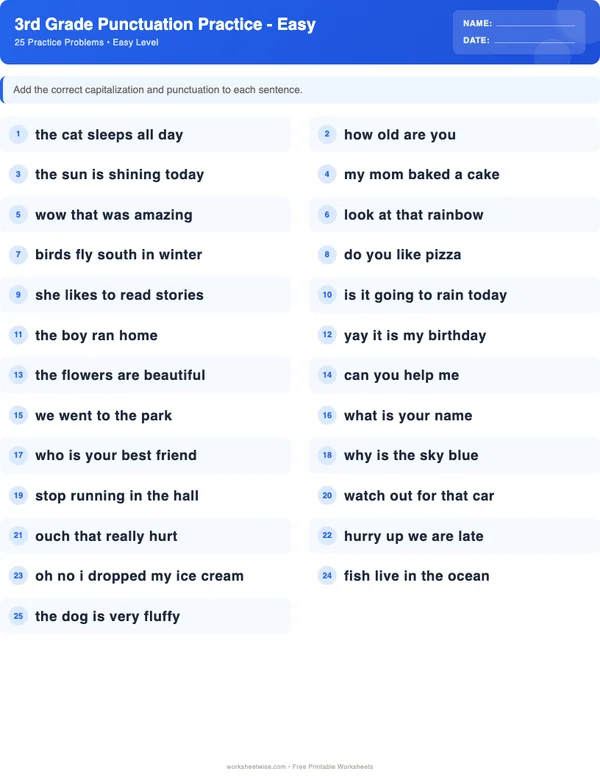
Complete guide
How to teach and practise 3rd grade grammar worksheets
3,401 words Updated 6 instructional visuals
Choose One Grammar Target Before You Print
The live 3rd grade grammar catalogue offers three starting points: parts of speech, punctuation, and sentence structure. Each topic has one free 14-problem sheet, and the catalogue contains 54 worksheet variants across the three topics. The useful decision is not “Which grammar worksheet should a third grader complete?” It is “Which single language decision does this learner need to practice next?”
Start with evidence from the learner’s writing:
- Choose sentence structure when thoughts are incomplete, several thoughts run together, or the learner cannot locate who or what a sentence is about.
- Choose punctuation when sentences are structurally understandable but their boundaries, lists, dates, dialogue, contractions, or possessives are unclear.
- Choose parts of speech when the learner needs to recognize how words function or replace vague language with more exact nouns, verbs, adjectives, or adverbs.
Grade labels describe the intended practice level, not a placement verdict. Local curriculum sequences differ, and a learner may need an earlier oral model in one area while handling independent written work in another. Age can help adults discover likely materials, but it should not decide placement. Select from the work in front of you.
The three free sheets are all catalogued as “easy,” but that label should describe observable task features, not the learner. Here, it indicates a relatively accessible entry point: one familiar topic, 14 problems, direct decisions, and less integration than a passage requiring several rules at once. A learner is not “easy” or “advanced.” A task may offer more or fewer supports, shorter or longer sentences, one or several rules, and recognition or original composition.
See the Three Skills as a Connected Progression
Grammar is easier to teach when adults preserve the differences among its component skills. Identifying a verb, repairing a fragment, and placing a comma are not interchangeable activities. They make different demands.
A practical progression moves through three layers:
- Word function: What job is each word doing?
- Sentence construction: Does this group of words express a complete thought, and how are its parts connected?
- Reader signals: Which punctuation helps a reader interpret that structure?
This is not a mandatory three-week sequence. A learner who writes complete sentences but omits apostrophes may begin with punctuation. Another who correctly adds periods to fragments needs sentence work before more end-mark practice.
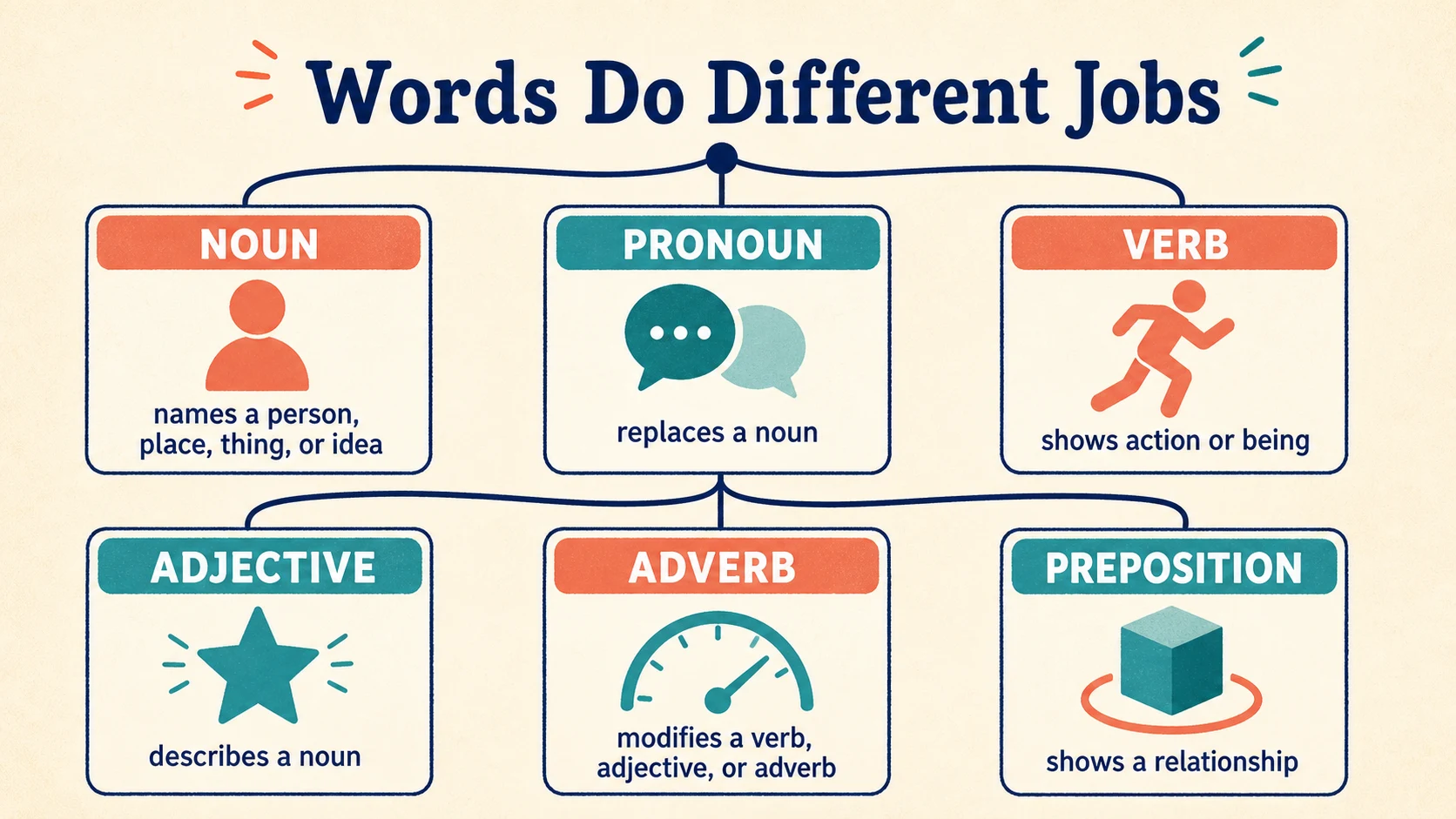
Use the map to distinguish naming a word’s function from applying that knowledge while constructing or revising a sentence.
Parts of speech: identify a word by its job
The live parts-of-speech description spans nouns, verbs, adjectives, adverbs, pronouns, prepositions, conjunctions, and interjections. That breadth should not become the first assignment. Begin with nouns and verbs because they connect directly to the subject-and-predicate structure of a sentence. Add another category only when it serves a specific reading or writing decision.
Context matters because an English word can do different jobs. In these two sentences, the same spelling does not guarantee the same classification:
- “We watch the birds.” Here, watch tells what “we” do, so it is a verb.
- “My watch stopped.” Here, watch names a thing, so it is a noun.
A learner who calls watch a noun in both sentences may be recalling a memorized definition without checking the word’s function. Ask, “What is the word doing in this sentence?” Do not respond with a longer list of definitions.
Sentence structure: build and connect complete thoughts
Sentence work begins with completeness: someone or something, plus what that subject does or is. It then expands into subjects and predicates, fragments, run-ons, sentence combining, added detail, and varied beginnings.
This area often exposes a difference between oral understanding and written control. A learner may explain an event clearly aloud but write, “After the game.” That phrase creates an expectation but does not finish the thought. An adult can ask the learner to complete it orally before requiring a written correction.
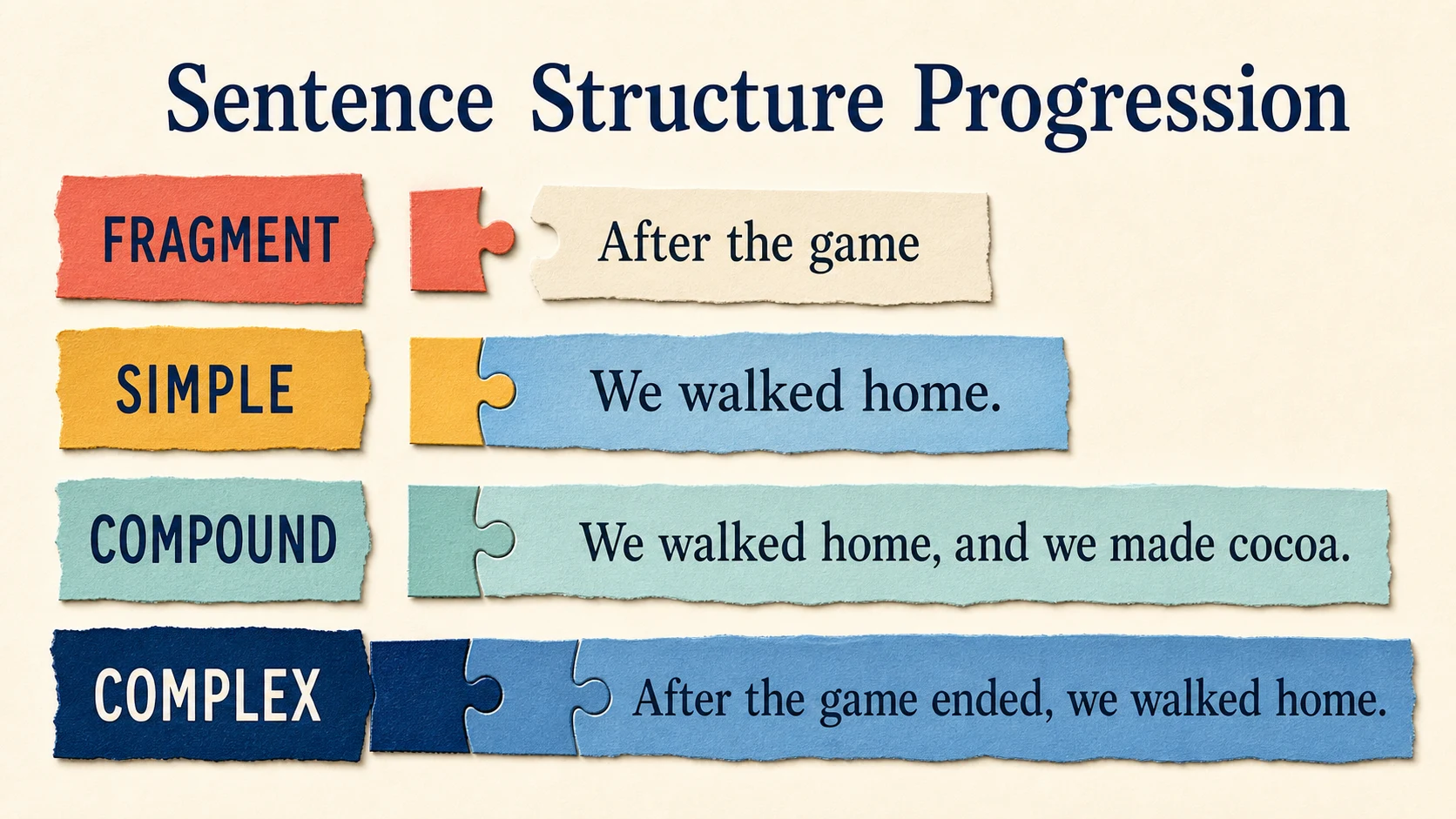
Move from hearing and completing a thought to marking its parts, revising it, and finally producing a complete sentence without a frame.
Punctuation: show how the sentence should be read
Punctuation is not decoration added after grammar. It signals boundaries and relationships that the writer has already decided. Third-grade practice may include end marks, commas in selected contexts, apostrophes, and quotation marks. More complex punctuation should be introduced one rule at a time rather than mixed indiscriminately.
A learner who writes “Did Maya bring lunch.” may understand the sentence’s structure but miss the signal required by its purpose. A learner who writes “When Maya brought lunch.” has supplied an end mark but not completed the dependent opening. The first response calls for question-mark practice; the second calls for sentence completion.
The Common Core English Language Arts standards include grade-level expectations for conventions, including sentence production, parts of speech, capitalization, punctuation, and spelling. That framework helps explain why these skills appear together. It does not mean every learner must meet them in an identical order or that one worksheet demonstrates mastery.
Compare the Live Free Entry Points
Each live topic has a free 14-problem worksheet. Use that common length to compare content, not to assume the three sheets require identical reasoning.
| Free entry point | Best initial question | What the work can reveal | What it cannot establish |
|---|---|---|---|
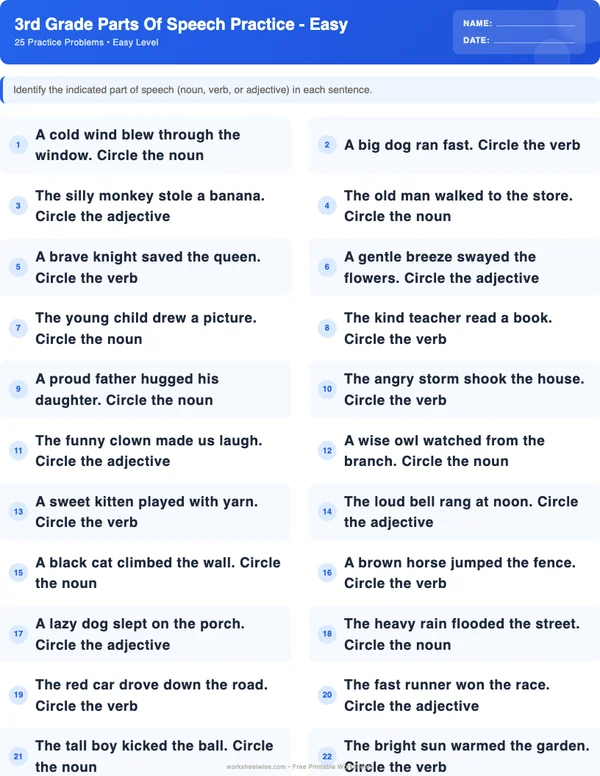
| 3rd Grade Parts of Speech guide and free sheet | Can the learner identify a word’s function in context? | Whether noun, verb, or another taught category is being recognized consistently | Whether the learner will use precise words in original paragraphs |
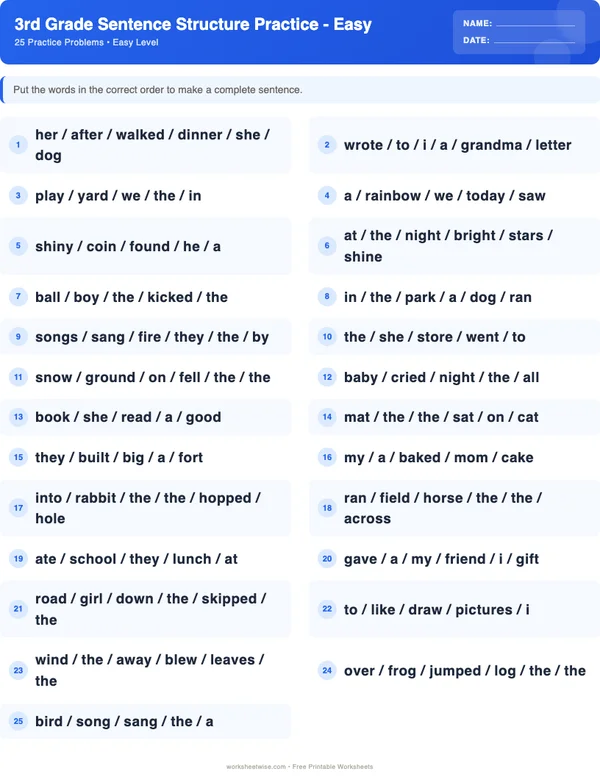
| 3rd Grade Sentence Structure guide and free sheet | Can the learner distinguish a complete thought from a fragment or run-on? | Whether sentence boundaries, subjects, predicates, or connections cause trouble | Why the difficulty occurs or how it appears across all writing |
| 3rd Grade Punctuation guide and free sheet | Can the learner apply one known punctuation rule? | Which presented marks or contexts are controlled | Whether punctuation transfers to unprompted composition |
Do not administer all three simply because they are free. Fourteen items are enough to create fatigue or blur the original question, especially after a full school day. Preview the first few items, choose the sheet closest to an observed need, and stop once the response pattern is clear.
Use the wider set of 54 variants only after defining the target. Variant count indicates choice within the catalogue; it does not establish a required sequence, effectiveness, or suitability for every learner.
Work Four Representative Examples Before Teaching
An adult should solve and explain the target item before assigning it. That check prevents an answer-focused exchange in which the learner guesses correctly but cannot state the relevant decision.
Example 1: Find the noun and verb before adding labels
Sentence: The lantern glowed.
Checked analysis:
- lantern names the thing the sentence is about: noun and subject.
- glowed tells what the lantern did: verb and complete predicate.
- the accompanies the noun, but it is not the target if the lesson is bounded to nouns and verbs.
This example belongs in third-grade grammar because it connects two catalogue strands without overloading either one. The learner can identify word functions and then use those functions to explain why the sentence is complete.
A suitable prompt is, “Underline who or what the sentence is about once. Underline what it did twice.” Only afterward ask for the labels noun and verb. If the learner marks glowed as a noun, ask, “Can a lantern do this action?” The question directs attention back to function.
A next item can change only one feature: The lanterns glowed. This checks whether the learner still locates the noun and verb when the noun becomes plural. It does not yet add adjectives, adverbs, and prepositions.
Example 2: Repair a fragment without changing its meaning
Fragment: After the rain stopped.
Checked analysis:
- After makes “the rain stopped” dependent on another event.
- The reader waits to learn what happened after the rain stopped.
- A complete repair is: After the rain stopped, we walked home.
The repair contains the opening dependent group “After the rain stopped” and the complete thought “we walked home.” The comma follows the introductory element.
This example belongs here because third-grade sentence-structure practice includes distinguishing fragments from complete sentences and expanding incomplete thoughts. It also shows why punctuation alone cannot fix every error. Adding a period to the original does not supply the missing main idea.
If the learner deletes after and writes “The rain stopped,” that is also a grammatically complete repair. Accept it if the direction is merely “make a complete sentence.” If the learning target is completing an introductory element, require a main clause instead. The direction determines which answer is sufficient.
Example 3: Combine repeated ideas economically
Original sentences:
The fox was quick. The fox was quiet.
Checked combinations include:
- The fox was quick and quiet.
- The quick, quiet fox moved through the grass.
The first answer preserves the original information and removes repetition. The second adds a new action, so it is appropriate only when sentence expansion is permitted. The comma between quick and quiet separates coordinate adjectives describing the same noun.
This example belongs in the sentence-combining progression because the learner must recognize shared content, retain both descriptions, and choose a structure. It is more demanding than circling a conjunction but more bounded than revising an entire paragraph.
Do not insist that the longest sentence is best. “The quick and quiet fox was quick and it was quiet” is technically interpretable but fails the purpose of reducing repetition. Ask the learner to read both versions aloud and identify which communicates the same information more cleanly.
Example 4: Select punctuation from meaning and structure
Unpunctuated sentence: Did you pack pencils paper and glue
Checked answer: Did you pack pencils, paper, and glue?
Reasoning:
- The sentence asks a direct question, so it ends with a question mark.
- pencils, paper, and glue are three items in a series, so commas separate them.
- The final comma before and follows the convention used in the corrected example.
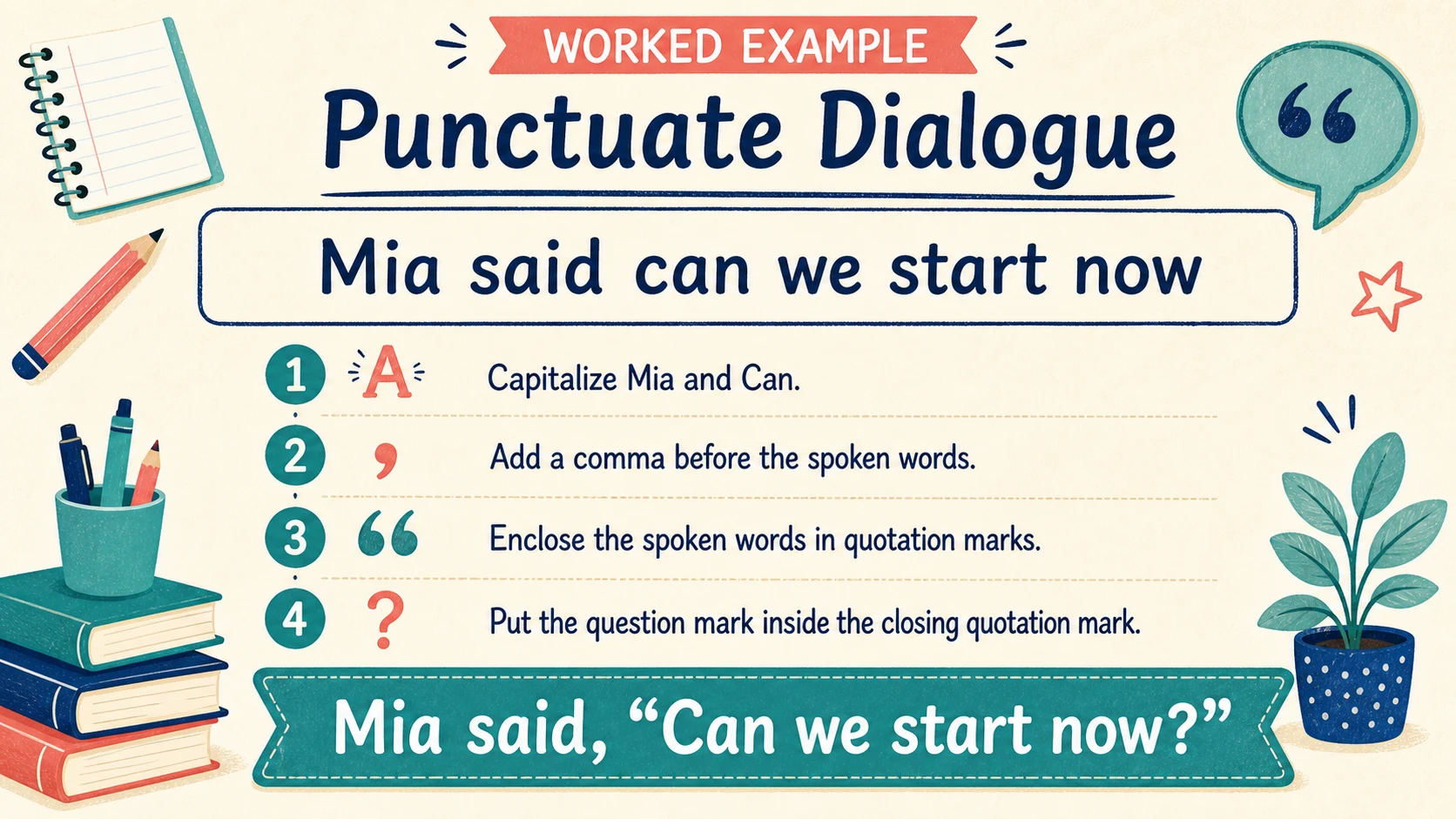
Have the learner identify the sentence purpose and the list separately; each feature accounts for a different punctuation choice.
This belongs in third-grade punctuation because it applies two familiar signals in one sentence while keeping the vocabulary and syntax manageable. If the target is end punctuation, temporarily supply the commas and ask only for the final mark. If the target is commas in a list, supply the question mark. Removing an irrelevant demand preserves the skill being measured.
Use a Short Routine That Produces Evidence
The Institute of Education Sciences writing practice guide recommends explicit teaching of writing strategies, attention to foundational writing skills, and frequent opportunities to write for meaningful purposes. It addresses elementary writing broadly; it did not evaluate WorksheetWise or this catalogue. Apply that guidance here by connecting brief, explicit grammar practice to actual sentence production rather than treating worksheet completion as the endpoint. See IES, Teaching Elementary School Students to Be Effective Writers.
A repeatable sentence-structure routine
Use this routine for about ten focused minutes:
- State one target: “Today we will decide whether a group of words is a complete sentence.”
- Model one decision: Think aloud while checking for who or what and what happens.
- Solve two together: Let the learner answer first, then request a reason.
- Assign three independently: Watch without prompting.
- Transfer once: Ask the learner to write or revise one related sentence.
- Record the pattern: Note the error type, not just the score.
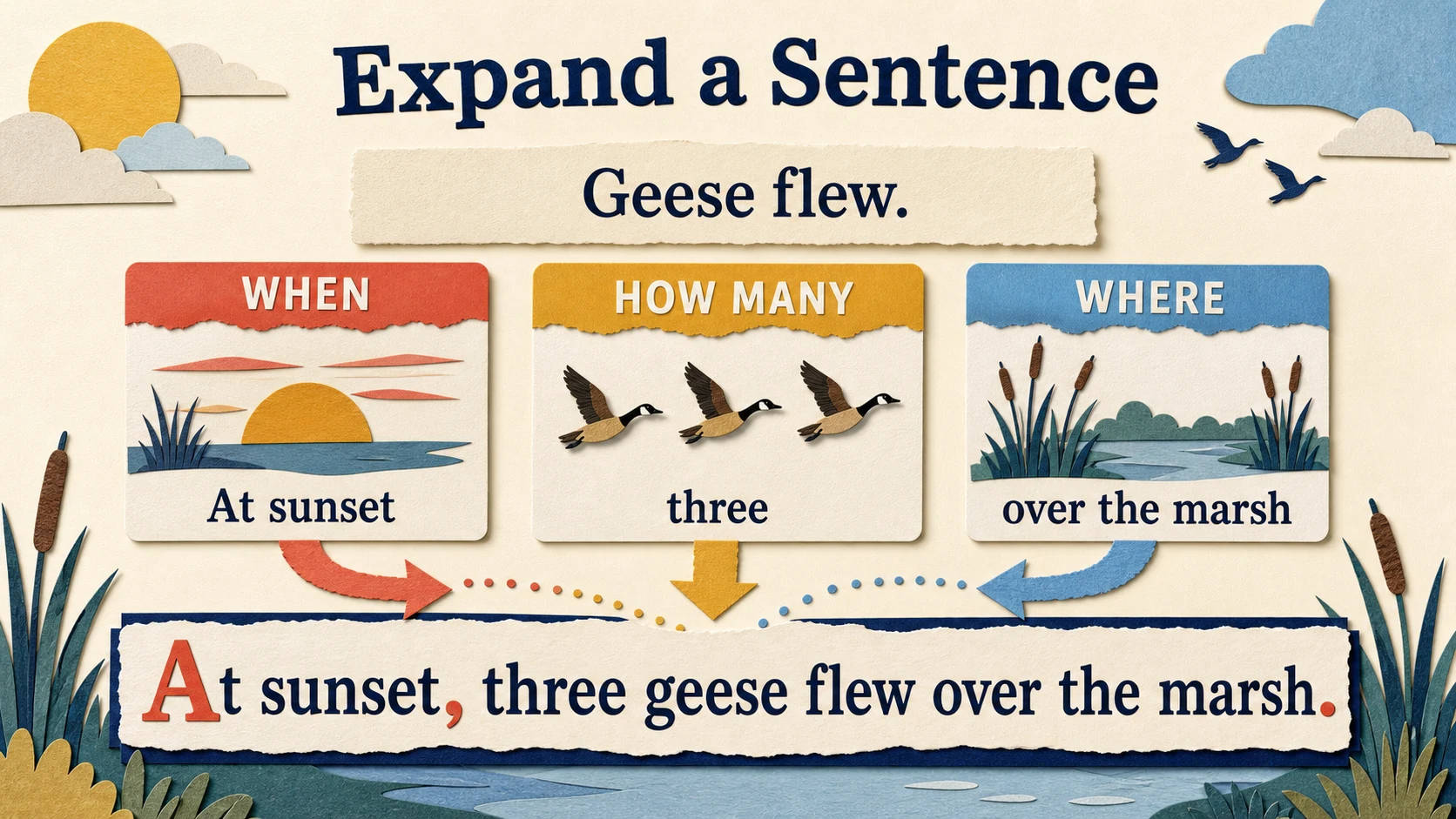
Keep the routine stable while changing the sentence feature, so the learner’s attention stays on completeness, combining, or expansion.
For example, after three fragment decisions, ask the learner to revise one sentence from a current story or response. That transfer sentence is often more informative than three additional recognition items.
A parallel punctuation routine
Punctuation needs its own reasoning sequence:
- Read the sentence aloud.
- Identify its purpose and complete thoughts.
- Name the one punctuation rule under study.
- Place or correct the mark.
- Explain what the mark signals to the reader.
- Apply the same rule to one original sentence.
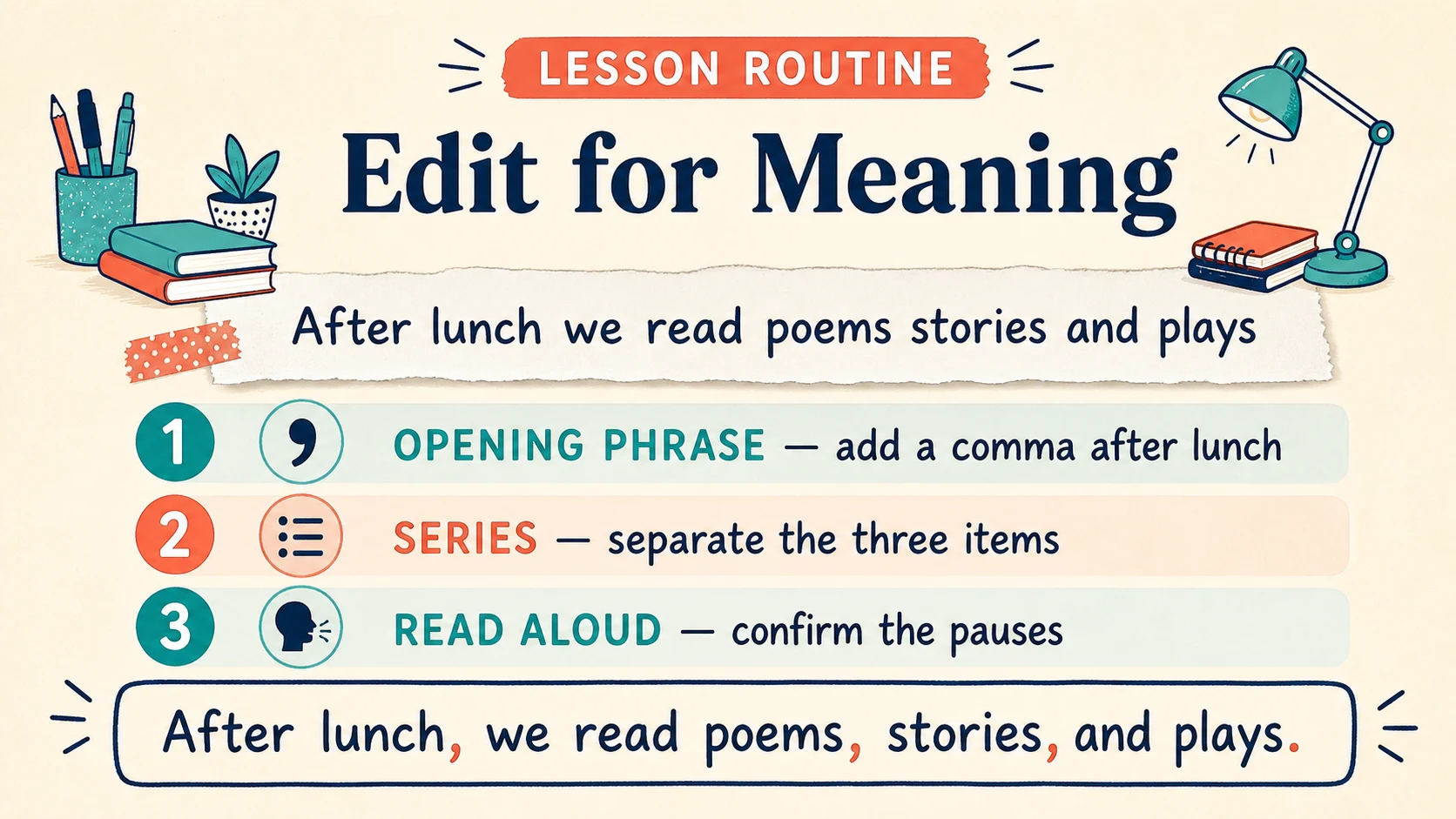
Use one punctuation context per lesson—such as end marks or commas in a list—before combining rules in editing practice.
The IES foundational reading guide emphasizes systematic instruction and supported practice in foundational reading skills. It is primarily a reading guide, not a grammar-workbook endorsement, but its attention to explicit modeling and gradual support is relevant when a learner must read sentences accurately before analyzing them. See IES, Foundational Skills to Support Reading for Understanding.
If decoding consumes most of the learner’s attention, read the grammar item aloud while leaving the grammatical decision to the learner. That adaptation changes the access route, not the target.
Interpret Errors Before Choosing Another Sheet
A total such as 9 out of 14 does not tell you what to teach. Sort the responses by the decision that produced them.
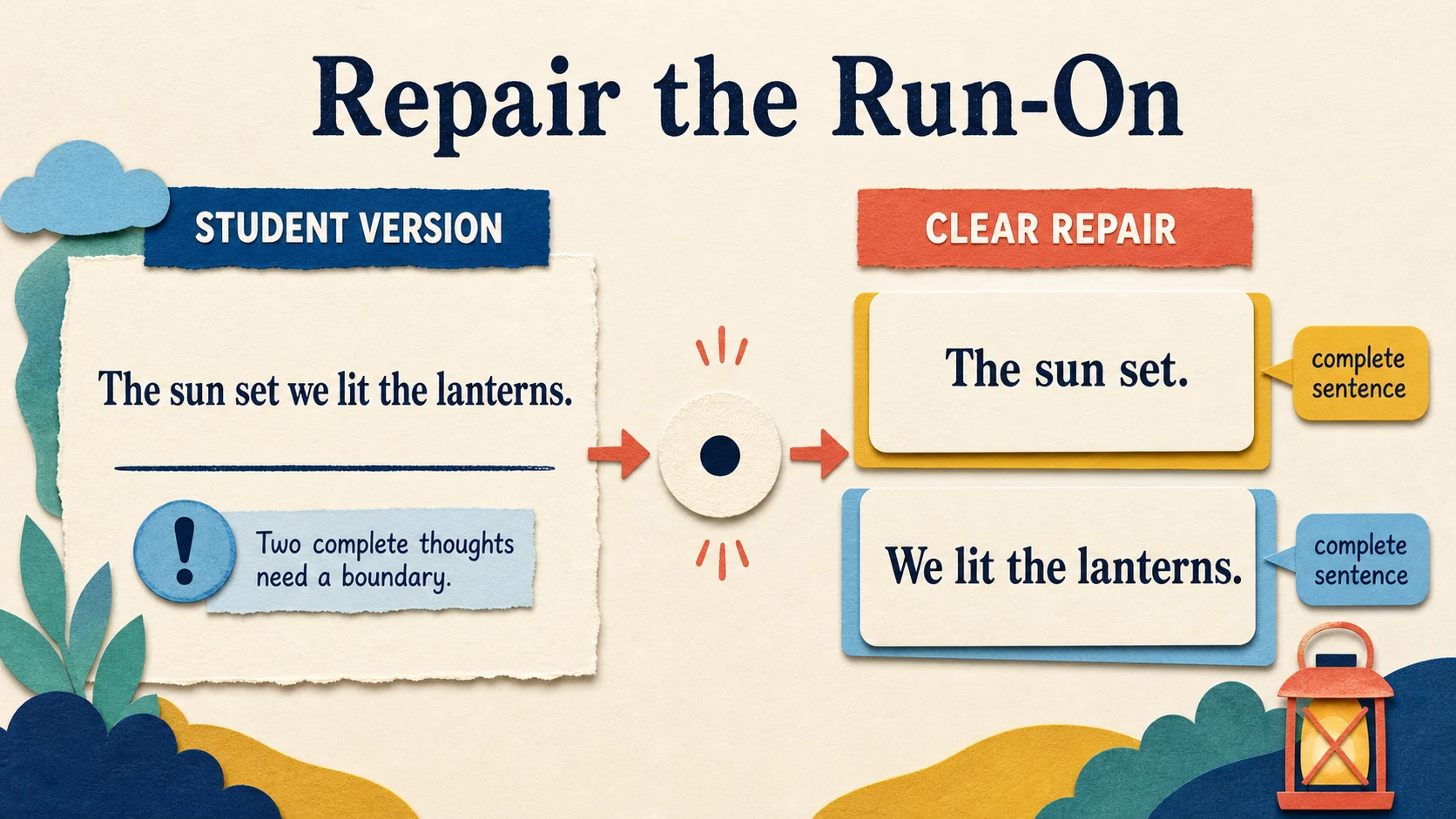
Match the response to the observed error pattern: a missing main thought, an unclear boundary, or difficulty locating the sentence’s core.
When every punctuated group is called a sentence
The learner may be using capitalization and a period as the definition of completeness. Test the idea orally:
- “Under the old bridge.”
- “The dog slept.”
- “Because we were late.”
Ask which one tells a complete thought and what is missing from the others. If oral decisions improve when punctuation is hidden, return to subject-and-predicate work rather than assigning another punctuation sheet.
When two complete thoughts are joined with only a comma
Example: I finished my book, I returned it.
The learner recognizes a pause but not the grammatical boundary. Show three valid repairs:
- I finished my book. I returned it.
- I finished my book, and I returned it.
- After I finished my book, I returned it.
These answers are not interchangeable in instruction. The first separates ideas, the second coordinates them, and the third makes one event dependent on another. For an initial repair, teach one option and check it consistently.
When the learner labels words from memory
Suppose the learner says light is always a noun. Compare:
- The light is bright. Noun: it names a thing.
- Please light the candle. Verb: it names the requested action.
- I carried a light bag. Adjective: it describes the bag.
This is an instructional comparison, not a reason to conclude that the learner has a language disorder or broad comprehension problem. Continue with contextual sorting and revisit the same word in different sentences.
When punctuation errors cluster in only one context
A learner might correctly use periods and question marks but omit commas in lists. That is a narrow rule gap, not “weak punctuation.” Select list practice and leave dates, dialogue, apostrophes, and introductory elements for later checks.
Conversely, random-looking punctuation across a paragraph may actually reflect sentence-boundary uncertainty. Ask the learner to draw a slash where each complete thought ends before adding marks. If the slashes are misplaced, teach boundaries first.
Adapt Access Without Replacing the Grammar Target
An adaptation is useful when it removes an unrelated barrier while preserving the decision you want to observe.
For a learner who writes slowly, allow circling, underlining, movable word cards, or oral explanation. If the target is recognizing a complete sentence, handwriting speed is not essential. If the target is independently producing and punctuating a sentence, however, an entirely oral response would remove part of the target; use dictation only for a preliminary check.
For a learner who loses place on a 14-problem page:
- Cover all but one row.
- Fold the page so only four items show.
- Complete two items, pause, and return.
- Mark the relevant words with consistent colors.
- Enlarge the sheet without simplifying the sentences.
For multilingual learners, check whether an error reflects the English construction being practiced rather than a lack of ideas. Use a clear model, invite an oral rehearsal, and contrast two English sentences. Avoid turning a grammar item into a test of unfamiliar cultural knowledge.
For learners who need more challenge, deepen the same target instead of merely adding volume. After identifying adjectives in supplied sentences, ask the learner to compare a vague and precise revision. After repairing a run-on, ask for two valid repairs and a discussion of how they differ.
For an after-school session, the After-school Grammar Worksheets collection can help adults choose a shorter context-appropriate activity. A homeschool adult can connect the same target to current composition through the 3rd Grade Homeschool Worksheets. In either setting, preserve the bounded question and avoid using extra pages as a substitute for interpretation.
Move From Recognition to Independent Writing Carefully
A correct worksheet response shows performance under that worksheet’s conditions. It does not prove that the learner will apply the rule tomorrow, in a story, or while managing spelling and ideas simultaneously.
Use a four-step transfer check:
Recognize
The learner identifies the feature in a supplied sentence: noun, fragment, conjunction, or missing mark.
Explain
The learner gives a usable reason: “This is incomplete because after makes me wait for what happened next.”
Revise
The learner changes a supplied sentence without losing its intended meaning.
Produce
The learner writes a new sentence demonstrating the same feature and checks it independently.
Move forward when the learner is accurate across several varied examples and can explain the choice without an adult feeding the rule. If recognition is secure but production is not, do not jump to a different topic. Add a sentence frame, oral rehearsal, or revision task at the same target.
A warm-up can therefore be only three items: one familiar check, one current target, and one transfer sentence. A writing mini-lesson can use a sentence from the learner’s own draft. Test-preparation practice may use selected-response formats, but it should still include an explanation so distractor selection does not become guessing practice.
Know What These Worksheets Cannot Tell You
The catalogue supports practice; it does not provide a diagnosis. One free sheet cannot establish a disability, developmental level, curriculum placement, or overall writing ability. Errors may be affected by reading load, attention, fatigue, unfamiliar vocabulary, unclear directions, or the number of rules combined in one item.
The worksheets also cannot replace extended writing. A learner needs opportunities to plan, draft, revise, and communicate for real purposes. Grammar practice should make those sentences clearer, not crowd out composition.
Do not infer that:
- Completing all 14 problems means the skill is mastered.
- A low score means the learner lacks the concept in every context.
- A high score guarantees independent application.
- The catalogue’s 54 variants form a compulsory order.
- A standards-aligned exercise covers every local curriculum requirement.
- More difficult-looking punctuation is automatically the right next step.
When concerns persist across oral language, reading, and writing contexts, document concrete examples and speak with the learner’s teacher or an appropriate qualified professional. Describe what happened—“The learner consistently treats introductory fragments as complete sentences”—without assigning a diagnosis.
Make the Next Worksheet Earn Its Place
Choose tomorrow’s task from one observable result today.
If the learner writes “The small dog.” and cannot explain what is missing, open the 3rd Grade Sentence Structure guide and free sheet. Preview the items, select three that ask for complete-sentence decisions, and use the “Who or what? Did what?” check. End by having the learner complete “The small dog ___” with a predicate and read the result aloud.
If the learner writes complete sentences but produces “We bought apples oranges and pears.”, use the 3rd Grade Punctuation guide and free sheet and select list-comma items only. If the learner confuses nouns and verbs in otherwise complete sentences, begin with three contextual items from the 3rd Grade Parts of Speech guide and free sheet.
Record one sentence after the session: “Next time, the learner will…” Complete it with an observable action, such as “separate two complete thoughts with a period” or “identify the verb by stating what the subject does.” That sentence—not a broad label—is the practical bridge to the next useful worksheet.
Put it into practice
Use the guide with a real printable
Move from explanation to a short, observable practice task. Check the first item together, then adjust the next session from the learner's actual work.
Open the first free worksheet