Curated collectionAnswer keys includedPrint-ready PDFs
Kindergarten Morning Work Worksheets
Build predictable, low-friction arrival routines with retrieval, a short completion boundary and a fast teacher scan.
Start with a real resource
Browse this worksheet collection
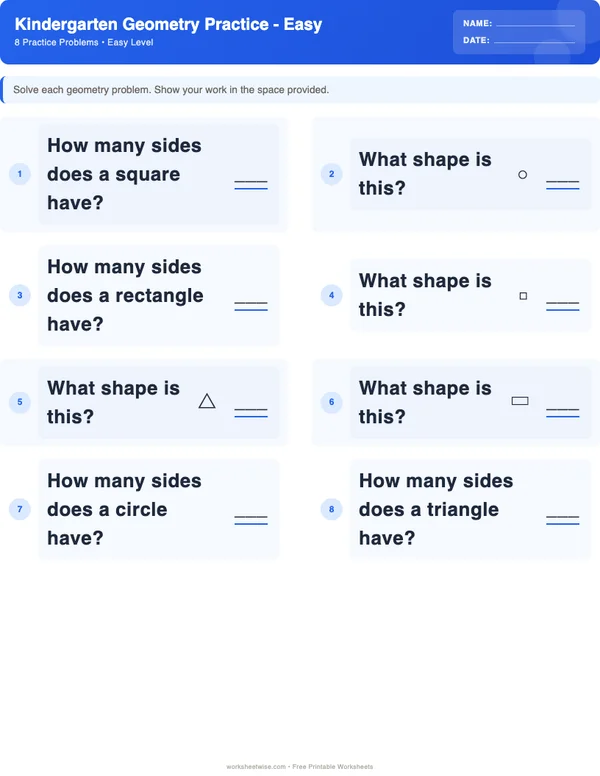
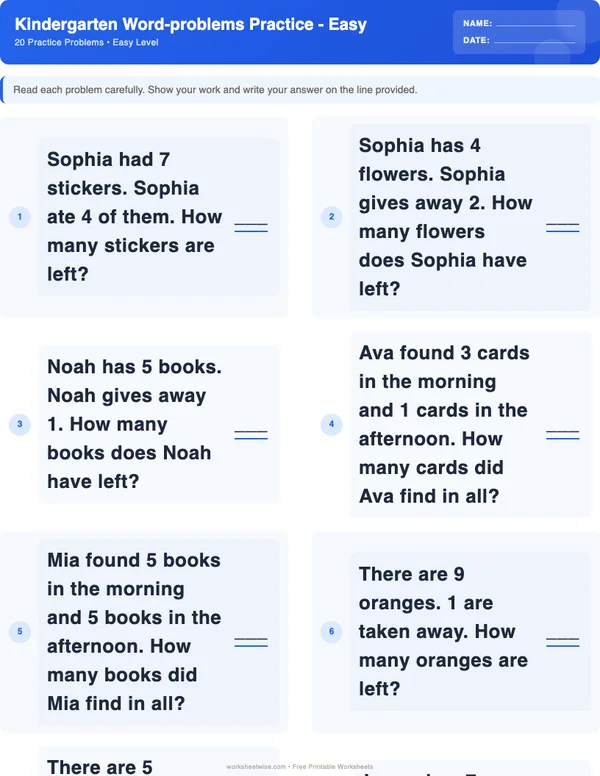
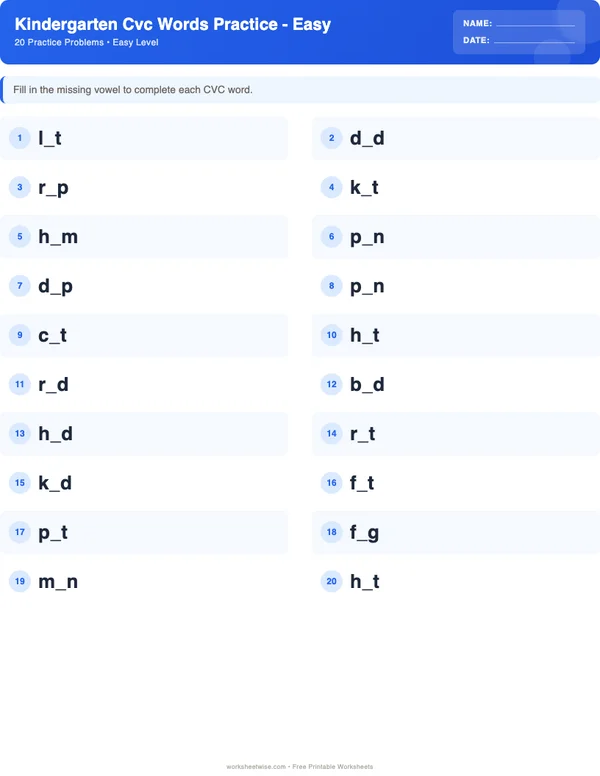
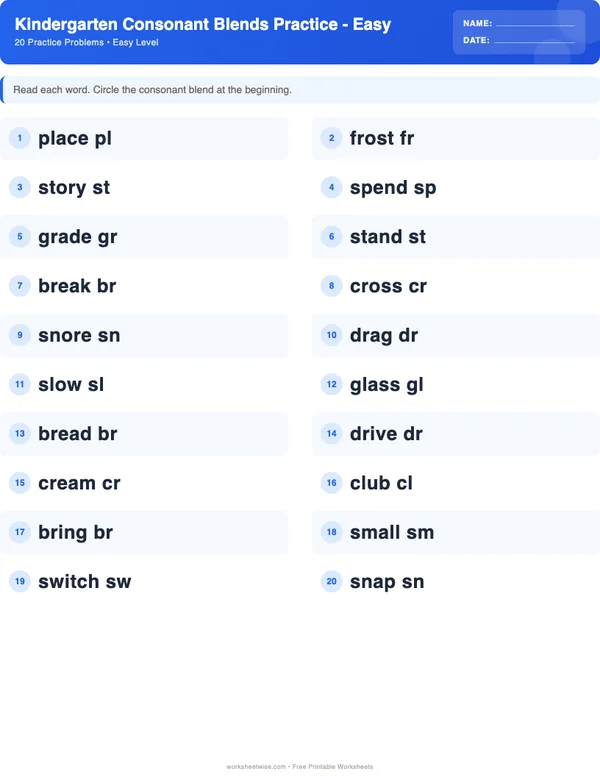
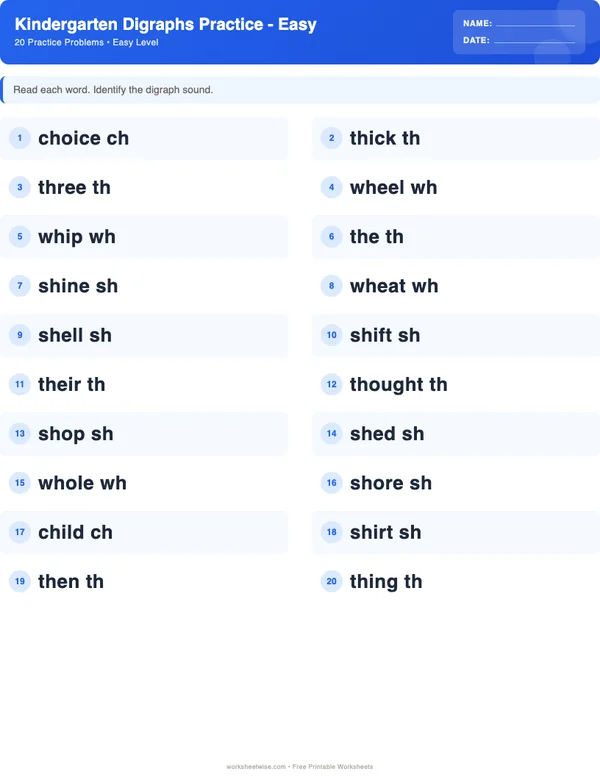
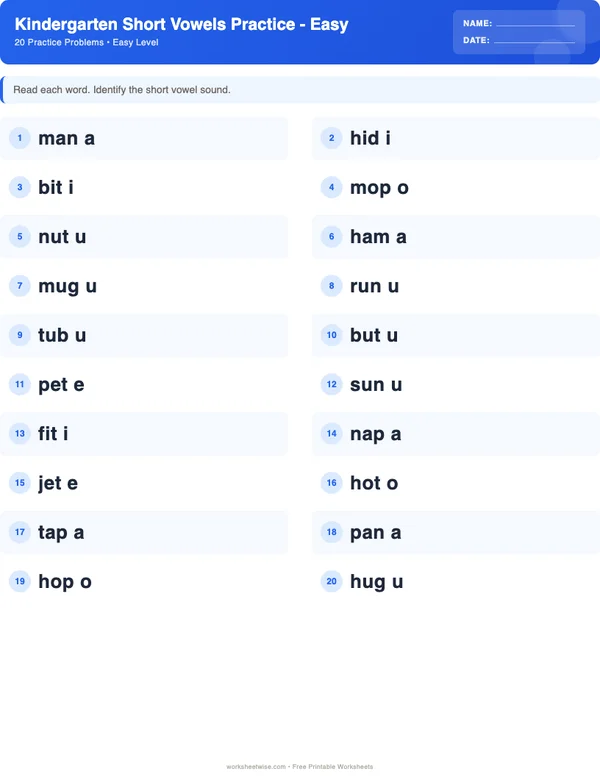
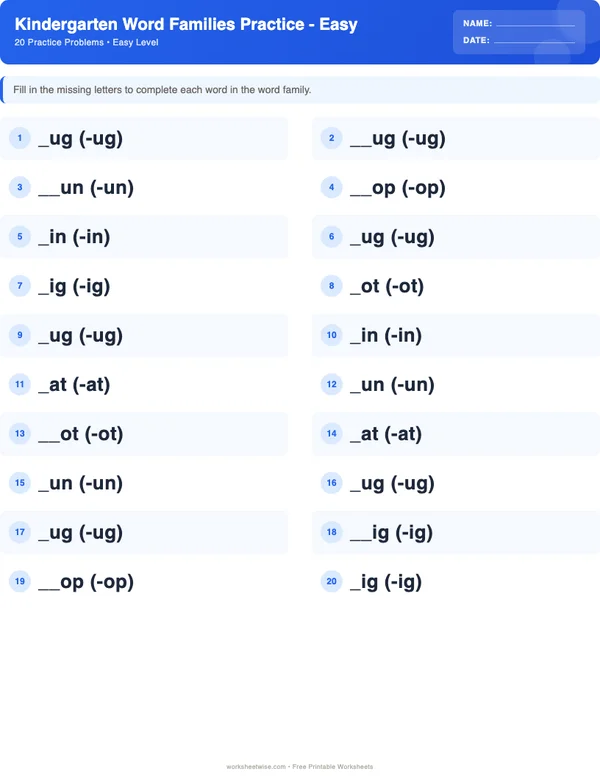
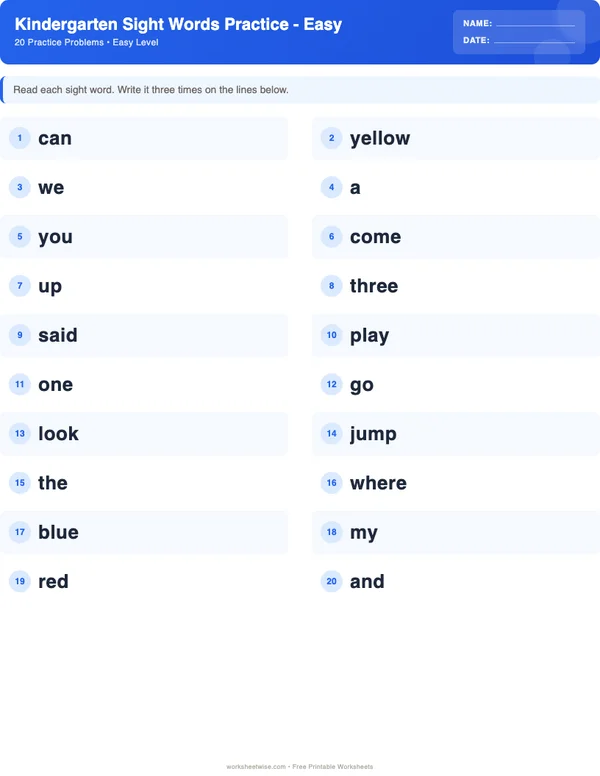
13 relevant free entry points are available. Each one includes a printable learner PDF and separate answer key.
A useful practice loop
Print less. Observe more.
- Choose one skill and model the first item aloud.
- Use a short set and notice the learner’s strategy.
- Change the next task from the work you can see.
Need more than the free sheet?
Plus includes all 234 matching catalogue variations where available, plus saved deterministic generators and the worksheet designer.
See Plus membershipComplete guide
How to teach and practise kindergarten morning-work worksheets
3,431 words Updated 6 instructional visuals
A kindergarten arrival routine should be short, familiar, and easy to scan
Use kindergarten morning work as a five-to-eight-minute retrieval routine, not as a miniature lesson or a demand to finish an entire worksheet. A workable page has three parts:
- Two or three items the child has solved successfully before.
- One item that reveals how the child is thinking.
- A clear stopping point that does not depend on working faster than classmates.
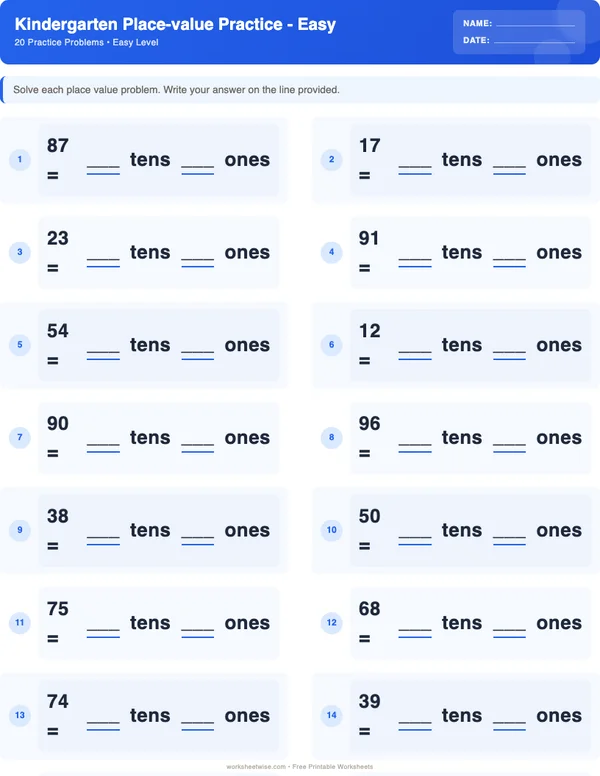
That boundary matters. The live collection includes 234 kindergarten variants across three subjects and 13 topics, with 13 free entry points. Representative counting, addition, subtraction, place-value, geometry, CVC-word, blend, digraph, short-vowel, word-family, and sight-word sheets contain 20 problems; punctuation and word-problem sheets contain 12. Those totals describe the resources, not a sensible daily arrival quota. Mark four items, cover the unused section, or tell children to stop at a visible star.
The morning task should retrieve something already taught. New concepts still need modeling, talk, objects, and guided practice. The adult’s job during arrival is to notice whether children can start independently, use the intended representation, and recover from a small mistake. The completed page is less informative than those behaviors.
The guidance below combines two kinds of information:
- Sourced guidance: recommendations from the approved IES practice guides and the published Common Core pages.
- Editorial suggestions: WorksheetWise routines, time boundaries, example sequences, and scan codes proposed for this specific kindergarten context.
The outside sources did not review WorksheetWise or its worksheets.
Select the page by task features, not by its label
Every representative free sheet in this collection is labeled “easy.” That label should be translated into observable features before assigning anything. Here, an appropriate low-friction morning task usually has familiar directions, one-step responses, a small quantity range, generous visual space, and no untaught spelling or operation hidden inside the prompt.
Do not label a child “easy,” “developing,” or “advanced.” Describe the work instead: “counts five objects accurately when they are in a row but skips one when they are scattered,” or “reads ship but treats sh as two sounds.”
Grade labels describe an intended practice level; local curriculum sequences differ. Kindergarten on the page is not proof that every kindergarten learner has received the prerequisite instruction.
Run four checks before printing
Check the prerequisite. A digraph page is not independent work for a child who has not been taught that two letters can represent one sound. A subtraction page is not retrieval if the class has only practiced counting.
Check the reading load. A mathematical answer can be obscured by an unreadable direction or story. Read directions aloud consistently when decoding is not the target.
Check the motor load. Circling one answer, drawing three counters, and writing a complete sentence place very different demands on handwriting. Reduce copying when the target is sound identification or quantity.
Check the completion boundary. Choose the exact items in advance. Four visible items are a real assignment; “do as much as you can” turns speed into an unstated goal.
Age, when shown while browsing resources, should be treated as a discovery aid rather than a placement decision. In particular, for ages three and four, prioritize brief adult-led oral, matching, manipulative, and movement work over desk work. Readiness is better judged from the actual task and the support required.
Establish one arrival script before varying the content
Teach the routine as deliberately as any academic procedure. Keep the materials, direction symbols, help option, and stopping signal stable for at least a week.
The seven-minute sequence
Minute 0–1: Enter and orient. The child puts away belongings, takes the page and pencil, and points to the stop mark. A picture cue can show “name, do, check, place in tray.”
Minute 1–2: Retrieve orally. The adult or a familiar visual prompts one tiny rehearsal: count from 6 to 10, say the sounds in map, or read a statement with a period. This is not a second assignment. It activates the same knowledge needed on the page.
Minutes 2–6: Complete the marked set. Children work on three or four selected items. Approved supports—such as counters, a number line, sound boxes, or an alphabet strip—remain in the same place each day.
Minute 6–7: Check and submit. The child points to each answer once, fixes anything noticed independently, and places the page in a designated tray. Early finishers reread, recount, or draw a model for one completed answer. They do not advance into an untaught section.
A child arriving late should receive the same boundary, reduced to one known item and one informative item if necessary. Morning work should restore entry into the class routine, not create an immediate backlog.
Teach independence as observable actions
Independence does not mean silent completion without tools. Look for whether the child can:
- begin after the usual cue;
- identify the marked stopping point;
- choose a familiar support without waiting;
- attempt an item before requesting help;
- use the agreed help signal;
- submit the work without starting an unrelated page.
If several children cannot begin, change the routine or directions before changing the skill level. If one child can explain the answer orally but cannot record it, preserve the academic target with a different response method.
Use counting to make the routine concrete
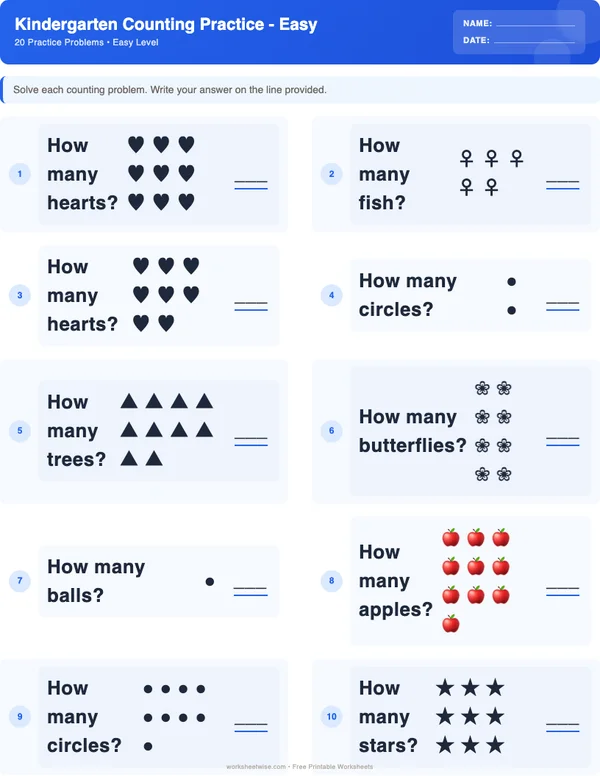
Counting is a strong early-week choice because it can connect spoken numbers, objects, pictures, and numerals. The catalogue’s counting progression includes rote counting, one-to-one correspondence, counting forward, missing numbers, and later skip-counting patterns. For morning work, select only a portion that the class has already practiced with objects.
The IES guide for teaching math to young children recommends teaching number and operations through a developmental progression, monitoring what children know, and providing daily opportunities for mathematics. That supports using the arrival scan to inform later instruction; it does not mean a worksheet alone supplies the progression.
Checked example 1: count a scattered set
Draw or select seven dots in a loose arrangement. Ask the child to touch or mark each dot and write the total.
A correct check is straightforward: tagging each of the seven dots once produces 7. If the child says the stable sequence “one, two, three, four, five, six, seven” but touches one dot twice, the issue is not numeral formation. The response suggests that one-to-one tracking needs another look.
This example belongs in kindergarten morning work because it retrieves counting and one-to-one correspondence without requiring a written explanation. A scattered arrangement is more informative than a neat row because it makes the child organize the count. On the next instructional turn, provide seven counters and ask the child to move each one into a cup while counting. Keep the quantity at seven; change the tracking support, not the mathematical target.
Use the Kindergarten Counting guide and free sheet when this is the current taught skill. If the marked items include teen numbers, confirm that children have already worked with the less predictable names from 11 through 19 rather than assuming a familiar single-digit count transfers automatically.
Move from counters to addition and subtraction carefully
Morning computation should preserve meaning. Children who have used counters to join and remove sets can retrieve the same ideas with pictures and number sentences. Do not introduce bare equations first at arrival.
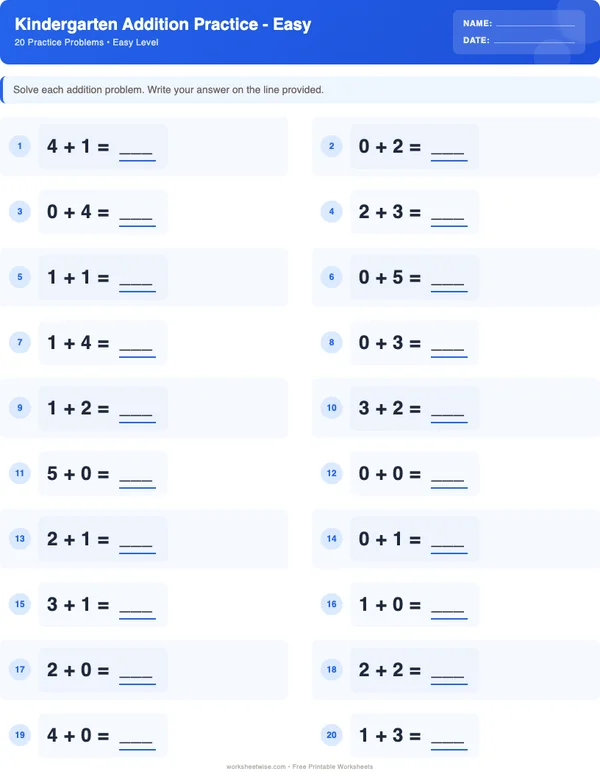
The collection describes a concrete-representational-abstract progression for addition. As an editorial application, rotate the representation while keeping the quantity relationship constant: objects during instruction, a drawing during morning retrieval, and a numeral sentence only after the child can explain what the symbols represent.
Checked example 2: join within five
Show three circles, then two more circles, and ask, “How many altogether?” The child may count all five and complete 3 + 2 = __.
The checked answer is 5 because the two sets contain three and two objects, and . This belongs in kindergarten because it stays within five, uses a visible joining situation, and asks for one response. It also allows a quick scan: a written 4 paired with five correctly drawn objects may reflect a recording slip, while four total objects may reflect inaccurate counting or an incomplete second set.
The next action differs accordingly. For a recording slip, have the child match numeral cards to quantities. For an inaccurate count, return to moving and touching counters. The Kindergarten Addition guide and free sheet provides the relevant catalogue entry point.
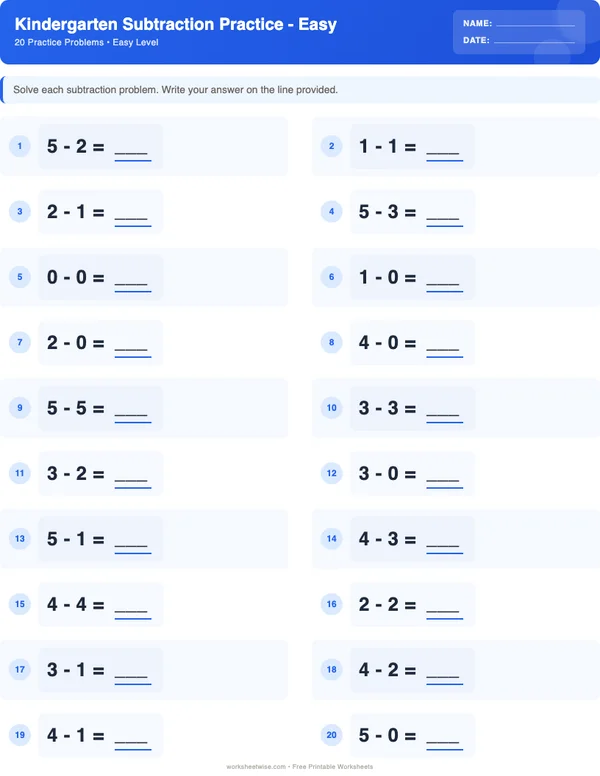
Checked example 3: remove within five
Place or draw five apples and cross out two. Ask the child to complete 5 − 2 = __.
The answer is 3: removing two objects from a set of five leaves three. This example belongs here because the action is visible and the quantities are small enough to verify by recounting. It does not require the child to infer subtraction from a keyword.
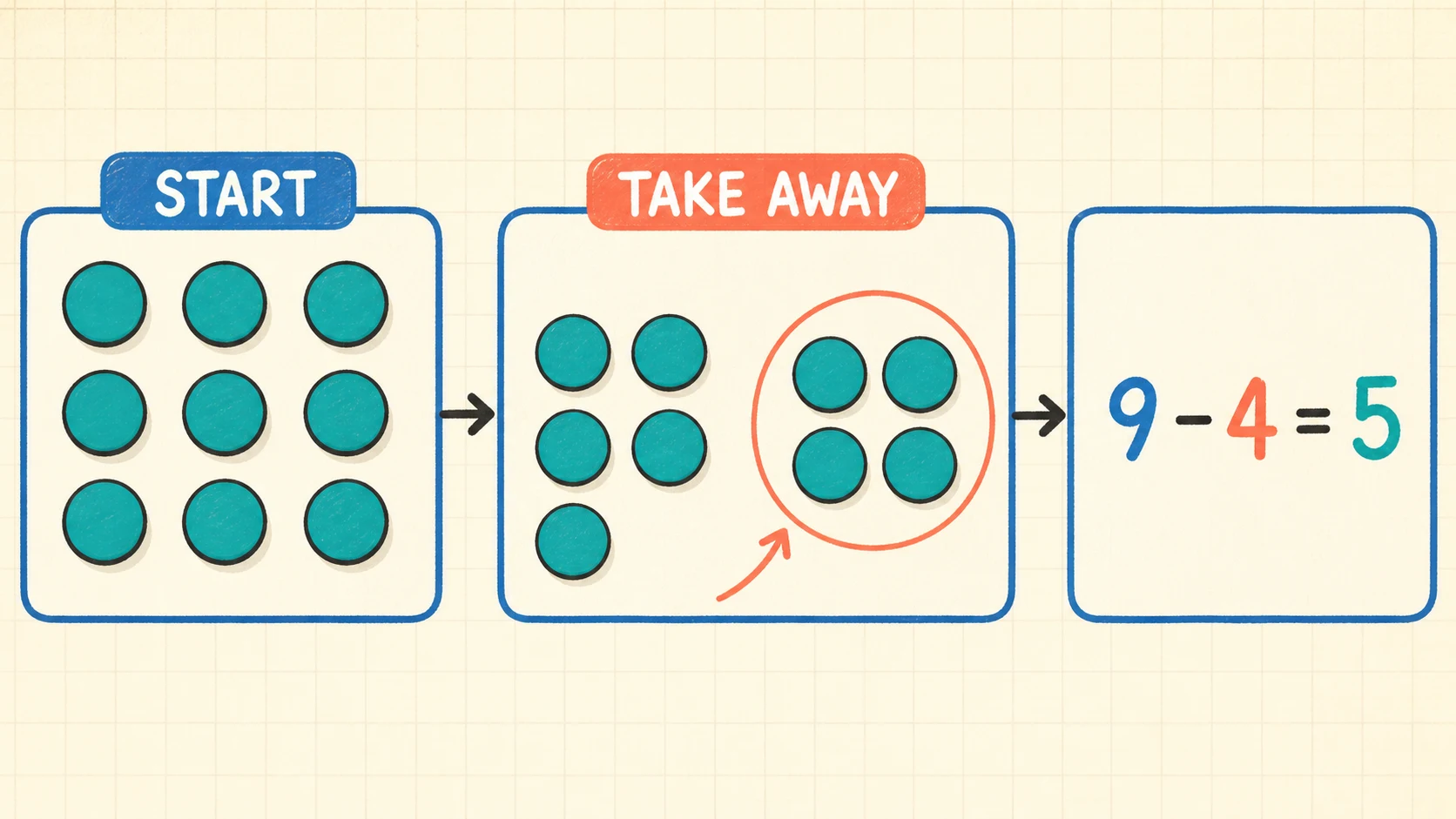
Use the map to locate a morning subtraction item within the taught path from concrete removal toward pictures and symbols.
If a child writes 7, ask, “Did the group get bigger or smaller?” That checks whether the operation was interpreted as joining. If the child crosses out two but writes 2, ask, “What does the blank ask us to record—the number crossed out or the number left?” Neither error supports a diagnosis.
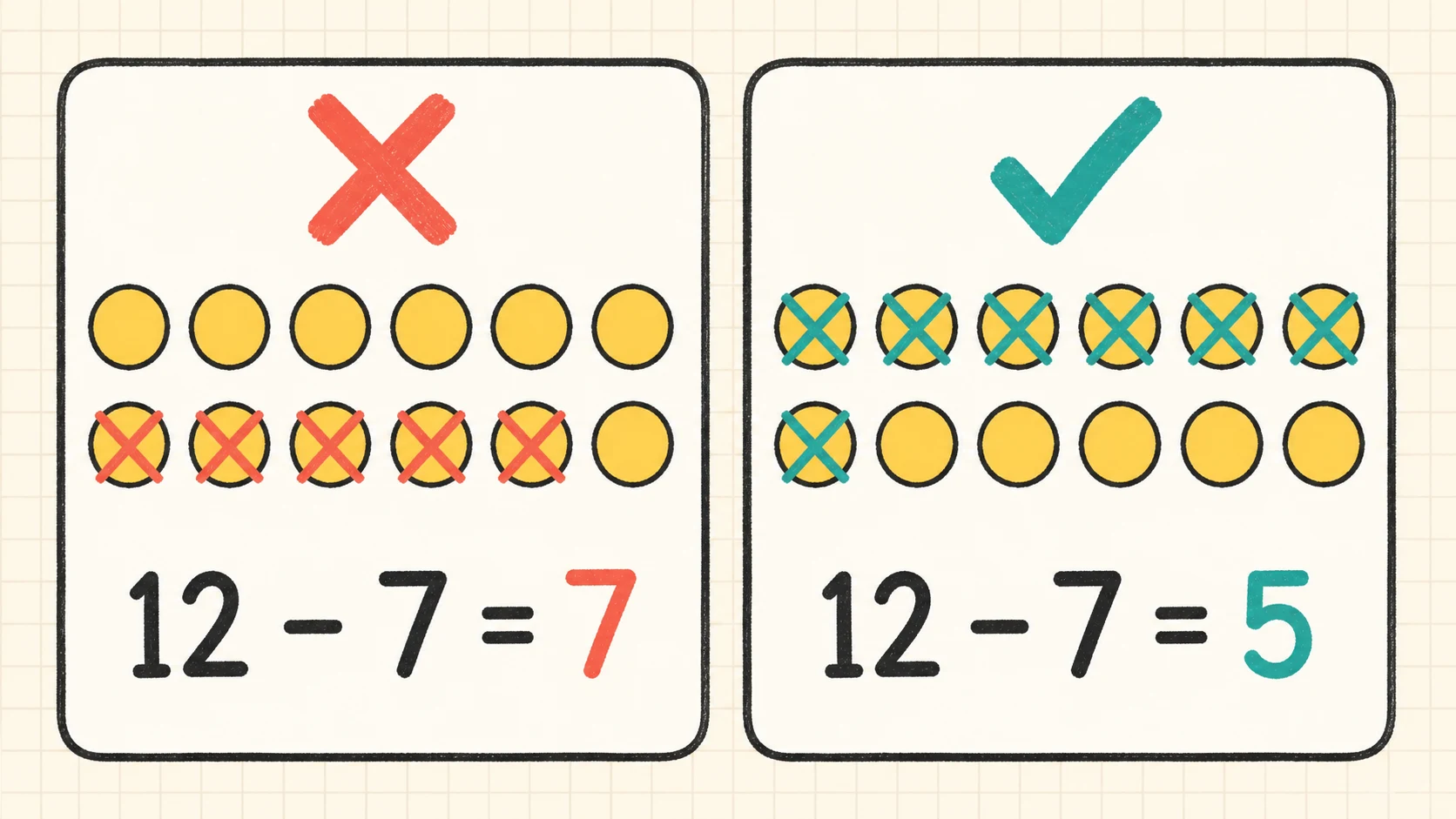
Match the visible response to a brief follow-up prompt before choosing the next kindergarten subtraction task.
The Kindergarten Subtraction guide and free sheet is a better next resource than increasing the number range. Keep removal, comparison, and missing-part situations distinct until each has been modeled. The Common Core mathematics pages describe kindergarten work with addition and subtraction situations, but published standards should not be treated as proof of local sequencing or as an endorsement of a particular page.
Alternate phonics patterns without turning arrival into a test
Phonics morning work is most useful when it rehearses a pattern taught explicitly the previous day. The catalogue sequence includes short vowels and CVC words before the greater sound-memory demand of blends, while digraphs require recognizing that two letters can represent one sound.
The IES foundational reading guide recommends linking speech sounds with letters, teaching decoding and word analysis, and giving children daily opportunities to read connected text. A word-sort worksheet can support one part of that work, but it does not replace oral sound practice, teacher modeling, or connected reading.
Checked example 4: build and read an -at family
Place the fixed ending at on the page and offer the initial letters c, h, and m. The child builds and reads:
c+at= cath+at= hatm+at= mat
All three are real CVC words with the short a sound and the shared -at ending. This example belongs in kindergarten because the child changes only the onset while retrieving a stable rime. It reduces the number of changing features and makes the pattern visible.
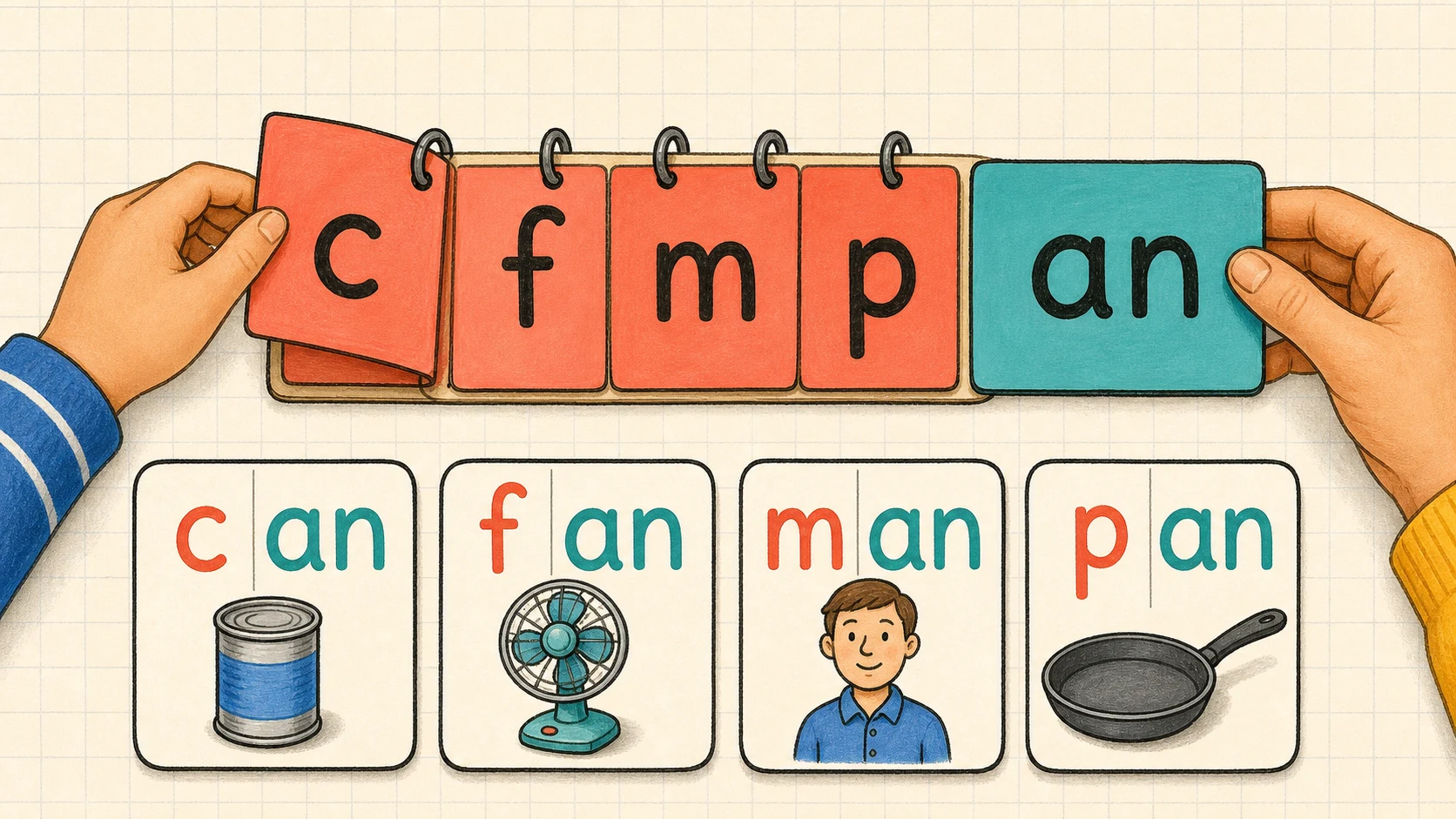
Keep the oral build-read-check sequence stable when an -at, -ig, or other taught family appears at arrival.
A fast scan should separate word recognition from copying. Ask the child to point and read one completed word. If cat is copied correctly but read as “cot,” revisit the vowel sound orally. If the child reads all three words but reverses a letter in writing, do not replace the decoding task with harder words; provide a letter tile or tracing model while retaining the same words.
Checked example 5: distinguish a digraph from a blend
Compare ship and slip. In ship, sh represents one consonant sound followed by /i/ /p/. In slip, the beginning retains two sounds, /s/ /l/, followed by /i/ /p/.
This example belongs after children have secure CVC blending and have been explicitly introduced to sh. It checks a kindergarten-relevant distinction without asking children to memorize the terms “digraph” and “blend.” Ask, “Which word begins with two letters working together for one sound?” The checked answer is ship.
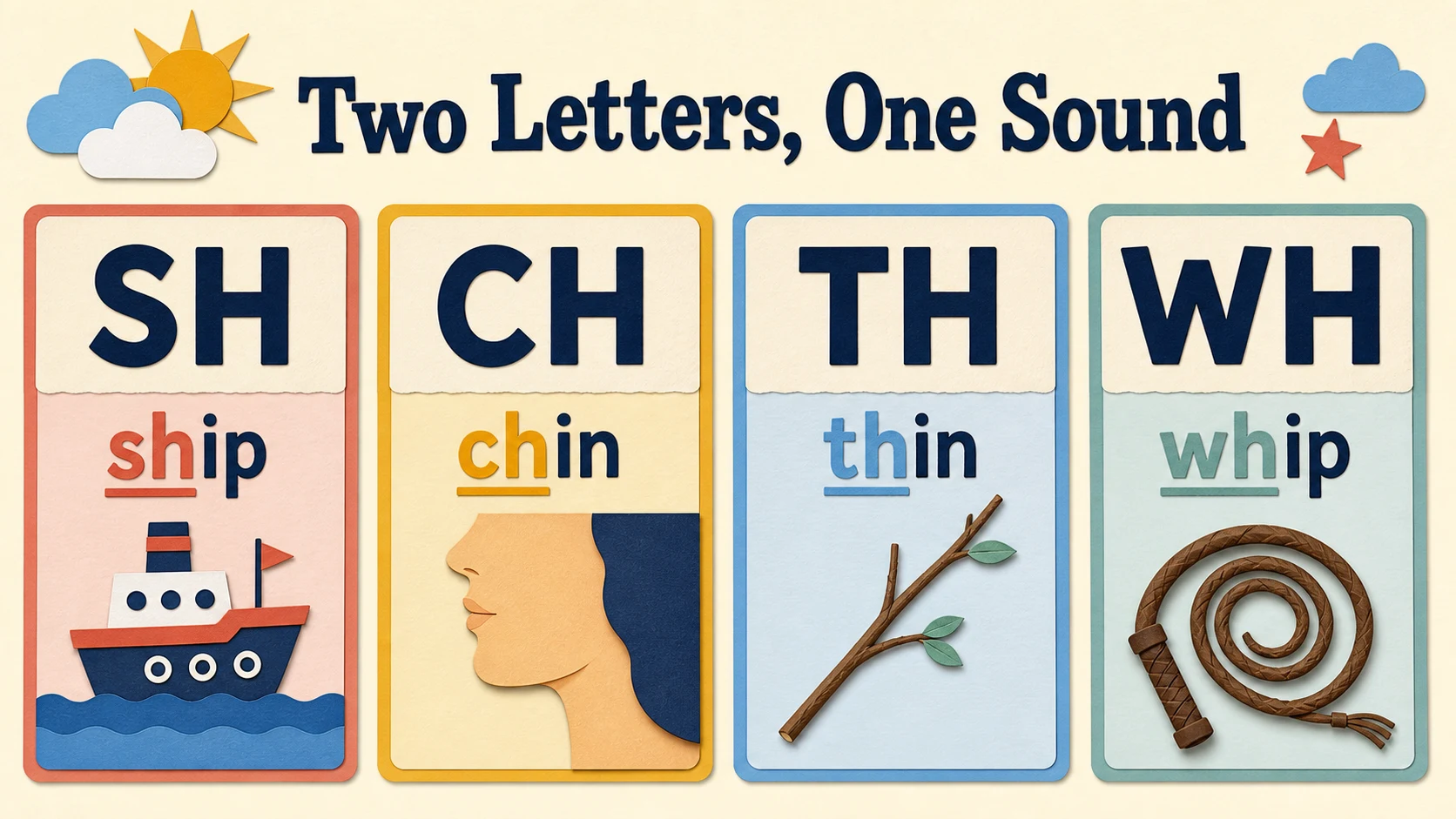
Use the map to choose one already-taught digraph position and avoid mixing every pattern into one arrival task.
If a child reads ship as “sip,” place two fingers together under sh, say the sound, and blend again. If the child reads slip as “sip,” tap /s/ and /l/ separately before blending. Those supports preserve the target distinction. For a broader phonics selection, use the Morning work Phonics Worksheets collection rather than mixing unrelated literacy tasks at random.
Keep punctuation tied to voice and meaning
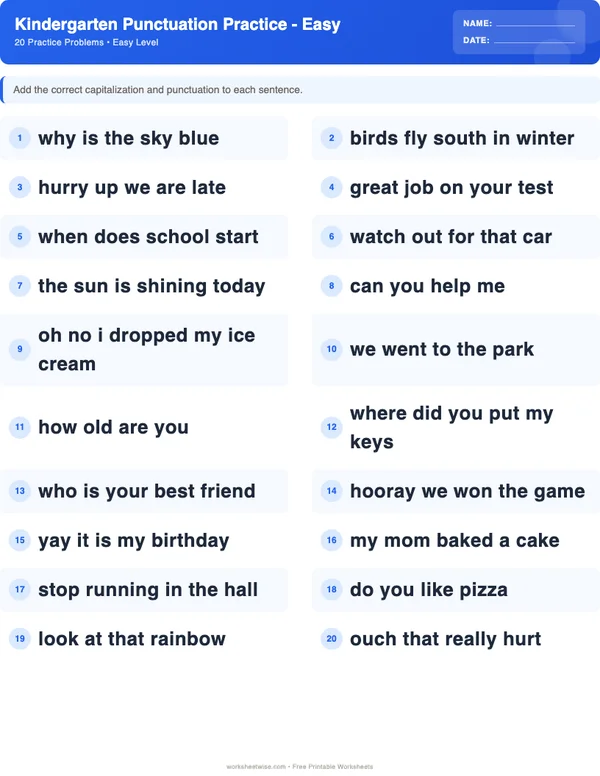
The catalogue’s kindergarten punctuation resource has 12 problems and covers the earliest end marks as part of a much longer punctuation progression. A kindergarten morning selection should usually stay with periods, question marks, and exclamation points already taught through reading aloud. Commas, apostrophes, quotation marks, and paragraph editing may belong later in local sequences.
Checked example 6: choose an end mark
Read these sentences aloud and ask for the missing mark:
The dog is wet__→ periodIs the dog wet__→ question markLook at that huge dog__→ exclamation point
The first communicates a statement, the second asks a direct question, and the third expresses strong feeling or emphasis. These examples belong in kindergarten because the sentence structures and vocabulary are short, while the voice provides an audible clue to meaning.
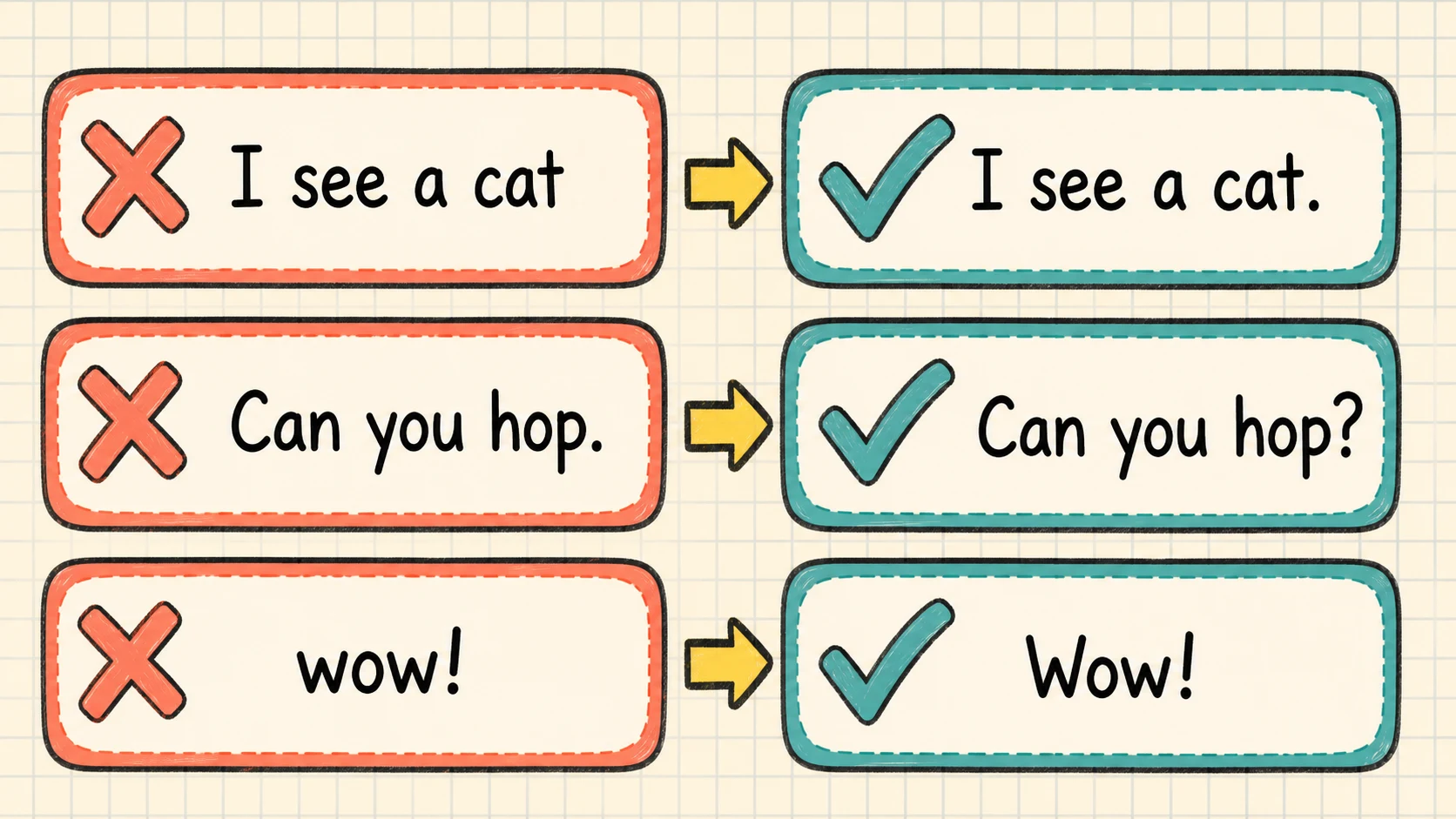
Use a wrong end mark to choose a voice-and-meaning prompt, not merely to mark the whole item incorrect.
If a child places a period after every sentence, read the statement and question as naturally as possible and ask which one requests an answer. If a child uses an exclamation point simply because the dog is large, compare a calm observation with an excited command. The next action is oral contrast before another written set.

Space kindergarten end-mark retrieval across days while keeping each arrival set short enough for a fast scan.
The IES elementary writing guide recommends daily writing opportunities and explicit attention to handwriting, spelling, and sentence construction. That guidance supports regular practice, but it does not require every arrival task to demand an original sentence. Selecting an end mark or dictating a short sentence can isolate punctuation when idea generation and handwriting would otherwise obscure it. The Morning work Grammar Worksheets page can support that focused selection.
Follow a realistic five-day sequence
A weekly plan should revisit taught content instead of assigning five unrelated pages. This sequence assumes the class has already received instruction in counting sets, joining and removing within five, an -at word family, sh, and basic end punctuation.
Monday: establish success with counting
Mark three counting items: one orderly set, one scattered set, and one missing numeral in a familiar sequence. Allow counters. Scan for stable number order and one-to-one tracking. Record only the most useful observation, such as “recounts scattered set after losing place.”
Tuesday: retrieve joining with a picture
Use two addition pictures within five and one familiar counting item. Ask one child from each response pattern to explain by pointing: “three here, two here, five altogether.” The counting item provides continuity; addition is the week’s changing feature.
Wednesday: connect removal to the picture
Use one visible take-away example, one matching subtraction sentence, and one addition item from Tuesday. Children may cross out objects or use counters. Scan whether the remaining quantity—not the removed quantity—is entered.
Thursday: rehearse one phonics pattern
Use three -at words and one sh picture-word match only if both patterns have been taught. Have each child read one answer quietly to an adult during the morning transition or later that day. Written accuracy alone cannot confirm decoding.
Friday: apply punctuation and review one prior item
Use two end-mark items plus one repeated math or phonics item selected from the week’s scans. Friday is not a cumulative test. It is a chance to see whether a brief correction carried into another attempt.
This sequence deliberately limits daily novelty. It also keeps the week balanced across math, phonics, and grammar without pretending that equal page counts equal balanced instruction.
Give feedback that can change the next attempt
A fast teacher scan needs a small code and a defined response. Use codes such as:
- I: started and completed independently;
- P: completed with the usual tool or prompt;
- R: needs a brief reteach before another worksheet attempt;
- M: response method obscured the skill.
Add one content note only when it affects selection: “double-counted a dot,” “read sh as /s/,” or “used period for question.” Avoid broad judgments such as “careless” or “doesn’t understand phonics.”
Correct less, learn more
Choose one revealing item for feedback rather than covering the page in marks. Ask the child to show the action again with objects, read the word aloud, or use the sentence’s voice. Then provide a nearby second attempt:
- seven scattered dots become seven movable counters;
5 − 2remains the same quantity but gains objects;shipremains the same word but gains connected sound boxes;- a written question becomes an oral question before the mark is chosen.
This is feedback because it changes the next action. Simply supplying the answer is correction.
For whole-class planning, tally response patterns without attaching fixed labels to children. If eight pages show skipped objects in scattered sets, teach a tracking method to the group. If one page shows the pattern, conduct a brief individual check. A worksheet response is one observation under one set of conditions.
Adapt access while preserving the target skill
A useful adaptation changes how the child reaches or records the target without quietly substituting a different target.
When language or reading is the barrier
Read math directions aloud, demonstrate the response format with a different example, and let the child retell a word problem. Do not point to the correct operation. For punctuation, read each sentence neutrally first and then with its intended voice.
When handwriting is the barrier
Let the child circle a numeral, place a number card, move counters, select an end-mark card, or build a word with letter tiles. If the target is writing a numeral or letter, retain one short formation attempt after the conceptual response.
When attention or visual load is the barrier
Cover unused items, enlarge the active section, present one row at a time, and keep the stopping mark visible. Do not reduce the mathematical quantity unless quantity itself is not the target.
When the task is completed too quickly
Ask for one explanation, another representation, or a check—not another full page. A child who answers 3 + 2 = 5 can draw the two joined groups. A child who reads cat, hat, and mat can use one word in an oral sentence. Extension should deepen the same skill before it introduces a new pattern.
Know what morning work cannot establish
A completed page cannot establish independent decoding unless someone hears the child read. It cannot show secure counting if pictures were copied from a neighbor or counted with unobserved assistance. It cannot distinguish conceptual subtraction from memorized answers without a model or explanation. It cannot diagnose a disability, developmental condition, or instructional need by itself.
Morning work also should not replace:
- explicit teaching of a new concept;
- hands-on mathematics;
- oral phonemic-awareness work;
- connected reading;
- read-alouds and discussion;
- play, movement, or social arrival;
- sustained writing with a real purpose.
The Common Core English language arts pages describe kindergarten expectations within a broader progression, but standards information is not a placement test. Local curricula may teach skills in a different order, and a grade label does not establish mastery or readiness.
Stop the written routine and investigate the conditions if distress, fatigue, sensory load, language access, or an unfamiliar format prevents participation. “Could not complete this morning” is not an academic conclusion.
Turn tomorrow’s arrival into one observable decision
Choose one already-taught skill, mark no more than four items, and write the stop symbol before children arrive. During the routine, observe just one behavior: whether each child can begin, use the intended strategy, or check the answer.
Afterward, sort the pages into three next actions:
- repeat the same task features independently;
- repeat with one access support;
- reteach briefly with objects, oral practice, or modeling.
For a concrete starting point, open the free deterministic worksheet generators, create a kindergarten task using content already taught, and mark a five-to-eight-minute completion boundary. Tomorrow’s goal is not a finished sheet. It is one clean observation that tells you what to keep, support, or reteach next.
Put it into practice
Use the guide with a real printable
Move from explanation to a short, observable practice task. Check the first item together, then adjust the next session from the learner's actual work.
Open the first free worksheetExplore a neighboring collection