Curated collectionAnswer keys includedPrint-ready PDFs
Pre-K Morning Work Worksheets
Build predictable, low-friction arrival routines with retrieval, a short completion boundary and a fast teacher scan.
Start with a real resource
Browse this worksheet collection
5 relevant free entry points are available. Each one includes a printable learner PDF and separate answer key.
A useful practice loop
Print less. Observe more.
- Choose one skill and model the first item aloud.
- Use a short set and notice the learner’s strategy.
- Change the next task from the work you can see.
Need more than the free sheet?
Plus includes all 90 matching catalogue variations where available, plus saved deterministic generators and the worksheet designer.
See Plus membershipComplete guide
How to teach and practise preschool morning-work worksheets
3,436 words Updated 6 instructional visuals
Use one short arrival task, not a full worksheet
Pre-K morning work should help children enter the room, reconnect with a familiar skill, finish a small amount of work, and show an adult what needs attention. It should not ask a three- or four-year-old to complete a 20-problem sheet independently.
A workable arrival routine lasts about 6–10 minutes and has three parts:
- Retrieve: Revisit one counting or phonics skill already taught with objects, pictures, movement, or oral rehearsal.
- Record: Complete one small, clearly marked section—often two to four responses rather than an entire page.
- Check: Show the work to an adult for a rapid scan, correction, or next-step prompt.
The live Pre-K collection contains 90 variants across two subjects and five topics: Counting, CVC Words, Short Vowels, Word Families, and Sight Words. Each representative free sheet contains 20 problems. That is a resource bank, not a recommended daily workload. Fold the page, cover unused rows, cut it into strips, or mark a stopping star so the completion boundary is visible before the child starts.
Keep the routine predictable while changing the content. A child may always begin by moving counters, matching two cards, or saying sounds with an adult, then complete three responses and place the page in a scan tray. Predictability supports independence because the procedure stays familiar even when Tuesday’s pictures differ from Monday’s.
Age is a discovery aid rather than a placement decision. Use it to locate likely resources, then choose from observed responses. For ages three and four, prioritize brief adult-led oral, matching, manipulative, and movement work over desk work. Grade labels describe intended practice level; local curriculum sequences differ.
Define “easy” by what the task asks the child to do
The representative free sheets are catalogued at the “easy” difficulty level, but that label should describe task features, not a child. Never call a learner easy, developing, or advanced.
For this arrival context, an accessible task usually has several observable features:
- The direction can be demonstrated in one action.
- Only one familiar skill must be recalled.
- The child can respond by pointing, matching, moving, circling, or making a brief mark.
- Pictures and objects reduce memory demands without giving away the answer.
- The page has little visual competition.
- The adult can tell within seconds whether the response is correct.
- The marked stopping point can be reached in about three to five focused minutes after oral or manipulative preparation.
A task becomes more demanding when it mixes several vowel sounds, requires letter formation and decoding at once, presents scattered objects that must be tracked, removes picture support, or asks the child to remember a direction with multiple steps. Those may be useful later, but they are poor choices for an unsettled arrival unless an adult is available to guide them.
Difficulty can also change without changing worksheets. Matching the printed word cat to a cat picture is less demanding than building cat from letters; building it is less demanding than hearing the word and writing all three letters. Select the response mode deliberately.
Set up a six-to-ten-minute arrival routine
Place only the materials needed that morning in a tray: one shortened page, a pencil or crayon, and any counters, letter tiles, or matching cards. Extra tools create choices unrelated to the learning target.
Minute 0–2: reconnect through action
Begin with an action the child already knows. For counting, the child touches and moves four buttons while saying one number for each button. For phonics, an adult says map slowly while the child pushes one token into each of three sound boxes. For a sight word, the adult displays the, says it, and invites the child to find the matching card.
This is retrieval, but it should not become a surprise test. If the child cannot begin, model one complete example. The IES guide for teaching math to young children recommends using developmental progressions and monitoring what children can do so teaching can build from their current understanding. In this routine, that means watching the child count or match before choosing the page response.
Minute 2–6: complete a marked section
Use a box, colored line, paper strip, or drawn star to show exactly where to stop. Say, “Do these three, then put your pencil on the star.” Avoid “Do as much as you can,” which gives a young child no stable definition of finished.
If the source page has 20 problems, expose only the selected portion. One child might count three pictured sets; another might match two word-family pictures. Both can participate in the same arrival procedure while practicing different content.
Minute 6–8: make one immediate check
The adult scans for the target behavior, not neatness in general. Ask one short verification question:
- “Show me how you counted this set.”
- “Which sound did you hear in the middle?”
- “What stayed the same in cat and hat?”
- “Point to the without using the picture.”
If the answer is secure, mark the page and release the child to the next classroom activity. If not, correct one item with objects or oral modeling. Do not require the child to erase and redo a whole strip.
Minute 8–10: record the next teaching move
Use a tiny notation rather than a grade: I for independent, P for completed after a prompt, or M for needed a model. Add the specific observation when useful: “lost track when objects were scattered” or “heard /m/ but not /a/.”
That record should determine the next action. It is not a diagnosis, score, or promise of progress.
Choose counting work that reveals one-to-one correspondence
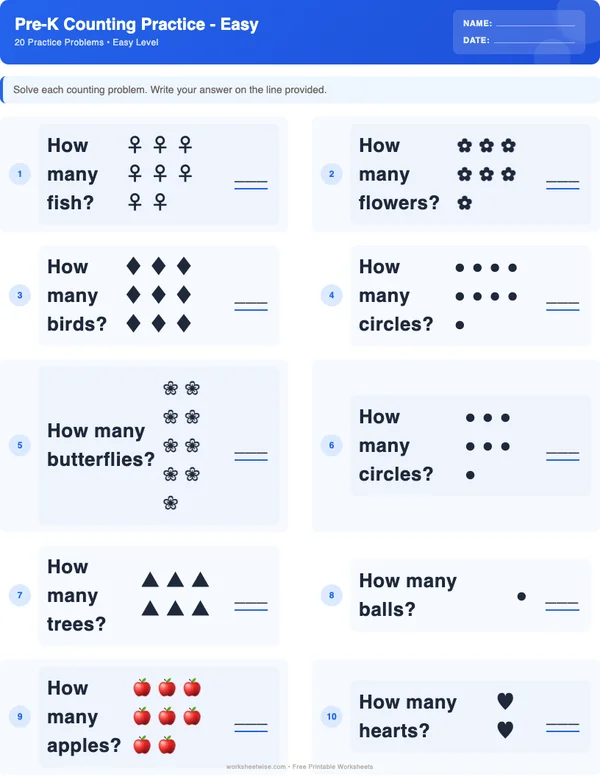
The Pre-K Counting resource describes practice with number sequences, missing numbers, and sets of objects, with Pre-K attention on counting to 20 using concrete objects. For morning arrival, begin with quantities the child can manage accurately rather than automatically selecting the largest number range on the page.
Checked example: count five objects, then choose 5
Place five linking cubes in a loose row. The child moves each cube into a cup while saying “one, two, three, four, five.” Then show a worksheet row with five pictured objects and two numeral choices, 4 and 5. The child circles 5.
The checked answer is 5 because there are five objects and each is counted once. This example belongs in Pre-K morning work because it moves from concrete objects to a picture and then to a numeral while keeping the quantity small and the completion boundary short. It also lets the adult distinguish reciting number words from coordinating one word with each object.
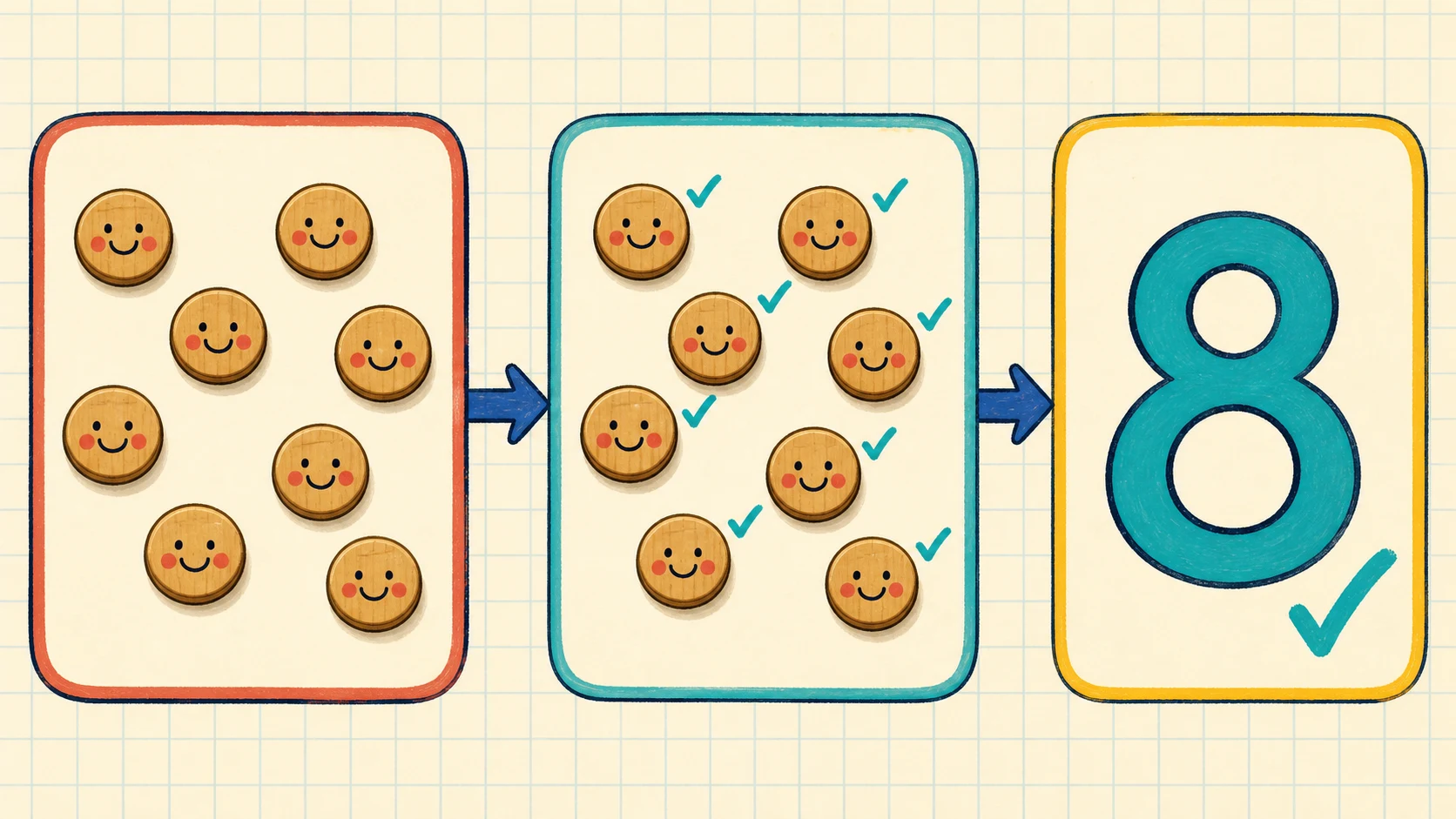
Move five counters before circling 5 so the morning mark records a counted quantity, not a numeral guess.
After success with a row, rearrange the same five cubes into a scattered group. Do not increase the quantity at the same time. If the child counts a cube twice, teach a tracking action: slide each counted cube across a line or place it in a container. The target remains one-to-one counting; handwriting, speed, and counting to 20 are separate demands.
Use the Pre-K Counting guide and free sheet when the child can already participate in this concrete routine. For broader planning, the Morning work Math Worksheets collection can help locate other math practice, but keep the daily Pre-K boundary to one familiar skill.
Make phonics oral and movable before it becomes written
The collection’s four phonics topics are related but not interchangeable. Short-vowel listening supports CVC blending; CVC words can later be compared as word families; selected high-frequency words need their own explicit attention. Morning work should retrieve one taught relationship rather than introduce all four at once.
The IES foundational reading guide supports explicit work with sound segments, sound–letter relationships, word reading, and connected text. It does not evaluate WorksheetWise. Applied here, its guidance favors an adult model and a small number of accurate oral responses before independent marks on a page.
Checked example: blend map
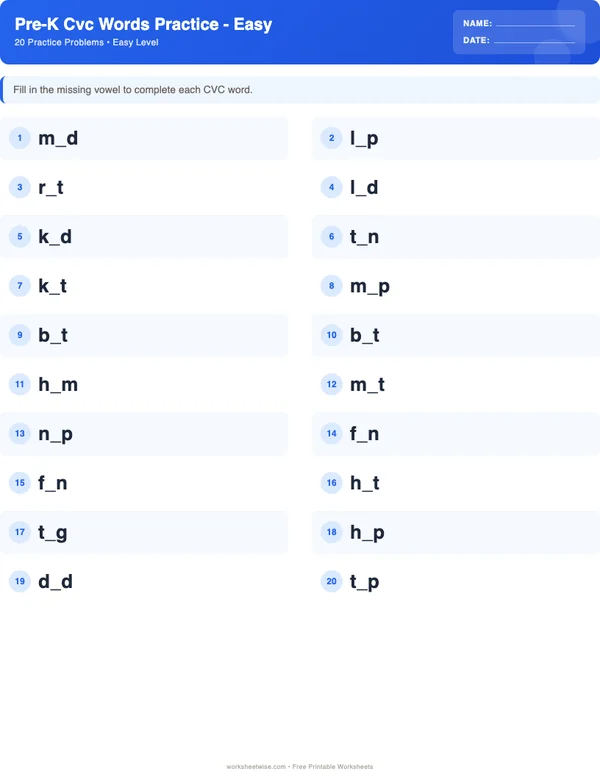
Say and stretch /m/ /ă/ /p/ without inserting extra vowel sounds after the consonants. The child pushes three tokens into three boxes, sweeps a finger beneath them, and says map. Next, the child matches the printed word map to the picture of a map.
The checked answer is map: m represents the first sound, a the short middle vowel, and p the final sound. It belongs here because it uses the representative CVC structure and can be completed through listening, token movement, blending, and matching before writing is expected.
If the child says mop, do not label the whole response wrong and move on. The first and last sounds were preserved; the middle vowel changed. Return to an oral contrast such as map/mop, exaggerate only enough to hear the difference, and ask the child to point to the matching picture. The Pre-K CVC Words guide and free sheet is the relevant follow-up resource.
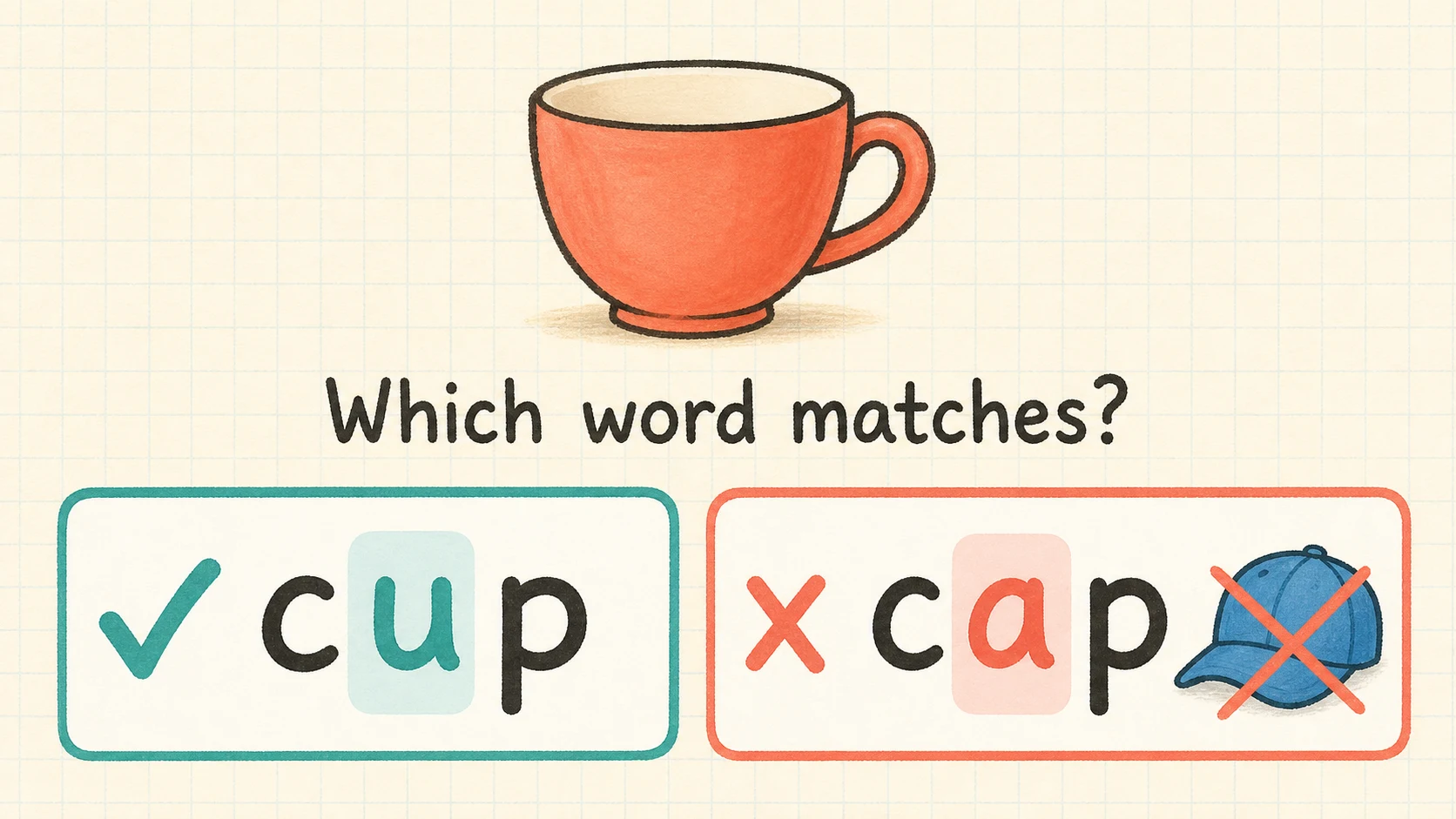
Treat a Pre-K CVC error as evidence about blending, sound order, or vowel discrimination, then choose one oral response.
Checked example: choose the short vowel in sit
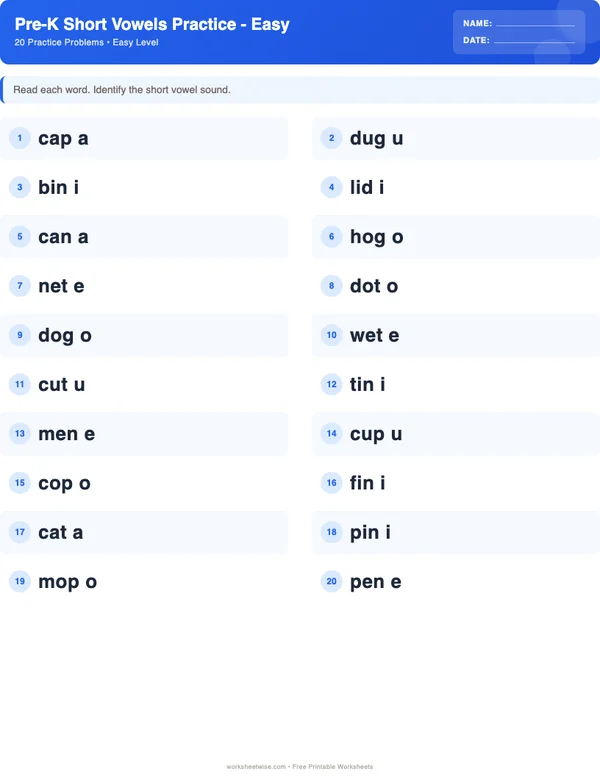
Show pictures for sit and sat. Say both words, then say sit again. The child uses the “itch” gesture associated with short i, selects the letter i, and places it in s_t.
The checked completion is sit because the middle sound is short i, /ĭ/. This belongs in Pre-K morning work only after short i has been taught orally. It asks for one middle-sound decision and allows a tile response, so letter formation does not hide whether the vowel was heard.
If the child chooses a, repeat the pair sit/sat and let the child match pictures before returning to letters. Keep the target as vowel discrimination. Do not add copying the full word as a consequence for an auditory error. The Pre-K Short Vowels guide and free sheet provides a more focused route when the child needs repeated practice with one vowel.
Use word families to notice a stable ending
Word-family work is appropriate when the child can hear an initial sound and has already met the relevant short vowel. It should supplement systematic phonics, not replace attention to each sound.
Checked example: change cat to hat
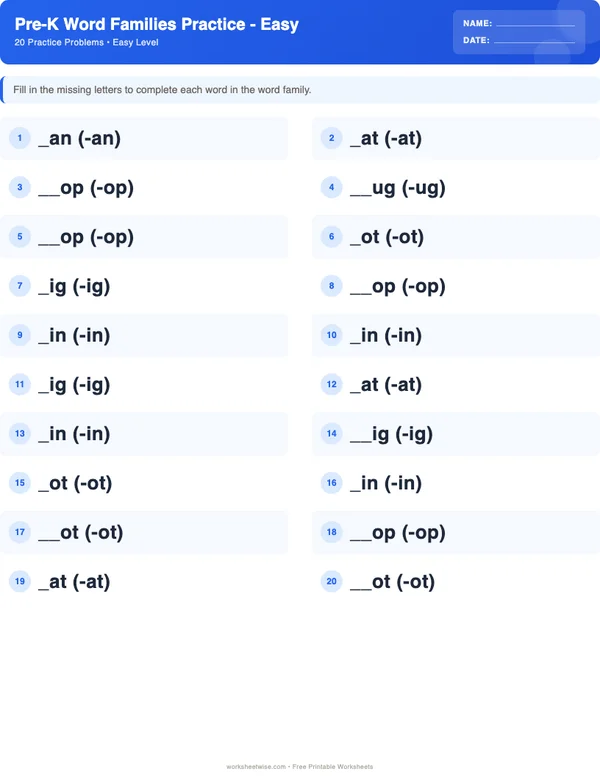
Build cat with three magnetic letters. Ask, “What part stays the same?” Keep a and t in place, remove c, and offer h and p. Say hat and have the child choose h, producing hat.
The checked answer is hat because changing the initial letter from c to h while keeping -at creates the spoken word. This example belongs here because the child physically changes one letter and sees the stable ending. The action is more informative than copying a row of rhyming words.
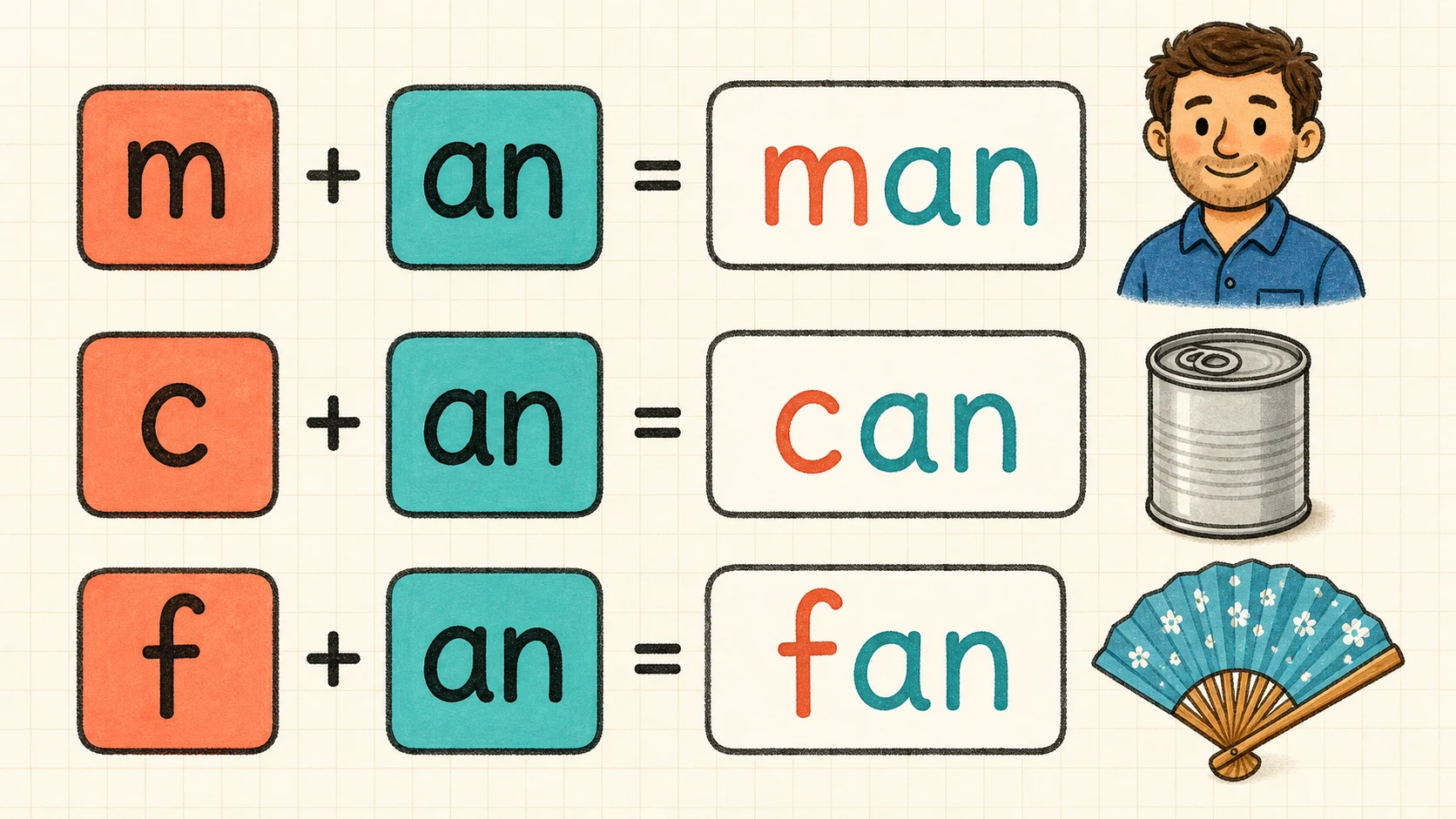
Keep -at fixed and move one initial letter so the Pre-K learner can see exactly what changed.
On the worksheet, ask for only two matches: cat/hat and cat/sun. The child should identify hat as sharing the -at ending; sun does not. If the child selects words because their pictures are related rather than because their sounds match, return to oral rhyme: “cat, hat” and “cat, sun.” Cover the print until the sound comparison is clear.
A longer practice plan should revisit rather than constantly add families. Use the Pre-K Word Families guide and free sheet to select a familiar family, then distribute a few examples across days.
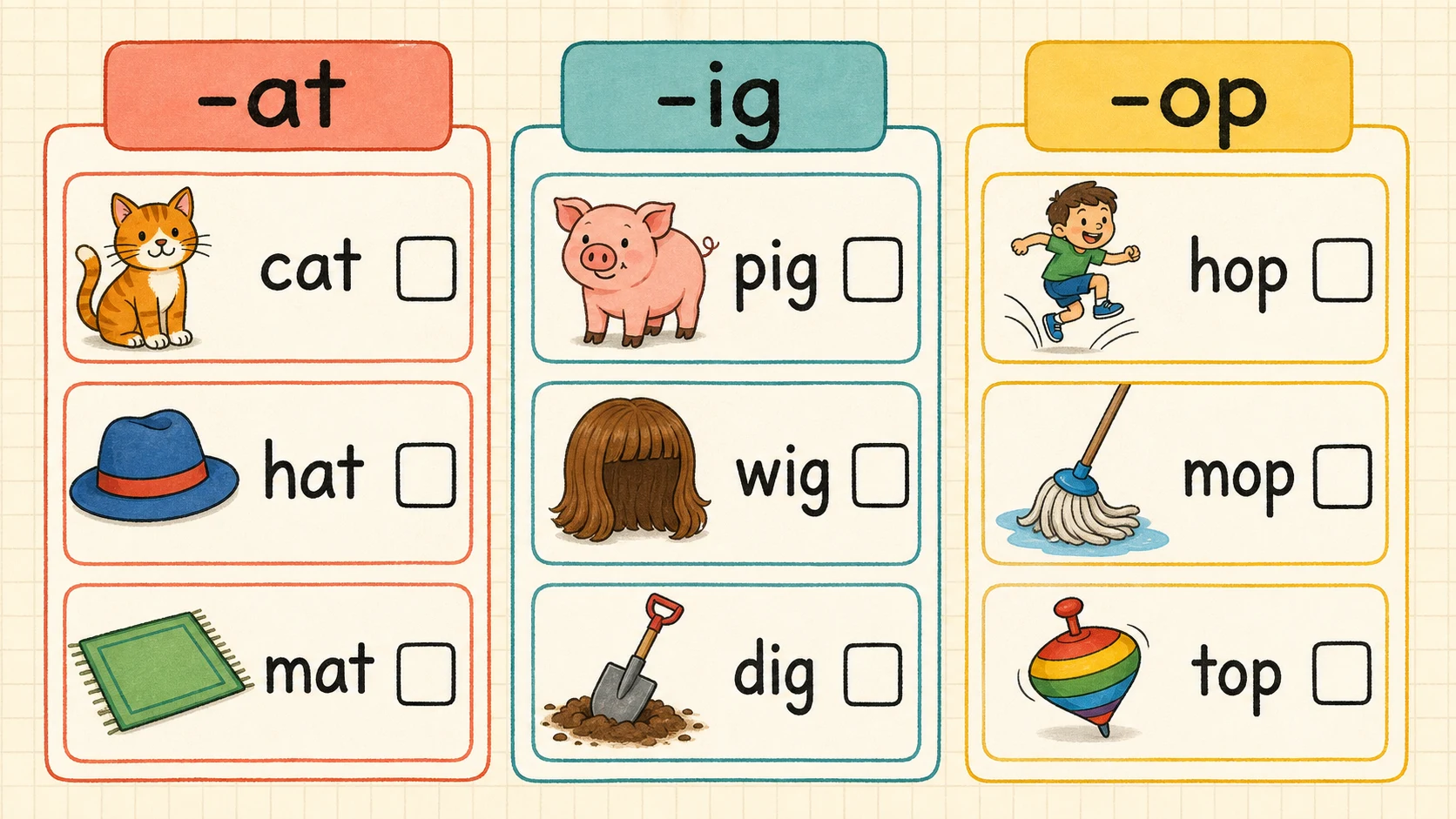
Across two weeks, revisit one known ending in short cycles instead of presenting a fresh family every morning.
Keep sight-word practice small and explicit
The catalogue includes sight-word activities such as tracing, writing, finding words in sentences, and reading short passages. Not every format belongs at arrival time. Choose a word already introduced and a response the child can complete without guessing from the page layout.
Checked example: find the
Place three cards on the table: the, is, and and. Display a matching model of the. Say “the,” point to each letter while naming t-h-e, then ask the child to find the same word among the three cards. After the match, use it orally: “the cup.”
The checked match is the because its letters and order exactly match the model. This example belongs in Pre-K because it is brief, uses a small choice set, and separates word recognition from handwriting. It does not claim that one match proves instant recognition.
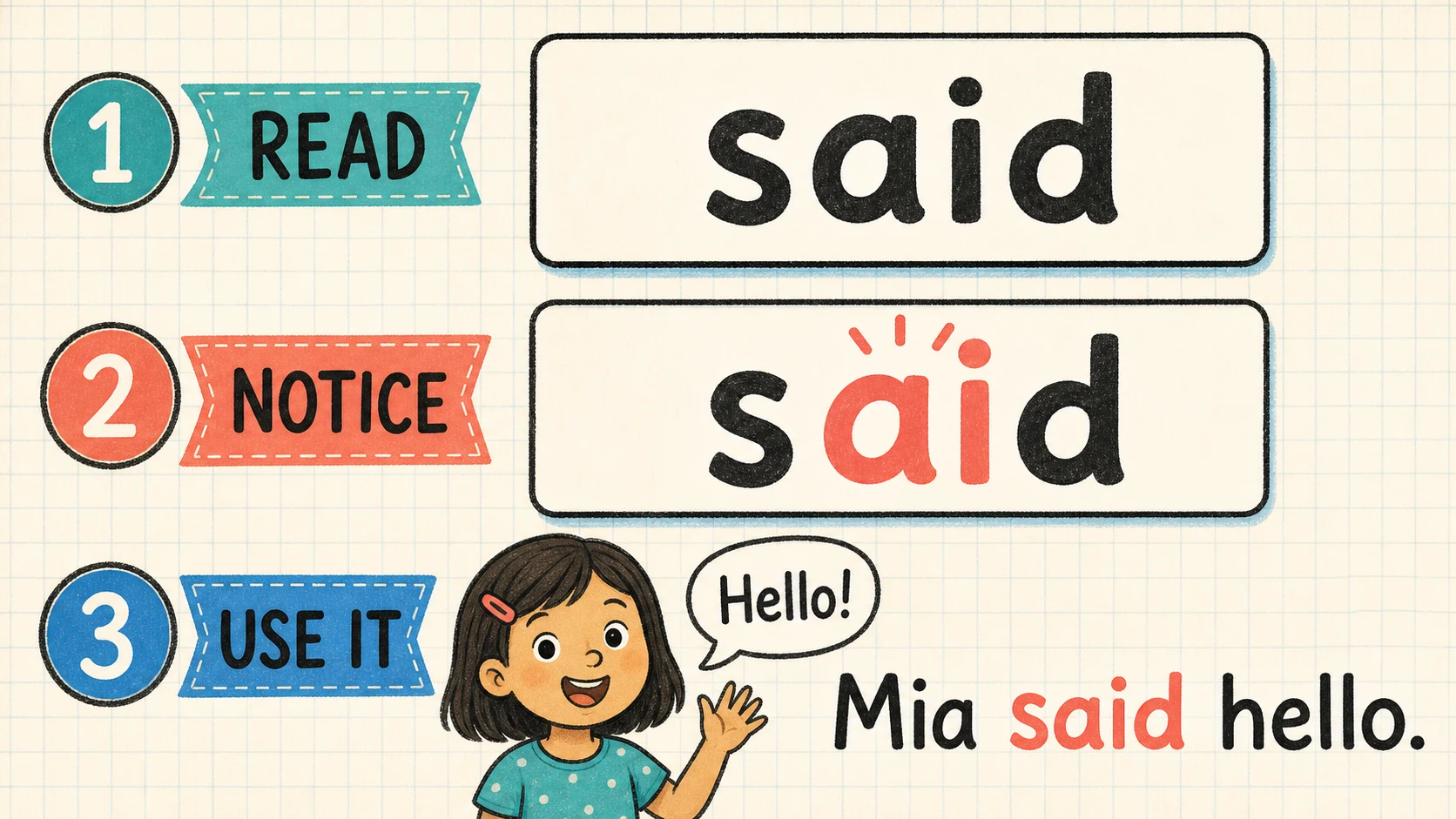
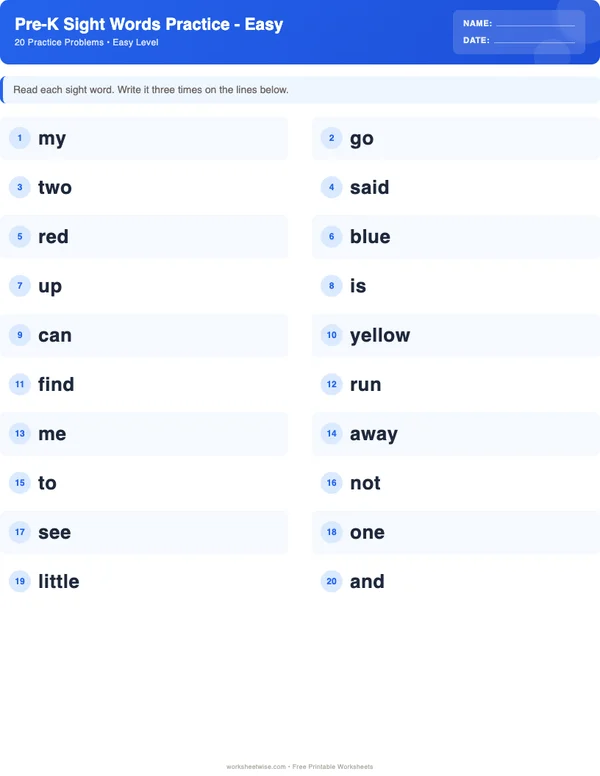
Model the word the, reduce the choice set, and check recognition before asking for a pencil response.
Over several mornings, fade support in observable steps: exact matching, choosing without the model, finding the word in a short familiar phrase, and finally reading it when encountered with other known words. Move forward only when the child responds accurately without relying on position or a picture.
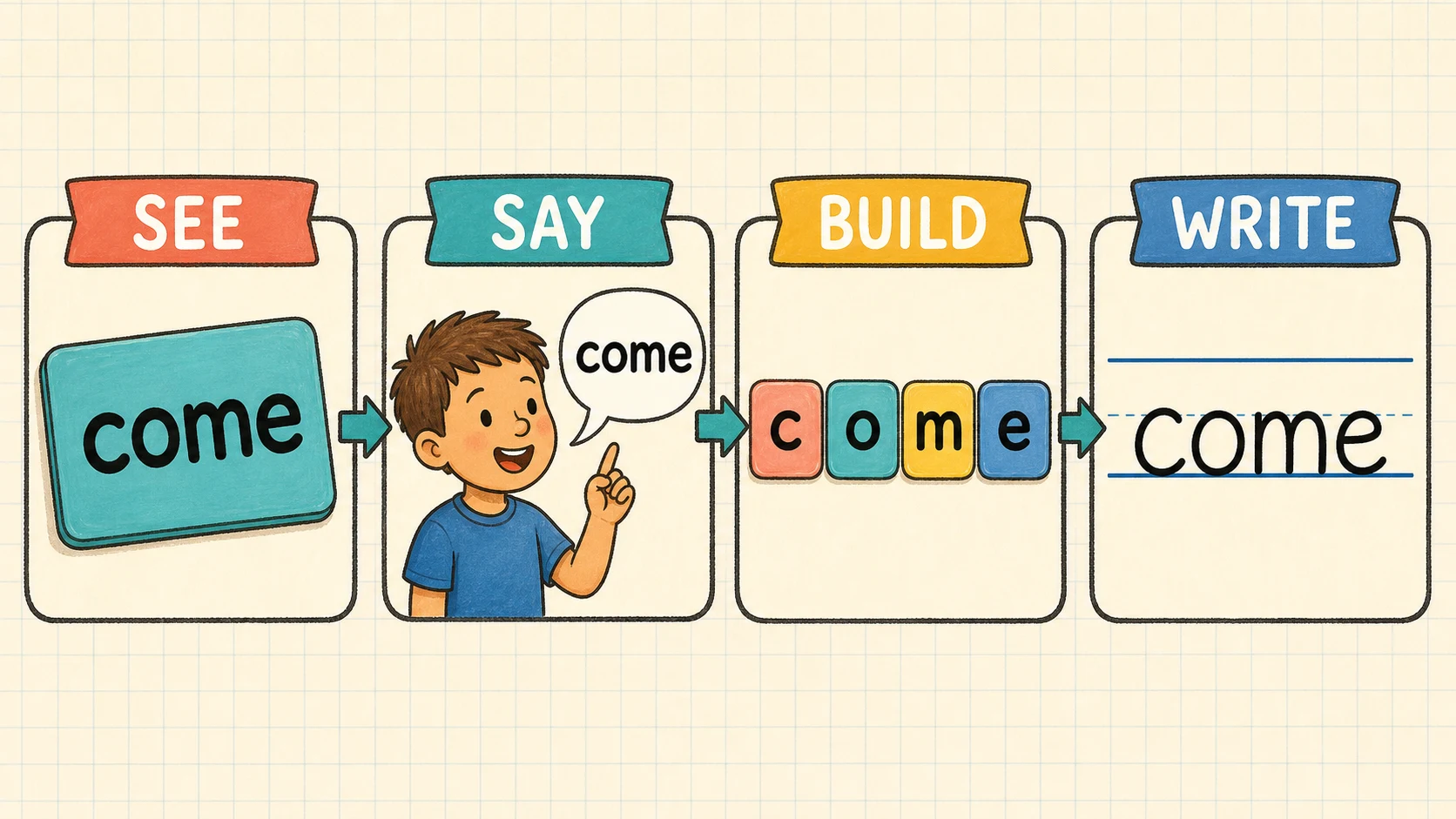
Independence means recognizing the taught word after supports are deliberately removed, not completing more items.
Use the Pre-K Sight Words guide and free sheet for focused practice. Avoid introducing three to five new words merely because that number appears in a general teaching tip; the actual number should reflect what has already been taught and what the child can rehearse accurately in this brief routine.
Run a weekly sequence with retrieval and a fast scan
A realistic week alternates content while preserving the arrival procedure. It does not attempt to use all five topics every morning.
Monday: establish the model
Use a known counting quantity with objects. Model one complete example, then expose two worksheet responses. Record whether the child moves or touches each object once. Monday’s goal is to re-establish the routine after the weekend, not to maximize output.
Tuesday: retrieve the same idea in a new arrangement
Keep the quantity range the same but scatter the objects. Ask the child to use a tracking strategy. If Monday involved five cubes in a row, Tuesday can use five buttons in a loose group. The worksheet mark comes after the physical count.
Wednesday: rehearse one taught phonics contrast
Choose either one CVC word, one short-vowel contrast, or one word-family change. Do not combine all three. Use tokens or letters first, then ask for two page responses. Scan the exact sound position that matters.
Thursday: fade one support
Repeat Wednesday’s target but remove one aid. For map, the adult might stretch the word without placing the tokens. For -at, the ending may stay visible while the child selects an initial letter. If accuracy collapses, restore the support; fading was premature.
Friday: review and sample independence
Offer one familiar counting response and one familiar phonics response, each with a visible stop. Ask the child to begin using the established tray routine. The adult still remains available. Record which part was independent: starting, handling materials, answering, or putting the work in the scan tray.
This sequence makes independence observable. It also prevents Friday’s “independent” page from containing new directions, unfamiliar pictures, or a larger problem set than the child has seen all week.
Interpret errors before choosing another sheet
A wrong mark does not identify a cause by itself. Ask the child to show or say how the answer was made.
| Observation during the morning task | Plausible task-level interpretation | Immediate response | Next morning |
|---|---|---|---|
| Recites to five but counts one object twice | Tracking, not number-word order, may be the obstacle | Move each counted object into a cup | Use the same quantity in a different arrangement |
| Gives the right total but circles the wrong numeral | Quantity and numeral recognition are not yet coordinated in that response | Match the counted set to numeral cards | Keep the quantity stable; reduce numeral choices |
| Says map as mop | The middle vowel changed while first and last sounds remained | Contrast map/mop orally with pictures | Practice one vowel contrast before print |
| Reads hat after a model but cannot build it | Recognition with support exceeded independent letter selection | Keep -at fixed and offer two initial letters | Repeat the same transformation |
| Selects the only when it is always first | Position may be cueing the answer | Rearrange the cards | Present the same three words in a new order |
| Stops after one item and watches other children | The boundary, direction, or environment may be competing with the task | Restate one action and point to the stopping star | Shorten to two responses and preserve the target |
These observations guide instruction; they are not diagnoses. A single morning can also be affected by fatigue, separation, language familiarity, motor demands, vision, hearing, or an unclear picture. Look for repeated patterns across comparable tasks before changing the instructional target.
Adapt the response without losing the target skill
An adaptation is useful when it removes an irrelevant barrier while preserving what the child must think about.
For counting, allow the child to move real counters instead of marking every picture. Preserve the requirement to coordinate one number word with each object. Do not count for the child and then ask only for the numeral.
For short vowels, let the child point to an anchor picture or place a vowel tile. Preserve the requirement to identify the middle sound. Do not reduce the task to copying a visible letter.
For CVC blending, use three tokens and an adult-provided oral word. Preserve the sequence of three sounds and the final blend. If speech production makes the response difficult, accept pointing to the matching picture after the child indicates the sound sequence.
For word families, keep the rime visible and let the child swap an onset tile. Preserve comparison of what stays the same and what changes. Do not ask the child merely to color rhyming pictures after an adult supplies every answer.
For sight words, enlarge the cards, reduce the choice set, or use matching before recall. Preserve attention to the printed word. A picture-only match no longer measures the same target.
Movement is especially appropriate for ages three and four. A child can hop once for each counted object, step on the numeral that matches a set, or carry the correct word card to a matching board. Movement should embody the decision, not serve as an unrelated reward after desk work.
Keep firm boundaries around Pre-K morning work
Morning work is not the right setting for every learning need. Do not use it to introduce a new phonics pattern without adult instruction, assess a long list of words, require extended handwriting, fill arrival time with repetitive coloring, or compare how quickly children finish.
The Common Core mathematics and English language arts standards describe kindergarten expectations, not a compulsory Pre-K morning-work sequence. They can help adults understand later learning demands, but they do not establish placement from age or from one worksheet. Consult the Common Core mathematics standards or English language arts standards only in the context of local curriculum decisions.
Likewise, a completed page does not demonstrate mastery. The IES mathematics guidance for learners experiencing difficulty emphasizes systematic instruction, clear mathematical language, representations, and monitoring. In Pre-K arrival work, the defensible use of that guidance is modest: make the task explicit, let the child show thinking with objects or pictures, and use the response to select the next prompt. It does not justify diagnosing a learner from errors or promising an outcome.
Stop the task when distress rises, the direction remains unclear after modeling, or the motor demand overwhelms the target. Move the teaching to a quieter adult-led time. Arrival should establish safety and predictability, not turn a difficult separation into a performance test.
Make tomorrow’s tray from one observed response
Choose one child or one small-group pattern from today’s scan tray. Write a concrete observation, such as “counted five in a row, double-counted when scattered” or “matched the with a model, used position without it.” Then prepare tomorrow’s tray to test one next step:
- Keep the content familiar.
- Change only one task feature.
- Include objects, tiles, or cards before the pencil.
- Expose two to four responses.
- Draw a stopping star.
- Decide the one question the adult will ask at the scan.
For a ready starting point, open the Pre-K Counting guide and free sheet, select two counting-set items, and pair them with five movable objects. Tomorrow morning, watch whether the child moves each object once; that observable action—not the number of completed problems—determines what you prepare next.
Put it into practice
Use the guide with a real printable
Move from explanation to a short, observable practice task. Check the first item together, then adjust the next session from the learner's actual work.
Open the first free worksheetExplore a neighboring collection