Curated collectionAnswer keys includedPrint-ready PDFs
Worksheets for 9-Year-Olds: Printable Practice Guide
Fourth-grade multi-step work, vocabulary precision and deliberate checking rather than answer-only completion.
Start with a real resource
Browse this worksheet collection
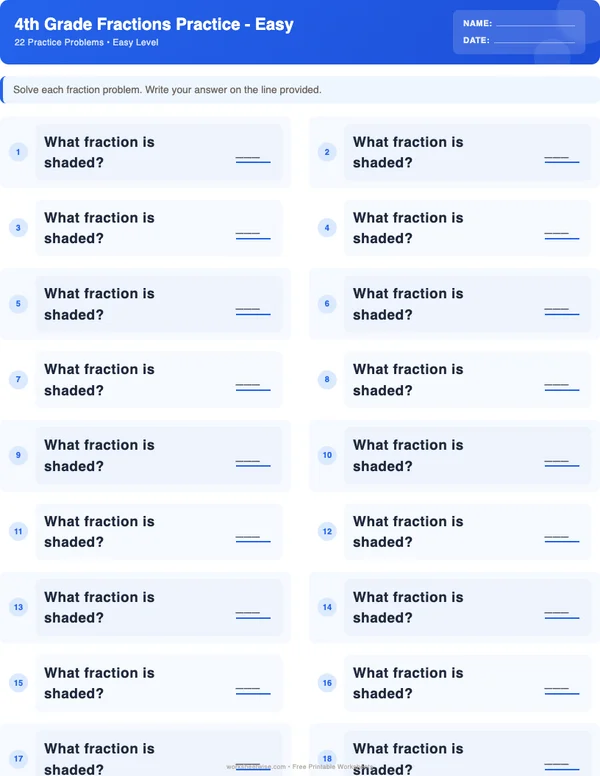
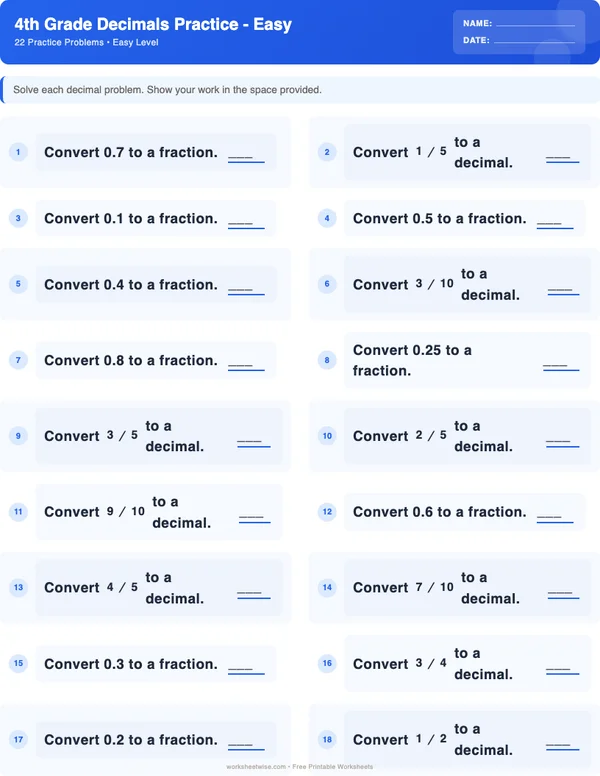
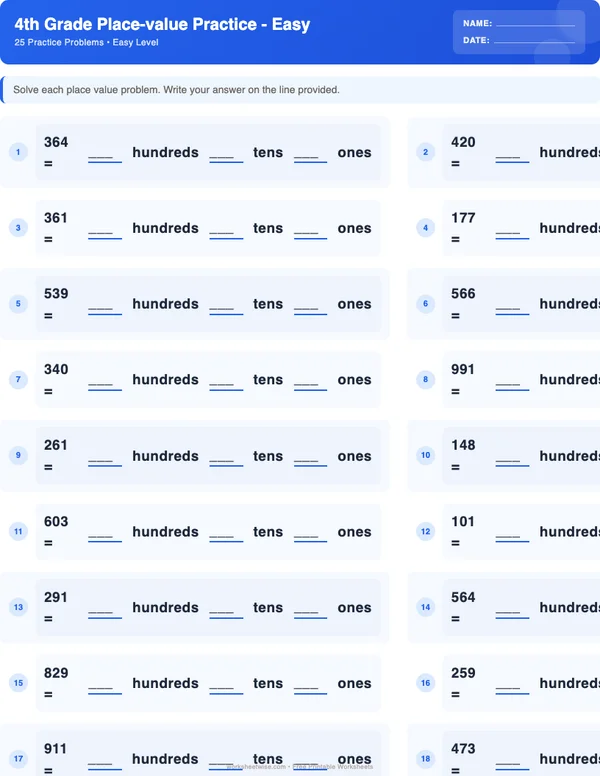
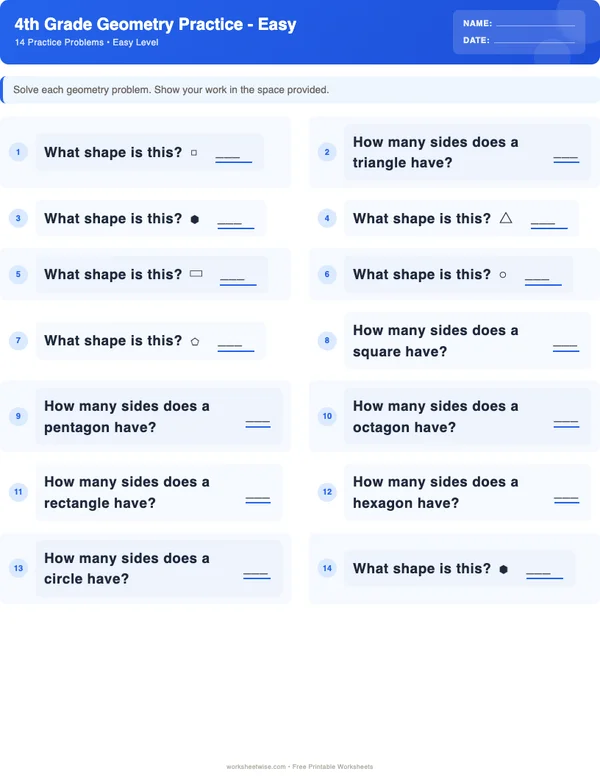
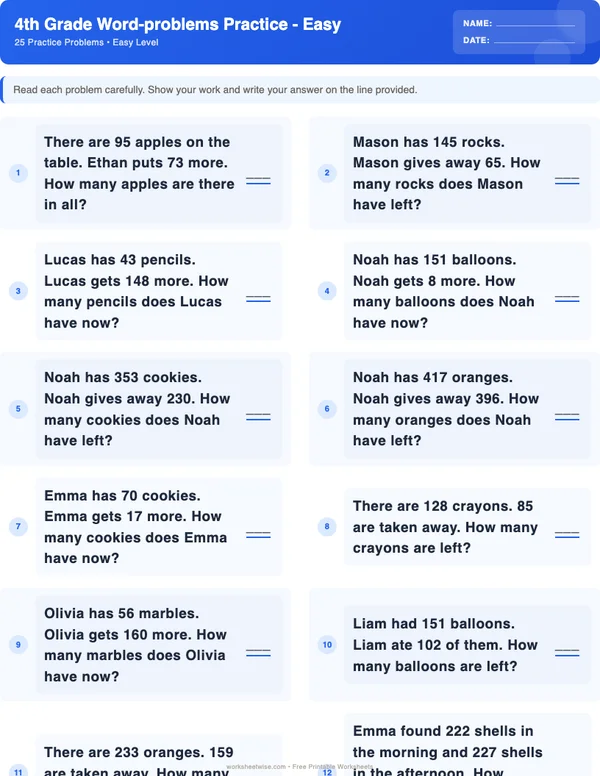
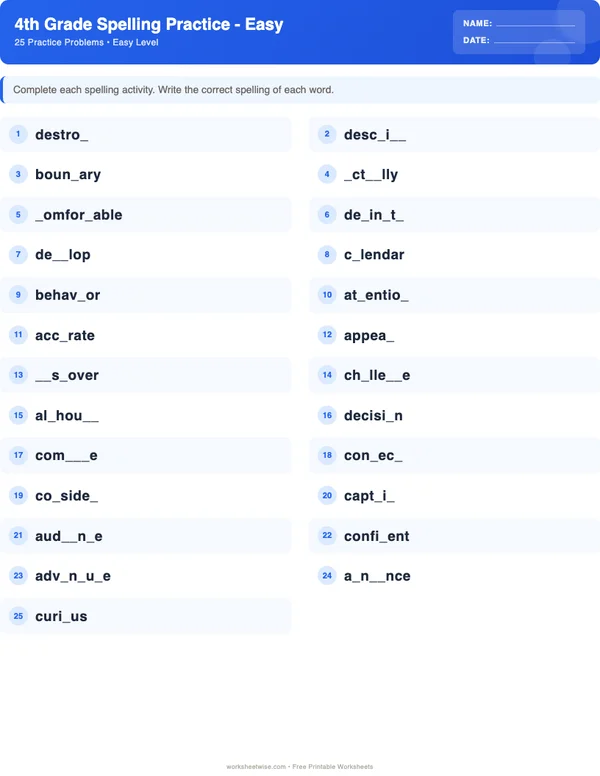
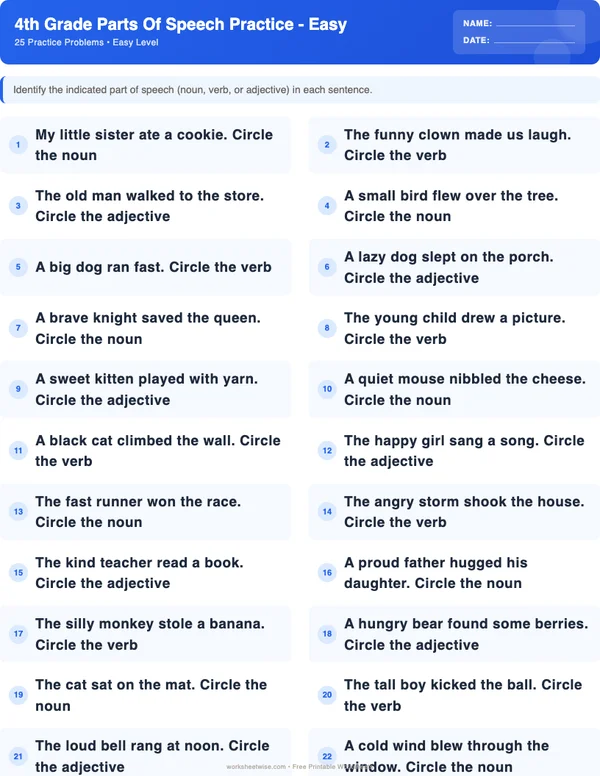
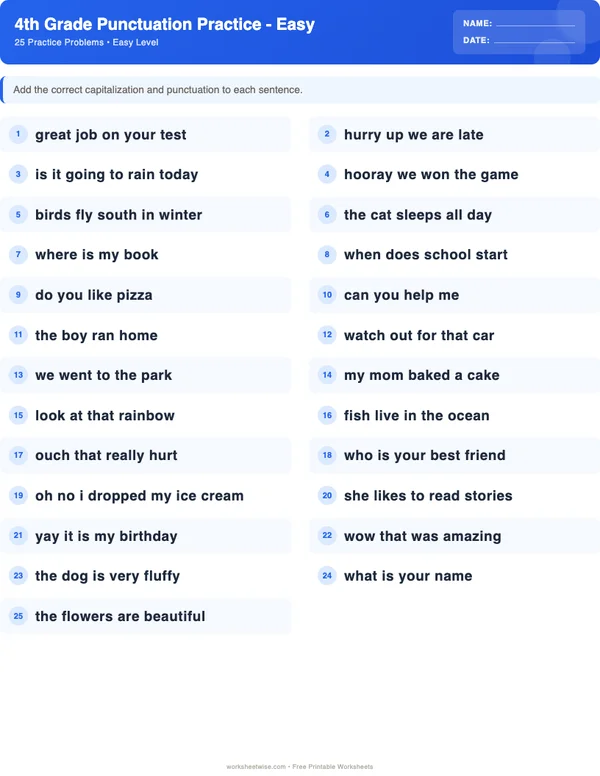
13 relevant free entry points are available. Each one includes a printable learner PDF and separate answer key.
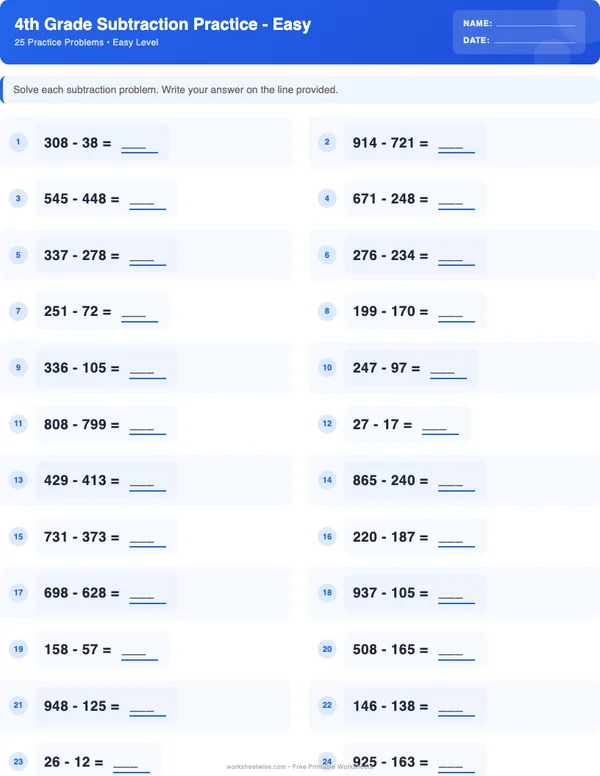
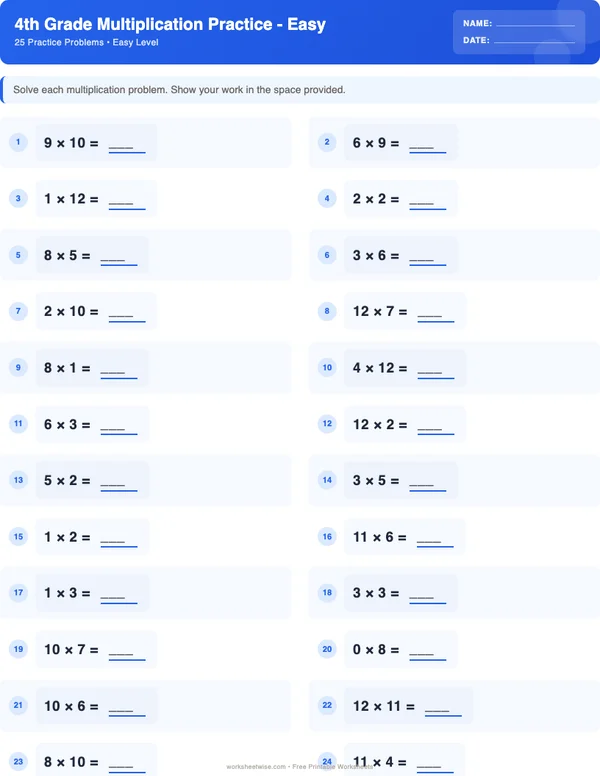
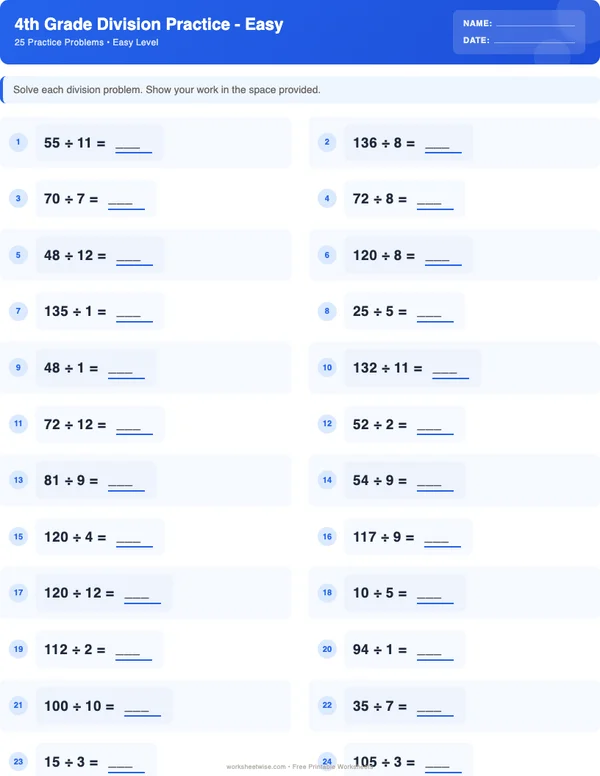
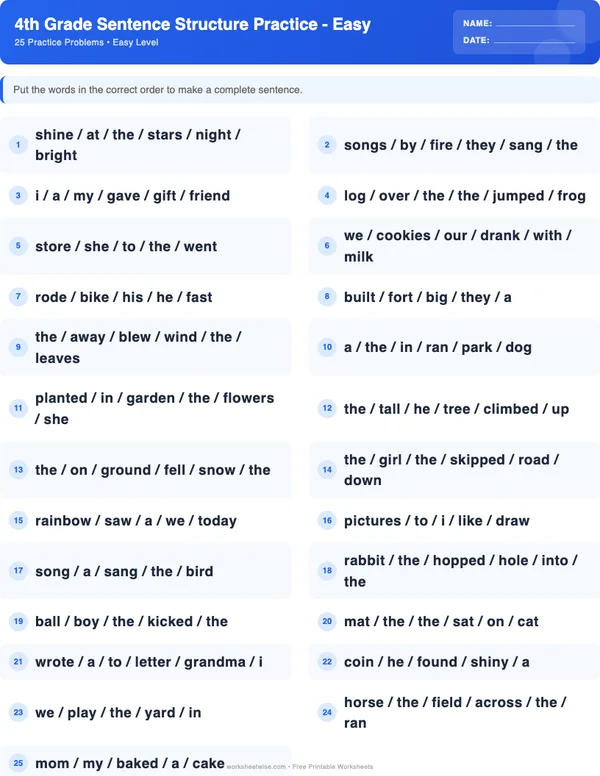
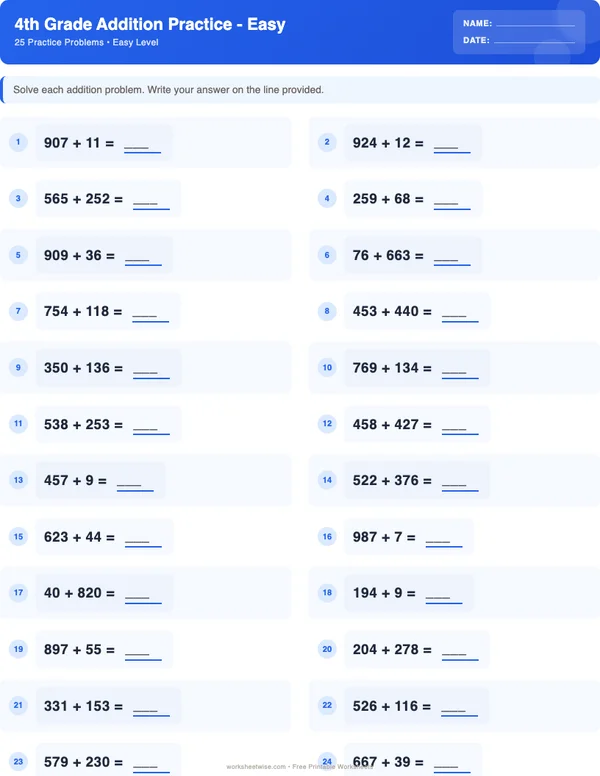
A useful practice loop
Print less. Observe more.
- Choose one skill and model the first item aloud.
- Use a short set and notice the learner’s strategy.
- Change the next task from the work you can see.
Need more than the free sheet?
Plus includes all 234 matching catalogue variations where available, plus saved deterministic generators and the worksheet designer.
See Plus membershipComplete guide
How to teach and practise worksheets for 9 year olds
3,192 words Updated 6 instructional visuals
Choose fourth-grade practice by watching the work, not the birthday
Worksheets for 9-year-olds should usually offer fourth-grade practice that requires more than producing answers: interpreting directions, choosing operations, using precise vocabulary, showing intermediate steps, and checking whether a result makes sense. A useful page may involve multi-digit computation, multiplication and division relationships, fractions or decimals, word problems, spelling patterns, parts of speech, punctuation, or sentence construction.
Age is a discovery aid, not a placement decision. Nine-year-olds vary in prior instruction, language experience, confidence, attention, and familiarity with particular formats. Begin with a plausible fourth-grade task, observe how the learner approaches it, and adjust from that evidence. Do not move a learner to harder work merely because the first answers are correct, or to easier work merely because the page takes time.
The current WorksheetWise catalogue for this age filter contains 234 worksheet variants across three subjects and 13 topics, with 13 free entry points. Every listed resource is tagged for intended fourth-grade practice. Grade labels describe intended practice level; local curriculum sequences differ.
Use a worksheet when it lets you answer a specific question such as:
- Can the learner select an operation without relying on a keyword?
- Can they explain what regrouping represents?
- Can they distinguish a noun from an adjective in a complete sentence?
- Can they apply a spelling pattern to an unfamiliar word?
- Can they find and correct an error after solving?
Those questions are more useful than “Can they finish the page?”
Select a page by its actual demands
Before printing, inspect the task rather than relying on its topic or difficulty label. The catalogue’s representative free sheets are marked “easy,” but that describes the worksheet’s observable features, not the learner. On this page, an easier entry point generally means familiar fourth-grade content, direct directions, a standard format, and limited novelty. It does not mean every item will be effortless or that the learner should work without support.
Separate the target skill from supporting demands
Identify one target skill and note everything else the learner must manage. A division page may target quotient reasoning while also requiring multiplication-fact recall, orderly written work, and comprehension of words such as dividend or remainder. A grammar page may target parts of speech while also requiring fluent reading.
Choose a sheet when the supporting demands are manageable enough to reveal the target skill. If reading the directions consumes all available effort, read them aloud. If crowded handwriting obscures the mathematics, let the learner write on lined paper. These adaptations preserve the intended reasoning.
Avoid selecting a page simply because it contains many problems. The representative addition, subtraction, multiplication, division, place-value, geometry, and spelling sheets each contain 25 problems; the fraction and decimal sheets contain 22; and the word-problem, parts-of-speech, punctuation, and sentence-structure sheets contain 14. A lower item count can still create a greater reasoning load.
Match the format to the evidence you need
Use computation items to inspect place alignment, strategy choice, and checking. Use word problems to inspect interpretation and operation selection. Use sentence work to inspect whether grammar knowledge transfers into meaningful language. Use spelling sorts or dictation to inspect pattern knowledge rather than visual copying.
For broader browsing, the full worksheet library is more useful than moving automatically to an older or younger age page. Filter by the skill that the learner is actually practicing.
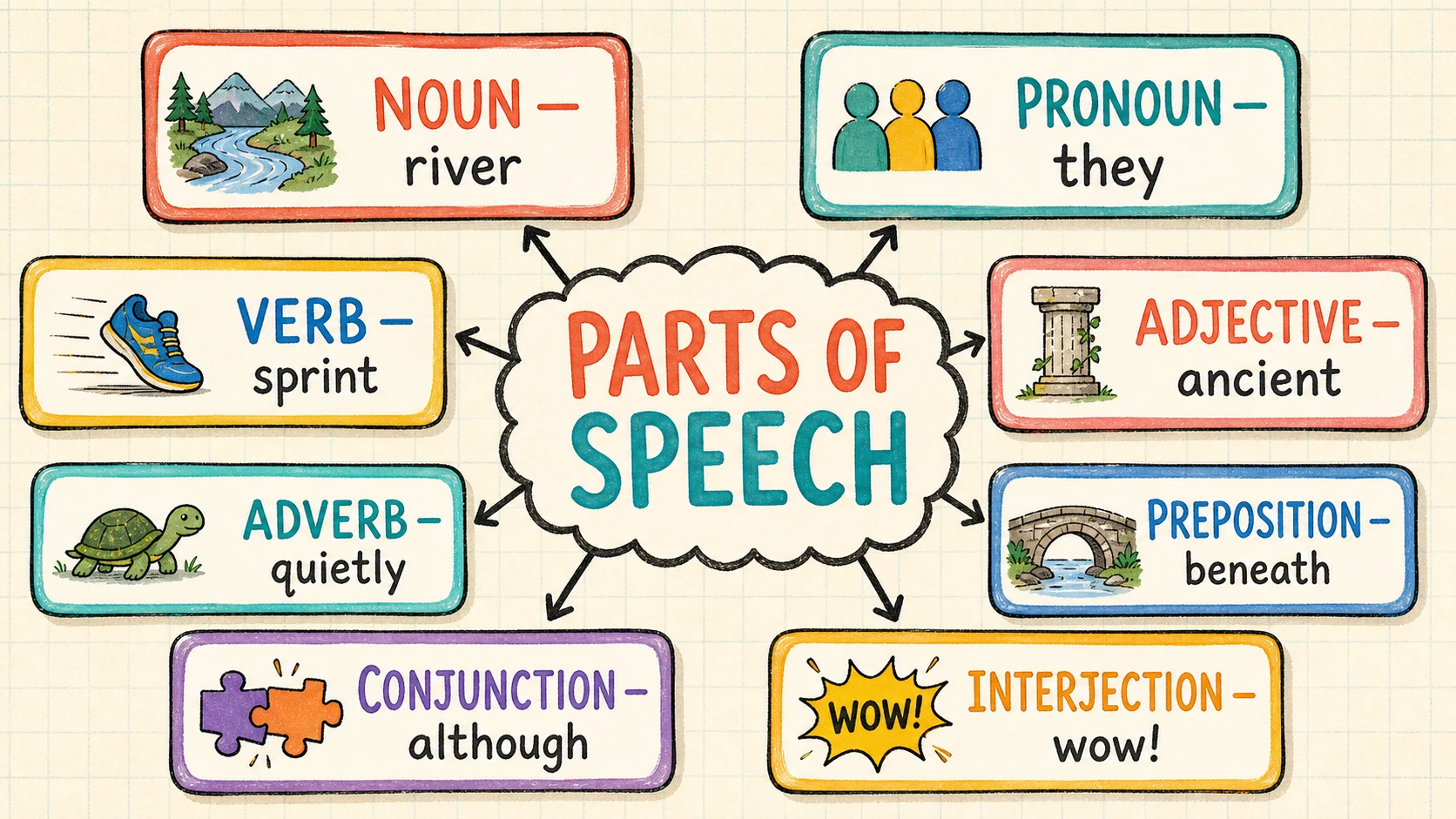
Use the map to choose one language decision—such as distinguishing adjectives from nouns—rather than asking for simultaneous mastery of every part of speech.
Watch the first five minutes before deciding what comes next
A short observation often tells you more than the final score. Sit nearby for the first few items without correcting every move.
Look for an entry plan
Ask the learner to read or hear the direction and say what they will do first. A workable plan might be “I’ll estimate, multiply, then compare my answer with the estimate” or “I’ll find the word each adjective describes.”
Notice whether the learner:
- begins after reading the full direction;
- identifies known and unknown quantities;
- selects a representation, operation, or language rule;
- records intermediate thinking in a readable way;
- notices when an answer conflicts with the context;
- can explain a decision without merely repeating a rule.
Silence is not automatically confusion, and quick speech is not automatically understanding. Ask for one concrete explanation: “Why did you regroup here?” or “Which noun does this adjective modify?”
Distinguish productive effort from overload
Continue when the learner makes progress with occasional pauses, can use a prompt, and corrects at least some errors after checking. Simplify when the intended idea is accessible but a supporting demand repeatedly blocks it. Stop when the learner is guessing across several items, cannot restate the task after explanation, becomes increasingly distressed, or is too tired to use feedback.
Stopping is not a judgment about ability. Record what happened: “Could model 24 ÷ 6 with counters, but lost track in written partial quotients after eight minutes.” That note gives the next adult a usable starting point.
Make paper practice brief, active, and explainable
A 25-problem page need not be assigned as a single sitting. For many learners, six carefully discussed problems reveal more than 25 rushed answers.
Use a twelve-minute routine
- Preview for one minute. Name the target: “Today we are checking how you choose steps in two-operation problems.”
- Model or discuss one item for two minutes. The adult thinks aloud briefly, then the learner identifies the important decision.
- Solve three to five items for five minutes. Ask the learner to show enough work that another person could follow it.
- Check one correct and one incorrect item for three minutes. The learner explains why the correct method works and repairs an error.
- Record the next move for one minute. Write “continue,” “simplify one demand,” or “stop and revisit the prerequisite,” with a reason.
Keep the pencil moving, but include talk, pointing, drawing, and materials. The adult’s role is to expose thinking, not to supply each next step.
The IES mathematics intervention guide recommends systematic instruction, clear mathematical language, representations, and opportunities for cumulative review for learners who need additional support. That is general instructional guidance; it is not an evaluation of WorksheetWise or a claim that a particular page will produce a particular outcome.
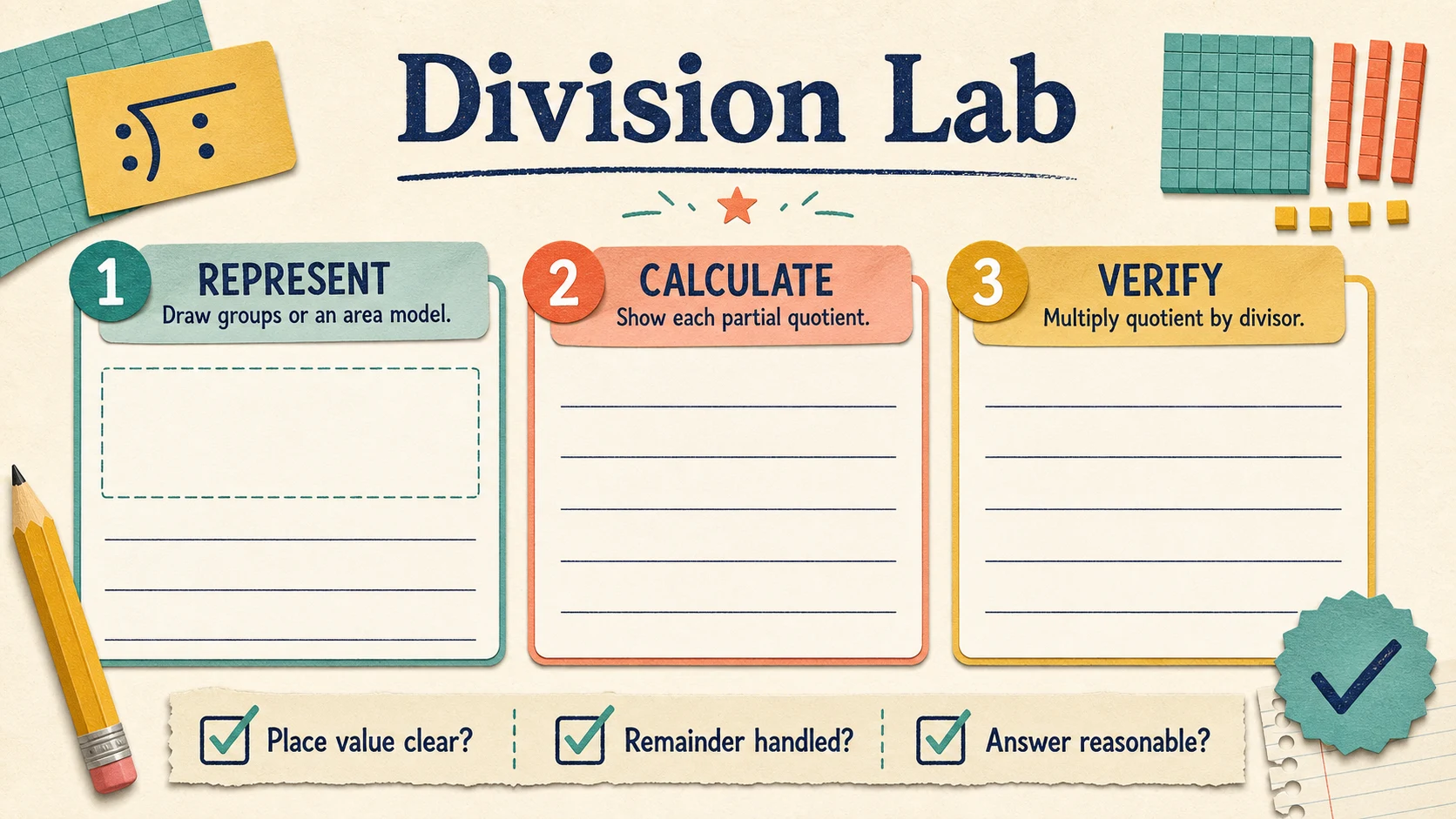
Treat the two-week plan as a spacing aid: sample a few division decisions, revisit them later, and adjust from observed work instead of completing every box automatically.
Build deliberate checking into mathematics
At this age, “check your work” is too vague. Give the learner a specific checking action before they begin.
Example 1: division with a remainder that changes the answer
Suppose 25 students need vans that hold 6 students each.
A learner may calculate:
remainder .
The arithmetic is correct because , but four vans hold only 24 students. The contextual answer is 5 vans.
This example belongs in a nine-year-old fourth-grade guide because the catalogue’s division materials include division word problems and interpretation of remainders, not just fact recall. It also demonstrates why answer-only completion is insufficient.
Use a three-part check:
- Arithmetic: Does reconstruct 25?
- Context: Can every student ride?
- Statement: Does the written answer include the unit, vans?
The Common Core mathematics standards provide one widely used description of fourth-grade expectations, including multi-step word problems and interpreting remainders. They are a reference point, not proof of alignment for this catalogue, and local sequences may differ.
Example 2: partial products instead of an unexplained algorithm
For , decompose both factors:
Check the second partial product:
Then estimate: is near , and is near , so a product near is plausible. The exact answer, 322, fits that estimate.
This example belongs here because the live multiplication description progresses from arrays and equal groups to area models, partial products, and multi-digit computation. It requires several coordinated steps and a reasonableness check—precisely the shift from answer production to deliberate fourth-grade work.
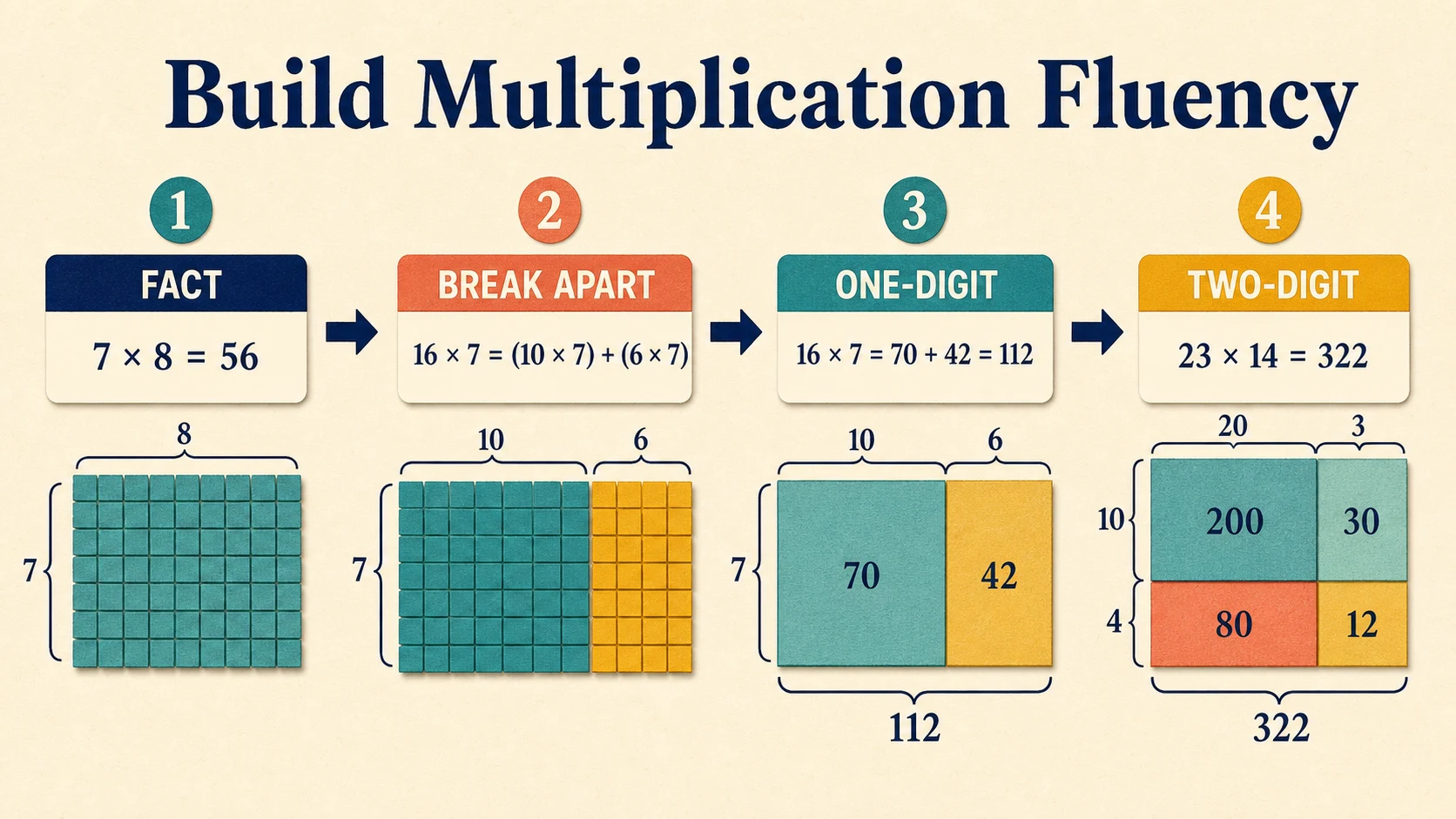
Move along this progression only when the learner can explain how equal groups or partial products connect to the written calculation.
If the learner calculates correctly but omits , do not assign easier multiplication facts immediately. Cover part of the page, draw an area model, and label the two partial products. That preserves multi-digit multiplication while reducing organizational demand. The 4th Grade Multiplication guide and free sheet offers a focused entry point for this observation.
Example 3: subtraction checked through addition
For , a correct regrouping process gives:
Check with the inverse operation:
A useful explanation is not “I borrowed.” It is: “I decomposed one thousand into hundreds, then one hundred into tens, and then one ten into ones, without changing the total value.”
This belongs here because the catalogue’s subtraction guidance emphasizes multi-digit regrouping, place value, and the inverse relationship with addition. It also reveals a common error pattern: subtracting the smaller visible digit from the larger one without respecting place or order.
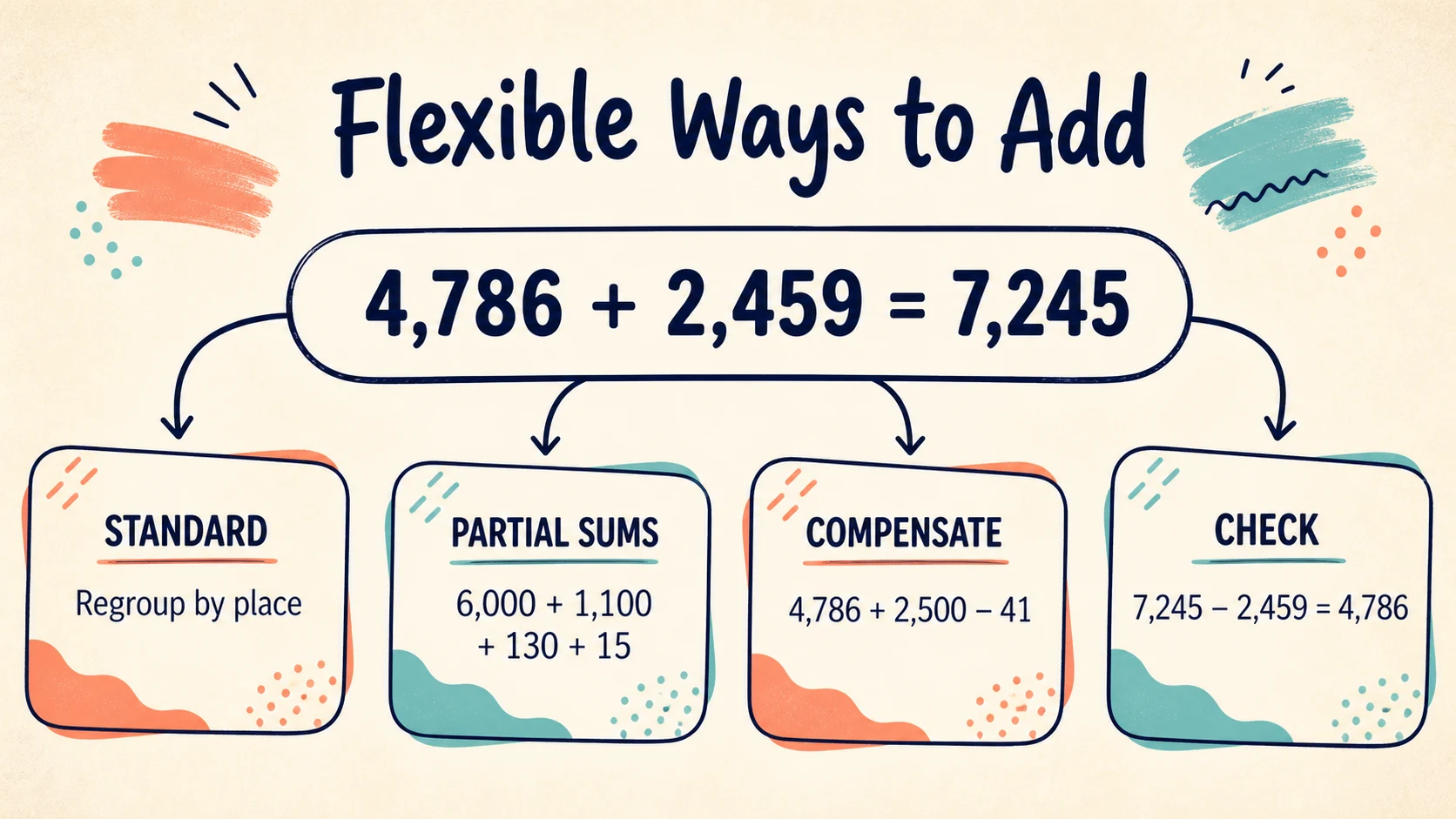
Use addition as a checking tool for subtraction, while also watching whether the learner aligns ones, tens, hundreds, and thousands consistently.
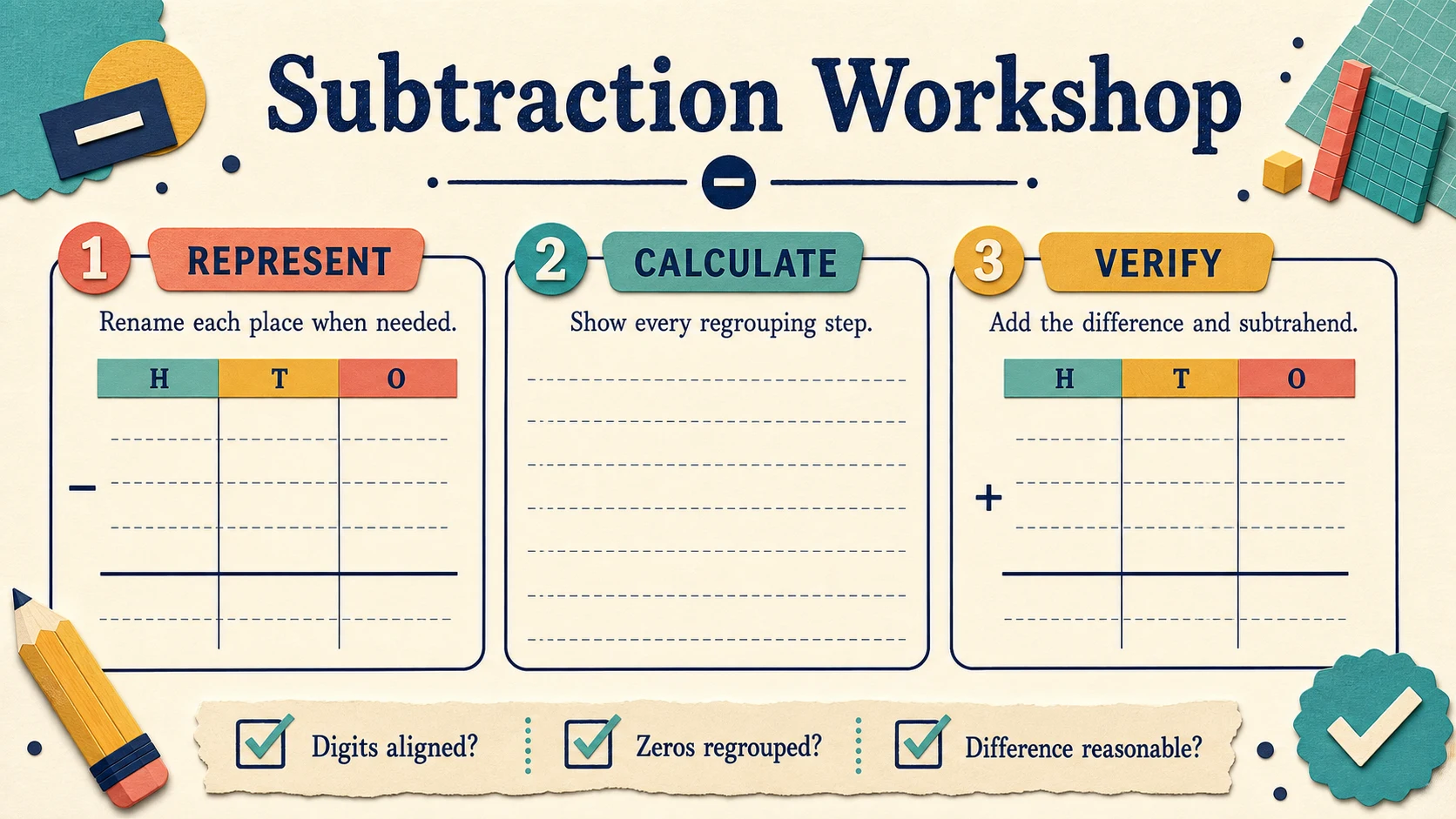
Space subtraction review across several short sessions and retain the same checking routine long enough for the learner to use it without prompting.
If errors occur only when zeros require regrouping, choose several carefully selected items rather than returning to an entire page of basic subtraction. The 4th Grade Subtraction guide and free sheet can support that narrower follow-up.
Pair symbols with talk, drawings, and materials
Paper records thinking, but it need not carry the whole lesson. The IES early mathematics practice guide recommends helping children connect informal representations and mathematical ideas, using progressions and monitoring what children know. Although the guide focuses on younger children, the principle of connecting representations remains useful when a fourth-grade learner meets a new or unstable idea. This is a suggested application, not a claim from IES about this page.
Use materials without lowering the mathematical target
For , place-value disks or a quick place-value chart can show why ten ones become one ten and why ten tens become one hundred. The learner should still solve the fourth-grade addition problem; the material makes the regrouping visible.
For and , use equal-length paper strips. Divide one into fourths and the other into eighths. Reexpress as , then compare . Do not use unequal “pizza” drawings that make visual comparison unreliable.
For a parts-of-speech item, write each word of “The curious fox moved quietly” on a card. Have the learner connect:
- fox to noun;
- curious to the noun it describes;
- moved to verb;
- quietly to the verb it modifies.
The physical arrangement preserves grammatical classification while reducing the burden of scanning a dense line of print.
Keep adult talk precise
Use the vocabulary needed for the concept, then ask the learner to connect the term to an action:
- “What does the remainder represent here?”
- “Which place are you regrouping?”
- “What noun is the pronoun replacing?”
- “What spelling pattern stayed the same?”
- “Where does the first complete thought end?”
Avoid turning every prompt into a clue. “What can you check?” keeps the decision with the learner; “Multiply 6 by 4 now” supplies the decision.
Demand vocabulary precision in language work
Fourth-grade grammar and spelling practice should move between identification and use. A learner who circles every requested word correctly may still be unable to explain its function or apply the same idea while writing.
Example 4: classify a word by its job in the sentence
Consider these sentences:
- “We light the lantern.”
- “The light filled the room.”
- “Carry the light bag.”
In sentence 1, light is a verb: it names the action. In sentence 2, it is a noun: it names what filled the room. In sentence 3, it is an adjective: it describes bag.
This checked example belongs here because the catalogue’s parts-of-speech materials move from basic identification toward classification in context, including words that can perform different grammatical jobs. The example requires vocabulary precision; memorizing “a verb is an action word” is not enough.
Ask the learner to prove each answer by identifying what the word does, not by reciting a definition. Then ask for a new sentence in which light has one of the three roles.
The IES elementary writing guide recommends explicit instruction in writing strategies, attention to foundational writing skills, and a supportive community for writing. Applied here, that supports moving from worksheet identification into a short piece of the learner’s own writing. It does not establish that a WorksheetWise sheet has been studied or validated by IES.
Example 5: study a spelling pattern, then test transfer
Use the words hope, hoping, hoped, and hopeful. The base word hope retains its meaning across the set. When adding -ing, the final silent e is dropped: hope + ing = hoping. When adding -ed, it is also dropped: hope + ed = hoped. In hopeful, the base spelling remains visible.
After the learner studies the set, dictate a transfer word such as bake and ask for baking and baked. Correct forms are:
This belongs here because the catalogue’s spelling entry targets patterns, suffixes, multisyllabic words, word sorting, and look-cover-write-check. It tests whether the learner can apply a pattern rather than merely reproduce a memorized list.
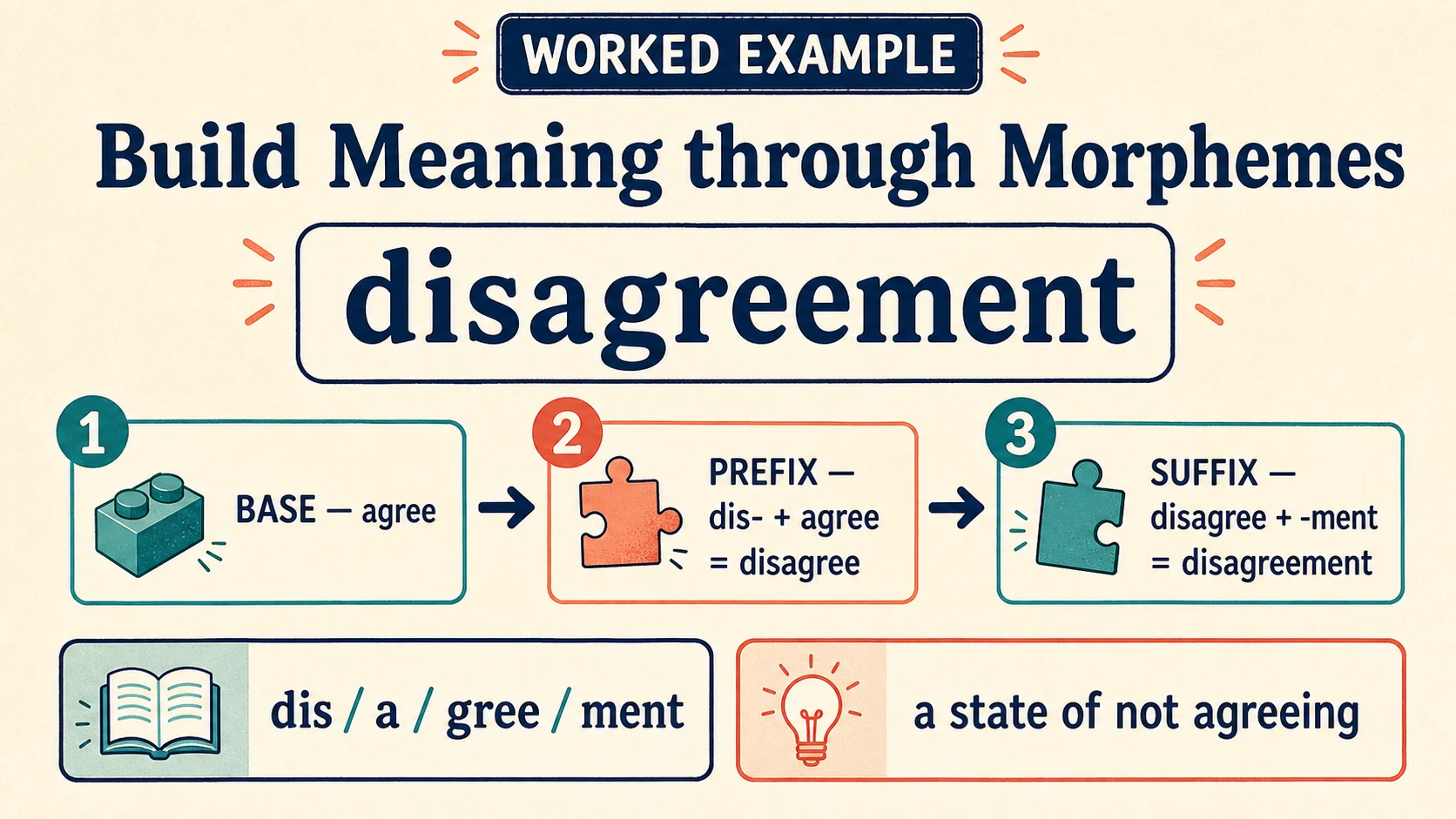
Use the worked example to expose the spelling decision, then check transfer with a new word that follows the same pattern.
The IES foundational reading guide emphasizes explicit work with sound-spelling relationships and word analysis in early reading instruction. For a nine-year-old, using a spelling pattern and testing it in reading and writing is a reasonable extension, but the specific transfer routine above is an editorial suggestion.
Interpret error patterns before changing the level
A total score compresses very different problems. Review wrong answers by pattern.
When to simplify one demand
Simplify when the learner understands the target idea but a secondary demand repeatedly interferes.
- If division reasoning is sound with counters but written layout collapses, provide graph paper or pre-drawn columns.
- If a learner can explain a word problem orally but misreads dense text, read it aloud and preserve the mathematical decisions.
- If grammar classification is accurate orally but handwriting is slow, let the learner label words with abbreviations such as N, V, Adj, and Adv.
- If a learner knows a spelling pattern but loses their place in a 25-word list, cover all but five words.
These changes reduce reading, visual, memory, or motor load without replacing the target skill.
When to continue at the same level
Continue with a small, varied set when the learner solves most items accurately, can explain the method, and makes errors that respond to a reminder. Variation matters: include a regrouping problem with a zero, a word problem in which division leaves a remainder, or a sentence in which a familiar word changes grammatical role.
Do not increase difficulty solely because the learner works quickly. First ask for a representation, explanation, estimate, or independent check. Speed without interpretation can conceal brittle knowledge.
When to stop and revisit a prerequisite
Stop the current page when several prompts do not restore meaningful progress. Revisit a prerequisite if the learner cannot:
- compose or decompose place values needed for regrouping;
- connect a division fact to a known multiplication fact;
- distinguish equal from unequal fractional parts;
- locate the complete noun or verb relationship in a short sentence;
- hear or identify the spelling feature the page assumes.
Select one prerequisite and observe it directly. Do not infer a diagnosis from a worksheet session. Persistent concerns across settings should be documented and discussed with the learner’s teacher or another qualified professional.
Protect the target while adapting the session
An adaptation is useful when it changes access but preserves the decision the learner needs to make.
Access adaptations
Read instructions aloud, enlarge the print, provide a blank place-value chart, reduce the visible number of items, allow oral explanations, or use counters and fraction strips. Offer a multiplication chart only if fact retrieval is not the target. If the goal is to assess multiplication-fact recall, the chart would replace the skill rather than support it.
Challenge adaptations
For a learner who completes the entry task accurately, deepen the same skill before changing topics:
- ask for two methods for ;
- ask whether a division remainder should be ignored, reported, or rounded up in three different contexts;
- require an estimate before exact addition;
- ask the learner to revise a sentence by replacing a vague verb;
- add one unfamiliar word that follows the studied spelling pattern.
A genuinely harder task has observable additional demands: more steps, less obvious operation choice, more complex language, unfamiliar transfer, or a requirement to justify and check. “Advanced learner” is not a worksheet feature and should not become a fixed label.
Set boundaries around what a worksheet can tell you
A worksheet is a small sample under particular conditions. It cannot establish a diagnosis, measure complete grade mastery, or predict future outcomes. Accuracy may be affected by fatigue, reading load, unfamiliar notation, anxiety, background knowledge, or the amount of adult prompting.
The catalogue counts describe available resources, not evidence of effectiveness. The “free” designation identifies the 13 free entry points; it does not imply that free resources were independently evaluated. Likewise, “fourth grade” describes intended practice level, not a guaranteed match to every school’s sequence.
Keep a brief record with four facts:
- the skill and exact task used;
- how many items the learner attempted;
- what support was provided;
- one observable pattern in the work.
“Needed one prompt to align place values, then independently checked three sums with estimation” is useful. “Bad at addition” is not.
Make the next session depend on one visible decision
Choose one free sheet from the 4th Grade Division guide and assign only the first four suitable items. Before solving, ask the learner to identify whether each item represents sharing or grouping. After solving, have them verify each quotient with multiplication and explain any remainder in context.
Then record exactly one next action:
- Simplify: model the quantities with counters while keeping the same division question.
- Continue: complete four more items using the same check.
- Stop and revisit: practice the missing multiplication fact family before returning to the sheet.
That decision—based on observed reasoning, not age or page completion—is the most useful result of the session.
Put it into practice
Use the guide with a real printable
Move from explanation to a short, observable practice task. Check the first item together, then adjust the next session from the learner's actual work.
Open the first free worksheetExplore a neighboring collection
Choose by a different teaching need
Worksheets for 10-Year-Olds: Printable Practice Guide Worksheets for 11-Year-Olds: Printable Practice Guide Worksheets for 12-Year-Olds: Printable Practice Guide Worksheets for 3-Year-Olds: Printable Practice Guide Worksheets for 4-Year-Olds: Printable Practice Guide Worksheets for 5-Year-Olds: Printable Practice Guide Worksheets for 6-Year-Olds: Printable Practice Guide Worksheets for 7-Year-Olds: Printable Practice Guide