What 4th Grade Geometry Includes
Fourth-grade geometry centers on using properties and measurements to describe, draw, compare, and classify figures. A learner should work toward being able to:
- Recognize points, lines, line segments, rays, and angles.
- Distinguish parallel lines from perpendicular lines.
- Identify and classify angles.
- Classify two-dimensional shapes by their properties.
- Recognize symmetry.
- Calculate and distinguish perimeter and area.
- Explain a classification or calculation using geometric evidence.
The concise answer is that instruction should move from seeing and handling geometry to naming, measuring, and reasoning about it. Begin with drawings, cutouts, tiles, folded paper, and familiar objects. Add precise vocabulary only after the learner can point to the relevant feature. Then move into calculations and written explanations.
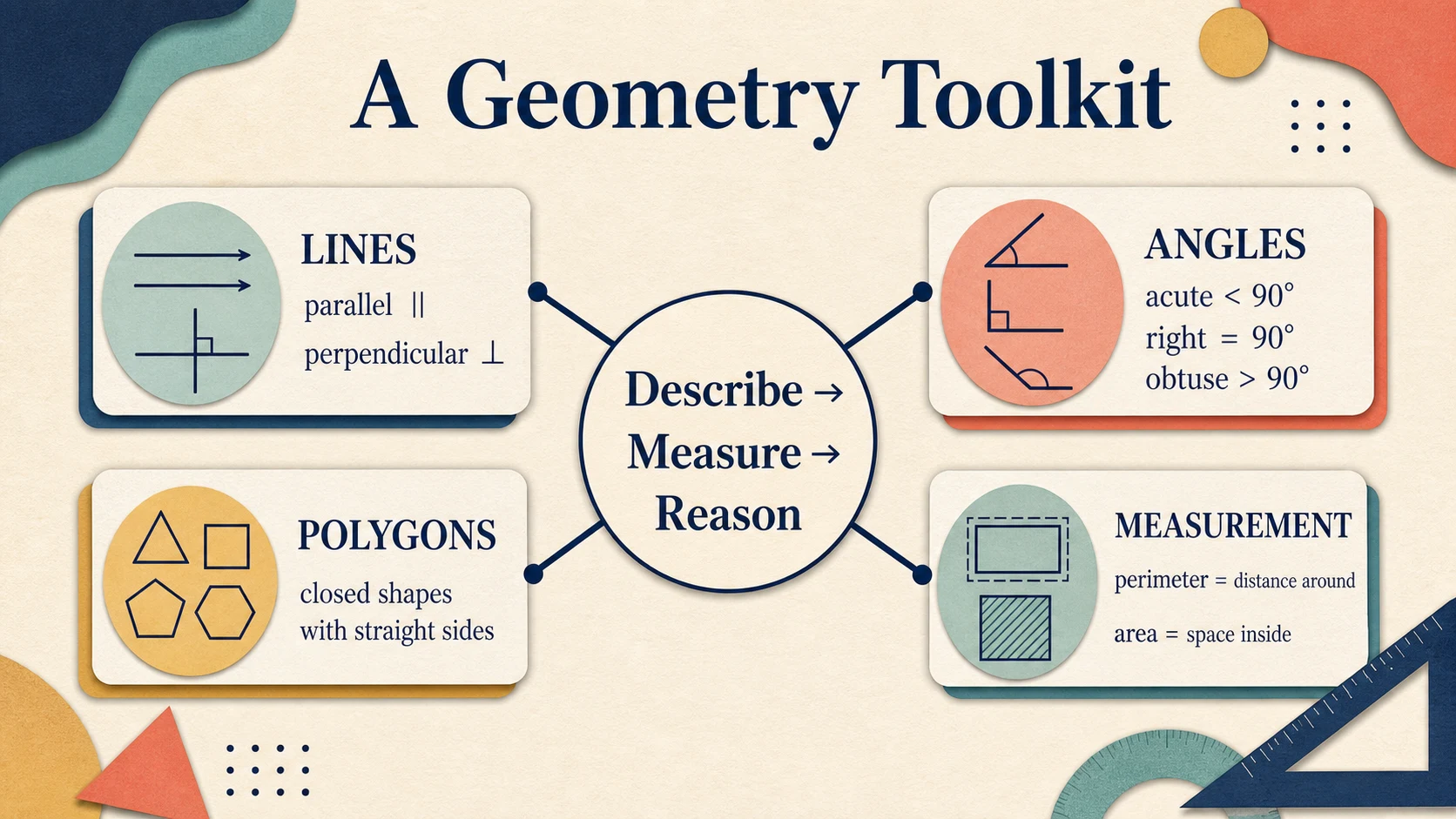
The major skills connect: line and angle knowledge supports shape classification, while measurement connects geometric figures to numbers.
Grade labels describe the intended practice level; local school and homeschool sequences differ. A fourth grader may therefore encounter these ideas in a different order or may need work usually labeled for an earlier grade. The learner’s observed work—not the grade label alone—should determine pacing and practice selection.
The Common Core State Standards for Mathematics provide one useful high-level frame for this stage: drawing and identifying lines and angles, classifying shapes by properties, and measuring angles. They should be treated as a curricular reference, not as evidence that every learner or local program follows an identical timetable.
Prerequisites to Check Before Beginning
Geometry difficulties sometimes come from an unfinished prerequisite rather than from the new concept itself. A quick check can prevent unnecessary repetition.
Shape and attribute knowledge
Ask the learner to identify several familiar two-dimensional shapes and explain how they know. Include examples in different sizes and orientations. A triangle remains a triangle when it points down or has unequal sides. A rectangle remains a rectangle when its longer sides are vertical.
The learner should be able to count sides and vertices without relying entirely on the shape’s overall appearance. If the learner calls every four-sided figure a square, return to sorting examples by visible attributes.
Measurement and multiplication
Area and perimeter require different numerical foundations. For perimeter, the learner needs reliable addition and an understanding of length units. For rectangular area, the learner needs to interpret rows and columns and use multiplication.
Check these ideas with a small tiled rectangle:
- Can the learner count 3 rows of 4 squares as 3×4=12?
- Can the learner trace the outside boundary?
- Can the learner explain that a square unit covers a surface while a linear unit measures an edge?
If multiplication is still slow, keep dimensions small. The objective should remain geometric reasoning, rather than turning every problem into a test of calculation fluency.
Spatial language and careful observation
Confirm that terms such as inside, outside, beside, opposite, horizontal, vertical, turn, and corner make sense in context. These words support later explanations of lines, angles, and symmetry.
A learner does not need perfect vocabulary before starting. However, the adult should note whether an incorrect answer comes from misunderstanding the figure or misunderstanding the question’s language.
A Grade-Appropriate Teaching Progression
A useful progression moves from recognition to description, then to measurement and reasoning. Do not advance simply because a page is complete. Advance when the learner can solve representative problems and explain why the answer works.
| Stage |
Main idea |
Concrete or visual model |
Evidence of readiness to continue |
| 1 |
Review shapes and attributes |
Cutout shapes, sticks, drawings |
Identifies sides and vertices in varied orientations |
| 2 |
Points, lines, segments, and rays |
Dots, string, rulers, arrow drawings |
Distinguishes finite segments from lines and rays |
| 3 |
Parallel and perpendicular lines |
Paper strips, grid paper, room edges |
Identifies each relationship and gives a reason |
| 4 |
Angle types |
Corner models, hinged strips, right-angle card |
Compares angles with a right angle |
| 5 |
Angle measurement |
Transparent protractor and drawn rays |
Places the protractor correctly and reads the correct scale |
| 6 |
Shape classification |
Attribute cards and sorting diagrams |
Classifies figures using more than one property |
| 7 |
Symmetry |
Folding, mirrors, tracing paper |
Tests a possible line rather than guessing |
| 8 |
Perimeter and area |
Square tiles and grid paper |
Separates boundary length from covered surface |
| 9 |
Mixed reasoning |
Diagrams and short written explanations |
Selects the relevant property or operation independently |
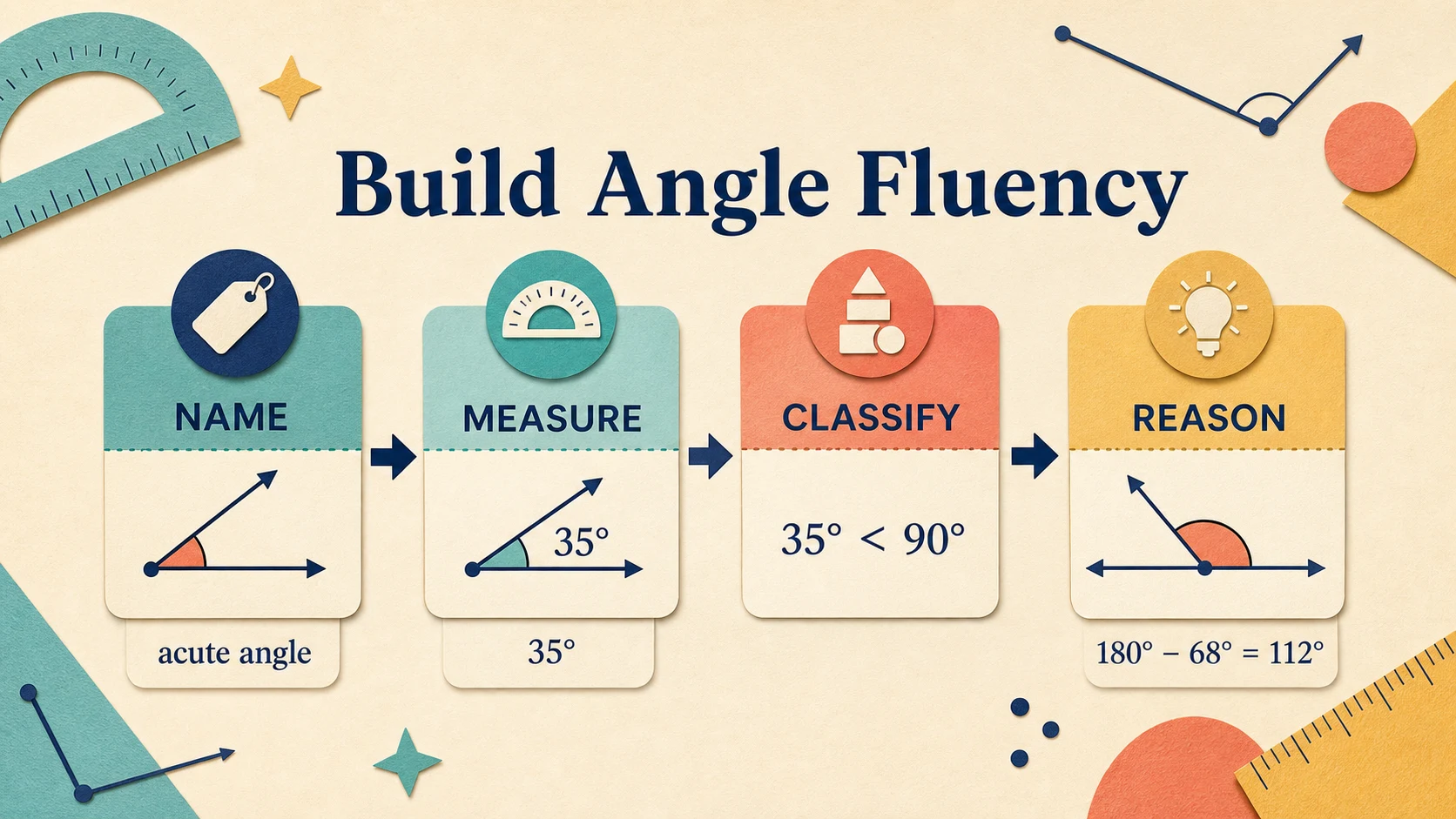
Support can be reduced gradually as the learner demonstrates accurate reasoning, measurement, and explanation.
The catalogue’s progression places rectangle area and perimeter foundations before fourth-grade work with lines, angles, and classification. Coordinate planes and more advanced classification appear later in the stated sequence. That makes coordinate geometry optional enrichment here, not a required starting point.
Concrete and Visual Models That Clarify the Mathematics
Lines, segments, rays, and relationships
Use string or paper strips to distinguish figures that look similar on a worksheet:
- A point marks an exact location.
- A line extends without ending in either direction.
- A line segment has two endpoints.
- A ray has one endpoint and continues in one direction.
On paper, arrowheads communicate continued extension. This matters: a plain stroke with two marked endpoints represents a segment, not a line.
To model parallel lines, place two rulers side by side with a constant gap. To model perpendicular lines, cross two strips so they form square corners. A small paper corner can serve as a portable right-angle checker.
Include nonexamples. Intersecting lines are not automatically perpendicular; they must meet at right angles. Segments may be parallel even though they do not have the same length.
Angles
Make an angle from two cardboard strips joined with a paper fastener. Keep the vertex fixed and rotate one ray. This helps the learner attend to the amount of turn rather than the length of the drawn sides.
Use a square paper corner as the benchmark:
- An acute angle is smaller than a right angle.
- A right angle matches the square corner.
- An obtuse angle is larger than a right angle but smaller than a straight angle.
When measuring, place the protractor’s center mark on the vertex and align its baseline with one ray. Then read the scale that begins at zero on that aligned ray. A learner who selects the other scale may report 130∘ for a 50∘ angle.
Shapes and classification
Build figures with craft sticks, draw them on dot paper, or sort printed cards. Ask for two types of reasoning:
- What properties does this figure have?
- Which category or categories do those properties place it in?
Classification should not become a guessing game based on appearance. A square has four equal sides and four right angles. Those properties also satisfy the definition of a rectangle as a quadrilateral with four right angles. Therefore, in an inclusive classification system, a square can belong to both categories.
Use varied orientations and proportions. A narrow rectangle, a tilted square, and a long thin triangle reveal whether the learner is using properties or merely matching a familiar picture.
Area and perimeter
Start with square tiles. Build a rectangle, count all tiles for area, and count or measure the outside edges for perimeter. Say the units aloud:
- Area: square centimeters, square inches, or another square unit.
- Perimeter: centimeters, inches, or another linear unit.
Build several rectangles from 12 tiles. A 3×4 rectangle has area 12 square units and perimeter 14 units. A 2×6 rectangle also has area 12 square units but perimeter 16 units. The model makes clear that equal area does not require equal perimeter.
Fully Checked Worked Examples
Example 1: Classifying lines and angles
Suppose two lines cross and form four square corners. Classify the lines and the angles.
Reasoning: Square corners indicate right angles. Lines that intersect to form right angles are perpendicular.
Answer: The lines are perpendicular, and all four angles are right angles.
Check: A full turn measures 360∘. Four right angles total
4×90∘=360∘.
The angle total is consistent with one full turn around the intersection.
Boundary case: If two lines cross but one angle is acute, the lines intersect but are not perpendicular. Crossing alone is insufficient evidence.
Example 2: Measuring an angle correctly
An angle’s first ray points to the right along the protractor’s baseline. The second ray passes through the marks labeled 65∘ on the inner scale and 115∘ on the outer scale. What is the angle measure?
Reasoning: Start with the scale whose zero is on the ray pointing right. That is the inner scale in this setup.
Answer:
65∘
The angle is acute because 65∘<90∘.
Check: The drawing shows an opening smaller than a square corner. A result of 115∘ would be obtuse, so it would contradict the visible comparison with 90∘.
Boundary case: Rotating the entire page does not change the measure. Angle size depends on the opening between the rays, not on whether a ray points right, left, up, or down.
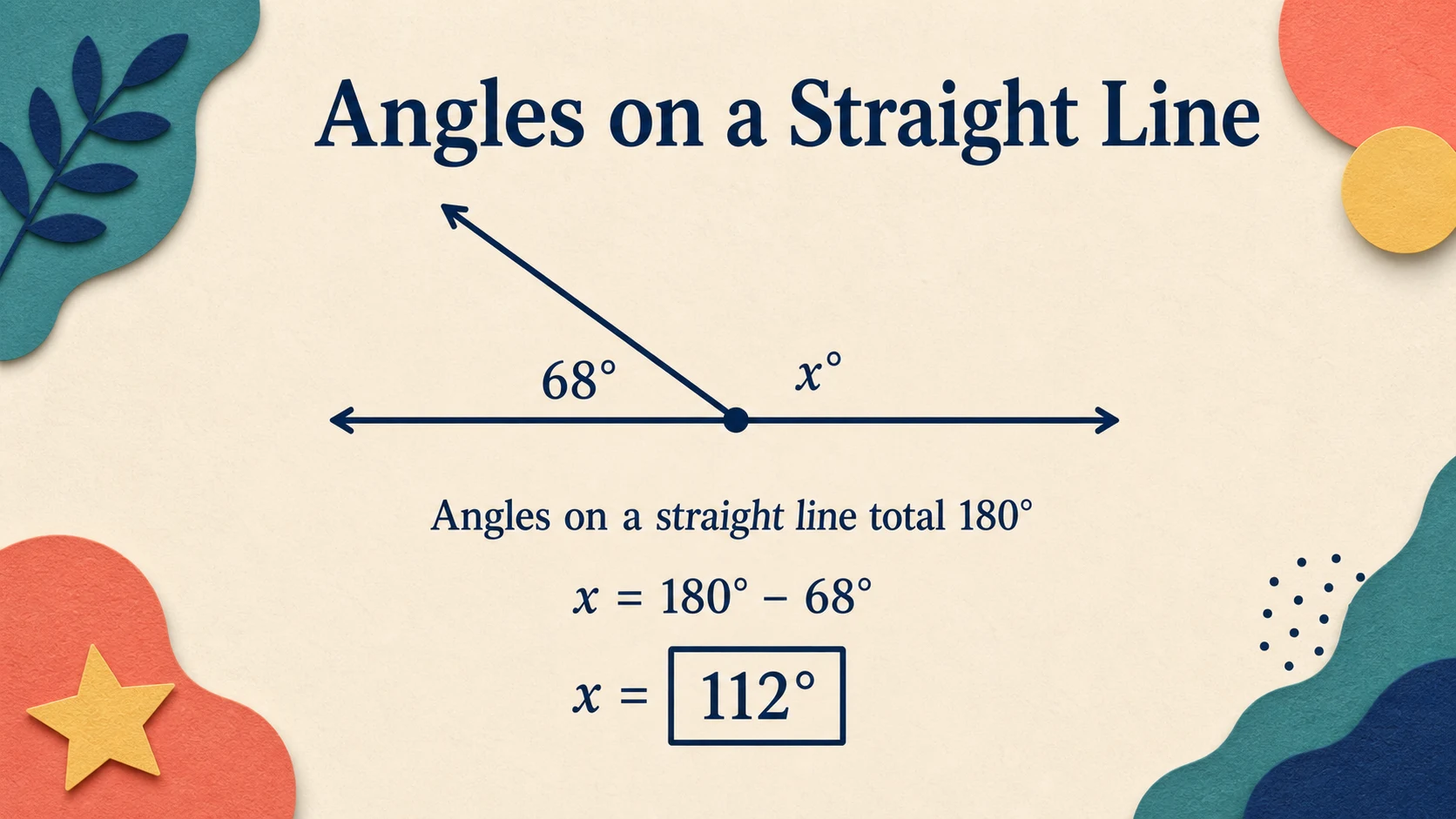
Connecting a manipulable or drawn model to a calculation makes each step available for checking.
Example 3: Classifying a quadrilateral
A quadrilateral has four equal sides and four right angles. How should it be classified?
Reasoning:
- Four sides make it a quadrilateral.
- Four equal sides and four right angles make it a square.
- Four right angles also satisfy the property used to identify a rectangle.
Answer: It is a square and a rectangle, as well as a quadrilateral.
Check: Test each statement against the given properties. Nothing in “rectangle” requires unequal adjacent sides. The figure therefore fits the broader rectangle category and the more specific square category.
Boundary case: A quadrilateral with four equal sides but no right angles is not established as a square. Equal sides alone do not supply the missing angle condition.
Example 4: Finding perimeter and area
A rectangle is 8 centimeters long and 3 centimeters wide. Find its perimeter and area.
Perimeter: Add all four side lengths:
8+3+8+3=22.
Equivalently,
P=2(8+3)=2(11)=22 cm.
Area: Multiply the number of unit rows by the number of units in each row:
A=8×3=24 cm2.
Answer: The perimeter is 22 centimeters, and the area is 24 square centimeters.
Check: The perimeter calculation contains two lengths of 8 and two widths of 3. For area, a drawing would contain 3 rows of 8 unit squares, and 8+8+8=24.
Boundary case: The numbers 22 and 24 cannot be swapped merely because both came from the same rectangle. One measures boundary length; the other measures covered surface.
Example 5: Same area, different perimeter
Compare a 3×4 rectangle and a 2×6 rectangle.
For the first rectangle:
A=3×4=12 square units
P=2(3+4)=14 units
For the second rectangle:
A=2×6=12 square units
P=2(2+6)=16 units
Answer: Both rectangles have area 12 square units, but their perimeters are different: 14 units and 16 units.
Check: Twelve square tiles can be rearranged into either array without changing the number of tiles. The outside boundary changes because the arrangements have different dimensions.
This example is especially useful when a learner assumes that equal areas must produce equal perimeters.
A Short, Repeatable Lesson Routine
A focused geometry lesson can take about 15 to 25 minutes, but that range is an instructional suggestion rather than a universal timetable. Shorten or extend it in response to attention, accuracy, and the complexity of the task.
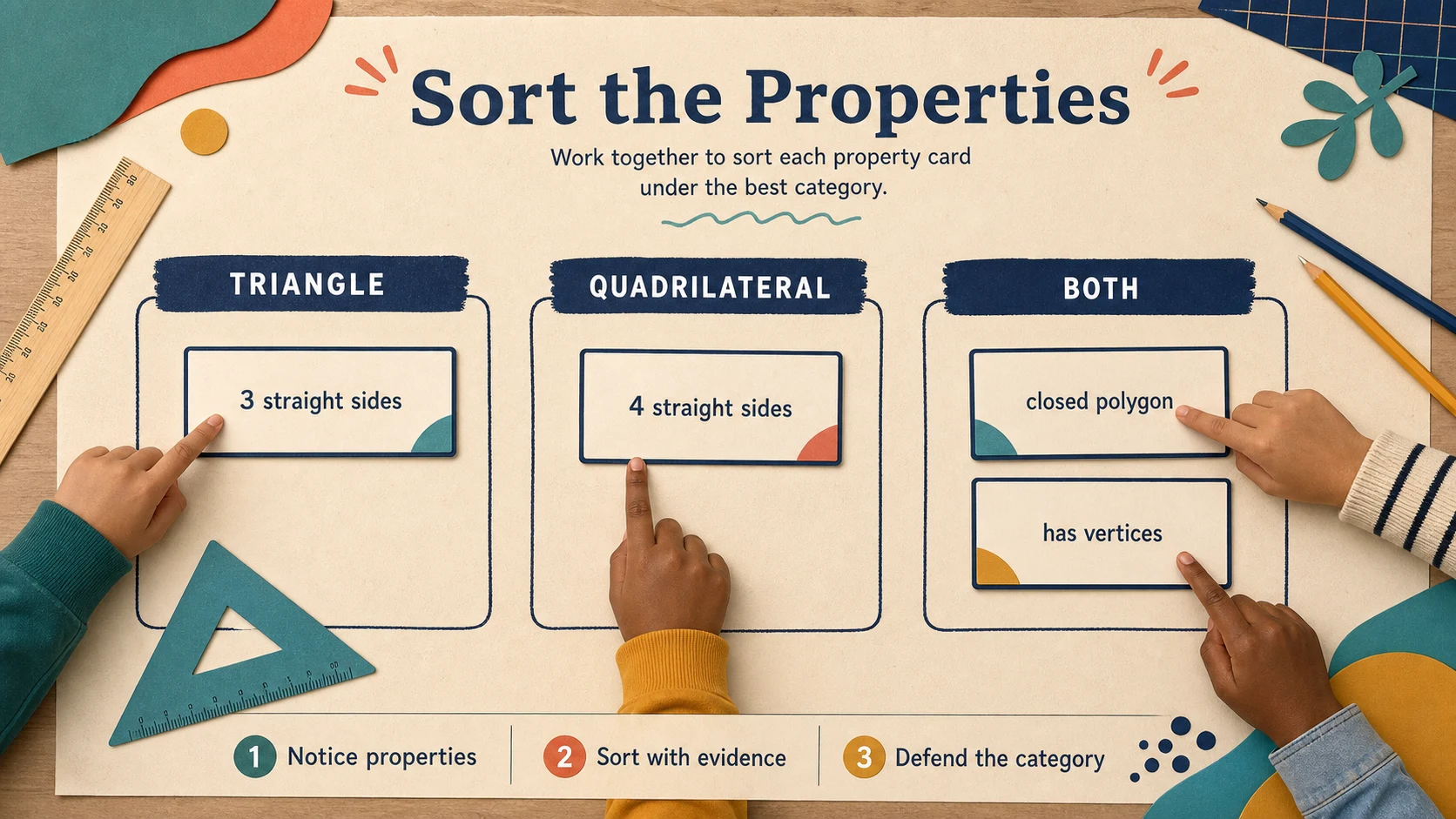
The routine cycles through retrieval, modeling, guided reasoning, independent practice, and a brief check.
1. Retrieve one prerequisite
Spend two or three minutes on a familiar idea. Ask the learner to identify a right angle, count vertices, or explain the difference between area and perimeter. This reveals whether the new lesson can rest on stable prior knowledge.
2. Model one idea
Use one clear example and think through it aloud. Point to the evidence in the figure: “These lines form a square corner, so they are perpendicular.” Keep the explanation specific enough that the learner could reuse it.
3. Solve together
Present a closely related problem. Ask the learner to make each decision while you record or prompt. If an error occurs, return to the model instead of supplying the answer immediately.
4. Try a small independent set
Use three to six carefully chosen problems. Include a straightforward item, a differently oriented example, and one item that requires an explanation. Independence should reveal whether the learner can choose the process without prompts.
5. Check and close
Review one correct answer and one error or hesitation. End with a short exit prompt, such as:
- “Draw an acute angle and explain how you know.”
- “Find the area and perimeter of a 5×2 rectangle.”
- “Name two categories that can include a square.”
The IES guide on teaching mathematics to young children supports high-level practices such as purposeful progressions, mathematical language, representations, and monitoring what learners understand. Its scope is broader than this fourth-grade topic, so it should inform teaching decisions rather than be presented as an evaluation of a WorksheetWise resource.
Choosing Practice That Matches the Learner
The most useful worksheet is not necessarily the longest or hardest. Select practice according to the error pattern you observed.
When the learner is beginning
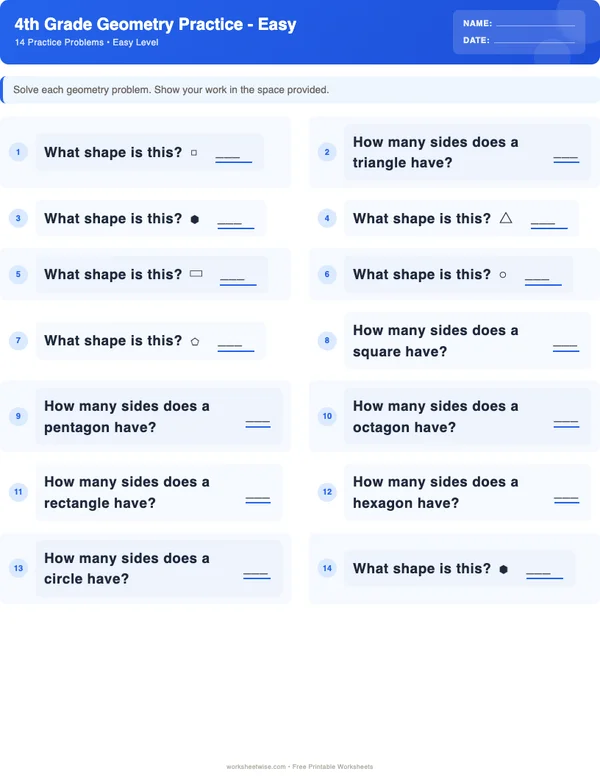
Choose uncluttered figures, familiar shapes, small whole-number dimensions, and one skill at a time. The free 4th Grade Geometry standard easy worksheet contains 25 exercises covering shapes, sides and vertices, perimeter, area, and geometric properties, with a separate answer key.
Use only the relevant portion if the learner is working on one concept. Completing all 25 problems is not automatically better than completing eight thoughtfully and explaining the reasoning.
When knowledge is accurate but fragile
Use mixed representations of the same concept:
- Right angles in different orientations.
- Rectangles that are tall, wide, or tilted.
- Angles drawn with short and long rays.
- Shapes with irrelevant visual details.
- Area problems shown as tiles, grids, and labeled dimensions.
Ask the learner to justify every third or fourth answer. Explanations reveal whether correct choices come from geometric properties or visual guessing.
When the learner is ready for broader review
Mix lines, angles, shape properties, area, and perimeter. The learner must first identify what the problem is asking and then choose a method. The 4th Grade Geometry Worksheet Pack contains 18 worksheets and can provide a wider practice pool, but more pages should not replace diagnosis or hands-on modeling.
For a broader grade-level context, use the fourth-grade math hub. If a learner needs repeated versions with adjusted numbers or layout, the free worksheet generators can support additional practice.
Differentiation Without Lowering the Mathematical Goal
Add support
For a learner who is struggling:
- Reduce the number of figures shown at once.
- Highlight the vertex of an angle.
- Let the learner place a square corner over a suspected right angle.
- Provide square tiles before introducing formulas.
- Label dimensions directly on a rectangle.
- Offer a word bank for line and angle terms.
- Ask for an oral explanation before requiring a written one.
The IES practice guide for assisting students struggling with mathematics provides high-level guidance on explicit, systematic instruction, clear mathematical language, representations, and cumulative review. It does not prescribe a child-specific intervention through this article. Persistent difficulty should be discussed with the learner’s teacher or another qualified educational professional who can examine the learner’s broader work.
Increase challenge
For a learner who is consistently accurate:
- Ask for all valid classifications of a figure.
- Give an incorrect solution and request a correction.
- Ask the learner to draw a figure meeting several conditions.
- Hold area constant while comparing perimeters.
- Hold perimeter constant while building different rectangles.
- Remove the formula prompt and ask the learner to choose the operation.
- Require an explanation using properties rather than appearance.
Challenge should deepen reasoning, not simply increase the number of repetitive problems.
Common Errors and Diagnostic Responses
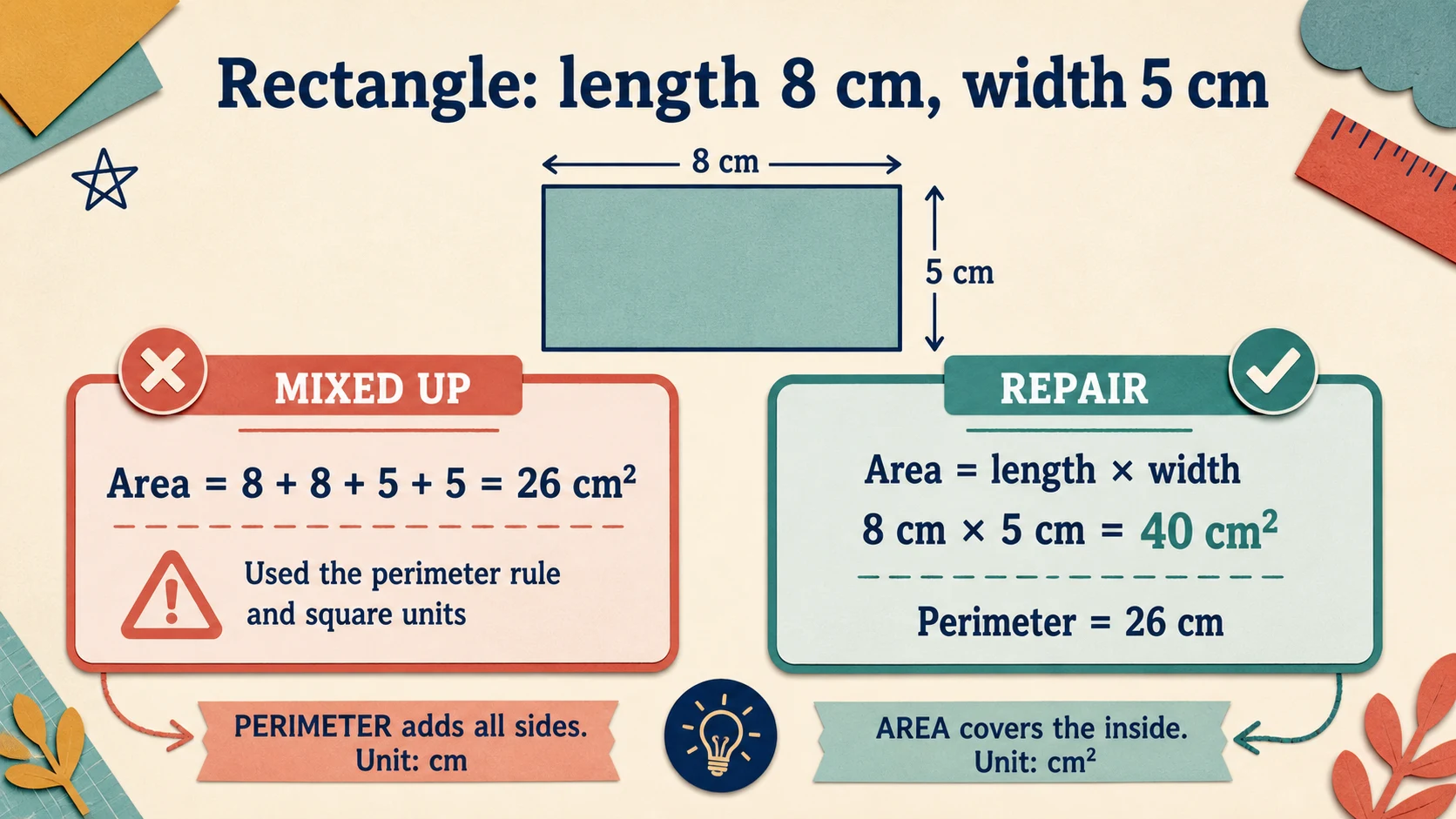
An error is most useful when it identifies the next representation, prompt, or practice type.
| Observed error |
Likely issue to investigate |
Teaching response |
| Calls a tilted square a diamond |
Classification by orientation |
Rotate the same cutout and list the properties that remain unchanged |
| Says all intersecting lines are perpendicular |
Focuses on crossing, not angle size |
Test intersections with a square paper corner |
| Confuses a line with a segment |
Overlooks endpoints and arrows |
Compare drawings and physically extend string beyond marked points |
| Reads 130∘ instead of 50∘ |
Uses the wrong protractor scale |
Trace from the aligned zero to the second ray |
| Thinks longer rays make a larger angle |
Attends to ray length |
Draw equal openings with different ray lengths |
| Uses l×w for perimeter |
Associates every rectangle with multiplication |
Trace the boundary and write all four side lengths first |
| Reports square units for perimeter |
Does not distinguish length from surface |
Pair a string boundary model with a tile-covering model |
| Says a square cannot be a rectangle |
Treats categories as exclusive |
Check the square against the rectangle’s defining properties |
| Counts grid lines instead of unit intervals |
Confuses marks with spaces |
Shade or bracket each unit interval before counting |
| Guesses a line of symmetry |
Relies on appearance |
Fold, trace, or mirror one half onto the other |
Do not diagnose from one careless response. Give a second problem with different numbers or orientation. If the same reasoning appears again, address that specific misconception. If the learner self-corrects and explains the correction, reduce support and check again later.
Monitoring Progress and Deciding What Comes Next
Record more than the percentage correct. A compact monitoring note can include:
- Skill attempted.
- Accuracy without help.
- Type of prompt required.
- Vocabulary used correctly.
- Whether a diagram or tool was needed.
- Error pattern.
- Result after a delayed review.
A learner is approaching independence when they can recognize the problem type, choose a representation or operation, complete the work accurately, and explain the answer without leading prompts. One correct page completed immediately after instruction does not establish durable understanding.
Use three checkpoints:
Immediate check
Can the learner complete a similar problem directly after the model?
Varied check
Can the learner solve the same concept when the figure is rotated, resized, or presented in another form?
Delayed check
Can the learner solve it after a day or several days, especially when it is mixed with other geometry topics?
If immediate work is correct but delayed work is not, add brief cumulative review. If the learner succeeds only when problems are grouped by type, add mixed practice that requires choosing the method. If explanations remain vague, return to precise property language.
A Two-Week Practice Plan
This plan is an adaptable example, not a universal timetable. Use shorter sessions, repeat a day, or omit material according to observed work.
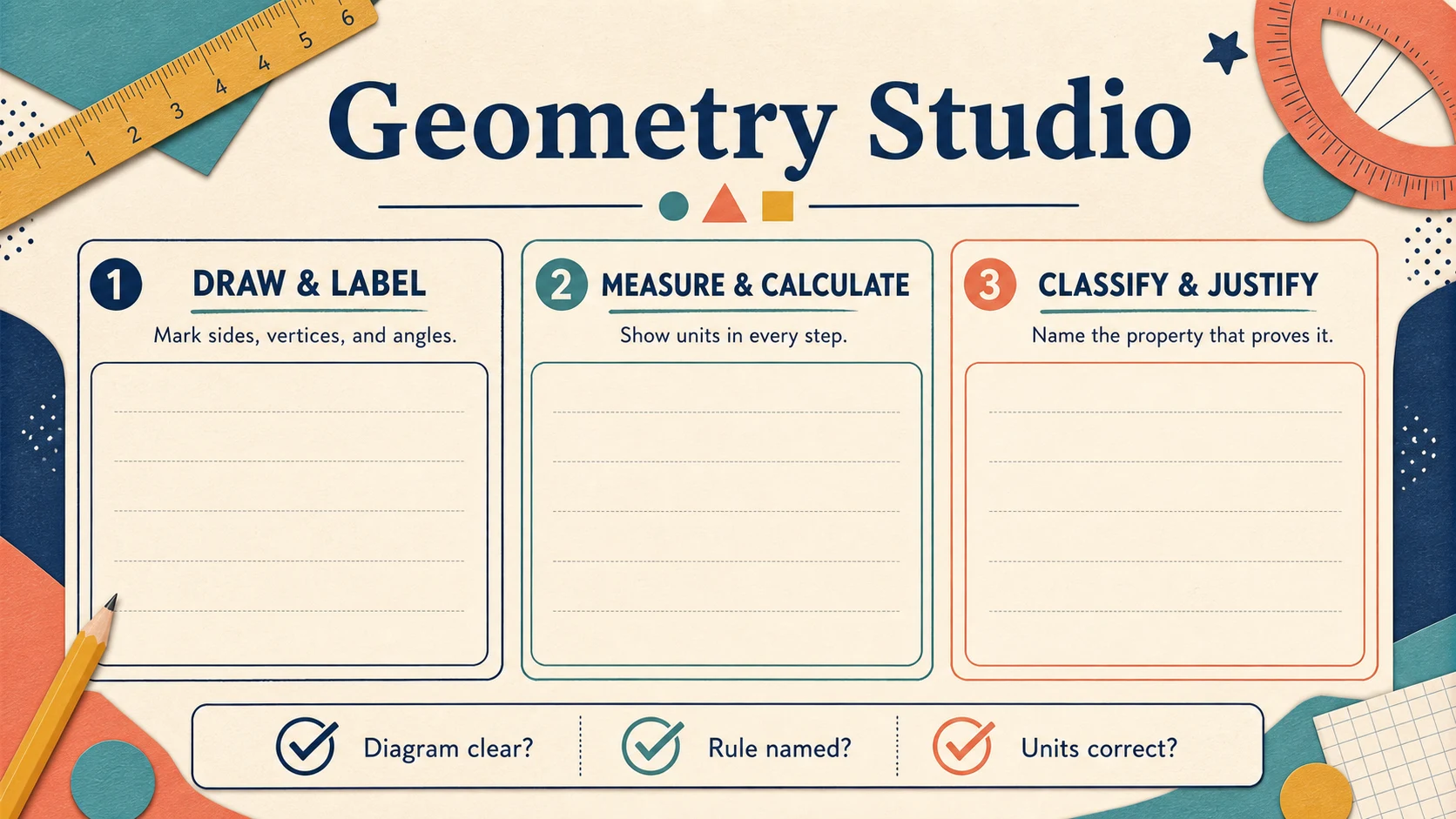
The sequence alternates new learning with retrieval and mixed review so that pacing can respond to evidence.
| Day |
Focus |
Suggested activity |
Quick evidence |
| 1 |
Prerequisite check |
Sort shapes; count sides and vertices; review multiplication arrays |
Explains two classifications |
| 2 |
Points, lines, segments, rays |
Build and draw each; identify endpoints and arrows |
Labels four examples |
| 3 |
Parallel and perpendicular lines |
Use rulers, paper strips, and room objects |
Justifies each relationship |
| 4 |
Angle types |
Compare hinged-strip angles with a square corner |
Classifies varied orientations |
| 5 |
Review |
Mix line relationships and angle types |
Corrects one false statement |
| 6 |
Measuring angles |
Model protractor placement and scale choice |
Measures and classifies three angles |
| 7 |
Shape properties |
Sort triangles and quadrilaterals by stated attributes |
Gives property-based reasons |
| 8 |
Inclusive classification |
Compare squares and rectangles; use a sorting diagram |
Names all valid categories |
| 9 |
Area and perimeter |
Build rectangles with tiles; trace boundaries |
Uses correct units |
| 10 |
Mixed application |
Complete selected worksheet problems and explain two |
Chooses methods independently |
After Day 5, pause if the learner still confuses lines, angle types, or orientations. After Day 10, review the notes rather than relying only on the total score. Repeat the weakest representation with new examples before moving to harder material.
Scope, Limitations, and the Honest Next Step
This guide covers the catalogue’s relevant fourth-grade geometry territory: lines, angles, shape properties and classification, symmetry, area, and perimeter. The available easy worksheet specifically practices shapes, sides and vertices, perimeter, area, and geometric properties. It should not be represented as a complete assessment of every local curriculum or as a substitute for instruction.
The guide also cannot determine why a particular learner struggles from a score alone. Fatigue, unfamiliar vocabulary, calculation errors, visual interpretation, and incomplete prerequisite knowledge can produce similar wrong answers. Look at the written work, ask the learner to explain one example, and test the suspected misconception with a second representation.
A practical next action is to choose six to ten relevant problems from the free 4th Grade Geometry worksheet. Ask the learner to solve them, explain two answers, and mark any use of prompts or models. Use that evidence to select the first teaching focus for the two-week plan.