What 4th Grade Word Problems Require
Fourth-grade word-problem work asks a learner to understand a situation, identify the quantities and their relationships, choose one or more operations, calculate accurately, and explain why the answer makes sense. Appropriate problems may use addition, subtraction, multiplication, division, fractions, mixed operations, and more than one step.
The short answer for an adult deciding what to teach is this: teach the learner to represent the situation before calculating. Have the learner retell the problem, name what is known and unknown, draw or build a model, write an equation, solve, and check the result. If the representation is wrong, more computation practice will not fix the underlying misunderstanding.
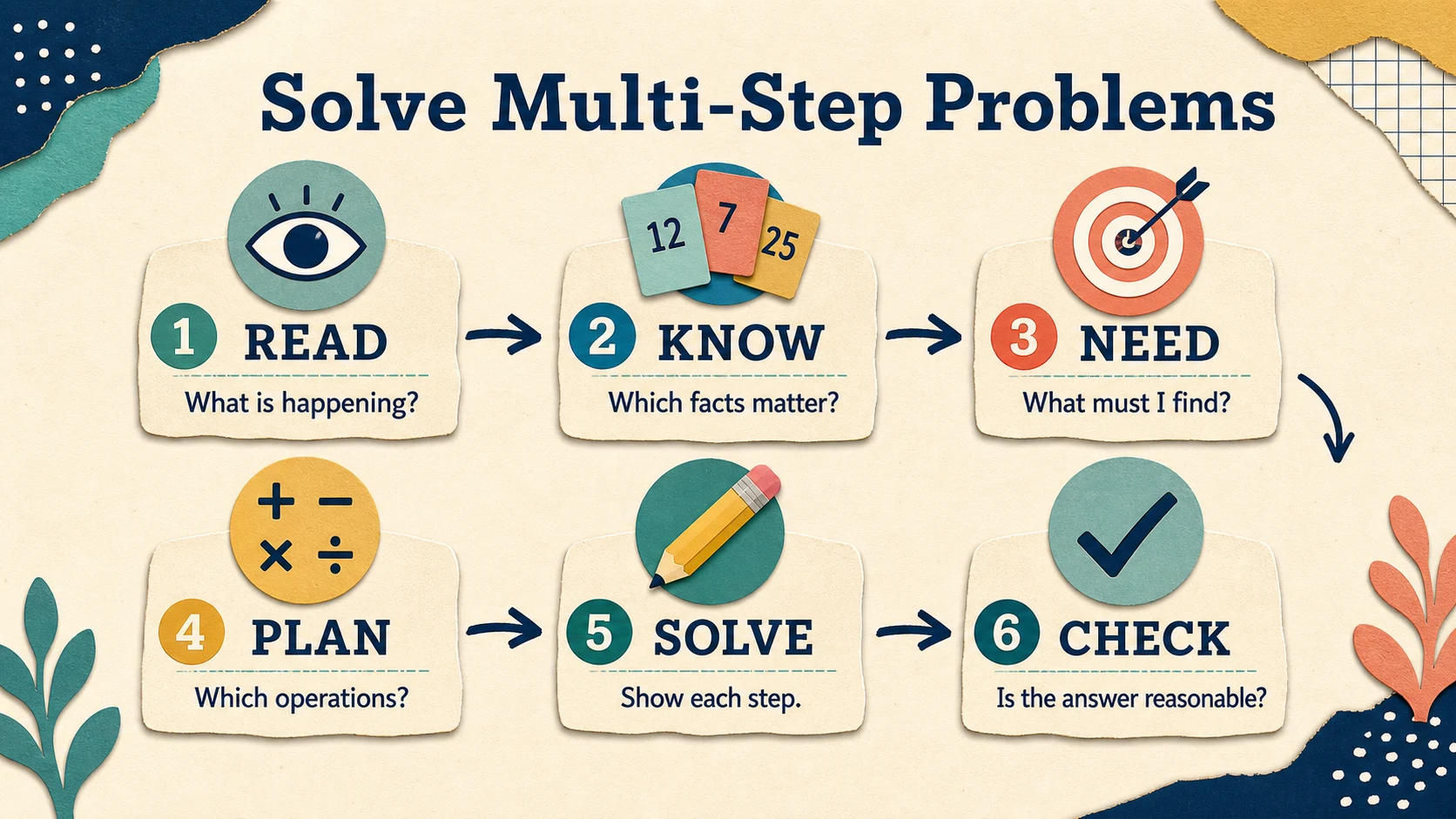
Word-problem success combines comprehension, representation, calculation, and checking.
Grade labels describe the intended practice level, not a guarantee that every learner has completed the same sequence. Local curricula and instructional sequences differ. Use the learner’s observed work—not age alone—to decide whether to review prerequisites, remain at the current level, or increase complexity.
The Common Core mathematics overview frames mathematical understanding as including both procedural skill and the ability to explain reasoning. Its fourth-grade progression includes multi-step whole-number problems using the four operations. This guide uses that as broad context; it does not claim comprehensive standards alignment for every activity or worksheet.
Prerequisites to Check First
A learner does not need flawless computation before beginning word problems. However, certain gaps can consume so much attention that the mathematical situation becomes difficult to follow.
Check whether the learner can:
- Read a short problem and retell the events without changing the quantities.
- Identify the question being asked.
- Add and subtract multi-digit whole numbers with reasonable accuracy.
- Interpret multiplication as equal groups, arrays, or repeated quantities.
- Interpret division as sharing equally or finding how many groups fit.
- Multiply numbers such as a multi-digit number by one digit and two two-digit numbers when the chosen problem requires it.
- Divide a multi-digit dividend by a one-digit divisor and interpret a remainder.
- Recognize equivalent fractions and compare fractions.
- Add or subtract fractions with like denominators.
- Estimate enough to notice an implausible result.
- Label an answer with an appropriate unit.
Use two or three brief tasks to separate reading difficulty from computation difficulty. For example, read a problem aloud and ask the learner to draw it without solving. Then provide the matching equation and ask for the calculation. A correct drawing with an incorrect calculation suggests a different teaching need than an incorrect drawing with accurate arithmetic.
Do not delay all word-problem instruction until every computation is secure. Instead, reduce the number size or provide a multiplication chart when the instructional target is understanding the situation. Remove the support when you want to assess calculation.
A Grade-Appropriate Progression
Progression should reflect increasing reasoning demands, not merely larger numbers. A learner may calculate 2,436 − 879 correctly yet struggle with a small comparison problem because the relationship is unclear.
| Stage |
Problem features |
Helpful support |
Evidence that the learner is ready to progress |
| 1. One-step relationships |
One operation; result unknown |
Objects, sketches, labeled bars |
Explains why the chosen operation matches the story |
| 2. Unknowns in varied positions |
Start, change, group size, or number of groups unknown |
Bar model and equation frame |
Solves without relying on the location of a keyword |
| 3. One-step mixed operations |
Addition, subtraction, multiplication, and division intermixed |
Strategy checklist |
Chooses an operation from the relationship |
| 4. Two-step problems |
Two connected calculations |
Numbered plan or two linked bars |
Keeps the intermediate result and uses it correctly |
| 5. Multi-step whole-number problems |
Relevant and irrelevant details; possible remainders |
Organized workspace |
Selects needed information and interprets the final result |
| 6. Fraction contexts |
Equivalent fractions, comparison, and like-denominator addition or subtraction |
Fraction strips or number line |
Connects the model, equation, and unit |
| 7. Independent mixed practice |
Varied structures and fewer prompts |
Blank workspace |
Represents, solves, checks, and explains independently |
Progress by changing one source of difficulty at a time.
A useful sequence might keep the story structure familiar while changing the numbers, then keep the numbers manageable while changing the unknown’s position. Avoid increasing reading complexity, number size, number of steps, and unfamiliar vocabulary all at once.
The catalogue’s 4th Grade Math collection can help adults compare nearby topics. If a learner’s difficulty is primarily multiplication, division, or fractions, focused computation practice may be more useful than assigning another page of mixed word problems.
Concrete and Visual Models
The model is not decoration. It makes the relationship among quantities visible and gives the learner something to inspect before choosing an operation.
Objects and acted-out situations
Use counters, cubes, coins, paper strips, or empty containers when the learner cannot yet explain the action in a problem. For “Four bags hold six markers each,” make four groups of six. For “Twenty-four markers are shared among four tables,” distribute the counters equally.
Objects are most useful when they reveal a distinction. The same numbers—4, 6, and 24—can describe equal groups, group size, or total. Ask the learner to point to each quantity and state what it represents.
Bar models
A part-part-whole bar shows smaller quantities combining into a total or a known total separated into parts. A comparison model uses aligned bars to show how much greater or smaller one quantity is. An equal-groups model shows repeated equal parts.
Suppose Maya has 38 stamps and Luis has 15 fewer. Draw Maya’s bar as 38. Draw Luis’s shorter bar with an unknown section, and mark the difference as 15. The relationship is 38 − 15 = 23; the word “fewer” alone is not the reason for subtracting. The aligned bars show that Luis’s amount is the smaller quantity.
Arrays, area models, and number lines
An array can represent 18 rows of 24 seats. Split 24 into 20 and 4 to create two simpler rectangles:
18 × 24 = (18 × 20) + (18 × 4)
A number line is useful for distance, elapsed changes, comparison, and fractions. Fraction strips make like-sized parts visible. The IES elementary mathematics intervention guide recommends systematic instruction, clear mathematical language, deliberate word-problem teaching, and well-chosen concrete or semi-concrete representations. That source supports the general use of representations; it did not evaluate WorksheetWise or any particular worksheet.
Fully Checked Worked Examples
Model complete reasoning aloud at first. Then gradually ask the learner to supply the retelling, diagram, equation, computation, and check.
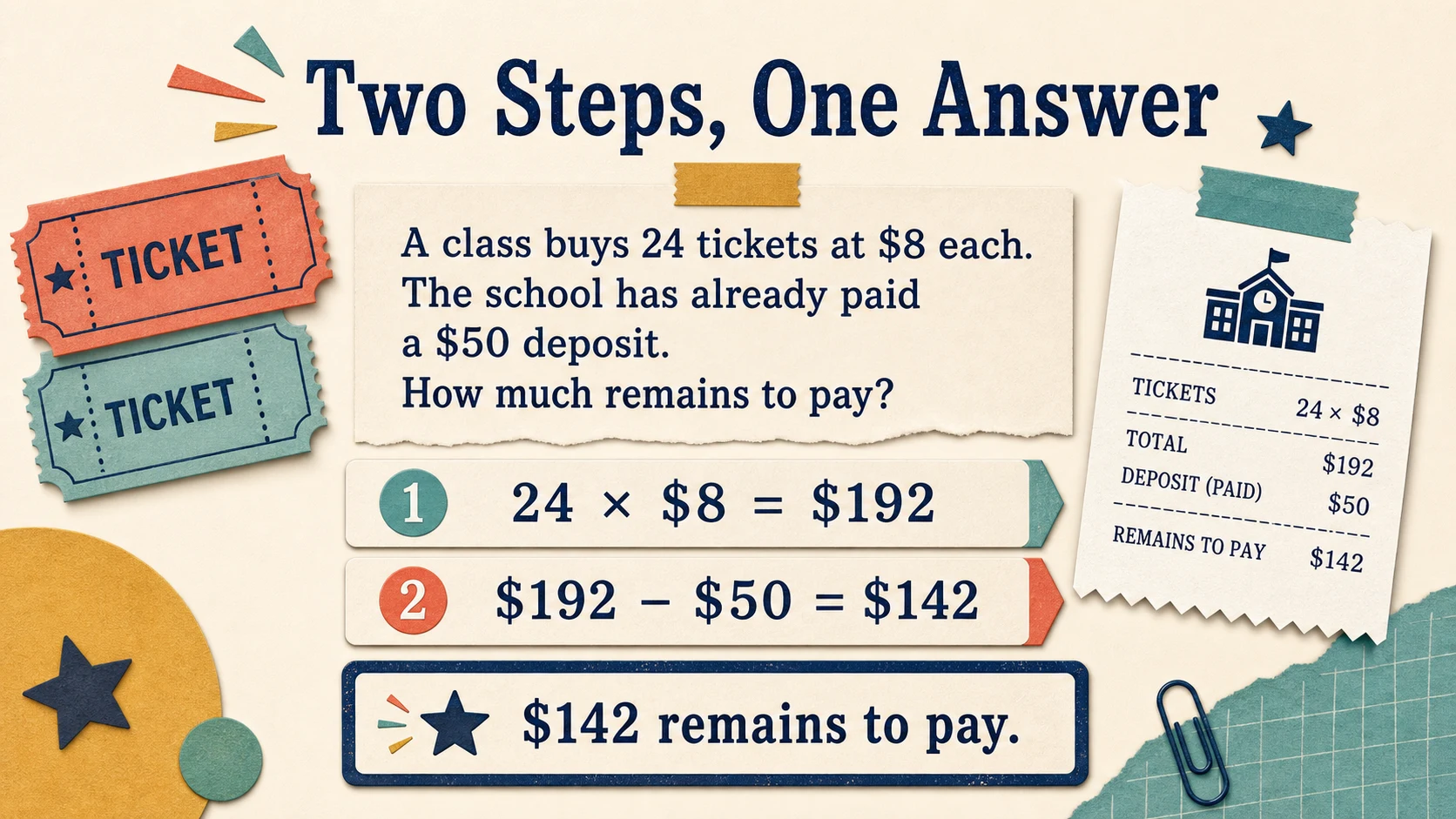
Move from the situation to a model, equation, calculation, and labeled answer.
Example 1: Comparison with an unknown amount
Problem: A library display has 286 nonfiction books. It has 137 more fiction books than nonfiction books. How many fiction books are on the display?
Retell: The fiction collection is larger. It contains the 286 nonfiction-book amount plus 137 more.
Equation: 286 + 137 = f
Calculate:
  286
+ 137
-----
  423
Answer: There are 423 fiction books.
Check: Since fiction is 137 more than 286, the answer must be greater than 286. Subtraction confirms the difference: 423 − 286 = 137.
A keyword shortcut can mislead here. A learner who sees “more” and automatically searches for a larger number may not identify which quantity is unknown. The comparison relationship determines the operation.
Example 2: Equal groups with two-digit multiplication
Problem: A school stores 24 pencils in each box. There are 36 boxes. How many pencils are stored?
Model: Draw an area model for 36 × 24, splitting 24 into 20 and 4.
Equations:
36 × 20 = 72036 × 4 = 144720 + 144 = 864
Answer: The school stores 864 pencils.
Check: Round 24 to 25. Then 36 × 25 = 900, so 864 is reasonable. Exact division also reverses the calculation: 864 ÷ 36 = 24.
A common boundary issue is unequal groups. If one box contains fewer pencils, 36 × 24 no longer describes the entire situation. Equal-group multiplication requires the group sizes to be equal.
Example 3: Division with a remainder
Problem: A farm packs 947 apples into crates that hold 6 apples each. How many full crates can it pack, and how many apples remain?
Equation: 947 ÷ 6
Because 6 × 157 = 942, the quotient is 157 and the remainder is 5.
Answer: The farm can pack 157 full crates, with 5 apples remaining.
Check: 157 × 6 + 5 = 942 + 5 = 947. The remainder is less than the divisor, as it must be.
The context controls how a remainder is reported. If the question instead asked how many crates were needed to transport every apple, the answer would be 158 crates, assuming a partly filled crate may be used. Writing only “157 R5” does not finish the interpretation.
Example 4: A two-step problem with extra information
Problem: An auditorium has 18 rows with 24 seats in each row. Tickets cost $7 each. On Friday, 167 seats were reserved. On Saturday, 189 seats were reserved. How many seats remain unreserved?
Plan: First find total seats. Then subtract both reserved amounts. The ticket price is not needed.
Calculate total capacity:
18 × 24 = 432
Calculate total reservations:
167 + 189 = 356
Calculate remaining seats:
432 − 356 = 76
Answer: 76 seats remain unreserved.
Check: 167 + 189 + 76 = 432. The three parts equal the total number of seats.
The $7 price is relevant only if the question asks about ticket revenue. Crossing out unused information is acceptable after the learner explains why it is not needed.
Example 5: Fractions with like denominators
Problem: A container held 7/8 of a liter of juice. A family used 3/8 of a liter. How much remained?
Model: Divide a strip into eight equal parts. Shade seven parts, then remove three shaded parts.
Equation: 7/8 − 3/8 = 4/8
Since 4/8 and 1/2 name the same amount, the result can be simplified.
Answer: 1/2 liter remained.
Check: 3/8 + 4/8 = 7/8, the starting amount. The denominator remains 8 during subtraction because the pieces are eighths; the operation changes how many eighths remain, not their size.
A Short, Repeatable Lesson Routine
The following routine is an instructional suggestion, not a universal timetable. A complete cycle may take 10–20 minutes, but the learner’s responses should determine the pace.
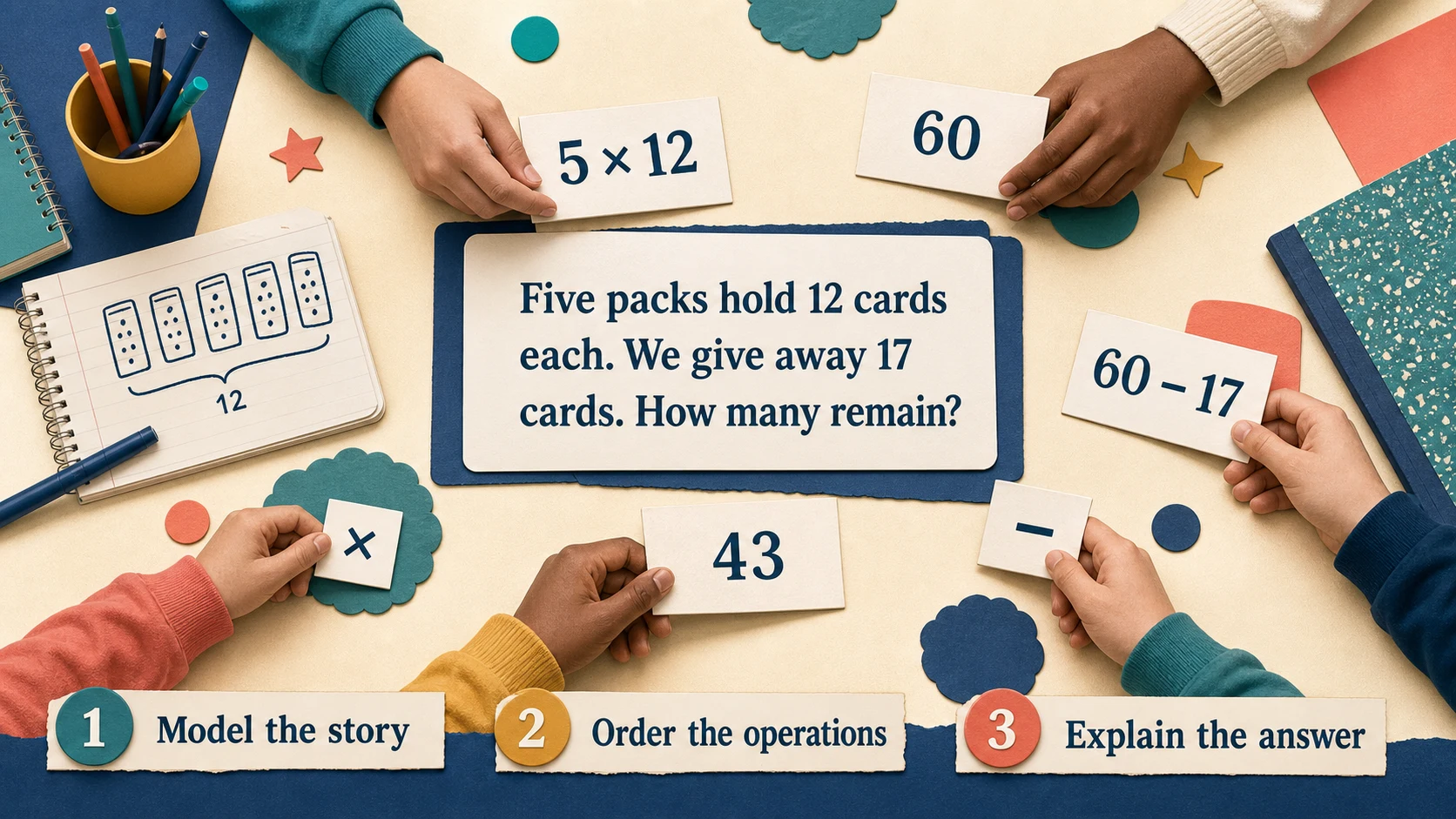
Keep the routine stable while varying the mathematical situations.
Read, retell, and identify
Read the entire problem before marking anything. Ask the learner to retell it without looking at the text. Then identify:
- What quantities are known?
- What does each number measure?
- What must be found?
- Is any information unnecessary or missing?
Clarify ordinary vocabulary without replacing the mathematical thinking. If reading is the barrier, read the problem aloud and continue assessing the math.
Represent and plan
Have the learner use objects, a sketch, bar model, array, table, or number line. Label every quantity and the unknown. Ask, “What relationship does your drawing show?” Then write an equation or a short sequence of equations.
Do not begin with a list of operation keywords. Words such as “left,” “more,” or “each” can appear in different structures. Retelling and representing are more dependable than matching one word to one operation.
Solve, check, and explain
Calculate using a method the learner understands. Then check with estimation, an inverse operation, or substitution into the original situation. Finish with a sentence that includes the unit.
Ask for one concise explanation: “I multiplied because there were 36 equal boxes with 24 pencils in each.” This reveals more than asking only, “Did you get the answer?”
Selecting Practice and Differentiating Support
Practice should target the next identifiable need. The Word Problems topic guide and resources provide a starting point, while the broader 4th Grade worksheet hub is useful when prerequisite practice is needed.
If comprehension is the main difficulty
Use shorter sentences and familiar contexts while retaining fourth-grade mathematical relationships. Read aloud, ask for a retell, and let the learner draw before calculating. Present one problem at a time so text volume does not obscure the task.
For a learner who selects every number, include an occasional irrelevant detail. For a learner who starts calculating before understanding the question, temporarily hide the numbers and discuss only the situation.
If representation is the main difficulty
Offer two possible diagrams and ask which one matches. Complete part of a bar model, leaving the learner to add labels and the unknown. Use the same structure across several stories so the relationship becomes recognizable.
Fade prompts gradually: completed model, partially completed model, blank model frame, and finally unrestricted workspace.
If calculation is the main difficulty
Preserve the word-problem structure but reduce the number size or permit a computation aid. Separately practice the relevant operation. Then return to the original number range to see whether understanding transfers.
For stronger learners, vary the unknown’s location, include extra information, request two methods, or ask them to write a new story for a given equation. Do not increase difficulty solely by making the passage longer.
The IES guide for teaching mathematics to young children applies specifically to preschool through kindergarten, not fourth grade. Its broad principles of developmental progression and monitoring what a child knows are useful background ideas, but they should not be presented as fourth-grade prescriptions.
Diagnosing Common Errors
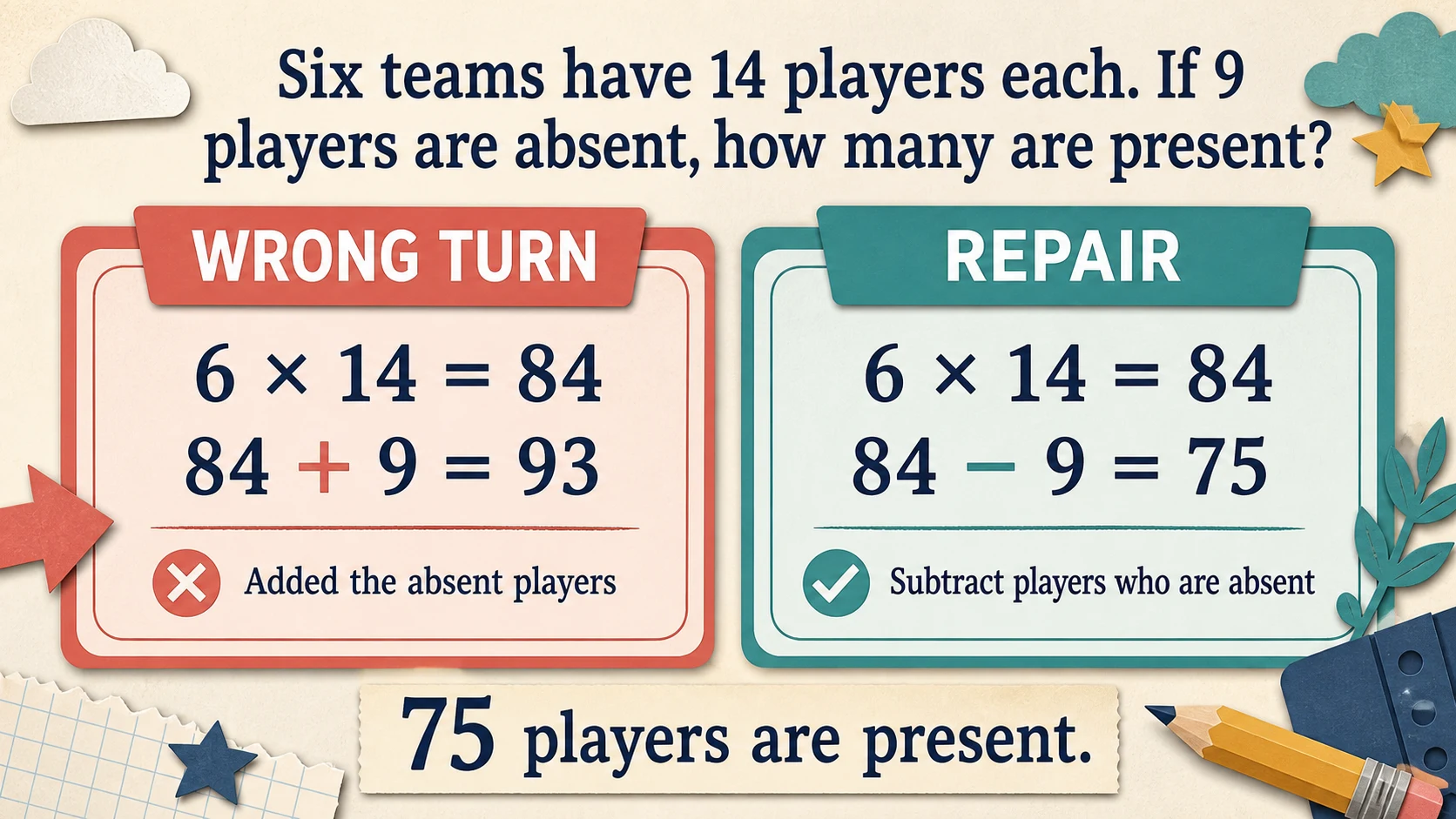
Diagnose the step that broke down before assigning more of the same practice.
| Observed work |
Likely issue to investigate |
Teaching response |
| Uses every number |
Assumes all details must be used |
Ask what each number measures and whether it helps answer the question |
| Chooses an operation from one word |
Relies on keyword matching |
Retell without numbers, draw the relationship, then restore quantities |
| Solves only the final sentence |
Does not connect earlier information |
Number the events and create a two-step plan |
| Writes an accurate equation but calculates incorrectly |
Computation gap |
Practice that operation separately, then revisit the same structure |
| Calculates correctly but answers the wrong question |
Loses track of the unknown |
Box the question and label the unknown in the model |
Gives 157 R5 without context |
Has not interpreted the remainder |
Ask what the quotient and remainder represent in the story |
| Adds denominators |
Treats fraction notation as two unrelated whole numbers |
Return to equal-sized fraction strips |
| Gives an unlabeled number |
Omits the meaning of the result |
Require a final sentence with the unit |
| Cannot explain a correct answer |
May have guessed or copied a procedure |
Ask for a diagram, equation, and one-sentence justification |
| Rejects a correct unfamiliar method |
Expects one fixed procedure |
Compare the method with the situation and verify it numerically |
A wrong answer is not a complete diagnosis. Record where the work first diverged: comprehension, representation, operation choice, calculation, or interpretation. Correct the earliest broken step.
Missing-information problems are another useful boundary case. If a story gives the number of boxes but not the number of items per box, the total cannot be determined. “Not enough information” is a mathematically valid conclusion when the learner can identify what is missing.
Monitoring Progress Without Rushing
Use a small record rather than a single score. For each session, note whether the learner independently:
- Retold the situation accurately.
- Identified the unknown.
- Selected relevant information.
- Produced a matching representation.
- Chose and completed the operation or operations.
- Checked and labeled the answer.
Look across several problems. One success may reflect a familiar story; one error may be an arithmetic slip. Progress is more convincing when the learner handles varied structures and explains choices with decreasing support.
Move forward when the current work is generally accurate, the reasoning is understandable, and prompts are fading. Step back when errors repeat at the same stage. If a learner can solve one-step problems but loses intermediate results in two-step work, keep the operations manageable and teach written organization before adding harder computation.
A Flexible Two-Week Practice Plan
This plan offers ten short sessions. It is not a universal timetable. Repeat, combine, or postpone sessions according to the learner’s observed work.
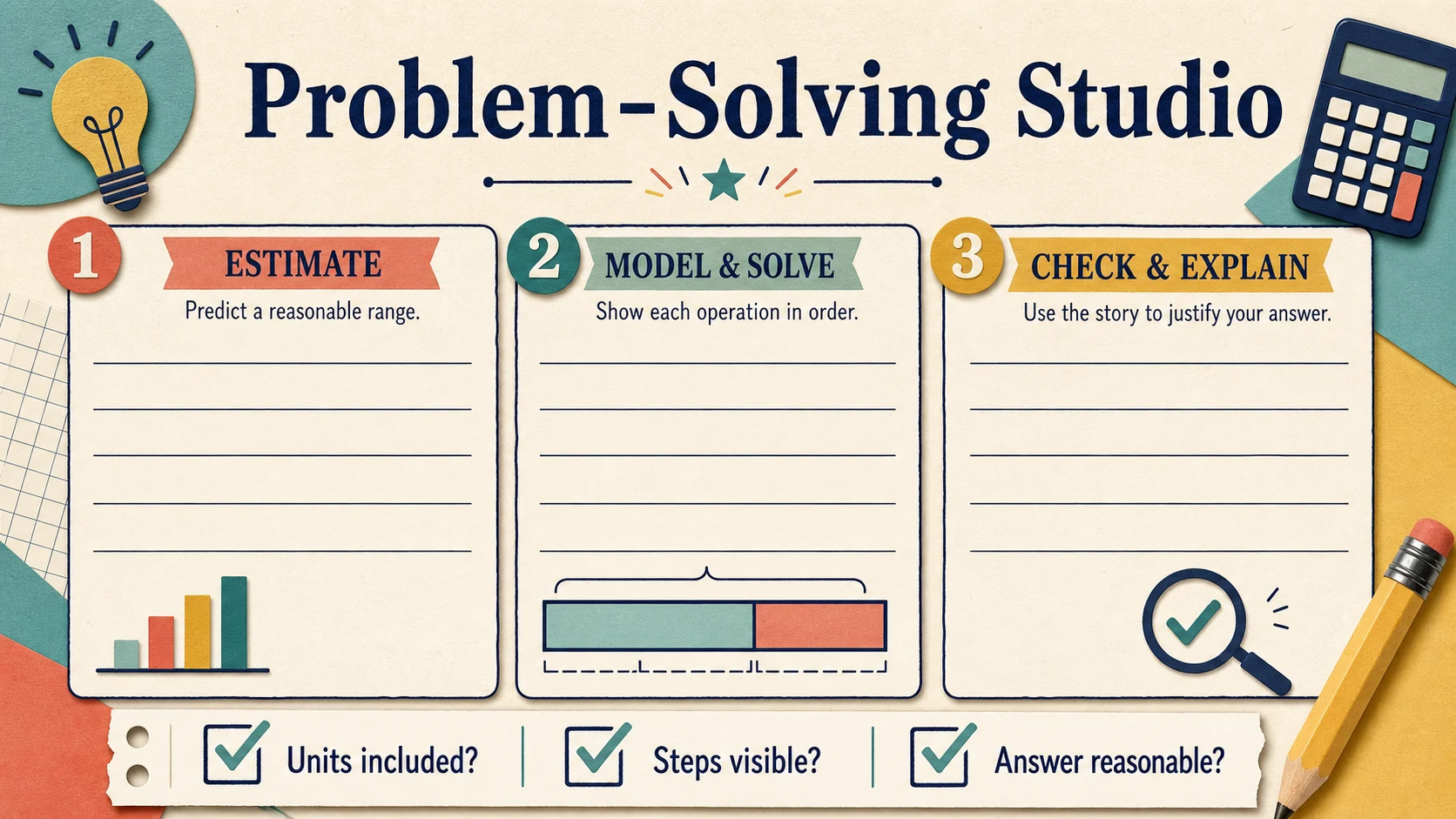
Alternate focused instruction, mixed practice, and review rather than racing through levels.
| Session |
Focus |
Suggested work |
What to observe |
| 1 |
Baseline |
Two one-step and two two-step problems |
Where does reasoning first break down? |
| 2 |
Part-part-whole |
Addition and subtraction with bar models |
Can the learner identify total and parts? |
| 3 |
Comparison |
Unknown larger amount, smaller amount, and difference |
Does the learner rely on “more” or “fewer”? |
| 4 |
Equal groups |
Multiplication and division stories using arrays |
Can the learner distinguish total, groups, and group size? |
| 5 |
Mixed review |
Four structures in an unpredictable order |
Is the operation chosen from meaning? |
| 6 |
Two-step planning |
Write both steps before calculating |
Is the intermediate result retained and labeled? |
| 7 |
Remainders |
Full groups, leftovers, and “how many needed” contexts |
Is the remainder interpreted appropriately? |
| 8 |
Fractions |
Like-denominator addition or subtraction with strips |
Does the model agree with the equation? |
| 9 |
Boundary cases |
Extra information and one missing-information problem |
Can the learner justify using or rejecting data? |
| 10 |
Independent application |
A short mixed set followed by explanation and correction |
Which supports can now be removed? |
Begin each session with one previously successful problem type. Teach or model one target, complete two or three related problems, and end with a brief independent attempt. Review errors while the reasoning is still visible. If the learner needs substantial prompting, repeat the structure with different quantities instead of advancing automatically.
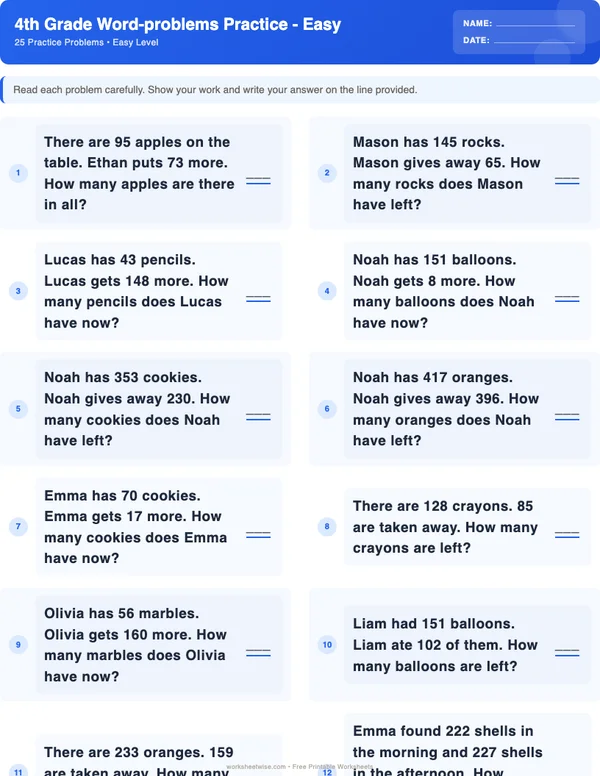
For a ready-made starting set, the free 4th Grade Word Problems worksheet contains 14 easy-level exercises involving reading comprehension, mixed operations, problem solving, and multi-step reasoning, with a separate answer key. The focused worksheet pack provides 18 worksheets when a larger practice pool is useful.
Limitations and the Next Instructional Decision
A worksheet can reveal patterns in written work, but it cannot by itself show whether an error came from unfamiliar vocabulary, attention, calculation, or misunderstanding the relationship. Talk through selected problems and inspect the learner’s model. This guide also does not replace local curriculum requirements or individualized professional guidance.
After the two-week sequence, sort the learner’s work by error type. Choose one next target: comprehension, representation, a specific operation, multi-step organization, fraction reasoning, or independent checking. Avoid assigning harder mixed work until that target improves.
A practical next action is to complete the free easy-level 4th Grade Word Problems worksheet, mark the first point of difficulty in each incorrect response, and use those observations to choose the next lesson. If the learner needs narrower or differently structured practice, create a tailored set with the free worksheet generators.