What 4th Grade Fractions Includes
Fourth-grade fraction work centers on understanding fractions as numbers, not merely shaded pieces of shapes. A learner should develop four connected abilities:
- Generate and recognize equivalent fractions.
- Compare fractions, including fractions with different denominators.
- Add and subtract fractions with like denominators.
- Relate improper fractions and mixed numbers.
Fourth-grade work may also include multiplying a fraction by a whole number and connecting fractions to decimals in tenths and hundredths. Adding fractions with unlike denominators, multiplying two fractions, and dividing fractions belong later in the stated progression.
The most useful teaching sequence is concrete model, visual representation, spoken explanation, and then symbols. Keep models available until the learner can explain why a procedure works. Move forward according to the learner’s observed work rather than a fixed number of lessons.
Grade labels describe the intended practice level; local curricula and teaching sequences differ. The Common Core mathematics standards offer one grade-by-grade framework, but this guide does not claim comprehensive alignment with every state, district, or homeschool program.
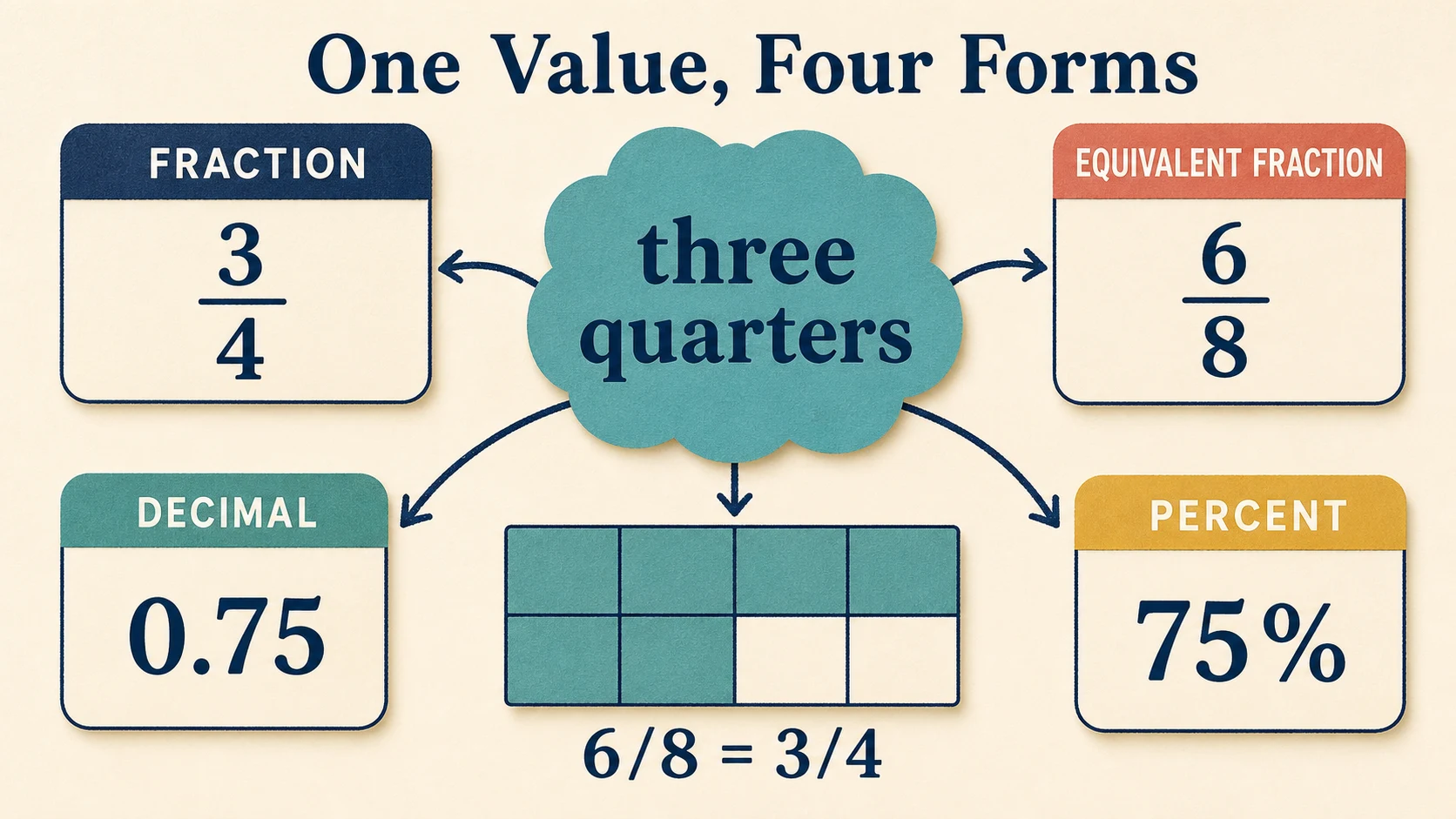
The skills connect through equal parts, equivalence, comparison, and operations.
The Ideas a Learner Needs First
Before beginning a full fourth-grade sequence, check the foundations. A learner does not need perfect speed, but should be able to reason accurately with the following ideas.
Equal parts and the unit whole
A fraction describes equal-sized parts of a particular whole. In 3/4, the denominator 4 says that one whole has been partitioned into four equal parts. The numerator 3 counts three of those parts.
Ask the learner to examine two rectangles called “one whole.” Divide one into four equal parts and the other into four unequal parts. Only the first can represent fourths. If the learner counts pieces without checking their size, return to folding paper or partitioning bars.
The whole must remain consistent when two fractions are compared. One-half of a small sheet of paper and one-half of a large sheet are the same fraction of their respective wholes, but they are not the same physical area.
Multiplication, division, and number-line knowledge
Equivalent-fraction reasoning relies on multiplication. To see why 2/3=6/9, the learner must recognize that each third has been divided into three smaller equal parts. There are now three times as many total parts and three times as many selected parts.
Basic division helps when simplifying a fraction or finding a useful equivalent form. Number-line knowledge is equally important: the learner should understand equal intervals, identify 0 and 1, and locate values between them.
A brief readiness check can include these tasks:
- Divide a strip into six equal sections.
- Mark 3/4 on a number line from 0 to 1.
- Explain why three fourths is greater than one fourth.
- Solve 4×3, 18÷3, and 24÷6.
- Name a fraction equal to one whole.
Errors here identify what to review. They do not, by themselves, establish a diagnosis or a permanent ability level.
A Grade-Appropriate Teaching Progression
Teach each stage with representations and short explanations before assigning a page of symbolic problems. The progression below is an instructional suggestion based on the supplied fourth-grade scope. It is not a universal timetable.
| Stage |
Main teaching goal |
Useful evidence of readiness |
| 1. Rebuild fraction meaning |
Identify the whole, equal parts, numerator, and denominator |
Names and draws fractions without treating unequal pieces as equal parts |
| 2. Place fractions on number lines |
Treat fractions as numbers, including values at and beyond 1 |
Partitions intervals equally and locates fractions accurately |
| 3. Generate equivalents |
Rename a fraction without changing its value |
Connects a model such as 2/4=4/8 to multiplication |
| 4. Compare fractions |
Compare like numerators, like denominators, and selected unlike denominators |
Uses benchmarks or equivalent forms and states a reason |
| 5. Add and subtract like denominators |
Combine or remove equal-sized fractional units |
Keeps the unit size fixed and operates on numerators |
| 6. Work with mixed and improper forms |
Compose and decompose wholes |
Converts in either direction and checks the value visually |
| 7. Multiply by a whole number |
Interpret repeated groups of a fraction |
Connects repeated addition to multiplication |
| 8. Connect fractions and decimals |
Relate tenths and hundredths to decimal notation |
Explains, for example, why 7/10=0.7 |
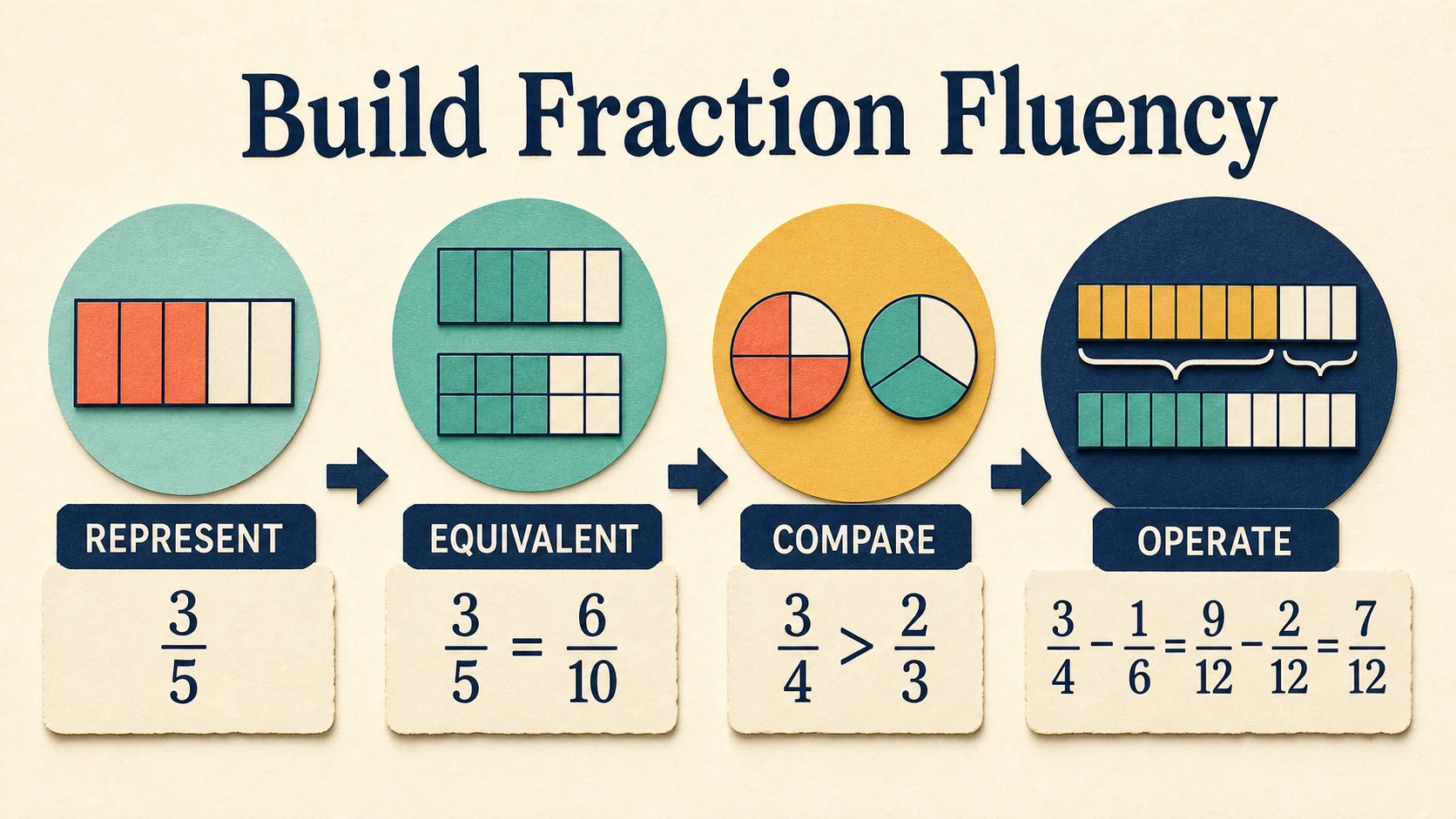
Support can fade from manipulatives to drawings, equations, and independent explanation.
This sequence keeps related ideas together. Equivalence supports comparison. Composing unit fractions supports addition. Understanding whole numbers on a fraction number line supports improper fractions and mixed numbers.
The WorksheetWise fourth-grade math collection can help an adult select practice after identifying the current stage. Avoid choosing a mixed review simply because its grade label matches. First determine which skill the learner can explain and which one is still uncertain.
Concrete and Visual Models That Clarify Fractions
The IES guide on assisting elementary students who struggle with mathematics recommends systematic instruction, clear mathematical language, carefully chosen representations, and number lines. That is high-level instructional guidance; it is not an evaluation of WorksheetWise materials or a prescription for every learner.
Fraction strips and folded paper
Use identical paper strips to maintain the same whole. Fold one into fourths and shade two parts. Fold another into eighths and shade four. Align the strips to show that 2/4 and 4/8 occupy the same length.
Then connect the action to symbols:
42=4×22×2=84
The multiplication records how every original part was subdivided. It does not create a larger quantity.
Fraction tiles or bars work similarly. Ask the learner to build one whole, cover 3/4, and find another combination that covers exactly the same length.
Fraction circles and area models
Circles can make part-whole relationships visible, provided the sectors are equal. Rectangles are often easier for equivalence because their partitions align cleanly.
An area model can show 3/8+2/8: shade three of eight equal sections in one color and two more in another. Five eighth-sized parts are shaded, so the sum is 5/8.
Area models are less effective when drawings are imprecise. If hand-drawn pieces differ noticeably in size, use grid paper, folded paper, or fraction strips.
Number lines
A number line shows magnitude and prevents fractions from becoming labels attached only to shapes. To place 5/4, mark 0, 1, and 2; divide each whole interval into four equal steps; then count five fourth-sized steps from 0. The point lies one fourth beyond 1.
Use number lines for comparisons and boundary cases:
- 0/5=0 because zero fifth-sized steps have been taken.
- 5/5=1 because five fifths compose one whole.
- 7/5>1 because seven fifth-sized steps pass the point representing one whole.
- 1/8<1/4 because an eighth-sized step is smaller than a fourth-sized step when the whole is fixed.
The IES Teaching Math to Young Children practice guide addresses younger learners, not fourth-grade fraction instruction. Its broad emphasis on developmental progressions and using progress monitoring to build on what a child knows still provides useful framing for checking prerequisites rather than assuming them.
Fully Checked Worked Examples
These examples move from meaning to calculation. Have the learner predict, model, calculate, and then check.
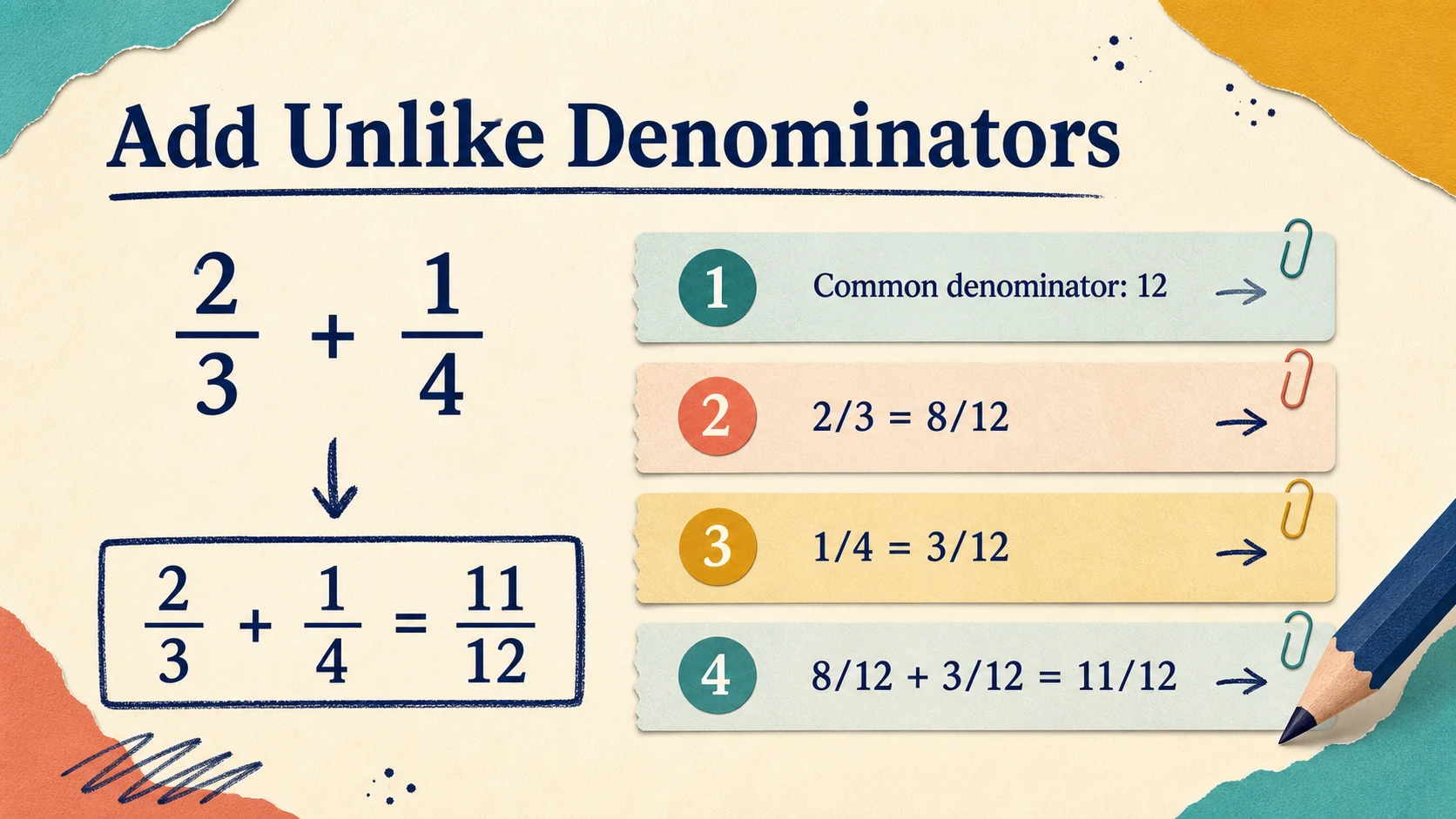
The representation should explain the calculation, not merely decorate it.
Example 1: Generate an equivalent fraction
Find a fraction equivalent to 3/5 with denominator 20.
Because 5×4=20, divide each original fifth into four equal pieces. Apply the same factor to the numerator:
53=5×43×4=2012
Check by cross-products:
3×20=60
5×12=60
The products match, so the fractions are equivalent. A strip model would also show both fractions covering three fifths of the same length.
Boundary warning: multiplying only the denominator gives 3/20, a much smaller value. Equivalent fractions require the numerator and denominator to change by the same nonzero factor.
Example 2: Compare unlike denominators
Compare 5/6 and 7/9.
One method is to use equivalent fractions with a shared denominator. A common denominator is 18:
65=6×35×3=1815
97=9×27×2=1814
Now the units are the same size. Since 15/18>14/18,
65>97
Check with benchmarks: both values are greater than 1/2 and less than 1, while 5/6 is only 1/6 short of 1 and 7/9 is 2/9 short. Because 1/6=3/18 and 2/9=4/18, 5/6 is closer to 1. The comparison is consistent.
Example 3: Add fractions with like denominators
Calculate:
87+83
The addends count eighths, so combine their numerators and retain the eighth-sized unit:
87+83=810
Convert the improper fraction. Eight eighths make one whole, leaving two eighths:
810=182=141
Check by decomposition:
87+81+82=1+82=141
An estimate also helps. 7/8 is close to 1 and 3/8 is less than 1/2, so a result between 1 and 121 is reasonable.
Do not add the denominators. The pieces remain eighths; only the number of eighths changes.
Example 4: Subtract with a like denominator
Calculate:
251−54
The mixed number does not initially contain enough fifths in its fractional part. Rename one whole as 5/5:
251=1+55+51=156
Now subtract:
156−54=152
Check by addition:
152+54=156=251
The check returns to the starting number.
Example 5: Convert an improper fraction
Convert 11/4 to a mixed number.
Count groups of four fourths:
411=44+44+43
Therefore:
411=243
A division check gives the same result:
11÷4=2 remainder 3
The quotient is the number of wholes, and the remainder becomes the numerator over the original denominator.
Important boundary cases include 4/4=1, not 144, and 8/4=2, not 240 as a preferred final form.
Example 6: Multiply a fraction by a whole number
A learner reads 2/3 of a chapter each day for four days. How many chapters is that in all?
Repeated addition gives:
32+32+32+32=38
Multiplication expresses the same action:
4×32=34×2=38=232
Check: four amounts slightly less than 1 should total slightly less than 4. 232 is reasonable.
This does not extend automatically to multiplying two fractions. Keep fraction-by-fraction multiplication for the later stage identified in the supplied progression.
A Short, Repeatable Lesson Routine
A focused session can take about 15 to 25 minutes, but that range is an instructional suggestion, not a sourced or universal requirement. Shorten, extend, or split the lesson according to accuracy, explanations, and attention.
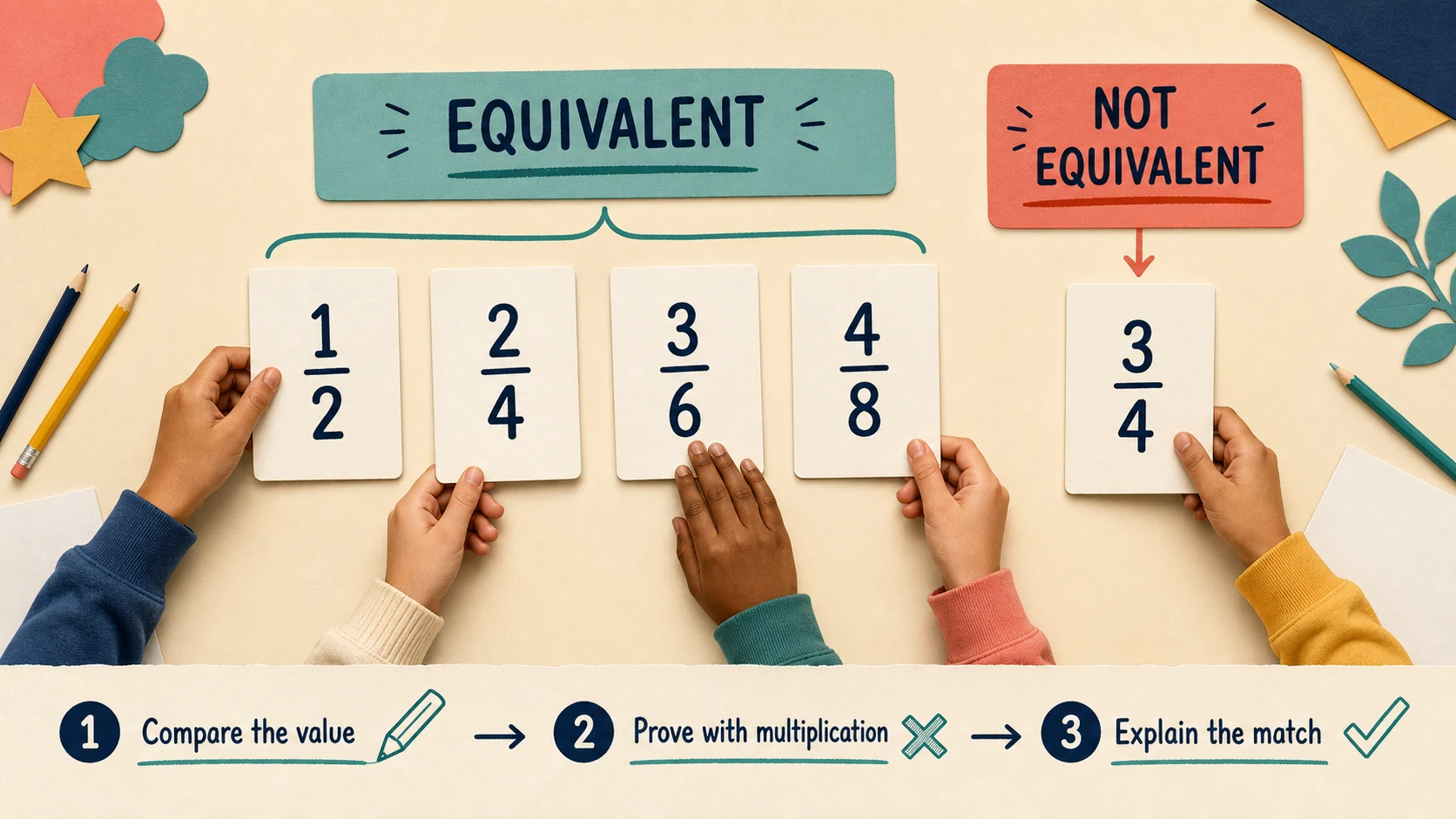
Each session moves from retrieval through explanation to a brief independent check.
1. Retrieve one prerequisite
Use two or three quick prompts. Ask the learner to identify 3/4, locate 1/2, or state a multiplication fact needed in the day’s work. Correct misunderstandings before adding a new step.
2. Model one example
Build or draw the fraction. Say precisely what the numerator and denominator represent. Connect each visible change to the equation.
For equivalence, say, “Each fourth was divided into two equal pieces, so there are twice as many total pieces and twice as many shaded pieces.”
3. Solve together
Present a similar problem. Let the learner handle the model and explain the next step. Prompt with focused language: “What is the whole?” “What size unit are we counting?” or “Where is 1 on this line?”
4. Try independently
Assign two to four carefully matched problems. Include one familiar item and one small variation. Do not introduce several new formats at once.
5. Close with an explanation
Ask for one sentence, drawing, or number-line mark that justifies an answer. Record the error type if the explanation reveals uncertainty, even when the final answer is correct.
Choosing Practice and Differentiating Support
Select work by skill, representation, and cognitive demand—not by problem count alone.
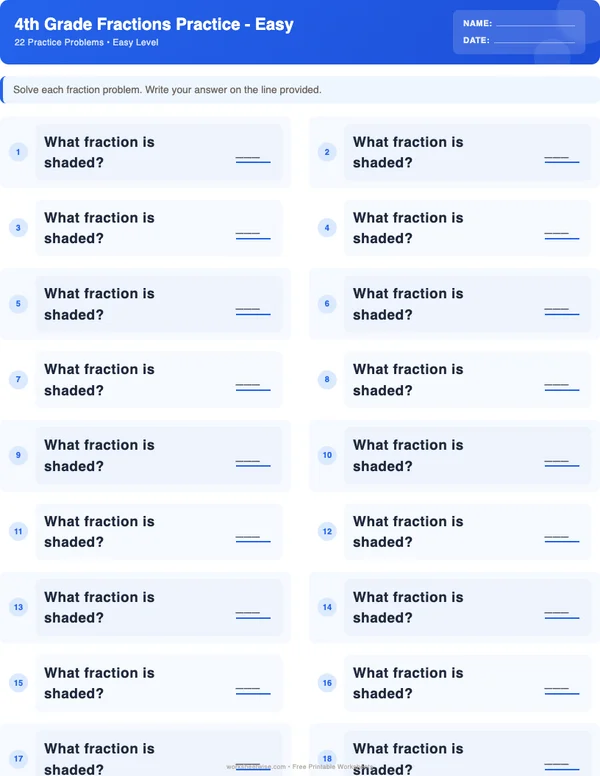
For initial practice, use one target at a time: equivalent fractions only, comparisons only, or like-denominator addition only. The free easy fourth-grade fractions worksheet contains 22 exercises across identifying, comparing, equivalence, and fraction operations, with a separate answer key. Because it mixes skills, choose a subset when the learner is still developing one idea.
For broader review, the fourth-grade fractions pack contains 18 worksheets. A larger collection provides selection options; it does not mean every worksheet should be completed or that more pages will automatically improve understanding.
When a learner needs more support
Reduce the number of problems and increase the quality of representation and explanation. Keep the numbers simple enough that the fraction idea, rather than difficult multiplication, remains central.
Useful adjustments include:
- Provide pre-drawn bars or number lines.
- Compare fractions with the same numerator or denominator before fully unlike pairs.
- Let the learner build an answer with tiles before writing an equation.
- Use a consistent prompt: “Name the unit, count the units, and check against 0, 1/2, and 1.”
- Alternate one modeled problem with one learner-completed problem.
If mistakes persist, return to the earliest point where the explanation becomes unclear. Repeating a full mixed worksheet may hide that point.
When a learner is ready for extension
Increase reasoning before increasing the computational scope. Ask the learner to:
- Find three fractions equivalent to 3/4.
- Place 5/8, 3/4, and 7/8 on one number line.
- Write two different like-denominator sums equal to 141.
- Decide whether a stated answer is reasonable without calculating it exactly.
- Create and solve a word problem represented by 5×3/8.
These remain within the intended ideas while requiring stronger explanation. Avoid moving prematurely into unlike-denominator addition or fraction division merely because routine work is accurate.
Diagnosing Common Errors
Treat an incorrect answer as evidence about the learner’s current reasoning. Ask for a drawing or explanation before supplying a rule.
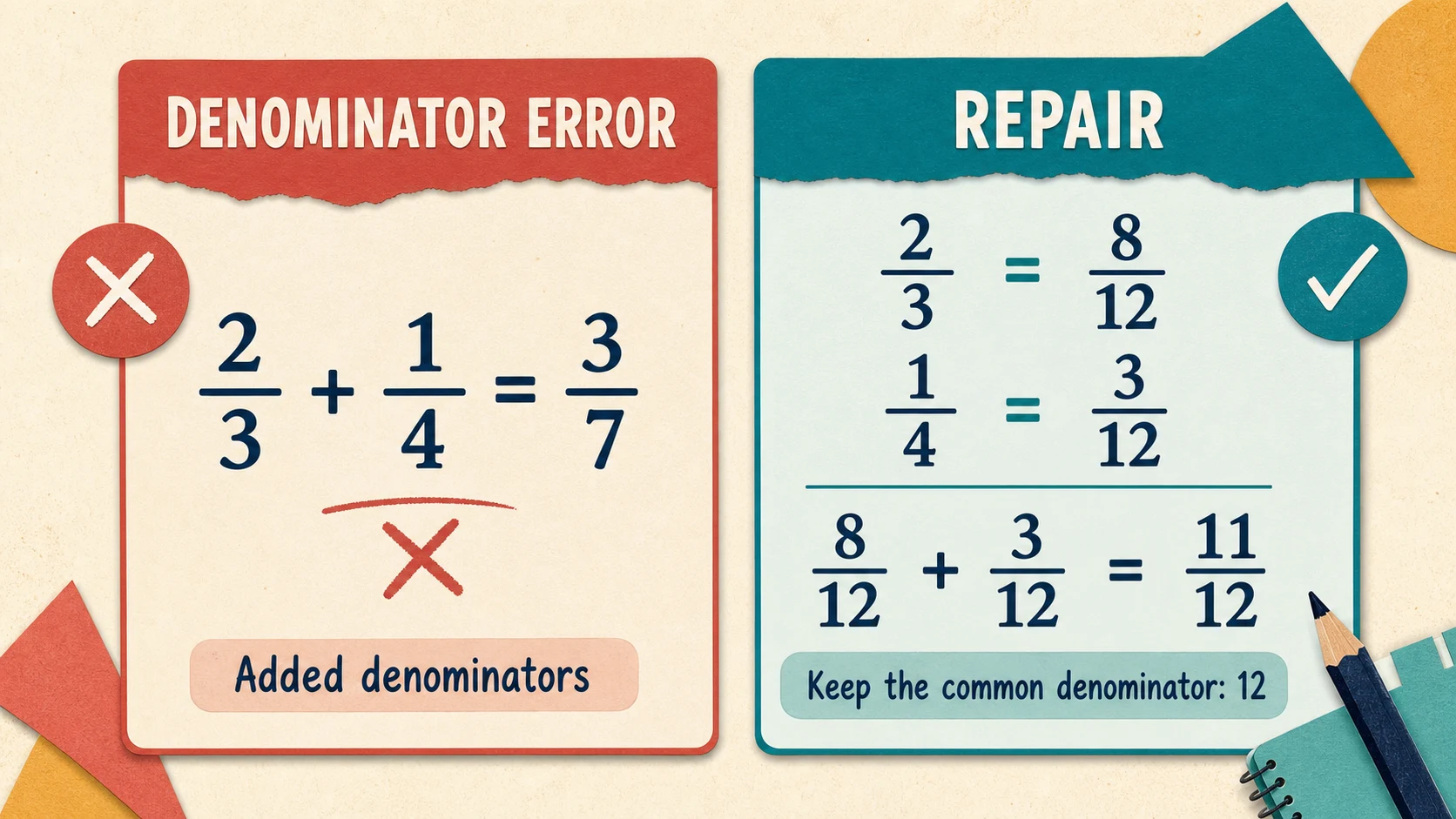
Match the response to the reasoning behind the error.
| Observed work |
Likely reasoning to investigate |
Teaching response |
| Says 1/8>1/4 |
Treats larger denominator as larger value |
Compare equal wholes cut into fourths and eighths; then mark both on a number line |
| Writes 2/7+3/7=5/14 |
Adds every visible number |
Build two sevenths plus three sevenths; name the five pieces as fifths of seven, or 5/7 |
| Writes 2/3=4/3 |
Changes only the numerator |
Subdivide every third into two pieces and count both selected and total pieces |
| Places 3/4 at the third tick on any line |
Counts marks rather than equal intervals |
Mark 0 and 1 first; divide the distance into four equal intervals |
| Writes 9/4=941 |
Places numerator beside the fraction |
Group fourths into complete sets of four; use division and interpret the remainder |
| Says 3/5>3/4 because fifths are larger numbers |
Confuses denominator labels with piece size |
Hold the numerator constant and compare three larger fourths with three smaller fifths |
| Produces a correct answer but cannot explain it |
May be applying a remembered procedure without secure meaning |
Ask for a bar, number line, estimate, or inverse check |
| Simplifies 6/8 to 5/7 |
Subtracts the same number rather than dividing by a common factor |
Show that equivalence requires scaling the number and size of parts together |
Also check whether the learner silently changes the whole. Two diagrams can be compared directly only when their wholes represent the same amount.
A single error may be accidental. A repeated pattern across different formats is more informative. For example, if 1/8>1/4 appears once, ask for a model. If the same reasoning appears with 1/6 and 1/3, reteach unit-fraction size before continuing to unlike-denominator comparisons.
Monitoring Progress Without Overtesting
Use a small weekly check containing four or five items:
- One representation or number-line task.
- One equivalence task.
- One comparison.
- One operation in the current scope.
- One explanation or error-analysis prompt.
Track more than percentage correct. Note whether the learner:
- Identifies the same whole.
- Partitions into equal intervals.
- Names the fractional unit.
- Chooses an appropriate comparison strategy.
- Estimates before or checks after calculating.
- Explains without relying entirely on adult prompts.
A practical readiness rule is to look for accurate work across more than one format and on more than one day. For instance, a learner who compares fractions correctly with bars but not on a number line needs another representation lesson, not necessarily harder comparisons.
Keep dated samples. Compare explanations as well as answers: “I know 4/5>3/4 because 16/20>15/20” provides clearer evidence than an unexplained inequality symbol.
A Two-Week Practice Plan
This plan assumes ten short sessions. It is adjustable, and the learner’s work should drive pacing. Repeat or split a day when a prerequisite remains insecure.
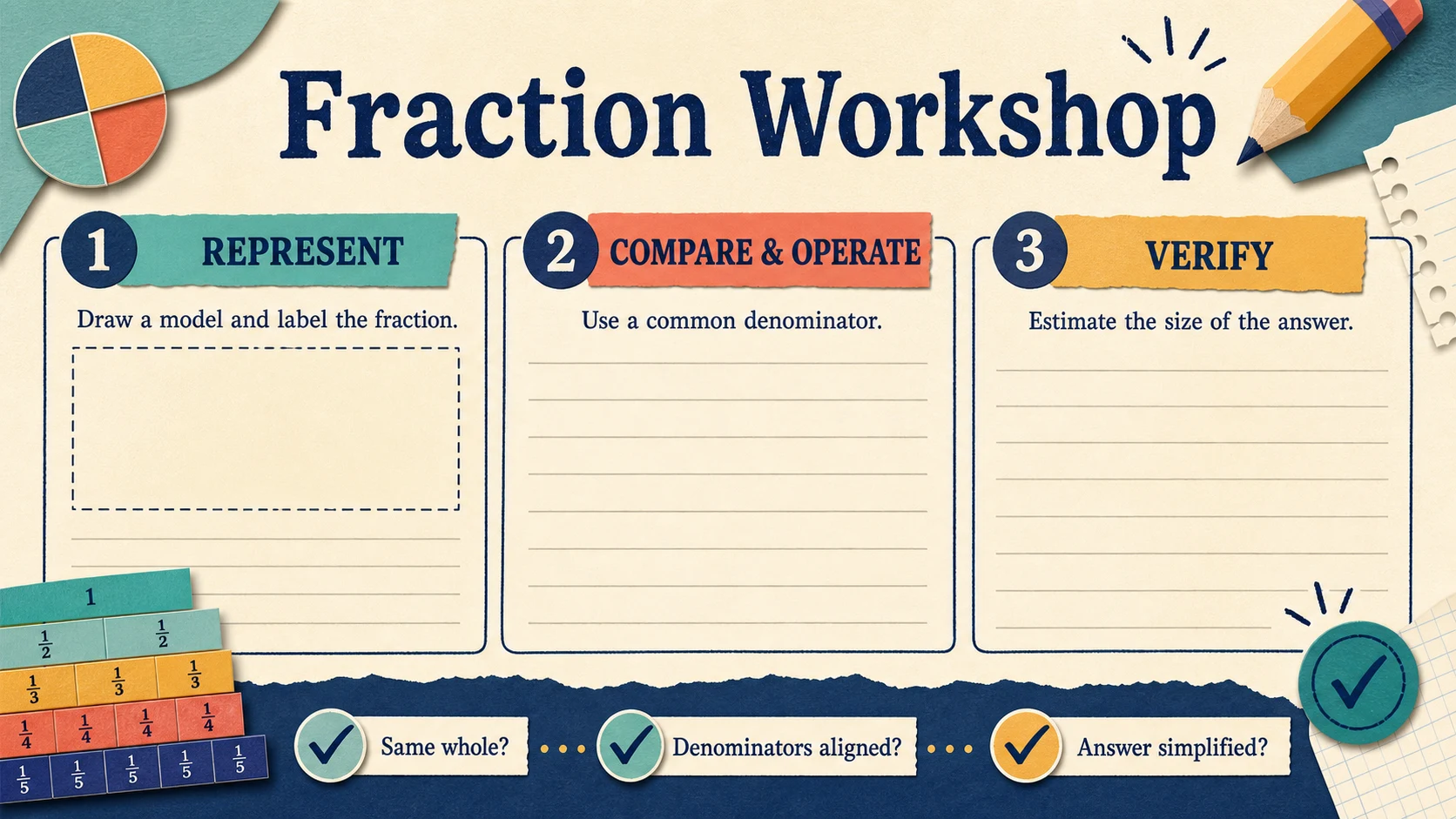
The plan alternates new learning, explanation, review, and cumulative checks.
| Day |
Focus |
Suggested activity |
Evidence to collect |
| 1 |
Readiness |
Identify wholes, equal parts, numerator, and denominator; partition a line from 0 to 1 |
One correct model and spoken explanation |
| 2 |
Number lines |
Place halves, fourths, and eighths between 0 and 2 |
Accurate equal intervals and locations |
| 3 |
Equivalence |
Build 1/2=2/4=4/8 and generate related equations |
Explanation of why both numbers scale |
| 4 |
More equivalence |
Complete missing-number equations such as 3/5=?/20 |
Correct factor and model or check |
| 5 |
Compare fractions |
Use common denominators and benchmarks for selected pairs |
Correct symbol plus stated reason |
| 6 |
Like-denominator addition |
Model sums below and above 1; estimate first |
Denominator retained and improper result interpreted |
| 7 |
Like-denominator subtraction |
Subtract from a fraction and from a mixed number |
Accurate regrouping with a check |
| 8 |
Mixed and improper forms |
Convert in both directions using groups of denominator-sized units |
Quotient, remainder, and model agree |
| 9 |
Whole-number multiplication |
Connect repeated addition to n×a/b |
Equation, model, and mixed-number result agree |
| 10 |
Cumulative review |
Use four or five mixed items and one explanation |
Identify the next skill from the error pattern |
On Days 3, 5, 7, and 9, begin with one item from an earlier day. This provides spaced review without turning every session into a long mixed assignment.
If the Day 10 check reveals scattered slips but sound explanations, use brief correction and another check later. If errors cluster—for example, every unlike-denominator comparison fails—return to the relevant model and assign a narrow set of problems.
The fourth-grade topic guide and worksheet collection can support this selection process. Adults who need differently sized or focused sets can also explore the free worksheet generators, while checking that generated practice remains within the learner’s current instructional boundary.
Scope, Limitations, and the Next Step
This guide supports decisions about common fourth-grade fraction work. It does not replace a local curriculum, formal assessment, individualized professional evaluation, or child-specific guidance. It also does not establish a universal pace. Materials labeled fourth grade indicate an intended practice level; local sequences and learner readiness differ.
Stay within the immediate teaching target. In the supplied progression, fourth grade includes equivalence, comparing fractions with unlike denominators, like-denominator addition and subtraction, mixed and improper forms, and multiplication of a fraction by a whole number. Unlike-denominator addition and subtraction, multiplying two fractions, and fraction division are later work.
The honest next step is to give a brief readiness check, identify the earliest uncertain skill, model one example, and assign only a few matching problems. If the learner is ready for a mixed review of foundational fourth-grade skills, begin with selected items from the free 4th Grade Fractions worksheet, then use the explanation and error pattern—not the page total—to choose the following lesson.