What fourth graders should learn about spelling words
4th Grade Spelling Words practice should teach learners to notice, explain, and apply spelling patterns—not simply memorize a weekly list. A useful sequence moves from hearing and reading a word to identifying its meaningful parts, sorting it by pattern, writing it from memory, and using it in a sentence. Previously taught patterns should return regularly so that correct spelling carries into everyday writing.
Appropriate study areas include long-vowel spellings, consonant doubling, r-controlled vowels, silent letters, prefixes, suffixes, high-frequency words, commonly confused words, and multisyllabic words. The learner’s observed work should determine the starting point. A fourth grader who confuses basic vowel patterns needs different practice from one who spells base words accurately but drops letters when adding suffixes.
Grade labels describe an intended practice level, not a fixed timetable or a judgment about a learner. Local curricula and instructional sequences differ. Use the label to choose a reasonable starting resource, then adjust from actual reading, spelling, and writing samples.
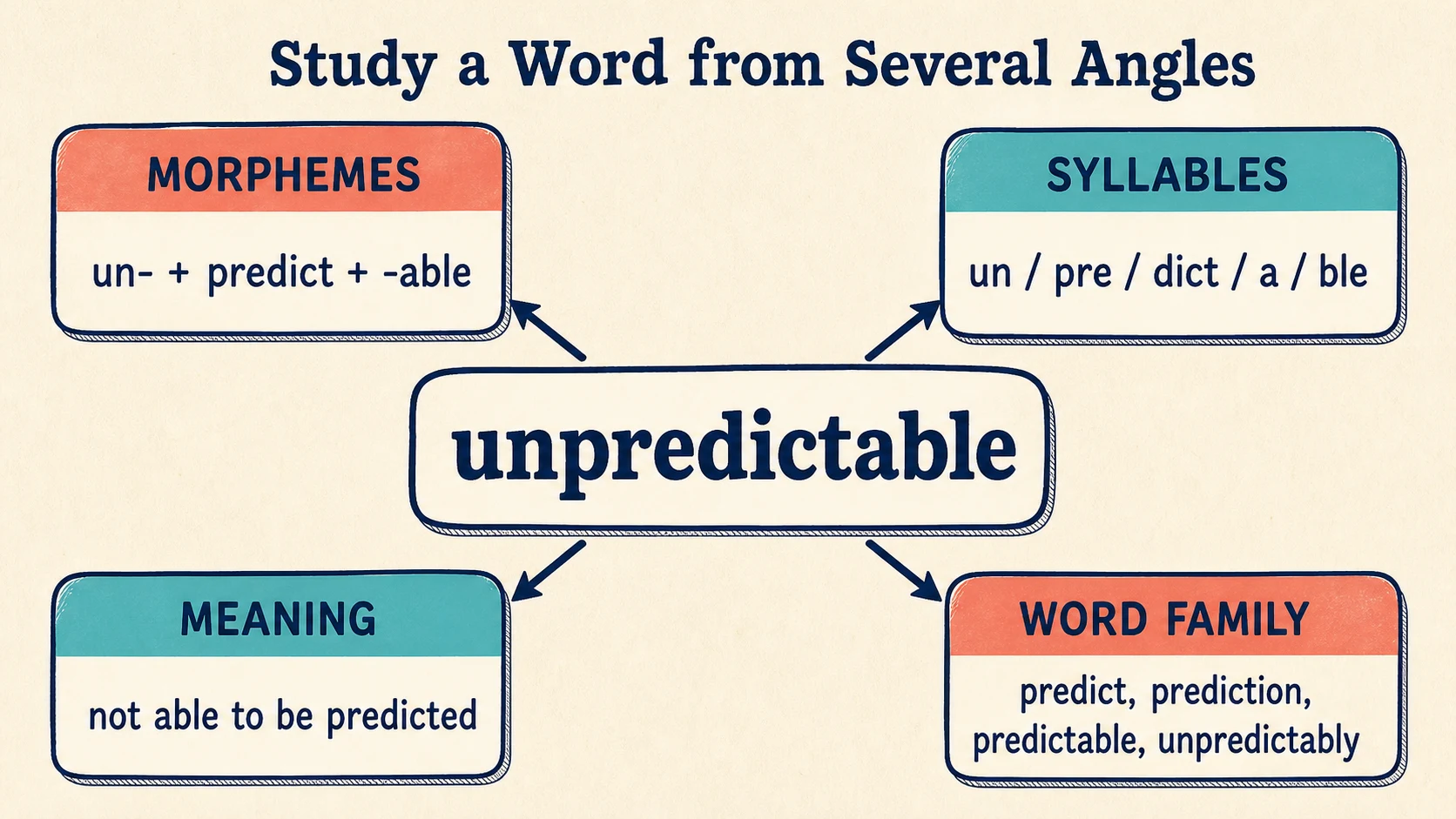
Spelling develops through connected work with sounds, letter patterns, word parts, memory, and written context.
The IES foundational-skills practice guide concerns early reading instruction through third grade. Its broad attention to foundational word-reading skills provides useful background for adults supporting older learners who still need work with basic sound-spelling relationships. The IES elementary-writing guide supplies the wider instructional context: spelling practice should ultimately support writing, not remain isolated from it. Neither guide evaluates WorksheetWise materials or prescribes this exact sequence.
Prerequisites to check before choosing a word list
Fourth-grade practice becomes more productive when the learner can already do several underlying tasks. Check these through a brief sample rather than assuming mastery from age or grade placement.
Hearing and representing sounds
Say a familiar word such as sunset without showing it. Ask the learner to repeat it slowly, separate its syllables, and write the sounds they hear. A plausible attempt such as sunset or even sunset with uncertain handwriting shows more usable sound awareness than an attempt that omits an entire syllable.
The goal is not to demand a perfect phonetic analysis of every English word. It is to see whether the learner can listen through a word instead of guessing from its first letter.
Recognizing common patterns
Ask the learner to sort a small set:
- rain, cake, play, break
- car, storm, bird, turn
- hope, hoping, hoped
Listen to the explanation. “These all have a long a sound, but they spell it differently” is stronger evidence than a correct sort with no reason. With the second group, the learner may notice that a vowel followed by r does not behave like a simple short or long vowel. In the third, attention shifts from sound alone to a base word and its endings.
Reading and using the word
A learner may copy necessary accurately without recognizing it in a sentence. Another may read a word fluently but misspell it. Check both directions: show the word for reading, then later dictate it for writing.
Sentence use also matters. If the learner writes Their going home, the issue is not simply remembering the letter sequence in they’re. The learner must connect spelling with meaning and grammar. Commonly confused words therefore need contextual practice, not only repeated copying.
A grade-appropriate progression
The following progression is a planning tool, not a universal schedule. Begin where errors become informative but the work remains manageable.
| Stage |
Main instructional focus |
Example task |
Evidence for moving on |
| 1. Secure earlier patterns |
Short and long vowels, common consonant patterns, r-controlled vowels |
Sort hop, hope, rain, play, storm |
Learner sorts and spells familiar examples consistently |
| 2. Compare spellings for one sound |
Alternative long-vowel spellings and silent-letter patterns |
Compare cake, rain, play, break |
Learner explains that one sound can have several spellings |
| 3. Build words from meaningful parts |
Base words, prefixes, and suffixes |
Build help, helpful, unhelpful |
Learner preserves the base and identifies added parts |
| 4. Study spelling changes |
Consonant doubling and changes made before suffixes |
Compare hop/hopping and hope/hoping |
Learner chooses the correct change and explains it |
| 5. Work with longer words |
Syllables and recognizable word parts |
Break disagreement into dis + agree + ment |
Learner uses chunks without losing letters |
| 6. Apply spelling in context |
Dictation, sentence writing, editing, and reference use |
Edit a short passage containing selected errors |
Accuracy begins to appear beyond the original list |
| 7. Review cumulatively |
Mix current words with previously taught patterns |
Complete an unannounced mixed sort |
Earlier patterns remain available over time |
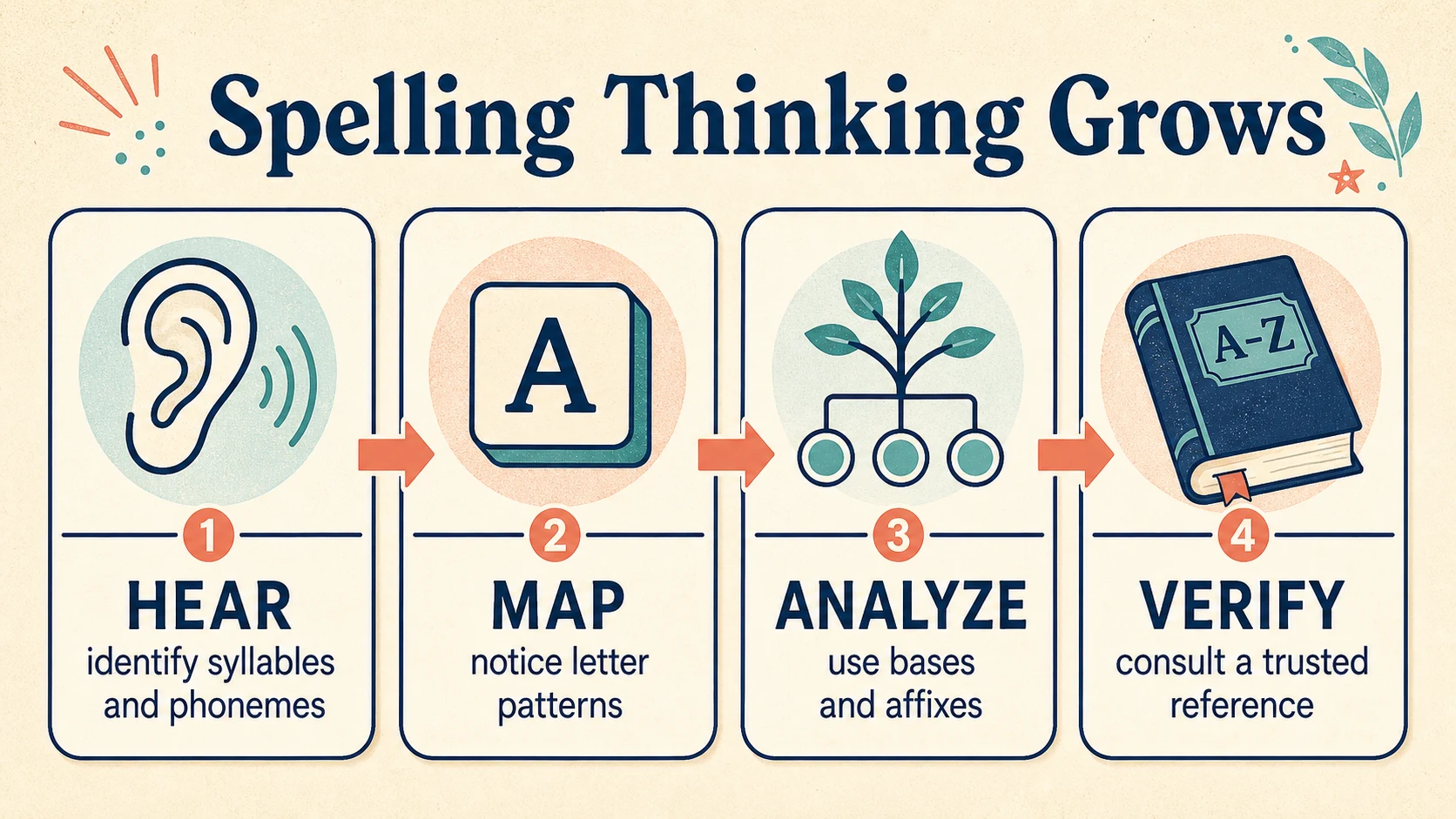
Support can gradually decrease as the learner explains patterns, recalls words, and applies them in writing.
The Common Core English Language Arts standards provide one prominent standards context. The supplied catalogue associates this topic with using conventional spelling, applying learned patterns and generalizations, and consulting references when needed. Local standards and teaching orders may organize these expectations differently.
Concrete and visual models for word study
Spelling is invisible until its structure is made visible. A few simple models help learners examine rather than merely stare at a word.
Sound boxes and letter groups
Draw one box for each sound the learner hears, then place the relevant letter or letter group in each box. In ship, the letters sh belong together because they represent one sound. This prevents the learner from treating every letter as an unrelated item.
For longer words, syllable boxes may be more useful. Write dis | agree | ment on three cards. The learner can assemble the word, read each part, and then write the whole word without spaces. This shows why a long word may be easier when its recognizable parts are preserved.
Pattern columns
Make labeled columns such as a_e, ai, ay, and other. Sort cake, rain, play, and break. The final word is an important boundary case: it has the same long-a sound, but it does not fit the first three headings. An “other” column prevents an approximate rule from being presented as universal.
Base-word frames
Box the base word and underline an affix:
- help + ful → helpful
- un + helpful → unhelpful
- agree + ment → agreement
This model directs attention to meaning as well as letter order. It also helps diagnose whether the learner knows the base word but loses it while adding another part.
Fully checked worked examples
Example 1: Sorting alternative long-a spellings
Sort these words: cake, rain, play, break, train, stay.
- Read every word aloud.
- Identify the shared long-a sound.
- Inspect the letters representing that sound.
- Sort by spelling:
| Pattern |
Words |
| a_e |
cake |
| ai |
rain, train |
| ay |
play, stay |
| ea |
break |
Check: each original word appears once, and each placement matches its written vowel pattern. The generalization is limited: the long-a sound can be represented in several ways. It would be inaccurate to tell the learner that long a is “always” spelled a_e, ai, or ay.
A transfer prompt might ask, “Where would paint go?” It belongs in the ai column. This tests application of the observed pattern without asking the learner to memorize another full list.
Example 2: Choosing whether to double a consonant
Complete the words formed from hop and hope:
- hop + ing → hopping
- hope + ing → hoping
For hopping, retain the short vowel sound in hop by doubling the final p before adding -ing: hop + p + ing. The checked result is hopping, with two consecutive p letters.
For hoping, remove the final silent e before adding -ing: hope − e + ing. The checked result is hoping, with one p.
These words are a valuable contrast because one letter changes the meaning and pronunciation. “Double every final consonant before -ing” is a misconception. Compare help + ing → helping, where no doubled p is needed. Teach a carefully chosen set of examples and boundary cases instead of turning an observed pattern into an unlimited rule.
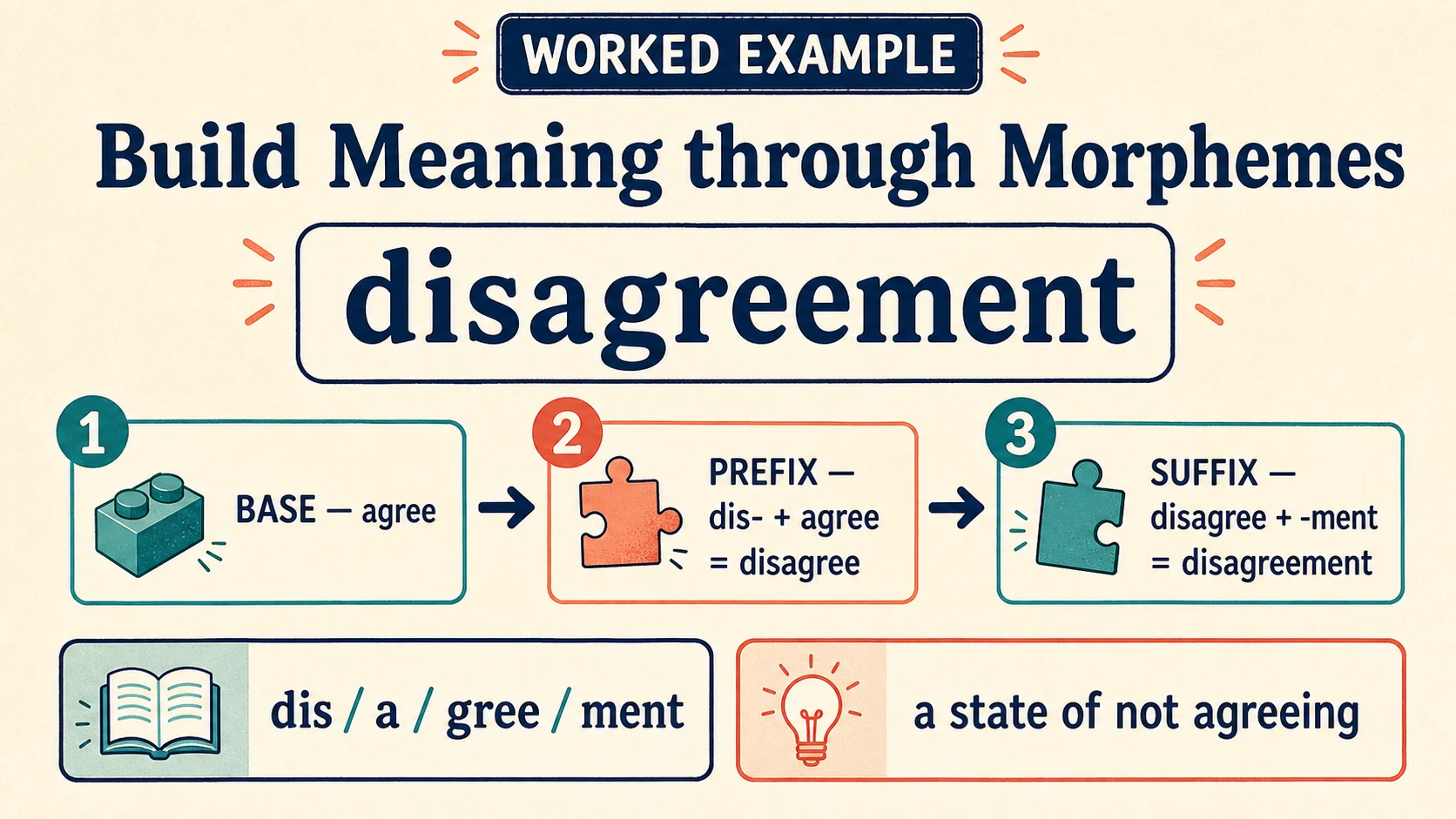
Visible word parts allow a learner to justify the spelling before writing from memory.
Example 3: Building a multisyllabic word
Build disagreement from meaningful parts.
- Begin with the base word agree.
- Add the prefix dis- to make disagree.
- Add the suffix -ment to make disagreement.
- Combine the parts: dis + agree + ment → disagreement.
Check the complete spelling letter by letter:
d-i-s-a-g-r-e-e-m-e-n-t
The double e in agree remains visible before -ment. A learner who writes disagrement has not made a random error; one e from the base has been lost. The teaching response is to rebuild the word from its parts, not simply prescribe more copying.
A useful boundary comparison is argue + ment → argument. That word does not preserve the final e in the same way. The pair shows why learners need word-specific checking alongside useful structural knowledge.
Example 4: Selecting a commonly confused word
Complete the sentence:
“_____ taking their books over there.”
The correct answer is They’re because the intended meaning is They are:
“They are taking their books over there.”
The other two forms have different jobs:
- their shows possession: “their books”
- there refers to a place in this sentence: “over there”
- they’re contracts they are: “They’re taking”
Check the completed sentence: “They’re taking their books over there.” All three forms now have a distinct, verifiable role.
Memorizing the three spellings in isolation is insufficient. Ask the learner to replace they’re with they are. If the expanded sentence still makes sense, the contraction is appropriate.
Example 5: Finding and repairing a misspelling
Edit this sentence:
“The children carried the boxs into the room.”
The plural boxs is incorrect. The conventional spelling is boxes.
- Identify the base word: box.
- Say the plural: boxes.
- Add -es, not only -s.
- Rewrite and reread: “The children carried the boxes into the room.”
Check: the base box remains intact, and the ending is -es. The learner should identify the incorrect part, repair it, and then use the corrected form again. This produces more information than a mark that merely labels the whole word wrong.
A short, repeatable lesson routine
A focused session can be brief. Stop or reduce the set when fatigue makes the work less informative.
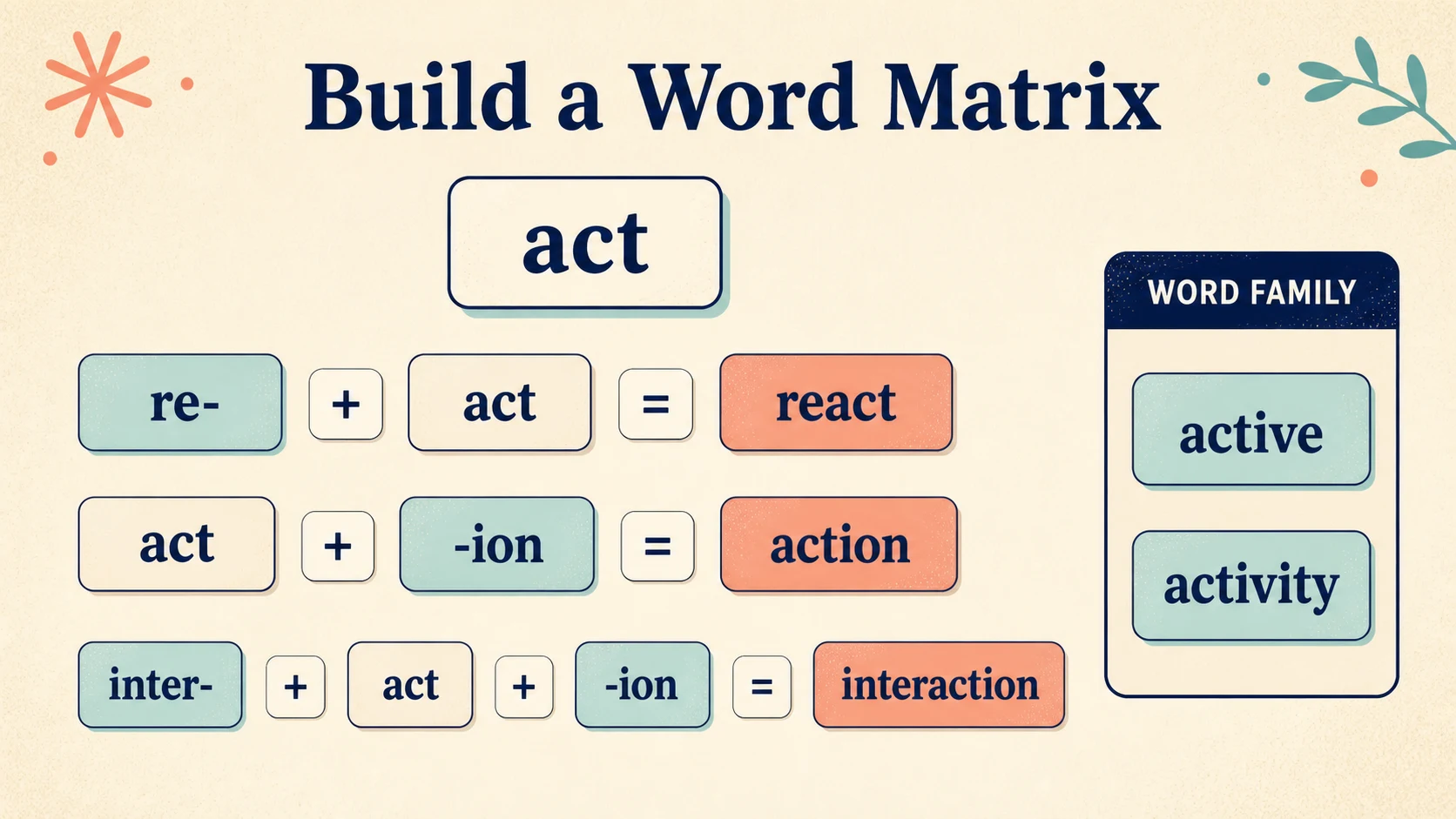
A stable routine leaves more attention available for studying the words themselves.
Notice, sort, explain, recall, apply
- Notice: Present five to eight related words. Read them together and mark the target letter groups.
- Sort: Have the learner group the words by pattern, word part, or spelling change.
- Explain: Ask what is alike, what is different, and which word does not fit neatly.
- Recall: Use look-cover-write-check. The learner studies one word, covers it, writes it from memory, and compares the attempt with the model.
- Apply: Dictate a sentence or ask for an original sentence containing one or two target words.
- Record: Save missed words and the reason for each error in a word-study notebook.
If a word is missed, locate the exact troublesome part. Then have the learner write the correct form three times with attention to that part. Three analyzed repetitions are more purposeful than a page of unexamined copying.
Choosing useful practice
The fourth-grade spelling hub can help adults compare spelling activities at the intended grade level. Selection should still be driven by the learner’s errors.
Choose word sorts when the learner can spell individual words after studying them but cannot explain their relationships. Choose look-cover-write-check when recall is the main difficulty. Use misspelling correction when the learner needs to inspect words carefully. Choose dictation or sentence writing when list accuracy does not carry into connected writing.
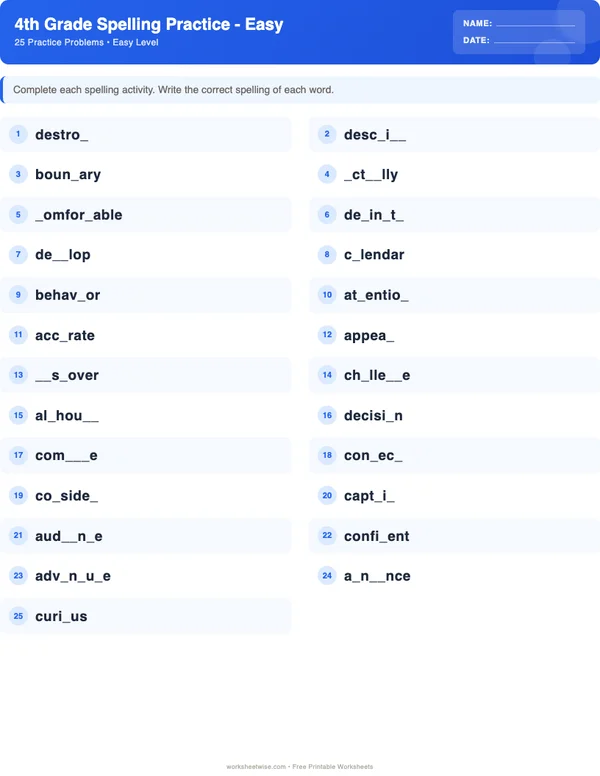
The catalogue’s free spelling-words worksheet contains 25 easy-level exercises involving fill-in-the-blank work, word scrambles, and misspelling correction. It practices spelling, word recognition, vocabulary, and letter patterns and includes a separate answer key. It is a sensible starting sample for a learner beginning this level or needing reinforcement, but one worksheet cannot diagnose every spelling need.
Adjusting support without changing the goal
For a learner who needs more support:
- Reduce the list to five or six words with one clear pattern.
- Read every word before asking for spelling.
- Provide pattern headings for the first sort.
- Keep the model visible during analysis, then cover it for one recall attempt.
- Dictate a short sentence containing one target word.
For a learner ready for extension:
- Add two or three challenge words that use or stretch the pattern.
- Remove the sort headings and ask the learner to create categories.
- Include an “other” word that requires a qualified explanation.
- Mix current words with words from previous sessions.
- Ask the learner to edit the words in a short paragraph.
Extension should demand stronger analysis or transfer, not simply a longer list.
Diagnosing common errors and misconceptions
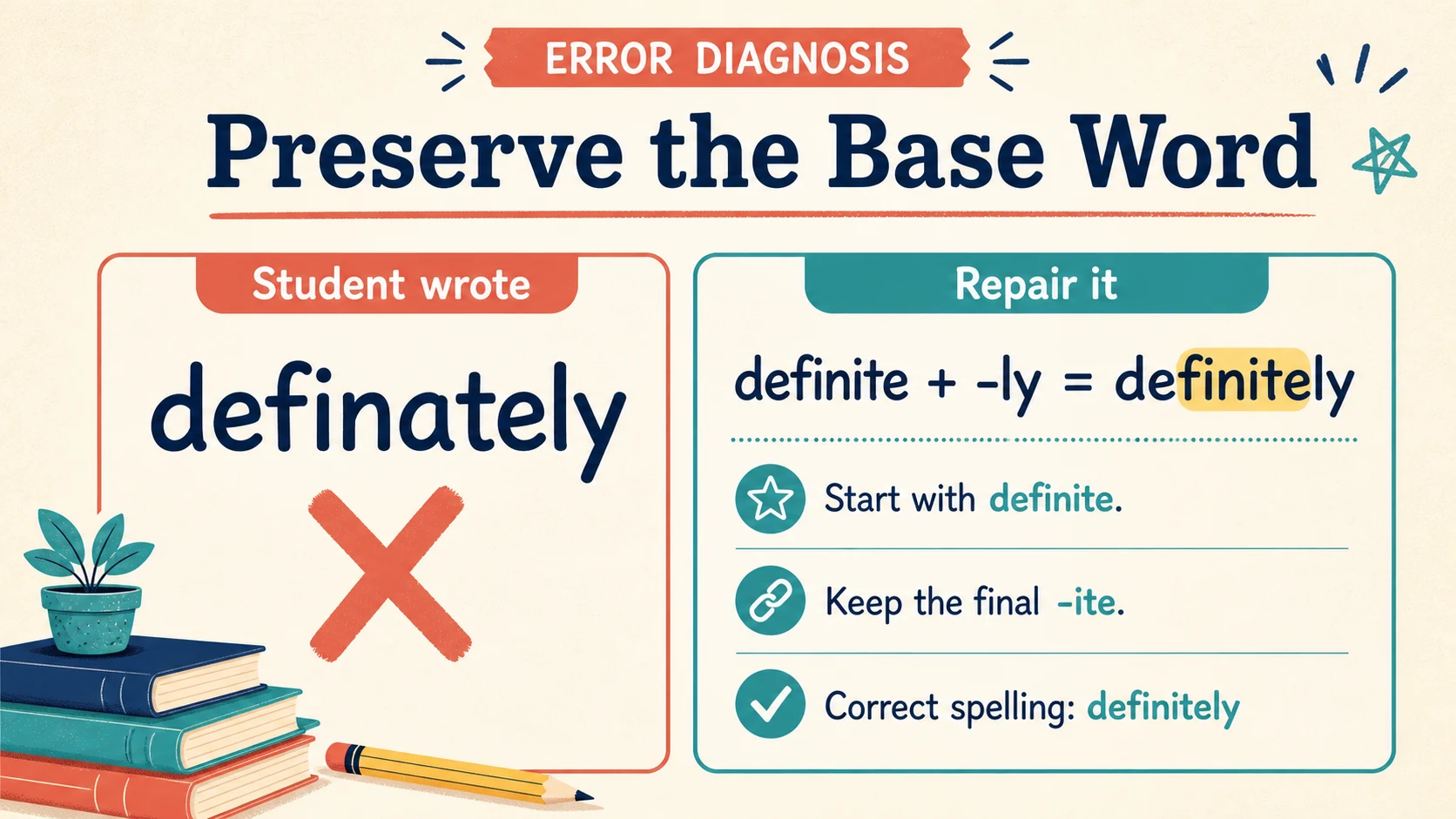
The location and type of an error point toward the next teaching move.
| Observed work |
Likely instructional need |
Useful response |
| Correct first sound, missing middle vowel |
Closer attention to every sound and syllable |
Stretch the word orally and map its sounds before rewriting |
| Correct during copying, incorrect from memory |
Visual recall and self-checking |
Use look-cover-write-check with a smaller set |
| Base word correct, suffix form incorrect |
Study of word building and spelling changes |
Box the base, add the suffix, and compare forms |
| Words correct on a test, wrong in a paragraph |
Transfer into connected writing |
Use dictation, editing, and brief original sentences |
| Their/there/they’re chosen by appearance |
Meaning-based discrimination |
Substitute the meaning or expand the contraction |
| Same old pattern disappears after a new unit |
Cumulative retrieval |
Mix a few reviewed words into every session |
| Long word loses a syllable |
Syllable and morpheme awareness |
Build the word from spoken syllables and meaningful parts |
| Learner applies a rule to every word |
Awareness of limits and exceptions |
Add a boundary case and revise the explanation |
Do not infer that a single misspelling proves a broad weakness. A slip made during rushed writing differs from the same error repeated in dictation, sorting, and revision. Collect more than one sample before changing the instructional focus.
Monitoring progress without overtesting
Keep a simple record with four columns: word, learner’s attempt, error location, and next action. Review patterns across several sessions.
A compact weekly check can include:
- Two current pattern words
- Two previously studied words
- One unfamiliar word that plausibly uses the current pattern
- One dictated sentence
- One opportunity to find and correct an error
The unfamiliar word shows whether the learner can generalize, while the sentence checks transfer. Do not treat either item as conclusive by itself.
Look for increasingly accurate explanations as well as correct answers. “I added -ment to agree and kept both e letters” reveals more control than a correct spelling produced by chance. Also note whether the learner notices and repairs errors independently.
Move forward when performance is stable across isolated words and at least some contextual work. If errors cluster around one feature, return to a smaller contrast set. If results vary mainly with task length or attention, shorten the session before concluding that the spelling pattern is unknown.
A two-week practice plan
This plan assumes short weekday sessions, but it is only an instructional suggestion. It is not a sourced universal timetable. Change the number of words, session length, and pace according to observed work and local requirements.
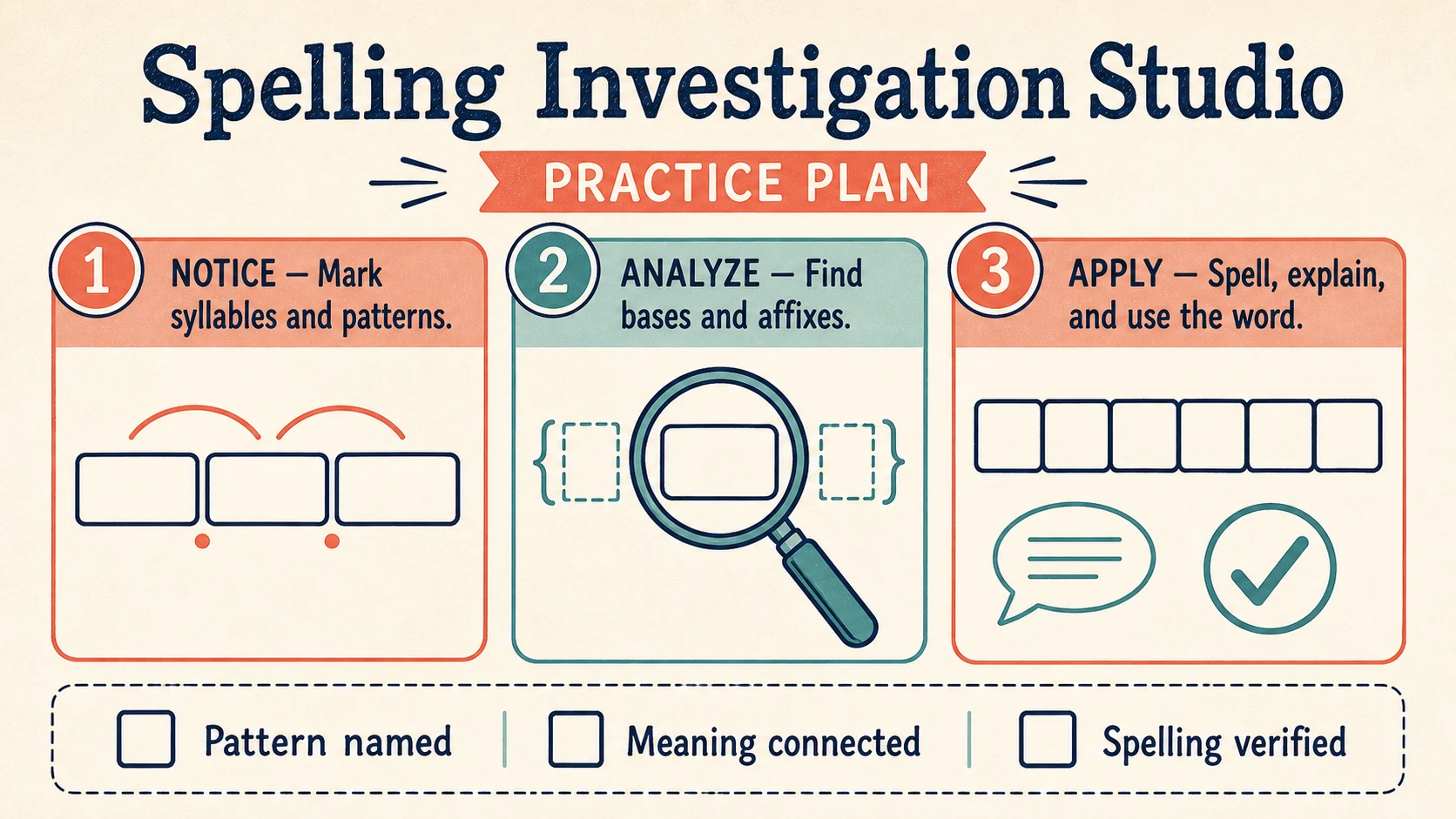
New study, contextual application, and cumulative review alternate across two flexible weeks.
| Day |
Focus |
Suggested activity |
Evidence to save |
| 1 |
Starting sample |
Dictate six to eight words and one sentence; do not preteach |
Original attempts |
| 2 |
Pattern discovery |
Sort the words and label the categories |
Sort plus oral explanation |
| 3 |
Accurate recall |
Use look-cover-write-check on missed words |
First and corrected attempts |
| 4 |
Context |
Write or dictate sentences using target words |
Sentence sample |
| 5 |
Mixed check |
Combine current words, one transfer word, and one sentence |
Errors categorized by feature |
| 6 |
Repair |
Reteach the most persistent feature with a smaller set |
Annotated word parts |
| 7 |
Word building |
Add prefixes or suffixes to known base words |
Completed word families |
| 8 |
Editing |
Correct selected misspellings in a short passage |
Edited passage |
| 9 |
Cumulative review |
Mix week-one words with previously learned patterns |
Unannounced sort or dictation |
| 10 |
Independent application |
Write a short paragraph, revise it, and consult a reference when appropriate |
Draft and corrected version |
On Day 1, avoid assigning every error equal weight. Select one coherent feature for instruction. On Day 5, compare performance with the starting sample. A word remembered once may need later review; a pattern explained and applied to a new example shows stronger learning.
On Day 10, distinguish spelling knowledge from reference skills. Some words should be recalled directly, while uncertain spellings may appropriately be checked. The learner should know how to recognize uncertainty, find a reliable spelling, and correct the draft.
Limits and the next teaching decision
A spelling worksheet provides structured practice, not a complete curriculum, universal diagnostic, or guarantee of transfer. Word searches may reinforce visual familiarity, while scrambles, sorts, sentence tasks, and error correction reveal different kinds of knowledge. No single format demonstrates full spelling control.
The supplied catalogue identifies connections among phonics patterns, high-frequency words, spelling generalizations, and everyday writing. It does not establish comprehensive alignment with every local standard or sequence. Adults should also avoid turning ordinary instructional observations into medical or child-specific conclusions. When a learner’s needs fall beyond routine teaching decisions, seek guidance through the appropriate local educational process.
For the next session, give the free easy-level 4th Grade Spelling Words worksheet, mark the exact part of each missed word, and choose one shared pattern for the following lesson. If a broader range of related practice is needed after that sample, compare the 18 worksheets in the focused spelling-words pack or create a more targeted activity with the free worksheet generators.