What 4th Grade Subtraction Includes
4th Grade Subtraction centers on accurately subtracting multi-digit whole numbers, explaining how place value supports regrouping, choosing efficient methods, and using subtraction in take-away, comparison, and missing-part problems. A learner should do more than follow a memorized procedure: they should estimate, represent the quantities, calculate, and use addition or another method to check whether the answer is reasonable.
The grade-level destination is fluent subtraction of multi-digit whole numbers with the standard algorithm. The Common Core mathematics standards place procedural skill alongside conceptual understanding and age-appropriate explanation. This guide uses that high-level framing; it does not claim that one resource covers every standard or local curriculum requirement.
Grade labels describe the intended practice level, not a fixed timetable for every learner. Local sequences differ, and a learner’s observed work should determine whether to move forward, pause, or revisit an earlier idea. The broader 4th Grade math collection can help adults compare subtraction practice with related work in number sense, multiplication, division, fractions, and decimals.
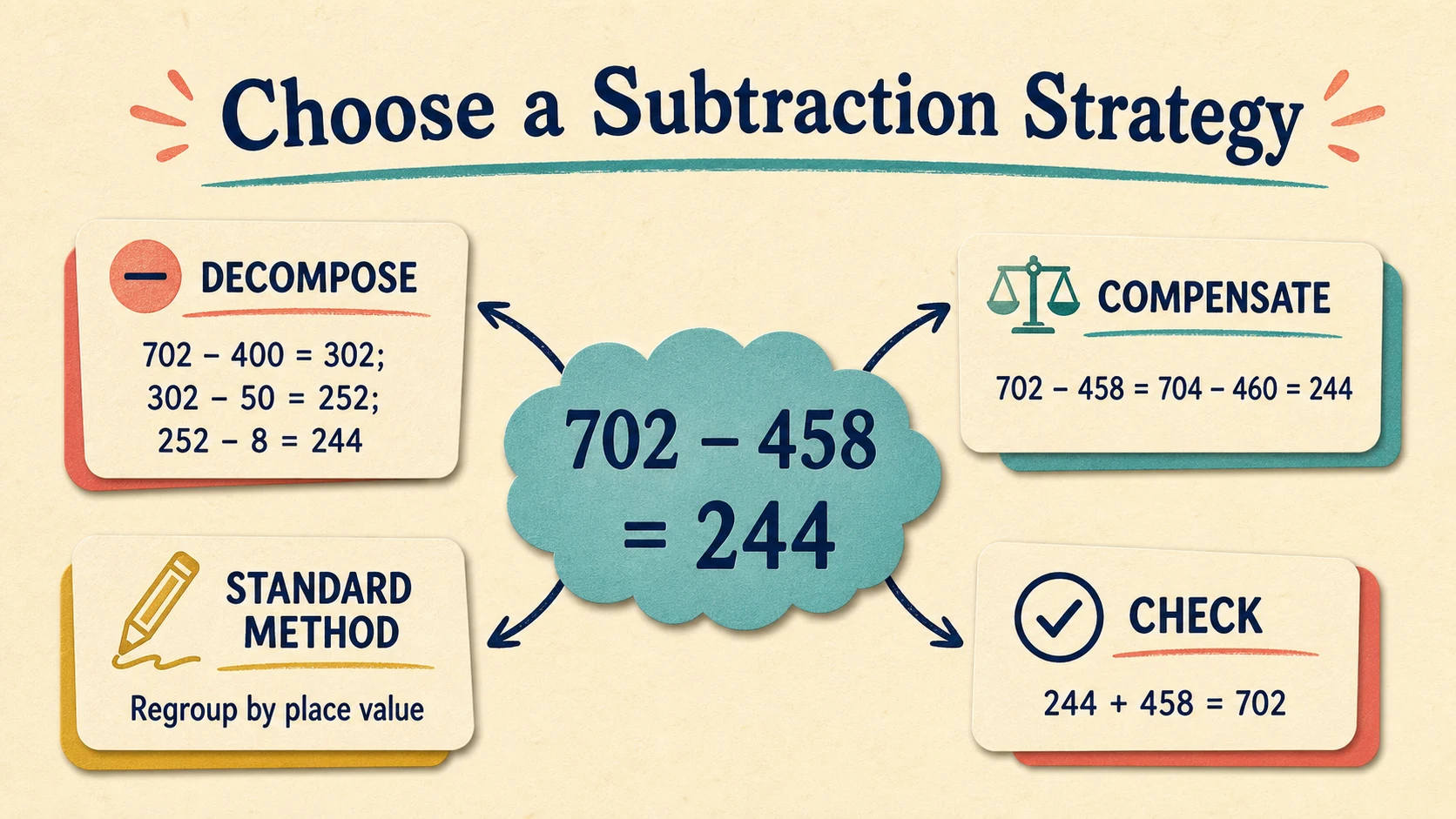
The skill develops through place value, representations, calculation, application, and checking.
A secure learner can usually:
- Explain subtraction as removal, comparison, or finding a missing part.
- Read and align multi-digit numbers by place value.
- Decompose one unit into 10 units of the next smaller place.
- Subtract with and without regrouping, including across zeros.
- Estimate a difference before calculating.
- solve word problems without relying on isolated keywords.
- Check a subtraction result with addition.
- Recognize boundary cases such as subtracting zero or obtaining a difference of zero.
Prerequisites to Check Before Multi-Digit Work
A difficulty with the written algorithm often begins below the level of the written steps. Before assigning a full page of multi-digit subtraction, use three or four brief problems to identify the actual starting point.
Place-value understanding
Ask the learner to describe a number such as 4,372:
- 4 thousands
- 3 hundreds
- 7 tens
- 2 ones
Then ask what happens if one hundred is exchanged. The quantity remains 4,372, but it can be represented as 4 thousands, 2 hundreds, 17 tens, and 2 ones. If the learner treats regrouping as changing the number rather than renaming it, return to base-ten blocks or quick place-value drawings.
Also check alignment. In 3,406−782, the 2 belongs under the 6, the 8 under the 0, and the 7 under the 4. A place-value chart can prevent digits from drifting into the wrong columns.
Addition and subtraction relationships
Use fact families to check whether the learner sees subtraction as the inverse of addition:
8+5=13,13−5=8,13−8=5
This relationship provides both a strategy and a checking method. If 6,432−2,185=4,247, then 4,247+2,185 must equal 6,432.
The learner should also have workable strategies for basic facts. Slow fact recall does not prevent conceptual instruction, but it can overload attention during a long algorithm. Allow a fact chart during initial multi-digit lessons if the goal is regrouping rather than fact fluency.
Meaning of the operation
Present three short situations:
- Removal: There were 45 tickets, and 18 were used.
- Comparison: One group collected 45 cans, and another collected 18.
- Missing part: There are 18 completed pages in a 45-page book.
All involve 45−18, but they describe different relationships. Ask the learner to explain what the difference means in each situation. This is more informative than asking for an operation based on a keyword.
A Grade-Appropriate Teaching Progression
Move through the progression according to demonstrated understanding. One correct answer is not enough evidence to remove support; look for accuracy across several problems and an explanation that matches the work.
| Stage |
Instructional focus |
Useful representation |
Evidence for moving on |
| 1 |
Review subtraction meanings and related addition facts |
Objects, drawings, fact families |
Identifies removal, comparison, and missing-part situations |
| 2 |
Subtract by place value without regrouping |
Expanded form, place-value chart |
Keeps places aligned and explains each partial difference |
| 3 |
Regroup in one place |
Base-ten blocks and drawings |
Exchanges one unit for 10 smaller units without changing the total |
| 4 |
Regroup in several places |
Place-value chart, then written notation |
Records each renamed place accurately |
| 5 |
Regroup across zeros |
Blocks or annotated place-value columns |
Explains the chain of exchanges rather than guessing digits |
| 6 |
Use the standard algorithm independently |
Vertical notation |
Calculates accurately and checks with addition |
| 7 |
Choose among methods |
Number line, compensation, algorithm |
Selects a method suited to the numbers |
| 8 |
Solve and explain word problems |
Diagram, equation, written statement |
Connects the answer to the context and checks reasonableness |
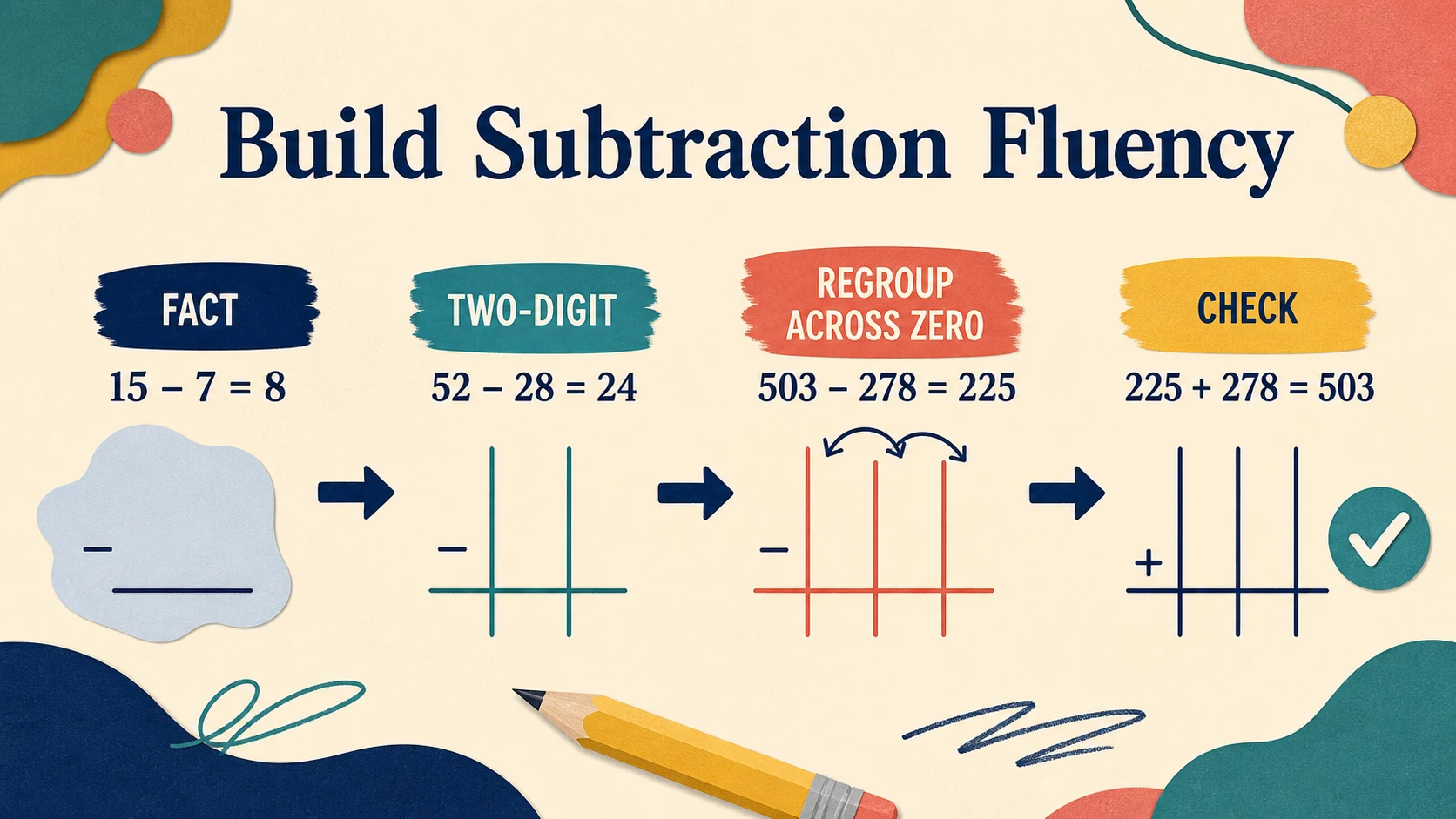
Support should fade only when the learner’s work shows that the underlying idea is secure.
This progression is consistent with a broad instructional principle in the IES guide on Teaching Math to Young Children: number and operations instruction should develop through a progression, and monitoring should be used to build on what a learner knows. That guide addresses younger children, so it supports the general framing rather than a specific fourth-grade sequence.
Concrete and Visual Models That Explain Regrouping
Base-ten blocks
Represent 243−128 with 2 hundreds flats, 4 tens rods, and 3 ones cubes. Because 3 ones cannot supply 8 ones, exchange one tens rod for 10 ones. The amount has not changed:
243=2 hundreds+3 tens+13 ones
Now remove 8 ones, 2 tens, and 1 hundred. The remaining amount is 115.
Have the learner narrate the exchange: “I renamed one ten as 10 ones.” This language is more precise than saying that a digit was “borrowed,” because nothing will be returned.
Place-value drawings and charts
A learner does not need detailed artwork. Squares can stand for hundreds, lines for tens, and dots for ones. Crossing out one line and drawing 10 dots makes the exchange visible.
A place-value chart is especially useful when zeros appear. In 5,002−786, there are initially no hundreds or tens available. The chart can show the successive renaming from thousands to hundreds, hundreds to tens, and tens to ones.
Open number lines
A number line is useful for comparison and missing-distance problems. To find 5,000−2,746, count upward:
2,746→2,800(+54)
2,800→3,000(+200)
3,000→5,000(+2,000)
The total increase is 54+200+2,000=2,254. This model shows the difference as distance rather than removal.
The IES guide on assisting elementary students who struggle with mathematics recommends systematic instruction, clear mathematical language, carefully selected representations, number lines, and deliberate word-problem instruction. These are general recommendations for elementary intervention, not an evaluation of WorksheetWise materials or a prescription for every learner.
Fully Checked Worked Examples
Example 1: Standard subtraction with regrouping
Find:
6,432−2,185
Estimate first:
6,400−2,200≈4,200
Align the numbers by place:
  6,432
- 2,185
-------
- Ones: 2 is less than 5. Rename one ten, leaving 2 tens and making 12 ones. 12−5=7.
- Tens: 2 is less than 8. Rename one hundred, leaving 3 hundreds and making 12 tens. 12−8=4.
- Hundreds: 3−1=2.
- Thousands: 6−2=4.
Therefore:
6,432−2,185=4,247
Check with addition:
4,247+2,185=6,432
The answer is also close to the estimate of 4,200.
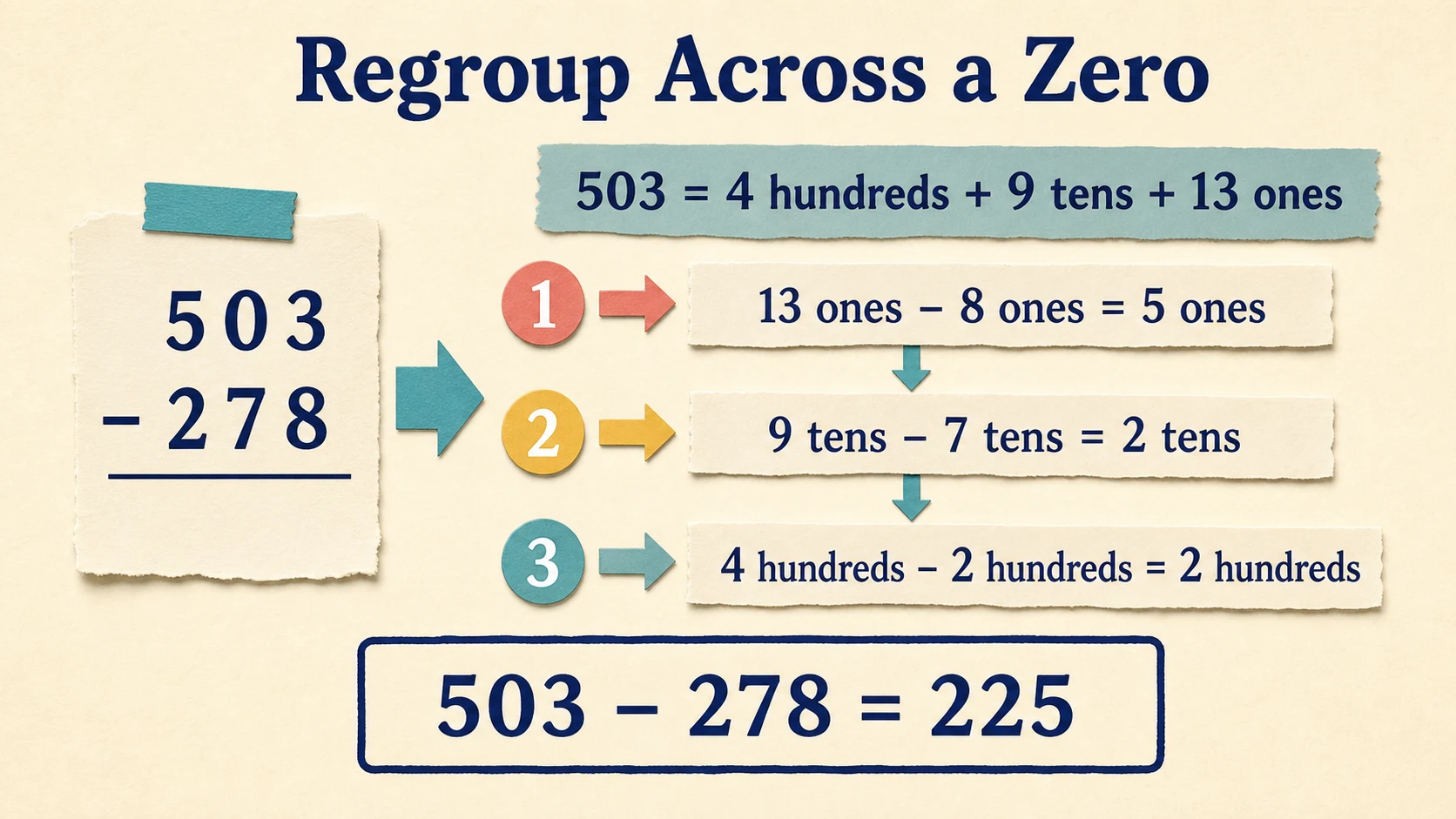
The written marks record place-value exchanges that can first be modeled with blocks or drawings.
Example 2: Regrouping across zeros
Find:
5,002−786
Write 786 as 0786 so every place is visible:
  5,002
- 0,786
-------
There are not enough ones to subtract 6, and the tens and hundreds places both contain zero.
- Rename one thousand as 10 hundreds. The thousands place becomes 4.
- Rename one of those hundreds as 10 tens. The hundreds place becomes 9.
- Rename one of those tens as 10 ones. The tens place becomes 9, and the ones become 12.
- Ones: 12−6=6.
- Tens: 9−8=1.
- Hundreds: 9−7=2.
- Thousands: 4−0=4.
Thus:
5,002−786=4,216
Check:
4,216+786=5,002
A learner who writes 5,224 may be changing zeros mechanically without tracking where each exchanged unit came from.
Example 3: Compensation for numbers near a benchmark
Find:
4,000−1,998
Because 1,998 is 2 less than 2,000, begin with:
4,000−2,000=2,000
Subtracting 1,998 removes 2 fewer than subtracting 2,000, so add 2 back:
2,000+2=2,002
Therefore:
4,000−1,998=2,002
Check:
2,002+1,998=4,000
This method is efficient because the subtrahend is close to a round number. It does not replace the standard algorithm; it expands the learner’s choices.
Example 4: Comparison problem
A library has 8,450 fiction books and 6,975 nonfiction books. How many more fiction books are there?
The phrase “how many more” asks for the difference:
8,450−6,975
Subtract by place value:
- Rename through the ones and tens as needed.
- 10−5=5 ones.
- After regrouping, 14−7=7 tens.
- After regrouping, 13−9=4 hundreds.
- 7−6=1 thousand.
So:
8,450−6,975=1,475
Check:
6,975+1,475=8,450
Answer in context: There are 1,475 more fiction books.
Example 5: Missing-part problem
A goal is 5,000 points. A team has 2,746 points. How many more points are needed?
Represent the unknown:
2,746+□=5,000
Use subtraction:
5,000−2,746=2,254
Check:
2,746+2,254=5,000
The team needs 2,254 more points. A number line may be more intuitive here because the situation asks for the distance from 2,746 to 5,000.
Boundary cases
Boundary cases reveal whether the learner understands the operation:
3,608−0=3,608
Subtracting zero leaves the quantity unchanged.
3,608−3,608=0
Equal quantities have a difference of zero.
For 205−38, write 38 as 038 when aligning columns. Do not place the 3 under the hundreds digit. If a problem would produce a negative result, confirm whether negative numbers are currently in scope; this guide and the catalogue worksheet focus on whole-number subtraction at the intended fourth-grade practice level.
A Short, Repeatable Lesson Routine
Use a compact routine of about 15–25 minutes as an instructional suggestion, not a universal timetable. Shorten, extend, or repeat a phase according to the learner’s work.
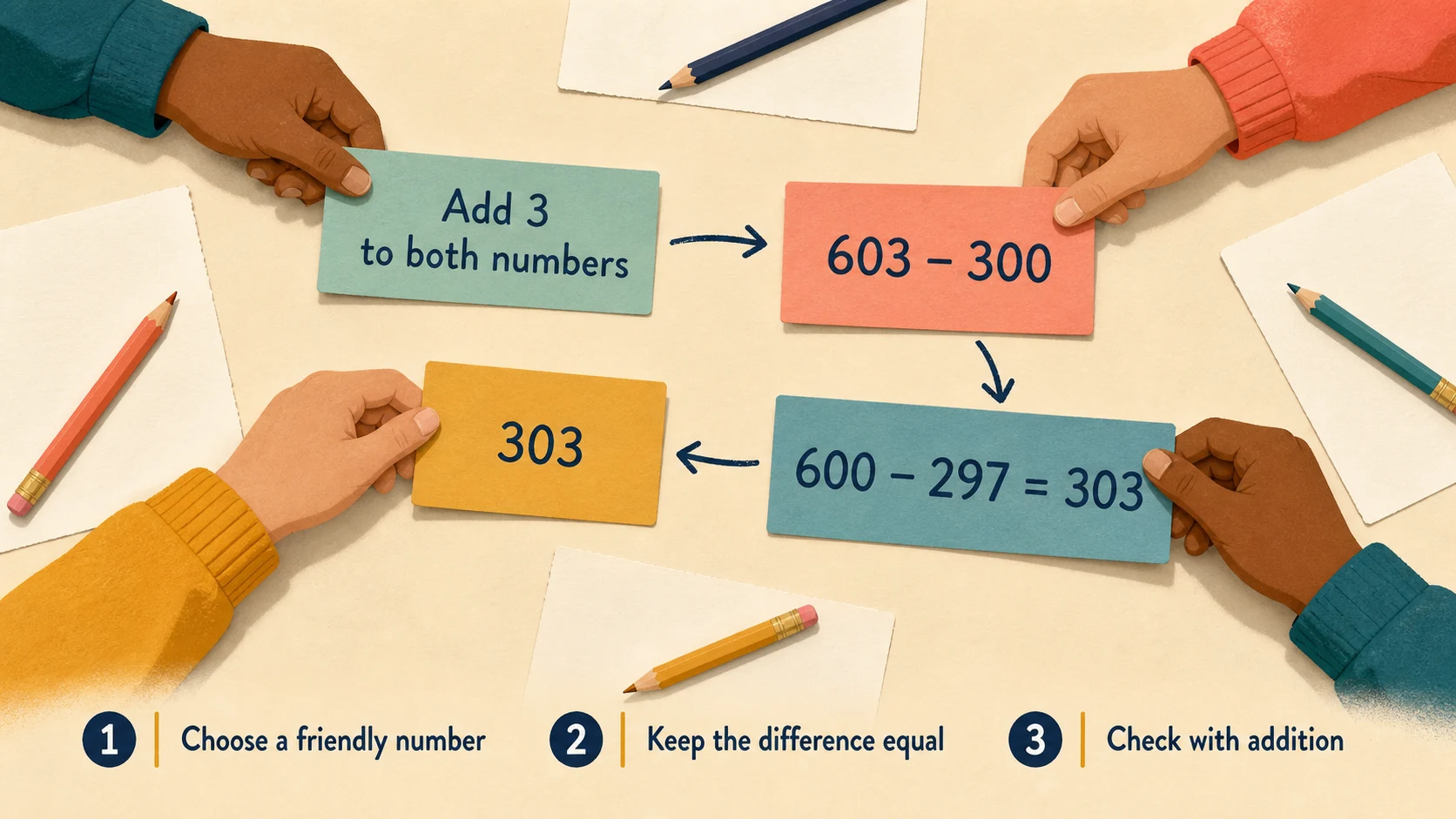
Each lesson connects prior knowledge, modeling, supported work, independent practice, and a brief check.
Connect and estimate
Begin with one fact-family prompt or place-value exchange. Then display the day’s problem and ask for an estimate. For 7,214−3,879, the learner might reason that 7,200−3,900 is about 3,300.
Model one problem
Demonstrate a single example with blocks, a drawing, or a place-value chart. Say what each exchange means. Keep the representation beside the written algorithm so the learner can connect the concrete action to the recorded notation.
Solve together
Complete one problem jointly. Ask the learner to direct the next step:
- Which place should we begin with?
- Is an exchange needed?
- What quantity does the renamed digit represent?
- Is the answer near the estimate?
These prompts expose reasoning without turning the lesson into a guessing exercise.
Practice independently and close
Assign three to six carefully chosen problems, not an automatically long set. End with one addition check or a one-sentence explanation. Record the error pattern, support used, and whether the learner corrected the work after a prompt.
Selecting Practice That Matches the Need
Choose practice by the feature that needs attention, not merely by the page’s grade label.
| Observed work |
Appropriate next practice |
| Misaligned digits |
Place-value charts and problems without regrouping |
| Accurate without regrouping, confused with one exchange |
Problems regrouping in one place with blocks |
| Accurate single exchanges, errors across zeros |
A short set containing internal zeros |
| Correct algorithm but unreasonable answers |
Estimation and addition checks |
| Accurate computation, weak word-problem interpretation |
Mixed removal, comparison, and missing-part situations |
| Consistently accurate and well explained |
Mixed multi-digit problems and method selection |
| Many unrelated errors on a long page |
Shorter sets that isolate one feature |
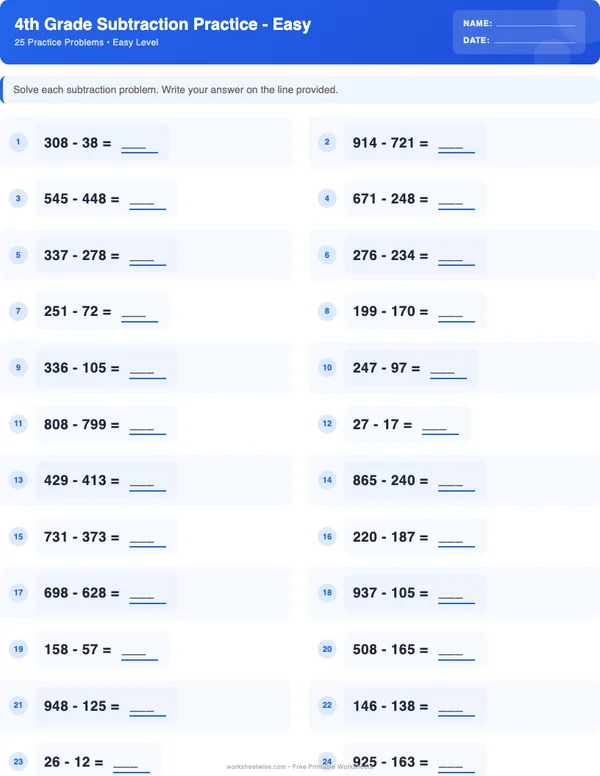
The 4th Grade Subtraction topic guide and resources provide a focused starting point. The free easy-level worksheet contains 25 exercises covering subtraction facts, mental math, number sense, and regrouping, with a separate answer key. It can be used for classroom practice, homework, or homeschool work, but 25 problems need not be completed in one sitting.
Use the answer key to check accuracy, then inspect the written steps. A correct answer alone may conceal an unstable method, while a wrong answer can come from one isolated fact error despite sound regrouping.
The focused subtraction pack contains 18 worksheets and is listed at $4.79. It offers more practice volume, but additional pages are useful only when they match an identified need. Free worksheet generators may be a better choice when an adult needs a custom-sized set or wants to isolate a particular kind of practice.
Differentiation Through Support and Challenge
When the learner needs more support
Reduce the number of new demands at one time:
- Use three-digit numbers before four-digit numbers.
- Begin with regrouping in only one column.
- Provide graph paper or a place-value chart for alignment.
- Keep base-ten blocks available while recording the algorithm.
- Allow an addition-fact chart if regrouping is the lesson target.
- Alternate one modeled problem with one learner-solved problem.
- Ask for an oral explanation before expecting a written one.
If errors persist, return to the earliest point where the learner can explain and perform the work reliably. Repeating a full mixed worksheet may provide less useful information than four targeted problems.
When the learner is ready for extension
Increase reasoning rather than simply adding larger numbers:
- Present two solved methods and ask which is more efficient.
- Ask the learner to create a subtraction problem with a difference of 2,500.
- Remove a digit from a written problem and use the difference to find it.
- Compare the standard algorithm with compensation or counting up.
- Have the learner write one removal problem and one comparison problem for the same equation.
- Ask for an estimate range before exact calculation.
Extension work should remain connected to subtraction meaning and place value. Speed alone is not the only sign of readiness.
Common Errors and Diagnostic Responses
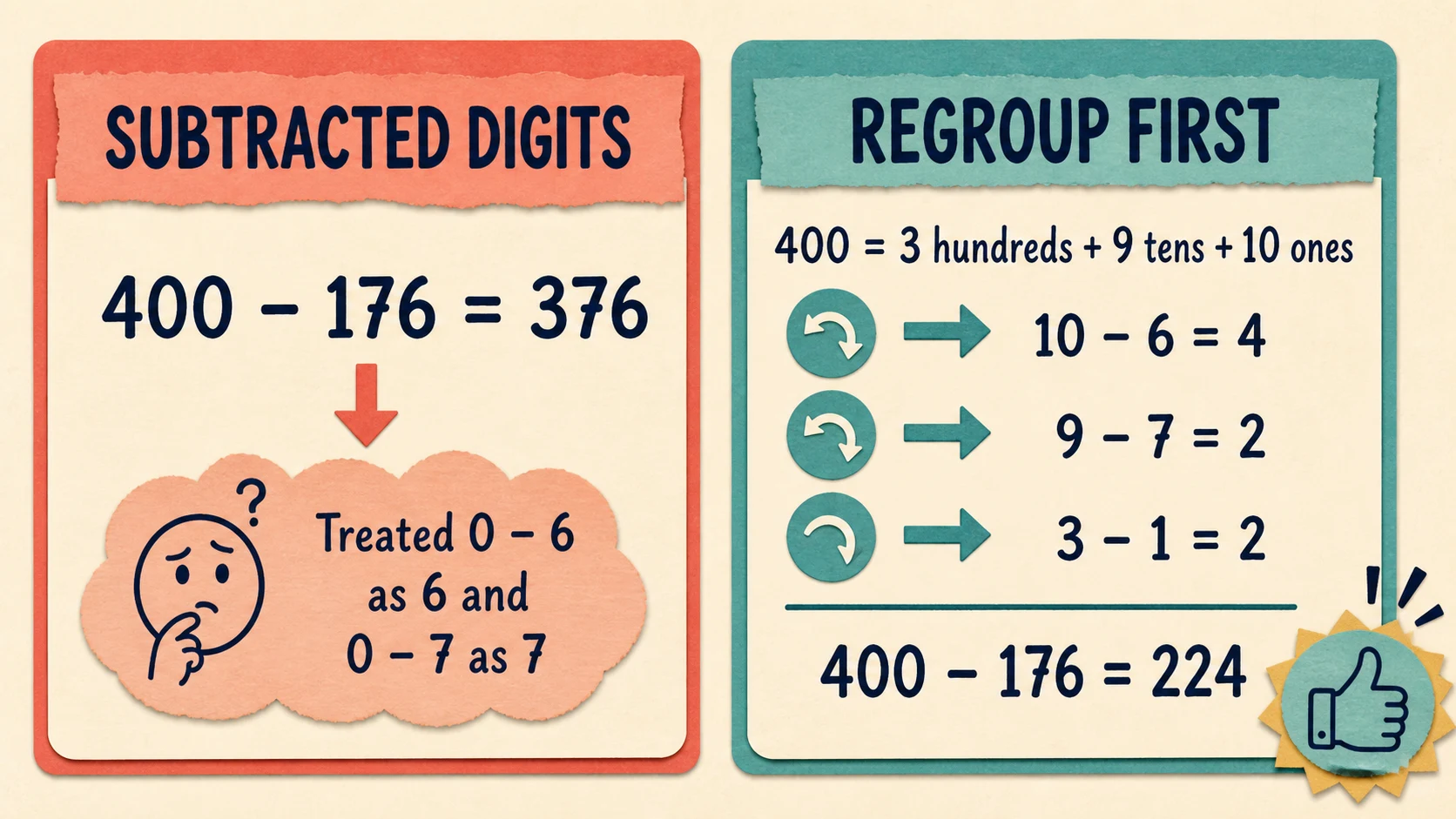
An error pattern is evidence about the next teaching move, not merely a mark to correct.
Subtracting the smaller digit from the larger digit
A learner may calculate 43−25 as 22 by doing 5−3 and 4−2. Ask the learner to model 43 and physically remove 25. The ones place requires exchanging one ten for 10 ones:
43=3 tens+13 ones
Then 13−5=8 and 3−2=1, giving 18. Avoid merely restating “borrow”; reconnect the notation to the quantity.
Losing track during multiple exchanges
In 5,002−786, a learner may alter several digits without knowing why. Use a place-value chart and perform one exchange at a time. After every exchange, ask the learner to state the renamed number. The representation must still equal 5,002.
Misaligning place values
If 782 is shifted left under 3,406, computation practice will not fix the underlying setup. Draw vertical place-value columns, write a leading zero when helpful, and have the learner read each aligned pair: ones with ones, tens with tens, and so on.
Treating every word problem as take-away
A learner may understand removal but struggle with comparison or missing-part situations. Use the same equation in three contexts and ask what the difference represents. Diagrams and number lines can make the relationship visible before calculation begins.
Accepting an unreasonable answer
Suppose a learner reports 7,214−3,879=6,665. Since roughly 3,900 is being removed from roughly 7,200, the difference should be near 3,300 and must be less than 7,214. Build estimation and addition checks into normal practice rather than reserving them for corrections.
Monitoring Progress Without Rushing
Use a brief record after each session:
- Problem type attempted
- Representation or prompt required
- Accuracy
- Error pattern
- Ability to explain regrouping
- Use of estimation or addition to check
- Suggested next step
Look for a pattern across several sessions. A practical sign of readiness is that the learner solves a small mixed set accurately, explains at least one regrouping step, and detects an unreasonable result. If performance changes sharply when zeros or word problems appear, keep those as separate teaching targets.
Timed work, if used, should not replace conceptual observation. Record whether errors come from facts, alignment, regrouping, interpretation, or rushing. The learner’s observed work—not a fixed date, worksheet count, or comparison with another child—should drive pacing.
A Flexible Two-Week Practice Plan
This ten-session plan is an instructional option, not a universal schedule. A session may be repeated, shortened, or postponed. Begin each day with one review item and finish with one checked problem.
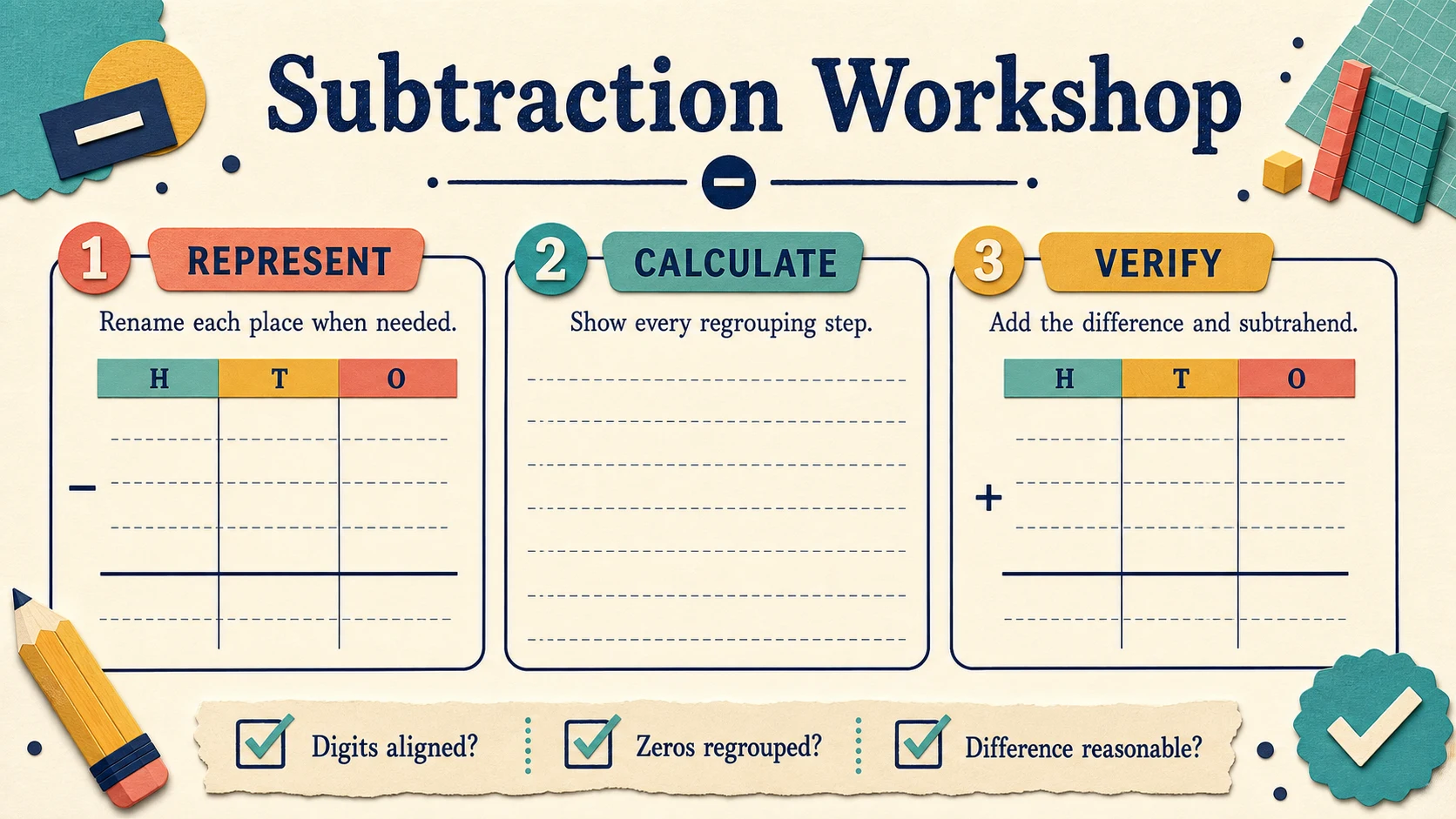
The plan alternates explanation, targeted calculation, application, and review.
| Session |
Focus |
Suggested work |
Evidence to record |
| 1 |
Starting check |
Facts, place value, one no-regrouping problem, one word problem |
Exact point where support becomes necessary |
| 2 |
Subtraction meanings |
Match removal, comparison, and missing-part stories to equations |
Explains what the difference represents |
| 3 |
No regrouping |
Expanded form and vertical subtraction |
Aligns places and subtracts each value |
| 4 |
One exchange |
Base-ten model followed by written notation |
Explains one unit becoming 10 smaller units |
| 5 |
Mixed review |
Problems with and without one exchange |
Decides correctly when regrouping is needed |
| 6 |
Several exchanges |
Carefully sequenced three- and four-digit problems |
Updates every affected place |
| 7 |
Zeros |
Two or three problems requiring exchanges across zeros |
Maintains the number’s value through the chain |
| 8 |
Efficient methods |
Standard algorithm, counting up, and compensation |
Chooses and explains a suitable method |
| 9 |
Word problems |
One problem of each subtraction type |
Writes an equation and contextual answer |
| 10 |
Independent check |
Short mixed set, estimate, exact answers, addition checks |
Identifies the next specific practice need |
If Session 4 reveals confusion, repeat concrete exchanges before proceeding. If Session 7 is accurate but slow, provide another short zero-focused set rather than restarting the entire sequence. If Session 10 is secure, mix subtraction into broader 4th Grade practice instead of continuing with isolated subtraction indefinitely.
Limitations and the Next Useful Step
A worksheet can provide sequenced practice and visible written evidence, but it cannot by itself determine why a learner made an error. It also cannot replace observation, discussion, concrete modeling, or decisions based on a local curriculum. This guide offers educational suggestions, not medical guidance, certification, guaranteed outcomes, or comprehensive standards alignment.
Begin with three diagnostic problems: one without regrouping, one with regrouping, and one short comparison problem. Inspect the setup and explanation as well as the answers. Then choose only the practice that matches the observed need. For a learner ready to rehearse foundational fourth-grade subtraction, use the free 25-problem subtraction worksheet with its separate answer key, divide it into manageable sets, and let the first set determine what to teach next.