What 4th Grade Addition Includes
4th Grade Addition centers on adding multi-digit whole numbers accurately, explaining regrouping through place value, selecting efficient strategies, and using addition in one- and multi-step problems. A learner should move beyond merely “carrying” digits: they should understand that 10 ones become 1 ten, 10 tens become 1 hundred, and the same exchange continues across larger places.
The grade-level destination in the supplied catalogue is fluent addition of multi-digit whole numbers with the standard algorithm. This matches the broad Grade 4 expectation in the Common Core mathematics standards, which emphasizes both procedural skill and mathematical understanding. The learner should therefore be able to calculate an answer and give a place-value explanation appropriate to the problem.
Grade labels describe the intended practice level, not a universal timetable. Local curricula, school sequences, and individual readiness differ. Let the learner’s observed work determine whether to move forward, repeat a lesson, or revisit an earlier skill.
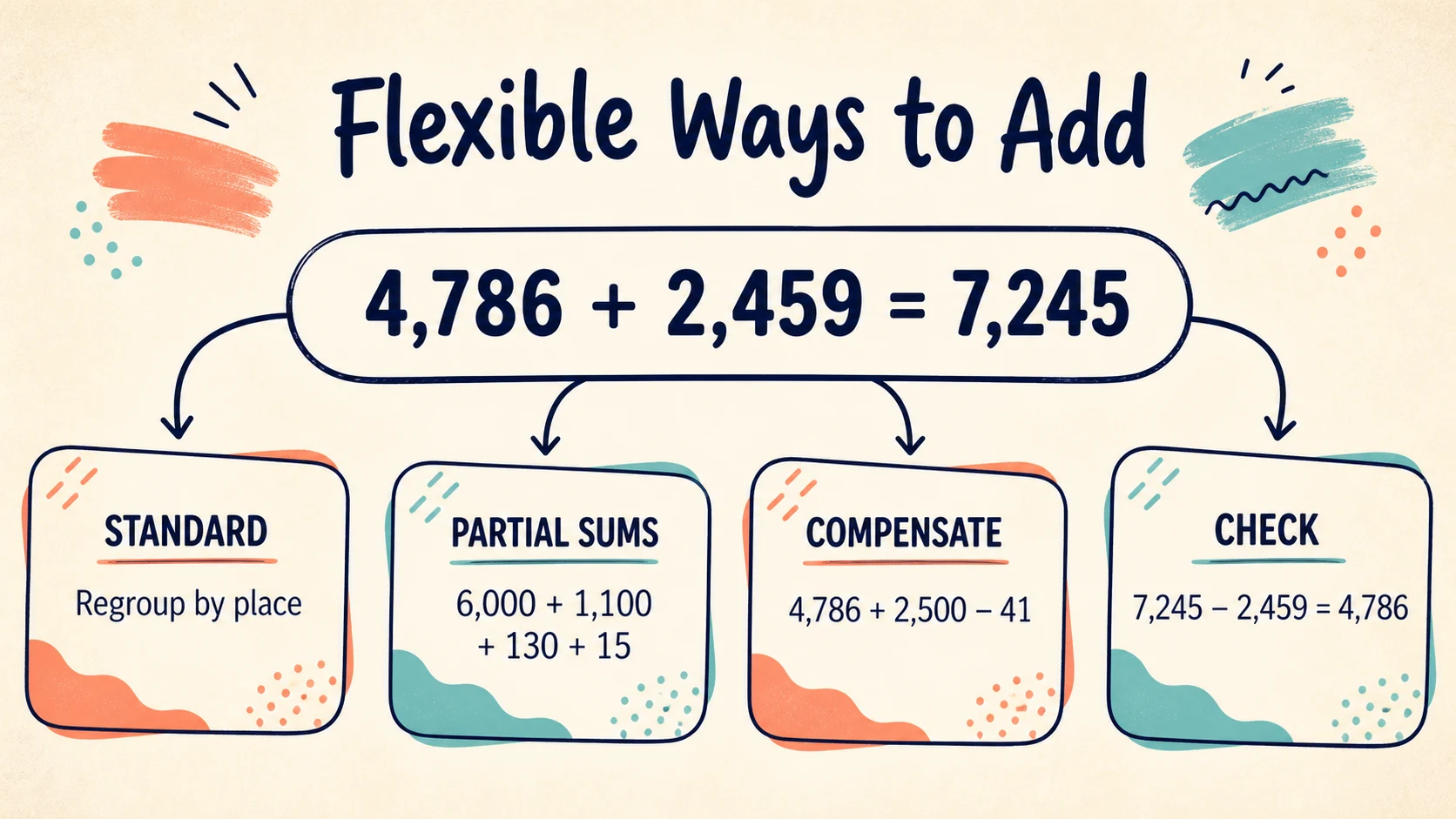
The central skill connects place value, regrouping, mental strategies, written calculation, estimation, and problem solving.
A practical way to judge readiness is to ask the learner to solve a few carefully chosen problems:
36 + 27, to reveal understanding of regrouping within 100485 + 312, to check place-value alignment2,648 + 1,975, to check regrouping across several columns5,999 + 1, to check what happens across consecutive 9s- A short word problem, to see whether the learner recognizes when addition applies
Do not draw a broad conclusion from one wrong answer. Look for a pattern across several problems and ask the learner to explain what each written digit represents.
Prerequisites to Check Before Multi-Digit Addition
Fourth-grade work rests on earlier number and operation knowledge. The learner does not need to complete an entire lower-grade program again, but gaps in these prerequisites can make the standard algorithm look arbitrary.
Place-value understanding
Check whether the learner can:
- Read and write whole numbers used in the current work.
- Identify the value of a digit by its position.
- Decompose a number, such as
4,372 = 4,000 + 300 + 70 + 2.
- Explain exchanges such as
10 ones = 1 ten and 10 hundreds = 1 thousand.
- Align ones with ones, tens with tens, and so on.
Try asking, “What does the 6 mean in 46,281?” A useful answer is “six thousand,” not simply “six.” Then ask the learner to write 30,000 + 700 + 9 as 30,709. Difficulty with the zero placeholders signals a place-value issue that should be addressed before dense written practice.
Addition facts and flexible mental strategies
A learner who has to reconstruct every fact may lose track of a multi-step calculation. Check facts within 20 and strategies such as:
- Making ten:
8 + 7 = 8 + 2 + 5 = 15
- Using a known double:
6 + 7 = 6 + 6 + 1 = 13
- Breaking apart a number:
34 + 28 = 34 + 20 + 8
- Compensating:
49 + 26 = 50 + 26 - 1
The supplied catalogue recommends developing conceptual understanding and multiple strategies before emphasizing timed fact practice. Timing may be one form of fluency work, but it should not replace place-value reasoning or error analysis.
Understanding addition situations
Check whether the learner recognizes addition when quantities are joined or when a total must be found. Avoid teaching that a single word always signals an operation. Instead, ask:
- What quantities are known?
- What quantity is missing?
- Are the quantities being combined?
- Does the answer need to be larger than either addend?
The IES guide for teaching mathematics to young children addresses preschool through kindergarten, not fourth-grade instruction. Its high-level ideas about developmental progression and monitoring what a learner knows are relevant to diagnosing these earlier foundations, but it should not be treated as a Grade 4 curriculum.
A Grade-Appropriate Addition Progression
A useful instructional sequence moves from place-value reasoning to increasingly independent calculation. It does not require every learner to spend the same number of days at each stage.
| Stage |
Instructional focus |
Example |
Evidence to look for |
| 1. Review foundations |
Place values, decomposition, and facts |
47 + 36 |
Explains 7 + 6 = 13 as 1 ten and 3 ones |
| 2. Add without regrouping |
Align corresponding places |
2,413 + 3,526 |
Adds each place accurately |
| 3. Regroup in one place |
Exchange 10 units for 1 of the next unit |
2,458 + 3,327 |
Records the regrouped unit in the correct column |
| 4. Regroup in several places |
Maintain meaning across repeated exchanges |
4,786 + 2,975 |
Completes every necessary exchange |
| 5. Cross a run of 9s |
Preserve zeros and create a new leading place |
29,999 + 1 |
Produces 30,000 and explains why |
| 6. Add more than two numbers |
Organize addends and use efficient pairings |
1,250 + 750 + 468 |
May combine 1,250 + 750 first |
| 7. Apply and check |
Solve contextual problems and assess reasonableness |
18,745 + 6,980 |
States the total with units and checks it |
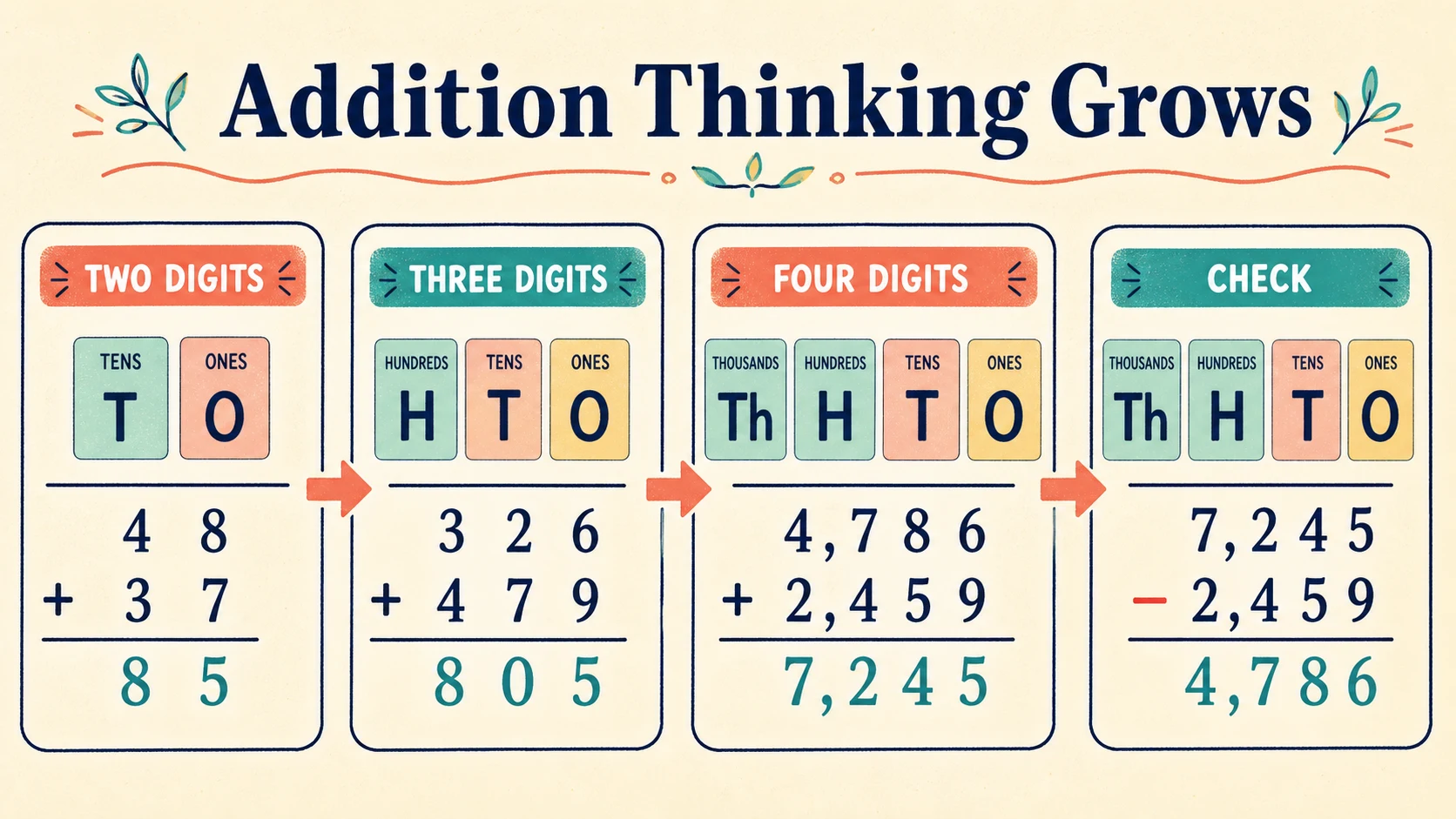
Progress depends on demonstrated understanding, not simply on completing a page.
Move ahead when the learner can solve a small mixed set accurately and explain at least one regrouping. If accuracy drops only when several columns regroup, keep the numbers large but reduce the number of regrouping events. If digit alignment is unstable, return to a place-value mat or grid paper rather than assigning more unstructured problems.
The 4th Grade Math hub can help adults compare addition work with the wider mathematics program. Use the 4th Grade Addition topic guide when the immediate goal is focused addition practice.
Concrete, Visual, and Written Models
The supplied teaching guidance uses a concrete-representational-abstract progression. For fourth graders, this does not mean making every problem with blocks. It means selecting a model when it clarifies the place-value action, then connecting that model explicitly to numbers and symbols.
Concrete model: base-ten pieces and exchanges
Represent 2,458 + 1,376 with thousands, hundreds, tens, and ones:
- Combine 8 ones and 6 ones to get 14 ones.
- Exchange 10 ones for 1 ten, leaving 4 ones.
- Combine 5 tens, 7 tens, and the new ten to get 13 tens.
- Exchange 10 tens for 1 hundred, leaving 3 tens.
- Combine 4 hundreds, 3 hundreds, and the new hundred to get 8 hundreds.
- Combine 2 thousands and 1 thousand to get 3 thousands.
The total is 3,834.
The important conversation is not about moving pieces mechanically. Ask, “What did the group of 10 ones become?” and “Where can we record that new ten?”
Visual model: place-value chart
Draw columns labeled ten-thousands, thousands, hundreds, tens, and ones. Write one digit in each cell. This makes zero placeholders and alignment visible.
For 4,082 + 735, write 735 as 0 thousands, 7 hundreds, 3 tens, and 5 ones. The chart helps prevent 735 from sliding left beneath 4,082.
Expanded notation can accompany the chart:
4,082 = 4,000 + 80 + 2
735 = 700 + 30 + 5
Then:
4,000 + 700 + 80 + 30 + 2 + 5 = 4,817
Visual model: open number line
An open number line can show a mental strategy for 3,475 + 260:
3,475 → 3,675 by adding 200
3,675 → 3,735 by adding 60
Therefore, 3,475 + 260 = 3,735.
This representation is particularly useful when one addend can be partitioned into friendly jumps. It should be connected to the equation so that the drawing remains a mathematical tool rather than a separate activity.
The IES elementary mathematics intervention guide recommends systematic instruction, clear mathematical language, well-chosen concrete and semi-concrete representations, number lines, and deliberate word-problem teaching for learners who struggle. Those are general instructional recommendations; the guide did not evaluate WorksheetWise or this particular material.
Fully Checked Worked Examples
Example 1: regrouping in two places
Add 58,736 + 24,895.
  58,736
+ 24,895
--------
  83,631
Work from right to left:
- Ones:
6 + 5 = 11. Write 1 one and regroup 1 ten.
- Tens:
3 + 9 + 1 = 13. Write 3 tens and regroup 1 hundred.
- Hundreds:
7 + 8 + 1 = 16. Write 6 hundreds and regroup 1 thousand.
- Thousands:
8 + 4 + 1 = 13. Write 3 thousands and regroup 1 ten-thousand.
- Ten-thousands:
5 + 2 + 1 = 8.
So the sum is 83,631.
Check by decomposition:
58,736 + 24,000 = 82,736
82,736 + 895 = 83,631
Both methods agree.
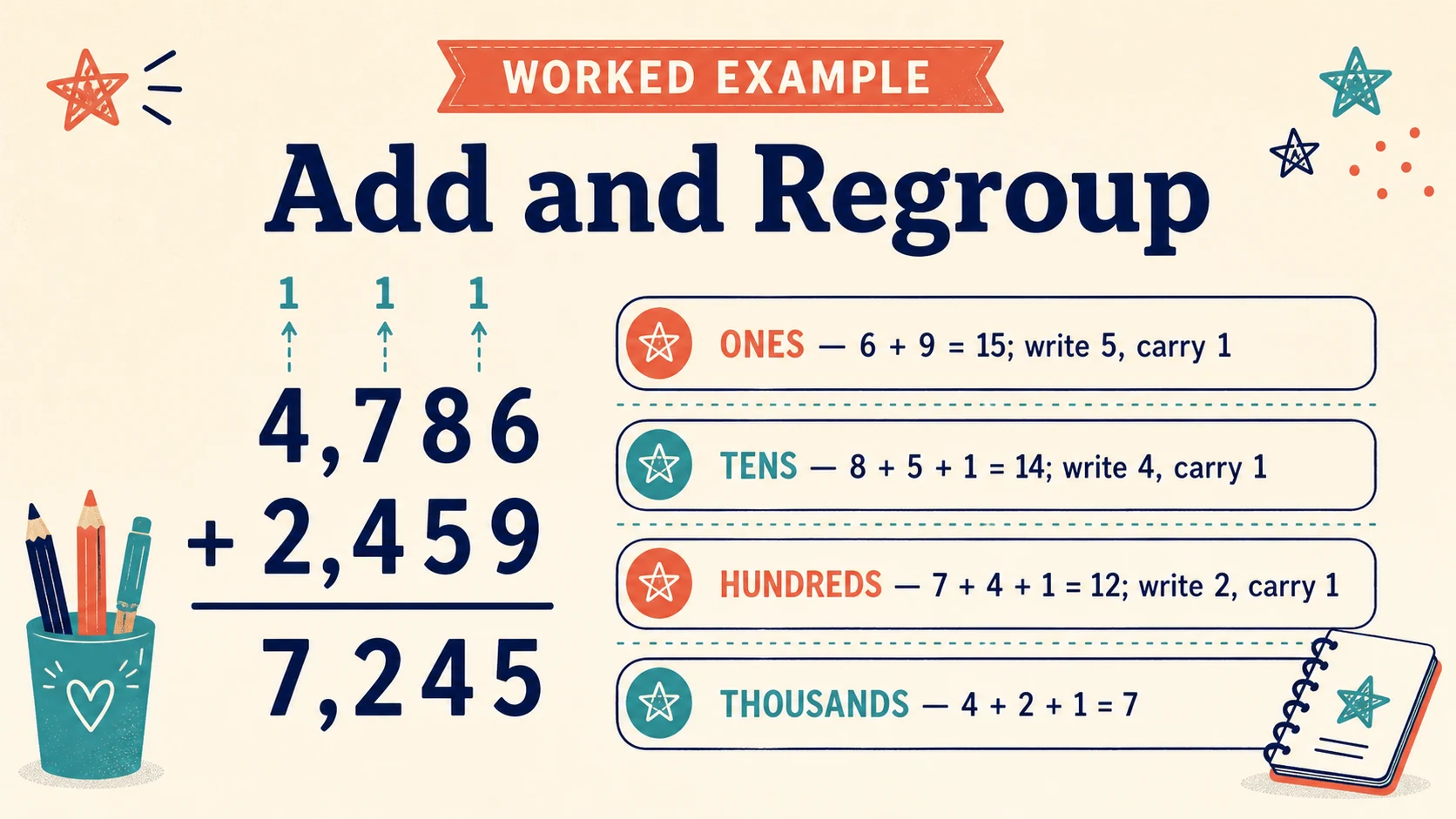
Each recorded regrouping represents a place-value exchange, not an extra unexplained digit.
Example 2: a zero inside an addend
Add 407,908 + 36,075.
  407,908
+ 036,075
---------
  443,983
The leading zero in the second line is shown only to make the alignment explicit.
- Ones:
8 + 5 = 13; write 3 and regroup 1 ten.
- Tens:
0 + 7 + 1 = 8.
- Hundreds:
9 + 0 = 9.
- Thousands:
7 + 6 = 13; write 3 and regroup 1 ten-thousand.
- Ten-thousands:
0 + 3 + 1 = 4.
- Hundred-thousands:
4 + 0 = 4.
The answer is 443,983.
Check by adding in parts:
407,908 + 30,000 = 437,908
437,908 + 6,075 = 443,983
Example 3: crossing consecutive 9s
Add 299,999 + 1.
Starting in the ones place:
9 + 1 = 10, so write 0 ones and regroup 1 ten.- Each following
9 + 1 also becomes 10.
- The exchange continues through tens, hundreds, thousands, and ten-thousands.
- In the hundred-thousands place,
2 + 1 = 3.
Therefore:
299,999 + 1 = 300,000
This is an important boundary case because one added unit changes every written place after the leading 2. A response such as 299,9910 shows that the learner has appended 10 instead of exchanging units across places.
Check by counting one number forward from 299,999: the next whole number is 300,000.
Example 4: adding zero
Add 48,275 + 0.
Zero adds no quantity, so every place remains unchanged:
48,275 + 0 = 48,275
Check by reversing the order:
0 + 48,275 = 48,275
This boundary case tests whether the learner understands zero as an addend. It does not require regrouping or a longer procedure.
Example 5: three addends and an efficient pairing
Add 12,468 + 7,532 + 6,905.
The first two addends make a friendly total:
12,468 + 7,532 = 20,000
Then:
20,000 + 6,905 = 26,905
Check in a different order:
7,532 + 6,905 = 14,437
14,437 + 12,468 = 26,905
The matching results confirm the calculation. This example also shows that addends can be combined in a convenient order without changing their total.
Example 6: addition in context
A library shelf section holds 18,745 fiction books and 6,980 informational books. How many books are in the two groups altogether?
The quantities are combined, so add:
18,745 + 6,980 = 25,725
A useful estimate is:
19,000 + 7,000 = 26,000
The exact answer, 25,725 books, is close to that estimate and has the correct unit. The estimate supports a reasonableness check; it does not replace the exact calculation.
A Short, Repeatable Lesson Routine
A compact lesson can be more informative than a long page of similar calculations. The following routine is an instructional suggestion, not a universal timetable.
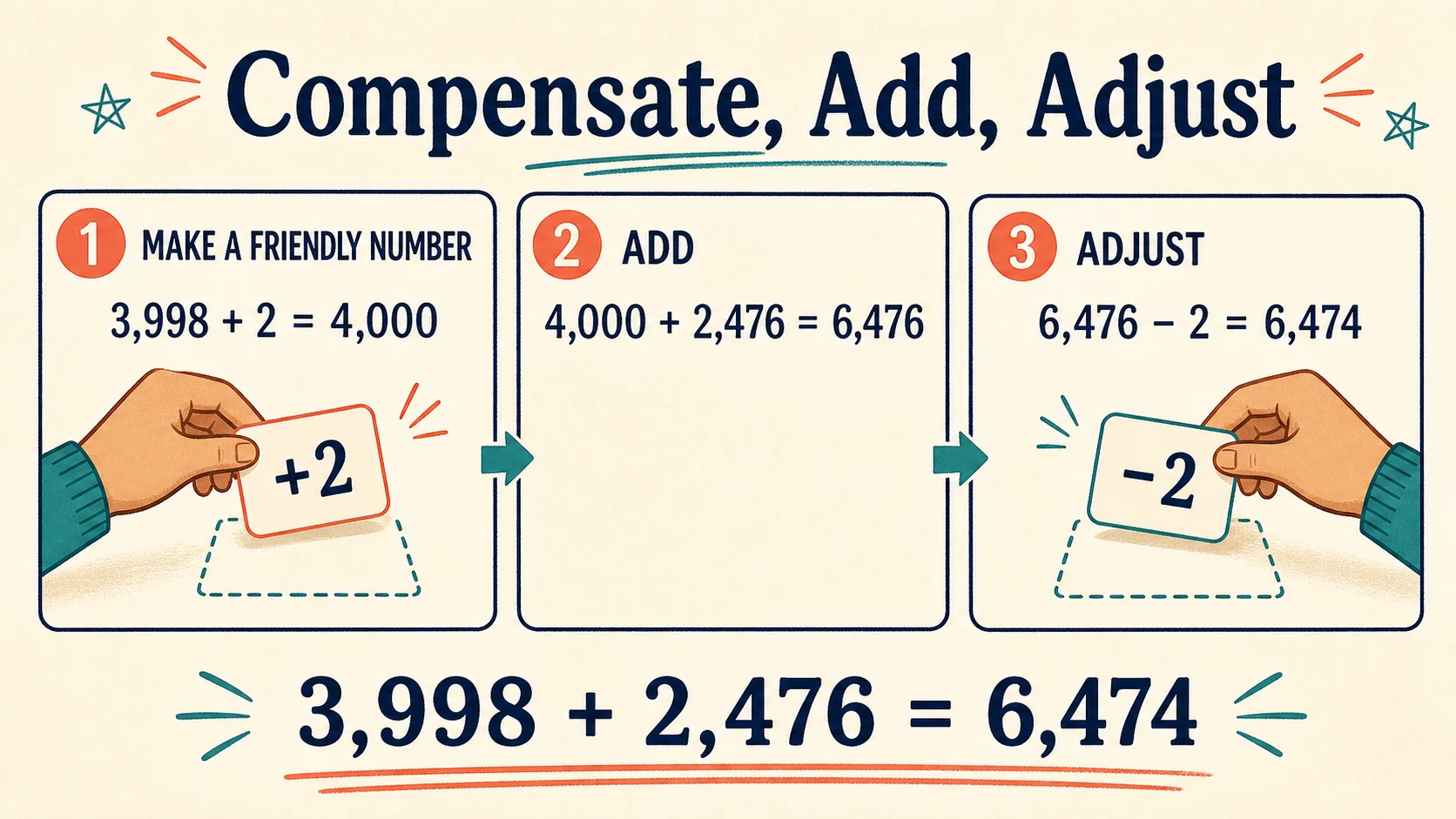
Use explanation, guided calculation, independent work, and a brief check in each cycle.
1. Retrieve a prerequisite
Begin with two or three quick prompts connected to the day’s problem:
- Decompose
6,407.
- Calculate
8 + 7.
- Explain why 10 tens equal 1 hundred.
Use the responses to decide whether the planned problem is accessible.
2. Model one carefully selected example
Solve one problem using a place-value model and written notation together. Name the units precisely: “13 tens” is more informative than “carry the 1.” Ask the learner to identify where the regrouped unit goes and why.
3. Solve one together
Let the learner direct the steps while the adult records them. If an error occurs, pause at the first incorrect place. Avoid completing the remaining columns for the learner.
4. Assign a short independent set
Use three to six problems that reveal whether the target idea transfers. Include some variation rather than changing only the digits. For example, mix one regrouping problem, one multi-regrouping problem, and one zero-placeholder problem.
5. Close with explanation and checking
Ask the learner to explain one exchange, estimate one total, or locate and correct a prepared error. Record the result briefly so that the next lesson begins from evidence.
Choosing Practice and Differentiating Support
The best practice set is not automatically the longest or hardest one. Match its structure to the learner’s current error pattern.
Practice for developing the skill
Choose problems with:
- Clearly aligned vertical columns
- Adequate writing space
- One regrouping event at first
- A model or worked example nearby
- Immediate opportunities to explain the exchange
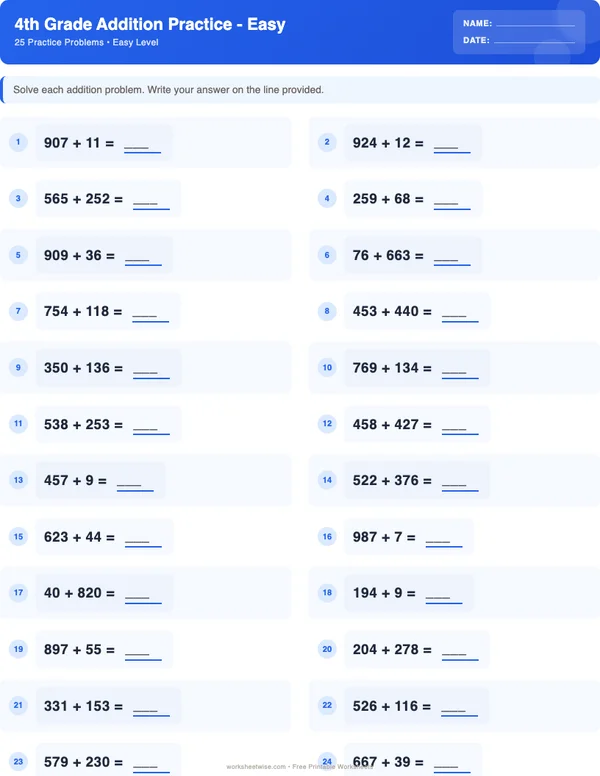
The free easy standard addition worksheet contains 25 exercises and targets addition facts, mental math, number sense, and place value. It includes a separate answer key. It can serve as an initial practice source, but the adult should still inspect how the learner works rather than relying only on the final score.
Practice for consolidation
Once the process is stable, mix:
- Problems with and without regrouping
- Regrouping in different columns
- Numbers containing internal zeros
- Two and three addends
- Horizontal and vertical formats
- Short contextual problems
- Exact answers and reasonableness checks
Mixed practice shows whether the learner can choose and apply a method without being told that every item follows an identical pattern.
Support when the learner is struggling
Reduce one source of difficulty at a time. Possible instructional adjustments include:
- Use fewer digits while keeping the same regrouping idea.
- Return to a place-value mat or base-ten representation.
- Provide grid paper for alignment.
- Have the learner say the place-value unit with each calculation.
- Cover later columns and reveal them one at a time.
- Work one example, then give one nearly parallel problem.
- Separate reading demands from calculation demands in word problems.
For a learner who answers accurately but slowly, first determine whether the delay comes from uncertain facts, repeated checking, alignment, or the regrouping process. Those causes call for different practice.
For a learner ready for more challenge, increase reasoning rather than merely printing larger numbers. Ask them to find a missing addend, compare two methods, correct an incorrect solution, or create two addends with a specified sum.
Common Errors and Diagnostic Responses
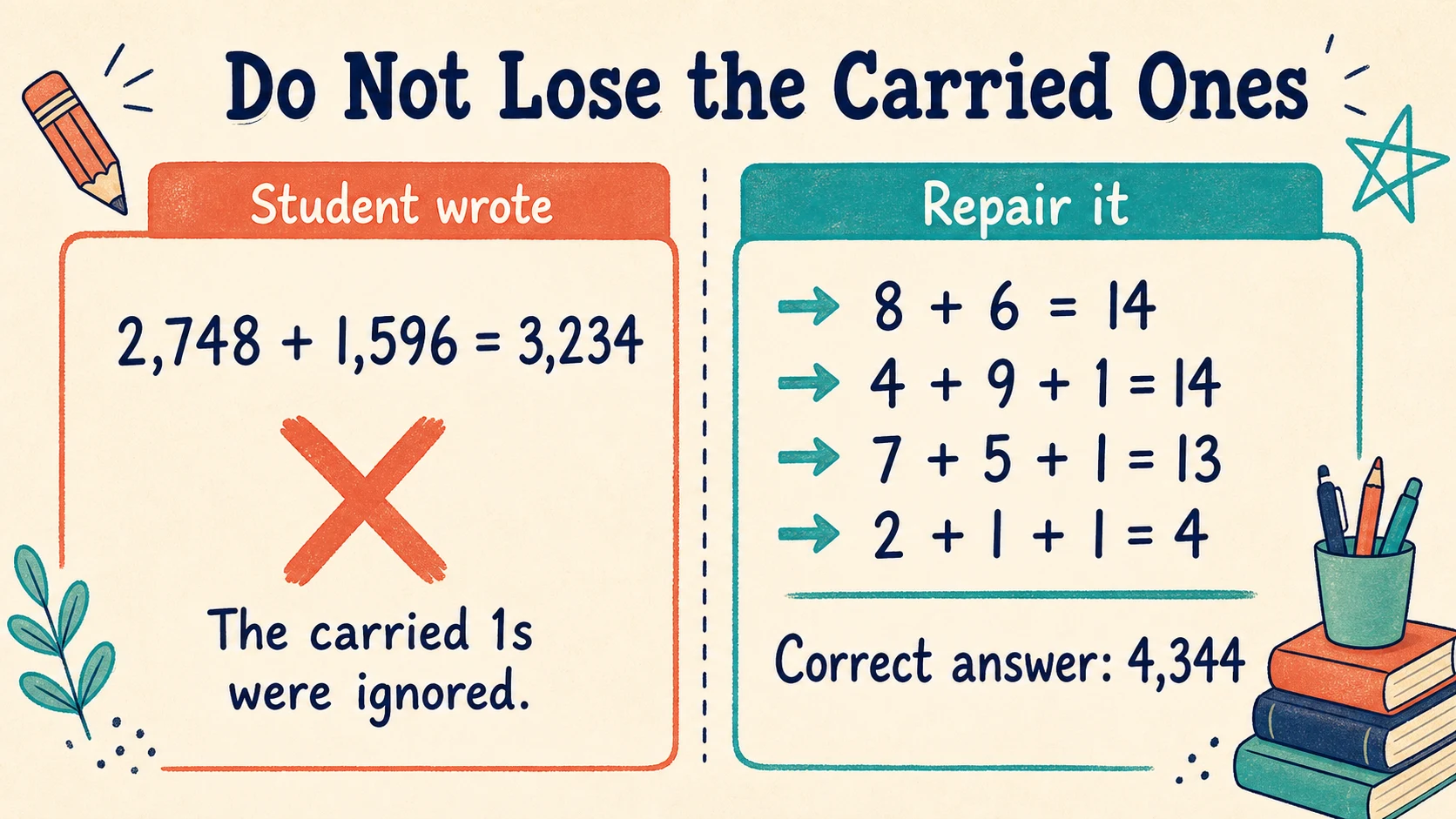
Treat an error as evidence about the learner’s current reasoning, then select a focused response.
| Observed work |
Likely issue to investigate |
Diagnostic prompt |
Teaching response |
| Digits are added in mismatched columns |
Place-value alignment |
“Which digits represent ones?” |
Use a labeled chart or grid paper |
27 + 18 = 315 |
Tens and ones recorded as separate strings |
“What is 7 ones plus 8 ones?” |
Model 15 ones as 1 ten and 5 ones |
| A regrouped unit is forgotten |
Recording or attention to the exchange |
“Where is the new ten represented?” |
Connect a physical exchange to the small recorded digit |
| The regrouped digit is added more than once |
Procedure is not tied to meaning |
“What quantity does this small 1 represent?” |
Rename every digit with its unit |
4,082 + 735 is treated as if 7 were thousands |
Internal zero or alignment confusion |
“Write both numbers in expanded form” |
Use a place-value chart with explicit zeros |
299,999 + 1 = 299,9910 |
Ten is appended instead of regrouped |
“Can a place contain 10 ones?” |
Exchange successively across each column |
| Exact answer is far below both positive addends |
Weak reasonableness check |
“Should combining these amounts make the result larger?” |
Estimate before or after calculating |
| Word problems are incorrect while bare sums are accurate |
Operation selection or language |
“What is known, and what total is missing?” |
Represent the situation before calculating |
A single slip may be a recording error. Repeated errors in the same place are stronger evidence of a conceptual or procedural gap. Ask the learner to think aloud on a fresh problem rather than demanding an explanation of work they no longer remember.
Avoid correcting every mark at once. Identify the earliest point where the reasoning changed course, reteach that point, and then let the learner finish a comparable problem.
Monitoring Progress Without Overtesting
Monitoring should answer three practical questions:
- Is the learner accurate?
- Can the learner explain the place-value action?
- Can the learner apply it when the problem format changes?
A brief record can contain the date, problem type, number correct, observed strategy, and one next step. For example:
| Date |
Task |
Evidence |
Next step |
| Day 1 |
Four-digit sums, one regrouping |
4 of 5 correct; explained ones-to-tens exchange |
Add regrouping in the hundreds place |
| Day 3 |
Mixed regrouping |
Accurate except when an addend contained zero |
Use a place-value chart |
| Day 5 |
Context problem |
Correct equation and answer; omitted unit |
Require a labeled concluding sentence |
Do not use percentage correct alone. Five correct answers copied from a model provide different evidence from five independently solved mixed problems. Likewise, one correct answer does not prove that regrouping is understood.
A reasonable checkpoint includes:
- One problem without regrouping
- Two with regrouping in different places
- One boundary case involving zero or consecutive 9s
- One contextual problem
- One brief explanation or estimate
Advance when the learner’s independent work is consistently accurate enough to show that errors are no longer systematic and the explanation matches the written method. If the same misconception continues, change the representation or task size rather than repeating an identical page.
A Two-Week Practice Plan
This plan is an adaptable instructional suggestion. “Day” means one practice occasion, not a mandated school schedule. Shorten, repeat, or reorder sessions according to observed work.
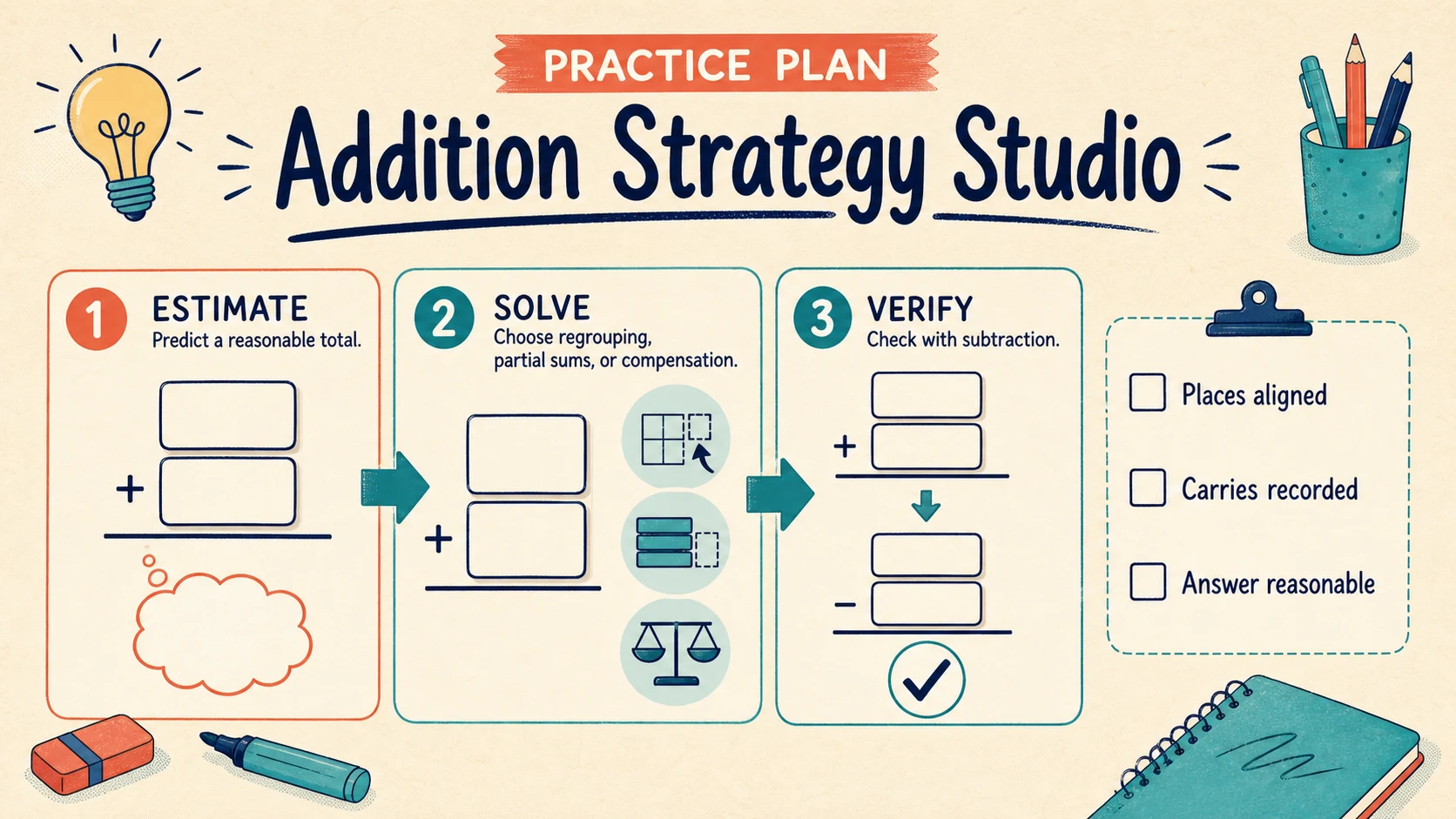
The sequence alternates teaching, mixed practice, application, and review.
| Day |
Main focus |
Suggested work |
Decision point |
| 1 |
Baseline and prerequisites |
Place value, facts, one three-digit sum, one four-digit sum |
Select the first unmet skill |
| 2 |
Addition without regrouping |
Model alignment; solve a short set |
If columns drift, use grid paper |
| 3 |
Regroup ones to tens |
Base-ten or drawn model plus written method |
Ask what the recorded 1 means |
| 4 |
Regroup tens to hundreds |
Guided and independent examples |
Check whether earlier regrouping is retained |
| 5 |
Mixed one-place regrouping |
Four to six varied problems and an error analysis |
Repeat only the troublesome form |
| 6 |
Several regrouping events |
One modeled example and a short independent set |
Reduce digits if the sequence breaks down |
| 7 |
Zeros in multi-digit numbers |
Expanded notation and aligned calculation |
Look for placeholder errors |
| 8 |
Boundary cases |
Add zero; add 1 across consecutive 9s |
Require a place-value explanation |
| 9 |
Three addends and efficient order |
Find friendly pairs before calculating |
Compare two valid orders |
| 10 |
Context and review |
Solve a word problem, estimate, then complete a mixed checkpoint |
Choose consolidation or targeted reteaching |
On review days, include one previously mastered form so that practice is not limited to the newest method. If the learner shows secure work before Day 10, move toward missing-addend problems or more varied applications. If they are still exchanging inaccurately, remain with concrete or visual models and smaller numbers.
The focused 4th Grade Addition pack contains 18 worksheets and is listed at $4.79. It may provide additional practice variety, but more pages should not substitute for diagnosing a recurring error.
Limits, Sound Expectations, and the Next Step
This guide addresses whole-number addition within the supplied fourth-grade topic scope. It does not establish comprehensive standards alignment, certify mastery, guarantee an outcome, or prescribe one schedule for every learner. It also does not provide medical or child-specific guidance. Decimal and fraction addition belong to later or separate instructional work in this progression and should not be inferred from success with whole numbers.
Worksheet answers reveal only part of the learner’s understanding. Conversation, models, independent calculation, and varied applications provide additional evidence. At the same time, manipulatives are not a goal by themselves. Their purpose is to clarify the quantities and exchanges represented by the written method.
An honest next step is to give the learner a small mixed sample, inspect the first point of difficulty, and select practice for that exact need. Begin with the free 4th Grade Addition standard easy worksheet, use its answer key to check accuracy, and ask the learner to explain one regrouping before choosing the following lesson.