4th Grade Decimals: the essential teaching focus
Fourth-grade decimal work should build a clear connection among base-ten place value, fractions with denominators of 10 or 100, visual models, and decimal notation. A learner should be able to interpret, read, write, represent, and compare decimals through hundredths—not merely follow rules about decimal points.
In practical terms, teach the learner to understand that:
- One whole can be divided into 10 tenths or 100 hundredths.
- A tenth is larger than a hundredth.
- Fractions such as 7/10 and 34/100 can be written as 0.7 and 0.34.
- Equivalent values may look different, as in 0.5=0.50.
- Decimal comparisons depend on place value, not the number of digits.
- Models, fraction notation, decimal notation, words, and number-line positions can describe the same value.
The Common Core State Standards for Mathematics place the fourth-grade emphasis on connecting fractions with denominators of 10 and 100 to decimal notation and comparing decimals through hundredths. Local curricula may introduce topics in a different order or include additional computation. Grade labels describe an intended practice level, not a universal timetable or a guarantee that every learner has met the same prerequisites.
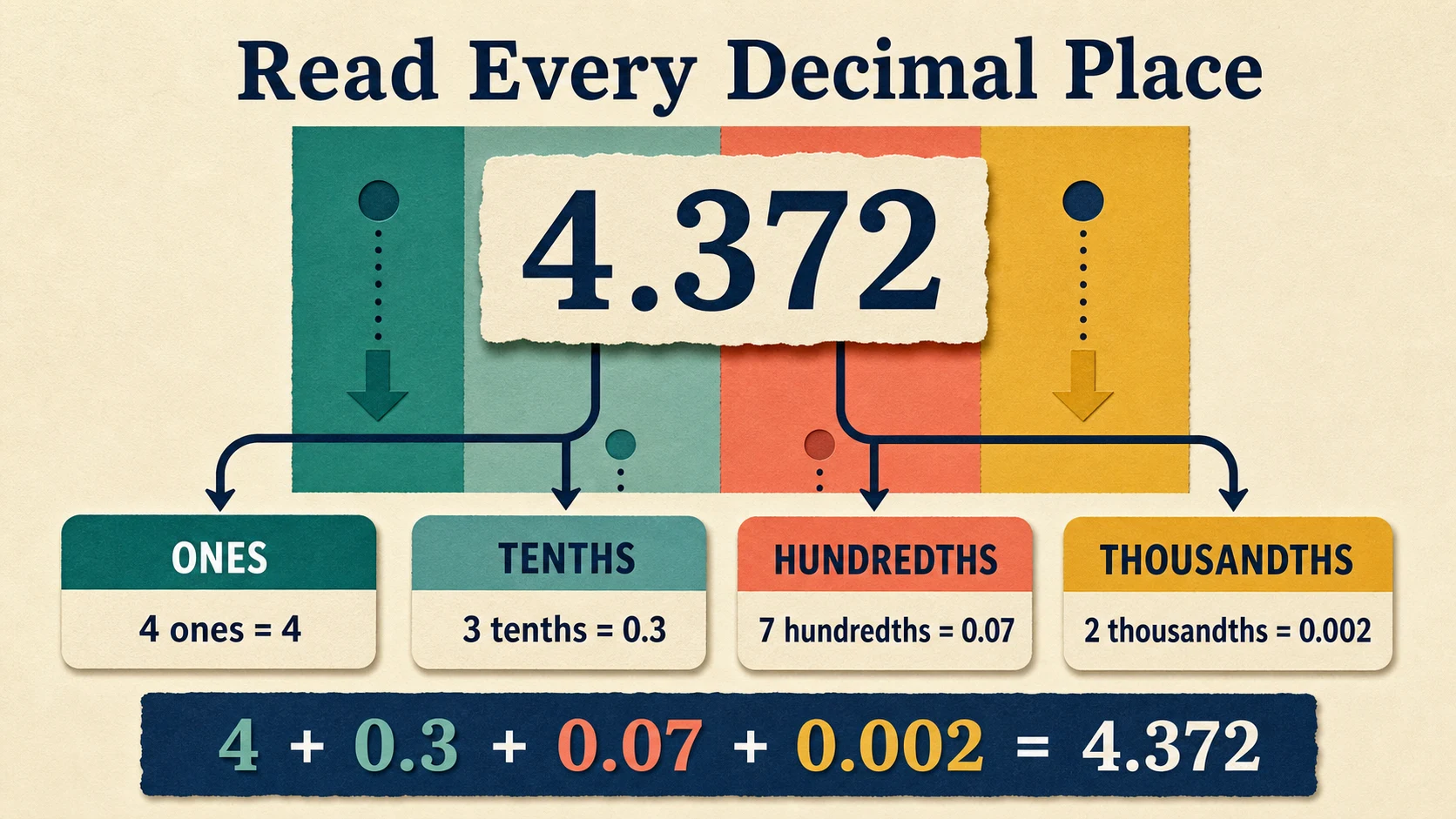
The central idea is the relationship among place value, fractions, models, decimal notation, and comparison.
Prerequisites to check before teaching decimals
Decimal difficulties often begin with an unfinished prerequisite. A short check is more useful than assuming that a fourth grader is ready because of age or grade placement.
Whole-number place value
Ask the learner to identify the value of a digit in numbers such as 352 and 507. The learner should distinguish the digit from its value: the 5 in 352 represents 50, while the 5 in 507 represents 500.
Then review the ten-to-one relationship between adjacent places:
- 10 ones make 1 ten.
- 10 tens make 1 hundred.
- A whole can likewise be divided into 10 tenths.
- A tenth can be divided into 10 hundredths.
A learner who reads place-value positions as unrelated labels may struggle to explain why 0.4 is greater than 0.36.
Fraction meaning
Check whether the learner can interpret a fraction as equal parts of one whole. For example, show a rectangle divided into 10 equal sections with 3 shaded. Ask what fraction is shaded and what the denominator tells us.
The expected reasoning is that 3/10 means 3 of 10 equal parts. If the learner counts shaded parts but cannot explain the whole or the equal partitions, stay with fraction models before introducing decimal symbols.
It is also useful to check simple equivalence involving tenths and hundredths. A learner can see that 2/10=20/100 by dividing each tenth into 10 smaller equal parts.
Reading symbols accurately
Make sure the learner attends to the decimal point. Contrast 25, 2.5, and 0.25. Do not initially ask for a memorized rule. Ask what each digit represents and which quantity is greater.
A zero before the decimal point signals that there are no whole units in a number such as 0.25. A final zero can preserve the value: 0.5 and 0.50 name the same quantity.
A grade-appropriate progression
The learner’s observed work should determine how quickly to move through this sequence. Correct answers without explanations may indicate procedural success but not secure understanding.
| Stage |
Teaching focus |
Useful evidence of readiness |
| 1 |
Partition one whole into tenths |
Identifies one part as 1/10 and several parts as a fraction |
| 2 |
Partition one whole into hundredths |
Identifies one small part as 1/100 |
| 3 |
Connect fractions and decimals |
Matches 6/10 with 0.6 and 27/100 with 0.27 |
| 4 |
Read and write decimals |
Moves among words, expanded form, fractions, and decimal notation |
| 5 |
Establish equivalence |
Explains why 0.4=0.40 |
| 6 |
Compare decimals through hundredths |
Uses a model, common units, or place value to justify <, >, or = |
| 7 |
Order several decimals |
Places values on a number line and explains their order |
| 8 |
Apply understanding in context |
Interprets decimals in money, measurement, or simple data situations |
| 9 |
Add computation when appropriate |
Uses estimation and place value rather than an unsupported decimal-point rule |
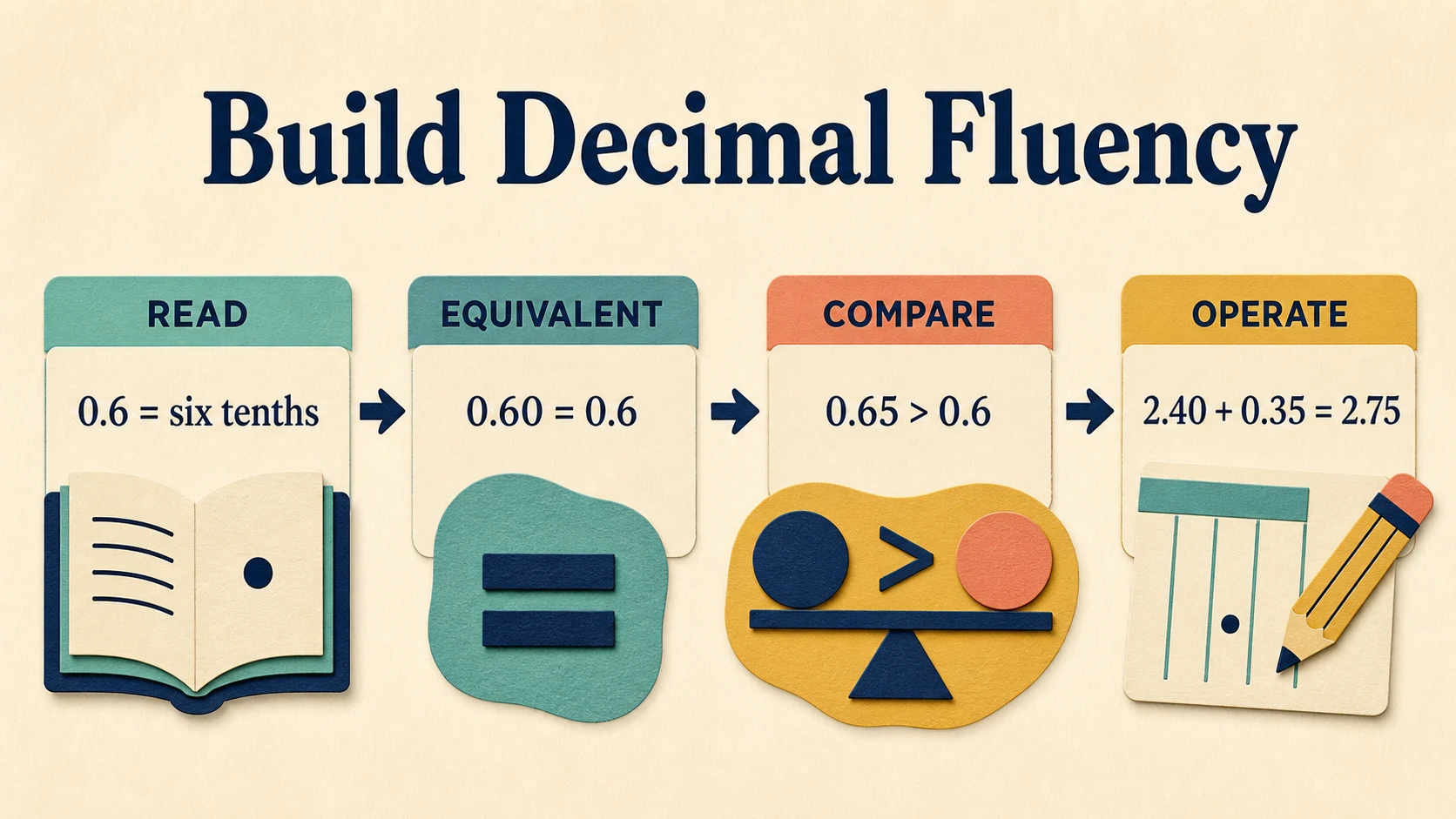
Move forward when the learner can represent and explain a value, not simply after completing a page.
The two IES mathematics practice guides provide high-level instructional framing around purposeful mathematical teaching, including the use of representations and attention to what learners understand. The later IES guide for assisting students who struggle with mathematics addresses systematic instruction and the use of student performance to guide support. These sources do not evaluate WorksheetWise or prescribe one decimal sequence for every learner.
Concrete and visual models that make decimals meaningful
Base-ten blocks
Assign the flat a value of 1 whole. Under that convention:
- One rod represents 0.1, or one tenth.
- One small cube represents 0.01, or one hundredth.
- Ten rods equal one flat.
- Ten small cubes equal one rod.
- One hundred small cubes equal one flat.
Keep the assigned whole consistent throughout an activity. Base-ten pieces do not possess fixed decimal values by themselves; their values depend on which piece has been designated as one whole.
Build 0.34 with 3 rods and 4 small cubes. Ask the learner to say:
Three tenths and four hundredths make thirty-four hundredths, or 0.34.
That explanation connects the model to both place-value units.
Tenths strips and hundredths grids
A tenths strip is useful for numbers such as 0.2, 0.7, and 1.0. A hundredths grid supports values such as 0.23 and 0.68.
To compare 0.4 with 0.36, represent 0.4 as 4 shaded tenths. Divide those tenths into hundredths, producing 40 shaded hundredths. The comparison becomes 40/100>36/100, so 0.4>0.36.
Use grids carefully: each grid must represent the same-sized whole. Comparing shaded portions of differently sized wholes can obscure the intended place-value relationship.
Number lines
Number lines show decimal magnitude and order. Mark 0 and 1, divide the interval into 10 equal parts, and locate 0.3. To place 0.34, enlarge the interval from 0.3 to 0.4 and divide it into 10 equal steps. The fourth small step after 0.3 is 0.34.
Number lines are particularly helpful when a learner treats decimals as disconnected strings of digits. The positions make it visible that 0.09 is close to 0, while 0.9 is close to 1.
Money as a supporting context
If one dollar is treated as the whole, one dime is 0.10 of a dollar and one cent is 0.01 of a dollar. Thus 25 cents can be written as $0.25.
Money is useful, but it should not be the only model. Dollar notation normally displays two digits after the decimal point, whereas general decimal notation allows 0.5 as well as 0.50. Pair money with grids, blocks, and number lines so the learner understands decimal structure beyond prices.
Fully checked worked examples
Example 1: moving from a model to decimal notation
A hundredths grid has 37 of its 100 equal squares shaded. Write the shaded part as a fraction and a decimal.
- There are 37 shaded parts.
- The whole contains 100 equal parts.
- The fraction is 37/100.
- Thirty-seven hundredths is written 0.37.
Therefore:
10037=0.37
Check: In 0.37, the 3 represents 3 tenths, or 30 hundredths. The 7 represents 7 additional hundredths. 30+7=37 hundredths, matching the model.
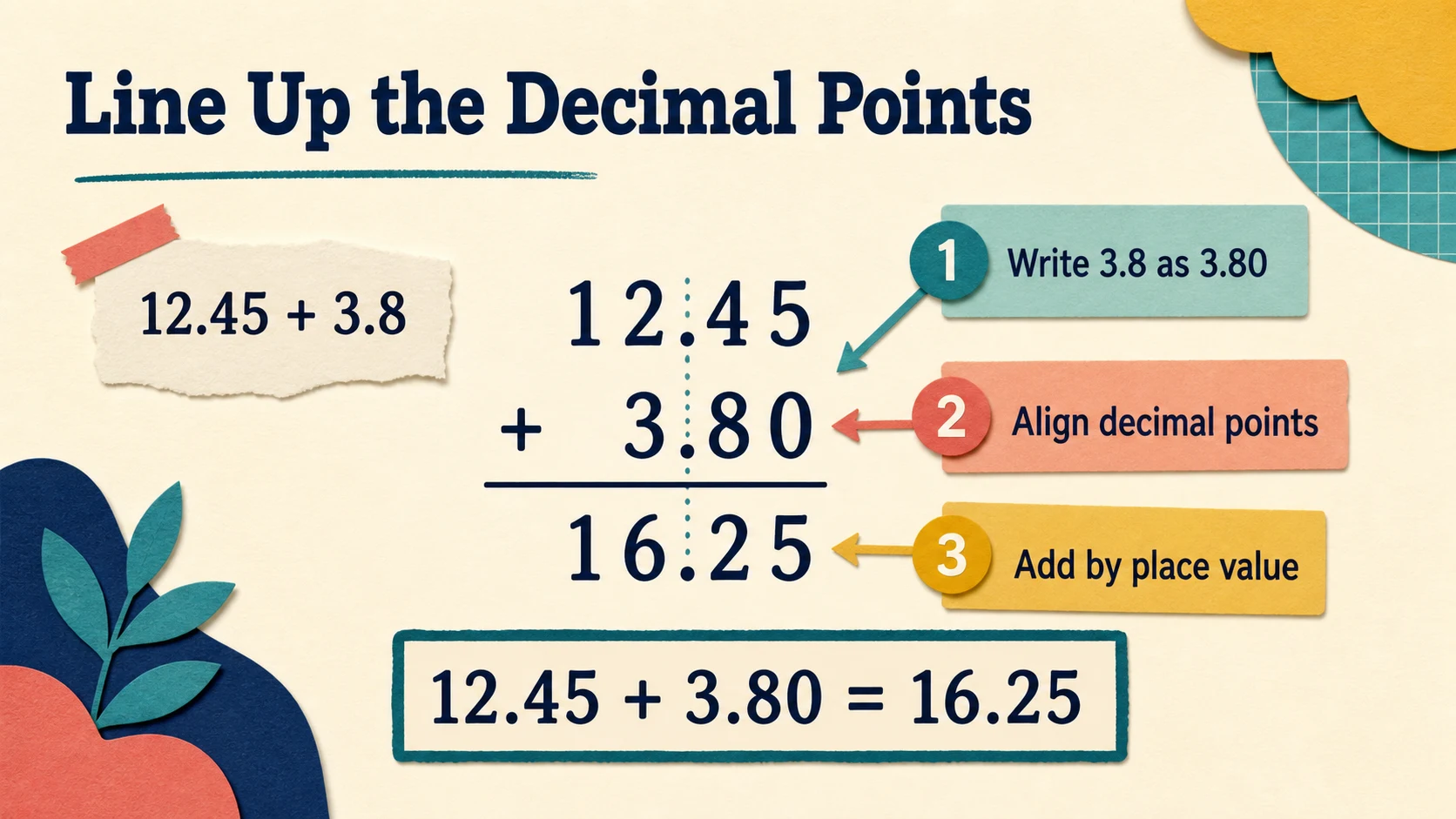
The model, fraction, place-value explanation, and decimal must all describe the same amount.
Example 2: converting tenths to hundredths
Write 6/10 as a decimal, and then write an equivalent fraction with a denominator of 100.
Six tenths is:
106=0.6
Each tenth contains 10 hundredths, so 6 tenths contain 6×10=60 hundredths:
106=10060=0.60
Therefore:
0.6=0.60
Check: Both numbers show 6 tenths. The final zero adds no hundredths, so it does not change the value.
Example 3: comparing a shorter and a longer decimal
Compare 0.4 and 0.36.
Write both values in hundredths:
0.4=0.40=10040
0.36=10036
Because 40>36:
0.4>0.36
Check with place value: Both numbers have 0 wholes. In the tenths place, 0.4 has 4 tenths while 0.36 has 3 tenths. The first different place is enough to decide the comparison.
Example 4: ordering decimals
Order 0.08, 0.8, 0.18, and 0.81 from least to greatest.
Express each number in hundredths:
0.08=1008
0.8=0.80=10080
0.18=10018
0.81=10081
Order the numerators:
8<18<80<81
Therefore:
0.08<0.18<0.8<0.81
Check: On a number line, 0.08 and 0.18 lie below 0.2, while 0.80 and 0.81 lie near 0.8.
Example 5: writing a decimal from words
Write “two and five hundredths” as a decimal.
- “Two” gives 2 wholes.
- “Five hundredths” gives 0.05, not 0.5.
- Combine the parts: 2+0.05=2.05.
Therefore:
2.05
Check: The tenths digit is 0 and the hundredths digit is 5. Reading the answer by place value gives “two and five hundredths.”
Example 6: a boundary case involving equality
Compare 0.70 and 0.7.
0.70=10070
Simplifying the fraction gives:
10070=107=0.7
Therefore:
0.70=0.7
Check with a grid: Seventy shaded hundredths cover the same area as seven shaded tenths.
Boundary cases and the limits of fourth-grade work
A definitive guide must identify what not to rush.
The central fourth-grade scope in the supplied standards information is decimal notation for tenths and hundredths, conversion from fractions with denominators of 10 or 100, and comparison through hundredths. Reading, writing, comparing, and representing these values should come before reliance on procedures for decimal operations.
Some materials, including the available WorksheetWise practice, include decimal addition, subtraction, and multiplication. Use those items according to the learner’s curriculum and demonstrated readiness. They may serve as preview, review, or extension work, but their presence does not mean every fourth grader should immediately complete all decimal operations independently.
Do not generalize fourth-grade procedures to thousandths without first teaching that place. Likewise, multiplying or dividing decimals calls for reasoning that extends beyond merely counting digits or moving a decimal point. Later work can build on fourth-grade place-value understanding.
Several useful boundary cases reveal whether ideas are secure:
- 0.9 is greater than 0.09.
- 0.40 equals 0.4.
- 1.00 equals 1.
- 0.01 is one hundredth, not one tenth.
- 2.05 is not the same as 2.5.
- No decimal lies “after” another merely because it has more digits.
A short, repeatable lesson routine
A focused lesson can be brief without being superficial. The following routine is an instructional suggestion, not a sourced universal schedule.
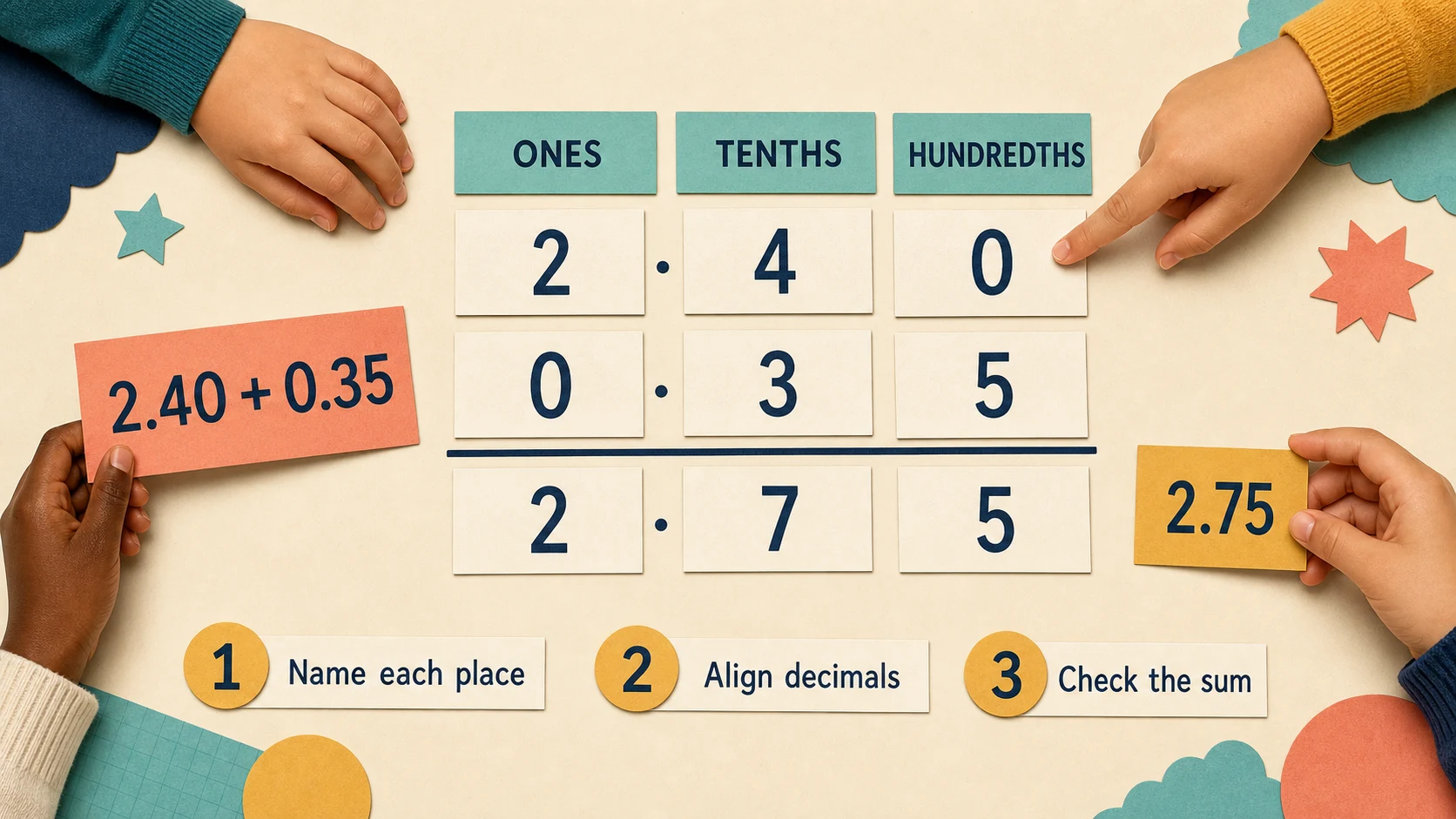
Use the same lesson structure while changing the decimal concept and level of support.
Reconnect with prior knowledge
Spend two or three minutes on one prerequisite. Ask the learner to identify 4/10 on a strip, rename a tenth as hundredths, or state the value of a digit.
Model one idea
Demonstrate one carefully chosen example with a grid, blocks, or a number line. Say what each part represents. Keep the model visible as you write the matching fraction and decimal.
For example:
2 tenths and 6 hundredths=10026=0.26
Solve together
Give a closely related problem. Ask the learner to do one step at a time and explain the choice. Prompt with specific language:
- “What is the whole?”
- “What unit are you counting?”
- “Which place should this digit occupy?”
- “Can you rename both numbers in hundredths?”
Check independently
Offer two to four problems that test the same idea without introducing an unrelated challenge. Include one boundary case, such as 0.5 compared with 0.50.
Close with an explanation
Ask for a spoken or written summary: “How do you know?” or “Show this value another way.” Record the kind of support needed. That evidence determines the next lesson.
Selecting practice that matches the learner
Practice should address a visible need. A longer worksheet is not automatically more useful than six well-selected problems.
Use the 4th Grade Math hub when decimal difficulty appears connected to broader number-sense, place-value, or fraction work. The dedicated Decimals topic guide and resources are more suitable when the prerequisite ideas are present and the learner needs targeted decimal practice.
Practice for initial understanding
Choose items that ask the learner to:
- Match shaded models to fractions and decimals.
- Build decimals with base-ten pieces.
- Label tenths and hundredths on a place-value chart.
- Read decimals aloud using place-value language.
- Convert between n/10, n/100, and decimal notation.
At this stage, avoid pages dominated by mixed operations. The immediate goal is meaning.
Practice for comparison and fluency
Once representations are secure, select:
- Pairs requiring <, >, or =.
- Comparisons involving equivalent forms, such as 0.6 and 0.60.
- Decimals with reversed digits, such as 0.27 and 0.72.
- Short ordering sets.
- Number-line placement.
- Brief contextual problems involving money or measurement.
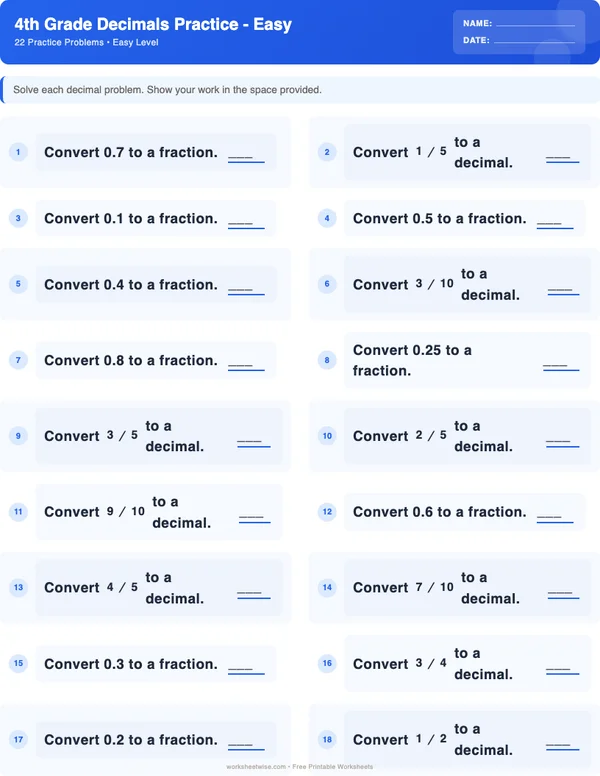
The free easy decimal worksheet contains 22 exercises and an answer key. Its catalogue description includes conversion and decimal operations, so review the actual items and assign only those that fit the learner’s current target.
Practice for consolidation
Use mixed practice only after the learner can identify which idea each problem requires. A focused pack can reduce the need to locate separate pages: the 4th Grade Decimals Worksheet Pack contains 18 worksheets. Select pages rather than treating the pack as a fixed sequence.
Differentiation without lowering the mathematical goal
When the learner needs more support
Keep the concept but reduce the load:
- Work with decimals below 1 before mixing whole numbers and decimals.
- Compare numbers that differ in the tenths place before numbers that differ only in the hundredths place.
- Provide a place-value chart.
- Let the learner build both values before choosing a comparison symbol.
- Use fewer problems and request an explanation for each one.
- Alternate recognition tasks with construction tasks.
If errors persist, return to fractions and equal partitions. Repeating the same symbolic exercise is unlikely to repair a missing model.
When the learner is ready for more challenge
Increase reasoning rather than simply adding more questions:
- Ask for two decimals between 0.3 and 0.4.
- Have the learner create a decimal that is greater than 0.56 but less than 0.60.
- Ask for three representations of 0.75.
- Present an incorrect claim and request a correction.
- Ask the learner to order decimals before checking them on a number line.
- Introduce curriculum-appropriate computation only after an estimate and representation.
For example, the claim 0.42>0.7 can be analyzed by renaming 0.7 as 0.70, comparing 42 hundredths with 70 hundredths, and drawing both values.
Common errors and diagnostic responses
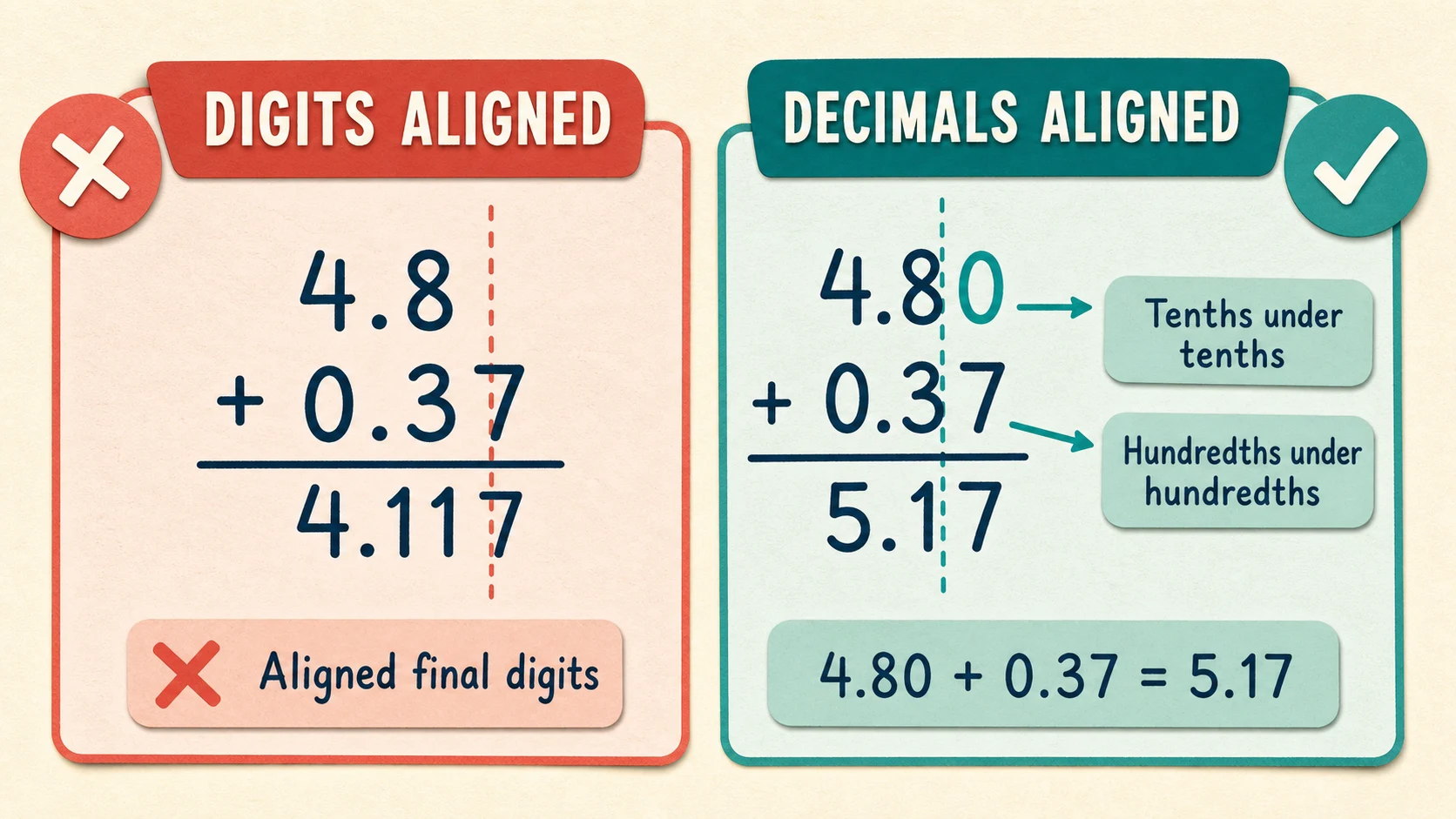
Treat an incorrect answer as evidence about the learner’s current reasoning.
| Observed error |
Likely reasoning to investigate |
Teaching response |
| Says 0.36>0.4 because 36 is greater than 4 |
Treats decimals as whole-number strings |
Rename 0.4 as 0.40; compare both on hundredths grids |
| Reads 0.05 as five tenths |
Confuses tenths and hundredths |
Use a place-value chart and contrast 0.5 with 0.05 |
| Says 0.7<0.70 because 70 is larger than 7 |
Believes more digits always change value |
Build both quantities and connect 7/10 to 70/100 |
| Writes 3/10 as 0.03 |
Places the numerator in the wrong position |
Match denominator 10 to tenths and denominator 100 to hundredths |
| Writes “four and six hundredths” as 4.6 |
Omits the empty tenths position |
Decompose as 4+0/10+6/100, then write 4.06 |
| Reverses < and > |
Symbol issue rather than decimal issue |
First state the comparison in words, then attach the symbol |
| Gives correct symbols but cannot explain |
May be guessing or following a surface rule |
Require a model, common-denominator form, or place-value explanation |
| Aligns computation by the final digit |
Treats notation as ordinary digit strings |
If computation is in scope, align digits by place value and estimate first |
Do not assign a diagnosis from one answer alone. Give two or three related prompts and listen to the explanation. A slip, a symbol confusion, and a persistent place-value misconception need different responses.
Monitoring progress and deciding when to move on
Use a small set of repeated indicators rather than a single worksheet score. Once or twice a week, ask the learner to complete one task from each relevant category:
- Represent a decimal with a model.
- Convert a fraction with denominator 10 or 100.
- Read and write a decimal.
- Compare two decimals and justify the comparison.
- Place or order decimals on a number line.
Record answers in three categories:
- Independent: correct with a valid explanation and no prompt.
- Supported: correct after a model, reminder, or question.
- Not yet secure: incorrect or unable to explain the representation.
Move toward mixed independent work when performance is consistently independent across representations, not only on one familiar page. If comparison is correct but fraction conversion is not, continue the fraction-decimal connection instead of advancing the whole sequence.
Speed is secondary to reliable reasoning at this stage. A learner who pauses to rename 0.8 as 0.80 is using a productive strategy.
A two-week practice plan
This plan assumes short sessions and should be adjusted to the learner’s observed work, local curriculum, and available time. It is not a universal timetable.
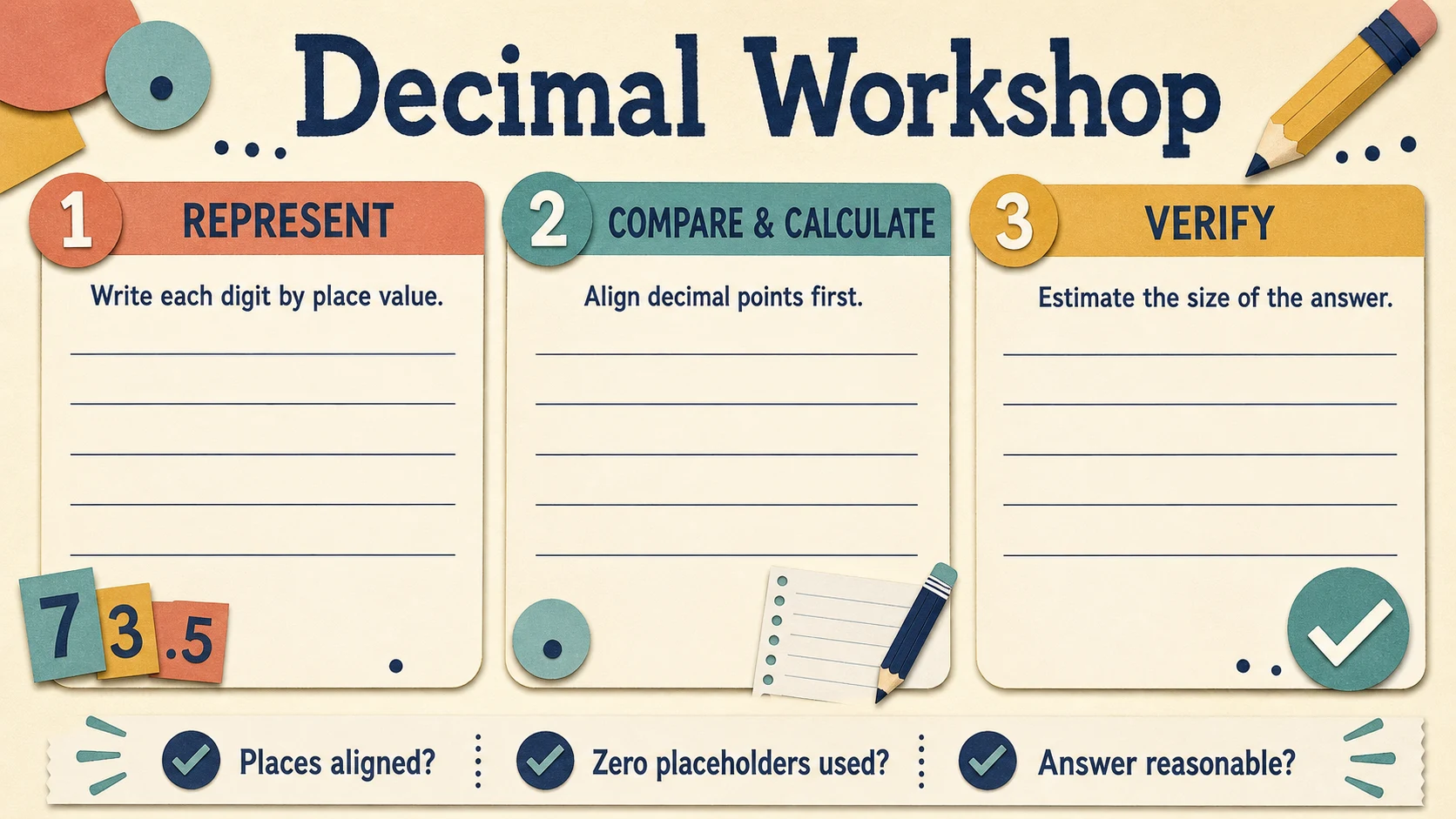
Each day adds one manageable demand while preserving earlier representations.
| Day |
Focus |
Suggested activity |
Evidence to collect |
| 1 |
Prerequisite check |
Review whole-number place value and fractions of one whole |
Can explain numerator, denominator, and adjacent place values |
| 2 |
Tenths |
Build and shade tenths; match them to decimals |
Correctly matches n/10 with 0.n |
| 3 |
Hundredths |
Use a hundredths grid and base-ten pieces |
Identifies tenths and hundredths separately |
| 4 |
Fraction-decimal conversion |
Convert denominators of 10 and 100 |
Places digits correctly |
| 5 |
Read and write |
Move among words, fractions, expanded form, and decimals |
Reads place values precisely |
| 6 |
Review |
Mix Days 2–5 in a short set |
Identifies which representation helps |
| 7 |
Equivalence |
Explore 0.3=0.30, 0.6=0.60, and 1=1.00 |
Explains why final zeros preserve value |
| 8 |
Compare decimals |
Begin with models, then use place value |
Justifies each comparison |
| 9 |
Boundary cases |
Compare 0.9 with 0.09, and 2.05 with 2.5 |
Attends to empty places |
| 10 |
Order decimals |
Use common hundredths and a number line |
Orders three or four values accurately |
| 11 |
Context |
Interpret money or measurement examples |
Connects the context to decimal units |
| 12 |
Targeted correction |
Revisit the most frequent error from earlier work |
Corrects the error with reduced prompting |
| 13 |
Mixed practice |
Combine models, conversion, comparison, and ordering |
Selects a suitable strategy independently |
| 14 |
Short assessment and reflection |
Give five representative tasks and discuss reasoning |
Shows which skills are independent and which need review |
If the learner struggles on Days 3 or 4, repeat model-based work before moving to comparison. If the learner is secure early, deepen explanations and boundary cases instead of racing into later-grade procedures.
Limitations and the next useful step
Worksheets can provide structured practice and an answer key, but a marked page cannot by itself reveal why an answer was chosen. Decimal understanding is better judged through written work, models, and brief explanations. Money contexts may help, yet they do not replace general place-value models. Grade placement also cannot determine pacing without evidence from the learner’s work.
Begin with the free 4th Grade Decimals worksheet. Preview its 22 exercises, choose six to eight that match the learner’s current target, and ask for a model or place-value explanation beside at least two answers. Use those responses—not the number of pages completed—to choose the next lesson.