What 4th Grade Place Value Means
4th Grade Place Value is the study of how a digit’s position determines its value in a multi-digit whole number. A learner should be able to read and write large numbers, explain the ten-to-one relationship between neighboring places, compose and decompose numbers, compare and order them, and round them to a stated place.
The central idea is multiplicative: moving one place to the left makes a digit’s value ten times as great. In 55,000, the left 5 represents 50,000, while the right 5 represents 5,000. The first value is ten times the second.
A learner who understands that structure is better prepared to reason about multi-digit multiplication, division, estimation, and later decimal place value. Correct answers matter, but explanations reveal whether the learner understands the system or is following a memorized procedure.
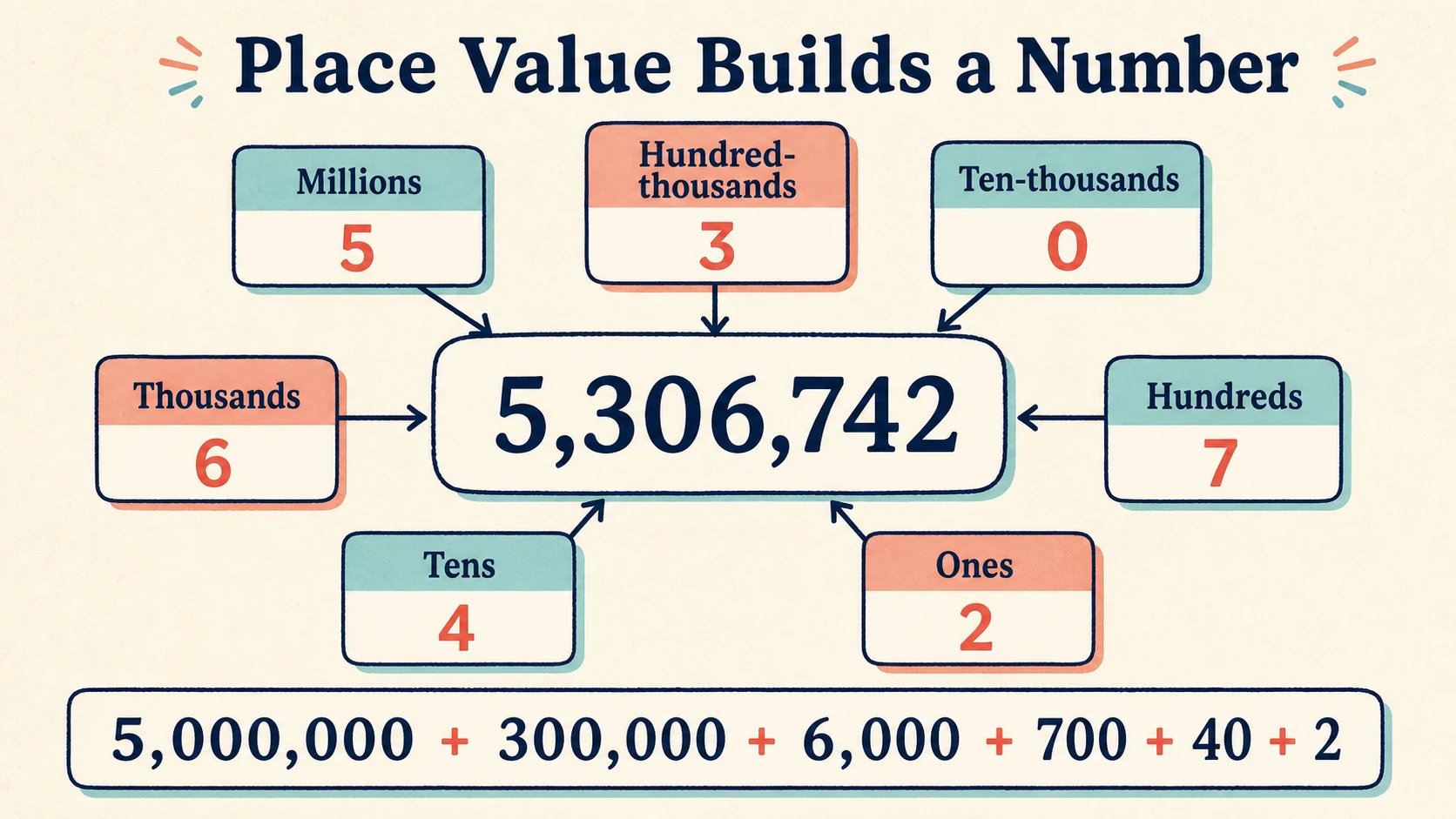
Place relationships connect number names, written forms, comparison, and rounding.
Grade labels describe the intended practice level, not a fixed timetable for every learner. Local curricula and instructional sequences differ. Use the learner’s observed work to decide where to begin, how quickly to move, and when to return to an earlier representation.
Check the Prerequisites Before Increasing Difficulty
Fourth-grade work builds on earlier understanding of ones, tens, hundreds, and thousands. Before assigning a long practice set, use a brief check with a few carefully chosen prompts.
A five-part readiness check
Ask the learner to:
- Read 4,208 aloud.
- State the value of the 2 in 4,208.
- Write 3,000 + 600 + 40 + 9 in standard form.
- Decide whether 5,371 is greater than or less than 5,317.
- Place 6,240 approximately on a number line from 6,000 to 7,000.
The checked answers are:
- Four thousand two hundred eight.
- The 2 represents 200.
- 3,649.
- 5,371 > 5,317 because the thousands and hundreds match, but 7 tens is greater than 1 ten.
- 6,240 belongs between 6,000 and 6,500, a little below the quarter point between 6,000 and 7,000.
Do not treat one mistake as proof that the learner lacks the entire prerequisite. Look for a pattern. A learner who reads 4,208 correctly but says that the 2 is worth 2 may need explicit work on digit value. A learner who writes 3,649 correctly but compares numbers from right to left needs a comparison routine.
Important boundary cases
Zero deserves direct attention because it holds a place even when that place contributes no additional quantity. In 405,072, the zero in the ten-thousands place and the zero in the hundreds place cannot simply be removed. Writing 45,072 changes the values of the other digits.
Also check transitions across a run of nines:
- One more than 9,999 is 10,000.
- One more than 99,999 is 100,000.
- Ten thousands equal one hundred thousand.
If these transitions are confusing, return to bundling or trading before asking for independent work with six-digit numbers.
Follow a Coherent Place Value Progression
The Common Core mathematics standards frame mathematical understanding as more than producing an answer: learners should also explain why their reasoning is valid. Within the supplied catalogue, the fourth-grade place value scope includes the relationships among places and reading, writing, comparing, and rounding multi-digit whole numbers. This guide uses that scope as an instructional organizer, not as a claim of comprehensive standards alignment.
| Stage |
Main learning goal |
Useful prompt |
Evidence to look for |
| 1. Rebuild the structure |
Connect 10 ones, 10 tens, 10 hundreds, and larger units |
“What could we trade these ten units for?” |
The learner names the new unit and preserves the total |
| 2. Identify digit value |
Distinguish a digit from the value it represents |
“What does the 6 mean in 462,310?” |
The learner says 60,000, not merely 6 |
| 3. Read and write numbers |
Connect standard, word, and expanded forms |
“Write 507,024 in two other forms” |
Zeros remain in the correct positions |
| 4. Compose and decompose |
Build the same number in more than one way |
“How else could 4,300 be decomposed?” |
The learner can regroup, such as 43 hundreds |
| 5. Compare and order |
Compare from the greatest place toward the right |
“Where is the first place that differs?” |
The learner bases the decision on place value |
| 6. Round |
Locate a number between consecutive benchmarks |
“Which multiple of 1,000 is nearer?” |
The learner identifies both endpoints before choosing |
| 7. Apply and explain |
Use place value in estimation and computation |
“How do you know your answer is reasonable?” |
The explanation refers to magnitude or place relationships |
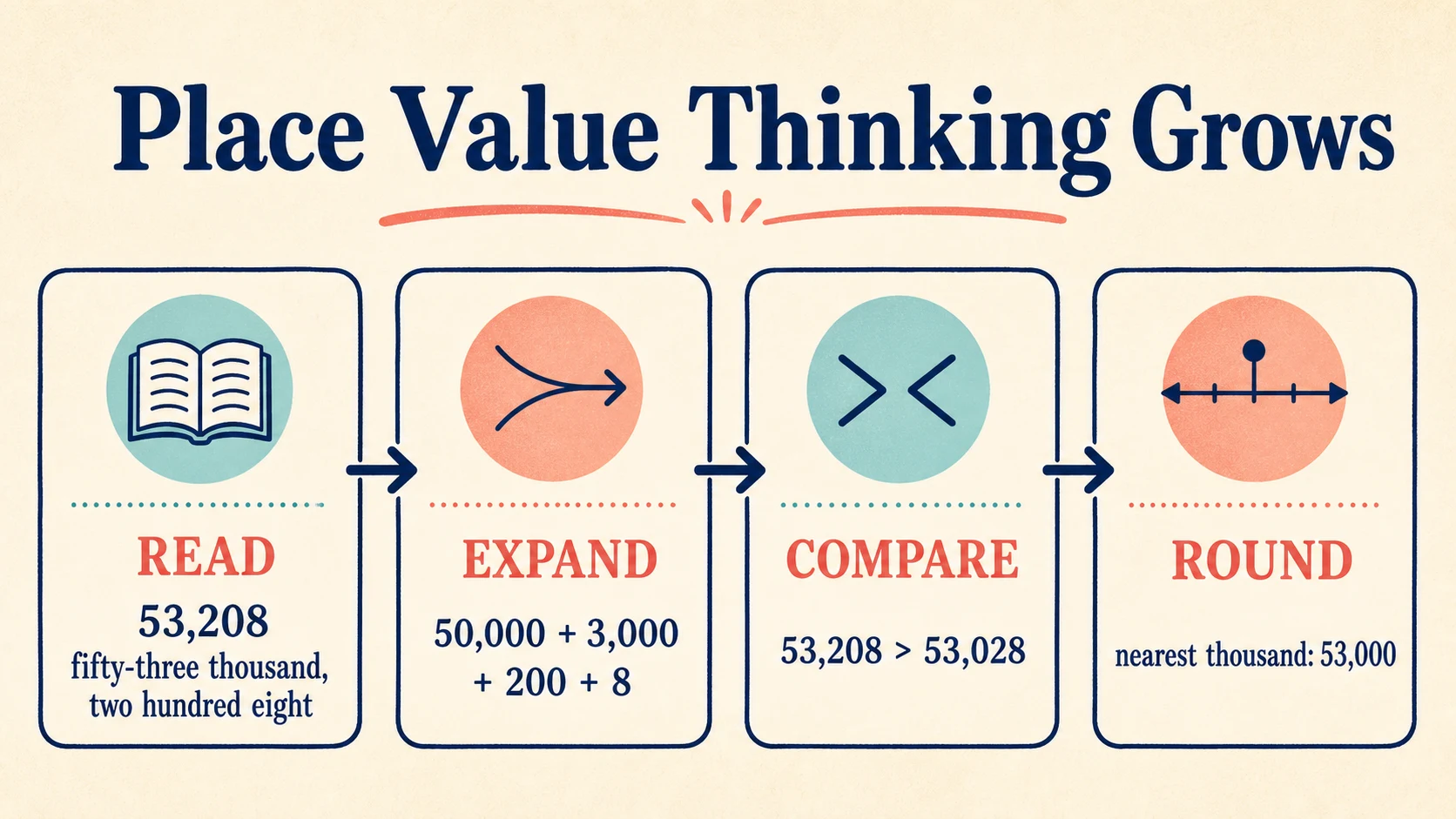
Move forward when explanations are dependable, not merely when one page is complete.
The progression is not a one-way staircase. A learner might compare six-digit numbers accurately but still need a place value chart when writing numbers containing internal zeros. Supply the representation needed for that particular difficulty, then reduce the support as the work becomes secure.
Make the Structure Visible
The IES guide for mathematics intervention in the elementary grades recommends systematic instruction, clear mathematical language, well-chosen representations, and number lines. Those recommendations support using a small, connected set of models instead of presenting unrelated tricks.
Bundles, blocks, and place value disks
Physical or drawn units can show why regrouping works:
- 10 ones can be exchanged for 1 ten.
- 10 tens can be exchanged for 1 hundred.
- 10 hundreds can be exchanged for 1 thousand.
Base-ten blocks are practical for smaller units. For larger numbers, labeled disks or cards are easier to manage. Six disks labeled “10,000” represent 60,000 without requiring an impractical quantity of blocks.
Ask the learner to describe each trade aloud: “Ten thousands have the same value as one ten-thousand.” Precise language helps separate the number of pieces from the value of each piece.
Place value charts
Use columns labeled hundred-thousands, ten-thousands, thousands, hundreds, tens, and ones. Place one digit in each column. For 304,016, the chart should show:
| Hundred-thousands |
Ten-thousands |
Thousands |
Hundreds |
Tens |
Ones |
| 3 |
0 |
4 |
0 |
1 |
6 |
Connect the chart to expanded form:
304,016 = 300,000 + 4,000 + 10 + 6.
The missing ten-thousands and hundreds are represented by zeros in standard form. They may be omitted from the addition expression because adding zero does not change the total.
Number lines for comparison and rounding
A number line makes the target benchmarks visible. To round 73,620 to the nearest thousand, mark 73,000 and 74,000. The midpoint is 73,500. Because 73,620 lies above the midpoint, it is nearer 74,000.
This approach explains the result. A digit-checking procedure can be introduced afterward as a concise record of the same reasoning: identify the rounding place, examine the digit immediately to its right, and decide whether the target digit stays or increases.
Fully Checked Worked Examples
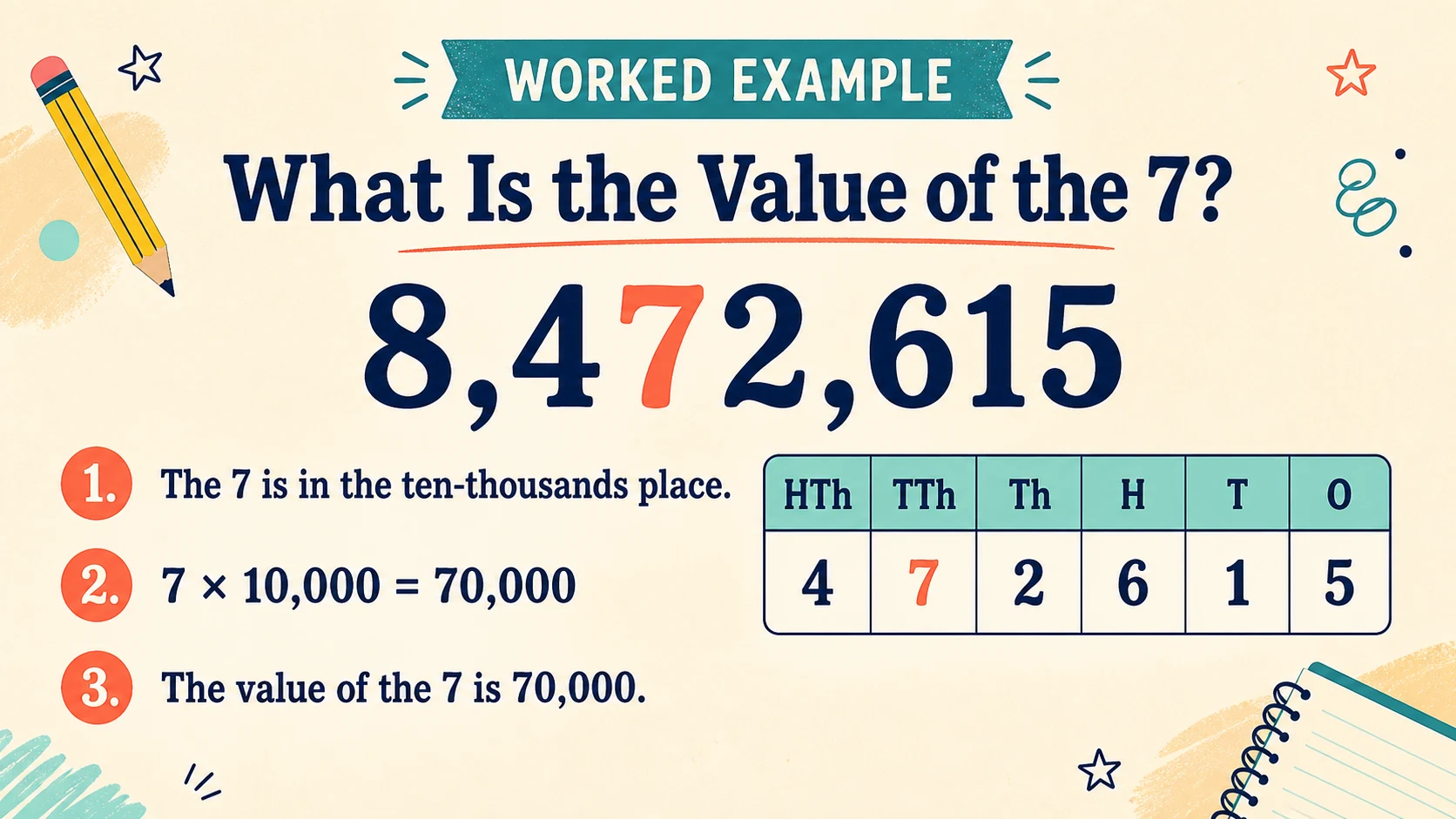
Link each symbolic step to the quantity represented.
Example 1: Find a digit’s value
Problem: What is the value of the 7 in 472,615?
The 7 is in the ten-thousands place.
7 × 10,000 = 70,000.
Answer: The 7 represents 70,000.
Check: Decompose the number:
472,615 = 400,000 + 70,000 + 2,000 + 600 + 10 + 5.
The term containing 7 is 70,000, so the answer is confirmed.
A useful follow-up is to compare the 7 in 472,615 with the 7 in 47,261. The first represents 70,000; the second represents 7,000. Moving the digit one place left multiplies its value by 10.
Example 2: Move among three number forms
Problem: Write 508,040 in expanded form and word form.
Read the places:
- 5 hundred-thousands = 500,000
- 0 ten-thousands
- 8 thousands = 8,000
- 0 hundreds
- 4 tens = 40
- 0 ones
Expanded form: 500,000 + 8,000 + 40.
Word form: five hundred eight thousand forty.
Check: 500,000 + 8,000 = 508,000, and 508,000 + 40 = 508,040.
The zeros are boundary markers. Writing 58,040 would place the 5 in the ten-thousands place rather than the hundred-thousands place.
Example 3: Compose a number from place values
Problem: Write the number containing 6 hundred-thousands, 2 ten-thousands, 0 thousands, 9 hundreds, 3 tens, and 4 ones.
Convert each part:
600,000 + 20,000 + 0 + 900 + 30 + 4 = 620,934.
Answer: 620,934.
Check by decomposing: The digits in 620,934 are 6, 2, 0, 9, 3, and 4 in the requested positions. Adding the nonzero parts gives:
600,000 + 20,000 + 900 + 30 + 4 = 620,934.
Example 4: Compare numbers with a late difference
Problem: Compare 406,918 and 406,891.
Compare from the greatest place:
- Hundred-thousands: 4 = 4
- Ten-thousands: 0 = 0
- Thousands: 6 = 6
- Hundreds: 9 = 9
- Tens: 1 > 9 is false; carefully inspect the actual tens digits
In 406,918, the tens digit is 1. In 406,891, the tens digit is 9. Therefore 1 ten is less than 9 tens.
Answer: 406,918 < 406,891.
Check by subtraction: 406,918 − 406,891 = 27. This appears to contradict the comparison because the result is positive. Recheck the digit positions: 406,918 has 9 hundreds and 1 ten, while 406,891 has 8 hundreds and 9 tens. The first differing place is actually the hundreds place: 9 hundreds > 8 hundreds.
Correct answer: 406,918 > 406,891.
This deliberately checked example shows why comparison must stop at the first differing place. It also demonstrates the value of verifying an answer rather than trusting a hurried first pass.
Example 5: Round to the nearest thousand
Problem: Round 364,501 to the nearest thousand.
The consecutive thousand benchmarks are 364,000 and 365,000. Their midpoint is 364,500. Since 364,501 is one more than the midpoint, it is closer to 365,000.
Answer: 365,000.
Check by distance:
- 364,501 − 364,000 = 501
- 365,000 − 364,501 = 499
Because 499 < 501, the upper benchmark is nearer.
For the boundary value 364,500, the standard whole-number rounding convention also gives 365,000. At 364,499, the result is 364,000.
Example 6: Round when several digits change
Problem: Round 249,999 to the nearest ten thousand.
The surrounding multiples of 10,000 are 240,000 and 250,000. The midpoint is 245,000. Since 249,999 is above that midpoint, it is closer to 250,000.
Answer: 250,000.
Check by distance:
- 249,999 − 240,000 = 9,999
- 250,000 − 249,999 = 1
The upper benchmark is only 1 away. The result changes several written digits, but the number line reasoning remains the same.
Use a Short, Repeatable Lesson Routine
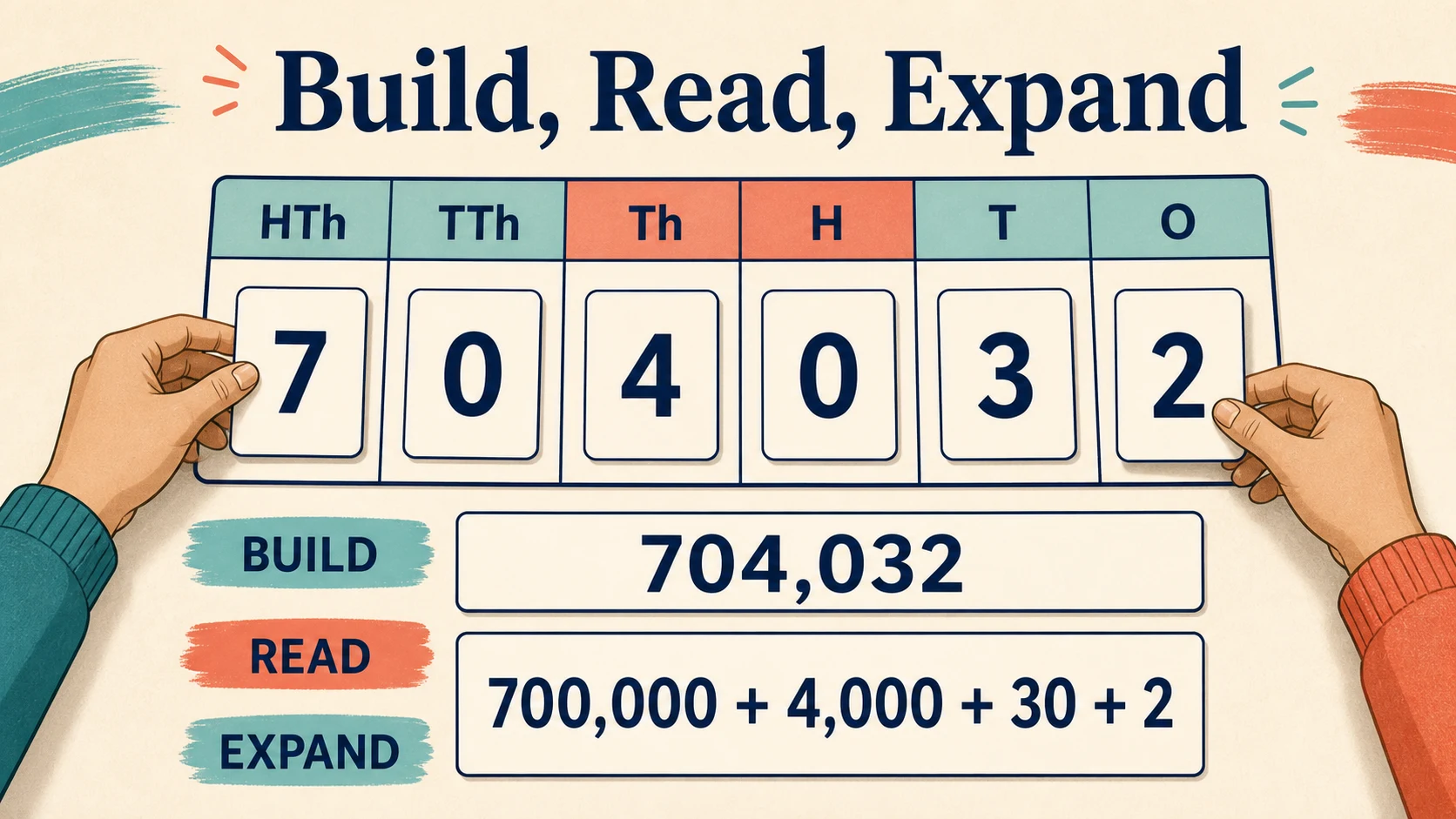
A stable routine leaves attention available for the mathematics.
A lesson can often fit into about 15 to 25 minutes, but this is an instructional suggestion, not a universal timetable. Shorten, extend, or divide the routine according to the learner’s work.
Launch, model, practice, and check
- Retrieve prior knowledge. Give two quick prompts, such as naming the value of a digit and reading a number with a zero.
- State one goal. For example: “Today we will compare numbers by finding the first place where they differ.”
- Model one example. Think aloud with a chart, disks, or number line. Keep the explanation focused on place value.
- Solve one together. Ask the learner to complete the next step and explain it.
- Assign a small independent set. Begin with three to six well-chosen items, not an entire page by default.
- Check immediately. Discuss one correct answer and one error or difficult item.
- Record the next move. Note whether to repeat, remove a support, or increase complexity.
The IES early-mathematics guide addresses preschool through kindergarten rather than fourth grade, so it should not be presented as a fourth-grade program. Its high-level emphasis on developmental progression and monitoring what a learner knows is still a useful planning principle: sequence ideas coherently and let observed performance guide what comes next.
Choose Practice That Matches the Need
A mixed worksheet is useful after the learner has met each skill separately. It is less useful when the learner’s difficulty is still unclear. Start by identifying the target.
Match the task to the evidence
| Observed need |
Choose practice featuring |
Avoid beginning with |
| Confuses digit and value |
Place charts and prompts asking “What value does the digit represent?” |
Large mixed sets |
| Drops internal zeros |
Standard, expanded, and word-form conversions |
Speed-focused copying |
| Compares from the ones side |
Pairs that share several leading digits |
Pairs with obviously different first digits only |
| Rounds every place at once |
One stated rounding place and visible benchmarks |
Mixed-place rounding without models |
| Applies a rule but cannot explain it |
Number lines and distance comparisons |
More repetitions of the same rule |
| Is accurate but hesitant |
Short cumulative sets with fading supports |
Returning to extensive concrete work automatically |
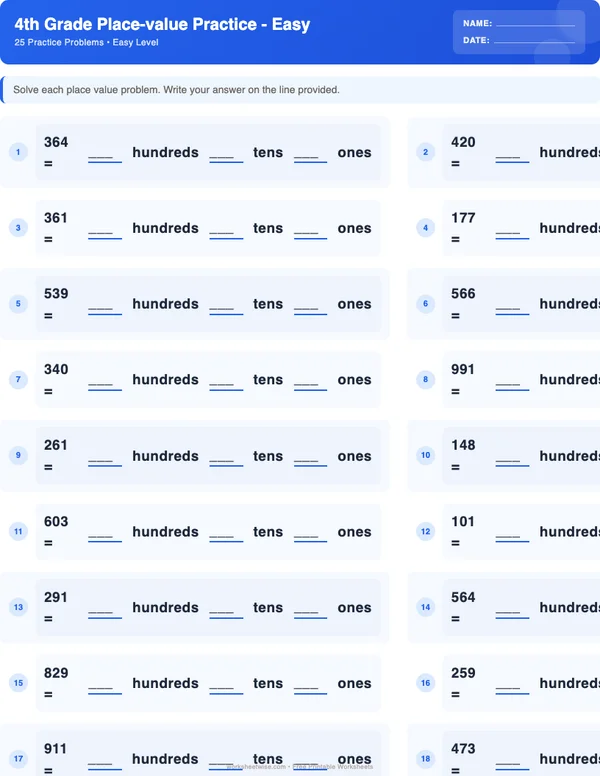
The free 4th Grade Place Value worksheet contains 25 easy-level exercises covering place value, expanded form, number comparison, and rounding, with a separate answer key. It is an appropriate option for initial reinforcement or a mixed review after instruction. It is not a diagnostic instrument, and completing it does not by itself demonstrate mastery.
For broader navigation, use the 4th-grade math collection to connect place value practice with multi-digit computation. The focused place value pack contains 18 worksheets and may suit learners who need more varied practice across several sessions. Select only the amount that serves the current goal.
Diagnose Common Errors Before Correcting Them
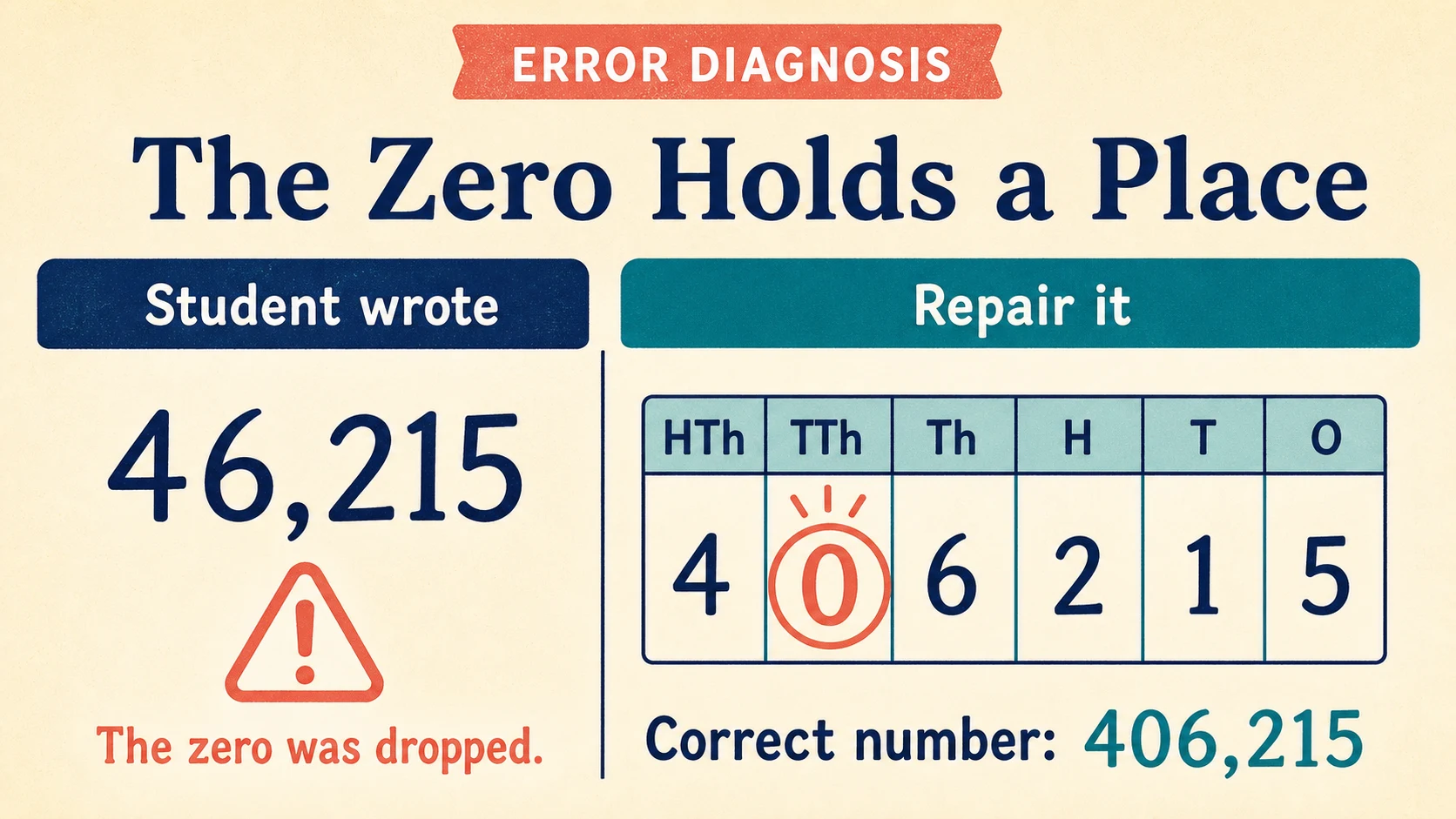
The form of an error often points to the representation that should come next.
Error patterns and teaching responses
| Learner’s work |
Likely issue to investigate |
Diagnostic prompt |
Instructional response |
| Says the 8 in 582,410 is worth 8 |
Names the digit instead of its value |
“Which column contains the 8?” |
Place the number in a labeled chart and connect 8 to 80,000 |
| Writes 500,000 + 8,000 + 40 as 58,040 |
Does not preserve empty places |
“Where will the 5 go?” |
Build the number one place at a time in a chart |
| Says 73,942 < 73,899 because 2 < 9 |
Compares from the right |
“What is the first place from the left that differs?” |
Cover later digits and compare the hundreds first |
| Rounds 46,281 to 50,000 when asked for the nearest hundred |
Attends to the largest place instead of the named place |
“Which multiples of 100 surround the number?” |
Mark 46,200 and 46,300 on a number line |
| Rounds 62,499 to 63,000 to the nearest thousand |
Treats any 9 as a signal to round up |
“What is the midpoint between 62,000 and 63,000?” |
Locate 62,499 below 62,500 |
| Writes “four hundred six thousand eighteen” as 46,018 |
Does not coordinate number language with place positions |
“How many digits should 406 thousand require before the final 18?” |
Partition the spoken number into 406 thousands and 18 |
Do not erase an error before asking the learner to explain it. The explanation distinguishes a place value misconception from a copying error, misread instruction, or isolated calculation slip. Then give a nearby problem that tests the same idea. For example, after correcting 62,499, ask for 62,500 and 62,501 to expose the rounding boundary.
Differentiate Without Changing the Core Idea
Differentiation should change the support, number size, or response demand while preserving the mathematical relationship being taught.
When the learner needs more support
Use fewer places at first, but retain zeros when they are relevant. A learner struggling with 403,070 might first work with 4,070, then 40,070, and finally return to 403,070.
Other useful adjustments include:
- Keep a labeled place value chart visible.
- Let the learner build or draw the number before writing it.
- Present one conversion direction at a time.
- Compare two numbers before ordering four or five.
- Mark both rounding benchmarks and the midpoint.
- Ask for an oral explanation before requiring a written one.
- Mix one previously secure item into each short set.
When the learner is ready for extension
Increase reasoning rather than merely adding digits. Ask the learner to:
- Find three decompositions of 72,400, such as 70,000 + 2,000 + 400, 724 hundreds, and 72 thousands + 4 hundreds.
- Create two numbers that round to 380,000 to the nearest ten thousand.
- Identify the smallest and greatest whole numbers that round to 54,000 to the nearest thousand: 53,500 and 54,499.
- Insert a digit into 4□,218 so the result is greater than 46,218 but less than 49,218. The possible digits are 7 and 8.
- Explain why 600,000 is ten times 60,000 using both an equation and a place value chart.
These tasks remain within place value while requiring justification, constraint checking, and flexible decomposition.
Monitor Understanding and Decide What Comes Next
Use a compact record rather than relying on a general impression. After a session, mark each target as independent, supported, or not yet secure.
A practical monitoring record
Record four pieces of information:
- The exact prompt or task type
- Whether a model was available
- The learner’s answer and explanation
- The next instructional decision
For example:
| Date |
Task |
Evidence |
Next decision |
| Day 3 |
Write 305,060 in expanded form |
Correct with chart; initially included 5,000 instead of 5,000? Rechecked and correctly identified 5,000 is wrong because the 5 is in the thousands place—actually 305,060 contains 5,000, so 300,000 + 5,000 + 60 is correct |
Confirm with a new internal-zero example |
| Day 5 |
Compare 481,209 and 481,290 |
Correct; explained that hundreds match and 0 tens is less than 9 tens |
Remove comparison chart |
| Day 7 |
Round 78,499 to nearest thousand |
Said 79,000; changed to 78,000 after locating midpoint |
Continue number-line work near boundaries |
The first entry illustrates why adult checking matters: the decomposition 300,000 + 5,000 + 60 is correct. A monitoring note should preserve verified mathematics rather than record a mistaken correction.
Move to harder practice when the learner succeeds across different examples and can explain the reasoning without a prompt that gives away the method. If accuracy falls when supports are removed, restore the smallest helpful support. If the same error persists, reduce the number range or return to a concrete or visual model.
A Flexible Two-Week Practice Plan
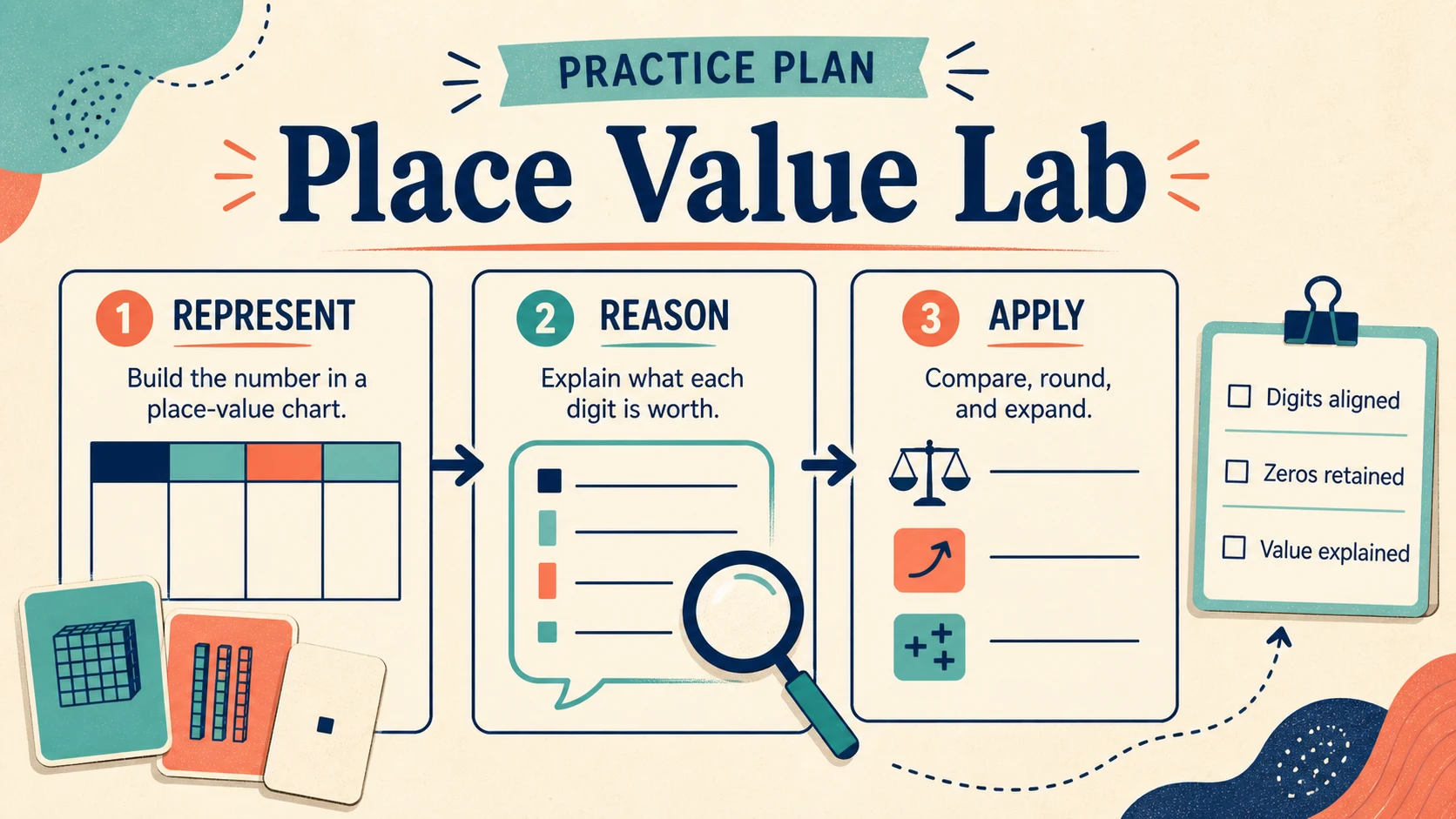
Use this sequence as a planning option, then adjust it from daily evidence.
This plan assumes ten short sessions. It is not a universal schedule, and there is no need to move on because a calendar says so.
| Day |
Focus |
Suggested work |
Quick check |
| 1 |
Readiness and structure |
Complete the five-part prerequisite check; model one ten-to-one trade |
Explain why 30,000 is ten times 3,000 |
| 2 |
Digit value |
Use disks or a chart with four- to six-digit numbers |
Name the value of two repeated digits |
| 3 |
Standard and expanded forms |
Convert in both directions, including internal zeros |
Write 602,040 in expanded form |
| 4 |
Word form |
Match spoken, word, and standard forms |
Explain the role of each zero in 507,008 |
| 5 |
Flexible decomposition |
Rename numbers in more than one way |
Show 4,300 as thousands and hundreds |
| 6 |
Comparing |
Compare pairs with several identical leading digits |
State the first differing place |
| 7 |
Ordering |
Order three or four numbers; justify adjacent comparisons |
Verify the least and greatest numbers |
| 8 |
Rounding with number lines |
Round to one named place; include midpoint cases |
Identify both benchmarks before rounding |
| 9 |
Mixed practice |
Use selected items from the free worksheet or another short set |
Sort errors by skill rather than score alone |
| 10 |
Review and transfer |
Revisit one weak area and solve one explanation task |
Complete a brief no-support check |
On review days, do not simply repeat every missed item. Group errors by cause. Three incorrect answers caused by one misunderstanding require one focused explanation followed by a few new examples, not three unrelated corrections.
Limitations and an Honest Next Step
A worksheet can provide clear practice and an answer key, but it cannot observe how a learner built an answer. It cannot determine whether a wrong response came from a place value misconception, inattention, reading difficulty, or an unclear explanation from the adult. It also cannot guarantee outcomes, replace responsive instruction, or establish that every local curriculum requirement has been covered.
Begin with a short sample rather than assigning all 25 problems automatically. Ask the learner to explain one digit-value item, one form-conversion item, one comparison, and one rounding problem. Use those explanations to select the next lesson.
A practical next action is to open the free 4th Grade Place Value worksheet, choose four to eight problems matching the learner’s current need, and check both the answers and the reasoning. If you need a narrower or newly varied set after that check, use the free worksheet generators to create practice around the specific skill that needs another pass.