What 4th Grade Division Means
The central goal of 4th Grade Division is to find whole-number quotients when a multi-digit dividend is divided by a one-digit divisor, including cases with remainders. A learner should understand division as both equal sharing and equal grouping, connect each calculation to multiplication, and explain what a remainder means in context.
In practical terms, the learner is ready for independent grade-level practice when they can:
- Recognize whether a situation asks for the size of each group or the number of groups.
- Use multiplication facts to solve related division facts.
- decompose a multi-digit dividend by place value.
- Record partial quotients or long-division steps accurately.
- Check a result with multiplication and addition.
- Interpret remainders according to the situation rather than applying one rule automatically.
The expected fourth-grade scope includes dividends of up to four digits and one-digit divisors. The Common Core State Standards for Mathematics identify this whole-number division work within the grade-four number-and-operations progression. Grade labels, however, describe intended practice level; local curricula and teaching sequences differ. The learner’s observed work should determine the starting point and pace.
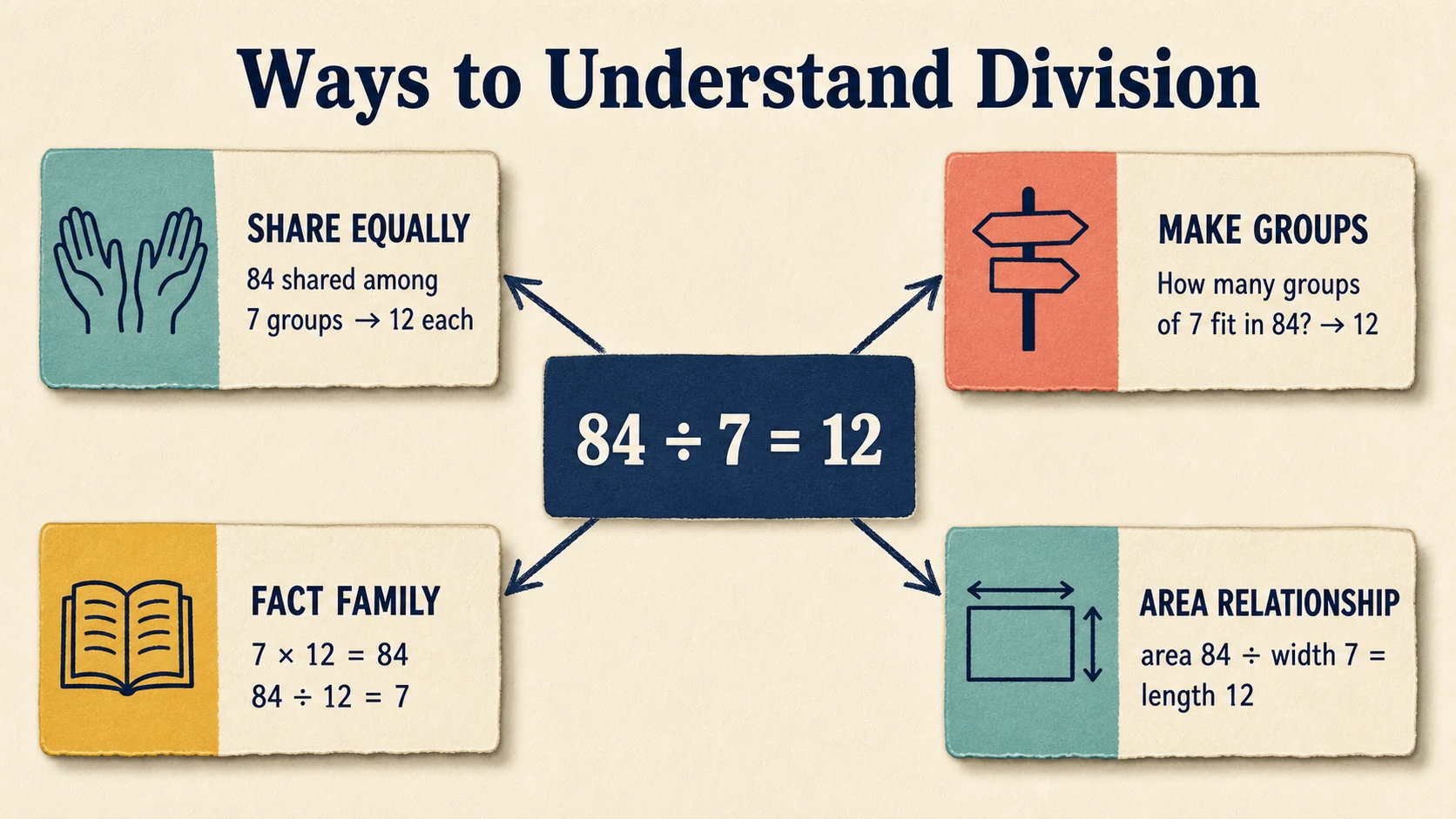
The skill develops from equal groups and multiplication relationships toward multi-digit calculation and remainder interpretation.
Build Meaning Before Teaching a Procedure
Division has two closely related interpretations. Learners need experience with both because a correct calculation does not guarantee a correct reading of a word problem.
Equal sharing
In an equal-sharing, or partitive, situation, the number of groups is known and the size of each group is unknown.
Suppose 24 counters are shared equally among 6 learners. Place one counter at a time into each of six groups until all 24 have been used. Each group receives 4 counters, so:
24÷6=4
Here, 24 is the total, 6 is the number of groups, and 4 is the amount in each group.
Equal grouping
In an equal-grouping, or quotitive, situation, the size of each group is known and the number of groups is unknown.
Suppose 24 counters are arranged in groups of 6. Four complete groups can be made:
24÷6=4
The equation is unchanged, but the 6 now means “six in each group,” while the quotient tells how many groups were made.
Ask the learner to name what each number represents. “Twenty-four divided by six equals four” is a reading of the symbols; “24 counters make 4 groups of 6” shows interpretation.
Concrete and visual models
Begin with objects that can be moved: counters, connecting cubes, buttons, craft sticks, or small blocks. Then represent the same action with drawings before moving to numerals alone.
Useful visual models include:
- Equal-group circles with objects distributed among them.
- Arrays, such as 28 dots arranged in 4 equal rows.
- Number-line jumps, such as counting how many jumps of 6 reach 30.
- Bar diagrams showing a total partitioned into equal sections.
- Area models that split a large dividend into easier multiples of the divisor.
- Place-value drawings that show hundreds, tens, and ones being decomposed or regrouped.
The IES guide on teaching mathematics to young children provides broad instructional support for connecting mathematical ideas with representations and intentional teaching. For a fourth grader, manipulatives are not a sign of failure. They are tools for making the meaning of a calculation visible.
Check the Prerequisites First
A learner does not need flawless multiplication recall before beginning division, but weak prerequisite knowledge can make every problem unnecessarily demanding.
Check these skills with a few short tasks:
| Prerequisite |
Quick check |
What the response reveals |
| Equal groups |
Make 3 equal groups from 18 counters |
Whether division has a concrete meaning |
| Multiplication facts |
Solve 7×6 |
Whether related division facts are accessible |
| Missing factors |
Complete 8×□=56 |
Whether the learner sees division as an unknown-factor problem |
| Place value |
Decompose 372 |
Whether hundreds, tens, and ones can be handled flexibly |
| Subtraction |
Solve 83−56 |
Whether partial products can be removed accurately |
| Estimation |
Decide whether 738÷6 is near 12, 120, or 1,200 |
Whether quotient size is reasonable |
Respond to the pattern, not just the score. A learner who can explain equal groups but hesitates over facts needs multiplication support alongside division. A learner who recalls facts but writes place-value steps incorrectly needs work with decomposition and recording.
The 4th Grade Math collection can help you compare division practice with related multiplication, number-sense, and place-value work.
Use a Grade-Appropriate Progression
A sensible progression moves from meaning to increasingly efficient notation. It is not a rigid timetable. Move ahead when the learner can explain and check the current form; step back when the written procedure becomes detached from quantity.
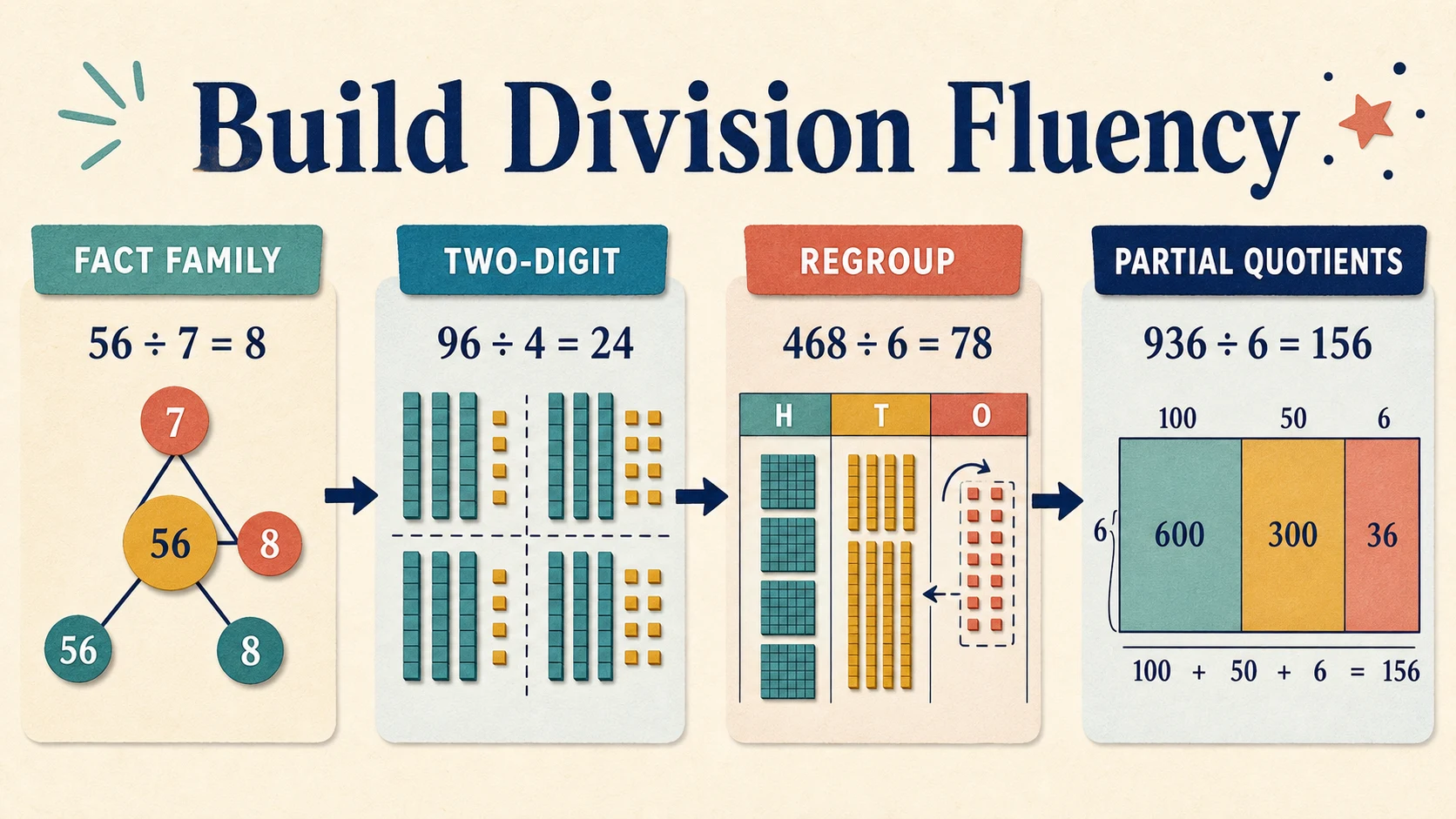
Support should decrease as the learner’s explanations, accuracy, and self-checking become more reliable.
| Stage |
Teaching focus |
Example |
Evidence that the learner is ready to continue |
| 1. Equal groups |
Sharing and grouping with objects |
18÷3 |
Builds or describes equal groups correctly |
| 2. Fact relationships |
Multiplication and division fact families |
7×8=56, so 56÷7=8 |
Uses a related fact without recounting everything |
| 3. Remainders |
Complete groups and leftovers |
29÷4=7 R 1 |
Identifies both quotient and leftover |
| 4. Friendly multiples |
Mental division and decomposition |
84÷4=(80÷4)+(4÷4) |
Splits numbers into divisible parts |
| 5. Partial quotients |
Subtracting known groups |
156÷3 |
Tracks partial quotients and remaining amount |
| 6. Place-value notation |
Long division with meaning |
936÷4 |
Explains divide, multiply, subtract, and bring down |
| 7. Context |
Remainder decisions in word problems |
Seats, boxes, teams, leftovers |
Uses the situation to interpret the result |
| 8. Independent practice |
Mixed calculations and problems |
Facts through four-digit dividends |
Solves, checks, and corrects with limited prompting |
The mnemonic “Divide, Multiply, Subtract, Bring down” can support memory, but it should name understood actions. Before relying on it, ask what is being divided, what the multiplication represents, why a quantity is subtracted, and what value is brought down.
Fully Checked Worked Examples
Example 1: Equal sharing with no remainder
A tutor has 36 counters and shares them equally among 4 learners. How many counters does each learner receive?
Use a known multiplication fact:
4×9=36
Therefore:
36÷4=9
Each learner receives 9 counters.
Check:
9×4=36
The product returns to the original total, so the quotient is correct.
Example 2: Partial quotients with a remainder
Calculate:
158÷6
Take away a convenient multiple of 6:
20×6=120
Subtract:
158−120=38
Take away another multiple:
6×6=36
38−36=2
Combine the partial quotients:
20+6=26
So:
158÷6=26 R 2
Check by reconstructing the dividend:
26×6+2=156+2=158
The remainder is valid because 2<6. A remainder equal to or greater than the divisor would mean another complete group could still be formed.
Example 3: Place-value division with a zero in the quotient
Calculate:
816÷4
Divide 8 hundreds by 4:
8÷4=2
That gives 2 hundreds. Next, divide 1 ten by 4. No complete group of 4 tens can be made, so the tens digit in the quotient is 0. Then combine the remaining 1 ten with 6 ones to make 16 ones:
16÷4=4
Therefore:
816÷4=204
Check:
204×4=816
The zero matters. Writing 24 would give 24×4=96, which is far too small. Estimation also exposes the error: 816 divided by 4 must be a little more than 800 divided by 4, or 200.
Example 4: Four-digit dividend
Calculate:
3,276÷7
One partial-quotients route is:
400×7=2,800
3,276−2,800=476
Then:
60×7=420
476−420=56
Finally:
8×7=56
56−56=0
Add the partial quotients:
400+60+8=468
Therefore:
3,276÷7=468
Check:
468×7=(400×7)+(60×7)+(8×7)
2,800+420+56=3,276
The quotient is correct.
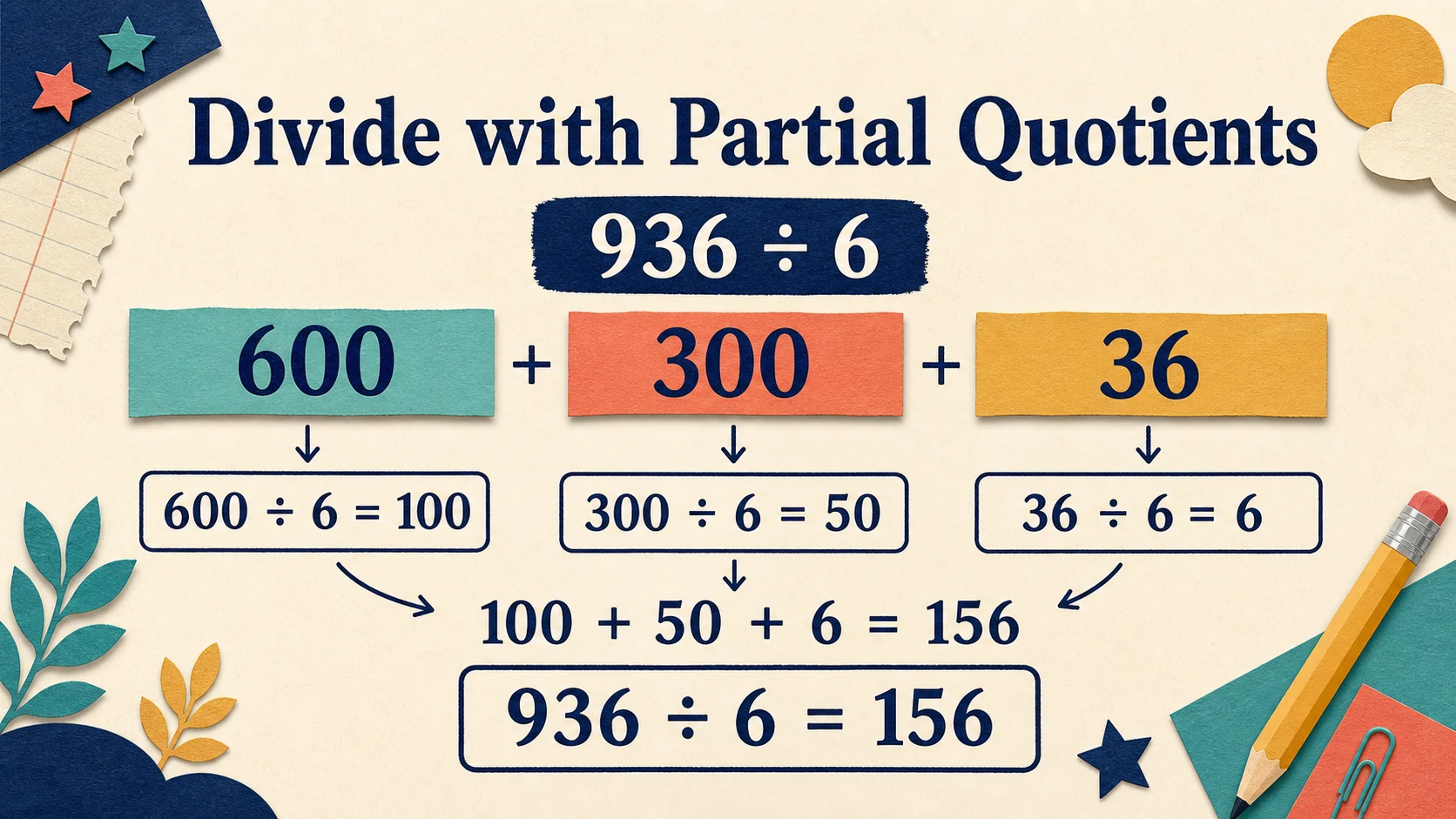
The representation, written calculation, and multiplication check should describe the same quantities.
Example 5: A remainder that requires rounding up
Twenty-five learners are traveling in vans. Each van holds 6 learners. How many vans are needed?
First calculate:
25÷6=4 R 1
Four full vans carry:
4×6=24
One learner remains. That learner still needs a seat, so another van is required. The answer is 5 vans, not “4 remainder 1.”
Check:
- Four vans provide 24 seats, which is insufficient.
- Five vans provide 30 seats, which is enough.
Example 6: A remainder that stays as a leftover
Twenty-five stickers are placed into complete packs of 6. How many complete packs can be made, and how many stickers remain?
25÷6=4 R 1
The answer is 4 complete packs with 1 sticker left over. Rounding up to 5 packs would be incorrect because there are not enough stickers to fill a fifth pack.
These last two examples use the same calculation. Context changes the appropriate answer.
Teach With a Short, Repeatable Routine
A focused lesson can be brief. Ten to twenty minutes may be enough for one teaching point, but this is an instructional suggestion rather than a universal timetable. Extend, shorten, or repeat the lesson according to the learner’s work.
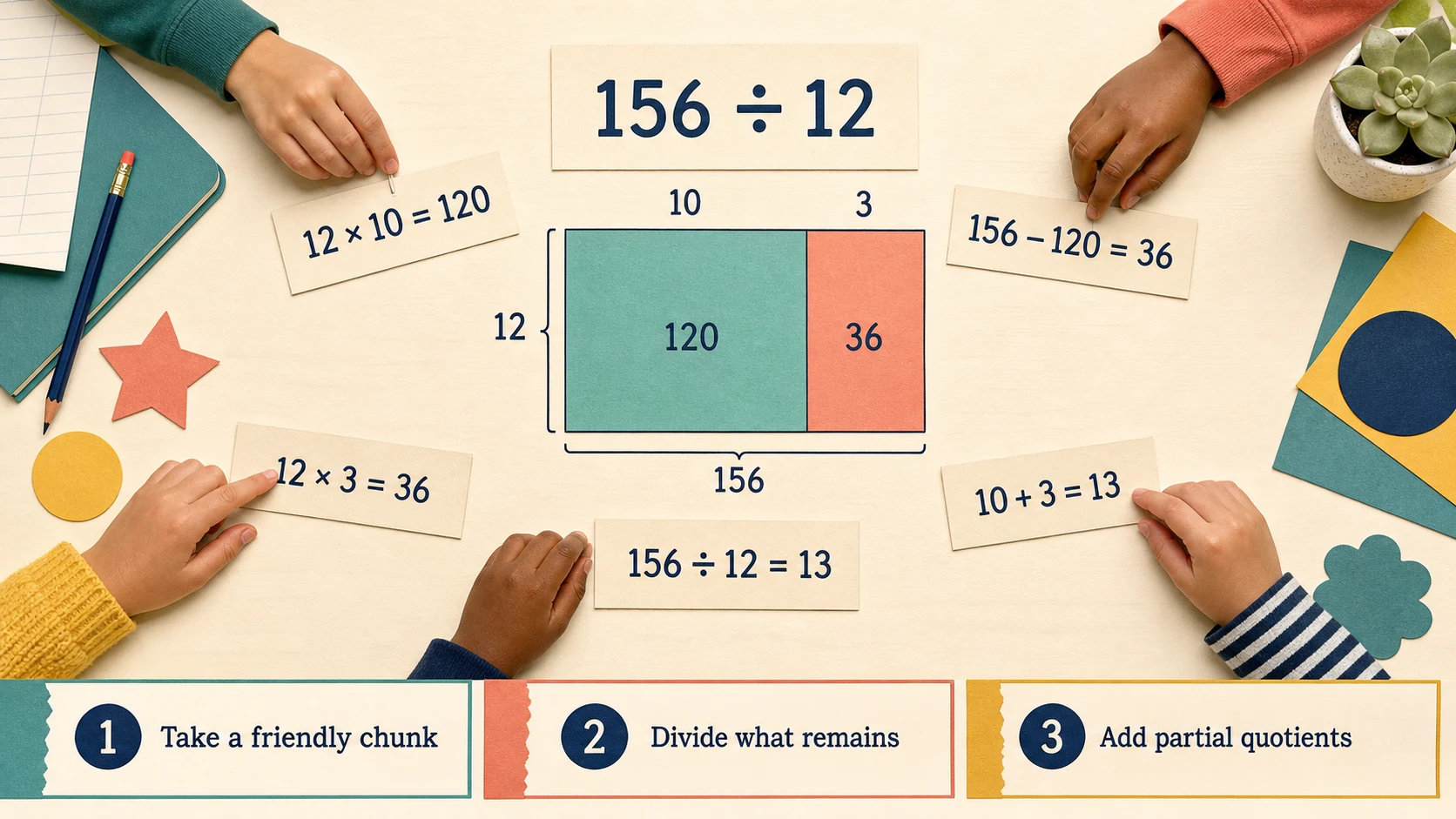
Each lesson connects prior knowledge, a visible model, guided reasoning, independent work, and a final check.
1. Retrieve a useful fact
Spend two or three minutes on multiplication and related division facts. For example:
6×7=42,42÷6=7,42÷7=6
Keep this focused on facts needed in the day’s problems.
2. Model one problem
Use counters, a diagram, an area model, or partial quotients. Speak precisely: “I am removing 30 groups of 4, which accounts for 120.”
3. Solve one together
Ask the learner to choose the next helpful multiple, explain a subtraction, or estimate the quotient. Supply a prompt when necessary, then reduce help.
4. Assign a small independent set
Three to six carefully chosen problems usually reveal more than a long page completed with fading attention. Include one familiar problem, one current target, and one transfer problem.
5. Check and explain
Have the learner verify one answer using:
divisor×quotient+remainder=dividend
End by asking for one sentence about the strategy or one correction to an error.
The IES practice guide for assisting students struggling with mathematics offers high-level guidance on systematic instruction, clear mathematical language, representations, and monitoring learner progress. Those principles can inform the routine, but they do not prescribe one schedule for every child.
Choose Practice by Evidence, Not Page Count
The best next practice set targets a visible need without mixing in so many demands that the cause of an error becomes unclear.
Use fact-family and mental-math practice when the learner:
- Repeatedly counts groups one by one.
- Cannot connect 48÷6 with 6×8.
- Understands models but calculates slowly because facts are inaccessible.
Use concrete or pictorial problems when the learner:
- Can perform written steps but cannot explain the quotient.
- Confuses number of groups with amount in each group.
- Treats a remainder as an arbitrary symbol.
Use partial quotients when the learner:
- Understands repeated subtraction but needs a more efficient method.
- Knows useful multiples such as 20×6 or 50×4.
- Loses the meaning of place value in compact long division.
Use long-division practice when the learner:
- Can estimate the answer’s size.
- Understands why multiples of the divisor are subtracted.
- Can regroup across place values.
- Is ready to make the recording more efficient.
Use word problems when the calculation is reasonably secure. Vary whether the divisor, quotient, number of groups, or group size is unknown. Include situations in which the remainder is reported, ignored, or causes the answer to round up.
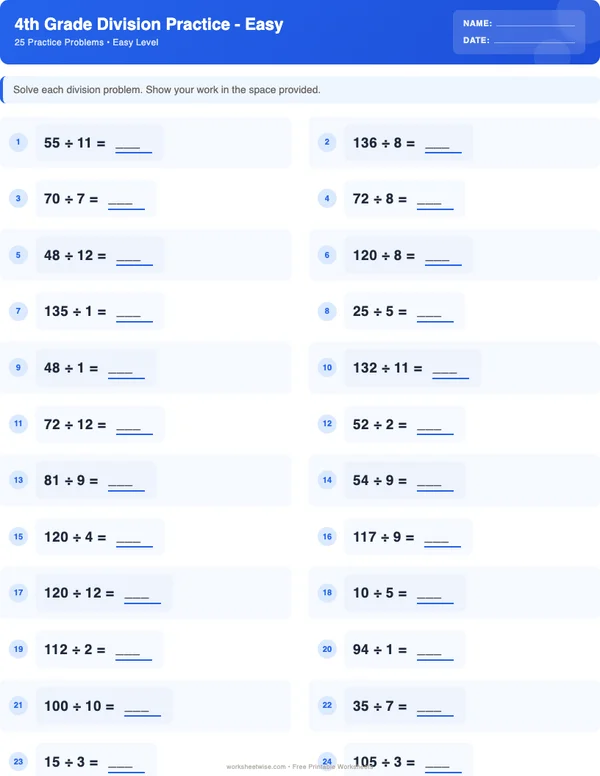
The free easy 4th Grade Division worksheet contains 25 exercises covering division facts, long division, mental math, number sense, and remainders. It includes a separate answer key. Use a selected portion if the learner needs focused observation; completing all 25 problems is not automatically better.
For broader sequencing, compare the Division topic guide and resources or the 4th Grade worksheet hub.
Diagnose Common Errors Precisely
Correcting every mistake with “try again” gives the learner too little information. Identify the smallest broken step and teach that step directly.
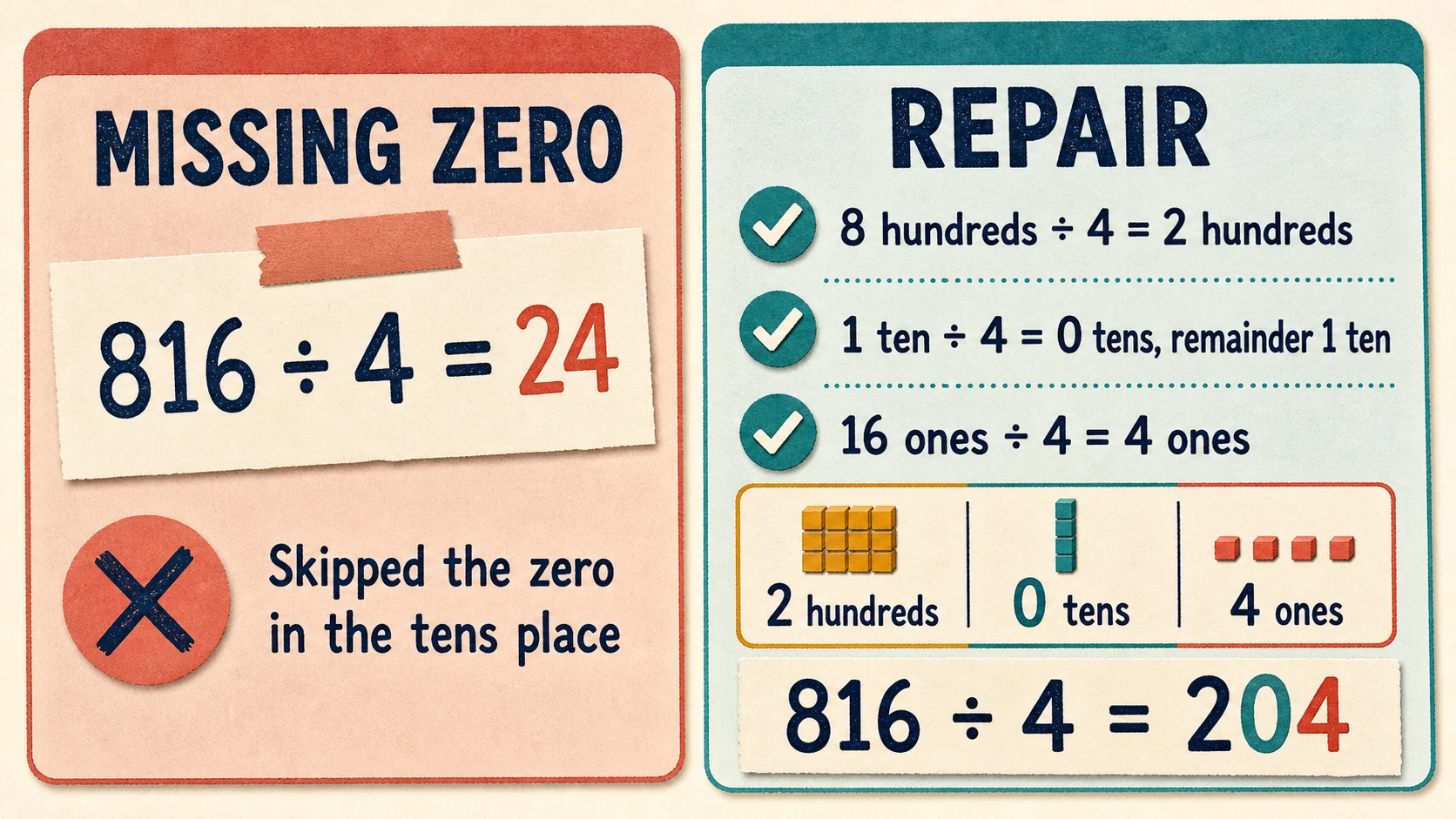
An error pattern points to a teaching response; one isolated slip may only require a check.
| Observed error |
Likely issue to investigate |
Teaching response |
| 42÷6=6 |
Weak or confused fact relationship |
Rebuild 6×7=42 with an array and write the fact family |
| Treats 20÷5 as 20−5 |
Division lacks an equal-groups meaning |
Make groups of 5 and count the groups |
| Writes 816÷4=24 |
Omits a zero in the quotient |
Use place-value columns and compare the result with an estimate |
| Chooses a multiple larger than the amount available |
Quotient digit or partial quotient is not being checked |
List nearby multiples of the divisor before subtracting |
| Produces a remainder of 7 when dividing by 6 |
Does not understand the remainder boundary |
Make another group of 6 and show why the quotient must increase |
| Always rounds a remainder up |
Applies a rule without reading the context |
Compare a seating problem with a complete-packs problem |
| Brings down a digit but cannot explain why |
Procedure has become detached from place value |
Expand the dividend and model the regrouping |
| Gets a plausible quotient but cannot verify it |
Checking routine is absent |
Multiply the divisor and quotient, then add the remainder |
Distinguish conceptual errors from recording slips. If a learner explains 936÷4=234 correctly but copies one digit incorrectly, address careful recording. If the learner cannot explain why the quotient is near 200, return to estimation and place value.
Differentiate Without Changing the Mathematical Goal
Differentiation should adjust access, representation, number choice, or amount of support. It need not replace division with unrelated work.
When the learner needs more support
- Use smaller dividends while preserving the same model.
- Provide a multiplication chart temporarily.
- Color-code dividend, divisor, quotient, and remainder.
- Supply an area-model frame or partial-quotients table.
- Let the learner build the problem with counters before writing.
- Present one problem at a time.
- Ask for an estimate before the exact calculation.
- Mix fewer problem types within one practice set.
A learner solving 156÷3 with partial quotients is working on the same central idea as one using compact notation. The representation is more supportive, but the quotient is not made easier by guessing or by removing reasoning.
When the learner is ready for extension
- Ask for two valid solution methods.
- Compare partial quotients with long division.
- Ask the learner to create a word problem for 43÷5.
- Present an incorrect solution for analysis.
- Hide one value in a division equation.
- Require an estimate and an exact answer.
- Compare two contexts that interpret the same remainder differently.
Extension should deepen explanation and flexibility before increasing number size beyond the intended scope.
Important boundary cases
Include cases that expose whether the learner understands the structure:
- A quotient digit of zero, as in 816÷4=204.
- A remainder of zero.
- A remainder one less than the divisor.
- A divisor of 1.
- A dividend smaller than the divisor in a contextual grouping problem.
- A word problem where only complete groups count.
- A word problem where an incomplete group still requires another container or vehicle.
For whole-number quotient-and-remainder work, the remainder must satisfy:
0≤remainder<divisor
Monitor Progress and Decide What Comes Next
Monitor a small set of indicators rather than relying only on percentage correct. Record what the learner can do independently, what requires prompting, and which error patterns recur.
A compact weekly record might include:
| Indicator |
Beginning |
Developing |
Secure |
| Explains equal sharing and grouping |
Needs a model and prompts |
Explains one interpretation |
Explains and compares both |
| Uses related multiplication facts |
Counts repeatedly |
Uses some facts |
Selects facts efficiently |
| Estimates quotient size |
Guess is unreasonable |
Chooses a reasonable range |
Uses estimate to catch errors |
| Solves multi-digit division |
Needs step-by-step support |
Occasional place-value errors |
Accurate with an understood method |
| Checks answers |
Rarely checks |
Checks when prompted |
Checks independently |
| Interprets remainders |
Uses one rule |
Correct in familiar contexts |
Explains decisions across contexts |
Advance when accuracy, explanation, and independence improve together. Do not advance solely because a worksheet is complete. If errors cluster around multiplication facts, address those facts. If facts are strong but notation is unstable, keep the numbers manageable and teach the recording. If calculation is accurate but word-problem answers are inappropriate, focus on units and context.
Follow a Two-Week Practice Plan
This plan assumes short sessions on ten practice days. It is a flexible instructional example, not a universal timetable. Repeat a day, reduce the problem count, or return to a model when the learner’s work indicates that more support is needed.
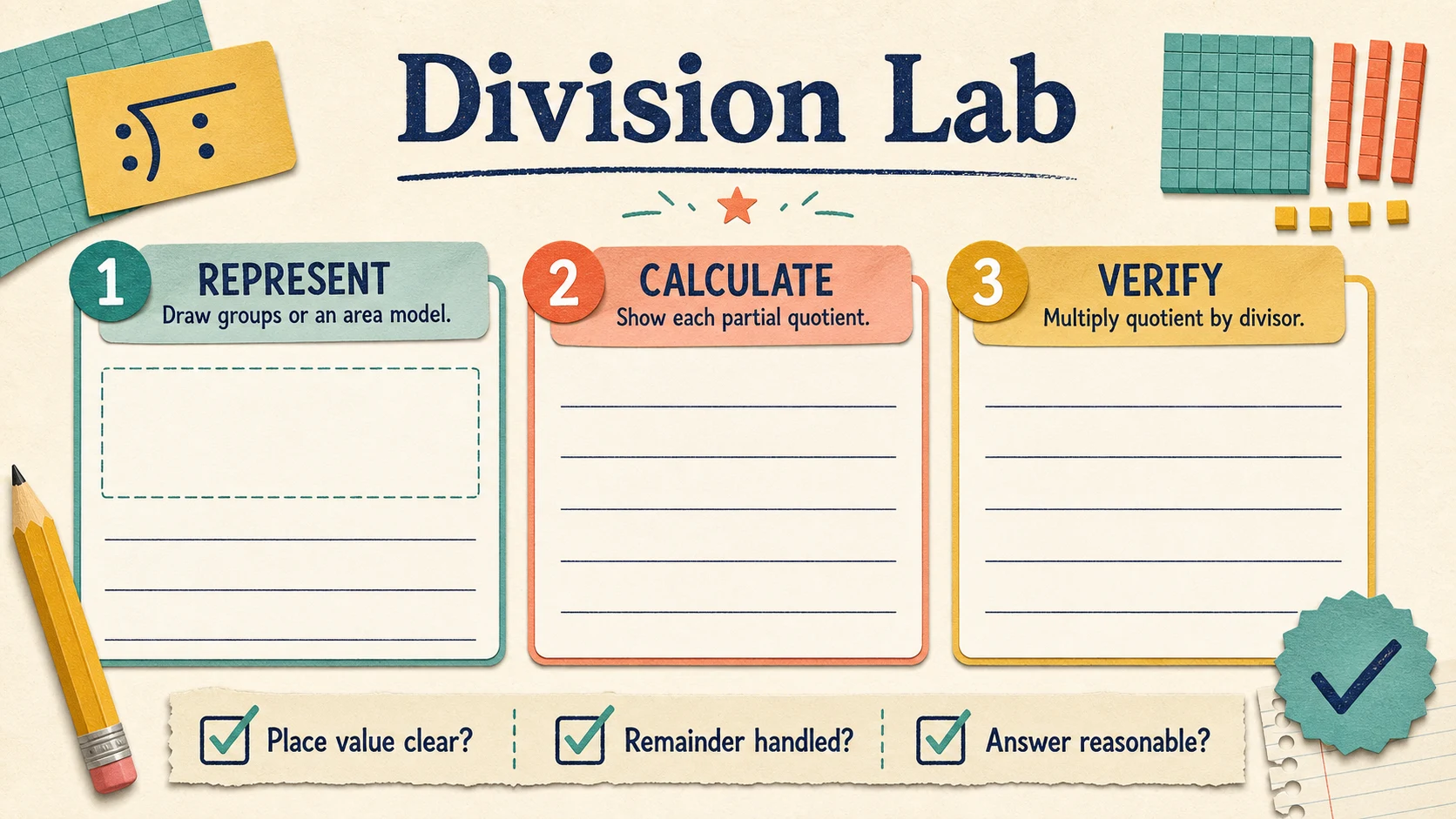
The plan alternates instruction, practice, explanation, and review instead of treating division as one long drill.
| Day |
Main focus |
Suggested work |
Evidence to collect |
| 1 |
Equal sharing and grouping |
Build and draw 18÷3, 24÷6, and 28÷4 |
Can the learner identify what the quotient represents? |
| 2 |
Fact families |
Connect six multiplication facts to twelve division facts |
Which facts are retrieved and which are rebuilt? |
| 3 |
Remainders |
Model 17÷5, 22÷4, and 29÷6 |
Is every remainder smaller than its divisor? |
| 4 |
Friendly decomposition |
Solve problems such as 84÷4 and 96÷3 by splitting dividends |
Can the learner choose divisible parts? |
| 5 |
Review and explain |
Mix facts, models, and two-digit dividends; correct one sample error |
Can the learner explain a correction? |
| 6 |
Partial quotients |
Solve three-digit dividends with one-digit divisors |
Are partial quotients combined accurately? |
| 7 |
Place-value notation |
Connect one partial-quotients solution to long division |
Can each written step be explained? |
| 8 |
Zero and remainder cases |
Include a zero quotient digit and several remainder sizes |
Does estimation catch missing digits? |
| 9 |
Contextual decisions |
Compare seating, packing, sharing, and leftover problems |
Does the answer include the correct unit and remainder decision? |
| 10 |
Independent mixed check |
Use a short mixed set, then have the learner check selected answers |
What is secure, and what needs the next teaching cycle? |
Keep review cumulative but controlled. Two fact questions, two current-skill calculations, and one word problem can be enough to show whether learning is holding. If the learner makes the same conceptual error twice, stop adding problems and reteach with a representation.
Limits and the Honest Next Step
A worksheet can provide structured practice, but it cannot determine why a learner made an error. An answer key confirms results; it does not replace listening to the learner’s explanation. Likewise, one successful page does not establish lasting mastery, and one difficult session does not establish inability.
This guide addresses whole-number division at the intended fourth-grade practice level: equal groups, multiplication relationships, one-digit divisors, multi-digit dividends, long division, mental strategies, and remainders. It does not claim a universal sequence, guaranteed outcomes, comprehensive standards alignment, or child-specific guidance. Local expectations differ, so use the learner’s curriculum and observed work to refine the sequence.
For the next session, choose five to eight items from the free 4th Grade Division worksheet. Ask the learner to estimate, solve, and check each answer. Use the first repeated error—not the number of unfinished questions—to select the following lesson. If more sustained practice is appropriate, the 4th Grade Division Worksheet Pack contains 18 worksheets; for narrowly targeted follow-up, create a fresh set through the free worksheet generators.