What 4th Grade Multiplication Includes
The central goal of 4th Grade Multiplication is to help a learner move from understanding equal groups and multiplication facts to accurately multiplying larger whole numbers. At this practice level, that includes multiplying numbers as large as four digits by one digit and multiplying two-digit numbers by two-digit numbers.
A learner should do more than produce answers. They should be able to:
- Interpret multiplication as equal groups, arrays, and area.
- Recall or efficiently derive multiplication facts.
- Use the commutative, associative, identity, and distributive properties.
- connect an area model to partial products.
- Explain why each partial product has its value.
- Use a written method accurately.
- Estimate or use another calculation to judge whether an answer is reasonable.
- Select multiplication when solving an appropriate word problem.
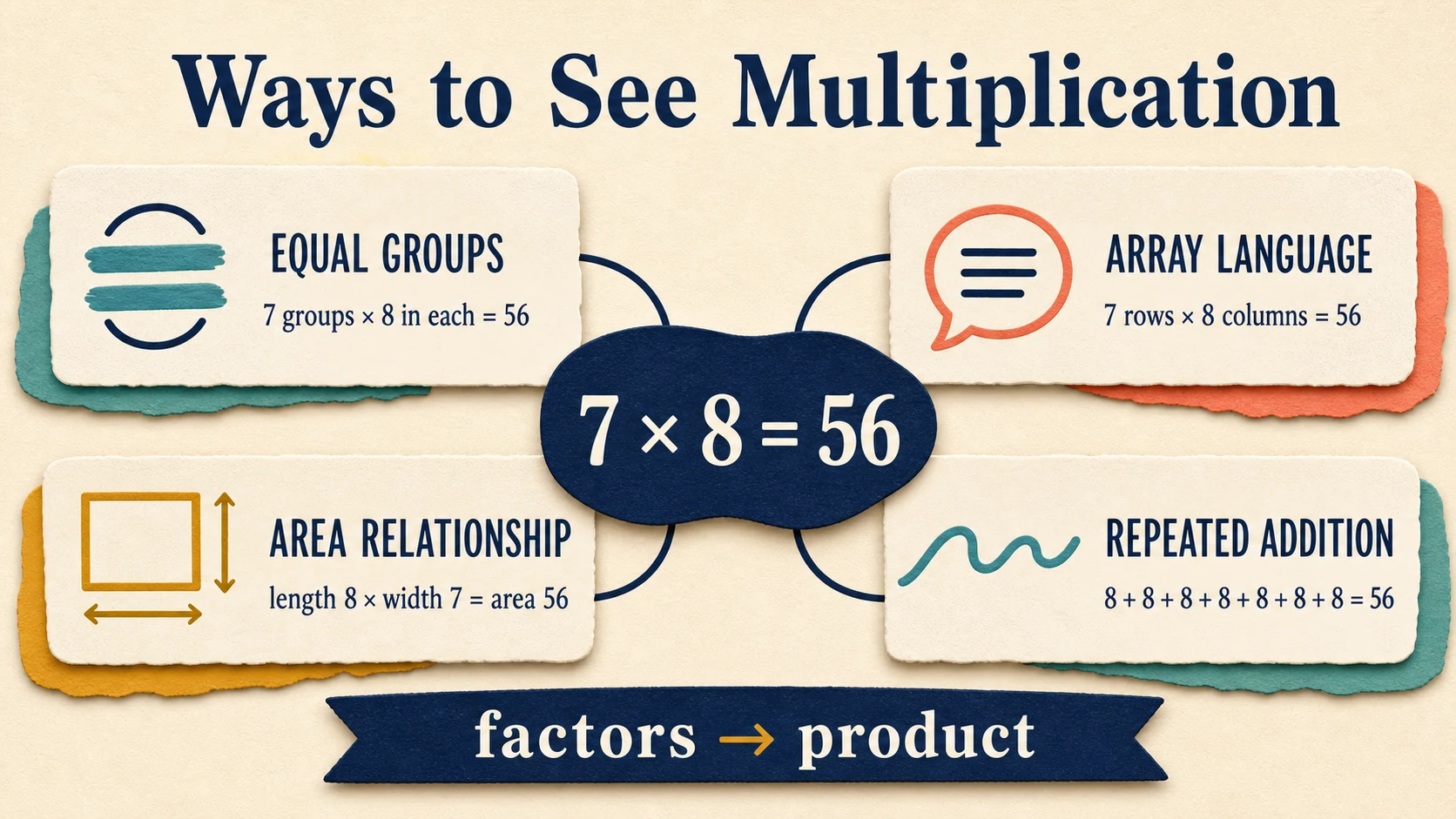
The skill develops from equal groups and fact strategies toward multi-digit calculation and application.
Grade labels describe an intended practice level, not a guarantee that every learner will follow the same timetable. Local curricula and instructional sequences differ. Begin with the learner’s observed work: if facts or place value are causing repeated breakdowns, address those foundations before increasing the size of the factors.
The Common Core mathematics standards provide useful high-level context: mathematical understanding and procedural skill both matter, and learners should be able to explain reasoning at an appropriate level. This guide does not claim comprehensive alignment with every state, district, or homeschool sequence.
Prerequisites to Check Before Teaching Larger Products
A short diagnostic is more useful than assuming that a learner is ready because of age or grade. Ask for written work and an explanation. Avoid relying only on whether an answer is correct.
Equal groups and arrays
Give the learner 18 counters and ask for three equal groups. They should form three groups of six and connect the model to 3×6=18.
Next, draw an array with four rows and seven objects in each row. Ask:
- How many rows are there?
- How many objects are in each row?
- Which multiplication equation describes the array?
- Could the same total be arranged another way?
A learner who writes 4+7 may recognize the two visible numbers without understanding that multiplication counts equal groups. Return to physically making and counting groups.
Fact knowledge and fact strategies
Check a small, varied set rather than presenting every fact:
- 6×7
- 8×4
- 9×6
- 3×8
- 5×12
- 7×1
- 11×0
A correct answer is useful, but the method matters. For 6×7, a learner might know 42, double 3×7, or calculate 5×7+1×7. These are all valid signs of connected fact knowledge.
If every harder fact is found by counting by ones, larger multiplication will demand too much attention. Teach facts strategically: begin with multiplication by 0, 1, 2, 5, and 10; connect 3s and 4s to doubling; then derive 6s, 7s, 8s, and 9s by breaking them into known facts. Skip counting can bridge addition and multiplication, but it should not remain the only method.
Place value and addition
Before introducing 326×4, check that the learner can:
- Read 326 as 3 hundreds, 2 tens, and 6 ones.
- Decompose it as 300+20+6.
- Calculate 1,200+80+24.
- Regroup 10 ones as 1 ten and 10 tens as 1 hundred.
- Estimate that 326×4 should be near 300×4=1,200.
A learner can know multiplication facts and still make multi-digit errors because place value or addition is unstable. Diagnose those separately rather than assigning more of the same multiplication problems.
A Grade-Appropriate Teaching Progression
The following progression is an instructional suggestion based on the supplied topic sequence. Move forward when the learner’s explanations and independent work are dependable, not simply when a set number of days has passed.
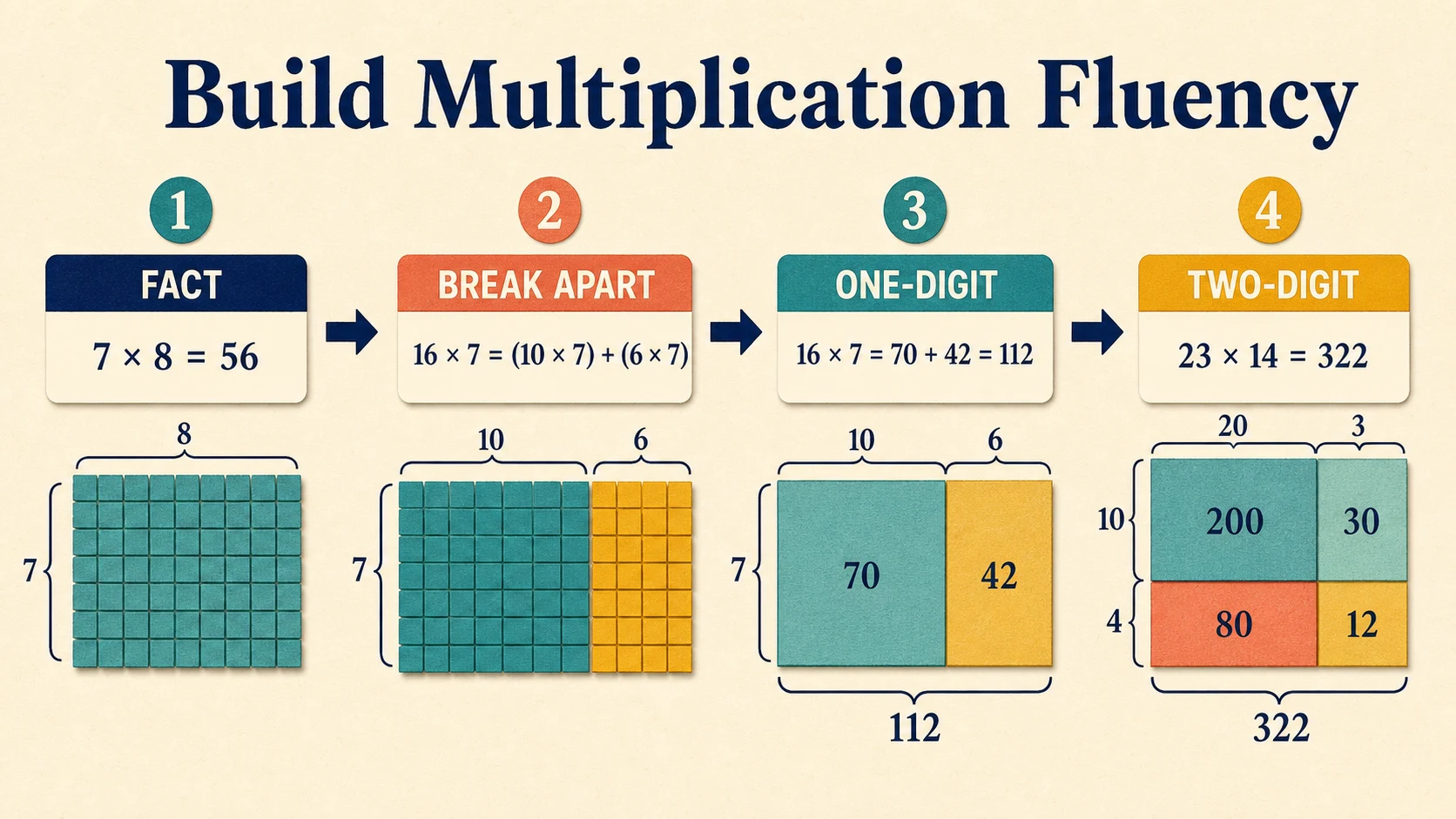
Support should fade as the learner connects representations, equations, and efficient written methods.
| Stage |
Main learning target |
Useful representation |
Evidence of readiness to continue |
| 1. Meaning |
Interpret multiplication as equal groups |
Counters, grouped objects, drawings |
Builds a model and writes a matching equation |
| 2. Arrays |
Connect rows, columns, and total |
Grid or dot array |
Explains both a×b and b×a |
| 3. Fact strategies |
Derive unknown facts from known facts |
Arrays split into parts |
Names the known facts used |
| 4. One-digit by multiples of 10 and 100 |
Apply facts through place value |
Base-ten drawings or expanded form |
Explains why 6×40=240 |
| 5. Multi-digit by one-digit |
Combine partial products |
Area model and expanded form |
Records and adds all place-value parts |
| 6. Two-digit by two-digit |
Distribute both factors |
Rectangular area model |
Produces four correct partial products |
| 7. Written efficiency |
Use an accurate compact method |
Partial-products layout or standard algorithm |
Connects each written step to place value |
| 8. Application |
Solve and check word problems |
Diagram, equation, estimate |
Chooses multiplication and interprets the product |
From facts to multiples of ten
Do not treat 7×40 as an unrelated rule. Connect it to 7×4=28:
7×40=7×(4×10)=(7×4)×10=280
Use place-value language: “Seven groups of four tens are twenty-eight tens, which is 280.” This is more informative than telling the learner to attach a zero, a shortcut that becomes unreliable in other contexts.
From expanded form to partial products
For 243×3, write:
(200+40+3)×3
Then distribute:
600+120+9=729
Once the learner understands where 600, 120, and 9 come from, those same quantities can be recorded in a vertical partial-products layout. A compact algorithm should be the final compression of understood place-value reasoning, not the learner’s first encounter with the calculation.
From one-digit to two-digit factors
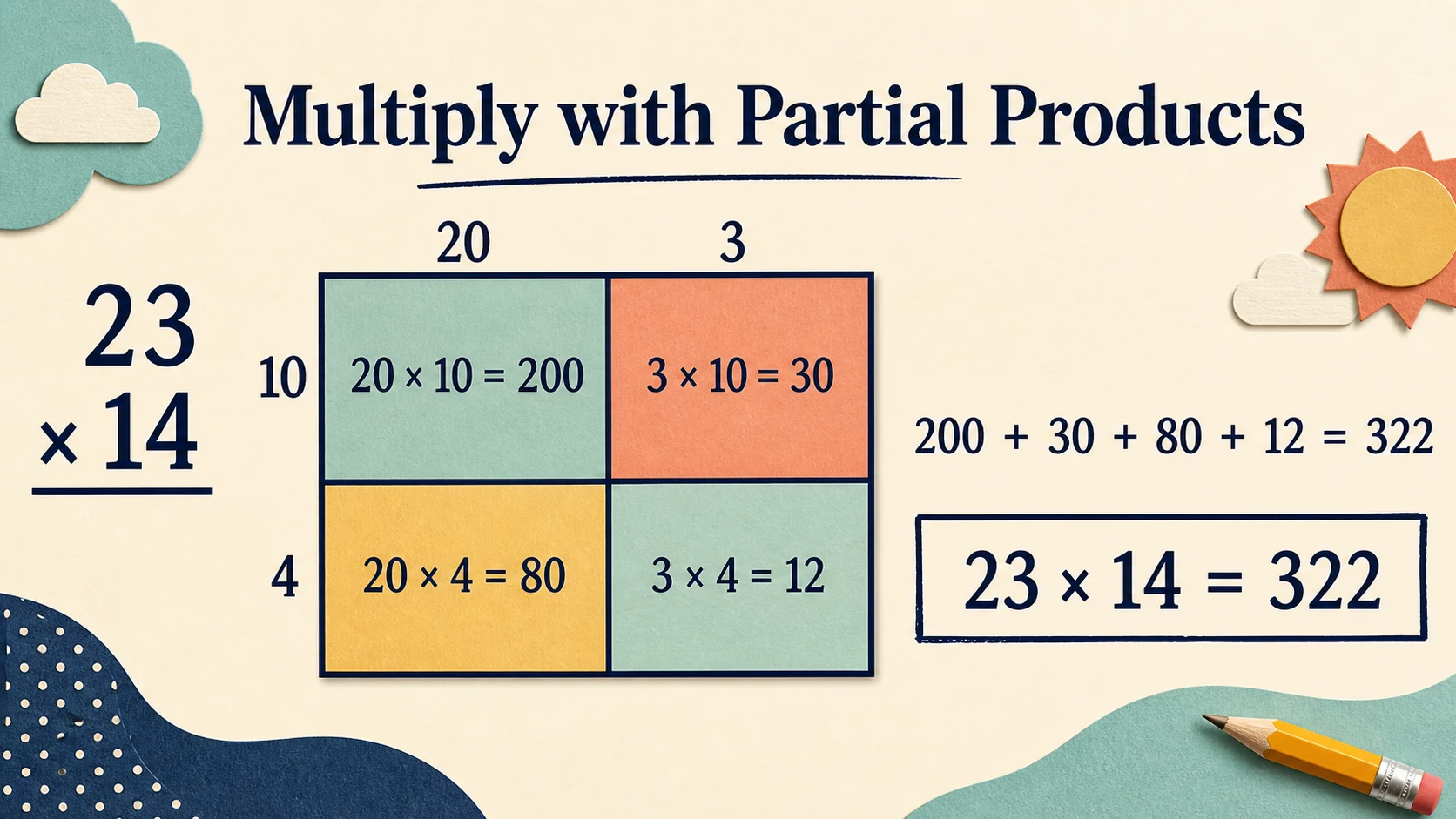
Two-digit by two-digit multiplication adds a second place-value decomposition. In 23×14, both numbers can be partitioned:
(20+3)(10+4)
The four partial products are 200, 80, 30, and 12. Learners who record only two or three parts need more work with the area model before moving to a more compact method.
Concrete and Visual Models That Clarify the Mathematics
The IES guide for elementary mathematics intervention recommends systematic instruction, clear mathematical language, and carefully chosen concrete and semi-concrete representations. That is high-level instructional guidance, not an evaluation of WorksheetWise materials or this particular guide.
Objects and drawings should make the quantities visible before symbols compress the reasoning.
Equal-group models
Use counters, cubes, bottle caps, or drawn circles when the learner needs to see what a multiplication expression represents. For 5×4, make five groups with four items in each group.
Be consistent about language. “Five groups of four” corresponds to 5×4. The total is 20. Turning the factors around gives the same product, but the new expression describes four groups of five.
Concrete objects are useful only while they clarify a relationship. If a learner can explain and calculate the expression without counting every object, move to a more efficient representation.
Arrays and the distributive property
An array for 7×8 can be split into five columns and three columns:
7×8=7×(5+3)
=(7×5)+(7×3)
=35+21=56
The split makes the distributive property visible. It also offers a way to reconstruct a forgotten fact from known facts.
Arrays show the commutative property as well. A rectangle with seven rows of eight contains the same number of objects when viewed as eight columns of seven. The orientation changes; the total does not.
Area models for larger numbers
For 34×26, divide one side into 30 and 4 and the other into 20 and 6. The four regions represent:
- 30×20=600
- 30×6=180
- 4×20=80
- 4×6=24
Adding the regions gives 600+180+80+24=884.
The area model is not merely decoration around an algorithm. It reveals why every part of one factor must be multiplied by every part of the other factor.
Fully Checked Worked Examples
Example 1: Deriving an unfamiliar fact
Find 7×8.
Break 8 into 5 and 3:
7×8=7×(5+3)
Apply the distributive property:
(7×5)+(7×3)=35+21
35+21=56
Therefore:
7×8=56
Check by reversing the factors and splitting 7:
8×7=8×(5+2)=40+16=56
Both strategies produce 56.
Example 2: Multiplying a three-digit number by one digit
Find 326×4.
Expand 326:
326=300+20+6
Multiply each part:
300×4=1,200
20×4=80
6×4=24
Add the partial products:
1,200+80+24=1,304
Therefore:
326×4=1,304
Reasonableness check: 326 is slightly greater than 300, and 300×4=1,200. An answer of 1,304 is reasonably a little greater than 1,200.
Example 3: Multiplying a four-digit number by one digit
Find 2,407×3.
Decompose the number, including the zero tens:
2,407=2,000+400+0+7
Multiply each place-value part:
2,000×3=6,000
400×3=1,200
0×3=0
7×3=21
Add:
6,000+1,200+0+21=7,221
Therefore:
2,407×3=7,221
Check with subtraction from a nearby number:
2,407×3=(2,400×3)+(7×3)
=7,200+21=7,221
The internal zero remains important because it holds the tens place.
Example 4: Multiplying two two-digit numbers
Find 34×26.
Use expanded form:
(30+4)(20+6)
Calculate all four partial products:
30×20=600
30×6=180
4×20=80
4×6=24
Add them carefully:
600+180+80+24=884
Therefore:
34×26=884
Check by reversing the factors and using 26×(30+4):
26×30=780
26×4=104
780+104=884
The independent decomposition confirms the answer.
Example 5: Solving a contextual problem
A tutor prepares 18 folders. Each folder contains 24 practice cards. How many cards are prepared?
The situation has 18 equal groups of 24, so calculate:
18×24
Decompose 18:
(10+8)×24
10×24=240
8×24=192
240+192=432
The tutor prepares 432 cards.
Check using the other factor:
18×(20+4)=360+72=432
The answer includes a unit and responds to the situation, not just the equation.
Boundary cases worth teaching explicitly
Zero and one reveal whether the learner understands factors:
684×0=0
There are zero groups of 684, so there are no objects in total.
684×1=684
One group of 684 remains 684.
A factor containing zero also needs care:
40×23=920
This can be checked as 4×23=92, followed by reasoning that four tens of 23 equal 92 tens, or 920. The zero is not ignored; it represents a place-value scaling by 10.
A Short, Repeatable Lesson Routine
A compact routine can fit into roughly 15 to 25 minutes, but this is a practical suggestion rather than a universal timetable. Shorten, extend, or repeat a phase in response to the learner’s work.
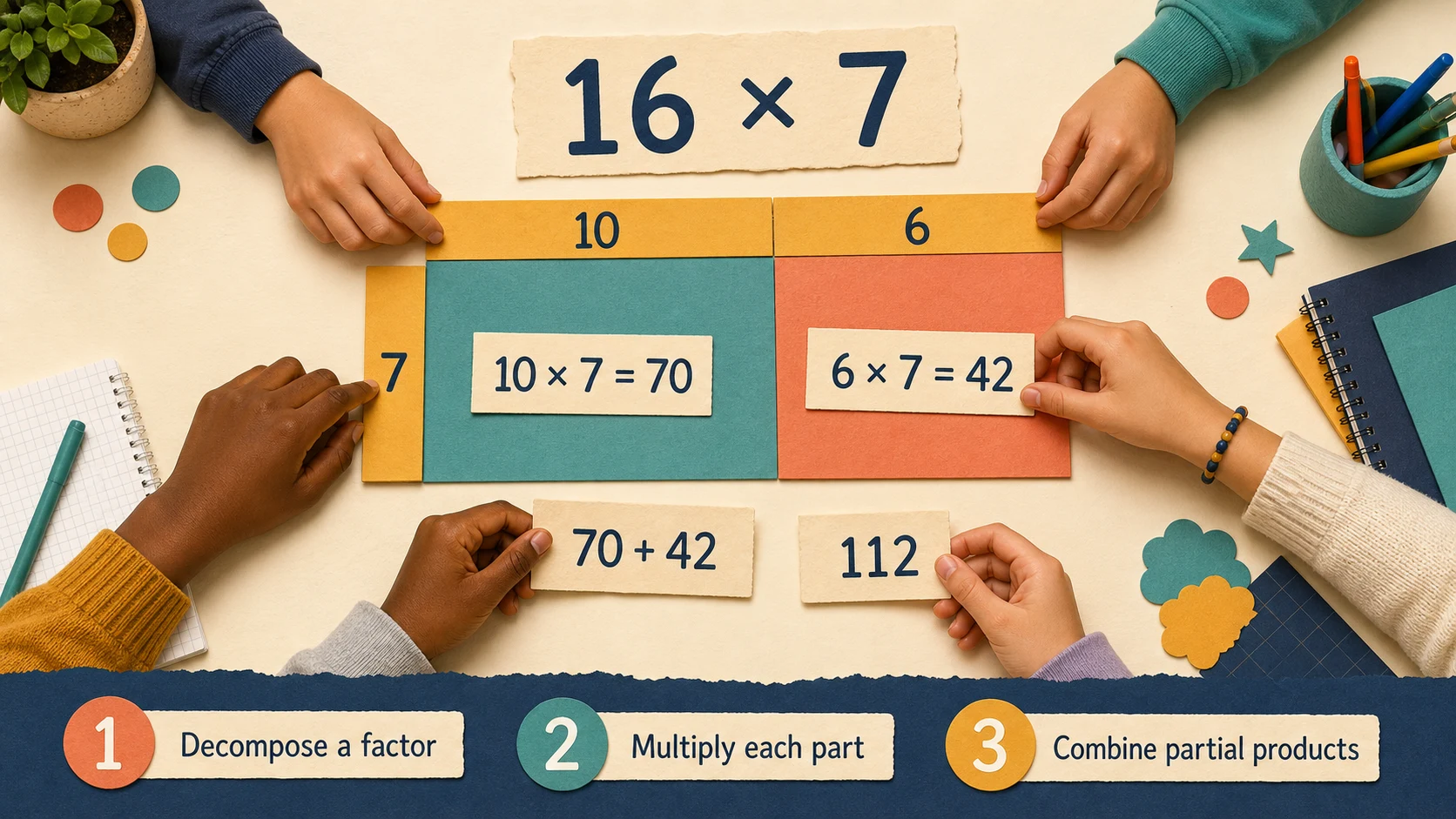
Each lesson connects prior knowledge, explicit modeling, supported practice, and an independent check.
-
Retrieve a known idea. Spend two or three minutes on facts or place value directly connected to the day’s problem. Before 47×6, review 7×6, 40×6, and 200+40+2.
-
Model one example. Think aloud while using an array, area model, or expanded form. Name the factors, product, and partial products precisely.
-
Solve one together. Ask the learner to choose the next step and explain it. Supply a prompt only when needed: “Which place-value part has not been multiplied yet?”
-
Assign two to four independent problems. Keep the set short enough that every response can be examined. Include one problem similar to the model and one that requires a small transfer.
-
Check and explain. Have the learner verify one answer by estimation, reversing the factors, or using a different decomposition.
-
Record the next teaching decision. Note whether the learner needs another model, mixed practice, fact review, or a larger challenge.
The IES early-mathematics practice guide concerns preschool and kindergarten, not fourth grade. Its broader framing around developmental progression and using progress monitoring to build on what a child knows is still useful as context. It should not be presented as fourth-grade-specific evidence.
Choosing Practice That Matches the Learner
Practice should be selected by the error pattern and current level of independence. More questions are not automatically better.
The 4th Grade Math hub can help adults compare multiplication with other mathematics topics. Use the dedicated multiplication topic guide when the learner needs focused work in this area.
When foundational practice is appropriate
Choose short fact and mental-math sets when the learner:
- Understands equal groups but calculates facts very slowly.
- Uses accurate strategies but needs repeated retrieval.
- Makes fact errors inside otherwise correct multi-digit work.
- Can explain facts using arrays or the distributive property.
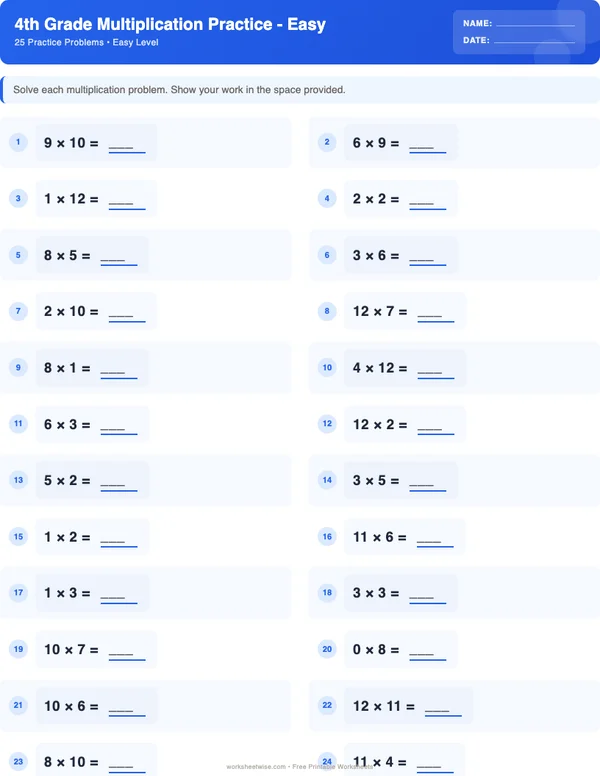
The free easy multiplication worksheet contains 25 exercises focused on multiplication facts, times tables, mental math, and number sense, with a separate answer key. It is suitable for foundational practice or reinforcement. It does not, by itself, cover the entire progression described in this guide.
When multi-digit practice is appropriate
Move to multi-digit questions when the learner can derive most needed facts and decompose numbers by place value. Begin with examples that do not require extensive regrouping, then introduce regrouping, internal zeros, and mixed factor sizes.
A useful sequence might be:
- 23×3
- 142×4
- 1,203×3
- 24×12
- 37×26
Do not increase every source of difficulty at once. A learner meeting two-digit by two-digit multiplication for the first time does not also need unfamiliar vocabulary, crowded formatting, and several computation steps in a word problem.
Differentiation through support and challenge
For a learner needing more support:
- Reduce the number of problems.
- Provide graph paper to help align place values.
- Keep an array or area-model template visible.
- Highlight each decomposed part in a consistent color.
- Allow a multiplication chart while teaching the multi-digit structure.
- Alternate a modeled problem with an independent one.
- Ask for an oral explanation before requiring a fully written explanation.
For a learner ready for greater challenge:
- Ask for two different decompositions of the same product.
- Include a missing partial product.
- Present an incorrect solution for analysis.
- Ask the learner to estimate before calculating.
- Compare two methods and decide which is more efficient.
- Use contextual problems with relevant and irrelevant information.
These are instructional options, not prescriptions for a specific child. If difficulties are persistent or extend beyond the scope of ordinary instructional adjustment, seek guidance through the learner’s school or an appropriately qualified educational professional.
Common Errors and Diagnostic Responses
Treat an error as evidence about the learner’s current reasoning. Correcting the final answer without finding the source often leads to the same mistake in the next problem.
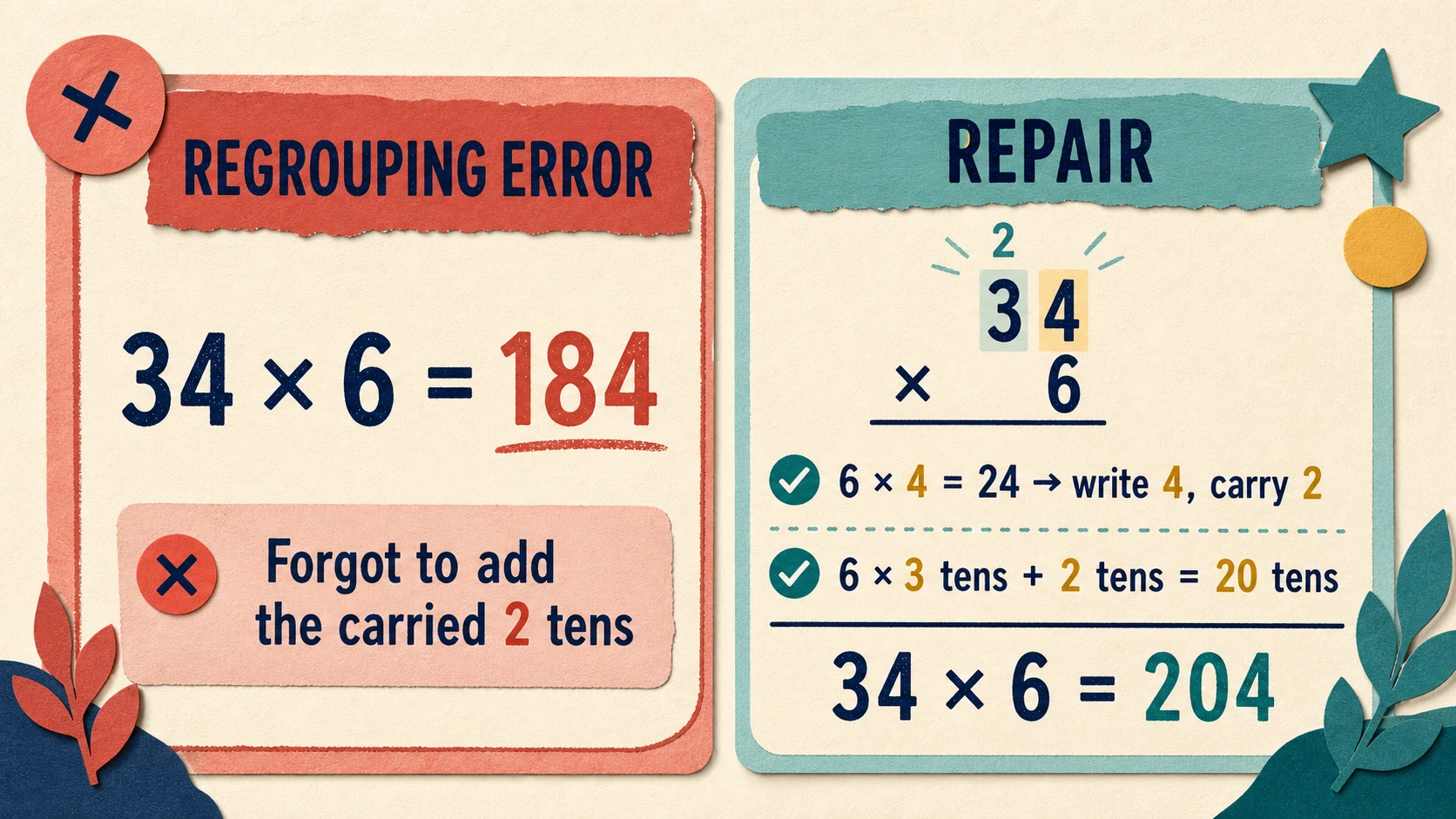
The most useful response targets the reasoning that produced the error.
| Observed work |
Likely instructional issue |
Teaching response |
| 6×8=42 |
Fact confusion |
Rebuild 6×8 as 5×8+1×8 |
| 7×40=2800 |
Place-value scaling is unclear |
Compare seven groups of 4 with seven groups of 4 tens |
| 243×3=609 |
The learner multiplied hundreds and ones but omitted tens |
Expand 243 and account for all three parts |
| 34×26=804 |
One or more partial products were omitted or added incorrectly |
Use a four-region area model and label each region |
| A second partial-product row begins in the ones place |
Tens in the second factor are treated as ones |
Say “two tens,” calculate its value, and connect it to the model |
| The exact answer is far from the estimate |
No reasonableness check |
Estimate first and compare after calculating |
| Multiplication is used whenever two numbers appear |
Operation choice is based on surface cues |
Ask what the quantities represent and whether equal groups exist |
| Correct model, incorrect total |
Addition rather than multiplication is the breakdown |
Separate the partial products from the addition check |
One especially common misconception is that “putting in a zero” is the reason a tens-row shifts. The real reason is place value. In 24×30, the 3 represents three tens, so 24×3 gives 72 groups of ten, or 720.
Another is that reversing factors changes the answer because the model looks different. Use 3×5 and 5×3: they describe different groupings but share a product of 15. This distinction preserves the meaning of a word problem while illustrating the commutative property.
Monitoring Progress and Deciding What Comes Next
Use a brief check every few sessions. Include one fact, one place-value product, one multi-digit calculation, and one explanation or contextual problem. Keep the format stable enough that changes in performance reflect mathematics rather than unfamiliar directions.
Track four dimensions separately:
- Accuracy: Are the products correct?
- Strategy: Is the method valid and appropriate?
- Explanation: Can the learner connect steps to groups, place value, or properties?
- Independence: How much prompting or representation is needed?
For example, a learner may answer four of five calculations correctly but need prompts to include every partial product. That is different from a learner who independently sets up every calculation but repeatedly misses 7×8. The first needs structural practice; the second needs focused fact work.
Advance when the learner can solve a small mixed set accurately, explain the main steps, and catch unreasonable answers. Pause or step back when the same conceptual error appears across several problems. One careless addition error does not necessarily require reteaching the multiplication model; repeated omissions of the tens partial product do.
Avoid using completion time as the only measure. Fluency matters, but a fast incorrect method is not a useful endpoint. If timed activity is used, it should be one part of practice after the learner has a dependable strategy, not a substitute for teaching.
A Two-Week Practice Plan
This plan assumes ten practice days and can be adjusted. It is not a universal schedule. Repeat a day, reduce the workload, or return to an earlier representation when the learner’s observed work calls for it.
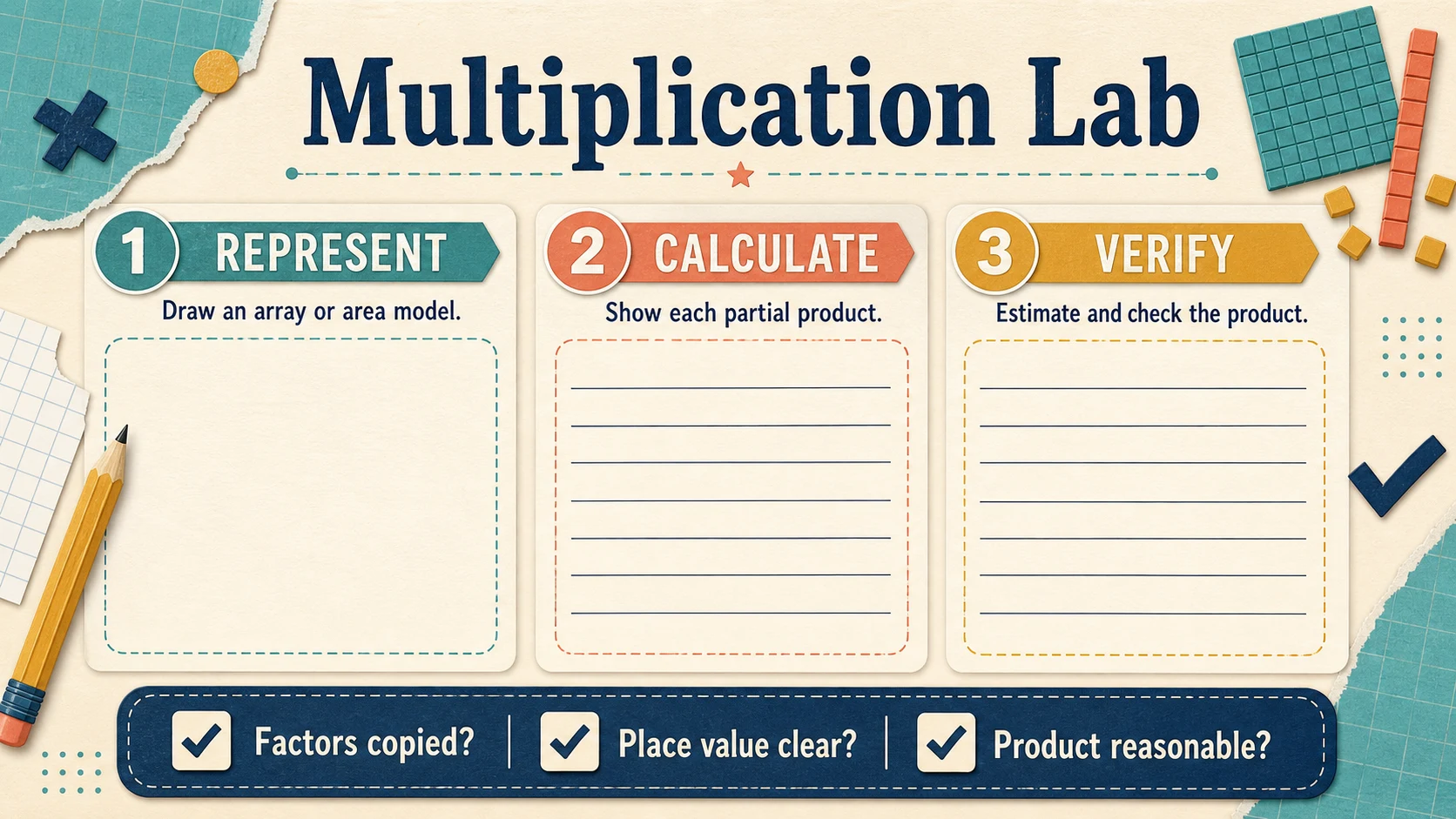
The plan alternates explanation, focused calculation, application, and review.
| Day |
Focus |
Suggested work |
Quick evidence to collect |
| 1 |
Diagnose foundations |
Equal groups, one array, six varied facts, one place-value decomposition |
Note whether errors involve meaning, facts, or place value |
| 2 |
Fact strategies |
Derive 6s, 7s, 8s, or 9s from known facts |
Learner explains one decomposition |
| 3 |
Multiples of 10 and 100 |
Products such as 6×40 and 3×500 |
Uses place-value language |
| 4 |
Multi-digit by one digit |
Area models for two- and three-digit factors |
Includes every partial product |
| 5 |
Review and application |
Mixed calculations plus one equal-groups problem |
Chooses multiplication and labels the answer |
| 6 |
Four-digit by one digit |
Expanded form, including an internal-zero example |
Preserves every place |
| 7 |
Two-digit by two-digit |
Build and label area models |
Produces four regions correctly |
| 8 |
Partial-products recording |
Connect the area model to a written layout |
Aligns and adds products accurately |
| 9 |
Mixed practice and error analysis |
Solve several forms and correct one false solution |
Identifies the exact incorrect step |
| 10 |
Independent check |
Facts, one-digit and two-digit factors, estimate, word problem |
Decide whether to review, extend, or maintain |
Keep each session manageable. On Days 4, 7, and 8, two carefully discussed problems may be more informative than a long page completed with repeated misunderstandings. On Days 5 and 10, include at least one unfamiliar arrangement so the learner must decide how to begin.
Limitations and the Honest Next Step
No single guide, worksheet, model, or two-week plan can establish complete multiplication understanding. A practice page shows only a sample of performance on a particular day. It may not reveal whether an error came from attention, fact recall, place value, addition, operation choice, or an unclear explanation.
The progression here covers the catalogue’s intended fourth-grade multiplication scope, but local sequences differ. Some learners will need more work with equal groups and facts; others will be ready to compare algorithms or solve more complex applications. Grade labels indicate intended practice level, and the learner’s actual work should determine pacing.
For the next session, give the learner three items: one fact such as 7×8, one multi-digit problem such as 243×3, and one request to explain or check an answer. Use the results to choose the smallest relevant next step. If foundational fact and mental-math practice is appropriate, begin with the free 4th Grade Multiplication worksheet. For broader, sustained practice, review the 18-worksheet 4th Grade Multiplication pack, selecting work according to the learner’s demonstrated needs rather than assigning the entire pack automatically.