What 5th Grade Geometry Includes
5th Grade Geometry centers on two connected abilities: plotting and interpreting points on a coordinate plane, and classifying two-dimensional figures from their properties. Learners also benefit from reviewing shapes, angles, area, and perimeter because those earlier skills supply the language and measurements used in later geometric reasoning.
A learner is ready to progress when observed work shows that they can:
- Identify relevant properties rather than judging a shape by appearance.
- Plot an ordered pair in the correct location.
- Explain why one shape can belong to more than one category.
- Keep area, perimeter, and angle measures conceptually separate.
- Solve familiar problems accurately and adapt the same ideas to a changed diagram.
This guide treats hands-on models, drawings, spoken reasoning, and written notation as connected stages—not competing methods. The goal is for the learner to understand what a representation means before relying on a memorized procedure.
Grade labels describe the intended practice level; local curricula and instructional sequences differ. The Common Core State Standards for Mathematics place plotting points and classifying two-dimensional figures within the Grade 5 geometry domain, but a school may review related measurement and shape concepts at a different point in the year.
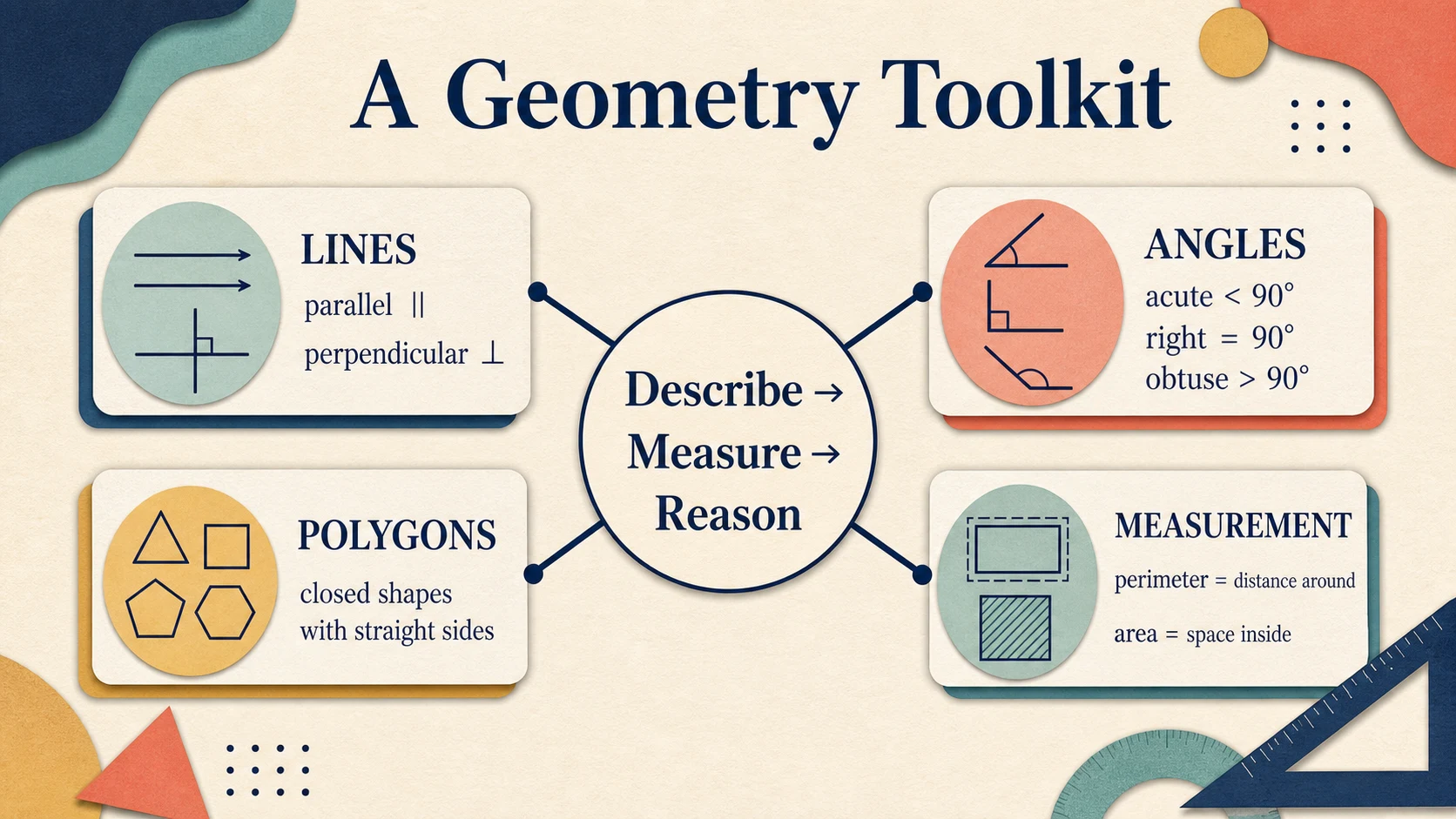
Coordinate reasoning and shape classification rest on earlier knowledge of attributes, angles, area, and perimeter.
Prerequisites to Check Before Teaching
A short readiness check is more useful than assuming that all earlier material is secure. Give the learner a few varied tasks without first demonstrating the method. Ask for explanations as well as answers.
Shape and attribute knowledge
Check whether the learner can recognize triangles and quadrilaterals in different sizes and orientations. Include a triangle pointing down, a narrow rectangle, a tilted square, and an irregular quadrilateral. Ask:
- How many sides and vertices does the figure have?
- Are any sides parallel?
- Are any sides equal in length?
- Does the figure contain right angles?
- What evidence supports its name?
A learner who calls a tilted square “not a square” is relying on orientation rather than properties. Return briefly to sorting, tracing, rotating, and describing shapes.
Lines and angles
The learner should distinguish a line, line segment, and ray and recognize parallel and perpendicular lines. They should also understand right, acute, and obtuse angles. Exact protractor work may be reviewed when necessary, but classification often requires only comparison with a right angle.
Use a square corner as a concrete right-angle reference. Place it over an angle in a drawing and decide whether the opening is equal to, smaller than, or larger than the reference.
Area and perimeter
Give a rectangle drawn on square grid paper. Ask the learner to find:
- The area by counting or organizing square units.
- The perimeter by measuring the outside boundary in linear units.
- A second rectangle with the same area but a different perimeter.
If the learner applies the wrong formula or omits units, rebuild the concepts with square tiles. Area counts the surface covered; perimeter measures the boundary around it.
Coordinate readiness
Before ordered pairs, confirm that the learner can:
- Read a number line.
- Locate zero and count equal intervals.
- Follow horizontal and vertical directions.
- Interpret a simple scale.
- Distinguish left–right from up–down.
Graph paper, a ruler, shape cards, square tiles, and a right-angle corner are enough for most of this diagnostic work. The 5th Grade math collection can help you place geometry practice beside any number or measurement review revealed by the check.
A Grade-Appropriate Teaching Progression
The progression below moves from prerequisite review to Grade 5 coordinate and classification work. Time should be adjusted from observed performance. A learner who explains accurately after three examples does not need twenty nearly identical ones; a learner making systematic errors needs another model and a smaller practice set.
| Stage |
Teaching focus |
Useful model |
Evidence of readiness to continue |
| 1 |
Recognize figures in varied orientations |
Cutout shapes and sorting cards |
Names shapes from properties, not position |
| 2 |
Describe sides, angles, and line relationships |
Ruler, square corner, marked diagrams |
Identifies parallel, perpendicular, equal, and right-angle features |
| 3 |
Separate area from perimeter |
Square tiles and grid paper |
Uses square units for area and linear units for perimeter |
| 4 |
Read the coordinate plane |
Floor grid or large paper grid |
Identifies origin, axes, directions, and equal intervals |
| 5 |
Plot and read ordered pairs |
First-quadrant graph paper |
Moves horizontally first and vertically second |
| 6 |
Interpret coordinate relationships |
Tables paired with graphs |
Explains what shared coordinates mean |
| 7 |
Classify quadrilaterals |
Property cards or hierarchy diagram |
Places a figure in every category justified by its properties |
| 8 |
Solve mixed and unfamiliar problems |
Diagrams without category cues |
Selects a method and explains the decision independently |
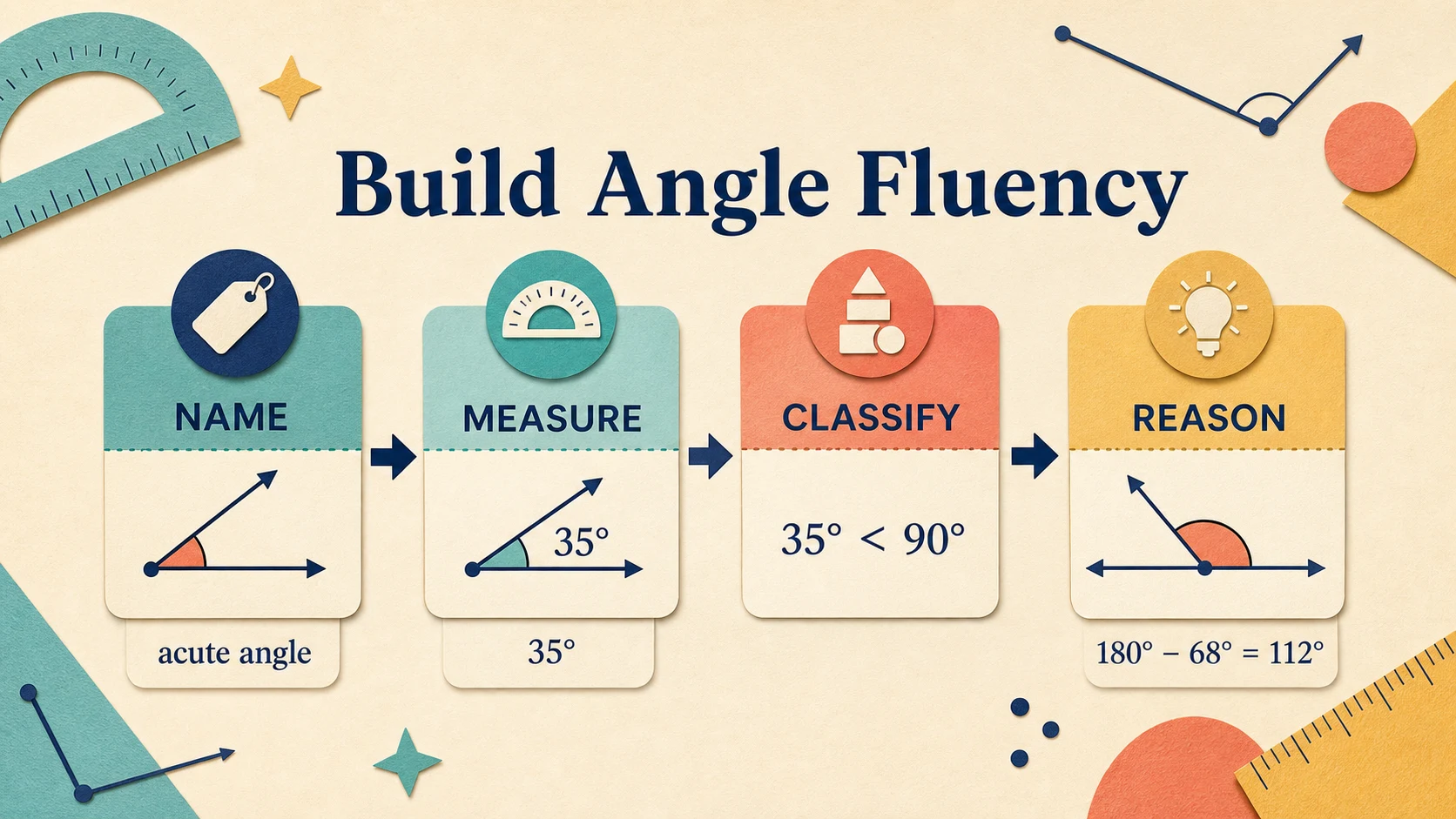
Move forward when the learner’s explanations and independent work are secure, not merely when a planned date arrives.
The IES guide on teaching mathematics to young children provides broad instructional framing around developmental progressions, monitoring, and helping learners connect representations. Although its stated age range is younger than fifth grade, those high-level principles can inform prerequisite repair. The examples and pacing decisions in this article remain instructional suggestions for this topic, not claims that the guide prescribes this exact sequence.
Concrete and Visual Models That Clarify Geometry
Geometry should be seen, handled, drawn, and discussed. Concrete work is not an end point, however. Each model should lead toward a diagram, accurate vocabulary, and mathematical notation.
Build a coordinate plane on the floor
Make two perpendicular number lines with tape. Mark the intersection as the origin, (0,0), and label the horizontal and vertical axes. Have the learner stand at the origin and follow an ordered pair such as (3,2):
- Move 3 equal spaces horizontally.
- Turn and move 2 equal spaces vertically.
- Place a card at the final point.
- Record (3,2) on paper.
Repeat with (2,3). The physical contrast makes the order visible. Transfer the points to graph paper immediately so the learner connects movement to notation.
Sort shapes with property cards
Prepare cards reading “four sides,” “two pairs of parallel sides,” “four right angles,” and “four equal sides.” Place a square, rectangle, rhombus, parallelogram, and other quadrilaterals beside them.
For each figure, ask which cards apply and why. Then organize categories so that narrower categories sit inside broader ones. A square can satisfy the defining properties of more than one category. The hierarchy is based on attributes, not on what the figure is “usually called.”
Build area while tracing perimeter
Arrange 12 square tiles as a 3×4 rectangle. Count 12 square units of area. Then trace the outer edge and calculate:
3+4+3+4=14 units
Rearrange the same tiles as a 2×6 rectangle:
Area=12 square units
Perimeter=2+6+2+6=16 units
The unchanged tile count and changed boundary make the distinction concrete.
Vary examples deliberately
Do not show every triangle with a horizontal base or every rectangle longer than it is tall. Rotate figures. Change their size. Include irrelevant markings and missing visual cues. Ask the learner to identify the properties that remain unchanged.
This variety prevents the picture’s surface appearance from becoming an unofficial definition. A long, tilted parallelogram and a compact one still belong to the same category when they share the relevant properties.
Fully Checked Worked Examples
The learner should first follow complete reasoning, then complete a partially worked problem, and finally solve a similar problem independently.
Worked example 1: Plot and interpret an ordered pair
Problem: Plot A(4,3) on a first-quadrant coordinate plane.
Start at the origin, (0,0). The first coordinate is 4, so move 4 units to the right along the horizontal axis. The second coordinate is 3, so move 3 units up. Mark and label the point A.
Check: From A, trace vertically down to the horizontal axis. It meets 4. Trace horizontally left to the vertical axis. It meets 3. Therefore, the plotted point is A(4,3).
A common incorrect answer is (3,4). That point reverses the movements and is not equivalent.
Worked example 2: Use coordinates to find a missing vertex
Problem: Three vertices of an axis-aligned rectangle are P(1,2), Q(6,2), and R(6,5). Find the fourth vertex S.
Points P and Q share a vertical coordinate of 2, so they form a horizontal side. Points Q and R share a horizontal coordinate of 6, so they form a vertical side.
For the opposite sides to remain horizontal and vertical, S must:
- Share P’s horizontal coordinate, 1.
- Share R’s vertical coordinate, 5.
Therefore:
S=(1,5)
Check: R(6,5) to S(1,5) is horizontal, and S(1,5) to P(1,2) is vertical. The horizontal side lengths are both 6−1=5 units. The vertical side lengths are both 5−2=3 units. The rectangle closes correctly.
Worked example 3: Classify a quadrilateral
Problem: A quadrilateral has four equal sides and four right angles. Classify it as specifically as possible and name other applicable categories.
Four right angles satisfy the defining property of a rectangle. Four equal sides satisfy the defining property of a rhombus. A figure with both sets of properties is a square.
Therefore, the most specific classification is square. It also belongs to the categories rectangle, rhombus, parallelogram, and quadrilateral because it satisfies the required properties of those broader groups.
Check: Four equal sides alone would not establish four right angles. Four right angles alone would not establish four equal sides. Both facts are needed to conclude that the figure is a square.
Worked example 4: Compare equal areas and different perimeters
Problem: Rectangle A is 3 units by 8 units. Rectangle B is 4 units by 6 units. Compare their areas and perimeters.
For Rectangle A:
Area=3×8=24 square units
Perimeter=2(3+8)=2(11)=22 units
For Rectangle B:
Area=4×6=24 square units
Perimeter=2(4+6)=2(10)=20 units
Both rectangles have an area of 24 square units, but Rectangle A has a perimeter of 22 units and Rectangle B has a perimeter of 20 units.
Check by addition: Rectangle A’s boundary is 3+8+3+8=22. Rectangle B’s is 4+6+4+6=20. Equal area does not require equal perimeter.
Worked example 5: Find an unknown side from perimeter
Problem: A rectangle has a perimeter of 30 cm and a length of 9 cm. Find its width.
A rectangle has two equal lengths and two equal widths:
30=9+9+w+w
Combine the known lengths:
30=18+2w
Subtract 18:
12=2w
Divide by 2:
w=6
The width is 6 cm.
Check:
9+9+6+6=30 cm
The result matches the given perimeter.
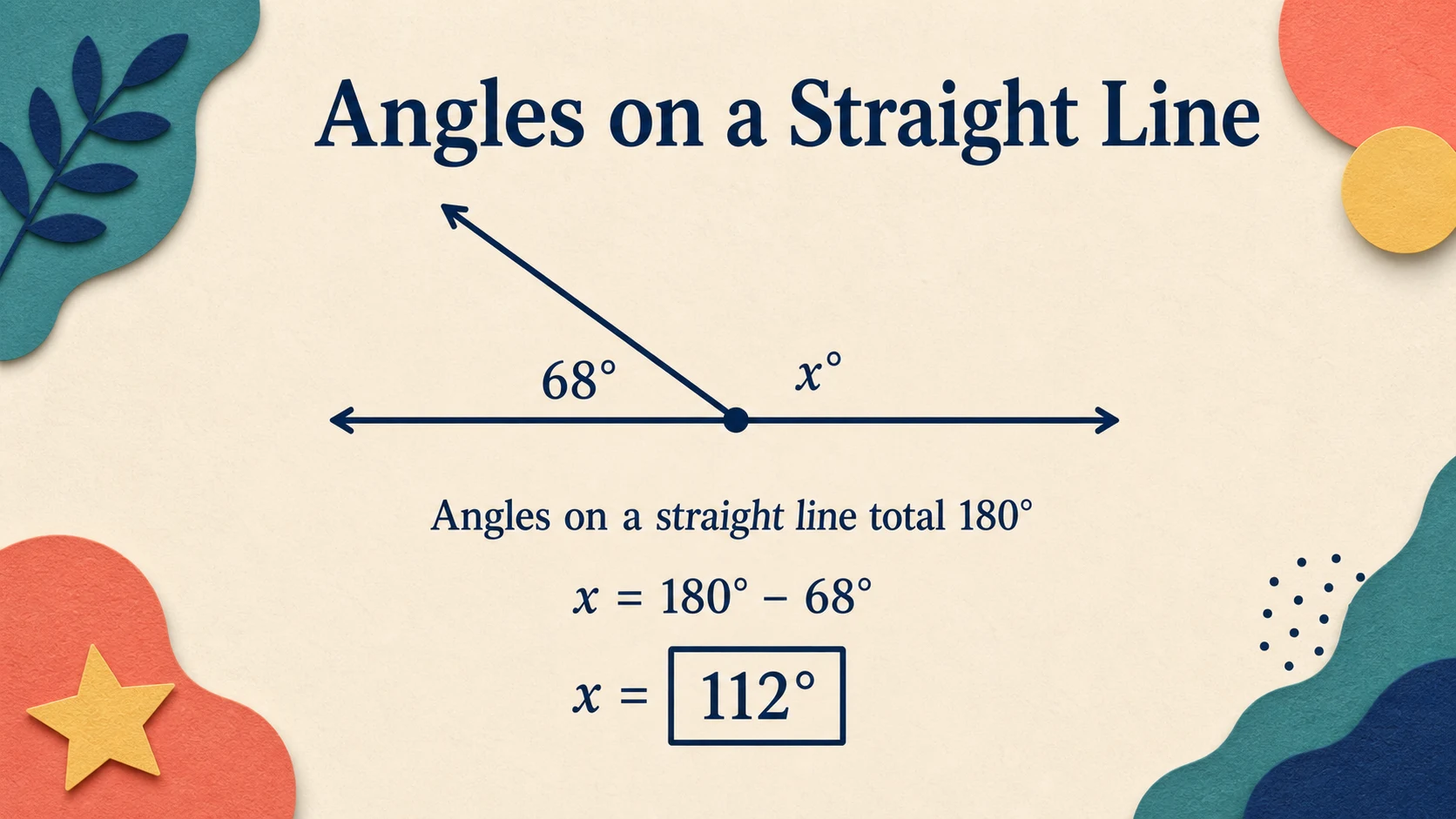
Connect an object or grid to a labeled drawing, an equation, and a final answer with appropriate units.
Boundary Cases Worth Teaching Explicitly
Boundary cases reveal whether the learner understands a definition or has memorized a familiar picture.
A square is the most important classification case. If rectangles are defined by four right angles, a square qualifies. Its equal sides do not disqualify it. Similarly, if a rhombus is defined by four equal sides, a square qualifies there too.
Other productive cases include:
- A rotated square remains a square.
- A long, narrow rectangle is still a rectangle.
- A quadrilateral with exactly one pair of parallel sides should not be classified as a parallelogram.
- Four equal sides do not, by themselves, guarantee four right angles.
- Diagonal-looking grid segments should not be measured merely by counting horizontal spaces.
- The point (0,4) lies on the vertical axis rather than inside a quadrant.
- The origin is (0,0), not (1,1).
- A figure may have the same area as another figure without having the same perimeter.
- A shape may share a perimeter with another shape while covering a different area.
Keep coordinate tasks within the plane and number range the learner has been taught. Do not introduce negative coordinates merely to make practice appear more advanced if the current sequence is limited to the first quadrant.
Common Errors and Diagnostic Responses
Treat an error as evidence about the learner’s current interpretation. Before reteaching an entire topic, determine whether the error is conceptual, procedural, visual, linguistic, or simply a recording slip.
| Observed error |
Likely issue to investigate |
Teaching response |
| Plots (2,5) at (5,2) |
Ordered-pair sequence is insecure |
Use the floor grid; narrate horizontal movement first, vertical movement second |
| Starts counting at 1 instead of the origin |
Number-line structure is insecure |
Mark zero clearly and count intervals, not grid lines |
| Says a square is not a rectangle |
Categories are treated as mutually exclusive |
Sort by defining properties and build a nested hierarchy |
| Names a shape only from appearance |
Orientation or proportion is being used as a definition |
Rotate and resize examples while keeping properties constant |
| Adds side lengths for area |
Area and perimeter are conflated |
Cover with square tiles, then trace the boundary |
| Gives area in centimeters |
Unit meaning is insecure |
Pair covered squares with square units and boundary lengths with linear units |
| Finds only l+w for perimeter |
Only half the boundary was counted |
Trace all four sides and write the expanded sum before using a formula |
| Assumes equal area means equal perimeter |
Relationship has been overgeneralized |
Build two rectangles with the same number of tiles and compare boundaries |
| Identifies parallel lines by visual closeness |
Parallelism is judged informally |
Extend or trace the lines and discuss constant direction |
| Produces an answer without evidence |
Reasoning is not yet visible |
Require one property statement, labeled diagram, or checking equation |
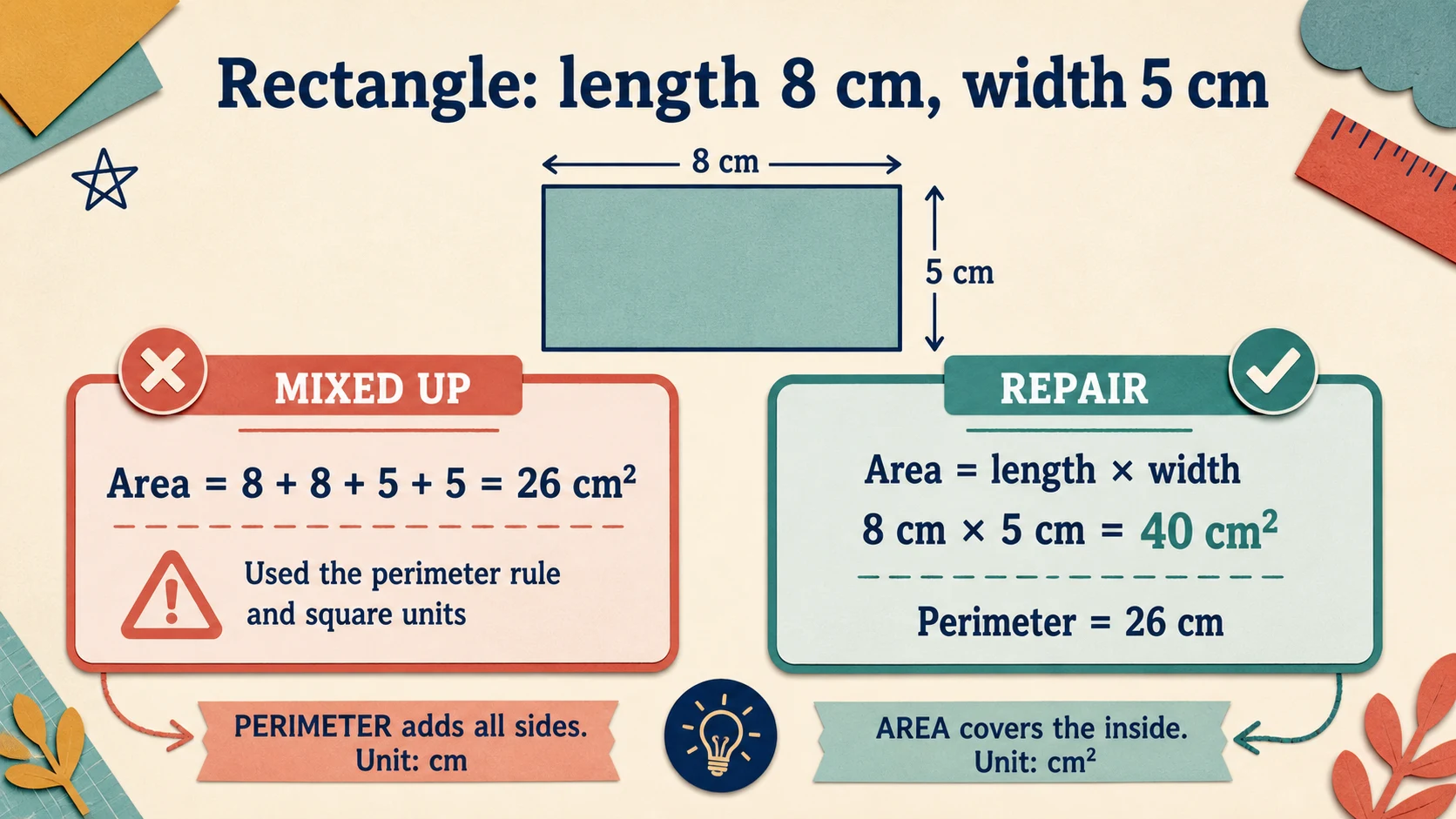
Match the response to the pattern in the learner’s work instead of assigning undifferentiated repetition.
The IES practice guide for assisting students struggling with mathematics supports broad practices such as systematic instruction, clear mathematical language, visual representations, and deliberate review. It does not evaluate WorksheetWise or prescribe this specific geometry lesson. Use it as general instructional framing while allowing the learner’s actual work to determine the next step.
A Short, Repeatable Lesson Routine
A focused lesson can fit into 20 to 30 minutes, but this is a flexible instructional suggestion rather than a universal timetable.
1. Retrieve prior learning
Spend three to five minutes on two familiar prompts. For example, identify a right angle and read one already-plotted point. The purpose is to reactivate useful knowledge, not to introduce a surprise test.
2. Model one new decision
Demonstrate a single problem while naming the reason for each step. For classification, say, “I see four right angles, so rectangle is one justified category.” For coordinates, trace each value back to its axis.
3. Solve together
Give a near example but require the learner to supply each decision. Ask, “Which coordinate tells us the horizontal movement?” or “Which marked property supports that category?” Correct misunderstandings while the representation is still visible.
4. Practice independently
Use three to six carefully selected problems. Begin with one close match, then vary orientation, wording, or missing information. A short set with explanation is more diagnostically useful than a long set completed by guessing.
5. Check and close
Review one correct response and one error or hesitation. End with a compact prompt such as:
- Plot (3,5) and explain the order.
- State two categories that include a square.
- Explain why square units belong with area.
- Draw two rectangles with equal area and different perimeters.
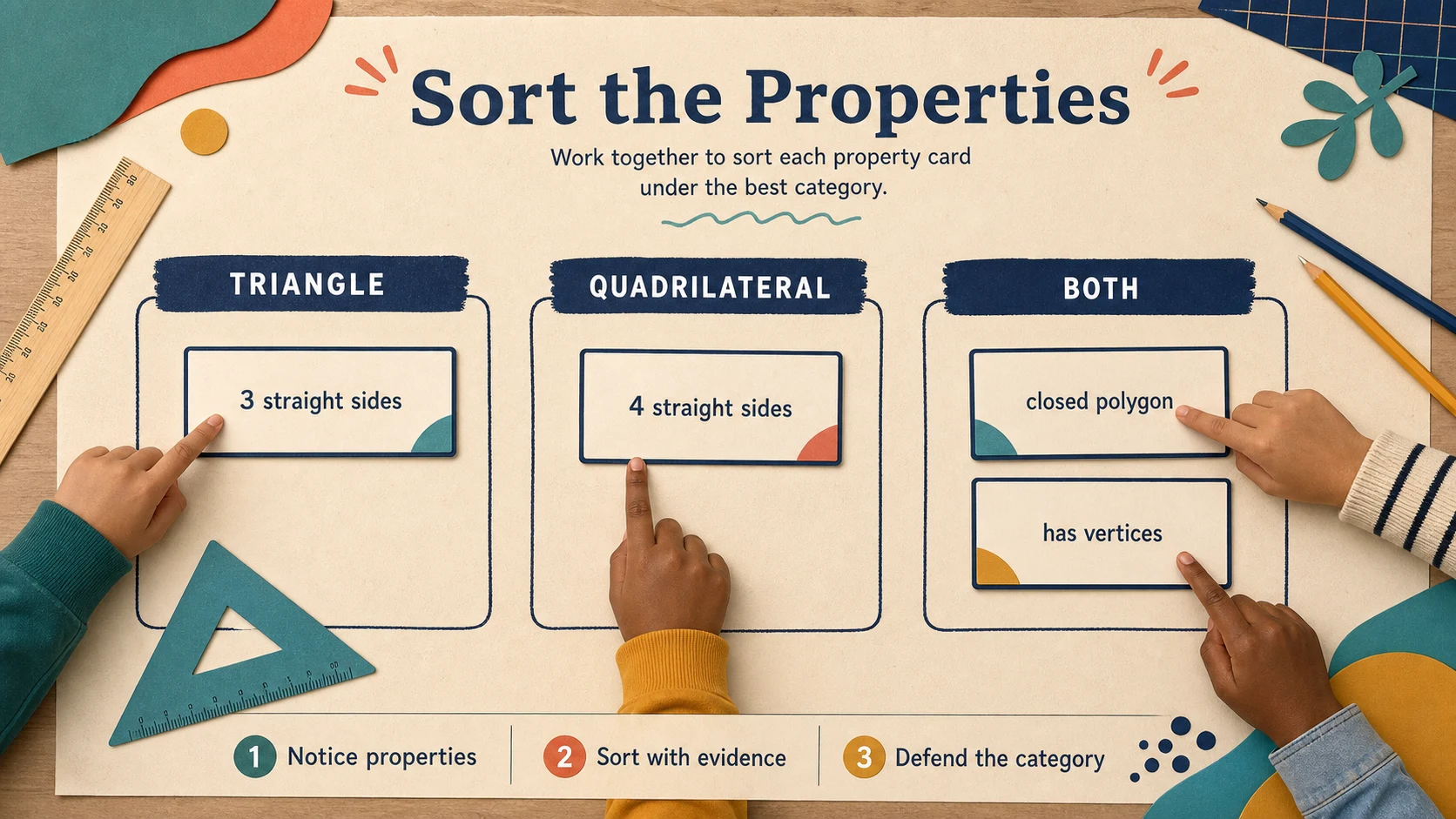
Retrieve, model, solve together, practice independently, and finish with a brief check.
Choosing Practice and Differentiating It
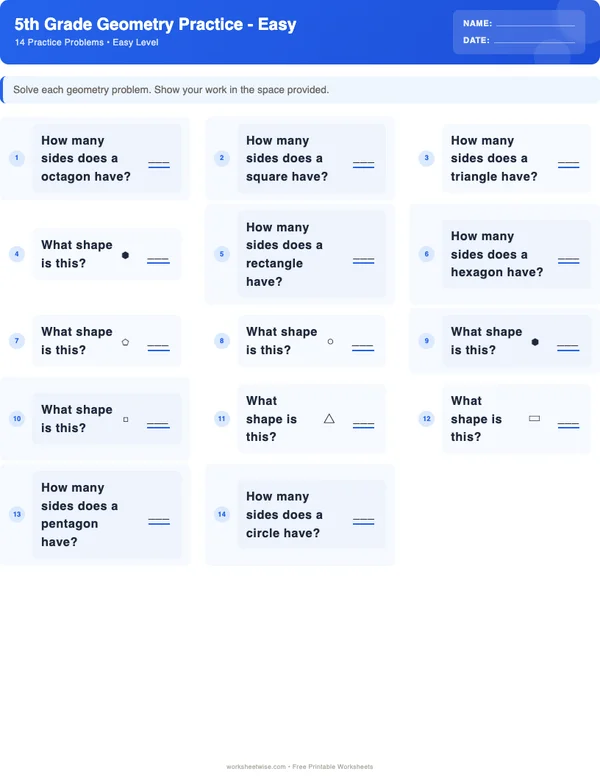
Practice should match the next unmet learning need. The available free standard-theme geometry worksheet contains 30 easy-level exercises covering shape identification, sides and vertices, perimeter, area, and geometric properties. It includes a separate answer key. That makes it suitable for foundational review, but its catalogue description does not establish that it covers every Grade 5 coordinate-plane or classification objective.
When the learner needs more support
Reduce visual and language load without removing the mathematical idea:
- Use one property at a time before combining properties.
- Provide a labeled coordinate plane with the origin emphasized.
- Let the learner place a physical marker before drawing a point.
- Give shape cards that can be rotated and sorted.
- Use square tiles before formulas.
- Ask for an oral explanation before a written one.
- Assign four well-chosen items instead of an entire page.
For persistent ordered-pair reversal, keep a small reminder beside the graph: “across, then up.” Remove it after several accurate independent responses.
When the learner is ready for extension
Increase reasoning, not merely number size:
- Give several possible categories and ask for all that apply.
- Ask the learner to draw a shape satisfying three stated properties.
- Provide three rectangle vertices and request the fourth.
- Ask whether a claim is always, sometimes, or never true.
- Compare figures with equal areas but different perimeters.
- Have the learner write an incorrect example and explain the error.
- Ask for two different solutions when more than one is possible.
The focused 5th Grade Geometry pack contains 18 worksheets and costs $4.79 according to the supplied catalogue. Consider it when repeated, varied practice is needed. Select individual pages based on observed work rather than treating completion of every page as the instructional goal.
Monitoring Progress Without Over-Testing
Record evidence by skill instead of relying only on a total score. A simple monitoring note might contain four columns:
| Date |
Skill |
Evidence |
Next move |
| Monday |
Plot ordered pairs |
4 of 5 correct; reversed one pair |
Use two contrasting pairs |
| Wednesday |
Classify quadrilaterals |
Names square but excludes rectangle |
Rebuild property hierarchy |
| Friday |
Area and perimeter |
Accurate calculations and units |
Move to comparison problems |
Look for three kinds of evidence:
- Accuracy: Is the answer correct?
- Reasoning: Can the learner identify the relevant property or relationship?
- Transfer: Can the learner succeed when the figure is rotated, the wording changes, or information is presented in a table?
One correct answer may be accidental. Several correct answers produced with a consistent explanation are stronger evidence. Likewise, one arithmetic slip does not necessarily show weak geometry. Ask the learner to explain the setup before deciding what to reteach.
A useful mastery check mixes old and new material after a delay. Include one coordinate problem, one classification problem, and one area-or-perimeter review problem. If the learner succeeds only when items are grouped by type, provide mixed practice requiring method selection.
A Flexible Two-Week Practice Plan
This plan assumes short sessions on ten instructional days. Adjust the length, number of problems, and amount of review according to the learner’s observed work. It is not a universal timetable.
| Day |
Focus |
Suggested activity |
Quick evidence |
| 1 |
Readiness check |
Varied shapes, one tiled rectangle, one simple grid |
Note specific secure and insecure skills |
| 2 |
Shape properties |
Rotate and sort quadrilaterals by sides and angles |
Explain two placements |
| 3 |
Category hierarchy |
Build square–rectangle–rhombus–parallelogram relationships |
Name all justified categories |
| 4 |
Area and perimeter review |
Build equal-area rectangles with tiles |
Compare area, perimeter, and units |
| 5 |
Mixed review |
Complete a short selected worksheet set |
Correct errors and explain one answer |
| 6 |
Coordinate structure |
Label origin and axes; use a floor grid |
Locate points from spoken pairs |
| 7 |
Plot ordered pairs |
Move from floor grid to graph paper |
Plot and verify five points |
| 8 |
Coordinate relationships |
Compare points sharing one coordinate |
Explain horizontal or vertical alignment |
| 9 |
Missing-vertex reasoning |
Complete rectangles on grid paper |
Verify shared coordinates and side lengths |
| 10 |
Cumulative check |
Mix classification, coordinates, area, and perimeter |
Choose the next practice target |
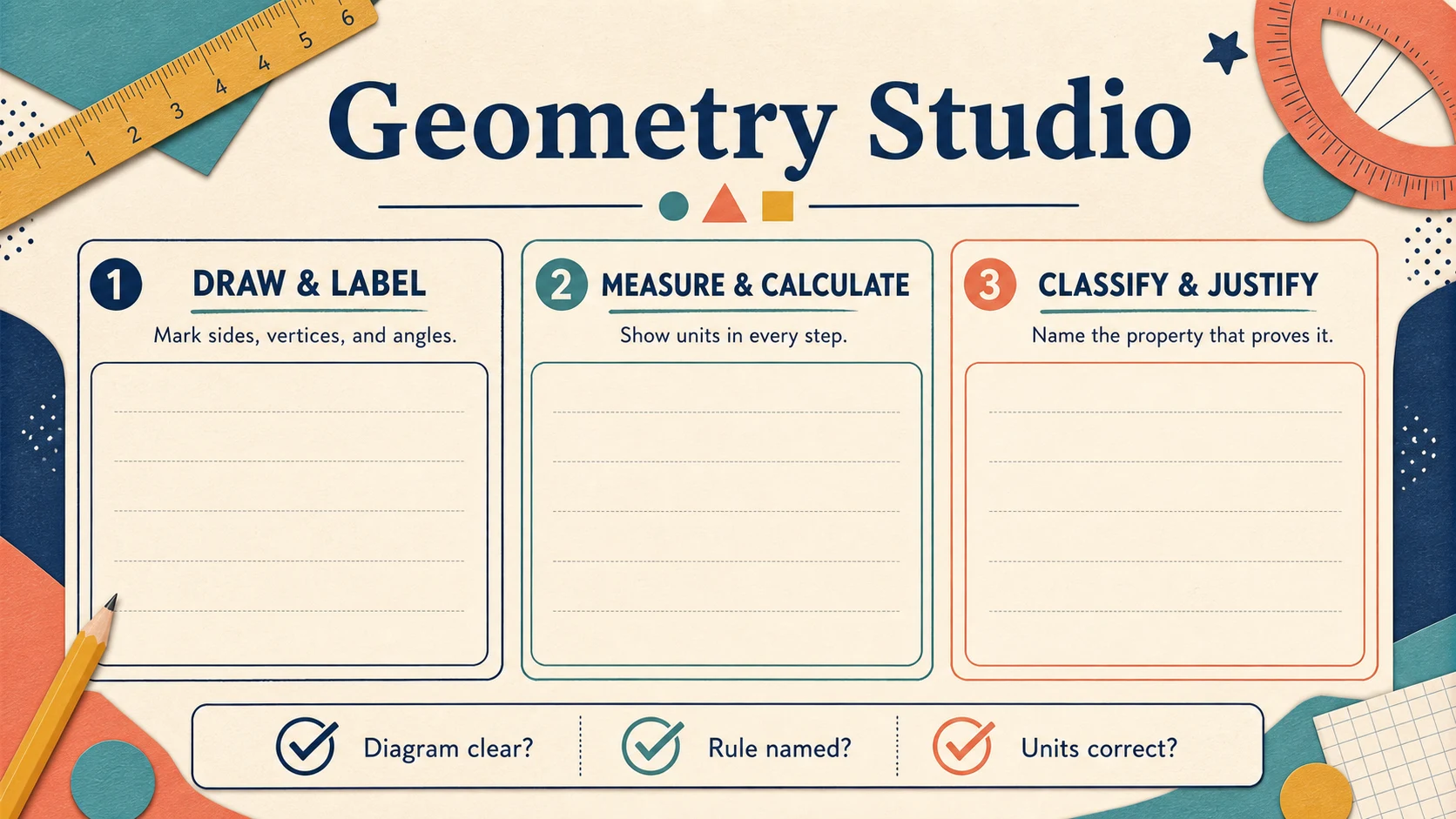
Use the plan as a decision framework, pausing or advancing in response to the learner’s work.
If Day 3 reveals secure classification, shorten that strand and spend more time on coordinates. If Day 7 shows repeated reversals, return to the floor grid before assigning additional graph-paper items. If area calculations are correct but units are missing, target notation rather than rebuilding the entire concept.
Limitations and the Honest Next Step
No single worksheet or topic guide can diagnose every reason for an error, represent every local curriculum sequence, or provide comprehensive standards alignment. A worksheet score also cannot show the full quality of a learner’s spatial reasoning. Conversation, drawings, manipulatives, and delayed review reveal information that a completed page may not.
This guide offers grade-appropriate instructional choices based on the supplied catalogue, verifiable examples, and high-level authoritative framing. It does not provide certification, guaranteed outcomes, medical guidance, or child-specific professional advice. Where school expectations differ, use the learner’s assigned curriculum and teacher feedback to decide exact scope and terminology.
The practical next action is to give five brief readiness prompts—one each on shape properties, category inclusion, area, perimeter, and ordered pairs. Then choose practice from the free 5th Grade Geometry worksheet for any foundational gaps. If the learner is already secure with those review skills, use the free worksheet generators or the broader 5th Grade worksheet hub to prepare focused coordinate-plane and classification practice that matches the next demonstrated need.