What 5th Grade Addition Should Include
5th Grade Addition should strengthen accurate, flexible addition across three connected areas: multi-digit whole numbers, decimals, and fractions with unlike denominators. A learner should understand why each method works, choose a suitable method, estimate before calculating, and check whether an answer is reasonable.
The most useful teaching sequence is:
- Confirm place-value and basic-fact prerequisites.
- connect physical or drawn models to written notation;
- practice one new variation at a time;
- mix problem types only after the learner can distinguish them;
- use observed work—not a fixed calendar—to decide when to advance.
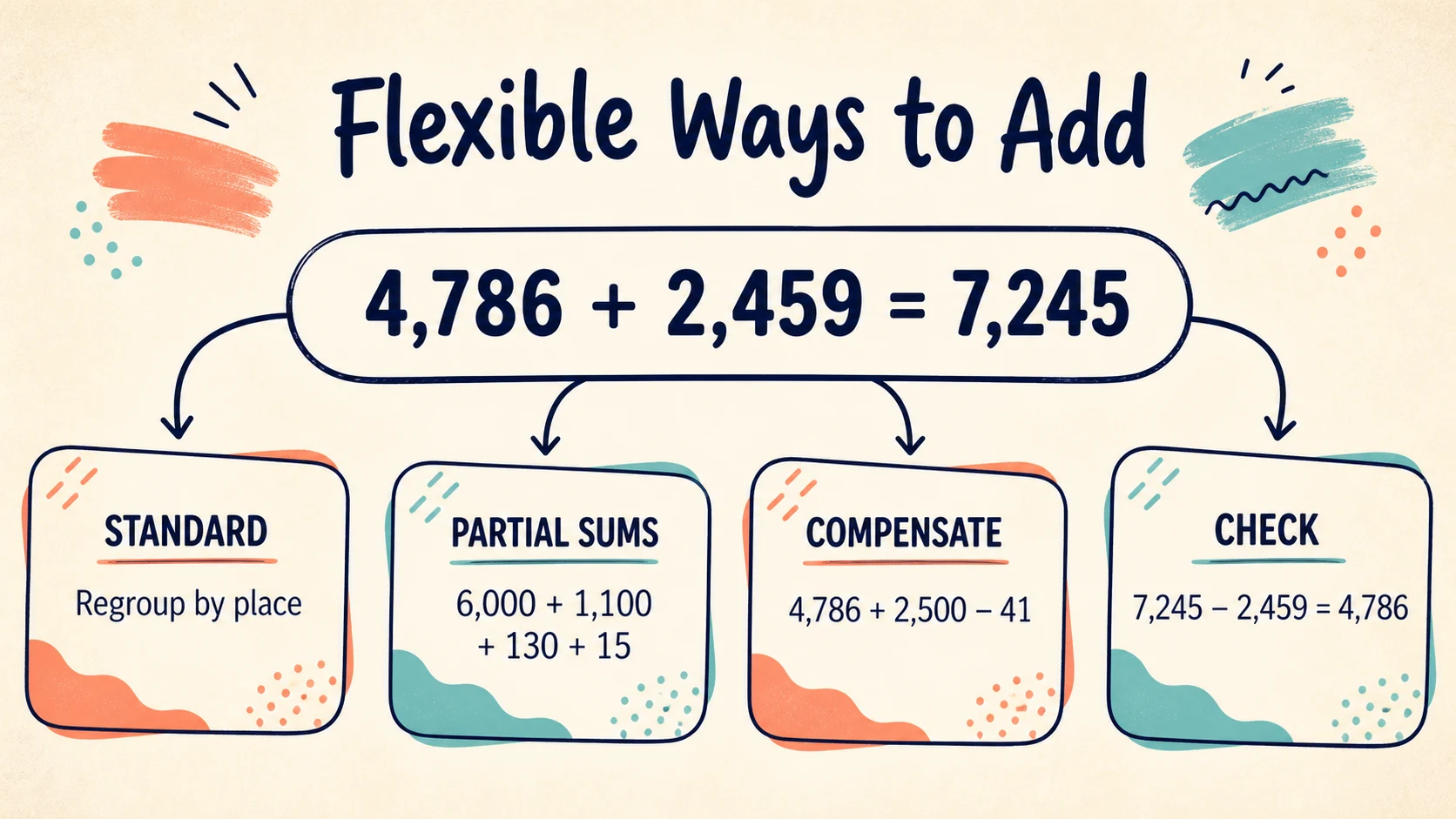
Whole numbers, decimals, fractions, estimation, and explanation form one connected addition pathway.
Grade labels describe the intended practice level, not an exact prescription for every learner. Local curricula and teaching sequences differ. The Common Core State Standards for Mathematics provide one useful reference point: multi-digit whole-number addition is established before fifth grade, while fifth-grade work extends place-value reasoning into decimal operations and develops addition of fractions with unlike denominators. That framing does not mean every learner begins fifth grade with the same command of the prerequisites.
Use the 5th Grade Math collection to see addition alongside the other operations expected at this level. When choosing a starting activity, rely on the learner’s written work and explanations rather than the grade label alone.
Prerequisites to Check Before Advancing
A short diagnostic is more informative than assigning a full worksheet immediately. Give one or two problems from each prerequisite area, ask the learner to work without help, and then ask, “How did you decide what to do?”
Basic addition and decomposition
The learner should be able to retrieve or efficiently derive common addition facts. For example:
- 8+7=15, perhaps by making ten: 8+2+5;
- 6+9=15, perhaps as 6+10−1;
- 35+20=55, using tens;
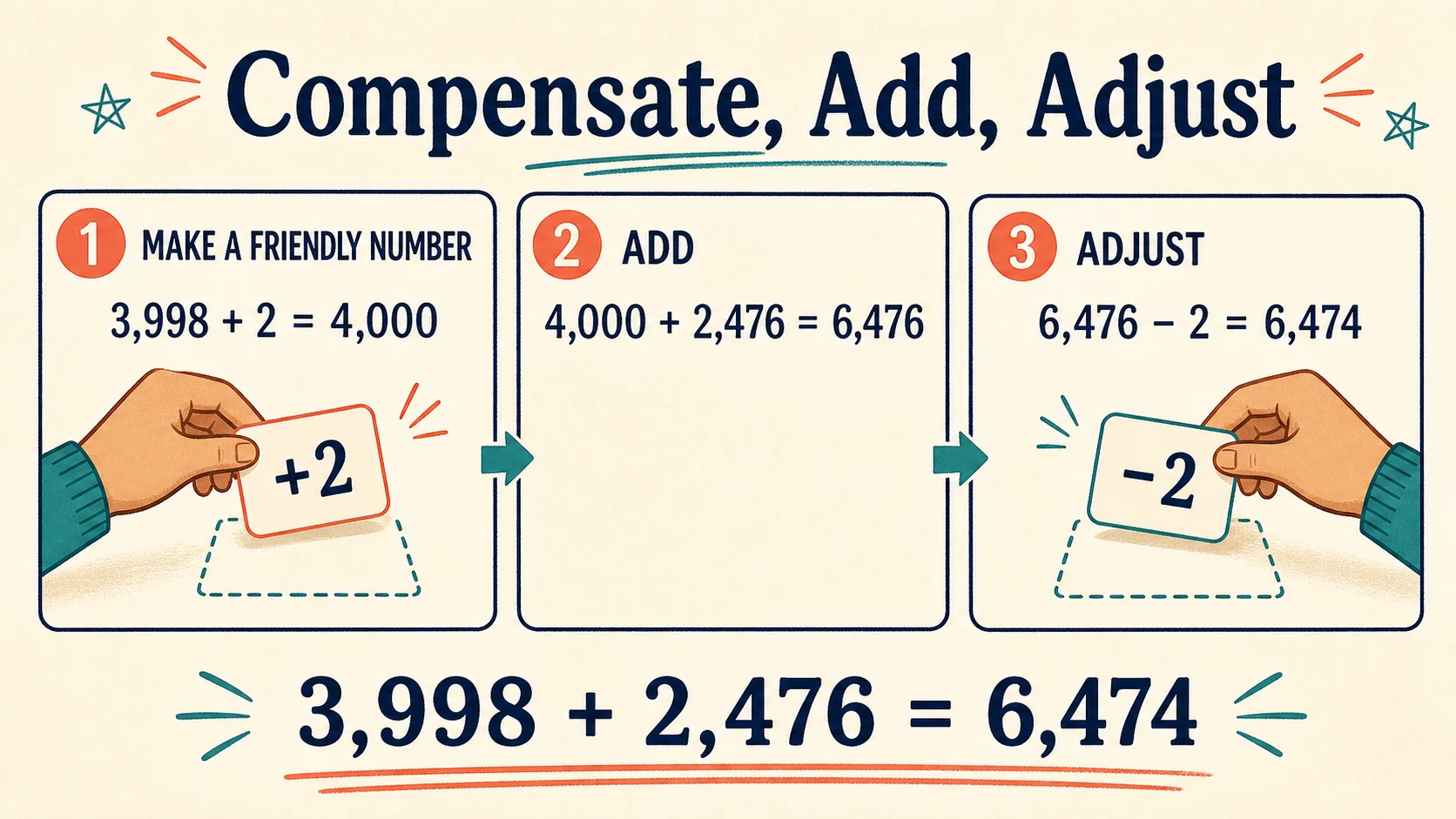
- 398+2=400, by completing a hundred.
Slow fact recall does not prohibit work with larger numbers, but it increases the amount the learner must hold in mind. If facts cause frequent interruptions, include brief untimed strategy practice alongside grade-level work.
Place value and regrouping
Check that the learner can identify the value of a digit and regroup between adjacent places. In 47,386, the 7 represents 7,000. Ten ones can be composed as one ten, ten tens as one hundred, and so forth.
Ask the learner to explain why 8+7 in the ones column produces 5 ones and 1 additional ten. An explanation such as “because 15 ones is 1 ten and 5 ones” shows more understanding than “I carried the 1.”
Decimal place value
Before decimal addition, verify that the learner can:
- read tenths and hundredths;
- recognize equivalent forms such as 0.5=0.50;
- compare decimals using place value;
- align quantities by their place, not by the number of written digits.
Money can provide a familiar context, but it should not become the only model. A learner also needs to understand decimals as numbers independent of dollars and cents.
Fraction foundations
For fraction addition, check whether the learner can:
- identify the numerator and denominator;
- generate equivalent fractions;
- find a common denominator in manageable cases;
- explain why changing a denominator requires changing the numerator;
- recognize that fractions must describe equal-sized parts before their counts can be combined.
If equivalent fractions are uncertain, teach that prerequisite before expecting reliable addition with unlike denominators.
A Grade-Appropriate Instructional Progression
The progression below is an instructional suggestion based on the catalogue’s concrete-representational-abstract approach. It is not a universal timetable. A learner may move quickly through one row and need several sessions on another.
| Stage |
Main mathematical work |
Helpful representation |
Evidence of readiness to advance |
| 1. Reconnect foundations |
Facts, making ten, place value, estimation |
Counters, ten frames, place-value chart |
Explains regrouping and derives uncertain facts |
| 2. Whole-number addition |
Multi-digit numbers with multiple regroupings |
Base-ten blocks or quick place-value sketches |
Aligns places, records regrouping, and checks by estimation |
| 3. Decimal addition |
Tenths and hundredths, including unequal written lengths |
Decimal grids, money, place-value chart |
Aligns decimal points and preserves place value |
| 4. Like-denominator fractions |
Combine counts of equal-sized parts |
Fraction strips or area models |
Adds numerators while keeping the unit unchanged |
| 5. Unlike-denominator fractions |
Rename fractions as equivalent fractions before adding |
Fraction strips, number lines, equations |
Selects a common denominator and justifies each equivalent fraction |
| 6. Mixed application |
Word problems, missing addends, estimation, method choice |
Bar models, equations, open number lines |
Identifies the quantities and chooses a defensible method |
| 7. Independent practice |
Accurate, efficient, explained solutions |
Mostly symbolic work, with models available |
Sustains accuracy and notices unreasonable answers |
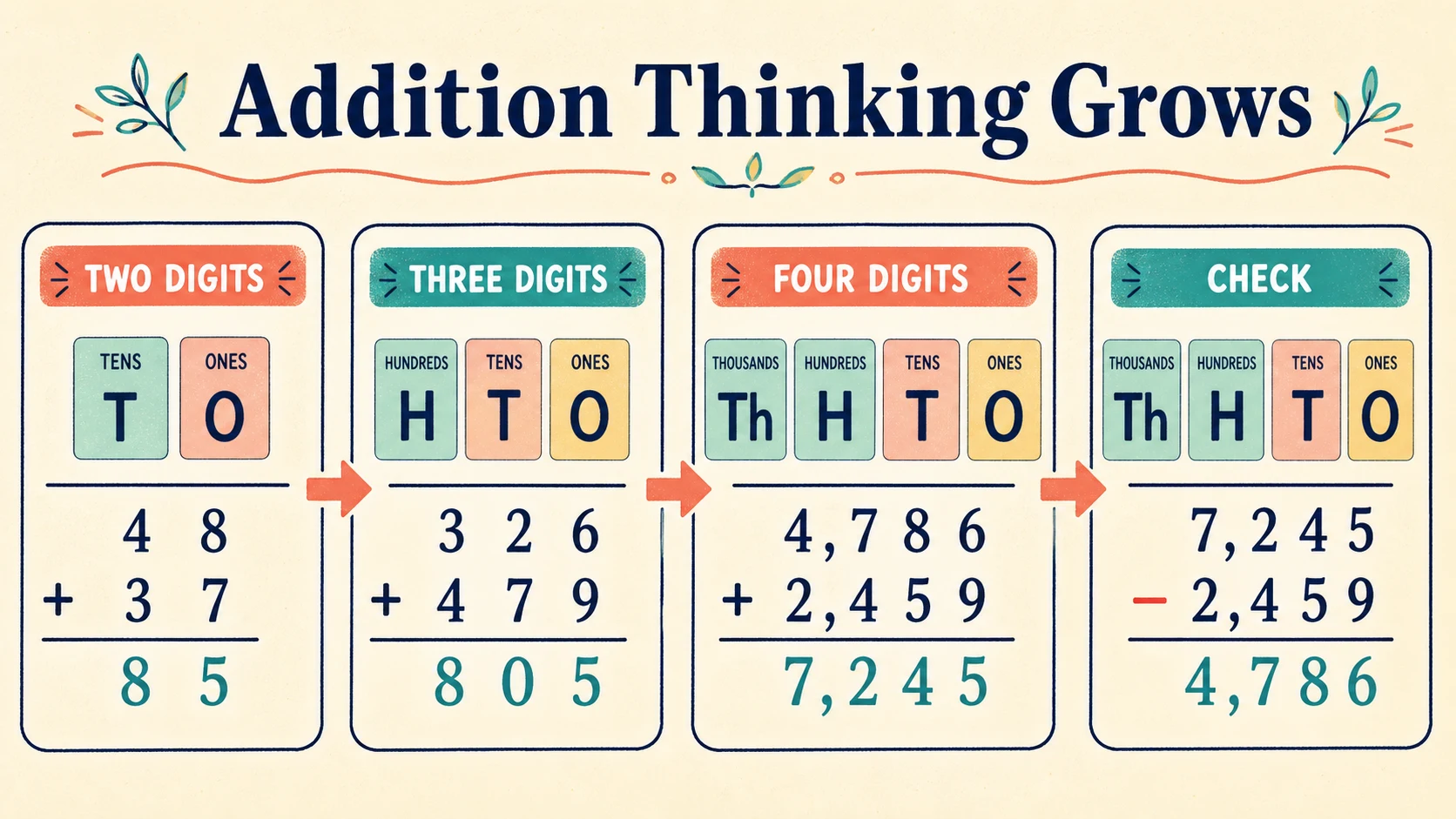
Advance when the learner’s work is accurate and explainable, not merely because a set number of days has passed.
The catalogue progression starts addition with objects and pictures, moves through mental strategies and place value, and culminates in whole-number, decimal, and fraction work. Fifth-grade instruction should not repeat every early stage by default. Instead, return to an earlier representation when it reveals the meaning behind a procedure the learner is misusing.
The IES practice guide Assisting Students Struggling with Mathematics supports broad instructional practices such as systematic instruction, clear mathematical language, representations, and deliberate review. It does not evaluate WorksheetWise materials or prescribe this particular sequence.
Concrete and Visual Models That Still Matter
Manipulatives are not limited to early elementary lessons. At fifth-grade level, they should clarify a mathematical relationship and then give way to drawings and notation.
Base-ten models for whole numbers
Represent 2,346+1,587 with thousands, hundreds, tens, and ones. Combine like units:
- 6 ones plus 7 ones makes 13 ones, regrouped as 1 ten and 3 ones;
- 4 tens plus 8 tens plus the new ten makes 13 tens, regrouped as 1 hundred and 3 tens;
- continue by place.
A quick sketch—squares for hundreds, lines for tens, and dots for ones—may be more practical than physical blocks. The purpose is to show that regrouping changes the form of a quantity, not its value.
Place-value charts for decimals
Write one digit in each column:
| Ones |
Tenths |
Hundredths |
| 4 |
7 |
0 |
| 2 |
3 |
8 |
This displays 4.70+2.38. The zero in the hundredths place makes an existing place explicit; it does not change 4.7. The chart also shows why aligning the rightmost digits would be incorrect.
Fraction strips and number lines
To add 21+31, place both fractions against the same whole. Divide that whole into sixths:
21=63,31=62.
Now the pieces are the same size, so their counts can be combined. On a number line, begin at 21 and move another 31, using sixths as the common unit.
Bar models for situations
Suppose a school collected 1,275 cans in one week and 986 the next. Draw one bar for each week, then bracket both bars as the total. This helps distinguish an addition situation from a comparison or missing-part problem before calculation begins.
The IES guide Teaching Math to Young Children addresses younger learners, but its high-level emphasis on connected representations and mathematical language offers useful background. For a fifth grader, models should be age-respectful, targeted, and linked explicitly to equations.
Fully Checked Worked Examples
Example 1: Multi-digit whole numbers with regrouping
Find 48,796+27,458.
Align equal places:
   48,796
+  27,458
---------
Calculate from right to left:
- Ones: 6+8=14. Write 4; regroup 1 ten.
- Tens: 9+5+1=15. Write 5; regroup 1 hundred.
- Hundreds: 7+4+1=12. Write 2; regroup 1 thousand.
- Thousands: 8+7+1=16. Write 6; regroup 1 ten-thousand.
- Ten-thousands: 4+2+1=7.
Therefore,
48,796+27,458=76,254.
Check by subtraction:
76,254−27,458=48,796.
An estimate also supports the result:
49,000+27,000≈76,000,
so 76,254 is reasonable.
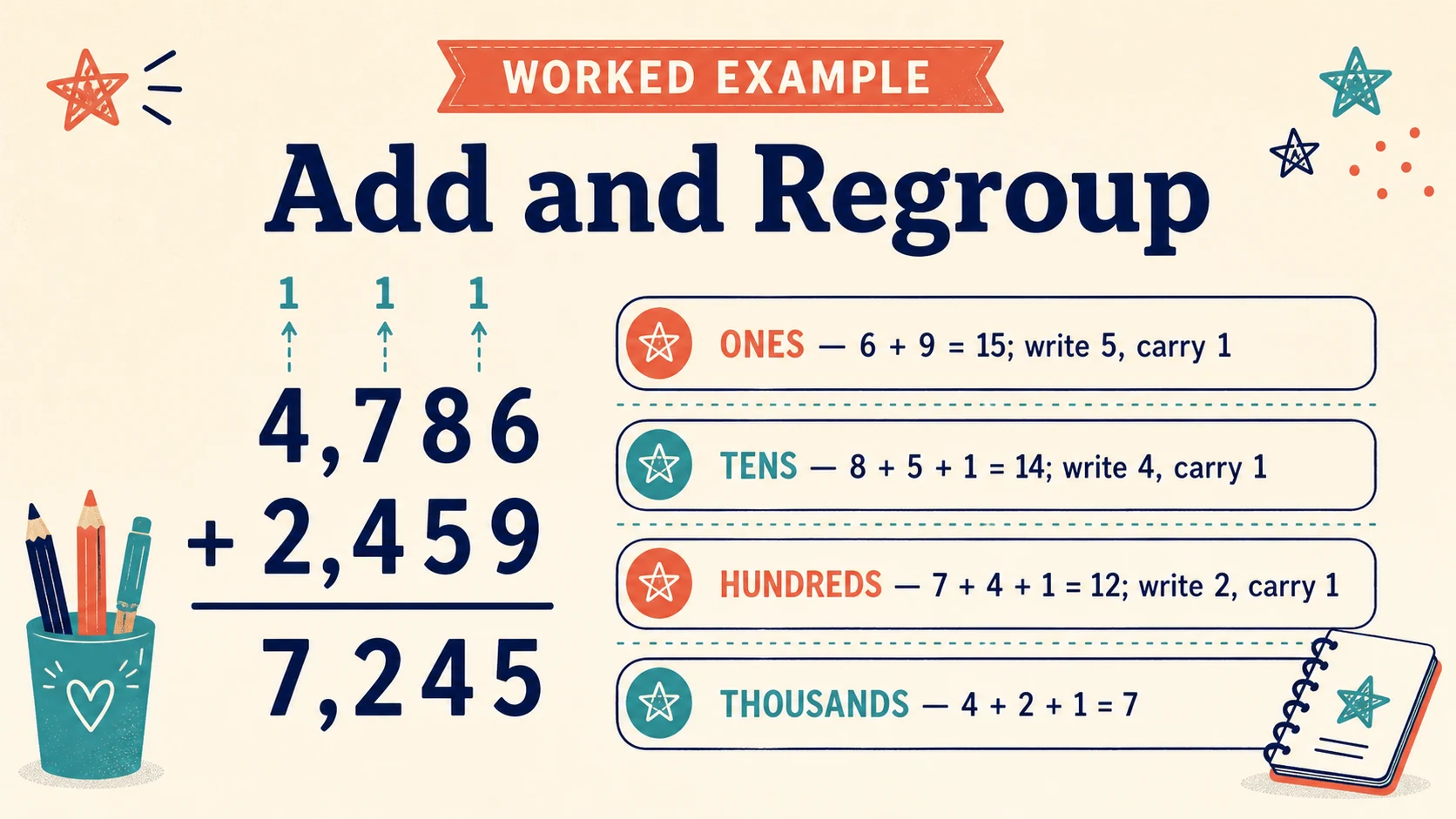
Regrouping records exchanges between adjacent place-value units; it is not an unexplained mark above a column.
Example 2: Decimal addends of unequal written length
Find 6.4+2.75.
Rename 6.4 as 6.40, then align decimal points:
   6.40
+  2.75
------
   9.15
- Hundredths: 0+5=5.
- Tenths: 4+7=11 tenths. Write 1 tenth and regroup 1 one.
- Ones: 6+2+1=9.
Thus,
6.4+2.75=9.15.
Check by compensation:
6.4+2.75=6.4+3−0.25=9.4−0.25=9.15.
A boundary warning: aligning the final digits as if both numbers were whole numbers would incorrectly treat 4 tenths as 4 hundredths.
Example 3: Fractions with unlike denominators
Find:
43+65.
A common denominator for 4 and 6 is 12.
43=129,65=1210.
Add the equivalent fractions:
129+1210=1219.
Convert the improper fraction if a mixed number is useful:
1219=1127.
Therefore,
43+65=1127.
Check with decimals as an independent confirmation:
0.75+0.8333…=1.5833…,
and
1127=1.5833….
The repeating decimals confirm the same value; they are not the preferred exact calculation.
Example 4: Mixed numbers
Find:
232+143.
Add the whole-number parts and fractional parts:
2+1=3.
For the fractions, use twelfths:
32=128,43=129.
Then:
128+129=1217=1125.
Combine the totals:
3+1125=4125.
So,
232+143=4125.
Check by converting first to improper fractions:
38+47=1232+1221=1253=4125.
Both methods agree.
Example 5: A missing-addend boundary case
A total is 15.6. One addend is 8.75. Find the missing addend:
8.75+□=15.6.
Addition is the situation, but subtraction is an efficient way to find the missing part:
15.60−8.75=6.85.
Check in the original equation:
8.75+6.85=15.60.
Therefore, the missing addend is 6.85. This example helps prevent the misconception that every problem described with addition must be solved by performing addition directly.
A Short, Repeatable Lesson Routine
A focused session can take about 15 to 25 minutes, but that range is an instructional suggestion, not a required timetable. Shorten, extend, or split the routine according to the learner’s attention and work.
Use the same lesson shape while changing the mathematical focus and level of support.
1. Retrieve and connect
Begin with two or three prerequisite prompts. Before decimal addition, for example, ask the learner to compare 0.6 and 0.56, then rename 0.6 as 0.60. Keep this opening brief enough that it does not replace the lesson’s main work.
2. Model one example
Solve a carefully chosen example while naming the quantities and places precisely. Connect any model to the written method. Say, “Eleven tenths is one whole and one tenth,” rather than merely directing the learner to carry a digit.
3. Solve one together
Let the learner supply the next step. Ask focused prompts:
- “Which units are being combined?”
- “Why can these fractions not be added yet?”
- “Where should the decimal points go?”
- “What estimate would make sense?”
Reduce prompting as soon as the learner begins making sound decisions independently.
4. Complete a short independent set
Use three to six problems that target the same idea but vary enough to reveal understanding. One decimal set might include 3.2+1.45, 0.68+4.7, and 12+0.09. Check the setup as well as the answer.
5. Explain and check
End with one explanation and one check. The learner might estimate, use the inverse operation, or solve with a second method. Record the error pattern or successful strategy that should shape the next session.
Choosing Practice That Matches the Learner
A useful assignment is neither the longest available nor automatically the one bearing the learner’s grade. Choose practice by the mathematical demand visible in each problem.
Match the set to the current need
Use focused practice when the learner is developing a method. Appropriate groups include:
- whole numbers with one regrouping;
- whole numbers with regrouping across zero;
- decimals through hundredths;
- fractions with related denominators, such as thirds and sixths;
- fractions requiring a less obvious common denominator;
- word problems requiring method selection.
Use mixed practice after the learner can identify the problem type without cues. Mixing too early may hide whether errors come from the new concept or from switching among concepts.
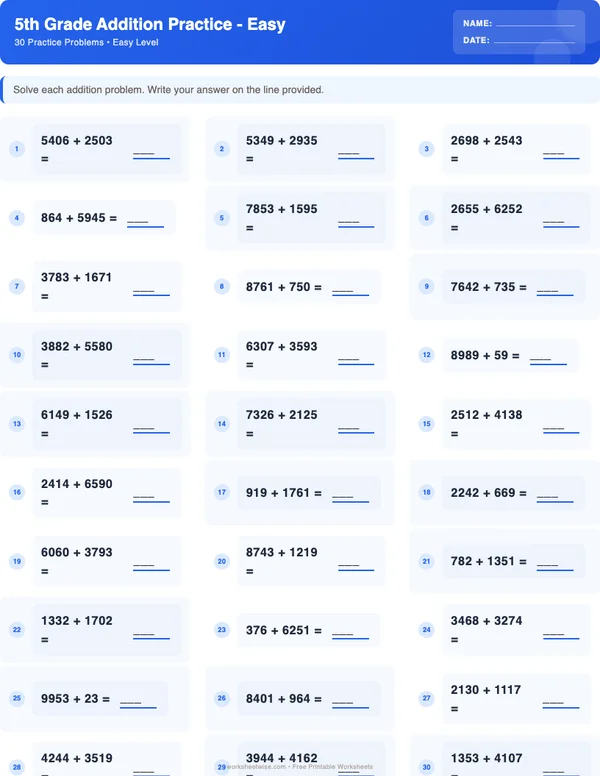
The free standard easy addition worksheet contains 30 exercises focused on addition facts, mental math, number sense, and place value, with a separate answer key. It is a reasonable option for foundational reinforcement or an initial work sample. It should not be treated as proof of mastery of every fifth-grade addition form.
For broader repetition, the 5th Grade Addition Worksheet Pack contains 18 worksheets. Select pages according to observed needs rather than assigning the entire pack in order.
Adjust challenge without changing the core skill
To reduce complexity:
- use fewer digits;
- limit the number of regroupings;
- provide a place-value chart;
- begin with related fraction denominators;
- allow an estimate and model before symbolic work.
To increase complexity:
- include internal zeros, as in 40,608+7,795;
- vary decimal lengths;
- require an exact fraction answer and a reasonableness check;
- include irrelevant information in a word problem;
- ask for two methods or an error analysis.
Do not increase challenge merely by increasing the number of nearly identical items. Complexity, independence, and explanation can be adjusted separately.
Common Errors and Diagnostic Responses
An incorrect answer is useful only when the adult identifies the decision that produced it.
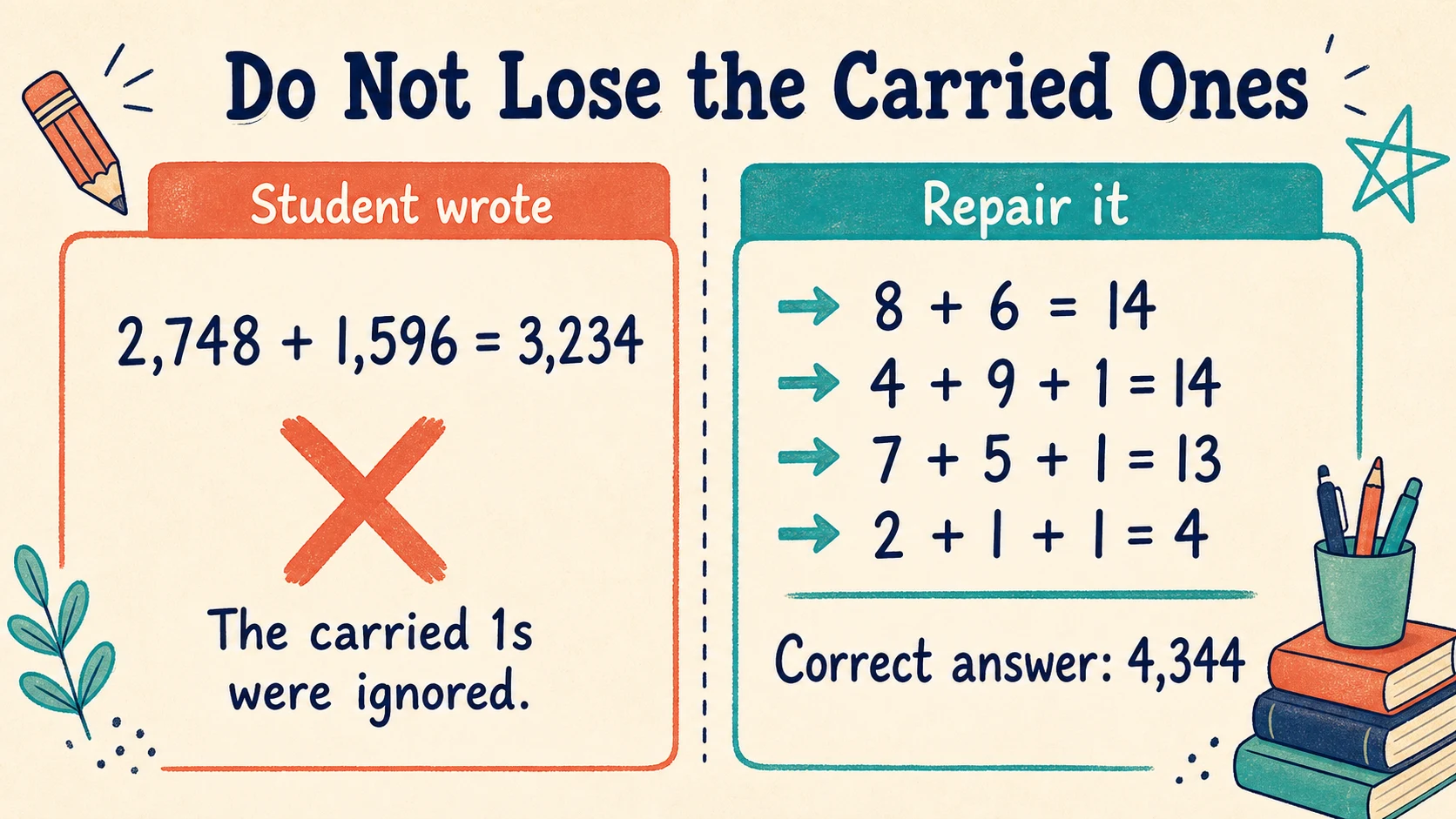
Diagnose the underlying place-value or unit error before assigning more of the same problem.
| Observed work |
Likely issue to investigate |
Teaching response |
| 458+76=1,218 |
Digits may have been aligned from the left |
Place both numbers in a ones-to-hundreds chart and identify each digit’s value |
| Regrouped digit is omitted later |
The learner may understand the sum but lose track of the exchanged unit |
Use a base-ten sketch, then record each exchange directly above its receiving column |
| 3.7+2.45=2.82 or another misaligned result |
Rightmost digits were aligned rather than decimal points |
Rename 3.7 as 3.70 and label ones, tenths, and hundredths |
| 52+31=83 |
Numerators and denominators were combined as separate whole numbers |
Use fraction strips to show that fifths and thirds are unequal units |
| 21=42, but 21 becomes 41 elsewhere |
Equivalent-fraction scaling is incomplete |
Multiply numerator and denominator by the same nonzero number and verify with a model |
| 243+121=345, then stops |
The learner has not renamed an improper fractional part |
Show 45=141, then combine the extra whole |
| Every word problem is solved by adding all numbers |
Operation choice is being driven by visible numerals |
Ask the learner to name the unknown and draw a bar model before calculating |
| Exact answer is accepted despite a poor estimate |
Procedure is disconnected from magnitude |
Estimate first and compare the exact result with a reasonable interval |
One wrong answer does not establish a stable misconception. Give a nearby problem and ask the learner to explain. If the same reasoning reappears, respond to that pattern. If the second problem is correct, the original mistake may have been a recording or attention error.
Monitoring Progress Without Over-Testing
Keep a compact record containing the date, problem type, level of support, accuracy, and one brief observation. For example: “Aligned decimals independently; forgot one regrouped whole; corrected after estimate.”
Monitor four dimensions:
- Accuracy: Are answers correct?
- Method: Is the approach mathematically valid and appropriately efficient?
- Explanation: Can the learner identify the units and justify regrouping or equivalence?
- Independence: How much prompting, modeling, or visual support is needed?
A learner is ready for harder work when performance is accurate across more than one occasion, explanations remain coherent, and support can be reduced. Perfect speed is not required. Timed practice, if used at all, should follow conceptual and strategy development rather than replace it.
A short exit item can guide the next lesson:
- one calculation from the day’s focus;
- one estimate or reasonableness check;
- one sentence explaining a key step.
If accuracy falls when models are removed, reconnect the representation to the written method. If accuracy remains high but work is slow, examine fact fluency and organization. If answers are correct but explanations are vague, ask for unit-specific language rather than automatically increasing difficulty.
A Flexible Two-Week Practice Plan
This ten-session plan assumes short weekday sessions. It is a practical option, not a universal schedule. Repeat, combine, or postpone sessions according to the learner’s work.
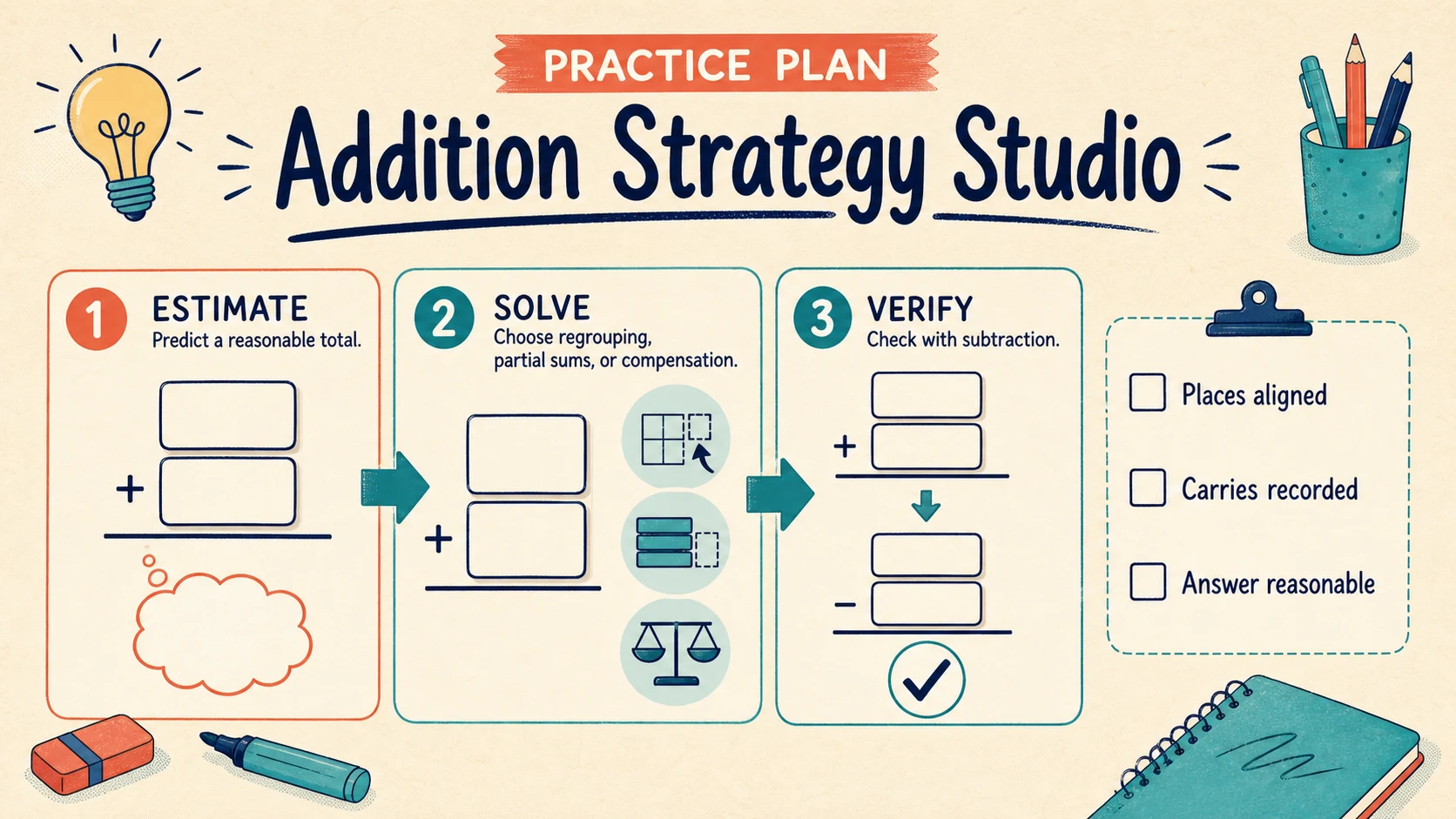
Use each session’s evidence to confirm or revise the following day’s task.
| Session |
Focus |
Suggested work |
Decision point |
| 1 |
Diagnostic |
Facts, place value, one whole-number sum, one decimal sum, equivalent fractions |
Identify the earliest unstable prerequisite |
| 2 |
Whole-number meaning |
Model and solve multi-digit sums with one or two regroupings |
Can the learner explain each exchange? |
| 3 |
Whole-number variation |
Include zeros, several regroupings, estimation, and checking |
Separate calculation errors from alignment errors |
| 4 |
Decimal place value |
Rename decimals with zeros; use a place-value chart |
Does the learner align by place? |
| 5 |
Decimal application |
Add tenths and hundredths in equations and short contexts |
Can the learner estimate the magnitude first? |
| 6 |
Fraction review |
Generate equivalent fractions and add like denominators |
Continue only when equivalent fractions are reliable |
| 7 |
Unlike denominators |
Use strips or number lines, then equations |
Can the learner justify the common denominator? |
| 8 |
Mixed numbers |
Add fractional parts, regroup when needed, and check |
Watch for unrenamed improper fractions |
| 9 |
Mixed application |
Combine whole-number, decimal, fraction, and missing-addend problems |
Can the learner choose the operation and method? |
| 10 |
Review and next placement |
Use a brief mixed set plus explanation prompts |
Choose reinforcement, extension, or a prerequisite return |
Across the plan, begin sessions with one retrieval problem from earlier work. Do not respond to a difficult day by doubling the problem count. Instead, reduce the set, add a representation, and determine whether the obstacle is fact recall, place value, equivalence, language, or recording.
Boundaries and Limitations
Addition instruction cannot be separated completely from subtraction, multiplication, division, and fraction equivalence. Subtraction checks addition; multiplication knowledge supports common denominators; place value supports every decimal calculation. A learner may therefore need work outside the topic before addition becomes dependable.
This guide cannot determine an individual learner’s needs from age or grade alone. It does not provide medical guidance, diagnose a learning condition, guarantee outcomes, or prescribe a universal timetable. It also does not claim comprehensive alignment with every state, district, or homeschool sequence.
Worksheets provide written practice and visible evidence, but they do not by themselves show what the learner understands. Listen to explanations, inspect erased or crossed-out work, and ask the learner to reproduce a method on a fresh problem. When persistent difficulty affects work across topics or continues despite explicit instruction and suitable practice, coordinate with the learner’s teacher or another qualified education professional who can examine a broader body of work.
The Most Useful Next Step
Give a brief diagnostic rather than beginning with a large mixed assignment. If the learner needs foundational reinforcement in facts, mental math, number sense, or place value, use the free 5th Grade Addition standard easy worksheet. Check the first few items promptly, ask the learner to explain one answer, and use the observed strategy—not the page title—to choose the next lesson.