What fifth-grade spelling practice should teach
5th Grade Spelling Words practice should help a learner recognize useful spelling patterns, explain how a word is built, recall irregular parts, and carry accurate spelling into sentences and everyday writing. A strong sequence moves beyond memorizing a weekly list. It combines:
- Common vowel and consonant patterns
- Silent letters
- Prefixes, suffixes, and base words
- Consonant doubling and final-e changes
- Multisyllabic word analysis
- High-frequency words
- Editing and sentence-level application
- Cumulative review of previously taught patterns
The learner’s observed work should determine pacing. If a learner can spell a list during a Friday test but miss the same words in a paragraph on Monday, the next step is transfer practice, not a harder list. If the learner cannot identify the incorrect part of a misspelled word, return to a more visible model: sound mapping, syllable division, a word sum, or a pattern sort.
Grade labels describe the intended practice level, not a universal timetable or a guarantee that every learner has met the same prerequisites. Local curricula and instructional sequences differ. Use the 5th Grade worksheet hub or Spelling collection to compare nearby practice levels when needed.
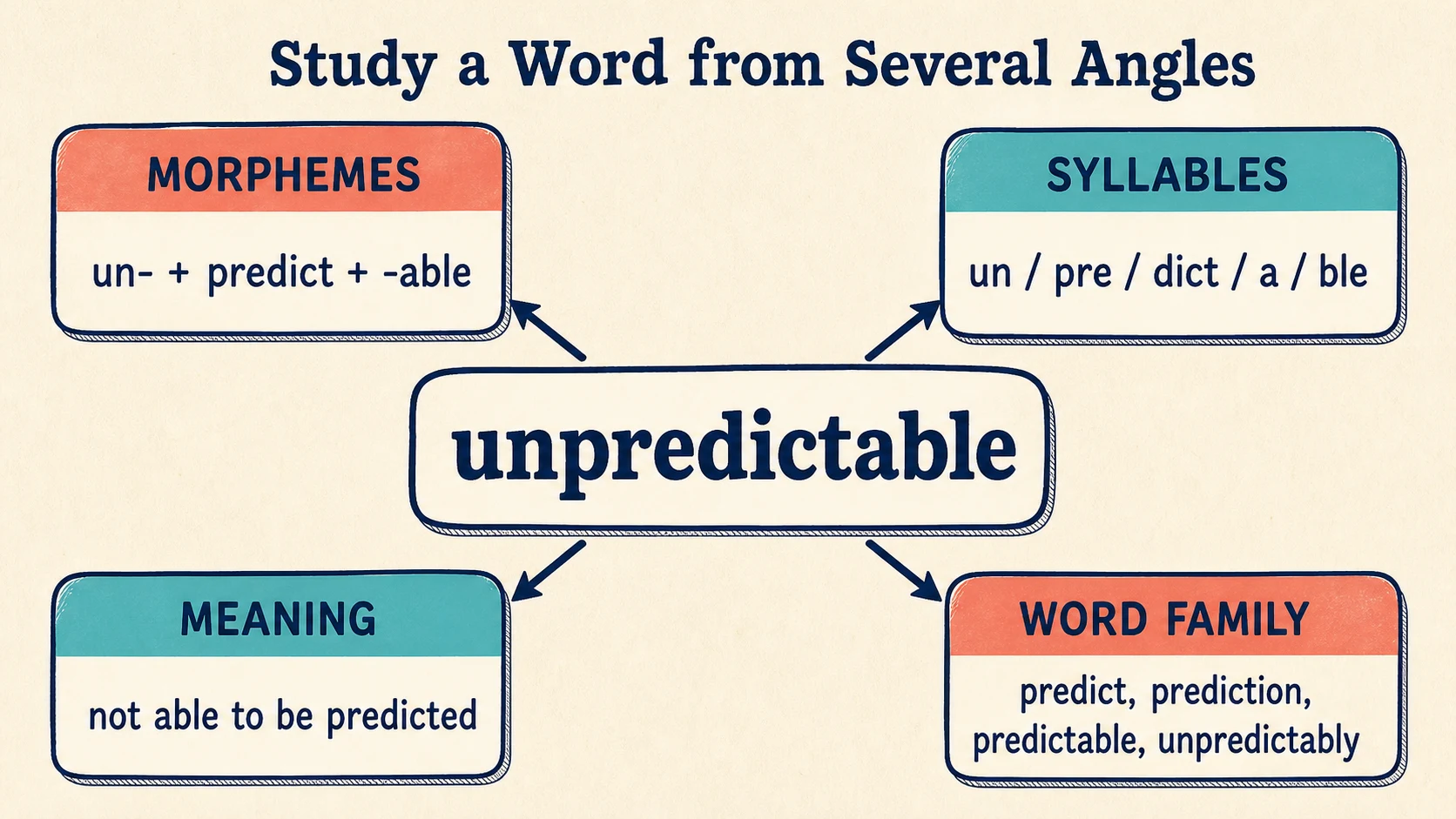
Spelling develops through connected work with sounds, patterns, meaningful word parts, memory, and writing.
The knowledge a learner needs first
Fifth-grade word study rests on skills developed earlier. These prerequisites do not need to be flawless, but major gaps can make longer words unnecessarily difficult.
A learner should be able to:
- Hear and represent the main sounds in a spoken word.
- Read and spell familiar short- and long-vowel patterns.
- recognize common consonant teams such as sh, ch, th, and tch.
- Divide a spoken word into syllables.
- Identify a base word and common additions such as un-, re-, -ful, -less, -ed, and -ing.
- Notice when a word contains a remembered or unexpected letter sequence.
- Compare a written attempt with a correct model.
- Write a complete sentence in which a target word makes sense.
The IES foundational reading guide is written for kindergarten through third grade, so it is not a fifth-grade spelling program. Its high-level recommendations nevertheless clarify the foundation: connect speech sounds to letters, analyze word parts, and practice writing and recognizing words. For an older learner with unfinished foundational skills, it is reasonable to revisit those processes with age-respectful vocabulary.
A quick prerequisite check
Dictate these words without showing them: float, scratched, hopeful, return, and sunset. Then ask the learner to mark the base word or recognizable parts.
The responses can reveal different needs:
- “Flot” for float suggests attention to the long-o spelling in this word.
- “Scrached” for scratched suggests the learner may need to examine both tch and the past-tense ending.
- “Hopful” for hopeful suggests uncertainty about retaining the final e.
- “Riturn” for return suggests the prefix or the first unstressed syllable is not secure.
- “Sunsit” for sunset suggests the second short vowel needs attention.
This is a brief instructional check, not a standardized assessment. Use it to choose a starting point, not to assign a permanent label.
A practical progression for spelling words
Pattern instruction is most useful when support is reduced only after the learner shows control. A suggested progression follows.
| Stage |
Main work |
Adult support |
Evidence for moving on |
| 1. Notice |
Read words and highlight the shared spelling feature |
Name and model the feature |
Learner points to the relevant letters accurately |
| 2. Compare |
Sort words into two or three pattern groups |
Provide headings and discuss contrasts |
Learner explains why words belong together |
| 3. Build |
Combine base words with prefixes or suffixes |
Model word sums and changes |
Learner preserves or changes letters correctly |
| 4. Recall |
Use look-cover-write-check and short dictation |
Prompt careful checking |
Learner spells most targets without viewing them |
| 5. Apply |
Write dictated and original sentences |
Give meaning and grammar prompts only as needed |
Target spelling remains correct in context |
| 6. Review |
Mix current and previously studied patterns |
Select words from error records |
Accuracy holds after a delay and in new writing |
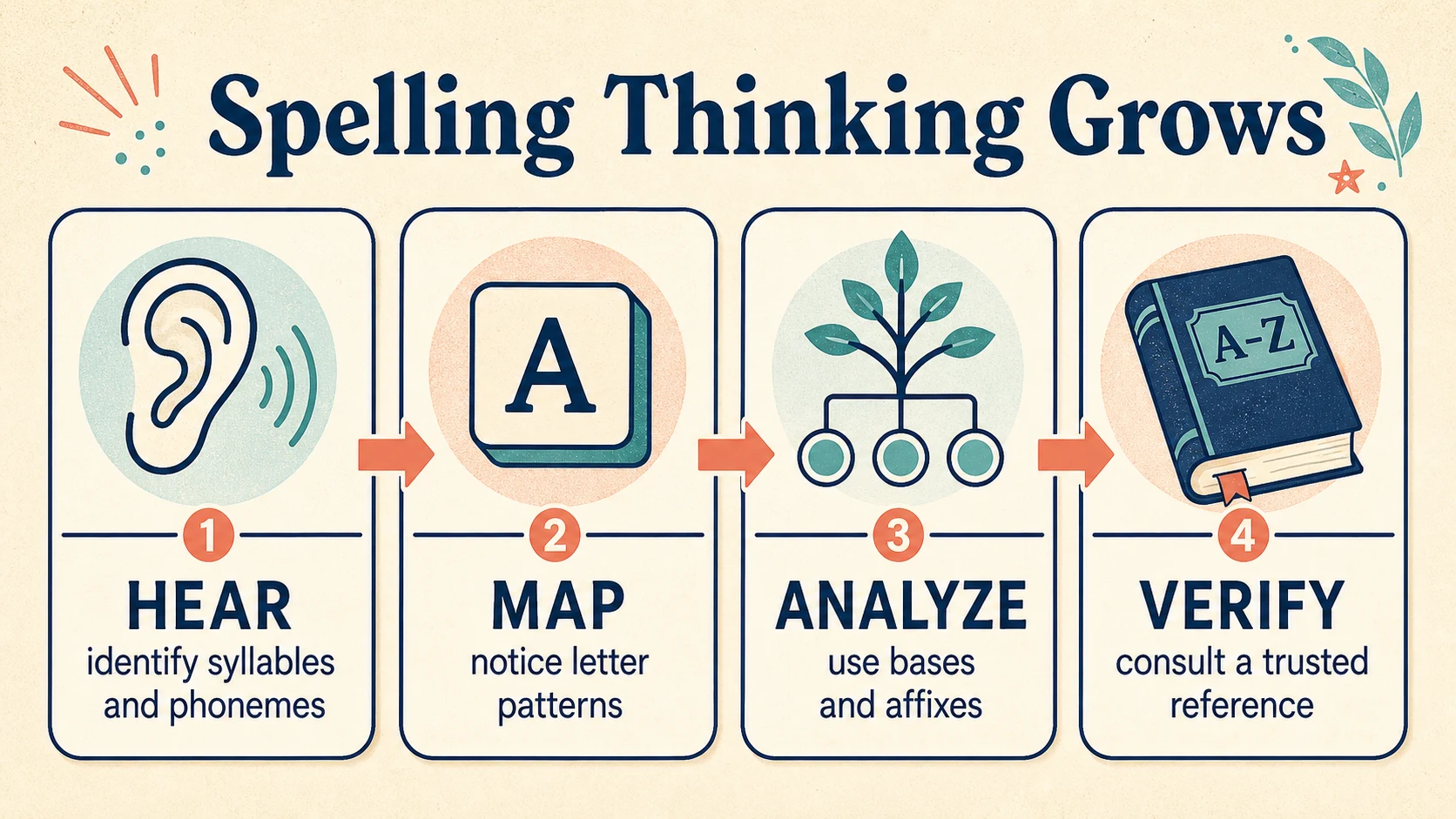
Support can move from visible patterns and guided word building to delayed recall and independent writing.
Suggested content order
A workable order is not simply “easy words to hard words.” Teach related ideas together:
- Review common long-vowel spellings and r-controlled vowels.
- Revisit consonant teams, silent letters, and familiar high-frequency words.
- Study final-e behavior when suffixes are added.
- Study consonant doubling in familiar base words.
- Build words with prefixes and suffixes.
- Divide and reconstruct multisyllabic words.
- Compare word families in which pronunciation or spelling changes.
- Mix these patterns in editing, dictation, and original writing.
Move backward when errors show that a prerequisite is missing. Move forward when the learner can explain the pattern and use it beyond the original list.
Concrete and visual models that reveal word structure
Long words become more manageable when their structure is visible. Three models are especially practical.
Sound-to-letter mapping
Say a word slowly and use one box for each sound or stable sound unit. For bright, a simplified map might be:
| /b/ |
/r/ |
/ī/ |
/t/ |
| b |
r |
igh |
t |
The three letters igh represent the vowel sound in this word. The model prevents the learner from assuming that every sound must have exactly one letter.
This approach has limits. English spellings also preserve meaningful word relationships, and pronunciation varies. Do not force a perfectly simple sound match when the written structure gives better information.
Syllable frames
Break a longer word into pronounceable sections, then reconstruct it:
in | de | pend | ent
The syllable frame reduces memory load, but sound alone does not settle every vowel. In independent, the ending is -ent, not -ant. That final choice must be learned through visual comparison and connection to depend.
Word sums and matrices
A word sum shows which meaningful parts remain stable:
un + help + ful = unhelpful
A small matrix can generate related words:
| Prefix |
Base |
Suffix |
| help- |
help |
-ful |
| un- |
|
-less |
|
|
-er |
Possible results include help, helpful, helpless, helper, and unhelpful. Not every theoretical combination will be a normal English word, so the learner should confirm meaning and usage rather than joining pieces mechanically.
Fully checked worked examples
Each example below includes a decision, a spelling, and a verification step.
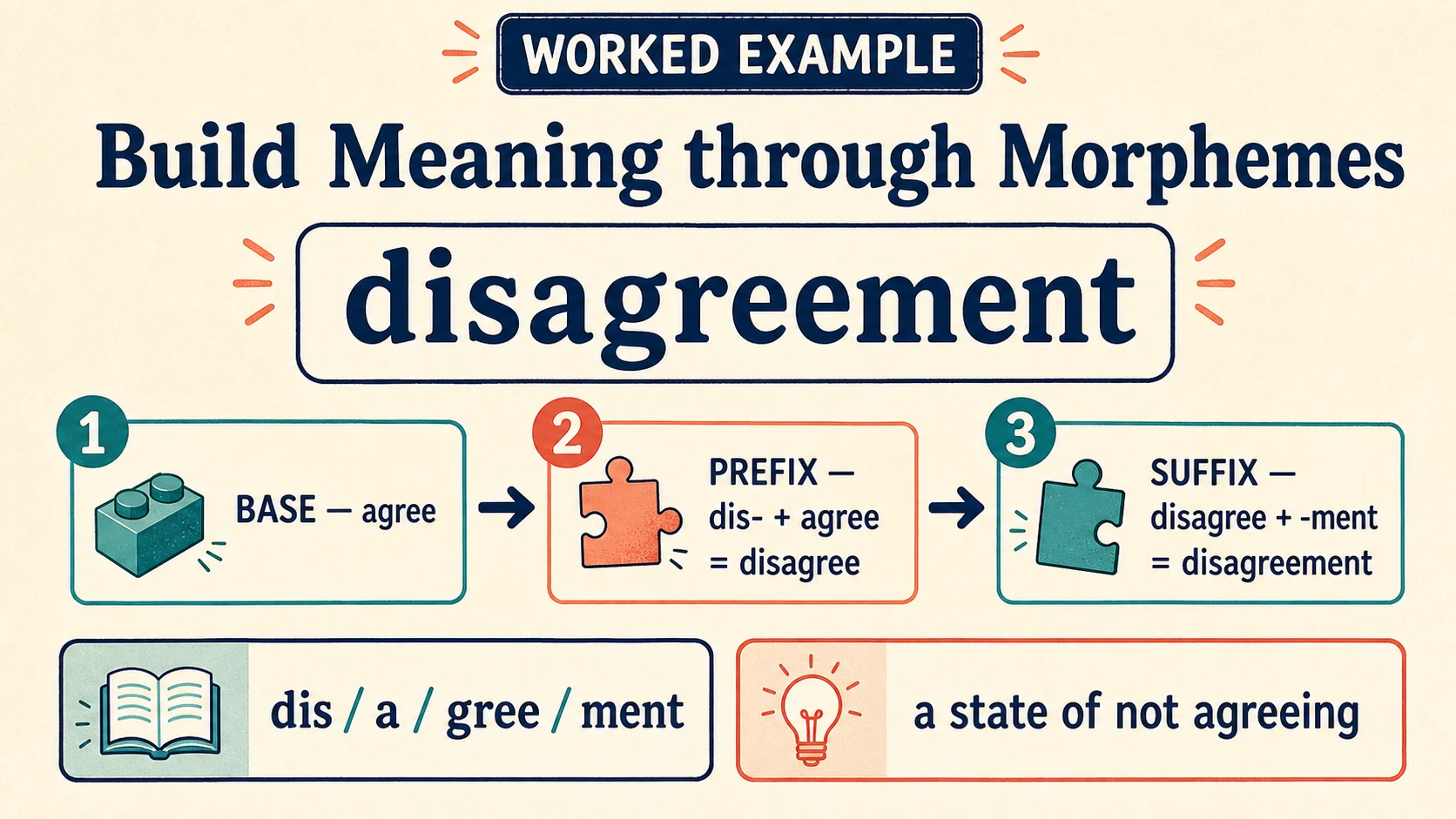
The learner identifies the base, applies a spelling change, and checks the completed word.
Example 1: Adding -ing to begin
Task: Complete the sentence: “The concert is ___ now.”
- Identify the base word:
begin.
- Hear the stress: the stronger beat falls on the final syllable, gin.
- Notice the ending: one vowel followed by one consonant.
- Double the final consonant before adding -ing.
begin + n + ing = beginning
Answer: “The concert is beginning now.”
Check: The result contains two adjacent ns at the join: one closes begin, and the added one appears before -ing. The spelling is beginning, not begining.
Example 2: Keeping final e in hopeful
Task: Add -ful to hope.
- Identify the base:
hope.
- Identify the suffix:
-ful.
- The suffix begins with a consonant.
- Keep the final e in this word.
hope + ful = hopeful
Answer: hopeful
Check: Removing the suffix from hopeful leaves the complete base hope. The result has one l because the suffix is spelled -ful, not -full.
This contrasts with a word such as hoping:
hope + ing = hoping
There, the final e is dropped before the vowel-starting suffix. The comparison is more useful than an overgeneralized instruction to “always drop silent e.”
Example 3: Changing y in reliable
Task: Add -able to rely.
- Identify the base:
rely.
- Replace the final y with i for this word formation.
- Add -able.
rely → reli + able = reliable
Answer: reliable
Check: Divide the completed word as re | li | a | ble for visual study. The middle sequence is lia, and the ending is able. The spelling is reliable, not relyable.
A boundary case is enjoyable: the y remains. This shows why learners should study examples and word families instead of treating “change y to i” as an exception-free command.
Example 4: Using a base word to correct independant
Task: Correct the sentence: “Maya completed the project independantly.”
First correct the adjective embedded in the adverb:
in + depend + ent = independent
Then add -ly:
independent + ly = independently
Answer: “Maya completed the project independently.”
Check: The base depend remains visible. The ending sequence is ent + ly, producing ently. The incorrect form independantly substitutes a where the correct word has e.
Example 5: Finding a useful family connection
Task: Choose the correct spelling: signiture or signature.
- Connect the word to the familiar base sign.
- Observe that the g is not clearly heard in sign but is heard in signature.
- Preserve the family connection at the beginning:
sign.
- Add the remaining letters:
ature.
sign + ature = signature
Answer: signature
Check: The word begins sign-, not sin- and not signi-. Its full letter sequence is s-i-g-n-a-t-u-r-e.
This example is a memory aid through word relationship, not a claim that every silent letter becomes audible in a related word.
A short, repeatable lesson routine
The following 12–15 minute routine is an instructional suggestion, not a universal schedule. Shorten it when attention or accuracy falls, and extend application only when the learner remains productive.
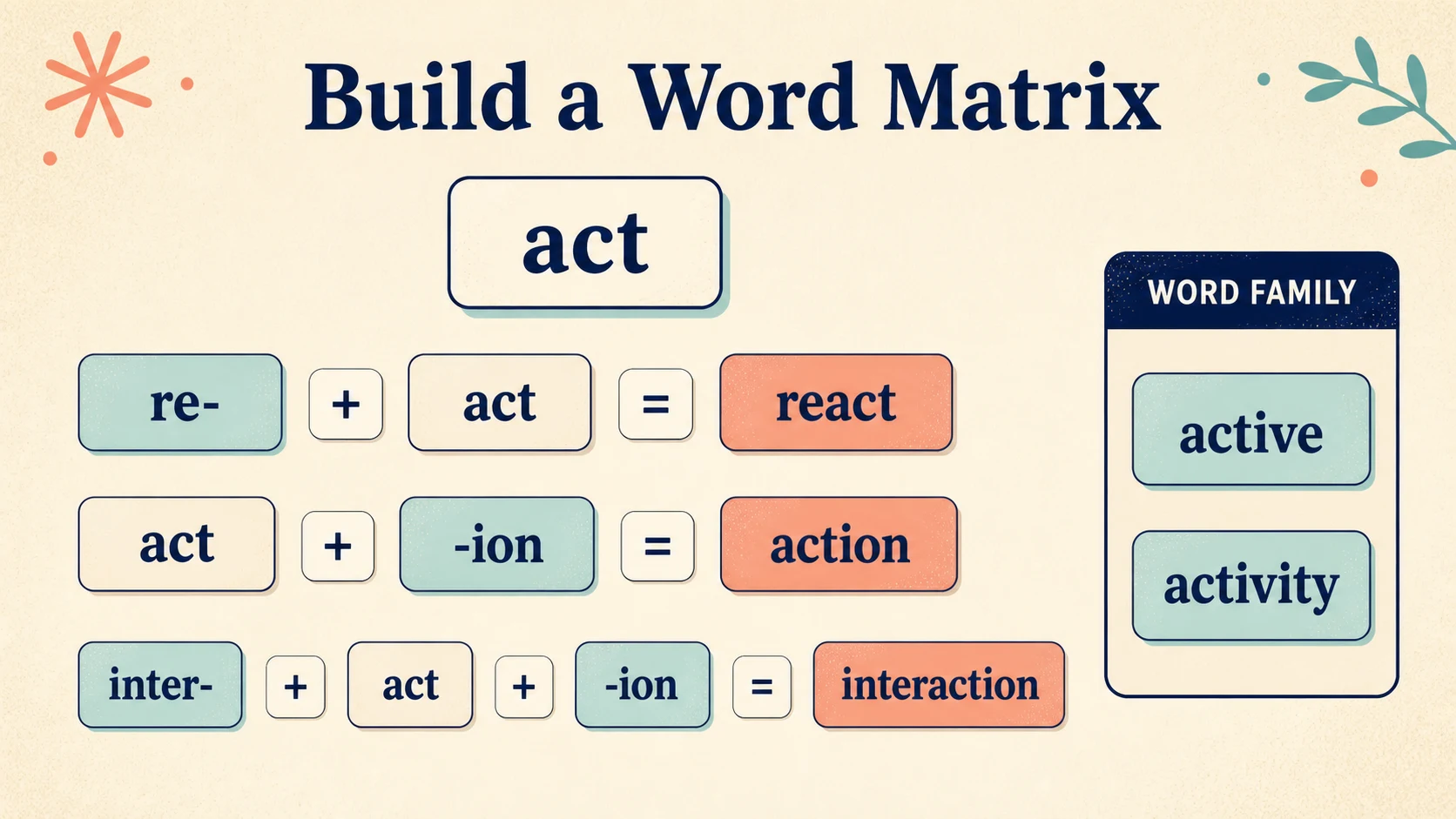
A compact routine connects pattern noticing, accurate recall, checking, and sentence-level use.
1. Review two known words
Dictate two words from earlier lessons. Do not display them first. Ask the learner to check each word and name any uncertain part.
2. Introduce one contrast
Display four to six words that reveal a useful distinction. For example:
- Double: running, beginning, admitted
- Do not double: opening, visiting, limiting
Ask what changes at the word boundary. Avoid giving a rule before the learner has examined the examples.
3. Sort and explain
Mix the words. The learner sorts them and completes a sentence stem such as, “I placed beginning here because ___.” An explanation provides more information than a correct pile alone.
4. Use look-cover-write-check
The learner:
- Looks closely at the whole word.
- Names or marks the difficult part.
- Covers the model.
- Writes the word from memory.
- Uncovers and compares letter by letter.
- Repeats only the missed or uncertain word.
Rainbow writing can add visual attention, but color should serve the pattern. For example, write the doubled consonant in one color rather than tracing every letter repeatedly without analysis.
5. Apply in a sentence
Dictate a sentence containing one or two target words. Then ask for an original sentence with one target. This links isolated spelling with meaningful writing.
The IES elementary writing guide recommends helping elementary students develop fluency with spelling and sentence construction as part of writing instruction. That high-level recommendation supports including sentence use; it does not establish a required length for this particular routine.
How to choose appropriate practice
Choose an activity according to the error you need to investigate or correct.
| Observed need |
Useful practice |
Less informative choice |
| Learner confuses two patterns |
Word sort with explanation |
Copying an unrelated list |
| Learner knows a word when shown but cannot recall it |
Look-cover-write-check, followed by delayed dictation |
Keeping the model visible throughout |
| Learner omits parts of long words |
Syllable frames and word reconstruction |
Presenting more long words at once |
| Learner misspells suffix forms |
Base-plus-suffix word sums |
Memorizing only the completed form |
| Learner passes list tests but misspells in paragraphs |
Sentence dictation and editing |
Another isolated list test |
| Learner repeatedly misses personal high-frequency words |
Small personal word notebook with cumulative review |
Replacing the whole weekly list |
| Learner is secure with the current pattern |
Two or three related challenge words |
Unrelated difficult vocabulary |
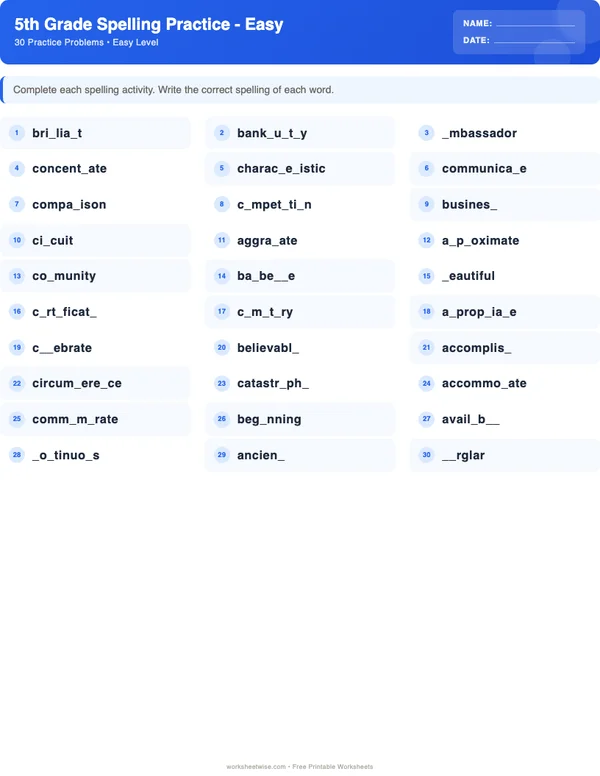
The free standard easy worksheet contains 30 exercises using fill-in-the-blank, word scrambles, and misspelling correction. It is a sensible choice for an initial sample, confidence-building review, homework, or reinforcement of word recognition and letter patterns. Its separate answer key supports quick checking.
It should not be treated as a complete spelling course or proof of mastery. A scramble can show whether the learner can reconstruct a displayed set of letters, but it does not by itself show unaided spelling. Follow worksheet practice with a few unprompted words and one sentence.
For broader repeated practice, the focused spelling words pack contains 18 worksheets. Use extra pages selectively. More exercises are helpful only when they address an observed need.
Differentiation without lowering the thinking
Differentiation should change the amount of support, the size of the word set, or the application demand. It need not reduce every learner to easier vocabulary.
When the learner needs more support
- Use five or six related words instead of a long mixed list.
- Display pattern headings during the first sort.
- Say the word, use it in a sentence, and say it again before dictation.
- Let the learner mark syllables or meaningful parts before writing.
- Contrast one correct form with one plausible error.
- Review missed words in the next session and again after a delay.
- Permit reference checking during editing, then include one target in later closed-book dictation.
If basic sound-to-letter mapping is still unstable, return temporarily to shorter words that use the same pattern. Preserve age-appropriate meaning and presentation.
When the learner is ready to extend
- Add two or three challenge words that use the same pattern.
- Remove sort headings and ask the learner to create categories.
- Ask for a rule with a stated boundary case.
- Compare related forms such as compete, competing, and competition.
- Dictate a short passage containing current and reviewed words.
- Have the learner find the pattern in a book being read.
- Ask the learner to edit an original paragraph after a delay.
Challenge should come from deeper analysis and transfer, not merely obscure vocabulary.
For multilingual learners
Confirm that the learner knows the word’s meaning and can identify it in a sentence before interpreting a spelling error. Pronunciation differences may affect how a learner segments a word. Provide a clear spoken model, but assess the written pattern that was taught. This is an instructional accommodation, not medical or child-specific guidance.
Common errors and what they reveal
A misspelling is most useful when the adult identifies its type. “Wrong” does not explain what to teach next.
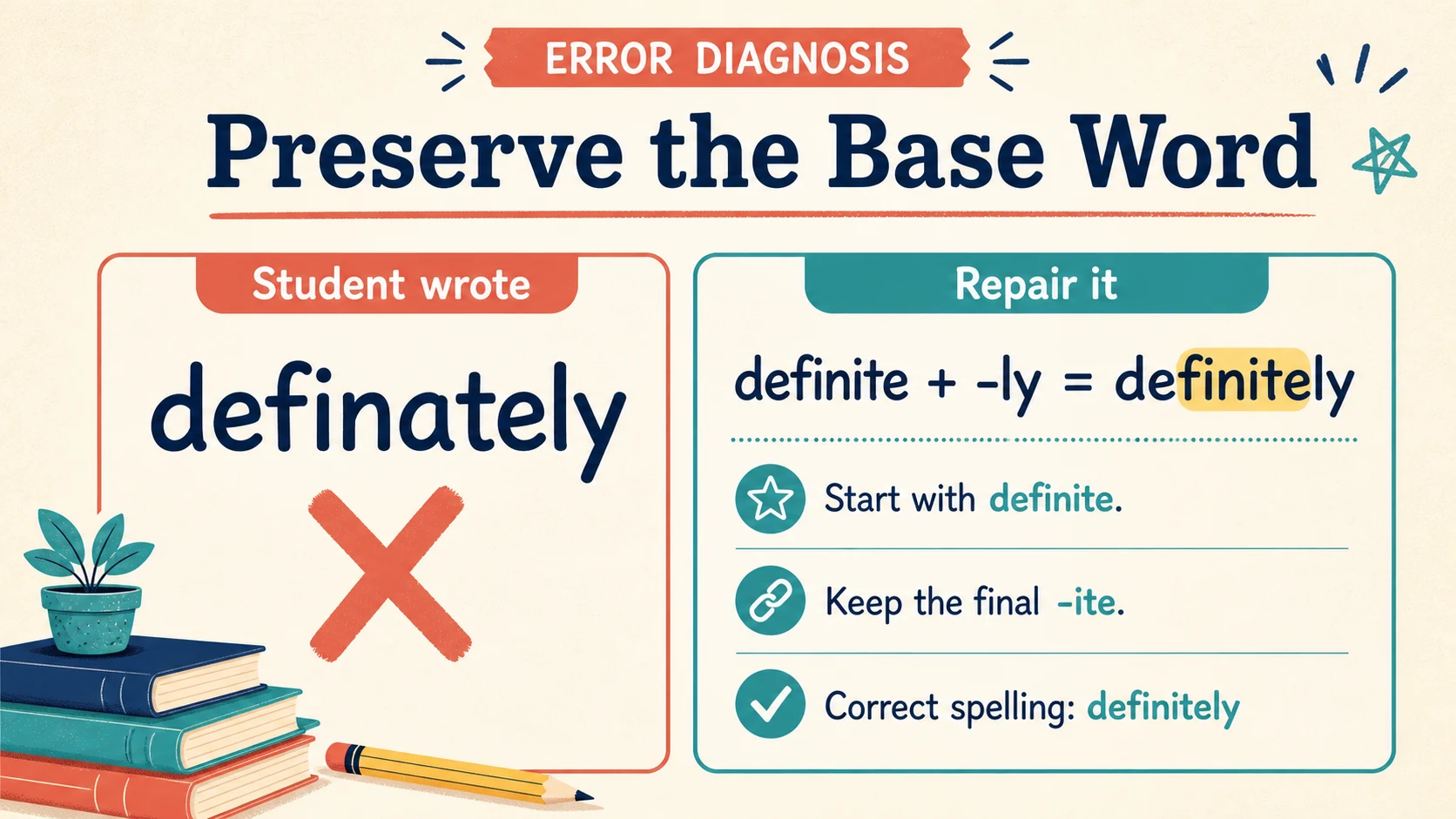
Different errors call for different teaching responses rather than identical repetition.
| Error |
Likely instructional issue |
Teaching response |
| begining |
Doubled consonant omitted |
Rebuild begin + n + ing and contrast with opening |
| hopful |
Final e removed incorrectly |
Compare hope, hopeful, and hoping |
| relyable |
Word-specific suffix change not secure |
Rebuild reliable and compare it with enjoyable |
| independant |
Unstressed ending represented by sound alone |
Connect the spelling to depend and highlight -ent |
| definately |
Learner relies on an indistinct vowel |
Mark the exact difficult sequence in the correct model |
| Correct list, incorrect paragraph |
Recall has not transferred to writing |
Use sentence dictation, original sentences, and delayed editing |
| Correct after repeated copying only |
Recognition is stronger than retrieval |
Cover the model and test after a short delay |
| Missing syllable in a long word |
Word was stored as an undivided string |
Divide, pronounce, build, cover, and reconstruct |
Misconceptions to correct
“Spelling is only sounding out.” Sound information matters, but it does not resolve every vowel, silent letter, or meaningful word part.
“Every word ending consonant-vowel-consonant doubles.” Compare running with opening. Word structure and stress can affect the result.
“Silent e always disappears before a suffix.” It remains in hopeful but disappears in hoping.
“A perfect weekly test means the word is mastered.” A list test measures performance in one setting. Check the word later and in connected writing.
“Copying a word three times is enough.” Rewriting can help after the learner identifies the incorrect part. Unexamined copying provides little evidence that the spelling can be recalled independently.
“Spellcheck replaces instruction.” A reference can confirm a spelling during editing, but the learner still needs to recognize uncertainty, choose among suggestions, and remember recurring words.
Monitoring progress and deciding what comes next
Use a small record rather than relying on a single score. For each target pattern, note performance in four conditions:
| Condition |
What to record |
| Visible model |
Can the learner locate and explain the important part? |
| Isolated recall |
Can the learner spell the word without seeing it? |
| Sentence use |
Does the spelling remain correct during dictation? |
| Delayed transfer |
Does it appear correctly later in original writing or review? |
A practical decision rule is qualitative:
- Continue support when the learner cannot identify the pattern or produces inconsistent attempts.
- Reduce prompting when the learner spells the word accurately and explains the decision.
- Move to transfer when isolated recall is secure but sentence use is not.
- Begin cumulative review when the learner succeeds across more than one session.
- Advance the pattern when accuracy remains stable in mixed practice.
Do not average unlike errors into one number. A learner who spells eight of ten words correctly but omits the same suffix twice needs a clearer suffix lesson. Another learner with the same score may have two unrelated memory errors.
The Common Core ELA framework presents literacy as connected work across reading, writing, speaking, listening, and language, with grade-specific detail built on broader anchor skills. That framing supports checking spelling in meaningful writing, but it does not mean this guide or its linked materials provide comprehensive standards alignment. Consult the learner’s local curriculum for required sequences and expectations.
A flexible two-week practice plan
This plan assumes ten short sessions. It is a suggested structure, not a universal timetable. Use fewer words, repeat a day, or change the pattern when the learner’s work shows that adjustment is needed.
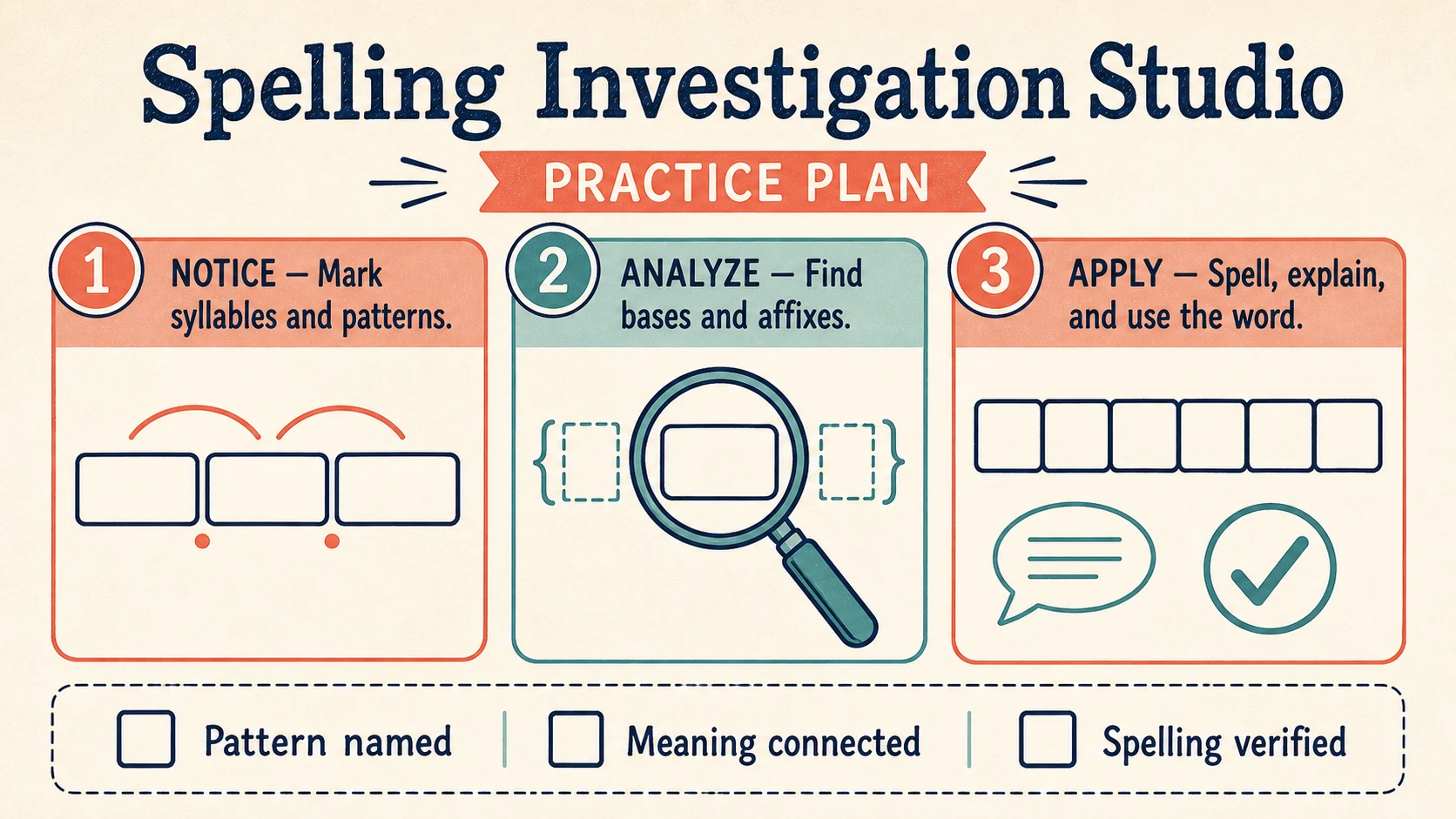
The plan alternates analysis, recall, application, correction, and delayed review.
| Day |
Focus |
Suggested activity |
Evidence to collect |
| 1 |
Baseline |
Dictate 8–10 words and one sentence |
Exact errors and uncertain parts |
| 2 |
Notice |
Highlight and sort words by two patterns |
Accuracy of sorting and explanation |
| 3 |
Build |
Use base-plus-suffix word sums |
Letter changes at each join |
| 4 |
Recall |
Look-cover-write-check; retest missed words later |
Unaided spelling after a delay |
| 5 |
Apply |
Dictate two sentences; correct by comparison |
Transfer into connected text |
| 6 |
Cumulative review |
Mix current words with four earlier words |
Retention after the break |
| 7 |
Boundary cases |
Compare pairs such as hopeful/hoping and running/opening |
Ability to explain why forms differ |
| 8 |
Editing |
Find and correct misspellings in a short passage |
Identification and accurate correction |
| 9 |
Independent writing |
Write a paragraph using three target words |
Spelling during composition and revision |
| 10 |
Review and plan |
Dictate a mixed sample and inspect the paragraph again |
Patterns secure, improving, or still unstable |
Keep a personal review list, but limit it to words that still need attention. Remove a word only after the learner spells it accurately in more than one context. Add new words because they reveal or extend a useful pattern, not simply because the calendar has moved to a new week.
Limits and the honest next step
A printable activity can provide structured practice, but it cannot determine why every learner made an error. It also cannot verify lasting transfer by itself. Adult observation remains important: listen to the explanation, inspect the exact letters changed or omitted, and compare isolated work with everyday writing.
This guide does not provide medical guidance, certification, guaranteed outcomes, a universal schedule, or comprehensive alignment with every local standard. If spelling difficulties are persistent and broad despite clear, sustained instruction, discuss the learner’s work with the classroom teacher or another appropriately qualified educational professional. Bring dated examples rather than a general statement that spelling is “hard.”
The most useful next action is to give the learner the free 5th Grade Spelling Words worksheet, check the 30 exercises with the included answer key, and record the type of each error. Then teach one revealed pattern with the short routine above. If you need a fresh, targeted follow-up rather than another fixed page, use the free worksheet generators to create practice around the learner’s next observed need.