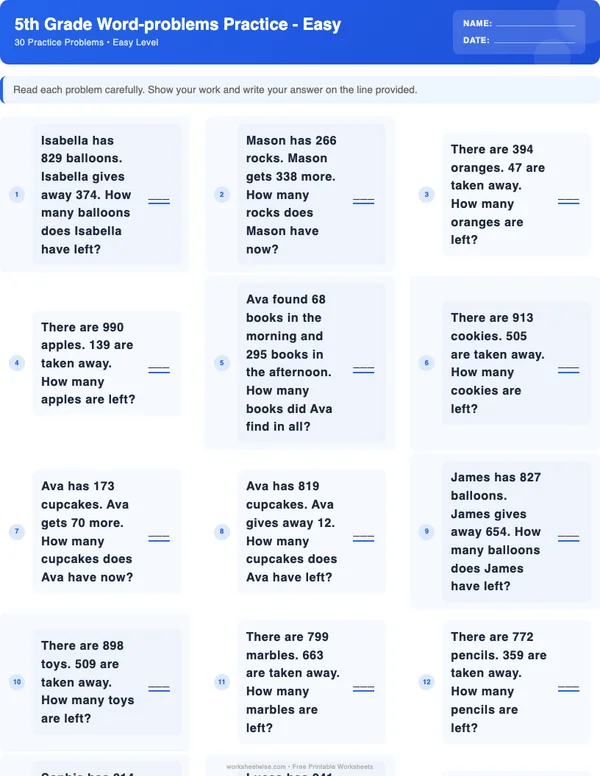
What 5th Grade Word Problems Require
Fifth-grade word problems ask learners to turn a described situation into mathematics. A successful solver must understand the question, identify relevant quantities, represent their relationships, select operations, calculate accurately, and decide whether the result makes sense.
The direct answer is this: teach the learner to understand the situation before choosing an operation. Have them retell the problem, name what is known and unknown, draw or write a model, solve, and check the answer in context. Do not make operation keywords the main strategy. A word such as “left” does not always mean subtraction, and “each” does not by itself determine whether to multiply or divide.
At this level, appropriate situations can involve:
- Multi-digit whole-number operations
- Addition and subtraction of fractions with unlike denominators
- Multiplication of fractions by whole numbers or other fractions
- Division of fractions by whole numbers
- Decimal addition, subtraction, multiplication, and division
- Volume
- Simple numerical expressions
- Problems requiring more than one operation
Grade labels describe an intended practice level, not a universal timetable. Local curricula and teaching sequences differ. Use the learner’s observed work—not the label alone—to decide where instruction should begin.
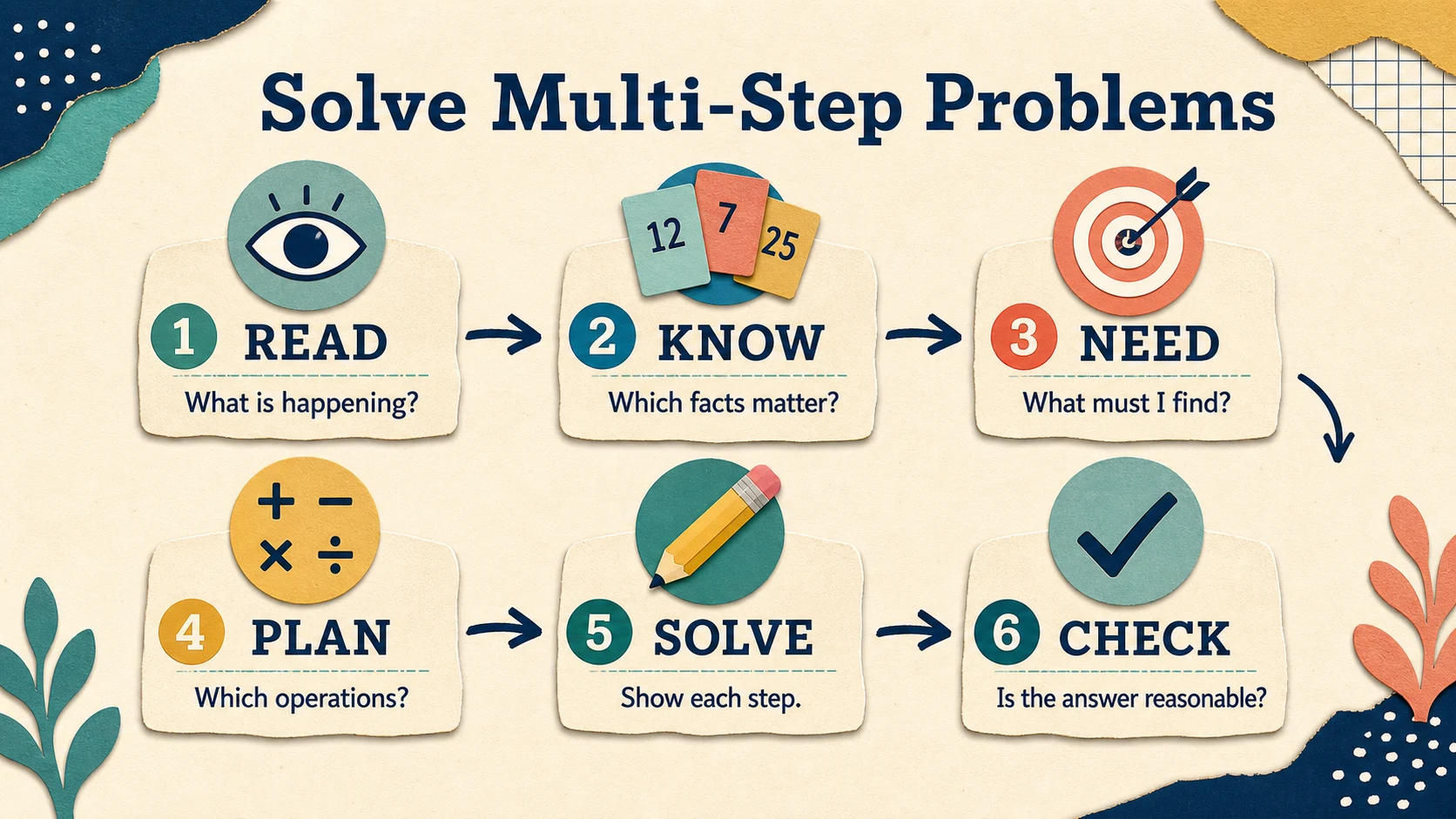
The skill combines comprehension, representation, calculation, and checking.
Prerequisites to Check Before Increasing Complexity
A learner may struggle with a word problem for several different reasons. Before assigning longer or more difficult problems, determine whether the obstacle is reading, mathematical structure, computation, or explanation.
Reading and retelling
Give the learner a short problem and ask for a retelling without numbers:
Several identical boxes hold the same number of markers. How many markers are there altogether?
A useful retelling might be: “There are equal groups, and I need the total.” If the learner repeats isolated words but cannot explain what is happening, work on comprehension and representation before emphasizing calculation.
The learner should also be able to identify:
- What the question asks
- Which quantities are given
- What each number measures
- Whether any information is irrelevant
- Whether enough information is available
Number and operation readiness
Check the computation that a problem is likely to require. A learner who understands that a problem calls for 24×18 may still be unable to finish if multi-digit multiplication is insecure. That is a calculation need, not necessarily a word-problem comprehension need.
Useful prerequisite checks include:
- Estimating whole-number products and quotients
- Renaming fractions with a common denominator
- Understanding a fraction as a quantity, not two unrelated whole numbers
- Reading decimal place values correctly
- Keeping measurement units attached to quantities
- Evaluating a simple expression in the required order
The fifth-grade scope described in the Common Core State Standards for Mathematics includes fraction applications and other grade-level mathematical work. That source offers broad curricular context; it does not evaluate this guide, WorksheetWise materials, or a particular learner.
Representation readiness
Before expecting an independent equation, check whether the learner can show a relationship with objects, a sketch, a number line, or a bar model. Representation is especially valuable when the correct operation is not obvious from the wording.
The IES guide on assisting students who struggle with mathematics provides high-level instructional recommendations that include systematic teaching and the use of visual representations. Applying a bar model to a particular problem below is an instructional choice consistent with that framing, not a claim that one diagram is universally best.
A Grade-Appropriate Teaching Progression
Difficulty should increase along one dimension at a time when possible. A learner who is beginning to interpret fraction situations does not also need dense wording, irrelevant information, and three operations in the same first lesson.
| Stage |
Problem structure |
Support to provide |
Evidence of readiness to move on |
| 1. Rebuild meaning |
One-step whole-number situations |
Objects, acting out, labeled pictures |
Retells the situation and identifies the unknown |
| 2. Represent relationships |
Part-whole, comparison, and equal groups |
Bar models, arrays, equations with a blank |
Chooses a model without relying on keywords |
| 3. Vary the unknown |
Result, starting amount, change, or group size unknown |
Partially completed diagrams |
Explains why the operation fits |
| 4. Combine steps |
Two-step whole-number and measurement problems |
Step boxes or an intermediate-question prompt |
Identifies and uses the needed intermediate result |
| 5. Extend number types |
Fractions and decimals |
Fraction strips, number lines, place-value notes |
Preserves units and estimates a reasonable range |
| 6. Increase independence |
Mixed operations and problem types |
A consistent solve-and-check routine |
Solves, checks, and explains with limited prompting |
| 7. Test discernment |
Extra information, missing information, and boundary cases |
Questions such as “Do we have enough information?” |
Rejects irrelevant data and identifies incomplete tasks |
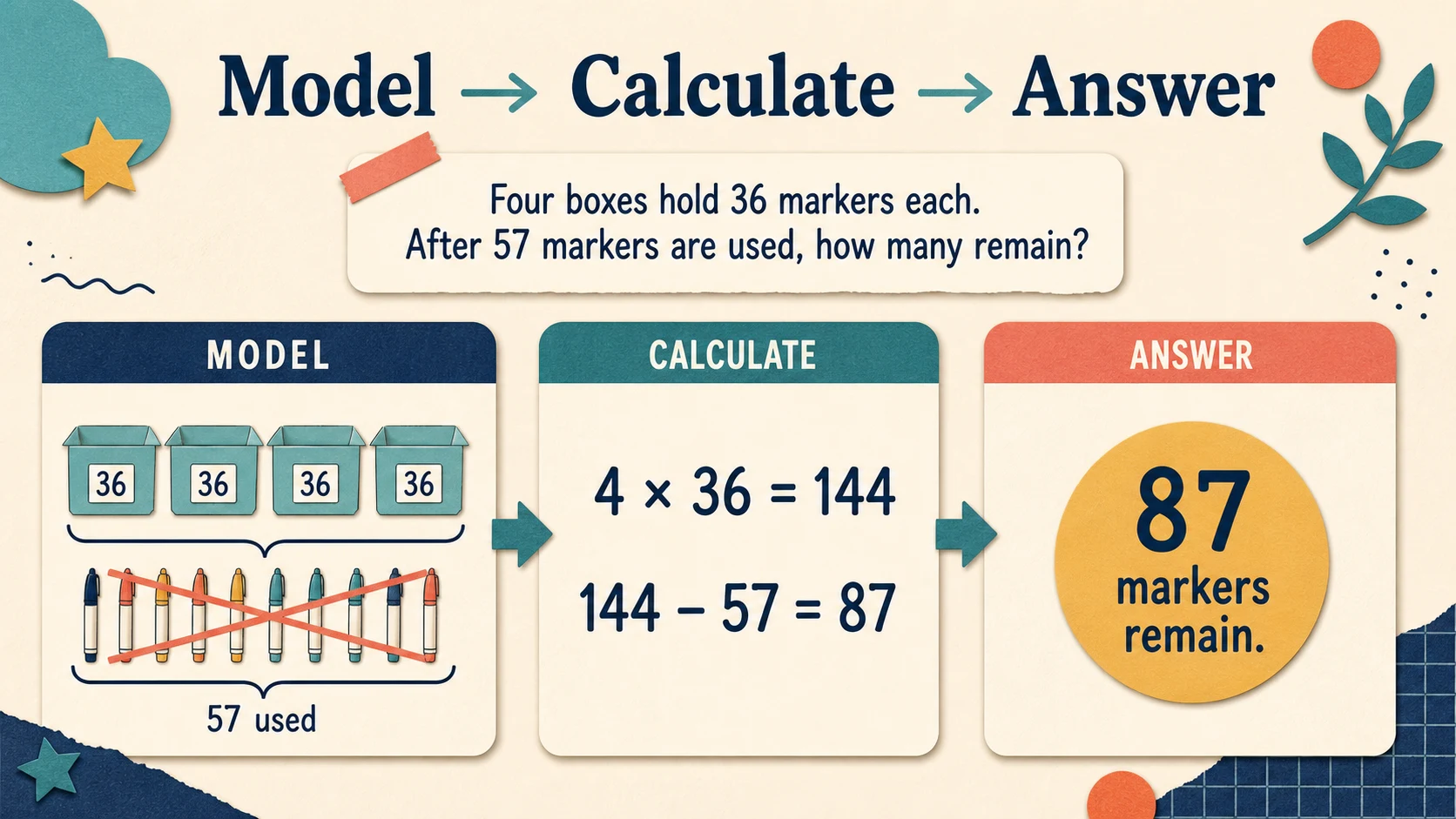
Progress by reducing support and varying structure, not merely by making numbers larger.
The 5th Grade Math collection can help an adult compare word-problem practice with computation practice. If the learner identifies operations correctly but makes calculation errors, targeted computation work may be more useful than another page of mixed stories. The broader 5th Grade worksheet hub provides context across subjects when reading demands are also affecting performance.
Concrete and Visual Models That Clarify Meaning
Models should reveal relationships. They are not decorations added after solving.
Part-part-whole bars
Use one bar for the total and divide it into known or unknown parts. This model suits joining, separating, and some fraction situations.
For example, if a 641-mile route includes 232 miles already completed, draw a total bar labeled 641. Mark one part 232 and the remaining part with a question mark. The diagram shows that the unknown is a missing part:
232+?=641
This is more dependable than seeing “remaining” and automatically subtracting without understanding the quantities.
Comparison bars
Draw aligned bars when one quantity is greater or smaller than another. The unmatched section represents the difference.
If one class collects 248 cans and another collects 319, two aligned bars make the unknown difference visible. The relationship can be written either as:
248+?=319
or:
319−248=?
Equal-group and array models
Use equal bars, rows, counters, or a rectangular array for multiplication and division. The same total of 144 objects can represent different questions:
- 12 groups with 12 in each: 12×12=144
- 144 divided into groups of 12: 144÷12=12
- 144 shared among 12 groups: 144÷12=12
The arithmetic may be identical while the unknown’s meaning changes. Ask the learner to label the result as “groups,” “objects per group,” or another relevant unit.
Fraction strips and number lines
Fraction strips help compare and combine unlike fractional parts. A number line helps show distance traveled, time elapsed, or an amount changing from a starting point.
Instructional suggestion: when denominators differ, let the learner sketch equivalent partitions before performing the symbolic calculation. The sketch need not be perfectly scaled, but its labels must be accurate.
Place-value and measurement sketches
For decimals, record the unit beside every quantity and align place values only after the situation is understood. For volume, sketch a rectangular prism and label length, width, and height. This helps distinguish l×w×h from adding the three dimensions.
The earlier IES mathematics practice guide addresses foundational teaching for younger children, including connecting mathematical ideas with representations. It does not set a fifth-grade sequence. Its high-level emphasis is useful here because older learners still benefit when diagrams, spoken explanations, and symbols refer to the same relationship.
Fully Checked Worked Examples
These examples deliberately vary the operation, number type, unknown position, and amount of relevant information.
Example 1: Multi-step whole-number inventory
A school store receives 18 boxes of pencils. Each box holds 24 pencils. It sells 157 pencils. How many pencils remain?
Understand the structure. First find the total received. Then subtract the number sold.
Model.
18 equal groups of 24→total received
total received−157=remaining
Solve.
18×24=18×(20+4)
=360+72=432
Then:
432−157=275
Answer. The store has 275 pencils remaining.
Check. Addition reverses the final subtraction:
275+157=432
The result is also reasonable because 18 groups of about 25 make about 450, and 450−150 is about 300. An exact answer of 275 is plausible.
Example 2: Fraction subtraction with unlike denominators
A trail is 641 miles long. A family has completed 232 miles. How many miles remain?
Understand the structure. The completed distance and remaining distance make the entire route.
232+?=641
Therefore:
641−232
Rename with a common denominator.
641=6123
232=2128
Because 3/12 is less than 8/12, regroup one whole:
6123=51215
Now subtract:
51215−2128=3127
Answer. 3127 miles remain.
Check.
2128+3127=51215=6123=641
The answer must be less than the whole route and greater than 3 miles. 3127 satisfies both conditions.
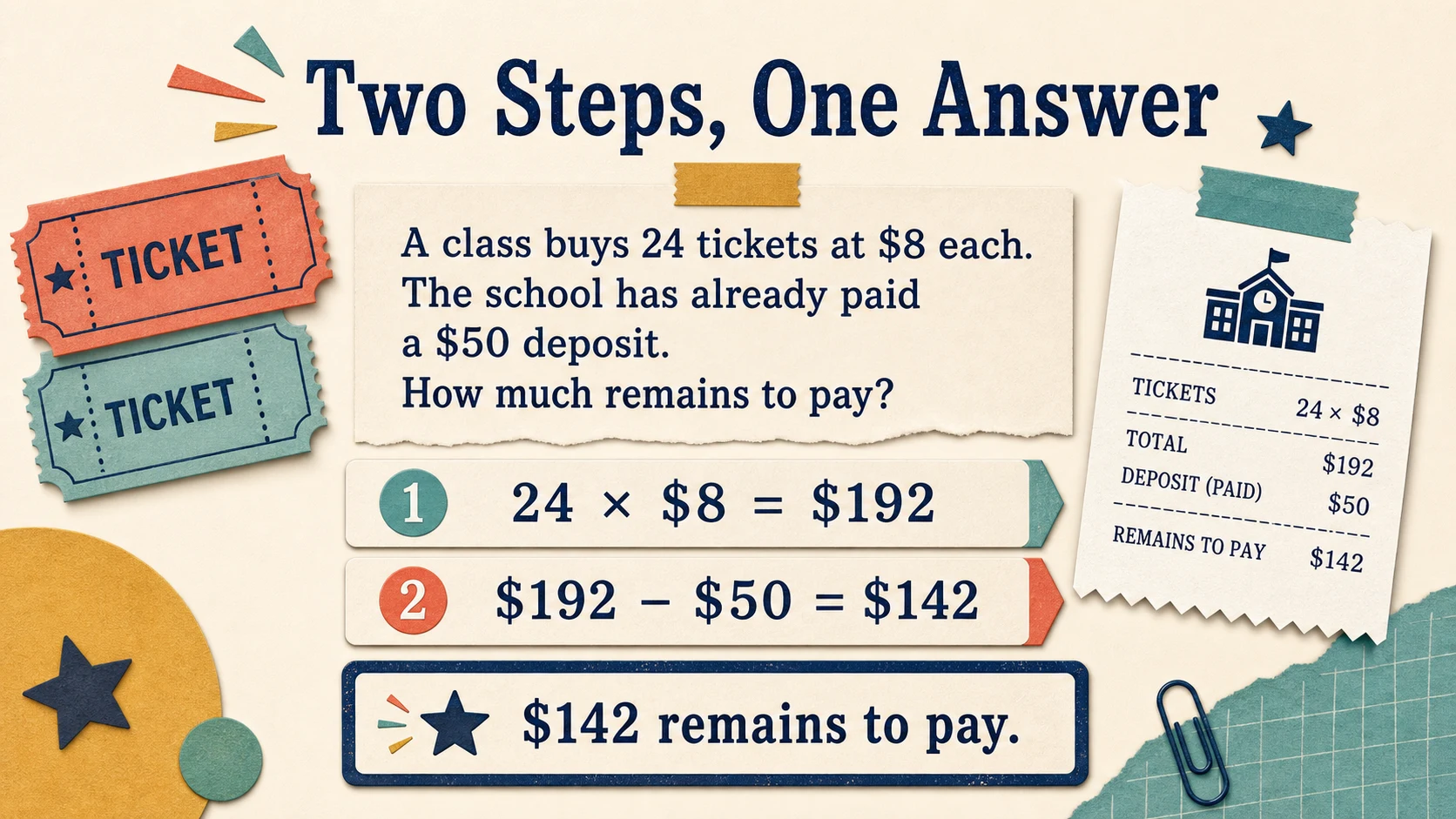
The written equation should preserve the relationship first shown by the model.
Example 3: Decimal cost with an intermediate total
Four identical notebooks cost $2.35 each. A customer pays with $15.00. How much change should the customer receive?
Understand the structure. Find the cost of four notebooks, then subtract that cost from the payment.
4×$2.35=$9.40
Then:
$15.00−$9.40=$5.60
Answer. The customer should receive $5.60 in change.
Check.
$9.40+$5.60=$15.00
An estimate also works:
4×$2.50≈$10
Change from $15 should therefore be about $5. The exact result of $5.60 is reasonable.
Example 4: Fraction of a quantity
A container holds 30 cups of soil. A gardener uses 53 of the soil. How many cups are used?
Understand the structure. The question asks for three fifths of 30.
Divide the whole into five equal groups:
30÷5=6
Each fifth is 6 cups. Take three fifths:
3×6=18
Equivalently:
53×30=18
Answer. The gardener uses 18 cups of soil.
Check. The result should be more than half of 30 because 53 is greater than 21, but it must be less than 30. Eighteen meets both conditions. The unused amount is 30−18=12, and:
18+12=30
Example 5: Volume with irrelevant information
A rectangular storage box is 8 inches long, 5 inches wide, and 4 inches high. It is blue and costs $12. What is its volume?
Sort the information. Length, width, and height are needed. Color and price do not affect volume.
V=l×w×h
V=8×5×4=160
Answer. The volume is 160 cubic inches.
Check. 8×5=40, and four layers of 40 cubic inches make 160 cubic inches. The unit must be cubic inches, not inches.
Boundary Cases That Build Discernment
Some tasks should not end in a numerical answer. Learners need permission to conclude that a problem is incomplete or that its wording permits more than one interpretation.
Missing information
“Five buses carry the same number of students. How many students are there altogether?”
This cannot be solved numerically because the number of students per bus is missing. The relationship is:
5×students per bus=total students
A learner who invents a number is not solving the stated problem.
A remainder that needs interpretation
A teacher has 98 cards and places 8 cards in each complete set.
98÷8=12 remainder 2
If the question asks for complete sets, the answer is 12 complete sets, with 2 cards left. If it asks how many containers are needed to hold every card, 13 containers are needed. The situation—not the division alone—determines how to use the remainder.
An answer that depends on an unstated condition
“A rectangular garden has an area of 48 square feet. What are its side lengths?”
There is no single answer without another condition. Whole-number possibilities include 1×48, 2×24, 3×16, 4×12, and 6×8. A learner should state that more information is needed to select one pair.
A Short, Repeatable Lesson Routine
Keep the routine stable while changing the mathematical content. Ten carefully discussed problems can reveal more than a long set completed through guessing.
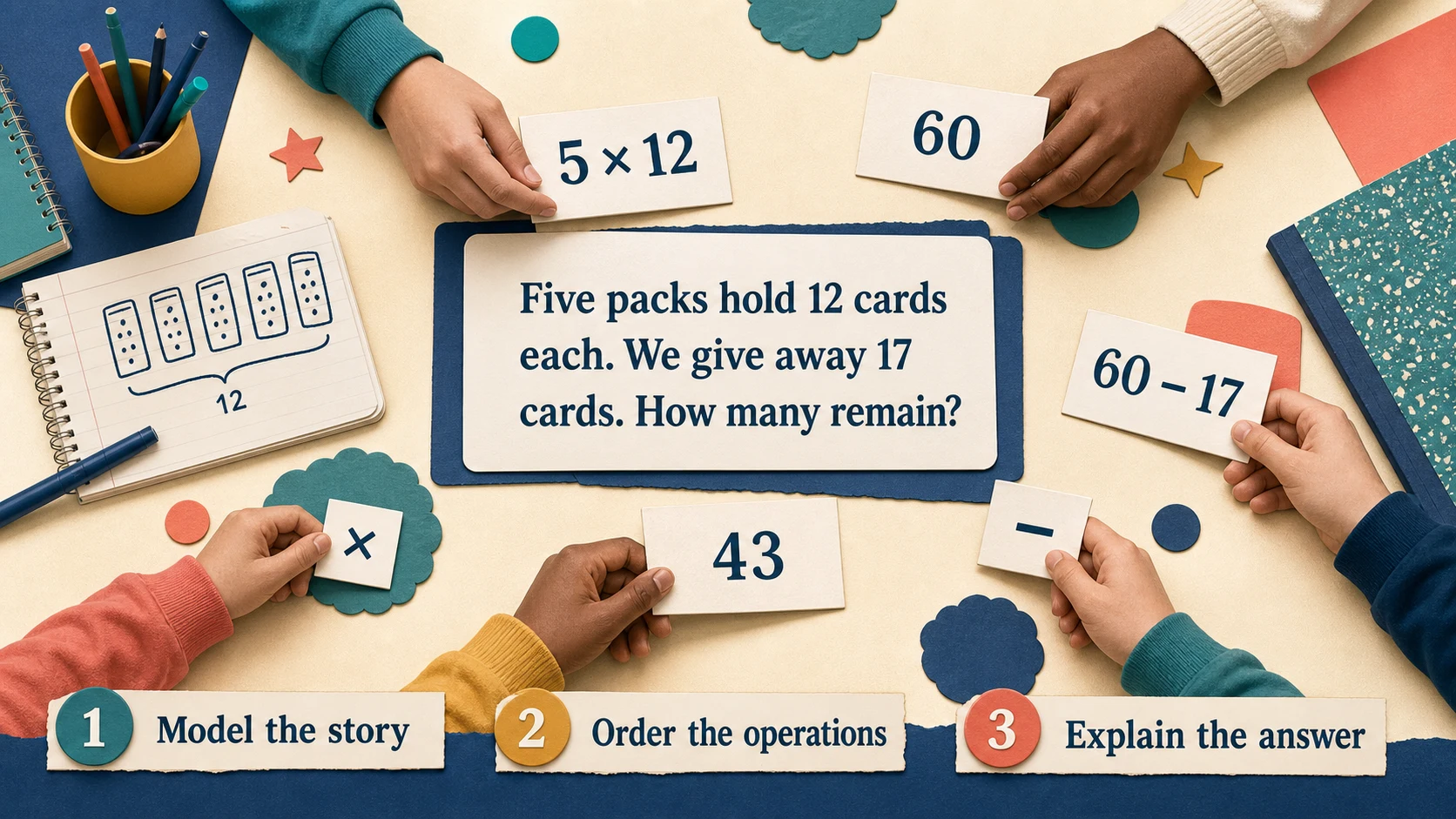
Repeat the reasoning cycle until the learner can use it with less prompting.
1. Read and retell
Read the entire problem. Ask the learner to describe what is happening without immediately calculating. Clarify vocabulary only when needed.
2. Identify knowns and the unknown
Label each number with its unit. Circle or restate the question. Cross out irrelevant information only after explaining why it is irrelevant.
3. Represent the relationship
Choose an object model, bar model, array, number line, table, sketch, or equation with a blank. Ask, “How does this model match the story?”
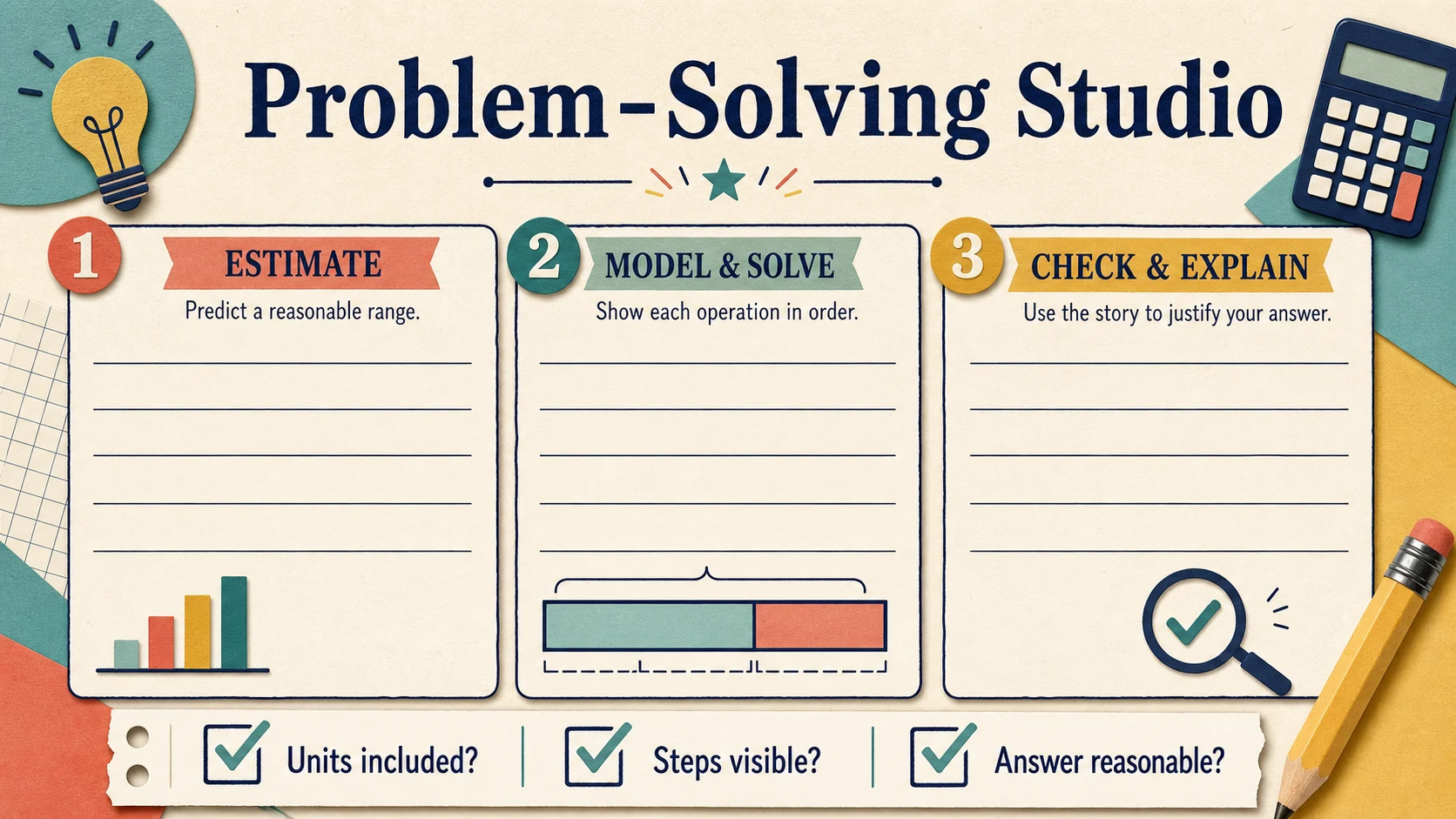
4. Estimate and solve
Predict a reasonable range, then calculate. For a multi-step problem, write the meaning of each intermediate result.
5. Check and explain
Use an inverse operation, estimation, substitution, or a second representation. Finish with a sentence that includes the answer and its unit.
Instructional suggestion: model one problem aloud, solve one collaboratively, and then assign one independently. If independent work breaks down, return to the exact step that caused difficulty instead of restarting the entire lesson automatically.
Choosing Practice and Differentiating Support
The 5th Grade Word Problems topic guide and practice collection is the most focused starting point. Select practice according to observed need.
| Observed work |
Practice to choose |
Support |
| Correct calculations but incorrect operations |
Short problems grouped by structure |
Retelling and bar models |
| Correct one-step work but confusion in two-step tasks |
Two-step problems with familiar numbers |
Ask for the intermediate question |
| Strong whole-number reasoning but weak fraction work |
One fraction structure at a time |
Fraction strips and common-denominator notes |
| Decimal place-value errors |
Decimal situations with estimation |
Label dollars, meters, or other units |
| Keyword guessing |
Mixed structures using similar vocabulary |
Require a model before an operation |
| Accurate but dependent on prompts |
Familiar mixed problems |
Fade the checklist one prompt at a time |
| Fast work with skipped explanations |
Boundary cases and error analysis |
Require checks and unit-labeled answers |
For learners needing more support, reduce linguistic complexity while retaining the mathematical relationship. Read the problem aloud if decoding is masking mathematical understanding, but still ask the learner to retell it. Provide a partially drawn bar rather than completing the reasoning.
For learners ready for extension, vary the unknown, include extra information, ask them to write a matching equation, or have them compare two solution methods. Larger numbers are not the only form of challenge.
The free standard easy worksheet contains 16 exercises and targets problem solving, reading comprehension, multi-step reasoning, and mixed operations. It includes a separate answer key. It is suitable as an initial practice sample or reinforcement, but its “easy” label should not replace observation of how the learner reasons.
Common Errors and Diagnostic Responses
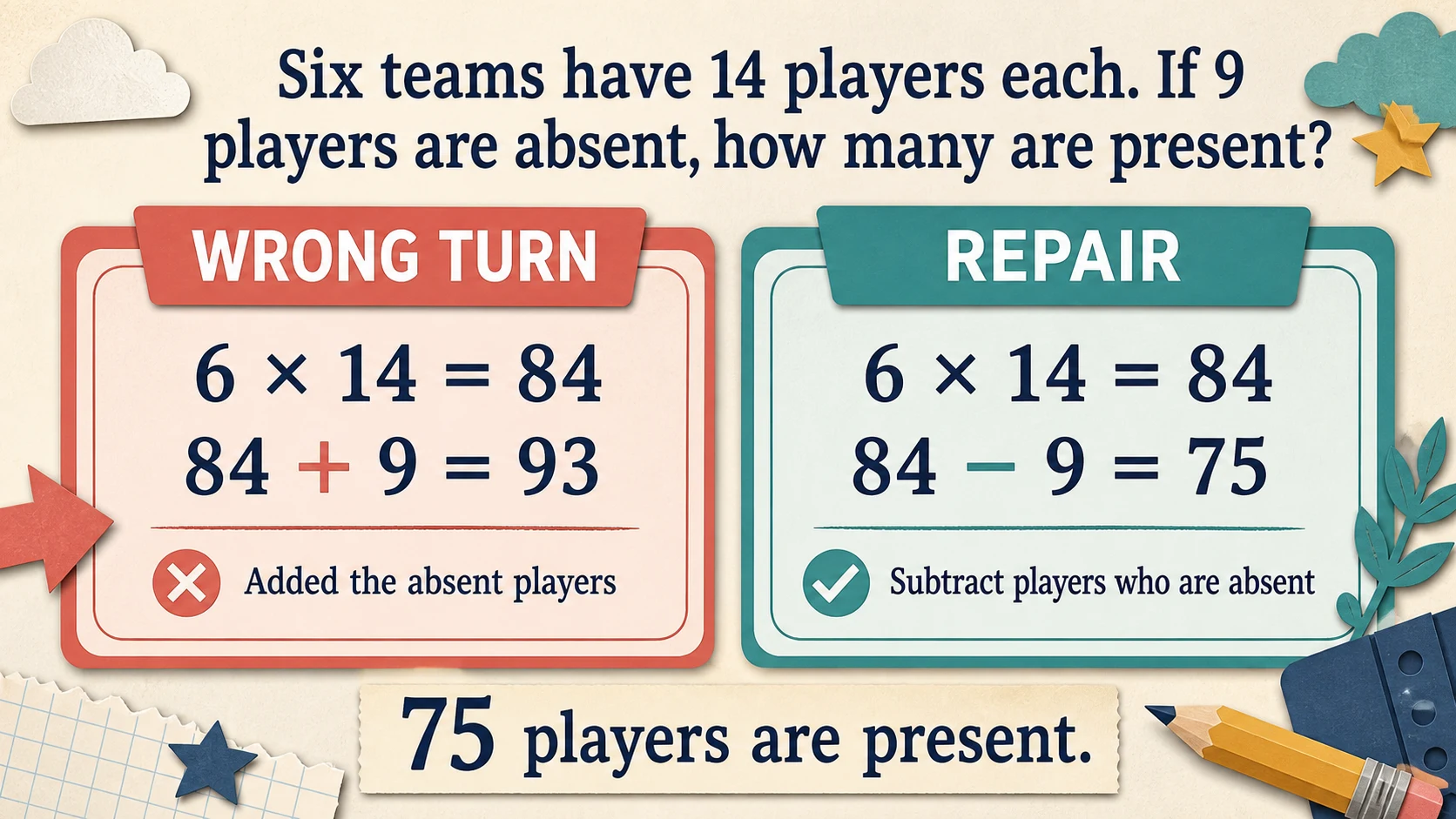
Diagnose the reasoning step before assigning more of the same practice.
Choosing an operation from one word
A learner sees “left” and subtracts, even when the starting amount is unknown.
Diagnostic prompt: “What quantities combine to make the total?”
Teaching response: Draw the relationship and vary the unknown. Compare 15−6=? with ?−6=9.
Using every number
A learner includes a price or date that does not affect the requested quantity.
Diagnostic prompt: “If we remove this fact, can we still answer the question?”
Teaching response: Use short problems containing one clearly irrelevant detail, then ask for a justification.
Performing only the first step
The learner finds the number purchased but does not subtract the number used.
Diagnostic prompt: “What does your current answer represent? Is that what the question asks?”
Teaching response: Write an intermediate question above each calculation.
Losing units
The learner reports “160 inches” for volume or “5.60 notebooks” for change.
Diagnostic prompt: “What does this number count or measure?”
Teaching response: Label quantities throughout the work, not only in the final sentence.
Combining fractions incorrectly
The learner adds denominators or subtracts fractional parts without equivalent units.
Diagnostic prompt: “Are these pieces the same size?”
Teaching response: Return to fraction strips and equivalent partitions before symbolic work.
Accepting an unreasonable answer
A learner calculates that the change from $15 after spending $9.40 is $24.40.
Diagnostic prompt: “Should the change be greater or less than the amount paid?”
Teaching response: Estimate before calculating and compare the exact result with that estimate.
Monitoring Progress Without Over-Testing
Record more than right or wrong. A brief weekly sample can show whether support should continue, change, or fade.
Track whether the learner can:
- Retell the situation accurately
- Identify the requested quantity
- Separate relevant from irrelevant information
- Select and label a useful representation
- Choose operations from relationships
- Complete the calculations
- Preserve units
- Check reasonableness
- Explain the result independently
A simple record might use independent, prompted, and not yet demonstrated. Note the prompt provided; “correct after being told to subtract” is different from “correct after being asked what the unknown bar represents.”
Look for patterns across several problems. One arithmetic slip does not establish a conceptual weakness. Repeatedly selecting the wrong operation despite accurate computation suggests that representation and comprehension need attention. Repeatedly choosing the right operation but miscalculating suggests targeted number practice.
A Two-Week Practice Plan
This plan is an instructional suggestion, not a universal schedule. Shorten, repeat, or reorder sessions in response to the learner’s work.
Use each day’s evidence to adjust the following session.
| Day |
Focus |
Suggested work |
What to observe |
| 1 |
Baseline |
Three varied one-step problems and one two-step problem |
Retelling, operation choice, calculation |
| 2 |
Part-whole |
Whole-number and decimal bar models |
Whether the unknown is labeled correctly |
| 3 |
Comparison |
Difference situations with varied wording |
Reliance on meaning rather than keywords |
| 4 |
Equal groups |
Multiplication and division stories |
Meaning of groups versus group size |
| 5 |
Review |
Mixed set of four problems |
Which supports remain necessary |
| 6 |
Two-step reasoning |
Find and name intermediate results |
Whether both steps answer the final question |
| 7 |
Fractions |
Unlike-denominator addition or subtraction |
Equivalent units and reasonableness |
| 8 |
Fraction of a quantity |
Objects or bars followed by equations |
Connection between division and multiplication |
| 9 |
Decimals and measurement |
Costs, lengths, or volume |
Place value and units |
| 10 |
Discernment |
Extra data, missing data, and remainder cases |
Whether the learner challenges incomplete tasks |
| 11 |
Mixed supported practice |
Five problems with a checklist |
Accurate use of the routine |
| 12 |
Mixed independent practice |
Four familiar structures without prompts |
Independence and checking |
| 13 |
Error correction |
Rework selected errors using a new model |
Whether explanations improve |
| 14 |
Review and next choice |
A short mixed sample |
What to consolidate or extend |
Stop a session if fatigue makes the evidence unreliable. If a learner needs repeated prompts on the same step, reduce the number of problems and teach that step directly. If the learner is consistently accurate and can explain the reasoning, fade models or add structural variation.
Limitations and the Honest Next Step
A worksheet can provide useful, sequenced practice, but it cannot by itself determine why a learner is struggling. An answer key confirms results; it does not reveal whether an error came from reading, representation, operation choice, calculation, or attention. Written practice also cannot replace discussion when a learner’s reasoning is unclear.
This guide does not claim comprehensive alignment with every local curriculum. It does not prescribe a universal pace, guarantee outcomes, or provide medical or child-specific guidance. The authoritative sources cited above support broad instructional framing; they did not review WorksheetWise or the materials linked here.
The most useful next action is to give the learner four carefully chosen problems from the free 5th Grade Word Problems worksheet. Ask for a retelling, model, calculation, and reasonableness check on each one. Use the resulting work to decide whether the next session should focus on comprehension, representation, computation, or greater independence.