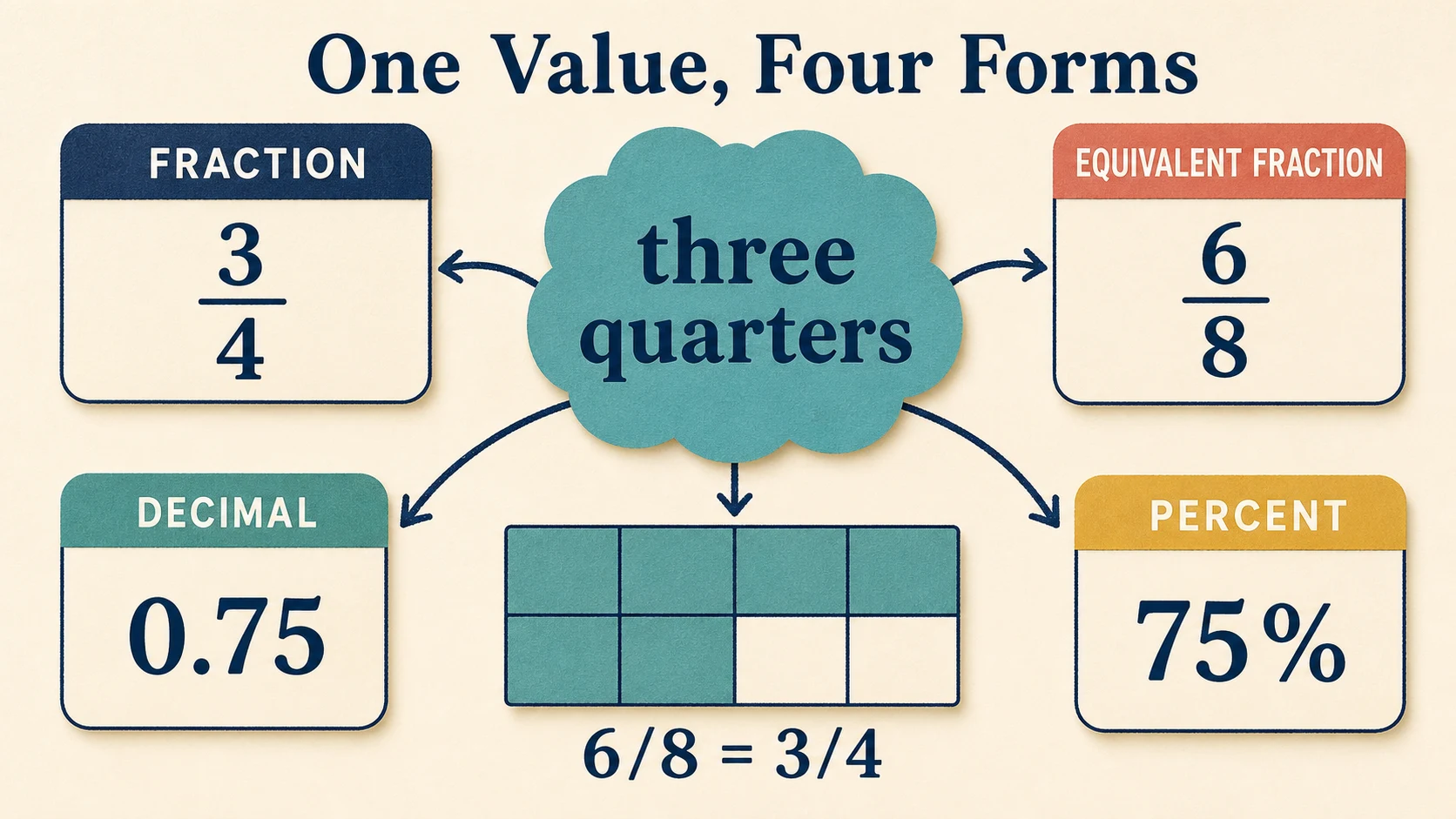
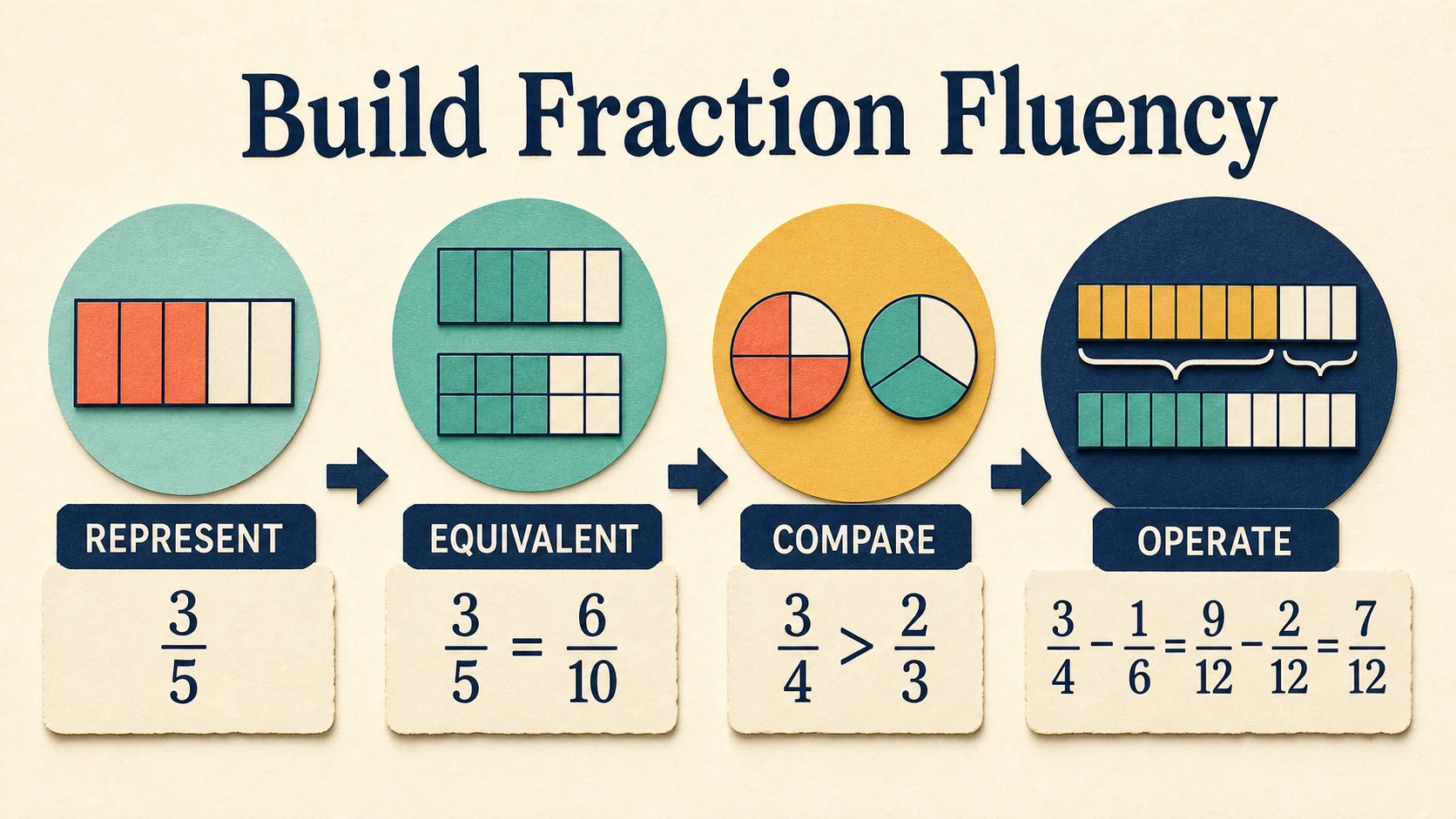
Fractions represent one of the most challenging and important topics in elementary mathematics. Students begin by partitioning shapes into equal parts and naming fractions, then progress to placing fractions on number lines, comparing fractions, finding equivalent fractions, and performing operations with fractions — addition, subtraction, multiplication, and division. A deep understanding of fractions is the strongest predictor of success in algebra. These worksheets cover fraction identification, comparison, equivalence, mixed numbers, and all four operations with both like and unlike denominators.
Partition shapes into equal parts (1-2); understand fractions as numbers on a number line (3); explain equivalent fractions and compare fractions (3); generate equivalent fractions, compare fractions with unlike denominators (4); add and subtract fractions with like denominators (4); multiply fractions by whole numbers (4); add and subtract fractions with unlike denominators (5); multiply and divide fractions (5).
The 5th Grade Fractions Worksheet Pack includes every current theme and all three difficulty levels—18 worksheets and 18 answer keys in one private ZIP.
Fifth-grade fraction instruction should help a learner treat fractions as numbers that can be compared, renamed, added, subtracted, multiplied, and divided—not merely as shaded pieces of a shape. A useful sequence begins with equivalence and number-line reasoning, moves through addition and subtraction with unlike denominators, and then develops multiplication and division through concrete situations and visual models.
The learner’s observed work should determine the pace. If a student can follow an addition procedure but cannot explain why 1/3 and 2/6 name the same number, more equivalence work is warranted. If the student models multiplication accurately but makes occasional arithmetic errors, shorter computation-focused practice may be enough.
Grade labels describe the intended practice level; local curricula and instructional sequences differ. The Common Core State Standards for Mathematics provide one widely used progression in which fifth-grade fraction work includes adding and subtracting fractions with unlike denominators, interpreting fraction multiplication and division, and solving related problems. This guide uses that broad scope without claiming that every school teaches the skills in exactly the same order.
Equivalence and fraction magnitude support every later operation.
Prerequisites to Check Before Teaching Operations
A learner does not need flawless recall of every earlier fraction lesson. However, several ideas should be reasonably secure before extended work with operations.
Equal parts and unit fractions
Ask the learner to divide a strip of paper into four equal parts and identify one part as 1/4. Then show four parts of unequal size and ask whether each part can still be called one fourth. The answer is no: the denominator describes equal-size parts of one whole.
Check whether the learner understands a unit fraction such as 1/5 as one part when a whole has been divided into five equal parts. From there, 3/5 means three copies of 1/5.
Fractions on a number line
The number line shows that fractions are numbers with fixed locations. It also prevents the idea that every fraction must be less than one.
Ask the learner to mark 0, 1, and 2, partition each interval into fourths, and locate 3/4, 5/4, and 143. A student who places 5/4 between 0 and 1 may be treating the numerator and denominator as separate whole numbers rather than interpreting the fraction’s magnitude.
Equivalent fractions and multiplication facts
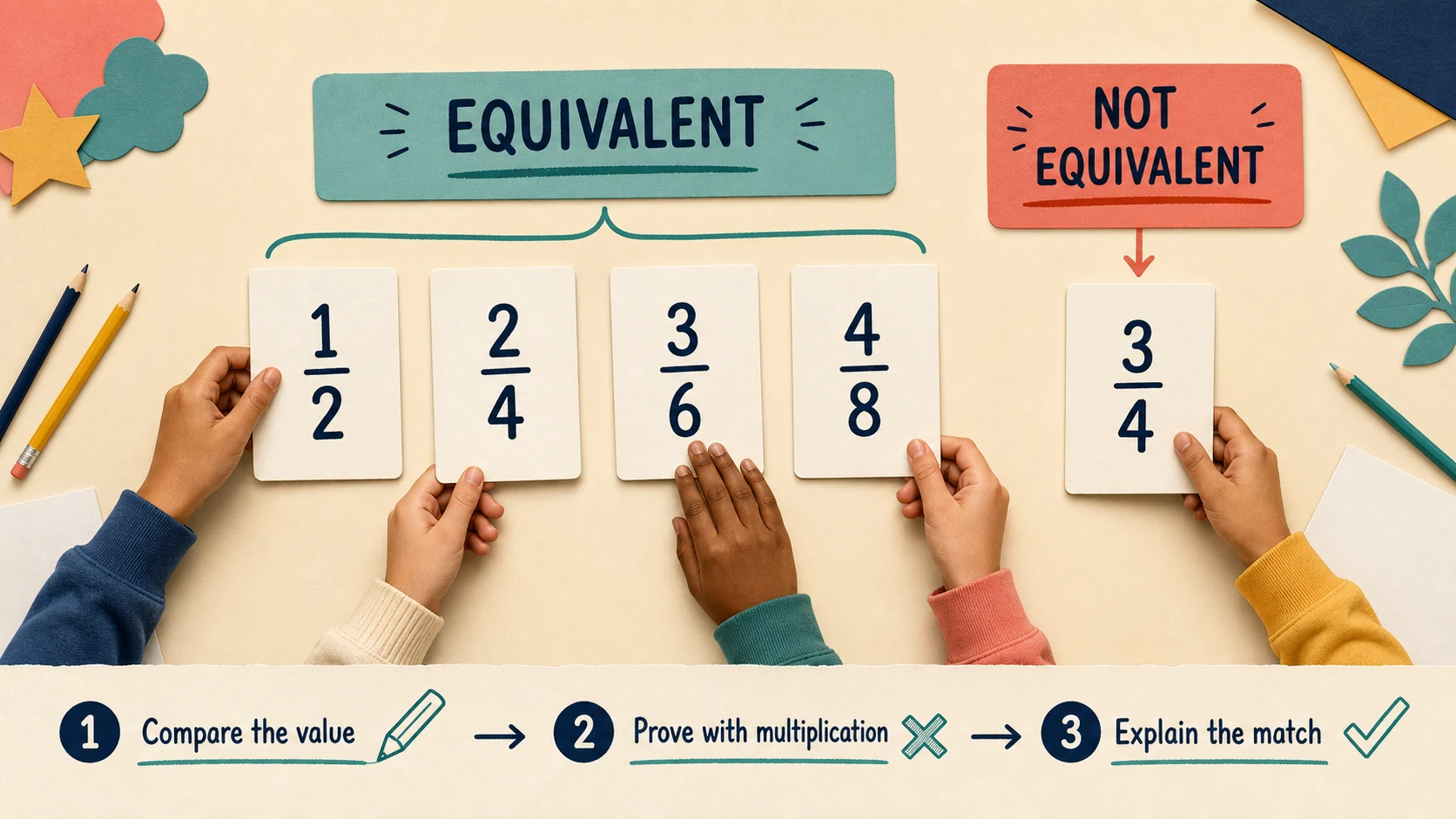
Before adding unlike denominators, the learner should be able to generate and recognize equivalent fractions:
32=64=96
The numerator and denominator are multiplied by the same nonzero number, so the fraction’s value does not change. Visual confirmation should come before routine use of this procedure.
Basic multiplication and division facts also matter because they support common denominators, simplification, and conversions between mixed numbers and improper fractions. If fact recall is slow, provide a multiplication chart while assessing fraction understanding. This separates a fraction misconception from a fact-retrieval difficulty.
A Grade-Appropriate Teaching Progression
The following sequence is instructional guidance, not a universal timetable. Move forward when the learner can represent the current idea, explain it in words, and solve a short mixed set with reasonable consistency.
Stage
Main idea
Useful model
Evidence to look for
1
Fraction magnitude and equivalence
Number lines, paper strips, fraction bars
Locates fractions and explains equivalent names
2
Compare fractions
Number lines, benchmarks, equivalent fractions
Justifies <, >, or = without relying on a visual guess
3
Add and subtract unlike denominators
Fraction bars and partitioned number lines
Renames fractions using a common unit
4
Work with mixed numbers
Length models and number lines beyond one
Converts forms and regroups meaningfully
5
Multiply fractions and whole numbers
Equal groups, scaling, area models
Explains what each factor means
6
Multiply two fractions
Overlapping area model
Interprets “a fraction of a fraction”
7
Divide fractions and whole numbers
Sharing and measurement models
States what the quotient represents
8
Solve mixed and contextual problems
Diagram chosen by the learner
Selects an operation and checks whether the answer is reasonable
Reduce visual support gradually while preserving explanation and estimation.
A learner may need to move backward temporarily. For example, repeated denominator errors during addition usually call for a return to equivalent fractions, not simply another page of addition problems. The 5th Grade Math collection can help adults select neighboring skills when the difficulty is partly caused by whole-number computation.
Concrete and Visual Models That Clarify the Mathematics
The IES practice guide on teaching mathematics supports purposeful use of representations and attention to mathematical language. For fifth graders, manipulatives should reveal a relationship that the learner can later express with drawings and symbols.
Fraction bars and folded strips
Use identical paper strips to establish equivalence. Fold one strip into thirds and shade two parts. Fold another into sixths and shade four parts. Align the strips:
32=64
The strips must represent wholes of equal length. Comparing fractions drawn on different-size wholes creates misleading evidence.
Fraction bars are also useful for addition. Placing 1/2 beside 1/3 reveals that halves and thirds are different-size units. Partitioning both into sixths produces compatible units:
21+31=63+62=65
Number lines
On a number line, equivalent fractions occupy the same point. This makes equivalence a statement about number value rather than appearance. Number lines also support:
comparison with benchmarks such as 0, 1/2, and 1;
improper fractions and mixed numbers;
addition as movement in one direction;
subtraction as distance or movement in the opposite direction.
To compare 5/8 and 2/3, a learner might note that both exceed 1/2, then use twenty-fourths:
85=2415,32=2416
Therefore, 5/8<2/3.
Area models
Area models make fraction multiplication visible. Divide a rectangle vertically into thirds and shade 2/3. Then divide it horizontally into fourths and mark 3/4 in another direction. Six of the twelve equal regions overlap:
32×43=126=21
The model connects the phrase “three fourths of two thirds” to the multiplication procedure. It also helps explain why multiplying by a proper fraction makes a positive quantity smaller.
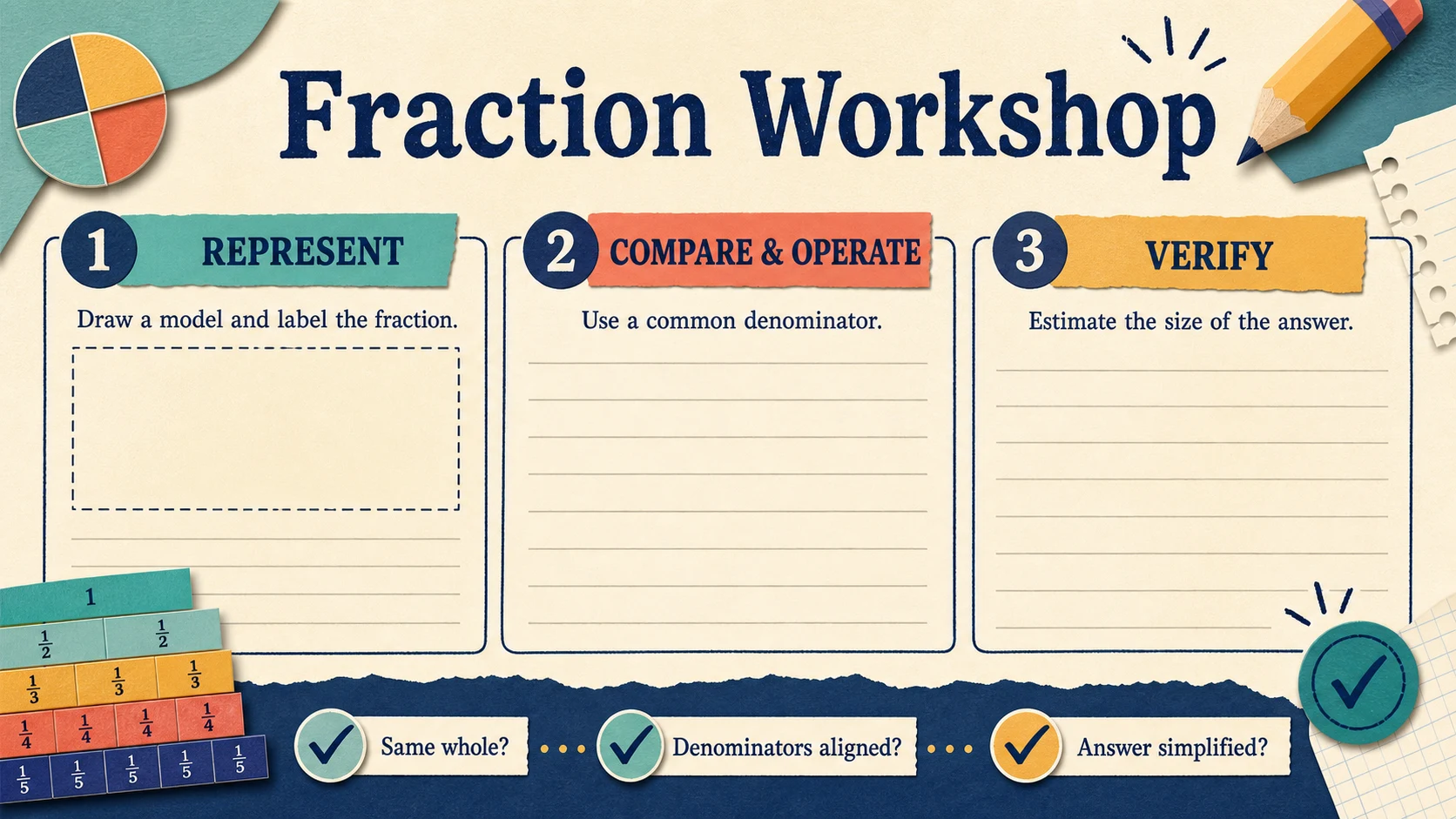
Represent the quantities first, then connect each visual partition to the symbols.
Fully Checked Worked Examples
Each example includes a reasonableness check. Encourage the learner to estimate before calculating and verify afterward.
Example 1: Add fractions with unlike denominators
Find:
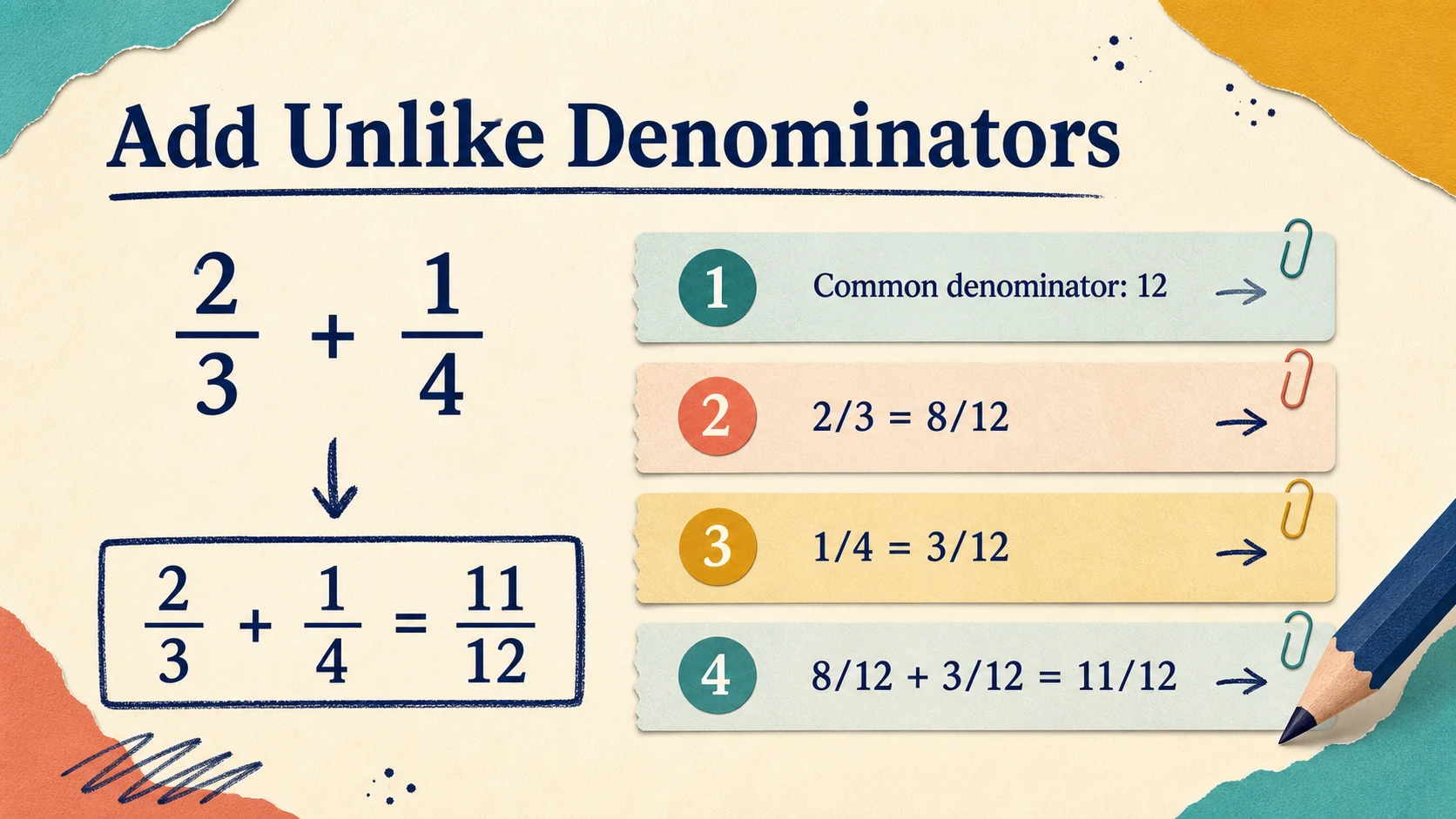
43+52
The denominators 4 and 5 name different-size parts. A common denominator is 20:
43=201552=208
Now add equal-size parts:
2015+208=2023=1203
Check: 3/4 is 0.75, and 2/5 is 0.4. Their sum is 1.15, equal to 1203. Even without decimals, both fractions are near 1/2 or greater, so a total slightly above 1 is sensible.
Example 2: Subtract mixed numbers by regrouping
Find:
341−132
Use twelfths:
341=3123132=1128
Because 3/12 is smaller than 8/12, regroup one whole as 12/12:
3123=21215
Subtract:
21215−1128=1127
Check by addition:
1127+1128=21215=3123=341
The result is also reasonable because 341−132 should lie between 1 and 2.
Example 3: Multiply a fraction by a whole number
A recipe uses 3/4 cup of oats per batch. How much is needed for 3 batches?
3×43=49=241
One interpretation is three equal groups:
43+43+43=49
Check: three groups of a quantity slightly less than one cup should total slightly less than three cups. 241 cups fits that estimate.
Example 4: Multiply two fractions
Find:
32×85
Multiply numerators and denominators:
3×82×5=2410=125
The result represents two thirds of five eighths. Check the magnitude: multiplying 5/8 by 2/3, a positive number below one, must produce an answer below 5/8. Since 5/12<5/8, the result passes that check.
A learner may simplify before multiplying:
32×85=31×45=125
This changes the calculation’s form, not its value.
Example 5: Divide a fraction by a whole number
Three people share 3/4 liter of juice equally. How much does each receive?
43÷3=43×31=123=41
A sharing model divides the three fourth-size portions among three people, giving each person one fourth liter.
Check:
3×41=43
The answer must be smaller than 3/4 because a positive amount is being shared among three people.
Example 6: Divide a whole number by a unit fraction
How many 1/3-meter pieces can be cut from 2 meters?
2÷31=6
A number line confirms the result: each whole meter contains three one-third-meter lengths, so two meters contain six.
Check:
6×31=2
This boundary case is important because division does not always make a number smaller. Dividing by a positive number less than one asks how many small groups fit into the quantity, so the quotient can be greater than the dividend.
Boundary Cases Learners Should Meet Explicitly
Do not hide cases that challenge an unreliable rule.
A fraction can equal or exceed one. For example:
77=1,79=172
A larger denominator does not automatically produce a larger fraction. With the same numerator and same whole:
81<41
Eighths are smaller pieces than fourths.
Multiplication does not always make a number larger:
8×41=2
Division does not always make a number smaller:
4÷21=8
Zero also deserves deliberate attention:
0×53=0,0÷53=0
Division by zero is undefined, so an expression such as 3/5÷0 has no numerical answer. Keep this distinct from a zero numerator, as in 0/5=0.
When comparing or operating on visual fractions, confirm that the wholes are the same size. One half of a small rectangle can be physically smaller than one third of a much larger rectangle, even though 1/2>1/3 when both fractions refer to equal wholes.
A Short, Repeatable Lesson Routine
The IES guide for assisting students who struggle with mathematics addresses explicit, systematic instruction, visual representations, mathematical language, and cumulative review. A practical home or small-group routine can reflect those principles without assuming that one schedule fits every learner.
Keep the structure stable while changing the mathematical focus.
1. Retrieve and inspect
Begin with two or three brief review items. Include one visual or explanation prompt, not only calculations. For example: “Mark 5/6 on a number line and name an equivalent fraction.”
Inspect the work before continuing. If the learner cannot create equal intervals on the number line, address that before expecting accurate comparison.
2. Model one new connection
Demonstrate a single example using objects or a drawing. Think aloud about the meaning of the numerator, denominator, operation, and expected magnitude. Connect the model directly to each symbolic step.
For 1/2+1/3, show why sixths are needed. Avoid presenting “find a common denominator” as an unexplained command.
3. Solve together
Complete two related examples. Ask the learner to choose the next step and explain it. Prompt with specific language: “What unit do these denominators name?” or “Should the product be larger or smaller than 3/4?”
4. Try independently
Give three to six carefully selected problems. Stop if the same conceptual error appears twice. Repeating a misunderstood procedure across a full page can strengthen the wrong pattern.
5. Close with a check
Ask for one sentence, diagram, or estimate that captures the lesson. Examples include:
“Fractions need equal-size parts before their numerators can be added.”
“Multiplying by 1/2 finds half of the starting amount.”
“My answer should be above one because both addends are above one half.”
Choosing Practice and Differentiating Support
Practice should match the error being addressed. A page labeled “fractions” may combine identification, equivalence, comparison, and operations, but those tasks do not demand the same reasoning.
Use the 5th Grade Fractions topic guide and resources to locate practice at the relevant point in the sequence. The 5th Grade hub is useful when fraction work also exposes gaps in multiplication, division, or multi-digit computation.
When the learner needs more support
Reduce the number of problems, not the quality of reasoning. Consider:
keeping fraction bars or a multiplication chart available;
using denominators that fit familiar relationships, such as halves, fourths, and eighths;
presenting one operation at a time;
highlighting the whole in every model;
asking the learner to estimate before calculating;
alternating one modeled item with one independent item.
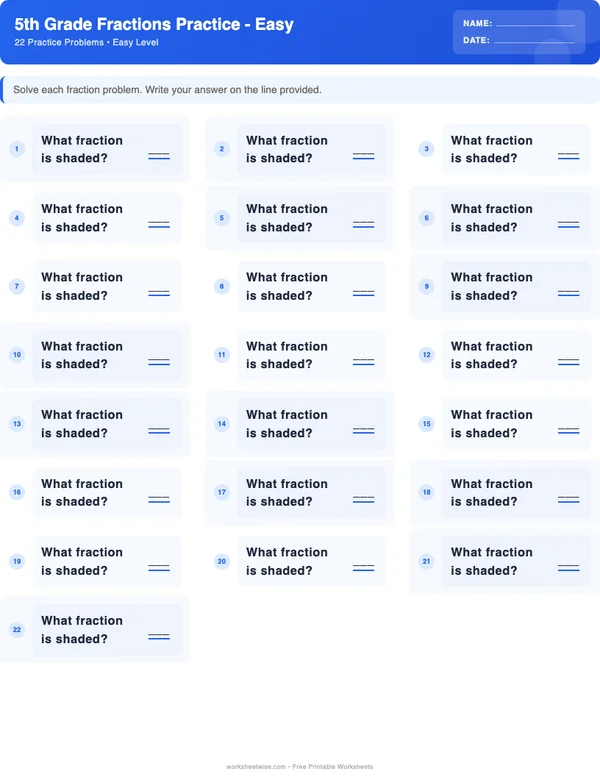
The available easy worksheet contains 22 exercises covering fractions, equivalent fractions, comparison, and fraction operations, with a separate answer key. It can serve as a short diagnostic or reinforcement set, but a learner who is struggling with one specific idea may benefit from selecting only the relevant items rather than completing all 22 at once.
When the learner is ready for extension
Increase the reasoning demand before increasing the size of the numbers. Ask the learner to:
solve one problem in two ways;
place several answers on a number line;
write a context for a given equation;
find and correct an intentionally incorrect solution;
compare two procedures for efficiency;
predict whether an answer is above or below a benchmark.
For example, instead of assigning ten more products, ask why 4/5×7/8 must be less than both 4/5 and 7/8. The learner can calculate afterward to confirm the prediction.
For broader repeated practice, the focused fractions pack contains 18 worksheets. Select from it by skill and observed need rather than assuming that every learner should complete the entire pack.
Common Errors and Diagnostic Responses
Treat a repeated error as evidence about the learner’s current model, not merely as carelessness.
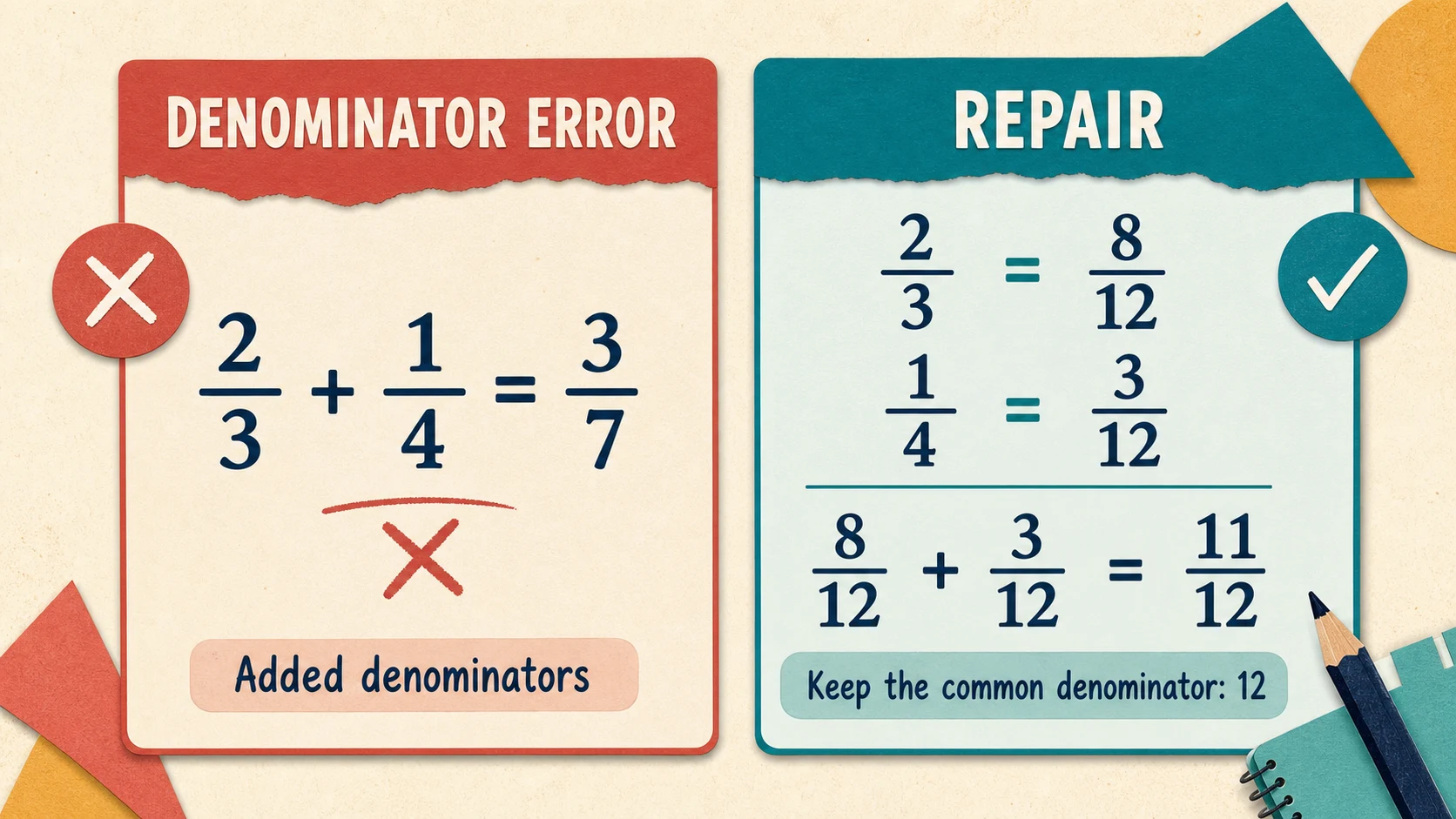
Adding denominators
Incorrect:
31+41=72
Diagnosis: the learner may be applying whole-number addition separately to the numerator and denominator.
Response: build 1/3 and 1/4 with equal-length bars. Ask whether the pieces are the same size. Rename both as twelfths:
124+123=127
Assuming the larger denominator means the larger fraction
Incorrect:
81>41
Diagnosis: the learner may read the denominator as an ordinary whole number rather than the number of equal parts in the whole.
Response: fold equal paper strips into fourths and eighths. Compare one piece from each strip, then locate both values on a number line.
Using an operation without considering magnitude
A learner calculates 3/4×2/5=6/20 correctly but claims the answer is 3101 after converting.
Diagnosis: the fraction operation may be secure while fraction magnitude and simplification are not.
Response: estimate first. A fraction of a fraction must be below one in this example. Then simplify:
206=103
Inverting during every kind of division
A learner may memorize “flip and multiply” but reverse the wrong quantity or use the rule during multiplication.
Response: return to a context. In 2÷1/3, ask how many thirds fit in two wholes. Draw six thirds, connect that count to the quotient, and only then relate the model to a symbolic procedure.
Treating mixed-number parts separately without regrouping
Incorrect:
451−253=252
Diagnosis: the learner subtracts 3−1 after noticing that 1−3 is difficult.
Response: rename one whole:
451=356
Then subtract:
356−253=153
Verify by addition.
Monitoring Progress Without Over-Testing
Monitor three dimensions: accuracy, representation, and explanation. A correct answer obtained through an unexplained rule does not provide the same evidence as a correct model, estimate, calculation, and check.
Once or twice per week, use a brief set containing:
one equivalence or comparison item;
one operation item;
one visual representation;
one context problem;
one explanation or error-analysis prompt.
Record the error type rather than only the score. Useful notes include “unequal number-line intervals,” “adds denominators,” “operation correct; simplification error,” and “cannot explain quotient.” These notes point toward the next lesson.
Look for transfer as well. After successful practice with like formats, change the presentation. A learner who can calculate 3/4×2/5 should also interpret “two fifths of three fourths,” shade an area model, and decide whether the product is greater or less than 3/4.
Advance when performance remains sound across more than one format. Return to a prerequisite when errors are consistent and conceptual. Occasional arithmetic slips call for checking routines, not necessarily reteaching the entire topic.
A Two-Week Practice Plan
This plan is an adaptable example, not a sourced or universal timetable. Sessions can be shortened, repeated, or separated by rest days according to the learner’s observed work.
Use each day’s exit check to decide whether to continue, repeat, or step back.
Day
Focus
Suggested work
Exit evidence
1
Diagnose prerequisites
Equal parts, unit fractions, number-line placement
Represents 5/4 and explains its location
2
Equivalence
Folded strips and number lines
Generates two equivalents for 3/4
3
Comparison
Benchmarks and common denominators
Justifies three comparisons
4
Unlike-denominator addition
Model, estimate, calculate, simplify
Explains why a common unit is required
5
Subtraction
Number-line differences and symbolic work
Checks subtraction with addition
6
Mixed numbers
Convert and regroup
Solves one regrouping example accurately
7
Cumulative review
Short mixed set; analyze one error
Identifies which skill needs more work
8
Fraction times whole number
Equal groups and repeated addition
Connects model to multiplication
9
Fraction times fraction
Area models
Predicts product magnitude
10
Multiplication practice
Mixed models and contexts
Simplifies and checks two products
11
Fraction divided by whole number
Equal sharing
Explains the size of each share
12
Whole number divided by unit fraction
Measurement division
States how many fractional groups fit
13
Mixed problem solving
Choose operations and draw models
Labels quantities and units
14
Review and next-step check
Five-item assessment plus explanation
Shows readiness or identifies a precise gap
If Day 4 reveals weak equivalence, repeat Days 2 and 3 with new representations. If Day 9 calculations are accurate but the learner cannot explain why the product shrinks, continue area-model work before moving to an entirely symbolic set.
Limitations and the Next Useful Step
A worksheet cannot by itself reveal everything about a learner’s thinking. Written answers may show the result without showing whether the learner estimated, used a model, guessed, or followed a remembered procedure. Watch the solution process and ask neutral prompts such as “How do you know?” and “What should the answer be close to?”
This guide also does not prescribe a local curriculum, guarantee an outcome, or provide child-specific or medical guidance. Its sequence is a practical interpretation of the supplied fifth-grade fraction scope. Teachers, tutors, and homeschool families should adjust it to local expectations and to evidence in the learner’s work.
A useful next action is to give the free 5th Grade Fractions worksheet in two short sections. Use the included answer key to check accuracy, but also ask the learner to model one comparison and explain one operation. Choose the next lesson from the error pattern you observe.
Put it into practice
Use the guide with a real printable
Move from explanation to a short, observable practice task. Check the first item together, then adjust the next session from the learner's actual work.