What 5th Grade Place Value Means
Place value tells a learner how much a digit represents because of its position in a number. In fifth-grade work, the central pattern is that a place is ten times the value of the place immediately to its right and one tenth the value of the place immediately to its left. Learners apply that structure to multi-digit whole numbers and decimals, including decimals through thousandths.
A learner who understands the topic should be able to:
- Identify the value represented by a digit.
- Explain relationships between neighboring places.
- Compose and decompose numbers.
- Move among standard, expanded, and word forms.
- Compare and order whole numbers and decimals.
- Round by reasoning about nearby benchmarks.
- Use place value to support estimation and computation.
For example, the 6 in 6,000 represents ten times as much as the 6 in 600. In 0.6, the same digit represents ten times as much as it does in 0.06. These are not separate tricks. They are applications of the same base-ten structure.
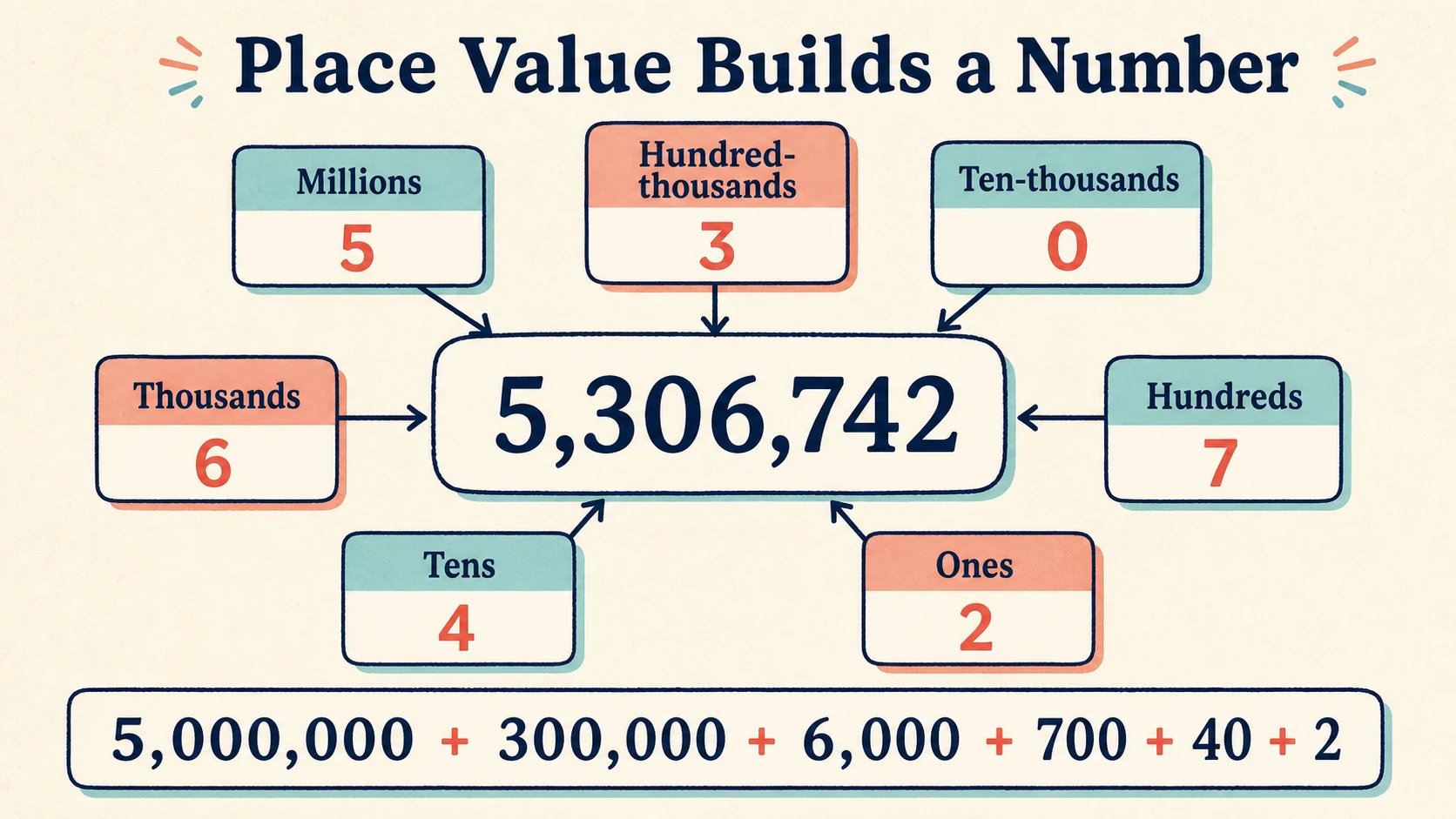
The skills connect through one repeating base-ten pattern.
Grade labels describe the intended practice level, not a guarantee that every learner has the same prior knowledge. Local curricula and teaching sequences differ. Use the learner’s observed work—not age, grade label, or a fixed calendar—to decide where instruction should begin and how quickly it should proceed.
Prerequisites to Check Before New Instruction
A short prerequisite check is more useful than immediately assigning a full page. Ask the learner to complete and explain one task from each area:
- State the value of the 4 in 342,615.
- Write 70,000 + 900 + 20 + 6 in standard form.
- Compare 36,408 and 36,480.
- Place 2.4 approximately on a number line from 2 to 3.
- Explain what happens to the value of a digit when it moves one place left.
The expected responses are 40,000; 70,926; 36,408 < 36,480; a point four tenths of the way from 2 to 3; and “its value becomes ten times as great.”
Do not treat a wrong response as a complete diagnosis. Ask, “How did you decide?” A learner who writes 70,926 but cannot connect each addend to a place needs different support from one who understands the places but makes a copying error.
Essential prior understandings
Before extensive decimal work, the learner should generally be able to:
- Read a whole-number place-value chart.
- Recognize zero as a placeholder.
- Decompose whole numbers by place.
- Compare whole numbers from the greatest place first.
- Locate whole numbers between benchmarks on a number line.
- Understand multiplication and division by 10 in familiar cases.
If several of these are insecure, return briefly to whole-number models. The developmental-progression principle in the IES guide on early mathematics is written for preschool through kindergarten, not fifth grade. Its high-level emphasis on building from what learners know and monitoring progress is still useful framing, but it is not a fifth-grade scope-and-sequence recommendation.
A Grade-Appropriate Teaching Progression
Teach the ideas in connected stages. Advance when the learner can represent and explain a stage with reasonable consistency, not simply after a preset number of days.
| Stage |
Instructional focus |
Useful evidence of readiness to advance |
| 1 |
Review whole-number places and the role of zero |
Identifies digit values and decomposes numbers without dropping internal zeros |
| 2 |
Establish the ten-to-one relationship between adjacent places |
Explains, with a chart or model, why 700 is ten times 70 |
| 3 |
Extend the pattern through tenths, hundredths, and thousandths |
Connects 0.7, 0.07, and 0.007 without calling them interchangeable |
| 4 |
Connect standard, expanded, and word forms |
Converts among all three forms and accounts for every nonzero digit |
| 5 |
Compare and order numbers |
Compares from the greatest place and uses zeros only to clarify equivalent decimal forms |
| 6 |
Round using benchmarks and number lines |
Identifies the two bounding multiples and selects the nearer one |
| 7 |
Apply place value in estimation and computation |
Uses digit values to explain whether an answer is reasonable |
| 8 |
Mix representations and problem types |
Selects a method independently and explains the result |
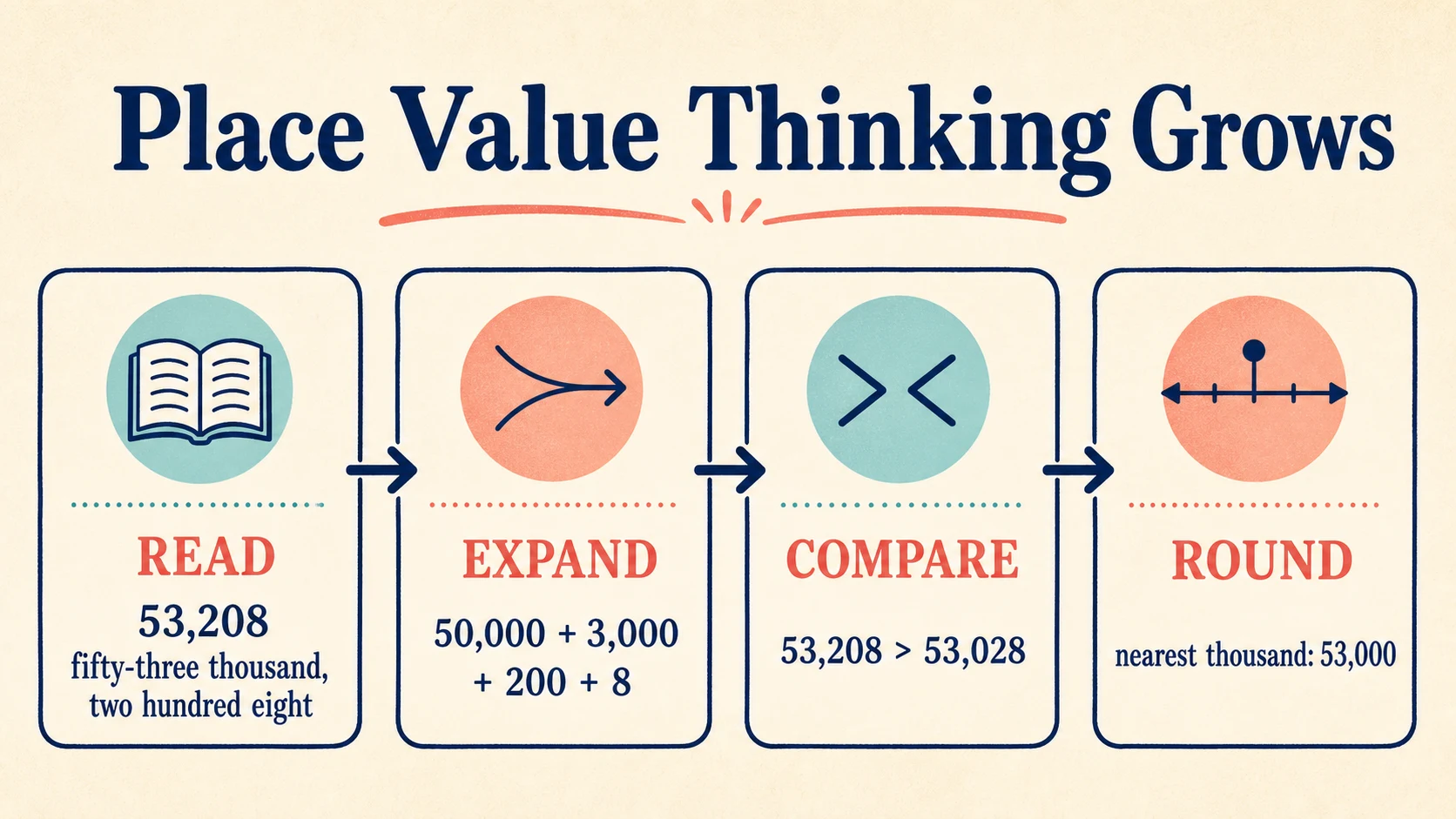
Support is reduced as explanations and accuracy become more secure.
The Common Core mathematics overview frames mathematical understanding as more than obtaining an answer; learners should also explain why a conclusion is true at an appropriate level. The WorksheetWise catalogue associates this topic with fifth-grade place-value work, including 5.NBT.A.1, but this guide does not claim comprehensive alignment with every state, district, or curriculum.
Concrete and Visual Models That Clarify the Structure
Models should reveal the base-ten relationship, not become decorations added after a procedure.
Place-value charts and discs
A chart provides a stable location for each place. Label columns from left to right, including ones, tenths, hundredths, and thousandths. Place-value discs can represent large numbers more efficiently than drawing hundreds of individual blocks.
Have the learner make trades:
- Ten 1-discs trade for one 10-disc.
- Ten 0.1-discs trade for one 1-disc.
- Ten 0.01-discs trade for one 0.1-disc.
Ask the learner to describe each trade aloud. Precise language matters: “Ten hundredths equal one tenth” is clearer than “Move it over.”
Base-ten blocks with a declared unit
Base-ten blocks can represent decimals only when the unit is explicitly defined. If the large flat represents 1, a rod can represent 0.1 and a small unit cube can represent 0.01. If a different piece is declared to be 1, every other value changes accordingly.
Write the chosen unit beside the model. Otherwise, a learner may rely on a block’s familiar whole-number name instead of reasoning from its relative size.
Number lines
Use number lines for comparison and rounding. To round 3.47 to the nearest tenth, mark 3.4 and 3.5 as bounding tenths, then locate 3.47. This shows why 3.47 rounds to 3.5: it is closer to 3.5 than to 3.4.
The IES elementary mathematics intervention guide recommends systematic instruction, clear mathematical language, selected representations, and number lines for learners who struggle with mathematics. It covers kindergarten through grade 6. That supports the high-level instructional choices here; it does not mean the source reviewed WorksheetWise materials or prescribed this exact lesson sequence.
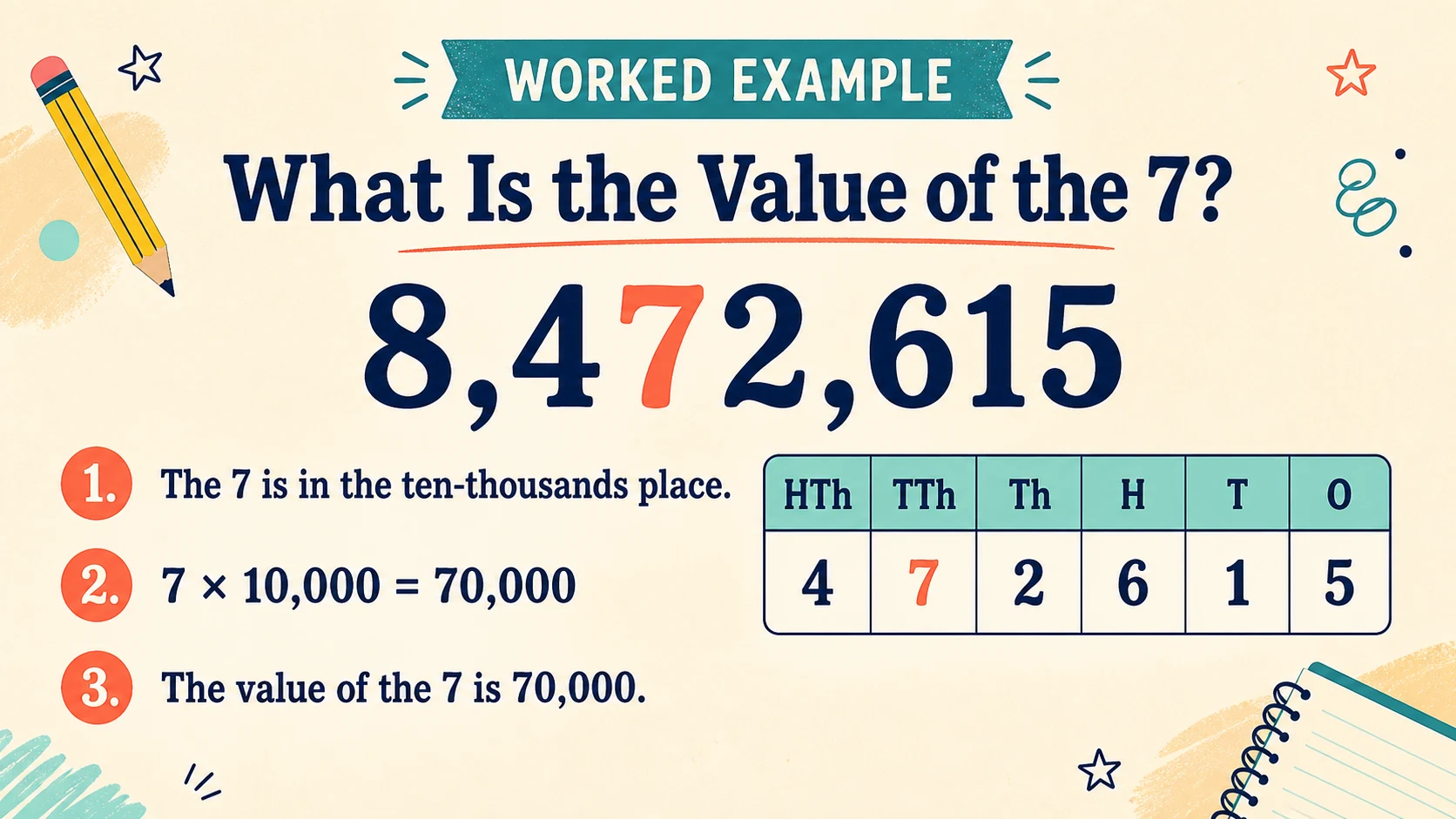
Connect the model, spoken explanation, written form, and answer.
Fully Checked Worked Examples
Example 1: Determine a digit’s value
Find the value of the 7 in 372,604.071.
Place the digits in their positions:
| Digit |
3 |
7 |
2 |
6 |
0 |
4 |
0 |
7 |
1 |
| Place |
hundred-thousands |
ten-thousands |
thousands |
hundreds |
tens |
ones |
tenths |
hundredths |
thousandths |
The first 7 is in the ten-thousands place, so its value is:
7 × 10,000 = 70,000
The second 7 is in the hundredths place, so its value is:
7 × 0.01 = 0.07
Check: 70,000 is 1,000,000 times 0.07 because the two 7s are six places apart. Each step changes the value by a factor of 10.
Example 2: Convert among number forms
Write 305,040.072 in expanded form.
Account for each nonzero place:
- 3 hundred-thousands = 300,000
- 5 thousands = 5,000
- 4 tens = 40
- 7 hundredths = 0.07
- 2 thousandths = 0.002
Therefore:
305,040.072 = 300,000 + 5,000 + 40 + 0.07 + 0.002
A corresponding word form is three hundred five thousand forty and seventy-two thousandths. Here, “and” marks the decimal point.
Check by recomposing:
300,000 + 5,000 + 40 = 305,040
0.07 + 0.002 = 0.072
305,040 + 0.072 = 305,040.072
The zeros are not listed as expanded-form addends, but they preserve the positions of the nonzero digits in standard form.
Example 3: Compare decimals with unequal lengths
Compare 48.507 and 48.57.
The whole-number parts are both 48. Compare the decimal places:
- Tenths: both have 5.
- Hundredths: 48.507 has 0; 48.57 has 7.
Because 0 hundredths is less than 7 hundredths:
48.507 < 48.57
Appending a zero can make the comparison easier:
48.57 = 48.570
Now compare 48.507 and 48.570. The result is unchanged.
Check by subtraction:
48.570 − 48.507 = 0.063
The positive difference confirms that 48.570 is greater. A common incorrect method is to say 507 is greater than 57 and therefore 48.507 is greater. That ignores the place values represented by the decimal digits.
Example 4: Round a decimal to the nearest hundredth
Round 6.349 to the nearest hundredth.
The bounding hundredths are 6.34 and 6.35. The thousandths digit is 9, so 6.349 lies closer to 6.35.
Distances provide a check:
6.349 − 6.340 = 0.009
6.350 − 6.349 = 0.001
Therefore:
6.349 rounds to 6.35
The hundredths digit changes from 4 to 5, and digits to its right are removed from the rounded result.
Example 5: Handle an exact halfway case
Round 249,500 to the nearest thousand.
The bounding thousands are 249,000 and 250,000.
249,500 − 249,000 = 500
250,000 − 249,500 = 500
The number is exactly halfway. Under the familiar school convention described in the catalogue—look to the digit on the right and round up when it is 5 or more—the result is:
249,500 rounds to 250,000
This boundary case deserves explicit teaching because “choose the closer benchmark” alone does not decide a tie.
Example 6: Explain a ten-to-one relationship
Compare the value of the 8 in 8.24 with the value of the 8 in 0.824.
In 8.24, the 8 represents 8 ones, or 8.
In 0.824, the 8 represents 8 tenths, or 0.8.
Compute the relationship:
8 ÷ 0.8 = 10
Therefore, the 8 in 8.24 represents ten times the value of the 8 in 0.824.
Check in the other direction: 0.8 is one tenth of 8. Both statements describe the same adjacent-place relationship.
A Short, Repeatable Lesson Routine
A useful routine can fit into about 15–25 minutes, but that range is an instructional suggestion, not a universal timetable. Shorten, extend, or split it according to the learner’s attention, accuracy, and explanations.
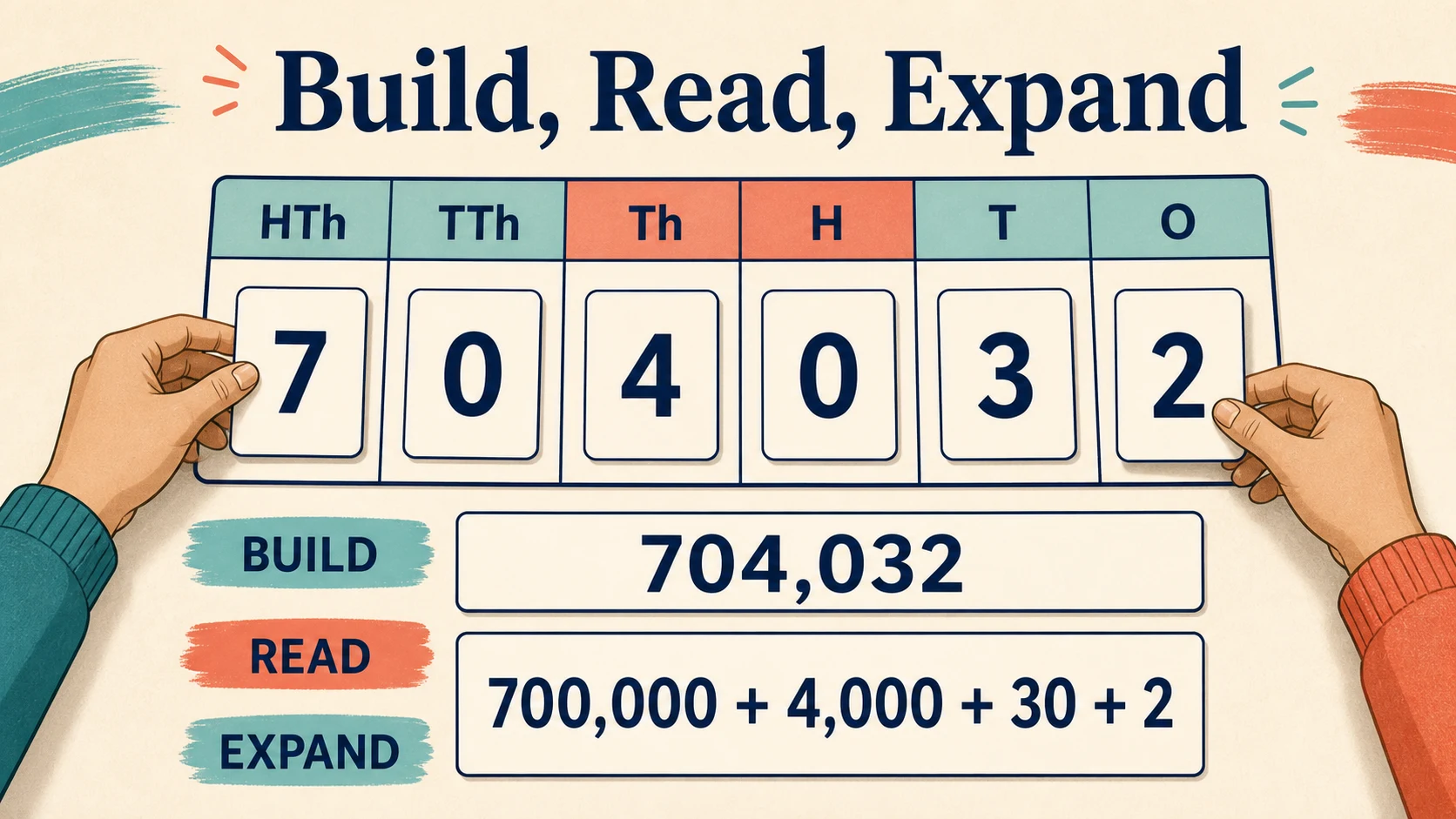
Keep the sequence stable while changing the numbers and representations.
1. Retrieve a prerequisite
Begin with two brief items from earlier learning. For decimal comparison, review the value of tenths and hundredths. Ask for one explanation, not just two answers.
2. Model one new case
Use a chart, discs, blocks, or a number line. Say what each part represents. Connect the model to an equation or written number.
3. Solve one together
Let the learner make the next decision. Prompt with focused language such as, “Which place should we compare first?” Avoid taking over the entire solution after one hesitation.
4. Assign two independent checks
Choose one familiar item and one boundary or contrast item. For rounding, pair 4.362 with 4.365. Review the work immediately when practical.
5. Close with an explanation
Ask the learner to state the central relationship in one or two sentences. Record errors that should shape the next lesson.
Choosing Practice and Differentiating Support
Practice should match the error pattern. A long mixed worksheet is inefficient when the learner has one specific misconception.
Use the 5th Grade math hub to see the subject context, or the Place Value topic guide to stay within this skill area.
When the learner needs more support
Reduce the number range or number of decimal places while preserving the idea. Keep a labeled chart visible. Ask the learner to build, draw, say, and then write the number. Use sets of four to six carefully related items, such as:
- 0.4, 0.04, 0.004
- 5.2, 5.02, 5.002
- 3.47 rounded to a tenth, then to a hundredth
Do not remove the model merely because one answer is correct. Fade it after the learner can explain the relationship across several varied examples.
When the learner is ready for independence
Mix forms and require method selection. Include internal zeros, unequal decimal lengths, and numbers near rounding midpoints. Ask for occasional written justifications rather than explanations on every item.
Suitable extensions include finding a number that meets several conditions, correcting an incorrect worked solution, or producing two numbers that round to the same benchmark. These tasks extend reasoning without introducing unsupported content.
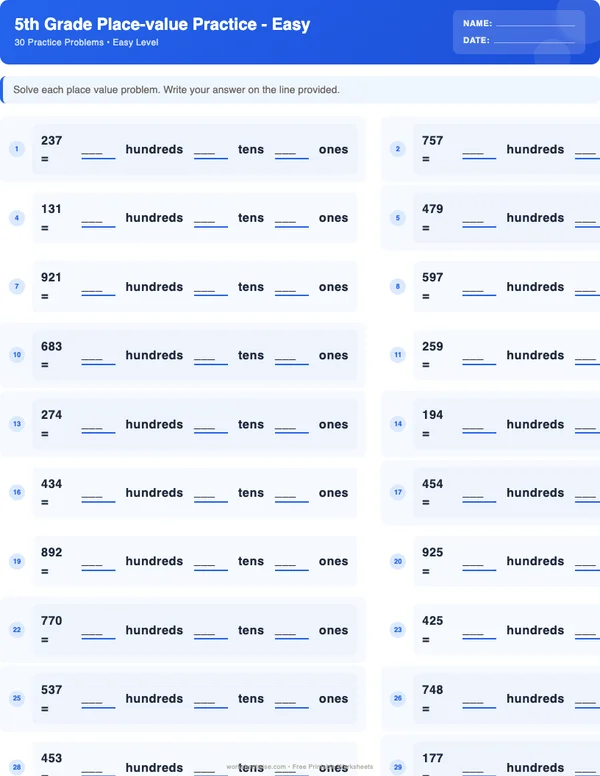
The catalogue’s free worksheet contains 30 easy-level exercises covering place value, expanded form, comparison, and rounding, with a separate answer key. It is best suited to initial practice or reinforcement. The focused place-value pack contains 18 worksheets and may be useful when repeated practice across the topic is needed. More pages are not automatically better; select only the items that address the learner’s current need.
Diagnosing Common Errors
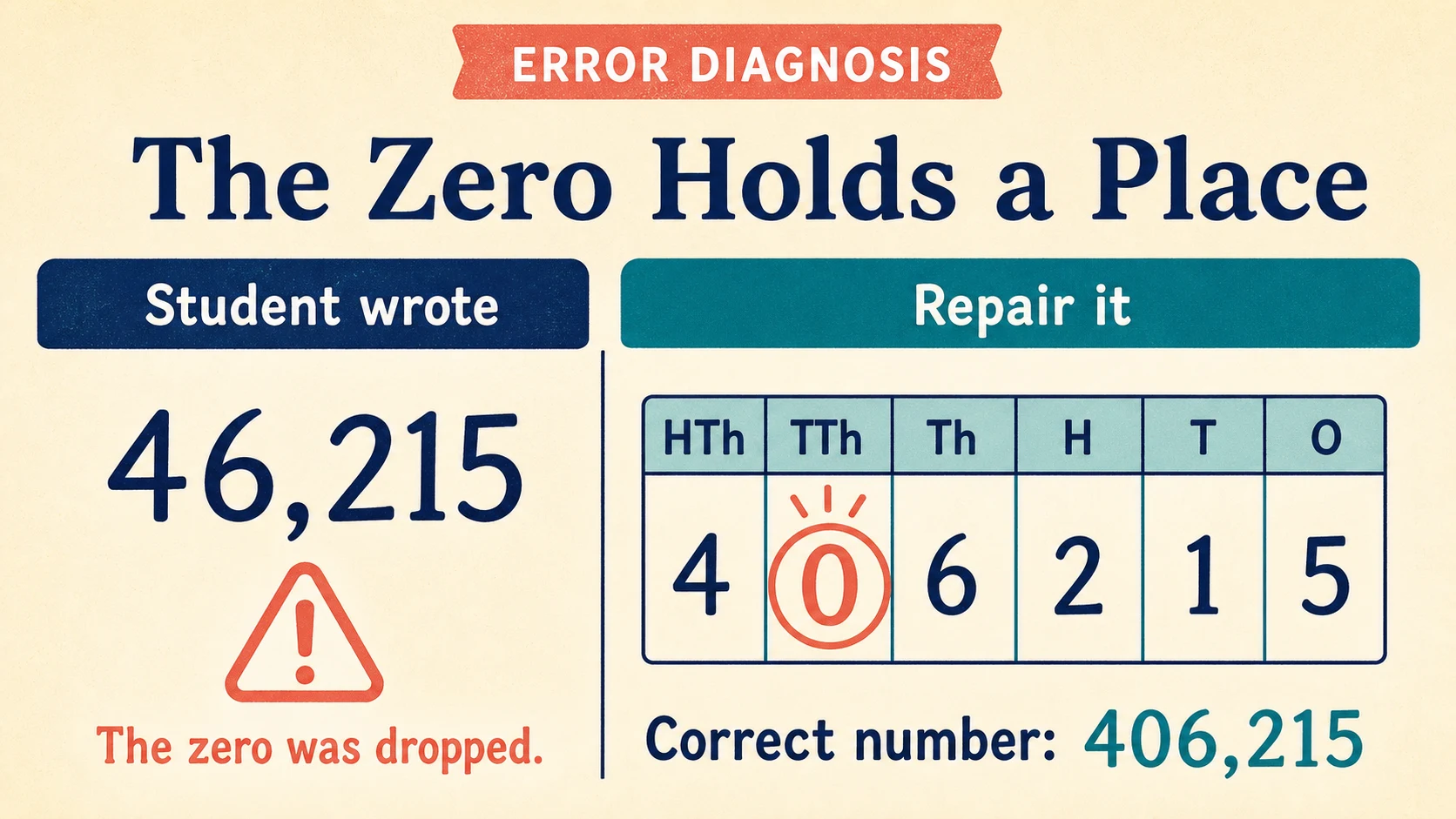
Use the type of error to choose the next representation or prompt.
| Observed error |
Likely issue to investigate |
Teaching response |
| Says the 6 in 0.06 is “six” |
Names the digit rather than its value |
Place 0.6, 0.06, and 0.006 on a chart; have the learner name digit and value separately |
| Writes 402,018 as 42,018 |
Drops a zero that holds a place |
Build or chart each nonzero digit before writing standard form |
| Says 3.8 < 3.72 because 8 < 72 |
Treats decimal digits as whole numbers |
Rewrite 3.8 as 3.80 and compare tenths before hundredths |
| Writes 50,304 as 50,000 + 300 + 4, then calls the 3 “thousands” |
Can decompose but misnames a place |
Match each addend to a labeled chart column |
| Rounds 7.461 to 7.5 when asked for the nearest hundredth |
Rounds to the wrong place |
Identify and mark the target place before locating bounding hundredths |
| Rounds 2.499 to 2.410 |
Changes digits mechanically |
Use the number line between 2.49 and 2.50, then write only the selected benchmark |
| Believes moving every digit right makes the number ten times greater |
Reverses the direction of scaling |
Compare one digit in adjacent columns and write multiplication and division statements |
| Gives correct answers but cannot explain them |
May be relying on a memorized routine |
Request a model, benchmark comparison, or place-by-place justification |
A single mistake may be accidental. Look for repetition across differently formatted examples. If a learner compares decimals correctly in a chart but not in standard notation, the conceptual knowledge may be present while the transition between representations remains insecure.
Avoid vague feedback such as “Watch the decimal.” Name the mathematical issue: “You compared the number of written digits instead of comparing tenths first.”
Monitoring Progress Without Over-Testing
Monitor a small set of observable behaviors:
- Accuracy across several representations.
- Ability to name both a digit and its value.
- Correct use of zero as a placeholder.
- Selection of the appropriate comparison or rounding place.
- Ability to explain a ten-to-one relationship.
- Independence from charts or prompts.
- Retention after a gap of several days.
A simple exit check can contain three items: one direct task, one contrast or boundary case, and one explanation. Mark each as secure, developing, or not yet evident. These labels are planning notes, not permanent judgments about the learner.
Advance when performance is accurate across varied examples and explanations are coherent. If accuracy falls when models are removed, restore support and fade it more gradually. If the learner succeeds during a lesson but not two days later, include spaced review before adding complexity.
A Flexible Two-Week Practice Plan
This plan assumes ten brief sessions. It is a practical suggestion, not a mandated schedule. Homeschool families, tutors, and classroom educators can combine or repeat days. The learner’s work should determine pacing.
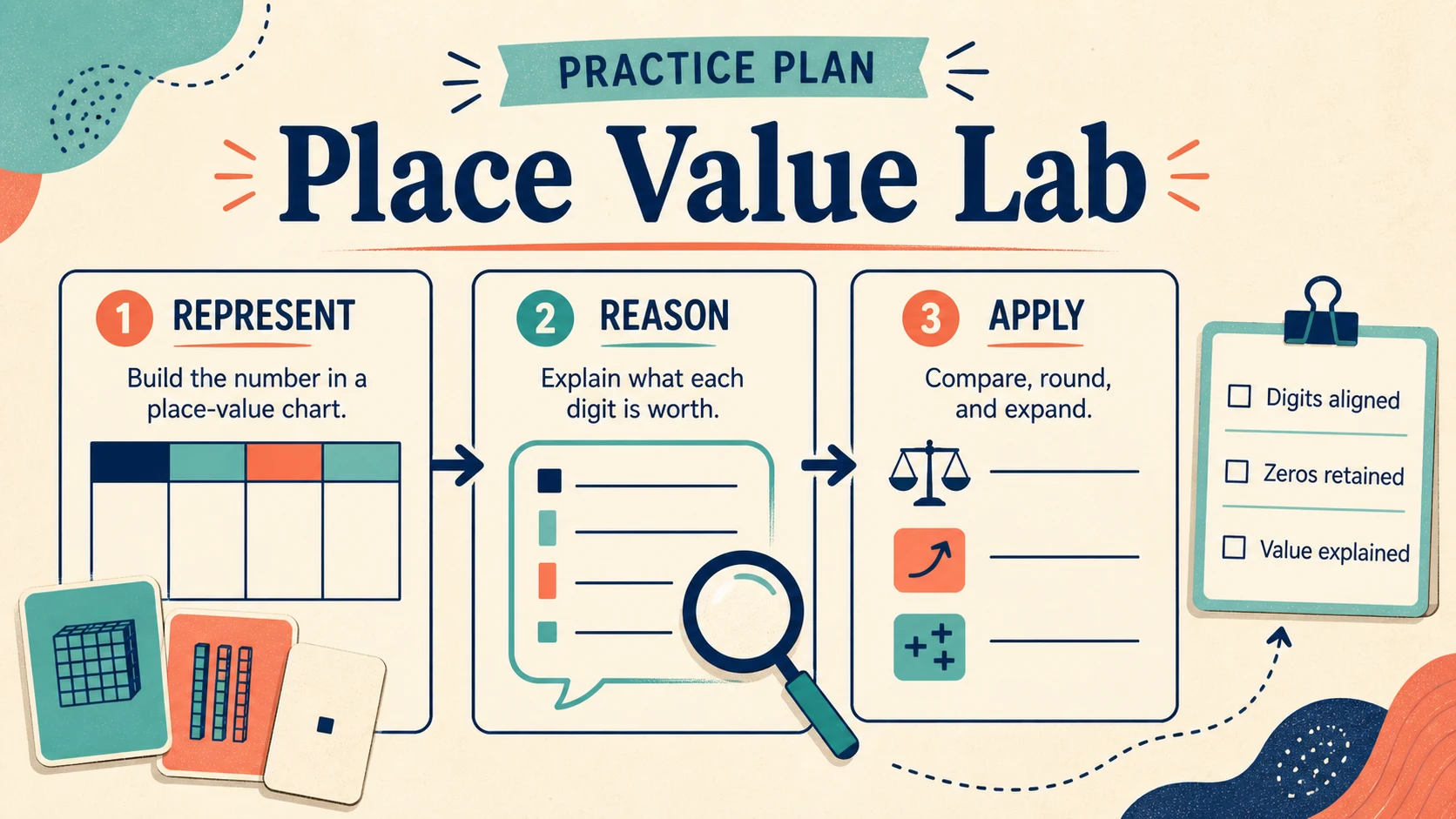
Revisit earlier ideas while gradually increasing independence.
| Day |
Main focus |
Suggested evidence to collect |
| 1 |
Prerequisite check with whole-number values, forms, and comparison |
Note whether errors concern place names, zero, or comparison |
| 2 |
Adjacent whole-number places and ten-to-one relationships |
Learner explains two related digit values |
| 3 |
Extend the chart through thousandths |
Learner builds and reads three decimals |
| 4 |
Standard, expanded, and word forms |
One conversion in each direction, including internal zeros |
| 5 |
Mixed review of Days 1–4 |
Short independent check followed by correction |
| 6 |
Compare and order decimals |
Explanation of one unequal-length comparison |
| 7 |
Round whole numbers using bounding benchmarks |
Include one exact halfway case |
| 8 |
Round decimals to tenths and hundredths |
Include numbers just below, at, and above a midpoint |
| 9 |
Mixed application and error analysis |
Learner corrects and explains two incorrect solutions |
| 10 |
Cumulative check and next-step decision |
Record secure skills and one remaining priority |
On each day, begin with one item from an earlier session. If Day 5 shows continued confusion between hundredths and thousandths, repeat model-based decimal work rather than moving automatically to comparison. If Day 8 is secure quickly, include estimation or computation examples that depend on the same place-value reasoning.
Limits of This Guide
This guide cannot diagnose every learning difficulty or replace knowledge of a learner’s curriculum, language background, prior instruction, or classroom requirements. It does not provide medical guidance, promise outcomes, certify mastery, or claim comprehensive standards alignment.
Place value is also broader than one worksheet or two-week plan. Learners must continue using it in multi-digit computation, decimal operations, estimation, rounding, and number sense. Return to models when later errors reveal that the underlying structure is not yet stable.
The Most Useful Next Step
Begin with a five-item prerequisite check, then teach the smallest unresolved idea using a chart, model, and explanation. Once the learner can explain that idea, choose a short practice set and review the work before assigning more.
For an accessible starting point, use the free 5th Grade Place Value standard easy worksheet. Select only the items that match the learner’s present need, check them with the included answer key, and let the observed work determine the next lesson.